CHARITABLE PLANNING FOR 
UPPER-INCOME DONORS 
PRINTING SUGGESTIONS: 
If you want to print out these slides, may I suggest: 
#1 – AVOID PRINTING THE DARK BACKGROUND. 
It makes it hard to read. Suggest using the print 
command “BLACK and WHITE”; avoid using “color” 
#2 – PRINT SIX SLIDES PER PAGE. Slides contain a 
very large font. Six slides per page will conserve paper.
CHARITABLE PLANNING FOR 
UPPER-INCOME DONORS 
Advancement Network 
2014 Annual Conference 
Cleveland, Ohio -- October 18, 2014 
CHRISTOPHER R. HOYT 
University of Missouri - Kansas City 
School of Law
Tax Planning Challenges 
* Planning Strategies for the new 
3.8% surtax: Net Investment Income 
* Retirement Assets -- Hot Topics 
-- Lifetime planning 
-- Bequests of Retirement Assets 
-- spouse -- trusts -- charities
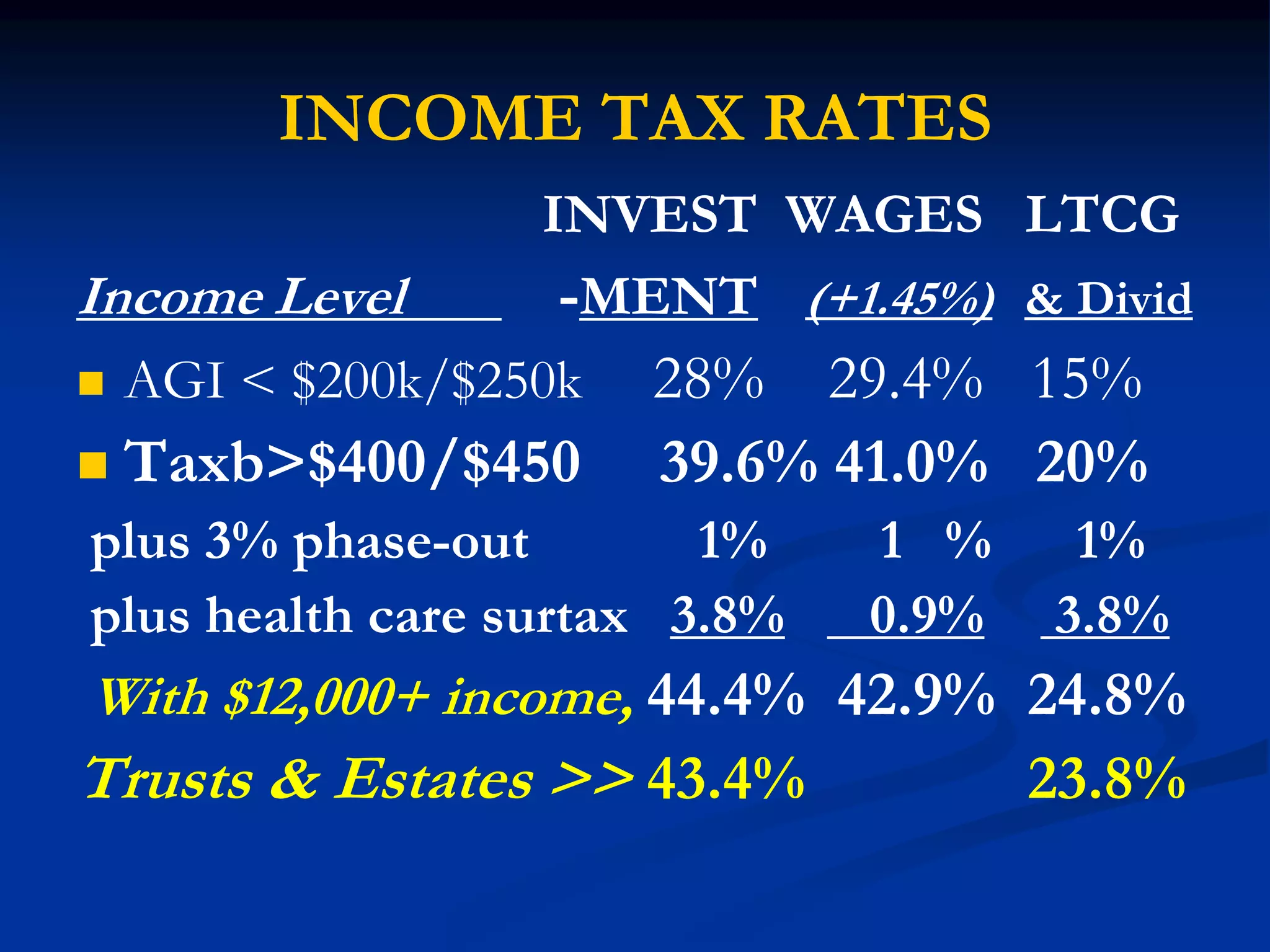
INCOME TAX RATES 
INVEST WAGES LTCG 
Income Level -MENT (+1.45%) & Divid 
 AGI < $200k/$250k 28% 29.4% 15% 
Congratulations! Brilliant tax planning! 
“Bush tax cuts” remain in full effect for 
people with adjusted gross income under 
$200,000 ($250,000 on a joint return)
INCOME TAX RATES 
INVEST WAGES LTCG 
Income Level -MENT (+1.45%) & Divid 
 AGI < $200k/$250k 28% 29.4% 15% 
 AGI > $200k/$250k 33% 34.4% 15% 
33% rate when taxable income 
> $186,350 -- single 
> $226,850 – married filing jointly
TAX RATES paid on TAXABLE INCOME 
ADJUSTED GROSS INCOME (“AGI”) 
 Minus: Greater of 
-- Standard Deduction ($6,100) 
or 
-- Itemized Deductions (Mortgage interest; 
charitable contributions; state & local taxes) 
 Minus: Personal Exemption & Dependents 
($3,900 each) 
= TAXABLE INCOME
WEALTHY PAY SOME TAXES ON “AGI” 
ADJUSTED GROSS INCOME(“AGI”) 
 Minus: Greater of 
-- Standard Deduction ($6,100) 
or 
-- Itemized Deductions (Mortgage interest; 
charitable contributions; state & local taxes) 
 Minus: Personal Exemption & Dependents 
($3,900 each) 
= TAXABLE INCOME
INCOME TAX RATES 
INVEST WAGES LTCG 
Income Level -MENT (+1.45%) & Divid 
 AGI < $200k/$250k 28% 29.4% 15% 
 AGI > $200k/$250k 33% 34.4% 15% 
plus health care surtax 3.8% 0.9% 3.8% 
36.8% 35.3% 18.8%
0.9% MEDICARE SURTAX: 
When Compensation Exceeds $200,000 
($250,000 married joint return) 
 Compensation 
-- wages & self-employment income 
(Added to 1.45% Medicare/Medicaid tax ) 
(Employee pays entire 0.9%; no employer match) 
 Employer must withhold when W-2 
Form compensation exceeds $200,000 
 Married joint? Together over $250,000? 
-- Pay on Form 1040 , e.g. if neither spouse has over $200,000 
. (e.g., Husband has $100k and Wife has $160k = $260k)
3.8% Net Investment Income Tax 
MAGI > $200,000 ($250,000 joint returns) 
3.8% surtax on the lesser of: 
 Net Investment Income 
or 
 MAGI over $200,000 ($250,000 joint) 
( $200k/$250k not indexed for inflation ) 
Trusts and estates pay 3.8% at $12,150 !!
3.8% Net Investment Income Tax 
MAGI > $200,000 ($250,000 joint returns) 
How many people are affected? 
2011 Tax Returns with AGI over $200,000: 
3.2% of all returns 
 0.7% of single returns 
 7.6% of married joint returns 
86% of the returns with over $200,000* 
of AGI were married joint
3.8% Net Investment Income Tax 
MAGI > $200,000 ($250,000 joint returns) 
Strategies for three different taxpayers: 
#1 - Richest 1% - Income over $400,000 
-- Reduce NII (not likely to get AGI <200k) 
#2 – Taxpayers with AGI near $200k ($250 jt) 
-- Either reduce NII or reduce AGI 
#3 - Taxpayers with AGI below $200k ($250 jt) 
-- Avoid spikes in income that trigger 3.8% tax 
-- Charitable Remainder Trusts !!
CHARITABLE REMAINDER TRUSTS 
 Payment to non-charitable beneficiary 
(ies) for life *or* for a term of years 
(maximum 20 years) 
 Remainder interest distributed to 
charity 
Exempt from income tax
CHARITABLE REMAINDER TRUSTS 
EXAMPLE 
 Husband & wife age 65 
 Sell stock or land for $1 million gain 
 Other option: contribute to CRT 
before sale is finalized; have CRT 
make the sale
CHARITABLE REMAINDER TRUSTS 
CRT PROVIDES: 
 1. Charitable income tax deduction 
 2. Greater cash flow for life 
 3. Avoid spike in income – 3.8% tax 
 4. “Wealth replacement” strategy with 
life insurance.
CHARITABLE REMAINDER TRUSTS 
DONATE STOCK TO C.R.T. ; 
KEEP THE STOCK C.R.T. SELLS STOCK 
Sales Price $ 1,000,000 $1,000,000 
Cost of Stock -0- -0- 
Gain on Sale $ 1,000,000 $1,000,000 
Capital Gains 
Tax (about 25%) 250,000 None 
Remaining Proceeds $ 750,000 $1,000,000
CHARITABLE REMAINDER TRUSTS 
DONATE STOCK TO C.R.T. ; 
KEEP THE STOCK C.R.T. SELLS STOCK 
Remaining Proceeds $ 750,000 $1,000,000 
Interest Rate x 5% x 5% 
Annual Income $ 37,500 $ 50,000 
══════ ══════ 
(33% more)
3.8% Net Investment Income Tax 
MAGI > $200,000 ($250,000 joint returns) 
Net Investment Income 
 Interest & Dividends 
 Annuities 
 Rents & Royalties 
 Profits from LLC / S Corp (if not employed) 
 Business of trading commodities & fin instruments 
 Most capital gains
3.8% Net Investment Income Tax 
MAGI > $200,000 ($250,000 joint returns) 
Income Exempt from Surtax: 
 Trade / Business income from an LLC, 
partnership, Subchapter S corporation or sole 
proprietorship, provided the recipient is 
employed at the business. 
-- “material participation” test 
(work 500+ hours during the year?) 
 Gain from selling property used in trade/ 
business [rental property gains -> 3.8% tax]
3.8% Net Investment Income Tax 
MAGI > $200,000 ($250,000 joint returns) 
Other Income Exempt from 3.8% Surtax: 
Income that isn’t interest, rents, gains, etc : 
 Retirement income – social security, qualified 
plans: IRAs, 401(k), pensions, etc – (non-qualified 
annuities are subject to tax) 
 Wages & self-employment income ( 0.9% tax) 
 Alimony income 
 Lottery winnings
INCOME TAX RATES 
INVEST WAGES LTCG 
Income Level -MENT (+1.45%) & Divid 
 AGI < $200k/$250k 28% 29.4% 15% 
 AGI > $200k/$250k 33% 34.4% 15% 
plus health care surtax 3.8% 0.9% 3.8% 
36.8% 35.3% 18.8%
INCOME TAX RATES 
INVEST WAGES LTCG 
Income Level -MENT (+1.45%) & Divid 
 AGI < $200k/$250k 28% 29.4% 15% 
 AGI > $200k/$250k 33% 34.4% 15% 
 AGI > $250k/$300k 33% 34.4% 15% 
-- 3% phase-out itemized deductions 
-- Phase-out personal exemptions
PHASEOUTS 
AGI > $250,000 ($300,000 joint returns) 
[2014: > $254,200 ($305,060 joint returns)] 
 3% Phase-out Itemized Deductions 
-- disguised 1% tax rate hike (3% x 33% rate) 
 Personal and Dependent Exemptions 
-- $3,900 apiece for self & each dependent 
-- lose 2% for every $2,500 income increase 
-- 100% eliminated AGI > $377k ($427k jnt) 
(Phase-out $254k-$377k ( $305k-$427k jnt))
INCOME TAX RATES 
INVEST WAGES LTCG 
Income Level -MENT (+1.45%) & Divid 
 AGI < $200k/$250k 28% 29.4% 15% 
 AGI > $250k/$300k 33% 34.4% 15% 
plus 3% phase-out 1% 1 % 1% 
plus health care surtax 3.8% 0.9% 3.8% 
37.8% 36.3% 19.8% 
[plus personal exemption phase-out means 
extra tax until AGI $377,000 ($427,000 jnt)]
INCOME TAX RATES 
INVEST WAGES LTCG 
Income Level -MENT (+1.45%) & Divid 
 AGI < $200k/$250k 28% 29.4% 15% 
 Taxb>$400/$450 39.6% 41.0% 20%
INCOME TAX RATES 
INVEST WAGES LTCG 
Income Level -MENT (+1.45%) & Divid 
 AGI < $200k/$250k 28% 29.4% 15% 
 Taxb>$400/$450 39.6% 41.0% 20% 
plus 3% phase-out 1% 1 % 1% 
plus health care surtax 3.8% 0.9% 3.8% 
With $12,000+ income, 44.4% 42.9% 24.8% 
Trusts & Estates >> 43.4% 23.8%
3.8% Net Investment Income Tax 
MAGI > $200,000 ($250,000 joint returns) 
Two Ways to reduce the 3.8% surtax : 
#1 - Reduce AGI to less than $200,000 
($250,000 joint) 
and/or 
#2 – Reduce Net Investment Income
3.8% Net Investment Income Tax 
MAGI > $200,000 ($250,000 joint returns) 
Strategies for three different taxpayers: 
#1 - Richest 1% - Income over $400,000 
-- Reduce NII (not likely to get AGI <200k) 
#2 – Taxpayers with AGI near $200k ($250 jt) 
-- Either reduce NII or reduce AGI 
#3 - Taxpayers with AGI below $200k ($250 jt) 
-- Avoid spikes in income that trigger 3.8% tax
Reduce Net Investment Income 
Two Ways to reduce Net Investment Income: 
#1 - Convert NII into income that isn’t NII 
#2 – Shift NII to family and to charity that 
aren’t subject to tax on their NII
Reduce Net Investment Income 
Convert NII into Income That Isn’t NII 
Some examples: 
#1 - Taxable interest to tax-free muni interest 
#2 – Life insurance 
#3 – Work 500+ hours at business 
#4 – Monster-size Roth IRA Conversions
Reduce Net Investment Income 
Shift NII to Family/Charity who pay 
no 3.8% tax [note: trusts do pay 3.8%] 
Family: Give income-generating investments 
Charity: 
#1 – Make gifts of appreciated stock 
#2 - Donor advised funds & private foundations 
#3 – Charitable lead trusts
#1 – MAKE GIFTS 
OF APPRECIATED STOCK 
DOUBLE-TAX ADVANTAGE 
 Charitable Income Tax Deduction for the 
Full Appreciated Value of the Stock 
 Never Pay Income Tax on the Growth of 
the Value of the Stock 
 Loss Property? Sell for tax loss; give cash
DOUBLE BENEFIT FROM GIFT 
OF APPRECIATED L.T.C.G. 
PROPERTY 
<< AVOID LONG-TERM 
CAPITAL GAIN TAX 
<< CHARITABLE INCOME 
TAX DEDUCTION
$ Benefits Max Federal Taxes Saved 
Person in 2012 
50% 
* 25% RE Dep Recap 
* 28% Collectibles 
<< 15%* LTCG Tax Rate 
<< 35% Marginal Tax Rate
IMPACT OF 
INDIVIDUAL INCOME TAX 
RATE CHANGES 
in 2012 and 2013-14
FUTURE INCOME TAX RATES 
Highest tax rates 2012 2013-14 
 Investment income 35% 44.4% 
 Earned income 36.4% 43.0% 
(wages – 1.45% health) 
 LT Capital Gains 15% 24.8%
$ Benefits Max Federal Taxes Saved 
Person in the Year 2012 
50% 
* 25% RE Dep Recap 
* 28% Collectibles 
<< 15%* LTCG Tax Rate 
<< 35% Marginal Tax Rate
$ Benefits Max Federal Taxes Saved 
Person in the Year 2014 
65.4% 
* 29.8% RE Dep Recap 
* 32.8% Collectibles 
<< 24.8%* LTCG Tax Rate 
<< 39.6*% Marginal Tax Rate 
(3.8% surtax not avoided 
by charitable deduction)
Reduce Net Investment Income 
Shift investment income to 
charity: 
#1 – Make gifts of appreciated stock 
#2 - Donor advised funds 
& private foundations 
#3 – Charitable lead trusts
DONOR ADVISED FUNDS 
Administrative Convenience 
– split large gift to many charities 
-- anonymous gifts possible with DAFs 
-- one receipt from DAF/PF instead of 
many CWAs from many charities
Shift Net Investment Income 
Client with $400,000+ of income says: 
• “My $100,000 investment produces 
$4,000 of taxable income every year” 
• “I give $4,000 to charity every year” 
• “I want to make a charitable bequest 
of $100,000”
Shift Net Investment Income 
Client with $400,000+ of income says: 
• “My $100,000 investment produces $4,000 of taxable income 
every year” 
• “I give $4,000 to charity every year” 
SOLUTION: LIFETIME GIFT OF $100,000 
TO PF or DAF; Shift income 
• Lifetime income tax deduction produces 
refund; better than just estate tax bequest 
• Investment income of PF/DAF not subject 
to 3.8% NII surtax 
• Tip: Make gift to DAF of appreciated stock
Reduce Net Investment Income 
Shift NII to Family/Charity who pay 
no 3.8% tax [note: trusts do pay 3.8%] 
Family: Give income-generating investments 
Charity: 
#1 – Make gifts of appreciated stock 
#2 - Donor advised funds & private foundations 
#3 – Charitable lead trusts
Shift Net Investment Income 
Client with $400,000+ of income says: 
• “My $100,000 investment produces 
$4,000 of taxable income every year” 
• “I give $3,000 to charity every year” 
• “I don’t want a charitable bequest of 
$100k. Want $100k to go to family.”
Shift Net Investment Income 
Client with $400,000+ of income says: 
• “My $100,000 investment produces $4,000 of 
taxable income every year” 
• “I give away $3,000 to charity every year” 
• “I want family to get the $100,000 investment” 
CONCEPT: Put $100,000 into a Charitable 
Lead Trust for a term of years. Whereas 
donor is paying 3.8% NIIT on all 4%, the 
CLT would pay only on undistributed 1%. 
[ PLUS: CLT discount on wealth transfer ]
Reduce Net Investment Income 
Shift NII to Family/Charity who pay no 3.8% tax 
[note: trusts do pay 3.8%] 
#1 – Donate appreciated stock 
#2 - Donor advised funds & private foundations 
#3 – Charitable lead trusts 
COST/BENEFIT – Is administrative cost of 
PF or CLT worth doing just for 3.8% tax 
savings? Other benefits are needed. 
( Compare: DAF cheap!)
Taxpayers with AGI Near $200,000 
Two Ways to reduce the 3.8% surtax : 
#1 - Reduce Net Investment Income 
(convert NII or shift NII) 
and/or 
#2 – Reduce AGI to less than 
$200,000 ($250,000 joint)
Taxpayers with AGI Near $200,000 and 
with lots of Net Investment Income 
Reduce AGI to less than $200k ($250 jnt) 
• Reduce NII (see strategies listed earlier) 
• Avoid large Roth IRA conversions 
• Maximize compensation deferral 
-- 401(k) contributions 
-- Non-qualified deferred comp (Sec. 409A) 
• “Charitable IRA Rollover”
Taxpayers with AGI Near $200,000 
”Charitable IRA Rollover” - over age 70 ½ 
• “QCD” – Qualified Charitable Distribution 
• Have charitable gift made directly from IRA to 
charity (max: $100,000 /year) 
• QCD distribution not counted as income 
(Price? No itemized charitable deduction) 
• QCD can satisfy annual RMD
REQUIRED MINIMUM 
DISTRIBUTIONS 
*LIFETIME DISTRIBUTIONS* 
Age of Account Owner Required Payout 
70 1/2 3.65% 
75 4.37% 
80 5.35% 
85 6.76% 
90 8.75% 
95 11.63% 
100 15.88%
Taxpayers with AGI Near $200,000 and 
with lots of Net Investment Income 
”Charitable IRA Rollover” - over age 70 ½ 
71 year old professional 
• $150,000 compensation income 
• $50,000 net investment income 
• This year: first RMD from IRA: $40,000 
• Intends to make charitable gift: $30,000
Taxpayers with AGI Near $200,000 
”Charitable IRA Rollover” - over age 70 ½ 
Compensation $150,000 
Investment 50,000 
IRA RMD 40,000 << IRA income 
AGI $240,000 not subject 
to 3.8% tax
Taxpayers with AGI Near $200,000 
”Charitable IRA Rollover” - over age 70 ½ 
Normal Gift 
Compensation $150,000 
Investment 50,000 
IRA RMD 40,000 
AGI $240,000 << 3.8% surtax 
Taxable Income $210,000 on $40,000
Taxpayers with AGI Near $200,000 
”Charitable IRA Rollover” - over age 70 ½ 
Normal Gift IRA Gift 
Compensation $150,000 $150,000 
Investment 50,000 50,000 
IRA RMD 40,000 10,000 
AGI $240,000 $210,000 
3.8% surtax on: $40,000 $10,000
Will Law Be Extended to 2014? 
>Planning strategy for 2014 
if, as in 2008, 2010 & 2012, law has not been 
extended until December!: 
Give RMD to charity; 
 can’t lose ! (Some IRAs balk) 
 (May 29, 2014 – House Ways & Means Cmmtee 
voted to make retroactive & permanent !)
3.8% Net Investment Income Tax 
MAGI > $200,000 ($250,000 joint returns) 
Strategies for three different taxpayers: 
#1 - Richest 1% - Income over $400,000 
-- Need to reduce NII (won’t have AGI <200k) 
#2 – Taxpayers with AGI near $200k ($250 jt) 
-- Either reduce NII or reduce AGI 
#3 - Taxpayers with AGI below $200k ($250 jt)
Retirement Assets 
Proposal to liquidate inherited IRAs 
in just five years 
Impact on planning 
charitable bequests
THREE STAGES OF A 
RETIREMENT ACCOUNT 
Accumulate Wealth 
Retirement Withdrawals 
Distributions After Death
Accumulate Wealth 
Tax deduction at contribution 
Accumulate in tax-exempt trust 
Taxed upon distribution 
= Tax Deferred Compensation
TYPES OF QRPs 
1. Sec. 401 – Company plans 
2. Sec. 408 – IRAs 
-- SEP & SIMPLE IRAs 
3. Sec. 403(b) & 457–Charities 
4. Roth IRAs & 401(k)/403(b)
Roth IRA, 
Roth 401(k), or Roth 403(b) 
INVERSE OF TRADITIONAL: 
No tax deduction at contribution 
Accumulate in tax-exempt trust 
Not taxed upon distribution
THREE STAGES 
 Accumulate Wealth 
Retirement Withdrawals 
 Distributions After Death
RETIREMENT 
TAXATION 
General Rule – Ordinary income 
Exceptions: 
-- Tax-free return of capital 
-- NUA for appreciated employer 
stock 
-- Roth distributions are tax-free
USUAL OBJECTIVE: 
Defer paying income taxes in order to get 
greater cash flow 
Principal 10% Yield 
 Pre-Tax Amount $ 100,000 $ 10,000 
 Income Tax 
on Distribution (40%) 40,000 
 Amount Left to Invest $ 60,000 $ 6,000
REQUIRED MINIMUM 
DISTRIBUTION (“RMD”) 
BACKGROUND: 50% penalty if not 
receive distribution from IRA, 401(k), etc: 
#1 – lifetime distributions from own IRA: 
beginning after age 70 ½ 
#2 – an inherited IRA, 401(k), etc – 
 beginning year after death *
REQUIRED MINIMUM 
DISTRIBUTIONS 
*LIFETIME DISTRIBUTIONS* 
Age of Account Owner Required Payout 
70 1/2 3.65% 
75 4.37% 
80 5.35% 
85 6.76% 
90 8.75% 
95 11.63% 
100 15.88%
ADVANTAGES OF 
ROTH IRAs 
Unlike a regular IRA, 
no mandatory lifetime 
distributions from a 
Roth IRA after age 70 ½ 
Yes, there are mandatory 
distributions after death
THREE STAGES 
 Accumulate Wealth 
 Retirement Withdrawals 
Distributions After Death
Distributions 
After Death 
 Income taxation 
 Mandatory ERISA distributions 
 Estate taxation 
 Asset Protection – Clark v. Rameker 
Collision of multiple laws at death
Inherited IRAs -- Bankruptcy 
US Supreme Court: Inherited IRAs are 
not “retirement funds” entitled to 
Sec. 522 bankruptcy exemption 
under federal or state exemption 
laws. Clark, et ux v. Rameker, 573 U. S. __ (Jun, 12, 2014) 
Solution: Name trust with spendthrift 
provisions as beneficiary of an IRA 
or other qualified plan ?
Distributions 
After Death 
> Income taxation 
> Mandatory ERISA distributions 
> Estate taxation 
Collision of three tax worlds at death
INCOME IN RESPECT OF A 
DECEDENT - “IRD” – Sec. 691 
 No stepped up basis for retirement assets 
 After death, payments are income in 
respect of a decedent (“IRD”) to the 
beneficiaries 
 Common mistake in the past: children 
liquidate inherited retirement accounts.
Distributions 
After Death 
> Income taxation 
> Mandatory ERISA distributions 
> Estate taxation 
Collision of three tax worlds at death
Distributions 
After Death 
After death, must start liquidating account 
• Tax planning for family members who 
inherit: DEFER distributions as long as 
possible – greater tax savings 
• “Stretch IRA” – make payments over 
beneficiary’s life expectancy
Distributions 
After Death 
“ life expectancy“ 
Oversimplified: Half of population will 
die before that age, and half will die after 
Implication: For the 50% of people who 
live beyond L.E. date, an inherited IRA 
will be empty before they die.
REQUIRED MINIMUM 
DISTRIBUTIONS 
*LIFE EXPECTANCY TABLE* 
Age of Beneficiary Life Expectancy 
30 83 53.3 more years 
40 83 43.6 
50 84 34.2 
60 85 25.2 
70 87 17.0 
80 90 10.2 
90 97 6.9
REQUIRED MIN. DISTRIBUTIONS 
*LIFE EXPECTANCY TABLE* 
“STRETCH IRAS” 
Age of Beneficiary Life Expectancy 
30 53.3 more years 
40 43.6 
50 34.2 
60 25.2 
70 17.0 
80 10.2 
90 6.9
REQUIRED MIN. DISTRIBUTIONS 
*LIFE EXPECTANCY TABLE* 
“STRETCH IRAS” 
Age of Beneficiary Life Expectancy 
30 1.9% 53.3 more years 
40 2.3% 43.6 
50 2.9% 34.2 
60 4.0% 25.2 
70 5.9% 17.0 
80 10.0% 10.2 
90 14.5% 6.9
SENATE PROPOSAL: 
LIQUIDATE ALL INHERITED 
IRAs IN FIVE YEARS 
 2012 – Highway Bill – not enacted 
 President Obama budget proposal 
 June, 2014 – Sen. Wyden adds to Highway Bill 
EXCEPTIONS 
 -- Spouse -- minor child -- disabled 
 -- Person not more than ten years younger
REQUIRED MINIMUM DISTRIBUTIONS 
Example: Death at age 80? 
CURRENT LAW: *Life Expectancy Table* 
Age of Beneficiary Life Expectancy 
30 1.9% 53.3 more years 
40 2.3% 43.6 
50 2.9% 34.2 
60 4.0% 25.2 
70 5.9% 17.0 
80 10.0% 10.2 
90 10.0% 6.9 * [10.2 yrs]
REQUIRED MINIMUM DISTRIBUTIONS 
Example: Death at age 80? 
PROPOSED: FIVE YEARS if >10 yrs younger 
Age of Beneficiary Life Expectancy 
30 5 years 
40 5 
50 5 
60 5 
70 5.9% 17.0 
80 10.0% 10.2 
90 10.00% 6.9 * [10.2 yrs]
SENATE PROPOSAL: 
LIQUIDATE ALL INHERITED 
IRAs IN FIVE YEARS 
EXCEPTIONS 
 -- Spouse -- minor child -- disabled 
 -- Person not more than ten years younger 
TAX TRAP: Does naming a trust for a spouse 
(e.g., QTIP trust; credit shelter trust) as an IRA 
beneficiary mean required liquidation in 5 years?
SENATE PROPOSAL: LIQUIDATE ALL 
INHERITED IRAs IN FIVE YEARS 
IMPLICATIONS FOR CHARITIES 
Donors more likely to consider 
 Outright bequests 
 Retirement assets to tax-exempt CRT 
 Child: income more than 5 years; then charity 
 Spouse only (marital estate tax deduction) 
 Spouse & children (no marital deduction)
FUNDING CRTs 
WITH 
RETIREMENT ASSETS
2-GENERATION CHARITABLE 
REMAINDER TRUST 
 Typically pays 5% to elderly surviving 
spouse for life, then 5% to children for 
life, then liquidates to charity 
 Like an IRA, a CRT is exempt from 
income tax 
 Can operate like a credit-shelter trust 
for IRD assets [no marital deduction]
2-GENERATION CHARITABLE 
REMAINDER TRUST 
 Can be a solution for second 
marriages when estate is top-heavy 
with retirement assets. Example: 
-- Half of IRA to surviving spouse 
-- Other half of IRA to a CRT for 2nd 
spouse and children from 1st marriage
2-GENERATION CHARITABLE 
REMAINDER TRUST 
TECHNICAL REQUIREMENTS 
 Minimum 10% charitable deduction 
-- all children should be over age 40 
 CRUT – minimum 5% annual distrib 
 Not eligible for marital deduction 
(see 2002 article on topic)
MANDATORY DISTRIBUTIONS 
[Assume inherit IRA at age 80 and die at 92] 
Own Accumulation Conduit 
AGE IRA Trust Trust . C R T . 
80 5.35% 9.80% 9.80% 5.00% 
85 6.76% 19.23% 13.16% 5.00% 
90 8.78% 100.00% 18.18% 5.00% 
91 9.26% empty 19.23% 5.00% 
92 9.81% empty 20.41% 5.00%
HOW TO LEAVE A 
RETIREMENT 
ACCOUNT TO BOTH 
FAMILY & CHARITY
CHARITABLE BEQUESTS 
FROM QRPs 
 Best type of bequest: taxable income ! 
 Easier than formality of a will: Name 
charity as beneficiary on form of plan 
-- no need for attorney to draft 
-- no need for witnesses, etc.
“You can’t make a charitable bequest 
unless you have a will” 
Wrong. A retirement plan is a trust with its 
own beneficiary designations. Like other 
trusts, assets can pass outside probate. 
Name a charity as a beneficiary 
- the cheapest “charitable remainder trust”
LIFETIME GIFTS: ONLY IRAs 
BEQUESTS: ANY QRP 
1. Sec. 401 – Company plans 
2. Sec. 408 – IRAs 
-- SEP & SIMPLE IRAs 
3. Sec. 403(b) & 457–Charities 
4. Roth IRAs & 401(k)/403(b)
Avoiding Problems With 
Charitable Bequests 
* Let Other Beneficiaries 
Have Stretch IRA 
*Keep IRD Off of Estate’s Income Tax Return 
* Guarantee Offsetting Charitable Income Tax 
Deduction if Have to Report Income
REQUIRED MIN. DISTRIBUTIONS 
*LIFE EXPECTANCY TABLE* 
“STRETCH IRAS” 
Age of Beneficiary Life Expectancy 
30 53.3 more years 
40 43.6 
50 34.2 
60 25.2 
70 17.0 
80 10.2 
90 6.9
Avoiding Problems With 
Charitable Bequests 
* Let Other Beneficiaries Have Stretch IRA 
*Keep IRD Off of Estate’s Income 
Tax Return 
* Guarantee Offsetting Charitable 
Income Tax Deduction if Have to 
Report Income
WHAT CAN GO WRONG ? 
TWO WAYS TO MAKE A 
CHARITABLE BEQUEST FROM A 
RETIREMENT ACCOUNT 
#1 – NAME CHARITY AS 
BENEFICIARY OF THE ACCOUNT 
#2 – PAY ACCOUNT TO ESTATE OR 
TRUST THAT THEN MAKES A 
CHARITABLE BEQUEST
Avoiding Problems With 
Charitable Bequests 
* Let Other Beneficiaries 
Have Stretch IRA 
*Keep IRD Off of Estate’s Income Tax Return 
* Guarantee Offsetting Charitable Income Tax 
Deduction if Have to Report Income
WHAT CAN GO WRONG #1? 
• Other beneficiaries cannot do stretch 
IRA if charity is beneficiary? 
• Solutions: 
* cash out charity’s share by Sept 30 
or 
* separate account for charity p. 39
WHAT CAN GO WRONG #2 ? 
TWO WAYS TO MAKE A 
CHARITABLE BEQUEST FROM A 
RETIREMENT ACCOUNT 
#1 – NAME CHARITY AS 
BENEFICIARY OF THE ACCOUNT 
#2 – PAY ACCOUNT TO ESTATE OR 
TRUST THAT THEN MAKES A 
CHARITABLE BEQUEST
WHAT CAN GO WRONG #2? 
Estate or trust has taxable income 
from receiving IRA distribution, 
but maybe there is no offsetting 
charitable income tax deduction 
when the IRA check is given to a 
charity.
WHAT CAN GO WRONG? 
 IRS Chief Counsel Memorandum ILM 200848020 
 Decedent left his IRA to a trust that benefited 
his six children and several charities 
 Trust received cash from IRA; paid entire 
charitable share, leaving the six children as the 
only remaining beneficiaries of the trust. 
 IRS: “Taxable income from IRA, but no 
charitable deduction.” Reason: trust had no 
instructions to pay income to charities p.39
WHAT CAN GO WRONG? 
 Solution #1 – Keep IRD off of 
estate’s/trust’s income tax return 
a. Name charity as beneficiary of IRA 
b. “Distribute” IRA to charity if 
document allows 
Caution: IRS memo on danger of using 
retirement accounts to satisfy pecuniary bequests p.41
WHAT CAN GO WRONG? 
SOLUTION #2 – draft document to 
get an offsetting charitable income tax 
deduction in case estate or trust has 
income 
 I instruct that all of my charitable gifts, bequests and 
devises shall be made, to the extent possible, from 
"income in respect of a decedent" ….. P.42
CHARITABLE PLANNING FOR 
UPPER-INCOME DONORS 
Advancement Network 
2014 Annual Conference 
Cleveland, Ohio -- October 18, 2014 
CHRISTOPHER R. HOYT 
University of Missouri - Kansas City 
School of Law

2014 AdNet Days - Chris Hoyt Handout

  • 1.
    CHARITABLE PLANNING FOR UPPER-INCOME DONORS PRINTING SUGGESTIONS: If you want to print out these slides, may I suggest: #1 – AVOID PRINTING THE DARK BACKGROUND. It makes it hard to read. Suggest using the print command “BLACK and WHITE”; avoid using “color” #2 – PRINT SIX SLIDES PER PAGE. Slides contain a very large font. Six slides per page will conserve paper.
  • 2.
    CHARITABLE PLANNING FOR UPPER-INCOME DONORS Advancement Network 2014 Annual Conference Cleveland, Ohio -- October 18, 2014 CHRISTOPHER R. HOYT University of Missouri - Kansas City School of Law
  • 3.
    Tax Planning Challenges * Planning Strategies for the new 3.8% surtax: Net Investment Income * Retirement Assets -- Hot Topics -- Lifetime planning -- Bequests of Retirement Assets -- spouse -- trusts -- charities
  • 4.
    INCOME TAX RATES INVEST WAGES LTCG Income Level -MENT (+1.45%) & Divid  AGI < $200k/$250k 28% 29.4% 15% Congratulations! Brilliant tax planning! “Bush tax cuts” remain in full effect for people with adjusted gross income under $200,000 ($250,000 on a joint return)
  • 5.
    INCOME TAX RATES INVEST WAGES LTCG Income Level -MENT (+1.45%) & Divid  AGI < $200k/$250k 28% 29.4% 15%  AGI > $200k/$250k 33% 34.4% 15% 33% rate when taxable income > $186,350 -- single > $226,850 – married filing jointly
  • 6.
    TAX RATES paidon TAXABLE INCOME ADJUSTED GROSS INCOME (“AGI”)  Minus: Greater of -- Standard Deduction ($6,100) or -- Itemized Deductions (Mortgage interest; charitable contributions; state & local taxes)  Minus: Personal Exemption & Dependents ($3,900 each) = TAXABLE INCOME
  • 7.
    WEALTHY PAY SOMETAXES ON “AGI” ADJUSTED GROSS INCOME(“AGI”)  Minus: Greater of -- Standard Deduction ($6,100) or -- Itemized Deductions (Mortgage interest; charitable contributions; state & local taxes)  Minus: Personal Exemption & Dependents ($3,900 each) = TAXABLE INCOME
  • 8.
    INCOME TAX RATES INVEST WAGES LTCG Income Level -MENT (+1.45%) & Divid  AGI < $200k/$250k 28% 29.4% 15%  AGI > $200k/$250k 33% 34.4% 15% plus health care surtax 3.8% 0.9% 3.8% 36.8% 35.3% 18.8%
  • 9.
    0.9% MEDICARE SURTAX: When Compensation Exceeds $200,000 ($250,000 married joint return)  Compensation -- wages & self-employment income (Added to 1.45% Medicare/Medicaid tax ) (Employee pays entire 0.9%; no employer match)  Employer must withhold when W-2 Form compensation exceeds $200,000  Married joint? Together over $250,000? -- Pay on Form 1040 , e.g. if neither spouse has over $200,000 . (e.g., Husband has $100k and Wife has $160k = $260k)
  • 10.
    3.8% Net InvestmentIncome Tax MAGI > $200,000 ($250,000 joint returns) 3.8% surtax on the lesser of:  Net Investment Income or  MAGI over $200,000 ($250,000 joint) ( $200k/$250k not indexed for inflation ) Trusts and estates pay 3.8% at $12,150 !!
  • 11.
    3.8% Net InvestmentIncome Tax MAGI > $200,000 ($250,000 joint returns) How many people are affected? 2011 Tax Returns with AGI over $200,000: 3.2% of all returns  0.7% of single returns  7.6% of married joint returns 86% of the returns with over $200,000* of AGI were married joint
  • 12.
    3.8% Net InvestmentIncome Tax MAGI > $200,000 ($250,000 joint returns) Strategies for three different taxpayers: #1 - Richest 1% - Income over $400,000 -- Reduce NII (not likely to get AGI <200k) #2 – Taxpayers with AGI near $200k ($250 jt) -- Either reduce NII or reduce AGI #3 - Taxpayers with AGI below $200k ($250 jt) -- Avoid spikes in income that trigger 3.8% tax -- Charitable Remainder Trusts !!
  • 13.
    CHARITABLE REMAINDER TRUSTS  Payment to non-charitable beneficiary (ies) for life *or* for a term of years (maximum 20 years)  Remainder interest distributed to charity Exempt from income tax
  • 14.
    CHARITABLE REMAINDER TRUSTS EXAMPLE  Husband & wife age 65  Sell stock or land for $1 million gain  Other option: contribute to CRT before sale is finalized; have CRT make the sale
  • 15.
    CHARITABLE REMAINDER TRUSTS CRT PROVIDES:  1. Charitable income tax deduction  2. Greater cash flow for life  3. Avoid spike in income – 3.8% tax  4. “Wealth replacement” strategy with life insurance.
  • 16.
    CHARITABLE REMAINDER TRUSTS DONATE STOCK TO C.R.T. ; KEEP THE STOCK C.R.T. SELLS STOCK Sales Price $ 1,000,000 $1,000,000 Cost of Stock -0- -0- Gain on Sale $ 1,000,000 $1,000,000 Capital Gains Tax (about 25%) 250,000 None Remaining Proceeds $ 750,000 $1,000,000
  • 17.
    CHARITABLE REMAINDER TRUSTS DONATE STOCK TO C.R.T. ; KEEP THE STOCK C.R.T. SELLS STOCK Remaining Proceeds $ 750,000 $1,000,000 Interest Rate x 5% x 5% Annual Income $ 37,500 $ 50,000 ══════ ══════ (33% more)
  • 18.
    3.8% Net InvestmentIncome Tax MAGI > $200,000 ($250,000 joint returns) Net Investment Income  Interest & Dividends  Annuities  Rents & Royalties  Profits from LLC / S Corp (if not employed)  Business of trading commodities & fin instruments  Most capital gains
  • 19.
    3.8% Net InvestmentIncome Tax MAGI > $200,000 ($250,000 joint returns) Income Exempt from Surtax:  Trade / Business income from an LLC, partnership, Subchapter S corporation or sole proprietorship, provided the recipient is employed at the business. -- “material participation” test (work 500+ hours during the year?)  Gain from selling property used in trade/ business [rental property gains -> 3.8% tax]
  • 20.
    3.8% Net InvestmentIncome Tax MAGI > $200,000 ($250,000 joint returns) Other Income Exempt from 3.8% Surtax: Income that isn’t interest, rents, gains, etc :  Retirement income – social security, qualified plans: IRAs, 401(k), pensions, etc – (non-qualified annuities are subject to tax)  Wages & self-employment income ( 0.9% tax)  Alimony income  Lottery winnings
  • 21.
    INCOME TAX RATES INVEST WAGES LTCG Income Level -MENT (+1.45%) & Divid  AGI < $200k/$250k 28% 29.4% 15%  AGI > $200k/$250k 33% 34.4% 15% plus health care surtax 3.8% 0.9% 3.8% 36.8% 35.3% 18.8%
  • 22.
    INCOME TAX RATES INVEST WAGES LTCG Income Level -MENT (+1.45%) & Divid  AGI < $200k/$250k 28% 29.4% 15%  AGI > $200k/$250k 33% 34.4% 15%  AGI > $250k/$300k 33% 34.4% 15% -- 3% phase-out itemized deductions -- Phase-out personal exemptions
  • 23.
    PHASEOUTS AGI >$250,000 ($300,000 joint returns) [2014: > $254,200 ($305,060 joint returns)]  3% Phase-out Itemized Deductions -- disguised 1% tax rate hike (3% x 33% rate)  Personal and Dependent Exemptions -- $3,900 apiece for self & each dependent -- lose 2% for every $2,500 income increase -- 100% eliminated AGI > $377k ($427k jnt) (Phase-out $254k-$377k ( $305k-$427k jnt))
  • 24.
    INCOME TAX RATES INVEST WAGES LTCG Income Level -MENT (+1.45%) & Divid  AGI < $200k/$250k 28% 29.4% 15%  AGI > $250k/$300k 33% 34.4% 15% plus 3% phase-out 1% 1 % 1% plus health care surtax 3.8% 0.9% 3.8% 37.8% 36.3% 19.8% [plus personal exemption phase-out means extra tax until AGI $377,000 ($427,000 jnt)]
  • 25.
    INCOME TAX RATES INVEST WAGES LTCG Income Level -MENT (+1.45%) & Divid  AGI < $200k/$250k 28% 29.4% 15%  Taxb>$400/$450 39.6% 41.0% 20%
  • 26.
    INCOME TAX RATES INVEST WAGES LTCG Income Level -MENT (+1.45%) & Divid  AGI < $200k/$250k 28% 29.4% 15%  Taxb>$400/$450 39.6% 41.0% 20% plus 3% phase-out 1% 1 % 1% plus health care surtax 3.8% 0.9% 3.8% With $12,000+ income, 44.4% 42.9% 24.8% Trusts & Estates >> 43.4% 23.8%
  • 27.
    3.8% Net InvestmentIncome Tax MAGI > $200,000 ($250,000 joint returns) Two Ways to reduce the 3.8% surtax : #1 - Reduce AGI to less than $200,000 ($250,000 joint) and/or #2 – Reduce Net Investment Income
  • 28.
    3.8% Net InvestmentIncome Tax MAGI > $200,000 ($250,000 joint returns) Strategies for three different taxpayers: #1 - Richest 1% - Income over $400,000 -- Reduce NII (not likely to get AGI <200k) #2 – Taxpayers with AGI near $200k ($250 jt) -- Either reduce NII or reduce AGI #3 - Taxpayers with AGI below $200k ($250 jt) -- Avoid spikes in income that trigger 3.8% tax
  • 29.
    Reduce Net InvestmentIncome Two Ways to reduce Net Investment Income: #1 - Convert NII into income that isn’t NII #2 – Shift NII to family and to charity that aren’t subject to tax on their NII
  • 30.
    Reduce Net InvestmentIncome Convert NII into Income That Isn’t NII Some examples: #1 - Taxable interest to tax-free muni interest #2 – Life insurance #3 – Work 500+ hours at business #4 – Monster-size Roth IRA Conversions
  • 31.
    Reduce Net InvestmentIncome Shift NII to Family/Charity who pay no 3.8% tax [note: trusts do pay 3.8%] Family: Give income-generating investments Charity: #1 – Make gifts of appreciated stock #2 - Donor advised funds & private foundations #3 – Charitable lead trusts
  • 32.
    #1 – MAKEGIFTS OF APPRECIATED STOCK DOUBLE-TAX ADVANTAGE  Charitable Income Tax Deduction for the Full Appreciated Value of the Stock  Never Pay Income Tax on the Growth of the Value of the Stock  Loss Property? Sell for tax loss; give cash
  • 33.
    DOUBLE BENEFIT FROMGIFT OF APPRECIATED L.T.C.G. PROPERTY << AVOID LONG-TERM CAPITAL GAIN TAX << CHARITABLE INCOME TAX DEDUCTION
  • 34.
    $ Benefits MaxFederal Taxes Saved Person in 2012 50% * 25% RE Dep Recap * 28% Collectibles << 15%* LTCG Tax Rate << 35% Marginal Tax Rate
  • 35.
    IMPACT OF INDIVIDUALINCOME TAX RATE CHANGES in 2012 and 2013-14
  • 36.
    FUTURE INCOME TAXRATES Highest tax rates 2012 2013-14  Investment income 35% 44.4%  Earned income 36.4% 43.0% (wages – 1.45% health)  LT Capital Gains 15% 24.8%
  • 37.
    $ Benefits MaxFederal Taxes Saved Person in the Year 2012 50% * 25% RE Dep Recap * 28% Collectibles << 15%* LTCG Tax Rate << 35% Marginal Tax Rate
  • 38.
    $ Benefits MaxFederal Taxes Saved Person in the Year 2014 65.4% * 29.8% RE Dep Recap * 32.8% Collectibles << 24.8%* LTCG Tax Rate << 39.6*% Marginal Tax Rate (3.8% surtax not avoided by charitable deduction)
  • 39.
    Reduce Net InvestmentIncome Shift investment income to charity: #1 – Make gifts of appreciated stock #2 - Donor advised funds & private foundations #3 – Charitable lead trusts
  • 40.
    DONOR ADVISED FUNDS Administrative Convenience – split large gift to many charities -- anonymous gifts possible with DAFs -- one receipt from DAF/PF instead of many CWAs from many charities
  • 41.
    Shift Net InvestmentIncome Client with $400,000+ of income says: • “My $100,000 investment produces $4,000 of taxable income every year” • “I give $4,000 to charity every year” • “I want to make a charitable bequest of $100,000”
  • 42.
    Shift Net InvestmentIncome Client with $400,000+ of income says: • “My $100,000 investment produces $4,000 of taxable income every year” • “I give $4,000 to charity every year” SOLUTION: LIFETIME GIFT OF $100,000 TO PF or DAF; Shift income • Lifetime income tax deduction produces refund; better than just estate tax bequest • Investment income of PF/DAF not subject to 3.8% NII surtax • Tip: Make gift to DAF of appreciated stock
  • 43.
    Reduce Net InvestmentIncome Shift NII to Family/Charity who pay no 3.8% tax [note: trusts do pay 3.8%] Family: Give income-generating investments Charity: #1 – Make gifts of appreciated stock #2 - Donor advised funds & private foundations #3 – Charitable lead trusts
  • 44.
    Shift Net InvestmentIncome Client with $400,000+ of income says: • “My $100,000 investment produces $4,000 of taxable income every year” • “I give $3,000 to charity every year” • “I don’t want a charitable bequest of $100k. Want $100k to go to family.”
  • 45.
    Shift Net InvestmentIncome Client with $400,000+ of income says: • “My $100,000 investment produces $4,000 of taxable income every year” • “I give away $3,000 to charity every year” • “I want family to get the $100,000 investment” CONCEPT: Put $100,000 into a Charitable Lead Trust for a term of years. Whereas donor is paying 3.8% NIIT on all 4%, the CLT would pay only on undistributed 1%. [ PLUS: CLT discount on wealth transfer ]
  • 46.
    Reduce Net InvestmentIncome Shift NII to Family/Charity who pay no 3.8% tax [note: trusts do pay 3.8%] #1 – Donate appreciated stock #2 - Donor advised funds & private foundations #3 – Charitable lead trusts COST/BENEFIT – Is administrative cost of PF or CLT worth doing just for 3.8% tax savings? Other benefits are needed. ( Compare: DAF cheap!)
  • 47.
    Taxpayers with AGINear $200,000 Two Ways to reduce the 3.8% surtax : #1 - Reduce Net Investment Income (convert NII or shift NII) and/or #2 – Reduce AGI to less than $200,000 ($250,000 joint)
  • 48.
    Taxpayers with AGINear $200,000 and with lots of Net Investment Income Reduce AGI to less than $200k ($250 jnt) • Reduce NII (see strategies listed earlier) • Avoid large Roth IRA conversions • Maximize compensation deferral -- 401(k) contributions -- Non-qualified deferred comp (Sec. 409A) • “Charitable IRA Rollover”
  • 49.
    Taxpayers with AGINear $200,000 ”Charitable IRA Rollover” - over age 70 ½ • “QCD” – Qualified Charitable Distribution • Have charitable gift made directly from IRA to charity (max: $100,000 /year) • QCD distribution not counted as income (Price? No itemized charitable deduction) • QCD can satisfy annual RMD
  • 50.
    REQUIRED MINIMUM DISTRIBUTIONS *LIFETIME DISTRIBUTIONS* Age of Account Owner Required Payout 70 1/2 3.65% 75 4.37% 80 5.35% 85 6.76% 90 8.75% 95 11.63% 100 15.88%
  • 51.
    Taxpayers with AGINear $200,000 and with lots of Net Investment Income ”Charitable IRA Rollover” - over age 70 ½ 71 year old professional • $150,000 compensation income • $50,000 net investment income • This year: first RMD from IRA: $40,000 • Intends to make charitable gift: $30,000
  • 52.
    Taxpayers with AGINear $200,000 ”Charitable IRA Rollover” - over age 70 ½ Compensation $150,000 Investment 50,000 IRA RMD 40,000 << IRA income AGI $240,000 not subject to 3.8% tax
  • 53.
    Taxpayers with AGINear $200,000 ”Charitable IRA Rollover” - over age 70 ½ Normal Gift Compensation $150,000 Investment 50,000 IRA RMD 40,000 AGI $240,000 << 3.8% surtax Taxable Income $210,000 on $40,000
  • 54.
    Taxpayers with AGINear $200,000 ”Charitable IRA Rollover” - over age 70 ½ Normal Gift IRA Gift Compensation $150,000 $150,000 Investment 50,000 50,000 IRA RMD 40,000 10,000 AGI $240,000 $210,000 3.8% surtax on: $40,000 $10,000
  • 55.
    Will Law BeExtended to 2014? >Planning strategy for 2014 if, as in 2008, 2010 & 2012, law has not been extended until December!: Give RMD to charity;  can’t lose ! (Some IRAs balk)  (May 29, 2014 – House Ways & Means Cmmtee voted to make retroactive & permanent !)
  • 56.
    3.8% Net InvestmentIncome Tax MAGI > $200,000 ($250,000 joint returns) Strategies for three different taxpayers: #1 - Richest 1% - Income over $400,000 -- Need to reduce NII (won’t have AGI <200k) #2 – Taxpayers with AGI near $200k ($250 jt) -- Either reduce NII or reduce AGI #3 - Taxpayers with AGI below $200k ($250 jt)
  • 57.
    Retirement Assets Proposalto liquidate inherited IRAs in just five years Impact on planning charitable bequests
  • 58.
    THREE STAGES OFA RETIREMENT ACCOUNT Accumulate Wealth Retirement Withdrawals Distributions After Death
  • 59.
    Accumulate Wealth Taxdeduction at contribution Accumulate in tax-exempt trust Taxed upon distribution = Tax Deferred Compensation
  • 60.
    TYPES OF QRPs 1. Sec. 401 – Company plans 2. Sec. 408 – IRAs -- SEP & SIMPLE IRAs 3. Sec. 403(b) & 457–Charities 4. Roth IRAs & 401(k)/403(b)
  • 61.
    Roth IRA, Roth401(k), or Roth 403(b) INVERSE OF TRADITIONAL: No tax deduction at contribution Accumulate in tax-exempt trust Not taxed upon distribution
  • 62.
    THREE STAGES Accumulate Wealth Retirement Withdrawals  Distributions After Death
  • 63.
    RETIREMENT TAXATION GeneralRule – Ordinary income Exceptions: -- Tax-free return of capital -- NUA for appreciated employer stock -- Roth distributions are tax-free
  • 64.
    USUAL OBJECTIVE: Deferpaying income taxes in order to get greater cash flow Principal 10% Yield  Pre-Tax Amount $ 100,000 $ 10,000  Income Tax on Distribution (40%) 40,000  Amount Left to Invest $ 60,000 $ 6,000
  • 65.
    REQUIRED MINIMUM DISTRIBUTION(“RMD”) BACKGROUND: 50% penalty if not receive distribution from IRA, 401(k), etc: #1 – lifetime distributions from own IRA: beginning after age 70 ½ #2 – an inherited IRA, 401(k), etc –  beginning year after death *
  • 66.
    REQUIRED MINIMUM DISTRIBUTIONS *LIFETIME DISTRIBUTIONS* Age of Account Owner Required Payout 70 1/2 3.65% 75 4.37% 80 5.35% 85 6.76% 90 8.75% 95 11.63% 100 15.88%
  • 67.
    ADVANTAGES OF ROTHIRAs Unlike a regular IRA, no mandatory lifetime distributions from a Roth IRA after age 70 ½ Yes, there are mandatory distributions after death
  • 68.
    THREE STAGES Accumulate Wealth  Retirement Withdrawals Distributions After Death
  • 69.
    Distributions After Death  Income taxation  Mandatory ERISA distributions  Estate taxation  Asset Protection – Clark v. Rameker Collision of multiple laws at death
  • 70.
    Inherited IRAs --Bankruptcy US Supreme Court: Inherited IRAs are not “retirement funds” entitled to Sec. 522 bankruptcy exemption under federal or state exemption laws. Clark, et ux v. Rameker, 573 U. S. __ (Jun, 12, 2014) Solution: Name trust with spendthrift provisions as beneficiary of an IRA or other qualified plan ?
  • 71.
    Distributions After Death > Income taxation > Mandatory ERISA distributions > Estate taxation Collision of three tax worlds at death
  • 72.
    INCOME IN RESPECTOF A DECEDENT - “IRD” – Sec. 691  No stepped up basis for retirement assets  After death, payments are income in respect of a decedent (“IRD”) to the beneficiaries  Common mistake in the past: children liquidate inherited retirement accounts.
  • 73.
    Distributions After Death > Income taxation > Mandatory ERISA distributions > Estate taxation Collision of three tax worlds at death
  • 74.
    Distributions After Death After death, must start liquidating account • Tax planning for family members who inherit: DEFER distributions as long as possible – greater tax savings • “Stretch IRA” – make payments over beneficiary’s life expectancy
  • 75.
    Distributions After Death “ life expectancy“ Oversimplified: Half of population will die before that age, and half will die after Implication: For the 50% of people who live beyond L.E. date, an inherited IRA will be empty before they die.
  • 76.
    REQUIRED MINIMUM DISTRIBUTIONS *LIFE EXPECTANCY TABLE* Age of Beneficiary Life Expectancy 30 83 53.3 more years 40 83 43.6 50 84 34.2 60 85 25.2 70 87 17.0 80 90 10.2 90 97 6.9
  • 77.
    REQUIRED MIN. DISTRIBUTIONS *LIFE EXPECTANCY TABLE* “STRETCH IRAS” Age of Beneficiary Life Expectancy 30 53.3 more years 40 43.6 50 34.2 60 25.2 70 17.0 80 10.2 90 6.9
  • 78.
    REQUIRED MIN. DISTRIBUTIONS *LIFE EXPECTANCY TABLE* “STRETCH IRAS” Age of Beneficiary Life Expectancy 30 1.9% 53.3 more years 40 2.3% 43.6 50 2.9% 34.2 60 4.0% 25.2 70 5.9% 17.0 80 10.0% 10.2 90 14.5% 6.9
  • 79.
    SENATE PROPOSAL: LIQUIDATEALL INHERITED IRAs IN FIVE YEARS  2012 – Highway Bill – not enacted  President Obama budget proposal  June, 2014 – Sen. Wyden adds to Highway Bill EXCEPTIONS  -- Spouse -- minor child -- disabled  -- Person not more than ten years younger
  • 80.
    REQUIRED MINIMUM DISTRIBUTIONS Example: Death at age 80? CURRENT LAW: *Life Expectancy Table* Age of Beneficiary Life Expectancy 30 1.9% 53.3 more years 40 2.3% 43.6 50 2.9% 34.2 60 4.0% 25.2 70 5.9% 17.0 80 10.0% 10.2 90 10.0% 6.9 * [10.2 yrs]
  • 81.
    REQUIRED MINIMUM DISTRIBUTIONS Example: Death at age 80? PROPOSED: FIVE YEARS if >10 yrs younger Age of Beneficiary Life Expectancy 30 5 years 40 5 50 5 60 5 70 5.9% 17.0 80 10.0% 10.2 90 10.00% 6.9 * [10.2 yrs]
  • 82.
    SENATE PROPOSAL: LIQUIDATEALL INHERITED IRAs IN FIVE YEARS EXCEPTIONS  -- Spouse -- minor child -- disabled  -- Person not more than ten years younger TAX TRAP: Does naming a trust for a spouse (e.g., QTIP trust; credit shelter trust) as an IRA beneficiary mean required liquidation in 5 years?
  • 83.
    SENATE PROPOSAL: LIQUIDATEALL INHERITED IRAs IN FIVE YEARS IMPLICATIONS FOR CHARITIES Donors more likely to consider  Outright bequests  Retirement assets to tax-exempt CRT  Child: income more than 5 years; then charity  Spouse only (marital estate tax deduction)  Spouse & children (no marital deduction)
  • 84.
    FUNDING CRTs WITH RETIREMENT ASSETS
  • 85.
    2-GENERATION CHARITABLE REMAINDERTRUST  Typically pays 5% to elderly surviving spouse for life, then 5% to children for life, then liquidates to charity  Like an IRA, a CRT is exempt from income tax  Can operate like a credit-shelter trust for IRD assets [no marital deduction]
  • 86.
    2-GENERATION CHARITABLE REMAINDERTRUST  Can be a solution for second marriages when estate is top-heavy with retirement assets. Example: -- Half of IRA to surviving spouse -- Other half of IRA to a CRT for 2nd spouse and children from 1st marriage
  • 87.
    2-GENERATION CHARITABLE REMAINDERTRUST TECHNICAL REQUIREMENTS  Minimum 10% charitable deduction -- all children should be over age 40  CRUT – minimum 5% annual distrib  Not eligible for marital deduction (see 2002 article on topic)
  • 88.
    MANDATORY DISTRIBUTIONS [Assumeinherit IRA at age 80 and die at 92] Own Accumulation Conduit AGE IRA Trust Trust . C R T . 80 5.35% 9.80% 9.80% 5.00% 85 6.76% 19.23% 13.16% 5.00% 90 8.78% 100.00% 18.18% 5.00% 91 9.26% empty 19.23% 5.00% 92 9.81% empty 20.41% 5.00%
  • 89.
    HOW TO LEAVEA RETIREMENT ACCOUNT TO BOTH FAMILY & CHARITY
  • 90.
    CHARITABLE BEQUESTS FROMQRPs  Best type of bequest: taxable income !  Easier than formality of a will: Name charity as beneficiary on form of plan -- no need for attorney to draft -- no need for witnesses, etc.
  • 91.
    “You can’t makea charitable bequest unless you have a will” Wrong. A retirement plan is a trust with its own beneficiary designations. Like other trusts, assets can pass outside probate. Name a charity as a beneficiary - the cheapest “charitable remainder trust”
  • 92.
    LIFETIME GIFTS: ONLYIRAs BEQUESTS: ANY QRP 1. Sec. 401 – Company plans 2. Sec. 408 – IRAs -- SEP & SIMPLE IRAs 3. Sec. 403(b) & 457–Charities 4. Roth IRAs & 401(k)/403(b)
  • 93.
    Avoiding Problems With Charitable Bequests * Let Other Beneficiaries Have Stretch IRA *Keep IRD Off of Estate’s Income Tax Return * Guarantee Offsetting Charitable Income Tax Deduction if Have to Report Income
  • 94.
    REQUIRED MIN. DISTRIBUTIONS *LIFE EXPECTANCY TABLE* “STRETCH IRAS” Age of Beneficiary Life Expectancy 30 53.3 more years 40 43.6 50 34.2 60 25.2 70 17.0 80 10.2 90 6.9
  • 95.
    Avoiding Problems With Charitable Bequests * Let Other Beneficiaries Have Stretch IRA *Keep IRD Off of Estate’s Income Tax Return * Guarantee Offsetting Charitable Income Tax Deduction if Have to Report Income
  • 96.
    WHAT CAN GOWRONG ? TWO WAYS TO MAKE A CHARITABLE BEQUEST FROM A RETIREMENT ACCOUNT #1 – NAME CHARITY AS BENEFICIARY OF THE ACCOUNT #2 – PAY ACCOUNT TO ESTATE OR TRUST THAT THEN MAKES A CHARITABLE BEQUEST
  • 97.
    Avoiding Problems With Charitable Bequests * Let Other Beneficiaries Have Stretch IRA *Keep IRD Off of Estate’s Income Tax Return * Guarantee Offsetting Charitable Income Tax Deduction if Have to Report Income
  • 98.
    WHAT CAN GOWRONG #1? • Other beneficiaries cannot do stretch IRA if charity is beneficiary? • Solutions: * cash out charity’s share by Sept 30 or * separate account for charity p. 39
  • 99.
    WHAT CAN GOWRONG #2 ? TWO WAYS TO MAKE A CHARITABLE BEQUEST FROM A RETIREMENT ACCOUNT #1 – NAME CHARITY AS BENEFICIARY OF THE ACCOUNT #2 – PAY ACCOUNT TO ESTATE OR TRUST THAT THEN MAKES A CHARITABLE BEQUEST
  • 100.
    WHAT CAN GOWRONG #2? Estate or trust has taxable income from receiving IRA distribution, but maybe there is no offsetting charitable income tax deduction when the IRA check is given to a charity.
  • 101.
    WHAT CAN GOWRONG?  IRS Chief Counsel Memorandum ILM 200848020  Decedent left his IRA to a trust that benefited his six children and several charities  Trust received cash from IRA; paid entire charitable share, leaving the six children as the only remaining beneficiaries of the trust.  IRS: “Taxable income from IRA, but no charitable deduction.” Reason: trust had no instructions to pay income to charities p.39
  • 102.
    WHAT CAN GOWRONG?  Solution #1 – Keep IRD off of estate’s/trust’s income tax return a. Name charity as beneficiary of IRA b. “Distribute” IRA to charity if document allows Caution: IRS memo on danger of using retirement accounts to satisfy pecuniary bequests p.41
  • 103.
    WHAT CAN GOWRONG? SOLUTION #2 – draft document to get an offsetting charitable income tax deduction in case estate or trust has income  I instruct that all of my charitable gifts, bequests and devises shall be made, to the extent possible, from "income in respect of a decedent" ….. P.42
  • 104.
    CHARITABLE PLANNING FOR UPPER-INCOME DONORS Advancement Network 2014 Annual Conference Cleveland, Ohio -- October 18, 2014 CHRISTOPHER R. HOYT University of Missouri - Kansas City School of Law