MOD N COUNTERS
&
JOHNSON COUNTERS
Samir Poudel
Sanjana Shrestha
Shishir Ghimire
Srijana Devkota
Presented By:
CONTENTS
01 02
MOD N COUNTERS RING COUNTERS
03
JOHNSON COUNTERS
MOD N Counter
Introduction
• A circuit which passes through N number of states before returning to the starting
state.
• Simply it can be say that a binary counter counts 0 to N-1.
• For eg : In mod-11 counter it can count 0 to 10 which can be simply say that this
counter has 11 states.
• For MOD N counter, the number of flipflop required by calculating this eqn:N<=
Where ,
n= number of flipflop required
N= integer value written after MOD
 For eg : In mod 5 counter :
5<= 5<=8
So , we need 3 flipflops to design mod 5 counter which counts 0 to 4 ie: 5 states
which have 3 bits of number.
 But in some cases n bit = mod counters.
For eg: 3 bit = mod 8 counters. ( ie: =8).
Introduction
 No of states through counter passes.
 Decide no of bits for Ripple Counter.
 State Diagram
 Truth Table for analysis.
 Excitation Table for Design
 K Map for Simplification
 Logic Diagram
Steps for Designing MOD N
Counter
Some Examples of MOD N Counters
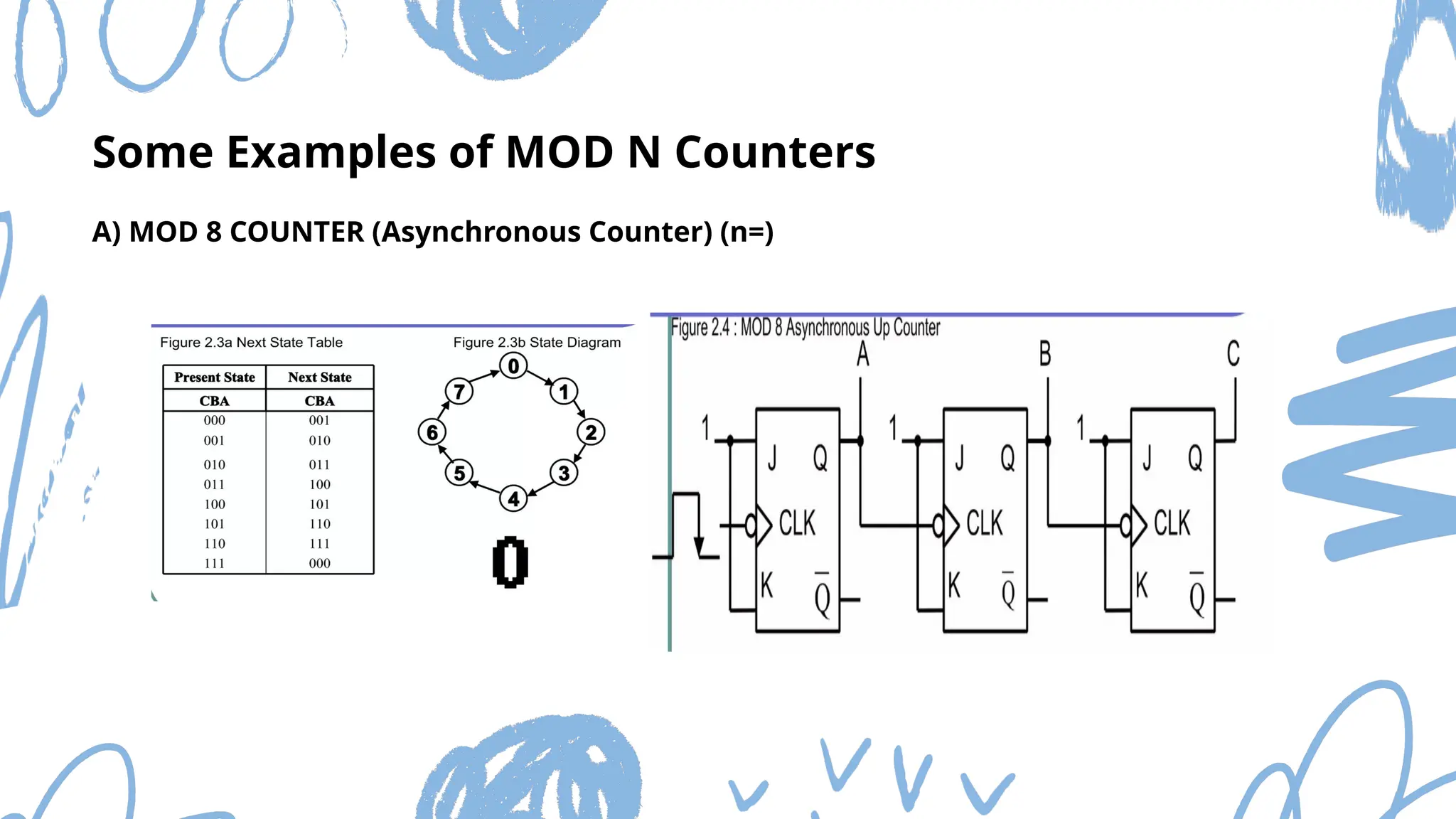
A) MOD 8 COUNTER (Asynchronous Counter) (n=)
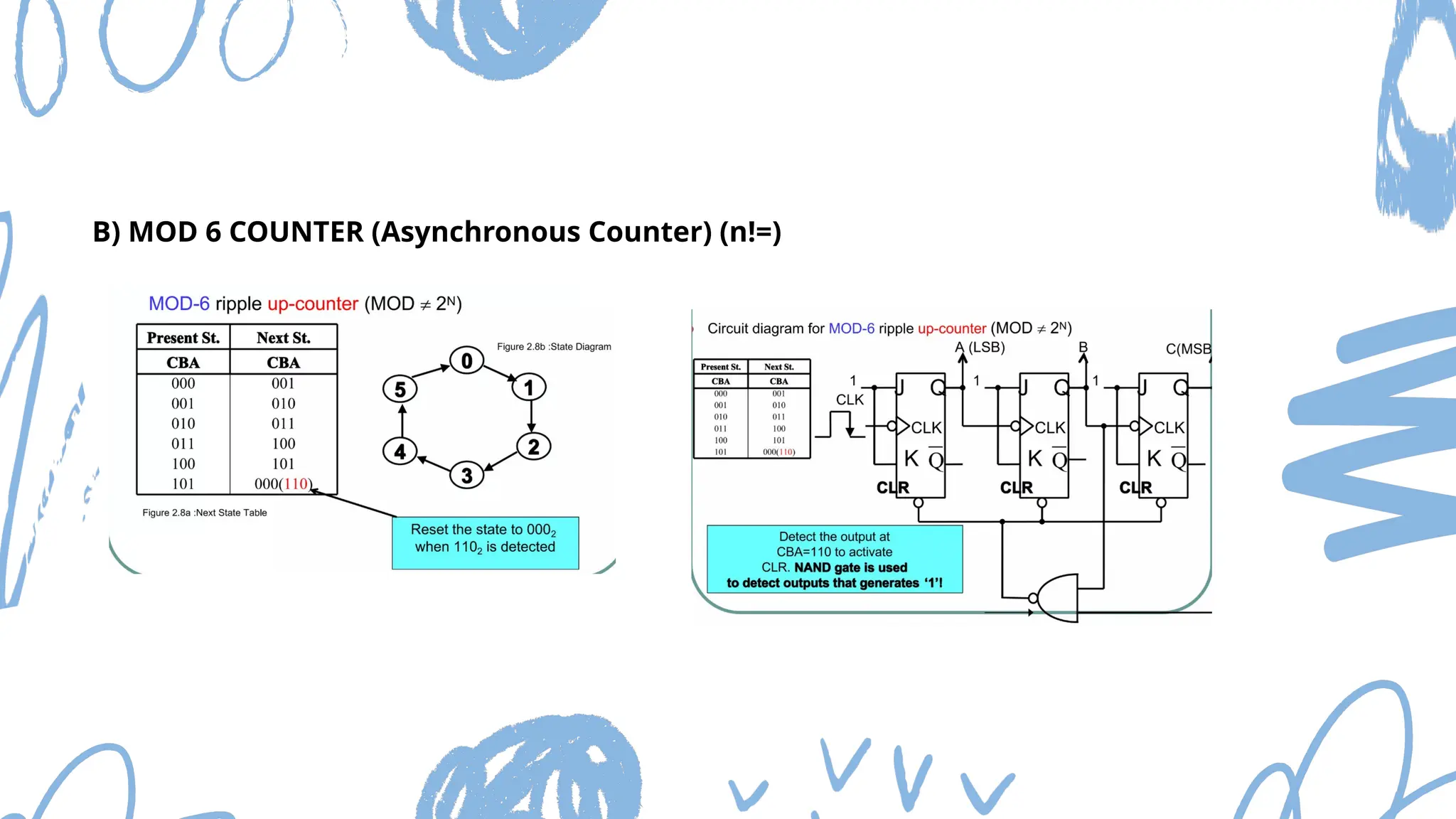
B) MOD 6 COUNTER (Asynchronous Counter) (n!=)
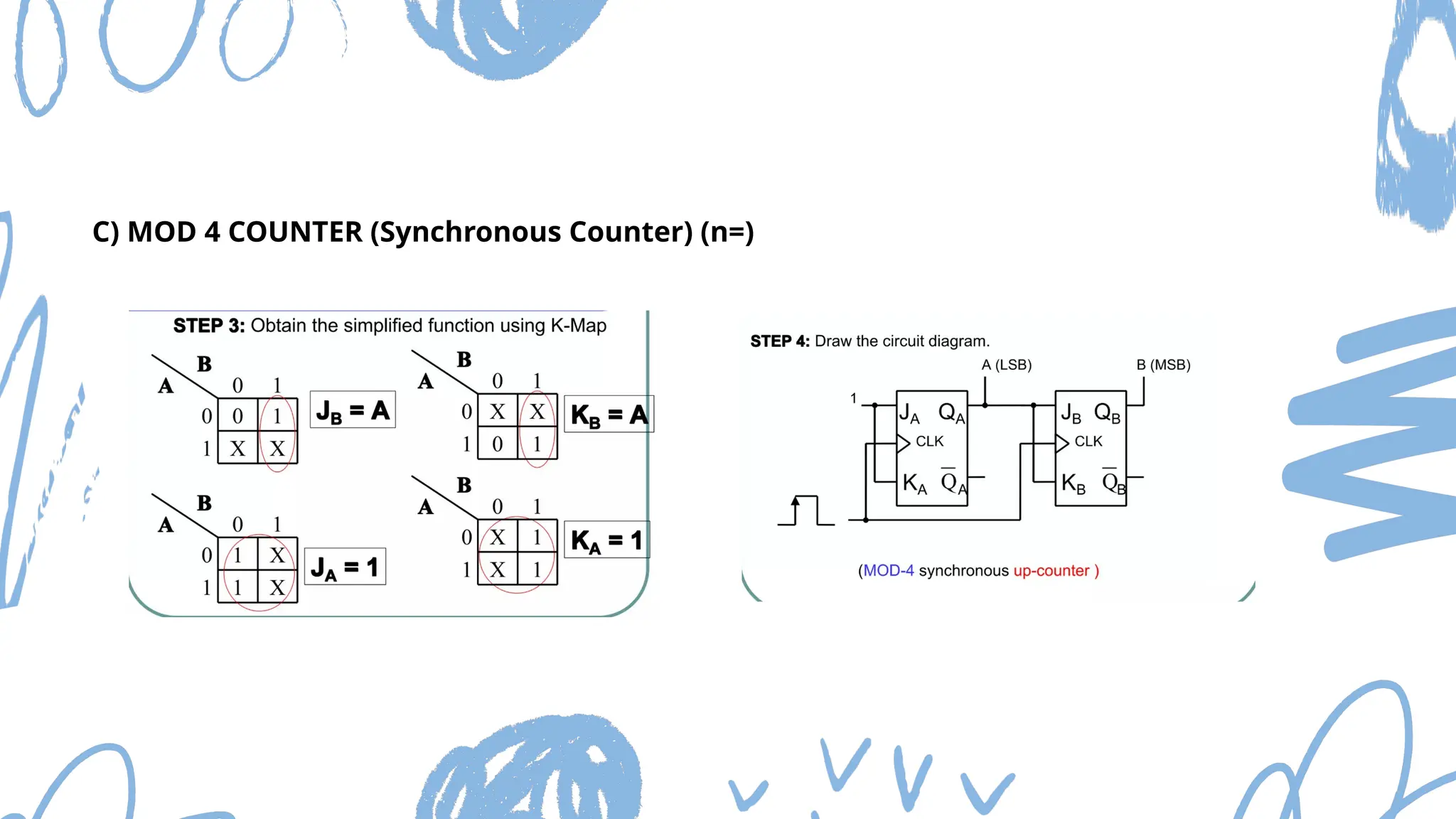
C) MOD 4 COUNTER (Synchronous Counter) (n=)
 Time Measurement
 Alarm Clock
 Set a timer for taking the photo in camera.
 Flashing indicator lights in vehicles.
 Digital Clock.
Applications of MOD N counter
Ring Counter
Introduction
• Digital sequential logic circuit that can be used to count the number of events or
pulses that occur in a system.
• Type of Synchronous Counter ( which same clock pulse is applied to all flip flop) .
• Made up of D flipflop .
• Works on the principle of Shift Register.
• Here K bit of flip flop then k times state of output.
• A type of counter which ring is formed by connecting Q of LSB to D of MSB.
Working Principle
 Let us consider the initial binary number be 1011 which is also called as the counting state at 1, where
Q3=1 , Q2=0, Q1=1 and Q0=1.
 Since the given binary number is 4 bit so we use 4 D flipflops which is labelled as Q0, Q1 Q2, Q3.
 Let Q0 flipflop be the LSB and Q3 flipflop be MSB.
 Here, Q3 flipflop is connected to Q2, Q2 connected to Q1 and Q1 is connected to Q0 flipflop.
 Then, in this flipflop Q of Q0 is connected to the flipflop Q3 to form a complete ring counter.
 Let CLK be the clock which is provided to the all 4 flipflop which can be positive or negative triggered which is
applied simultaneously.
Working Principle
Counting
State
Q3 Q2 Q1 Q0
1 1 0 1 1
2 1 1 0 1
3 1 1 1 0
4 0 1 1 1
Johnson
Counter
Introduction
• Digital sequential logic circuit that can be used to count the number of events or
pulses that occur in a system.
• Also called as the Switch Tail Ring Counter.
• Type of Synchronous Counter ( which same clock pulse is applied to all flip flop) .
• Made up of D flipflop .
• Works on the principle of Shift Register.
• A type of ring counter which ring is formed by connecting Q’ of LSB to D of MSB.
• Here K bit of flip flop then 2k times state of output.
Working Principle
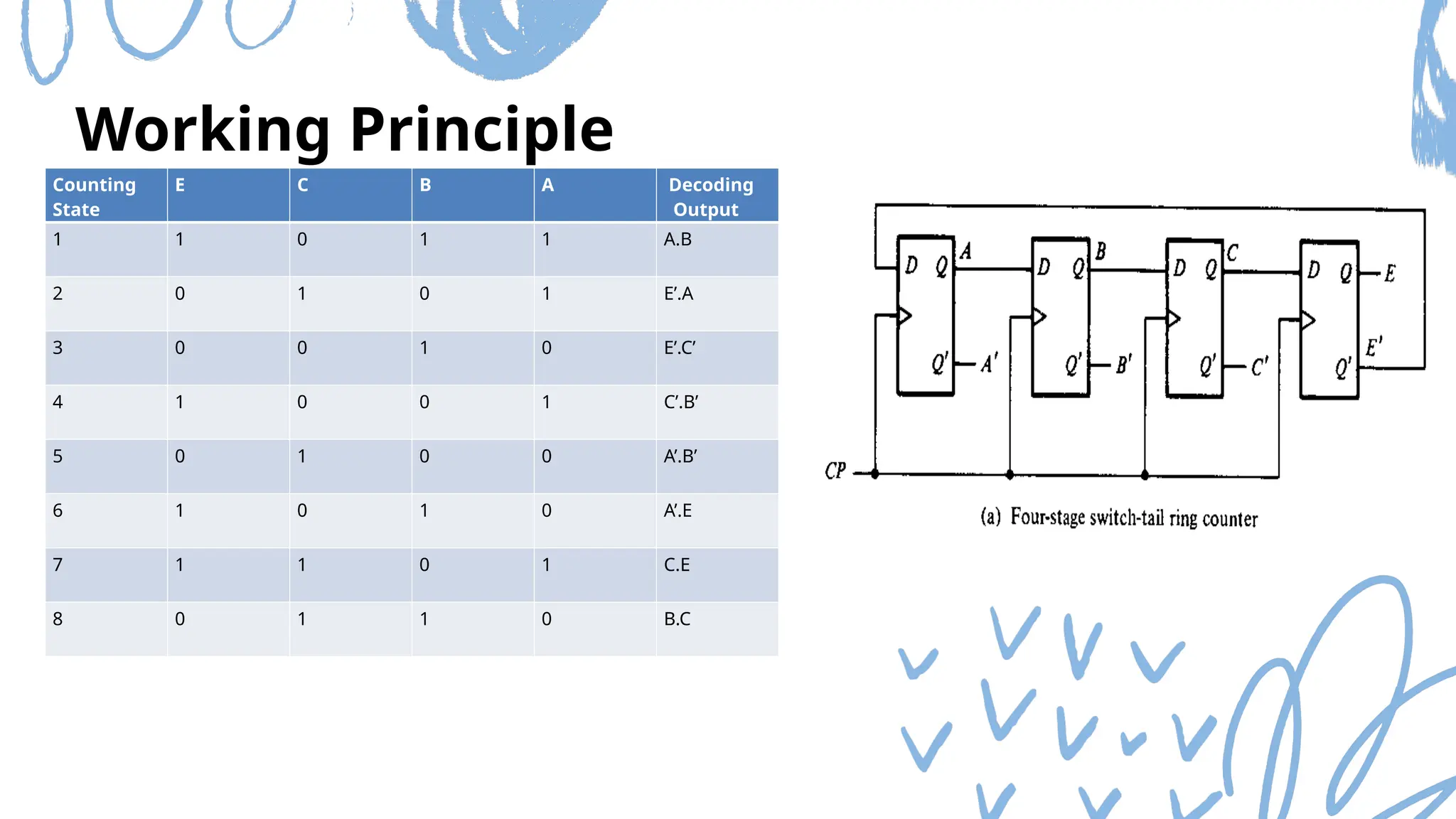
 Let us consider the initial binary number be 1011 which is also called as the counting state at 1
where E=1 , C=0, B=1 and A=1.
 Since the given binary number is 4 bit so we use 4 D flipflops which is labelled as A B C E.
 Let E flipflop be the LSB and A flipflop be MSB.
 Here A flipflop is connected to B, B connected to C and C is connected to E flipflop.
 Then, in this flipflop Q’ of E is connected to the flipflop A to form a complete ring counter.
 Let CP be the clock which is provided to the all 4 flipflop which can be positive or negative triggered which is applied
simultaneously.
Working Principle
Counting
State
E C B A Decoding
Output
1 1 0 1 1 A.B
2 0 1 0 1 E’.A
3 0 0 1 0 E’.C’
4 1 0 0 1 C’.B’
5 0 1 0 0 A’.B’
6 1 0 1 0 A’.E
7 1 1 0 1 C.E
8 0 1 1 0 B.C
Applications
 It is used in walking LED.
 It is used to convert the square waves to sine waves
Any
Queries?
Thank you
very much!

Slide of MOD N COUNTERS , RING COUNTERS AND JOHNSON COUNTERS

  • 1.
    MOD N COUNTERS & JOHNSONCOUNTERS Samir Poudel Sanjana Shrestha Shishir Ghimire Srijana Devkota Presented By:
  • 2.
    CONTENTS 01 02 MOD NCOUNTERS RING COUNTERS 03 JOHNSON COUNTERS
  • 3.
  • 4.
    Introduction • A circuitwhich passes through N number of states before returning to the starting state. • Simply it can be say that a binary counter counts 0 to N-1. • For eg : In mod-11 counter it can count 0 to 10 which can be simply say that this counter has 11 states. • For MOD N counter, the number of flipflop required by calculating this eqn:N<= Where , n= number of flipflop required N= integer value written after MOD
  • 5.
     For eg: In mod 5 counter : 5<= 5<=8 So , we need 3 flipflops to design mod 5 counter which counts 0 to 4 ie: 5 states which have 3 bits of number.  But in some cases n bit = mod counters. For eg: 3 bit = mod 8 counters. ( ie: =8). Introduction
  • 6.
     No ofstates through counter passes.  Decide no of bits for Ripple Counter.  State Diagram  Truth Table for analysis.  Excitation Table for Design  K Map for Simplification  Logic Diagram Steps for Designing MOD N Counter
  • 7.
    Some Examples ofMOD N Counters A) MOD 8 COUNTER (Asynchronous Counter) (n=)
  • 8.
    B) MOD 6COUNTER (Asynchronous Counter) (n!=)
  • 9.
    C) MOD 4COUNTER (Synchronous Counter) (n=)
  • 10.
    C) MOD 4COUNTER (Synchronous Counter) (n=)
  • 11.
     Time Measurement Alarm Clock  Set a timer for taking the photo in camera.  Flashing indicator lights in vehicles.  Digital Clock. Applications of MOD N counter
  • 12.
  • 13.
    Introduction • Digital sequentiallogic circuit that can be used to count the number of events or pulses that occur in a system. • Type of Synchronous Counter ( which same clock pulse is applied to all flip flop) . • Made up of D flipflop . • Works on the principle of Shift Register. • Here K bit of flip flop then k times state of output. • A type of counter which ring is formed by connecting Q of LSB to D of MSB.
  • 14.
    Working Principle  Letus consider the initial binary number be 1011 which is also called as the counting state at 1, where Q3=1 , Q2=0, Q1=1 and Q0=1.  Since the given binary number is 4 bit so we use 4 D flipflops which is labelled as Q0, Q1 Q2, Q3.  Let Q0 flipflop be the LSB and Q3 flipflop be MSB.  Here, Q3 flipflop is connected to Q2, Q2 connected to Q1 and Q1 is connected to Q0 flipflop.  Then, in this flipflop Q of Q0 is connected to the flipflop Q3 to form a complete ring counter.  Let CLK be the clock which is provided to the all 4 flipflop which can be positive or negative triggered which is applied simultaneously.
  • 15.
    Working Principle Counting State Q3 Q2Q1 Q0 1 1 0 1 1 2 1 1 0 1 3 1 1 1 0 4 0 1 1 1
  • 16.
  • 17.
    Introduction • Digital sequentiallogic circuit that can be used to count the number of events or pulses that occur in a system. • Also called as the Switch Tail Ring Counter. • Type of Synchronous Counter ( which same clock pulse is applied to all flip flop) . • Made up of D flipflop . • Works on the principle of Shift Register. • A type of ring counter which ring is formed by connecting Q’ of LSB to D of MSB. • Here K bit of flip flop then 2k times state of output.
  • 18.
    Working Principle  Letus consider the initial binary number be 1011 which is also called as the counting state at 1 where E=1 , C=0, B=1 and A=1.  Since the given binary number is 4 bit so we use 4 D flipflops which is labelled as A B C E.  Let E flipflop be the LSB and A flipflop be MSB.  Here A flipflop is connected to B, B connected to C and C is connected to E flipflop.  Then, in this flipflop Q’ of E is connected to the flipflop A to form a complete ring counter.  Let CP be the clock which is provided to the all 4 flipflop which can be positive or negative triggered which is applied simultaneously.
  • 19.
    Working Principle Counting State E CB A Decoding Output 1 1 0 1 1 A.B 2 0 1 0 1 E’.A 3 0 0 1 0 E’.C’ 4 1 0 0 1 C’.B’ 5 0 1 0 0 A’.B’ 6 1 0 1 0 A’.E 7 1 1 0 1 C.E 8 0 1 1 0 B.C
  • 20.
    Applications  It isused in walking LED.  It is used to convert the square waves to sine waves
  • 21.
  • 22.