Histology Slide list “ Thank You Sanjar!”  from the ‘0nizzy
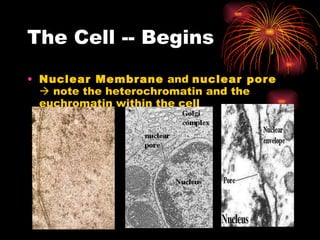
The Cell -- Begins Nuclear Membrane  and  nuclear pore     note the heterochromatin and the euchromatin within the cell
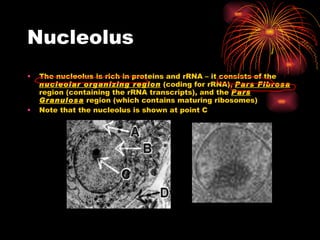
Nucleolus The nucleolus is rich in proteins and rRNA – it consists of the  nucleolar organizing region  (coding for rRNA),  Pars Fibrosa  region (containing the rRNA transcripts), and the  Pars Granulosa  region (which contains maturing ribosomes) Note that the nucleolus is shown at point C
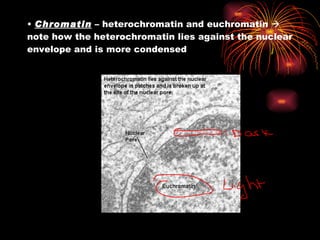
Chromatin  – heterochromatin and euchromatin    note how the heterochromatin lies against the nuclear envelope and is more condensed
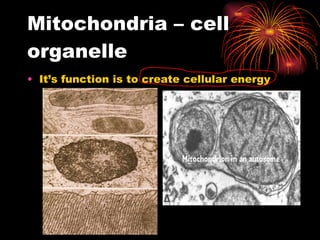
Mitochondria – cell organelle It’s function is to create cellular energy
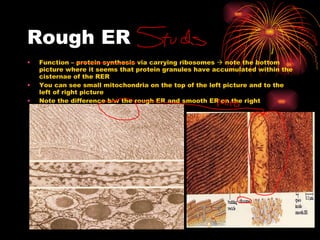
Rough ER Function – protein synthesis via carrying ribosomes    note the bottom picture where it seems that protein granules have accumulated within the cisternae of the RER You can see small mitochondria on the top of the left picture and to the left of right picture Note the difference b/w the rough ER and smooth ER on the right
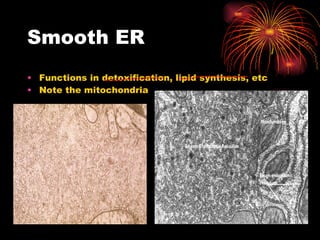
Smooth ER Functions in detoxification, lipid synthesis, etc Note the mitochondria
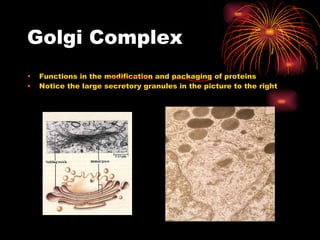
Golgi Complex Functions in the modification and packaging of proteins Notice the large secretory granules in the picture to the right
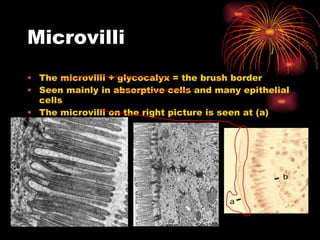
Microvilli The microvilli + glycocalyx = the brush border Seen mainly in absorptive cells and many epithelial cells The microvilli on the right picture is seen at (a)
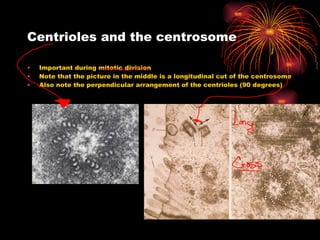
Centrioles and the centrosome Important during mitotic division Note that the picture in the middle is a longitudinal cut of the centrosome Also note the perpendicular arrangement of the centrioles (90 degrees)
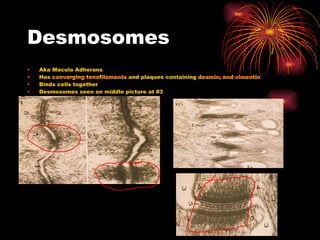
Desmosomes Aka Macula Adherans Has converging tonofilaments and plaques containing desmin, and vimentin Binds cells together Desmosomes seen on middle picture at #3
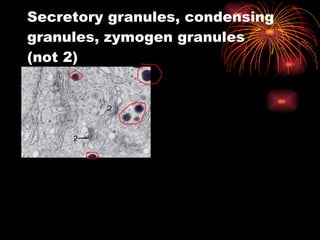
Secretory granules, condensing granules, zymogen granules (not 2)
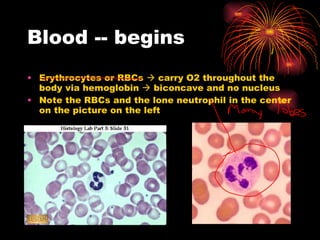
Blood -- begins Erythrocytes or RBCs    carry O2 throughout the body via hemoglobin    biconcave and no nucleus Note the RBCs and the lone neutrophil in the center on the picture on the left
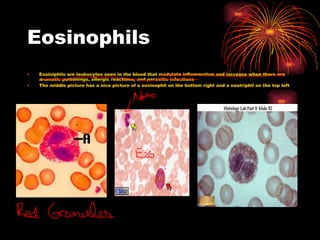
Eosinophils Eosiniphils are leukocytes seen in the blood that modulate inflammation and increase when there are aromatic poisonings, allergic reactions, and parasitic infections The middle picture has a nice picture of a eosinophil on the bottom right and a neutriphil on the top left
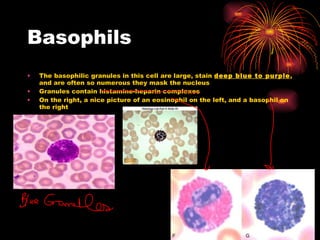
Basophils The basophilic granules in this cell are large, stain  deep blue to purple , and are often so numerous they mask the nucleus  Granules contain histamine-heparin complexes On the right, a nice picture of an eosinophil on the left, and a basophil on the right
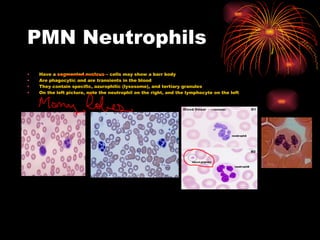
PMN Neutrophils Have a segmented nucleus – cells may show a barr body Are phagocytic and are transients in the blood They contain specific, azurophilic (lysosome), and tertiary granules On the left picture, note the neutrophil on the right, and the lymphocyte on the left
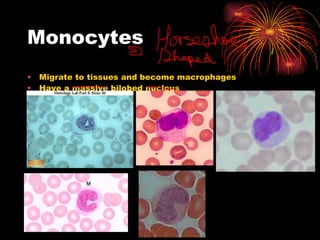
Monocytes Migrate to tissues and become macrophages  Have a massive bilobed nucleus
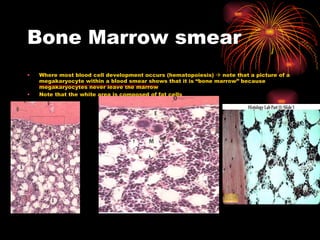
Bone Marrow smear Where most blood cell development occurs (hematopoiesis)    note that a picture of a megakaryocyte within a blood smear shows that it is “bone marrow” because megakaryocytes never leave the marrow Note that the white area is composed of fat cells
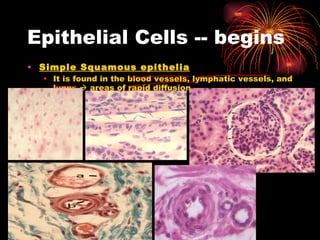
Epithelial Cells -- begins Simple Squamous epithelia It is found in the blood vessels, lymphatic vessels, and lungs    areas of rapid diffusion
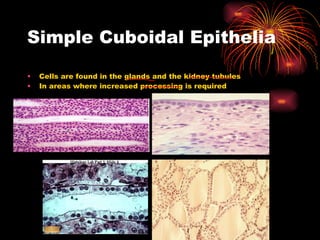
Simple Cuboidal Epithelia Cells are found in the glands and the kidney tubules In areas where increased processing is required
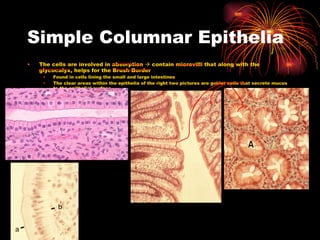
Simple Columnar Epithelia The cells are involved in absorption    contain microvilli that along with the glycocalyx, helps for the Brush Border Found in cells lining the small and large intestines The clear areas within the epithelia of the right two pictures are goblet cells that secrete mucus to the epithelial surface
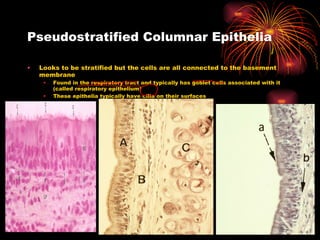
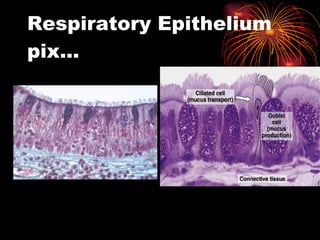
Pseudostratified Columnar Epithelia Looks to be stratified but the cells are all connected to the basement membrane Found in the respiratory tract and typically has goblet cells associated with it (called respiratory epithelium) These epithelia typically have cilia on their surfaces
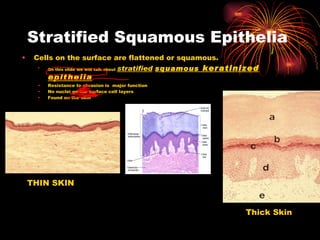
Stratified Squamous Epithelia Cells on the surface are flattened or squamous. On this slide we will talk about   stratified   squamous  keratinized epithelia Resistance to abrasion is  major function No nuclei on the surface cell layers Found on the skin THIN SKIN Thick Skin
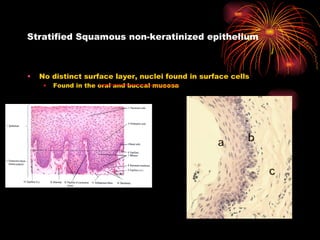
Stratified Squamous non-keratinized epithelium No distinct surface layer, nuclei found in surface cells Found in the oral and buccal mucosa
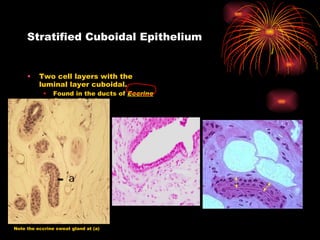
Stratified Cuboidal Epithelium Two cell layers with the luminal layer cuboidal. Found in the ducts of  Eccrine Sweat Glands Note the eccrine sweat gland at (a)
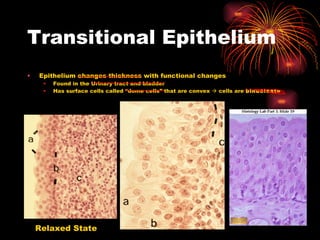
Transitional Epithelium Epithelium changes thickness with functional changes Found in the Urinary tract and bladder  Has surface cells called “dome cells” that are convex    cells are  binucleate Relaxed State
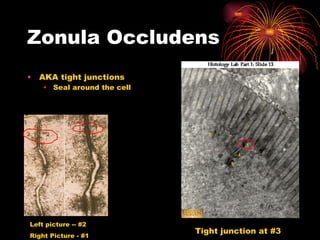
Zonula Occludens AKA tight junctions Seal around the cell Left picture -- #2 Right Picture - #1 Tight junction at #3
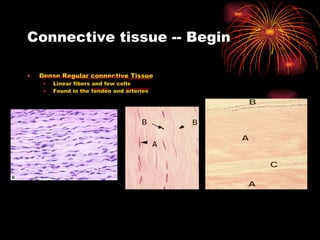
Connective tissue -- Begin Dense Regular connective Tissue Linear fibers and few cells Found in the tendon and arteries
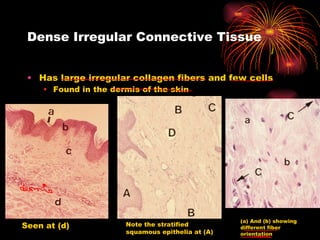
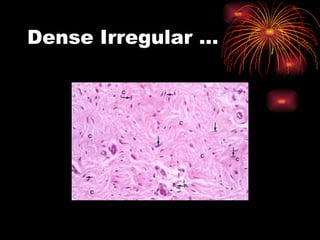
Dense Irregular Connective Tissue Has large irregular collagen fibers and few cells Found in the dermis of the skin Seen at (d) Note the stratified squamous epithelia at (A) (a) And (b) showing different fiber orientation
Dense Irregular …
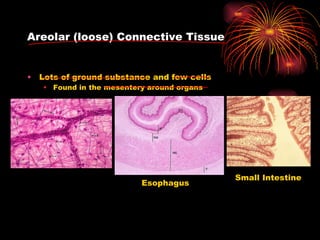
Areolar (loose) Connective Tissue Lots of ground substance and few cells Found in the mesentery around organs Esophagus Small Intestine
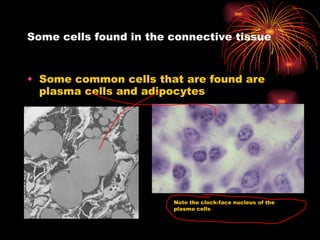
Some cells found in the connective tissue Some common cells that are found are plasma cells and adipocytes Note the clock-face nucleus of the plasma cells
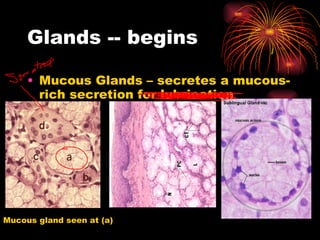
Glands -- begins Mucous Glands – secretes a mucous-rich secretion for lubrication Mucous gland seen at (a)
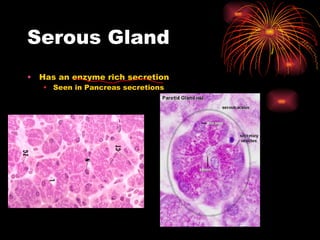
Serous Gland Has an enzyme rich secretion Seen in Pancreas secretions
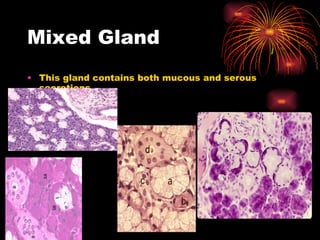
Mixed Gland This gland contains both mucous and serous secretions
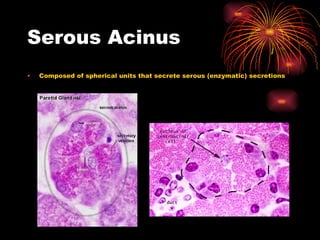
Serous Acinus Composed of spherical units that secrete serous (enzymatic) secretions
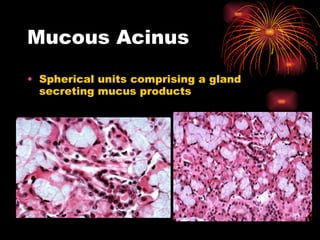
Mucous Acinus Spherical units comprising a gland secreting mucus products
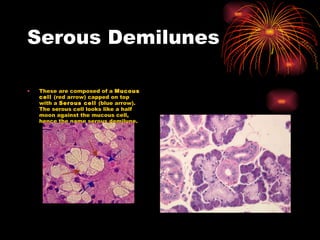
Serous Demilunes These are composed of a  Mucous cell  (red arrow) capped on top with a  Serous cell  (blue arrow). The serous cell looks like a half moon against the mucous cell, hence the name serous demilune.
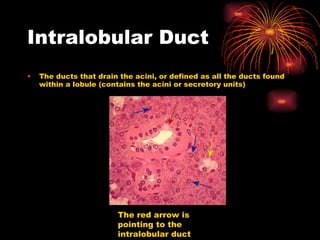
Intralobular Duct The ducts that drain the acini, or defined as all the ducts found within a lobule (contains the acini or secretory units) The red arrow is pointing to the intralobular duct
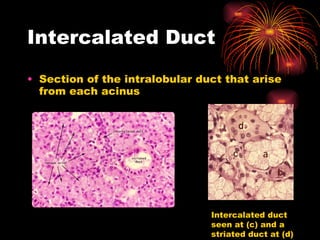
Intercalated Duct Section of the intralobular duct that arise from each acinus  Intercalated duct seen at (c) and a striated duct at (d)
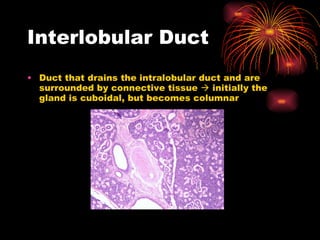
Interlobular Duct Duct that drains the intralobular duct and are surrounded by connective tissue    initially the gland is cuboidal, but becomes columnar
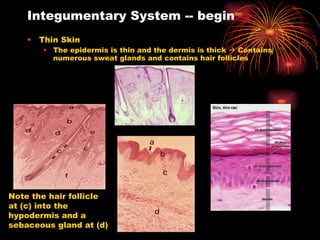
Integumentary System -- begin Thin Skin The epidermis is thin and the dermis is thick    Contains numerous sweat glands and contains hair follicles Note the hair follicle at (c) into the hypodermis and a sebaceous gland at (d)
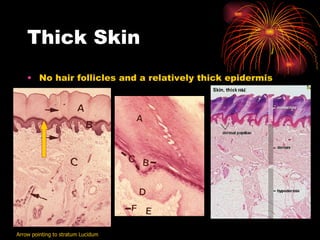
Thick Skin No hair follicles and a relatively thick epidermis Arrow pointing to stratum Lucidum
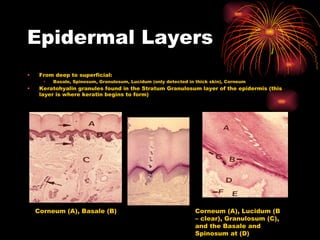
Epidermal Layers From deep to superficial: Basale, Spinosum, Granulosum, Lucidum (only detected in thick skin), Corneum Keratohyalin granules found in the Stratum Granulosum layer of the epidermis (this layer is where keratin begins to form)  Corneum (A), Basale (B) Corneum (A), Lucidum (B – clear), Granulosum (C), and the Basale and Spinosum at (D)
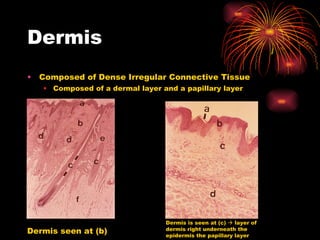
Dermis Composed of Dense Irregular Connective Tissue Composed of a dermal layer and a papillary layer Dermis seen at (b) Dermis is seen at (c)    layer of dermis right underneath the epidermis the papillary layer
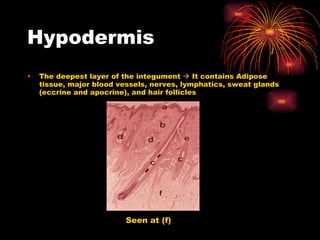
Hypodermis  The deepest layer of the integument    It contains Adipose tissue, major blood vessels, nerves, lymphatics, sweat glands (eccrine and apocrine), and hair follicles Seen at (f)
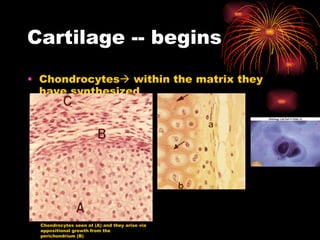
Cartilage -- begins Chondrocytes   within the matrix they have synthesized Chondrocytes seen at (A) and they arise via appositional growth from the perichondrium (B)
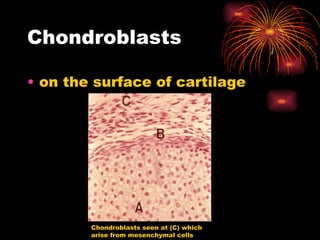
Chondroblasts on the surface of cartilage Chondroblasts seen at (C) which arise from mesenchymal cells
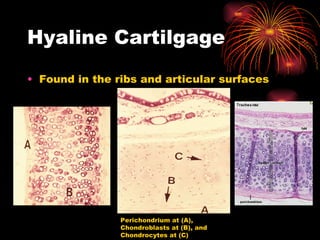
Hyaline Cartilgage Found in the ribs and articular surfaces Perichondrium at (A), Chondroblasts at (B), and Chondrocytes at (C)
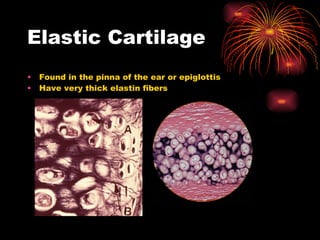
Elastic Cartilage Found in the pinna of the ear or epiglottis Have very thick elastin fibers
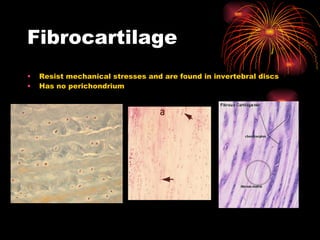
Fibrocartilage Resist mechanical stresses and are found in invertebral discs Has no perichondrium
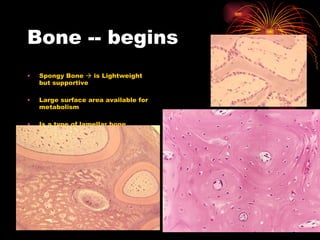
Bone -- begins Spongy Bone    is Lightweight but supportive Large surface area available for metabolism Is a type of lamellar bone
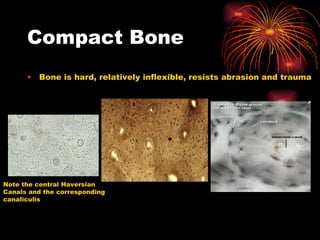
Compact Bone Bone is hard, relatively inflexible, resists abrasion and trauma Note the central Haversian Canals and the corresponding canaliculis
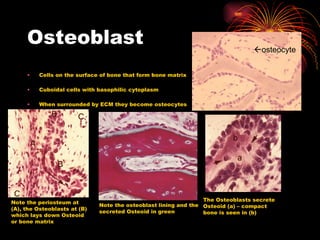
Osteoblast Cells on the surface of bone that form bone matrix Cuboidal cells with basophilic cytoplasm When surrounded by ECM they become osteocytes Note the periosteum at (A), the Osteoblasts at (B) which lays down Osteoid or bone matrix Note the osteoblast lining and the secreted Osteoid in green The Osteoblasts secrete Osteoid (a) – compact bone is seen in (b)  osteocyte
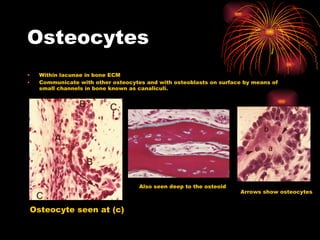
Osteocytes Within lacunae in bone ECM Communicate with other osteocytes and with osteoblasts on surface by means of small channels in bone known as canaliculi. Osteocyte seen at (c) Also seen deep to the osteoid Arrows show osteocytes
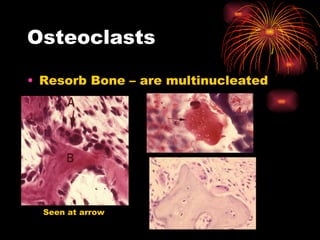
Osteoclasts Resorb Bone – are multinucleated Seen at arrow
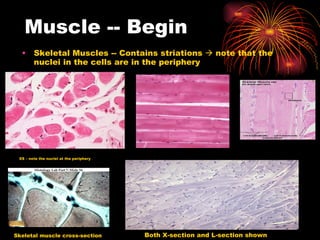
Muscle -- Begin Skeletal Muscles -- Contains striations    note that the nuclei in the cells are in the periphery Skeletal muscle cross-section Both X-section and L-section shown XS – note the nuclei at the periphery
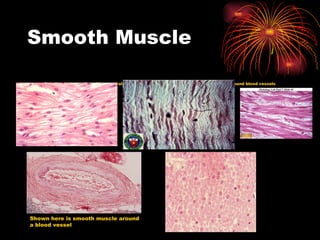
Smooth Muscle Spindle shaped cells, with a central nucleus    can be found around the GI tract and around blood vessels Shown here is smooth muscle around a blood vessel
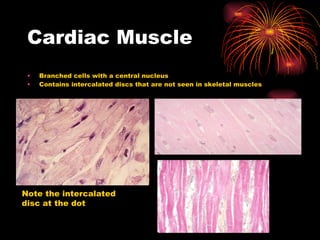
Cardiac Muscle Branched cells with a central nucleus Contains intercalated discs that are not seen in skeletal muscles . Note the intercalated disc at the dot
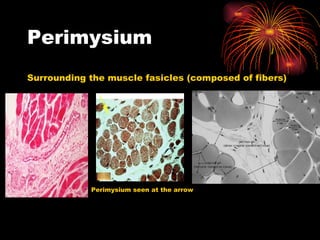
Perimysium Surrounding the muscle fasicles (composed of fibers) Perimysium seen at the arrow
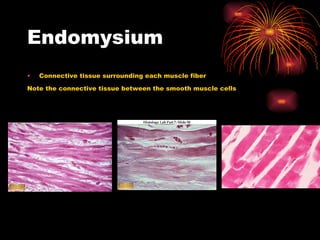
Endomysium Connective tissue surrounding each muscle fiber Note the connective tissue between the smooth muscle cells
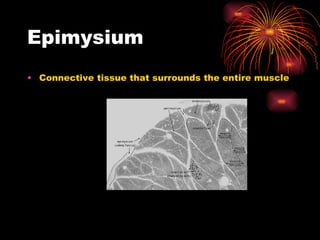
Epimysium Connective tissue that surrounds the entire muscle
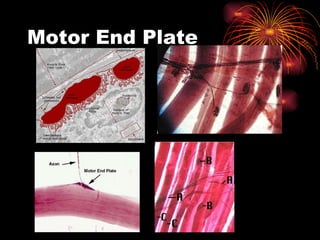
Motor End Plate
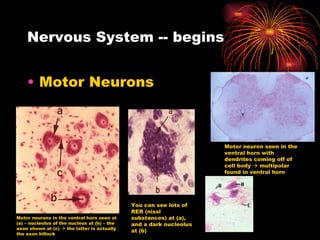
Nervous System -- begins Motor Neurons Motor neurons in the ventral horn seen at (a) – nucleolus of the nucleus at (b) – the axon shown at (c)    the latter is actually the axon hillock You can see lots of RER (nissl substances) at (a), and a dark nucleolus at (b) Motor neuron seen in the ventral horn with dendrites coming off of cell body    multipolar found in ventral horn
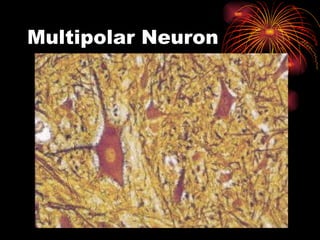
Multipolar Neuron
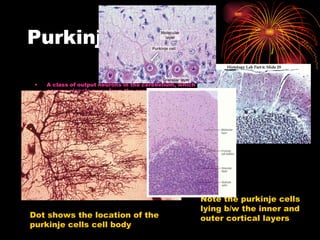
Purkinje cells A class of output neurons in the cerebellum, which are the only neurons that convey signals away from the cerebellum  . Dot shows the location of the purkinje cells cell body Note the purkinje cells lying b/w the inner and outer cortical layers
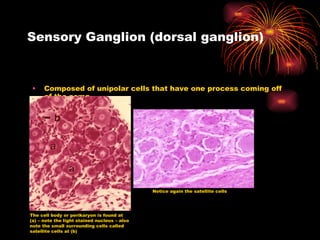
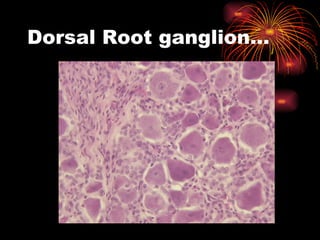
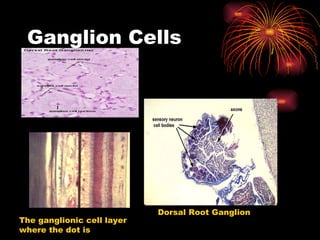
Sensory Ganglion (dorsal ganglion) Composed of unipolar cells that have one process coming off of the soma The cell body or perikaryon is found at (a) – note the light stained nucleus – also note the small surrounding cells called satellite cells at (b) Notice again the satellite cells
Dorsal Root ganglion…
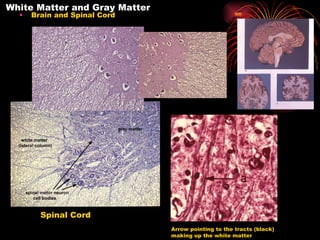
White Matter and Gray Matter Brain and Spinal Cord Spinal Cord Arrow pointing to the tracts (black) making up the white matter
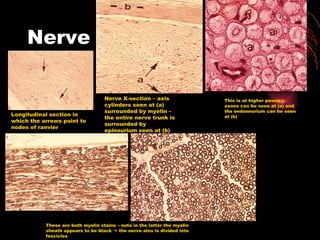
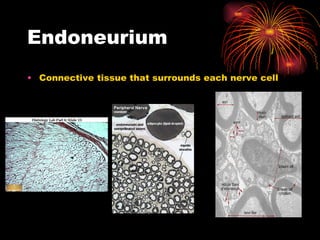
Nerve Longitudinal section in which the arrows point to nodes of ranvier Nerve X-section – axis cylinders seen at (a) surrounded by myelin – the entire nerve trunk is surrounded by epineurium seen at (b) This is at higher power – axons can be seen at (a) and the endoneurium can be seen at (b) These are both myelin stains – note in the latter the myelin sheath appears to be black    the nerve also is divided into fascicles
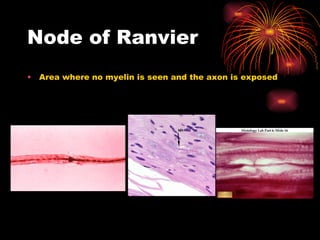
Node of Ranvier Area where no myelin is seen and the axon is exposed
Endoneurium Connective tissue that surrounds each nerve cell
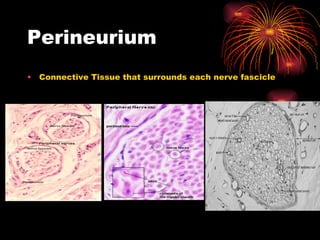
Perineurium Connective Tissue that surrounds each nerve fascicle
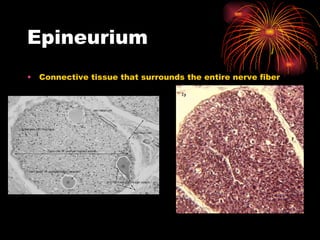
Epineurium Connective tissue that surrounds the entire nerve fiber
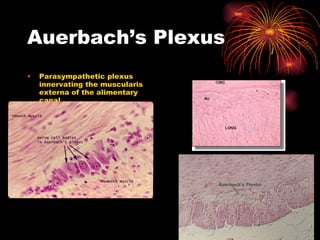
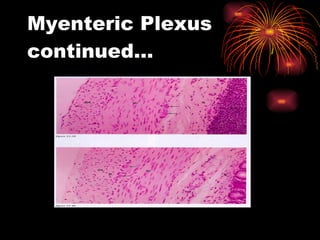
Auerbach’s Plexus Parasympathetic plexus innervating the muscularis externa of the alimentary canal
Myenteric Plexus continued…
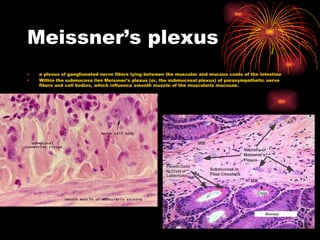
Meissner’s plexus a plexus of ganglionated nerve fibers lying between the muscular and mucous coats of the intestine  Within the submucosa lies Meissner's plexus (or, the submucosal plexus) of parasympathetic nerve fibers and cell bodies, which influence smooth muscle of the muscularis mucosae.
Ganglion Cells . The ganglionic cell layer where the dot is Dorsal Root Ganglion
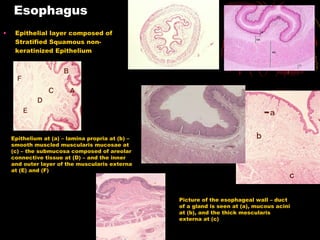
Esophagus Epithelial layer composed of Stratified Squamous non-keratinized Epithelium Epithelium at (a) – lamina propria at (b) – smooth muscled muscularis mucosae at (c) – the submucosa composed of areolar connective tissue at (D) – and the inner and outer layer of the muscularis externa at (E) and (F) Picture of the esophageal wall – duct of a gland is seen at (a), mucous acini at (b), and the thick mescularis externa at (c)
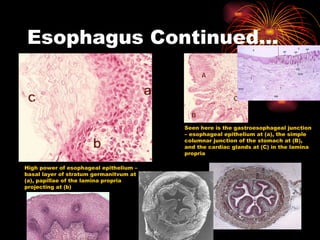
Esophagus Continued… High power of esophageal epithelium – basal layer of stratum germanitvum at (a), papillae of the lamina propria projecting at (b) Seen here is the gastroesophageal junction – esophageal epithelium at (a), the simple columnar junction of the stomach at (B), and the cardiac glands at (C) in the lamina propria
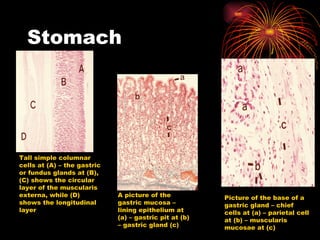
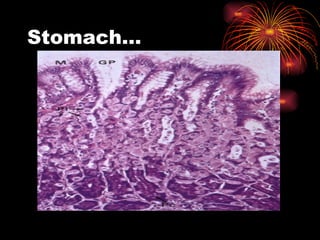
Stomach Tall simple columnar cells at (A) – the gastric or fundus glands at (B),  (C) shows the circular layer of the muscularis externa, while (D) shows the longitudinal layer A picture of the gastric mucosa – lining epithelium at (a) – gastric pit at (b) – gastric gland (c) Picture of the base of a gastric gland – chief cells at (a) – parietal cell at (b) – muscularis mucosae at (c)
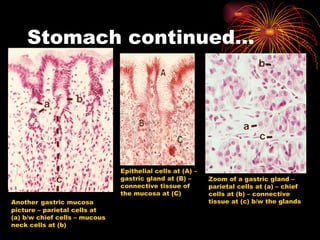
Stomach continued… Another   gastric mucosa picture – parietal cells at (a) b/w chief cells – mucous neck cells at (b) Epithelial cells at (A) – gastric gland at (B) – connective tissue of the mucosa at (C) Zoom of a gastric gland – parietal cells at (a) – chief cells at (b) – connective tissue at (c) b/w the glands
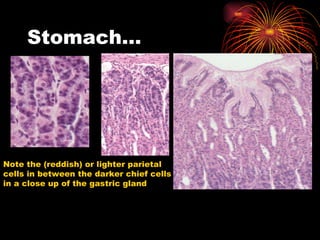
Stomach… Note the (reddish) or lighter parietal cells in between the darker chief cells in a close up of the gastric gland
Stomach…
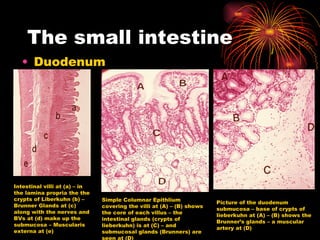
The small intestine Duodenum Intestinal villi at (a) – in the lamina propria the the crypts of Liberkuhn (b) – Brunner Glands at (c) along with the nerves and BVs at (d) make up the submucosa – Muscularis externa at (e) Simple Columnar Epithlium covering the villi at (A) – (B) shows the core of each villus – the intestinal glands (crypts of lieberkuhn) is at (C) – and submucosal glands (Brunners) are seen at (D) Picture of the duodenum submucosa – base of crypts of lieberkuhn at (A) – (B) shows the Brunner’s glands – a muscular artery at (D)
 
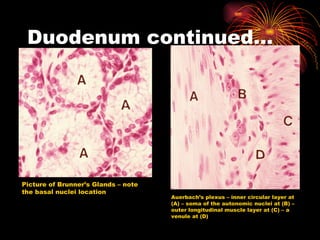
Duodenum continued… Picture of Brunner’s Glands – note the basal nuclei location Auerbach’s plexus – inner circular layer at (A) – soma of the autonomic nuclei at (B) – outer longitudinal muscle layer at (C) – a venule at (D)
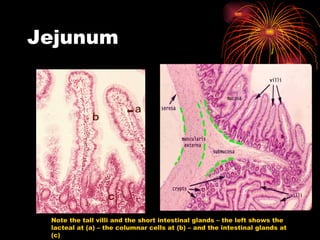
Jejunum Note the tall villi and the short intestinal glands – the left shows the lacteal at (a) – the columnar cells at (b) – and the intestinal glands at (c)
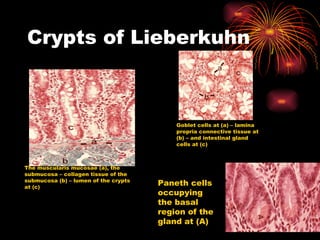
Crypts of Lieberkuhn The muscularis mucosae (a), the submucosa – collagen tissue of the submucosa (b) – lumen of the crypts at (c) Goblet cells at (a) – lamina propria connective tissue at (b) – and intestinal gland cells at (c) Paneth cells occupying the basal region of the gland at (A)
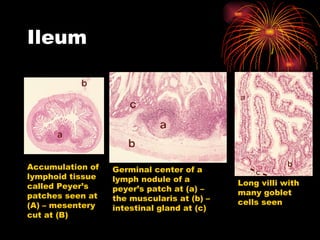
Ileum Accumulation of lymphoid tissue called Peyer’s patches seen at (A) – mesentery cut at (B) Germinal center of a lymph nodule of a peyer’s patch at (a) – the muscularis at (b) – intestinal gland at (c) Long villi with many goblet cells seen
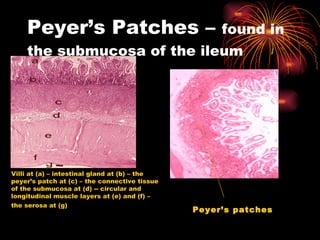
Peyer’s Patches –  found in the submucosa of the ileum Villi at (a) – intestinal gland at (b) – the peyer’s patch at (c) – the connective tissue of the submucosa at (d) -- circular and longitudinal muscle layers at (e) and (f) – the serosa at (g)   Peyer’s patches
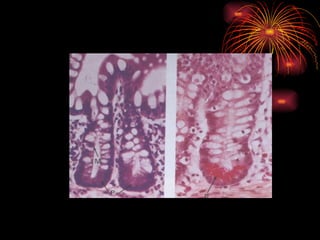
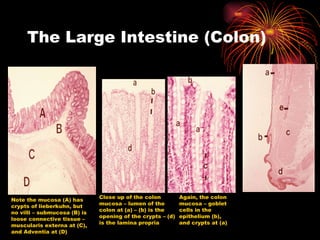
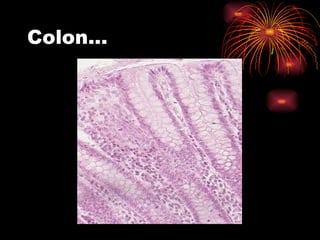
The Large Intestine (Colon) Note the mucosa (A) has crypts of lieberkuhn, but no villi – submucosa (B) is loose connective tissue – muscularis externa at (C), and Adventia at (D) Close up of the colon mucosa – lumen of the colon at (a) – (b) is the opening of the crypts – (d) is the lamina propria Again, the colon mucosa – goblet cells in the epithelium (b), and crypts at (a)
Colon…
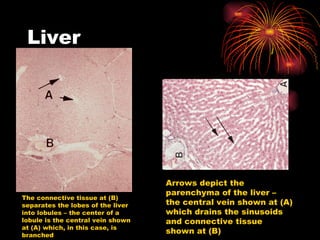
Liver The connective tissue at (B) separates the lobes of the liver into lobules – the center of a lobule is the central vein shown at (A) which, in this case, is branched Arrows depict the parenchyma of the liver – the central vein shown at (A) which drains the sinusoids and connective tissue shown at (B)
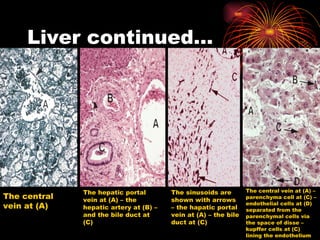
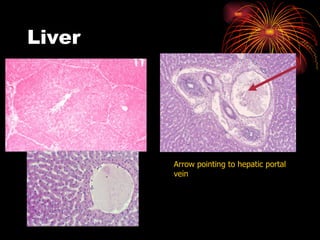
Liver continued… The central vein at (A) The hepatic portal vein at (A) – the hepatic artery at (B) – and the bile duct at (C) The sinusoids are shown with arrows – the hapatic portal vein at (A) – the bile duct at (C) The central vein at (A) – parenchyma cell at (C) – endothelial cells at (D) separated from the parenchymal cells via the space of disse – kupffer cells at (C) lining the endothelium
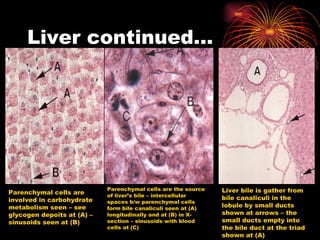
Liver continued… Parenchymal cells are involved in carbohydrate metabolism seen – see glycogen depoits at (A) – sinusoids seen at (B) Parenchymal cells are the source of liver’s bile – intercellular spaces b/w parenchymal cells form bile canaliculi seen at (A) longitudinally and at (B) in X-section – sinusoids with blood cells at (C) Liver bile is gather from bile canaliculi in the lobule by small ducts shown at arrows – the small ducts empty into the bile duct at the triad shown at (A)
Liver Arrow pointing to hepatic portal vein
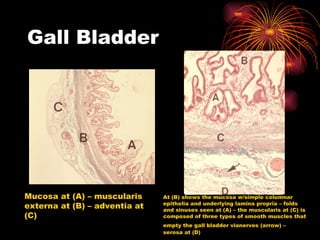
Gall Bladder Mucosa at (A) – muscularis externa at (B) – adventia at (C) At (B) shows the mucosa w/simple columnar epithelia and underlying lamina propria – folds and sinuses seen at (A) – the muscularis at (C) is composed of three types of smooth muscles that empty the gall bladder vianerves (arrow) –   serosa at (D)
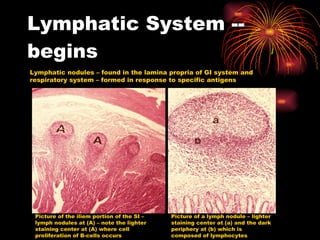
Lymphatic System -- begins Lymphatic nodules – found in the lamina propria of GI system and respiratory system – formed in response to specific antigens Picture of the iliem portion of the SI – lymph nodules at (A) – note the lighter staining center at (A) where cell proliferation of B-cells occurs Picture of a lymph nodule – lighter staining center at (a) and the dark periphery at (b) which is composed of lymphocytes
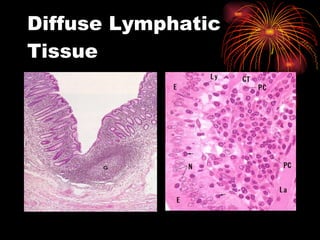
Diffuse Lymphatic Tissue
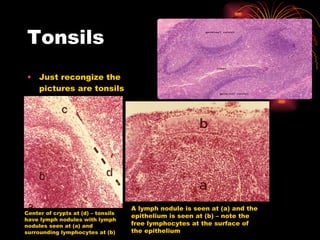
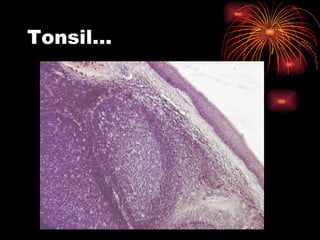
Tonsils Just recongize the pictures are tonsils Center of crypts at (d) – tonsils have lymph nodules with lymph nodules seen at (a) and surrounding lymphocytes at (b) A lymph nodule is seen at (a) and the epithelium is seen at (b) – note the free lymphocytes at the surface of the epithelium
Tonsil…
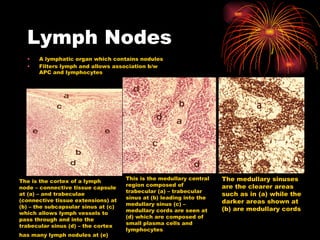
Lymph Nodes A lymphatic organ which contains nodules Filters lymph and allows association b/w APC and lymphocytes The is the cortex of a lymph node – connective tissue capsule at (a) – and trabeculae (connective tissue extensions) at (b) – the subcapsular sinus at (c) which allows lymph vessels to pass through and into the trabecular sinus (d) – the cortex has many lymph nodules at (e)   This is the medullary central region composed of trabecular (a) – trabecular sinus at (b) leading into the medullary sinus (c) – medullary cords are seen at (d) which are composed of small plasma cells and lymphocytes The medullary sinuses are the clearer areas such as in (a) while the darker areas shown at (b) are medullary cords
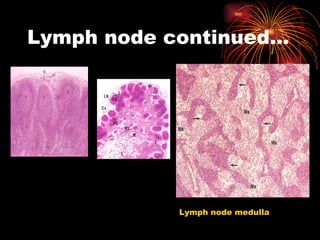
Lymph node continued… Lymph node medulla
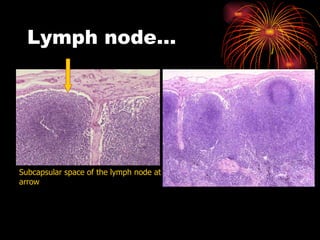
Lymph node… Subcapsular space of the lymph node at arrow
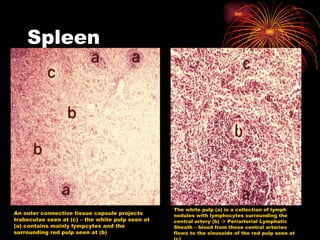
Spleen An outer connective tissue capsule projects trabeculae seen at (c) – the white pulp seen at (a) contains mainly lympcytes and the surrounding red pulp seen at (b) The white pulp (a) is a collection of lymph nodules with lymphocytes surrounding the central artery (b)    Periarterial Lymphatic Sheath – blood from these central arteries flows to the sinusoids of the red pulp seen at (c)
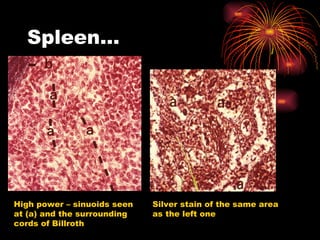
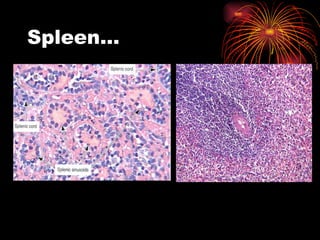
Spleen… High power – sinuoids seen at (a) and the surrounding cords of Billroth Silver stain of the same area as the left one
Spleen…
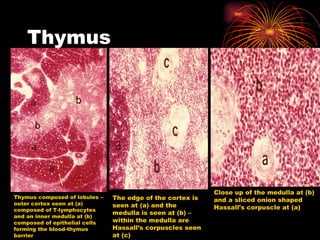
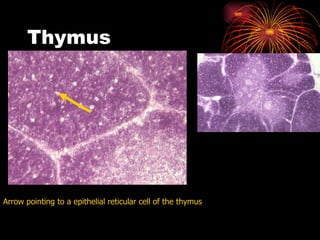
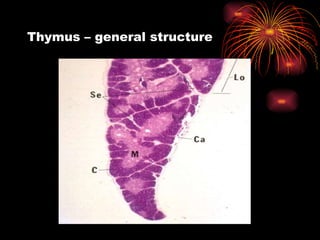
Thymus Thymus composed of lobules – outer cortex seen at (a) composed of T-lymphocytes and an inner medulla at (b) composed of epithelial cells forming the blood-thymus barrier The edge of the cortex is seen at (a) and the medulla is seen at (b) – within the medulla are Hassall’s corpuscles seen at (c) Close up of the medulla at (b) and a sliced onion shaped Hassall's corpuscle at (a)
Thymus Arrow pointing to a epithelial reticular cell of the thymus
Thymus – general structure
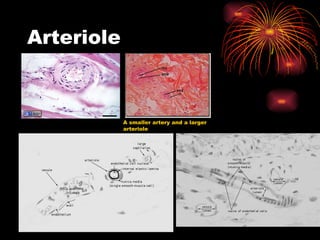
Arteriole A smaller artery and a larger arteriole
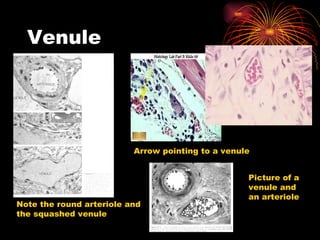
Venule Note the round arteriole and the squashed venule Arrow pointing to a venule Picture of a venule and an arteriole
Vein
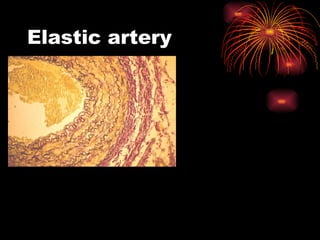
Elastic artery
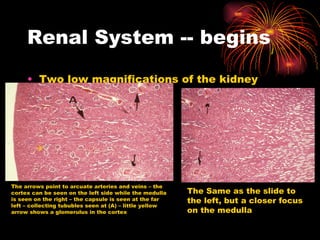
Renal System -- begins Two low magnifications of the kidney The arrows point to arcuate arteries and veins – the cortex can be seen on the left side while the medulla is seen on the right – the capsule is seen at the far left – collecting tububles seen at (A) – little yellow arrow shows a glomerulus in the cortex .  The Same as the slide to the left, but a closer focus on the medulla
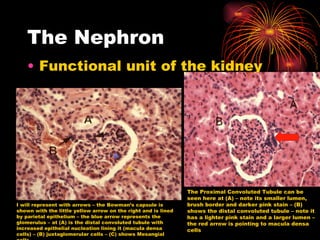
The Nephron Functional unit of the kidney I will represent with arrows – the Bowman’s capsule is shown with the little yellow arrow on the right and is lined by parietal epithelium – the blue arrow represents the glomerulus – at (A) is the distal convoluted tubule with increased epithelial nucleation lining it (macula densa cells) – (B) juxtaglomerular cells – (C) shows Mesangial cells   The Proximal Convoluted Tubule can be seen here at (A) – note its smaller lumen, brush border and darker pink stain – (B) shows the distal convoluted tubule – note it has a lighter pink stain and a larger lumen – the red arrow is pointing to macula densa cells
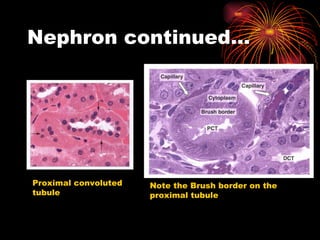
Nephron continued… Proximal convoluted tubule Note the Brush border on the proximal tubule
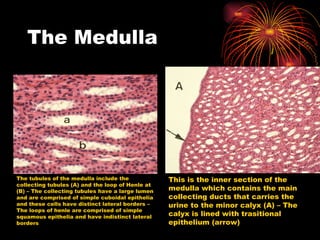
The Medulla The tubules of the medulla include the collecting tubules (A) and the loop of Henle at (B) – The collecting tubules have a large lumen and are comprised of simple cuboidal epithelia and these cells have distinct lateral borders – The loops of henle are comprised of simple squamous epithelia and have indistinct lateral borders This is the inner section of the medulla which contains the main collecting ducts that carries the urine to the minor calyx (A) – The calyx is lined with trasitional epithelium (arrow)
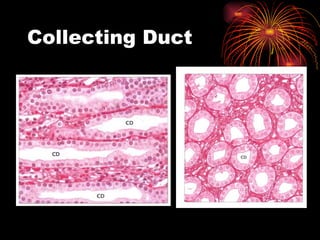
Collecting Duct
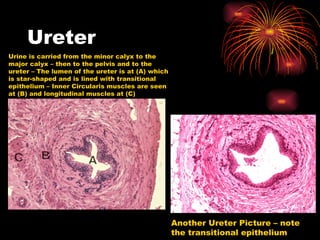
Ureter Urine is carried from the minor calyx to the major calyx – then to the pelvis and to the ureter – The lumen of the ureter is at (A) which is star-shaped and is lined with transitional epithelium – Inner Circularis muscles are seen at (B) and longitudinal muscles at (C) Another Ureter Picture – note the transitional epithelium
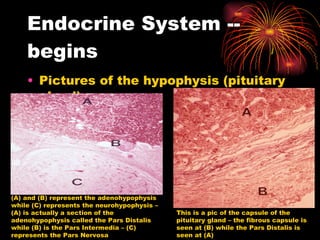
Endocrine System -- begins Pictures of the hypophysis (pituitary gland) (A) and (B) represent the adenohypophysis while (C) represents the neurohypophysis – (A) is actually a section of the adenohypophysis called the Pars Distalis while (B) is the Pars Intermedia – (C) represents the Pars Nervosa This is a pic of the capsule of the pituitary gland – the fibrous capsule is seen at (B) while the Pars Distalis is seen at (A)
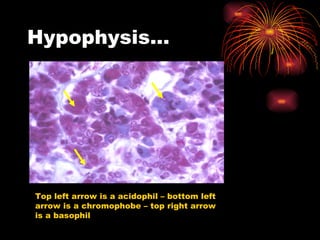
Hypophysis… Top left arrow is a acidophil – bottom left arrow is a chromophobe – top right arrow is a basophil
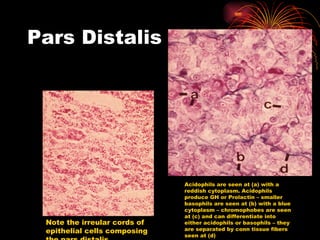
Pars Distalis Note the irreular cords of epithelial cells composing the pars distalis Acidophils are seen at (a) with a reddish cytoplasm. Acidophils produce GH or Prolactin – smaller basophils are seen at (b) with a blue cytoplasm – chromophobes are seen at (c) and can differentiate into either acidophils or basophils – they are separated by conn tissue fibers seen at (d)
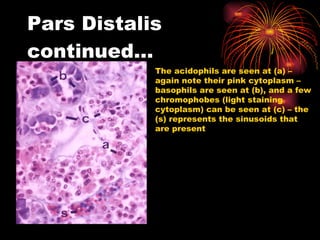
Pars Distalis continued… The acidophils are seen at (a) – again note their pink cytoplasm – basophils are seen at (b), and a few chromophobes (light staining cytoplasm) can be seen at (c) – the (s) represents the sinusoids that are present
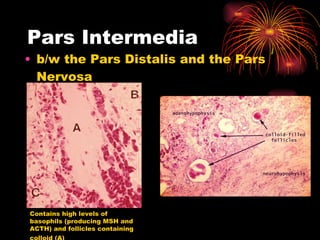
Pars Intermedia b/w the Pars Distalis and the Pars Nervosa Contains high levels of basophils (producing MSH and ACTH) and follicles containing colloid (A)
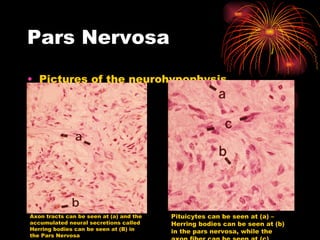
Pars Nervosa Pictures of the neurohypophysis  Axon tracts can be seen at (a) and the accumulated neural secretions called Herring bodies can be seen at (B) in the Pars Nervosa Pituicytes can be seen at (a) – Herring bodies can be seen at (b) in the pars nervosa, while the axon fiber can be seen at (c)
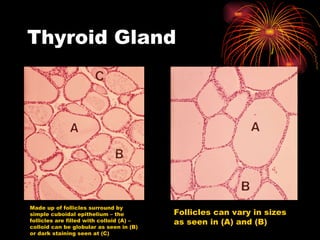
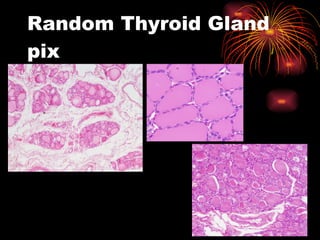
Thyroid Gland Made up of follicles surround by simple cuboidal epithelium – the follicles are filled with colloid (A) – colloid can be globular as seen in (B) or dark staining seen at (C) Follicles can vary in sizes as seen in (A) and (B)
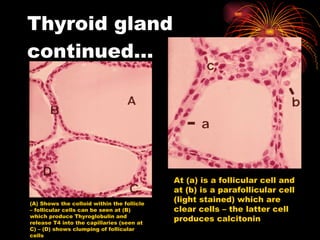
Thyroid gland continued… (A) Shows the colloid within the follicle – follicular cells can be seen at (B) which produce Thyroglobulin and release T4 into the capillaries (seen at C) – (D) shows clumping of follicular cells At (a) is a follicular cell and at (b) is a parafollicular cell (light stained) which are clear cells – the latter cell produces calcitonin
Random Thyroid Gland pix
Parathyroid Gland Picture of thyroid [(C) and (B)] and parathyroid glands (A) – note the parathyroid gland is composed of cords of cells and is separated from the thyroid by a capsule   Note the cells are lined up along capillaries – chief cells are seen at (a) and comprise most of the cells – some chief cells are large and contain lots of glycogen (b) – note they are more clear – these chief cells release PTH – chief cells are also seen at (c) and are in contact with capillaries
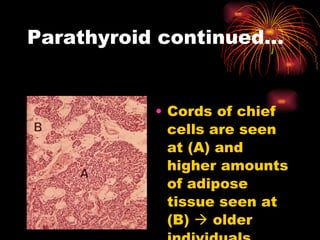
Parathyroid continued… Cords of chief cells are seen at (A) and higher amounts of adipose tissue seen at (B)    older individuals
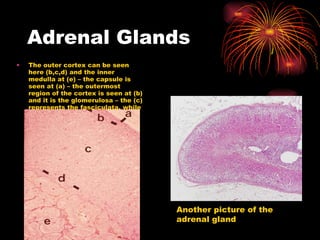
Adrenal Glands The outer cortex can be seen here (b,c,d) and the inner medulla at (e) – the capsule is seen at (a) – the outermost region of the cortex is seen at (b) and it is the glomerulosa – the (c) represents the fasciculata, while (d) represents the reticularis Another picture of the adrenal gland
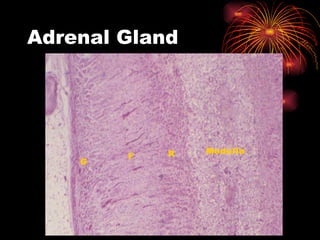
Adrenal Gland G F R Medulla
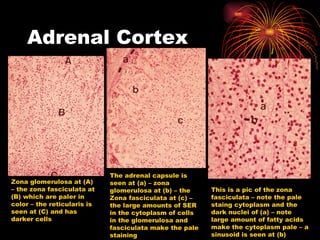
Adrenal Cortex Zona glomerulosa at (A) – the zona fasciculata at (B) which are paler in color – the reticularis is seen at (C) and has darker cells The adrenal capsule is seen at (a) – zona glomerulosa at (b) – the Zona fasciculata at (c) – the large amounts of SER in the cytoplasm of cells in the glomerulosa and fasciculata make the pale staining This is a pic of the zona fasciculata – note the pale staing cytoplasm and the dark nuclei of (a) – note large amount of fatty acids make the cytoplasm pale – a sinusoid is seen at (b)
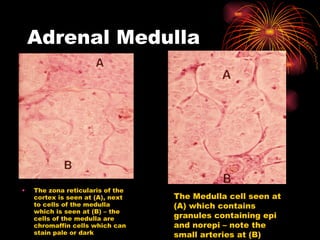
Adrenal Medulla The zona reticularis of the cortex is seen at (A), next to cells of the medulla which is seen at (B) – the cells of the medulla are chromaffin cells which can stain pale or dark The Medulla cell seen at (A) which contains granules containing epi and norepi – note the small arteries at (B)
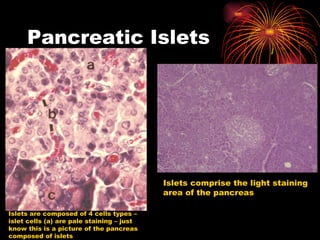
Pancreatic Islets Islets are composed of 4 cells types – islet cells (a) are pale staining – just know this is a picture of the pancreas composed of islets Islets comprise the light staining area of the pancreas
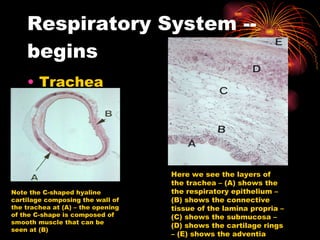
Respiratory System -- begins Trachea Note the C-shaped hyaline cartilage composing the wall of the trachea at (A) – the opening of the C-shape is composed of smooth muscle that can be seen at (B) Here we see the layers of the trachea – (A) shows the the respiratory epithelium – (B) shows the connective tissue of the lamina propria – (C) shows the submucosa – (D) shows the cartilage rings – (E) shows the adventia
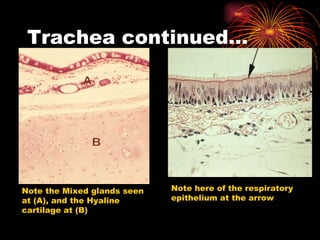
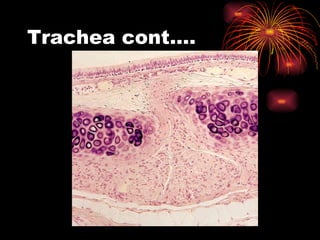
Trachea continued… Note the Mixed glands seen at (A), and the Hyaline cartilage at (B) Note here of the respiratory epithelium at the arrow
Trachea cont….
Respiratory Epithelium pix…
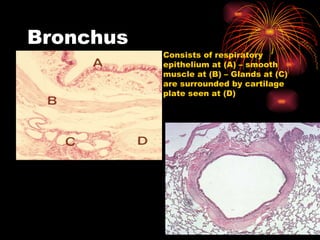
Bronchus Consists of respiratory epithelium at (A) – smooth muscle at (B) – Glands at (C) are surrounded by cartilage plate seen at (D)
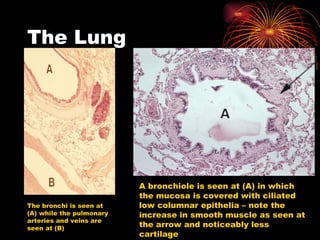
The Lung The bronchi is seen at (A) while the pulmonary arteries and veins are seen at (B) A bronchiole is seen at (A) in which the mucosa is covered with ciliated low columnar epithelia – note the increase in smooth muscle as seen at the arrow and noticeably less cartilage
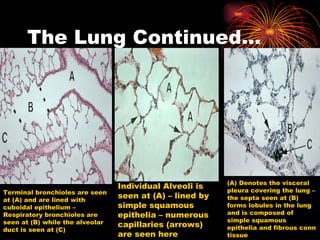
The Lung Continued… Terminal bronchioles are seen at (A) and are lined with cuboidal epithelium – Respiratory bronchioles are seen at (B) while the alveolar duct is seen at (C) Individual Alveoli is seen at (A) – lined by simple squamous epithelia – numerous capillaries (arrows) are seen here (A) Denotes the visceral pleura covering the lung – the septa seen at (B) forms lobules in the lung and is composed of simple squamous epithelia and fibrous conn tissue
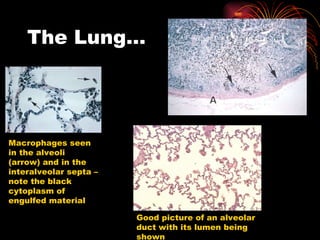
The Lung… Macrophages seen in the alveoli (arrow) and in the interalveolar septa – note the black cytoplasm of engulfed material Good picture of an alveolar duct with its lumen being shown
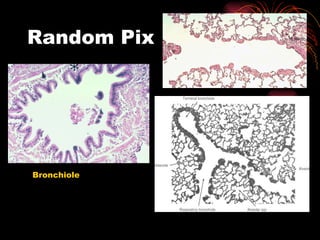
Random Pix Bronchiole
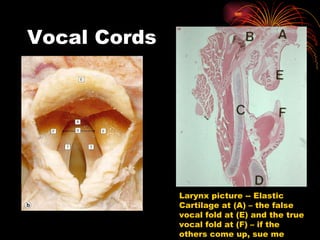
Vocal Cords Larynx picture -- Elastic Cartilage at (A) – the false vocal fold at (E) and the true vocal fold at (F) – if the others come up, sue me
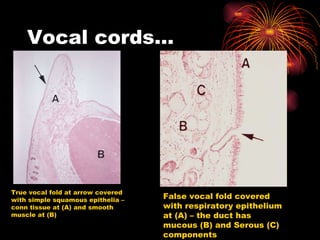
Vocal cords… True vocal fold at arrow covered with simple squamous epithelia – conn tissue at (A) and smooth muscle at (B) False vocal fold covered with respiratory epithelium at (A) – the duct has mucous (B) and Serous (C) components
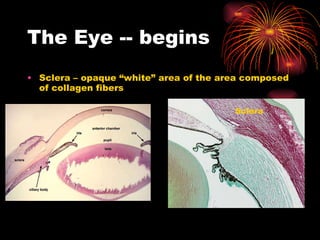
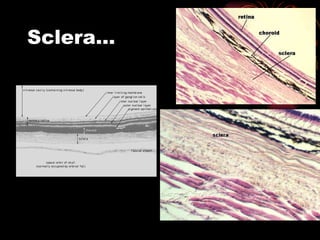
The Eye -- begins Sclera – opaque “white” area of the area composed of collagen fibers Sclera
Sclera…
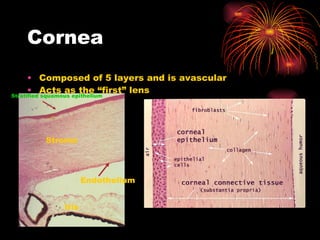
Cornea Composed of 5 layers and is avascular Acts as the “first” lens Stratified squamous epithelium Stroma Endothelium Iris
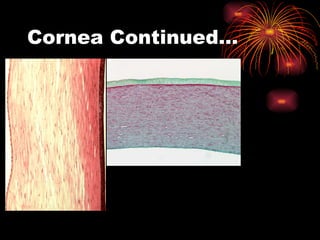
Cornea Continued…
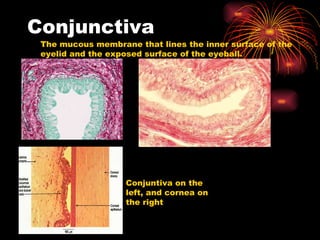
Conjunctiva The mucous membrane that lines the inner surface of the eyelid and the exposed surface of the eyeball. Conjuntiva on the left, and cornea on the right
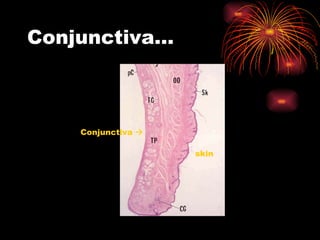
Conjunctiva… Conjunctiva   skin
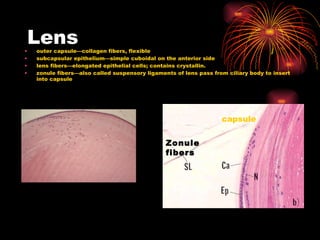
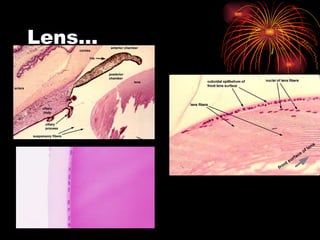
Lens outer capsule—collagen fibers, flexible subcapsular epithelium—simple cuboidal on the anterior side  lens fibers—elongated epithelial cells; contains crystallin. zonule fibers—also called suspensory ligaments of lens pass from ciliary body to insert into capsule capsule Zonule fibers
Lens…
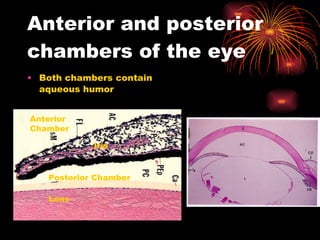
Anterior and posterior chambers of the eye Both chambers contain aqueous humor Lens Posterior Chamber Anterior Chamber Iris
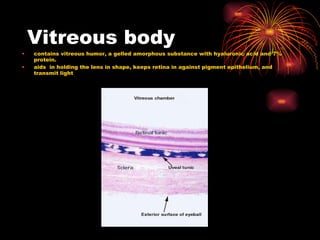
Vitreous body contains vitreous humor, a gelled amorphous substance with hyaluronic acid and 7% protein. aids  in holding the lens in shape, keeps retina in against pigment epithelium, and transmit light
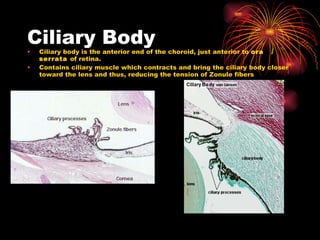
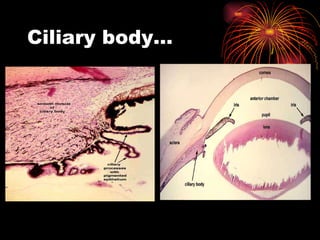
Ciliary Body Ciliary body is the anterior end of the choroid, just anterior to  ora serrata  of retina.  Contains ciliary muscle which contracts and bring the ciliary body closer toward the lens and thus, reducing the tension of Zonule fibers
Ciliary body…
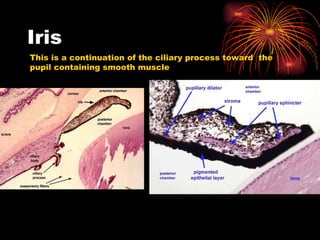
Iris This is a continuation of the ciliary process toward  the pupil containing smooth muscle
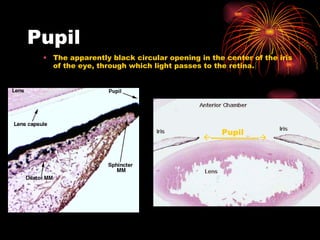
Pupil The apparently black circular opening in the center of the iris of the eye, through which light passes to the retina.  ------------------  Pupil
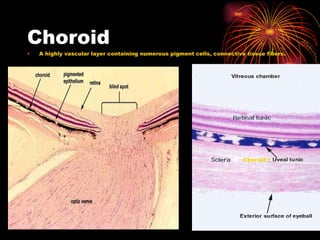
Choroid A highly vascular layer containing numerous pigment cells, connective tissue fibers.  Choroid 
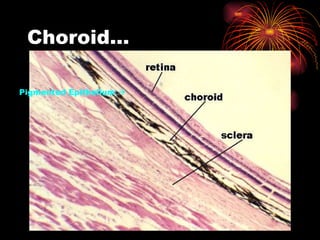
Choroid… Pigmented Epithelium  
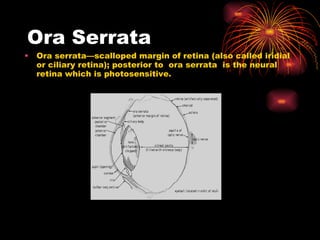
Ora Serrata Ora serrata—scalloped margin of retina (also called iridial or ciliary retina); posterior to  ora serrata  is the neural retina which is photosensitive.
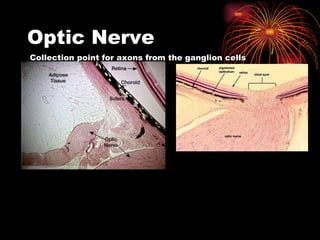
Optic Nerve Collection point for axons from the ganglion cells
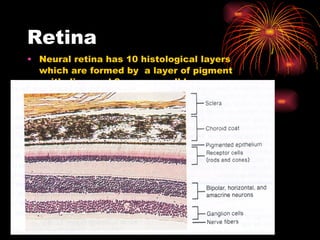
Retina Neural retina has 10 histological layers which are formed by  a layer of pigment epithelium and 3  neuron cell layers
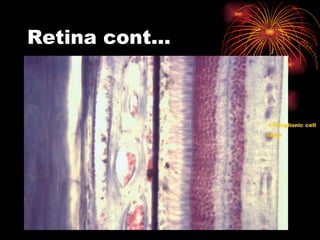
Retina cont… Ganglionic cell  layer
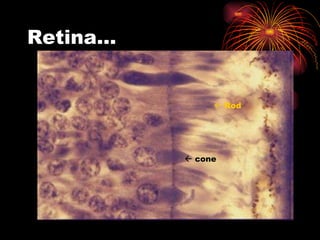
Retina…    Rod    cone
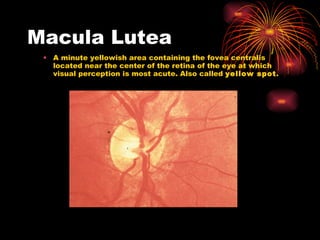
Macula Lutea A minute yellowish area containing the fovea centralis located near the center of the retina of the eye at which visual perception is most acute. Also called  yellow spot .
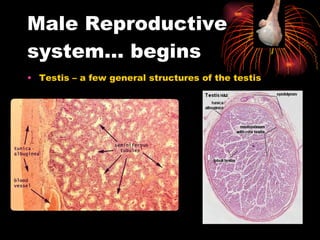
Male Reproductive system… begins Testis – a few general structures of the testis
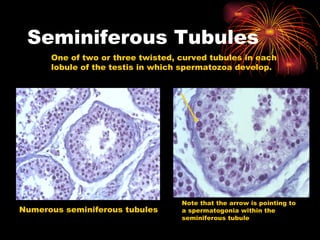
Seminiferous Tubules One of two or three twisted, curved tubules in each lobule of the testis in which spermatozoa develop. Numerous seminiferous tubules Note that the arrow is pointing to a spermatogonia within the seminiferous tubule
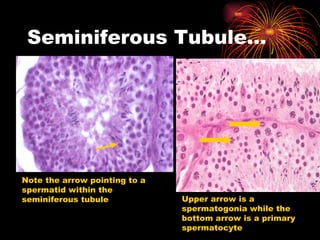
Seminiferous Tubule… Note the arrow pointing to a spermatid within the seminiferous tubule Upper arrow is a spermatogonia while the bottom arrow is a primary spermatocyte
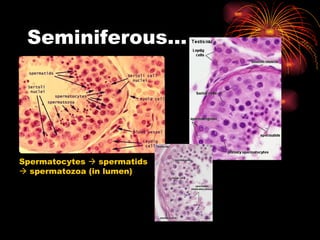
Seminiferous… Spermatocytes    spermatids    spermatozoa (in lumen)
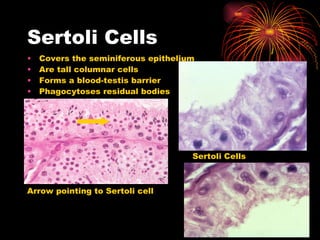
Sertoli Cells Covers the seminiferous epithelium Are tall columnar cells Forms a blood-testis barrier Phagocytoses residual bodies Arrow pointing to Sertoli cell Sertoli Cells
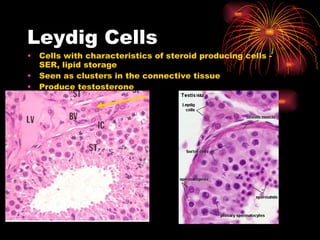
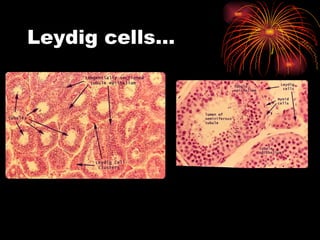
Leydig Cells Cells with characteristics of steroid producing cells - SER, lipid storage Seen as clusters in the connective tissue Produce testosterone
Leydig cells…
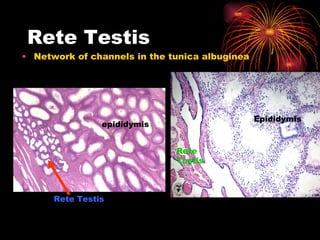
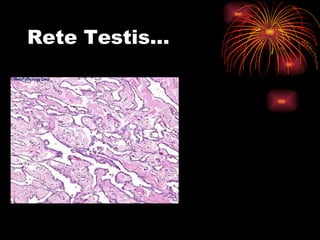
Rete Testis Network of channels in the tunica albuginea  epididymis Rete Testis Epididymis Rete Testis
Rete Testis…
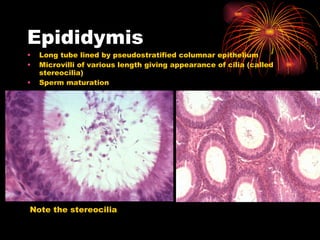
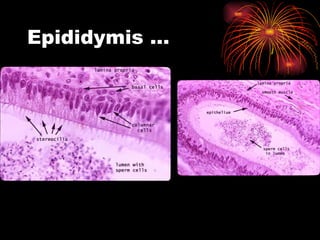
Epididymis Long tube lined by pseudostratified columnar epithelium Microvilli of various length giving appearance of cilia (called stereocilia) Sperm maturation  Note the stereocilia
Epididymis …
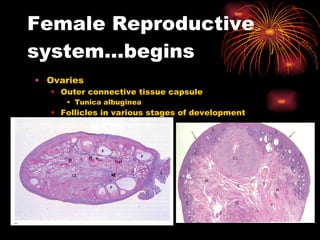
Female Reproductive system…begins Ovaries Outer connective tissue capsule Tunica albuginea Follicles in various stages of development Connective tissue stroma
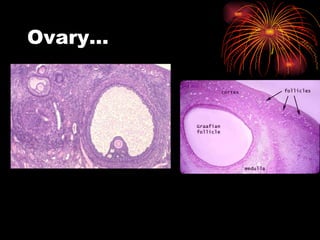
Ovary…
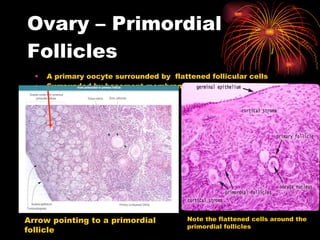
Ovary – Primordial Follicles A primary oocyte surrounded by  flattened follicular cells Surrounded by basement membrane Located at periphery of ovary Arrow pointing to a primordial follicle Note the flattened cells around the primordial follicles
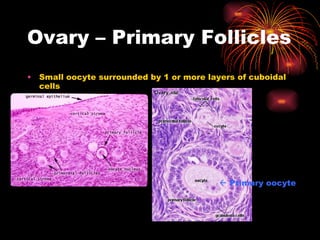
Ovary – Primary Follicles Small oocyte surrounded by 1 or more layers of cuboidal cells     Primary oocyte
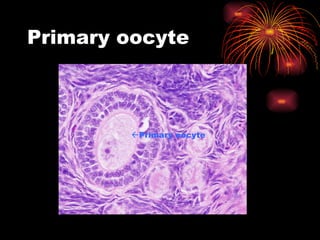
Primary oocyte  Primary oocyte
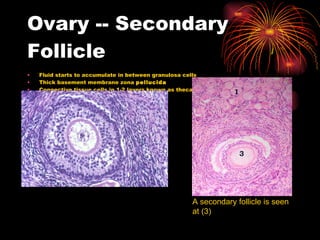
Ovary -- Secondary Follicle Fluid starts to accumulate in between granulosa cells Thick basement membrane zona  pellucida Connective tissue cells in 1-2 layers known as theca cells A secondary follicle is seen at (3)
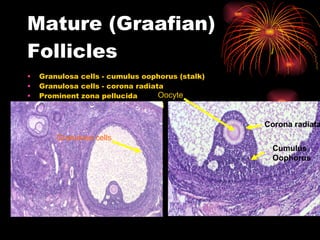
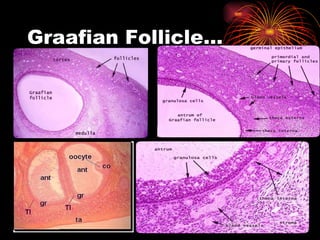
Mature (Graafian) Follicles Granulosa cells - cumulus oophorus (stalk) Granulosa cells - corona radiata Prominent zona pellucida Antrum filled with liquor folliculi Oocyte Corona radiata Cumulus Oophorus Granulosa cells
Graafian Follicle…
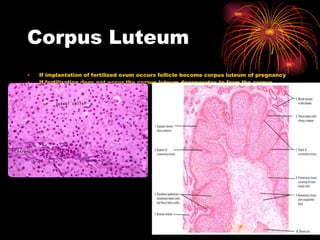
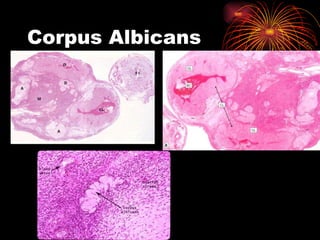
Corpus Luteum If implantation of fertilized ovum occurs follicle become corpus luteum of pregnancy If fertilization does not occur the corpus luteum degenerates to form the corpus albicans
Corpus Albicans

Slide list awesome

  • 1.
    Histology Slide list“ Thank You Sanjar!” from the ‘0nizzy
  • 2.
    The Cell --Begins Nuclear Membrane and nuclear pore  note the heterochromatin and the euchromatin within the cell
  • 3.
    Nucleolus The nucleolusis rich in proteins and rRNA – it consists of the nucleolar organizing region (coding for rRNA), Pars Fibrosa region (containing the rRNA transcripts), and the Pars Granulosa region (which contains maturing ribosomes) Note that the nucleolus is shown at point C
  • 4.
    Chromatin –heterochromatin and euchromatin  note how the heterochromatin lies against the nuclear envelope and is more condensed
  • 5.
    Mitochondria – cellorganelle It’s function is to create cellular energy
  • 6.
    Rough ER Function– protein synthesis via carrying ribosomes  note the bottom picture where it seems that protein granules have accumulated within the cisternae of the RER You can see small mitochondria on the top of the left picture and to the left of right picture Note the difference b/w the rough ER and smooth ER on the right
  • 7.
    Smooth ER Functionsin detoxification, lipid synthesis, etc Note the mitochondria
  • 8.
    Golgi Complex Functionsin the modification and packaging of proteins Notice the large secretory granules in the picture to the right
  • 9.
    Microvilli The microvilli+ glycocalyx = the brush border Seen mainly in absorptive cells and many epithelial cells The microvilli on the right picture is seen at (a)
  • 10.
    Centrioles and thecentrosome Important during mitotic division Note that the picture in the middle is a longitudinal cut of the centrosome Also note the perpendicular arrangement of the centrioles (90 degrees)
  • 11.
    Desmosomes Aka MaculaAdherans Has converging tonofilaments and plaques containing desmin, and vimentin Binds cells together Desmosomes seen on middle picture at #3
  • 12.
    Secretory granules, condensinggranules, zymogen granules (not 2)
  • 13.
    Blood -- beginsErythrocytes or RBCs  carry O2 throughout the body via hemoglobin  biconcave and no nucleus Note the RBCs and the lone neutrophil in the center on the picture on the left
  • 14.
    Eosinophils Eosiniphils areleukocytes seen in the blood that modulate inflammation and increase when there are aromatic poisonings, allergic reactions, and parasitic infections The middle picture has a nice picture of a eosinophil on the bottom right and a neutriphil on the top left
  • 15.
    Basophils The basophilicgranules in this cell are large, stain deep blue to purple , and are often so numerous they mask the nucleus Granules contain histamine-heparin complexes On the right, a nice picture of an eosinophil on the left, and a basophil on the right
  • 16.
    PMN Neutrophils Havea segmented nucleus – cells may show a barr body Are phagocytic and are transients in the blood They contain specific, azurophilic (lysosome), and tertiary granules On the left picture, note the neutrophil on the right, and the lymphocyte on the left
  • 17.
    Monocytes Migrate totissues and become macrophages Have a massive bilobed nucleus
  • 18.
    Bone Marrow smearWhere most blood cell development occurs (hematopoiesis)  note that a picture of a megakaryocyte within a blood smear shows that it is “bone marrow” because megakaryocytes never leave the marrow Note that the white area is composed of fat cells
  • 19.
    Epithelial Cells --begins Simple Squamous epithelia It is found in the blood vessels, lymphatic vessels, and lungs  areas of rapid diffusion
  • 20.
    Simple Cuboidal EpitheliaCells are found in the glands and the kidney tubules In areas where increased processing is required
  • 21.
    Simple Columnar EpitheliaThe cells are involved in absorption  contain microvilli that along with the glycocalyx, helps for the Brush Border Found in cells lining the small and large intestines The clear areas within the epithelia of the right two pictures are goblet cells that secrete mucus to the epithelial surface
  • 22.
    Pseudostratified Columnar EpitheliaLooks to be stratified but the cells are all connected to the basement membrane Found in the respiratory tract and typically has goblet cells associated with it (called respiratory epithelium) These epithelia typically have cilia on their surfaces
  • 23.
    Stratified Squamous EpitheliaCells on the surface are flattened or squamous. On this slide we will talk about stratified squamous keratinized epithelia Resistance to abrasion is major function No nuclei on the surface cell layers Found on the skin THIN SKIN Thick Skin
  • 24.
    Stratified Squamous non-keratinizedepithelium No distinct surface layer, nuclei found in surface cells Found in the oral and buccal mucosa
  • 25.
    Stratified Cuboidal EpitheliumTwo cell layers with the luminal layer cuboidal. Found in the ducts of Eccrine Sweat Glands Note the eccrine sweat gland at (a)
  • 26.
    Transitional Epithelium Epitheliumchanges thickness with functional changes Found in the Urinary tract and bladder Has surface cells called “dome cells” that are convex  cells are binucleate Relaxed State
  • 27.
    Zonula Occludens AKAtight junctions Seal around the cell Left picture -- #2 Right Picture - #1 Tight junction at #3
  • 28.
    Connective tissue --Begin Dense Regular connective Tissue Linear fibers and few cells Found in the tendon and arteries
  • 29.
    Dense Irregular ConnectiveTissue Has large irregular collagen fibers and few cells Found in the dermis of the skin Seen at (d) Note the stratified squamous epithelia at (A) (a) And (b) showing different fiber orientation
  • 30.
  • 31.
    Areolar (loose) ConnectiveTissue Lots of ground substance and few cells Found in the mesentery around organs Esophagus Small Intestine
  • 32.
    Some cells foundin the connective tissue Some common cells that are found are plasma cells and adipocytes Note the clock-face nucleus of the plasma cells
  • 33.
    Glands -- beginsMucous Glands – secretes a mucous-rich secretion for lubrication Mucous gland seen at (a)
  • 34.
    Serous Gland Hasan enzyme rich secretion Seen in Pancreas secretions
  • 35.
    Mixed Gland Thisgland contains both mucous and serous secretions
  • 36.
    Serous Acinus Composedof spherical units that secrete serous (enzymatic) secretions
  • 37.
    Mucous Acinus Sphericalunits comprising a gland secreting mucus products
  • 38.
    Serous Demilunes Theseare composed of a Mucous cell (red arrow) capped on top with a Serous cell (blue arrow). The serous cell looks like a half moon against the mucous cell, hence the name serous demilune.
  • 39.
    Intralobular Duct Theducts that drain the acini, or defined as all the ducts found within a lobule (contains the acini or secretory units) The red arrow is pointing to the intralobular duct
  • 40.
    Intercalated Duct Sectionof the intralobular duct that arise from each acinus Intercalated duct seen at (c) and a striated duct at (d)
  • 41.
    Interlobular Duct Ductthat drains the intralobular duct and are surrounded by connective tissue  initially the gland is cuboidal, but becomes columnar
  • 42.
    Integumentary System --begin Thin Skin The epidermis is thin and the dermis is thick  Contains numerous sweat glands and contains hair follicles Note the hair follicle at (c) into the hypodermis and a sebaceous gland at (d)
  • 43.
    Thick Skin Nohair follicles and a relatively thick epidermis Arrow pointing to stratum Lucidum
  • 44.
    Epidermal Layers Fromdeep to superficial: Basale, Spinosum, Granulosum, Lucidum (only detected in thick skin), Corneum Keratohyalin granules found in the Stratum Granulosum layer of the epidermis (this layer is where keratin begins to form) Corneum (A), Basale (B) Corneum (A), Lucidum (B – clear), Granulosum (C), and the Basale and Spinosum at (D)
  • 45.
    Dermis Composed ofDense Irregular Connective Tissue Composed of a dermal layer and a papillary layer Dermis seen at (b) Dermis is seen at (c)  layer of dermis right underneath the epidermis the papillary layer
  • 46.
    Hypodermis Thedeepest layer of the integument  It contains Adipose tissue, major blood vessels, nerves, lymphatics, sweat glands (eccrine and apocrine), and hair follicles Seen at (f)
  • 47.
    Cartilage -- beginsChondrocytes  within the matrix they have synthesized Chondrocytes seen at (A) and they arise via appositional growth from the perichondrium (B)
  • 48.
    Chondroblasts on thesurface of cartilage Chondroblasts seen at (C) which arise from mesenchymal cells
  • 49.
    Hyaline Cartilgage Foundin the ribs and articular surfaces Perichondrium at (A), Chondroblasts at (B), and Chondrocytes at (C)
  • 50.
    Elastic Cartilage Foundin the pinna of the ear or epiglottis Have very thick elastin fibers
  • 51.
    Fibrocartilage Resist mechanicalstresses and are found in invertebral discs Has no perichondrium
  • 52.
    Bone -- beginsSpongy Bone  is Lightweight but supportive Large surface area available for metabolism Is a type of lamellar bone
  • 53.
    Compact Bone Boneis hard, relatively inflexible, resists abrasion and trauma Note the central Haversian Canals and the corresponding canaliculis
  • 54.
    Osteoblast Cells onthe surface of bone that form bone matrix Cuboidal cells with basophilic cytoplasm When surrounded by ECM they become osteocytes Note the periosteum at (A), the Osteoblasts at (B) which lays down Osteoid or bone matrix Note the osteoblast lining and the secreted Osteoid in green The Osteoblasts secrete Osteoid (a) – compact bone is seen in (b)  osteocyte
  • 55.
    Osteocytes Within lacunaein bone ECM Communicate with other osteocytes and with osteoblasts on surface by means of small channels in bone known as canaliculi. Osteocyte seen at (c) Also seen deep to the osteoid Arrows show osteocytes
  • 56.
    Osteoclasts Resorb Bone– are multinucleated Seen at arrow
  • 57.
    Muscle -- BeginSkeletal Muscles -- Contains striations  note that the nuclei in the cells are in the periphery Skeletal muscle cross-section Both X-section and L-section shown XS – note the nuclei at the periphery
  • 58.
    Smooth Muscle Spindleshaped cells, with a central nucleus  can be found around the GI tract and around blood vessels Shown here is smooth muscle around a blood vessel
  • 59.
    Cardiac Muscle Branchedcells with a central nucleus Contains intercalated discs that are not seen in skeletal muscles . Note the intercalated disc at the dot
  • 60.
    Perimysium Surrounding themuscle fasicles (composed of fibers) Perimysium seen at the arrow
  • 61.
    Endomysium Connective tissuesurrounding each muscle fiber Note the connective tissue between the smooth muscle cells
  • 62.
    Epimysium Connective tissuethat surrounds the entire muscle
  • 63.
  • 64.
    Nervous System --begins Motor Neurons Motor neurons in the ventral horn seen at (a) – nucleolus of the nucleus at (b) – the axon shown at (c)  the latter is actually the axon hillock You can see lots of RER (nissl substances) at (a), and a dark nucleolus at (b) Motor neuron seen in the ventral horn with dendrites coming off of cell body  multipolar found in ventral horn
  • 65.
  • 66.
    Purkinje cells Aclass of output neurons in the cerebellum, which are the only neurons that convey signals away from the cerebellum . Dot shows the location of the purkinje cells cell body Note the purkinje cells lying b/w the inner and outer cortical layers
  • 67.
    Sensory Ganglion (dorsalganglion) Composed of unipolar cells that have one process coming off of the soma The cell body or perikaryon is found at (a) – note the light stained nucleus – also note the small surrounding cells called satellite cells at (b) Notice again the satellite cells
  • 68.
  • 69.
    White Matter andGray Matter Brain and Spinal Cord Spinal Cord Arrow pointing to the tracts (black) making up the white matter
  • 70.
    Nerve Longitudinal sectionin which the arrows point to nodes of ranvier Nerve X-section – axis cylinders seen at (a) surrounded by myelin – the entire nerve trunk is surrounded by epineurium seen at (b) This is at higher power – axons can be seen at (a) and the endoneurium can be seen at (b) These are both myelin stains – note in the latter the myelin sheath appears to be black  the nerve also is divided into fascicles
  • 71.
    Node of RanvierArea where no myelin is seen and the axon is exposed
  • 72.
    Endoneurium Connective tissuethat surrounds each nerve cell
  • 73.
    Perineurium Connective Tissuethat surrounds each nerve fascicle
  • 74.
    Epineurium Connective tissuethat surrounds the entire nerve fiber
  • 75.
    Auerbach’s Plexus Parasympatheticplexus innervating the muscularis externa of the alimentary canal
  • 76.
  • 77.
    Meissner’s plexus aplexus of ganglionated nerve fibers lying between the muscular and mucous coats of the intestine Within the submucosa lies Meissner's plexus (or, the submucosal plexus) of parasympathetic nerve fibers and cell bodies, which influence smooth muscle of the muscularis mucosae.
  • 78.
    Ganglion Cells .The ganglionic cell layer where the dot is Dorsal Root Ganglion
  • 79.
    Esophagus Epithelial layercomposed of Stratified Squamous non-keratinized Epithelium Epithelium at (a) – lamina propria at (b) – smooth muscled muscularis mucosae at (c) – the submucosa composed of areolar connective tissue at (D) – and the inner and outer layer of the muscularis externa at (E) and (F) Picture of the esophageal wall – duct of a gland is seen at (a), mucous acini at (b), and the thick mescularis externa at (c)
  • 80.
    Esophagus Continued… Highpower of esophageal epithelium – basal layer of stratum germanitvum at (a), papillae of the lamina propria projecting at (b) Seen here is the gastroesophageal junction – esophageal epithelium at (a), the simple columnar junction of the stomach at (B), and the cardiac glands at (C) in the lamina propria
  • 81.
    Stomach Tall simplecolumnar cells at (A) – the gastric or fundus glands at (B), (C) shows the circular layer of the muscularis externa, while (D) shows the longitudinal layer A picture of the gastric mucosa – lining epithelium at (a) – gastric pit at (b) – gastric gland (c) Picture of the base of a gastric gland – chief cells at (a) – parietal cell at (b) – muscularis mucosae at (c)
  • 82.
    Stomach continued… Another gastric mucosa picture – parietal cells at (a) b/w chief cells – mucous neck cells at (b) Epithelial cells at (A) – gastric gland at (B) – connective tissue of the mucosa at (C) Zoom of a gastric gland – parietal cells at (a) – chief cells at (b) – connective tissue at (c) b/w the glands
  • 83.
    Stomach… Note the(reddish) or lighter parietal cells in between the darker chief cells in a close up of the gastric gland
  • 84.
  • 85.
    The small intestineDuodenum Intestinal villi at (a) – in the lamina propria the the crypts of Liberkuhn (b) – Brunner Glands at (c) along with the nerves and BVs at (d) make up the submucosa – Muscularis externa at (e) Simple Columnar Epithlium covering the villi at (A) – (B) shows the core of each villus – the intestinal glands (crypts of lieberkuhn) is at (C) – and submucosal glands (Brunners) are seen at (D) Picture of the duodenum submucosa – base of crypts of lieberkuhn at (A) – (B) shows the Brunner’s glands – a muscular artery at (D)
  • 86.
  • 87.
    Duodenum continued… Pictureof Brunner’s Glands – note the basal nuclei location Auerbach’s plexus – inner circular layer at (A) – soma of the autonomic nuclei at (B) – outer longitudinal muscle layer at (C) – a venule at (D)
  • 88.
    Jejunum Note thetall villi and the short intestinal glands – the left shows the lacteal at (a) – the columnar cells at (b) – and the intestinal glands at (c)
  • 89.
    Crypts of LieberkuhnThe muscularis mucosae (a), the submucosa – collagen tissue of the submucosa (b) – lumen of the crypts at (c) Goblet cells at (a) – lamina propria connective tissue at (b) – and intestinal gland cells at (c) Paneth cells occupying the basal region of the gland at (A)
  • 90.
    Ileum Accumulation oflymphoid tissue called Peyer’s patches seen at (A) – mesentery cut at (B) Germinal center of a lymph nodule of a peyer’s patch at (a) – the muscularis at (b) – intestinal gland at (c) Long villi with many goblet cells seen
  • 91.
    Peyer’s Patches – found in the submucosa of the ileum Villi at (a) – intestinal gland at (b) – the peyer’s patch at (c) – the connective tissue of the submucosa at (d) -- circular and longitudinal muscle layers at (e) and (f) – the serosa at (g) Peyer’s patches
  • 92.
    The Large Intestine(Colon) Note the mucosa (A) has crypts of lieberkuhn, but no villi – submucosa (B) is loose connective tissue – muscularis externa at (C), and Adventia at (D) Close up of the colon mucosa – lumen of the colon at (a) – (b) is the opening of the crypts – (d) is the lamina propria Again, the colon mucosa – goblet cells in the epithelium (b), and crypts at (a)
  • 93.
  • 94.
    Liver The connectivetissue at (B) separates the lobes of the liver into lobules – the center of a lobule is the central vein shown at (A) which, in this case, is branched Arrows depict the parenchyma of the liver – the central vein shown at (A) which drains the sinusoids and connective tissue shown at (B)
  • 95.
    Liver continued… Thecentral vein at (A) The hepatic portal vein at (A) – the hepatic artery at (B) – and the bile duct at (C) The sinusoids are shown with arrows – the hapatic portal vein at (A) – the bile duct at (C) The central vein at (A) – parenchyma cell at (C) – endothelial cells at (D) separated from the parenchymal cells via the space of disse – kupffer cells at (C) lining the endothelium
  • 96.
    Liver continued… Parenchymalcells are involved in carbohydrate metabolism seen – see glycogen depoits at (A) – sinusoids seen at (B) Parenchymal cells are the source of liver’s bile – intercellular spaces b/w parenchymal cells form bile canaliculi seen at (A) longitudinally and at (B) in X-section – sinusoids with blood cells at (C) Liver bile is gather from bile canaliculi in the lobule by small ducts shown at arrows – the small ducts empty into the bile duct at the triad shown at (A)
  • 97.
    Liver Arrow pointingto hepatic portal vein
  • 98.
    Gall Bladder Mucosaat (A) – muscularis externa at (B) – adventia at (C) At (B) shows the mucosa w/simple columnar epithelia and underlying lamina propria – folds and sinuses seen at (A) – the muscularis at (C) is composed of three types of smooth muscles that empty the gall bladder vianerves (arrow) – serosa at (D)
  • 99.
    Lymphatic System --begins Lymphatic nodules – found in the lamina propria of GI system and respiratory system – formed in response to specific antigens Picture of the iliem portion of the SI – lymph nodules at (A) – note the lighter staining center at (A) where cell proliferation of B-cells occurs Picture of a lymph nodule – lighter staining center at (a) and the dark periphery at (b) which is composed of lymphocytes
  • 100.
  • 101.
    Tonsils Just recongizethe pictures are tonsils Center of crypts at (d) – tonsils have lymph nodules with lymph nodules seen at (a) and surrounding lymphocytes at (b) A lymph nodule is seen at (a) and the epithelium is seen at (b) – note the free lymphocytes at the surface of the epithelium
  • 102.
  • 103.
    Lymph Nodes Alymphatic organ which contains nodules Filters lymph and allows association b/w APC and lymphocytes The is the cortex of a lymph node – connective tissue capsule at (a) – and trabeculae (connective tissue extensions) at (b) – the subcapsular sinus at (c) which allows lymph vessels to pass through and into the trabecular sinus (d) – the cortex has many lymph nodules at (e) This is the medullary central region composed of trabecular (a) – trabecular sinus at (b) leading into the medullary sinus (c) – medullary cords are seen at (d) which are composed of small plasma cells and lymphocytes The medullary sinuses are the clearer areas such as in (a) while the darker areas shown at (b) are medullary cords
  • 104.
    Lymph node continued…Lymph node medulla
  • 105.
    Lymph node… Subcapsularspace of the lymph node at arrow
  • 106.
    Spleen An outerconnective tissue capsule projects trabeculae seen at (c) – the white pulp seen at (a) contains mainly lympcytes and the surrounding red pulp seen at (b) The white pulp (a) is a collection of lymph nodules with lymphocytes surrounding the central artery (b)  Periarterial Lymphatic Sheath – blood from these central arteries flows to the sinusoids of the red pulp seen at (c)
  • 107.
    Spleen… High power– sinuoids seen at (a) and the surrounding cords of Billroth Silver stain of the same area as the left one
  • 108.
  • 109.
    Thymus Thymus composedof lobules – outer cortex seen at (a) composed of T-lymphocytes and an inner medulla at (b) composed of epithelial cells forming the blood-thymus barrier The edge of the cortex is seen at (a) and the medulla is seen at (b) – within the medulla are Hassall’s corpuscles seen at (c) Close up of the medulla at (b) and a sliced onion shaped Hassall's corpuscle at (a)
  • 110.
    Thymus Arrow pointingto a epithelial reticular cell of the thymus
  • 111.
  • 112.
    Arteriole A smallerartery and a larger arteriole
  • 113.
    Venule Note theround arteriole and the squashed venule Arrow pointing to a venule Picture of a venule and an arteriole
  • 114.
  • 115.
  • 116.
    Renal System --begins Two low magnifications of the kidney The arrows point to arcuate arteries and veins – the cortex can be seen on the left side while the medulla is seen on the right – the capsule is seen at the far left – collecting tububles seen at (A) – little yellow arrow shows a glomerulus in the cortex .  The Same as the slide to the left, but a closer focus on the medulla
  • 117.
    The Nephron Functionalunit of the kidney I will represent with arrows – the Bowman’s capsule is shown with the little yellow arrow on the right and is lined by parietal epithelium – the blue arrow represents the glomerulus – at (A) is the distal convoluted tubule with increased epithelial nucleation lining it (macula densa cells) – (B) juxtaglomerular cells – (C) shows Mesangial cells   The Proximal Convoluted Tubule can be seen here at (A) – note its smaller lumen, brush border and darker pink stain – (B) shows the distal convoluted tubule – note it has a lighter pink stain and a larger lumen – the red arrow is pointing to macula densa cells
  • 118.
    Nephron continued… Proximalconvoluted tubule Note the Brush border on the proximal tubule
  • 119.
    The Medulla Thetubules of the medulla include the collecting tubules (A) and the loop of Henle at (B) – The collecting tubules have a large lumen and are comprised of simple cuboidal epithelia and these cells have distinct lateral borders – The loops of henle are comprised of simple squamous epithelia and have indistinct lateral borders This is the inner section of the medulla which contains the main collecting ducts that carries the urine to the minor calyx (A) – The calyx is lined with trasitional epithelium (arrow)
  • 120.
  • 121.
    Ureter Urine iscarried from the minor calyx to the major calyx – then to the pelvis and to the ureter – The lumen of the ureter is at (A) which is star-shaped and is lined with transitional epithelium – Inner Circularis muscles are seen at (B) and longitudinal muscles at (C) Another Ureter Picture – note the transitional epithelium
  • 122.
    Endocrine System --begins Pictures of the hypophysis (pituitary gland) (A) and (B) represent the adenohypophysis while (C) represents the neurohypophysis – (A) is actually a section of the adenohypophysis called the Pars Distalis while (B) is the Pars Intermedia – (C) represents the Pars Nervosa This is a pic of the capsule of the pituitary gland – the fibrous capsule is seen at (B) while the Pars Distalis is seen at (A)
  • 123.
    Hypophysis… Top leftarrow is a acidophil – bottom left arrow is a chromophobe – top right arrow is a basophil
  • 124.
    Pars Distalis Notethe irreular cords of epithelial cells composing the pars distalis Acidophils are seen at (a) with a reddish cytoplasm. Acidophils produce GH or Prolactin – smaller basophils are seen at (b) with a blue cytoplasm – chromophobes are seen at (c) and can differentiate into either acidophils or basophils – they are separated by conn tissue fibers seen at (d)
  • 125.
    Pars Distalis continued…The acidophils are seen at (a) – again note their pink cytoplasm – basophils are seen at (b), and a few chromophobes (light staining cytoplasm) can be seen at (c) – the (s) represents the sinusoids that are present
  • 126.
    Pars Intermedia b/wthe Pars Distalis and the Pars Nervosa Contains high levels of basophils (producing MSH and ACTH) and follicles containing colloid (A)
  • 127.
    Pars Nervosa Picturesof the neurohypophysis Axon tracts can be seen at (a) and the accumulated neural secretions called Herring bodies can be seen at (B) in the Pars Nervosa Pituicytes can be seen at (a) – Herring bodies can be seen at (b) in the pars nervosa, while the axon fiber can be seen at (c)
  • 128.
    Thyroid Gland Madeup of follicles surround by simple cuboidal epithelium – the follicles are filled with colloid (A) – colloid can be globular as seen in (B) or dark staining seen at (C) Follicles can vary in sizes as seen in (A) and (B)
  • 129.
    Thyroid gland continued…(A) Shows the colloid within the follicle – follicular cells can be seen at (B) which produce Thyroglobulin and release T4 into the capillaries (seen at C) – (D) shows clumping of follicular cells At (a) is a follicular cell and at (b) is a parafollicular cell (light stained) which are clear cells – the latter cell produces calcitonin
  • 130.
  • 131.
    Parathyroid Gland Pictureof thyroid [(C) and (B)] and parathyroid glands (A) – note the parathyroid gland is composed of cords of cells and is separated from the thyroid by a capsule Note the cells are lined up along capillaries – chief cells are seen at (a) and comprise most of the cells – some chief cells are large and contain lots of glycogen (b) – note they are more clear – these chief cells release PTH – chief cells are also seen at (c) and are in contact with capillaries
  • 132.
    Parathyroid continued… Cordsof chief cells are seen at (A) and higher amounts of adipose tissue seen at (B)  older individuals
  • 133.
    Adrenal Glands Theouter cortex can be seen here (b,c,d) and the inner medulla at (e) – the capsule is seen at (a) – the outermost region of the cortex is seen at (b) and it is the glomerulosa – the (c) represents the fasciculata, while (d) represents the reticularis Another picture of the adrenal gland
  • 134.
    Adrenal Gland GF R Medulla
  • 135.
    Adrenal Cortex Zonaglomerulosa at (A) – the zona fasciculata at (B) which are paler in color – the reticularis is seen at (C) and has darker cells The adrenal capsule is seen at (a) – zona glomerulosa at (b) – the Zona fasciculata at (c) – the large amounts of SER in the cytoplasm of cells in the glomerulosa and fasciculata make the pale staining This is a pic of the zona fasciculata – note the pale staing cytoplasm and the dark nuclei of (a) – note large amount of fatty acids make the cytoplasm pale – a sinusoid is seen at (b)
  • 136.
    Adrenal Medulla Thezona reticularis of the cortex is seen at (A), next to cells of the medulla which is seen at (B) – the cells of the medulla are chromaffin cells which can stain pale or dark The Medulla cell seen at (A) which contains granules containing epi and norepi – note the small arteries at (B)
  • 137.
    Pancreatic Islets Isletsare composed of 4 cells types – islet cells (a) are pale staining – just know this is a picture of the pancreas composed of islets Islets comprise the light staining area of the pancreas
  • 138.
    Respiratory System --begins Trachea Note the C-shaped hyaline cartilage composing the wall of the trachea at (A) – the opening of the C-shape is composed of smooth muscle that can be seen at (B) Here we see the layers of the trachea – (A) shows the the respiratory epithelium – (B) shows the connective tissue of the lamina propria – (C) shows the submucosa – (D) shows the cartilage rings – (E) shows the adventia
  • 139.
    Trachea continued… Notethe Mixed glands seen at (A), and the Hyaline cartilage at (B) Note here of the respiratory epithelium at the arrow
  • 140.
  • 141.
  • 142.
    Bronchus Consists ofrespiratory epithelium at (A) – smooth muscle at (B) – Glands at (C) are surrounded by cartilage plate seen at (D)
  • 143.
    The Lung Thebronchi is seen at (A) while the pulmonary arteries and veins are seen at (B) A bronchiole is seen at (A) in which the mucosa is covered with ciliated low columnar epithelia – note the increase in smooth muscle as seen at the arrow and noticeably less cartilage
  • 144.
    The Lung Continued…Terminal bronchioles are seen at (A) and are lined with cuboidal epithelium – Respiratory bronchioles are seen at (B) while the alveolar duct is seen at (C) Individual Alveoli is seen at (A) – lined by simple squamous epithelia – numerous capillaries (arrows) are seen here (A) Denotes the visceral pleura covering the lung – the septa seen at (B) forms lobules in the lung and is composed of simple squamous epithelia and fibrous conn tissue
  • 145.
    The Lung… Macrophagesseen in the alveoli (arrow) and in the interalveolar septa – note the black cytoplasm of engulfed material Good picture of an alveolar duct with its lumen being shown
  • 146.
  • 147.
    Vocal Cords Larynxpicture -- Elastic Cartilage at (A) – the false vocal fold at (E) and the true vocal fold at (F) – if the others come up, sue me
  • 148.
    Vocal cords… Truevocal fold at arrow covered with simple squamous epithelia – conn tissue at (A) and smooth muscle at (B) False vocal fold covered with respiratory epithelium at (A) – the duct has mucous (B) and Serous (C) components
  • 149.
    The Eye --begins Sclera – opaque “white” area of the area composed of collagen fibers Sclera
  • 150.
  • 151.
    Cornea Composed of5 layers and is avascular Acts as the “first” lens Stratified squamous epithelium Stroma Endothelium Iris
  • 152.
  • 153.
    Conjunctiva The mucousmembrane that lines the inner surface of the eyelid and the exposed surface of the eyeball. Conjuntiva on the left, and cornea on the right
  • 154.
  • 155.
    Lens outer capsule—collagenfibers, flexible subcapsular epithelium—simple cuboidal on the anterior side lens fibers—elongated epithelial cells; contains crystallin. zonule fibers—also called suspensory ligaments of lens pass from ciliary body to insert into capsule capsule Zonule fibers
  • 156.
  • 157.
    Anterior and posteriorchambers of the eye Both chambers contain aqueous humor Lens Posterior Chamber Anterior Chamber Iris
  • 158.
    Vitreous body containsvitreous humor, a gelled amorphous substance with hyaluronic acid and 7% protein. aids in holding the lens in shape, keeps retina in against pigment epithelium, and transmit light
  • 159.
    Ciliary Body Ciliarybody is the anterior end of the choroid, just anterior to ora serrata of retina. Contains ciliary muscle which contracts and bring the ciliary body closer toward the lens and thus, reducing the tension of Zonule fibers
  • 160.
  • 161.
    Iris This isa continuation of the ciliary process toward the pupil containing smooth muscle
  • 162.
    Pupil The apparentlyblack circular opening in the center of the iris of the eye, through which light passes to the retina.  ------------------  Pupil
  • 163.
    Choroid A highlyvascular layer containing numerous pigment cells, connective tissue fibers. Choroid 
  • 164.
  • 165.
    Ora Serrata Oraserrata—scalloped margin of retina (also called iridial or ciliary retina); posterior to ora serrata is the neural retina which is photosensitive.
  • 166.
    Optic Nerve Collectionpoint for axons from the ganglion cells
  • 167.
    Retina Neural retinahas 10 histological layers which are formed by a layer of pigment epithelium and 3 neuron cell layers
  • 168.
  • 169.
    Retina…  Rod  cone
  • 170.
    Macula Lutea Aminute yellowish area containing the fovea centralis located near the center of the retina of the eye at which visual perception is most acute. Also called yellow spot .
  • 171.
    Male Reproductive system…begins Testis – a few general structures of the testis
  • 172.
    Seminiferous Tubules Oneof two or three twisted, curved tubules in each lobule of the testis in which spermatozoa develop. Numerous seminiferous tubules Note that the arrow is pointing to a spermatogonia within the seminiferous tubule
  • 173.
    Seminiferous Tubule… Notethe arrow pointing to a spermatid within the seminiferous tubule Upper arrow is a spermatogonia while the bottom arrow is a primary spermatocyte
  • 174.
    Seminiferous… Spermatocytes  spermatids  spermatozoa (in lumen)
  • 175.
    Sertoli Cells Coversthe seminiferous epithelium Are tall columnar cells Forms a blood-testis barrier Phagocytoses residual bodies Arrow pointing to Sertoli cell Sertoli Cells
  • 176.
    Leydig Cells Cellswith characteristics of steroid producing cells - SER, lipid storage Seen as clusters in the connective tissue Produce testosterone
  • 177.
  • 178.
    Rete Testis Networkof channels in the tunica albuginea epididymis Rete Testis Epididymis Rete Testis
  • 179.
  • 180.
    Epididymis Long tubelined by pseudostratified columnar epithelium Microvilli of various length giving appearance of cilia (called stereocilia) Sperm maturation Note the stereocilia
  • 181.
  • 182.
    Female Reproductive system…beginsOvaries Outer connective tissue capsule Tunica albuginea Follicles in various stages of development Connective tissue stroma
  • 183.
  • 184.
    Ovary – PrimordialFollicles A primary oocyte surrounded by flattened follicular cells Surrounded by basement membrane Located at periphery of ovary Arrow pointing to a primordial follicle Note the flattened cells around the primordial follicles
  • 185.
    Ovary – PrimaryFollicles Small oocyte surrounded by 1 or more layers of cuboidal cells  Primary oocyte
  • 186.
    Primary oocyte Primary oocyte
  • 187.
    Ovary -- SecondaryFollicle Fluid starts to accumulate in between granulosa cells Thick basement membrane zona pellucida Connective tissue cells in 1-2 layers known as theca cells A secondary follicle is seen at (3)
  • 188.
    Mature (Graafian) FolliclesGranulosa cells - cumulus oophorus (stalk) Granulosa cells - corona radiata Prominent zona pellucida Antrum filled with liquor folliculi Oocyte Corona radiata Cumulus Oophorus Granulosa cells
  • 189.
  • 190.
    Corpus Luteum Ifimplantation of fertilized ovum occurs follicle become corpus luteum of pregnancy If fertilization does not occur the corpus luteum degenerates to form the corpus albicans
  • 191.