1
Including the Mainframe in a DevOps
Software Delivery Environment
Rick Slade, Executive Solution Architect - DevOps
October, 2017
2
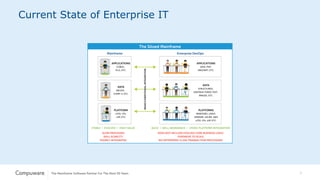
Current State of Enterprise IT
3
4
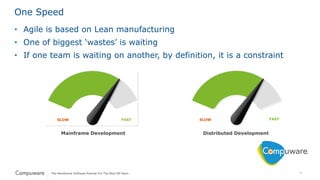
One Speed
• Agile is based on Lean manufacturing
• One of biggest ‘wastes’ is waiting
• If one team is waiting on another, by definition, it is a constraint
FASTSLOW
Distributed Development
FASTSLOW
Mainframe Development
5
6
DevOps Supporting Practices
• Iterative/Agile
• Minimum Viable Product
• Lean
• “Whole team”
• Collaboration
• Test Data Management
• Continuous Integration, Delivery, Feedback and Learning
• Automation – Analysis, Coding, Testing, Deployment, Monitoring
• Measurement
7
DevOps Supporting Tools
• Planning/Backlog Management
• Analysis, System & Program
• Code and Unit Test
• Quality Assurance
• Automated Testing
• Deployment
• Orchestration
• Collaboration
• Monitoring
8
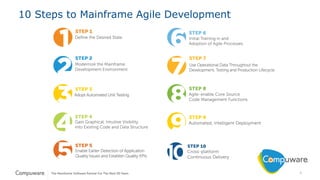
10 Steps to Mainframe Agile Development
9
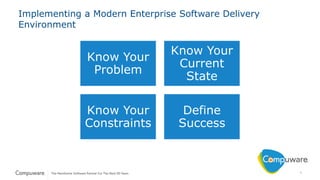
Implementing a Modern Enterprise Software Delivery
Environment
Know Your
Problem
Know Your
Current
State
Know Your
Constraints
Define
Success
10
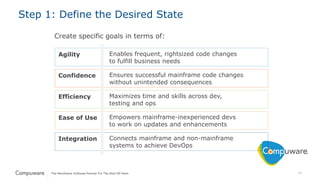
Step 1: Define the Desired State
Create specific goals in terms of:
Agility Enables frequent, rightsized code changes
to fulfill business needs
Confidence Ensures successful mainframe code changes
without unintended consequences
Efficiency Maximizes time and skills across dev,
testing and ops
Ease of Use Empowers mainframe-inexperienced devs
to work on updates and enhancements
Integration Connects mainframe and non-mainframe
systems to achieve DevOps
11
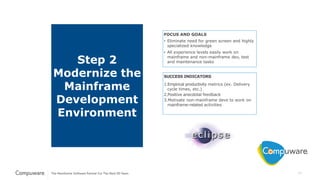
Step 2
Modernize the
Mainframe
Development
Environment
FOCUS AND GOALS
• Eliminate need for green screen and highly
specialized knowledge
• All experience levels easily work on
mainframe and non-mainframe dev, test
and maintenance tasks
SUCCESS INDICATORS
1.Empirical productivity metrics (ex. Delivery
cycle times, etc.)
2.Positive anecdotal feedback
3.Motivate non-mainframe devs to work on
mainframe-related activities
12
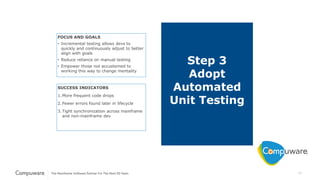
Step 3
Adopt
Automated
Unit Testing
FOCUS AND GOALS
• Incremental testing allows devs to
quickly and continuously adjust to better
align with goals
• Reduce reliance on manual testing
• Empower those not accustomed to
working this way to change mentality
SUCCESS INDICATORS
1.More frequent code drops
2.Fewer errors found later in lifecycle
3.Tight synchronization across mainframe
and non-mainframe dev
13
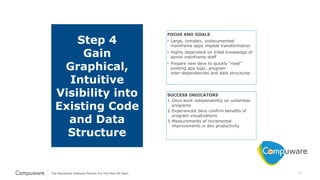
Step 4
Gain
Graphical,
Intuitive
Visibility into
Existing Code
and Data
Structure
FOCUS AND GOALS
• Large, complex, undocumented
mainframe apps impede transformation
• Highly dependent on tribal knowledge of
senior mainframe staff
• Prepare new devs to quickly “read”
existing app logic, program
inter-dependencies and data structures
SUCCESS INDICATORS
1.Devs work independently on unfamiliar
programs
2.Experienced devs confirm benefits of
program visualizations
3.Measurements of incremental
improvements in dev productivity
14
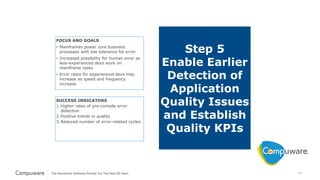
Step 5
Enable Earlier
Detection of
Application
Quality Issues
and Establish
Quality KPIs
FOCUS AND GOALS
• Mainframes power core business
processes with low tolerance for error
• Increased possibility for human error as
less-experienced devs work on
mainframe tasks
• Error rates for experienced devs may
increase as speed and frequency
increase
SUCCESS INDICATORS
1.Higher rates of pre-compile error
detection
2.Positive trends in quality
3.Reduced number of error-related cycles
15
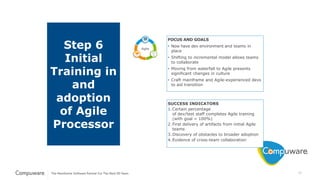
Step 6
Initial
Training in
and
adoption
of Agile
Processor
FOCUS AND GOALS
• Now have dev environment and teams in
place
• Shifting to incremental model allows teams
to collaborate
• Moving from waterfall to Agile presents
significant changes in culture
• Craft mainframe and Agile-experienced devs
to aid transition
SUCCESS INDICATORS
1.Certain percentage
of dev/test staff completes Agile training
(with goal = 100%)
2.First delivery of artifacts from initial Agile
teams
3.Discovery of obstacles to broader adoption
4.Evidence of cross-team collaboration
16
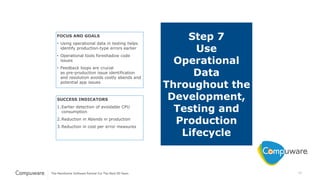
Step 7
Use
Operational
Data
Throughout the
Development,
Testing and
Production
Lifecycle
FOCUS AND GOALS
• Using operational data in testing helps
identify production-type errors earlier
• Operational tools foreshadow code
issues
• Feedback loops are crucial
as pre-production issue identification
and resolution avoids costly abends and
potential app issues
SUCCESS INDICATORS
1.Earlier detection of avoidable CPU
consumption
2.Reduction in Abends in production
3.Reduction in cost per error measures
17
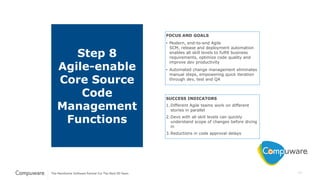
Step 8
Agile-enable
Core Source
Code
Management
Functions
FOCUS AND GOALS
• Modern, end-to-end Agile
SCM, release and deployment automation
enables all skill levels to fulfill business
requirements, optimize code quality and
improve dev productivity
• Automated change management eliminates
manual steps, empowering quick iteration
through dev, test and QA
SUCCESS INDICATORS
1.Different Agile teams work on different
stories in parallel
2.Devs with all skill levels can quickly
understand scope of changes before diving
in
3.Reductions in code approval delays
18
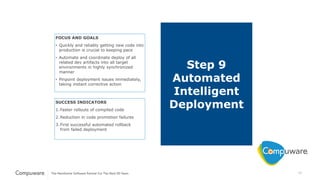
Step 9
Automated
Intelligent
Deployment
FOCUS AND GOALS
• Quickly and reliably getting new code into
production is crucial to keeping pace
• Automate and coordinate deploy of all
related dev artifacts into all target
environments in highly synchronized
manner
• Pinpoint deployment issues immediately,
taking instant corrective action
SUCCESS INDICATORS
1.Faster rollouts of compiled code
2.Reduction in code promotion failures
3.First successful automated rollback
from failed deployment
19
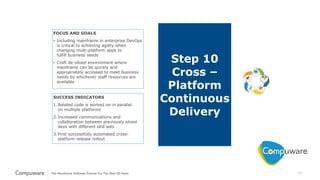
Step 10
Cross –
Platform
Continuous
Delivery
FOCUS AND GOALS
• Including mainframe in enterprise DevOps
is critical to achieving agility when
changing multi-platform apps to
fulfill business needs
• Craft de-siloed environment where
mainframe can be quickly and
appropriately accessed to meet business
needs by whichever staff resources are
available
SUCCESS INDICATORS
1.Related code is worked on in parallel
on multiple platforms
2.Increased communications and
collaboration between previously siloed
devs with different skill sets
3.First successfully automated cross-
platform release rollout
20
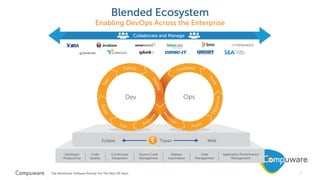
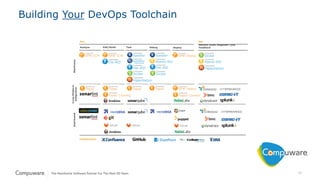
Debug Deploy
Monitor Audit Diagnose Tune
FeedbackTestEdit/BuildAnalyze
Collaboration
Mainframe
CrossPlatform
Integration
Distributed
Dev Ops
Building Your DevOps Toolchain
21
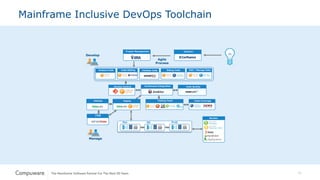
Dev
Agile
Process
IdeationProject Management
Code Editing Validate CodeAnalyze Code Debug Code Edit / Manage Data
Develop
Continuous IntegrationVersion Control Code Quality
Testing Tools Code CoverageRelease Deploy
Manage
ITSM
Monitor
Dev QA Prod
Mainframe Inclusive DevOps Toolchain
22
© 2016 Compuware Corporation. All rights reserved.

NRB - LUXEMBOURG MAINFRAME DAY 2017 - Compuware DevOps presentation

  • 1.
    1 Including the Mainframein a DevOps Software Delivery Environment Rick Slade, Executive Solution Architect - DevOps October, 2017
  • 2.
    2 Current State ofEnterprise IT
  • 3.
  • 4.
    4 One Speed • Agileis based on Lean manufacturing • One of biggest ‘wastes’ is waiting • If one team is waiting on another, by definition, it is a constraint FASTSLOW Distributed Development FASTSLOW Mainframe Development
  • 5.
  • 6.
    6 DevOps Supporting Practices •Iterative/Agile • Minimum Viable Product • Lean • “Whole team” • Collaboration • Test Data Management • Continuous Integration, Delivery, Feedback and Learning • Automation – Analysis, Coding, Testing, Deployment, Monitoring • Measurement
  • 7.
    7 DevOps Supporting Tools •Planning/Backlog Management • Analysis, System & Program • Code and Unit Test • Quality Assurance • Automated Testing • Deployment • Orchestration • Collaboration • Monitoring
  • 8.
    8 10 Steps toMainframe Agile Development
  • 9.
    9 Implementing a ModernEnterprise Software Delivery Environment Know Your Problem Know Your Current State Know Your Constraints Define Success
  • 10.
    10 Step 1: Definethe Desired State Create specific goals in terms of: Agility Enables frequent, rightsized code changes to fulfill business needs Confidence Ensures successful mainframe code changes without unintended consequences Efficiency Maximizes time and skills across dev, testing and ops Ease of Use Empowers mainframe-inexperienced devs to work on updates and enhancements Integration Connects mainframe and non-mainframe systems to achieve DevOps
  • 11.
    11 Step 2 Modernize the Mainframe Development Environment FOCUSAND GOALS • Eliminate need for green screen and highly specialized knowledge • All experience levels easily work on mainframe and non-mainframe dev, test and maintenance tasks SUCCESS INDICATORS 1.Empirical productivity metrics (ex. Delivery cycle times, etc.) 2.Positive anecdotal feedback 3.Motivate non-mainframe devs to work on mainframe-related activities
  • 12.
    12 Step 3 Adopt Automated Unit Testing FOCUSAND GOALS • Incremental testing allows devs to quickly and continuously adjust to better align with goals • Reduce reliance on manual testing • Empower those not accustomed to working this way to change mentality SUCCESS INDICATORS 1.More frequent code drops 2.Fewer errors found later in lifecycle 3.Tight synchronization across mainframe and non-mainframe dev
  • 13.
    13 Step 4 Gain Graphical, Intuitive Visibility into ExistingCode and Data Structure FOCUS AND GOALS • Large, complex, undocumented mainframe apps impede transformation • Highly dependent on tribal knowledge of senior mainframe staff • Prepare new devs to quickly “read” existing app logic, program inter-dependencies and data structures SUCCESS INDICATORS 1.Devs work independently on unfamiliar programs 2.Experienced devs confirm benefits of program visualizations 3.Measurements of incremental improvements in dev productivity
  • 14.
    14 Step 5 Enable Earlier Detectionof Application Quality Issues and Establish Quality KPIs FOCUS AND GOALS • Mainframes power core business processes with low tolerance for error • Increased possibility for human error as less-experienced devs work on mainframe tasks • Error rates for experienced devs may increase as speed and frequency increase SUCCESS INDICATORS 1.Higher rates of pre-compile error detection 2.Positive trends in quality 3.Reduced number of error-related cycles
  • 15.
    15 Step 6 Initial Training in and adoption ofAgile Processor FOCUS AND GOALS • Now have dev environment and teams in place • Shifting to incremental model allows teams to collaborate • Moving from waterfall to Agile presents significant changes in culture • Craft mainframe and Agile-experienced devs to aid transition SUCCESS INDICATORS 1.Certain percentage of dev/test staff completes Agile training (with goal = 100%) 2.First delivery of artifacts from initial Agile teams 3.Discovery of obstacles to broader adoption 4.Evidence of cross-team collaboration
  • 16.
    16 Step 7 Use Operational Data Throughout the Development, Testingand Production Lifecycle FOCUS AND GOALS • Using operational data in testing helps identify production-type errors earlier • Operational tools foreshadow code issues • Feedback loops are crucial as pre-production issue identification and resolution avoids costly abends and potential app issues SUCCESS INDICATORS 1.Earlier detection of avoidable CPU consumption 2.Reduction in Abends in production 3.Reduction in cost per error measures
  • 17.
    17 Step 8 Agile-enable Core Source Code Management Functions FOCUSAND GOALS • Modern, end-to-end Agile SCM, release and deployment automation enables all skill levels to fulfill business requirements, optimize code quality and improve dev productivity • Automated change management eliminates manual steps, empowering quick iteration through dev, test and QA SUCCESS INDICATORS 1.Different Agile teams work on different stories in parallel 2.Devs with all skill levels can quickly understand scope of changes before diving in 3.Reductions in code approval delays
  • 18.
    18 Step 9 Automated Intelligent Deployment FOCUS ANDGOALS • Quickly and reliably getting new code into production is crucial to keeping pace • Automate and coordinate deploy of all related dev artifacts into all target environments in highly synchronized manner • Pinpoint deployment issues immediately, taking instant corrective action SUCCESS INDICATORS 1.Faster rollouts of compiled code 2.Reduction in code promotion failures 3.First successful automated rollback from failed deployment
  • 19.
    19 Step 10 Cross – Platform Continuous Delivery FOCUSAND GOALS • Including mainframe in enterprise DevOps is critical to achieving agility when changing multi-platform apps to fulfill business needs • Craft de-siloed environment where mainframe can be quickly and appropriately accessed to meet business needs by whichever staff resources are available SUCCESS INDICATORS 1.Related code is worked on in parallel on multiple platforms 2.Increased communications and collaboration between previously siloed devs with different skill sets 3.First successfully automated cross- platform release rollout
  • 20.
    20 Debug Deploy Monitor AuditDiagnose Tune FeedbackTestEdit/BuildAnalyze Collaboration Mainframe CrossPlatform Integration Distributed Dev Ops Building Your DevOps Toolchain
  • 21.
    21 Dev Agile Process IdeationProject Management Code EditingValidate CodeAnalyze Code Debug Code Edit / Manage Data Develop Continuous IntegrationVersion Control Code Quality Testing Tools Code CoverageRelease Deploy Manage ITSM Monitor Dev QA Prod Mainframe Inclusive DevOps Toolchain
  • 22.
    22 © 2016 CompuwareCorporation. All rights reserved.