Slicing Smart Cities
A short introduction to the urban spaces of
the 21st
century
Slice 4. Mobility &
Urban Planning
Created by Joan Manuel Lopez
@TheBitCity
Under CC BY-SA 4.0 License
2
➢ Mobility & Urban Planning
✔ Overview
✔ Urban Mobility
✔ Intelligent Transportation Systems
✔ Urban Planning
✔ Public safety
✔ Resilience
3
Overview
➔ Mobility
Movement between an origin point and a
destination point, regardless the mean of
transport used
➔ Urban Planning
Planification and design of urban spaces and
their provision of services
The way a city is designed affects the way to move
within it
4
Overview
➔ Urban mobility challenges
➔ Excessive dependence on private vehicles
➔ Important source of pollution
➔ Congestion of urban and interurban roads
➔ Urban planning challenges
➔ Growth of urban population
➔ Increasing pressure over services and infrastructures
➔ Informal settlements
 Environmental and social problems
5
Urban Mobility
Movement between an origin point and a
destination point
➔ Fundamental right of citizens
➔ Safety Low accident rate→
➔ Accesibility Within everyone's reach→
➔ Confort Under optimal conditions→
➔ Smooth Without unjustified interruptions→
6
Urban Mobility
Improvement actions:
➔ Efficient public transportation system
➔ Encourage multimodality
➔ Promotion of non-polluting modes
➔ Adoption of ITS
➔ Urban design approaching citizens and services
to distances easily covered on foot
7
Intelligent Transportation Systems
Taking advantage of the possibilities of ICT
in transportation management
➔ Knowledge in real-time of the state of urban and
interurban roads
➔ Knowledge in real-time of the state of the public
transportation system
➔ Information about optimal ways
➔ "Journey planner" tools
➔ Enabling integrated pricing systems
8
Intelligent Transportation Systems
➔ Examples of use of ITS
➔ Management of urban buses fleets
➔ Control center of railway traffic
➔ Management of regulated parking areas
➔ Development of innovative services, usually on
non-polluting modes
➔ Bikesharing (bicing, vélib, etc.)
➔ Management of charging points for electrical vehicles
➔ Carpooling (BlaBlaCar, etc.)
➔ Self-guided urban walking tours
9
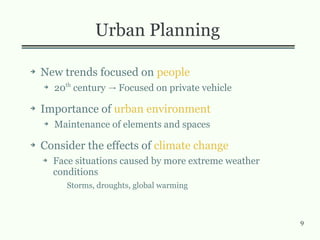
Urban Planning
➔ New trends focused on people
➔
20th
century Focused on private vehicle→
➔ Importance of urban environment
➔ Maintenance of elements and spaces
➔ Consider the effects of climate change
➔ Face situations caused by more extreme weather
conditions
Storms, droughts, global warming
10
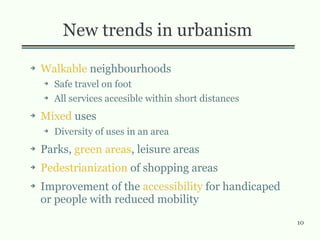
New trends in urbanism
➔ Walkable neighbourhoods
➔ Safe travel on foot
➔ All services accesible within short distances
➔ Mixed uses
➔ Diversity of uses in an area
➔ Parks, green areas, leisure areas
➔ Pedestrianization of shopping areas
➔ Improvement of the accessibility for handicaped
or people with reduced mobility
11
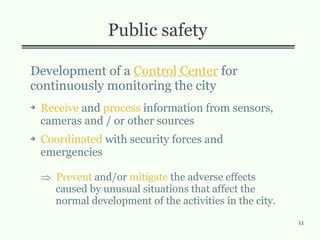
Public safety
Development of a Control Center for
continuously monitoring the city
➔ Receive and process information from sensors,
cameras and / or other sources
➔ Coordinated with security forces and
emergencies
 Prevent and/or mitigate the adverse effects
caused by unusual situations that affect the
normal development of the activities in the city.
12
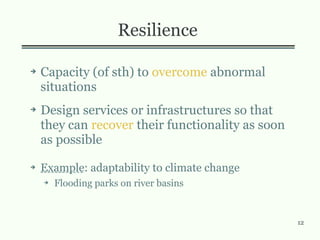
Resilience
➔ Capacity (of sth) to overcome abnormal
situations
➔ Design services or infrastructures so that
they can recover their functionality as soon
as possible
➔ Example: adaptability to climate change
➔ Flooding parks on river basins
Thank you!
Linkedin:
Twitter:
Blog:
https://es.linkedin.com/in/joanmanuellopez
@TheBitCity
https://thebitcity.wordpress.com/

Slicing Smart Cities. Slice 4 - Mobility & Urban Planning

  • 1.
    Slicing Smart Cities Ashort introduction to the urban spaces of the 21st century Slice 4. Mobility & Urban Planning Created by Joan Manuel Lopez @TheBitCity Under CC BY-SA 4.0 License
  • 2.
    2 ➢ Mobility &Urban Planning ✔ Overview ✔ Urban Mobility ✔ Intelligent Transportation Systems ✔ Urban Planning ✔ Public safety ✔ Resilience
  • 3.
    3 Overview ➔ Mobility Movement betweenan origin point and a destination point, regardless the mean of transport used ➔ Urban Planning Planification and design of urban spaces and their provision of services The way a city is designed affects the way to move within it
  • 4.
    4 Overview ➔ Urban mobilitychallenges ➔ Excessive dependence on private vehicles ➔ Important source of pollution ➔ Congestion of urban and interurban roads ➔ Urban planning challenges ➔ Growth of urban population ➔ Increasing pressure over services and infrastructures ➔ Informal settlements  Environmental and social problems
  • 5.
    5 Urban Mobility Movement betweenan origin point and a destination point ➔ Fundamental right of citizens ➔ Safety Low accident rate→ ➔ Accesibility Within everyone's reach→ ➔ Confort Under optimal conditions→ ➔ Smooth Without unjustified interruptions→
  • 6.
    6 Urban Mobility Improvement actions: ➔Efficient public transportation system ➔ Encourage multimodality ➔ Promotion of non-polluting modes ➔ Adoption of ITS ➔ Urban design approaching citizens and services to distances easily covered on foot
  • 7.
    7 Intelligent Transportation Systems Takingadvantage of the possibilities of ICT in transportation management ➔ Knowledge in real-time of the state of urban and interurban roads ➔ Knowledge in real-time of the state of the public transportation system ➔ Information about optimal ways ➔ "Journey planner" tools ➔ Enabling integrated pricing systems
  • 8.
    8 Intelligent Transportation Systems ➔Examples of use of ITS ➔ Management of urban buses fleets ➔ Control center of railway traffic ➔ Management of regulated parking areas ➔ Development of innovative services, usually on non-polluting modes ➔ Bikesharing (bicing, vélib, etc.) ➔ Management of charging points for electrical vehicles ➔ Carpooling (BlaBlaCar, etc.) ➔ Self-guided urban walking tours
  • 9.
    9 Urban Planning ➔ Newtrends focused on people ➔ 20th century Focused on private vehicle→ ➔ Importance of urban environment ➔ Maintenance of elements and spaces ➔ Consider the effects of climate change ➔ Face situations caused by more extreme weather conditions Storms, droughts, global warming
  • 10.
    10 New trends inurbanism ➔ Walkable neighbourhoods ➔ Safe travel on foot ➔ All services accesible within short distances ➔ Mixed uses ➔ Diversity of uses in an area ➔ Parks, green areas, leisure areas ➔ Pedestrianization of shopping areas ➔ Improvement of the accessibility for handicaped or people with reduced mobility
  • 11.
    11 Public safety Development ofa Control Center for continuously monitoring the city ➔ Receive and process information from sensors, cameras and / or other sources ➔ Coordinated with security forces and emergencies  Prevent and/or mitigate the adverse effects caused by unusual situations that affect the normal development of the activities in the city.
  • 12.
    12 Resilience ➔ Capacity (ofsth) to overcome abnormal situations ➔ Design services or infrastructures so that they can recover their functionality as soon as possible ➔ Example: adaptability to climate change ➔ Flooding parks on river basins
  • 13.