


Sleep
Mediation vs. Medication
By
Soheir H. ElGhonemy
Assist. Professor of Psychiatry- Ain Shams University
Member of International Society of Addiction Medicine
Member of WPA, European and American Psychiatric
Associations
Trainer Approved by NCFLD
selghonamy@hotmail.com
Sleep
 Each of us will spend third of our lives asleep.
 Sleep is a complex and pervasive cognitive state affected
by medications in many different ways.
 The field of sleep disorders medicine has become
increasingly complex with more than 90 disorders of sleep
described, each with clear diagnostic criteria.
 An even larger group of diseases produces mental or
physical discomfort affecting sleep.
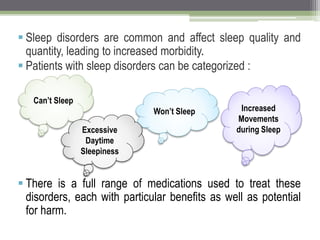
 Sleep disorders are common and affect sleep quality and
quantity, leading to increased morbidity.
 Patients with sleep disorders can be categorized :
 There is a full range of medications used to treat these
disorders, each with particular benefits as well as potential
for harm.
Can’t Sleep
Won’t Sleep
Excessive
Daytime
Sleepiness
Increased
Movements
during Sleep
Meditation: Pathway to Well Being
 Well-Being:
 Physical
 Mental
 Emotional
 Spiritual
Meditation
 Increases energy
 Relieves stress
 Reduces fatigue
 Relieves insomnia
 Reduces blood pressure and cholesterol
 Reduces anxiety
 Balances hormones
 Improves self-confidence
 Emptying or concentration of the mind
 Focusing
 Mindfulness
 All spiritual traditions have some connection with the
practice of meditation
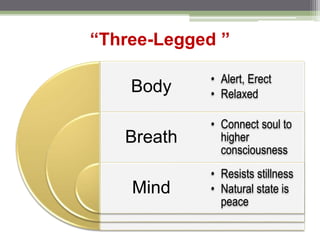
“Three-Legged ”
Body
Breath
Mind
• Alert, Erect
• Relaxed
• Connect soul to
higher
consciousness
• Resists stillness
• Natural state is
peace
Non-Judgment
 One of the keys to happiness is to stop the habit of self-
judgment and self-hatred.
 When we stop judging ourselves we will stop judging others.
 Where there is no judgment, there is peace.
 Mindfulness meditation has emerged as a novel approach to
emotion regulation and stress reduction that has several
health benefits.
 A meditation-based program arised for individuals suffering
from chronic sleep disturbance.
 Individuals with chronic insomnia often feel that they have
no control over their sleep and present with a rigid
attachment to the desire for more sleep.
 Mindfulness-based therapy for insomnia was developed to
help these individuals by using mindfulness meditation to
manage the emotional reactions to sleep disturbance and
daytime fatigue that commonly arise during the course of
chronic insomnia.
A 10-Step Mindfulness Practice For Better
Sleep
 Remember, this is not an exercise to make you go to
sleep, but rather to increase your awareness and
understanding of your mind at night. It just so happens
that it often results in sleep.
Step 1
 Once you’re lying comfortably in bed, take five deep
breaths, breathing in through the nose and out through the
mouth. As you breathe in, try to get a sense of the lungs
filling with air and the chest expanding. As you breathe out,
imagine the thoughts and feelings of the day just
disappearing into the distance, and any feelings of tension
in the body just melting away.
 This will help to prepare both the body and the mind for the
exercise ahead.
Step 2
 Begin by checking-in -- how you’re feeling --in both body
and mind. Remember that in the same way you can’t rush
relaxation, you cannot rush sleep, so take your time with
this part of the exercise.
 Don’t worry if there are lots of thoughts whizzing around
(this is absolutely normal). For now, just let them do their
own thing. Whatever you do, avoid the temptation to resist
the thoughts, no matter how unsettling or uncomfortable
they may be.
Step 3
 Next, become aware of the physical points of contact in a
little bit more detail. Bring your attention back to the
sensation of the body touching the bed, the weight of the
body sinking down into the mattress. Sounds can be
especially disturbing when you’re trying to go to sleep. At
first it’s helpful to recognize whether it’s a sound you can
change, or if it’s something outside of your control,
something you can do nothing about. Then, rather than
resisting the sound, gently rest your attention on it,
remaining present with the sound for 30 seconds or so,
before bringing your attention back to the body.
Step 4:
 Now try to get a sense of how the body actually feels. At first, do
this in a general way. For example, does the body feel heavy or
light, restless or still? Then try to get a more accurate picture by
mentally scanning down through the body, from head to toe,
gently observing any tension or tightness. Invariably, the mind
will be drawn to areas of tension, but you can relax in the
knowledge that you are about to sleep and that the exercise will
help to release those areas.
 You can do this scan several times, taking about 20 to 30
seconds each time. Remember to notice the areas that feel
relaxed and comfortable, as well as any areas of discomfort.
Step 5:
 By now you will have probably already noticed the rising
and falling sensation of the breath. As always, don’t try to
change the rhythm of the breath in any way, instead allow
the body to do its own thing.
 There is no right or wrong way to breathe within the context
of this exercise, so don’t worry if you feel it more in the
chest than the stomach. Notice whether the breath is deep
or shallow, long or short, smooth or irregular.
Step 6:
 As you watch the breath for a minute or two, it’s quite
normal for the mind to wander off. When you realize you’ve
been distracted, in that moment you are back in the
present, and all you need do is gently return the focus to
the rising and falling sensation. You don’t need to time this
part of the exercise, you can just naturally move on to the
next section when it feels as if a couple of minutes has
passed.
Step 7:
 This next part of the exercise is about thinking back through the
day in a focused and structured way. Begin by thinking back to
the very first moment you can remember in the day, right after
waking up in the morning. Do you remember how you felt upon
waking? Now, as if your brain has been set to a very gentle
"fast-forward," simply watch as your mind replays the events,
meetings and conversations of the day. This doesn’t need to be
in detail, it’s more of an overview, a series of snapshots passing
through the mind.
 Take about three minutes to go through the entire day, right up to the
present moment.
Step 8:
 Having brought yourself up to the present moment, you can
now return your focus to the body.
 Place your attention on the small toe of the left foot and
imagine that you’re just switching it off for the night. You
can even repeat the words
"switch off" or "and rest" in your mind as you focus on the
toe. It’s as if you’re giving the muscles, joints, bones and
everything else permission to switch off for the night,
knowing they will not be needed again until the morning.
Step 9:
 Do the same with the next toe, and the next, and so on.
Continue in this way through the ball of the foot, the arch,
the heel, the ankle, the lower half of the leg and so on all the
way up to the hip and pelvic area.
 Before you repeat this exercise with the right leg, take a
moment to notice the difference in the feeling between the
leg that has been "switched off" and the one that hasn’t.
 If there was any doubt in your mind about whether anything
was actually happening as you do this exercise, you’ll feel it
now. Repeat the same exercise on the right leg, once again
starting with the toes and working your way all the way up to
the waist.
Step 10:
 Continue this exercise up through the trunk, down through
the arms, hands and fingers, and up through the throat,
neck, face and head.
 Take a moment to enjoy the sensation of being free of
tension, of not needing to do anything with the body, of
having given up control. You can now allow the mind to
wander as much as it wants, freely associating from one
thought to the next, no matter where it wants to go, until
you drift off to sleep.
Sleep workshop 2015

Sleep workshop 2015

  • 1.
    Sleep Mediation vs. Medication By SoheirH. ElGhonemy Assist. Professor of Psychiatry- Ain Shams University Member of International Society of Addiction Medicine Member of WPA, European and American Psychiatric Associations Trainer Approved by NCFLD selghonamy@hotmail.com
  • 2.
    Sleep  Each ofus will spend third of our lives asleep.  Sleep is a complex and pervasive cognitive state affected by medications in many different ways.  The field of sleep disorders medicine has become increasingly complex with more than 90 disorders of sleep described, each with clear diagnostic criteria.  An even larger group of diseases produces mental or physical discomfort affecting sleep.
  • 3.
     Sleep disordersare common and affect sleep quality and quantity, leading to increased morbidity.  Patients with sleep disorders can be categorized :  There is a full range of medications used to treat these disorders, each with particular benefits as well as potential for harm. Can’t Sleep Won’t Sleep Excessive Daytime Sleepiness Increased Movements during Sleep
  • 4.
    Meditation: Pathway toWell Being  Well-Being:  Physical  Mental  Emotional  Spiritual
  • 5.
    Meditation  Increases energy Relieves stress  Reduces fatigue  Relieves insomnia  Reduces blood pressure and cholesterol  Reduces anxiety  Balances hormones  Improves self-confidence  Emptying or concentration of the mind  Focusing  Mindfulness  All spiritual traditions have some connection with the practice of meditation
  • 6.
    “Three-Legged ” Body Breath Mind • Alert,Erect • Relaxed • Connect soul to higher consciousness • Resists stillness • Natural state is peace
  • 7.
    Non-Judgment  One ofthe keys to happiness is to stop the habit of self- judgment and self-hatred.  When we stop judging ourselves we will stop judging others.  Where there is no judgment, there is peace.
  • 8.
     Mindfulness meditationhas emerged as a novel approach to emotion regulation and stress reduction that has several health benefits.  A meditation-based program arised for individuals suffering from chronic sleep disturbance.  Individuals with chronic insomnia often feel that they have no control over their sleep and present with a rigid attachment to the desire for more sleep.
  • 9.
     Mindfulness-based therapyfor insomnia was developed to help these individuals by using mindfulness meditation to manage the emotional reactions to sleep disturbance and daytime fatigue that commonly arise during the course of chronic insomnia.
  • 10.
    A 10-Step MindfulnessPractice For Better Sleep  Remember, this is not an exercise to make you go to sleep, but rather to increase your awareness and understanding of your mind at night. It just so happens that it often results in sleep.
  • 11.
    Step 1  Onceyou’re lying comfortably in bed, take five deep breaths, breathing in through the nose and out through the mouth. As you breathe in, try to get a sense of the lungs filling with air and the chest expanding. As you breathe out, imagine the thoughts and feelings of the day just disappearing into the distance, and any feelings of tension in the body just melting away.  This will help to prepare both the body and the mind for the exercise ahead.
  • 12.
    Step 2  Beginby checking-in -- how you’re feeling --in both body and mind. Remember that in the same way you can’t rush relaxation, you cannot rush sleep, so take your time with this part of the exercise.  Don’t worry if there are lots of thoughts whizzing around (this is absolutely normal). For now, just let them do their own thing. Whatever you do, avoid the temptation to resist the thoughts, no matter how unsettling or uncomfortable they may be.
  • 13.
    Step 3  Next,become aware of the physical points of contact in a little bit more detail. Bring your attention back to the sensation of the body touching the bed, the weight of the body sinking down into the mattress. Sounds can be especially disturbing when you’re trying to go to sleep. At first it’s helpful to recognize whether it’s a sound you can change, or if it’s something outside of your control, something you can do nothing about. Then, rather than resisting the sound, gently rest your attention on it, remaining present with the sound for 30 seconds or so, before bringing your attention back to the body.
  • 14.
    Step 4:  Nowtry to get a sense of how the body actually feels. At first, do this in a general way. For example, does the body feel heavy or light, restless or still? Then try to get a more accurate picture by mentally scanning down through the body, from head to toe, gently observing any tension or tightness. Invariably, the mind will be drawn to areas of tension, but you can relax in the knowledge that you are about to sleep and that the exercise will help to release those areas.  You can do this scan several times, taking about 20 to 30 seconds each time. Remember to notice the areas that feel relaxed and comfortable, as well as any areas of discomfort.
  • 15.
    Step 5:  Bynow you will have probably already noticed the rising and falling sensation of the breath. As always, don’t try to change the rhythm of the breath in any way, instead allow the body to do its own thing.  There is no right or wrong way to breathe within the context of this exercise, so don’t worry if you feel it more in the chest than the stomach. Notice whether the breath is deep or shallow, long or short, smooth or irregular.
  • 16.
    Step 6:  Asyou watch the breath for a minute or two, it’s quite normal for the mind to wander off. When you realize you’ve been distracted, in that moment you are back in the present, and all you need do is gently return the focus to the rising and falling sensation. You don’t need to time this part of the exercise, you can just naturally move on to the next section when it feels as if a couple of minutes has passed.
  • 17.
    Step 7:  Thisnext part of the exercise is about thinking back through the day in a focused and structured way. Begin by thinking back to the very first moment you can remember in the day, right after waking up in the morning. Do you remember how you felt upon waking? Now, as if your brain has been set to a very gentle "fast-forward," simply watch as your mind replays the events, meetings and conversations of the day. This doesn’t need to be in detail, it’s more of an overview, a series of snapshots passing through the mind.  Take about three minutes to go through the entire day, right up to the present moment.
  • 18.
    Step 8:  Havingbrought yourself up to the present moment, you can now return your focus to the body.  Place your attention on the small toe of the left foot and imagine that you’re just switching it off for the night. You can even repeat the words "switch off" or "and rest" in your mind as you focus on the toe. It’s as if you’re giving the muscles, joints, bones and everything else permission to switch off for the night, knowing they will not be needed again until the morning.
  • 19.
    Step 9:  Dothe same with the next toe, and the next, and so on. Continue in this way through the ball of the foot, the arch, the heel, the ankle, the lower half of the leg and so on all the way up to the hip and pelvic area.  Before you repeat this exercise with the right leg, take a moment to notice the difference in the feeling between the leg that has been "switched off" and the one that hasn’t.  If there was any doubt in your mind about whether anything was actually happening as you do this exercise, you’ll feel it now. Repeat the same exercise on the right leg, once again starting with the toes and working your way all the way up to the waist.
  • 20.
    Step 10:  Continuethis exercise up through the trunk, down through the arms, hands and fingers, and up through the throat, neck, face and head.  Take a moment to enjoy the sensation of being free of tension, of not needing to do anything with the body, of having given up control. You can now allow the mind to wander as much as it wants, freely associating from one thought to the next, no matter where it wants to go, until you drift off to sleep.