IBN SINA COLLEGE OF NURSING
AND HEALTH SCIENCES
Junaid khurshid M.sc Nursing Tutor
SKIN LESIONS
• A skin lesion is a part of the skin that has an abnormal growth or
appearance compared to the skin around it.
• Two categories of skin lesions exist: primary and secondary.
• Primary skin lesions are abnormal skin conditions present at birth
or acquired over a person’s lifetime.
• Secondary skin lesions are the result of irritated or manipulated
primary skin lesions. For example, if someone scratches a mole
until it bleeds, the resulting lesion, a crust, is now a secondary skin
lesion.
Conditions that cause skin lesions
ACNE
• Commonly located in face neck
shoulders chest
• Breakouts are composed of
blackheads pimples and nodules
• If untreated may leave scars or
darken the skin
COLD SORES
• A cold sore is a red, painful, fluid-
filled blister that appears near the
mouth and lips
• The affected area will often tingle or
burn before the cold sore is visible.
• These blisters occur alone or in
clusters
• Blisters may reoccur in response to
stress, menstruation, illness, or sun
exposure
Actinic keratosis
• An actinic keratosis
is a thick, scaly, or
crusty skin patch
that’s typically less
than 2 centimeters
(cm)
• It appears on parts of
the body that receive
a lot of sun exposure
(the hands, arms,
face, scalp, and neck)
Allergic eczema
• Allergic eczema leaves
the skin itchy, red,
scaly.
• It’s often found on the
hands and forearms
and may resemble a
burn.
• It also causes blisters
that weep, ooze, or
become crusty.
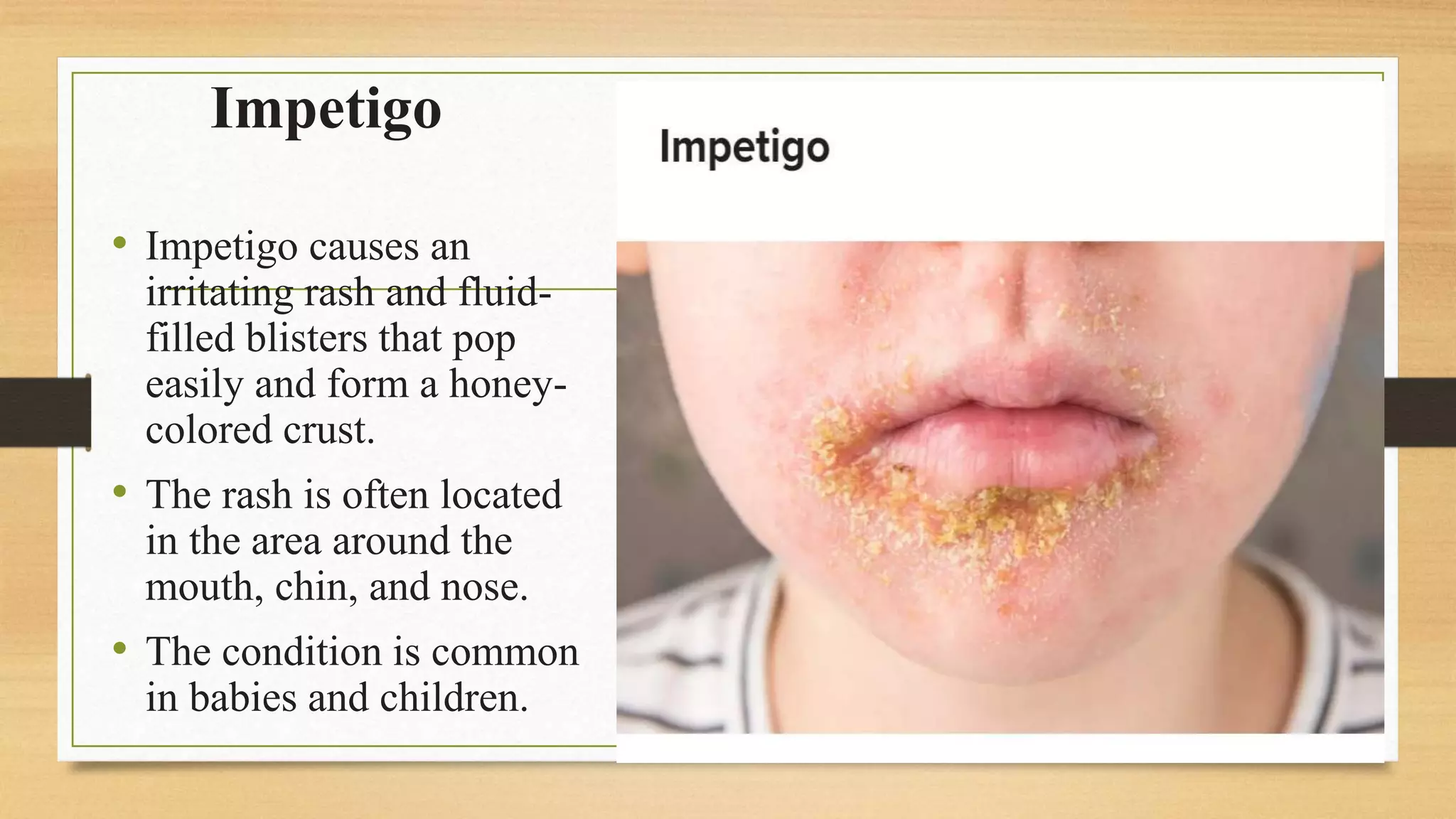
Impetigo
• Impetigo causes an
irritating rash and fluid-
filled blisters that pop
easily and form a honey-
colored crust.
• The rash is often located
in the area around the
mouth, chin, and nose.
• The condition is common
in babies and children.
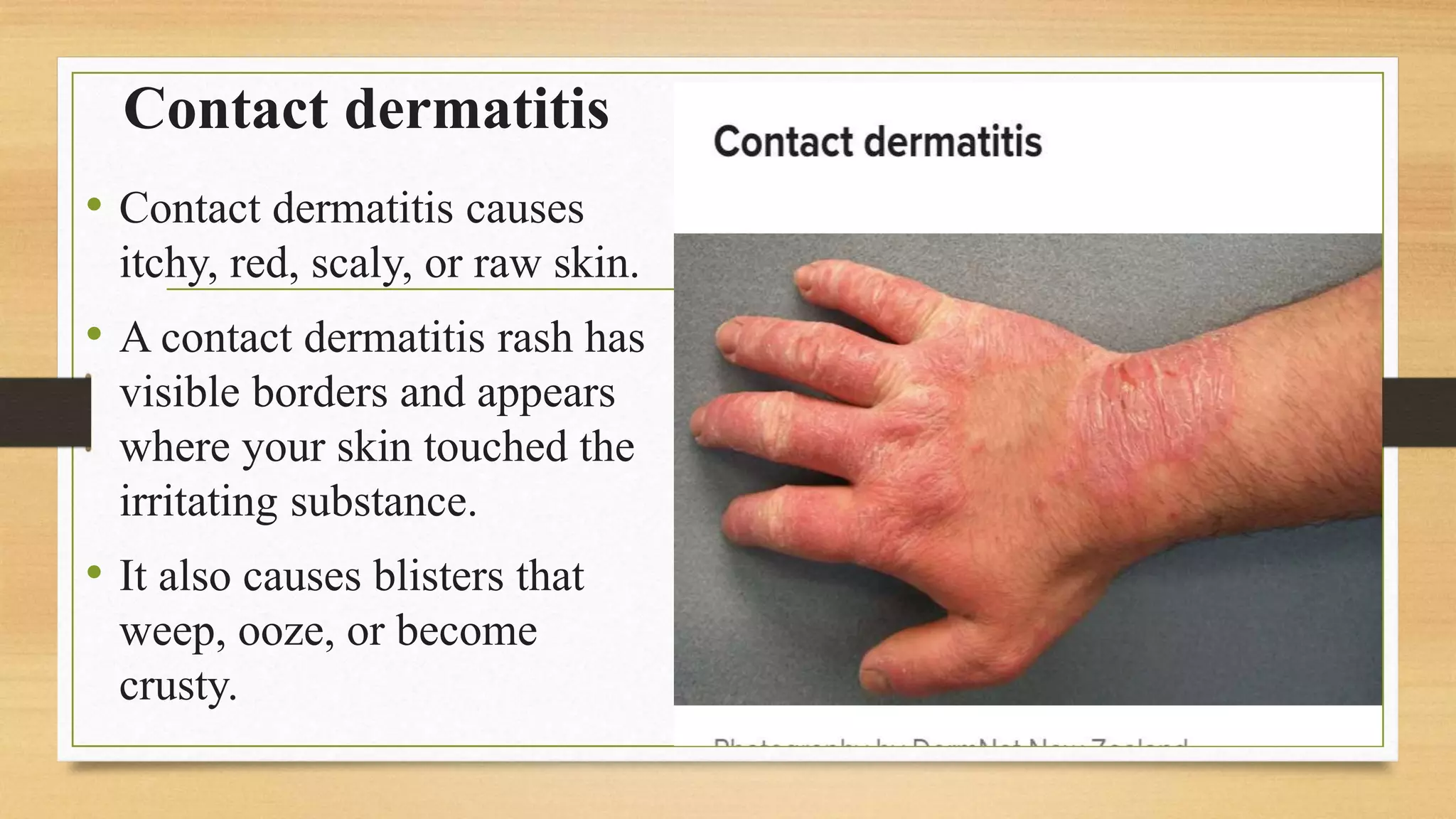
Contact dermatitis
• Contact dermatitis causes
itchy, red, scaly, or raw skin.
• A contact dermatitis rash has
visible borders and appears
where your skin touched the
irritating substance.
• It also causes blisters that
weep, ooze, or become
crusty.
Chickenpox
• Chickenpox leaves
clusters of itchy, red,
fluid-filled blisters
• A chickenpox rash is
accompanied by fever,
body aches, sore throat,
and loss of appetite
Epidermoid cysts
• Epidermoid cysts
are found on the
face, neck,
• Large cysts may
cause pressure and
pain.
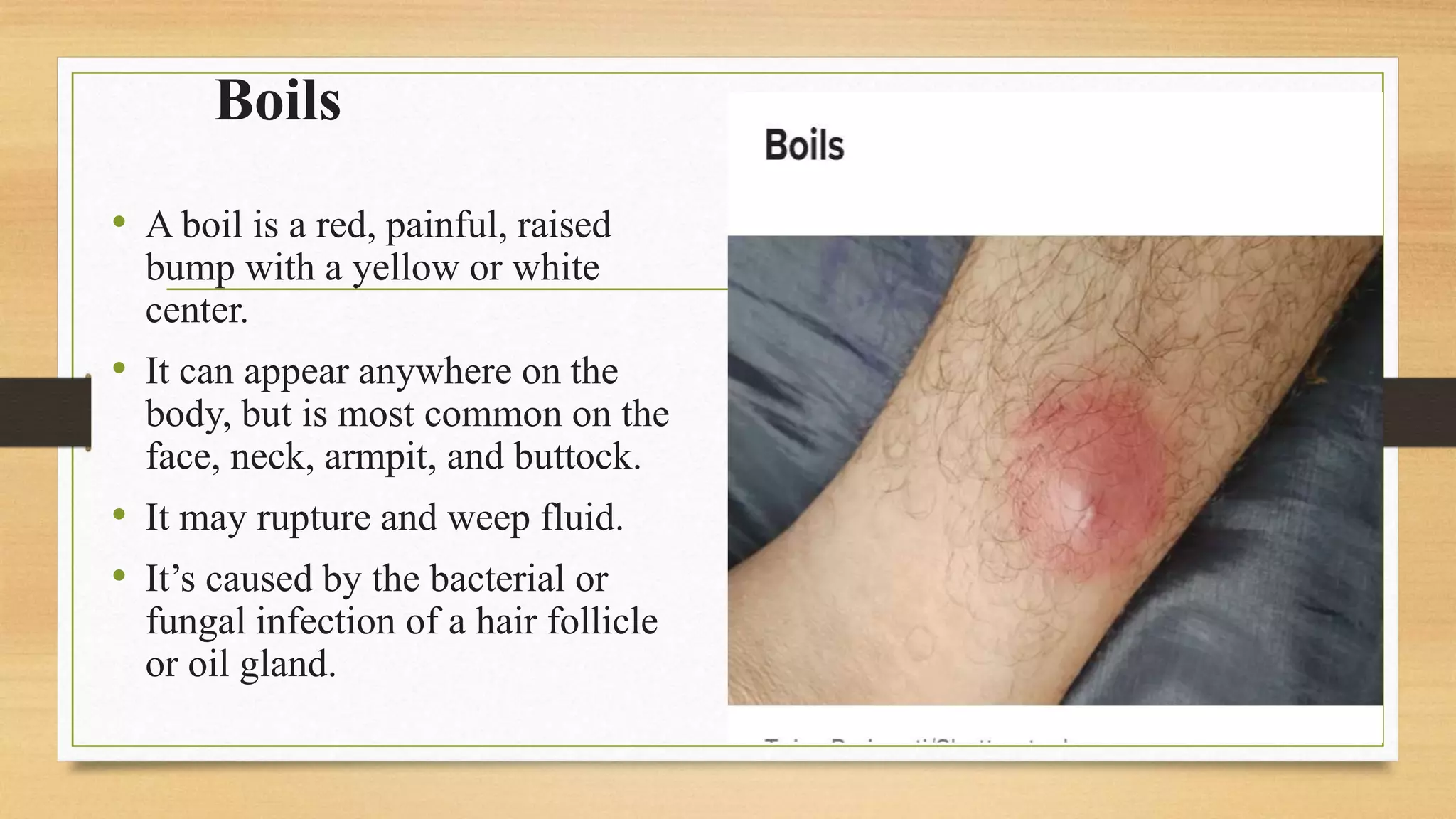
Boils
• A boil is a red, painful, raised
bump with a yellow or white
center.
• It can appear anywhere on the
body, but is most common on the
face, neck, armpit, and buttock.
• It may rupture and weep fluid.
• It’s caused by the bacterial or
fungal infection of a hair follicle
or oil gland.
Blisters
• A blister is
characterized by a
watery, clear, fluid-
filled area on the
skin.
• It can be found
anywhere on the
body.
Warts
• A wart is a raised, rough bump
that may be found on the skin
or mucous membranes.
• It’s caused by many different
types of a virus called human
papillomavirus (HPV).
• A wart may occur singly or in
groups.
SKIN LESIONS ibn sina.pptx

SKIN LESIONS ibn sina.pptx

  • 1.
    IBN SINA COLLEGEOF NURSING AND HEALTH SCIENCES Junaid khurshid M.sc Nursing Tutor
  • 2.
    SKIN LESIONS • Askin lesion is a part of the skin that has an abnormal growth or appearance compared to the skin around it. • Two categories of skin lesions exist: primary and secondary. • Primary skin lesions are abnormal skin conditions present at birth or acquired over a person’s lifetime. • Secondary skin lesions are the result of irritated or manipulated primary skin lesions. For example, if someone scratches a mole until it bleeds, the resulting lesion, a crust, is now a secondary skin lesion.
  • 3.
    Conditions that causeskin lesions ACNE • Commonly located in face neck shoulders chest • Breakouts are composed of blackheads pimples and nodules • If untreated may leave scars or darken the skin
  • 4.
    COLD SORES • Acold sore is a red, painful, fluid- filled blister that appears near the mouth and lips • The affected area will often tingle or burn before the cold sore is visible. • These blisters occur alone or in clusters • Blisters may reoccur in response to stress, menstruation, illness, or sun exposure
  • 5.
    Actinic keratosis • Anactinic keratosis is a thick, scaly, or crusty skin patch that’s typically less than 2 centimeters (cm) • It appears on parts of the body that receive a lot of sun exposure (the hands, arms, face, scalp, and neck)
  • 6.
    Allergic eczema • Allergiceczema leaves the skin itchy, red, scaly. • It’s often found on the hands and forearms and may resemble a burn. • It also causes blisters that weep, ooze, or become crusty.
  • 7.
    Impetigo • Impetigo causesan irritating rash and fluid- filled blisters that pop easily and form a honey- colored crust. • The rash is often located in the area around the mouth, chin, and nose. • The condition is common in babies and children.
  • 8.
    Contact dermatitis • Contactdermatitis causes itchy, red, scaly, or raw skin. • A contact dermatitis rash has visible borders and appears where your skin touched the irritating substance. • It also causes blisters that weep, ooze, or become crusty.
  • 9.
    Chickenpox • Chickenpox leaves clustersof itchy, red, fluid-filled blisters • A chickenpox rash is accompanied by fever, body aches, sore throat, and loss of appetite
  • 10.
    Epidermoid cysts • Epidermoidcysts are found on the face, neck, • Large cysts may cause pressure and pain.
  • 11.
    Boils • A boilis a red, painful, raised bump with a yellow or white center. • It can appear anywhere on the body, but is most common on the face, neck, armpit, and buttock. • It may rupture and weep fluid. • It’s caused by the bacterial or fungal infection of a hair follicle or oil gland.
  • 12.
    Blisters • A blisteris characterized by a watery, clear, fluid- filled area on the skin. • It can be found anywhere on the body.
  • 13.
    Warts • A wartis a raised, rough bump that may be found on the skin or mucous membranes. • It’s caused by many different types of a virus called human papillomavirus (HPV). • A wart may occur singly or in groups.