
Skimming and Scanning
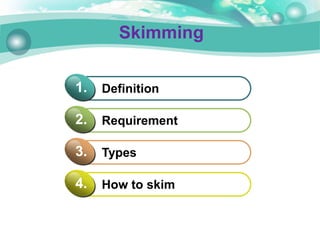
Skimming
Definition
1.
Requirement
2.
Types
3.
How to skim
4.
 1. Definition
 Skimming means reading selectively to
get a general idea of what an article is
about and to become familiar with the
most important ideas in it.
Skimming
 2. Requirement (speed and
comprehension)
 comprehension level is about 50-70%;
 speed should be about twice as fast as
the average reading speed or even faster.
Skimming
 3. Types of Skimming:
preread-skimming
skim-reading
review skimming
Skimming
4. How to skim
1). read the title
2). read the introduction
3). read any headings and subheadings
4). notice any pictures, charts or graphs included
5). read the first sentence of each paragraph
6). glance at the remainder of the paragraph
7). read the summary or last paragraph
Skimming
Some points in skimming
1. Concentrate on the main idea and keep
high speed
2. Don’t read every word of the material.
3. Pay attention to the key words and signal
words.
4. Catch or summarize the topic sentences.
Skimming
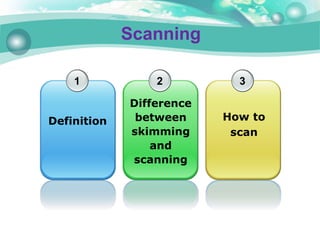
Scanning
1
Definition
2
Difference
between
skimming
and
scanning
3
How to
scan
Scanning
 1. Definition
 Scanning in reading is a technique for
quickly looking through reading material
to locate a particular piece of information
--- a fact, a date, a name, a statistic.
2. Differences between skimming and
scanning:
1). For skimming, in most cases we do not know
what the material is about beforehand; for
scanning, we usually have some idea about the
content of the material beforehand.
Scanning
2). Purpose for skimming---to get the general
idea; purpose for scanning---to sort out the exact
information we need.
3). For skimming, comprehension rate is about
50-70%; for scanning, you should be 100%
correct about the information you need.
Scanning
Scanning
 3. How to scan
1. check the organization
2. remember your purpose
3. anticipate clue words
4. identify likely answer locations
5. use a systematic pattern
6. confirm your answer

skimming and scanning

  • 1.
  • 2.
  • 3.
     1. Definition Skimming means reading selectively to get a general idea of what an article is about and to become familiar with the most important ideas in it. Skimming
  • 4.
     2. Requirement(speed and comprehension)  comprehension level is about 50-70%;  speed should be about twice as fast as the average reading speed or even faster. Skimming
  • 5.
     3. Typesof Skimming: preread-skimming skim-reading review skimming Skimming
  • 6.
    4. How toskim 1). read the title 2). read the introduction 3). read any headings and subheadings 4). notice any pictures, charts or graphs included 5). read the first sentence of each paragraph 6). glance at the remainder of the paragraph 7). read the summary or last paragraph Skimming
  • 7.
    Some points inskimming 1. Concentrate on the main idea and keep high speed 2. Don’t read every word of the material. 3. Pay attention to the key words and signal words. 4. Catch or summarize the topic sentences. Skimming
  • 8.
  • 9.
    Scanning  1. Definition Scanning in reading is a technique for quickly looking through reading material to locate a particular piece of information --- a fact, a date, a name, a statistic.
  • 10.
    2. Differences betweenskimming and scanning: 1). For skimming, in most cases we do not know what the material is about beforehand; for scanning, we usually have some idea about the content of the material beforehand. Scanning
  • 11.
    2). Purpose forskimming---to get the general idea; purpose for scanning---to sort out the exact information we need. 3). For skimming, comprehension rate is about 50-70%; for scanning, you should be 100% correct about the information you need. Scanning
  • 12.
    Scanning  3. Howto scan 1. check the organization 2. remember your purpose 3. anticipate clue words 4. identify likely answer locations 5. use a systematic pattern 6. confirm your answer