Southwest High School welcomes you to:Volunteer OrientationPICTUREPICTUREPICTUREPICTURE
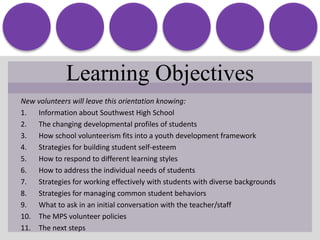
Learning ObjectivesNew volunteers will leave this orientation knowing:Information about Southwest High SchoolThe changing developmental profiles of students How school volunteerism fits into a youth development framework Strategies for building student self-esteemHow to respond to different learning stylesHow to address the individual needs of students Strategies for working effectively with students with diverse backgroundsStrategies for managing common student behaviors What to ask in an initial conversation with the teacher/staffThe MPS volunteer policiesThe next steps
Southwest High SchoolMoving toward academic successVision
Mission
Goals
ValuesSouthwest High SchoolOur studentsEnrollment
DemographicsSouthwest High SchoolWhat we offerAcademic curriculum
Magnet programs
Clubs and activities
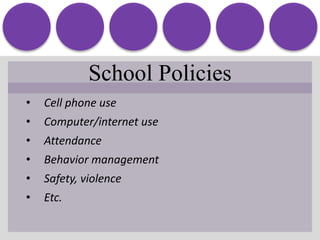
Business/college partnershipsSchool PoliciesCell phone use
Computer/internet use
Attendance
Behavior management
Safety, violence
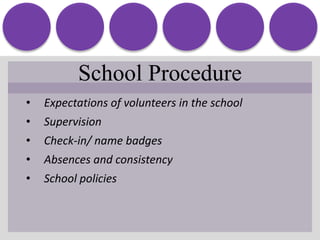
Etc.School ProcedureExpectations of volunteers in the school
Supervision
Check-in/ name badges
Absences and consistency
School policiesLogistics and ResourcesSchool calendar
Parking
Class schedule
Staff contact informationVolunteer OpportunitiesPICTUREHere would be examples of traditional opportunities you have available in your schoolDevelopmental ProfilesPICTURETake a moment to thinkback to yourtime in [insert your school demographic].  In one word, how would you describe yourself?
What was important to you at that time?
How did you spend your free time?Developmental ProfilesElementary SchoolPICTUREBuild trust and set boundariesSet clear boundaries and goalsBe precise and specificReinforce positive behaviorAllow movement
Developmental ProfilesMiddle SchoolPICTUREEncourage critical thinking
Write and write and write some more
Teach academic success skills
Become an advocate
Set attainable goalsDevelopmental ProfilesHigh SchoolPICTUREPICTUREBe a sounding boardModel the service ethicKnow your learnerAsk for help when you need itPICTURE
When Working with StudentsSet an example
Be prepared
Review, review, review
Give praise
Be positive

Site Volunteer Orientation

Editor's Notes

  • #2 DON’T KEEP THESE PICTURES, TAKE THEM AROUND YOUR SCHOOL AND ADD THEM TO THIS POWERPOINT!SLIDE TRANSITIONS AND ANIMATIONS ARE IN PLACE, BUT CAN BE CHANGED!
  • #5 GRAPHS?
  • #11 KEEP ONLY THE DEVELOPMENTAL PROFILE SPECIFIC TO YOUR SCHOOL!
  • #12 Elementary school is composed of fundamental learning and building basic knowledge. Elementary school is an important time in all children’s academic development.Suggestions for working with Elementary School StudentsBuilding trust and setting boundaries are essential factors in establishing an effective learning environment.Set clear boundaries and goals from day one. Be sure to explain why you are there. Maintain a firm and friendly demeanor.Be precise and specific when directing students. Make sure you have their undivided attention before placing expectations on them.Reinforce positive behavior! Catch students being good. Give lots of attention for appropriate behavior.Allow movement, especially for younger students. Let them move around and/or stretch. Take a break when necessary.
  • #13 Middle school includes more homework, harder tests, and tough reading assignments. Middle school and junior high can be a big transition for any child. At the middle school level, the reading material a student needs to master is "content rich," ranging from word problems to scientific facts. Tutoring sessions may involve deciphering unfamiliar words, solving problems, and deepening reading comprehension.Encourage critical thinking. Although it may be tempting to tell the student everything you know about a given subject, resist the urge to do the work yourself. Instead, explain your own thinking process and help your students build their own academic skills.Write and write and write some more. Students must write for a variety of purposes, so additional work on grammar, sentence structure, and punctuation may be needed. A tutor can harness the power of creativity. In your next session, experiment with poetry or try writing a screen play.Teach academic success skills. Many students need explicit instructions on how to organize material, take notes, and study for tests. A tutor can help a student gain mastery in these areas by explaining and modeling. Bring your datebook to sessions to show how you organize your time.Become an advocate. In addition to questioning students about schoolwork, making direct connections with classroom teachers helps you give and receive valuable feedback. Help your students figure out what to do when they have questions or concerns in class.Set attainable goals. It is imperative to set goals so that the session stays on task and results in concrete accomplishments. Reflect on the progress made (and ask the student involved to do the same!).