- RAVI
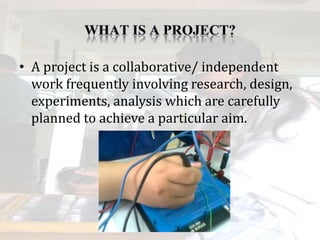
• A project is a collaborative/ independent
work frequently involving research, design,
experiments, analysis which are carefully
planned to achieve a particular aim.
• Project based learning (PBL) increases
motivation to study and help students to develop
long-term learning skills.
• Students develop deep, integrated understanding
of content and process of applications.
• PBL promotes responsibilities and independent
learning.
• PBL promotes collaboration to share and discuss
to find a critical solution for a problem.
• Students develop inquiry skills, acquire
laboratory experience, gain a higher level of
cognitive skills.
• Students make predictions, analyze data,
create a product, use technology and
troubleshoot.
• Project links educational institution and
career industries.
• Projects based learning frequently practice
the following five steps:
a. Determining the purpose and topic
b. Gathering the background information
c. Organizing the information
d. Sharing knowledge/analysis
e. Experimentation/construction/testing/product/
troubleshoot
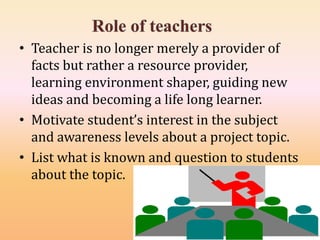
• Teacher is no longer merely a provider of
facts but rather a resource provider,
learning environment shaper, guiding new
ideas and becoming a life long learner.
• Motivate student’s interest in the subject
and awareness levels about a project topic.
• List what is known and question to students
about the topic.
• Categorize the questions for research to
select a topic.
• Brainstorm the sources of information
available in the institution.
• Record main ideas and interesting details.
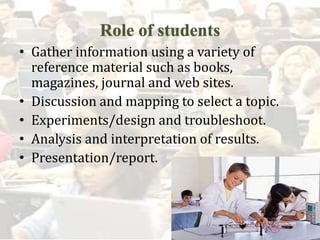
• Gather information using a variety of
reference material such as books,
magazines, journal and web sites.
• Discussion and mapping to select a topic.
• Experiments/design and troubleshoot.
• Analysis and interpretation of results.
• Presentation/report.
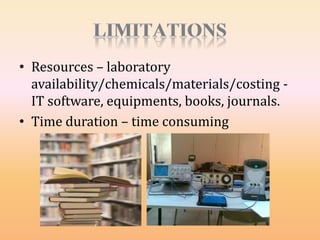
• Resources – laboratory
availability/chemicals/materials/costing -
IT software, equipments, books, journals.
• Time duration – time consuming
Ethical and Gender Implications
• Research and Freedom to select a topic.
• Experimentation on complex tasks.
• Application and integration of subject.
REFERENCES
• http://wikipedia.com
• http://olc.spsd.sk.ca/de/pd/instr/categ.html
• http://olc.spsd.sk.ca/de/pd/instr/alpha.html
• http://scholar.lib.vt.edu/ejournals/JTE/v18n1/
pdf/frank.pdf
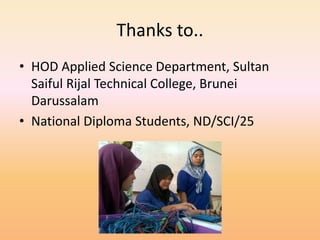
Thanks to..
• HOD Applied Science Department, Sultan
Saiful Rijal Technical College, Brunei
Darussalam
• National Diploma Students, ND/SCI/25

Sirravi

  • 1.
  • 2.
    • A projectis a collaborative/ independent work frequently involving research, design, experiments, analysis which are carefully planned to achieve a particular aim.
  • 3.
    • Project basedlearning (PBL) increases motivation to study and help students to develop long-term learning skills. • Students develop deep, integrated understanding of content and process of applications. • PBL promotes responsibilities and independent learning. • PBL promotes collaboration to share and discuss to find a critical solution for a problem.
  • 4.
    • Students developinquiry skills, acquire laboratory experience, gain a higher level of cognitive skills. • Students make predictions, analyze data, create a product, use technology and troubleshoot. • Project links educational institution and career industries.
  • 5.
    • Projects basedlearning frequently practice the following five steps: a. Determining the purpose and topic b. Gathering the background information c. Organizing the information d. Sharing knowledge/analysis e. Experimentation/construction/testing/product/ troubleshoot
  • 6.
    • Teacher isno longer merely a provider of facts but rather a resource provider, learning environment shaper, guiding new ideas and becoming a life long learner. • Motivate student’s interest in the subject and awareness levels about a project topic. • List what is known and question to students about the topic.
  • 7.
    • Categorize thequestions for research to select a topic. • Brainstorm the sources of information available in the institution. • Record main ideas and interesting details.
  • 8.
    • Gather informationusing a variety of reference material such as books, magazines, journal and web sites. • Discussion and mapping to select a topic. • Experiments/design and troubleshoot. • Analysis and interpretation of results. • Presentation/report.
  • 9.
    • Resources –laboratory availability/chemicals/materials/costing - IT software, equipments, books, journals. • Time duration – time consuming
  • 10.
    Ethical and GenderImplications • Research and Freedom to select a topic. • Experimentation on complex tasks. • Application and integration of subject.
  • 11.
    REFERENCES • http://wikipedia.com • http://olc.spsd.sk.ca/de/pd/instr/categ.html •http://olc.spsd.sk.ca/de/pd/instr/alpha.html • http://scholar.lib.vt.edu/ejournals/JTE/v18n1/ pdf/frank.pdf
  • 12.
    Thanks to.. • HODApplied Science Department, Sultan Saiful Rijal Technical College, Brunei Darussalam • National Diploma Students, ND/SCI/25