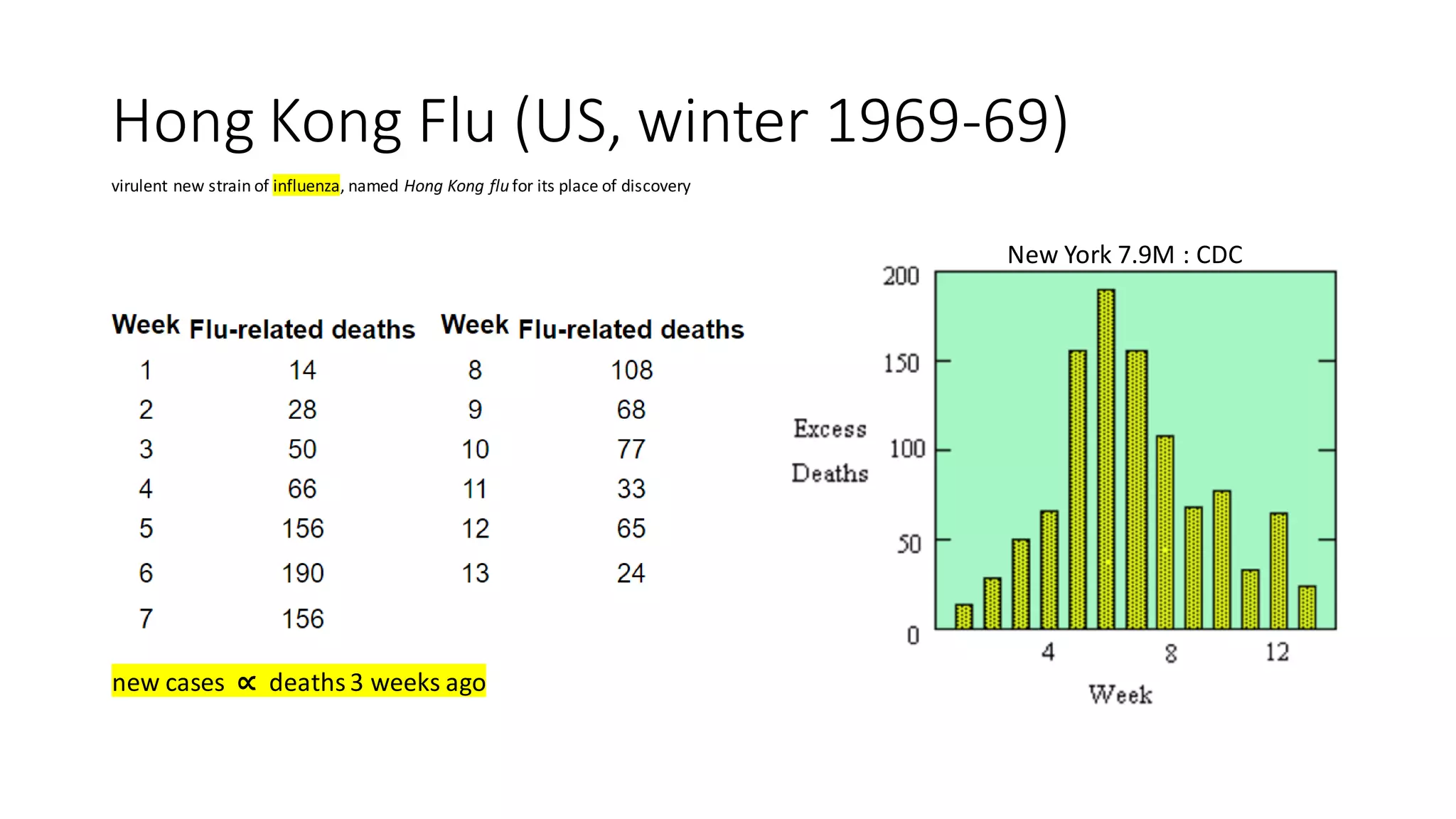
Hong Kong Flu (US, winter 1969-69)
New York 7.9M : CDC
virulent new strain of influenza, named Hong Kong flu for its place of discovery
new cases ∝ deaths 3 weeks ago
∴ s(t) is decreasing
active cases
total – active cases
S(0) 7,900,000
I(0) 10
R(0) 0
contact number /infected
c = b.D
= b/k
basic reproductive number
R0 = b.D
effective reproductive number
R = b.D.s(t)
D
independent of time
is constant
on integration
obtaining parameter
s(0) = 1
i(0) = 0
i(∞) = 0
1.4-1.6: 2009 flu H1N1, swine
1.4-2.8: 1918 flu H1N1, influenza
12.8: 1918-28 measles (US)
4.9: 1955 poliomyelitis (US)
5.7: COVID-19
For halting epidemic, R ≤ 1
R = R0.s(t)
∴ s(t) = 1/R0
= 0.175
82.5% herd immunity needed
R0
epidemic can't develop if:
- i'(t) < 0
- s(0) < 1/c
90% vaccine efficacy?
common cold,influenza:no long-lastingimmunity
immunization:for avoidingepidemic
measles:babies areimmune due to maternal antibodies
tuberculosis,typhoid:peoplecontinue to carry
infection without havingdisease
COVID-19: diseasehas significantincubation period
recovered people don't acquireimmunity
diseases with passiveimmunity and latency
recovered people acquiretemporary immunity
some people dieof diseasecomplications
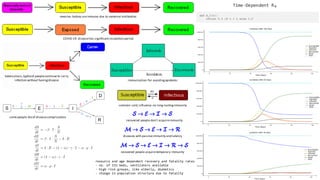
Time-Dependent R₀
resource and age dependent recovery and fatality rates
- no. of ICU beds, ventilators available
- high risk groups, like elderly, diabetics
- change in population structure due to fatality
CAS: computer algebra system
function dependent on n variables
s(a, t), i(a, t), r(a, t)
b(a, t), k(a, t)?
levels of parallelism
- multiple parameters values (sir)
- separate graph nodes
- per-node distribution
- multiple time steps
multiple particles
S, I, R, a, x, y

SIR Model : Disease Modelling : Epidemiology

  • 1.
    Hong Kong Flu(US, winter 1969-69) New York 7.9M : CDC virulent new strain of influenza, named Hong Kong flu for its place of discovery new cases ∝ deaths 3 weeks ago
  • 2.
    ∴ s(t) isdecreasing active cases total – active cases
  • 3.
    S(0) 7,900,000 I(0) 10 R(0)0 contact number /infected c = b.D = b/k basic reproductive number R0 = b.D effective reproductive number R = b.D.s(t) D independent of time is constant on integration obtaining parameter s(0) = 1 i(0) = 0 i(∞) = 0 1.4-1.6: 2009 flu H1N1, swine 1.4-2.8: 1918 flu H1N1, influenza 12.8: 1918-28 measles (US) 4.9: 1955 poliomyelitis (US) 5.7: COVID-19 For halting epidemic, R ≤ 1 R = R0.s(t) ∴ s(t) = 1/R0 = 0.175 82.5% herd immunity needed R0 epidemic can't develop if: - i'(t) < 0 - s(0) < 1/c 90% vaccine efficacy?
  • 4.
    common cold,influenza:no long-lastingimmunity immunization:foravoidingepidemic measles:babies areimmune due to maternal antibodies tuberculosis,typhoid:peoplecontinue to carry infection without havingdisease COVID-19: diseasehas significantincubation period recovered people don't acquireimmunity diseases with passiveimmunity and latency recovered people acquiretemporary immunity some people dieof diseasecomplications Time-Dependent R₀ resource and age dependent recovery and fatality rates - no. of ICU beds, ventilators available - high risk groups, like elderly, diabetics - change in population structure due to fatality
  • 5.
    CAS: computer algebrasystem function dependent on n variables s(a, t), i(a, t), r(a, t) b(a, t), k(a, t)? levels of parallelism - multiple parameters values (sir) - separate graph nodes - per-node distribution - multiple time steps multiple particles S, I, R, a, x, y