PRI vs SIP
PRI
What is PRI?
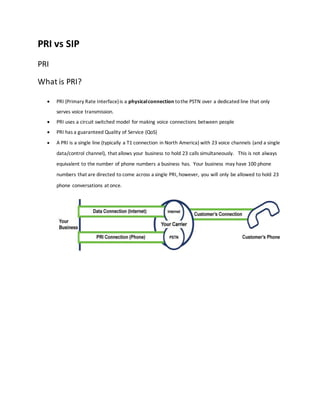
 PRI (Primary Rate Interface)is a physicalconnection tothe PSTN over a dedicated line that only
serves voice transmission.
 PRI uses a circuit switched model for making voice connections between people
 PRI has a guaranteed Quality of Service (QoS)
 A PRI is a single line (typically a T1 connection in North America) with 23 voice channels (and a single
data/control channel), that allows your business to hold 23 calls simultaneously. This is not always
equivalent to the number of phone numbers a business has. Your business may have 100 phone
numbers that are directed to come across a single PRI, however, you will only be allowed to hold 23
phone conversations at once.
SIP Trunking
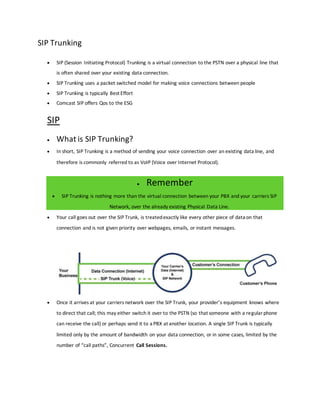
 SIP (Session Initiating Protocol) Trunking is a virtual connection to the PSTN over a physical line that
is often shared over your existing data connection.
 SIP Trunking uses a packet switched model for making voice connections between people
 SIP Trunking is typically Best Effort
 Comcast SIP offers Qos to the ESG
SIP
 What is SIP Trunking?
 In short, SIP Trunking is a method of sending your voice connection over an existing data line, and
therefore is commonly referred to as VoIP (Voice over Internet Protocol).
 Remember
 SIP Trunking is nothing more than the virtual connection between your PBX and your carriers SIP
Network, over the already existing Physical Data Line.
 Your call goes out over the SIP Trunk, is treatedexactly like every other piece of data on that
connection and is not given priority over webpages, emails, or instant messages.
 Once it arrives at your carriers network over the SIP Trunk, your provider’s equipment knows where
to direct that call; this may either switch it over to the PSTN (so that someone with a regularphone
can receive the call) or perhaps send it to a PBX at another location. A single SIP Trunk is typically
limited only by the amount of bandwidth on your data connection, or in some cases, limited by the
number of “call paths”, Concurrent Call Sessions.

SIP V PRI SIMPLIFIED

  • 1.
    PRI vs SIP PRI Whatis PRI?  PRI (Primary Rate Interface)is a physicalconnection tothe PSTN over a dedicated line that only serves voice transmission.  PRI uses a circuit switched model for making voice connections between people  PRI has a guaranteed Quality of Service (QoS)  A PRI is a single line (typically a T1 connection in North America) with 23 voice channels (and a single data/control channel), that allows your business to hold 23 calls simultaneously. This is not always equivalent to the number of phone numbers a business has. Your business may have 100 phone numbers that are directed to come across a single PRI, however, you will only be allowed to hold 23 phone conversations at once.
  • 2.
    SIP Trunking  SIP(Session Initiating Protocol) Trunking is a virtual connection to the PSTN over a physical line that is often shared over your existing data connection.  SIP Trunking uses a packet switched model for making voice connections between people  SIP Trunking is typically Best Effort  Comcast SIP offers Qos to the ESG SIP  What is SIP Trunking?  In short, SIP Trunking is a method of sending your voice connection over an existing data line, and therefore is commonly referred to as VoIP (Voice over Internet Protocol).  Remember  SIP Trunking is nothing more than the virtual connection between your PBX and your carriers SIP Network, over the already existing Physical Data Line.  Your call goes out over the SIP Trunk, is treatedexactly like every other piece of data on that connection and is not given priority over webpages, emails, or instant messages.  Once it arrives at your carriers network over the SIP Trunk, your provider’s equipment knows where to direct that call; this may either switch it over to the PSTN (so that someone with a regularphone can receive the call) or perhaps send it to a PBX at another location. A single SIP Trunk is typically limited only by the amount of bandwidth on your data connection, or in some cases, limited by the number of “call paths”, Concurrent Call Sessions.