Systematic
Investment
Plans
(SIP)
Read the Full Article on MajorGainz
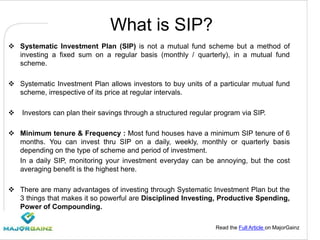
What is SIP?
 Systematic Investment Plan (SIP) is not a mutual fund scheme but a method of
investing a fixed sum on a regular basis (monthly / quarterly), in a mutual fund
scheme.
 Systematic Investment Plan allows investors to buy units of a particular mutual fund
scheme, irrespective of its price at regular intervals.
 Investors can plan their savings through a structured regular program via SIP.
 Minimum tenure & Frequency : Most fund houses have a minimum SIP tenure of 6
months. You can invest thru SIP on a daily, weekly, monthly or quarterly basis
depending on the type of scheme and period of investment.
In a daily SIP, monitoring your investment everyday can be annoying, but the cost
averaging benefit is the highest here.
 There are many advantages of investing through Systematic Investment Plan but the
3 things that makes it so powerful are Disciplined Investing, Productive Spending,
Power of Compounding.
Read the Full Article on MajorGainz
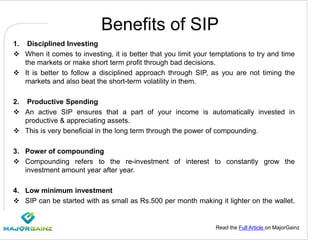
Benefits of SIP
1. Disciplined Investing
 When it comes to investing, it is better that you limit your temptations to try and time
the markets or make short term profit through bad decisions.
 It is better to follow a disciplined approach through SIP, as you are not timing the
markets and also beat the short-term volatility in them.
2. Productive Spending
 An active SIP ensures that a part of your income is automatically invested in
productive & appreciating assets.
 This is very beneficial in the long term through the power of compounding.
3. Power of compounding
 Compounding refers to the re-investment of interest to constantly grow the
investment amount year after year.
4. Low minimum investment
 SIP can be started with as small as Rs.500 per month making it lighter on the wallet.
Read the Full Article on MajorGainz
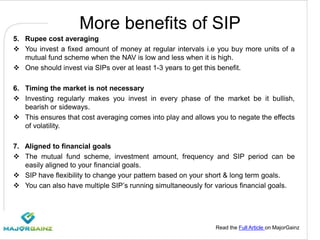
More benefits of SIP
5. Rupee cost averaging
 You invest a fixed amount of money at regular intervals i.e you buy more units of a
mutual fund scheme when the NAV is low and less when it is high.
 One should invest via SIPs over at least 1-3 years to get this benefit.
6. Timing the market is not necessary
 Investing regularly makes you invest in every phase of the market be it bullish,
bearish or sideways.
 This ensures that cost averaging comes into play and allows you to negate the effects
of volatility.
7. Aligned to financial goals
 The mutual fund scheme, investment amount, frequency and SIP period can be
easily aligned to your financial goals.
 SIP have flexibility to change your pattern based on your short & long term goals.
 You can also have multiple SIP’s running simultaneously for various financial goals.
Read the Full Article on MajorGainz
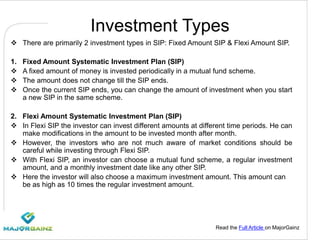
Investment Types
 There are primarily 2 investment types in SIP: Fixed Amount SIP & Flexi Amount SIP.
1. Fixed Amount Systematic Investment Plan (SIP)
 A fixed amount of money is invested periodically in a mutual fund scheme.
 The amount does not change till the SIP ends.
 Once the current SIP ends, you can change the amount of investment when you start
a new SIP in the same scheme.
2. Flexi Amount Systematic Investment Plan (SIP)
 In Flexi SIP the investor can invest different amounts at different time periods. He can
make modifications in the amount to be invested month after month.
 However, the investors who are not much aware of market conditions should be
careful while investing through Flexi SIP.
 With Flexi SIP, an investor can choose a mutual fund scheme, a regular investment
amount, and a monthly investment date like any other SIP.
 Here the investor will also choose a maximum investment amount. This amount can
be as high as 10 times the regular investment amount.
Read the Full Article on MajorGainz
Investment Methods
Passive Method
 One can invest in a scheme through SIP for a long period, say 2-3 years.
 One does not need to do anything after this and can let the SIP benefits unfold over
time.
 This method is best suited to investors who are not in regular touch with the markets
or do not have the expertise to understand different market conditions.
Active Method
 One invests in a scheme through SIP for a shorter period, say 6-9 months.
 Towards the expiry of the SIP, the investor can decide whether to continue the SIP as
it is or change the amount, frequency or scheme depending on market conditions.
 SIP gives you the flexibility to change your investments over time and you can take
advantage of this flexibility to increase your returns.
 This method requires the investor to be in regular touch with markets and possess
the required knowledge to change the investment pattern every 6-9 months
depending on current and future expected market conditions.
Read the Full Article on MajorGainz
SIP Period vs Holding period
 SIP period is the time for which your SIP is active and regular investments are
happening.
 Holding period is the time for which you stay invested in the mutual fund scheme
even after the SIP period is over.
 While a longer SIP period gives you the benefit of cost averaging, a longer holding
period gives you the benefit of capital appreciation when markets go up over time.
 To take full advantage of the cost averaging benefits of SIP, your holding period
should be much longer than the SIP period. Only then the true benefits of your SIP
can be enjoyed .
Read the Full Article on MajorGainz
When SIP may not deliver
 There are times when a SIP investment may not yield the desired results for the
investor. One should be careful to get the maximum benefit from the SIP.
1. Shorter period
 For a SIP to deliver on its promise of rupee cost averaging, it must witness a falling
market. This way the cost of purchase for the investor can be averaged.
 If the markets do not witness a downturn, and the investor is only exposed to an
upward market, the average purchase cost of his SIP will continue to rise over a
period of time. Such a scenario is fairly possible over shorter time periods.
 Opting for a SIP period that runs for a longer time frame, at least 2-3 years is better.
2. SIP in the wrong fund
 Investing via SIP does not improve the prospects of a low performing fund. A poorly
managed fund stays that irrespective of the investment mode. Its shortcomings will
not be eliminated by an SIP.
 Hence the key lies in first selecting a well-managed fund that is right for the investor
and then investing in it via an SIP.
Read the Full Article on MajorGainz
When SIP may not deliver
3. Inappropriate entry time
 The start timing is a very crucial factor for SIP returns.
 The best time to start a SIP is when the markets are relatively stable or appear to
have peaked out. This may sound very counter-intuitive but since rupee cost
averaging is one of the major benefits of SIP, one stands to gain from it only when
markets fall before going up again.
 When markets are relatively stable or near their peak, the chances of a correction are
higher, giving you an opportunity to average your cost.
 Once markets start to go up post the correction, you would gain and the yield will turn
out to be higher.
 If you expect the markets to continuously rise for the next 3-6 months, it makes better
sense to invest with a lump sum amount rather than start an SIP. This will give you
better returns over that short term period.
 Once you feel the bull run is nearly over, you can start the SIP.
Read the Full Article on MajorGainz
Conclusion
 SIP ensures that your money is invested in an appreciating asset periodically
 SIP enables you to invest in every phase of the market.
 SIP gives you the advantage of putting some amount of money periodically i.e daily,
weekly, monthly.
 Any Investor can go for SIP because the minimum investment is Rs.500.
 SIP can help you achieve both short term and long term goals.
 One should stay invested for a longer time period to get the true benefits of SIP.
 In short, SIP is not a magical instrument but it can be turned into one with proper
homework and planning before investing.
Wish you
in life !!!

Systematic Investment Plans (SIP)

  • 1.
  • 2.
    Read the FullArticle on MajorGainz What is SIP?  Systematic Investment Plan (SIP) is not a mutual fund scheme but a method of investing a fixed sum on a regular basis (monthly / quarterly), in a mutual fund scheme.  Systematic Investment Plan allows investors to buy units of a particular mutual fund scheme, irrespective of its price at regular intervals.  Investors can plan their savings through a structured regular program via SIP.  Minimum tenure & Frequency : Most fund houses have a minimum SIP tenure of 6 months. You can invest thru SIP on a daily, weekly, monthly or quarterly basis depending on the type of scheme and period of investment. In a daily SIP, monitoring your investment everyday can be annoying, but the cost averaging benefit is the highest here.  There are many advantages of investing through Systematic Investment Plan but the 3 things that makes it so powerful are Disciplined Investing, Productive Spending, Power of Compounding.
  • 3.
    Read the FullArticle on MajorGainz Benefits of SIP 1. Disciplined Investing  When it comes to investing, it is better that you limit your temptations to try and time the markets or make short term profit through bad decisions.  It is better to follow a disciplined approach through SIP, as you are not timing the markets and also beat the short-term volatility in them. 2. Productive Spending  An active SIP ensures that a part of your income is automatically invested in productive & appreciating assets.  This is very beneficial in the long term through the power of compounding. 3. Power of compounding  Compounding refers to the re-investment of interest to constantly grow the investment amount year after year. 4. Low minimum investment  SIP can be started with as small as Rs.500 per month making it lighter on the wallet.
  • 4.
    Read the FullArticle on MajorGainz More benefits of SIP 5. Rupee cost averaging  You invest a fixed amount of money at regular intervals i.e you buy more units of a mutual fund scheme when the NAV is low and less when it is high.  One should invest via SIPs over at least 1-3 years to get this benefit. 6. Timing the market is not necessary  Investing regularly makes you invest in every phase of the market be it bullish, bearish or sideways.  This ensures that cost averaging comes into play and allows you to negate the effects of volatility. 7. Aligned to financial goals  The mutual fund scheme, investment amount, frequency and SIP period can be easily aligned to your financial goals.  SIP have flexibility to change your pattern based on your short & long term goals.  You can also have multiple SIP’s running simultaneously for various financial goals.
  • 5.
    Read the FullArticle on MajorGainz Investment Types  There are primarily 2 investment types in SIP: Fixed Amount SIP & Flexi Amount SIP. 1. Fixed Amount Systematic Investment Plan (SIP)  A fixed amount of money is invested periodically in a mutual fund scheme.  The amount does not change till the SIP ends.  Once the current SIP ends, you can change the amount of investment when you start a new SIP in the same scheme. 2. Flexi Amount Systematic Investment Plan (SIP)  In Flexi SIP the investor can invest different amounts at different time periods. He can make modifications in the amount to be invested month after month.  However, the investors who are not much aware of market conditions should be careful while investing through Flexi SIP.  With Flexi SIP, an investor can choose a mutual fund scheme, a regular investment amount, and a monthly investment date like any other SIP.  Here the investor will also choose a maximum investment amount. This amount can be as high as 10 times the regular investment amount.
  • 6.
    Read the FullArticle on MajorGainz Investment Methods Passive Method  One can invest in a scheme through SIP for a long period, say 2-3 years.  One does not need to do anything after this and can let the SIP benefits unfold over time.  This method is best suited to investors who are not in regular touch with the markets or do not have the expertise to understand different market conditions. Active Method  One invests in a scheme through SIP for a shorter period, say 6-9 months.  Towards the expiry of the SIP, the investor can decide whether to continue the SIP as it is or change the amount, frequency or scheme depending on market conditions.  SIP gives you the flexibility to change your investments over time and you can take advantage of this flexibility to increase your returns.  This method requires the investor to be in regular touch with markets and possess the required knowledge to change the investment pattern every 6-9 months depending on current and future expected market conditions.
  • 7.
    Read the FullArticle on MajorGainz SIP Period vs Holding period  SIP period is the time for which your SIP is active and regular investments are happening.  Holding period is the time for which you stay invested in the mutual fund scheme even after the SIP period is over.  While a longer SIP period gives you the benefit of cost averaging, a longer holding period gives you the benefit of capital appreciation when markets go up over time.  To take full advantage of the cost averaging benefits of SIP, your holding period should be much longer than the SIP period. Only then the true benefits of your SIP can be enjoyed .
  • 8.
    Read the FullArticle on MajorGainz When SIP may not deliver  There are times when a SIP investment may not yield the desired results for the investor. One should be careful to get the maximum benefit from the SIP. 1. Shorter period  For a SIP to deliver on its promise of rupee cost averaging, it must witness a falling market. This way the cost of purchase for the investor can be averaged.  If the markets do not witness a downturn, and the investor is only exposed to an upward market, the average purchase cost of his SIP will continue to rise over a period of time. Such a scenario is fairly possible over shorter time periods.  Opting for a SIP period that runs for a longer time frame, at least 2-3 years is better. 2. SIP in the wrong fund  Investing via SIP does not improve the prospects of a low performing fund. A poorly managed fund stays that irrespective of the investment mode. Its shortcomings will not be eliminated by an SIP.  Hence the key lies in first selecting a well-managed fund that is right for the investor and then investing in it via an SIP.
  • 9.
    Read the FullArticle on MajorGainz When SIP may not deliver 3. Inappropriate entry time  The start timing is a very crucial factor for SIP returns.  The best time to start a SIP is when the markets are relatively stable or appear to have peaked out. This may sound very counter-intuitive but since rupee cost averaging is one of the major benefits of SIP, one stands to gain from it only when markets fall before going up again.  When markets are relatively stable or near their peak, the chances of a correction are higher, giving you an opportunity to average your cost.  Once markets start to go up post the correction, you would gain and the yield will turn out to be higher.  If you expect the markets to continuously rise for the next 3-6 months, it makes better sense to invest with a lump sum amount rather than start an SIP. This will give you better returns over that short term period.  Once you feel the bull run is nearly over, you can start the SIP.
  • 10.
    Read the FullArticle on MajorGainz Conclusion  SIP ensures that your money is invested in an appreciating asset periodically  SIP enables you to invest in every phase of the market.  SIP gives you the advantage of putting some amount of money periodically i.e daily, weekly, monthly.  Any Investor can go for SIP because the minimum investment is Rs.500.  SIP can help you achieve both short term and long term goals.  One should stay invested for a longer time period to get the true benefits of SIP.  In short, SIP is not a magical instrument but it can be turned into one with proper homework and planning before investing.
  • 11.