 ABDUL RONI
(06022681519002)
 MARHAMAH FAJRIAH NASUTION
(06022681519005)
 META SILVIA GUNAWAN
(06022681519017)
 NOVEAWAN
(06022681519014)
 RIZKY PUTRI JANNATI
(06022681519012)
GROUP 4
MOTIVATING BOYS TO READ:
INQUIRY, MODELING, AND CHOICE
MATTER
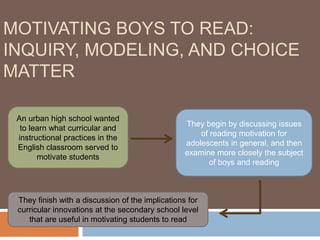
An urban high school wanted
to learn what curricular and
instructional practices in the
English classroom served to
motivate students
They begin by discussing issues
of reading motivation for
adolescents in general, and then
examine more closely the subject
of boys and reading
They finish with a discussion of the implications for
curricular innovations at the secondary school level
that are useful in motivating students to read
Motivating Adolescents to Read
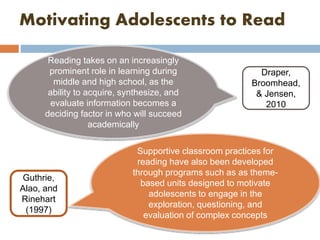
Supportive classroom practices for
reading have also been developed
through programs such as as theme-
based units designed to motivate
adolescents to engage in the
exploration, questioning, and
evaluation of complex concepts
Reading takes on an increasingly
prominent role in learning during
middle and high school, as the
ability to acquire, synthesize, and
evaluate information becomes a
deciding factor in who will succeed
academically
Draper,
Broomhead,
& Jensen,
2010
Guthrie,
Alao, and
Rinehart
(1997)
Motivating Adolescent Males to
Read
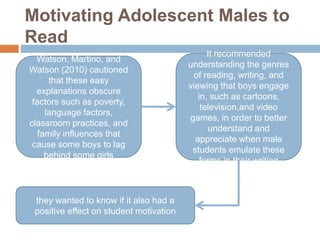
Watson, Martino, and
Watson (2010) cautioned
that these easy
explanations obscure
factors such as poverty,
language factors,
classroom practices, and
family influences that
cause some boys to lag
behind some girls
It recommended
understanding the genres
of reading, writing, and
viewing that boys engage
in, such as cartoons,
television,and video
games, in order to better
understand and
appreciate when male
students emulate these
forms in their writing
they wanted to know if it also had a
positive effect on student motivation
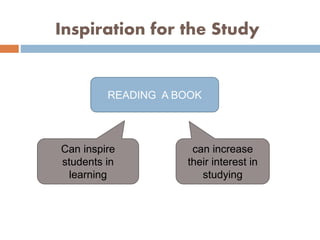
Inspiration for the Study
READING A BOOK
Can inspire
students in
learning
can increase
their interest in
studying
School and Student Profile
“You didn’t really have to read.
The books were just assigned,
but you could pass without
reading.”
“because they needed to be read
for me to understand the
[essential] question. I didn’t
know the answer and the books
helped me think of my answer.”
Eric, an Asian/Pacif ic
Islander who has a
learning and behavioral
disability
Nico, a high performing
student
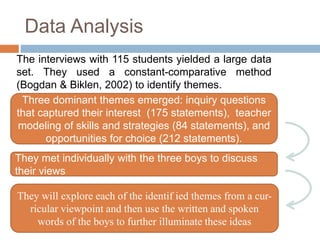
Data Analysis
Three dominant themes emerged: inquiry questions
that captured their interest (175 statements), teacher
modeling of skills and strategies (84 statements), and
opportunities for choice (212 statements).
They will explore each of the identif ied themes from a cur-
ricular viewpoint and then use the written and spoken
words of the boys to further illuminate these ideas
They met individually with the three boys to discuss
their views
The interviews with 115 students yielded a large data
set. They used a constant-comparative method
(Bogdan & Biklen, 2002) to identify themes.
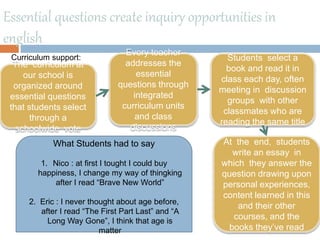
Essential questions create inquiry opportunities in
english
The curriculum at
our school is
organized around
essential questions
that students select
through a
schoolwide vote
Every teacher
addresses the
essential
questions through
integrated
curriculum units
and class
discussions
Students select a
book and read it in
class each day, often
meeting in discussion
groups with other
classmates who are
reading the same title
At the end, students
write an essay in
which they answer the
question drawing upon
personal experiences,
content learned in this
and their other
courses, and the
books they’ve read
What Students had to say
1. Nico : at first I tought I could buy
happiness, I change my way of thingking
after I read “Brave New World”
2. Eric : I never thought about age before,
after I read “The First Part Last” and “A
Long Way Gone”, I think that age is
matter
Curriculum support:
Teacher Modeling and Public
Composition
Curriculum Support What Students Had to Say
In terms of reading, teachers
model their comprehension,
word solving, and their use of
text structures and text
features
Claudio said, “I never knew that they
[teachers] had to think about what
they were reading. I thought they
just got it. And then I didn’t just get
it, so I quit.”
Ex:
Does Age Matter?
Sebagai siswa mengalami proses
penyusunan publik dan mulai
menulis pada istilah mereka
sendiri, mereka menarik pada
pemodelan bahwa guru mereka
telah disediakan sebagai serta
proses berpikir ditunjukkan untuk
mereka
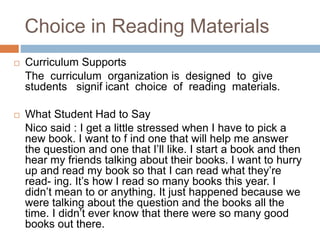
Choice in Reading Materials
 Curriculum Supports
The curriculum organization is designed to give
students signif icant choice of reading materials.
 What Student Had to Say
Nico said : I get a little stressed when I have to pick a
new book. I want to f ind one that will help me answer
the question and one that I’ll like. I start a book and then
hear my friends talking about their books. I want to hurry
up and read my book so that I can read what they’re
read- ing. It’s how I read so many books this year. I
didn’t mean to or anything. It just happened because we
were talking about the question and the books all the
time. I didn’t ever know that there were so many good
books out there.
THANK YOU

Academy Writing (Group 4) lesson-3

  • 1.
     ABDUL RONI (06022681519002) MARHAMAH FAJRIAH NASUTION (06022681519005)  META SILVIA GUNAWAN (06022681519017)  NOVEAWAN (06022681519014)  RIZKY PUTRI JANNATI (06022681519012) GROUP 4
  • 2.
    MOTIVATING BOYS TOREAD: INQUIRY, MODELING, AND CHOICE MATTER An urban high school wanted to learn what curricular and instructional practices in the English classroom served to motivate students They begin by discussing issues of reading motivation for adolescents in general, and then examine more closely the subject of boys and reading They finish with a discussion of the implications for curricular innovations at the secondary school level that are useful in motivating students to read
  • 3.
    Motivating Adolescents toRead Supportive classroom practices for reading have also been developed through programs such as as theme- based units designed to motivate adolescents to engage in the exploration, questioning, and evaluation of complex concepts Reading takes on an increasingly prominent role in learning during middle and high school, as the ability to acquire, synthesize, and evaluate information becomes a deciding factor in who will succeed academically Draper, Broomhead, & Jensen, 2010 Guthrie, Alao, and Rinehart (1997)
  • 4.
    Motivating Adolescent Malesto Read Watson, Martino, and Watson (2010) cautioned that these easy explanations obscure factors such as poverty, language factors, classroom practices, and family influences that cause some boys to lag behind some girls It recommended understanding the genres of reading, writing, and viewing that boys engage in, such as cartoons, television,and video games, in order to better understand and appreciate when male students emulate these forms in their writing they wanted to know if it also had a positive effect on student motivation
  • 5.
    Inspiration for theStudy READING A BOOK Can inspire students in learning can increase their interest in studying
  • 6.
    School and StudentProfile “You didn’t really have to read. The books were just assigned, but you could pass without reading.” “because they needed to be read for me to understand the [essential] question. I didn’t know the answer and the books helped me think of my answer.” Eric, an Asian/Pacif ic Islander who has a learning and behavioral disability Nico, a high performing student
  • 7.
    Data Analysis Three dominantthemes emerged: inquiry questions that captured their interest (175 statements), teacher modeling of skills and strategies (84 statements), and opportunities for choice (212 statements). They will explore each of the identif ied themes from a cur- ricular viewpoint and then use the written and spoken words of the boys to further illuminate these ideas They met individually with the three boys to discuss their views The interviews with 115 students yielded a large data set. They used a constant-comparative method (Bogdan & Biklen, 2002) to identify themes.
  • 8.
    Essential questions createinquiry opportunities in english The curriculum at our school is organized around essential questions that students select through a schoolwide vote Every teacher addresses the essential questions through integrated curriculum units and class discussions Students select a book and read it in class each day, often meeting in discussion groups with other classmates who are reading the same title At the end, students write an essay in which they answer the question drawing upon personal experiences, content learned in this and their other courses, and the books they’ve read What Students had to say 1. Nico : at first I tought I could buy happiness, I change my way of thingking after I read “Brave New World” 2. Eric : I never thought about age before, after I read “The First Part Last” and “A Long Way Gone”, I think that age is matter Curriculum support:
  • 9.
    Teacher Modeling andPublic Composition Curriculum Support What Students Had to Say In terms of reading, teachers model their comprehension, word solving, and their use of text structures and text features Claudio said, “I never knew that they [teachers] had to think about what they were reading. I thought they just got it. And then I didn’t just get it, so I quit.” Ex: Does Age Matter? Sebagai siswa mengalami proses penyusunan publik dan mulai menulis pada istilah mereka sendiri, mereka menarik pada pemodelan bahwa guru mereka telah disediakan sebagai serta proses berpikir ditunjukkan untuk mereka
  • 10.
    Choice in ReadingMaterials  Curriculum Supports The curriculum organization is designed to give students signif icant choice of reading materials.  What Student Had to Say Nico said : I get a little stressed when I have to pick a new book. I want to f ind one that will help me answer the question and one that I’ll like. I start a book and then hear my friends talking about their books. I want to hurry up and read my book so that I can read what they’re read- ing. It’s how I read so many books this year. I didn’t mean to or anything. It just happened because we were talking about the question and the books all the time. I didn’t ever know that there were so many good books out there.
  • 11.