Single Camera Techniques
This essay will address single camera productiontechniques such as
camera, lighting, soundand editing. Singlecamera productions are
productionsusing onlyone camera rather thanmultiple. Theuse of
thistypeof productionis gaining popularityand this allows people
with single camera technical skills to gain employment in that area.
This essay will also identify key productionroles and lookat mise-
en-scene as well as cinematography whileusing examples to elaborateon previous points.
Single cameras on productions are mainly used to
create more realism with a scene and get the audience
within the action. This creates an intimate feel to the
film which is why some film directors prefer single
camera such as Sam Peckinpah, an American film
director and screenwriter known for being visually
innovative and his action depiction.1
He is famous for
shooting a scene multiple times, as single cameras
demand, to make sure the shot was correct. Multiple
shot-takes can be time consuming, this is because they
have to set up each shot individually, making it a
disadvantage when working in a single camera
production. Directors tend to go for single camera
productions more as they have more control over the camera and the locations for the
shoots aren’t limited unlike if it was a multi-camera production where placement/room
for the cameras would have to be considered. Along with the production being time
consuming, it can result in it being more expensive including more planning. However,
the production can allow actors to get into character.
Lighting is still important in single camera as it is
used to light the film to create
effects which can impact the
audience. Lighting is far easier to
control and manipulate. You can
shoot each shot differently and the
lighting can add to the tone of the
film. For example, at the start of
Citizen Kane lighting is used to
manipulate the shot of the character
so he is viewed as a collective with
no face association and is said to be watching/revealing the
movie like the audience. There are different types of set up in a single camera
production, unlike multi-camera it allows variety. Instead of the shots looking
studio lit they can be realistic and detailed connotating to different meanings
1https://en.wikipedia.org/wiki/Sam_Peckinpah
creating a bigger effect on the audience. A basic set up would be a ‘low key
lighting set-up’ which consists of one light pointing towards a subject and a
camera. It is designed to fill in the rooms light at a low level to be able to cast
shadows. These set ups can be easily adjusted, but if needed again they should be
slightly changed to fit the shot and keep consistency.
Sound adds to a film and can sometimes define a film and decide whether it’s a
good or a bad film. In single camera productions, due to the use of shoulder shots,
cutaways and any restricted view shots this allows the film to use a single
dialogue or audio track. This helps
make the track more consistent. Also,
boom microphones are a ‘staple of
single camera productions’ and help
get ‘in the action’ creating a personal
feel to the film. Of course, in post-
production Foley (a reproduction of
everyday sound effects added to a film)
would or could be applied.
A
disadvantage of single camera sound is that not
all takes can be delivered with the same pace of
dialogue so they will add a second camera if there
are certain shots or lots of dialogue. Film-makers
in single camera can invent new ways to hide a
microphone for the best shot which can waste
time but could create very good audio such as
they audio in Citizen Kane where they make a
‘fake ceiling’ just to hide the microphones as they
wanted lots of low shots.
Editing in any film is important and it
can take a long time to sift through.
Single camera productions are edited
after a scene has been filmed as they
cannot be completed live like a multi-
camera production. Shot logs (a list of
shots captured) are taken into consideration when editing lots of footage together
and can state which ones are successful or not. Also, when editing a single camera
you can also create a ‘rough cut’ of a film if an editor is on the set. This technique
is especially useful when on a time limit, an editor will be given the footage as the
shoot is ongoing and will ‘draft’ up a rough version of an edit to help gain an
understanding of the storyline.
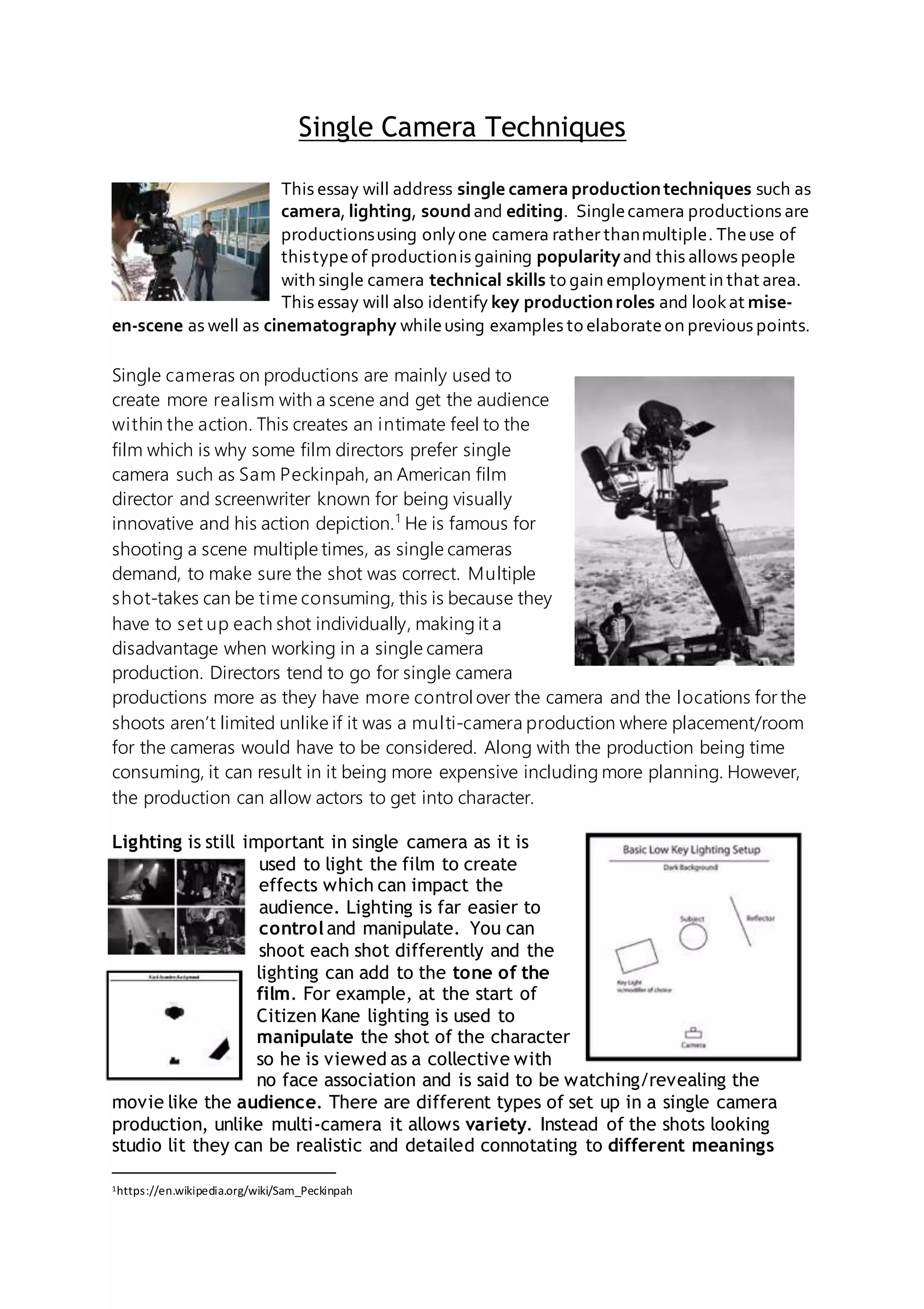
There are specific genres and formats associated with
either multi-camera productions or single camera
productions. Certain formats ‘lend themselves’ to single
camera as they suit the genre or are easier to do
logistically. For example, period, crime drama and horror
can be very single camera orientated. Horror especially as
to create a very intimate and realistic elemental feel, they
use single camera to ‘get up close’ in shots. This gives the
film-makers more freedom to explore and get creative
with visuals. For example, ‘The Shining’ would be a good
use of having lots of control creatively over a single-cam
production.
In multi-camera productions, comedy and soap operas
are geared towards using multiple cameras as they are
either studios/sets or they need to be filmed quickly as
usually soap operas are airing every week or so. For
example, ‘Mrs Browns Boys’ is a studio set in front of a
live audience and it is filmed in a multi-camera set up.
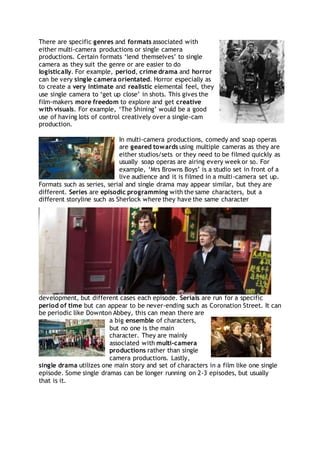
Formats such as series, serial and single drama may appear similar, but they are
different. Series are episodic programming with the same characters, but a
different storyline such as Sherlock where they have the same character
development, but different cases each episode. Serials are run for a specific
period of time but can appear to be never-ending such as Coronation Street. It can
be periodic like Downton Abbey, this can mean there are
a big ensemble of characters,
but no one is the main
character. They are mainly
associated with multi-camera
productions rather than single
camera productions. Lastly,
single drama utilizes one main story and set of characters in a film like one single
episode. Some single dramas can be longer running on 2-3 episodes, but usually
that is it.
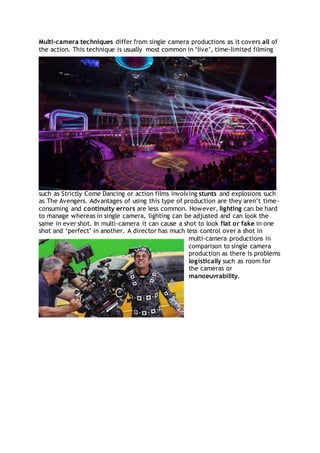
Multi-camera techniques differ from single camera productions as it covers all of
the action. This technique is usually most common in ‘live’, time-limited filming
such as Strictly Come Dancing or action films involving stunts and explosions such
as The Avengers. Advantages of using this type of production are they aren’t time-
consuming and continuity errors are less common. However, lighting can be hard
to manage whereas in single camera, lighting can be adjusted and can look the
same in ever shot. In multi-camera it can cause a shot to look flat or fake in one
shot and ‘perfect’ in another. A director has much less control over a shot in
multi-camera productions in
comparison to single camera
production as there is problems
logistically such as room for
the cameras or
manoeuvrability.

Single camera techniques

  • 1.
    Single Camera Techniques Thisessay will address single camera productiontechniques such as camera, lighting, soundand editing. Singlecamera productions are productionsusing onlyone camera rather thanmultiple. Theuse of thistypeof productionis gaining popularityand this allows people with single camera technical skills to gain employment in that area. This essay will also identify key productionroles and lookat mise- en-scene as well as cinematography whileusing examples to elaborateon previous points. Single cameras on productions are mainly used to create more realism with a scene and get the audience within the action. This creates an intimate feel to the film which is why some film directors prefer single camera such as Sam Peckinpah, an American film director and screenwriter known for being visually innovative and his action depiction.1 He is famous for shooting a scene multiple times, as single cameras demand, to make sure the shot was correct. Multiple shot-takes can be time consuming, this is because they have to set up each shot individually, making it a disadvantage when working in a single camera production. Directors tend to go for single camera productions more as they have more control over the camera and the locations for the shoots aren’t limited unlike if it was a multi-camera production where placement/room for the cameras would have to be considered. Along with the production being time consuming, it can result in it being more expensive including more planning. However, the production can allow actors to get into character. Lighting is still important in single camera as it is used to light the film to create effects which can impact the audience. Lighting is far easier to control and manipulate. You can shoot each shot differently and the lighting can add to the tone of the film. For example, at the start of Citizen Kane lighting is used to manipulate the shot of the character so he is viewed as a collective with no face association and is said to be watching/revealing the movie like the audience. There are different types of set up in a single camera production, unlike multi-camera it allows variety. Instead of the shots looking studio lit they can be realistic and detailed connotating to different meanings 1https://en.wikipedia.org/wiki/Sam_Peckinpah
  • 2.
    creating a biggereffect on the audience. A basic set up would be a ‘low key lighting set-up’ which consists of one light pointing towards a subject and a camera. It is designed to fill in the rooms light at a low level to be able to cast shadows. These set ups can be easily adjusted, but if needed again they should be slightly changed to fit the shot and keep consistency. Sound adds to a film and can sometimes define a film and decide whether it’s a good or a bad film. In single camera productions, due to the use of shoulder shots, cutaways and any restricted view shots this allows the film to use a single dialogue or audio track. This helps make the track more consistent. Also, boom microphones are a ‘staple of single camera productions’ and help get ‘in the action’ creating a personal feel to the film. Of course, in post- production Foley (a reproduction of everyday sound effects added to a film) would or could be applied. A disadvantage of single camera sound is that not all takes can be delivered with the same pace of dialogue so they will add a second camera if there are certain shots or lots of dialogue. Film-makers in single camera can invent new ways to hide a microphone for the best shot which can waste time but could create very good audio such as they audio in Citizen Kane where they make a ‘fake ceiling’ just to hide the microphones as they wanted lots of low shots. Editing in any film is important and it can take a long time to sift through. Single camera productions are edited after a scene has been filmed as they cannot be completed live like a multi- camera production. Shot logs (a list of shots captured) are taken into consideration when editing lots of footage together and can state which ones are successful or not. Also, when editing a single camera you can also create a ‘rough cut’ of a film if an editor is on the set. This technique is especially useful when on a time limit, an editor will be given the footage as the shoot is ongoing and will ‘draft’ up a rough version of an edit to help gain an understanding of the storyline.
  • 3.
    There are specificgenres and formats associated with either multi-camera productions or single camera productions. Certain formats ‘lend themselves’ to single camera as they suit the genre or are easier to do logistically. For example, period, crime drama and horror can be very single camera orientated. Horror especially as to create a very intimate and realistic elemental feel, they use single camera to ‘get up close’ in shots. This gives the film-makers more freedom to explore and get creative with visuals. For example, ‘The Shining’ would be a good use of having lots of control creatively over a single-cam production. In multi-camera productions, comedy and soap operas are geared towards using multiple cameras as they are either studios/sets or they need to be filmed quickly as usually soap operas are airing every week or so. For example, ‘Mrs Browns Boys’ is a studio set in front of a live audience and it is filmed in a multi-camera set up. Formats such as series, serial and single drama may appear similar, but they are different. Series are episodic programming with the same characters, but a different storyline such as Sherlock where they have the same character development, but different cases each episode. Serials are run for a specific period of time but can appear to be never-ending such as Coronation Street. It can be periodic like Downton Abbey, this can mean there are a big ensemble of characters, but no one is the main character. They are mainly associated with multi-camera productions rather than single camera productions. Lastly, single drama utilizes one main story and set of characters in a film like one single episode. Some single dramas can be longer running on 2-3 episodes, but usually that is it.
  • 4.
    Multi-camera techniques differfrom single camera productions as it covers all of the action. This technique is usually most common in ‘live’, time-limited filming such as Strictly Come Dancing or action films involving stunts and explosions such as The Avengers. Advantages of using this type of production are they aren’t time- consuming and continuity errors are less common. However, lighting can be hard to manage whereas in single camera, lighting can be adjusted and can look the same in ever shot. In multi-camera it can cause a shot to look flat or fake in one shot and ‘perfect’ in another. A director has much less control over a shot in multi-camera productions in comparison to single camera production as there is problems logistically such as room for the cameras or manoeuvrability.