Co-Presenters Karen Finn Senior Consultant karen@resultsleadership.org  www. resultsleadership.org Katherine Mowers Senior Consultant [email_address] www.citidc.com Simplifying and Maximizing Organizational Impact Data
Session Overview Identify most important performance measures High-level assessment of your current organizational data and business systems Learn  a process to review software Learn about software options And learn from the  of others in the room Simplifying and Maximizing Organizational Impact Data
The change journey ©2009 Community IT Innovators (CITI) “ If we don’t change the direction we are headed, we will end up where we are going.” -  Chinese proverb
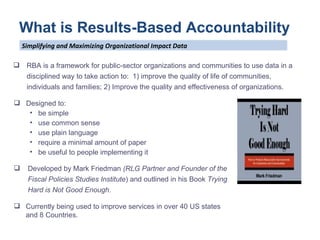
RBA is a framework for public-sector organizations and communities to use data in a disciplined way to take action to:  1) improve the quality of life of communities, individuals and families; 2) Improve the quality and effectiveness of organizations. Developed by Mark Friedman  (RLG Partner and Founder of the Fiscal Policies Studies Institute ) and outlined in his Book  Trying Hard is Not Good Enough. Currently being used to improve services in over 40 US states and 8 Countries. Designed to: be simple use common sense use plain language  require a minimal amount of paper be useful to people implementing it What is Results-Based Accountability Simplifying and Maximizing Organizational Impact Data
Population Accountability Performance Accountability About the well-being of  whole populations Neighborhoods - Cities - Counties Start with the ends and work backwards to the means .  Result :   A condition of well being that we want to achieve for a given population  Youth succeeding in school  A healthy environment A Safe community Establish measures that can be used to quantify the progress toward achieving that Result.   (Indicators) Indicator:  A measure that helps quantify the achievement of a Result Graduation rate Air quality index Crime rate About the well-being of  client populations The client base that is directly impacted by a program First key principle of RBA:  What are we trying to achieve?.  How does RBA work? Simplifying and Maximizing Organizational Impact Data
Population Accountability Performance Accountability About the well-being of  whole populations Neighborhoods - Cities - Counties Result:   A condition of well being that we want to achieve for a given population  Youth succeeding in school  A Clean environment A Safe community Indicator:  A measure that helps quantify the achievement of a Result Graduation rate Air quality index Crime rate Establish programs (agencies, service systems etc.) that can positively affect these indicators. About the well-being of  client populations Program:  A program, agency, or service system that is helping to achieve our Result Performance Measure:  A measure of how well our programs are serving the people that they reach How much did we do? How well did we do it? Is anyone better off? The client base that is directly impacted by a program Because our client base is typically smaller than our whole population, we must establish ways to measure our performance in the context of those that we reach.  How does RBA work? Simplifying and Maximizing Organizational Impact Data
Population Accountability Performance Accountability About the well-being of  whole populations Neighborhoods - Cities - Counties Result:   A condition of well being that we want to achieve for a given population  Youth succeeding in school  A healthy environment A Safe community Indicator:  A measure that helps quantify the achievement of a Result Graduation rate Air quality index Crime rate About the well-being of  client populations Program:  A program, agency, or service system that is helping to achieve our Result Performance Measure:  A measure of how well our programs are serving the people that they reach How much did we do? How well did we do it? Is anyone better off? The people who are directly affected by a program Use this information to make transparent, data-driven decisions Second Key Principle of RBA: How does RBA work? Simplifying and Maximizing Organizational Impact Data
Population Accountability Performance Accountability What is the condition of well-being that you want for your community? How will you measure it? (Indicators) How are we doing on the indicators? (baseline and forecast) What is the story behind the data? Who are our partners with a role to play? What works to do better? What do we propose to do? Who are your customers? How can you measure if your customers are better off?  How can you measure the quality of the service you provide? How are we doing on these measures? (baseline and forecast) What is the story behind the data? Who are our partners with a role to play? What works to do better? What do you propose to do? Seven Questions of RBA  Simplifying and Maximizing Organizational Impact Data
Story behind the baseline Partners   (with a role to play in turning the curve) What Works Action Plan (w/ Budget) Performance Measure:  % of after school participants reading at grade level Start at the  End Work  Backwards to  Means Turn-the-Curve Thinking   Talk to Action
“ All Performance Measures that have ever existed in the history of the universe involve answering two sets of interlocking questions.”
How Much did we do? ( # ) How Well did we do it? ( % ) Quantity Quality Program Performance Measures
Effort How hard did we try? Effect Is anyone better off? Program Performance Measures
Program Performance Measures Effort Effect How Much How Well
How much did we do? Program Performance Measures How well did we do it? Is anyone better off? Quantity Quality Effect  Effort # %
How much did we do? Education How well did we do it? Is anyone better off? Quantity Quality Effect  Effort Number of students Student-teacher ratio Number of high school graduates Percent of high school graduates
How much did we do? Education How well did we do it? Is anyone better off? Quantity Quality Effect  Effort Number of students Student-teacher ratio Percent of  9 th  graders who enter college or employment after graduation Number of  9 th  graders who enter college or employment after graduation
How much did we do? The Matter of Control How well did we do it? Is anyone better off? More Control Quantity Quality Effect  Effort Less Control Partnerships needed to improve performance
How much did we do? Separating the Wheat from the Chaff Types of Measures Found in Each Quadrant How well did we do it? Is anyone better off? # Clients/customers   served # Activities (by type   of activity) % Common measures e.g. client staff ratio, workload ratio, staff turnover rate, staff morale, % staff fully trained, % clients seen in their own language, worker safety, unit cost %  Skills / Knowledge   (e.g. parenting skills) # %  Attitude / Opinion   (e.g. toward drugs) # %  Behavior   (e.g. school attendance) # %  Circumstance     (e.g. working, in stable housing) # % Activity-specific   measures e.g. % timely, % clients completing activity,  % correct and complete, % meeting standard Point in Time  vs. Point to Point Improvement
Program: After School Program  Customers:  Middle School Boys Measures in  red  = data available Q1  How much do you do? # of target population served: # of 6 th  grade boys served # of 7 th  grade boys served # of boys referred by juvenile services # of boys from lower SES served # of activities: # hours of homework help # of sporting events # of art classes # prevention workshops # of nutrition classes Q2:  How Well do you do it? Common Measures: Staff turnover rate % of staff speaking a second language Staff to student ratio % of activities where class size is less than 20 % of staff certified in Youth Worker Methods % of staff with training in good nutrition Quality Measure for each activity: % of staff with experience in subjects % of teachers saying children’s homework has improved % of youth signing up for sporting events % of youth saying art classes are fun % of prevention programs scoring a 4.0 or higher on the Youth Program Quality Assessment % of youth signing up for nutrition classes Q3: Is anyone better off? (#) # of students served who learned a new skill # of students who have learned how to prepare healthy meals # of youth with improved social skills # of students who take up a new sport or hobby # of students with an increase in social skills # of students with improved school attendance # of students with improved grades # of students with reduced suspensions # of students who have lost weight or maintained a healthy weight Q 4:  Is anyone better off (%) % of students served who learned a new skill % of students who have learned how to prepare a healthy meal % of youth with improved social skills %  of students who take up a new sport or hobby %  of students with an increase in social skills % of students with improved school attendance % of students with improved grades % of students with reduced suspensions % of students who have lost weight or maintained a healthy weight
Program: After School Program  Customers:  Middle School Boys Q1  How much do you do? # of customers served: # of 6 th  grade boys served # of 7 th  grade boys served # of boys referred by juvenile services Q2:  How Well do you do it? Headline Measures: % of staff certified in Youth Worker Methods % of youth signing up for nutrition classes Q3: Is anyone better off? (#) Headline Measures: # of students taking up a new sport or hobby # of students who have lost weight or maintained a healthy weight Q 4:  Is anyone better off (%) Headline Measures: % of students taking up a new sport or hobby % of students who have lost weight or maintained a healthy weight
Facilitates transparency and collaboration Systematically supports decision making with data Helps organizations align the performance of programs and initiatives with the impact they create in the community.   www.resultsscorecard.com
www.resultscorecard.com
 
Let’s talk lexicon What is information? What is data? Assessing your data and business systems
Assess your data and business systems How do you currently track data for your performance measures?  Who do you share performance measures with?  Who internally? Who externally? In what format do you use to share this information? What are the top 3-5 challenges you and your organization face with tracking data, organizing the data into information and sharing it with others? Simplifying and Maximizing Organizational Impact Data
Challenges often faced … Simplifying and Maximizing Organizational Impact Data
Excel files Excel files Excel files Case mgmt/ enterprise database Free 3 rd  party tools Excel files Excel files Word files File Server Email blast  system  Access databases Paper files Paper forms Email system Website  Content Mgmt System Donor/  Contact mgmt database Business systems can consist of … Accounting  system Simplifying and Maximizing Organizational Impact Data
80 percent  of the success of any initiative depends on  how effectively the people transition  to  new processes.  20 percent  depends on the  actual technology solution. People Process and Technology What determines success? 80% 20%
Addressing the pain and business needs Existing business systems Epiphany Keep  and   improve Establish and    implement changes  1 Explore options Software selection    process Select solution(s) Implementation Realization that    there must be a    better way 2 3 Decide  a path Take action Significant opportunity for transformation What  we’ll talk about today Simplifying and Maximizing Organizational Impact Data
3 to 6 months Planning Requirements & Research RFP Final Demos Contract Due Diligence Timeline expectations Simplifying and Maximizing Organizational Impact Data
Activities Organize Discovery Team Blessing and/or involvement of Sr. Management Confirm/Refine Business Case Milestones/Deliverables Detailed Project Plan Scope  Schedule Structure Planning Requirements  & Research RFP Final Demos Contract Due Diligence Objective:  Begin with the end in mind Project Planning This is an organizational development and capacity building project with strategic value to the whole organization. Simplifying and Maximizing Organizational Impact Data
Requirements Analysis Activities Conduct discovery meetings/interviews Audit existing business processes and systems Draft Statement of Requirements  Prioritize Requirements Milestones/Deliverables Draft  Statement of Requirements document Objective:  Analyze, document, prioritize requirements for ideal system Planning Requirements & Research RFP Final Demos Contract Due Diligence Requirements & Research Must start here,  not  with researching options and seeing demos. Simplifying and Maximizing Organizational Impact Data
Vendor Research Tasks Research vendors & products compared to your requirements Conduct Initial Vendor Demonstrations (these are virtual) Create a Short List Milestones/Deliverables Vendor Interview Questionnaire Revised Statement of Requirements Vendor Short List (3 – 5 vendors) Vendor Comparison Matrix Objective:  Gain overview of software product/vendor landscape Planning Requirements & Research RFP Final Demos Contract Due Diligence Requirements & Research cont. Simplifying and Maximizing Organizational Impact Data
Tasks Develop RFP Evaluate Vendor Responses Select Vendor Finalists Milestones/Deliverables RFP & Proposal Template Highlight Business Drivers Statement of Requirements Vendor Background & Financial Performance References 3-5 Year TCO HW/SW Requirements Objective:  Apples to apples vendor proposal comparison Planning Requirements  & Research RFP Final Demos Contract Due Diligence Request for Proposal Simplifying and Maximizing Organizational Impact Data
Activities Develop Vendor Demonstration Script Conduct Final Demonstrations Select 1 st  and 2 nd  Choice Milestones/Deliverables Vendor Demonstration Script Vendor Comparison Matrix Objective:  See product in action ... “Prove it to us” …  Evaluate partnership potential. Planning Requirements & Research RFP Final Demos Contract Due Diligence Final Demos Simplifying and Maximizing Organizational Impact Data
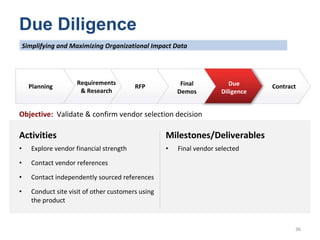
Activities Explore vendor financial strength Contact vendor references Contact independently sourced references Conduct site visit of other customers using the product Milestones/Deliverables Final vendor selected Objective:  Validate & confirm vendor selection decision Planning Requirements & Research RFP Final Demos Contract Due Diligence Due Diligence Simplifying and Maximizing Organizational Impact Data
Activities Negotiate, negotiate, negotiate !!! Legal counsel review Milestones/Deliverables Signed Contract Objective:  Secure optimal pricing & terms Planning Requirements & Research RFP Final Demos Contract Due Diligence Contracting Simplifying and Maximizing Organizational Impact Data
But this is just the beginning …
Business process decisions and design -> design document Configuration by vendor Sign off on vendor design specifications Developing case scenarios Data clean-up and data migration Establish Quality standards  Testing of system … test again, and again and again  Training & learning Change management and transition support throughout Go-live Process accountability And … an open mind and flexibility  Next is Implementation involves: Simplifying and Maximizing Organizational Impact Data
Features of case mgmt systems Case Management Calendaring/Scheduling – varies and most  systems it is very limited Tracking of Service Providers/Community Resources Ability to have Service Plan and/or Goal setting and track progress  Self-sufficiency matrix - varies Workflow automation:  To do’s, email alerts in system Volunteer management Reporting – and some have graphics And more … Simplifying and Maximizing Organizational Impact Data
Notable case mgmt systems in the market Simplifying and Maximizing Organizational Impact Data
The change journey ©2009 Community IT Innovators (CITI) “ If we don’t change the direction we are headed, we will end up where we are going.” -  Chinese proverb

Performance Management for Nonprofits: Simplifying and Maximizing Organization Impact Data

  • 1.
    Co-Presenters Karen FinnSenior Consultant karen@resultsleadership.org www. resultsleadership.org Katherine Mowers Senior Consultant [email_address] www.citidc.com Simplifying and Maximizing Organizational Impact Data
  • 2.
    Session Overview Identifymost important performance measures High-level assessment of your current organizational data and business systems Learn a process to review software Learn about software options And learn from the of others in the room Simplifying and Maximizing Organizational Impact Data
  • 3.
    The change journey©2009 Community IT Innovators (CITI) “ If we don’t change the direction we are headed, we will end up where we are going.” - Chinese proverb
  • 4.
    RBA is aframework for public-sector organizations and communities to use data in a disciplined way to take action to: 1) improve the quality of life of communities, individuals and families; 2) Improve the quality and effectiveness of organizations. Developed by Mark Friedman (RLG Partner and Founder of the Fiscal Policies Studies Institute ) and outlined in his Book Trying Hard is Not Good Enough. Currently being used to improve services in over 40 US states and 8 Countries. Designed to: be simple use common sense use plain language require a minimal amount of paper be useful to people implementing it What is Results-Based Accountability Simplifying and Maximizing Organizational Impact Data
  • 5.
    Population Accountability PerformanceAccountability About the well-being of whole populations Neighborhoods - Cities - Counties Start with the ends and work backwards to the means . Result : A condition of well being that we want to achieve for a given population Youth succeeding in school A healthy environment A Safe community Establish measures that can be used to quantify the progress toward achieving that Result. (Indicators) Indicator: A measure that helps quantify the achievement of a Result Graduation rate Air quality index Crime rate About the well-being of client populations The client base that is directly impacted by a program First key principle of RBA: What are we trying to achieve?. How does RBA work? Simplifying and Maximizing Organizational Impact Data
  • 6.
    Population Accountability PerformanceAccountability About the well-being of whole populations Neighborhoods - Cities - Counties Result: A condition of well being that we want to achieve for a given population Youth succeeding in school A Clean environment A Safe community Indicator: A measure that helps quantify the achievement of a Result Graduation rate Air quality index Crime rate Establish programs (agencies, service systems etc.) that can positively affect these indicators. About the well-being of client populations Program: A program, agency, or service system that is helping to achieve our Result Performance Measure: A measure of how well our programs are serving the people that they reach How much did we do? How well did we do it? Is anyone better off? The client base that is directly impacted by a program Because our client base is typically smaller than our whole population, we must establish ways to measure our performance in the context of those that we reach. How does RBA work? Simplifying and Maximizing Organizational Impact Data
  • 7.
    Population Accountability PerformanceAccountability About the well-being of whole populations Neighborhoods - Cities - Counties Result: A condition of well being that we want to achieve for a given population Youth succeeding in school A healthy environment A Safe community Indicator: A measure that helps quantify the achievement of a Result Graduation rate Air quality index Crime rate About the well-being of client populations Program: A program, agency, or service system that is helping to achieve our Result Performance Measure: A measure of how well our programs are serving the people that they reach How much did we do? How well did we do it? Is anyone better off? The people who are directly affected by a program Use this information to make transparent, data-driven decisions Second Key Principle of RBA: How does RBA work? Simplifying and Maximizing Organizational Impact Data
  • 8.
    Population Accountability PerformanceAccountability What is the condition of well-being that you want for your community? How will you measure it? (Indicators) How are we doing on the indicators? (baseline and forecast) What is the story behind the data? Who are our partners with a role to play? What works to do better? What do we propose to do? Who are your customers? How can you measure if your customers are better off? How can you measure the quality of the service you provide? How are we doing on these measures? (baseline and forecast) What is the story behind the data? Who are our partners with a role to play? What works to do better? What do you propose to do? Seven Questions of RBA Simplifying and Maximizing Organizational Impact Data
  • 9.
    Story behind thebaseline Partners (with a role to play in turning the curve) What Works Action Plan (w/ Budget) Performance Measure: % of after school participants reading at grade level Start at the End Work Backwards to Means Turn-the-Curve Thinking Talk to Action
  • 10.
    “ All PerformanceMeasures that have ever existed in the history of the universe involve answering two sets of interlocking questions.”
  • 11.
    How Much didwe do? ( # ) How Well did we do it? ( % ) Quantity Quality Program Performance Measures
  • 12.
    Effort How harddid we try? Effect Is anyone better off? Program Performance Measures
  • 13.
    Program Performance MeasuresEffort Effect How Much How Well
  • 14.
    How much didwe do? Program Performance Measures How well did we do it? Is anyone better off? Quantity Quality Effect Effort # %
  • 15.
    How much didwe do? Education How well did we do it? Is anyone better off? Quantity Quality Effect Effort Number of students Student-teacher ratio Number of high school graduates Percent of high school graduates
  • 16.
    How much didwe do? Education How well did we do it? Is anyone better off? Quantity Quality Effect Effort Number of students Student-teacher ratio Percent of 9 th graders who enter college or employment after graduation Number of 9 th graders who enter college or employment after graduation
  • 17.
    How much didwe do? The Matter of Control How well did we do it? Is anyone better off? More Control Quantity Quality Effect Effort Less Control Partnerships needed to improve performance
  • 18.
    How much didwe do? Separating the Wheat from the Chaff Types of Measures Found in Each Quadrant How well did we do it? Is anyone better off? # Clients/customers served # Activities (by type of activity) % Common measures e.g. client staff ratio, workload ratio, staff turnover rate, staff morale, % staff fully trained, % clients seen in their own language, worker safety, unit cost % Skills / Knowledge (e.g. parenting skills) # % Attitude / Opinion (e.g. toward drugs) # % Behavior (e.g. school attendance) # % Circumstance (e.g. working, in stable housing) # % Activity-specific measures e.g. % timely, % clients completing activity, % correct and complete, % meeting standard Point in Time vs. Point to Point Improvement
  • 19.
    Program: After SchoolProgram Customers: Middle School Boys Measures in red = data available Q1 How much do you do? # of target population served: # of 6 th grade boys served # of 7 th grade boys served # of boys referred by juvenile services # of boys from lower SES served # of activities: # hours of homework help # of sporting events # of art classes # prevention workshops # of nutrition classes Q2: How Well do you do it? Common Measures: Staff turnover rate % of staff speaking a second language Staff to student ratio % of activities where class size is less than 20 % of staff certified in Youth Worker Methods % of staff with training in good nutrition Quality Measure for each activity: % of staff with experience in subjects % of teachers saying children’s homework has improved % of youth signing up for sporting events % of youth saying art classes are fun % of prevention programs scoring a 4.0 or higher on the Youth Program Quality Assessment % of youth signing up for nutrition classes Q3: Is anyone better off? (#) # of students served who learned a new skill # of students who have learned how to prepare healthy meals # of youth with improved social skills # of students who take up a new sport or hobby # of students with an increase in social skills # of students with improved school attendance # of students with improved grades # of students with reduced suspensions # of students who have lost weight or maintained a healthy weight Q 4: Is anyone better off (%) % of students served who learned a new skill % of students who have learned how to prepare a healthy meal % of youth with improved social skills % of students who take up a new sport or hobby % of students with an increase in social skills % of students with improved school attendance % of students with improved grades % of students with reduced suspensions % of students who have lost weight or maintained a healthy weight
  • 20.
    Program: After SchoolProgram Customers: Middle School Boys Q1 How much do you do? # of customers served: # of 6 th grade boys served # of 7 th grade boys served # of boys referred by juvenile services Q2: How Well do you do it? Headline Measures: % of staff certified in Youth Worker Methods % of youth signing up for nutrition classes Q3: Is anyone better off? (#) Headline Measures: # of students taking up a new sport or hobby # of students who have lost weight or maintained a healthy weight Q 4: Is anyone better off (%) Headline Measures: % of students taking up a new sport or hobby % of students who have lost weight or maintained a healthy weight
  • 21.
    Facilitates transparency andcollaboration Systematically supports decision making with data Helps organizations align the performance of programs and initiatives with the impact they create in the community. www.resultsscorecard.com
  • 22.
  • 23.
  • 24.
    Let’s talk lexiconWhat is information? What is data? Assessing your data and business systems
  • 25.
    Assess your dataand business systems How do you currently track data for your performance measures? Who do you share performance measures with? Who internally? Who externally? In what format do you use to share this information? What are the top 3-5 challenges you and your organization face with tracking data, organizing the data into information and sharing it with others? Simplifying and Maximizing Organizational Impact Data
  • 26.
    Challenges often faced… Simplifying and Maximizing Organizational Impact Data
  • 27.
    Excel files Excelfiles Excel files Case mgmt/ enterprise database Free 3 rd party tools Excel files Excel files Word files File Server Email blast system Access databases Paper files Paper forms Email system Website Content Mgmt System Donor/ Contact mgmt database Business systems can consist of … Accounting system Simplifying and Maximizing Organizational Impact Data
  • 28.
    80 percent of the success of any initiative depends on how effectively the people transition to new processes. 20 percent depends on the actual technology solution. People Process and Technology What determines success? 80% 20%
  • 29.
    Addressing the painand business needs Existing business systems Epiphany Keep and improve Establish and implement changes 1 Explore options Software selection process Select solution(s) Implementation Realization that there must be a better way 2 3 Decide a path Take action Significant opportunity for transformation What we’ll talk about today Simplifying and Maximizing Organizational Impact Data
  • 30.
    3 to 6months Planning Requirements & Research RFP Final Demos Contract Due Diligence Timeline expectations Simplifying and Maximizing Organizational Impact Data
  • 31.
    Activities Organize DiscoveryTeam Blessing and/or involvement of Sr. Management Confirm/Refine Business Case Milestones/Deliverables Detailed Project Plan Scope Schedule Structure Planning Requirements & Research RFP Final Demos Contract Due Diligence Objective: Begin with the end in mind Project Planning This is an organizational development and capacity building project with strategic value to the whole organization. Simplifying and Maximizing Organizational Impact Data
  • 32.
    Requirements Analysis ActivitiesConduct discovery meetings/interviews Audit existing business processes and systems Draft Statement of Requirements Prioritize Requirements Milestones/Deliverables Draft Statement of Requirements document Objective: Analyze, document, prioritize requirements for ideal system Planning Requirements & Research RFP Final Demos Contract Due Diligence Requirements & Research Must start here, not with researching options and seeing demos. Simplifying and Maximizing Organizational Impact Data
  • 33.
    Vendor Research TasksResearch vendors & products compared to your requirements Conduct Initial Vendor Demonstrations (these are virtual) Create a Short List Milestones/Deliverables Vendor Interview Questionnaire Revised Statement of Requirements Vendor Short List (3 – 5 vendors) Vendor Comparison Matrix Objective: Gain overview of software product/vendor landscape Planning Requirements & Research RFP Final Demos Contract Due Diligence Requirements & Research cont. Simplifying and Maximizing Organizational Impact Data
  • 34.
    Tasks Develop RFPEvaluate Vendor Responses Select Vendor Finalists Milestones/Deliverables RFP & Proposal Template Highlight Business Drivers Statement of Requirements Vendor Background & Financial Performance References 3-5 Year TCO HW/SW Requirements Objective: Apples to apples vendor proposal comparison Planning Requirements & Research RFP Final Demos Contract Due Diligence Request for Proposal Simplifying and Maximizing Organizational Impact Data
  • 35.
    Activities Develop VendorDemonstration Script Conduct Final Demonstrations Select 1 st and 2 nd Choice Milestones/Deliverables Vendor Demonstration Script Vendor Comparison Matrix Objective: See product in action ... “Prove it to us” … Evaluate partnership potential. Planning Requirements & Research RFP Final Demos Contract Due Diligence Final Demos Simplifying and Maximizing Organizational Impact Data
  • 36.
    Activities Explore vendorfinancial strength Contact vendor references Contact independently sourced references Conduct site visit of other customers using the product Milestones/Deliverables Final vendor selected Objective: Validate & confirm vendor selection decision Planning Requirements & Research RFP Final Demos Contract Due Diligence Due Diligence Simplifying and Maximizing Organizational Impact Data
  • 37.
    Activities Negotiate, negotiate,negotiate !!! Legal counsel review Milestones/Deliverables Signed Contract Objective: Secure optimal pricing & terms Planning Requirements & Research RFP Final Demos Contract Due Diligence Contracting Simplifying and Maximizing Organizational Impact Data
  • 38.
    But this isjust the beginning …
  • 39.
    Business process decisionsand design -> design document Configuration by vendor Sign off on vendor design specifications Developing case scenarios Data clean-up and data migration Establish Quality standards Testing of system … test again, and again and again Training & learning Change management and transition support throughout Go-live Process accountability And … an open mind and flexibility Next is Implementation involves: Simplifying and Maximizing Organizational Impact Data
  • 40.
    Features of casemgmt systems Case Management Calendaring/Scheduling – varies and most systems it is very limited Tracking of Service Providers/Community Resources Ability to have Service Plan and/or Goal setting and track progress Self-sufficiency matrix - varies Workflow automation: To do’s, email alerts in system Volunteer management Reporting – and some have graphics And more … Simplifying and Maximizing Organizational Impact Data
  • 41.
    Notable case mgmtsystems in the market Simplifying and Maximizing Organizational Impact Data
  • 42.
    The change journey©2009 Community IT Innovators (CITI) “ If we don’t change the direction we are headed, we will end up where we are going.” - Chinese proverb

Editor's Notes

  • #7 Performance Accountability differs from population accountability in that is is about the well-being of client populations. No one agency, program or service system can be held accountable on the population level, so RBA clearly distinguishes between the two and has three categories of performance measures. How much, how well, is anyone better off? We use a different phrase “performance measure” to clearly distinguish it from an “indicator” or a measure that helps to quantify the achievement of a result.
  • #8 Second key principle of RBA: Once you have the information, how do you use it? RBA offers 7 questions to use the data to “turn the curve” on the measures.
  • #12 All performance measures can be derived from the cross between two sets of interlocking questions: How much did we do? And How well did we do it?
  • #13 Vs. these two dimensions of the work itself: Effort and Effect
  • #15 Or an even simpler construction: How much did we do? How well did we do it? Is anyone better off?
  • #16 This illustrates the different types of measures for schools.
  • #17 Here, with a tougher, more challenging measure in the lower right quadrant.
  • #23 While RBA is a simple framework without special software, we have developed a Results Scorecard that is web-based and helps you to track, present and use data efficiently and effectively. You can show your progress in one snapshot of a scorecard and also drilled down deeply into data to explore the story behind the data, who your partners are and what works to do even better.
  • #24 The software provides teams with a real-time tool to plan for improvements and then track projects, actions and results. Many organizations are not able to get to using the Results Scorecard because it does take having centralized data – can be in Excel, or even better, in a centralized database.
  • #25 What is data? Data is the s mallest variable – just the facts. What can you do with it? Organize it. The data you track is used for understanding your performance measures. It makes up the building blocks of information. What is information? Organized data that you can: study, gain knowledge from, analyze, make decisions, be accountable, make changes, share stories, raise money.
  • #28 Some organizations we work with use Excel and Word and this is a painful way to function, and it affects their ability to do reporting for daily, weekly, monthly operations and for performance mgmt. If you have a system that is working for you, this is great – use it effectively. If you do not have a system that works for you, we’ll talk about how to select one.
  • #29   Without the 20% technology, you can not accomplish the 80%
  • #30 This process is far more important than just picking a system . It’s about improving the way the organization accomplishes its mission and expanding the effectiveness of services it offers. Incorporating new technology is an opportunity to refine business processes, increase effectiveness, decrease stress, and build capacity.
  • #33 You want to define the problem before you find a solution
  • #34 Good place for leveraging a consultant!
  • #40 More important than selection Requires total organizational commitment Quite difficult – painfully so … yet an opportunity for transformation Need strong project manager and implementation team Communicate regularly with all staff and stakeholders Expect to spend 20%-25% more on implementation than proposed Expect to spend 25%-100% more time & effort than expected