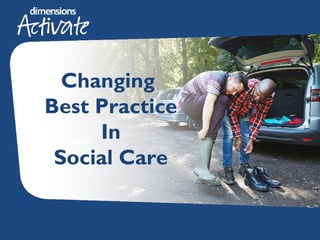
Changing
Best Practice
In
Social Care
The research
In 2014, Dimensions partnered with The University of Kent Tizard
Centre and the Challenging Behaviour Foundation, funded by the NIHR
school for social care research
The randomised controlled trial in 24 homes of 1-8 people over a year
resulted in
A 60% drop in challenging behaviour
A 33% increase in the use of meaningful support
A 25% increase in meaningful activity
Considerable increases in staff motivation
The research
As a founder member of the PBS Academy, it was also
essential that Activate responded to the demands of the new
PBS Competence framework.
Activate will help create the “high quality care and support
environments” that form the basis of tier 1 of that framework
Further information on the methodology and outcomes here
The Challenge
To teach thousands of colleagues across the country a new way
of supporting people – winning hearts and minds
To deliver a new technological infrastructure to support this
outcomes-based model
To convert the research into a practical approach to supporting
people whilst maintaining its integrity
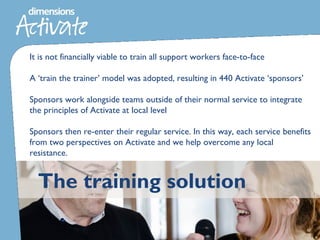
The training solution
It is not financially viable to train all support workers face-to-face
A ‘train the trainer’ model was adopted, resulting in 440 Activate ‘sponsors’
Sponsors work alongside teams outside of their normal service to integrate
the principles of Activate at local level
Sponsors then re-enter their regular service. In this way, each service benefits
from two perspectives on Activate and we help overcome any local
resistance.
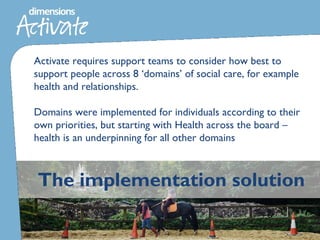
The implementation solution
Activate requires support teams to consider how best to
support people across 8 ‘domains’ of social care, for example
health and relationships.
Domains were implemented for individuals according to their
own priorities, but starting with Health across the board –
health is an underpinning for all other domains
The technological solution
Activate follows a ‘periodic service review’ (PSR) approach to setting and
monitoring outcomes.
These could be anything that is meaningful to a person; from learning to
make a cup of tea to establishing a friendship or attending a health screening
Delivering PSR at scale requires technology in every service; to set up,
monitor and report on outcomes achieved
The technological solution
We selected Iplanit as a supplier of a software solution following an extensive
selection process including two phases of pilots, and exploration of in-house
development options.
We put tablet computers in every single service.
Training included basic IT literacy skills for support teams.
This also required underlying infrastructure development such as secure local
wifi.
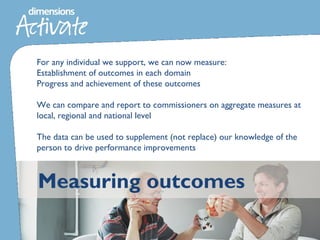
Measuring outcomes
For any individual we support, we can now measure:
Establishment of outcomes in each domain
Progress and achievement of these outcomes
We can compare and report to commissioners on aggregate measures at
local, regional and national level
The data can be used to supplement (not replace) our knowledge of the
person to drive performance improvements
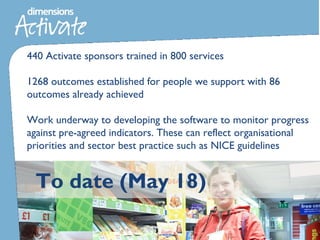
To date (May 18)
440 Activate sponsors trained in 800 services
1268 outcomes established for people we support with 86
outcomes already achieved
Work underway to developing the software to monitor progress
against pre-agreed indicators. These can reflect organisational
priorities and sector best practice such as NICE guidelines
Find out more
https://www.dimensions-uk.org/initiative/activate/

Activate implementation 2018

  • 1.
  • 2.
    The research In 2014,Dimensions partnered with The University of Kent Tizard Centre and the Challenging Behaviour Foundation, funded by the NIHR school for social care research The randomised controlled trial in 24 homes of 1-8 people over a year resulted in A 60% drop in challenging behaviour A 33% increase in the use of meaningful support A 25% increase in meaningful activity Considerable increases in staff motivation
  • 3.
    The research As afounder member of the PBS Academy, it was also essential that Activate responded to the demands of the new PBS Competence framework. Activate will help create the “high quality care and support environments” that form the basis of tier 1 of that framework Further information on the methodology and outcomes here
  • 4.
    The Challenge To teachthousands of colleagues across the country a new way of supporting people – winning hearts and minds To deliver a new technological infrastructure to support this outcomes-based model To convert the research into a practical approach to supporting people whilst maintaining its integrity
  • 5.
    The training solution Itis not financially viable to train all support workers face-to-face A ‘train the trainer’ model was adopted, resulting in 440 Activate ‘sponsors’ Sponsors work alongside teams outside of their normal service to integrate the principles of Activate at local level Sponsors then re-enter their regular service. In this way, each service benefits from two perspectives on Activate and we help overcome any local resistance.
  • 6.
    The implementation solution Activaterequires support teams to consider how best to support people across 8 ‘domains’ of social care, for example health and relationships. Domains were implemented for individuals according to their own priorities, but starting with Health across the board – health is an underpinning for all other domains
  • 7.
    The technological solution Activatefollows a ‘periodic service review’ (PSR) approach to setting and monitoring outcomes. These could be anything that is meaningful to a person; from learning to make a cup of tea to establishing a friendship or attending a health screening Delivering PSR at scale requires technology in every service; to set up, monitor and report on outcomes achieved
  • 8.
    The technological solution Weselected Iplanit as a supplier of a software solution following an extensive selection process including two phases of pilots, and exploration of in-house development options. We put tablet computers in every single service. Training included basic IT literacy skills for support teams. This also required underlying infrastructure development such as secure local wifi.
  • 9.
    Measuring outcomes For anyindividual we support, we can now measure: Establishment of outcomes in each domain Progress and achievement of these outcomes We can compare and report to commissioners on aggregate measures at local, regional and national level The data can be used to supplement (not replace) our knowledge of the person to drive performance improvements
  • 10.
    To date (May18) 440 Activate sponsors trained in 800 services 1268 outcomes established for people we support with 86 outcomes already achieved Work underway to developing the software to monitor progress against pre-agreed indicators. These can reflect organisational priorities and sector best practice such as NICE guidelines
  • 11.