Simple
Present
Teacher: Antonio Cisneros.
Personal
pronouns
Subject Pronouns.
• I
First person, singular.
• You
Second person, singular.
• It
Third person, singular.
• She/he
Third person singular.
• We
First person, plural.
• You
Second person, plural.
• They
Third person, plural.
Examples.
1. I like ice-cream.
2. You have a goat.
3. It is raining.
4. She makes pancakes.
5. He is a gardener.
1. We drink coffee.
2. You are the winners.
3. They work in a restaurant.
Simple
present.
What is simple present?
01
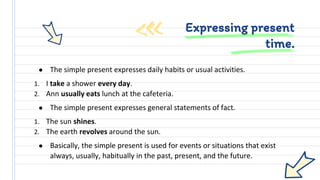
● The simple present expresses daily habits or usual activities.
1. I take a shower every day.
2. Ann usually eats lunch at the cafeteria.
● The simple present expresses general statements of fact.
1. The sun shines.
2. The earth revolves around the sun.
● Basically, the simple present is used for events or situations that exist
always, usually, habitually in the past, present, and the future.
Expressing present
time.
Forms
of the
simple
present.
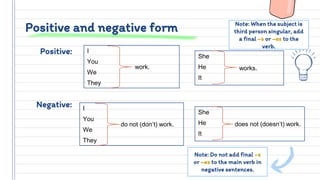
Positive and negative form
Positive: I
work.
You
We
They
She
works.
He
It
Negative: I
do not (don’t) work.
You
We
They
She
does not (doesn’t) work.
He
It
Note: When the subject is
third person singular, add
a final –s or –es to the
verb.
Note: Do not add final –s
or –es to the main verb in
negative sentences.
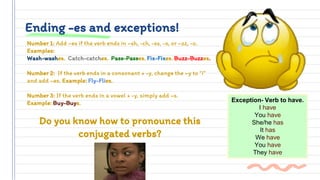
Ending -es and exceptions!
Number 1: Add –es if the verb ends in –sh, -ch, -ss, -x, or –zz, -o.
Examples:
Wash-washes. Catch-catches. Pass-Passes. Fix-Fixes. Buzz-Buzzes.
Number 2: If the verb ends in a consonant + -y, change the –y to “i”
and add –es. Example: Fly-Flies.
Number 3: If the verb ends in a vowel + -y, simply add –s.
Example: Buy-Buys.
Do you know how to pronounce this
conjugated verbs?
Exception- Verb to have.
I have
You have
She/he has
It has
We have
You have
They have
Question and answer.
Question:
Answer:
Note: Do not add a final –s or
–es to the main verb in a
question.
Do
I
work?
you
we
they
Does
she
work?
he
it
Yes,
I
do.
you
we
they
Yes,
she
does.
he
it
No,
I
don’t.
you
we
they
No,
she
doesn’t.
he
it
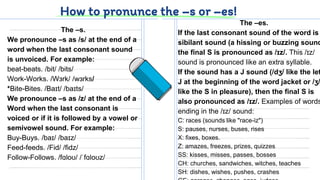
How to pronunce the –s or –es!
The –s.
We pronounce –s as /s/ at the end of a
word when the last consonant sound
is unvoiced. For example:
beat-beats. /bit/ /bits/
Work-Works. /Wɜrk/ /wɜrks/
*Bite-Bites. /Baɪt/ /baɪts/
We pronounce –s as /z/ at the end of a
Word when the last consonant is
voiced or if it is followed by a vowel or
semivowel sound. For example:
Buy-Buys. /baɪ/ /baɪz/
Feed-feeds. /Fid/ /fidz/
Follow-Follows. /fɑloʊ/ /ˈfɑloʊz/
The –es.
If the last consonant sound of the word is
sibilant sound (a hissing or buzzing sound
the final S is pronounced as /ɪz/. This /ɪz/
sound is pronounced like an extra syllable.
If the sound has a J sound (/dʒ/ like the let
J at the beginning of the word jacket or /ʒ/
like the S in pleasure), then the final S is
also pronounced as /ɪz/. Examples of words
ending in the /ɪz/ sound:
C: races (sounds like "race-iz")
S: pauses, nurses, buses, rises
X: fixes, boxes.
Z: amazes, freezes, prizes, quizzes
SS: kisses, misses, passes, bosses
CH: churches, sandwiches, witches, teaches
SH: dishes, wishes, pushes, crashes
Practice time!
● I always ____ breakfast. (to eat)
● I always eat breakfast.
● She usually ____ at 7 am. (to get up)
● She usually gets up at 7 am.
● He ______ two cup of coffee in the
morning. (to drink)
● He drinks two cup of coffee in the
morning.
● They ____ bacon. (negative form)
● They do not eat bacon.
● Ann drinks tea. (Question form)
● Does Ann drink coffee?
● He does the homework. (negative form)
● You drink coffee. (Question form)
● Do you drink coffee.
● The students _____ always in English. (to
speak)
● The students speak always in English.
● We listen to music after lunch. (Negative
form)
● We don’t listen to music after lunch.
Now, create 2 sentences
using simple present.
Extra material.
1. English Pronunciation Practice - How do you pronounce words
ending in S? https://www.youtube.com/watch?v=jJRqZPyuoFM
2. Simple present-Subject pronouns-online practice:
https://agendaweb.org/exercises/verbs/present/affirmative-
forms-pronouns Link 2: https://agendaweb.org/verbs/present-
simple/index.html
Link 3: https://www.really-learn-english.com/simple-present-
exercises.html
Thank you for being here!
Remember, but be careful: Better late than
never.

present simple: affirmative, negative and question.pptx

  • 1.
  • 2.
    Personal pronouns Subject Pronouns. • I Firstperson, singular. • You Second person, singular. • It Third person, singular. • She/he Third person singular. • We First person, plural. • You Second person, plural. • They Third person, plural.
  • 3.
    Examples. 1. I likeice-cream. 2. You have a goat. 3. It is raining. 4. She makes pancakes. 5. He is a gardener. 1. We drink coffee. 2. You are the winners. 3. They work in a restaurant.
  • 4.
  • 5.
    ● The simplepresent expresses daily habits or usual activities. 1. I take a shower every day. 2. Ann usually eats lunch at the cafeteria. ● The simple present expresses general statements of fact. 1. The sun shines. 2. The earth revolves around the sun. ● Basically, the simple present is used for events or situations that exist always, usually, habitually in the past, present, and the future. Expressing present time.
  • 6.
  • 7.
    Positive and negativeform Positive: I work. You We They She works. He It Negative: I do not (don’t) work. You We They She does not (doesn’t) work. He It Note: When the subject is third person singular, add a final –s or –es to the verb. Note: Do not add final –s or –es to the main verb in negative sentences.
  • 8.
    Ending -es andexceptions! Number 1: Add –es if the verb ends in –sh, -ch, -ss, -x, or –zz, -o. Examples: Wash-washes. Catch-catches. Pass-Passes. Fix-Fixes. Buzz-Buzzes. Number 2: If the verb ends in a consonant + -y, change the –y to “i” and add –es. Example: Fly-Flies. Number 3: If the verb ends in a vowel + -y, simply add –s. Example: Buy-Buys. Do you know how to pronounce this conjugated verbs? Exception- Verb to have. I have You have She/he has It has We have You have They have
  • 9.
    Question and answer. Question: Answer: Note:Do not add a final –s or –es to the main verb in a question. Do I work? you we they Does she work? he it Yes, I do. you we they Yes, she does. he it No, I don’t. you we they No, she doesn’t. he it
  • 10.
    How to pronuncethe –s or –es! The –s. We pronounce –s as /s/ at the end of a word when the last consonant sound is unvoiced. For example: beat-beats. /bit/ /bits/ Work-Works. /Wɜrk/ /wɜrks/ *Bite-Bites. /Baɪt/ /baɪts/ We pronounce –s as /z/ at the end of a Word when the last consonant is voiced or if it is followed by a vowel or semivowel sound. For example: Buy-Buys. /baɪ/ /baɪz/ Feed-feeds. /Fid/ /fidz/ Follow-Follows. /fɑloʊ/ /ˈfɑloʊz/ The –es. If the last consonant sound of the word is sibilant sound (a hissing or buzzing sound the final S is pronounced as /ɪz/. This /ɪz/ sound is pronounced like an extra syllable. If the sound has a J sound (/dʒ/ like the let J at the beginning of the word jacket or /ʒ/ like the S in pleasure), then the final S is also pronounced as /ɪz/. Examples of words ending in the /ɪz/ sound: C: races (sounds like "race-iz") S: pauses, nurses, buses, rises X: fixes, boxes. Z: amazes, freezes, prizes, quizzes SS: kisses, misses, passes, bosses CH: churches, sandwiches, witches, teaches SH: dishes, wishes, pushes, crashes
  • 11.
    Practice time! ● Ialways ____ breakfast. (to eat) ● I always eat breakfast. ● She usually ____ at 7 am. (to get up) ● She usually gets up at 7 am. ● He ______ two cup of coffee in the morning. (to drink) ● He drinks two cup of coffee in the morning. ● They ____ bacon. (negative form) ● They do not eat bacon. ● Ann drinks tea. (Question form) ● Does Ann drink coffee? ● He does the homework. (negative form) ● You drink coffee. (Question form) ● Do you drink coffee. ● The students _____ always in English. (to speak) ● The students speak always in English. ● We listen to music after lunch. (Negative form) ● We don’t listen to music after lunch. Now, create 2 sentences using simple present.
  • 12.
    Extra material. 1. EnglishPronunciation Practice - How do you pronounce words ending in S? https://www.youtube.com/watch?v=jJRqZPyuoFM 2. Simple present-Subject pronouns-online practice: https://agendaweb.org/exercises/verbs/present/affirmative- forms-pronouns Link 2: https://agendaweb.org/verbs/present- simple/index.html Link 3: https://www.really-learn-english.com/simple-present- exercises.html
  • 13.
    Thank you forbeing here! Remember, but be careful: Better late than never.