Simple present
Valeria Montiel Bautista.
Angel Román Rivas López
Gloria Cruz Diaz
Aleida Fernanda Villegas
Perez
Janeth Valera Silva
Ruth Samantha Porras
Callejas
Roberto Germán Ruíz
Godínez
Team:
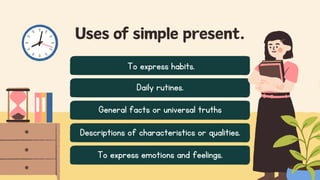
Uses of simple present.
Daily rutines.
To express habits.
General facts or universal truths
Descriptions of characteristics or qualities.
To express emotions and feelings.
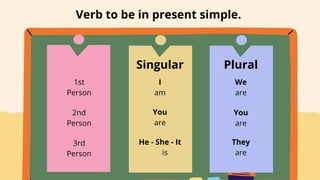
Plural
Singular
I
am
We
are
1st
Person
2nd
Person
3rd
Person
You
are
He - She - It
is
You
are
They
are
Verb to be in present simple.
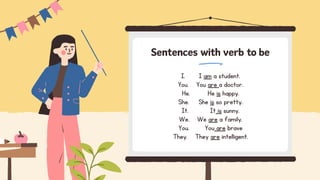
I. I am a student.
You. You are a doctor.
He. He is happy.
She. She is so pretty.
It. It is sunny.
We. We are a family.
You. You are brave
They. They are intelligent.
Sentences with verb to be
Plural
Singular
I
Yo
We
Nosotros(as)
1st
Person
2nd
Person
3rd
Person
You
Usted
He - She - It
El - Ella - Eso
You
Ustedes
They
Ellos(as)
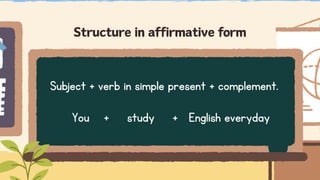
Structure in affirmative form
Subject + verb in simple present + complement.
You + study + English everyday
Most verbs add "s"
Third-Person Conjugation Rules
Example: He eats.
Verbs ending in sh, ch, x, o and ss add “es”
Example: She goes, He watches.
If the verb ends in consonant + y the “y” changes to “ies”.
Example: She studies.
Important note.
Errors in Using
the Simple
Present
Omitting the "s" ending in the third person singular.
Incorrectly adding the "s" or "es" ending to verbs in the
first person, second person and plural.
First Person Singular (I)
Incorrect: I walks to school every day.
Correct: I walk to school every day.
Second Person Singular/Plural (You)
Incorrect: You eats breakfast early.
Correct: You eat breakfast early.
First Person Plural (We)
Incorrect: We goes to the park on weekends.
Correct: We go to the park on weekends.
Third Person Plural (They)
Incorrect: They reads a lot of books.
Correct: They read a lot of books.
Examples with other verbs
Regulars verbs
She works in a school.
They study every day.
We play soccer on weekends.
He listens to music in his room.
I wash the dishes after dinner.
Examples with other verbs
Irregular verbs
He goes to school by bus.
She has two dogs.
I make breakfast every morning.
She takes a shower every day.
He does our homework in the evening.
Equipo académico. (2024). Reglas y uso del present simple en inglés |
British Council. British Council Colombia. Retrieved November 11, 2024,
from https://www.britishcouncil.co/blog/aprende-ingles/present-
simple
References
Brainlang. (2022). Verbos regulares e irregulares en inglés, la guía
definitiva. BrainLang. Retrieved November 11, 2024, from
https://www.brainlang.com/blog/verbos-regulares-irregulares-en-
ingles.html

Present simple PRESENTACION PARA CONOCER

  • 1.
  • 2.
    Valeria Montiel Bautista. AngelRomán Rivas López Gloria Cruz Diaz Aleida Fernanda Villegas Perez Janeth Valera Silva Ruth Samantha Porras Callejas Roberto Germán Ruíz Godínez Team:
  • 3.
    Uses of simplepresent. Daily rutines. To express habits. General facts or universal truths Descriptions of characteristics or qualities. To express emotions and feelings.
  • 4.
    Plural Singular I am We are 1st Person 2nd Person 3rd Person You are He - She- It is You are They are Verb to be in present simple.
  • 5.
    I. I ama student. You. You are a doctor. He. He is happy. She. She is so pretty. It. It is sunny. We. We are a family. You. You are brave They. They are intelligent. Sentences with verb to be
  • 6.
  • 7.
    Structure in affirmativeform Subject + verb in simple present + complement. You + study + English everyday
  • 8.
    Most verbs add"s" Third-Person Conjugation Rules Example: He eats. Verbs ending in sh, ch, x, o and ss add “es” Example: She goes, He watches. If the verb ends in consonant + y the “y” changes to “ies”. Example: She studies.
  • 9.
    Important note. Errors inUsing the Simple Present Omitting the "s" ending in the third person singular. Incorrectly adding the "s" or "es" ending to verbs in the first person, second person and plural. First Person Singular (I) Incorrect: I walks to school every day. Correct: I walk to school every day. Second Person Singular/Plural (You) Incorrect: You eats breakfast early. Correct: You eat breakfast early. First Person Plural (We) Incorrect: We goes to the park on weekends. Correct: We go to the park on weekends. Third Person Plural (They) Incorrect: They reads a lot of books. Correct: They read a lot of books.
  • 10.
    Examples with otherverbs Regulars verbs She works in a school. They study every day. We play soccer on weekends. He listens to music in his room. I wash the dishes after dinner.
  • 11.
    Examples with otherverbs Irregular verbs He goes to school by bus. She has two dogs. I make breakfast every morning. She takes a shower every day. He does our homework in the evening.
  • 12.
    Equipo académico. (2024).Reglas y uso del present simple en inglés | British Council. British Council Colombia. Retrieved November 11, 2024, from https://www.britishcouncil.co/blog/aprende-ingles/present- simple References Brainlang. (2022). Verbos regulares e irregulares en inglés, la guía definitiva. BrainLang. Retrieved November 11, 2024, from https://www.brainlang.com/blog/verbos-regulares-irregulares-en- ingles.html