Sim
ple
Present
SIMPLE PRESENT TENSE
 Use the Simple Present to express the idea that an action is repeated
or usual.
 The action can be a habit, a hobby, a daily event, a scheduled event or
something that often happens.
 It can also be something a person often forgets or usually does not
do.
 Examples:
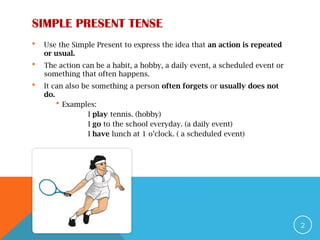
I play tennis. (hobby)
I go to the school everyday. (a daily event)
I have lunch at 1 o’clock. ( a scheduled event)
2
SOME RULES
AFFIRMATIVE FORM (I, you, we, they)
 When we write the affirmative form we use this formula:
Subject + verb in present + complement
 Examples:
 You have English class twice a week.
(Subject + Verb + Complement)
 I take a shower every morning.
(Subject + Verb + Complement)
3
AFFIRMATIVE FORM: 3RD PERSON (He, She, It)
 When we use present simple tense in third person we add “s” or “es”
to the verb
 Examples:
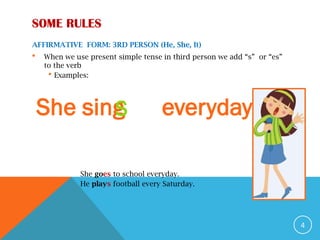
She goes to school everyday.
He plays football every Saturday.
4
She sing everyday
S
SOME RULES
THE NEGATIVE FORM FOR I, YOU, WE, THEY
 When we write the negative form for these pronouns we do it like this:
Personal pronoun + Do + not + verb + complement
We can use don’t too
 Examples:
I do not like soup / I don’t like soup.
We do not play football
They do not live in Temuco
5
THE NEGATIVE FORM FOR HE, SHE, IT
 When we write the negative form for these pronouns we do it like this:
Personal pronoun + Does + not + verb + complement
 Examples:
 He doesn’t read books
 She doesn’t play basketball
NOTE:
 If the verb ends in "SS", "SH", "CH", "O" or "X“ we add “ES”
 If the verb ends in “Y” we change the “Y” for and “I” and add “ES”
6
INTERROGATIVE FORM FOR I, YOU, WE, THEY
 When we write the interrogative form for these pronouns we do it like
this:
 Do + personal pronoun + verb + complement + ?
 Examples:
 Do you play the guitar?
 Do they go to the cinema?
7
INTERROGATIVE FORM FOR HE, SHE, IT
 When we write the interrogative form for these pronouns we do it like
this:
 Does + personal pronoun + verb + complement + ?
 Examples:
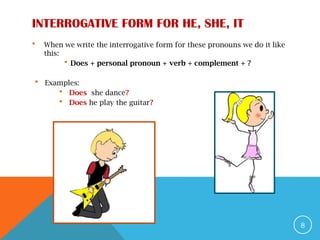
 Does she dance?
 Does he play the guitar?
8
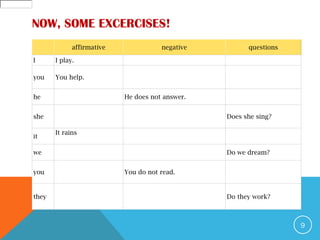
NOW, SOME EXCERCISES!
affirmative negative questions
I I play.
you You help.
he He does not answer.
she Does she sing?
it
It rains
we Do we dream?
you You do not read.
they Do they work?
9

SIMPLE PRESENT ESFM THEA UNIT 10 (CHECK AND ANALYZE IT)

  • 1.
  • 2.
    SIMPLE PRESENT TENSE Use the Simple Present to express the idea that an action is repeated or usual.  The action can be a habit, a hobby, a daily event, a scheduled event or something that often happens.  It can also be something a person often forgets or usually does not do.  Examples: I play tennis. (hobby) I go to the school everyday. (a daily event) I have lunch at 1 o’clock. ( a scheduled event) 2
  • 3.
    SOME RULES AFFIRMATIVE FORM(I, you, we, they)  When we write the affirmative form we use this formula: Subject + verb in present + complement  Examples:  You have English class twice a week. (Subject + Verb + Complement)  I take a shower every morning. (Subject + Verb + Complement) 3
  • 4.
    AFFIRMATIVE FORM: 3RDPERSON (He, She, It)  When we use present simple tense in third person we add “s” or “es” to the verb  Examples: She goes to school everyday. He plays football every Saturday. 4 She sing everyday S SOME RULES
  • 5.
    THE NEGATIVE FORMFOR I, YOU, WE, THEY  When we write the negative form for these pronouns we do it like this: Personal pronoun + Do + not + verb + complement We can use don’t too  Examples: I do not like soup / I don’t like soup. We do not play football They do not live in Temuco 5
  • 6.
    THE NEGATIVE FORMFOR HE, SHE, IT  When we write the negative form for these pronouns we do it like this: Personal pronoun + Does + not + verb + complement  Examples:  He doesn’t read books  She doesn’t play basketball NOTE:  If the verb ends in "SS", "SH", "CH", "O" or "X“ we add “ES”  If the verb ends in “Y” we change the “Y” for and “I” and add “ES” 6
  • 7.
    INTERROGATIVE FORM FORI, YOU, WE, THEY  When we write the interrogative form for these pronouns we do it like this:  Do + personal pronoun + verb + complement + ?  Examples:  Do you play the guitar?  Do they go to the cinema? 7
  • 8.
    INTERROGATIVE FORM FORHE, SHE, IT  When we write the interrogative form for these pronouns we do it like this:  Does + personal pronoun + verb + complement + ?  Examples:  Does she dance?  Does he play the guitar? 8
  • 9.
    NOW, SOME EXCERCISES! affirmativenegative questions I I play. you You help. he He does not answer. she Does she sing? it It rains we Do we dream? you You do not read. they Do they work? 9