
INTERVIEWS
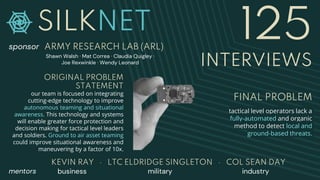
125
sponsor
SILKNET
mentors
KEVIN RAY · LTC ELDRIDGE SINGLETON · COL SEAN DAY
business military industry
ARMY RESEARCH LAB (ARL)
our team is focused on integrating
cutting-edge technology to improve
autonomous teaming and situational
awareness. This technology and systems
will enable greater force protection and
decision making for tactical level leaders
and soldiers. Ground to air asset teaming
could improve situational awareness and
maneuvering by a factor of 10x.
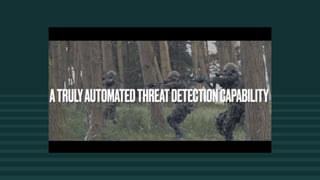
tactical level operators lack a
fully-automated and organic
method to detect local and
ground-based threats.
ORIGINAL PROBLEM
STATEMENT
FINAL PROBLEM
Shawn Walsh · Mat Correa · Claudia Quigley ·
Joe Rexwinkle · Wendy Leonard
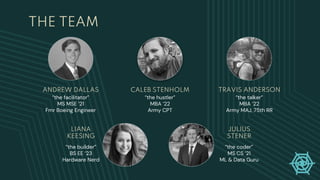
THE TEAM
“the facilitator”
MS MSE ‘21
Fmr Boeing Engineer
ANDREW DALLAS
“the hustler”
MBA ‘22
Army CPT
“the talker”
MBA ‘22
Army MAJ, 75th RR
CALEB STENHOLM TRAVIS ANDERSON
“the builder”
BS EE ‘23
Hardware Nerd
LIANA
KEESING
“the coder”
MS CS ‘21
ML & Data Guru
JULIUS
STENER
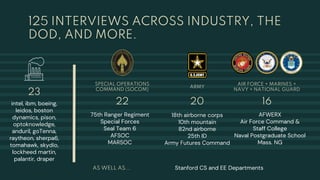
125 INTERVIEWS ACROSS INDUSTRY, THE
DOD, AND MORE.
22
23
intel, ibm, boeing,
leidos, boston
dynamics, pison,
optoknowledge,
anduril, goTenna,
raytheon, sherpa6,
tomahawk, skydio,
lockheed martin,
palantir, draper
SPECIAL OPERATIONS
COMMAND (SOCOM)
75th Ranger Regiment
Special Forces
Seal Team 6
AFSOC
MARSOC
20
ARMY
18th airborne corps
10th mountain
82nd airborne
25th ID
Army Futures Command
16
AIR FORCE + MARINES +
NAVY + NATIONAL GUARD
AFWERX
Air Force Command &
Staff College
Naval Postgraduate School
Mass. NG
AS WELL AS... Stanford CS and EE Departments
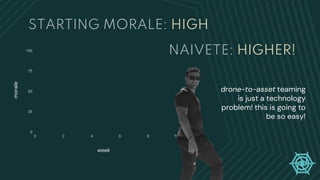
STARTING MORALE: HIGH
drone-to-asset teaming
is just a technology
problem! this is going to
be so easy!
week
morale
NAIVETE: HIGHER!
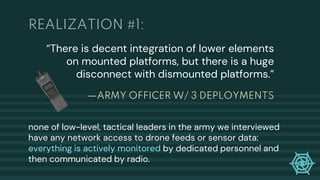
—ARMY OFFICER W/ 3 DEPLOYMENTS
“There is decent integration of lower elements
on mounted platforms, but there is a huge
disconnect with dismounted platforms.”
REALIZATION #1:
none of low-level, tactical leaders in the army we interviewed
have any network access to drone feeds or sensor data:
everything is actively monitored by dedicated personnel and
then communicated by radio.
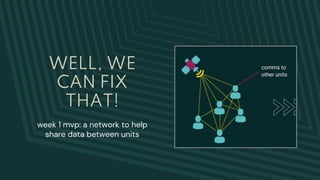
WELL, WE
CAN FIX
THAT!
week 1 mvp: a network to help
share data between units
AND THEN,
WE’RE HIT WITH 3 DISCOVERIES
week
morale
THE ARMY IS TRYING TO
CHANGE THIS IN CAPSET 21
—TEAM LEADER AT
DEVCOM SOLDIER CENTER
“CAPSET 21 includes phone and
radio networking to provide
capability down to the team
leader. ITN [integrated tactical
network] is the layered network
that will serve as the backbone.”
01
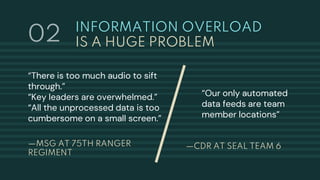
INFORMATION OVERLOAD
IS A HUGE PROBLEM
—MSG AT 75TH RANGER
REGIMENT
“There is too much audio to sift
through.”
“Key leaders are overwhelmed.”
“All the unprocessed data is too
cumbersome on a small screen.”
02
“Our only automated
data feeds are team
member locations”
—CDR AT SEAL TEAM 6
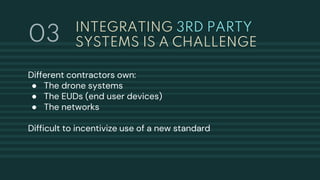
INTEGRATING 3RD PARTY
SYSTEMS IS A CHALLENGE
Different contractors own:
● The drone systems
● The EUDs (end user devices)
● The networks
Difficult to incentivize use of a new standard
03
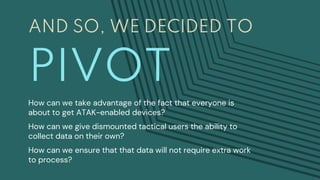
AND SO, WE DECIDED TO
PIVOT
How can we take advantage of the fact that everyone is
about to get ATAK-enabled devices?
How can we give dismounted tactical users the ability to
collect data on their own?
How can we ensure that that data will not require extra work
to process?
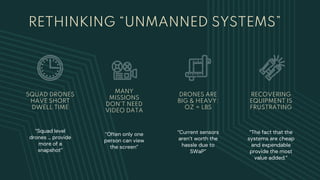
RETHINKING “UNMANNED SYSTEMS”
“Squad level
drones … provide
more of a
snapshot”
SQUAD DRONES
HAVE SHORT
DWELL TIME
MANY
MISSIONS
DON’T NEED
VIDEO DATA
“Often only one
person can view
the screen”
DRONES ARE
BIG & HEAVY:
OZ = LBS
“Current sensors
aren’t worth the
hassle due to
SWaP”
RECOVERING
EQUIPMENT IS
FRUSTRATING
“The fact that the
systems are cheap
and expendable
provide the most
value added.”
SO, WE MOVE AWAY FROM DRONES,
AND BECOME...
SILKNET
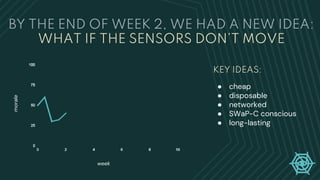
BY THE END OF WEEK 2, WE HAD A NEW IDEA:
WHAT IF THE SENSORS DON’T MOVE
week
morale
● cheap
● disposable
● networked
● SWaP-C conscious
● long-lasting
KEY IDEAS:
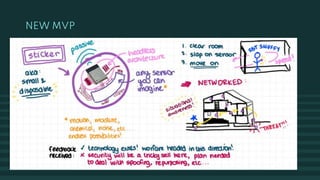
NEW MVP
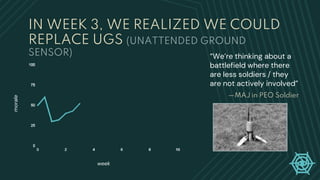
IN WEEK 3, WE REALIZED WE COULD
REPLACE UGS (UNATTENDED GROUND
SENSOR)
week
morale
“We’re thinking about a
battlefield where there
are less soldiers / they
are not actively involved”
—MAJ in PEO Soldier
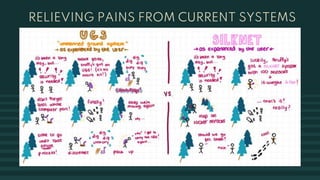
RELIEVING PAINS FROM CURRENT SYSTEMS
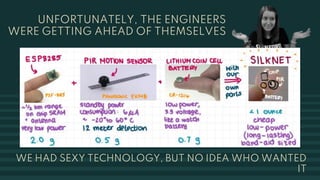
UNFORTUNATELY, THE ENGINEERS
WERE GETTING AHEAD OF THEMSELVES
WE HAD SEXY TECHNOLOGY, BUT NO IDEA WHO WANTED
IT
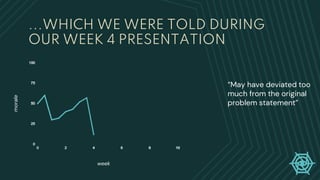
...WHICH WE WERE TOLD DURING
OUR WEEK 4 PRESENTATION
week
morale
“May have deviated too
much from the original
problem statement”
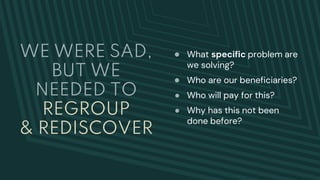
WE WERE SAD,
BUT WE
NEEDED TO
REGROUP
& REDISCOVER
● What specific problem are
we solving?
● Who are our beneficiaries?
● Who will pay for this?
● Why has this not been
done before?
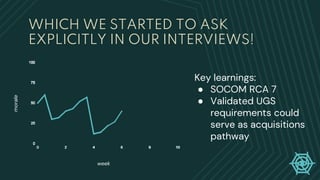
WHICH WE STARTED TO ASK
EXPLICITLY IN OUR INTERVIEWS!
week
morale
Key learnings:
● SOCOM RCA 7
● Validated UGS
requirements could
serve as acquisitions
pathway
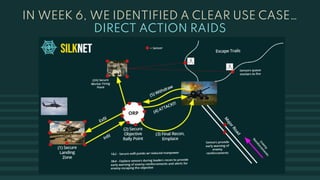
IN WEEK 6, WE IDENTIFIED A CLEAR USE CASE…
DIRECT ACTION RAIDS
… AND INVESTIGATED CRUCIAL
DEPLOYMENT CHALLENGES
We talked to program managers, acquisitions specialists, and PEOs, as well as
people in the defense industry ecosystem.
“TRL 6 is necessary to
deploy to AEWE and
other army programs.”
—SOCOM PEO
“SOCOM wants products that
are more technologically
developed. “
—ARMY
ACQUISITIONS
OFFICER
—VC
“Can you name a commercial
product that SOCOM bought
from a venture-backed startup?”
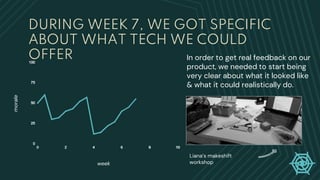
DURING WEEK 7, WE GOT SPECIFIC
ABOUT WHAT TECH WE COULD
OFFER
week
morale
In order to get real feedback on our
product, we needed to start being
very clear about what it looked like
& what it could realistically do.
Liana’s makeshift
workshop
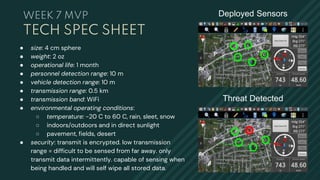
Deployed Sensors
Threat Detected
● size: 4 cm sphere
● weight: 2 oz
● operational life: 1 month
● personnel detection range: 10 m
● vehicle detection range: 10 m
● transmission range: 0.5 km
● transmission band: WiFi
● environmental operating conditions:
○ temperature: -20 C to 60 C, rain, sleet, snow
○ indoors/outdoors and in direct sunlight
○ pavement, fields, desert
● security: transmit is encrypted. low transmission
range = difficult to be sensed from far away. only
transmit data intermittently. capable of sensing when
being handled and will self wipe all stored data.
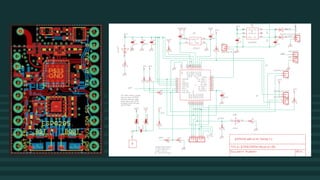
TECH SPEC SHEET
WEEK 7 MVP
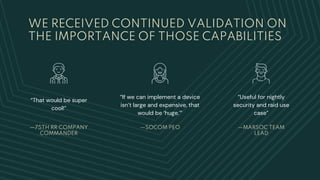
WE RECEIVED CONTINUED VALIDATION ON
THE IMPORTANCE OF THOSE CAPABILITIES
“If we can implement a device
isn’t large and expensive, that
would be ‘huge.’”
—75TH RR COMPANY
COMMANDER
“That would be super
cool!”
—SOCOM PEO —MARSOC TEAM
LEAD
“Useful for nightly
security and raid use
case”
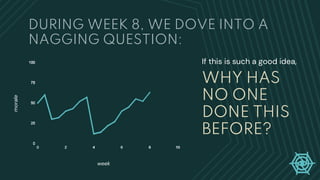
DURING WEEK 8, WE DOVE INTO A
NAGGING QUESTION:
week
morale
WHY HAS
NO ONE
DONE THIS
BEFORE?
If this is such a good idea,
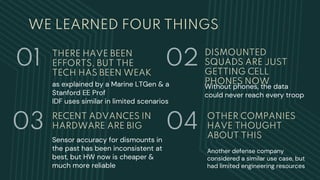
WE LEARNED FOUR THINGS
RECENT ADVANCES IN
HARDWARE ARE BIG
Sensor accuracy for dismounts in
the past has been inconsistent at
best, but HW now is cheaper &
much more reliable
DISMOUNTED
SQUADS ARE JUST
GETTING CELL
PHONES NOW
Without phones, the data
could never reach every troop
THERE HAVE BEEN
EFFORTS, BUT THE
TECH HAS BEEN WEAK
as explained by a Marine LTGen & a
Stanford EE Prof
IDF uses similar in limited scenarios
01
03
02
04 OTHER COMPANIES
HAVE THOUGHT
ABOUT THIS
Another defense company
considered a similar use case, but
had limited engineering resources
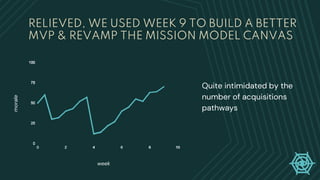
RELIEVED, WE USED WEEK 9 TO BUILD A BETTER
MVP & REVAMP THE MISSION MODEL CANVAS
week
morale
Quite intimidated by the
number of acquisitions
pathways
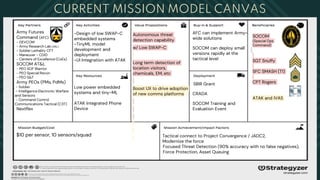
CURRENT MISSION MODEL CANVAS
SOCOM
(Special Ops
Command)
SGT Snuffy
SFC SMASH (T1)
CPT Rogers
ATAK and IVAS
Army Futures
Command (AFC)
- DEVCOM
- Army Research Lab (ARL)
- Soldier Lethality CFT
- Maneuver - CDID
- Centers of Excellence (CoEs)
SOCOM AT&L
- PEO SOF Warrior
- PEO Special Recon
- PEO S&T
Army PEOs (PMs, PdMs)
- Soldier
- Intelligence Electronic Warfare
and Sensors
- Command Control
Communications Tactical (C3T)
Nextflex
Low power embedded
systems and tiny-ML
ATAK Integrated Phone
Device
Autonomous threat
detection capability
w/ Low SWAP-C
Long term detection of
location visitors,
chemicals, EM, etc
Boost UX to drive adoption
of new comms platforms
-Design of low SWAP-C
embedded systems
-TinyML model
development and
deployment
-UI Integration with ATAK
Tactical connect to Project Convergence / JADC2,
Modernize the force
Focused Threat Detection (90% accuracy with no false negatives),
Force Protection, Asset Queuing
SBIR Grant
CRADA
SOCOM Training and
Evaluation Event
AFC can implement Army-
wide solutions
SOCOM can deploy small
versions rapidly at the
tactical level
$10 per sensor, 10 sensors/squad
WEEK 11: NOW THE REAL WORK BEGINS!
PARTICIPATE IN H4X LABS
Develop business model and
technology for demonstrations,
production, and acquisition
APPLY FOR SIBRS
Currently working applications
for DoD and NSF grants
GOING FORWARD, WE PLAN TO
PERFORM CUSTOMER
DISCOVERY FOR DUAL USE
APPLICATIONS
Applications in security, fire,
gaming, agriculture
RAISE SEED
FUNDING!
Shawn Walsh
Mat Correa
Claudia Quigley
Joe Rexwinkle
Wendy Leonard
Kevin Ray
LTC (P) Eldridge “Raj” Singleton
COL (P) Sean Day
The H4X Teaching Staff
And all of our interviewees!
A HUGE THANKS TO
CONTACT INFO
dronebuddies@lists.stanford.edu
tma75@stanford.edu
csten@stanford.edu
julius@stener.org
lkeesing@stanford.edu
andrew.s.dallas95@gmail.com

Silknet H4D 2021 Lessons Learned

  • 1.
    INTERVIEWS 125 sponsor SILKNET mentors KEVIN RAY ·LTC ELDRIDGE SINGLETON · COL SEAN DAY business military industry ARMY RESEARCH LAB (ARL) our team is focused on integrating cutting-edge technology to improve autonomous teaming and situational awareness. This technology and systems will enable greater force protection and decision making for tactical level leaders and soldiers. Ground to air asset teaming could improve situational awareness and maneuvering by a factor of 10x. tactical level operators lack a fully-automated and organic method to detect local and ground-based threats. ORIGINAL PROBLEM STATEMENT FINAL PROBLEM Shawn Walsh · Mat Correa · Claudia Quigley · Joe Rexwinkle · Wendy Leonard
  • 2.
    THE TEAM “the facilitator” MSMSE ‘21 Fmr Boeing Engineer ANDREW DALLAS “the hustler” MBA ‘22 Army CPT “the talker” MBA ‘22 Army MAJ, 75th RR CALEB STENHOLM TRAVIS ANDERSON “the builder” BS EE ‘23 Hardware Nerd LIANA KEESING “the coder” MS CS ‘21 ML & Data Guru JULIUS STENER
  • 3.
    125 INTERVIEWS ACROSSINDUSTRY, THE DOD, AND MORE. 22 23 intel, ibm, boeing, leidos, boston dynamics, pison, optoknowledge, anduril, goTenna, raytheon, sherpa6, tomahawk, skydio, lockheed martin, palantir, draper SPECIAL OPERATIONS COMMAND (SOCOM) 75th Ranger Regiment Special Forces Seal Team 6 AFSOC MARSOC 20 ARMY 18th airborne corps 10th mountain 82nd airborne 25th ID Army Futures Command 16 AIR FORCE + MARINES + NAVY + NATIONAL GUARD AFWERX Air Force Command & Staff College Naval Postgraduate School Mass. NG AS WELL AS... Stanford CS and EE Departments
  • 4.
    STARTING MORALE: HIGH drone-to-assetteaming is just a technology problem! this is going to be so easy! week morale NAIVETE: HIGHER!
  • 5.
    —ARMY OFFICER W/3 DEPLOYMENTS “There is decent integration of lower elements on mounted platforms, but there is a huge disconnect with dismounted platforms.” REALIZATION #1: none of low-level, tactical leaders in the army we interviewed have any network access to drone feeds or sensor data: everything is actively monitored by dedicated personnel and then communicated by radio.
  • 6.
    WELL, WE CAN FIX THAT! week1 mvp: a network to help share data between units
  • 7.
    AND THEN, WE’RE HITWITH 3 DISCOVERIES week morale
  • 8.
    THE ARMY ISTRYING TO CHANGE THIS IN CAPSET 21 —TEAM LEADER AT DEVCOM SOLDIER CENTER “CAPSET 21 includes phone and radio networking to provide capability down to the team leader. ITN [integrated tactical network] is the layered network that will serve as the backbone.” 01
  • 9.
    INFORMATION OVERLOAD IS AHUGE PROBLEM —MSG AT 75TH RANGER REGIMENT “There is too much audio to sift through.” “Key leaders are overwhelmed.” “All the unprocessed data is too cumbersome on a small screen.” 02 “Our only automated data feeds are team member locations” —CDR AT SEAL TEAM 6
  • 10.
    INTEGRATING 3RD PARTY SYSTEMSIS A CHALLENGE Different contractors own: ● The drone systems ● The EUDs (end user devices) ● The networks Difficult to incentivize use of a new standard 03
  • 11.
    AND SO, WEDECIDED TO PIVOT How can we take advantage of the fact that everyone is about to get ATAK-enabled devices? How can we give dismounted tactical users the ability to collect data on their own? How can we ensure that that data will not require extra work to process?
  • 12.
    RETHINKING “UNMANNED SYSTEMS” “Squadlevel drones … provide more of a snapshot” SQUAD DRONES HAVE SHORT DWELL TIME MANY MISSIONS DON’T NEED VIDEO DATA “Often only one person can view the screen” DRONES ARE BIG & HEAVY: OZ = LBS “Current sensors aren’t worth the hassle due to SWaP” RECOVERING EQUIPMENT IS FRUSTRATING “The fact that the systems are cheap and expendable provide the most value added.”
  • 13.
    SO, WE MOVEAWAY FROM DRONES, AND BECOME... SILKNET
  • 14.
    BY THE ENDOF WEEK 2, WE HAD A NEW IDEA: WHAT IF THE SENSORS DON’T MOVE week morale ● cheap ● disposable ● networked ● SWaP-C conscious ● long-lasting KEY IDEAS:
  • 15.
  • 16.
    IN WEEK 3,WE REALIZED WE COULD REPLACE UGS (UNATTENDED GROUND SENSOR) week morale “We’re thinking about a battlefield where there are less soldiers / they are not actively involved” —MAJ in PEO Soldier
  • 17.
    RELIEVING PAINS FROMCURRENT SYSTEMS
  • 18.
    UNFORTUNATELY, THE ENGINEERS WEREGETTING AHEAD OF THEMSELVES WE HAD SEXY TECHNOLOGY, BUT NO IDEA WHO WANTED IT
  • 19.
    ...WHICH WE WERETOLD DURING OUR WEEK 4 PRESENTATION week morale “May have deviated too much from the original problem statement”
  • 20.
    WE WERE SAD, BUTWE NEEDED TO REGROUP & REDISCOVER ● What specific problem are we solving? ● Who are our beneficiaries? ● Who will pay for this? ● Why has this not been done before?
  • 21.
    WHICH WE STARTEDTO ASK EXPLICITLY IN OUR INTERVIEWS! week morale Key learnings: ● SOCOM RCA 7 ● Validated UGS requirements could serve as acquisitions pathway
  • 22.
    IN WEEK 6,WE IDENTIFIED A CLEAR USE CASE… DIRECT ACTION RAIDS
  • 23.
    … AND INVESTIGATEDCRUCIAL DEPLOYMENT CHALLENGES We talked to program managers, acquisitions specialists, and PEOs, as well as people in the defense industry ecosystem. “TRL 6 is necessary to deploy to AEWE and other army programs.” —SOCOM PEO “SOCOM wants products that are more technologically developed. “ —ARMY ACQUISITIONS OFFICER —VC “Can you name a commercial product that SOCOM bought from a venture-backed startup?”
  • 24.
    DURING WEEK 7,WE GOT SPECIFIC ABOUT WHAT TECH WE COULD OFFER week morale In order to get real feedback on our product, we needed to start being very clear about what it looked like & what it could realistically do. Liana’s makeshift workshop
  • 25.
    Deployed Sensors Threat Detected ●size: 4 cm sphere ● weight: 2 oz ● operational life: 1 month ● personnel detection range: 10 m ● vehicle detection range: 10 m ● transmission range: 0.5 km ● transmission band: WiFi ● environmental operating conditions: ○ temperature: -20 C to 60 C, rain, sleet, snow ○ indoors/outdoors and in direct sunlight ○ pavement, fields, desert ● security: transmit is encrypted. low transmission range = difficult to be sensed from far away. only transmit data intermittently. capable of sensing when being handled and will self wipe all stored data. TECH SPEC SHEET WEEK 7 MVP
  • 28.
    WE RECEIVED CONTINUEDVALIDATION ON THE IMPORTANCE OF THOSE CAPABILITIES “If we can implement a device isn’t large and expensive, that would be ‘huge.’” —75TH RR COMPANY COMMANDER “That would be super cool!” —SOCOM PEO —MARSOC TEAM LEAD “Useful for nightly security and raid use case”
  • 29.
    DURING WEEK 8,WE DOVE INTO A NAGGING QUESTION: week morale WHY HAS NO ONE DONE THIS BEFORE? If this is such a good idea,
  • 30.
    WE LEARNED FOURTHINGS RECENT ADVANCES IN HARDWARE ARE BIG Sensor accuracy for dismounts in the past has been inconsistent at best, but HW now is cheaper & much more reliable DISMOUNTED SQUADS ARE JUST GETTING CELL PHONES NOW Without phones, the data could never reach every troop THERE HAVE BEEN EFFORTS, BUT THE TECH HAS BEEN WEAK as explained by a Marine LTGen & a Stanford EE Prof IDF uses similar in limited scenarios 01 03 02 04 OTHER COMPANIES HAVE THOUGHT ABOUT THIS Another defense company considered a similar use case, but had limited engineering resources
  • 31.
    RELIEVED, WE USEDWEEK 9 TO BUILD A BETTER MVP & REVAMP THE MISSION MODEL CANVAS week morale Quite intimidated by the number of acquisitions pathways
  • 32.
    CURRENT MISSION MODELCANVAS SOCOM (Special Ops Command) SGT Snuffy SFC SMASH (T1) CPT Rogers ATAK and IVAS Army Futures Command (AFC) - DEVCOM - Army Research Lab (ARL) - Soldier Lethality CFT - Maneuver - CDID - Centers of Excellence (CoEs) SOCOM AT&L - PEO SOF Warrior - PEO Special Recon - PEO S&T Army PEOs (PMs, PdMs) - Soldier - Intelligence Electronic Warfare and Sensors - Command Control Communications Tactical (C3T) Nextflex Low power embedded systems and tiny-ML ATAK Integrated Phone Device Autonomous threat detection capability w/ Low SWAP-C Long term detection of location visitors, chemicals, EM, etc Boost UX to drive adoption of new comms platforms -Design of low SWAP-C embedded systems -TinyML model development and deployment -UI Integration with ATAK Tactical connect to Project Convergence / JADC2, Modernize the force Focused Threat Detection (90% accuracy with no false negatives), Force Protection, Asset Queuing SBIR Grant CRADA SOCOM Training and Evaluation Event AFC can implement Army- wide solutions SOCOM can deploy small versions rapidly at the tactical level $10 per sensor, 10 sensors/squad
  • 33.
    WEEK 11: NOWTHE REAL WORK BEGINS!
  • 34.
    PARTICIPATE IN H4XLABS Develop business model and technology for demonstrations, production, and acquisition APPLY FOR SIBRS Currently working applications for DoD and NSF grants GOING FORWARD, WE PLAN TO PERFORM CUSTOMER DISCOVERY FOR DUAL USE APPLICATIONS Applications in security, fire, gaming, agriculture RAISE SEED FUNDING!
  • 35.
    Shawn Walsh Mat Correa ClaudiaQuigley Joe Rexwinkle Wendy Leonard Kevin Ray LTC (P) Eldridge “Raj” Singleton COL (P) Sean Day The H4X Teaching Staff And all of our interviewees! A HUGE THANKS TO CONTACT INFO dronebuddies@lists.stanford.edu tma75@stanford.edu csten@stanford.edu julius@stener.org lkeesing@stanford.edu andrew.s.dallas95@gmail.com