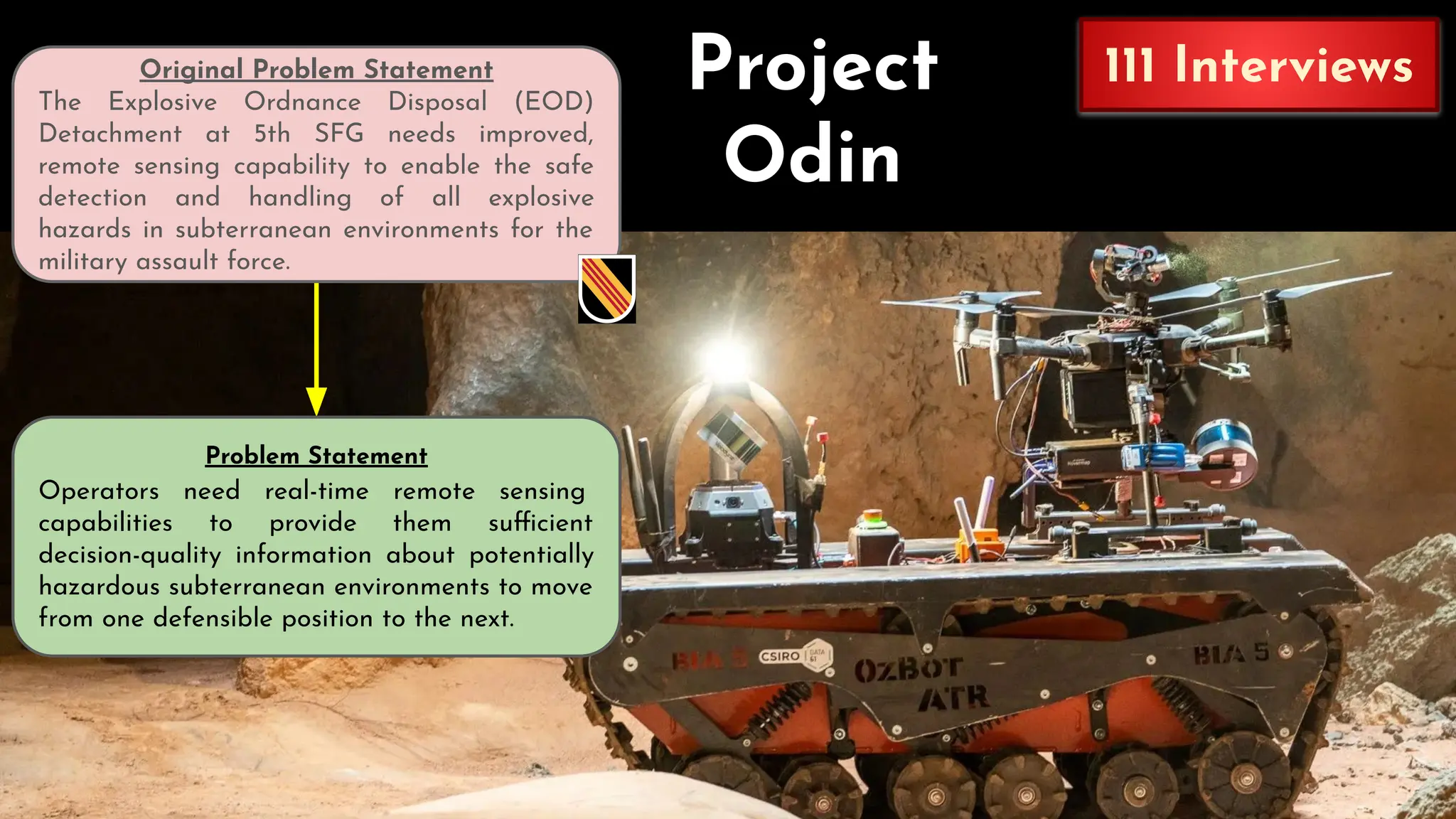
Project
Odin
Problem Statement
Operators need real-time remote sensing
capabilities to provide them sufficient
decision-quality information about potentially
hazardous subterranean environments to move
from one defensible position to the next.
Original Problem Statement
The Explosive Ordnance Disposal (EOD)
Detachment at 5th SFG needs improved,
remote sensing capability to enable the safe
detection and handling of all explosive
hazards in subterranean environments for the
military assault force.
111 Interviews
2
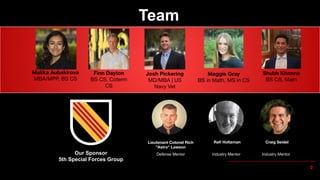
Team
Malika Aubakirova
MBA/MPP, BS CS
Finn Dayton
BS CS, Coterm
CS
Josh Pickering
MD/MBA | US
Navy Vet
Shubh Khanna
BS CS, Math
Lieutenant Colonel Rich
"Astro" Lawson
Rafi Holtzman
Defense Mentor Industry Mentor
Craig Seidel
Industry Mentor
Maggie Gray
BS in Math, MS in CS
Our Sponsor
5th Special Forces Group
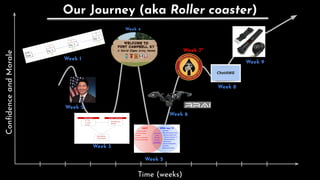
Our Journey (aka Roller coaster)
Week 1
Week 2
Week 3
Week 4
Week 5
Week 6
Week 7*
Week 8
Week 9
Time (weeks)
Confidence
and
Morale
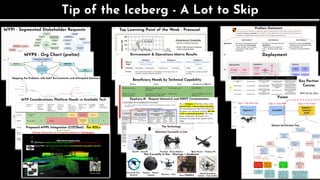
Tip of the Iceberg - A Lot to Skip
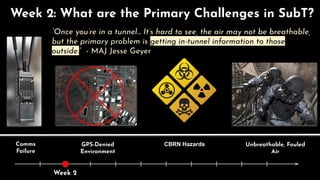
Week 2: What are the Primary Challenges in SubT?
Week 2
Comms
Failure
GPS-Denied
Environment
CBRN Hazards Unbreathable, Fouled
Air
“Once you’re in a tunnel… It’s hard to see, the air may not be breathable,
but the primary problem is getting in-tunnel information to those
outside.” - MAJ Jesse Geyer
Week 2: How Have Others Approached SubT?
Timothy Chung - PM DARPA 6 years
“Geology, physics, inherent
environment… [SubT] is uniquely challenging and getting actionable
situational awareness is tough. There are so many ways to break a
robot underground.”
Week 2
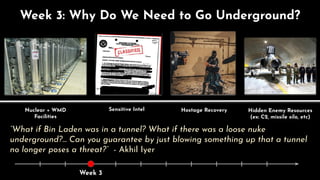
Week 3: Why Do We Need to Go Underground?
Week 3
Nuclear + WMD
Facilities
Sensitive Intel Hostage Recovery Hidden Enemy Resources
(ex: C2, missile silo, etc)
“What if Bin Laden was in a tunnel? What if there was a loose nuke
underground?... Can you guarantee by just blowing something up that a tunnel
no longer poses a threat?” - Akhil Iyer
Week 3: Different SubT Environments
“Probably looking at 1-4 hours, if we’re bringing in a bit of equipment
[underground]. Robots needs to be our eyes.” - CPT Stults
Category 1
Caves + Natural Cavities
Category 2
Urban Subsystems
Category 3
Military Underground Facility
Week 3
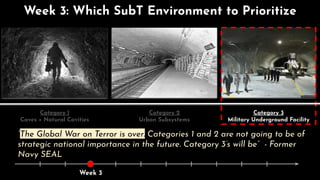
Week 3: Which SubT Environment to Prioritize
“The Global War on Terror is over. Categories 1 and 2 are not going to be of
strategic national importance in the future. Category 3’s will be“ - Former
Navy SEAL
Category 1
Caves + Natural Cavities
Category 2
Urban Subsystems
Category 3
Military Underground Facility
Week 3
Weeks 1 - 3
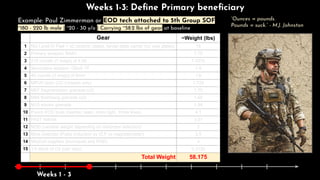
Weeks 1-3: Define Primary beneficiary
Example: Paul Zimmerman or EOD tech attached to 5th Group SOF
Gear ~Weight (lbs)
1 NIJ Level IV Flak = x2 ceramic plates, kevlar plate carrier (no side plates) 15
2 Primary weapon: M4A1 7.75
3 210 rounds (7 mags) of 5.56 7.4375
4 Secondary weapon: Glock 19 1.9
5 45 rounds (3 mags) of 9mm 1.6
6 MPU5 radio (x2) (chassis only) 1.725
7 M67 fragmentation grenade (x2) 1.75
8 M84 flashbang grenade (x2) 1.65
9 M15 smoke grenade 1.94
10 Pouch EOD tools (Gerber, laser, chem light, throw lines) 4.1
11 FAST helmet 3.51
12 NOD (variable weight depending on wardrobe selection) 2
13 Mine Detector (Pulse Induction vs VLF vs magnetometer) 3.5
14 Medical supplies (tourniquet and IFAK) 4
15 1/4 block of C4 (can vary) 0.3125
Total Weight 58.175
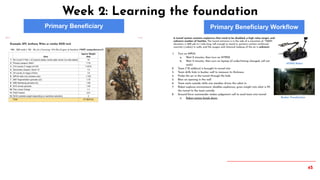
~180 - 220 lb male | ~20 - 30 y/o | Carrying ~58.2 lbs of gear at baseline
“Ounces = pounds.
Pounds = suck.” - M.J. Johnston
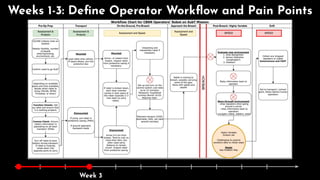
Weeks 1-3: Define Operator Workflow and Pain Points
Week 3
Week 4: Fort Campbell!
“Like all robots, it [MTRS2] never seems to work
when it needs to.” - SFC Anthony Wiles
“My trust is more in blood than technology.”
- Cpt. David Stults
Week 4
Maggie!
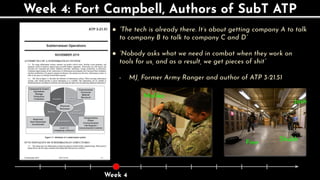
Week 4: Fort Campbell, Authors of SubT ATP
● “The tech is already there. It’s about getting company A to talk
to company B to talk to company C and D”
● “Nobody asks what we need in combat when they work on
tools for us, and as a result, we get pieces of shit”
- MJ, Former Army Ranger and author of ATP 3-21.51
Week 4
Malika
Finn Shubh
Josh
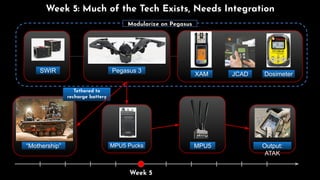
JCAD
XAM Dosimeter
SWIR Pegasus 3
MPU5
MPU5 Pucks Output:
ATAK
“Mothership”
Tethered to
recharge battery
Communicate
with MPU5 +
repeaters
Modularize on Pegasus
Week 5: Much of the Tech Exists, Needs Integration
Week 5
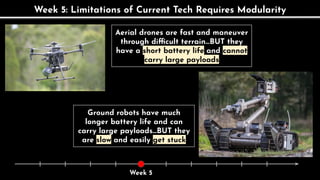
Week 5: Limitations of Current Tech Requires Modularity
Aerial drones are fast and maneuver
through difficult terrain…BUT they
have a short battery life and cannot
carry large payloads
Ground robots have much
longer battery life and can
carry large payloads…BUT they
are slow and easily get stuck
Week 5
Week 5
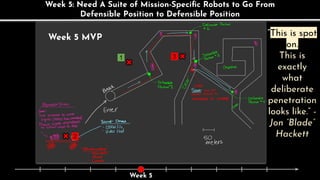
Week 5 MVP
1 3
2
“This is spot
on.
This is
exactly
what
deliberate
penetration
looks like.” -
Jon “Blade”
Hackett
Week 5: Need A Suite of Mission-Specific Robots to Go From
Defensible Position to Defensible Position
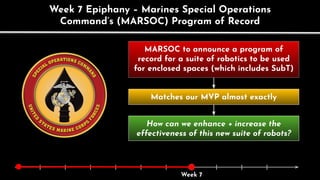
Week 7 Epiphany – Marines Special Operations
Command’s (MARSOC) Program of Record
MARSOC to announce a program of
record for a suite of robotics to be used
for enclosed spaces (which includes SubT)
Matches our MVP almost exactly
Week 7
How can we enhance + increase the
effectiveness of this new suite of robots?
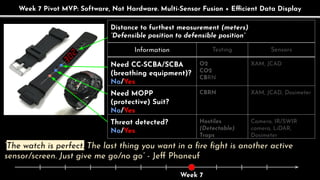
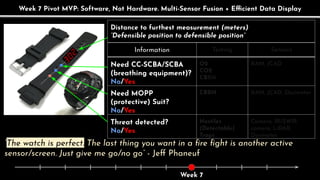
Week 7 Pivot MVP: Software, Not Hardware. Multi-Sensor Fusion + Efficient Data Display
Distance to furthest measurement (meters)
“Defensible position to defensible position”
Information Testing Sensors
Need CC-SCBA/SCBA
(breathing equipment)?
No/Yes
O2
CO2
CBRN
XAM, JCAD
Need MOPP
(protective) Suit?
No/Yes
CBRN XAM, JCAD, Dosimeter
Threat detected?
No/Yes
Hostiles
(Detectable)
Traps
Camera, IR/SWIR
camera, LiDAR,
Dosimeter
“The watch is perfect. The last thing you want in a fire fight is another active
sensor/screen. Just give me go/no go” - Jeff Phaneuf
Week 7
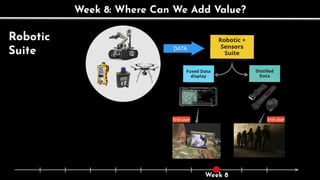
Robotic
Suite
Week 8: Where Can We Add Value?
Week 8
Robotic
Suite
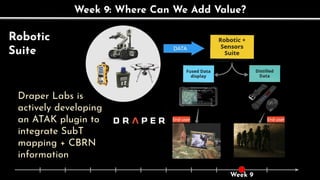
Week 9: Where Can We Add Value?
Week 9
Draper Labs is
actively developing
an ATAK plugin to
integrate SubT
mapping + CBRN
information
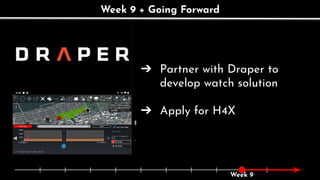
Week 9 + Going Forward
Week 9
➔ Partner with Draper to
develop watch solution
➔ Apply for H4X
23
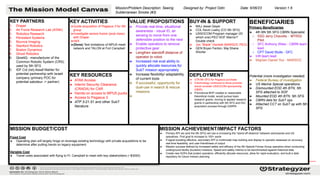
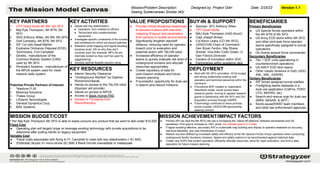
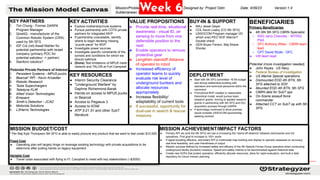
KEY ACTIVITIES
●Guide acquisition of Pegasus 3 for 5th
group
●Investigate sensor-fusion (post class)
with Draper
●H4X
●(Done) Test limitations of MPU5 mesh
network and TALON at Fort Campbell
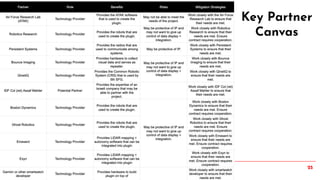
KEY PARTNERS
1. Draper
2. Air Force Research Lab (ATAK)
3. Robotics Research
4. Persistent Systems
5. Bounce Imaging
6. Stanford Robotics
7. Boston Dynamics
8. Ghost Robotics
9. QinetiQ - manufacturer of the
Common Robotic System (CRS)
used by 5th SFG
10. IDF Col (ret) Assaf Mahler for
potential partnership with Israeli
company (primary POC for
potential saboteur -> partner)
KEY RESOURCES
● ATAK Access
● Interim Security Clearance
(CRADA) for CAR
● Hands-on access to MPU5 pucks
● Access to Pegasus 3
● ATP 3-21.51 and other SubT
literature
VALUE PROPOSITIONS
● Provide real-time, situational
awareness - visual ID, air
sensing to move from one
defensible position to the next
● Enable operators to remove
protective gear
● Lengthen standoff distance of
operator to robot
● Increased risk eval ability to
quickly allocate resources for
SubT mission appropriately
● Increase flexibility/ adaptability
of current tools
● If successful, opportunity for
dual-use in search & rescue
missions
●
MISSION ACHIEVEMENT/IMPACT FACTORS
● Primary KPI we (and the 5th SFG) will use is increasing the "stand-off distance" between adversaries and US
operatives. First goal to increase to 100+ yards
● If signal boosting effective, secondary KPI is multimodal map building and display to operator assessed on accuracy,
real-time feasibility, and user-friendliness of output
● Mission success defined by increased safety and efficacy of the 5th Special Forces Group operators when conducting
underground facility (bunkers) missions. Speed and safety metrics to be benchmarked against historical data
● Create new SOPs that protect operators, efficiently allocate resources, allow for rapid evaluation, and built a data
repository for future mission planning
MISSION BUDGET/COST
Fixed Cost
● Operating plan will largely hinge on leverage existing technology with private acquisitions to be
determine after putting hands on legacy equipment
Variable Cost
● Travel costs associated with flying to Ft. Campbell to meet with key stakeholders (~$3000)
BENEFICIARIES
Primary Beneficiaries
● 4th BN 5th SFG CBRN Specialist
○ SSG Jerry Chavolla - MTRS2
Pilot
○ SFC Anthony Wiles - CBRN team
lead
○ CPT David Stults - GFC
● Infil team lead
● MajGen Daniel Yoo - MARSOC
Potential (more investigation needed)
● Federal Bureau of investigation
● US Marine Special operations
● Dismounted EOD 4th BTN, 5th
SFG attached to SOF
● Mounted EOD 4th BTN, 5th SFG
● CBRN dets for SubT ops
● Attached CCT on SubT op with 5th
SFG
BUY-IN & SUPPORT
● MAJ Jesse Geyer
● COL Kevin Leahy (CO 5th SFG)
● USSOCOM Program manager (ID
which one) PEO SOF Warrior?
Double check
● Jon “Blade” Hackett (MARSOC PEO)
● GEN Bryan Fenton, Maj Shane
Shorter
DEPLOYMENT
● OTA 5th SFG for Pegasus purchase
● If technology continued to show promise,
would consider USSOCOM sponsorship
(SBIR)
● If functional MVP created or reasonable
theoretical model, would pursue basic
research grants, moving to applied research
grants in partnership with 5th SFG and DIU
acquisition process through DARPA
Mission/Problem Description: Seeing
Subterranean Smoke (#3)
Designed by: Project Odin Date: 6/06/23 Version:1.6
THANK YOU
Teaching Team
Steve Blank
Pete Newell
Dr. Joe Felter
Steve Weinstein
Dr. Jeff Decker
Joel Johnson
Theo Velaise
Andrew Fang
Andrew Radford
Katherine Miller
Our Mentors
Lieutenant Colonel Rich
"Astro" Lawson
Rafi Holtzman
Craig Seidel
& everyone who donated their time to our
journey Our Sponsors
CPT Stults
5th SFG
25
Key Partner
Canvas
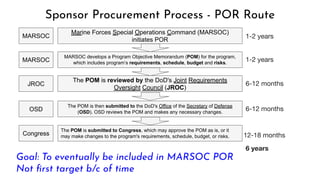
Sponsor Procurement Process - POR Route
MARSOC
Marine Forces Special Operations Command (MARSOC)
initiates POR
MARSOC
MARSOC develops a Program Objective Memorandum (POM) for the program,
which includes program’s requirements, schedule, budget and risks.
JROC
The POM is reviewed by the DoD's Joint Requirements
Oversight Council (JROC)
OSD
The POM is then submitted to the DoD's Office of the Secretary of Defense
(OSD). OSD reviews the POM and makes any necessary changes.
Congress
The POM is submitted to Congress, which may approve the POM as is, or it
may make changes to the program's requirements, schedule, budget, or risks.
1-2 years
1-2 years
6-12 months
6-12 months
12-18 months
6 years
Goal: To eventually be included in MARSOC POR
Not first target b/c of time
27
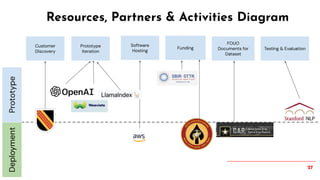
Resources, Partners & Activities Diagram
Customer
Discovery
FOUO
Documents for
Dataset
Testing & Evaluation
Deployment
Prototype
Funding
Software
Hosting
Prototype
Iteration
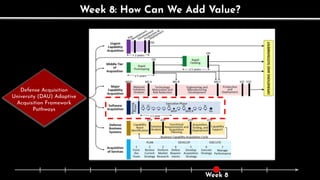
Week 8: How Can We Add Value?
Week 8
Defense Acquisition
University (DAU) Adaptive
Acquisition Framework
Pathways
Week 7 Pivot MVP: Software, Not Hardware. Multi-Sensor Fusion + Efficient Data Display
Distance to furthest measurement (meters)
“Defensible position to defensible position”
Information Testing Sensors
Need CC-SCBA/SCBA
(breathing equipment)?
No/Yes
O2
CO2
CBRN
XAM, JCAD
Need MOPP
(protective) Suit?
No/Yes
CBRN XAM, JCAD, Dosimeter
Threat detected?
No/Yes
Hostiles
(Detectable)
Traps
Camera, IR/SWIR
camera, LiDAR,
Dosimeter
“The watch is perfect. The last thing you want in a fire fight is another active
sensor/screen. Just give me go/no go” - Jeff Phaneuf
Week 7
30
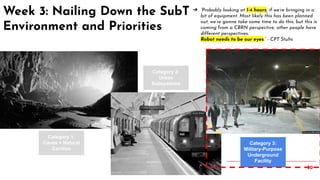
Week 3: Nailing Down the SubT
Environment and Priorities
➔ “Probably looking at 1-4 hours, if we’re bringing in a
bit of equipment. Most likely this has been planned
out, we’re gonna take some time to do this, but this is
coming from a CBRN perspective, other people have
different perspectives.
Robot needs to be our eyes.” - CPT Stults
Category 1:
Caves + Natural
Cavities
Category 2:
Urban
Subsystems
Category 3:
Military-Purpose
Underground
Facility
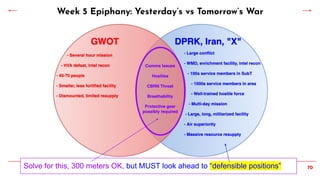
Week 3-5: The Scale of “Tomorrow’s War” (>>GWOT)
Weeks 3-5
“Cat 1/2 are diametrically different than Cat 3
[Cat 3] requires a huge amounts of equipment…
There will be a battalion sized force just to protect the entrance. It could
take multiple days just to enter.” -Former Navy Seal
32
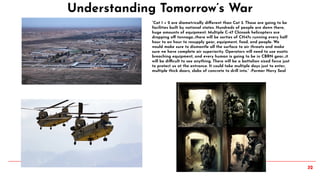
Understanding Tomorrow’s War
“Cat 1 + 2 are diametrically different than Cat 3. Those are going to be
facilities built by national states. Hundreds of people are down there,
huge amounts of equipment. Multiple C-47 Chinook helicopters are
dropping off tonnage…there will be sorties of CH47s running every half
hour to an hour to resupply gear, equipment, food, and people. We
would make sure to dismantle all the surface to air threats and make
sure we have complete air superiority. Operators will need to use exotic
breaching equipment, and every human is going to be in CBRN gear…it
will be difficult to see anything. There will be a battalion sized force just
to protect us at the entrance. It could take multiple days just to enter,
multiple thick doors, slabs of concrete to drill into.” -Former Navy Seal
33
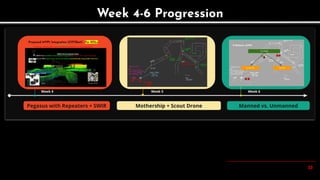
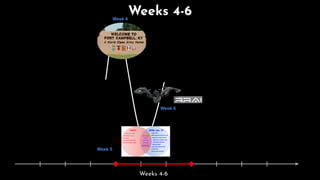
Week 4-6 Progression
Week 1
Week 2
Week 3
Week 4
Week 5
Week 6
Week 7*
Week 8
Week 9
Weeks 4-6
Weeks 4-6
35
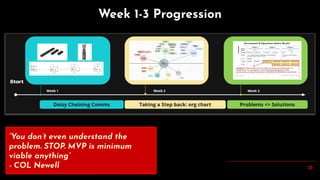
Week 1-3 Progression
“You don’t even understand the
problem. STOP. MVP is minimum
viable anything”
- COL Newell
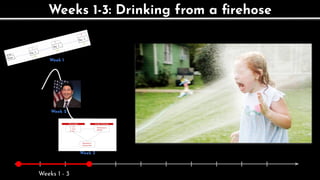
Weeks 1-3: Drinking from a firehose
Week 1
Week 2
Week 3
Week 4
Week 5
Week 6
Week 7*
Week 8
Week 9
Weeks 1 - 3
37
Week 8
38
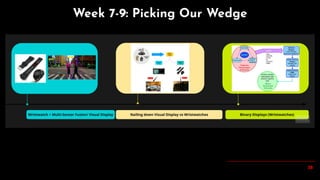
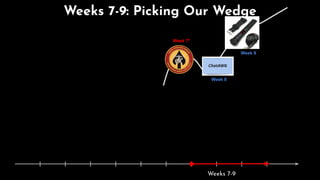
Week 7-9: Picking Our Wedge
Week 1
Week 2
Week 3
Week 4
Week 5
Week 6
Week 7*
Week 8
Week 9
Weeks 7-9
Weeks 7-9: Picking Our Wedge
ACQUISITIONS
NEXT STEPS
Week 9: Picking a Wedge -
High-Density Data Output
➔ “When I’m flying [the F-35], I
use my Garmin smartwatch to
maintain situational
awareness. It shows the cabin
altitude program, if it gets too
high or too low it will start
vibrating.” - Robert Cowsert
Week 9: Picking a Wedge -
High-Density Data Output
➔ When I’m flying [the F-35], I
use my Garmin smartwatch
to maintain situational
awareness. It shows the
cabin altitude program, if it
gets too high or too low it
will start vibrating.” - Robert
44
Week 2: Learning the foundation
Primary Beneficiary Primary Beneficiary Workflow
45
Week 2: Learning the foundation
Primary Beneficiary Primary Beneficiary Workflow
46
Week 2: Learning the foundation
Primary Beneficiary Primary Beneficiary Workflow
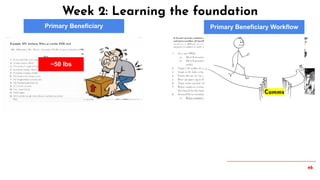
~50 lbs
Comms
47
Week 2: Learning the foundation
Primary Beneficiary Primary Beneficiary Workflow
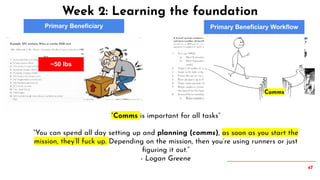
“Comms is important for all tasks”
“You can spend all day setting up and planning (comms), as soon as you start the
mission, they’ll fuck up. Depending on the mission, then you’re using runners or just
figuring it out.”
- Logan Greene
~50 lbs
Comms
48
Slide 2 – Team members – name, background, expertise and your role on the team. Name of mentors and their
affiliation.
49
Week 1: Getting Ahead of
Ourselves
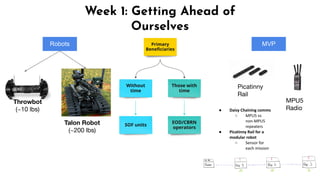
Throwbot
(~10 lbs)
Talon Robot
(~200 lbs)
Robots MVP
Picatinny
Rail
MPU5
Radio
● Daisy Chaining comms
○ MPU5 vs
non-MPU5
repeaters
● Picatinny Rail for a
modular robot
○ Sensor for
each mission
50
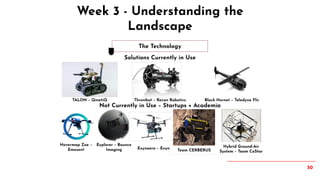
Week 3 - Understanding the
Landscape
51
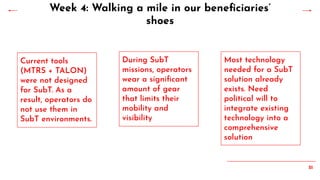
Week 4: Walking a mile in our beneficiaries’
shoes
Current tools
(MTRS + TALON)
were not designed
for SubT. As a
result, operators do
not use them in
SubT environments.
Most technology
needed for a SubT
solution already
exists. Need
political will to
integrate existing
technology into a
comprehensive
solution
During SubT
missions, operators
wear a significant
amount of gear
that limits their
mobility and
visibility
52
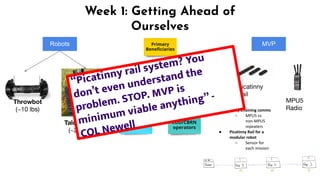
Week 1: Getting Ahead of
Ourselves
Throwbot
(~10 lbs)
Talon Robot
(~200 lbs)
Robots MVP
Picatinny
Rail
MPU5
Radio
● Daisy Chaining comms
○ MPU5 vs
non-MPU5
repeaters
● Picatinny Rail for a
modular robot
○ Sensor for
each mission
“Picatinny rail system? You
don’t even understand the
problem. STOP. MVP is
minimum viable anything” -
COL Newell
53
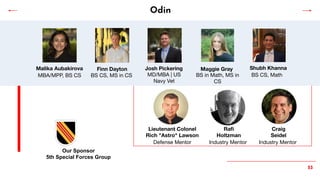
Malika Aubakirova Finn Dayton Josh Pickering
MBA/MPP, BS CS BS CS, MS in CS MD/MBA | US
Navy Vet
Maggie Gray
BS in Math, MS in
CS
Shubh Khanna
BS CS, Math
Lieutenant Colonel
Rich "Astro" Lawson
Rafi
Holtzman
Defense Mentor Industry Mentor
Craig
Seidel
Industry Mentor
Odin
Our Sponsor
5th Special Forces Group
Our Journey
Week 1: Thus far we have spoken to several KOLs spanning our in-house contact recommendations to individuals
outside of our problem-specific contacts to individuals with experience in product acquisition within the defense
industry to better understand market definition
Week 2: The Explosive Ordnance Disposal (EOD) Detachment at 5th SFG foremost requests are improved
communications underground as well as weight-conscious solution (potentially robots) to achieve actionable
situational awareness.
Week 3: Spoke with operators, tech companies and National Center for Urban Operations (NCUO) personnel to
answer last week’s questions and define: Environments, Operations, and Available tech
Week 4: Met with 5th Group EOD, CBRN det, and military contractors at Fort Campbell to discuss: Environmental
limitations, Mission sets, Technology in development, Military acquisitions, Program of record, timeline for
deployment
Week 5: Spoke with our sponsor and various KOLs, including representatives of RR.AI, creator of Pegasus,
RADēCO, manufacturer and distributor in the energy and defense industries, Exyn Technologies, Industrial Drone
Technology, FBI Agent, Navy SEALs, etc
Week 6: Discussed our MVPs and discovered more pain points with Operators, NCUO, FBI, Carnegie Mellon
engineers, Iris Technology
Week 7: Discussion our MVPs with operators and worked with acquisition experts, understanding POR,
deployment, and multisensor fusion and visual display.
Week 8: Interviews with F35 pilots and engineers, mine safety experts, TAK experts, and more to narrow down our
focus among possible paths.
55
Slide 3 – Original Hypotheses
● The World – market/opportunity, how does it operate
● The Characters – customers/value proposition/ product-market fit, pick a few examples to illustrate
● Narrative Arc – lessons learned how? Enthusiasm, despair, learning then insight
● Quotes from customers “we loved it” or “stupid idea”
● Show us – images and demo to illustrate learning = diagrams, wireframes & pivots to finished product)
● Editing – does each slide advance the learning
Theater
● Point us to what you want us to see
● Ought to be self-explanatory
● Use analogies
● Bring any “show and tell” examples
56
Slide 4 - Mission Model Canvas Version 1 (use the modified Osterwalder Canvas; do not make up your own). “Here was
our original idea.”
● Zoom in on the important parts of the canvas to make any key points
KEY ACTIVITIES
● Speak with key stakeholders:
● Operators, from enlisted to officers
● Technicians who create/maintain
equipment
● Investigate specific constraints of the tunnels
and conditions for which we should optimize
● Research what mapping and signal boosting
solutions exist, DD on why they don't
currently work (for example, MPU-5s are
internally locked so they can't be used for
piggybacking)
● Develop optimal feasible solution using
either first or third party equipment/software
KEY PARTNERS
1. CPT David Stults 4th BN, 5th SFG
2. Maj Kyle Thompson, 4th BTN, 5th
SFG
3. SSG Anthony Wiles, 4th BN, 5th SFG
4. Golf Company, 4th BTN, 5th SFG
5. IDF Col (ret) Assaf Mahler
6. Explosive Ordnance Disposal (EOD)
Technicians, Fort Campbell
7. Qinetiq - manufacturer of the
Common Robotic System (CRS)
used by 5th SFG
8. Persistent Systems - manufacturer of
the MPU5 system used for mesh
network radio system
Potential Private Partners of Interest
1. Teledyne FLIR
2. Motorola Solutions
3. Thales Group
4. L3Harris Technologies
5. General Dynamics Corp.
6. BAE Systems
KEY RESOURCES
● Interim Security Clearance
● "Underground Warfare" by Daphne
Richemond-Barak
● Hands-on access to the TALON robot
(Sponsor will provide)
● Hands-on access to MPU5
● Access to Black Hornet PRS
● Access to Throwbots from
ReconRobotics
VALUE PROPOSITIONS
● Provide critical situational awareness
to decision-makers with real-time
mapping of layout and parameters
from sensors in hostile environments
● Significantly lengthen standoff
distance, reducing need for operator
breach prior to evaluation and
potential action with TALON robot
● Increased efficiency of operator
teams to quickly evaluate risk level of
underground bunkers and allocate
resources appropriately
● Create repository of data for
post-mission analysis and future
mission planning
● If successful, opportunity for dual-use
in search-and-rescue missions
MISSION ACHIEVEMENT/IMPACT FACTORS
● Primary KPI we (and the 5th SFG) will use is increasing the "stand-off distance" between adversaries and US
operatives. First goal to increase to 100+ yards, the ultimate goal of 2-3 miles
● If signal boosting effective, secondary KPI is multimodal map building and display to operator assessed on accuracy,
real-time feasibility, and user-friendliness of output
● Mission success defined by increased safety and efficacy of the 5th Special Forces Group operators when conducting
underground facility (bunkers) missions. Speed and safety metrics to be benchmarked against historical data
● Create new SOPs that protect operators, efficiently allocate resources, allow for rapid evaluation, and built a data
repository for future mission planning
Mission/Problem Description:
Seeing Subterranean Smoke (#3)
Designed by: Project Odin Date: 2/25/23 Version:1.1
MISSION BUDGET/COST
* Per Maj Kyle Thompson 5th SFG is able to easily procure any product that we want to test under $10,000
Fixed Cost
● Operating plan will largely hinge on leverage existing technology with private acquisitions to be
determine after putting hands on legacy equipment
Variable Cost
● Travel costs associated with flying to Ft. Campbell to meet with key stakeholders (~$1,500)
● (Potential) Skydio 2+ micro-drone ($1,099) if Black Hornet unavailable or inadequate
BENEFICIARIES
Primary Beneficiaries
● US Special forces operators within
the 4th BTN of 5th SFG
● US Army EOD techs within 5th SFG
and other joint-task force operator
teams specifically assigned to tunnel
operations
● On-Scene assault force commander
Secondary Beneficiaries
● Tier 1 SOF units specializing in
counterterrorism operations
● US NAVY EOD tech teams
● Other robotic divisions in DoD (JIDO,
ARL, NRL, DARPA)
Tertiary Beneficiaries
● IDF forces assigned tunnel warfare
● Firefighting teams stateside in a
dual-use application (CalFire, FDNY,
CFD, MDFRD, etc)
● Search-and-rescue orgs for dual-use
(MRA, NASAR, & IAFF)
● Bomb-squad/SWAT team members
and other law enforcement agencies
BUY-IN & SUPPORT
● Sponsor: SFC Anthony Wiles
● CPT David Stults
● MAJ Kyle Thompson (H4D Alum!)
● Capt Joseph Brown
● Col Kevin Leahy (CO 5th SFG)
● USSOCOM Chain of Command -
Gen Bryan Fenton, Maj Shane
Shorter, Vice Adm Collin Green, Lt
Gen Francis Donovan
● Centers of innovation within SOC
● Partnerships within academic labs
DEPLOYMENT
● Start with 5th SFG committed ~$10k budget
and strong relationship building with
operators and technical personnel within the
command
● If functional MVP created or reasonable
theoretical model, would pursue basic
research grants, moving to applied research
grants in partnership with 5th SFG and DIU
acquisition process through DARPA
● If technology continued to show promise,
would consider USSOCOM sponsorship,
seeking contract
58
Slide 5 – “So here’s what we did…” (explain how you got out of the building)
● Show us your first MVP
59
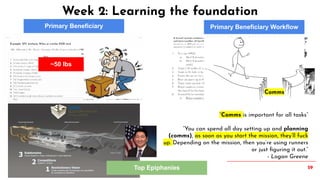
Week 2: Learning the foundation
Primary Beneficiary Primary Beneficiary Workflow
Top Epiphanies
“Comms is important for all tasks”
“You can spend all day setting up and planning
(comms), as soon as you start the mission, they’ll fuck
up. Depending on the mission, then you’re using runners
or just figuring it out.”
- Logan Greene
~50 lbs
Comms
60
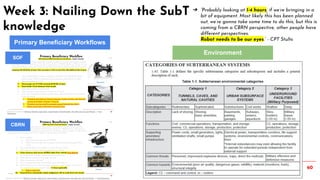
Week 3: Nailing Down the SubT
knowledge
➔ “Probably looking at 1-4 hours, if we’re bringing in a
bit of equipment. Most likely this has been planned
out, we’re gonna take some time to do this, but this is
coming from a CBRN perspective, other people have
different perspectives.
Robot needs to be our eyes.” - CPT Stults
Primary Beneficiary Workflows
CBRN
SOF
Environment
61
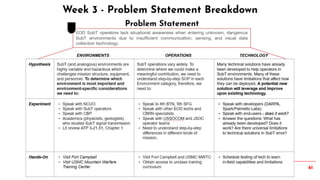
Week 3 - Problem Statement Breakdown
62
Week 3 MVP: Environment & Operations Matrix
Results
Hypothesis: These facilities can vary widely. To create meaningful impact, we
should narrow our investigation to solving the first 300 meters of these
environments, providing visual and air testing data (as described by beneficiary)
Time on
Target
Category 1
(Tunnels, Caves, and Natural
Cavities)
Category 2
(Urban Subsurface Systems)
Category 3
(Military Purposed Underground
Facilities)
Subcategory Rudimentary Sophisticated Substructures Civil Works Shallow Deep
Functions Civil: commercial operations, transportation, and storage enemy: C2,
operations, storage, production, protection
C2, operations, storage, production,
protection
< 1 hr EOD, SOF
1 - 4 hrs EOD, SOF EOD, SOF CBRN, SOF, EOD CBRN, SOF, EOD CBRN, SOF, EOD CBRN, SOF, EOD
> 4 hrs CBRN, SOF, EOD CBRN, SOF, EOD CBRN, SOF, EOD
Week 1
Week 2
Week 3
Week 4
Week 5
Week 6
Week 7*
Week 8
Week 9
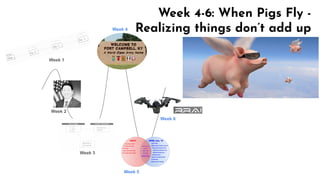
Week 4-6: When Pigs Fly -
Realizing things don’t add up
64
Week 4-6: When Pigs Fly -
Realizing things don’t add up
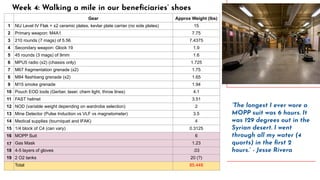
Week 4: Walking a mile in our beneficiaries’ shoes
“The longest I ever wore a
MOPP suit was 6 hours. It
was 129 degrees out in the
Syrian desert. I went
through all my water (4
quarts) in the first 2
hours.” - Jesse Rivera
Gear Approx Weight (lbs)
1 NIJ Level IV Flak = x2 ceramic plates, kevlar plate carrier (no side plates) 15
2 Primary weapon: M4A1 7.75
3 210 rounds (7 mags) of 5.56 7.4375
4 Secondary weapon: Glock 19 1.9
5 45 rounds (3 mags) of 9mm 1.6
6 MPU5 radio (x2) (chassis only) 1.725
7 M67 fragmentation grenade (x2) 1.75
8 M84 flashbang grenade (x2) 1.65
9 M15 smoke grenade 1.94
10 Pouch EOD tools (Gerber, laser, chem light, throw lines) 4.1
11 FAST helmet 3.51
12 NOD (variable weight depending on wardrobe selection) 2
13 Mine Detector (Pulse Induction vs VLF vs magnetometer) 3.5
14 Medical supplies (tourniquet and IFAK) 4
15 1/4 block of C4 (can vary) 0.3125
16 MOPP Suit 6
17 Gas Mask 1.23
18 4-5 layers of gloves .03
19 2 O2 tanks 20 (?)
Total 85.448
66
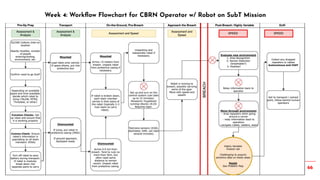
Week 4: Workflow Flowchart for CBRN Operator w/ Robot on SubT Mission
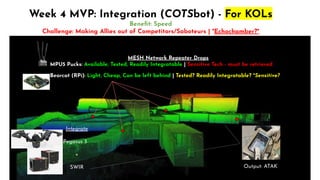
Week 4 MVP: Integration (COTSbot) - For KOLs
Benefit: Speed
Challenge: Making Allies out of Competitors/Saboteurs | *Echochamber?*
Integrate
Pegasus 3
+
SWIR
MESH Network Repeater Drops
MPU5 Pucks: Available, Tested, Readily Integratable | Sensitive Tech - must be retrieved
Bearcat (RPi): Light, Cheap, Can be left behind | Tested? Readily Integratable? *Sensitive?
Output: ATAK
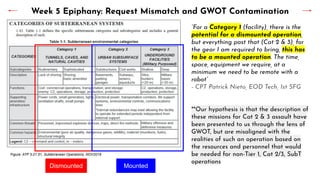
Figure: ATP 3-21.51, Subterranean Operations, NOV2019
“For a Category 1 (facility), there is the
potential for a dismounted operation,
but everything past that (Cat 2 & 3), for
the gear I am required to bring, this has
to be a mounted operation. The time,
space, equipment we require, at a
minimum we need to be remote with a
robot”
- CPT Patrick Nieto, EOD Tech, 1st SFG
**Our hypothesis is that the description of
these missions for Cat 2 & 3 assault have
been presented to us through the lens of
GWOT, but are misaligned with the
realities of such an operation based on
the resources and personnel that would
be needed for non-Tier 1, Cat 2/3, SubT
operations
Week 5 Epiphany: Request Mismatch and GWOT Contamination
Mounted
Dismounted
69
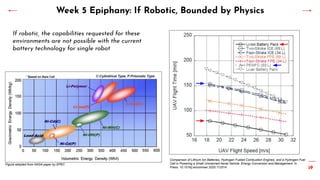
Week 5 Epiphany: If Robotic, Bounded by Physics
Comparison of Lithium Ion Batteries, Hydrogen Fueled Combustion Engines, and a Hydrogen Fuel
Cell in Powering a Small Unmanned Aerial Vehicle. Energy Conversion and Management. In
Press. 10.1016/j.enconman.2020.112514.
If robotic, the capabilities requested for these
environments are not possible with the current
battery technology for single robot
Figure adopted from NASA paper by EPEC
70
Solve for this, 300 meters OK, but MUST look ahead to “defensible positions”
Week 5 Epiphany: Yesterday’s vs Tomorrow’s War
71
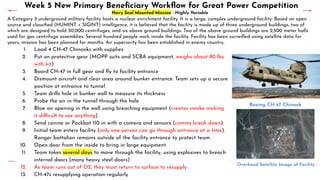
Week 5 New Primary Beneficiary Workflow for Great Power Competition
Navy Seal Mounted Mission - Highly Variable
1. Load 4 CH-47 Chinooks with supplies
2. Put on protective gear (MOPP suits and SCBA equipment, weighs about 80 lbs
with kit)
3. Board CH-47 in full gear and fly to facility entrance
4. Dismount aircraft and clear area around bunker entrance. Team sets up a secure
position at entrance to tunnel
5. Team drills hole in bunker wall to measure its thickness
6. Probe the air in the tunnel through the hole
7. Blow an opening in the wall using breaching equipment (creates smoke making
it difficult to see anything)
8. Send canine or Packbot 110 in with a camera and sensors (comms break down)
9. Initial team enters facility (only one person can go through entrance at a time).
Ranger battalion remains outside of the facility entrance to protect team.
10. Open door from the inside to bring in large equipment.
11. Team takes several days to move through the facility, using explosives to breach
internal doors (many heavy steel doors)
12. As team runs out of O2, they must return to surface to resupply
13. CH-47s resupplying operation regularly
A Category 3 underground military facility hosts a nuclear enrichment facility. It is a large, complex underground facility. Based on open
source and classified (HUMINT + SIGINT) intelligence, it is believed that the facility is made up of three underground buildings, two of
which are designed to hold 50,000 centrifuges, and six above ground buildings. Two of the above ground buildings are 2,500 meter halls
used for gas centrifuge assemblies. Several hundred people work inside the facility. Facility has been surveilled using satellite data for
years, mission has been planned for months. Air superiority has been established in enemy country.
Boeing CH-47 Chinook
Overhead Satellite Image of Facility
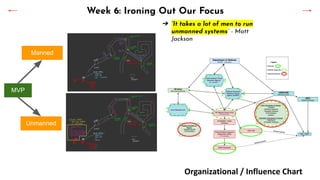
MVP
Unmanned
Manned
Week 6: Ironing Out Our Focus
Organizational / Influence Chart
➔ “It takes a lot of men to run
unmanned systems” - Matt
Jackson
73
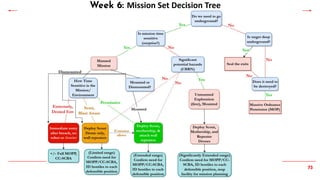
Week 6: Mission Set Decision Tree
74
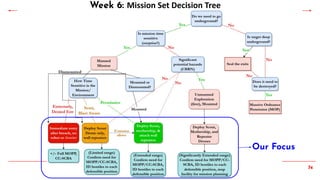
Week 6: Mission Set Decision Tree
Our Focus
75
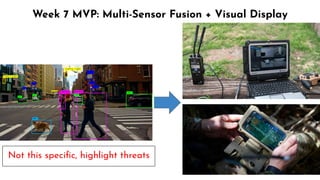
Week 7 MVP: Multi-Sensor Fusion + Visual Display
Not this specific, highlight threats
76
Slide 6 – “So here’s what we found (what was reality), so then… here’s what we did”
● Presentation requires at least three Mission Model Canvas slides
o Zoom in on the important parts of the canvas to make any key points
● Presentation requires at least three diagrams of some part of the canvas. For example o Get/Keep/Grow pipeline
o Channel diagram
o Customer/payer flow
o Activities/Resources/Partners connections
o Petal diagram
o TAM/SAM
77
- Include images/icons and by the numbers analysis
Who we talked to breakdown/chart
78
https://aaf.dau.edu/aaf/aaf-pathways/
DAU Funding Slide and Spreadsheet
79
Slide n
● Investment readiness slide
● Whether you think this a viable business,
● Whether you want to pursue it after the class, etc.
80
- This is a viable business → a program of record is ACTIVELY being developed. It will
require a data integration, display, and analysis piece that somebody will need to
provide.
- There is significant overlap between SubT and urban operations.
- While SubT and urban operations are not a top priority right now, if we were to enter
a war with a country like Iran, China, North Korea, or Russia, it would quickly become a
priority. We should develop necessary technology now to prepare for the wars of the
future.
-
Investment Readiness
81
Final Slides – Click through each one of your weekly MMC slides.
KEY ACTIVITIES
● Speak with key stakeholders:
● Operators, from enlisted to officers
● Technicians who create/maintain
equipment
● Investigate specific constraints of the tunnels
and conditions for which we should optimize
● Research what mapping and signal boosting
solutions exist, DD on why they don't
currently work (for example, MPU-5s are
internally locked so they can't be used for
piggybacking)
● Develop optimal feasible solution using
either first or third party equipment/software
KEY PARTNERS
1. CPT David Stults 4th BN, 5th SFG
2. Maj Kyle Thompson, 4th BTN, 5th
SFG
3. SSG Anthony Wiles, 4th BN, 5th SFG
4. Golf Company, 4th BTN, 5th SFG
5. IDF Col (ret) Assaf Mahler
6. Explosive Ordnance Disposal (EOD)
Technicians, Fort Campbell
7. Qinetiq - manufacturer of the
Common Robotic System (CRS)
used by 5th SFG
8. Persistent Systems - manufacturer of
the MPU5 system used for mesh
network radio system
Potential Private Partners of Interest
1. Teledyne FLIR
2. Motorola Solutions
3. Thales Group
4. L3Harris Technologies
5. General Dynamics Corp.
6. BAE Systems
KEY RESOURCES
● Interim Security Clearance
● "Underground Warfare" by Daphne
Richemond-Barak
● Hands-on access to the TALON robot
(Sponsor will provide)
● Hands-on access to MPU5
● Access to Black Hornet PRS
● Access to Throwbots from
ReconRobotics
VALUE PROPOSITIONS
● Provide critical situational awareness
to decision-makers with real-time
mapping of layout and parameters
from sensors in hostile environments
● Significantly lengthen standoff
distance, reducing need for operator
breach prior to evaluation and
potential action with TALON robot
● Increased efficiency of operator
teams to quickly evaluate risk level of
underground bunkers and allocate
resources appropriately
● Create repository of data for
post-mission analysis and future
mission planning
● If successful, opportunity for dual-use
in search-and-rescue missions
MISSION ACHIEVEMENT/IMPACT FACTORS
● Primary KPI we (and the 5th SFG) will use is increasing the "stand-off distance" between adversaries and US
operatives. First goal to increase to 100+ yards, the ultimate goal of 2-3 miles
● If signal boosting effective, secondary KPI is multimodal map building and display to operator assessed on accuracy,
real-time feasibility, and user-friendliness of output
● Mission success defined by increased safety and efficacy of the 5th Special Forces Group operators when conducting
underground facility (bunkers) missions. Speed and safety metrics to be benchmarked against historical data
● Create new SOPs that protect operators, efficiently allocate resources, allow for rapid evaluation, and built a data
repository for future mission planning
Mission/Problem Description:
Seeing Subterranean Smoke (#3)
Designed by: Project Odin Date: 2/25/23 Version:1.1
MISSION BUDGET/COST
* Per Maj Kyle Thompson 5th SFG is able to easily procure any product that we want to test under $10,000
Fixed Cost
● Operating plan will largely hinge on leverage existing technology with private acquisitions to be
determine after putting hands on legacy equipment
Variable Cost
● Travel costs associated with flying to Ft. Campbell to meet with key stakeholders (~$1,500)
● (Potential) Skydio 2+ micro-drone ($1,099) if Black Hornet unavailable or inadequate
BENEFICIARIES
Primary Beneficiaries
● US Special forces operators within
the 4th BTN of 5th SFG
● US Army EOD techs within 5th SFG
and other joint-task force operator
teams specifically assigned to tunnel
operations
● On-Scene assault force commander
Secondary Beneficiaries
● Tier 1 SOF units specializing in
counterterrorism operations
● US NAVY EOD tech teams
● Other robotic divisions in DoD (JIDO,
ARL, NRL, DARPA)
Tertiary Beneficiaries
● IDF forces assigned tunnel warfare
● Firefighting teams stateside in a
dual-use application (CalFire, FDNY,
CFD, MDFRD, etc)
● Search-and-rescue orgs for dual-use
(MRA, NASAR, & IAFF)
● Bomb-squad/SWAT team members
and other law enforcement agencies
BUY-IN & SUPPORT
● Sponsor: SFC Anthony Wiles
● CPT David Stults
● MAJ Kyle Thompson (H4D Alum!)
● Capt Joseph Brown
● Col Kevin Leahy (CO 5th SFG)
● USSOCOM Chain of Command -
Gen Bryan Fenton, Maj Shane
Shorter, Vice Adm Collin Green, Lt
Gen Francis Donovan
● Centers of innovation within SOC
● Partnerships within academic labs
DEPLOYMENT
● Start with 5th SFG committed ~$10k budget
and strong relationship building with
operators and technical personnel within the
command
● If functional MVP created or reasonable
theoretical model, would pursue basic
research grants, moving to applied research
grants in partnership with 5th SFG and DIU
acquisition process through DARPA
● If technology continued to show promise,
would consider USSOCOM sponsorship,
seeking contract
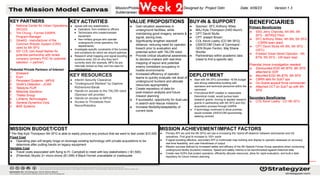
Week 1
83
KEY ACTIVITIES
● Speak with key stakeholders:
● Operators, from enlisted to officers
● Technicians who create/maintain
equipment
● Non-military groups who operate
underground (mine operators, fire
departments)
● Investigate specific constraints of the tunnels
and conditions for which we should optimize
● Research what mapping and signal boosting
solutions exist, DD on why they don't
currently work (for example, MPU-5s are
internally locked so they can't be used for
piggybacking)
● Develop optimal feasible solution using
either first or third party equipment/software
KEY PARTNERS
1. National Center for Urban Operations
(NCUO)
2. Tim Chung - Former DARPA
Program Manager
3. QinetiQ - manufacturer of the
Common Robotic System (CRS)
used by 5th SFG
4. IDF COL (ret) Assaf Mahler for
potential partnership with Israeli
company (primary POC for potential
saboteur -> partner)
Potential Private Partners of Interest
1. Emesent
2. Exyn
3. Persistent Systems - MPU5
4. Smith’s Detection - JCAD
5. Teledyne FLIR
6. Motorola Solutions
7. Thales Group
8. L3Harris Technologies
9. General Dynamics Corp.
10. BAE Systems
KEY RESOURCES
● Interim Security Clearance
● "Underground Warfare" by Daphne
Richemond-Barak
● Hands-on access to the TALON robot
(Sponsor will provide)
● Hands-on access to MPU5
● Access to Throwbots from
ReconRobotics
VALUE PROPOSITIONS
● Gain situation awareness in
underground facilities, while
maintaining good imagery, sensors &
signal, saving lives.
● Significantly lengthen standoff
distance, reducing need for operator
breach prior to evaluation and
potential action with TALON robot
● Provide critical situational awareness
to decision-makers with real-time
mapping of layout and potential
enemy combatant occupancy in
hostile environments
● Increased efficiency of operator
teams to quickly evaluate risk level of
underground bunkers and allocate
resources appropriately
● Create repository of data for
post-mission analysis and future
mission planning
● If successful, opportunity for dual-use
in search-and-rescue missions
● Increase flexibility/adaptability of
current tools
MISSION ACHIEVEMENT/IMPACT FACTORS
● Primary KPI we (and the 5th SFG) will use is increasing the "stand-off distance" between adversaries and US
operatives. First goal to increase to 100+ yards
● If signal boosting effective, secondary KPI is multimodal map building and display to operator assessed on accuracy,
real-time feasibility, and user-friendliness of output
● Mission success defined by increased safety and efficacy of the 5th Special Forces Group operators when conducting
underground facility (bunkers) missions. Speed and safety metrics to be benchmarked against historical data
● Create new SOPs that protect operators, efficiently allocate resources, allow for rapid evaluation, and built a data
repository for future mission planning
MISSION BUDGET/COST
* Per Maj Kyle Thompson 5th SFG is able to easily procure any product that we want to test under $10,000
Fixed Cost
● Operating plan will largely hinge on leverage existing technology with private acquisitions to be
determine after putting hands on legacy equipment
Variable Cost
● Travel costs associated with flying to Ft. Campbell to meet with key stakeholders (~$1,500)
● (Potential) Skydio 2+ micro-drone ($1,099) if Black Hornet unavailable or inadequate
BENEFICIARIES
Primary Beneficiaries
● SSG Jerry Chavolla, 4th BN, 5th
SFG - (MTRS2 Pilot)
● SFC Anthony Wiles, 4th BN, 5th SFG
- (CBRN team lead)
● CPT David Stults 4th BN, 5th SFG -
(GFC)
● Enlisted Green Beret Operator - 4th
BTN, 5th SFG - Infil team lead
Potential (more investigation needed)
● Dismounted EOD 4th BTN, 5th SFG
attached to SOF
● Mounted EOD 4th BTN, 5th SFG
● CBRN dets for SubT ops
● On-Scene assault force commander
● Attached CCT on SubT op with 5th
SFG
Secondary Beneficiaries
● COL Kevin Leahy - CO 5th SFG
BUY-IN & SUPPORT
● Sponsor: SFC Anthony Wiles
● MAJ Kyle Thompson (H4D Alum!)
● CPT David Stults
● CPT Joseph Brown
● COL Kevin Leahy (CO 5th SFG)
● USSOCOM Chain of Command -
GEN Bryan Fenton, Maj Shane
Shorter
● Partnerships within academic labs
(need to find a specific lab)
DEPLOYMENT
● Start with 5th SFG committed ~$10k budget
and strong relationship building with
operators and technical personnel within the
command
● If functional MVP created or reasonable
theoretical model, would pursue basic
research grants, moving to applied research
grants in partnership with 5th SFG and DIU
acquisition process through DARPA
● If technology continued to show promise,
would consider USSOCOM sponsorship,
seeking contract
Mission/Problem Description: Seeing
Subterranean Smoke (#3)
Designed by: Project Odin Date: 4/09/23 Version:1.3
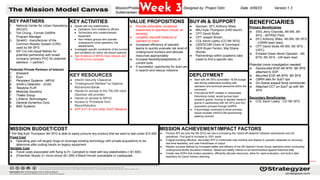
Week 2
84
KEY ACTIVITIES
● Speak with key stakeholders:
● Operators, from enlisted to officers
● Technicians who create/maintain
equipment
● Non-military groups who operate
underground (mine operators, fire
departments)
● Investigate specific constraints of the tunnels
and conditions for which we should optimize
● Test limitations of MPU5 mesh network and
TALON at Fort Campbell
KEY PARTNERS
1. National Center for Urban Operations
(NCUO)
2. Tim Chung - Former DARPA
Program Manager
3. QinetiQ - manufacturer of the
Common Robotic System (CRS)
used by 5th SFG
4. IDF Col (ret) Assaf Mahler for
potential partnership with Israeli
company (primary POC for potential
saboteur -> partner)
Potential Private Partners of Interest
1. Emesent
2. Exyn
3. Persistent Systems - MPU5
4. Smith’s Detection - JCAD
5. Teledyne FLIR
6. Motorola Solutions
7. Thales Group
8. L3Harris Technologies
9. General Dynamics Corp.
10. BAE Systems
KEY RESOURCES
● Interim Security Clearance
● "Underground Warfare" by Daphne
Richemond-Barak
● Hands-on access to the TALON robot
(Sponsor will provide)
● Hands-on access to MPU5
● Access to Throwbots from
ReconRobotics
● ATP 3-21.51 and other SubT literature
VALUE PROPOSITIONS
● Provide actionable, situational
awareness to operators (visual, air
sensing)
● Lengthen standoff distance of
operator to robot
● Increased efficiency of operator
teams to quickly evaluate risk level of
underground bunkers and allocate
resources appropriately
● Increase flexibility/adaptability of
current tools
● If successful, opportunity for dual-use
in search-and-rescue missions
MISSION ACHIEVEMENT/IMPACT FACTORS
● Primary KPI we (and the 5th SFG) will use is increasing the "stand-off distance" between adversaries and US
operatives. First goal to increase to 100+ yards
● If signal boosting effective, secondary KPI is multimodal map building and display to operator assessed on accuracy,
real-time feasibility, and user-friendliness of output
● Mission success defined by increased safety and efficacy of the 5th Special Forces Group operators when conducting
underground facility (bunkers) missions. Speed and safety metrics to be benchmarked against historical data
● Create new SOPs that protect operators, efficiently allocate resources, allow for rapid evaluation, and built a data
repository for future mission planning
MISSION BUDGET/COST
* Per Maj Kyle Thompson 5th SFG is able to easily procure any product that we want to test under $10,000
Fixed Cost
● Operating plan will largely hinge on leverage existing technology with private acquisitions to be
determine after putting hands on legacy equipment
Variable Cost
● Travel costs associated with flying to Ft. Campbell to meet with key stakeholders (~$1,500)
● (Potential) Skydio 2+ micro-drone ($1,099) if Black Hornet unavailable or inadequate
BENEFICIARIES
Primary Beneficiaries
● SSG Jerry Chavolla, 4th BN, 5th
SFG - (MTRS2 Pilot)
● SFC Anthony Wiles, 4th BN, 5th SFG
- (CBRN team lead)
● CPT David Stults 4th BN, 5th SFG -
(GFC)
● Enlisted Green Beret Operator - 4th
BTN, 5th SFG - Infil team lead
Potential (more investigation needed)
● Dismounted EOD 4th BTN, 5th SFG
attached to SOF
● Mounted EOD 4th BTN, 5th SFG
● CBRN dets for SubT ops
● On-Scene assault force commander
● Attached CCT on SubT op with 5th
SFG
Secondary Beneficiaries
● COL Kevin Leahy - CO 5th SFG
BUY-IN & SUPPORT
● Sponsor: SFC Anthony Wiles
● MAJ Kyle Thompson (H4D Alum!)
● CPT David Stults
● CPT Joseph Brown
● COL Kevin Leahy (CO 5th SFG)
● USSOCOM Chain of Command -
GEN Bryan Fenton, Maj Shane
Shorter
● Partnerships within academic labs
(need to find a specific lab)
DEPLOYMENT
● Start with 5th SFG committed ~$10k budget
and strong relationship building with
operators and technical personnel within the
command
● If functional MVP created or reasonable
theoretical model, would pursue basic
research grants, moving to applied research
grants in partnership with 5th SFG and DIU
acquisition process through DARPA
● If technology continued to show promise,
would consider USSOCOM sponsorship,
seeking contract
Mission/Problem Description: Seeing
Subterranean Smoke (#3)
Designed by: Project Odin Date: 4/09/23 Version:1.3
Week 3
85
KEY ACTIVITIES
● Continue to develop beneficiaries
● Pursue partnership with COTS private
partners for integrated MVP
● If partnership unavailable, identify
where to begin iterating missing
“puzzle piece” for MVP
● Investigate specific constraints of the
tunnels and conditions for which we
should optimize
● (Done) Test limitations of MPU5 mesh
network and TALON at Fort Campbell
KEY PARTNERS
1. National Center for Urban
Operations (NCUO)
2. Tim Chung - Former DARPA
Program Manager
3. QinetiQ - manufacturer of the
Common Robotic System (CRS)
used by 5th SFG
4. IDF Col (ret) Assaf Mahler for
potential partnership with Israeli
company (primary POC for
potential saboteur -> partner)
5. Stanford robotics?
Potential Private Partners of Interest
1. Persistent Systems - MPU5 pucks
2. Bearcat* RPi - Kevin Knoedler
3. Robotic Research
4. Teledyne FLIR
5. Allied Vision Technologies
6. Emesent
7. Smith’s Detection - JCAD
8. Motorola Solutions
9. L3Harris Technologies
KEY RESOURCES
● Interim Security Clearance
● "Underground Warfare" by
Daphne Richemond-Barak
● Hands-on access to MPU5 pucks
or Bearcat
● Access to Pegasus 3
● Access to ATAK
● ATP 3-21.51 and other SubT
literature
VALUE PROPOSITIONS
● Provide real-time, situational
awareness - visual ID, air
sensing
● Lengthen standoff distance
of operator to robot
● Increased efficiency of
operator teams to quickly
evaluate risk level of
underground bunkers and
allocate resources
appropriately
● Increase
flexibility/adaptability of
current tools
● If successful, opportunity for
dual-use in
search-and-rescue missions
MISSION ACHIEVEMENT/IMPACT FACTORS
● Primary KPI we (and the 5th SFG) will use is increasing the "stand-off distance" between adversaries and US
operatives. First goal to increase to 100+ yards
● If signal boosting effective, secondary KPI is multimodal map building and display to operator assessed on accuracy,
real-time feasibility, and user-friendliness of output
● Mission success defined by increased safety and efficacy of the 5th Special Forces Group operators when conducting
underground facility (bunkers) missions. Speed and safety metrics to be benchmarked against historical data
● Create new SOPs that protect operators, efficiently allocate resources, allow for rapid evaluation, and built a data
repository for future mission planning
MISSION BUDGET/COST
* Per Maj Kyle Thompson 5th SFG is able to easily procure any product that we want to test under $10,000
Fixed Cost
● Operating plan will largely hinge on leverage existing technology with private acquisitions to be
determine after putting hands on legacy equipment
Variable Cost
● Travel costs associated with flying to Ft. Campbell to meet with key stakeholders (~$1,500)
● (Potential) Skydio 2+ micro-drone ($1,099) if Black Hornet unavailable or inadequate
BENEFICIARIES
Primary Beneficiaries
● 4th BN 5th SFG CBRN Specilist
○ SSG Jerry Chavolla - MTRS2 Pilot
○ SFC Anthony Wiles - CBRN team
lead
○ CPT David Stults - GFC
● Infil team lead
Potential (more investigation needed)
● Dismounted EOD 4th BTN, 5th SFG
attached to SOF
● Mounted EOD 4th BTN, 5th SFG
● CBRN dets for SubT ops
● On-Scene assault force commander
● Attached CCT on SubT op with 5th
SFG
Secondary Beneficiaries
●
BUY-IN & SUPPORT
● MAJ Jesse Geyer
● COL Kevin Leahy (CO 5th SFG)
● USSOCOM Program manager (ID
which one) PEO SOF Warrior?
Double check
● GEN Bryan Fenton, Maj Shane
Shorter
DEPLOYMENT
● Start with 5th SFG committed ~$10k budget
and strong relationship building with
operators and technical personnel within the
command
● If functional MVP created or reasonable
theoretical model, would pursue basic
research grants, moving to applied research
grants in partnership with 5th SFG and DIU
acquisition process through DARPA
● If technology continued to show promise,
would consider USSOCOM sponsorship,
seeking contract
Mission/Problem Description: Seeing
Subterranean Smoke (#3)
Designed by: Project Odin Date: 4/09/23 Version:1.4
Week 4
86
KEY ACTIVITIES
● Explore mothership/mule systems
● Pursue partnership with COTS private
partners for integrated MVP
● If partnership unavailable, identify
where to begin iterating missing
“puzzle piece” for MVP
● Investigate power sources
● Investigate specific constraints of the
tunnels and conditions for which we
should optimize
● (Done) Test limitations of MPU5 mesh
network and TALON at Fort Campbell
KEY PARTNERS
1. National Center for Urban
Operations (NCUO)
2. Tim Chung - Former DARPA
Program Manager
3. QinetiQ - manufacturer of the
Common Robotic System (CRS)
used by 5th SFG
4. IDF Col (ret) Assaf Mahler for
potential partnership with Israeli
company (primary POC for
potential saboteur -> partner)
5. Stanford robotics?
Potential Private Partners of Interest
1. Persistent Systems - MPU5 pucks
2. Bearcat* RPi - Kevin Knoedler
3. Robotic Research
4. Tesla Superchargers
5. Teledyne FLIR
6. Allied Vision Technologies
7. Emesent
8. Smith’s Detection - JCAD
9. Motorola Solutions
10. L3Harris Technologies
KEY RESOURCES
● Interim Security Clearance
● "Underground Warfare" by
Daphne Richemond-Barak
● Hands-on access to MPU5 pucks
or Bearcat
● Access to Pegasus 3
● Access to ATAK
● ATP 3-21.51 and other SubT
literature
VALUE PROPOSITIONS
● Provide real-time, situational
awareness - visual ID, air
sensing to move from one
defensible position to the next
for route to next defensible
position
● Enable operators to remove
protective gear
● Lengthen standoff distance of
operator to robot
● Increased efficiency of
operator teams to quickly
evaluate risk level of
underground bunkers and
allocate resources
appropriately
● Increase flexibility/adaptability
of current tools
● If successful, opportunity for
dual-use in search-and-rescue
missions
MISSION ACHIEVEMENT/IMPACT FACTORS
● Primary KPI we (and the 5th SFG) will use is increasing the "stand-off distance" between adversaries and US
operatives. First goal to increase to 100+ yards
● If signal boosting effective, secondary KPI is multimodal map building and display to operator assessed on accuracy,
real-time feasibility, and user-friendliness of output
● Mission success defined by increased safety and efficacy of the 5th Special Forces Group operators when conducting
underground facility (bunkers) missions. Speed and safety metrics to be benchmarked against historical data
● Create new SOPs that protect operators, efficiently allocate resources, allow for rapid evaluation, and built a data
repository for future mission planning
MISSION BUDGET/COST
* Per Maj Kyle Thompson 5th SFG is able to easily procure any product that we want to test under $10,000
Fixed Cost
● Operating plan will largely hinge on leverage existing technology with private acquisitions to be
determine after putting hands on legacy equipment
Variable Cost
● Travel costs associated with flying to Ft. Campbell to meet with key stakeholders (~$3000)
● (Potential) Skydio 2+ micro-drone ($1,099) if Black Hornet unavailable or inadequate
BENEFICIARIES
Primary Beneficiaries
● 4th BN 5th SFG CBRN Specialist
○ SSG Jerry Chavolla - MTRS2
Pilot
○ SFC Anthony Wiles - CBRN team
lead
○ CPT David Stults - GFC
● Infil team lead
Potential (more investigation needed)
● John Keyes, US Navy
● Federal Bureau of investigation
● US Marine Special operations
● Dismounted EOD 4th BTN, 5th
SFG attached to SOF
● Mounted EOD 4th BTN, 5th SFG
● CBRN dets for SubT ops
● On-Scene assault force
commander
● Attached CCT on SubT op with 5th
SFG
BUY-IN & SUPPORT
● MAJ Jesse Geyer
● COL Kevin Leahy (CO 5th SFG)
● USSOCOM Program manager (ID
which one) PEO SOF Warrior?
Double check
● GEN Bryan Fenton, Maj Shane
Shorter
DEPLOYMENT
● Start with 5th SFG committed ~$10k budget
and strong relationship building with
operators and technical personnel within the
command
● If functional MVP created or reasonable
theoretical model, would pursue basic
research grants, moving to applied research
grants in partnership with 5th SFG and DIU
acquisition process through DARPA
● If technology continued to show promise,
would consider USSOCOM sponsorship,
seeking contract
Mission/Problem Description: Seeing
Subterranean Smoke (#3)
Designed by: Project Odin Date: 4/09/23 Version:1.4
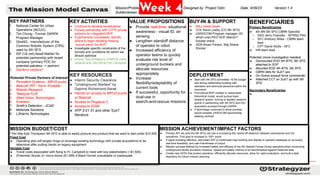
Week 5
87
KEY ACTIVITIES
● Explore mothership/mule systems
● Pursue partnership with COTS private
partners for integrated MVP
● If partnership unavailable, identify
where to begin iterating missing
“puzzle piece” for MVP
● Investigate power sources
● Investigate specific constraints of the
tunnels and conditions for which we
should optimize
● (Done) Test limitations of MPU5 mesh
network and TALON at Fort Campbell
KEY PARTNERS
1. Tim Chung - Former DARPA
Program Manager
2. QinetiQ - manufacturer of the
Common Robotic System (CRS)
used by 5th SFG
3. IDF Col (ret) Assaf Mahler for
potential partnership with Israeli
company (primary POC for
potential saboteur -> partner)
4. Stanford robotics?
Potential Private Partners of Interest
1. Persistent Systems - MPU5 pucks
2. Bearcat* RPi - Kevin Knoedler
3. Robotic Research
4. Tesla Superchargers
5. Teledyne FLIR
6. Allied Vision Technologies
7. Emesent
8. Smith’s Detection - JCAD
9. Motorola Solutions
10. L3Harris Technologies
KEY RESOURCES
● Interim Security Clearance
● "Underground Warfare" by
Daphne Richemond-Barak
● Hands-on access to MPU5 pucks
or Bearcat
● Access to Pegasus 3
● Access to ATAK
● ATP 3-21.51 and other SubT
literature
VALUE PROPOSITIONS
● Provide real-time, situational
awareness - visual ID, air
sensing to move from one
defensible position to the
next
● Enable operators to remove
protective gear
● Lengthen standoff distance
of operator to robot
● Increased efficiency of
operator teams to quickly
evaluate risk level of
underground bunkers and
allocate resources
appropriately
● Increase flexibility/
adaptability of current tools
● If successful, opportunity for
dual-use in search & rescue
missions
MISSION ACHIEVEMENT/IMPACT FACTORS
● Primary KPI we (and the 5th SFG) will use is increasing the "stand-off distance" between adversaries and US
operatives. First goal to increase to 100+ yards
● If signal boosting effective, secondary KPI is multimodal map building and display to operator assessed on accuracy,
real-time feasibility, and user-friendliness of output
● Mission success defined by increased safety and efficacy of the 5th Special Forces Group operators when conducting
underground facility (bunkers) missions. Speed and safety metrics to be benchmarked against historical data
● Create new SOPs that protect operators, efficiently allocate resources, allow for rapid evaluation, and built a data
repository for future mission planning
MISSION BUDGET/COST
* Per Maj Kyle Thompson 5th SFG is able to easily procure any product that we want to test under $10,000
Fixed Cost
● Operating plan will largely hinge on leverage existing technology with private acquisitions to be
determine after putting hands on legacy equipment
Variable Cost
● Travel costs associated with flying to Ft. Campbell to meet with key stakeholders (~$3000)
BENEFICIARIES
Primary Beneficiaries
● 4th BN 5th SFG CBRN Specialist
○ SSG Jerry Chavolla - MTRS2
Pilot
○ SFC Anthony Wiles - CBRN team
lead
○ CPT David Stults - GFC
● Infil team lead
Potential (more investigation needed)
● John Keyes, US Navy
● Federal Bureau of investigation
● US Marine Special operations
● Dismounted EOD 4th BTN, 5th
SFG attached to SOF
● Mounted EOD 4th BTN, 5th SFG
● CBRN dets for SubT ops
● On-Scene assault force
commander
● Attached CCT on SubT op with 5th
SFG
BUY-IN & SUPPORT
● MAJ Jesse Geyer
● COL Kevin Leahy (CO 5th SFG)
● USSOCOM Program manager (ID
which one) PEO SOF Warrior?
Double check
● GEN Bryan Fenton, Maj Shane
Shorter
DEPLOYMENT
● Start with 5th SFG committed ~$10k budget
and strong relationship building with
operators and technical personnel within the
command
● If functional MVP created or reasonable
theoretical model, would pursue basic
research grants, moving to applied research
grants in partnership with 5th SFG and DIU
acquisition process through DARPA
● If technology continued to show promise,
would consider USSOCOM sponsorship,
seeking contract
Mission/Problem Description: Seeing
Subterranean Smoke (#3)
Designed by: Project Odin Date: 4/09/23 Version:1.4
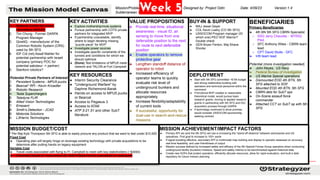
Week 6
88
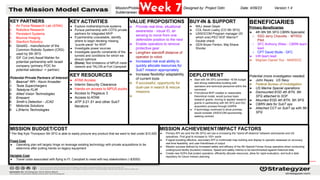
KEY ACTIVITIES
● Explore mothership/mule systems
● Pursue partnership with COTS private
partners for integrated MVP
● If partnership unavailable, identify
where to begin iterating missing
“puzzle piece” for MVP
● Investigate power sources
● Investigate specific constraints of the
tunnels and conditions for which we
should optimize
● (Done) Test limitations of MPU5 mesh
network and TALON at Fort Campbell
KEY PARTNERS
1. Air Force Research Lab (ATAK)
2. Robotics Research
3. Persistent Systems
4. Bounce Imaging
5. Stanford Robotics
6. QinetiQ - manufacturer of the
Common Robotic System (CRS)
used by 5th SFG
7. IDF Col (ret) Assaf Mahler for
potential partnership with Israeli
company (primary POC for
potential saboteur -> partner)
Potential Private Partners of Interest
1. Bearcat* RPi - Kevin Knoedler
2. Tesla Superchargers
3. Teledyne FLIR
4. Allied Vision Technologies
5. Emesent
6. Smith’s Detection - JCAD
7. Motorola Solutions
8. L3Harris Technologies
KEY RESOURCES
● ATAK Access
● Interim Security Clearance
● Hands-on access to MPU5 pucks
● Access to Pegasus 3
● Access to ATAK
● ATP 3-21.51 and other SubT
literature
VALUE PROPOSITIONS
● Provide real-time, situational
awareness - visual ID, air
sensing to move from one
defensible position to the next
● Enable operators to remove
protective gear
● Lengthen standoff distance of
operator to robot
● Increased risk eval ability to
quickly allocate resources for
SubT mission appropriately
● Increase flexibility/ adaptability
of current tools
● If successful, opportunity for
dual-use in search & rescue
missions
●
MISSION ACHIEVEMENT/IMPACT FACTORS
● Primary KPI we (and the 5th SFG) will use is increasing the "stand-off distance" between adversaries and US
operatives. First goal to increase to 100+ yards
● If signal boosting effective, secondary KPI is multimodal map building and display to operator assessed on accuracy,
real-time feasibility, and user-friendliness of output
● Mission success defined by increased safety and efficacy of the 5th Special Forces Group operators when conducting
underground facility (bunkers) missions. Speed and safety metrics to be benchmarked against historical data
● Create new SOPs that protect operators, efficiently allocate resources, allow for rapid evaluation, and built a data
repository for future mission planning
MISSION BUDGET/COST
* Per Maj Kyle Thompson 5th SFG is able to easily procure any product that we want to test under $10,000
Fixed Cost
● Operating plan will largely hinge on leverage existing technology with private acquisitions to be
determine after putting hands on legacy equipment
Variable Cost
● Travel costs associated with flying to Ft. Campbell to meet with key stakeholders (~$3000)
BENEFICIARIES
Primary Beneficiaries
● 4th BN 5th SFG CBRN Specialist
○ SSG Jerry Chavolla - MTRS2
Pilot
○ SFC Anthony Wiles - CBRN team
lead
○ CPT David Stults - GFC
● Infil team lead
● MajGen Daniel Yoo - MARSOC
Potential (more investigation needed)
● John Keyes, US Navy
● Federal Bureau of investigation
● US Marine Special operations
● Dismounted EOD 4th BTN, 5th
SFG attached to SOF
● Mounted EOD 4th BTN, 5th SFG
● CBRN dets for SubT ops
● Attached CCT on SubT op with 5th
SFG
BUY-IN & SUPPORT
● MAJ Jesse Geyer
● COL Kevin Leahy (CO 5th SFG)
● USSOCOM Program manager (ID
which one) PEO SOF Warrior?
Double check
● GEN Bryan Fenton, Maj Shane
Shorter
DEPLOYMENT
● Start with 5th SFG committed ~$10k budget
and strong relationship building with
operators and technical personnel within the
command
● If functional MVP created or reasonable
theoretical model, would pursue basic
research grants, moving to applied research
grants in partnership with 5th SFG and DIU
acquisition process through DARPA
● If technology continued to show promise,
would consider USSOCOM sponsorship,
seeking contract
Mission/Problem Description: Seeing
Subterranean Smoke (#3)
Designed by: Project Odin Date: 4/09/23 Version:1.4
Week 7

Hacking for Defense Team Odin Presentation

  • 1.
    Project Odin Problem Statement Operators needreal-time remote sensing capabilities to provide them sufficient decision-quality information about potentially hazardous subterranean environments to move from one defensible position to the next. Original Problem Statement The Explosive Ordnance Disposal (EOD) Detachment at 5th SFG needs improved, remote sensing capability to enable the safe detection and handling of all explosive hazards in subterranean environments for the military assault force. 111 Interviews
  • 2.
    2 Team Malika Aubakirova MBA/MPP, BSCS Finn Dayton BS CS, Coterm CS Josh Pickering MD/MBA | US Navy Vet Shubh Khanna BS CS, Math Lieutenant Colonel Rich "Astro" Lawson Rafi Holtzman Defense Mentor Industry Mentor Craig Seidel Industry Mentor Maggie Gray BS in Math, MS in CS Our Sponsor 5th Special Forces Group
  • 3.
    Our Journey (akaRoller coaster) Week 1 Week 2 Week 3 Week 4 Week 5 Week 6 Week 7* Week 8 Week 9 Time (weeks) Confidence and Morale
  • 4.
    Tip of theIceberg - A Lot to Skip
  • 5.
    Week 2: Whatare the Primary Challenges in SubT? Week 2 Comms Failure GPS-Denied Environment CBRN Hazards Unbreathable, Fouled Air “Once you’re in a tunnel… It’s hard to see, the air may not be breathable, but the primary problem is getting in-tunnel information to those outside.” - MAJ Jesse Geyer
  • 6.
    Week 2: HowHave Others Approached SubT? Timothy Chung - PM DARPA 6 years “Geology, physics, inherent environment… [SubT] is uniquely challenging and getting actionable situational awareness is tough. There are so many ways to break a robot underground.” Week 2
  • 7.
    Week 3: WhyDo We Need to Go Underground? Week 3 Nuclear + WMD Facilities Sensitive Intel Hostage Recovery Hidden Enemy Resources (ex: C2, missile silo, etc) “What if Bin Laden was in a tunnel? What if there was a loose nuke underground?... Can you guarantee by just blowing something up that a tunnel no longer poses a threat?” - Akhil Iyer
  • 8.
    Week 3: DifferentSubT Environments “Probably looking at 1-4 hours, if we’re bringing in a bit of equipment [underground]. Robots needs to be our eyes.” - CPT Stults Category 1 Caves + Natural Cavities Category 2 Urban Subsystems Category 3 Military Underground Facility Week 3
  • 9.
    Week 3: WhichSubT Environment to Prioritize “The Global War on Terror is over. Categories 1 and 2 are not going to be of strategic national importance in the future. Category 3’s will be“ - Former Navy SEAL Category 1 Caves + Natural Cavities Category 2 Urban Subsystems Category 3 Military Underground Facility Week 3
  • 10.
    Weeks 1 -3 Weeks 1-3: Define Primary beneficiary Example: Paul Zimmerman or EOD tech attached to 5th Group SOF Gear ~Weight (lbs) 1 NIJ Level IV Flak = x2 ceramic plates, kevlar plate carrier (no side plates) 15 2 Primary weapon: M4A1 7.75 3 210 rounds (7 mags) of 5.56 7.4375 4 Secondary weapon: Glock 19 1.9 5 45 rounds (3 mags) of 9mm 1.6 6 MPU5 radio (x2) (chassis only) 1.725 7 M67 fragmentation grenade (x2) 1.75 8 M84 flashbang grenade (x2) 1.65 9 M15 smoke grenade 1.94 10 Pouch EOD tools (Gerber, laser, chem light, throw lines) 4.1 11 FAST helmet 3.51 12 NOD (variable weight depending on wardrobe selection) 2 13 Mine Detector (Pulse Induction vs VLF vs magnetometer) 3.5 14 Medical supplies (tourniquet and IFAK) 4 15 1/4 block of C4 (can vary) 0.3125 Total Weight 58.175 ~180 - 220 lb male | ~20 - 30 y/o | Carrying ~58.2 lbs of gear at baseline “Ounces = pounds. Pounds = suck.” - M.J. Johnston
  • 11.
    Weeks 1-3: DefineOperator Workflow and Pain Points Week 3
  • 12.
    Week 4: FortCampbell! “Like all robots, it [MTRS2] never seems to work when it needs to.” - SFC Anthony Wiles “My trust is more in blood than technology.” - Cpt. David Stults Week 4 Maggie!
  • 13.
    Week 4: FortCampbell, Authors of SubT ATP ● “The tech is already there. It’s about getting company A to talk to company B to talk to company C and D” ● “Nobody asks what we need in combat when they work on tools for us, and as a result, we get pieces of shit” - MJ, Former Army Ranger and author of ATP 3-21.51 Week 4 Malika Finn Shubh Josh
  • 14.
    JCAD XAM Dosimeter SWIR Pegasus3 MPU5 MPU5 Pucks Output: ATAK “Mothership” Tethered to recharge battery Communicate with MPU5 + repeaters Modularize on Pegasus Week 5: Much of the Tech Exists, Needs Integration Week 5
  • 15.
    Week 5: Limitationsof Current Tech Requires Modularity Aerial drones are fast and maneuver through difficult terrain…BUT they have a short battery life and cannot carry large payloads Ground robots have much longer battery life and can carry large payloads…BUT they are slow and easily get stuck Week 5
  • 17.
    Week 5 Week 5MVP 1 3 2 “This is spot on. This is exactly what deliberate penetration looks like.” - Jon “Blade” Hackett Week 5: Need A Suite of Mission-Specific Robots to Go From Defensible Position to Defensible Position
  • 18.
    Week 7 Epiphany– Marines Special Operations Command’s (MARSOC) Program of Record MARSOC to announce a program of record for a suite of robotics to be used for enclosed spaces (which includes SubT) Matches our MVP almost exactly Week 7 How can we enhance + increase the effectiveness of this new suite of robots?
  • 19.
    Week 7 PivotMVP: Software, Not Hardware. Multi-Sensor Fusion + Efficient Data Display Distance to furthest measurement (meters) “Defensible position to defensible position” Information Testing Sensors Need CC-SCBA/SCBA (breathing equipment)? No/Yes O2 CO2 CBRN XAM, JCAD Need MOPP (protective) Suit? No/Yes CBRN XAM, JCAD, Dosimeter Threat detected? No/Yes Hostiles (Detectable) Traps Camera, IR/SWIR camera, LiDAR, Dosimeter “The watch is perfect. The last thing you want in a fire fight is another active sensor/screen. Just give me go/no go” - Jeff Phaneuf Week 7
  • 20.
    Robotic Suite Week 8: WhereCan We Add Value? Week 8
  • 21.
    Robotic Suite Week 9: WhereCan We Add Value? Week 9 Draper Labs is actively developing an ATAK plugin to integrate SubT mapping + CBRN information
  • 22.
    Week 9 +Going Forward Week 9 ➔ Partner with Draper to develop watch solution ➔ Apply for H4X
  • 23.
    23 KEY ACTIVITIES ●Guide acquisitionof Pegasus 3 for 5th group ●Investigate sensor-fusion (post class) with Draper ●H4X ●(Done) Test limitations of MPU5 mesh network and TALON at Fort Campbell KEY PARTNERS 1. Draper 2. Air Force Research Lab (ATAK) 3. Robotics Research 4. Persistent Systems 5. Bounce Imaging 6. Stanford Robotics 7. Boston Dynamics 8. Ghost Robotics 9. QinetiQ - manufacturer of the Common Robotic System (CRS) used by 5th SFG 10. IDF Col (ret) Assaf Mahler for potential partnership with Israeli company (primary POC for potential saboteur -> partner) KEY RESOURCES ● ATAK Access ● Interim Security Clearance (CRADA) for CAR ● Hands-on access to MPU5 pucks ● Access to Pegasus 3 ● ATP 3-21.51 and other SubT literature VALUE PROPOSITIONS ● Provide real-time, situational awareness - visual ID, air sensing to move from one defensible position to the next ● Enable operators to remove protective gear ● Lengthen standoff distance of operator to robot ● Increased risk eval ability to quickly allocate resources for SubT mission appropriately ● Increase flexibility/ adaptability of current tools ● If successful, opportunity for dual-use in search & rescue missions ● MISSION ACHIEVEMENT/IMPACT FACTORS ● Primary KPI we (and the 5th SFG) will use is increasing the "stand-off distance" between adversaries and US operatives. First goal to increase to 100+ yards ● If signal boosting effective, secondary KPI is multimodal map building and display to operator assessed on accuracy, real-time feasibility, and user-friendliness of output ● Mission success defined by increased safety and efficacy of the 5th Special Forces Group operators when conducting underground facility (bunkers) missions. Speed and safety metrics to be benchmarked against historical data ● Create new SOPs that protect operators, efficiently allocate resources, allow for rapid evaluation, and built a data repository for future mission planning MISSION BUDGET/COST Fixed Cost ● Operating plan will largely hinge on leverage existing technology with private acquisitions to be determine after putting hands on legacy equipment Variable Cost ● Travel costs associated with flying to Ft. Campbell to meet with key stakeholders (~$3000) BENEFICIARIES Primary Beneficiaries ● 4th BN 5th SFG CBRN Specialist ○ SSG Jerry Chavolla - MTRS2 Pilot ○ SFC Anthony Wiles - CBRN team lead ○ CPT David Stults - GFC ● Infil team lead ● MajGen Daniel Yoo - MARSOC Potential (more investigation needed) ● Federal Bureau of investigation ● US Marine Special operations ● Dismounted EOD 4th BTN, 5th SFG attached to SOF ● Mounted EOD 4th BTN, 5th SFG ● CBRN dets for SubT ops ● Attached CCT on SubT op with 5th SFG BUY-IN & SUPPORT ● MAJ Jesse Geyer ● COL Kevin Leahy (CO 5th SFG) ● USSOCOM Program manager (ID which one) PEO SOF Warrior? Double check ● Jon “Blade” Hackett (MARSOC PEO) ● GEN Bryan Fenton, Maj Shane Shorter DEPLOYMENT ● OTA 5th SFG for Pegasus purchase ● If technology continued to show promise, would consider USSOCOM sponsorship (SBIR) ● If functional MVP created or reasonable theoretical model, would pursue basic research grants, moving to applied research grants in partnership with 5th SFG and DIU acquisition process through DARPA Mission/Problem Description: Seeing Subterranean Smoke (#3) Designed by: Project Odin Date: 6/06/23 Version:1.6
  • 24.
    THANK YOU Teaching Team SteveBlank Pete Newell Dr. Joe Felter Steve Weinstein Dr. Jeff Decker Joel Johnson Theo Velaise Andrew Fang Andrew Radford Katherine Miller Our Mentors Lieutenant Colonel Rich "Astro" Lawson Rafi Holtzman Craig Seidel & everyone who donated their time to our journey Our Sponsors CPT Stults 5th SFG
  • 25.
  • 26.
    Sponsor Procurement Process- POR Route MARSOC Marine Forces Special Operations Command (MARSOC) initiates POR MARSOC MARSOC develops a Program Objective Memorandum (POM) for the program, which includes program’s requirements, schedule, budget and risks. JROC The POM is reviewed by the DoD's Joint Requirements Oversight Council (JROC) OSD The POM is then submitted to the DoD's Office of the Secretary of Defense (OSD). OSD reviews the POM and makes any necessary changes. Congress The POM is submitted to Congress, which may approve the POM as is, or it may make changes to the program's requirements, schedule, budget, or risks. 1-2 years 1-2 years 6-12 months 6-12 months 12-18 months 6 years Goal: To eventually be included in MARSOC POR Not first target b/c of time
  • 27.
    27 Resources, Partners &Activities Diagram Customer Discovery FOUO Documents for Dataset Testing & Evaluation Deployment Prototype Funding Software Hosting Prototype Iteration
  • 28.
    Week 8: HowCan We Add Value? Week 8 Defense Acquisition University (DAU) Adaptive Acquisition Framework Pathways
  • 29.
    Week 7 PivotMVP: Software, Not Hardware. Multi-Sensor Fusion + Efficient Data Display Distance to furthest measurement (meters) “Defensible position to defensible position” Information Testing Sensors Need CC-SCBA/SCBA (breathing equipment)? No/Yes O2 CO2 CBRN XAM, JCAD Need MOPP (protective) Suit? No/Yes CBRN XAM, JCAD, Dosimeter Threat detected? No/Yes Hostiles (Detectable) Traps Camera, IR/SWIR camera, LiDAR, Dosimeter “The watch is perfect. The last thing you want in a fire fight is another active sensor/screen. Just give me go/no go” - Jeff Phaneuf Week 7
  • 30.
    30 Week 3: NailingDown the SubT Environment and Priorities ➔ “Probably looking at 1-4 hours, if we’re bringing in a bit of equipment. Most likely this has been planned out, we’re gonna take some time to do this, but this is coming from a CBRN perspective, other people have different perspectives. Robot needs to be our eyes.” - CPT Stults Category 1: Caves + Natural Cavities Category 2: Urban Subsystems Category 3: Military-Purpose Underground Facility
  • 31.
    Week 3-5: TheScale of “Tomorrow’s War” (>>GWOT) Weeks 3-5 “Cat 1/2 are diametrically different than Cat 3 [Cat 3] requires a huge amounts of equipment… There will be a battalion sized force just to protect the entrance. It could take multiple days just to enter.” -Former Navy Seal
  • 32.
    32 Understanding Tomorrow’s War “Cat1 + 2 are diametrically different than Cat 3. Those are going to be facilities built by national states. Hundreds of people are down there, huge amounts of equipment. Multiple C-47 Chinook helicopters are dropping off tonnage…there will be sorties of CH47s running every half hour to an hour to resupply gear, equipment, food, and people. We would make sure to dismantle all the surface to air threats and make sure we have complete air superiority. Operators will need to use exotic breaching equipment, and every human is going to be in CBRN gear…it will be difficult to see anything. There will be a battalion sized force just to protect us at the entrance. It could take multiple days just to enter, multiple thick doors, slabs of concrete to drill into.” -Former Navy Seal
  • 33.
  • 34.
    Week 1 Week 2 Week3 Week 4 Week 5 Week 6 Week 7* Week 8 Week 9 Weeks 4-6 Weeks 4-6
  • 35.
    35 Week 1-3 Progression “Youdon’t even understand the problem. STOP. MVP is minimum viable anything” - COL Newell
  • 36.
    Weeks 1-3: Drinkingfrom a firehose Week 1 Week 2 Week 3 Week 4 Week 5 Week 6 Week 7* Week 8 Week 9 Weeks 1 - 3
  • 37.
  • 38.
  • 39.
    Week 1 Week 2 Week3 Week 4 Week 5 Week 6 Week 7* Week 8 Week 9 Weeks 7-9 Weeks 7-9: Picking Our Wedge
  • 40.
  • 41.
  • 42.
    Week 9: Pickinga Wedge - High-Density Data Output ➔ “When I’m flying [the F-35], I use my Garmin smartwatch to maintain situational awareness. It shows the cabin altitude program, if it gets too high or too low it will start vibrating.” - Robert Cowsert
  • 43.
    Week 9: Pickinga Wedge - High-Density Data Output ➔ When I’m flying [the F-35], I use my Garmin smartwatch to maintain situational awareness. It shows the cabin altitude program, if it gets too high or too low it will start vibrating.” - Robert
  • 44.
    44 Week 2: Learningthe foundation Primary Beneficiary Primary Beneficiary Workflow
  • 45.
    45 Week 2: Learningthe foundation Primary Beneficiary Primary Beneficiary Workflow
  • 46.
    46 Week 2: Learningthe foundation Primary Beneficiary Primary Beneficiary Workflow ~50 lbs Comms
  • 47.
    47 Week 2: Learningthe foundation Primary Beneficiary Primary Beneficiary Workflow “Comms is important for all tasks” “You can spend all day setting up and planning (comms), as soon as you start the mission, they’ll fuck up. Depending on the mission, then you’re using runners or just figuring it out.” - Logan Greene ~50 lbs Comms
  • 48.
    48 Slide 2 –Team members – name, background, expertise and your role on the team. Name of mentors and their affiliation.
  • 49.
    49 Week 1: GettingAhead of Ourselves Throwbot (~10 lbs) Talon Robot (~200 lbs) Robots MVP Picatinny Rail MPU5 Radio ● Daisy Chaining comms ○ MPU5 vs non-MPU5 repeaters ● Picatinny Rail for a modular robot ○ Sensor for each mission
  • 50.
    50 Week 3 -Understanding the Landscape
  • 51.
    51 Week 4: Walkinga mile in our beneficiaries’ shoes Current tools (MTRS + TALON) were not designed for SubT. As a result, operators do not use them in SubT environments. Most technology needed for a SubT solution already exists. Need political will to integrate existing technology into a comprehensive solution During SubT missions, operators wear a significant amount of gear that limits their mobility and visibility
  • 52.
    52 Week 1: GettingAhead of Ourselves Throwbot (~10 lbs) Talon Robot (~200 lbs) Robots MVP Picatinny Rail MPU5 Radio ● Daisy Chaining comms ○ MPU5 vs non-MPU5 repeaters ● Picatinny Rail for a modular robot ○ Sensor for each mission “Picatinny rail system? You don’t even understand the problem. STOP. MVP is minimum viable anything” - COL Newell
  • 53.
    53 Malika Aubakirova FinnDayton Josh Pickering MBA/MPP, BS CS BS CS, MS in CS MD/MBA | US Navy Vet Maggie Gray BS in Math, MS in CS Shubh Khanna BS CS, Math Lieutenant Colonel Rich "Astro" Lawson Rafi Holtzman Defense Mentor Industry Mentor Craig Seidel Industry Mentor Odin Our Sponsor 5th Special Forces Group
  • 54.
    Our Journey Week 1:Thus far we have spoken to several KOLs spanning our in-house contact recommendations to individuals outside of our problem-specific contacts to individuals with experience in product acquisition within the defense industry to better understand market definition Week 2: The Explosive Ordnance Disposal (EOD) Detachment at 5th SFG foremost requests are improved communications underground as well as weight-conscious solution (potentially robots) to achieve actionable situational awareness. Week 3: Spoke with operators, tech companies and National Center for Urban Operations (NCUO) personnel to answer last week’s questions and define: Environments, Operations, and Available tech Week 4: Met with 5th Group EOD, CBRN det, and military contractors at Fort Campbell to discuss: Environmental limitations, Mission sets, Technology in development, Military acquisitions, Program of record, timeline for deployment Week 5: Spoke with our sponsor and various KOLs, including representatives of RR.AI, creator of Pegasus, RADēCO, manufacturer and distributor in the energy and defense industries, Exyn Technologies, Industrial Drone Technology, FBI Agent, Navy SEALs, etc Week 6: Discussed our MVPs and discovered more pain points with Operators, NCUO, FBI, Carnegie Mellon engineers, Iris Technology Week 7: Discussion our MVPs with operators and worked with acquisition experts, understanding POR, deployment, and multisensor fusion and visual display. Week 8: Interviews with F35 pilots and engineers, mine safety experts, TAK experts, and more to narrow down our focus among possible paths.
  • 55.
    55 Slide 3 –Original Hypotheses ● The World – market/opportunity, how does it operate ● The Characters – customers/value proposition/ product-market fit, pick a few examples to illustrate ● Narrative Arc – lessons learned how? Enthusiasm, despair, learning then insight ● Quotes from customers “we loved it” or “stupid idea” ● Show us – images and demo to illustrate learning = diagrams, wireframes & pivots to finished product) ● Editing – does each slide advance the learning Theater ● Point us to what you want us to see ● Ought to be self-explanatory ● Use analogies ● Bring any “show and tell” examples
  • 56.
    56 Slide 4 -Mission Model Canvas Version 1 (use the modified Osterwalder Canvas; do not make up your own). “Here was our original idea.” ● Zoom in on the important parts of the canvas to make any key points
  • 57.
    KEY ACTIVITIES ● Speakwith key stakeholders: ● Operators, from enlisted to officers ● Technicians who create/maintain equipment ● Investigate specific constraints of the tunnels and conditions for which we should optimize ● Research what mapping and signal boosting solutions exist, DD on why they don't currently work (for example, MPU-5s are internally locked so they can't be used for piggybacking) ● Develop optimal feasible solution using either first or third party equipment/software KEY PARTNERS 1. CPT David Stults 4th BN, 5th SFG 2. Maj Kyle Thompson, 4th BTN, 5th SFG 3. SSG Anthony Wiles, 4th BN, 5th SFG 4. Golf Company, 4th BTN, 5th SFG 5. IDF Col (ret) Assaf Mahler 6. Explosive Ordnance Disposal (EOD) Technicians, Fort Campbell 7. Qinetiq - manufacturer of the Common Robotic System (CRS) used by 5th SFG 8. Persistent Systems - manufacturer of the MPU5 system used for mesh network radio system Potential Private Partners of Interest 1. Teledyne FLIR 2. Motorola Solutions 3. Thales Group 4. L3Harris Technologies 5. General Dynamics Corp. 6. BAE Systems KEY RESOURCES ● Interim Security Clearance ● "Underground Warfare" by Daphne Richemond-Barak ● Hands-on access to the TALON robot (Sponsor will provide) ● Hands-on access to MPU5 ● Access to Black Hornet PRS ● Access to Throwbots from ReconRobotics VALUE PROPOSITIONS ● Provide critical situational awareness to decision-makers with real-time mapping of layout and parameters from sensors in hostile environments ● Significantly lengthen standoff distance, reducing need for operator breach prior to evaluation and potential action with TALON robot ● Increased efficiency of operator teams to quickly evaluate risk level of underground bunkers and allocate resources appropriately ● Create repository of data for post-mission analysis and future mission planning ● If successful, opportunity for dual-use in search-and-rescue missions MISSION ACHIEVEMENT/IMPACT FACTORS ● Primary KPI we (and the 5th SFG) will use is increasing the "stand-off distance" between adversaries and US operatives. First goal to increase to 100+ yards, the ultimate goal of 2-3 miles ● If signal boosting effective, secondary KPI is multimodal map building and display to operator assessed on accuracy, real-time feasibility, and user-friendliness of output ● Mission success defined by increased safety and efficacy of the 5th Special Forces Group operators when conducting underground facility (bunkers) missions. Speed and safety metrics to be benchmarked against historical data ● Create new SOPs that protect operators, efficiently allocate resources, allow for rapid evaluation, and built a data repository for future mission planning Mission/Problem Description: Seeing Subterranean Smoke (#3) Designed by: Project Odin Date: 2/25/23 Version:1.1 MISSION BUDGET/COST * Per Maj Kyle Thompson 5th SFG is able to easily procure any product that we want to test under $10,000 Fixed Cost ● Operating plan will largely hinge on leverage existing technology with private acquisitions to be determine after putting hands on legacy equipment Variable Cost ● Travel costs associated with flying to Ft. Campbell to meet with key stakeholders (~$1,500) ● (Potential) Skydio 2+ micro-drone ($1,099) if Black Hornet unavailable or inadequate BENEFICIARIES Primary Beneficiaries ● US Special forces operators within the 4th BTN of 5th SFG ● US Army EOD techs within 5th SFG and other joint-task force operator teams specifically assigned to tunnel operations ● On-Scene assault force commander Secondary Beneficiaries ● Tier 1 SOF units specializing in counterterrorism operations ● US NAVY EOD tech teams ● Other robotic divisions in DoD (JIDO, ARL, NRL, DARPA) Tertiary Beneficiaries ● IDF forces assigned tunnel warfare ● Firefighting teams stateside in a dual-use application (CalFire, FDNY, CFD, MDFRD, etc) ● Search-and-rescue orgs for dual-use (MRA, NASAR, & IAFF) ● Bomb-squad/SWAT team members and other law enforcement agencies BUY-IN & SUPPORT ● Sponsor: SFC Anthony Wiles ● CPT David Stults ● MAJ Kyle Thompson (H4D Alum!) ● Capt Joseph Brown ● Col Kevin Leahy (CO 5th SFG) ● USSOCOM Chain of Command - Gen Bryan Fenton, Maj Shane Shorter, Vice Adm Collin Green, Lt Gen Francis Donovan ● Centers of innovation within SOC ● Partnerships within academic labs DEPLOYMENT ● Start with 5th SFG committed ~$10k budget and strong relationship building with operators and technical personnel within the command ● If functional MVP created or reasonable theoretical model, would pursue basic research grants, moving to applied research grants in partnership with 5th SFG and DIU acquisition process through DARPA ● If technology continued to show promise, would consider USSOCOM sponsorship, seeking contract
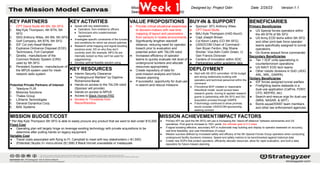
  • 58.
    58 Slide 5 –“So here’s what we did…” (explain how you got out of the building) ● Show us your first MVP
  • 59.
    59 Week 2: Learningthe foundation Primary Beneficiary Primary Beneficiary Workflow Top Epiphanies “Comms is important for all tasks” “You can spend all day setting up and planning (comms), as soon as you start the mission, they’ll fuck up. Depending on the mission, then you’re using runners or just figuring it out.” - Logan Greene ~50 lbs Comms
  • 60.
    60 Week 3: NailingDown the SubT knowledge ➔ “Probably looking at 1-4 hours, if we’re bringing in a bit of equipment. Most likely this has been planned out, we’re gonna take some time to do this, but this is coming from a CBRN perspective, other people have different perspectives. Robot needs to be our eyes.” - CPT Stults Primary Beneficiary Workflows CBRN SOF Environment
  • 61.
    61 Week 3 -Problem Statement Breakdown
  • 62.
    62 Week 3 MVP:Environment & Operations Matrix Results Hypothesis: These facilities can vary widely. To create meaningful impact, we should narrow our investigation to solving the first 300 meters of these environments, providing visual and air testing data (as described by beneficiary) Time on Target Category 1 (Tunnels, Caves, and Natural Cavities) Category 2 (Urban Subsurface Systems) Category 3 (Military Purposed Underground Facilities) Subcategory Rudimentary Sophisticated Substructures Civil Works Shallow Deep Functions Civil: commercial operations, transportation, and storage enemy: C2, operations, storage, production, protection C2, operations, storage, production, protection < 1 hr EOD, SOF 1 - 4 hrs EOD, SOF EOD, SOF CBRN, SOF, EOD CBRN, SOF, EOD CBRN, SOF, EOD CBRN, SOF, EOD > 4 hrs CBRN, SOF, EOD CBRN, SOF, EOD CBRN, SOF, EOD
  • 63.
    Week 1 Week 2 Week3 Week 4 Week 5 Week 6 Week 7* Week 8 Week 9 Week 4-6: When Pigs Fly - Realizing things don’t add up
  • 64.
    64 Week 4-6: WhenPigs Fly - Realizing things don’t add up
  • 65.
    Week 4: Walkinga mile in our beneficiaries’ shoes “The longest I ever wore a MOPP suit was 6 hours. It was 129 degrees out in the Syrian desert. I went through all my water (4 quarts) in the first 2 hours.” - Jesse Rivera Gear Approx Weight (lbs) 1 NIJ Level IV Flak = x2 ceramic plates, kevlar plate carrier (no side plates) 15 2 Primary weapon: M4A1 7.75 3 210 rounds (7 mags) of 5.56 7.4375 4 Secondary weapon: Glock 19 1.9 5 45 rounds (3 mags) of 9mm 1.6 6 MPU5 radio (x2) (chassis only) 1.725 7 M67 fragmentation grenade (x2) 1.75 8 M84 flashbang grenade (x2) 1.65 9 M15 smoke grenade 1.94 10 Pouch EOD tools (Gerber, laser, chem light, throw lines) 4.1 11 FAST helmet 3.51 12 NOD (variable weight depending on wardrobe selection) 2 13 Mine Detector (Pulse Induction vs VLF vs magnetometer) 3.5 14 Medical supplies (tourniquet and IFAK) 4 15 1/4 block of C4 (can vary) 0.3125 16 MOPP Suit 6 17 Gas Mask 1.23 18 4-5 layers of gloves .03 19 2 O2 tanks 20 (?) Total 85.448
  • 66.
    66 Week 4: WorkflowFlowchart for CBRN Operator w/ Robot on SubT Mission
  • 67.
    Week 4 MVP:Integration (COTSbot) - For KOLs Benefit: Speed Challenge: Making Allies out of Competitors/Saboteurs | *Echochamber?* Integrate Pegasus 3 + SWIR MESH Network Repeater Drops MPU5 Pucks: Available, Tested, Readily Integratable | Sensitive Tech - must be retrieved Bearcat (RPi): Light, Cheap, Can be left behind | Tested? Readily Integratable? *Sensitive? Output: ATAK
  • 68.
    Figure: ATP 3-21.51,Subterranean Operations, NOV2019 “For a Category 1 (facility), there is the potential for a dismounted operation, but everything past that (Cat 2 & 3), for the gear I am required to bring, this has to be a mounted operation. The time, space, equipment we require, at a minimum we need to be remote with a robot” - CPT Patrick Nieto, EOD Tech, 1st SFG **Our hypothesis is that the description of these missions for Cat 2 & 3 assault have been presented to us through the lens of GWOT, but are misaligned with the realities of such an operation based on the resources and personnel that would be needed for non-Tier 1, Cat 2/3, SubT operations Week 5 Epiphany: Request Mismatch and GWOT Contamination Mounted Dismounted
  • 69.
    69 Week 5 Epiphany:If Robotic, Bounded by Physics Comparison of Lithium Ion Batteries, Hydrogen Fueled Combustion Engines, and a Hydrogen Fuel Cell in Powering a Small Unmanned Aerial Vehicle. Energy Conversion and Management. In Press. 10.1016/j.enconman.2020.112514. If robotic, the capabilities requested for these environments are not possible with the current battery technology for single robot Figure adopted from NASA paper by EPEC
  • 70.
    70 Solve for this,300 meters OK, but MUST look ahead to “defensible positions” Week 5 Epiphany: Yesterday’s vs Tomorrow’s War
  • 71.
    71 Week 5 NewPrimary Beneficiary Workflow for Great Power Competition Navy Seal Mounted Mission - Highly Variable 1. Load 4 CH-47 Chinooks with supplies 2. Put on protective gear (MOPP suits and SCBA equipment, weighs about 80 lbs with kit) 3. Board CH-47 in full gear and fly to facility entrance 4. Dismount aircraft and clear area around bunker entrance. Team sets up a secure position at entrance to tunnel 5. Team drills hole in bunker wall to measure its thickness 6. Probe the air in the tunnel through the hole 7. Blow an opening in the wall using breaching equipment (creates smoke making it difficult to see anything) 8. Send canine or Packbot 110 in with a camera and sensors (comms break down) 9. Initial team enters facility (only one person can go through entrance at a time). Ranger battalion remains outside of the facility entrance to protect team. 10. Open door from the inside to bring in large equipment. 11. Team takes several days to move through the facility, using explosives to breach internal doors (many heavy steel doors) 12. As team runs out of O2, they must return to surface to resupply 13. CH-47s resupplying operation regularly A Category 3 underground military facility hosts a nuclear enrichment facility. It is a large, complex underground facility. Based on open source and classified (HUMINT + SIGINT) intelligence, it is believed that the facility is made up of three underground buildings, two of which are designed to hold 50,000 centrifuges, and six above ground buildings. Two of the above ground buildings are 2,500 meter halls used for gas centrifuge assemblies. Several hundred people work inside the facility. Facility has been surveilled using satellite data for years, mission has been planned for months. Air superiority has been established in enemy country. Boeing CH-47 Chinook Overhead Satellite Image of Facility
  • 72.
    MVP Unmanned Manned Week 6: IroningOut Our Focus Organizational / Influence Chart ➔ “It takes a lot of men to run unmanned systems” - Matt Jackson
  • 73.
    73 Week 6: MissionSet Decision Tree
  • 74.
    74 Week 6: MissionSet Decision Tree Our Focus
  • 75.
    75 Week 7 MVP:Multi-Sensor Fusion + Visual Display Not this specific, highlight threats
  • 76.
    76 Slide 6 –“So here’s what we found (what was reality), so then… here’s what we did” ● Presentation requires at least three Mission Model Canvas slides o Zoom in on the important parts of the canvas to make any key points ● Presentation requires at least three diagrams of some part of the canvas. For example o Get/Keep/Grow pipeline o Channel diagram o Customer/payer flow o Activities/Resources/Partners connections o Petal diagram o TAM/SAM
  • 77.
    77 - Include images/iconsand by the numbers analysis Who we talked to breakdown/chart
  • 78.
  • 79.
    79 Slide n ● Investmentreadiness slide ● Whether you think this a viable business, ● Whether you want to pursue it after the class, etc.
  • 80.
    80 - This isa viable business → a program of record is ACTIVELY being developed. It will require a data integration, display, and analysis piece that somebody will need to provide. - There is significant overlap between SubT and urban operations. - While SubT and urban operations are not a top priority right now, if we were to enter a war with a country like Iran, China, North Korea, or Russia, it would quickly become a priority. We should develop necessary technology now to prepare for the wars of the future. - Investment Readiness
  • 81.
    81 Final Slides –Click through each one of your weekly MMC slides.
  • 82.
    KEY ACTIVITIES ● Speakwith key stakeholders: ● Operators, from enlisted to officers ● Technicians who create/maintain equipment ● Investigate specific constraints of the tunnels and conditions for which we should optimize ● Research what mapping and signal boosting solutions exist, DD on why they don't currently work (for example, MPU-5s are internally locked so they can't be used for piggybacking) ● Develop optimal feasible solution using either first or third party equipment/software KEY PARTNERS 1. CPT David Stults 4th BN, 5th SFG 2. Maj Kyle Thompson, 4th BTN, 5th SFG 3. SSG Anthony Wiles, 4th BN, 5th SFG 4. Golf Company, 4th BTN, 5th SFG 5. IDF Col (ret) Assaf Mahler 6. Explosive Ordnance Disposal (EOD) Technicians, Fort Campbell 7. Qinetiq - manufacturer of the Common Robotic System (CRS) used by 5th SFG 8. Persistent Systems - manufacturer of the MPU5 system used for mesh network radio system Potential Private Partners of Interest 1. Teledyne FLIR 2. Motorola Solutions 3. Thales Group 4. L3Harris Technologies 5. General Dynamics Corp. 6. BAE Systems KEY RESOURCES ● Interim Security Clearance ● "Underground Warfare" by Daphne Richemond-Barak ● Hands-on access to the TALON robot (Sponsor will provide) ● Hands-on access to MPU5 ● Access to Black Hornet PRS ● Access to Throwbots from ReconRobotics VALUE PROPOSITIONS ● Provide critical situational awareness to decision-makers with real-time mapping of layout and parameters from sensors in hostile environments ● Significantly lengthen standoff distance, reducing need for operator breach prior to evaluation and potential action with TALON robot ● Increased efficiency of operator teams to quickly evaluate risk level of underground bunkers and allocate resources appropriately ● Create repository of data for post-mission analysis and future mission planning ● If successful, opportunity for dual-use in search-and-rescue missions MISSION ACHIEVEMENT/IMPACT FACTORS ● Primary KPI we (and the 5th SFG) will use is increasing the "stand-off distance" between adversaries and US operatives. First goal to increase to 100+ yards, the ultimate goal of 2-3 miles ● If signal boosting effective, secondary KPI is multimodal map building and display to operator assessed on accuracy, real-time feasibility, and user-friendliness of output ● Mission success defined by increased safety and efficacy of the 5th Special Forces Group operators when conducting underground facility (bunkers) missions. Speed and safety metrics to be benchmarked against historical data ● Create new SOPs that protect operators, efficiently allocate resources, allow for rapid evaluation, and built a data repository for future mission planning Mission/Problem Description: Seeing Subterranean Smoke (#3) Designed by: Project Odin Date: 2/25/23 Version:1.1 MISSION BUDGET/COST * Per Maj Kyle Thompson 5th SFG is able to easily procure any product that we want to test under $10,000 Fixed Cost ● Operating plan will largely hinge on leverage existing technology with private acquisitions to be determine after putting hands on legacy equipment Variable Cost ● Travel costs associated with flying to Ft. Campbell to meet with key stakeholders (~$1,500) ● (Potential) Skydio 2+ micro-drone ($1,099) if Black Hornet unavailable or inadequate BENEFICIARIES Primary Beneficiaries ● US Special forces operators within the 4th BTN of 5th SFG ● US Army EOD techs within 5th SFG and other joint-task force operator teams specifically assigned to tunnel operations ● On-Scene assault force commander Secondary Beneficiaries ● Tier 1 SOF units specializing in counterterrorism operations ● US NAVY EOD tech teams ● Other robotic divisions in DoD (JIDO, ARL, NRL, DARPA) Tertiary Beneficiaries ● IDF forces assigned tunnel warfare ● Firefighting teams stateside in a dual-use application (CalFire, FDNY, CFD, MDFRD, etc) ● Search-and-rescue orgs for dual-use (MRA, NASAR, & IAFF) ● Bomb-squad/SWAT team members and other law enforcement agencies BUY-IN & SUPPORT ● Sponsor: SFC Anthony Wiles ● CPT David Stults ● MAJ Kyle Thompson (H4D Alum!) ● Capt Joseph Brown ● Col Kevin Leahy (CO 5th SFG) ● USSOCOM Chain of Command - Gen Bryan Fenton, Maj Shane Shorter, Vice Adm Collin Green, Lt Gen Francis Donovan ● Centers of innovation within SOC ● Partnerships within academic labs DEPLOYMENT ● Start with 5th SFG committed ~$10k budget and strong relationship building with operators and technical personnel within the command ● If functional MVP created or reasonable theoretical model, would pursue basic research grants, moving to applied research grants in partnership with 5th SFG and DIU acquisition process through DARPA ● If technology continued to show promise, would consider USSOCOM sponsorship, seeking contract Week 1
  • 83.
    83 KEY ACTIVITIES ● Speakwith key stakeholders: ● Operators, from enlisted to officers ● Technicians who create/maintain equipment ● Non-military groups who operate underground (mine operators, fire departments) ● Investigate specific constraints of the tunnels and conditions for which we should optimize ● Research what mapping and signal boosting solutions exist, DD on why they don't currently work (for example, MPU-5s are internally locked so they can't be used for piggybacking) ● Develop optimal feasible solution using either first or third party equipment/software KEY PARTNERS 1. National Center for Urban Operations (NCUO) 2. Tim Chung - Former DARPA Program Manager 3. QinetiQ - manufacturer of the Common Robotic System (CRS) used by 5th SFG 4. IDF COL (ret) Assaf Mahler for potential partnership with Israeli company (primary POC for potential saboteur -> partner) Potential Private Partners of Interest 1. Emesent 2. Exyn 3. Persistent Systems - MPU5 4. Smith’s Detection - JCAD 5. Teledyne FLIR 6. Motorola Solutions 7. Thales Group 8. L3Harris Technologies 9. General Dynamics Corp. 10. BAE Systems KEY RESOURCES ● Interim Security Clearance ● "Underground Warfare" by Daphne Richemond-Barak ● Hands-on access to the TALON robot (Sponsor will provide) ● Hands-on access to MPU5 ● Access to Throwbots from ReconRobotics VALUE PROPOSITIONS ● Gain situation awareness in underground facilities, while maintaining good imagery, sensors & signal, saving lives. ● Significantly lengthen standoff distance, reducing need for operator breach prior to evaluation and potential action with TALON robot ● Provide critical situational awareness to decision-makers with real-time mapping of layout and potential enemy combatant occupancy in hostile environments ● Increased efficiency of operator teams to quickly evaluate risk level of underground bunkers and allocate resources appropriately ● Create repository of data for post-mission analysis and future mission planning ● If successful, opportunity for dual-use in search-and-rescue missions ● Increase flexibility/adaptability of current tools MISSION ACHIEVEMENT/IMPACT FACTORS ● Primary KPI we (and the 5th SFG) will use is increasing the "stand-off distance" between adversaries and US operatives. First goal to increase to 100+ yards ● If signal boosting effective, secondary KPI is multimodal map building and display to operator assessed on accuracy, real-time feasibility, and user-friendliness of output ● Mission success defined by increased safety and efficacy of the 5th Special Forces Group operators when conducting underground facility (bunkers) missions. Speed and safety metrics to be benchmarked against historical data ● Create new SOPs that protect operators, efficiently allocate resources, allow for rapid evaluation, and built a data repository for future mission planning MISSION BUDGET/COST * Per Maj Kyle Thompson 5th SFG is able to easily procure any product that we want to test under $10,000 Fixed Cost ● Operating plan will largely hinge on leverage existing technology with private acquisitions to be determine after putting hands on legacy equipment Variable Cost ● Travel costs associated with flying to Ft. Campbell to meet with key stakeholders (~$1,500) ● (Potential) Skydio 2+ micro-drone ($1,099) if Black Hornet unavailable or inadequate BENEFICIARIES Primary Beneficiaries ● SSG Jerry Chavolla, 4th BN, 5th SFG - (MTRS2 Pilot) ● SFC Anthony Wiles, 4th BN, 5th SFG - (CBRN team lead) ● CPT David Stults 4th BN, 5th SFG - (GFC) ● Enlisted Green Beret Operator - 4th BTN, 5th SFG - Infil team lead Potential (more investigation needed) ● Dismounted EOD 4th BTN, 5th SFG attached to SOF ● Mounted EOD 4th BTN, 5th SFG ● CBRN dets for SubT ops ● On-Scene assault force commander ● Attached CCT on SubT op with 5th SFG Secondary Beneficiaries ● COL Kevin Leahy - CO 5th SFG BUY-IN & SUPPORT ● Sponsor: SFC Anthony Wiles ● MAJ Kyle Thompson (H4D Alum!) ● CPT David Stults ● CPT Joseph Brown ● COL Kevin Leahy (CO 5th SFG) ● USSOCOM Chain of Command - GEN Bryan Fenton, Maj Shane Shorter ● Partnerships within academic labs (need to find a specific lab) DEPLOYMENT ● Start with 5th SFG committed ~$10k budget and strong relationship building with operators and technical personnel within the command ● If functional MVP created or reasonable theoretical model, would pursue basic research grants, moving to applied research grants in partnership with 5th SFG and DIU acquisition process through DARPA ● If technology continued to show promise, would consider USSOCOM sponsorship, seeking contract Mission/Problem Description: Seeing Subterranean Smoke (#3) Designed by: Project Odin Date: 4/09/23 Version:1.3 Week 2
  • 84.
    84 KEY ACTIVITIES ● Speakwith key stakeholders: ● Operators, from enlisted to officers ● Technicians who create/maintain equipment ● Non-military groups who operate underground (mine operators, fire departments) ● Investigate specific constraints of the tunnels and conditions for which we should optimize ● Test limitations of MPU5 mesh network and TALON at Fort Campbell KEY PARTNERS 1. National Center for Urban Operations (NCUO) 2. Tim Chung - Former DARPA Program Manager 3. QinetiQ - manufacturer of the Common Robotic System (CRS) used by 5th SFG 4. IDF Col (ret) Assaf Mahler for potential partnership with Israeli company (primary POC for potential saboteur -> partner) Potential Private Partners of Interest 1. Emesent 2. Exyn 3. Persistent Systems - MPU5 4. Smith’s Detection - JCAD 5. Teledyne FLIR 6. Motorola Solutions 7. Thales Group 8. L3Harris Technologies 9. General Dynamics Corp. 10. BAE Systems KEY RESOURCES ● Interim Security Clearance ● "Underground Warfare" by Daphne Richemond-Barak ● Hands-on access to the TALON robot (Sponsor will provide) ● Hands-on access to MPU5 ● Access to Throwbots from ReconRobotics ● ATP 3-21.51 and other SubT literature VALUE PROPOSITIONS ● Provide actionable, situational awareness to operators (visual, air sensing) ● Lengthen standoff distance of operator to robot ● Increased efficiency of operator teams to quickly evaluate risk level of underground bunkers and allocate resources appropriately ● Increase flexibility/adaptability of current tools ● If successful, opportunity for dual-use in search-and-rescue missions MISSION ACHIEVEMENT/IMPACT FACTORS ● Primary KPI we (and the 5th SFG) will use is increasing the "stand-off distance" between adversaries and US operatives. First goal to increase to 100+ yards ● If signal boosting effective, secondary KPI is multimodal map building and display to operator assessed on accuracy, real-time feasibility, and user-friendliness of output ● Mission success defined by increased safety and efficacy of the 5th Special Forces Group operators when conducting underground facility (bunkers) missions. Speed and safety metrics to be benchmarked against historical data ● Create new SOPs that protect operators, efficiently allocate resources, allow for rapid evaluation, and built a data repository for future mission planning MISSION BUDGET/COST * Per Maj Kyle Thompson 5th SFG is able to easily procure any product that we want to test under $10,000 Fixed Cost ● Operating plan will largely hinge on leverage existing technology with private acquisitions to be determine after putting hands on legacy equipment Variable Cost ● Travel costs associated with flying to Ft. Campbell to meet with key stakeholders (~$1,500) ● (Potential) Skydio 2+ micro-drone ($1,099) if Black Hornet unavailable or inadequate BENEFICIARIES Primary Beneficiaries ● SSG Jerry Chavolla, 4th BN, 5th SFG - (MTRS2 Pilot) ● SFC Anthony Wiles, 4th BN, 5th SFG - (CBRN team lead) ● CPT David Stults 4th BN, 5th SFG - (GFC) ● Enlisted Green Beret Operator - 4th BTN, 5th SFG - Infil team lead Potential (more investigation needed) ● Dismounted EOD 4th BTN, 5th SFG attached to SOF ● Mounted EOD 4th BTN, 5th SFG ● CBRN dets for SubT ops ● On-Scene assault force commander ● Attached CCT on SubT op with 5th SFG Secondary Beneficiaries ● COL Kevin Leahy - CO 5th SFG BUY-IN & SUPPORT ● Sponsor: SFC Anthony Wiles ● MAJ Kyle Thompson (H4D Alum!) ● CPT David Stults ● CPT Joseph Brown ● COL Kevin Leahy (CO 5th SFG) ● USSOCOM Chain of Command - GEN Bryan Fenton, Maj Shane Shorter ● Partnerships within academic labs (need to find a specific lab) DEPLOYMENT ● Start with 5th SFG committed ~$10k budget and strong relationship building with operators and technical personnel within the command ● If functional MVP created or reasonable theoretical model, would pursue basic research grants, moving to applied research grants in partnership with 5th SFG and DIU acquisition process through DARPA ● If technology continued to show promise, would consider USSOCOM sponsorship, seeking contract Mission/Problem Description: Seeing Subterranean Smoke (#3) Designed by: Project Odin Date: 4/09/23 Version:1.3 Week 3
  • 85.
    85 KEY ACTIVITIES ● Continueto develop beneficiaries ● Pursue partnership with COTS private partners for integrated MVP ● If partnership unavailable, identify where to begin iterating missing “puzzle piece” for MVP ● Investigate specific constraints of the tunnels and conditions for which we should optimize ● (Done) Test limitations of MPU5 mesh network and TALON at Fort Campbell KEY PARTNERS 1. National Center for Urban Operations (NCUO) 2. Tim Chung - Former DARPA Program Manager 3. QinetiQ - manufacturer of the Common Robotic System (CRS) used by 5th SFG 4. IDF Col (ret) Assaf Mahler for potential partnership with Israeli company (primary POC for potential saboteur -> partner) 5. Stanford robotics? Potential Private Partners of Interest 1. Persistent Systems - MPU5 pucks 2. Bearcat* RPi - Kevin Knoedler 3. Robotic Research 4. Teledyne FLIR 5. Allied Vision Technologies 6. Emesent 7. Smith’s Detection - JCAD 8. Motorola Solutions 9. L3Harris Technologies KEY RESOURCES ● Interim Security Clearance ● "Underground Warfare" by Daphne Richemond-Barak ● Hands-on access to MPU5 pucks or Bearcat ● Access to Pegasus 3 ● Access to ATAK ● ATP 3-21.51 and other SubT literature VALUE PROPOSITIONS ● Provide real-time, situational awareness - visual ID, air sensing ● Lengthen standoff distance of operator to robot ● Increased efficiency of operator teams to quickly evaluate risk level of underground bunkers and allocate resources appropriately ● Increase flexibility/adaptability of current tools ● If successful, opportunity for dual-use in search-and-rescue missions MISSION ACHIEVEMENT/IMPACT FACTORS ● Primary KPI we (and the 5th SFG) will use is increasing the "stand-off distance" between adversaries and US operatives. First goal to increase to 100+ yards ● If signal boosting effective, secondary KPI is multimodal map building and display to operator assessed on accuracy, real-time feasibility, and user-friendliness of output ● Mission success defined by increased safety and efficacy of the 5th Special Forces Group operators when conducting underground facility (bunkers) missions. Speed and safety metrics to be benchmarked against historical data ● Create new SOPs that protect operators, efficiently allocate resources, allow for rapid evaluation, and built a data repository for future mission planning MISSION BUDGET/COST * Per Maj Kyle Thompson 5th SFG is able to easily procure any product that we want to test under $10,000 Fixed Cost ● Operating plan will largely hinge on leverage existing technology with private acquisitions to be determine after putting hands on legacy equipment Variable Cost ● Travel costs associated with flying to Ft. Campbell to meet with key stakeholders (~$1,500) ● (Potential) Skydio 2+ micro-drone ($1,099) if Black Hornet unavailable or inadequate BENEFICIARIES Primary Beneficiaries ● 4th BN 5th SFG CBRN Specilist ○ SSG Jerry Chavolla - MTRS2 Pilot ○ SFC Anthony Wiles - CBRN team lead ○ CPT David Stults - GFC ● Infil team lead Potential (more investigation needed) ● Dismounted EOD 4th BTN, 5th SFG attached to SOF ● Mounted EOD 4th BTN, 5th SFG ● CBRN dets for SubT ops ● On-Scene assault force commander ● Attached CCT on SubT op with 5th SFG Secondary Beneficiaries ● BUY-IN & SUPPORT ● MAJ Jesse Geyer ● COL Kevin Leahy (CO 5th SFG) ● USSOCOM Program manager (ID which one) PEO SOF Warrior? Double check ● GEN Bryan Fenton, Maj Shane Shorter DEPLOYMENT ● Start with 5th SFG committed ~$10k budget and strong relationship building with operators and technical personnel within the command ● If functional MVP created or reasonable theoretical model, would pursue basic research grants, moving to applied research grants in partnership with 5th SFG and DIU acquisition process through DARPA ● If technology continued to show promise, would consider USSOCOM sponsorship, seeking contract Mission/Problem Description: Seeing Subterranean Smoke (#3) Designed by: Project Odin Date: 4/09/23 Version:1.4 Week 4
  • 86.
    86 KEY ACTIVITIES ● Exploremothership/mule systems ● Pursue partnership with COTS private partners for integrated MVP ● If partnership unavailable, identify where to begin iterating missing “puzzle piece” for MVP ● Investigate power sources ● Investigate specific constraints of the tunnels and conditions for which we should optimize ● (Done) Test limitations of MPU5 mesh network and TALON at Fort Campbell KEY PARTNERS 1. National Center for Urban Operations (NCUO) 2. Tim Chung - Former DARPA Program Manager 3. QinetiQ - manufacturer of the Common Robotic System (CRS) used by 5th SFG 4. IDF Col (ret) Assaf Mahler for potential partnership with Israeli company (primary POC for potential saboteur -> partner) 5. Stanford robotics? Potential Private Partners of Interest 1. Persistent Systems - MPU5 pucks 2. Bearcat* RPi - Kevin Knoedler 3. Robotic Research 4. Tesla Superchargers 5. Teledyne FLIR 6. Allied Vision Technologies 7. Emesent 8. Smith’s Detection - JCAD 9. Motorola Solutions 10. L3Harris Technologies KEY RESOURCES ● Interim Security Clearance ● "Underground Warfare" by Daphne Richemond-Barak ● Hands-on access to MPU5 pucks or Bearcat ● Access to Pegasus 3 ● Access to ATAK ● ATP 3-21.51 and other SubT literature VALUE PROPOSITIONS ● Provide real-time, situational awareness - visual ID, air sensing to move from one defensible position to the next for route to next defensible position ● Enable operators to remove protective gear ● Lengthen standoff distance of operator to robot ● Increased efficiency of operator teams to quickly evaluate risk level of underground bunkers and allocate resources appropriately ● Increase flexibility/adaptability of current tools ● If successful, opportunity for dual-use in search-and-rescue missions MISSION ACHIEVEMENT/IMPACT FACTORS ● Primary KPI we (and the 5th SFG) will use is increasing the "stand-off distance" between adversaries and US operatives. First goal to increase to 100+ yards ● If signal boosting effective, secondary KPI is multimodal map building and display to operator assessed on accuracy, real-time feasibility, and user-friendliness of output ● Mission success defined by increased safety and efficacy of the 5th Special Forces Group operators when conducting underground facility (bunkers) missions. Speed and safety metrics to be benchmarked against historical data ● Create new SOPs that protect operators, efficiently allocate resources, allow for rapid evaluation, and built a data repository for future mission planning MISSION BUDGET/COST * Per Maj Kyle Thompson 5th SFG is able to easily procure any product that we want to test under $10,000 Fixed Cost ● Operating plan will largely hinge on leverage existing technology with private acquisitions to be determine after putting hands on legacy equipment Variable Cost ● Travel costs associated with flying to Ft. Campbell to meet with key stakeholders (~$3000) ● (Potential) Skydio 2+ micro-drone ($1,099) if Black Hornet unavailable or inadequate BENEFICIARIES Primary Beneficiaries ● 4th BN 5th SFG CBRN Specialist ○ SSG Jerry Chavolla - MTRS2 Pilot ○ SFC Anthony Wiles - CBRN team lead ○ CPT David Stults - GFC ● Infil team lead Potential (more investigation needed) ● John Keyes, US Navy ● Federal Bureau of investigation ● US Marine Special operations ● Dismounted EOD 4th BTN, 5th SFG attached to SOF ● Mounted EOD 4th BTN, 5th SFG ● CBRN dets for SubT ops ● On-Scene assault force commander ● Attached CCT on SubT op with 5th SFG BUY-IN & SUPPORT ● MAJ Jesse Geyer ● COL Kevin Leahy (CO 5th SFG) ● USSOCOM Program manager (ID which one) PEO SOF Warrior? Double check ● GEN Bryan Fenton, Maj Shane Shorter DEPLOYMENT ● Start with 5th SFG committed ~$10k budget and strong relationship building with operators and technical personnel within the command ● If functional MVP created or reasonable theoretical model, would pursue basic research grants, moving to applied research grants in partnership with 5th SFG and DIU acquisition process through DARPA ● If technology continued to show promise, would consider USSOCOM sponsorship, seeking contract Mission/Problem Description: Seeing Subterranean Smoke (#3) Designed by: Project Odin Date: 4/09/23 Version:1.4 Week 5
  • 87.
    87 KEY ACTIVITIES ● Exploremothership/mule systems ● Pursue partnership with COTS private partners for integrated MVP ● If partnership unavailable, identify where to begin iterating missing “puzzle piece” for MVP ● Investigate power sources ● Investigate specific constraints of the tunnels and conditions for which we should optimize ● (Done) Test limitations of MPU5 mesh network and TALON at Fort Campbell KEY PARTNERS 1. Tim Chung - Former DARPA Program Manager 2. QinetiQ - manufacturer of the Common Robotic System (CRS) used by 5th SFG 3. IDF Col (ret) Assaf Mahler for potential partnership with Israeli company (primary POC for potential saboteur -> partner) 4. Stanford robotics? Potential Private Partners of Interest 1. Persistent Systems - MPU5 pucks 2. Bearcat* RPi - Kevin Knoedler 3. Robotic Research 4. Tesla Superchargers 5. Teledyne FLIR 6. Allied Vision Technologies 7. Emesent 8. Smith’s Detection - JCAD 9. Motorola Solutions 10. L3Harris Technologies KEY RESOURCES ● Interim Security Clearance ● "Underground Warfare" by Daphne Richemond-Barak ● Hands-on access to MPU5 pucks or Bearcat ● Access to Pegasus 3 ● Access to ATAK ● ATP 3-21.51 and other SubT literature VALUE PROPOSITIONS ● Provide real-time, situational awareness - visual ID, air sensing to move from one defensible position to the next ● Enable operators to remove protective gear ● Lengthen standoff distance of operator to robot ● Increased efficiency of operator teams to quickly evaluate risk level of underground bunkers and allocate resources appropriately ● Increase flexibility/ adaptability of current tools ● If successful, opportunity for dual-use in search & rescue missions MISSION ACHIEVEMENT/IMPACT FACTORS ● Primary KPI we (and the 5th SFG) will use is increasing the "stand-off distance" between adversaries and US operatives. First goal to increase to 100+ yards ● If signal boosting effective, secondary KPI is multimodal map building and display to operator assessed on accuracy, real-time feasibility, and user-friendliness of output ● Mission success defined by increased safety and efficacy of the 5th Special Forces Group operators when conducting underground facility (bunkers) missions. Speed and safety metrics to be benchmarked against historical data ● Create new SOPs that protect operators, efficiently allocate resources, allow for rapid evaluation, and built a data repository for future mission planning MISSION BUDGET/COST * Per Maj Kyle Thompson 5th SFG is able to easily procure any product that we want to test under $10,000 Fixed Cost ● Operating plan will largely hinge on leverage existing technology with private acquisitions to be determine after putting hands on legacy equipment Variable Cost ● Travel costs associated with flying to Ft. Campbell to meet with key stakeholders (~$3000) BENEFICIARIES Primary Beneficiaries ● 4th BN 5th SFG CBRN Specialist ○ SSG Jerry Chavolla - MTRS2 Pilot ○ SFC Anthony Wiles - CBRN team lead ○ CPT David Stults - GFC ● Infil team lead Potential (more investigation needed) ● John Keyes, US Navy ● Federal Bureau of investigation ● US Marine Special operations ● Dismounted EOD 4th BTN, 5th SFG attached to SOF ● Mounted EOD 4th BTN, 5th SFG ● CBRN dets for SubT ops ● On-Scene assault force commander ● Attached CCT on SubT op with 5th SFG BUY-IN & SUPPORT ● MAJ Jesse Geyer ● COL Kevin Leahy (CO 5th SFG) ● USSOCOM Program manager (ID which one) PEO SOF Warrior? Double check ● GEN Bryan Fenton, Maj Shane Shorter DEPLOYMENT ● Start with 5th SFG committed ~$10k budget and strong relationship building with operators and technical personnel within the command ● If functional MVP created or reasonable theoretical model, would pursue basic research grants, moving to applied research grants in partnership with 5th SFG and DIU acquisition process through DARPA ● If technology continued to show promise, would consider USSOCOM sponsorship, seeking contract Mission/Problem Description: Seeing Subterranean Smoke (#3) Designed by: Project Odin Date: 4/09/23 Version:1.4 Week 6
  • 88.
    88 KEY ACTIVITIES ● Exploremothership/mule systems ● Pursue partnership with COTS private partners for integrated MVP ● If partnership unavailable, identify where to begin iterating missing “puzzle piece” for MVP ● Investigate power sources ● Investigate specific constraints of the tunnels and conditions for which we should optimize ● (Done) Test limitations of MPU5 mesh network and TALON at Fort Campbell KEY PARTNERS 1. Air Force Research Lab (ATAK) 2. Robotics Research 3. Persistent Systems 4. Bounce Imaging 5. Stanford Robotics 6. QinetiQ - manufacturer of the Common Robotic System (CRS) used by 5th SFG 7. IDF Col (ret) Assaf Mahler for potential partnership with Israeli company (primary POC for potential saboteur -> partner) Potential Private Partners of Interest 1. Bearcat* RPi - Kevin Knoedler 2. Tesla Superchargers 3. Teledyne FLIR 4. Allied Vision Technologies 5. Emesent 6. Smith’s Detection - JCAD 7. Motorola Solutions 8. L3Harris Technologies KEY RESOURCES ● ATAK Access ● Interim Security Clearance ● Hands-on access to MPU5 pucks ● Access to Pegasus 3 ● Access to ATAK ● ATP 3-21.51 and other SubT literature VALUE PROPOSITIONS ● Provide real-time, situational awareness - visual ID, air sensing to move from one defensible position to the next ● Enable operators to remove protective gear ● Lengthen standoff distance of operator to robot ● Increased risk eval ability to quickly allocate resources for SubT mission appropriately ● Increase flexibility/ adaptability of current tools ● If successful, opportunity for dual-use in search & rescue missions ● MISSION ACHIEVEMENT/IMPACT FACTORS ● Primary KPI we (and the 5th SFG) will use is increasing the "stand-off distance" between adversaries and US operatives. First goal to increase to 100+ yards ● If signal boosting effective, secondary KPI is multimodal map building and display to operator assessed on accuracy, real-time feasibility, and user-friendliness of output ● Mission success defined by increased safety and efficacy of the 5th Special Forces Group operators when conducting underground facility (bunkers) missions. Speed and safety metrics to be benchmarked against historical data ● Create new SOPs that protect operators, efficiently allocate resources, allow for rapid evaluation, and built a data repository for future mission planning MISSION BUDGET/COST * Per Maj Kyle Thompson 5th SFG is able to easily procure any product that we want to test under $10,000 Fixed Cost ● Operating plan will largely hinge on leverage existing technology with private acquisitions to be determine after putting hands on legacy equipment Variable Cost ● Travel costs associated with flying to Ft. Campbell to meet with key stakeholders (~$3000) BENEFICIARIES Primary Beneficiaries ● 4th BN 5th SFG CBRN Specialist ○ SSG Jerry Chavolla - MTRS2 Pilot ○ SFC Anthony Wiles - CBRN team lead ○ CPT David Stults - GFC ● Infil team lead ● MajGen Daniel Yoo - MARSOC Potential (more investigation needed) ● John Keyes, US Navy ● Federal Bureau of investigation ● US Marine Special operations ● Dismounted EOD 4th BTN, 5th SFG attached to SOF ● Mounted EOD 4th BTN, 5th SFG ● CBRN dets for SubT ops ● Attached CCT on SubT op with 5th SFG BUY-IN & SUPPORT ● MAJ Jesse Geyer ● COL Kevin Leahy (CO 5th SFG) ● USSOCOM Program manager (ID which one) PEO SOF Warrior? Double check ● GEN Bryan Fenton, Maj Shane Shorter DEPLOYMENT ● Start with 5th SFG committed ~$10k budget and strong relationship building with operators and technical personnel within the command ● If functional MVP created or reasonable theoretical model, would pursue basic research grants, moving to applied research grants in partnership with 5th SFG and DIU acquisition process through DARPA ● If technology continued to show promise, would consider USSOCOM sponsorship, seeking contract Mission/Problem Description: Seeing Subterranean Smoke (#3) Designed by: Project Odin Date: 4/09/23 Version:1.4 Week 7