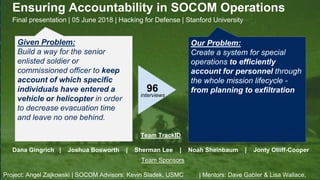


Ensuring Accountability in SOCOM Operations
Final presentation | 05 June 2018 | Hacking for Defense | Stanford University
Team Sponsors
Project: Angel Zajkowski | SOCOM Advisors: Kevin Sladek, USMC | Mentors: Dave Gabler & Lisa Wallace,
Team TrackID
Dana Gingrich | Joshua Bosworth | Sherman Lee | Noah Sheinbaum | Jonty Olliff-Cooper
96
Given Problem:
Build a way for the senior
enlisted soldier or
commissioned officer to keep
account of which specific
individuals have entered a
vehicle or helicopter in order
to decrease evacuation time
and leave no one behind.
Our Problem:
Create a system for special
operations to efficiently
account for personnel through
the whole mission lifecycle -
from planning to exfiltration
interviews
2
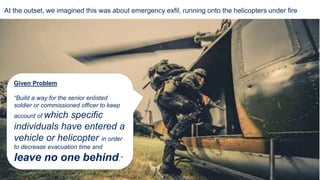
At the outset, we imagined this was about emergency exfil, running onto the helicopters under fire
Given Problem
“Build a way for the senior enlisted
soldier or commissioned officer to keep
account of which specific
individuals have entered a
vehicle or helicopter in order
to decrease evacuation time and
leave no one behind.”
3
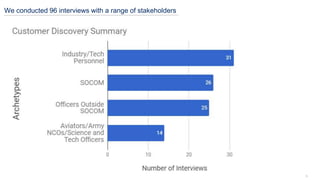
We conducted 96 interviews with a range of stakeholders
- Systems Engineering
- Design accountability
information flow
- Product Design
- Solving bulk processing of
inputs
- Product integration with
existing equipment loads
- Scale beyond SOCOM
use-case
- Continued sponsorship by
military beneficiary
(feasibility and user
experience)
- Vehicle / Aircraft
maintainers (integration and
scalability)
- Small sensor / receiver
manufacturer (RFID
capability)
- Department of Defense
radio spectrum control
- Primary: SOCOM teams
conducting complex, high-
risk missions.
- Secondary: Similar teams
and missions, including the
expanded Department of
Defense, allied nations, and
civilian emergency services.
- Tertiary: Non-mission
oriented tasks requiring
timely accountability
information.
- Improved Implicit
Communication: decrease
expected time to conduct
routine tasks, and reduce
frequency of severe error.
- Modular/Adaptable
Framework: shift to
accommodate mission-
specific information
requirements.
- Multi-Level Information
Flow: providing low-latency,
actionable information
appropriate to multiple
echelons.
- Low-latency, automated accountability system improving passive
situational awareness, providing notifications at the lowest level and
improving overall mission success.
- Integrated into current (and adaptable to future) SOCOM TTPs, and
broader DoD systems.
- Integrate legacy
equipment with minimal
additions.
- Focus on immediate
solutions to immediate and
pervasive dilemmas.
Fixed:
- Exploration of communication and awareness enhancing options.
- Design & Engineering of chosen solution.
Variable:
- Product Production & Support
- Connections with a broad
user base.
- Existing RFID technology
with multiple use cases
- SOCOM Team Leaders &
Operators
- Supporting Units:
achievable aircraft & vehicle
integration
-NSA: in accordance with
secure/active
communication standards
Beneficiaries
Mission AchievementMission Budget/Costs
Buy-In/Support
Deployment
Value
Proposition
Key Activities
Key Resources
Key Partners
...blended with tools from the Lean Startup methodology
5
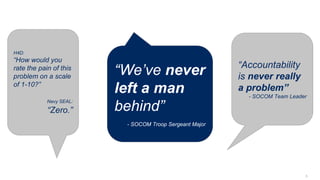
“We’ve never
left a man
behind”
- SOCOM Troop Sergeant Major
“Accountability
is never really
a problem”
- SOCOM Team Leader
H4D:
“How would you
rate the pain of this
problem on a scale
of 1-10?”
Navy SEAL:
“Zero.”
6
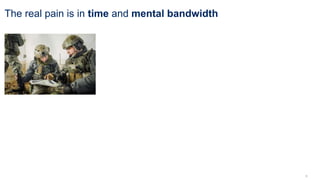
The real pain is in time and mental bandwidth
7
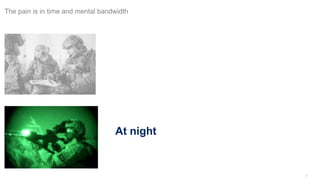
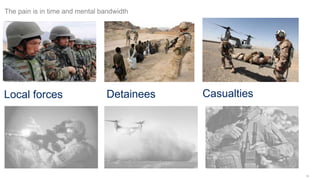
The pain is in time and mental bandwidth
At night
8
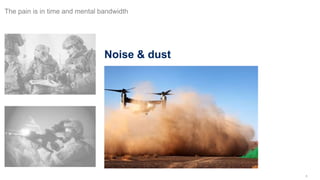
The pain is in time and mental bandwidth
Noise & dust
9
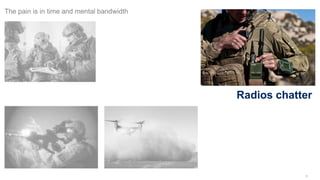
The pain is in time and mental bandwidth
Radios chatter
10
The pain is in time and mental bandwidth
CasualtiesLocal forces Detainees
11
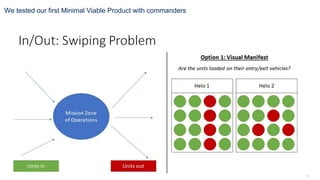
We tested our first Minimal Viable Product with commanders
12
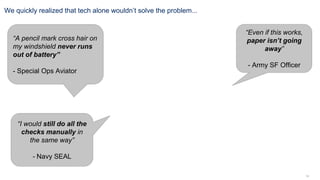
We quickly realized that tech alone wouldn’t solve the problem...
“A pencil mark cross hair on
my windshield never runs
out of battery”
- Special Ops Aviator
13
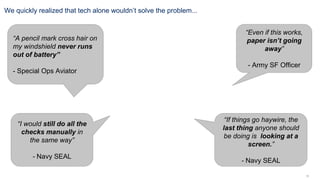
We quickly realized that tech alone wouldn’t solve the problem...
“Even if this works,
paper isn’t going
away”
- Army SF Officer
“A pencil mark cross hair on
my windshield never runs
out of battery”
- Special Ops Aviator
14
We quickly realized that tech alone wouldn’t solve the problem...
“Even if this works,
paper isn’t going
away”
- Army SF Officer
“A pencil mark cross hair on
my windshield never runs
out of battery”
- Special Ops Aviator
“I would still do all the
checks manually in
the same way”
- Navy SEAL
15
“If things go haywire, the
last thing anyone should
be doing is looking at a
screen.”
- Navy SEAL
We quickly realized that tech alone wouldn’t solve the problem...
“Even if this works,
paper isn’t going
away”
- Army SF Officer
“A pencil mark cross hair on
my windshield never runs
out of battery”
- Special Ops Aviator
“I would still do all the
checks manually in
the same way”
- Navy SEAL
16
“If things go haywire, the
last thing anyone should
be doing is looking at a
screen.”
- Navy SEAL
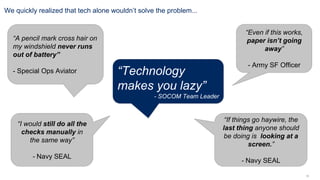
We quickly realized that tech alone wouldn’t solve the problem...
“Even if this works,
paper isn’t going
away”
- Army SF Officer
“A pencil mark cross hair on
my windshield never runs
out of battery”
- Special Ops Aviator
“I would still do all the
checks manually in
the same way”
- Navy SEAL
“Technology
makes you lazy”
- SOCOM Team Leader
17
They want a tech
solution
18
They want a tech
solution
19
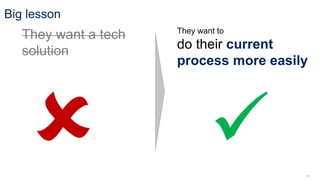
Big lesson
They want a tech
solution
They want to
do their current
process more easily
20
So, who is doing what?
21
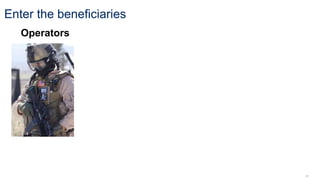
Enter the beneficiaries
Operators
22
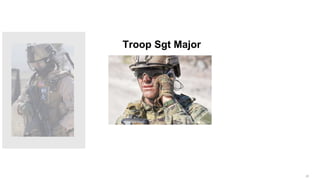
Troop Sgt Major
23
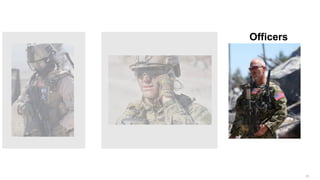
Officers
24
“More than half of a [TSM’s] time is
spent on accountability”
- Army NCO
The Troop Sergeant Major is the key beneficiary
25
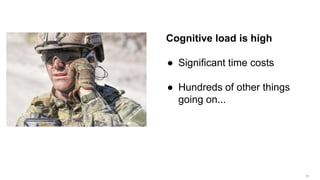
Cognitive load is high
● Significant time costs
● Hundreds of other things
going on...
26
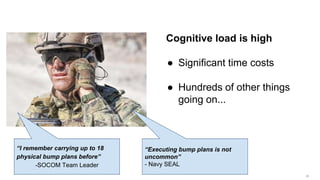
“I remember carrying up to 18
physical bump plans before”
-SOCOM Team Leader
“Executing bump plans is not
uncommon”
- Navy SEAL
Cognitive load is high
● Significant time costs
● Hundreds of other things
going on...
27
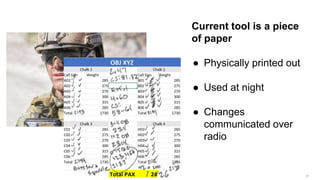
Current tool is a piece
of paper
● Physically printed out
● Used at night
● Changes
communicated over
radio
28
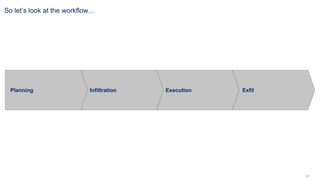
So let’s look at the workflow...
Infiltration ExecutionPlanning Exfil
29
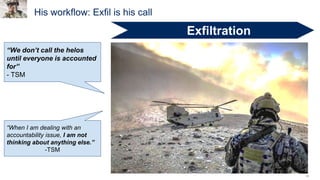
“We don’t call the helos
until everyone is accounted
for”
- TSM
Exfiltration
His workflow: Exfil is his call
“When I am dealing with an
accountability issue, I am not
thinking about anything else.”
-TSM
30
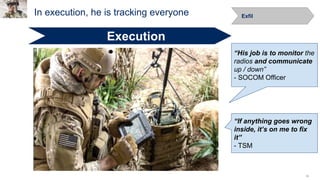
Exfil
Execution
“His job is to monitor the
radios and communicate
up / down”
- SOCOM Officer
“If anything goes wrong
inside, it’s on me to fix
it”
- TSM
In execution, he is tracking everyone
31
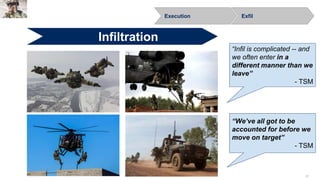
ExfilExecution
Infiltration
“Infil is complicated -- and
we often enter in a
different manner than we
leave”
- TSM
“We’ve all got to be
accounted for before we
move on target”
- TSM
32
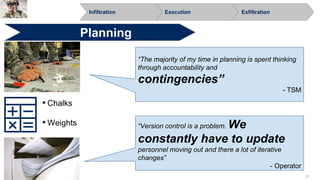
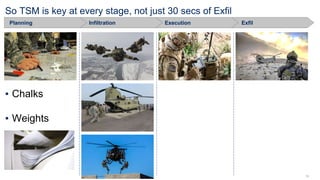
▪ Chalks
▪ Weights
Infiltration Execution Exfiltration
Planning
“Version control is a problem. We
constantly have to update
personnel moving out and there a lot of iterative
changes”
- Operator
“The majority of my time in planning is spent thinking
through accountability and
contingencies”
- TSM
33
Infiltration ExecutionPlanning Exfil
house
Little bird
Text
▪ Chalks
▪ Weights
So TSM is key at every stage, not just 30 secs of Exfil
34
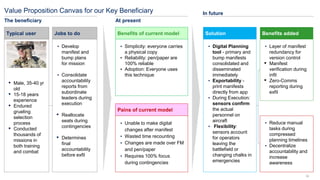
Value Proposition Canvas for our Key Beneficiary
Typical user
The beneficiary
Jobs to do
At present
Benefits of current model
Pains of current model
In future
Benefits added
▪ Male, 35-40 yr
old
▪ 15-18 years
experience
▪ Endured
grueling
selection
process
▪ Conducted
thousands of
missions in
both training
and combat
▪ Develop
manifest and
bump plans
for mission
▪ Consolidate
accountability
reports from
subordinate
leaders during
execution
▪ Reallocate
seats during
contingencies
▪ Determines
final
accountability
before exfil
▪ Simplicity: everyone carries
a physical copy
▪ Reliability: pen/paper are
100% reliable
▪ Adoption: Everyone uses
this technique
▪ Unable to make digital
changes after manifest
▪ Wasted time recounting
▪ Changes are made over FM
and pen/paper
▪ Requires 100% focus
during contingencies
▪ Layer of manifest
redundancy for
version control
▪ Manifest
verification during
infil
▪ Zero-Comms
reporting during
exfil
▪ Reduce manual
tasks during
compressed
planning timelines
▪ Decentralize
accountability and
increase
awareness
▪ Text
Solution
▪ Digital Planning
tool - primary and
bump manifests
consolidated and
disseminated
immediately
▪ Exportability -
print manifests
directly from app
▪ During Execution:
sensors confirm
the actual
personnel on
aircraft
▪ Flexibility:
sensors account
for operators
leaving the
battlefield or
changing chalks in
emergencies
35
So, what have we come
up with?
36
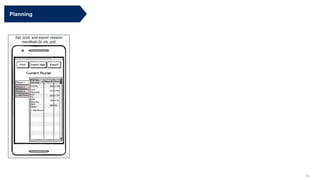
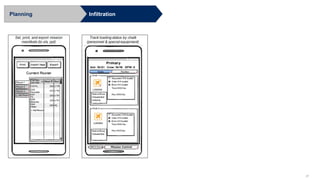
Planning
37
InfiltrationPlanning
38
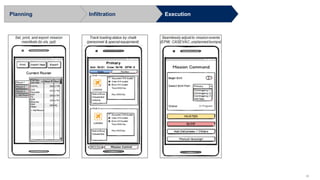
Infiltration ExecutionPlanning
39
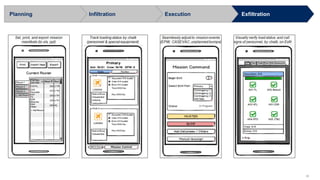
Infiltration ExecutionPlanning Exfiltration
40
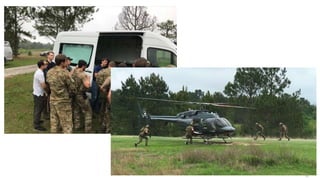
So we tested it
down at Fort Bragg
41
42
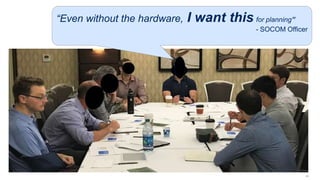
“Even without the hardware, I want this for planning”
- SOCOM Officer
43
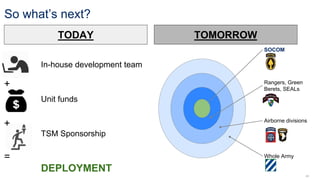
So what’s next?
SOCOM
Whole Army
Airborne divisions
Rangers, Green
Berets, SEALs
TOMORROWTODAY
In-house development team
Unit funds
TSM Sponsorship
DEPLOYMENT
+
+
=
44
Our work would not have been possible without the incredible support and sponsorship of the SOCOM
organization, namely Angel and Matt. They went above and beyond to ensure we had the access and
understanding we needed to be successful, and planned an incredible visit to Fort Bragg that helped us get a
handle on the problem that would have been otherwise impossible.
We would also like to thank Dave Gabler and Lisa Wallace, our mentors at Qadium, and Kevin Sladek,
for their tireless guidance and support.
Countless individuals supported us in this journey, with their time and advice, willingness to deliver feedback
(good and bad), and openness to our various ideas. Though there are too many to list here, we owe a debt of
gratitude to all of them.
Finally, thank you

Trackid H4D Stanford 2018

  • 1.
    Ensuring Accountability inSOCOM Operations Final presentation | 05 June 2018 | Hacking for Defense | Stanford University Team Sponsors Project: Angel Zajkowski | SOCOM Advisors: Kevin Sladek, USMC | Mentors: Dave Gabler & Lisa Wallace, Team TrackID Dana Gingrich | Joshua Bosworth | Sherman Lee | Noah Sheinbaum | Jonty Olliff-Cooper 96 Given Problem: Build a way for the senior enlisted soldier or commissioned officer to keep account of which specific individuals have entered a vehicle or helicopter in order to decrease evacuation time and leave no one behind. Our Problem: Create a system for special operations to efficiently account for personnel through the whole mission lifecycle - from planning to exfiltration interviews
  • 2.
    2 At the outset,we imagined this was about emergency exfil, running onto the helicopters under fire Given Problem “Build a way for the senior enlisted soldier or commissioned officer to keep account of which specific individuals have entered a vehicle or helicopter in order to decrease evacuation time and leave no one behind.”
  • 3.
    3 We conducted 96interviews with a range of stakeholders
  • 4.
    - Systems Engineering -Design accountability information flow - Product Design - Solving bulk processing of inputs - Product integration with existing equipment loads - Scale beyond SOCOM use-case - Continued sponsorship by military beneficiary (feasibility and user experience) - Vehicle / Aircraft maintainers (integration and scalability) - Small sensor / receiver manufacturer (RFID capability) - Department of Defense radio spectrum control - Primary: SOCOM teams conducting complex, high- risk missions. - Secondary: Similar teams and missions, including the expanded Department of Defense, allied nations, and civilian emergency services. - Tertiary: Non-mission oriented tasks requiring timely accountability information. - Improved Implicit Communication: decrease expected time to conduct routine tasks, and reduce frequency of severe error. - Modular/Adaptable Framework: shift to accommodate mission- specific information requirements. - Multi-Level Information Flow: providing low-latency, actionable information appropriate to multiple echelons. - Low-latency, automated accountability system improving passive situational awareness, providing notifications at the lowest level and improving overall mission success. - Integrated into current (and adaptable to future) SOCOM TTPs, and broader DoD systems. - Integrate legacy equipment with minimal additions. - Focus on immediate solutions to immediate and pervasive dilemmas. Fixed: - Exploration of communication and awareness enhancing options. - Design & Engineering of chosen solution. Variable: - Product Production & Support - Connections with a broad user base. - Existing RFID technology with multiple use cases - SOCOM Team Leaders & Operators - Supporting Units: achievable aircraft & vehicle integration -NSA: in accordance with secure/active communication standards Beneficiaries Mission AchievementMission Budget/Costs Buy-In/Support Deployment Value Proposition Key Activities Key Resources Key Partners ...blended with tools from the Lean Startup methodology
  • 5.
    5 “We’ve never left aman behind” - SOCOM Troop Sergeant Major “Accountability is never really a problem” - SOCOM Team Leader H4D: “How would you rate the pain of this problem on a scale of 1-10?” Navy SEAL: “Zero.”
  • 6.
    6 The real painis in time and mental bandwidth
  • 7.
    7 The pain isin time and mental bandwidth At night
  • 8.
    8 The pain isin time and mental bandwidth Noise & dust
  • 9.
    9 The pain isin time and mental bandwidth Radios chatter
  • 10.
    10 The pain isin time and mental bandwidth CasualtiesLocal forces Detainees
  • 11.
    11 We tested ourfirst Minimal Viable Product with commanders
  • 12.
    12 We quickly realizedthat tech alone wouldn’t solve the problem... “A pencil mark cross hair on my windshield never runs out of battery” - Special Ops Aviator
  • 13.
    13 We quickly realizedthat tech alone wouldn’t solve the problem... “Even if this works, paper isn’t going away” - Army SF Officer “A pencil mark cross hair on my windshield never runs out of battery” - Special Ops Aviator
  • 14.
    14 We quickly realizedthat tech alone wouldn’t solve the problem... “Even if this works, paper isn’t going away” - Army SF Officer “A pencil mark cross hair on my windshield never runs out of battery” - Special Ops Aviator “I would still do all the checks manually in the same way” - Navy SEAL
  • 15.
    15 “If things gohaywire, the last thing anyone should be doing is looking at a screen.” - Navy SEAL We quickly realized that tech alone wouldn’t solve the problem... “Even if this works, paper isn’t going away” - Army SF Officer “A pencil mark cross hair on my windshield never runs out of battery” - Special Ops Aviator “I would still do all the checks manually in the same way” - Navy SEAL
  • 16.
    16 “If things gohaywire, the last thing anyone should be doing is looking at a screen.” - Navy SEAL We quickly realized that tech alone wouldn’t solve the problem... “Even if this works, paper isn’t going away” - Army SF Officer “A pencil mark cross hair on my windshield never runs out of battery” - Special Ops Aviator “I would still do all the checks manually in the same way” - Navy SEAL “Technology makes you lazy” - SOCOM Team Leader
  • 17.
    17 They want atech solution
  • 18.
    18 They want atech solution
  • 19.
    19 Big lesson They wanta tech solution They want to do their current process more easily
  • 20.
    20 So, who isdoing what?
  • 21.
  • 22.
  • 23.
  • 24.
    24 “More than halfof a [TSM’s] time is spent on accountability” - Army NCO The Troop Sergeant Major is the key beneficiary
  • 25.
    25 Cognitive load ishigh ● Significant time costs ● Hundreds of other things going on...
  • 26.
    26 “I remember carryingup to 18 physical bump plans before” -SOCOM Team Leader “Executing bump plans is not uncommon” - Navy SEAL Cognitive load is high ● Significant time costs ● Hundreds of other things going on...
  • 27.
    27 Current tool isa piece of paper ● Physically printed out ● Used at night ● Changes communicated over radio
  • 28.
    28 So let’s lookat the workflow... Infiltration ExecutionPlanning Exfil
  • 29.
    29 “We don’t callthe helos until everyone is accounted for” - TSM Exfiltration His workflow: Exfil is his call “When I am dealing with an accountability issue, I am not thinking about anything else.” -TSM
  • 30.
    30 Exfil Execution “His job isto monitor the radios and communicate up / down” - SOCOM Officer “If anything goes wrong inside, it’s on me to fix it” - TSM In execution, he is tracking everyone
  • 31.
    31 ExfilExecution Infiltration “Infil is complicated-- and we often enter in a different manner than we leave” - TSM “We’ve all got to be accounted for before we move on target” - TSM
  • 32.
    32 ▪ Chalks ▪ Weights InfiltrationExecution Exfiltration Planning “Version control is a problem. We constantly have to update personnel moving out and there a lot of iterative changes” - Operator “The majority of my time in planning is spent thinking through accountability and contingencies” - TSM
  • 33.
    33 Infiltration ExecutionPlanning Exfil house Littlebird Text ▪ Chalks ▪ Weights So TSM is key at every stage, not just 30 secs of Exfil
  • 34.
    34 Value Proposition Canvasfor our Key Beneficiary Typical user The beneficiary Jobs to do At present Benefits of current model Pains of current model In future Benefits added ▪ Male, 35-40 yr old ▪ 15-18 years experience ▪ Endured grueling selection process ▪ Conducted thousands of missions in both training and combat ▪ Develop manifest and bump plans for mission ▪ Consolidate accountability reports from subordinate leaders during execution ▪ Reallocate seats during contingencies ▪ Determines final accountability before exfil ▪ Simplicity: everyone carries a physical copy ▪ Reliability: pen/paper are 100% reliable ▪ Adoption: Everyone uses this technique ▪ Unable to make digital changes after manifest ▪ Wasted time recounting ▪ Changes are made over FM and pen/paper ▪ Requires 100% focus during contingencies ▪ Layer of manifest redundancy for version control ▪ Manifest verification during infil ▪ Zero-Comms reporting during exfil ▪ Reduce manual tasks during compressed planning timelines ▪ Decentralize accountability and increase awareness ▪ Text Solution ▪ Digital Planning tool - primary and bump manifests consolidated and disseminated immediately ▪ Exportability - print manifests directly from app ▪ During Execution: sensors confirm the actual personnel on aircraft ▪ Flexibility: sensors account for operators leaving the battlefield or changing chalks in emergencies
  • 35.
    35 So, what havewe come up with?
  • 36.
  • 37.
  • 38.
  • 39.
  • 40.
    40 So we testedit down at Fort Bragg
  • 41.
  • 42.
    42 “Even without thehardware, I want this for planning” - SOCOM Officer
  • 43.
    43 So what’s next? SOCOM WholeArmy Airborne divisions Rangers, Green Berets, SEALs TOMORROWTODAY In-house development team Unit funds TSM Sponsorship DEPLOYMENT + + =
  • 44.
    44 Our work wouldnot have been possible without the incredible support and sponsorship of the SOCOM organization, namely Angel and Matt. They went above and beyond to ensure we had the access and understanding we needed to be successful, and planned an incredible visit to Fort Bragg that helped us get a handle on the problem that would have been otherwise impossible. We would also like to thank Dave Gabler and Lisa Wallace, our mentors at Qadium, and Kevin Sladek, for their tireless guidance and support. Countless individuals supported us in this journey, with their time and advice, willingness to deliver feedback (good and bad), and openness to our various ideas. Though there are too many to list here, we owe a debt of gratitude to all of them. Finally, thank you