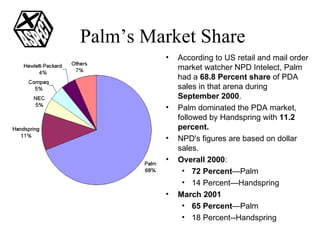
Palm’s Market Share According to US retail and mail order market watcher NPD Intelect, Palm had a  68.8 Percent share  of PDA sales in that arena during  September 2000 . Palm dominated the PDA market, followed by Handspring with  11.2 percent. NPD's figures are based on dollar sales. Overall 2000 : 72 Percent —Palm  14 Percent—Handspring March 2001   65 Percent —Palm 18 Percent--Handspring
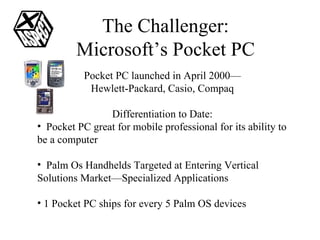
The Challenger:  Microsoft’s Pocket PC  Pocket PC launched in April 2000— Hewlett-Packard, Casio, Compaq Differentiation to Date: Pocket PC great for mobile professional for its ability to be a computer Palm Os Handhelds Targeted at Entering Vertical Solutions Market—Specialized Applications 1 Pocket PC ships for every 5 Palm OS devices
Handhelds Sold More than $1 billion in sales for handhelds in the United States, a doubling from the previous year Average selling price of a handheld was about $293 in 2000 Price cuts continue this month—Palm VIIx for $99 with purchase Palm.net 12-month service contract ($24.99 minimum/month) Wobbly economy contributed
Burst of Specialized  Applications Growth in U.S. Vertical enterprise markets, government and education in the U.S. as one of the richest opportunities for these companies in 2001 - 2002 In wireless, large opportunities perceived to be in financial sector, health care and manufacturing Need for real-time communications Move toward paperless processing Use of bar coding technology to maintain control in inventory and other tracking
Moving to 3G Wireless Standards CDMA  (Code Division Multiple Access) more prevalent in Asia, eight to ten times capacity of analog WCDMA  (Wideband Code Division Multiple Access), a 3G standard push for multimedia for to be seen in Japan and Europe GSM  (Global System for Mobile Communications) more prevalent in Europe TDMA  (Time Division Multiple Access) not widely accepted in the US--tripled the capacity of analog and was integrated into GSM SHORT-TERM SOLUTION--GPRS  (General Packet Radio Service)—packet data service binding several TDMA timeslots into an always-on channel—sits on top of analog network CDPD  (Cellular Digital Packet Data)—sits on top of an analog network, in US, limited to 19.2 Kbps
Technology Overview:  Bluetooth wireless technology is an open specification for a wireless personal area network.  The specification aims to define a globally accepted short distance (30 meters) radio communication protocol.  Its connectivity covers voice, data, and video between virtually any type of digital device, mobile or fixed. Key characteristics of Bluetooth-enabled devices is that they detect and communicate with other similarly-enabled devices within range—all without conscious user intervention It was originally conceived as a cable replacement for wireless products.  Developed by Swedish Telecom giant LM Ericsson Telephone Co., but being adopted by other major players. Bluetooth PDAs and smart phones operate on the 2.4GHZ frequency in the US.
Significance to the Market Independent research firms have recently projected the total Bluetooth wireless market at 900 million to more than a billion units worldwide by the end of 2005.  Cellular phones and handhelds are expected to be among the earliest adopters of Bluetooth wireless technology. In-Stat predicted that the Bluetooth market would approach US $5 billion by 2005. A new 2001 study of the growth of Bluetooth indicates that more than 11 million Bluetooth enabled products will be shipped this year with a value of $2.5 billion.
Current Areas of Interest Email and messaging: No. 1 Government  L-Commerce CRM Legal Health Care
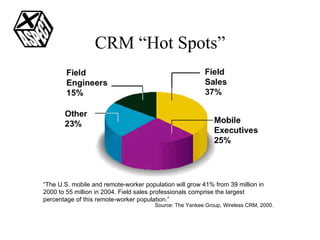
CRM “Hot Spots” Source: The Yankee Group, Wireless CRM, 2000. “ The U.S. mobile and remote-worker population will grow 41% from 39 million in 2000 to 55 million in 2004. Field sales professionals comprise the largest percentage of this remote-worker population.”
Overall Wrap-up:   Market Inhibitors Security concerns for data in corporate environment High wireless access costs, incomplete coverage areas and lack of interoperable standards Killer applications yet to be discovered
Overall Wrap up:  Market Accelerators PDAs seen as productivity enhancements, especially in forms-based processing Faster data speeds for mobile devices will aid acceptance Convergence of wireless voice and data—look for more phone products Bar coding technology on handhelds will play to older industries, such as manufacturing and distribution…I.e.  www.gesupply.com handheld remote ordering
Aspectx Competitive Intelligence *Marketing *Public Relations *Business Planning *Event Marketing*Web Consulting For more information contact: Dawn Marie Yankeelov, President Aspectx (w) 502-254-9757 (c) 502-548-1304 (f) 502-254-9793 [email_address] www.aspectx.com

Siliconslides

  • 1.
    Palm’s Market ShareAccording to US retail and mail order market watcher NPD Intelect, Palm had a 68.8 Percent share of PDA sales in that arena during September 2000 . Palm dominated the PDA market, followed by Handspring with 11.2 percent. NPD's figures are based on dollar sales. Overall 2000 : 72 Percent —Palm 14 Percent—Handspring March 2001 65 Percent —Palm 18 Percent--Handspring
  • 2.
    The Challenger: Microsoft’s Pocket PC Pocket PC launched in April 2000— Hewlett-Packard, Casio, Compaq Differentiation to Date: Pocket PC great for mobile professional for its ability to be a computer Palm Os Handhelds Targeted at Entering Vertical Solutions Market—Specialized Applications 1 Pocket PC ships for every 5 Palm OS devices
  • 3.
    Handhelds Sold Morethan $1 billion in sales for handhelds in the United States, a doubling from the previous year Average selling price of a handheld was about $293 in 2000 Price cuts continue this month—Palm VIIx for $99 with purchase Palm.net 12-month service contract ($24.99 minimum/month) Wobbly economy contributed
  • 4.
    Burst of Specialized Applications Growth in U.S. Vertical enterprise markets, government and education in the U.S. as one of the richest opportunities for these companies in 2001 - 2002 In wireless, large opportunities perceived to be in financial sector, health care and manufacturing Need for real-time communications Move toward paperless processing Use of bar coding technology to maintain control in inventory and other tracking
  • 5.
    Moving to 3GWireless Standards CDMA (Code Division Multiple Access) more prevalent in Asia, eight to ten times capacity of analog WCDMA (Wideband Code Division Multiple Access), a 3G standard push for multimedia for to be seen in Japan and Europe GSM (Global System for Mobile Communications) more prevalent in Europe TDMA (Time Division Multiple Access) not widely accepted in the US--tripled the capacity of analog and was integrated into GSM SHORT-TERM SOLUTION--GPRS (General Packet Radio Service)—packet data service binding several TDMA timeslots into an always-on channel—sits on top of analog network CDPD (Cellular Digital Packet Data)—sits on top of an analog network, in US, limited to 19.2 Kbps
  • 6.
    Technology Overview: Bluetooth wireless technology is an open specification for a wireless personal area network. The specification aims to define a globally accepted short distance (30 meters) radio communication protocol. Its connectivity covers voice, data, and video between virtually any type of digital device, mobile or fixed. Key characteristics of Bluetooth-enabled devices is that they detect and communicate with other similarly-enabled devices within range—all without conscious user intervention It was originally conceived as a cable replacement for wireless products. Developed by Swedish Telecom giant LM Ericsson Telephone Co., but being adopted by other major players. Bluetooth PDAs and smart phones operate on the 2.4GHZ frequency in the US.
  • 7.
    Significance to theMarket Independent research firms have recently projected the total Bluetooth wireless market at 900 million to more than a billion units worldwide by the end of 2005. Cellular phones and handhelds are expected to be among the earliest adopters of Bluetooth wireless technology. In-Stat predicted that the Bluetooth market would approach US $5 billion by 2005. A new 2001 study of the growth of Bluetooth indicates that more than 11 million Bluetooth enabled products will be shipped this year with a value of $2.5 billion.
  • 8.
    Current Areas ofInterest Email and messaging: No. 1 Government L-Commerce CRM Legal Health Care
  • 9.
    CRM “Hot Spots”Source: The Yankee Group, Wireless CRM, 2000. “ The U.S. mobile and remote-worker population will grow 41% from 39 million in 2000 to 55 million in 2004. Field sales professionals comprise the largest percentage of this remote-worker population.”
  • 10.
    Overall Wrap-up: Market Inhibitors Security concerns for data in corporate environment High wireless access costs, incomplete coverage areas and lack of interoperable standards Killer applications yet to be discovered
  • 11.
    Overall Wrap up: Market Accelerators PDAs seen as productivity enhancements, especially in forms-based processing Faster data speeds for mobile devices will aid acceptance Convergence of wireless voice and data—look for more phone products Bar coding technology on handhelds will play to older industries, such as manufacturing and distribution…I.e. www.gesupply.com handheld remote ordering
  • 12.
    Aspectx Competitive Intelligence*Marketing *Public Relations *Business Planning *Event Marketing*Web Consulting For more information contact: Dawn Marie Yankeelov, President Aspectx (w) 502-254-9757 (c) 502-548-1304 (f) 502-254-9793 [email_address] www.aspectx.com