INTRODUCTION
2
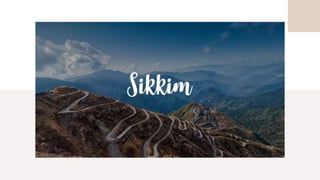
▫ Sikkim is A state in northeastern India. It borders the
Tibet autonomous region of China in the north and
northeast, Bhutan in the east, Nepal in the west, and
west Bengal in the south. Sikkim is also close to
India’s Siliguri corridor near Bangladesh. Sikkim is
the least populous and second smallest among the
Indian State. A part of the eastern Himalaya, Sikkim
is notable for its Biodiversity, including alpine and
subtropical climates, as well as being A host to
Kangchenjunga.
GEOGRAPHICAL INTRODUCTION
3
Sikkim is a small mountainous State in the Eastern
Himalayan region in India. It covers an area of 7,096
sq. km, extending approximately 114km from North to
South and 64 km from East to West. The State is
situated between 88°00’ 58” and 88°55’ 25” East
longitudes and 27°04’ and 28° 07’ 48” North latitudes.
It is surrounded by vast stretches of Tibetan plateau
in North; Chumbi valley & Kingdom of Bhutan in the
East; Darjeeling district of West Bengal in South and
Kingdom of Nepal in West. With nine sub-divisions &
eight towns the State has four districts namely East,
West, North and South.
COSTUMES OF SIKKIM
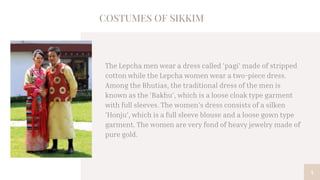
The Lepcha men wear a dress called 'pagi' made of stripped
cotton while the Lepcha women wear a two-piece dress.
Among the Bhutias, the traditional dress of the men is
known as the 'Bakhu', which is a loose cloak type garment
with full sleeves. The women's dress consists of a silken
'Honju', which is a full sleeve blouse and a loose gown type
garment. The women are very fond of heavy jewelry made of
pure gold.
4
SIKKIMESE LANGUAGE
5
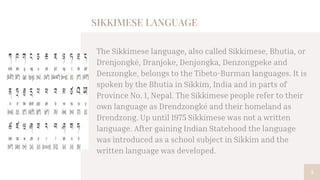
The Sikkimese language, also called Sikkimese, Bhutia, or
Drenjongké, Dranjoke, Denjongka, Denzongpeke and
Denzongke, belongs to the Tibeto-Burman languages. It is
spoken by the Bhutia in Sikkim, India and in parts of
Province No. 1, Nepal. The Sikkimese people refer to their
own language as Drendzongké and their homeland as
Drendzong. Up until 1975 Sikkimese was not a written
language. After gaining Indian Statehood the language
was introduced as a school subject in Sikkim and the
written language was developed.
FESTIVALS OF SIKKIM
6
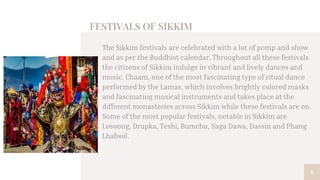
The Sikkim festivals are celebrated with a lot of pomp and show
and as per the Buddhist calendar. Throughout all these festivals
the citizens of Sikkim indulge in vibrant and lively dances and
music. Chaam, one of the most fascinating type of ritual dance
performed by the Lamas, which involves brightly colored masks
and fascinating musical instruments and takes place at the
different monasteries across Sikkim while these festivals are on.
Some of the most popular festivals, notable in Sikkim are
Losoong, Drupka, Teshi, Bumchu, Saga Dawa, Dassin and Phang
Lhabsol.
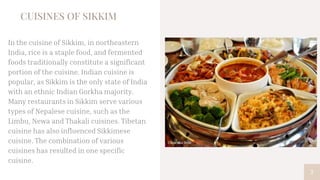
CUISINES OF SIKKIM
In the cuisine of Sikkim, in northeastern
India, rice is a staple food, and fermented
foods traditionally constitute a significant
portion of the cuisine. Indian cuisine is
popular, as Sikkim is the only state of India
with an ethnic Indian Gorkha majority.
Many restaurants in Sikkim serve various
types of Nepalese cuisine, such as the
Limbu, Newa and Thakali cuisines. Tibetan
cuisine has also influenced Sikkimese
cuisine. The combination of various
cuisines has resulted in one specific
cuisine.
7
TOURIST ATTRACTION
8
Rumtek Monastery
Mangan
Cholamu
Tendong Hill
Geyzing
Biksthang
Yangtey
Kanchenjunga Base Camp
Singalila
Green Lake
Zero Point
Tso Lhamo Lake
Thangu
Enchey Monastery
Jawaharlal Nehru Botanical
Garden
Tsomgo Lake
Yuksom
Nathula Pass
Lachung, Lachen And Yumthang
Valley
Ravangla
Namchi
Zuluk
Teesta River
Gangtok
Pelling
Singalila National Park
Phodong Monastery
Gurudongmar Lake
Goechala
Khangchendzonga National Park
Aritar
Do Drul Chorten
DANCES OF SIKKIM
1. Lu Khangthamo Dance
2. Rechungma Dance
3. Maruni Dance
4. Tamang Selo Dance
5. Limboo or Subba Folk Dance
6. Yak Chham and Singhi Chham
7. Mask Dance
8. Chutkay Dance
9. Chu Faat Dance
10. Kagyed Dance
11. Ta Shi Yang Ku Dance
12. Zo Mal Lok Dance 9
THANKYOU!
10
Credits:
• Aarya Kawale
• Amanali Ansari
• Aryan Awale
• Astha Barsat
• Atharva Kadam

SIKKIM.pptx

  • 2.
    INTRODUCTION 2 ▫ Sikkim isA state in northeastern India. It borders the Tibet autonomous region of China in the north and northeast, Bhutan in the east, Nepal in the west, and west Bengal in the south. Sikkim is also close to India’s Siliguri corridor near Bangladesh. Sikkim is the least populous and second smallest among the Indian State. A part of the eastern Himalaya, Sikkim is notable for its Biodiversity, including alpine and subtropical climates, as well as being A host to Kangchenjunga.
  • 3.
    GEOGRAPHICAL INTRODUCTION 3 Sikkim isa small mountainous State in the Eastern Himalayan region in India. It covers an area of 7,096 sq. km, extending approximately 114km from North to South and 64 km from East to West. The State is situated between 88°00’ 58” and 88°55’ 25” East longitudes and 27°04’ and 28° 07’ 48” North latitudes. It is surrounded by vast stretches of Tibetan plateau in North; Chumbi valley & Kingdom of Bhutan in the East; Darjeeling district of West Bengal in South and Kingdom of Nepal in West. With nine sub-divisions & eight towns the State has four districts namely East, West, North and South.
  • 4.
    COSTUMES OF SIKKIM TheLepcha men wear a dress called 'pagi' made of stripped cotton while the Lepcha women wear a two-piece dress. Among the Bhutias, the traditional dress of the men is known as the 'Bakhu', which is a loose cloak type garment with full sleeves. The women's dress consists of a silken 'Honju', which is a full sleeve blouse and a loose gown type garment. The women are very fond of heavy jewelry made of pure gold. 4
  • 5.
    SIKKIMESE LANGUAGE 5 The Sikkimeselanguage, also called Sikkimese, Bhutia, or Drenjongké, Dranjoke, Denjongka, Denzongpeke and Denzongke, belongs to the Tibeto-Burman languages. It is spoken by the Bhutia in Sikkim, India and in parts of Province No. 1, Nepal. The Sikkimese people refer to their own language as Drendzongké and their homeland as Drendzong. Up until 1975 Sikkimese was not a written language. After gaining Indian Statehood the language was introduced as a school subject in Sikkim and the written language was developed.
  • 6.
    FESTIVALS OF SIKKIM 6 TheSikkim festivals are celebrated with a lot of pomp and show and as per the Buddhist calendar. Throughout all these festivals the citizens of Sikkim indulge in vibrant and lively dances and music. Chaam, one of the most fascinating type of ritual dance performed by the Lamas, which involves brightly colored masks and fascinating musical instruments and takes place at the different monasteries across Sikkim while these festivals are on. Some of the most popular festivals, notable in Sikkim are Losoong, Drupka, Teshi, Bumchu, Saga Dawa, Dassin and Phang Lhabsol.
  • 7.
    CUISINES OF SIKKIM Inthe cuisine of Sikkim, in northeastern India, rice is a staple food, and fermented foods traditionally constitute a significant portion of the cuisine. Indian cuisine is popular, as Sikkim is the only state of India with an ethnic Indian Gorkha majority. Many restaurants in Sikkim serve various types of Nepalese cuisine, such as the Limbu, Newa and Thakali cuisines. Tibetan cuisine has also influenced Sikkimese cuisine. The combination of various cuisines has resulted in one specific cuisine. 7
  • 8.
    TOURIST ATTRACTION 8 Rumtek Monastery Mangan Cholamu TendongHill Geyzing Biksthang Yangtey Kanchenjunga Base Camp Singalila Green Lake Zero Point Tso Lhamo Lake Thangu Enchey Monastery Jawaharlal Nehru Botanical Garden Tsomgo Lake Yuksom Nathula Pass Lachung, Lachen And Yumthang Valley Ravangla Namchi Zuluk Teesta River Gangtok Pelling Singalila National Park Phodong Monastery Gurudongmar Lake Goechala Khangchendzonga National Park Aritar Do Drul Chorten
  • 9.
    DANCES OF SIKKIM 1.Lu Khangthamo Dance 2. Rechungma Dance 3. Maruni Dance 4. Tamang Selo Dance 5. Limboo or Subba Folk Dance 6. Yak Chham and Singhi Chham 7. Mask Dance 8. Chutkay Dance 9. Chu Faat Dance 10. Kagyed Dance 11. Ta Shi Yang Ku Dance 12. Zo Mal Lok Dance 9
  • 10.
    THANKYOU! 10 Credits: • Aarya Kawale •Amanali Ansari • Aryan Awale • Astha Barsat • Atharva Kadam