PRESENTATION BY-Crimsy Goyal, Guraansh Arora,
Dhairya Goyal
CLASS-9th F
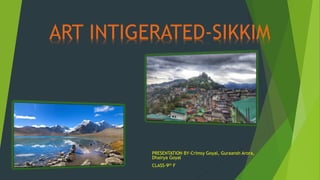
ART INTIGERATED-SIKKIM
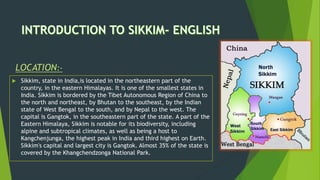
 Sikkim, state in India,is located in the northeastern part of the
country, in the eastern Himalayas. It is one of the smallest states in
India. Sikkim is bordered by the Tibet Autonomous Region of China to
the north and northeast, by Bhutan to the southeast, by the Indian
state of West Bengal to the south, and by Nepal to the west. The
capital is Gangtok, in the southeastern part of the state. A part of the
Eastern Himalaya, Sikkim is notable for its biodiversity, including
alpine and subtropical climates, as well as being a host to
Kangchenjunga, the highest peak in India and third highest on Earth.
Sikkim's capital and largest city is Gangtok. Almost 35% of the state is
covered by the Khangchendzonga National Park.
LOCATION:-
LANGUAGE:-
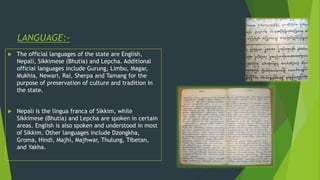
 The official languages of the state are English,
Nepali, Sikkimese (Bhutia) and Lepcha. Additional
official languages include Gurung, Limbu, Magar,
Mukhia, Newari, Rai, Sherpa and Tamang for the
purpose of preservation of culture and tradition in
the state.
 Nepali is the lingua franca of Sikkim, while
Sikkimese (Bhutia) and Lepcha are spoken in certain
areas. English is also spoken and understood in most
of Sikkim. Other languages include Dzongkha,
Groma, Hindi, Majhi, Majhwar, Thulung, Tibetan,
and Yakha.
COSTUME:-
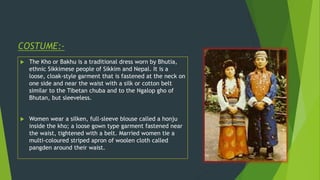
 The Kho or Bakhu is a traditional dress worn by Bhutia,
ethnic Sikkimese people of Sikkim and Nepal. It is a
loose, cloak-style garment that is fastened at the neck on
one side and near the waist with a silk or cotton belt
similar to the Tibetan chuba and to the Ngalop gho of
Bhutan, but sleeveless.
 Women wear a silken, full-sleeve blouse called a honju
inside the kho; a loose gown type garment fastened near
the waist, tightened with a belt. Married women tie a
multi-coloured striped apron of woolen cloth called
pangden around their waist.
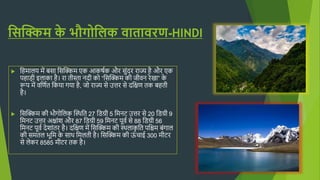
सिक्किम क
े भौगोसिक वातावरण-HINDI
 हिमालय में बसा हसक्किम एक आकर्षक और सुंदर राज्य िै और एक
पिाड़ी इलाका िै। रा त़ीस्ता नद़ी को “हसक्किम क़ी ज़ीवन रेखा” क
े
रूप में वहणषत हकया गया िै, जो राज्य से उत्तर से दहिण तक बित़ी
िै।
 हसक्किम क़ी भौगोहलक क्कथिहत 27 हिग्ऱी 5 हमनट उत्तर से 20 हिग्ऱी 9
हमनट उत्तर अिाुंश और 87 हिग्ऱी 59 हमनट पूवष से 88 हिग्ऱी 56
हमनट पूवष देशाुंतर िै। दहिण में हसक्किम क़ी थिलाक
ृ हत पहिम बुंगाल
क़ी समतल भूहम क
े साि हमलत़ी िै। हसक्किम क़ी ऊ
ुं चाई 300 म़ीटर
से लेकर 8585 म़ीटर तक िै।
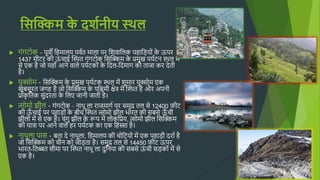
सिक्किम क
े दर्शनीय स्थि
 गुंगटोक - पूवी हिमालय पवषत माला पर हशवाहलक पिाहडयोुं क
े ऊपर
1437 म़ीटर क़ी ऊ
ुं चाई क्कथित गुंगटोक हसक्किम क
े प्रमख पयषटन थिल में
से एक िै जो यिााँ आने वाले पयषटकोुं क
े हदल-हदमाग को ताजा कर देत़ी
िै।
 यक्सोम - हसक्किम क
े प्रमख पयषटक थिल में शमार यक्सोम एक
खूबसूरत जगि िै जो हसक्किम क
े पहिम़ी िेत्र में क्कथित िै और अपऩी
प्राक
ृ हतक सुंदरता क
े हलए जाऩी जात़ी िै।
 त्सोमो झ़ील - गुंगटोक – नािू ला राजमागष पर समद्र तल से 12400 फ़ीट
क़ी ऊ
ाँ चाई पर पिाडोुं क
े ब़ीच क्कथित त्सोमो झ़ील भारत क़ी सबसे ऊ
ाँ च़ी
झ़ीलोुं में से एक िै। चुंग झ़ील क
े रूप में लोकहप्रय, त्सोमो झ़ील हसक्किम
क़ी यात्रा पर आने वाले िर पयषटक का एक हिस्सा िै।
 नािला पास - बता दे नािला, हिमालय क़ी चोहटयोुं में एक पिाड़ी दराष िै
जो हसक्किम को च़ीन को जोडता िै। समद्र तल से 14450 फ़ीट ऊपर
भारत-हतब्बत स़ीमा पर क्कथित नािू ला दहनया क़ी सबसे ऊ
ुं च़ी सडकोुं में से
एक िै।
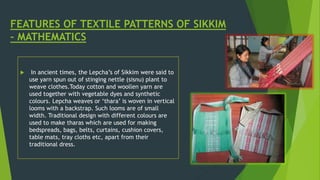
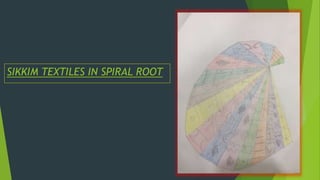
FEATURES OF TEXTILE PATTERNS OF SIKKIM
– MATHEMATICS
 In ancient times, the Lepcha’s of Sikkim were said to
use yarn spun out of stinging nettle (sisnu) plant to
weave clothes.Today cotton and woollen yarn are
used together with vegetable dyes and synthetic
colours. Lepcha weaves or ‘thara’ is woven in vertical
looms with a backstrap. Such looms are of small
width. Traditional design with different colours are
used to make tharas which are used for making
bedspreads, bags, belts, curtains, cushion covers,
table mats, tray cloths etc, apart from their
traditional dress.
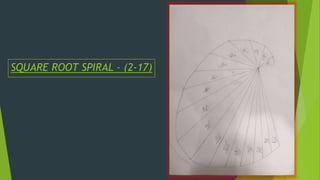
SQUARE ROOT SPIRAL – (2-17)
SIKKIM TEXTILES IN SPIRAL ROOT
ORGANIC FARMLAND-SCIENCE
 Cereals - Rice,Maize,Finger Millet,Barley
 Pulses – Pea,Urd
 Oil seed – soyabean,mustard
 Tuber Crops – Potato,Sweet potato
 Spices - Large Cardamom,chilly,turmeric
 Fruits – Mandarin,Banana,Papaya,Litchi
 Passion Fruit – Guava,Jack Fruit
 Vegetables - Brocolli,Iskus,Tomato
SOME CASH CROPS GROWN IN SIKKIM:-
BENEFITS OF ORGANIC FARMING:-
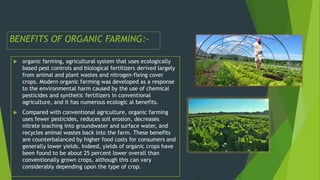
 organic farming, agricultural system that uses ecologically
based pest controls and biological fertilizers derived largely
from animal and plant wastes and nitrogen-fixing cover
crops. Modern organic farming was developed as a response
to the environmental harm caused by the use of chemical
pesticides and synthetic fertilizers in conventional
agriculture, and it has numerous ecologic al benefits.
 Compared with conventional agriculture, organic farming
uses fewer pesticides, reduces soil erosion, decreases
nitrate leaching into groundwater and surface water, and
recycles animal wastes back into the farm. These benefits
are counterbalanced by higher food costs for consumers and
generally lower yields. Indeed, yields of organic crops have
been found to be about 25 percent lower overall than
conventionally grown crops, although this can vary
considerably depending upon the type of crop.
NUTRITIONAL VALUE OF ANY ONE CROP
GROWN IN SIKKIM
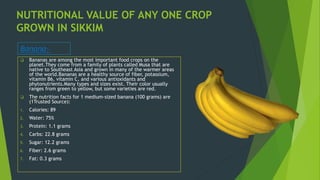
 Bananas are among the most important food crops on the
planet.They come from a family of plants called Musa that are
native to Southeast Asia and grown in many of the warmer areas
of the world.Bananas are a healthy source of fiber, potassium,
vitamin B6, vitamin C, and various antioxidants and
phytonutrients.Many types and sizes exist. Their color usually
ranges from green to yellow, but some varieties are red.
 The nutrition facts for 1 medium-sized banana (100 grams) are
(1Trusted Source):
1. Calories: 89
2. Water: 75%
3. Protein: 1.1 grams
4. Carbs: 22.8 grams
5. Sugar: 12.2 grams
6. Fiber: 2.6 grams
7. Fat: 0.3 grams
Banana:-
NATURAL DISASTER PREPAREDENESS - SST
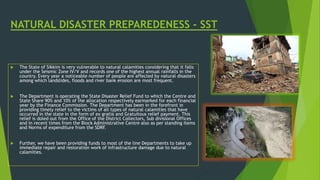
 The State of Sikkim is very vulnerable to natural calamities considering that it falls
under the Seismic Zone IV/V and records one of the highest annual rainfalls in the
country. Every year a noticeable number of people are affected by natural disasters
among which landslides, floods and river bank erosion are most frequent.
 The Department is operating the State Disaster Relief Fund to which the Centre and
State Share 90% and 10% of the allocation respectively earmarked for each financial
year by the Finance Commission. The Department has been in the forefront in
providing timely relief to the victims of all types of natural calamities that have
occurred in the state in the form of ex gratia and Gratuitous relief payment. This
relief is doled out from the Office of the District Collectors, Sub divisional Offices
and in recent times from the Block Administrative Centre also as per standing Items
and Norms of expenditure from the SDRF.
 Further, we have been providing funds to most of the line Departments to take up
immediate repair and restoration work of infrastructure damage due to natural
calamities.
Preparedeness taken by Sikkim people :-
 Power Generators and Fuel
Portable Fuel Generators
Portable Solar Generators
Wind Generators
Fuel Containers - Keep Full. Rotate and keep fuel containers full, fuel is always one
of the first items to disappear in an emergency or disaster situation.
 Warmth and Shelter Equipment
Emergency Heaters/Stoves
Survival Blankets
Sleeping-bag/Blankets
Fire-starters, Firewood, etc
 Water Supplies
Purifiers
Filters
Containers
Hand Well-Water Pump (Hard to find item for self-sufficient well-water supply)
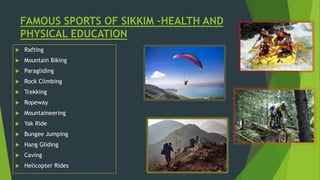
FAMOUS SPORTS OF SIKKIM –HEALTH AND
PHYSICAL EDUCATION
 Rafting
 Mountain Biking
 Paragliding
 Rock Climbing
 Trekking
 Ropeway
 Mountaineering
 Yak Ride
 Bungee Jumping
 Hang Gliding
 Caving
 Helicopter Rides
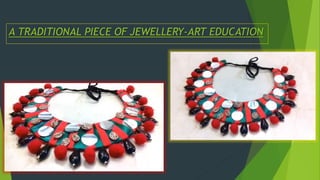
A TRADITIONAL PIECE OF JEWELLERY-ART EDUCATION
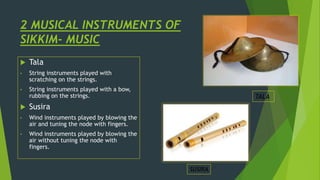
2 MUSICAL INSTRUMENTS OF
SIKKIM- MUSIC
 Tala
• String instruments played with
scratching on the strings.
• String instruments played with a bow,
rubbing on the strings.
 Susira
• Wind instruments played by blowing the
air and tuning the node with fingers.
• Wind instruments played by blowing the
air without tuning the node with
fingers.
TALA
SUSIRA
COLLAGE ON INCREDEBLE INDIA -
DESHBHAKTI
ART INTEGRATED PROJECT.pptx

ART INTEGRATED PROJECT.pptx

  • 1.
    PRESENTATION BY-Crimsy Goyal,Guraansh Arora, Dhairya Goyal CLASS-9th F ART INTIGERATED-SIKKIM
  • 2.
     Sikkim, statein India,is located in the northeastern part of the country, in the eastern Himalayas. It is one of the smallest states in India. Sikkim is bordered by the Tibet Autonomous Region of China to the north and northeast, by Bhutan to the southeast, by the Indian state of West Bengal to the south, and by Nepal to the west. The capital is Gangtok, in the southeastern part of the state. A part of the Eastern Himalaya, Sikkim is notable for its biodiversity, including alpine and subtropical climates, as well as being a host to Kangchenjunga, the highest peak in India and third highest on Earth. Sikkim's capital and largest city is Gangtok. Almost 35% of the state is covered by the Khangchendzonga National Park. LOCATION:-
  • 3.
    LANGUAGE:-  The officiallanguages of the state are English, Nepali, Sikkimese (Bhutia) and Lepcha. Additional official languages include Gurung, Limbu, Magar, Mukhia, Newari, Rai, Sherpa and Tamang for the purpose of preservation of culture and tradition in the state.  Nepali is the lingua franca of Sikkim, while Sikkimese (Bhutia) and Lepcha are spoken in certain areas. English is also spoken and understood in most of Sikkim. Other languages include Dzongkha, Groma, Hindi, Majhi, Majhwar, Thulung, Tibetan, and Yakha.
  • 4.
    COSTUME:-  The Khoor Bakhu is a traditional dress worn by Bhutia, ethnic Sikkimese people of Sikkim and Nepal. It is a loose, cloak-style garment that is fastened at the neck on one side and near the waist with a silk or cotton belt similar to the Tibetan chuba and to the Ngalop gho of Bhutan, but sleeveless.  Women wear a silken, full-sleeve blouse called a honju inside the kho; a loose gown type garment fastened near the waist, tightened with a belt. Married women tie a multi-coloured striped apron of woolen cloth called pangden around their waist.
  • 5.
    सिक्किम क े भौगोसिकवातावरण-HINDI  हिमालय में बसा हसक्किम एक आकर्षक और सुंदर राज्य िै और एक पिाड़ी इलाका िै। रा त़ीस्ता नद़ी को “हसक्किम क़ी ज़ीवन रेखा” क े रूप में वहणषत हकया गया िै, जो राज्य से उत्तर से दहिण तक बित़ी िै।  हसक्किम क़ी भौगोहलक क्कथिहत 27 हिग्ऱी 5 हमनट उत्तर से 20 हिग्ऱी 9 हमनट उत्तर अिाुंश और 87 हिग्ऱी 59 हमनट पूवष से 88 हिग्ऱी 56 हमनट पूवष देशाुंतर िै। दहिण में हसक्किम क़ी थिलाक ृ हत पहिम बुंगाल क़ी समतल भूहम क े साि हमलत़ी िै। हसक्किम क़ी ऊ ुं चाई 300 म़ीटर से लेकर 8585 म़ीटर तक िै।
  • 6.
    सिक्किम क े दर्शनीयस्थि  गुंगटोक - पूवी हिमालय पवषत माला पर हशवाहलक पिाहडयोुं क े ऊपर 1437 म़ीटर क़ी ऊ ुं चाई क्कथित गुंगटोक हसक्किम क े प्रमख पयषटन थिल में से एक िै जो यिााँ आने वाले पयषटकोुं क े हदल-हदमाग को ताजा कर देत़ी िै।  यक्सोम - हसक्किम क े प्रमख पयषटक थिल में शमार यक्सोम एक खूबसूरत जगि िै जो हसक्किम क े पहिम़ी िेत्र में क्कथित िै और अपऩी प्राक ृ हतक सुंदरता क े हलए जाऩी जात़ी िै।  त्सोमो झ़ील - गुंगटोक – नािू ला राजमागष पर समद्र तल से 12400 फ़ीट क़ी ऊ ाँ चाई पर पिाडोुं क े ब़ीच क्कथित त्सोमो झ़ील भारत क़ी सबसे ऊ ाँ च़ी झ़ीलोुं में से एक िै। चुंग झ़ील क े रूप में लोकहप्रय, त्सोमो झ़ील हसक्किम क़ी यात्रा पर आने वाले िर पयषटक का एक हिस्सा िै।  नािला पास - बता दे नािला, हिमालय क़ी चोहटयोुं में एक पिाड़ी दराष िै जो हसक्किम को च़ीन को जोडता िै। समद्र तल से 14450 फ़ीट ऊपर भारत-हतब्बत स़ीमा पर क्कथित नािू ला दहनया क़ी सबसे ऊ ुं च़ी सडकोुं में से एक िै।
  • 7.
    FEATURES OF TEXTILEPATTERNS OF SIKKIM – MATHEMATICS  In ancient times, the Lepcha’s of Sikkim were said to use yarn spun out of stinging nettle (sisnu) plant to weave clothes.Today cotton and woollen yarn are used together with vegetable dyes and synthetic colours. Lepcha weaves or ‘thara’ is woven in vertical looms with a backstrap. Such looms are of small width. Traditional design with different colours are used to make tharas which are used for making bedspreads, bags, belts, curtains, cushion covers, table mats, tray cloths etc, apart from their traditional dress.
  • 8.
  • 9.
    SIKKIM TEXTILES INSPIRAL ROOT
  • 10.
    ORGANIC FARMLAND-SCIENCE  Cereals- Rice,Maize,Finger Millet,Barley  Pulses – Pea,Urd  Oil seed – soyabean,mustard  Tuber Crops – Potato,Sweet potato  Spices - Large Cardamom,chilly,turmeric  Fruits – Mandarin,Banana,Papaya,Litchi  Passion Fruit – Guava,Jack Fruit  Vegetables - Brocolli,Iskus,Tomato SOME CASH CROPS GROWN IN SIKKIM:-
  • 11.
    BENEFITS OF ORGANICFARMING:-  organic farming, agricultural system that uses ecologically based pest controls and biological fertilizers derived largely from animal and plant wastes and nitrogen-fixing cover crops. Modern organic farming was developed as a response to the environmental harm caused by the use of chemical pesticides and synthetic fertilizers in conventional agriculture, and it has numerous ecologic al benefits.  Compared with conventional agriculture, organic farming uses fewer pesticides, reduces soil erosion, decreases nitrate leaching into groundwater and surface water, and recycles animal wastes back into the farm. These benefits are counterbalanced by higher food costs for consumers and generally lower yields. Indeed, yields of organic crops have been found to be about 25 percent lower overall than conventionally grown crops, although this can vary considerably depending upon the type of crop.
  • 12.
    NUTRITIONAL VALUE OFANY ONE CROP GROWN IN SIKKIM  Bananas are among the most important food crops on the planet.They come from a family of plants called Musa that are native to Southeast Asia and grown in many of the warmer areas of the world.Bananas are a healthy source of fiber, potassium, vitamin B6, vitamin C, and various antioxidants and phytonutrients.Many types and sizes exist. Their color usually ranges from green to yellow, but some varieties are red.  The nutrition facts for 1 medium-sized banana (100 grams) are (1Trusted Source): 1. Calories: 89 2. Water: 75% 3. Protein: 1.1 grams 4. Carbs: 22.8 grams 5. Sugar: 12.2 grams 6. Fiber: 2.6 grams 7. Fat: 0.3 grams Banana:-
  • 13.
    NATURAL DISASTER PREPAREDENESS- SST  The State of Sikkim is very vulnerable to natural calamities considering that it falls under the Seismic Zone IV/V and records one of the highest annual rainfalls in the country. Every year a noticeable number of people are affected by natural disasters among which landslides, floods and river bank erosion are most frequent.  The Department is operating the State Disaster Relief Fund to which the Centre and State Share 90% and 10% of the allocation respectively earmarked for each financial year by the Finance Commission. The Department has been in the forefront in providing timely relief to the victims of all types of natural calamities that have occurred in the state in the form of ex gratia and Gratuitous relief payment. This relief is doled out from the Office of the District Collectors, Sub divisional Offices and in recent times from the Block Administrative Centre also as per standing Items and Norms of expenditure from the SDRF.  Further, we have been providing funds to most of the line Departments to take up immediate repair and restoration work of infrastructure damage due to natural calamities.
  • 14.
    Preparedeness taken bySikkim people :-  Power Generators and Fuel Portable Fuel Generators Portable Solar Generators Wind Generators Fuel Containers - Keep Full. Rotate and keep fuel containers full, fuel is always one of the first items to disappear in an emergency or disaster situation.  Warmth and Shelter Equipment Emergency Heaters/Stoves Survival Blankets Sleeping-bag/Blankets Fire-starters, Firewood, etc  Water Supplies Purifiers Filters Containers Hand Well-Water Pump (Hard to find item for self-sufficient well-water supply)
  • 15.
    FAMOUS SPORTS OFSIKKIM –HEALTH AND PHYSICAL EDUCATION  Rafting  Mountain Biking  Paragliding  Rock Climbing  Trekking  Ropeway  Mountaineering  Yak Ride  Bungee Jumping  Hang Gliding  Caving  Helicopter Rides
  • 16.
    A TRADITIONAL PIECEOF JEWELLERY-ART EDUCATION
  • 17.
    2 MUSICAL INSTRUMENTSOF SIKKIM- MUSIC  Tala • String instruments played with scratching on the strings. • String instruments played with a bow, rubbing on the strings.  Susira • Wind instruments played by blowing the air and tuning the node with fingers. • Wind instruments played by blowing the air without tuning the node with fingers. TALA SUSIRA
  • 18.
    COLLAGE ON INCREDEBLEINDIA - DESHBHAKTI