SIKKIM
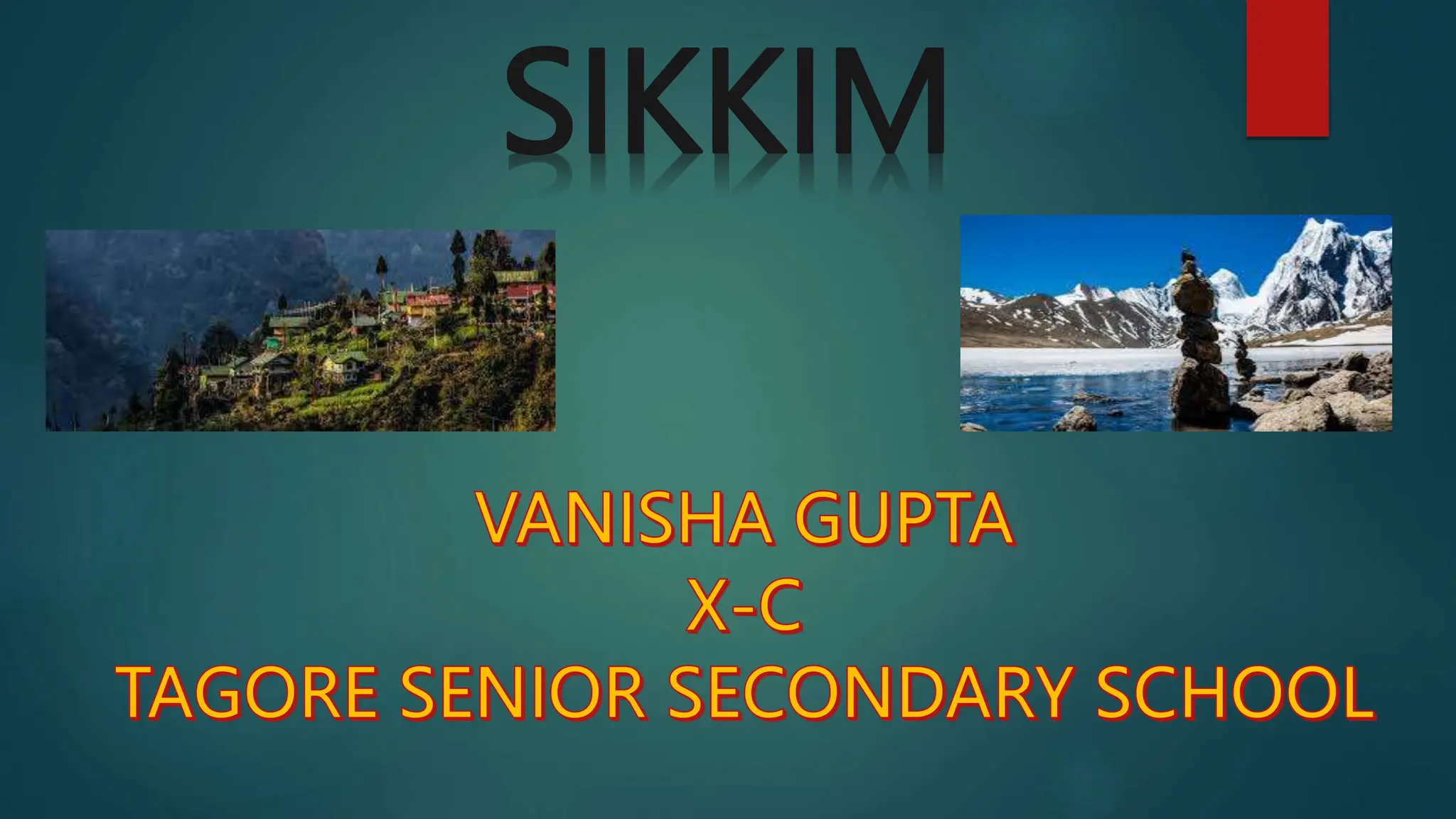
Sikkim is a state in northeastern India. It borders the Tibet
Autonomous Region of China in the north and northeast,
Bhutan in the east, Nepal in the west, and West Bengal in the
south. Sikkim is also close to India's Siliguri Corridor near
Bangladesh. Sikkim is the least populous and second smallest
among the Indian states. A part of the Eastern Himalaya, Sikkim
is notable for its biodiversity, including alpine and subtropical
climates, as well as being a host to Kangchenjunga, the highest
peak in India and third highest on Earth. Sikkim's capital and
largest city is Gangtok. Almost 35% of the state is covered by
the Khangchendzonga National Park - a UNESCO World
Heritage Site.
The history of Sikkim, an area in present-day North-East India, began
in 1642 as a kingdom established when India and Nepal were still
many princely states with many rulers at that time and had not unified
to the present Union of India and present country of Nepal. At that
time Sikkim had already solidified into country then with a king known
as a Chogyal or dharma king, and till 16 May 1975 was an independent
country ruled by the monarchs. Sikkim had twelve kings; Thondup
Namgyal was the last king of Independent Sikkim.
There was contacts between ancient Hindus and Tibetans, followed by
the establishment of a Buddhist kingdom or Chogyal in the 17th
century. Sikkim emerged as a polity in its own right against a backdrop
of incursions from Tibet and Bhutan, during which the kingdom
enjoyed varying degrees of independence.
NEPALI
Nepali is one of the 22 Scheduled languages of India. In Indian Census prior to 1991,
the language was identified as Nepali. From 1991 Census onwards it is appearing
as Nepali.
Nepali, being mainly distributed in West Bengal, has been studied under Linguistic
Survey of India-West Bengal Volume. But, being the first populous language of Sikkim state,
the same has been studied for Sikkim state also to assess the divergence and convergence in
Nepali being spoken in two different linguistic environments. Whereas in West Bengal,
Nepali is spoken amidst the superposed Bengali language, In Sikkim, it is spoken in the
environment of Tibeto-Burman speech communities in West Bengal. Further, Nepali has
been studied in Himachal Pradesh too where the language exists in mixed environment of
both Indo-Aryan and Tibeto-Burman languages.
Gadul Singh Lama, popularly known as Sanu Lama, is an Indian fiction
writer, poet and translator of Nepali literature.[citation needed] An
engineer by profession, he has published three short story anthologies
and his stories have been translated into English, Hindi, Urdu, Assamese
and Oriya languages.[1] He is a recipient of Sahitya Akademi Award
(1993),[2] apart from other awards such as Sikkim Bhanu Puraskar, Dr.
Shova Kanti The gim Smrithi Puraskar and Madan Byakhanmala
Puraskar.[1] The Government of India awarded him the fourth highest
civilian honour of the Padma Shri, in 2005, for his contributions to
literature.
He has also written an autobiographical novel, Himalchuli Manitira, a
travelogue, Aangan Paratira, a poem anthology, Jahan BagcchaTista Rangit and
two translated religious works, Bhagawan Bhiddha Jeewan ra Darshan and Guru
Padmasambhava.
SIKKIM.pptx class 10, geography sikkim ppt

SIKKIM.pptx class 10, geography sikkim ppt

  • 1.
  • 2.
    Sikkim is astate in northeastern India. It borders the Tibet Autonomous Region of China in the north and northeast, Bhutan in the east, Nepal in the west, and West Bengal in the south. Sikkim is also close to India's Siliguri Corridor near Bangladesh. Sikkim is the least populous and second smallest among the Indian states. A part of the Eastern Himalaya, Sikkim is notable for its biodiversity, including alpine and subtropical climates, as well as being a host to Kangchenjunga, the highest peak in India and third highest on Earth. Sikkim's capital and largest city is Gangtok. Almost 35% of the state is covered by the Khangchendzonga National Park - a UNESCO World Heritage Site.
  • 3.
    The history ofSikkim, an area in present-day North-East India, began in 1642 as a kingdom established when India and Nepal were still many princely states with many rulers at that time and had not unified to the present Union of India and present country of Nepal. At that time Sikkim had already solidified into country then with a king known as a Chogyal or dharma king, and till 16 May 1975 was an independent country ruled by the monarchs. Sikkim had twelve kings; Thondup Namgyal was the last king of Independent Sikkim. There was contacts between ancient Hindus and Tibetans, followed by the establishment of a Buddhist kingdom or Chogyal in the 17th century. Sikkim emerged as a polity in its own right against a backdrop of incursions from Tibet and Bhutan, during which the kingdom enjoyed varying degrees of independence.
  • 4.
    NEPALI Nepali is oneof the 22 Scheduled languages of India. In Indian Census prior to 1991, the language was identified as Nepali. From 1991 Census onwards it is appearing as Nepali. Nepali, being mainly distributed in West Bengal, has been studied under Linguistic Survey of India-West Bengal Volume. But, being the first populous language of Sikkim state, the same has been studied for Sikkim state also to assess the divergence and convergence in Nepali being spoken in two different linguistic environments. Whereas in West Bengal, Nepali is spoken amidst the superposed Bengali language, In Sikkim, it is spoken in the environment of Tibeto-Burman speech communities in West Bengal. Further, Nepali has been studied in Himachal Pradesh too where the language exists in mixed environment of both Indo-Aryan and Tibeto-Burman languages.
  • 5.
    Gadul Singh Lama,popularly known as Sanu Lama, is an Indian fiction writer, poet and translator of Nepali literature.[citation needed] An engineer by profession, he has published three short story anthologies and his stories have been translated into English, Hindi, Urdu, Assamese and Oriya languages.[1] He is a recipient of Sahitya Akademi Award (1993),[2] apart from other awards such as Sikkim Bhanu Puraskar, Dr. Shova Kanti The gim Smrithi Puraskar and Madan Byakhanmala Puraskar.[1] The Government of India awarded him the fourth highest civilian honour of the Padma Shri, in 2005, for his contributions to literature.
  • 6.
    He has alsowritten an autobiographical novel, Himalchuli Manitira, a travelogue, Aangan Paratira, a poem anthology, Jahan BagcchaTista Rangit and two translated religious works, Bhagawan Bhiddha Jeewan ra Darshan and Guru Padmasambhava.