Amazon SDSN:
A Platform for Knowledge Sharing and Solutions
Emma Torres
Amazon SDSN
March 21 , 2014
1
What Does the SDSN Do?
Mission:
Promote sustainable development
• Mobilizing scientific and technological
knowledge
• Via information sharing, education, and
problem solving
• At the local, national, and global level
Organization of SDSN
33
Amazon
SDSN
Organization of SDSN
44
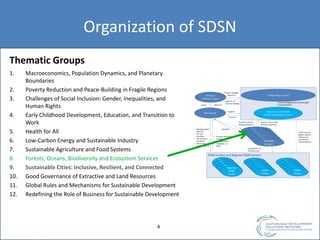
1. Macroeconomics, Population Dynamics, and Planetary
Boundaries
2. Poverty Reduction and Peace-Building in Fragile Regions
3. Challenges of Social Inclusion: Gender, Inequalities, and
Human Rights
4. Early Childhood Development, Education, and Transition to
Work
5. Health for All
6. Low-Carbon Energy and Sustainable Industry
7. Sustainable Agriculture and Food Systems
8. Forests, Oceans, Biodiversity and Ecosystem Services
9. Sustainable Cities: Inclusive, Resilient, and Connected
10. Good Governance of Extractive and Land Resources
11. Global Rules and Mechanisms for Sustainable Development
12. Redefining the Role of Business for Sustainable Development
Thematic Groups
Amazonia
Bacia hidrográfica da Amazônia
Países
6
Estados
Brasileiros
9
Bacia
Amazônica
Bacia
Amazônia
Bioma da Amazônia
Países
9
Estados
Brasileiros
9
Bioma
Amazônia
Bacia
Amazônica
14 países
2.456.565 km²
Amazônia Legal
5.217.423 Km²
Albânia
Bósnia
Bélgica
Suiça
República Checa
Alemanha
Espanha
França
Itália
Países Baixos
Portugal
Reino
Unido
Áustria
Amazônia Legal - Brasil
Amazônia Legal
5.217.423 Km²
Amapá
Rondônia
Acre
Maranhão
Mato
Grosso
ParáAmazonas
Tocantins
Roraima
9
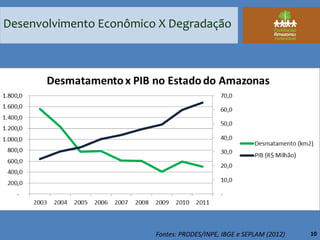
Desenvolvimento Econômico X Degradação
10Fontes: PRODES/INPE, IBGE e SEPLAM (2012)
A Amazonia urbana
 Manaus: 2 milhões de habitantes
Faturamento da Zona Franca de Manaus : + R$ 75 bilhões
Crescimento no 1° semestre 2013: 11,7%
Número de empregos diretos: 110 mil
Fonte: SUFRAMA
Floresta Amazônica uma
grande bomba d´água
provedores
Serviços ambientais
beneficiarios
pagamento
Paulo Otávio/Creative Commons
Why an Amazon SDSN
Amazon Basin largest tropical forest in the world
• 40 percent of the South America Continent
Half of Planet’s Biodiversity and Crucial Provider of Ecosystem Services
• Rainforest most extensive but rivers, lakes , wetlands and savannas
• Greatest concentrations plants, animals and microorganisms .
Survival depends network of large well connected protected areas
• Crucial provider of ecosystem services which underpin water,
energy, food for region and beyond
Amazon releases 8 trillion water vapor into atmosphere each year
maintaining climatic stability global, regional and locally. And Feeding
agriculture and hydropower, and water for industry and people : Rio de
la Plata Basin depends from evaporation from Amazon for 70 percent
of its water.
1414
Amazon Natural Capital Undervalued
• Economic value of these services is enormous
• Natural Capital Amazon comparative advantage and could energize
region’s sustainable development and position region in leadership
on new development paradigms
• But, the services that the Amazon provide , which include
maintenance of the global water cycle, nutrient and carbon cycle,
regional climate regulation, preventing soil erosion and others are
not captured in figures services
• Amazon is undergoing a rapid change
• Amazon Basin involves 8 countries: Brazil, Bolivia, Peru, Ecuador,
Colombia Venezuela Guyana and Suriname
• More than 30 million people live in the Amazon including 350
indigenous and ethnic groups ( about 32 no contacted groups in
Brazil alone)
1515
Significant and Vulnerable Economic
Contribution of the Amazon
Huge wealth is generated in Amazon
• Oil and Natural Gas
• Amazonian Hydropower supplies high percentage of
electricity needs. close to 100 damns being planned by
2020
• Amazonian produce feeds region
• Amazonian agricultural commodities export at scale (8B
only in Brazil 2012
• Amazonian minerals – 21 percent of Amazon is under
some form of mining
• All the above are depend on Amazonia water and energy
security
1616
The Amazon : Abundance under Threat
• Major drivers deforestation: infrastructure, cattle
ranching, agriculture expansion, unsustainable extractive
industries, oil exploration .
• All these threats will be multiplied by Climate change
exacerbating economic, environmental and social costs.
• Maintaining Amazonian ecosystems in balance with
sustainable economic growth is fundamental to people
and economies across the region
• Joint dependence on Amazonia natural resources and
joint exposure to regional scale risk call for greater
regional cooperation
1717
Innovative Transition to a New Sustainable
Development Paradigm
• The future of the Amazon is linked to the region’s
long term development.
• It presents a unique, challenging, and potentially
innovative scenario. The region has the potential to
developed as a first tropical economy based in
diversified natural resources, intensive in nature
knowledge based technologies
• The Brazilian Academy of Sciences states that “the
challenge of benefitting from the Amazon’s natural
capital in a sustainable manner is unique. There are
no models to be followed.”
1818
Enabling conditions for an Amazon SDSN
• Growing political awareness commitment governments , civil
society and business
• Vast reserves of protected areas
• Reduction of deforestation rates esp Brazil
• Considerable level of experimentation solutions and research at
research institutions, civil society organizations and private sector
• (Include examples)
• No comprehensive overview of region . Need for an integrated
regional polices and solutions
• Need to advance operational sustainable development frameworks
and solutions to mobilize key actors -national, local governments,
civil society, business science and academia- SDSN
1919
Amazon SDSN
• Vision Amazon 2030 -Mobilize leading research and
academic institutions to share existing knowledge
and explore solutions of scale
• Foster policy dialogue and develop integrated
policies based on scientific evidence
• Identify triple win policies and solutions at scale
2020
Amazon SDSN
To develop a sustainable development solutions
network for the Amazon region – mobilizing a regional
network of knowledge centers around three set of
activities:
• Build the Amazon Solutions Network
• Build a web based platform to share knowledge and
solutions for Amazon
• Foster dialogue and inform policy- makers on
evidence based sustainable solutions
2121
Amazon SDSN
Vision for Amazon 2030
• SDGs for Amazon: Goals Targets and Indicators
Human, Physical, Biodiversity , Forests (Pristine and Sustainable Managed Forests)
Valuation of Ecosystem Services
Poverty Eradication, Access to Basic Services
Population , Cities
Center of Nature Innovation
• Risks for Amazon
Fragmentation
Global Change- Climate Change : Mitigation and Adaptation
Land use
• Systematically Monitor and Track ( Annual report)
Land use change, Biodiversity , et al
Paths : Policy Making , Problem Solving – Enabling environment for Nature Based Innovation
Solid Evidence Based Analysis
2323
AMAZON - SDSN
• Consolidate and Enlarge Network – mobilize universities,
research , think tanks, indigenous groups, private sector
• Solutions, Criteria , Systematic Sharing
• Develop Web Platform
• Education : e.g.online What is Sustainablde Development in
the Amazon
• Value and Incorporate Traditional and Indigenous Knowledge
• Science and Evidence Public Policy
• Promote enabling environment for Sustainable Development
Entrepreneurship
• Share Private Sector Solutions and Sustainable Practices
2424
More information:
Website: www.unsdsn.org
Email: info@unsdsn.org
25

Emma Torres

  • 1.
    Amazon SDSN: A Platformfor Knowledge Sharing and Solutions Emma Torres Amazon SDSN March 21 , 2014 1
  • 2.
    What Does theSDSN Do? Mission: Promote sustainable development • Mobilizing scientific and technological knowledge • Via information sharing, education, and problem solving • At the local, national, and global level
  • 3.
  • 4.
    Organization of SDSN 44 1.Macroeconomics, Population Dynamics, and Planetary Boundaries 2. Poverty Reduction and Peace-Building in Fragile Regions 3. Challenges of Social Inclusion: Gender, Inequalities, and Human Rights 4. Early Childhood Development, Education, and Transition to Work 5. Health for All 6. Low-Carbon Energy and Sustainable Industry 7. Sustainable Agriculture and Food Systems 8. Forests, Oceans, Biodiversity and Ecosystem Services 9. Sustainable Cities: Inclusive, Resilient, and Connected 10. Good Governance of Extractive and Land Resources 11. Global Rules and Mechanisms for Sustainable Development 12. Redefining the Role of Business for Sustainable Development Thematic Groups
  • 5.
  • 6.
    Bacia hidrográfica daAmazônia Países 6 Estados Brasileiros 9 Bacia Amazônica Bacia Amazônia
  • 7.
  • 8.
    14 países 2.456.565 km² AmazôniaLegal 5.217.423 Km² Albânia Bósnia Bélgica Suiça República Checa Alemanha Espanha França Itália Países Baixos Portugal Reino Unido Áustria Amazônia Legal - Brasil Amazônia Legal 5.217.423 Km² Amapá Rondônia Acre Maranhão Mato Grosso ParáAmazonas Tocantins Roraima
  • 9.
  • 10.
    Desenvolvimento Econômico XDegradação 10Fontes: PRODES/INPE, IBGE e SEPLAM (2012)
  • 11.
    A Amazonia urbana Manaus: 2 milhões de habitantes Faturamento da Zona Franca de Manaus : + R$ 75 bilhões Crescimento no 1° semestre 2013: 11,7% Número de empregos diretos: 110 mil Fonte: SUFRAMA
  • 12.
  • 13.
  • 14.
    Why an AmazonSDSN Amazon Basin largest tropical forest in the world • 40 percent of the South America Continent Half of Planet’s Biodiversity and Crucial Provider of Ecosystem Services • Rainforest most extensive but rivers, lakes , wetlands and savannas • Greatest concentrations plants, animals and microorganisms . Survival depends network of large well connected protected areas • Crucial provider of ecosystem services which underpin water, energy, food for region and beyond Amazon releases 8 trillion water vapor into atmosphere each year maintaining climatic stability global, regional and locally. And Feeding agriculture and hydropower, and water for industry and people : Rio de la Plata Basin depends from evaporation from Amazon for 70 percent of its water. 1414
  • 15.
    Amazon Natural CapitalUndervalued • Economic value of these services is enormous • Natural Capital Amazon comparative advantage and could energize region’s sustainable development and position region in leadership on new development paradigms • But, the services that the Amazon provide , which include maintenance of the global water cycle, nutrient and carbon cycle, regional climate regulation, preventing soil erosion and others are not captured in figures services • Amazon is undergoing a rapid change • Amazon Basin involves 8 countries: Brazil, Bolivia, Peru, Ecuador, Colombia Venezuela Guyana and Suriname • More than 30 million people live in the Amazon including 350 indigenous and ethnic groups ( about 32 no contacted groups in Brazil alone) 1515
  • 16.
    Significant and VulnerableEconomic Contribution of the Amazon Huge wealth is generated in Amazon • Oil and Natural Gas • Amazonian Hydropower supplies high percentage of electricity needs. close to 100 damns being planned by 2020 • Amazonian produce feeds region • Amazonian agricultural commodities export at scale (8B only in Brazil 2012 • Amazonian minerals – 21 percent of Amazon is under some form of mining • All the above are depend on Amazonia water and energy security 1616
  • 17.
    The Amazon :Abundance under Threat • Major drivers deforestation: infrastructure, cattle ranching, agriculture expansion, unsustainable extractive industries, oil exploration . • All these threats will be multiplied by Climate change exacerbating economic, environmental and social costs. • Maintaining Amazonian ecosystems in balance with sustainable economic growth is fundamental to people and economies across the region • Joint dependence on Amazonia natural resources and joint exposure to regional scale risk call for greater regional cooperation 1717
  • 18.
    Innovative Transition toa New Sustainable Development Paradigm • The future of the Amazon is linked to the region’s long term development. • It presents a unique, challenging, and potentially innovative scenario. The region has the potential to developed as a first tropical economy based in diversified natural resources, intensive in nature knowledge based technologies • The Brazilian Academy of Sciences states that “the challenge of benefitting from the Amazon’s natural capital in a sustainable manner is unique. There are no models to be followed.” 1818
  • 19.
    Enabling conditions foran Amazon SDSN • Growing political awareness commitment governments , civil society and business • Vast reserves of protected areas • Reduction of deforestation rates esp Brazil • Considerable level of experimentation solutions and research at research institutions, civil society organizations and private sector • (Include examples) • No comprehensive overview of region . Need for an integrated regional polices and solutions • Need to advance operational sustainable development frameworks and solutions to mobilize key actors -national, local governments, civil society, business science and academia- SDSN 1919
  • 20.
    Amazon SDSN • VisionAmazon 2030 -Mobilize leading research and academic institutions to share existing knowledge and explore solutions of scale • Foster policy dialogue and develop integrated policies based on scientific evidence • Identify triple win policies and solutions at scale 2020
  • 21.
    Amazon SDSN To developa sustainable development solutions network for the Amazon region – mobilizing a regional network of knowledge centers around three set of activities: • Build the Amazon Solutions Network • Build a web based platform to share knowledge and solutions for Amazon • Foster dialogue and inform policy- makers on evidence based sustainable solutions 2121
  • 23.
    Amazon SDSN Vision forAmazon 2030 • SDGs for Amazon: Goals Targets and Indicators Human, Physical, Biodiversity , Forests (Pristine and Sustainable Managed Forests) Valuation of Ecosystem Services Poverty Eradication, Access to Basic Services Population , Cities Center of Nature Innovation • Risks for Amazon Fragmentation Global Change- Climate Change : Mitigation and Adaptation Land use • Systematically Monitor and Track ( Annual report) Land use change, Biodiversity , et al Paths : Policy Making , Problem Solving – Enabling environment for Nature Based Innovation Solid Evidence Based Analysis 2323
  • 24.
    AMAZON - SDSN •Consolidate and Enlarge Network – mobilize universities, research , think tanks, indigenous groups, private sector • Solutions, Criteria , Systematic Sharing • Develop Web Platform • Education : e.g.online What is Sustainablde Development in the Amazon • Value and Incorporate Traditional and Indigenous Knowledge • Science and Evidence Public Policy • Promote enabling environment for Sustainable Development Entrepreneurship • Share Private Sector Solutions and Sustainable Practices 2424
  • 25.