Angelo Riccaboni
Rector University of Siena
IAU 2014 International Conference -Iquitos, Peru
UN SDSN project
and MED Solutions
The UN SDSN Center for Mediterranean
1
 More than a billion of people still live in conditions of extreme
poverty, without access to basic health and education services
 The current global crisis and recent conflicts have exacerbated
hard situations of inequality (of income, gender, disability, age
and geographical collocation) and social exclusion
 Loss of biodiversity, degradation of waters, soils and forests,
and the effects of climate change are menacing the survival of
the mankind on the Earth
2
The planetary boundaries
 All the 191 member States of the United Nations agreed to define
precise and measurable goals guiding both individuals and
institutions in the struggle to problems of our society and to achieve
such goals within the 2015
 Mainly focused on the struggle to extreme poverty and the
discrimination in all its forms
3
Millennium Development Goals (MDGs)- 2000
MDGs
1. Eradicating extreme poverty and hunger
2. Achieving universal primary education
3. Promoting gender equality and empowering
women
4. Reducing child mortality rates
5. Improving maternal health
6. Combating HIV, malaria, and other diseases
7. Ensuring environmental sustainability
8. Developing a global partnership for
development
 In developing Countries:
 proportion of people living on less than 1.25$ a day from 47 % to 22%
(1990-2010)
 proportion of undernourished people from 23 % to 15 % (1990-2010)
 number of children without school education from 102 to 57 million
(2000-2010)
 mortality rate for children dropped by 41% and maternal mortality rate
dropped by 47% (1990-2011)
 1.9 billion people gained access to hygienic services (1990-2011)
However:
 Improvements have not affected evenly all countries
 Within some Communities social inequalities have sharpened
4
The progress towards the MDGs
 September 25, 2013: a Special Event on MDGs
organized by the President of the General Assembly of
UN
 Declaration, signed by Heads of State and Government from all
over the world, in which stronger commitment in the
achievement of MDGs by the end of 2015 was expressed
 Accelerating the achievement of MDGs is no more
sufficient to support the needs of a World in profoundly
changing
5
From the MDGs to the Sustainable
Development Goals (SDGs)
 Three main paths to give SDGs effectiveness:
1. The identification of long-term pathways to the
sustainable development and to the achievement of
SDGs
2. The collection and promotion of new “solutions” in
support to SDGs
3. Networking for local and regional problem solving (with
crucial role of innovation and research)
6
Sustainable Development Goals (SDGs)
 Created by the UN in August 2012 and directed by
Prof. Jeffrey Sachs (Earth Institute, Columbia
University)
 UN SDSN is an independent global network of
research centers, universities, businesses and other
institutions of civil society that aims to find and
facilitate the adoption of solutions that promote
sustainable development paths (www.unsdsn.org)
7
UN SDSN - The United Nations Sustainable
Development Solutions Network
 To participate to the global debate opened on the definition of
the SDGs
 ‘An Action Agenda for Sustainable Development’
 Produced by UN SDSN Leadership Council (June 6, 2013)
 Focus on social, economic and environmental topics and good governance
 Proposing 10 objectives, explicit and easily measurable
 To promote operational solutions to be adopted for the
effective prosecution of the SDGs
 Technologies, business models, institutional mechanisms and
policies that:
 have a transformative impact on sustainable development and can be
reproduced on a larger scale
 are technically feasible and do not require new basic research, but imply
only the recombination of existing technologies
 have not been experimented yet8
The purpose of UN SDSN
 „Energy Access for All in Sub-Saharan Africa‟, by ENI
 In rural areas of Sub-Saharan Africa, barriers to energy access
include lack of energy resources, lack of access to available
energy, and the prohibitive cost of energy from some sources
 SOLUTION: promote energy resources and the electricity
infrastructure for ensuring energy access for all in the region
 „ICT-enabled Community Health Workers‟, by Novartis
Foundation
 Across sub-Saharan Africa, community health workers using
mobile phones and broadband to access sophisticated medical
resources are delivering health care to where it is most needed
 SOLUTION: greatly expand that effort by training and equipping
one million health care workers by the end of 2015
9
The Solutions Initiatives of UN SDSN
Structured in:
 12 Thematic Groups (the first 7 reports - Sept. 18, 2013)
1. Macroeconomics, Population Dynamics, and Planetary Boundaries
2. Reducing Poverty and Building Peace in Fragile Regions
3. Challenges of Social Inclusion: Gender, Inequalities, and Human Rights
4. Early Childhood Development, Education, and Transition to Work
5. Health for All
6. Low-Carbon Energy and Sustainable Industry
7. Sustainable Agriculture and Food Systems
8. Forests, Oceans, Biodiversity, and Ecosystem Services
9. Sustainable Cities: Inclusive, Resilient, and Connected
10. Good Governance of Extractive and Land Resources
11. Global Governance and Norms for Sustainable Development
12. Redefining the Role of Business for Sustainable Development
 a network of National and Regional Centers
10
The activity of UN SDSN
 Under the umbrella of UN SDSN, the University of Siena
has become the first Regional SDSN Center, named
MED Solutions (www.medsolutions.unisi.it)
 MED Solutions will act as a regional hub and will
coordinate the activities of a network of universities,
research centers and businesses interested in identifying
and promoting Solutions Initiatives in the Mediterranean
Region
 Why a Mediterranean Network?
 Shared history
 Shared environment
 Shared future11
MED Solutions
The UN SDSN Center for Mediterranean
 Implement networking among MED actors focused on
sustainable development
 Propose regional pathways towards sustainable
development, drawing on the work by 12 UN SDSN
thematic groups
 Collect and monitor new Solutions for the Med Countries
through the „call for proposals‟
 Develop teaching materials and courses on sustainable
development
 Promote applied research on sustainable development
12
The objectives of MED Solutions
 The First Siena Conference was attended by 157
participants from 29 countries 19 of which are of
the Mediterranean.
 Pollution in the Mediterranean sea
 Energy challenges in the MED region
 The role of business for sustainability
 Vaccines against poverty
 Presentation of Solutions from researchers and
students
 38 solutions collected and 5 solutions selected
(www.medunsdsn.unisi.it/call-for-proposals)13
First Conference - July 3-5, 2013:
 By researchers:
 Flagship solution: Plastic-Buster (Cristina Fossi)
1. Sustainability Compass – guide for projects to reduce ecological
deficit and improve human development (Alessandro Galli)
2. Applications of Integrated Agricultural Management Framework in
Underdeveloped Poor Locations (Marwan Haddad)
3. Innovative technique for sea bed restoration by Posidonia
oceanica reforestation using a biodegrade support (Silvana Di
Bono)
 By students:
1. Voluntary market for Natural Capital in Sardinia (IT): Payments for
certified Ecosystem Services between public sellers and private
buyers by the Grighine Forest (Matilde Silvia Schirru)
2. Albedo control and cool roofs as a strategy to mitigate Global
Warming in economical crisis phase (Valentina Coccia)14
First Conference - July 3-5, 2013:
Solutions presented
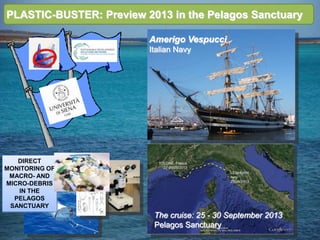
PLASTIC-BUSTER: Preview 2013 in the Pelagos Sanctuary
DIRECT
MONITORING OF
MACRO- AND
MICRO-DEBRIS
IN THE
PELAGOS
SANCTUARY
Amerigo Vespucci
Italian Navy
The cruise: 25 - 30 September 2013
Pelagos Sanctuary
Second Conference programmed in
Siena: March 5-6, 2015
 Focus Theme: “Food Sustainability in
the Mediterranean area”
Why Food?
 Expo Milan 2015 – “Feeding the Planet. Energy
for life
 Initiative Art. 185 (P.R.I.M.A) Partnership in
Research and Innovation in the Mediterranean
Area16
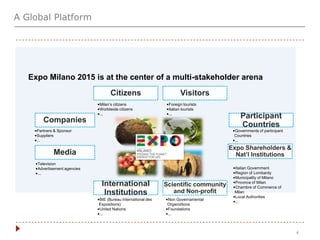
A Global Platform
4
Expo Shareholders &
Nat’l InstitutionsMedia
Companies
Citizens Visitors
Participant
Countries
Scientific community
and Non-profit
International
Institutions
•Foreign tourists
•Italian tourists
•...
•Television
•Advertisement agencies
•...
•Governments of participant
Countries
•...
•Partners & Sponsor
•Suppliers
•...
•Italian Government
•Region of Lombardy
•Municipality of Milano
•Province of Milan
•Chambre of Commerce of
Milan
•Local Authorities
•...
•Milan‟s citizens
•Worldwide citizens
•...
•BIE (Bureau International des
Expositions)
•United Nations
•...
•Non Governamental
Organiztions
•Foundations
•...
Expo Milano 2015 is at the center of a multi-stakeholder arena
Opportunities
EXPO could have access to a unique network of
world specialists in the fields of the event
SDSN could give visibility to its work and
encourage new players to join forces to scale up
the Solutions of the Network
 Key initiatives to be showcased might include:
 the Energy for All in Sub-Saharan Africa Solution Initiative;
 the Mediterranean SDSN Network (MED Solutions) activities, for
instance on the issues of decarbonization, food and agricolture, the role
of SMEs for SD;
 the presentation of new SDGs, with a special event at the EXPO.
 Other opportunities could include:
 a meeting of the SDSN Leadership Council or a SDSN event on
sustainable food organised in Italy in 2014;
 an awareness campaign with schools on SDGs during 2014;
 cooperation on solutions;
 the SDSN initiatives on decarbonization in the major GHG emitters and
on fertilizers.
 Other events could be identified by SDSN and EXPO together.
PRIMA Partnership in Research and
Innovation in the Mediterranean Area:
 Define a long term sustainable strategy for research
and innovation for the Euro - Mediterranean Area
 The development of PRIMA has its base on a Joint
Action Plan (JAP), addressing the Grand Challenges
of our Mediterranean Region.
 Thematic Focus: Food and Water Resources
21
PRIMA Partnership in Research and
Innovation in the Mediterranean Area:
Objectives
 In a frame of a true and balanced partnership, move
towards a:
 scientific integration of national research programmes
financed by national sources, which can be integrated at
transnational level;
 management integration based on a smart and inclusive
governance;
 financial integration among different national funds.
22
Email
medsolutions@unisi.it
Web pages
http://unsdsn.org/
http://www.medsolutions.unisi.it/
23

Angello Riccaboni

  • 1.
    Angelo Riccaboni Rector Universityof Siena IAU 2014 International Conference -Iquitos, Peru UN SDSN project and MED Solutions The UN SDSN Center for Mediterranean 1
  • 2.
     More thana billion of people still live in conditions of extreme poverty, without access to basic health and education services  The current global crisis and recent conflicts have exacerbated hard situations of inequality (of income, gender, disability, age and geographical collocation) and social exclusion  Loss of biodiversity, degradation of waters, soils and forests, and the effects of climate change are menacing the survival of the mankind on the Earth 2 The planetary boundaries
  • 3.
     All the191 member States of the United Nations agreed to define precise and measurable goals guiding both individuals and institutions in the struggle to problems of our society and to achieve such goals within the 2015  Mainly focused on the struggle to extreme poverty and the discrimination in all its forms 3 Millennium Development Goals (MDGs)- 2000 MDGs 1. Eradicating extreme poverty and hunger 2. Achieving universal primary education 3. Promoting gender equality and empowering women 4. Reducing child mortality rates 5. Improving maternal health 6. Combating HIV, malaria, and other diseases 7. Ensuring environmental sustainability 8. Developing a global partnership for development
  • 4.
     In developingCountries:  proportion of people living on less than 1.25$ a day from 47 % to 22% (1990-2010)  proportion of undernourished people from 23 % to 15 % (1990-2010)  number of children without school education from 102 to 57 million (2000-2010)  mortality rate for children dropped by 41% and maternal mortality rate dropped by 47% (1990-2011)  1.9 billion people gained access to hygienic services (1990-2011) However:  Improvements have not affected evenly all countries  Within some Communities social inequalities have sharpened 4 The progress towards the MDGs
  • 5.
     September 25,2013: a Special Event on MDGs organized by the President of the General Assembly of UN  Declaration, signed by Heads of State and Government from all over the world, in which stronger commitment in the achievement of MDGs by the end of 2015 was expressed  Accelerating the achievement of MDGs is no more sufficient to support the needs of a World in profoundly changing 5 From the MDGs to the Sustainable Development Goals (SDGs)
  • 6.
     Three mainpaths to give SDGs effectiveness: 1. The identification of long-term pathways to the sustainable development and to the achievement of SDGs 2. The collection and promotion of new “solutions” in support to SDGs 3. Networking for local and regional problem solving (with crucial role of innovation and research) 6 Sustainable Development Goals (SDGs)
  • 7.
     Created bythe UN in August 2012 and directed by Prof. Jeffrey Sachs (Earth Institute, Columbia University)  UN SDSN is an independent global network of research centers, universities, businesses and other institutions of civil society that aims to find and facilitate the adoption of solutions that promote sustainable development paths (www.unsdsn.org) 7 UN SDSN - The United Nations Sustainable Development Solutions Network
  • 8.
     To participateto the global debate opened on the definition of the SDGs  ‘An Action Agenda for Sustainable Development’  Produced by UN SDSN Leadership Council (June 6, 2013)  Focus on social, economic and environmental topics and good governance  Proposing 10 objectives, explicit and easily measurable  To promote operational solutions to be adopted for the effective prosecution of the SDGs  Technologies, business models, institutional mechanisms and policies that:  have a transformative impact on sustainable development and can be reproduced on a larger scale  are technically feasible and do not require new basic research, but imply only the recombination of existing technologies  have not been experimented yet8 The purpose of UN SDSN
  • 9.
     „Energy Accessfor All in Sub-Saharan Africa‟, by ENI  In rural areas of Sub-Saharan Africa, barriers to energy access include lack of energy resources, lack of access to available energy, and the prohibitive cost of energy from some sources  SOLUTION: promote energy resources and the electricity infrastructure for ensuring energy access for all in the region  „ICT-enabled Community Health Workers‟, by Novartis Foundation  Across sub-Saharan Africa, community health workers using mobile phones and broadband to access sophisticated medical resources are delivering health care to where it is most needed  SOLUTION: greatly expand that effort by training and equipping one million health care workers by the end of 2015 9 The Solutions Initiatives of UN SDSN
  • 10.
    Structured in:  12Thematic Groups (the first 7 reports - Sept. 18, 2013) 1. Macroeconomics, Population Dynamics, and Planetary Boundaries 2. Reducing Poverty and Building Peace in Fragile Regions 3. Challenges of Social Inclusion: Gender, Inequalities, and Human Rights 4. Early Childhood Development, Education, and Transition to Work 5. Health for All 6. Low-Carbon Energy and Sustainable Industry 7. Sustainable Agriculture and Food Systems 8. Forests, Oceans, Biodiversity, and Ecosystem Services 9. Sustainable Cities: Inclusive, Resilient, and Connected 10. Good Governance of Extractive and Land Resources 11. Global Governance and Norms for Sustainable Development 12. Redefining the Role of Business for Sustainable Development  a network of National and Regional Centers 10 The activity of UN SDSN
  • 11.
     Under theumbrella of UN SDSN, the University of Siena has become the first Regional SDSN Center, named MED Solutions (www.medsolutions.unisi.it)  MED Solutions will act as a regional hub and will coordinate the activities of a network of universities, research centers and businesses interested in identifying and promoting Solutions Initiatives in the Mediterranean Region  Why a Mediterranean Network?  Shared history  Shared environment  Shared future11 MED Solutions The UN SDSN Center for Mediterranean
  • 12.
     Implement networkingamong MED actors focused on sustainable development  Propose regional pathways towards sustainable development, drawing on the work by 12 UN SDSN thematic groups  Collect and monitor new Solutions for the Med Countries through the „call for proposals‟  Develop teaching materials and courses on sustainable development  Promote applied research on sustainable development 12 The objectives of MED Solutions
  • 13.
     The FirstSiena Conference was attended by 157 participants from 29 countries 19 of which are of the Mediterranean.  Pollution in the Mediterranean sea  Energy challenges in the MED region  The role of business for sustainability  Vaccines against poverty  Presentation of Solutions from researchers and students  38 solutions collected and 5 solutions selected (www.medunsdsn.unisi.it/call-for-proposals)13 First Conference - July 3-5, 2013:
  • 14.
     By researchers: Flagship solution: Plastic-Buster (Cristina Fossi) 1. Sustainability Compass – guide for projects to reduce ecological deficit and improve human development (Alessandro Galli) 2. Applications of Integrated Agricultural Management Framework in Underdeveloped Poor Locations (Marwan Haddad) 3. Innovative technique for sea bed restoration by Posidonia oceanica reforestation using a biodegrade support (Silvana Di Bono)  By students: 1. Voluntary market for Natural Capital in Sardinia (IT): Payments for certified Ecosystem Services between public sellers and private buyers by the Grighine Forest (Matilde Silvia Schirru) 2. Albedo control and cool roofs as a strategy to mitigate Global Warming in economical crisis phase (Valentina Coccia)14 First Conference - July 3-5, 2013: Solutions presented
  • 15.
    PLASTIC-BUSTER: Preview 2013in the Pelagos Sanctuary DIRECT MONITORING OF MACRO- AND MICRO-DEBRIS IN THE PELAGOS SANCTUARY Amerigo Vespucci Italian Navy The cruise: 25 - 30 September 2013 Pelagos Sanctuary
  • 16.
    Second Conference programmedin Siena: March 5-6, 2015  Focus Theme: “Food Sustainability in the Mediterranean area” Why Food?  Expo Milan 2015 – “Feeding the Planet. Energy for life  Initiative Art. 185 (P.R.I.M.A) Partnership in Research and Innovation in the Mediterranean Area16
  • 18.
    A Global Platform 4 ExpoShareholders & Nat’l InstitutionsMedia Companies Citizens Visitors Participant Countries Scientific community and Non-profit International Institutions •Foreign tourists •Italian tourists •... •Television •Advertisement agencies •... •Governments of participant Countries •... •Partners & Sponsor •Suppliers •... •Italian Government •Region of Lombardy •Municipality of Milano •Province of Milan •Chambre of Commerce of Milan •Local Authorities •... •Milan‟s citizens •Worldwide citizens •... •BIE (Bureau International des Expositions) •United Nations •... •Non Governamental Organiztions •Foundations •... Expo Milano 2015 is at the center of a multi-stakeholder arena
  • 19.
    Opportunities EXPO could haveaccess to a unique network of world specialists in the fields of the event SDSN could give visibility to its work and encourage new players to join forces to scale up the Solutions of the Network
  • 20.
     Key initiativesto be showcased might include:  the Energy for All in Sub-Saharan Africa Solution Initiative;  the Mediterranean SDSN Network (MED Solutions) activities, for instance on the issues of decarbonization, food and agricolture, the role of SMEs for SD;  the presentation of new SDGs, with a special event at the EXPO.  Other opportunities could include:  a meeting of the SDSN Leadership Council or a SDSN event on sustainable food organised in Italy in 2014;  an awareness campaign with schools on SDGs during 2014;  cooperation on solutions;  the SDSN initiatives on decarbonization in the major GHG emitters and on fertilizers.  Other events could be identified by SDSN and EXPO together.
  • 21.
    PRIMA Partnership inResearch and Innovation in the Mediterranean Area:  Define a long term sustainable strategy for research and innovation for the Euro - Mediterranean Area  The development of PRIMA has its base on a Joint Action Plan (JAP), addressing the Grand Challenges of our Mediterranean Region.  Thematic Focus: Food and Water Resources 21
  • 22.
    PRIMA Partnership inResearch and Innovation in the Mediterranean Area: Objectives  In a frame of a true and balanced partnership, move towards a:  scientific integration of national research programmes financed by national sources, which can be integrated at transnational level;  management integration based on a smart and inclusive governance;  financial integration among different national funds. 22
  • 23.