Madhavan S A, CBM October, 2018 1
Future is Inclusive
Madhavan SA
Senior Programme Officer
CBM South Asia Regional Office
Madhavan S A, CBM October, 2018 2
About CBM
CBM Vision Statement
An inclusive world in which all
persons with disabilities enjoy their
human rights and achieve their full
potential.
CBM Mission Statement
CBM is an international Christian
development organisation,
committed to improving the quality
of life of Persons with Disabilities in
the poorest countries of the world.
Madhavan S A, CBM October, 2018 3
• Over a billion people, about 15% of the world’s
population, have some form of disability.
• 1 in 5 people, 20% of the population of the poorest
people in developing countries have a disability.
• 80% of people with disabilities live in developing
countries.
• Children with a disability are much less likely to attend
school than children without disability. The gap in
primary school attendance rates between disabled and
non-disabled children ranges from 10% in India to
60% in Indonesia.
• Only 20% of women with disabilities in low income
countries are employed compared with 58% of men
with disabilities.
• People with disabilities are at greater risk of violence:
up to 4 – 10 times the rate of violence against people
without disabilities.
Disability Facts
Madhavan S A, CBM October, 2018 4
The challenge of numbers…
Do statistics tell the true story?
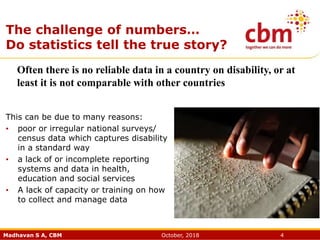
This can be due to many reasons:
• poor or irregular national surveys/
census data which captures disability
in a standard way
• a lack of or incomplete reporting
systems and data in health,
education and social services
• A lack of capacity or training on how
to collect and manage data
Often there is no reliable data in a country on disability, or at
least it is not comparable with other countries
Madhavan S A, CBM October, 2018 5
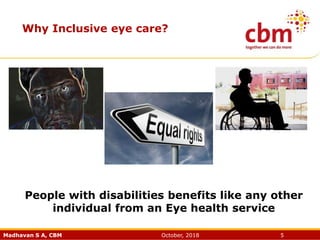
Why Inclusive eye care?
People with disabilities benefits like any other
individual from an Eye health service
Madhavan S A, CBM October, 2018 6
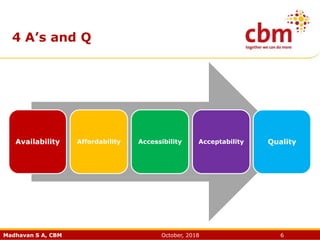
4 A’s and Q
Availability Affordability Accessibility Acceptability Quality
Madhavan S A, CBM October, 2018 7
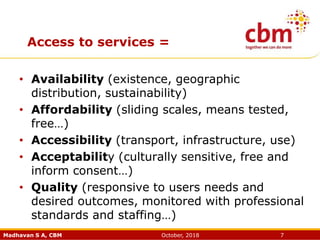
Access to services =
• Availability (existence, geographic
distribution, sustainability)
• Affordability (sliding scales, means tested,
free…)
• Accessibility (transport, infrastructure, use)
• Acceptability (culturally sensitive, free and
inform consent…)
• Quality (responsive to users needs and
desired outcomes, monitored with professional
standards and staffing…)
Madhavan S A, CBM October, 2018 8
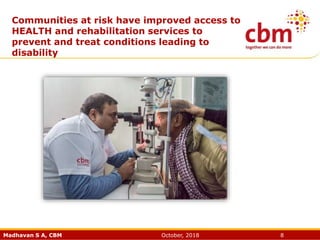
Communities at risk have improved access to
HEALTH and rehabilitation services to
prevent and treat conditions leading to
disability
Madhavan S A, CBM October, 2018 9
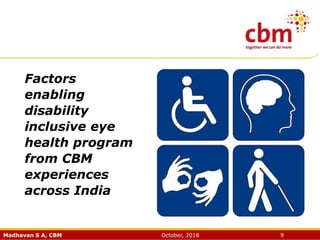
Factors
enabling
disability
inclusive eye
health program
from CBM
experiences
across India
Madhavan S A, CBM October, 2018 10
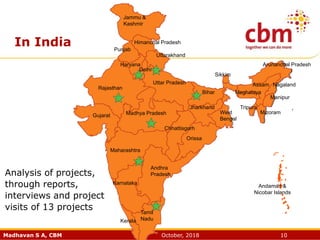
In India
Delhi
Meghalaya
Tamil
Nadu
Andaman &
Nicobar Islands
Jammu &
Kashmir
Himanchal Pradesh
Punjab
Haryana
Uttarakhand
Rajasthan
Uttar Pradesh
Madhya PradeshGujarat
Chhattisgarh
Orissa
Jharkhand
Bihar
West
Bengal
Sikkim
Mizoram
Arunanchal Pradesh
Assam Nagaland
Manipur
Tripura
Karnataka
Maharashtra
Andhra
Pradesh
Kerala
Analysis of projects,
through reports,
interviews and project
visits of 13 projects
Madhavan S A, CBM October, 2018 11
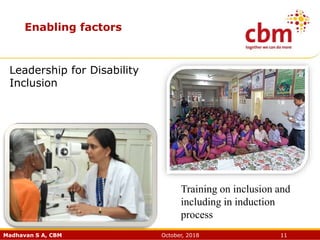
Enabling factors
Leadership for Disability
Inclusion
Training on inclusion and
including in induction
process
Madhavan S A, CBM October, 2018 12
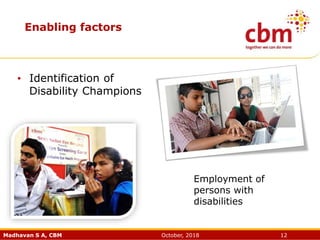
• Identification of
Disability Champions
Employment of
persons with
disabilities
Enabling factors
Madhavan S A, CBM October, 2018 13
Identifying rehabilitation
and other service
providers in the
community for people
with incurable visual
impairment
Enabling factors
Madhavan S A, CBM October, 2018 14
Factors which
hinder
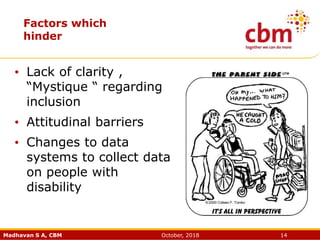
• Lack of clarity ,
“Mystique “ regarding
inclusion
• Attitudinal barriers
• Changes to data
systems to collect data
on people with
disability
Madhavan S A, CBM October, 2018 15
• Costs of making
institutions
accessible
Factors which
hinder
Madhavan S A, CBM October, 2018 16
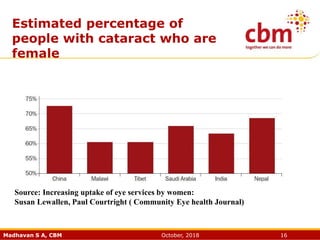
Estimated percentage of
people with cataract who are
female
Source: Increasing uptake of eye services by women:
Susan Lewallen, Paul Courtright ( Community Eye health Journal)
Madhavan S A, CBM October, 2018 17
Why gender in eye health
• Do not actively
participate
• Exclusion, gender
bias
• Childhood barriers
to education
• Vulnerability
Madhavan S A, CBM October, 2018 18
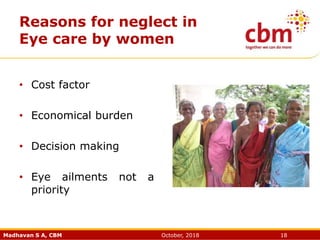
Reasons for neglect in
Eye care by women
• Cost factor
• Economical burden
• Decision making
• Eye ailments not a
priority
Madhavan S A, CBM October, 2018 19
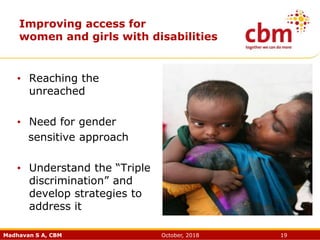
Improving access for
women and girls with disabilities
• Reaching the
unreached
• Need for gender
sensitive approach
• Understand the “Triple
discrimination” and
develop strategies to
address it
Madhavan S A, CBM October, 2018 20
Practical Tips:
• Consultation with women with disabilities
• Raise awareness among staff and collaborators
• Appoint a coordinator for disability inclusion
• Employ women with a disability
• Disaggregated data collection and analysis
• Develop networks and two-way referral
(Thanks to Joanne Webber, Chelsea Huggett, and CBM partners in India and
Cambodia.)
Madhavan S A, CBM October, 2018 21
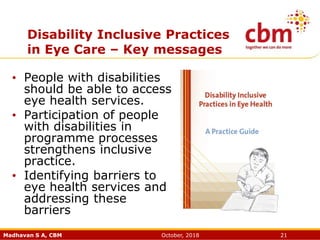
Disability Inclusive Practices
in Eye Care – Key messages
• People with disabilities
should be able to access
eye health services.
• Participation of people
with disabilities in
programme processes
strengthens inclusive
practice.
• Identifying barriers to
eye health services and
addressing these
barriers
Madhavan S A, CBM October, 2018 22
Disability Inclusive Practices
in Eye Care – Key messages
• Referral pathways to
disability services
• Counseling of people
with incurable blindness
and delivery of a
minimum level of
information on diagnosis
• Consider the specific
needs of women and
children with disabilities
Madhavan S A, CBM October, 2018 23
Ensuring equal access to eye care
services for persons with disabilities
require advocacy at all levels
• National Level
• State/District Level
• Community level
Advocacy
Madhavan S A, CBM October, 2018 24
National level
Advocacy should be focused on the following:
• Getting decision makers to acknowledge that there are
gender differences to eye care
• Persuading decision makers to increase access to eye
care for all
• Ensure data collection on the basis of gender
disaggregated disability data
Madhavan S A, CBM October, 2018 25
District level
• Generate local evidence
• In depth interviews with both men and women including
persons with disabilities
• Inform District health authorities and NGOs about the
importance of being sensitive to the needs of persons
with disabilities
Madhavan S A, CBM October, 2018 26
Community Level
• Advocacy targeted at both community members and
eye care service providers
• Poor families need to make difficult decisions about
prioritizing their health
• “To reach women you need to reach men”
Madhavan S A, CBM October, 2018 27
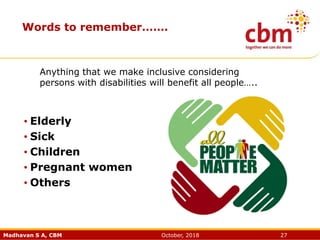
Words to remember…….
• Elderly
• Sick
• Children
• Pregnant women
• Others
Anything that we make inclusive considering
persons with disabilities will benefit all people…..
Madhavan S A, CBM October, 2018 28
Story of change
“You cannot have a baby”, those were the words of the first
gynecologist I visited few months after I got married. I was so
confused. Why wouldn’t I be able to have a baby? I am physically
disabled, but I have no medical reason not to. I faced a lot of
challenges either because of bad attitude of nurses or doctors
questioning my eligibility to be a mother or the inaccessible
medical facilities, whether it is the entrances, bathrooms,
examinations beds etc. I am now a mother of a 5 year old boy
which is one of the best things that ever happened to me, but I
keep thinking why did it end up to be a luxury thing while it is a
right? Why was I only able to do it when I had the money to go to
a better medical care system?”
Meena (name changed)
Madhavan S A, CBM October, 2018 29
Thank You!!
Future is inclusive

Lion sight first conclave madhavan

  • 1.
    Madhavan S A,CBM October, 2018 1 Future is Inclusive Madhavan SA Senior Programme Officer CBM South Asia Regional Office
  • 2.
    Madhavan S A,CBM October, 2018 2 About CBM CBM Vision Statement An inclusive world in which all persons with disabilities enjoy their human rights and achieve their full potential. CBM Mission Statement CBM is an international Christian development organisation, committed to improving the quality of life of Persons with Disabilities in the poorest countries of the world.
  • 3.
    Madhavan S A,CBM October, 2018 3 • Over a billion people, about 15% of the world’s population, have some form of disability. • 1 in 5 people, 20% of the population of the poorest people in developing countries have a disability. • 80% of people with disabilities live in developing countries. • Children with a disability are much less likely to attend school than children without disability. The gap in primary school attendance rates between disabled and non-disabled children ranges from 10% in India to 60% in Indonesia. • Only 20% of women with disabilities in low income countries are employed compared with 58% of men with disabilities. • People with disabilities are at greater risk of violence: up to 4 – 10 times the rate of violence against people without disabilities. Disability Facts
  • 4.
    Madhavan S A,CBM October, 2018 4 The challenge of numbers… Do statistics tell the true story? This can be due to many reasons: • poor or irregular national surveys/ census data which captures disability in a standard way • a lack of or incomplete reporting systems and data in health, education and social services • A lack of capacity or training on how to collect and manage data Often there is no reliable data in a country on disability, or at least it is not comparable with other countries
  • 5.
    Madhavan S A,CBM October, 2018 5 Why Inclusive eye care? People with disabilities benefits like any other individual from an Eye health service
  • 6.
    Madhavan S A,CBM October, 2018 6 4 A’s and Q Availability Affordability Accessibility Acceptability Quality
  • 7.
    Madhavan S A,CBM October, 2018 7 Access to services = • Availability (existence, geographic distribution, sustainability) • Affordability (sliding scales, means tested, free…) • Accessibility (transport, infrastructure, use) • Acceptability (culturally sensitive, free and inform consent…) • Quality (responsive to users needs and desired outcomes, monitored with professional standards and staffing…)
  • 8.
    Madhavan S A,CBM October, 2018 8 Communities at risk have improved access to HEALTH and rehabilitation services to prevent and treat conditions leading to disability
  • 9.
    Madhavan S A,CBM October, 2018 9 Factors enabling disability inclusive eye health program from CBM experiences across India
  • 10.
    Madhavan S A,CBM October, 2018 10 In India Delhi Meghalaya Tamil Nadu Andaman & Nicobar Islands Jammu & Kashmir Himanchal Pradesh Punjab Haryana Uttarakhand Rajasthan Uttar Pradesh Madhya PradeshGujarat Chhattisgarh Orissa Jharkhand Bihar West Bengal Sikkim Mizoram Arunanchal Pradesh Assam Nagaland Manipur Tripura Karnataka Maharashtra Andhra Pradesh Kerala Analysis of projects, through reports, interviews and project visits of 13 projects
  • 11.
    Madhavan S A,CBM October, 2018 11 Enabling factors Leadership for Disability Inclusion Training on inclusion and including in induction process
  • 12.
    Madhavan S A,CBM October, 2018 12 • Identification of Disability Champions Employment of persons with disabilities Enabling factors
  • 13.
    Madhavan S A,CBM October, 2018 13 Identifying rehabilitation and other service providers in the community for people with incurable visual impairment Enabling factors
  • 14.
    Madhavan S A,CBM October, 2018 14 Factors which hinder • Lack of clarity , “Mystique “ regarding inclusion • Attitudinal barriers • Changes to data systems to collect data on people with disability
  • 15.
    Madhavan S A,CBM October, 2018 15 • Costs of making institutions accessible Factors which hinder
  • 16.
    Madhavan S A,CBM October, 2018 16 Estimated percentage of people with cataract who are female Source: Increasing uptake of eye services by women: Susan Lewallen, Paul Courtright ( Community Eye health Journal)
  • 17.
    Madhavan S A,CBM October, 2018 17 Why gender in eye health • Do not actively participate • Exclusion, gender bias • Childhood barriers to education • Vulnerability
  • 18.
    Madhavan S A,CBM October, 2018 18 Reasons for neglect in Eye care by women • Cost factor • Economical burden • Decision making • Eye ailments not a priority
  • 19.
    Madhavan S A,CBM October, 2018 19 Improving access for women and girls with disabilities • Reaching the unreached • Need for gender sensitive approach • Understand the “Triple discrimination” and develop strategies to address it
  • 20.
    Madhavan S A,CBM October, 2018 20 Practical Tips: • Consultation with women with disabilities • Raise awareness among staff and collaborators • Appoint a coordinator for disability inclusion • Employ women with a disability • Disaggregated data collection and analysis • Develop networks and two-way referral (Thanks to Joanne Webber, Chelsea Huggett, and CBM partners in India and Cambodia.)
  • 21.
    Madhavan S A,CBM October, 2018 21 Disability Inclusive Practices in Eye Care – Key messages • People with disabilities should be able to access eye health services. • Participation of people with disabilities in programme processes strengthens inclusive practice. • Identifying barriers to eye health services and addressing these barriers
  • 22.
    Madhavan S A,CBM October, 2018 22 Disability Inclusive Practices in Eye Care – Key messages • Referral pathways to disability services • Counseling of people with incurable blindness and delivery of a minimum level of information on diagnosis • Consider the specific needs of women and children with disabilities
  • 23.
    Madhavan S A,CBM October, 2018 23 Ensuring equal access to eye care services for persons with disabilities require advocacy at all levels • National Level • State/District Level • Community level Advocacy
  • 24.
    Madhavan S A,CBM October, 2018 24 National level Advocacy should be focused on the following: • Getting decision makers to acknowledge that there are gender differences to eye care • Persuading decision makers to increase access to eye care for all • Ensure data collection on the basis of gender disaggregated disability data
  • 25.
    Madhavan S A,CBM October, 2018 25 District level • Generate local evidence • In depth interviews with both men and women including persons with disabilities • Inform District health authorities and NGOs about the importance of being sensitive to the needs of persons with disabilities
  • 26.
    Madhavan S A,CBM October, 2018 26 Community Level • Advocacy targeted at both community members and eye care service providers • Poor families need to make difficult decisions about prioritizing their health • “To reach women you need to reach men”
  • 27.
    Madhavan S A,CBM October, 2018 27 Words to remember……. • Elderly • Sick • Children • Pregnant women • Others Anything that we make inclusive considering persons with disabilities will benefit all people…..
  • 28.
    Madhavan S A,CBM October, 2018 28 Story of change “You cannot have a baby”, those were the words of the first gynecologist I visited few months after I got married. I was so confused. Why wouldn’t I be able to have a baby? I am physically disabled, but I have no medical reason not to. I faced a lot of challenges either because of bad attitude of nurses or doctors questioning my eligibility to be a mother or the inaccessible medical facilities, whether it is the entrances, bathrooms, examinations beds etc. I am now a mother of a 5 year old boy which is one of the best things that ever happened to me, but I keep thinking why did it end up to be a luxury thing while it is a right? Why was I only able to do it when I had the money to go to a better medical care system?” Meena (name changed)
  • 29.
    Madhavan S A,CBM October, 2018 29 Thank You!! Future is inclusive

Editor's Notes

  • #5 Tip: Good to highlight that often prevalence rates appear higher in Developed countries – but this is not the case- just that there is systematic and higher reporting and motivation to report. Perhaps ask would you bother to register for a disability card if it did not come with services and opportunities?
  • #17  This statistics is derived from population-based surveys in several countries and shows that 60 to 65 per cent of those blind from cataract are female. This is partly because women live longer than men and thus are more likely to develop cataract. In addition, women have been shown to have a slightly increased ageadjusted risk of cataract.2 Cataract blindness, however, can be cured, or even prevented if the operation is done early enough, and herein lies the crucial imbalance: women do not receive cataract surgery at the same rate as men. ( source quoted)
  • #18 Women do not frequently & actively participate in development programs leaving their perspective and voices unheard. Exclusion coupled with gender-biased practices, reinforce this invisibility and marginalisation Childhood barriers to education and social inclusion leave them with very few viable and meaningful work choices later in life. More vulnerable to Poverty, gender-based violence and barriers to reproductive health care.
  • #19 Women access eye care facilities only when it is free of cost Economical burden prevents women from accessing health care overall & specially eye care services Women do not have the decision making power to treat their eye ailments. Eye ailments not a priority for women themselves and by others within the family as there are other “ bigger” priorities to take care
  • #20 Nearly all eye health programmes strive to reach the most marginalised people. They also seek to be gender sensitive, ensuring equal access for all people. Women and girls with disabilities(including those with impaired vision) are some of the most marginalised people, as they face the triple discrimination of being female, having an impairment,and being among the poorest.
  • #21 Consultation with women with disabilities to identify what is blocking their access to eye care, and to talk about how best to overcome these barriers taking a bottom up approach Raise awareness among staff and collaborators about the impact of disability on women and girls and work together to address barriers Appoint a coordinator for disability inclusion, who understands gender sensitive practice (part-time or full-time) to ensure the action plan is developed and acted upon Employ women with a disability in your programme to ensure “ Inclusion” Collect and analyse data by gender, age, and disability, for example by using the Washington Group self-reporting questions. Develop networks and two-way referral between your programme and primary health care, rehabilitation, education, and DPOs. Ensure that women and girls with disabilities who cannot be assisted through medical intervention are referred to other services, such as education, rehabilitation, livelihood, social inclusion and health services.
  • #22 From the manual