SICKLE CELL DISEASE
/ANAEMIA
Mwenya Joseph Musesha
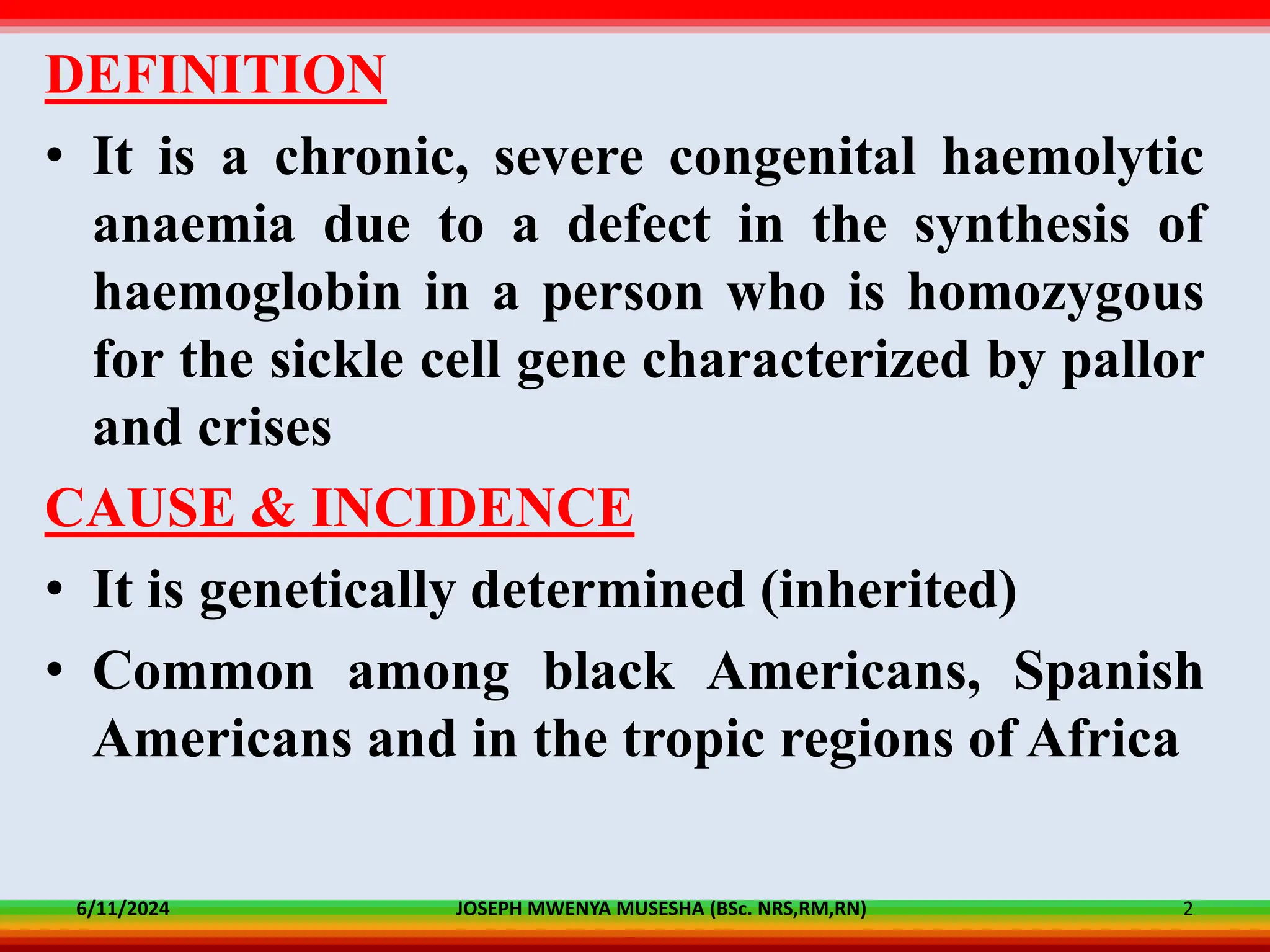
DEFINITION
• It is a chronic, severe congenital haemolytic
anaemia due to a defect in the synthesis of
haemoglobin in a person who is homozygous
for the sickle cell gene characterized by pallor
and crises
CAUSE & INCIDENCE
• It is genetically determined (inherited)
• Common among black Americans, Spanish
Americans and in the tropic regions of Africa
6/11/2024 JOSEPH MWENYA MUSESHA (BSc. NRS,RM,RN) 2
• Difficult to diagnose Sickle cell anaemia in
neonates even when they are sickle cell
homozygous, the foetal haemoglobin (HbF)
has no beta chain.
• As the neonate grows, HbF is replaced by
adult Hb (HbA) and the problems start to
manifest.
6/11/2024 JOSEPH MWENYA MUSESHA (BSc. NRS,RM,RN) 3
PATHOPHYSIOLOGY
• Each molecule of haemoglobin is made up of
four molecules of heme folded in one
molecule of globin
• Each molecule of globin consists two alpha
(α) and two beta (β) chains.
• Each alpha chain consists 141 amino acids
while the beta chain consists 136 amino acid
residuals in an adult normal haemoglobin
6/11/2024 JOSEPH MWENYA MUSESHA (BSc. NRS,RM,RN) 4
• In sickle cell the defect is that on position
number six (6) in the beta chain, instead of
having Glutamic acid, there is Valine.
• This causes the red blood cell membrane to
become unstable and fragile.
• Normal RBCs are supposed to die after 120
days but in this case they only live for 26 to 40
days
• At the same time the Oxygen carrying
capacity of these HbS molecules is reduced
6/11/2024 JOSEPH MWENYA MUSESHA (BSc. NRS,RM,RN) 5
6/11/2024 JOSEPH MWENYA MUSESHA (BSc. NRS,RM,RN) 6
• Normal Hb is usually stable under different
conditions.
• However, with sickle haemoglobin (HbS),
whenever oxygen tension is reduced (hypoxic
conditions) such as dehydration, high altitude
and exhaustion due to exercises, the
haemoglobin or the red blood cells change
shape and become more fragile.
• When HbS is deoxygenated, its molecules
polymerize to form long pseudo crystals which
distort RBCs’ membranes making it more
fragile
6/11/2024 JOSEPH MWENYA MUSESHA (BSc. NRS,RM,RN) 7
• The cells change shapes from the disc-like
biconcave to sickle shaped.
• Blood becomes thick, sticky and heavy leading
to blockage of capillaries
• This causes anoxia, ischaemia which further
worsens the condition with characteristic
myalgia, arthralgia with spontaneous
haemolysis
• The client experiences intraoseous pain and
pain in the visceral organs as a result of
entanglement of RBCs in vessels supplying
these organs.
6/11/2024 JOSEPH MWENYA MUSESHA (BSc. NRS,RM,RN) 8
• In an attempt to compensate haemolysis,
erythropoesis increases putting a burden on the
already affected bone morrow, spleen and liver.
• As a result there is bossing (enlargement) of
bones & hepato-splenomegaly.
• Hepato-splenomegaly develops as a result of
sequestration of large numbers of dying
RBCs.
• Bossing of bones comes about due to over
work of the bone marrow in cell producing
bones.
6/11/2024 JOSEPH MWENYA MUSESHA (BSc. NRS,RM,RN) 9
SICKLE CELL TRAIT
• An individual who is sickle cell gene
heterozygous
• The parents could either be both traits or one
is a trait while the other has normal genes
• The client is asymptomatic except in stressful
conditions with severe hypoxia.
• The trait individual is also referred to as a
sickle cell carrier. They have HbAs
6/11/2024 JOSEPH MWENYA MUSESHA (BSc. NRS,RM,RN) 10
TRANSMISION
• If one parent has normal HbA and the other
has abnormal HbAs which is a carrier
(trait), the chances of transmission to their
offsprings are: 50% carriers and 50%
normal
• If all the parents are carriers, they are likely
to have:
1) 25% sicklers
2) 25% normal
3) 50% carriers
6/11/2024 JOSEPH MWENYA MUSESHA (BSc. NRS,RM,RN) 11
• If both parents are sicklers, they will have all
(100% sicklers) their children sicklers
• If one of the parents is normal while the
other one is a sickler, they will have only
carrier children (100% traits)
6/11/2024 JOSEPH MWENYA MUSESHA (BSc. NRS,RM,RN) 12
6/11/2024 JOSEPH MWENYA MUSESHA (BSc. NRS,RM,RN) 13
CARRIER
NONCARRIER SICKLER
CARRIER
CARRIER CARRIER
CARRIER CARRIER NONCARRIER
NONCARRIER
NONCARRIER
CARRIER
CLINICAL FEATURES
• Sickle cells have short life span, stick together
and occlude small blood vessels resulting in a
number of syndromes called sickle cell crises
(singular = sickle cell crisis)
• Other features however are diagnostically
present even when one is not in any crisis.
1) Short torso as compared to legs and arms
2) Spider-like burrow chest
3) Pallor due to reduced O2 tissue perfusion resulting
from severe haemolysis
4) Oedema due to reduced oncotic pressure as a
result of reduced blood protein
6/11/2024 JOSEPH MWENYA MUSESHA (BSc. NRS,RM,RN) 14
5) Jaundice due to severe haemolysis
6) Haematuria due to rapture of capillaries as a
result of ischaemia
7) Chronic ulcers especially on legs due to
ischaemia to the extremities
8) Bossing of bones (of the head and heads of
long bones)
9) Delayed puberty with decreased fertility
10) Chronic fatigue due to hypoxia
11) Chronic arthralgia (joint pains)
12) Retarded growth
6/11/2024 JOSEPH MWENYA MUSESHA (BSc. NRS,RM,RN) 15
13)Susceptibility to infection due to outo-
splenectomy
14) Bone destruction
15)Susceptibility to cerebral vascular accidents
(CVAs)/stroke due to frequent attacks of
cerebral Ischaemia
16) Paresis
17) Blindness
18) Sickle cell crisis presentation
6/11/2024 JOSEPH MWENYA MUSESHA (BSc. NRS,RM,RN) 16
6/11/2024 JOSEPH MWENYA MUSESHA (BSc. NRS,RM,RN) 17
SICKLE CELL CRISIS (Plural = CRISES)
• A crisis is an episode of attack characterized by
severe abdominal pains, joint pains, dyspnoea,
signs of hypoxia and myalgia
• There is abdominal rigidity with board-like
consistency and no bowel sounds
• There is priapism in young men due to occlusion
of penile blood vessels
• There is arthralgia
• Deep yellow urine due to massive haemolysis
• The bones become painful
• There is fever (>38.8 to 40°C) due to increased
metabolism/superimposed infections
6/11/2024 JOSEPH MWENYA MUSESHA (BSc. NRS,RM,RN) 18
• Pallor, muscular spasms, swelling of joints,
backache, irritability, worsening jaundice and
anorexia
• There are four major sickle cell crises.
6/11/2024 JOSEPH MWENYA MUSESHA (BSc. NRS,RM,RN) 19
1-Vaso-oclussive (VOC) or Thrombotic crisis: -
it is a very painful crisis and is the wall mark of
SCD.
• It is the most common crisis
• It is characterized by plugging of capillaries
supplying tissues such as the bones &
abdominal organs by sticky, sickle shaped
RBCs.
• This causes ischaemia & severe pain in these
tissues/organs.
• The patient may develop tachycardia and
sweating.
6/11/2024 JOSEPH MWENYA MUSESHA (BSc. NRS,RM,RN) 20
• There is severe haemolysis and it is
sometimes called haemolytic
• Because of occlusion of visceral blood vessels,
there is severe abdominal pain as well.
• There is severe haemolysis of RBCs.
• This causes further deterioration of the
condition with characteristics ventilation
failure
• It is the common cause of adult deaths in
sickle disease
6/11/2024 JOSEPH MWENYA MUSESHA (BSc. NRS,RM,RN) 21
2-Acute Splenic sequestration crisis: -it usually
occurs in children between 8 and 12 months.
• There is sudden entrapment of RBCs in the
spleen and liver.
• Blood outflow from these tissues is blocked
causing pooling if RBCs in them.
• These organs enlarge and become painful
• There is also pallor, circulatory collapse
(shock)
• Priapism is a common complication because
of blood entrapment in the penis tissues.
6/11/2024 JOSEPH MWENYA MUSESHA (BSc. NRS,RM,RN) 22
• 3-Aplastic crisis: -this one results from bone
marrow depression.
• Infection with some viruses like the parvovirus
result in severe self limiting red cell aplasia.
• There is very low haemoglobin production
which may cause heart failure.
• 4-Sickle chest syndrome: -it may follow a vaso-
occlusive crisis and develops as a result of bone
marrow infarction resulting in fat emboli in the
lungs.
6/11/2024 JOSEPH MWENYA MUSESHA (BSc. NRS,RM,RN) 23
• Pulmonary oedema ensues with
characteristic dyspnoea
• 5-Haemolytic crisis: -there is massive
destruction of RBCs because of reduced
supply of Oxygen and nutrients caused by
blockage of small blood vessels. It is
characterized by severe jaundice and pallor
6/11/2024
JOSEPH MWENYA MUSESHA (BSc.
NRS,RM,RN)
24
FACORS PREDISPOSING TO A CRISIS
All hypoxic conditions such as:
• Stress
• Dehydration
• High altitude
• Pregnancy and labour
• Exposure to cold weather
• Trauma
• Active exercise
• Infections
6/11/2024 JOSEPH MWENYA MUSESHA (BSc. NRS,RM,RN) 25
DIAGNOSIS
• Clinical presentation: the client will show some
characteristics of sickle cell anaemia
• Thin blood film viewed under high beam
electronic microscope will demonstrate sickle
cells
• Sickling test: When RBCs are exposed to
reducing agents like sodium dithionite; HbA
will give a clear solution while HbS polymerizes
and produce a turbid solution. It forms the
basis of emergency diagnosis
6/11/2024 JOSEPH MWENYA MUSESHA (BSc. NRS,RM,RN) 26
• But does not distinguish between a trait and
someone with SCD
• A definitive diagnosis is achieved by Hb
electrophoresis to demonstrate the absence
HbA, some HbF (10-20%) and predominance of
HbS
• Chest X-ray
Differential diagnosis include;
• -Antistreptolysin O titer (ASOT) to rule out
rheumatic fever
• -Blood slide for Malaria parasites (BS for MPs)
6/11/2024 JOSEPH MWENYA MUSESHA (BSc. NRS,RM,RN) 27
MANAGEMENT
• There is no specific chemotherapy for sickle
cell disease.
• The management approach will be
symptomatic and will include;
• -Folic acid daily to promote haemopoesis
• -Antibiotics like Pen V to prevent
Pneumococcal infections
• -Pain relief with NSAIDs but Opiates in crisis
• -Patient should be immunized against Hepatitis
B, Haemophilus Influenza B and meningococci
6/11/2024 JOSEPH MWENYA MUSESHA (BSc. NRS,RM,RN) 28
• Other treatment modalities include
• -Blood transfusion to suppress production of
HbS ad maintain circulating HbS below 30%
• -Aggressive rehydration
• -Oxygen therapy
• -Bone marrow transplant.
• -Exchange transfusion may be done
6/11/2024 JOSEPH MWENYA MUSESHA (BSc. NRS,RM,RN) 29
NURSING MANAGEMENT OF A CRISIS
• The focus is to relieve pain
• To improve oxygenation
• To prevent ischaemia and necrosis
• The patient should be isolated from other
patients because he/she is susceptible to
infections (reverse isolation).
• Ensure that the room is clean and quiet to
promote rest and comfort to prevent exertion
by reducing the BMR and O2 demand.
6/11/2024 JOSEPH MWENYA MUSESHA (BSc. NRS,RM,RN) 30
• The patient should maintain a position in
which he/she is comfortable.
• However, if there is pulmonary oedema
evidenced by dyspnoea, the patient should be
propped up in fowler’s position
• Pillows must be placed wherever there is need
for protection esp. the bone eminences which
easily develop pressure ulcers.
PAIN
• Give analgesia and keep the room warm to
relieve pain
6/11/2024 JOSEPH MWENYA MUSESHA (BSc. NRS,RM,RN) 31
• Aspirin is not recommended because it is likely
to cause acidosis which further deteriorates the
condition.
• However, because of its haemodilution ability,
some practitioners recommend it over
Paracetamol
• Give warm fluids to drink and apply warm
compresses on affected body parts to reduce
muscle spasms
• Tell the patient not to cross legs when sitting or
sleeping to prevent vaso-occlusion
6/11/2024 JOSEPH MWENYA MUSESHA (BSc. NRS,RM,RN) 32
SUPPORTIVE THERAPY
• Administer Oxygen in case of respiratory
difficulties to facilitate tissue oxygen perfusion.
• If sickling period hasn’t prolonged, the sickle
shape of RBCs may be reversed with adequate
oxygenation
• Oxygen also helps to buffer the acidosis
• Give folic acid to improve blood cell count and
quality
• Do not give FeSO4 because iron is already in
circulation from lysing RBCs
6/11/2024 JOSEPH MWENYA MUSESHA (BSc. NRS,RM,RN) 33
• Give a lot of fluids orally or IV to promote
haemodilution thereby relieving agglutination
of RBCs. Warm fluids are preferred.
• Do not give diuretics because patient may loose
a lot of fluids leading to dehydration which can
worsen the condition
• Transfuse blood to relieve pallor, lethargy and
improve oxygen delivery to tissues
• In severe cases, spleenectomy may be
performed to avoid sequestration/haemolysis
and save patient’s life
6/11/2024 JOSEPH MWENYA MUSESHA (BSc. NRS,RM,RN) 34
• Psychological care: explain to the patient and
the caretakers that the disease is lifelong and
the patient will require full support from the
family.
• To allay anxiety in the patient and caretakers
• Answer questions as asked and refer those you
do not know
• Invite religious leaders to provide spiritual
counseling.
• Encourage relatives/significant others to
reassure the patient
6/11/2024 JOSEPH MWENYA MUSESHA (BSc. NRS,RM,RN) 35
• Observations: observe pain severity and
affected area.
• Patient’s expression and vabalisation will help.
Manage pain as presented. The patient feels the
pain while you are just told. Do not under rate
it.
• Observe for the worsening or resolving of
jaundice. With proper management it should
start to resolve within some days.
• Observe for signs of electrolyte imbalance and
acidosis such as delirium and lethargy
6/11/2024 JOSEPH MWENYA MUSESHA (BSc. NRS,RM,RN) 36
• Observe for cyanosis and pallor
• Observe for the signs of dehydration like dry
skin
• Nutrition: during a crisis attack, nutrition is
given parentally because oral feeding may be
tiresome to the already weak client
• Vitamin A and C are administered to prevent
blindness and boost up the immunity
• Give a high roughage diet to avoid constipation
• Give multivitamins as well.
6/11/2024 JOSEPH MWENYA MUSESHA (BSc. NRS,RM,RN) 37
• Exercises: assist with passive non exhausting
exercises while the patient is still in bed.
Exercises like finger clenching and release after
resuscitation
6/11/2024 JOSEPH MWENYA MUSESHA (BSc. NRS,RM,RN) 38
COMPLICATIONS
• Chronic leg ulcers due to peripheral ischaemia
• Frequent infections due to reduced immunity
• Frequent attacks of ischaemic cerebral vascular
accidents due to wide spread cerebral ischaemias and/or
haemorrhages
• Outosplenectomy due to blockage of blood flow from the
spleen cutting it off from the system
• Dehydration
• Decreased fertility
• IUFDs, still births and abortions in females
• Bone damage (Osteoporosis)
• Cardiomegally and cardiac failure
• Blindness
• Renal stones
6/11/2024 JOSEPH MWENYA MUSESHA (BSc. NRS,RM,RN) 39
INFORMATION EDUCATION &
COMMUNICATION
• Teach the client and care taker how to detect a
crisis by explaining the signs and symptoms of
a crisis
• Tell the client/care taker that client should
avoid exposure to cold weather at all cost.
Should wear warm clothes and always carry a
hot water flask.
• If the client is a female, explain also that
pregnancy and labour can worsen the
condition and result in death
6/11/2024 JOSEPH MWENYA MUSESHA (BSc. NRS,RM,RN) 40
• Encourage the client and care taker to seek
medical advice early whenever the client starts
developing signs of infection regardless of type
• Inform the client/caretaker that the client
should maintain good hydration at all costs to
prevent bloody from concentration and
becoming sticky
• Maintain hygiene to prevent infections
• Counsel couples wanting to marry (they should
know whether the partner is trait or sickler).
Educate them on the condition and the chances
of transmitting the disease to offsprings
6/11/2024 JOSEPH MWENYA MUSESHA (BSc. NRS,RM,RN) 41
END OF
LECTURE
6/11/2024
JOSEPH MWENYA MUSESHA (BSc.
NRS,RM,RN)
42

SICKLE CELL ANAEMIA ,TYPES AND MANAGEMENT

  • 1.
  • 2.
    DEFINITION • It isa chronic, severe congenital haemolytic anaemia due to a defect in the synthesis of haemoglobin in a person who is homozygous for the sickle cell gene characterized by pallor and crises CAUSE & INCIDENCE • It is genetically determined (inherited) • Common among black Americans, Spanish Americans and in the tropic regions of Africa 6/11/2024 JOSEPH MWENYA MUSESHA (BSc. NRS,RM,RN) 2
  • 3.
    • Difficult todiagnose Sickle cell anaemia in neonates even when they are sickle cell homozygous, the foetal haemoglobin (HbF) has no beta chain. • As the neonate grows, HbF is replaced by adult Hb (HbA) and the problems start to manifest. 6/11/2024 JOSEPH MWENYA MUSESHA (BSc. NRS,RM,RN) 3
  • 4.
    PATHOPHYSIOLOGY • Each moleculeof haemoglobin is made up of four molecules of heme folded in one molecule of globin • Each molecule of globin consists two alpha (α) and two beta (β) chains. • Each alpha chain consists 141 amino acids while the beta chain consists 136 amino acid residuals in an adult normal haemoglobin 6/11/2024 JOSEPH MWENYA MUSESHA (BSc. NRS,RM,RN) 4
  • 5.
    • In sicklecell the defect is that on position number six (6) in the beta chain, instead of having Glutamic acid, there is Valine. • This causes the red blood cell membrane to become unstable and fragile. • Normal RBCs are supposed to die after 120 days but in this case they only live for 26 to 40 days • At the same time the Oxygen carrying capacity of these HbS molecules is reduced 6/11/2024 JOSEPH MWENYA MUSESHA (BSc. NRS,RM,RN) 5
  • 6.
    6/11/2024 JOSEPH MWENYAMUSESHA (BSc. NRS,RM,RN) 6
  • 7.
    • Normal Hbis usually stable under different conditions. • However, with sickle haemoglobin (HbS), whenever oxygen tension is reduced (hypoxic conditions) such as dehydration, high altitude and exhaustion due to exercises, the haemoglobin or the red blood cells change shape and become more fragile. • When HbS is deoxygenated, its molecules polymerize to form long pseudo crystals which distort RBCs’ membranes making it more fragile 6/11/2024 JOSEPH MWENYA MUSESHA (BSc. NRS,RM,RN) 7
  • 8.
    • The cellschange shapes from the disc-like biconcave to sickle shaped. • Blood becomes thick, sticky and heavy leading to blockage of capillaries • This causes anoxia, ischaemia which further worsens the condition with characteristic myalgia, arthralgia with spontaneous haemolysis • The client experiences intraoseous pain and pain in the visceral organs as a result of entanglement of RBCs in vessels supplying these organs. 6/11/2024 JOSEPH MWENYA MUSESHA (BSc. NRS,RM,RN) 8
  • 9.
    • In anattempt to compensate haemolysis, erythropoesis increases putting a burden on the already affected bone morrow, spleen and liver. • As a result there is bossing (enlargement) of bones & hepato-splenomegaly. • Hepato-splenomegaly develops as a result of sequestration of large numbers of dying RBCs. • Bossing of bones comes about due to over work of the bone marrow in cell producing bones. 6/11/2024 JOSEPH MWENYA MUSESHA (BSc. NRS,RM,RN) 9
  • 10.
    SICKLE CELL TRAIT •An individual who is sickle cell gene heterozygous • The parents could either be both traits or one is a trait while the other has normal genes • The client is asymptomatic except in stressful conditions with severe hypoxia. • The trait individual is also referred to as a sickle cell carrier. They have HbAs 6/11/2024 JOSEPH MWENYA MUSESHA (BSc. NRS,RM,RN) 10
  • 11.
    TRANSMISION • If oneparent has normal HbA and the other has abnormal HbAs which is a carrier (trait), the chances of transmission to their offsprings are: 50% carriers and 50% normal • If all the parents are carriers, they are likely to have: 1) 25% sicklers 2) 25% normal 3) 50% carriers 6/11/2024 JOSEPH MWENYA MUSESHA (BSc. NRS,RM,RN) 11
  • 12.
    • If bothparents are sicklers, they will have all (100% sicklers) their children sicklers • If one of the parents is normal while the other one is a sickler, they will have only carrier children (100% traits) 6/11/2024 JOSEPH MWENYA MUSESHA (BSc. NRS,RM,RN) 12
  • 13.
    6/11/2024 JOSEPH MWENYAMUSESHA (BSc. NRS,RM,RN) 13 CARRIER NONCARRIER SICKLER CARRIER CARRIER CARRIER CARRIER CARRIER NONCARRIER NONCARRIER NONCARRIER CARRIER
  • 14.
    CLINICAL FEATURES • Sicklecells have short life span, stick together and occlude small blood vessels resulting in a number of syndromes called sickle cell crises (singular = sickle cell crisis) • Other features however are diagnostically present even when one is not in any crisis. 1) Short torso as compared to legs and arms 2) Spider-like burrow chest 3) Pallor due to reduced O2 tissue perfusion resulting from severe haemolysis 4) Oedema due to reduced oncotic pressure as a result of reduced blood protein 6/11/2024 JOSEPH MWENYA MUSESHA (BSc. NRS,RM,RN) 14
  • 15.
    5) Jaundice dueto severe haemolysis 6) Haematuria due to rapture of capillaries as a result of ischaemia 7) Chronic ulcers especially on legs due to ischaemia to the extremities 8) Bossing of bones (of the head and heads of long bones) 9) Delayed puberty with decreased fertility 10) Chronic fatigue due to hypoxia 11) Chronic arthralgia (joint pains) 12) Retarded growth 6/11/2024 JOSEPH MWENYA MUSESHA (BSc. NRS,RM,RN) 15
  • 16.
    13)Susceptibility to infectiondue to outo- splenectomy 14) Bone destruction 15)Susceptibility to cerebral vascular accidents (CVAs)/stroke due to frequent attacks of cerebral Ischaemia 16) Paresis 17) Blindness 18) Sickle cell crisis presentation 6/11/2024 JOSEPH MWENYA MUSESHA (BSc. NRS,RM,RN) 16
  • 17.
    6/11/2024 JOSEPH MWENYAMUSESHA (BSc. NRS,RM,RN) 17
  • 18.
    SICKLE CELL CRISIS(Plural = CRISES) • A crisis is an episode of attack characterized by severe abdominal pains, joint pains, dyspnoea, signs of hypoxia and myalgia • There is abdominal rigidity with board-like consistency and no bowel sounds • There is priapism in young men due to occlusion of penile blood vessels • There is arthralgia • Deep yellow urine due to massive haemolysis • The bones become painful • There is fever (>38.8 to 40°C) due to increased metabolism/superimposed infections 6/11/2024 JOSEPH MWENYA MUSESHA (BSc. NRS,RM,RN) 18
  • 19.
    • Pallor, muscularspasms, swelling of joints, backache, irritability, worsening jaundice and anorexia • There are four major sickle cell crises. 6/11/2024 JOSEPH MWENYA MUSESHA (BSc. NRS,RM,RN) 19
  • 20.
    1-Vaso-oclussive (VOC) orThrombotic crisis: - it is a very painful crisis and is the wall mark of SCD. • It is the most common crisis • It is characterized by plugging of capillaries supplying tissues such as the bones & abdominal organs by sticky, sickle shaped RBCs. • This causes ischaemia & severe pain in these tissues/organs. • The patient may develop tachycardia and sweating. 6/11/2024 JOSEPH MWENYA MUSESHA (BSc. NRS,RM,RN) 20
  • 21.
    • There issevere haemolysis and it is sometimes called haemolytic • Because of occlusion of visceral blood vessels, there is severe abdominal pain as well. • There is severe haemolysis of RBCs. • This causes further deterioration of the condition with characteristics ventilation failure • It is the common cause of adult deaths in sickle disease 6/11/2024 JOSEPH MWENYA MUSESHA (BSc. NRS,RM,RN) 21
  • 22.
    2-Acute Splenic sequestrationcrisis: -it usually occurs in children between 8 and 12 months. • There is sudden entrapment of RBCs in the spleen and liver. • Blood outflow from these tissues is blocked causing pooling if RBCs in them. • These organs enlarge and become painful • There is also pallor, circulatory collapse (shock) • Priapism is a common complication because of blood entrapment in the penis tissues. 6/11/2024 JOSEPH MWENYA MUSESHA (BSc. NRS,RM,RN) 22
  • 23.
    • 3-Aplastic crisis:-this one results from bone marrow depression. • Infection with some viruses like the parvovirus result in severe self limiting red cell aplasia. • There is very low haemoglobin production which may cause heart failure. • 4-Sickle chest syndrome: -it may follow a vaso- occlusive crisis and develops as a result of bone marrow infarction resulting in fat emboli in the lungs. 6/11/2024 JOSEPH MWENYA MUSESHA (BSc. NRS,RM,RN) 23
  • 24.
    • Pulmonary oedemaensues with characteristic dyspnoea • 5-Haemolytic crisis: -there is massive destruction of RBCs because of reduced supply of Oxygen and nutrients caused by blockage of small blood vessels. It is characterized by severe jaundice and pallor 6/11/2024 JOSEPH MWENYA MUSESHA (BSc. NRS,RM,RN) 24
  • 25.
    FACORS PREDISPOSING TOA CRISIS All hypoxic conditions such as: • Stress • Dehydration • High altitude • Pregnancy and labour • Exposure to cold weather • Trauma • Active exercise • Infections 6/11/2024 JOSEPH MWENYA MUSESHA (BSc. NRS,RM,RN) 25
  • 26.
    DIAGNOSIS • Clinical presentation:the client will show some characteristics of sickle cell anaemia • Thin blood film viewed under high beam electronic microscope will demonstrate sickle cells • Sickling test: When RBCs are exposed to reducing agents like sodium dithionite; HbA will give a clear solution while HbS polymerizes and produce a turbid solution. It forms the basis of emergency diagnosis 6/11/2024 JOSEPH MWENYA MUSESHA (BSc. NRS,RM,RN) 26
  • 27.
    • But doesnot distinguish between a trait and someone with SCD • A definitive diagnosis is achieved by Hb electrophoresis to demonstrate the absence HbA, some HbF (10-20%) and predominance of HbS • Chest X-ray Differential diagnosis include; • -Antistreptolysin O titer (ASOT) to rule out rheumatic fever • -Blood slide for Malaria parasites (BS for MPs) 6/11/2024 JOSEPH MWENYA MUSESHA (BSc. NRS,RM,RN) 27
  • 28.
    MANAGEMENT • There isno specific chemotherapy for sickle cell disease. • The management approach will be symptomatic and will include; • -Folic acid daily to promote haemopoesis • -Antibiotics like Pen V to prevent Pneumococcal infections • -Pain relief with NSAIDs but Opiates in crisis • -Patient should be immunized against Hepatitis B, Haemophilus Influenza B and meningococci 6/11/2024 JOSEPH MWENYA MUSESHA (BSc. NRS,RM,RN) 28
  • 29.
    • Other treatmentmodalities include • -Blood transfusion to suppress production of HbS ad maintain circulating HbS below 30% • -Aggressive rehydration • -Oxygen therapy • -Bone marrow transplant. • -Exchange transfusion may be done 6/11/2024 JOSEPH MWENYA MUSESHA (BSc. NRS,RM,RN) 29
  • 30.
    NURSING MANAGEMENT OFA CRISIS • The focus is to relieve pain • To improve oxygenation • To prevent ischaemia and necrosis • The patient should be isolated from other patients because he/she is susceptible to infections (reverse isolation). • Ensure that the room is clean and quiet to promote rest and comfort to prevent exertion by reducing the BMR and O2 demand. 6/11/2024 JOSEPH MWENYA MUSESHA (BSc. NRS,RM,RN) 30
  • 31.
    • The patientshould maintain a position in which he/she is comfortable. • However, if there is pulmonary oedema evidenced by dyspnoea, the patient should be propped up in fowler’s position • Pillows must be placed wherever there is need for protection esp. the bone eminences which easily develop pressure ulcers. PAIN • Give analgesia and keep the room warm to relieve pain 6/11/2024 JOSEPH MWENYA MUSESHA (BSc. NRS,RM,RN) 31
  • 32.
    • Aspirin isnot recommended because it is likely to cause acidosis which further deteriorates the condition. • However, because of its haemodilution ability, some practitioners recommend it over Paracetamol • Give warm fluids to drink and apply warm compresses on affected body parts to reduce muscle spasms • Tell the patient not to cross legs when sitting or sleeping to prevent vaso-occlusion 6/11/2024 JOSEPH MWENYA MUSESHA (BSc. NRS,RM,RN) 32
  • 33.
    SUPPORTIVE THERAPY • AdministerOxygen in case of respiratory difficulties to facilitate tissue oxygen perfusion. • If sickling period hasn’t prolonged, the sickle shape of RBCs may be reversed with adequate oxygenation • Oxygen also helps to buffer the acidosis • Give folic acid to improve blood cell count and quality • Do not give FeSO4 because iron is already in circulation from lysing RBCs 6/11/2024 JOSEPH MWENYA MUSESHA (BSc. NRS,RM,RN) 33
  • 34.
    • Give alot of fluids orally or IV to promote haemodilution thereby relieving agglutination of RBCs. Warm fluids are preferred. • Do not give diuretics because patient may loose a lot of fluids leading to dehydration which can worsen the condition • Transfuse blood to relieve pallor, lethargy and improve oxygen delivery to tissues • In severe cases, spleenectomy may be performed to avoid sequestration/haemolysis and save patient’s life 6/11/2024 JOSEPH MWENYA MUSESHA (BSc. NRS,RM,RN) 34
  • 35.
    • Psychological care:explain to the patient and the caretakers that the disease is lifelong and the patient will require full support from the family. • To allay anxiety in the patient and caretakers • Answer questions as asked and refer those you do not know • Invite religious leaders to provide spiritual counseling. • Encourage relatives/significant others to reassure the patient 6/11/2024 JOSEPH MWENYA MUSESHA (BSc. NRS,RM,RN) 35
  • 36.
    • Observations: observepain severity and affected area. • Patient’s expression and vabalisation will help. Manage pain as presented. The patient feels the pain while you are just told. Do not under rate it. • Observe for the worsening or resolving of jaundice. With proper management it should start to resolve within some days. • Observe for signs of electrolyte imbalance and acidosis such as delirium and lethargy 6/11/2024 JOSEPH MWENYA MUSESHA (BSc. NRS,RM,RN) 36
  • 37.
    • Observe forcyanosis and pallor • Observe for the signs of dehydration like dry skin • Nutrition: during a crisis attack, nutrition is given parentally because oral feeding may be tiresome to the already weak client • Vitamin A and C are administered to prevent blindness and boost up the immunity • Give a high roughage diet to avoid constipation • Give multivitamins as well. 6/11/2024 JOSEPH MWENYA MUSESHA (BSc. NRS,RM,RN) 37
  • 38.
    • Exercises: assistwith passive non exhausting exercises while the patient is still in bed. Exercises like finger clenching and release after resuscitation 6/11/2024 JOSEPH MWENYA MUSESHA (BSc. NRS,RM,RN) 38
  • 39.
    COMPLICATIONS • Chronic legulcers due to peripheral ischaemia • Frequent infections due to reduced immunity • Frequent attacks of ischaemic cerebral vascular accidents due to wide spread cerebral ischaemias and/or haemorrhages • Outosplenectomy due to blockage of blood flow from the spleen cutting it off from the system • Dehydration • Decreased fertility • IUFDs, still births and abortions in females • Bone damage (Osteoporosis) • Cardiomegally and cardiac failure • Blindness • Renal stones 6/11/2024 JOSEPH MWENYA MUSESHA (BSc. NRS,RM,RN) 39
  • 40.
    INFORMATION EDUCATION & COMMUNICATION •Teach the client and care taker how to detect a crisis by explaining the signs and symptoms of a crisis • Tell the client/care taker that client should avoid exposure to cold weather at all cost. Should wear warm clothes and always carry a hot water flask. • If the client is a female, explain also that pregnancy and labour can worsen the condition and result in death 6/11/2024 JOSEPH MWENYA MUSESHA (BSc. NRS,RM,RN) 40
  • 41.
    • Encourage theclient and care taker to seek medical advice early whenever the client starts developing signs of infection regardless of type • Inform the client/caretaker that the client should maintain good hydration at all costs to prevent bloody from concentration and becoming sticky • Maintain hygiene to prevent infections • Counsel couples wanting to marry (they should know whether the partner is trait or sickler). Educate them on the condition and the chances of transmitting the disease to offsprings 6/11/2024 JOSEPH MWENYA MUSESHA (BSc. NRS,RM,RN) 41
  • 42.
    END OF LECTURE 6/11/2024 JOSEPH MWENYAMUSESHA (BSc. NRS,RM,RN) 42