Elder Law   &   Medicaid Planning Futterman & Lanza, LLP 222 East Main Street, Suite 314 Smithtown, New York 11787 631-979-4300. Attorneys & Counselors at Law Copyright © 2011 Futterman & Lanza, LLP
Vision   Statement Preserving and protecting your  family’s hard earned assets and  passing them on to family  members, not to the potentially  catastrophic costs of long-term  care (i.e., the nursing home).
What is   long-term care? Long-term care is a variety of services that include medical and non-medical care to people who have a chronic illness or disability.  Long term-care needs can be provided through: (1) Home health care; (2) Assisted Living facilities; (3) Skilled nursing home facilities.
What are the costs of   long-term care? Home health-care costs vary depending on the number of hours required and the hourly pay rate charged by the personal care aide. Assisted Living costs range from $3,000/month to $8,000/month. Skilled nursing care costs on Long Island range from $9,000 to over $17,000 per month.
Who is exposed   to these costs? EVERYONE!
How do you pay for   long-term care? (1) Medicare (limited benefit); (2) Private pay; (3) Long-term care insurance; or (4) Medicaid.
Medic aid Medicaid is a “means tested”  insurance program jointly  funded by the federal, state  and local governments  (DSS), and provides home care and skilled nursing  home care services.
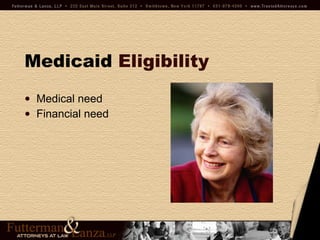
Medicaid  Eligibility Medical need Financial need
Medicaid Financial Eligibility   (Nursing Home) Resources Income
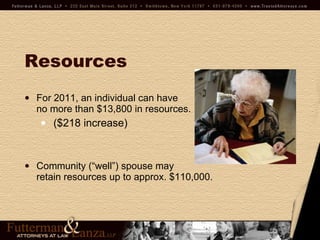
Resources For 2011, an individual can have  no more than $13,800 in resources. ($218 increase) Community (“well”) spouse may  retain resources up to approx. $110,000.
Exempt   Resources Irrevocable Funeral Trust (no limit) $1,500 burial fund Primary residence (generally) IRA’s or qualified retirement accounts if applicant is receiving RMD. Personal property (jewelry, car, etc.) Reparation payments
Income 2011 Income Levels: New York is a “spend down” state with regard to income.  Income over the personal needs allowance ($50/month) must be contributed toward the cost of care. UNLESS – there is a community spouse with income under $2,739/month.
Transfers Look Back Period Penalty Period
Look Back   Period Medicaid will now look back at applicant’s financial information for the 60 month period prior to the date applicant requests benefits. THIS IS A CHANGE FROM 36 MONTHS!!!!!!!!  (THE RESULT OF THE DEFICIT REDUCTION ACT)
What is DSS   Looking For? Looking to see if the applicant  (or spouse) made uncompensated transfers of income or resources (i.e.,  gifts )
What if DSS discovers   a gift was made?
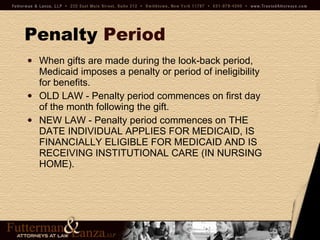
Penalty   Period When gifts are made during the look-back period, Medicaid imposes a penalty or period of ineligibility for benefits. OLD LAW - Penalty period commences on first day of the month following the gift. NEW LAW - Penalty period commences on THE DATE INDIVIDUAL APPLIES FOR MEDICAID, IS FINANCIALLY ELIGIBLE FOR MEDICAID AND IS RECEIVING INSTITUTIONAL CARE (IN NURSING HOME).
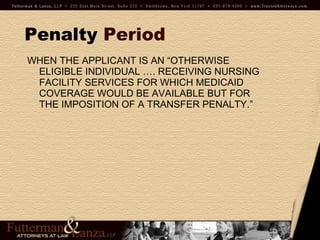
Penalty   Period WHEN THE APPLICANT IS AN “OTHERWISE ELIGIBLE INDIVIDUAL …. RECEIVING NURSING FACILITY SERVICES FOR WHICH MEDICAID COVERAGE WOULD BE AVAILABLE BUT FOR THE IMPOSITION OF A TRANSFER PENALTY.”
How long is the   penalty period?
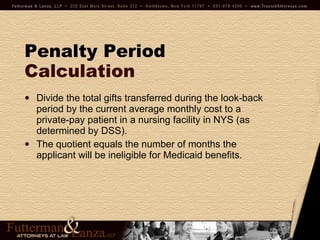
Penalty Period   Calculation Divide the total gifts transferred during the look-back period by the current average monthly cost to a private-pay patient in a nursing facility in NYS (as determined by DSS). The quotient equals the number of months the applicant will be ineligible for Medicaid benefits.
Current Average   Monthly Costs SEVEN REGIONS NYC $10,579 Nassau & Suffolk  $11,445 Northern Metro $10,105 Central $7,688 Northeastern $8,323 Rochester $8,942 Western $7,863
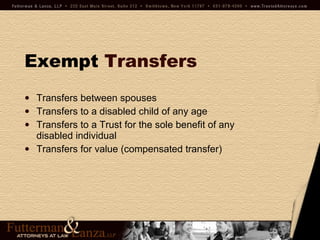
Exempt   Transfers Transfers between spouses Transfers to a disabled child of any age  Transfers to a Trust for the sole benefit of any disabled individual Transfers for value (compensated transfer)
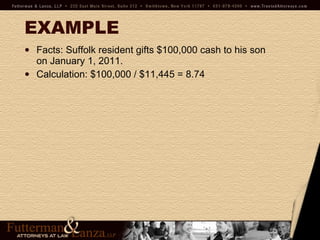
EXAMPLE Facts: Suffolk resident gifts $100,000 cash to his son on January 1, 2011. Calculation: $100,000 / $11,445 = 8.74
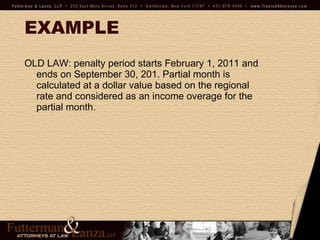
EXAMPLE OLD LAW: penalty period starts February 1, 2011 and ends on September 30, 201. Partial month is calculated at a dollar value based on the regional rate and considered as an income overage for the partial month.
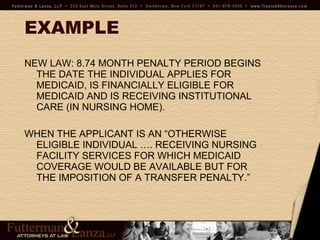
EXAMPLE NEW LAW: 8.74 MONTH PENALTY PERIOD BEGINS THE DATE THE INDIVIDUAL APPLIES FOR MEDICAID, IS FINANCIALLY ELIGIBLE FOR MEDICAID AND IS RECEIVING INSTITUTIONAL CARE (IN NURSING HOME).  WHEN THE APPLICANT IS AN “OTHERWISE ELIGIBLE INDIVIDUAL …. RECEIVING NURSING FACILITY SERVICES FOR WHICH MEDICAID COVERAGE WOULD BE AVAILABLE BUT FOR THE IMPOSITION OF A TRANSFER PENALTY.”
Footnotes Community (“well”) spouse  can make transfers without  affecting institutionalized  spouse’s eligibility only  AFTER acceptance. No “cap” on penalty periods.
Options for the   Homestead Sell it Transfer (gift) it Life Estate Transfer it into  protective trust
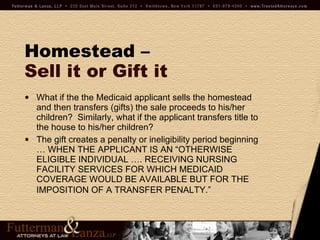
Homestead –   Sell it or Gift it What if the the Medicaid applicant sells the homestead and then transfers (gifts) the sale proceeds to his/her children?  Similarly, what if the applicant transfers title to the house to his/her children? The gift creates a penalty or ineligibility period beginning … WHEN THE APPLICANT IS AN “OTHERWISE ELIGIBLE INDIVIDUAL …. RECEIVING NURSING FACILITY SERVICES FOR WHICH MEDICAID COVERAGE WOULD BE AVAILABLE BUT FOR THE IMPOSITION OF A TRANSFER PENALTY.”
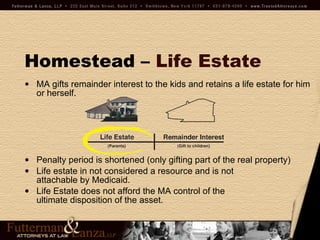
Homestead –   Life Estate MA gifts remainder interest to the kids and retains a life estate for him or herself. Penalty period is shortened (only gifting part of the real property) Life estate in not considered a resource and is not  attachable by Medicaid. Life Estate does not afford the MA control of the  ultimate disposition of the asset.
Homestead –   Transfer Into Trust Trust provides MA with more control over the ultimate disposition of the asset. Trust requires the MA retain the right to receive income from the trust for life.
Homestead –   Exempt Transfers Spouse Child under 21 Blind/disabled child Adult child, residing in home (2 years), that provided care to MA. Sibling of MA who has equity interest in house and who has resided in home one year immediately prior to MA’s institutionalization.

Medicaid Power Point 2011

  • 1.
    Elder Law & Medicaid Planning Futterman & Lanza, LLP 222 East Main Street, Suite 314 Smithtown, New York 11787 631-979-4300. Attorneys & Counselors at Law Copyright © 2011 Futterman & Lanza, LLP
  • 2.
    Vision Statement Preserving and protecting your family’s hard earned assets and passing them on to family members, not to the potentially catastrophic costs of long-term care (i.e., the nursing home).
  • 3.
    What is long-term care? Long-term care is a variety of services that include medical and non-medical care to people who have a chronic illness or disability. Long term-care needs can be provided through: (1) Home health care; (2) Assisted Living facilities; (3) Skilled nursing home facilities.
  • 4.
    What are thecosts of long-term care? Home health-care costs vary depending on the number of hours required and the hourly pay rate charged by the personal care aide. Assisted Living costs range from $3,000/month to $8,000/month. Skilled nursing care costs on Long Island range from $9,000 to over $17,000 per month.
  • 5.
    Who is exposed to these costs? EVERYONE!
  • 6.
    How do youpay for long-term care? (1) Medicare (limited benefit); (2) Private pay; (3) Long-term care insurance; or (4) Medicaid.
  • 7.
    Medic aid Medicaidis a “means tested” insurance program jointly funded by the federal, state and local governments (DSS), and provides home care and skilled nursing home care services.
  • 8.
    Medicaid EligibilityMedical need Financial need
  • 9.
    Medicaid Financial Eligibility (Nursing Home) Resources Income
  • 10.
    Resources For 2011,an individual can have no more than $13,800 in resources. ($218 increase) Community (“well”) spouse may retain resources up to approx. $110,000.
  • 11.
    Exempt Resources Irrevocable Funeral Trust (no limit) $1,500 burial fund Primary residence (generally) IRA’s or qualified retirement accounts if applicant is receiving RMD. Personal property (jewelry, car, etc.) Reparation payments
  • 12.
    Income 2011 IncomeLevels: New York is a “spend down” state with regard to income. Income over the personal needs allowance ($50/month) must be contributed toward the cost of care. UNLESS – there is a community spouse with income under $2,739/month.
  • 13.
    Transfers Look BackPeriod Penalty Period
  • 14.
    Look Back Period Medicaid will now look back at applicant’s financial information for the 60 month period prior to the date applicant requests benefits. THIS IS A CHANGE FROM 36 MONTHS!!!!!!!! (THE RESULT OF THE DEFICIT REDUCTION ACT)
  • 15.
    What is DSS Looking For? Looking to see if the applicant (or spouse) made uncompensated transfers of income or resources (i.e., gifts )
  • 16.
    What if DSSdiscovers a gift was made?
  • 17.
    Penalty Period When gifts are made during the look-back period, Medicaid imposes a penalty or period of ineligibility for benefits. OLD LAW - Penalty period commences on first day of the month following the gift. NEW LAW - Penalty period commences on THE DATE INDIVIDUAL APPLIES FOR MEDICAID, IS FINANCIALLY ELIGIBLE FOR MEDICAID AND IS RECEIVING INSTITUTIONAL CARE (IN NURSING HOME).
  • 18.
    Penalty Period WHEN THE APPLICANT IS AN “OTHERWISE ELIGIBLE INDIVIDUAL …. RECEIVING NURSING FACILITY SERVICES FOR WHICH MEDICAID COVERAGE WOULD BE AVAILABLE BUT FOR THE IMPOSITION OF A TRANSFER PENALTY.”
  • 19.
    How long isthe penalty period?
  • 20.
    Penalty Period Calculation Divide the total gifts transferred during the look-back period by the current average monthly cost to a private-pay patient in a nursing facility in NYS (as determined by DSS). The quotient equals the number of months the applicant will be ineligible for Medicaid benefits.
  • 21.
    Current Average Monthly Costs SEVEN REGIONS NYC $10,579 Nassau & Suffolk $11,445 Northern Metro $10,105 Central $7,688 Northeastern $8,323 Rochester $8,942 Western $7,863
  • 22.
    Exempt Transfers Transfers between spouses Transfers to a disabled child of any age Transfers to a Trust for the sole benefit of any disabled individual Transfers for value (compensated transfer)
  • 23.
    EXAMPLE Facts: Suffolkresident gifts $100,000 cash to his son on January 1, 2011. Calculation: $100,000 / $11,445 = 8.74
  • 24.
    EXAMPLE OLD LAW:penalty period starts February 1, 2011 and ends on September 30, 201. Partial month is calculated at a dollar value based on the regional rate and considered as an income overage for the partial month.
  • 25.
    EXAMPLE NEW LAW:8.74 MONTH PENALTY PERIOD BEGINS THE DATE THE INDIVIDUAL APPLIES FOR MEDICAID, IS FINANCIALLY ELIGIBLE FOR MEDICAID AND IS RECEIVING INSTITUTIONAL CARE (IN NURSING HOME). WHEN THE APPLICANT IS AN “OTHERWISE ELIGIBLE INDIVIDUAL …. RECEIVING NURSING FACILITY SERVICES FOR WHICH MEDICAID COVERAGE WOULD BE AVAILABLE BUT FOR THE IMPOSITION OF A TRANSFER PENALTY.”
  • 26.
    Footnotes Community (“well”)spouse can make transfers without affecting institutionalized spouse’s eligibility only AFTER acceptance. No “cap” on penalty periods.
  • 27.
    Options for the Homestead Sell it Transfer (gift) it Life Estate Transfer it into protective trust
  • 28.
    Homestead – Sell it or Gift it What if the the Medicaid applicant sells the homestead and then transfers (gifts) the sale proceeds to his/her children? Similarly, what if the applicant transfers title to the house to his/her children? The gift creates a penalty or ineligibility period beginning … WHEN THE APPLICANT IS AN “OTHERWISE ELIGIBLE INDIVIDUAL …. RECEIVING NURSING FACILITY SERVICES FOR WHICH MEDICAID COVERAGE WOULD BE AVAILABLE BUT FOR THE IMPOSITION OF A TRANSFER PENALTY.”
  • 29.
    Homestead – Life Estate MA gifts remainder interest to the kids and retains a life estate for him or herself. Penalty period is shortened (only gifting part of the real property) Life estate in not considered a resource and is not attachable by Medicaid. Life Estate does not afford the MA control of the ultimate disposition of the asset.
  • 30.
    Homestead – Transfer Into Trust Trust provides MA with more control over the ultimate disposition of the asset. Trust requires the MA retain the right to receive income from the trust for life.
  • 31.
    Homestead – Exempt Transfers Spouse Child under 21 Blind/disabled child Adult child, residing in home (2 years), that provided care to MA. Sibling of MA who has equity interest in house and who has resided in home one year immediately prior to MA’s institutionalization.

Editor's Notes

  • #7 Co-pay 109.50 (2004)