Shriram Gas Leak Case
 M.C. MEHTA V. UNION OF INDIA
[1987 SCR (1) 819, AIR 1987 965]
Background of the case
 Shriram Food and Fertilizers is an privately owned
company manufactures caustic chlorine and oleum.
 Complex of the factory with the area of approximately 76
acres and its was surrounded by densely populated
colonies such as Punjabi Bagh, West Patel Nagar,
Karampura, Ashok Vihar, Tri Nagar and Shastri Nagar
and within a radius of 3 kilometres around the complex
of the company and the colonies have the population of
approximately 2, 00,000”.
 An public interest litigation (No. 12,739, 1985) was filed
by “M.C. Mehta”.
•On the 4th of December 1985, Oleum gas had leaked from
the complex into the surrounding community resulting in
one fatality and many injuries.
•The Inspector of Factories and the Assistant Commissioner
of Factories issued orders to shut down the plant on the 7th
and 24th of December respectively under the Factories Act
(1948).
Victims Pleading’s
 On behalf of the gas leak victims the Delhi Legal aid
and Advice Board and the Delhi Bar Association filed
for compensation along with the original petition of
M.C. Mehta
 The Petitioners moved their pleadings under
 Article 21 (Right to Life),
 Article 32(Writ Petition)
 and an extension of Article 12 (State Enterprises) in
Indian Constitution to the Supreme Court.
Shriram Food and Fertilizers Response
 It First objected the scope of Article 32, that there was no
demand for compensation in the first petition by M.C. Mehta,
neither was it added by amendment to it after the accident.
They also stated that both Delhi Legal aid and Advice Board
and the Delhi Bar Association were not even the belligerents in
the first petition.
 Second objection was that on the use of Article 21 (on whose
violation the petitions were filed). Shriram Food and Fertilizer
was a privately owned enterprise. It did not fall under Article
12 (being party to the state or state machinery) and hence if it
had violated any fundamental right of a citizen it could not be
taken to court under Article 21.
 Shriram also responded by filing writ petitions of itself (No. 26
of 1986) to nullify the two orders from the Inspector of
Factories and the Assistant Commissioner of Factories and
interim opening of its caustic chlorine plant manufacturing;
glycerine, soap, hard oil, etc.
Court’s Decision
 With regard to the First Objection of Shriram Fertilizers, It
stated that the Supreme Court is not merely an institution for
constitutional remedy but also confers a responsibility to
safeguard the fundamental rights of the citizens, especially
those citizens who are from weaker sections of society and
cannot themselves get justice. The Supreme Court also stated
that Shriram Food and Fertilizers was being hyper-technical
and hence its appeals on this ground were denied.
 With regard to the Second Objection of Shriram Fertilizers, It
stated that due to the lack of time and considering the urgency
it was not going to go into the details of definition of state and
non-state institutions under Article 12, but since Shriram Food
and Fertilizers was involved in the manufacture of
commodities essential to the public life, and supplemented the
state industries in doing so, it enjoyed all the benefits and
liabilities which comes under Article 12.
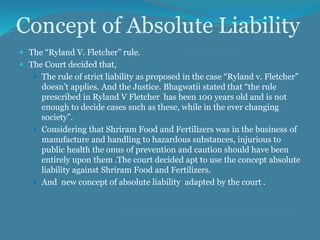
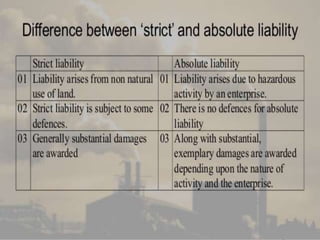
Concept of Absolute Liability
 The “Ryland V. Fletcher” rule.
 The Court decided that,
 The rule of strict liability as proposed in the case “Ryland v. Fletcher”
doesn’t applies. And the Justice. Bhagwatii stated that “the rule
prescribed in Ryland V Fletcher has been 100 years old and is not
enough to decide cases such as these, while in the ever changing
society”.
 Considering that Shriram Food and Fertilizers was in the business of
manufacture and handling to hazardous substances, injurious to
public health the onus of prevention and caution should have been
entirely upon them .The court decided apt to use the concept absolute
liability against Shriram Food and Fertilizers.
 And new concept of absolute liability adapted by the court .
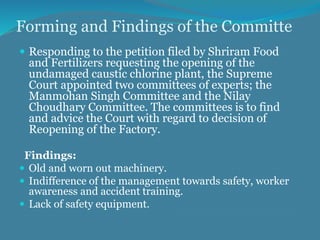
Forming and Findings of the Committe
 Responding to the petition filed by Shriram Food
and Fertilizers requesting the opening of the
undamaged caustic chlorine plant, the Supreme
Court appointed two committees of experts; the
Manmohan Singh Committee and the Nilay
Choudhary Committee. The committees is to find
and advice the Court with regard to decision of
Reopening of the Factory.
Findings:
 Old and worn out machinery.
 Indifference of the management towards safety, worker
awareness and accident training.
 Lack of safety equipment.
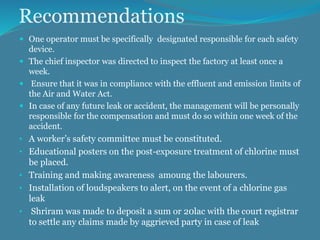
Recommendations
 One operator must be specifically designated responsible for each safety
device.
 The chief inspector was directed to inspect the factory at least once a
week.
 Ensure that it was in compliance with the effluent and emission limits of
the Air and Water Act.
 In case of any future leak or accident, the management will be personally
responsible for the compensation and must do so within one week of the
accident.
• A worker’s safety committee must be constituted.
• Educational posters on the post-exposure treatment of chlorine must
be placed.
• Training and making awareness amoung the labourers.
• Installation of loudspeakers to alert, on the event of a chlorine gas
leak
• Shriram was made to deposit a sum or 20lac with the court registrar
to settle any claims made by aggrieved party in case of leak
Judgment
 The Supreme Court delivered its judgement on the
19th of December 1986.
 Shriram responsible for the accident and resultant
compensation of the victims.
 The court also instructed Shriram to comply with all
the recommendations of the Nilay Choudhary and
Manmohan Singh Committees.
 The court also instructed the victims of the Oleum
gas leak to file their complain for compensation in
the Tis Hazari lower court of Delhi.
Significance of the Judgemet
 Court considered that Shriram’s caustic chlorine
plant employed around 4000 people.
 Considered that Shriram was in the business of
producing daily commodities.
 It produced chlorine for the chlorination and
purification of water for the Delhi Jal Board.
Criticism over the Judgment
Shriram Gas Leak Case.pptx

Shriram Gas Leak Case.pptx

  • 1.
    Shriram Gas LeakCase  M.C. MEHTA V. UNION OF INDIA [1987 SCR (1) 819, AIR 1987 965]
  • 2.
    Background of thecase  Shriram Food and Fertilizers is an privately owned company manufactures caustic chlorine and oleum.  Complex of the factory with the area of approximately 76 acres and its was surrounded by densely populated colonies such as Punjabi Bagh, West Patel Nagar, Karampura, Ashok Vihar, Tri Nagar and Shastri Nagar and within a radius of 3 kilometres around the complex of the company and the colonies have the population of approximately 2, 00,000”.  An public interest litigation (No. 12,739, 1985) was filed by “M.C. Mehta”.
  • 3.
    •On the 4thof December 1985, Oleum gas had leaked from the complex into the surrounding community resulting in one fatality and many injuries. •The Inspector of Factories and the Assistant Commissioner of Factories issued orders to shut down the plant on the 7th and 24th of December respectively under the Factories Act (1948).
  • 4.
    Victims Pleading’s  Onbehalf of the gas leak victims the Delhi Legal aid and Advice Board and the Delhi Bar Association filed for compensation along with the original petition of M.C. Mehta  The Petitioners moved their pleadings under  Article 21 (Right to Life),  Article 32(Writ Petition)  and an extension of Article 12 (State Enterprises) in Indian Constitution to the Supreme Court.
  • 5.
    Shriram Food andFertilizers Response  It First objected the scope of Article 32, that there was no demand for compensation in the first petition by M.C. Mehta, neither was it added by amendment to it after the accident. They also stated that both Delhi Legal aid and Advice Board and the Delhi Bar Association were not even the belligerents in the first petition.  Second objection was that on the use of Article 21 (on whose violation the petitions were filed). Shriram Food and Fertilizer was a privately owned enterprise. It did not fall under Article 12 (being party to the state or state machinery) and hence if it had violated any fundamental right of a citizen it could not be taken to court under Article 21.  Shriram also responded by filing writ petitions of itself (No. 26 of 1986) to nullify the two orders from the Inspector of Factories and the Assistant Commissioner of Factories and interim opening of its caustic chlorine plant manufacturing; glycerine, soap, hard oil, etc.
  • 6.
    Court’s Decision  Withregard to the First Objection of Shriram Fertilizers, It stated that the Supreme Court is not merely an institution for constitutional remedy but also confers a responsibility to safeguard the fundamental rights of the citizens, especially those citizens who are from weaker sections of society and cannot themselves get justice. The Supreme Court also stated that Shriram Food and Fertilizers was being hyper-technical and hence its appeals on this ground were denied.  With regard to the Second Objection of Shriram Fertilizers, It stated that due to the lack of time and considering the urgency it was not going to go into the details of definition of state and non-state institutions under Article 12, but since Shriram Food and Fertilizers was involved in the manufacture of commodities essential to the public life, and supplemented the state industries in doing so, it enjoyed all the benefits and liabilities which comes under Article 12.
  • 7.
    Concept of AbsoluteLiability  The “Ryland V. Fletcher” rule.  The Court decided that,  The rule of strict liability as proposed in the case “Ryland v. Fletcher” doesn’t applies. And the Justice. Bhagwatii stated that “the rule prescribed in Ryland V Fletcher has been 100 years old and is not enough to decide cases such as these, while in the ever changing society”.  Considering that Shriram Food and Fertilizers was in the business of manufacture and handling to hazardous substances, injurious to public health the onus of prevention and caution should have been entirely upon them .The court decided apt to use the concept absolute liability against Shriram Food and Fertilizers.  And new concept of absolute liability adapted by the court .
  • 9.
    Forming and Findingsof the Committe  Responding to the petition filed by Shriram Food and Fertilizers requesting the opening of the undamaged caustic chlorine plant, the Supreme Court appointed two committees of experts; the Manmohan Singh Committee and the Nilay Choudhary Committee. The committees is to find and advice the Court with regard to decision of Reopening of the Factory. Findings:  Old and worn out machinery.  Indifference of the management towards safety, worker awareness and accident training.  Lack of safety equipment.
  • 10.
    Recommendations  One operatormust be specifically designated responsible for each safety device.  The chief inspector was directed to inspect the factory at least once a week.  Ensure that it was in compliance with the effluent and emission limits of the Air and Water Act.  In case of any future leak or accident, the management will be personally responsible for the compensation and must do so within one week of the accident. • A worker’s safety committee must be constituted. • Educational posters on the post-exposure treatment of chlorine must be placed. • Training and making awareness amoung the labourers. • Installation of loudspeakers to alert, on the event of a chlorine gas leak • Shriram was made to deposit a sum or 20lac with the court registrar to settle any claims made by aggrieved party in case of leak
  • 11.
    Judgment  The SupremeCourt delivered its judgement on the 19th of December 1986.  Shriram responsible for the accident and resultant compensation of the victims.  The court also instructed Shriram to comply with all the recommendations of the Nilay Choudhary and Manmohan Singh Committees.  The court also instructed the victims of the Oleum gas leak to file their complain for compensation in the Tis Hazari lower court of Delhi.
  • 12.
    Significance of theJudgemet  Court considered that Shriram’s caustic chlorine plant employed around 4000 people.  Considered that Shriram was in the business of producing daily commodities.  It produced chlorine for the chlorination and purification of water for the Delhi Jal Board.
  • 13.