Bhopal Gas
Tragedy
Compensation Act 1923
COMPENSATION ACT
• The Employees Compensation Act, 1923 imposes statutory liability
upon an employer to discharge his moral obligation towards
employees when they suffer from any physical disabilities or
diseases, during the course of employment in hazardous working
conditions.
• The aim of the Act is to provide quick and cheaper disposal of
disputes relating to the compensation which is not possible in
comparison in case of proceedings of civil law. The Act also helps
the dependents to get relieved from the hardship, rising from
accident.
• It is a SOCIAL SECURITY legislation.
Introduction To case
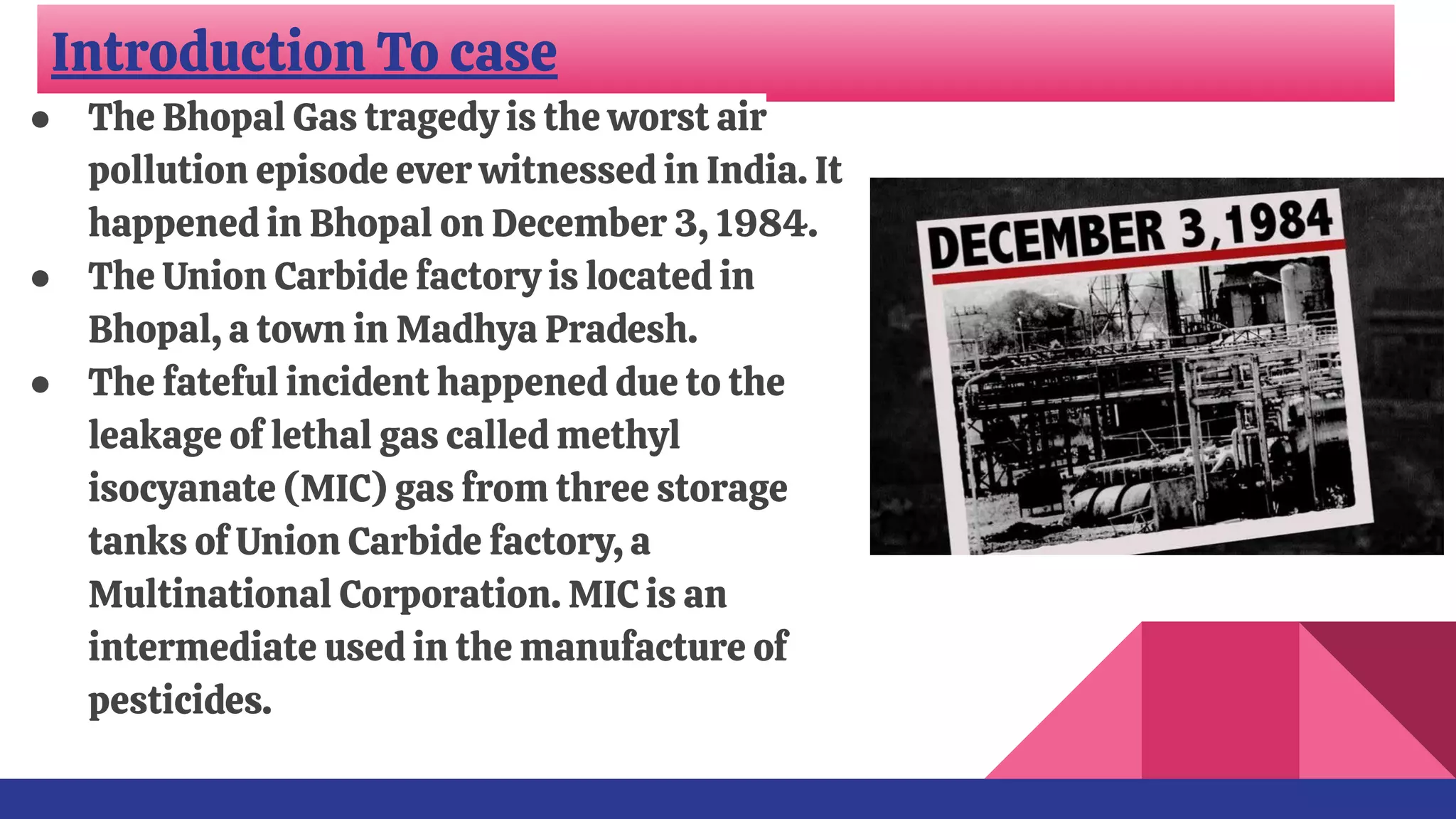
● The Bhopal Gas tragedy is the worst air
pollution episode ever witnessed in India. It
happened in Bhopal on December 3, 1984.
● The Union Carbide factory is located in
Bhopal, a town in Madhya Pradesh.
● The fateful incident happened due to the
leakage of lethal gas called methyl
isocyanate (MIC) gas from three storage
tanks of Union Carbide factory, a
Multinational Corporation. MIC is an
intermediate used in the manufacture of
pesticides.
Claims Under Bhopal Gas Tragedy
Effects of The Bhopal gas tragedy
● Poorly understood, 120000 chronic survivors
● Respiratory: Persistent fibrosis, Chronic
Bronchitis, TB Ocular: Chronic conjunctivitis,
Corneal opacity
● Reproductive: Pregnancy loss, Higher infant
mortality
● Gastro-intestinal: Hyperacidity, Chronic
gastritis
● Neurological: Impaired memory and motor
skills
● Genetic damage to plants
● Rivers and lakes polluted by chemicals:
destroying aquatic and animals thriving on the
sources
Factors Leading to Gas leak
❏ Storing MIC in large tanks and filling beyond
recommended levels,
❏ Poor maintenance,
❏ Failure of several safety systems,
❏ Safety systems being switched off to save
money—including the MIC tank refrigeration system
which could have mitigated the disaster severity,
❏ Plant location close to a densely populated area,
❏ Undersized safety devices,
❏ The dependence on manual operations,
Key legal cases on the Bhopal Gas Tragedy and its
aftermath
❏ December 1984: Days after gas leak first petitions filed
in US federal courts on behalf of victims.
❏ March 1985: Indian Parliament passes Bhopal Gas Leak
Disaster Act authorizing government to solely
represent Indian plaintiffs in Indian and elsewhere in
connection with tragedy. Union of India joins petition
along with victims against Union Carbide in April.
❏ June 1985: Individual petitions joined and listed before
Justice John Keenan of Southern District Court of New
York.
❏ May 1986: Justice Keenan dismisses petition and
orders Union Carbide to submit to jurisdiction of Indian
courts.
❏ March 1989: India’s Supreme Court (SC) directs UCC and government to settle the
case of compensation at US$ 470 million after hearing appeals from the High Court
ordering interim compensation of Rs 250 crore. Settlement terminates all civil and
criminal proceedings. Settlement is silent on the issue of environmental damages.
❏ March 1991: India’s Supreme Court hearing a review petition on the 1989
settlement refuses to reopen the issue of compensation but reinstates criminal
proceedings set aside by 1989 judgment. Government of India asked to make good
any deficiency in settlement fund if needed. Court recognizing potential long term
health hazards of gas leak orders establishment of a specialized hospital funded by
Union Carbide and its affiliates.
❏ November 2001: US Federal Court of Appeals directs Justice Keenan to try cases for
recovery environmental damage unrelated to Bhopal gas disaster. Also orders
Judge Keenan to hear additional environmental claims against Union Carbide and
its former CEO William Anderson.
❏ 2002: welfare courts wind up claim cases. More than 5,90,000 persons
compensated, 5,74,000 of them for varying degree of injuries and
15,000 people for death. Half amount is still left. Overwhekming
majority get a compensation of Rs. 25,000.
❏ April 2007: A divisional bench of India’s Supreme Court once again
rejects appeals asking for reopening the debate over adequacy of
settlement fund.
❏ 2010: NGO BGPMUS and BGPSSS file petition seeking five times more
compensation.
❏ 2019: the petition for enhanced compensation Rs. 7,728 crore yet to
come up for hearing after nine years.
IMPACT ON INDIAN LAW
• Government passed a series of law.
SOME SIGNIFICANT MILESTONES
• The Bhopal Gas Leak Disaster ( processing of claims)
Act, 1985
• The government passed and implemented
ENVIRONMENT PROTECTION ACT, 1986 under Article
253 of Indian Constitution.
• the factories act ,1948
( amendment 1987)
✔ redefined the word occupier.
✔ it is occupier’s obligation to show, in the event of accident,
that due diligence is exercised to enforce safety
obligations.
• PUBLIC LIABILITY INSURANCE ACT, 1991
✔ Provide interim compensation to victims in event of an
industrial disaster without having to prove neglect or
wrongful act of any person.
✔ maximum claim limit - Rs. 25,000 in case of death,
serious injury, loss or damage to property.
Conclusion
● The tragedy is still considered to be the world’s worst industrial disaster. To prevent
such events from occurring in the future, the government should thoroughly check and
regulate such industries. They should be placed under constant surveillance and the
activities of such industries should be monitored at least once in every six months. Any
kind of repair in any of the machines or equipments should be immediately attended to.
The government should take it upon itself to make sure that everything is functioning
properly.
● Apart from this, the government should also make sure that there is a proper mechanism
for compensation to the victims. It should ensure speedy justice and should make sure
that proper relief is given to the victims.
● It is totally unjustifiable to leave even a single victim without providing relief. Hopefully,
such incidents should never occur again, and even if they do, we should not forget the
lessons from Bhopal and we should make sure that any law capping the limit on the
liability of such large magnitude disasters should be declared as unconstitutional.
Bhopal gas Tragedy

Bhopal gas Tragedy

  • 1.
  • 2.
    COMPENSATION ACT • TheEmployees Compensation Act, 1923 imposes statutory liability upon an employer to discharge his moral obligation towards employees when they suffer from any physical disabilities or diseases, during the course of employment in hazardous working conditions. • The aim of the Act is to provide quick and cheaper disposal of disputes relating to the compensation which is not possible in comparison in case of proceedings of civil law. The Act also helps the dependents to get relieved from the hardship, rising from accident. • It is a SOCIAL SECURITY legislation.
  • 3.
    Introduction To case ●The Bhopal Gas tragedy is the worst air pollution episode ever witnessed in India. It happened in Bhopal on December 3, 1984. ● The Union Carbide factory is located in Bhopal, a town in Madhya Pradesh. ● The fateful incident happened due to the leakage of lethal gas called methyl isocyanate (MIC) gas from three storage tanks of Union Carbide factory, a Multinational Corporation. MIC is an intermediate used in the manufacture of pesticides.
  • 4.
  • 5.
    Effects of TheBhopal gas tragedy ● Poorly understood, 120000 chronic survivors ● Respiratory: Persistent fibrosis, Chronic Bronchitis, TB Ocular: Chronic conjunctivitis, Corneal opacity ● Reproductive: Pregnancy loss, Higher infant mortality ● Gastro-intestinal: Hyperacidity, Chronic gastritis ● Neurological: Impaired memory and motor skills ● Genetic damage to plants ● Rivers and lakes polluted by chemicals: destroying aquatic and animals thriving on the sources
  • 6.
    Factors Leading toGas leak ❏ Storing MIC in large tanks and filling beyond recommended levels, ❏ Poor maintenance, ❏ Failure of several safety systems, ❏ Safety systems being switched off to save money—including the MIC tank refrigeration system which could have mitigated the disaster severity, ❏ Plant location close to a densely populated area, ❏ Undersized safety devices, ❏ The dependence on manual operations,
  • 7.
    Key legal caseson the Bhopal Gas Tragedy and its aftermath ❏ December 1984: Days after gas leak first petitions filed in US federal courts on behalf of victims. ❏ March 1985: Indian Parliament passes Bhopal Gas Leak Disaster Act authorizing government to solely represent Indian plaintiffs in Indian and elsewhere in connection with tragedy. Union of India joins petition along with victims against Union Carbide in April. ❏ June 1985: Individual petitions joined and listed before Justice John Keenan of Southern District Court of New York. ❏ May 1986: Justice Keenan dismisses petition and orders Union Carbide to submit to jurisdiction of Indian courts.
  • 8.
    ❏ March 1989:India’s Supreme Court (SC) directs UCC and government to settle the case of compensation at US$ 470 million after hearing appeals from the High Court ordering interim compensation of Rs 250 crore. Settlement terminates all civil and criminal proceedings. Settlement is silent on the issue of environmental damages. ❏ March 1991: India’s Supreme Court hearing a review petition on the 1989 settlement refuses to reopen the issue of compensation but reinstates criminal proceedings set aside by 1989 judgment. Government of India asked to make good any deficiency in settlement fund if needed. Court recognizing potential long term health hazards of gas leak orders establishment of a specialized hospital funded by Union Carbide and its affiliates. ❏ November 2001: US Federal Court of Appeals directs Justice Keenan to try cases for recovery environmental damage unrelated to Bhopal gas disaster. Also orders Judge Keenan to hear additional environmental claims against Union Carbide and its former CEO William Anderson.
  • 9.
    ❏ 2002: welfarecourts wind up claim cases. More than 5,90,000 persons compensated, 5,74,000 of them for varying degree of injuries and 15,000 people for death. Half amount is still left. Overwhekming majority get a compensation of Rs. 25,000. ❏ April 2007: A divisional bench of India’s Supreme Court once again rejects appeals asking for reopening the debate over adequacy of settlement fund. ❏ 2010: NGO BGPMUS and BGPSSS file petition seeking five times more compensation. ❏ 2019: the petition for enhanced compensation Rs. 7,728 crore yet to come up for hearing after nine years.
  • 10.
    IMPACT ON INDIANLAW • Government passed a series of law. SOME SIGNIFICANT MILESTONES • The Bhopal Gas Leak Disaster ( processing of claims) Act, 1985 • The government passed and implemented ENVIRONMENT PROTECTION ACT, 1986 under Article 253 of Indian Constitution.
  • 11.
    • the factoriesact ,1948 ( amendment 1987) ✔ redefined the word occupier. ✔ it is occupier’s obligation to show, in the event of accident, that due diligence is exercised to enforce safety obligations. • PUBLIC LIABILITY INSURANCE ACT, 1991 ✔ Provide interim compensation to victims in event of an industrial disaster without having to prove neglect or wrongful act of any person. ✔ maximum claim limit - Rs. 25,000 in case of death, serious injury, loss or damage to property.
  • 12.
    Conclusion ● The tragedyis still considered to be the world’s worst industrial disaster. To prevent such events from occurring in the future, the government should thoroughly check and regulate such industries. They should be placed under constant surveillance and the activities of such industries should be monitored at least once in every six months. Any kind of repair in any of the machines or equipments should be immediately attended to. The government should take it upon itself to make sure that everything is functioning properly. ● Apart from this, the government should also make sure that there is a proper mechanism for compensation to the victims. It should ensure speedy justice and should make sure that proper relief is given to the victims. ● It is totally unjustifiable to leave even a single victim without providing relief. Hopefully, such incidents should never occur again, and even if they do, we should not forget the lessons from Bhopal and we should make sure that any law capping the limit on the liability of such large magnitude disasters should be declared as unconstitutional.