CLAIMS & INJURY
            MANAGMENT


OHS5110              BY CAITLIN HOWARD
CONTENTS
OBJECTIVES OF THE
    SESSION
Claims and injury
              management
 Workers’ compensation is a legislative privilege
 Provides compensation- both financial and
  rehabilitation services

 Provided to workers suffering injury/disability arising
  out of or during the course of employment
   Including accidents or illness/diseases
 Compulsory for an employer to have Workers’
  Compensation Insurance Policy
Responsibilities of injury
         management personnel
 General Manager


 Supervisor


 Occupational Health Nurse (OHN)


 Line Management


 Injury Management coordinator (IMC)
Process of injury claims

 Employee to inform Supervisor


 Injury is to be treated ASAP
Process of injury claims
 Employee referred for medical review – medical
  professional (OHN - gatehouse onsite)


 Inform GM within the 12hrs of being reported to OHN


 Complete an injury incident report
Process of injury claims

 Reported in company data management system (DMS)


 Injury to be reviewed by Doctor – provide a ‘First’
  medical certificate
Process of injury claim
 Establish a Case Management Team to coordinate the
  employee’s return to work


 Create a Return to Work Plan
Process of injury claim
 Notify company workers compensation department
 Any Restricted Work Cases (RTW) or Lost Time
  Cases(LTC) need to document:
   Occurrence report
   Mining injury report form
   Mines record book
Process of injury claim
 Lodge a claim- use Form 2B (workers comp form on
  Workcover website)


 Employee information kit offered by company


 File a claim for insurance payout
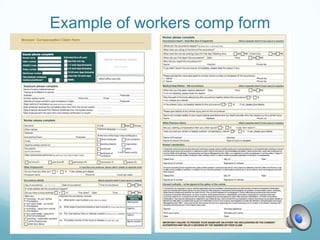
Example of workers comp form
Process of injury claims
 Injury Management – review
 Injury Management case closure
   injury management process is complete when employee
     can sustain normal duties without restrictions

 If employee is unable to return to normal duties, case
  referred to HR for further management
W.A. legislation & relevant resources
 Workers’ Compensation and Injury Management Act
  1981

 Workers’ Compensation and Injury Management
  Regulations 1982

 Workcover WA
 Department of Mines & Petroleum (DMP) Resources
  Safety
Injury claim optimal practice
 Effective risk management & early intervention
 Develop working relationship with rehabilitation agency
  and specialised medical practice

 Competent injury/rehabilitation management
 Commitment by injured worker to return to work
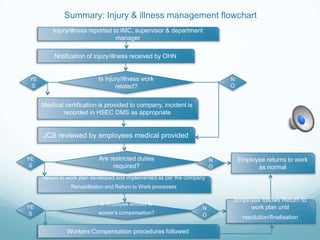
Summary: Injury & illness management flowchart
         Injury/illness reported to IMC, supervisor & department
                                  manager

         Notification of injury/illness received by OHN


YE                         Is injury/illness work                           N
 S                                related?                                  O


     Medical certification is provided to company, incident is
            recorded in HSEC DMS as appropriate


     JCS reviewed by employees medical provided


YE                         Are restricted duties                        N       Employee returns to work
 S                              required?                               O             as normal
     Return to work plan developed and implemented as per the company
                Rehabilitation and Return to Work processes

                                                                            Employee follows Return to
                           Is employee entitled to
YE                                                                  N            work plan until
 S                         worker's compensation?                   O            resolution/finalisation

              Workers Compensation procedures followed
Conclusion

 Legislation for the management of injury is important in
  successful company management


 Appropriate resources and injury care legislation are
  essential for minimising both financial and physical cost
  for employee and employer
References
Journals

   Cornally, S. (1986). Management's participation in rehabilitation. Success versus failure. Journal of Occupational Health & Safety – Australia & New Zealand, 3(4), 382 – 387.


   Weaver, M. (2006). Specialist medical practices in industrial health. In Barrett, T. & Browne, D. (Eds.) Rehabilitation. Work and Beyond. (pp. 51 - 66). Perth: Vineyard.


   Yates, R. (2006). Employers' perceptions of claims/injury management and rehabilitation in South Australia. Asia Pacific Journal of Human Resources, (44) 1, 102–122,


Websites

   Department of Mines & Petroleum (DMP) Resources Safety. (2006). (Retrieved March 13, 2013) from http://www.dmp.wa.gov.au/


   WorkCover Western Australia. (2005). Guidelines for Injury Management in the Workplace. (Retrieved March 11, 2013) from http://www.workcover.wa.gov.au


   WorkCover Western Australia. (2005). Workers‟ Compensation Code of Practice (Injury Management) 2005. (Retrieved March 11, 2013) from http://www.workcover.wa.gov.au


   WorkCover Western Australia. (2005). Workers‟ Compensation and Injury Management in WA. Guidance Notes for the Code of Practice (Injury Management) 2005. (Retrieved March
    11, 2013) from http://www.workcover.wa.gov.au

Show ass 1

  • 1.
    CLAIMS & INJURY MANAGMENT OHS5110 BY CAITLIN HOWARD
  • 2.
  • 3.
  • 4.
    Claims and injury management  Workers’ compensation is a legislative privilege  Provides compensation- both financial and rehabilitation services  Provided to workers suffering injury/disability arising out of or during the course of employment  Including accidents or illness/diseases  Compulsory for an employer to have Workers’ Compensation Insurance Policy
  • 5.
    Responsibilities of injury management personnel  General Manager  Supervisor  Occupational Health Nurse (OHN)  Line Management  Injury Management coordinator (IMC)
  • 6.
    Process of injuryclaims  Employee to inform Supervisor  Injury is to be treated ASAP
  • 8.
    Process of injuryclaims  Employee referred for medical review – medical professional (OHN - gatehouse onsite)  Inform GM within the 12hrs of being reported to OHN  Complete an injury incident report
  • 9.
    Process of injuryclaims  Reported in company data management system (DMS)  Injury to be reviewed by Doctor – provide a ‘First’ medical certificate
  • 10.
    Process of injuryclaim  Establish a Case Management Team to coordinate the employee’s return to work  Create a Return to Work Plan
  • 11.
    Process of injuryclaim  Notify company workers compensation department  Any Restricted Work Cases (RTW) or Lost Time Cases(LTC) need to document:  Occurrence report  Mining injury report form  Mines record book
  • 12.
    Process of injuryclaim  Lodge a claim- use Form 2B (workers comp form on Workcover website)  Employee information kit offered by company  File a claim for insurance payout
  • 13.
  • 14.
    Process of injuryclaims  Injury Management – review  Injury Management case closure  injury management process is complete when employee can sustain normal duties without restrictions  If employee is unable to return to normal duties, case referred to HR for further management
  • 15.
    W.A. legislation &relevant resources  Workers’ Compensation and Injury Management Act 1981  Workers’ Compensation and Injury Management Regulations 1982  Workcover WA  Department of Mines & Petroleum (DMP) Resources Safety
  • 16.
    Injury claim optimalpractice  Effective risk management & early intervention  Develop working relationship with rehabilitation agency and specialised medical practice  Competent injury/rehabilitation management  Commitment by injured worker to return to work
  • 17.
    Summary: Injury &illness management flowchart Injury/illness reported to IMC, supervisor & department manager Notification of injury/illness received by OHN YE Is injury/illness work N S related? O Medical certification is provided to company, incident is recorded in HSEC DMS as appropriate JCS reviewed by employees medical provided YE Are restricted duties N Employee returns to work S required? O as normal Return to work plan developed and implemented as per the company Rehabilitation and Return to Work processes Employee follows Return to Is employee entitled to YE N work plan until S worker's compensation? O resolution/finalisation Workers Compensation procedures followed
  • 18.
    Conclusion  Legislation forthe management of injury is important in successful company management  Appropriate resources and injury care legislation are essential for minimising both financial and physical cost for employee and employer
  • 19.
    References Journals  Cornally, S. (1986). Management's participation in rehabilitation. Success versus failure. Journal of Occupational Health & Safety – Australia & New Zealand, 3(4), 382 – 387.  Weaver, M. (2006). Specialist medical practices in industrial health. In Barrett, T. & Browne, D. (Eds.) Rehabilitation. Work and Beyond. (pp. 51 - 66). Perth: Vineyard.  Yates, R. (2006). Employers' perceptions of claims/injury management and rehabilitation in South Australia. Asia Pacific Journal of Human Resources, (44) 1, 102–122, Websites  Department of Mines & Petroleum (DMP) Resources Safety. (2006). (Retrieved March 13, 2013) from http://www.dmp.wa.gov.au/  WorkCover Western Australia. (2005). Guidelines for Injury Management in the Workplace. (Retrieved March 11, 2013) from http://www.workcover.wa.gov.au  WorkCover Western Australia. (2005). Workers‟ Compensation Code of Practice (Injury Management) 2005. (Retrieved March 11, 2013) from http://www.workcover.wa.gov.au  WorkCover Western Australia. (2005). Workers‟ Compensation and Injury Management in WA. Guidance Notes for the Code of Practice (Injury Management) 2005. (Retrieved March 11, 2013) from http://www.workcover.wa.gov.au

Editor's Notes

  • #2 Hi my name is Caitlin Howard and I’m a Safety Consultant for BHP Billiton and I am here today to provide training to you on the Claims & Injury Management process. As I am aware all of you are located across Western Australia in remote towns and may have to deal with the process on site with help from the Perth office, so I'm here today to provide a presentation detailing the Claims & Injury Management process (from injury to claims closure).
  • #3 The session today will includeThe objectives of todays presentationAn introduction into the Claims and Injury process and a detailed account of the process A detailed account of the Process from injury occurring to claim closingAnd to finish with sessions with a general overview of the session and you can ask any questions at this time.
  • #4 The objectives of the session today are:To Provide a detailed account of the Claims and Injury Process in a chronological manner from injury occurring to claim closing; including the key parties involved and their responsibilities and rights throughout the timelineI’m going to discuss all of the relevant forms and documents that managers may come across during this process (ie: claim form, medical certificates, GRTWP’s);Discuss legislative requirements Discuss “best practice” requirements to ensure a timely and successful return to work
  • #5 Here’s just a general introduction into the claims and injury management process. Workers’ compensation is a legislative privilege in WA and Australia it Provides compensation- both financial and rehabilitation services for workersit is provided to workers suffering injury/disability arising out of or during the course of employmentIncluding accidents or illness/diseasesCompulsory for an employer to have Workers’ Compensation Insurance Policy
  • #6 There are various roles and responsibilities for people onsite in any injury management situationGeneral Manager · Provides resources to ensure personnel are properly trained and supported in controlling the risks associated with Health & Hygiene at their operations; and · Responsible for compliance at their operations. SupervisorThe relevant supervisor is accountable for notification via line management to the General Manager or Functional Lead in accordance with the relevant timeframe. If contact cannot be made with a person then the next “in line” shall be informed.Occupational Health Nurse They are there to treat injuries.·  Notify the employee’s Supervisor and Department Manager by telephone and e-mail of injury or illness incidents; ·  Notify the Injury Management coordinator of injury or illness incidents; and ·  Maintain regular contact with the employee following the report of a work related disability or on notification of a non-work related injury or illness impacting on the employee’s capacity for work.Line Management ·  Ensure that all injuries or illnesses are reported; ·  Provide information to understand the employee’s job role including job demands and work tasks; and ·  Ensure that reasonable steps are taken to assist the employee to maintain links with the workplace during the injury management processes. Injury Management coordinator (IMC) · Develop a return to work program when restricted duties are deemed necessary in consultation with the designated medical provider.
  • #7 The first step in for the employee to inform their supervisor of the injury. All individuals shall contact an Supervisor at their operation if they feel that they are unable to complete all required work tasks of their current role as a result of injury or illness, or where: ·  They are experiencing ongoing pain or impairment resulting from a private medical condition; ·  Where directed by line management due to concerns about the health, safety and welfare of the individual; ·  Any medical condition that has resulted in an absence from work of four (4) or more consecutive shifts; ·  Where recovering from a surgical procedure; ·  Commencement of any medication or change to current medication; and · if  The individual is diagnosed with an infectious disease. According to the Workers’ Compensation and Injury Management Act 1981 in the event of a work related injury employers must take all necessary action to provide the injured worker with immediate first aid and access to appropriate medical assistance. The department of mines and petroleum states that any injury or illness requiring hospitalization should have a target of one hour from injury occurring to receiving first aid treatment.
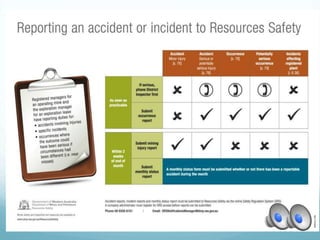
  • #8 Here is an Outline from the Department of Mines and Petroleum regarding reporting times of injuries from time of the incident ranging from a minor injury to a serious injury.
  • #9 The employee needs to be treated ASAP by the OHN onsite or any health professional and the General Manager should be informed of any incident within 12 hours from it happeningAn injury incident report will need to be completed as close to the injury as possible.
  • #10 A data management system is the primary tool in managing H&S incidents, investigations, stakeholder details and other information. Every employee will have a Job Capability Statement: this describes the physical requirements of a job role (or grouping of similar roles) as well as the potential risk of exposure to harmful agents associated with any job role.  A letter or report from a treating medical professional that outlines the nature of the injury, illness or disease, the employee’s capacity to meet Job Capability Statement requirements and the prognosis for recovery. If the injury is work related, the incident shall be reported in the H&S DMS in accordance with the Incident Reporting & Investigation processes and investigated as appropriate. Other statutory notifications shall also be made as per legislative requirements including, but not limited to, mining injury notification, occurrence report and worker’s compensation. As appropriate, the employee shall be referred for a medical review by a health care professional and a report issued. If required, a return to work program shall be developed and implemented including the establishment of a case management team, in accordance with the Rehabilitation and Return to Work processes.
  • #11 Where applicable, a return to work program shall be developed with the objective of returning an injured or ill employee to their normal duties. The goal is to reintegrate the individual into the workplace as soon as their injury or illness allows. It also allows for early identification of issues, which may prevent an individual from returning to their normal duties, allowing commencement of programs to enable the individual to move into another role (i.e. skills development or retraining). a medical practitioner certifies the injured or ill employee fit for work on restricted duties, the medically recommended restrictions and other work arrangements (e.g. restriction of work hours) shall be documented on the medical certificate. The medical practitioner shall be provided with the following documentation to assist in identifying the restrictions required: ·  Letter to the treating doctor including specific information related to the injury; ·  Any previous medical certification; ·  Job Capability Statement; and ·  Consent Form; 
A case management team shall be established to coordinate the employee’s return to work. 
The case management team (CMT) is a group of company employees and health professionals which has been formed by the Injury Management coordinator (IMC) to manage an individual’s injury or illness. Members of the team may vary depending upon the individual employee’s requirements; however, the team shall include a minimum of HR representation, IMC, Supervisor and the employee. 
Others may include: ·  Company doctor; ·  Doctor chosen by employee; ·  Insurer (worker’s compensation); ·  Physiotherapist; ·  Occupational therapist; ·  Clinical psychologist; ·  Rehabilitation provider (chosen by employee); ·  Occupational Health Nurse. 
The Line Manager shall remain in contact with the injured or ill employee to check on progress, and report back to the CMT to make arrangements for the employee to commence a return to work as soon as medically appropriate.
  • #12 The next step in the injury claims process is to Notify your company’s workers compensation departmentAny Restricted Work Cases (RTW) or Lost Time Cases(LTC) need to document:Occurrence reportMining injury report formMines record book
  • #13 Workers’ compensation is a legal entitlement for all workers in Western Australia. Employees with non- work related injuries, illnesses or diseases shall not be entitled to claim benefits under the company’s worker’s compensation policy.The case management team shall notify the Workers’ Compensation Department as soon as possible after a work-related injury occurs.Employee Information Kits are provided to operations by the workers’ compensation department. Employees nominating to lodge a claim shall be given an Employee Information Kit for completion.As a minimum, the following records shall be promptly forwarded to the Workers’ Compensation Claims Officer: ·  Incident Report; ·  Completed Workers’ Compensation Claim Form 2B; ·  First Medical Certificate and any other medical certificates and reports received thereafter; and ·  Completed Employers report form. 
Any company in WA is required to report to WorkCover on a monthly basis. At any time WorkCover can request access to the workers’ compensation department’s files for auditing purposes. It is therefore important to ensure operations provide information as listed below on a regular basis to the workers’ compensation department: ·  Medical certificates and reports; ·  Accounts; ·  Copies of all return to work plans; ·  Notification of any time lost associated with claims; ·  Notification of change in injured workers employment status; and ·  Any other information that may have an impact on the claim. 
The case management team shall participate in periodical worker’s compensation claim review meetings. All disputes pertaining to workers’ compensation matters shall initially be managed in accordance with the internal dispute resolution procedure administered by the worker’s compensation team in accordance with the Worker’s Compensation and Injury Management Act. The workers’ compensation department shall be notified of all disputes arising in the course of a workers’ compensation claim.
  • #14 example of the workers comp claim form, that can be found on workcover website
  • #15 The RTWP and injury management process is complete when the employee can sustain their normal duties without restrictions. In cases where the injured employee is unable to return to their normal duties, the RTW program will be considered completed when the injured employee is officially placed in alternate work.Prior to the closure of the employee’s RTW program the CMT shall ensure: ·  The employee has been reviewed by their treating medical expert; ·  The employee and line manager are informed of any need for ongoing or future review; ·  A final Work-Cover medical certificate is issued, if work related. 
The IMC shall provide a written notification of RTWP closure when notification of final medical clearance is received. A copy of this notification shall then be filed in the employee’s case file. Where the employee is unable to return to normal or alternate duties, the case shall be referred to Human Resources for further management.
  • #16 W.A. legislation & relevant resources Workers’ Compensation and Injury Management Act 1981 Workers’ Compensation and Injury Management Regulations 1982 Workcover WADepartment of Mines & Petroleum (DMP) Resources Safety(We have an injury management process To get injured workers back to work as safely and quickly as possibleIt is well known that the sooner an injured worker gets back to work – the better the recovery It is a legislative requirementBy law, every company must have an Injury Management Process.By law, every company must provide Return to Work programmes for injured workers
  • #17 Research into injury management and claims, found that to ensure a timely successful return to work there needs to beAn Effective risk management process & early intervention of injuryDeveloping a working relationship with rehabilitation agency and specialised medical practice has also found to improve RTW timeframe.There needs to be Competent injury/rehabilitation management And there needs to be Commitment by the injured worker to return to work
  • #18 Summarizing the steps of the injury claims and management process is this flowchart I’ve constructed. Starting from the initial injury reported right through to the workers comp proceedings if it has come to this stage.