1
DEBRE BIRHAN UNIVERSITY
COLLEGE OF MEDICINE
Approaching shock in children
Zelalem Mekonnen
Modulator - Dr. Getachew (Pediatrician)
March ,2013 E.C
Approaching shock in children
2
Objective
 Able to define shock
 Know classification of shock & stages of shock
 Understand pathophysiology & clinical feature of shock
 Evaluation of children presented with shock
 Know how to manage a child with shock
Shock
3
Shock is a state in which systemic reduction in tissue perfusion, resulting in
decreased tissue oxygen delivery.
Prolonged oxygen deprivation leads to generalized cellular hypoxia
& derangement of critical biochemical processes
Cell membrane ion pump dysfunction
Intracellular edema
Leakage of intracellular contents into the extracellular space
Inadequate regulation of intracellular pH
4
Parameters that determine adequate oxygen delivery to tissues
Blood flow to tissues (cardiac output)
Regional balance between blood flow & metabolic demand
Oxygen content of blood
i.e. hemoglobin concentration & percentage of hemoglobin saturated with
oxygen
5
Physiologic variables that the body can manipulate to
compensate for compromised perfusion
Increased Cardiac output
Increased stroke volume
 It is primarily governed by three factors
1. Preload
 Increased venous smooth muscle tone improves preload by shunting blood to
the heart.
 The more blood that enters the ventricle the greater stretching of the
myocardium resulting in more forceful contraction
2. Cardiac contractility
6
3. After load
 Increased afterload decreases the stroke volume
Increased systemic vascular resistance
 Vasoconstriction maintains perfusion pressure
 Blood is shunted away from peripheral structures to the heart & central
nervous system.
7
Epidemiology
Approximately 2% of all hospitalized infants, children & adults in
developed countries.
The mortality rate varies substantially depending on the etiology & clinical
circumstances
Decreases in the mortality rate for shock due to
 Educational efforts & the utilization of standardized management guidelines
 Early recognition & intervention
 Rapid transfer of critically ill to ICU have led to decreases in the mortality
rate for shock.
Types of Shock
8
Shock classification systems generally define five major types of shock:
1. Hypovolemic shock
2. Cardiogenic shock
3. Distributive shock
4. Obstructive shock
5. Septic shock
9
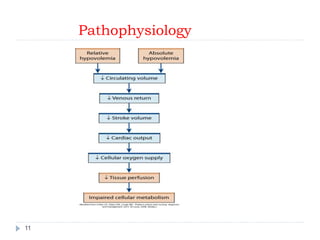
1. Hypovolemic shock
is inadequate tissue perfusion from decreased intravascular volume
result from fluid loss and/or inadequate fluid intake.
The most common cause of shock in children worldwide
Is most frequently caused by
 Diarrhea and/or vomiting
 Hemorrhage
 Osmotic diuresis ( hyperglycemia)
CONT.
10
 Capillary leak (sepsis & burn injury)
 Inadequate fluid intake (particularly among infants and young children who
cannot independently access fluids to replenish losses)
 Insensible losses ( fever or burns
Pathophysiology
11
12
Patients with hemorrhage categorized into four class.
Class I
 Acute loss of up to 15% of the child's blood volume.
 Usually respond well to crystalloid fluid replacement.
Class II
 15 to 30 % blood loss.
 Mild tachycardia & tachypnea with a narrow pulse pressure,
 Slightly delayed capillary refill, decreased urine output
 Usually be stabilized with crystalloid solution, may require blood products.
13
Class III
 Acute blood loss of 30 to 40 %
 Tachycardia, tachypnea, hypotension, delayed capillary refill, altered mental
status, and oliguria.
 Prompt resuscitation with crystalloid solution
 Most patients will need blood products as well.
Class IV
 More than 40 % acute blood loss.
 Profoundly depressed mentation, marked tachypnea and tachycardia, and
anuria.
 Children should quickly receive blood products.
 Operative intervention is to control hemorrhage.
14
2. Cardiogenic shock
characterized by reduced oxygen delivery related to a reduction in CO
owing to a primary cardiac problem
Results from pump failure, as decreased systolic function & depressed
cardiac output
 Congenital heart disease
 Infectious or acquired cardiomyopathies
 Ischemia
 Arrhythmia
 Hypocalcemia ,hyperkalemia or acidosis
Uncommon in children as compared with adults, among whom ischemic
heart disease is the major cause.
Pathophysiology
15
16
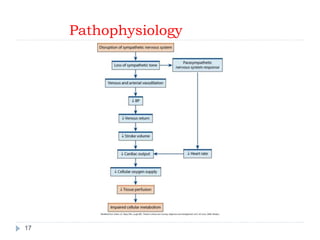
3. Distributive shock
condition of reduced oxygen delivery where the primary physiologic
disturbance is a reduction in systemic vascular resistance.
Caused by inadequate vasomotor tone, which leads to capillary leak &
maldistribution of fluid into the interstitium.
Etiology
 Anaphylaxis
 Neurologic- acute injury to the spinal cord or brainstem injury resulting in loss
of sympathetic venous tone.
 Drugs
Pathophysiology
17
18
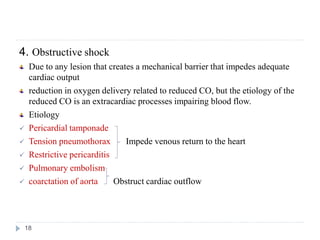
4. Obstructive shock
Due to any lesion that creates a mechanical barrier that impedes adequate
cardiac output
reduction in oxygen delivery related to reduced CO, but the etiology of the
reduced CO is an extracardiac processes impairing blood flow.
Etiology
 Pericardial tamponade
 Tension pneumothorax Impede venous return to the heart
 Restrictive pericarditis
 Pulmonary embolism
 coarctation of aorta Obstruct cardiac outflow
19
5. Septic shock
Septic process usually involves a more complex interaction of distributive,
hypovolemic & cardiogenic shock.
Etiology
 Bacterial
 Viral
 Fungal ( immunocompromised patients are at increased risk)
The primary derangements in septic shock results from exposure to
microbial components w/c trigger the cascade of inflammatory & vascular
mediators
Losses of fluid as a result of infection and inflammatory cascades that
increases capillary permeability with lose of plasma from the intravascular
space in to tissues.
Pathophysiology
20
21
Septic Shock: Warm Shock
 Early, compensated, hyperdynamic state
 Warm extremities with bounding pulses,
 Tachycardia, tachypnea, confusion
Septic Shock: Cold Shock
 Late, uncompensated stage with drop in cardiac output.
 Cyanosis, cold and clammy skin,
 Rapid pulses, shallow respirations
22
PATHOPHYSIOLOGY OF SHOCK
Deleterious effects of decreased tissue perfusion
 Poor perfusion of vital organs results in impaired function
 Lactic acid accumulates as cells switch to anaerobic metabolism to generate
energy.
 Increased lactic acid in tissues causes metabolic acidosis, which interferes
with cell and organ function.
 Hypoperfusion initiates inflammatory events that disrupt the
microcirculation and contribute to tissue injury.
 Catecholamine, corticosteroids, and glucagon initiate increased liver
glycolysis and lipolysis to maintain cell energy sources
 increase in lactic acid production.
23
Poor perfusion leads to cellular damage
I. Microcirculatory dysfunction
II. Tissue ischemia
III. Release of biochemical mediators;
 Vasoactive – leukotrienes, thromboxane.
 Inflammatory mediators (cytokines)
 Complement Activation
Stages of Shock
24
I. Compensated shock
Variety of neurohumoral mechanisms help to maintain cardiac output & blood
pressure.
 Baroreceptor reflexes & catecholamine release
 Activation of the renin-angiotensin axis & ADH release
 Generalized sympathetic stimulation
The net effect is tachycardia, peripheral vasoconstriction & renal conservation
of fluid.
Cutaneous vasoconstriction, is responsible for the characteristic coolness &
pallor of the skin in well-developed shock
25
Optimize oxygen delivery to the tissues by increasing oxygen extraction &
redistributing blood flow to the brain, heart, and kidneys.
Septic shock can initially cause cutaneous vasodilation and thus present
with warm, flushed skin.
Signs of peripheral vasoconstriction; such as cool skin, decreased
peripheral pulses, and oliguria
The body's homeostatic mechanisms rapidly compensate for diminished
perfusion and systolic blood pressure
26
Respiratory compensation involves
 Greater carbon dioxide (CO2 ) elimination in response to the metabolic
acidosis
 Increased CO2 production from poor tissue perfusion
Renal excretion of hydrogen ions & retention of bicarbonate to maintain
normal body pH
27
II. A progressive stage / Decompensated
 Compensatory mechanisms are overwhelmed
 Intracellular aerobic respiration is replaced by anaerobic glycolysis
 Excessive production of lactic acid.
 The resulting lactic acidosis lowers the tissue PH & blunts the vasomotor
response; arterioles dilate, & blood pooled into microcirculation
 Peripheral pooling worsens the
I. Cardiac output & endothelial cells at risk for anoxic injury
II. Subsequent disseminated intravascular coagulation
28
III. An irreversible stage
 After the body has incurred cellular & tissue injury
 Tachycardia replaced by bradycardia ,non detectable blood pressure and non
response to resuscitation
 Even if the hemodynamic defects are corrected, survival is not possible
 Progressive end-organ dysfunction leads to irreversible organ damage and
death
Clinical Manifestations
29
Hypovolemic shock
Manifests initially as orthostatic hypotension
Associated with dry mucous membranes, dry axillae,
Poor skin turgor, and decreased urine output.
May present with either normal or slightly cool distal extremities
Pulses may be normal, decreased, or absent
30
Cardiogenic shock
 Tachypnea, cool extremities,
 Delayed capillary filling time,
 Poor peripheral and/or central pulses,
 Declining mental status
 Decreased urine output
Approaches or evaluation
31
The goal of initial evaluation of shock
 Immediate identification of life threatening conditions
 Early classification of the type of shock and effective treatment
 Rapid recognition of circulatory compromise
Cont.
32
Paediatric assessment triangle(PAT) relies three observations
To quickly identify child with respiratory or circulatory compromise
 Appearance
 Breathing
 Circulatory status
Appearance (TICLS)
 Tone –what is the infants muscle tone
 Interactions –is child interactive to environment
 CONSOL ability- can the infant be consoled or distracted
 Look/gaze
 Speech/cry
33
Mental status/AVPU
 Alert
 Response to voice/verbally
 Response to pain
 Unresponsive
History
34
 History of fluid loss (vomiting ,diarrheal )
 Fever
 Exposure to an allergens such as bee sting or food
 Exposure to toxin
 Chronic heart disease
 Shortnes of breath /fast breathing
 History of trauma
Physical examination
35
Complete physical examinations including v/s with pulse oximetry should
performed.
 RR- tachypnea
 HR –tachycardia
 BP –may have normal in componseted shock
 Tempreture – fever/hypothermia in septic shock in infants
36
 Stridor .wheezing
 Distended neck veins
 Hepatomegaly in cardiogenic shock
 Edema
 Integumentary system
 Petichae, purpura- distributive or septic shock
 Skin rashes, angioedema- anaphylactic shock (distributive)
 Decreased skin turgor- hypovolemic
 Mental status
Investigation
37
 RBS
 Serum electrolytes
 Hematocrit
 Blood type cross match
 liver enzymes (ALT, AST),
 RFT
 Imaging studies: chest x-ray, echocardiography, abdominal U/S
Principle management of shock
38
Target goals of management
 Normal blood pressure for age
 Normal central and peripheral pulses
 Capillary refill<2 seconds
 Normal mental status
 Urine output >1.5-2 mL/kg /hr for infants and young children
> 1ml/kg per hr for older children and adolescents
39
 Stabilization of patient with breathing and air way(oxygen supplementation
 Passive leg rising
 Iv fluid treatment/management
 Control of bleeding ,pain ,fever/hypothermia
 Medication to control hypotension (vasopressors)
 Then specific underlying cause of shock medical and surgical treatment
 Continuous follow up of the patient
40
Prognosis
 The prognosis of shock depends on the underlining cause .
 Low volume ,anaphylactic shock and neurogenic shock are readily respond
well to medical therapy
Refereces
41
1. Nelson textbook of pediatrics, 21st edition.
2. Robbins and Cotran Pathologic Basis of Disease 9th edition.
3. Uptodate 2018
42

Shock in pediatric

  • 1.
    1 DEBRE BIRHAN UNIVERSITY COLLEGEOF MEDICINE Approaching shock in children Zelalem Mekonnen Modulator - Dr. Getachew (Pediatrician) March ,2013 E.C
  • 2.
    Approaching shock inchildren 2 Objective  Able to define shock  Know classification of shock & stages of shock  Understand pathophysiology & clinical feature of shock  Evaluation of children presented with shock  Know how to manage a child with shock
  • 3.
    Shock 3 Shock is astate in which systemic reduction in tissue perfusion, resulting in decreased tissue oxygen delivery. Prolonged oxygen deprivation leads to generalized cellular hypoxia & derangement of critical biochemical processes Cell membrane ion pump dysfunction Intracellular edema Leakage of intracellular contents into the extracellular space Inadequate regulation of intracellular pH
  • 4.
    4 Parameters that determineadequate oxygen delivery to tissues Blood flow to tissues (cardiac output) Regional balance between blood flow & metabolic demand Oxygen content of blood i.e. hemoglobin concentration & percentage of hemoglobin saturated with oxygen
  • 5.
    5 Physiologic variables thatthe body can manipulate to compensate for compromised perfusion Increased Cardiac output Increased stroke volume  It is primarily governed by three factors 1. Preload  Increased venous smooth muscle tone improves preload by shunting blood to the heart.  The more blood that enters the ventricle the greater stretching of the myocardium resulting in more forceful contraction 2. Cardiac contractility
  • 6.
    6 3. After load Increased afterload decreases the stroke volume Increased systemic vascular resistance  Vasoconstriction maintains perfusion pressure  Blood is shunted away from peripheral structures to the heart & central nervous system.
  • 7.
    7 Epidemiology Approximately 2% ofall hospitalized infants, children & adults in developed countries. The mortality rate varies substantially depending on the etiology & clinical circumstances Decreases in the mortality rate for shock due to  Educational efforts & the utilization of standardized management guidelines  Early recognition & intervention  Rapid transfer of critically ill to ICU have led to decreases in the mortality rate for shock.
  • 8.
    Types of Shock 8 Shockclassification systems generally define five major types of shock: 1. Hypovolemic shock 2. Cardiogenic shock 3. Distributive shock 4. Obstructive shock 5. Septic shock
  • 9.
    9 1. Hypovolemic shock isinadequate tissue perfusion from decreased intravascular volume result from fluid loss and/or inadequate fluid intake. The most common cause of shock in children worldwide Is most frequently caused by  Diarrhea and/or vomiting  Hemorrhage  Osmotic diuresis ( hyperglycemia)
  • 10.
    CONT. 10  Capillary leak(sepsis & burn injury)  Inadequate fluid intake (particularly among infants and young children who cannot independently access fluids to replenish losses)  Insensible losses ( fever or burns
  • 11.
  • 12.
    12 Patients with hemorrhagecategorized into four class. Class I  Acute loss of up to 15% of the child's blood volume.  Usually respond well to crystalloid fluid replacement. Class II  15 to 30 % blood loss.  Mild tachycardia & tachypnea with a narrow pulse pressure,  Slightly delayed capillary refill, decreased urine output  Usually be stabilized with crystalloid solution, may require blood products.
  • 13.
    13 Class III  Acuteblood loss of 30 to 40 %  Tachycardia, tachypnea, hypotension, delayed capillary refill, altered mental status, and oliguria.  Prompt resuscitation with crystalloid solution  Most patients will need blood products as well. Class IV  More than 40 % acute blood loss.  Profoundly depressed mentation, marked tachypnea and tachycardia, and anuria.  Children should quickly receive blood products.  Operative intervention is to control hemorrhage.
  • 14.
    14 2. Cardiogenic shock characterizedby reduced oxygen delivery related to a reduction in CO owing to a primary cardiac problem Results from pump failure, as decreased systolic function & depressed cardiac output  Congenital heart disease  Infectious or acquired cardiomyopathies  Ischemia  Arrhythmia  Hypocalcemia ,hyperkalemia or acidosis Uncommon in children as compared with adults, among whom ischemic heart disease is the major cause.
  • 15.
  • 16.
    16 3. Distributive shock conditionof reduced oxygen delivery where the primary physiologic disturbance is a reduction in systemic vascular resistance. Caused by inadequate vasomotor tone, which leads to capillary leak & maldistribution of fluid into the interstitium. Etiology  Anaphylaxis  Neurologic- acute injury to the spinal cord or brainstem injury resulting in loss of sympathetic venous tone.  Drugs
  • 17.
  • 18.
    18 4. Obstructive shock Dueto any lesion that creates a mechanical barrier that impedes adequate cardiac output reduction in oxygen delivery related to reduced CO, but the etiology of the reduced CO is an extracardiac processes impairing blood flow. Etiology  Pericardial tamponade  Tension pneumothorax Impede venous return to the heart  Restrictive pericarditis  Pulmonary embolism  coarctation of aorta Obstruct cardiac outflow
  • 19.
    19 5. Septic shock Septicprocess usually involves a more complex interaction of distributive, hypovolemic & cardiogenic shock. Etiology  Bacterial  Viral  Fungal ( immunocompromised patients are at increased risk) The primary derangements in septic shock results from exposure to microbial components w/c trigger the cascade of inflammatory & vascular mediators Losses of fluid as a result of infection and inflammatory cascades that increases capillary permeability with lose of plasma from the intravascular space in to tissues.
  • 20.
  • 21.
    21 Septic Shock: WarmShock  Early, compensated, hyperdynamic state  Warm extremities with bounding pulses,  Tachycardia, tachypnea, confusion Septic Shock: Cold Shock  Late, uncompensated stage with drop in cardiac output.  Cyanosis, cold and clammy skin,  Rapid pulses, shallow respirations
  • 22.
    22 PATHOPHYSIOLOGY OF SHOCK Deleteriouseffects of decreased tissue perfusion  Poor perfusion of vital organs results in impaired function  Lactic acid accumulates as cells switch to anaerobic metabolism to generate energy.  Increased lactic acid in tissues causes metabolic acidosis, which interferes with cell and organ function.  Hypoperfusion initiates inflammatory events that disrupt the microcirculation and contribute to tissue injury.  Catecholamine, corticosteroids, and glucagon initiate increased liver glycolysis and lipolysis to maintain cell energy sources  increase in lactic acid production.
  • 23.
    23 Poor perfusion leadsto cellular damage I. Microcirculatory dysfunction II. Tissue ischemia III. Release of biochemical mediators;  Vasoactive – leukotrienes, thromboxane.  Inflammatory mediators (cytokines)  Complement Activation
  • 24.
    Stages of Shock 24 I.Compensated shock Variety of neurohumoral mechanisms help to maintain cardiac output & blood pressure.  Baroreceptor reflexes & catecholamine release  Activation of the renin-angiotensin axis & ADH release  Generalized sympathetic stimulation The net effect is tachycardia, peripheral vasoconstriction & renal conservation of fluid. Cutaneous vasoconstriction, is responsible for the characteristic coolness & pallor of the skin in well-developed shock
  • 25.
    25 Optimize oxygen deliveryto the tissues by increasing oxygen extraction & redistributing blood flow to the brain, heart, and kidneys. Septic shock can initially cause cutaneous vasodilation and thus present with warm, flushed skin. Signs of peripheral vasoconstriction; such as cool skin, decreased peripheral pulses, and oliguria The body's homeostatic mechanisms rapidly compensate for diminished perfusion and systolic blood pressure
  • 26.
    26 Respiratory compensation involves Greater carbon dioxide (CO2 ) elimination in response to the metabolic acidosis  Increased CO2 production from poor tissue perfusion Renal excretion of hydrogen ions & retention of bicarbonate to maintain normal body pH
  • 27.
    27 II. A progressivestage / Decompensated  Compensatory mechanisms are overwhelmed  Intracellular aerobic respiration is replaced by anaerobic glycolysis  Excessive production of lactic acid.  The resulting lactic acidosis lowers the tissue PH & blunts the vasomotor response; arterioles dilate, & blood pooled into microcirculation  Peripheral pooling worsens the I. Cardiac output & endothelial cells at risk for anoxic injury II. Subsequent disseminated intravascular coagulation
  • 28.
    28 III. An irreversiblestage  After the body has incurred cellular & tissue injury  Tachycardia replaced by bradycardia ,non detectable blood pressure and non response to resuscitation  Even if the hemodynamic defects are corrected, survival is not possible  Progressive end-organ dysfunction leads to irreversible organ damage and death
  • 29.
    Clinical Manifestations 29 Hypovolemic shock Manifestsinitially as orthostatic hypotension Associated with dry mucous membranes, dry axillae, Poor skin turgor, and decreased urine output. May present with either normal or slightly cool distal extremities Pulses may be normal, decreased, or absent
  • 30.
    30 Cardiogenic shock  Tachypnea,cool extremities,  Delayed capillary filling time,  Poor peripheral and/or central pulses,  Declining mental status  Decreased urine output
  • 31.
    Approaches or evaluation 31 Thegoal of initial evaluation of shock  Immediate identification of life threatening conditions  Early classification of the type of shock and effective treatment  Rapid recognition of circulatory compromise
  • 32.
    Cont. 32 Paediatric assessment triangle(PAT)relies three observations To quickly identify child with respiratory or circulatory compromise  Appearance  Breathing  Circulatory status Appearance (TICLS)  Tone –what is the infants muscle tone  Interactions –is child interactive to environment  CONSOL ability- can the infant be consoled or distracted  Look/gaze  Speech/cry
  • 33.
    33 Mental status/AVPU  Alert Response to voice/verbally  Response to pain  Unresponsive
  • 34.
    History 34  History offluid loss (vomiting ,diarrheal )  Fever  Exposure to an allergens such as bee sting or food  Exposure to toxin  Chronic heart disease  Shortnes of breath /fast breathing  History of trauma
  • 35.
    Physical examination 35 Complete physicalexaminations including v/s with pulse oximetry should performed.  RR- tachypnea  HR –tachycardia  BP –may have normal in componseted shock  Tempreture – fever/hypothermia in septic shock in infants
  • 36.
    36  Stridor .wheezing Distended neck veins  Hepatomegaly in cardiogenic shock  Edema  Integumentary system  Petichae, purpura- distributive or septic shock  Skin rashes, angioedema- anaphylactic shock (distributive)  Decreased skin turgor- hypovolemic  Mental status
  • 37.
    Investigation 37  RBS  Serumelectrolytes  Hematocrit  Blood type cross match  liver enzymes (ALT, AST),  RFT  Imaging studies: chest x-ray, echocardiography, abdominal U/S
  • 38.
    Principle management ofshock 38 Target goals of management  Normal blood pressure for age  Normal central and peripheral pulses  Capillary refill<2 seconds  Normal mental status  Urine output >1.5-2 mL/kg /hr for infants and young children > 1ml/kg per hr for older children and adolescents
  • 39.
    39  Stabilization ofpatient with breathing and air way(oxygen supplementation  Passive leg rising  Iv fluid treatment/management  Control of bleeding ,pain ,fever/hypothermia  Medication to control hypotension (vasopressors)  Then specific underlying cause of shock medical and surgical treatment  Continuous follow up of the patient
  • 40.
    40 Prognosis  The prognosisof shock depends on the underlining cause .  Low volume ,anaphylactic shock and neurogenic shock are readily respond well to medical therapy
  • 41.
    Refereces 41 1. Nelson textbookof pediatrics, 21st edition. 2. Robbins and Cotran Pathologic Basis of Disease 9th edition. 3. Uptodate 2018
  • 42.