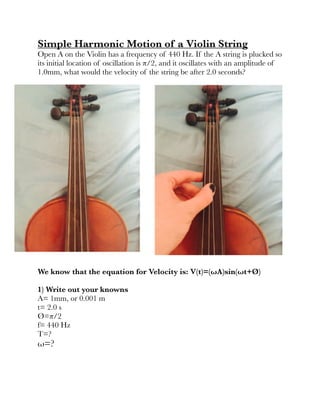
The document describes the velocity of an A string on a violin after 2 seconds of oscillation. It is given that the A string has a frequency of 440 Hz, an initial position of π/2, and an amplitude of 1.0 mm. The document solves for the unknown period and angular frequency, then uses the simple harmonic motion equation to find that the velocity of the string after 2 seconds is 2.76460 m/s or 2760 mm/s.
![2) Find your unknowns
!
The period, T, can be found with the equation T=1/f, and because we know
that f is 440Hz, it’s easy to solve for the period!
T=1/440
!
!
ω is equal to 2π/T, so just sub in our value for T.
ω= 2π/(1/440)
!
3) Sub into our equation for velocity
!
V(t)=(ωA)sin(ωt+Ø)
V(2.0s)=
[(2π/(1/440)rad/second)(0.001 m)] x sin[(2π/(1/440)rad/second)(2.0s)+(π/2)]
!
This gives us V(2.0)=2.76460 m/s OR 2760 mm/s…..That’s pretty fast!
!
4) Rationalize your answer
Look at a simple graph of Sin, try to think of all of the variables we are using
in terms of this graph.
Ø describes different possible initial locations of the oscillation (in our
example this is π/2) and A is the amplitude of the curve (1 mm). We Pulled the
string 1 mm, to it’s position of π/2 to start the oscillation.
!](https://image.slidesharecdn.com/shmlohayleysinclair-150126014807-conversion-gate01/85/Shm-lo-hayley-sinclair-2-320.jpg)


