BUSINESS COMMUNICATION
Master of Business
Administration
(MBA)
Semester :- 1st
Submitted By :
Shivam Patel
Submitted to :
Mrs. Poonam
Business
Business
Business
Business
Business
COMMUNICATION
What is Communication & Types Of
Communication
CONTENT
➢ What Is Communication
➢ Types of Communication
➢ Process Of Communicatin
Communication
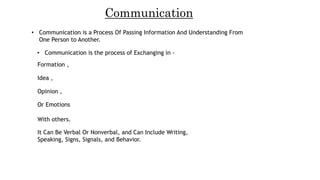
• Communication is a Process Of Passing Information And Understanding From
One Person to Another.
• Communication is the process of Exchanging in -
Formation ,
Idea ,
Opinion ,
Or Emotions
With others.
It Can Be Verbal Or Nonverbal, and Can Include Writing,
Speaking, Signs, Signals, and Behavior.
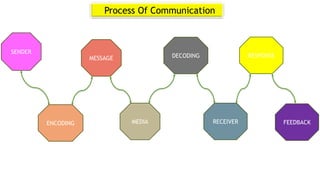
Process Of Communication
SENDER
MEDIA
DECODING RESPONSE
MESSAGE
RECEIVER FEEDBACK
ENCODING
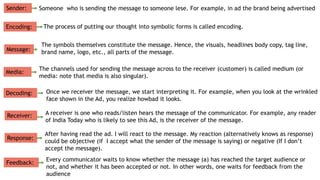
Sender: Someone who is sending the message to someone lese. For example, in ad the brand being advertised
Decoding:
Encoding: The process of putting our thought into symbolic forms is called encoding.
Message:
The symbols themselves constitute the message. Hence, the visuals, headlines body copy, tag line,
brand name, logo, etc., all parts of the message.
Media:
The channels used for sending the message across to the receiver (customer) is called medium (or
media: note that media is also singular).
Once we receiver the message, we start interpreting it. For example, when you look at the wrinkled
face shown in the Ad, you realize howbad it looks.
Receiver: A receiver is one who reads/listen hears the message of the communicator. For example, any reader
of India Today who is likely to see this Ad, is the receiver of the message.
Response:
After having read the ad. I will react to the message. My reaction (alternatively knows as response)
could be objective (if I accept what the sender of the message is saying) or negative (If I don’t
accept the message).
Feedback:
Every communicator waits to know whether the message (a) has reached the target audience or
not, and whether it has been accepted or not. In other words, one waits for feedback from the
audience
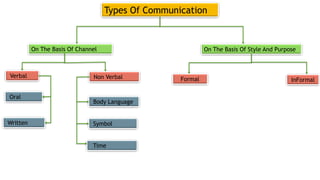
Types Of Communication
On The Basis Of Channel On The Basis Of Style And Purpose
Verbal Non Verbal
Body Language
Symbol
Time
Oral
Written
Formal InFormal
Verbal Communication
• When messages or information is exchanged or communicated through words is called verbal
communication. Verbal communication may be two types: written and Oral communication. Verbal
communication takes place through face-to-face conversation, group discussion, counselling, interview,
radio, television, radio, television, calls, memos, letters, reports, notes, email etc.
Non Verbal Communication
• Behavior and elements of speech aside from the words themselves that transmit meaning. Non- verbal
communication includes pitch, speed, tone and volume of voice, gestures and facial expressions, body
posture, stance, and proximity to the listener, eye movements and contact, and dress and appearance.
Research suggests that only 5 percent effect is produced by the spoken word, 45 percent by the,
inflexion, and elements of voice, and 50 percent by body language, movements, eye contact, etc…

SHIVAM Presentation Business Communication 2.pdf

  • 1.
    BUSINESS COMMUNICATION Master ofBusiness Administration (MBA) Semester :- 1st Submitted By : Shivam Patel Submitted to : Mrs. Poonam Business Business Business Business Business
  • 2.
    COMMUNICATION What is Communication& Types Of Communication
  • 3.
    CONTENT ➢ What IsCommunication ➢ Types of Communication ➢ Process Of Communicatin
  • 4.
    Communication • Communication isa Process Of Passing Information And Understanding From One Person to Another. • Communication is the process of Exchanging in - Formation , Idea , Opinion , Or Emotions With others. It Can Be Verbal Or Nonverbal, and Can Include Writing, Speaking, Signs, Signals, and Behavior.
  • 5.
    Process Of Communication SENDER MEDIA DECODINGRESPONSE MESSAGE RECEIVER FEEDBACK ENCODING
  • 6.
    Sender: Someone whois sending the message to someone lese. For example, in ad the brand being advertised Decoding: Encoding: The process of putting our thought into symbolic forms is called encoding. Message: The symbols themselves constitute the message. Hence, the visuals, headlines body copy, tag line, brand name, logo, etc., all parts of the message. Media: The channels used for sending the message across to the receiver (customer) is called medium (or media: note that media is also singular). Once we receiver the message, we start interpreting it. For example, when you look at the wrinkled face shown in the Ad, you realize howbad it looks. Receiver: A receiver is one who reads/listen hears the message of the communicator. For example, any reader of India Today who is likely to see this Ad, is the receiver of the message. Response: After having read the ad. I will react to the message. My reaction (alternatively knows as response) could be objective (if I accept what the sender of the message is saying) or negative (If I don’t accept the message). Feedback: Every communicator waits to know whether the message (a) has reached the target audience or not, and whether it has been accepted or not. In other words, one waits for feedback from the audience
  • 7.
    Types Of Communication OnThe Basis Of Channel On The Basis Of Style And Purpose Verbal Non Verbal Body Language Symbol Time Oral Written Formal InFormal
  • 8.
    Verbal Communication • Whenmessages or information is exchanged or communicated through words is called verbal communication. Verbal communication may be two types: written and Oral communication. Verbal communication takes place through face-to-face conversation, group discussion, counselling, interview, radio, television, radio, television, calls, memos, letters, reports, notes, email etc. Non Verbal Communication • Behavior and elements of speech aside from the words themselves that transmit meaning. Non- verbal communication includes pitch, speed, tone and volume of voice, gestures and facial expressions, body posture, stance, and proximity to the listener, eye movements and contact, and dress and appearance. Research suggests that only 5 percent effect is produced by the spoken word, 45 percent by the, inflexion, and elements of voice, and 50 percent by body language, movements, eye contact, etc…