TFD-HE13 - Shell & Tube Heat Exchager Design 1
SHELL & TUBE
HEAT EXCHANGER DESIGN
TFD-HE13 - Shell & Tube Heat Exchager Design 2
Introduction
q Shell & tube heat exchangers are the most versatile type of heat
exchangers.
§ Theyare used in process industries, in conventional and nuclear power
stations, steam generators, etc
§ Theyare used in manyalternative energyapplications including ocean,
thermal and geothermal.
q Shell & tube heat exchangers provide relativelylarge ratios of heat
transfer area to volume.
q Theycan be easilycleaned.
TFD-HE13 - Shell & Tube Heat Exchager Design 3
Shell & Tube HeatExchangers
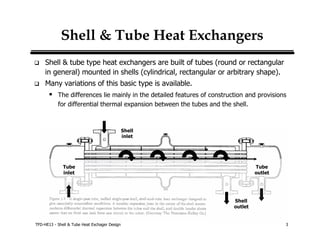
q Shell & tube type heat exchangers are built of tubes (round or rectangular
in general) mounted in shells (cylindrical, rectangular or arbitraryshape).
q Manyvariations of this basic type is available.
§ The differences lie mainlyin the detailed features of construction and provisions
for differential thermal expansion between the tubes and the shell.
Tube
outlet
Tube
inlet
Shell
outlet
Shell
inlet
TFD-HE13 - Shell & Tube Heat Exchager Design 4
Shell & Tube HeatExchangers
U-Tube, baffled, single pass
shell & tube heat exchanger
Two pass tube, baffledsingle pass
shell & tube heat exchanger
Two pass tube, floatinghead, baffled
single pass shell & tube heat exchanger
TFD-HE13 - Shell & Tube Heat Exchager Design 5
Shell Types
q TEMA (the Tubular Exchangers
Manufacturers Association) publishes
standards defining how shell and tube
exchangers should be built. They
define a naming system that is
commonlyused.
q Shells are also typicallypurchased in
standard sizes to control costs. Inside
the shell, baffles (dividers) are
installed to direct the flow around the
tubes, increase velocity, and promote
cross flow. Theyalso help support the
tubes. The baffle cut is the ratio of the
baffle window height to the shell
diameter. Typically, baffle cut is about
20 percent. It effects both heat
transfer and pressure drop. Designers
also need to specifythe baffle spacing;
the maximum spacing depends on how
much support the tubes need.
TFD-HE13 - Shell & Tube Heat Exchager Design 6
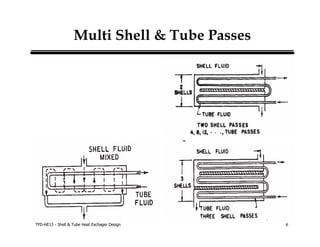
M ultiShell & Tube Passes
TFD-HE13 - Shell & Tube Heat Exchager Design 7
Tube toHeader Plate Connection
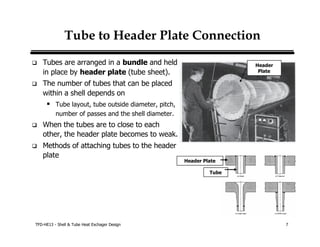
q Tubes are arranged in a bundle and held
in place byheaderplate (tube sheet).
q The number of tubes that can be placed
within a shell depends on
§ Tube layout, tube outside diameter, pitch,
number of passes and the shell diameter.
q When the tubes are to close to each
other, the header plate becomes to weak.
q Methods of attaching tubes to the header
plate
Header
Plate
HeaderPlate
Tube
TFD-HE13 - Shell & Tube Heat Exchager Design 8
Baffle Type & Geometry
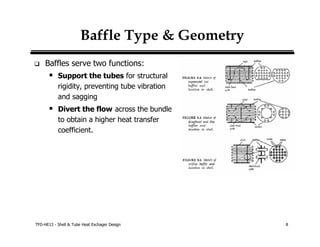
q Baffles serve two functions:
§ Support the tubes for structural
rigidity, preventing tube vibration
and sagging
§ Divert the flow across the bundle
to obtain a higher heat transfer
coefficient.
TFD-HE13 - Shell & Tube Heat Exchager Design 9
Segmental CutBaffles
Baffle Type & Geometry
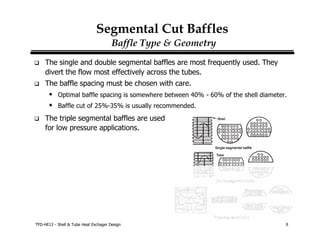
q The single and double segmental baffles are most frequentlyused. They
divert the flow most effectivelyacross the tubes.
q The baffle spacing must be chosen with care.
§ Optimal baffle spacing is somewhere between 40% - 60% of the shell diameter.
§ Baffle cut of 25%-35% is usuallyrecommended.
q The triple segmental baffles are used
for low pressure applications.
TFD-HE13 - Shell & Tube Heat Exchager Design 10
Disc & RingBaffles
Baffle Type & Geometry
q Disc and ring baffles are composed of alternating outer rings and
inner discs, which direct the flow radiallyacross the tube field.
§ The potential bundle-to-shell bypass stream is eliminated
§ This baffle type is veryeffective in pressure drop to heat transfer
conversion
q Disc
TFD-HE13 - Shell & Tube Heat Exchager Design 11
Orifice Baffle
Baffle Type & Geometry
q In an orifice baffle shell-side-fluid flows through the clearance
between tube outside diameter and baffle-hole diameter.
TFD-HE13 - Shell & Tube Heat Exchager Design 12
Number ofTubes
q The number of tubes in an exchanger depends on the
§ Fluid flow rates
§ Available pressure drop.
q The number of tubes is selected such that the
§ Tube side velocityfor water and similar liquids ranges from
0.9 to 2.4 m/s (3 to 8 ft/sec)
§ Shell-side velocityfrom 0.6 to 1.5 m/s (2 to 5 ft/sec).
q The lower velocitylimit corresponds to limiting the fouling, and the
upper velocitylimit corresponds to limiting the rate of erosion.
q When sand and silt are present, the velocityis kept high enough to
prevent settling.
TFD-HE13 - Shell & Tube Heat Exchager Design 13
Tube Passes
q Apass is when liquid flows all the wayacross from one end to the
other of the exchanger. We will count shell passes and tube passes.
§ An exchanger with one shell pass and two tube passes is a 1-2
exchanger. Almost always, the tube passes will be in multiples of two
(1-2, 1-4, 2-4, etc.)
§ Odd numbers of tube passes have more complicated mechanical
stresses, etc. An exception: 1-1 exchangers are sometimes used for
vaporizers and condensers.
q A large number of tube passes are used to increase the tube side
fluid velocityand heat transfer coefficient and minimize fouling.
§ This can onlybe done when there is enough pumping power since the
increased velocityand additional turns increases the pressure drop
significantly.
TFD-HE13 - Shell & Tube Heat Exchager Design 14
Tube Passes - Continued
q The number of tube passes depends on the available pressure drop.
§ Higher velocities in the tube result in higher heat transfer coefficients,
at the expense of increased pressure drop.
q Therefore, if a higher pressure drop is acceptable, it is desirable to
have fewer but longer tubes (reduced flow area and increased flow
length).
§ Long tubes are accommodated in a short shell exchanger bymultiple
tube passes.
q The number of tube passes in a shell generallyrange from 1 to 10
§ The standard design has one, two, or four tube passes.
§ An odd number of passes is uncommon and mayresult in mechanical
and thermal problems in fabrication and operation.
TFD-HE13 - Shell & Tube Heat Exchager Design 15
Tube M aterials
q Materials selection and compatibilitybetween construction
materials and working fluids are important issues, in particular with
regard to corrosion and/or operation at elevatedtemperatures.
q Requirement for low cost, light weight, high conductivity, and good
joining characteristics often leads to the selection of aluminum for
the heat transfer surface.
q On the other side, stainless steel is used for food processing or
fluids that require corrosion resistance.
q In general, one of the selection criteria for exchanger material
depends on the corrosiveness of the working fluid.
q A summaryTable is provided as a reference fo rcorrosive and non-
corrosive environments
TFD-HE13 - Shell & Tube Heat Exchager Design 16
M aterials for Corrosive &
Noncorrosive Service
TFD-HE13 - Shell & Tube Heat Exchager Design 17
Tube W all Thickness
q The wall thickness of heat exchanger tubes is standardized in terms
of Birmingham Wire Gage BWG of the tube.
q Small tube diameters (8 to 15mm) are preferred for greater area to
volume densitybut are limited for the purposes of cleaning.
q Large tube diameters are often required for condensers and boilers.
TFD-HE13 - Shell & Tube Heat Exchager Design 18
Tube Outside Diameter
q The most common plain tube sizes have 15.88,19.05, and 25.40 mm
(5/8, ¾, 1 inche) tube outside diameters.
q From the heat transfer viewpoint, smaller-diameter tubes yield
higher heat transfer coefficients and result in a more compact
exchanger.
q However, larger-diameter tubes are easier to clean and more
rugged.
q The foregoing common sizes represent a compromise.
§ For mechanical cleaning, the smallest practical size is 19.05 mm.
§ For chemical cleaning, smaller sizes can be used provided that the
tubes never plug completely.
TFD-HE13 - Shell & Tube Heat Exchager Design 19
Tube Length
q Tube length affects the cost and operation of heat exchangers.
§ Longer the tube length (for anygiven surface area),
• Fewer tubes are needed, requiring less complicated header plate with fewer
holes drilled
• Shell diameter decreases resulting in lower cost
q Typicallytubes are employed in 8, 12, 15, and 20 foot lengths.
Mechanical cleaning is limited to tubes 20 ft and shorter, although
standard exchangers can be built with tubes up to 40 ft.
q There are, like with anything limits of how long the tubes can be.
§ Shell-diameter-to-tube-length ratio should be
within limits of 1/5 to 1/15
q Maximum tube length is dictated by
§ Architectural layouts
§ Transportation (to about 30m.)
• The diameter of the two booster rockets is dictated bythe smallest highway
tunnel size between the location of manufacturer and Florida. Scientific hah!
TFD-HE13 - Shell & Tube Heat Exchager Design 20
Tube Length
Tube & Header Plate Deformation
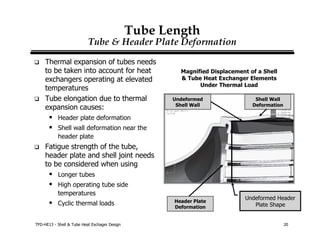
q Thermal expansion of tubes needs
to be taken into account for heat
exchangers operating at elevated
temperatures
q Tube elongation due to thermal
expansion causes:
§ Header plate deformation
§ Shell wall deformation near the
header plate
q Fatigue strength of the tube,
header plate and shell joint needs
to be considered when using
§ Longer tubes
§ High operating tube side
temperatures
§ Cyclic thermal loads
Undeformed Header
Plate Shape
Undeformed
Shell Wall
HeaderPlate
Deformation
Shell Wall
Deformation
MagnifiedDisplacement ofaShell
& Tube Heat ExchangerElements
UnderThermal Load
TFD-HE13 - Shell & Tube Heat Exchager Design 21
Tube Layout
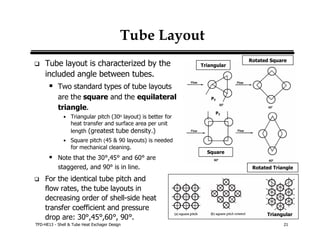
q Tube layout is characterized bythe
included angle between tubes.
§ Two standard types of tube layouts
are the square and the equilateral
triangle.
• Triangular pitch (30o layout) is better for
heat transfer and surface area per unit
length (greatest tube density.)
• Square pitch (45 & 90 layouts) is needed
for mechanical cleaning.
§ Note that the 30°,45° and 60° are
staggered, and 90° is in line.
PT
q For the identical tube pitch and
flow rates, the tube layouts in
decreasing order of shell-side heat
transfer coefficient and pressure
drop are: 30°,45°,60°, 90°.
Triangular
Square
RotatedSquare
RotatedTriangle
Triangular
PT
TFD-HE13 - Shell & Tube Heat Exchager Design 22
Tube Layout- Continued
q The 90° layout will have the lowest heat transfer coefficient and
the lowest pressure drop.
q The square pitch (90° or 45°) is used when jet or mechanical
cleaning is necessaryon the shell side. In that case, a minimum
cleaning lane of ¼ in. (6.35 mm) is provided.
§ The square pitch is generallynot used in the fixed header sheet design
because cleaning is not feasible.
q The triangularpitch provides a more compact arrangement,
usuallyresulting in smaller shell, and the strongest header sheet for
a specified shell-side flow area.
§ It is preferred when the operating pressure difference between the two
fluids is large.
TFD-HE13 - Shell & Tube Heat Exchager Design 23
Tube Pitch
q The selection oftube pitch is a compromise between a
§ Close pitch (small values of Pt/do) for increased shell-side heat transfer
and surface compactness, and an
§ Open pitch (large values of Pt/do) for decreased shell-side plugging and
ease in shell-side cleaning.
q Tube pitch PT is chosen so that the pitch ratio is 1.25 <PT/do <1.5
§ When the tubes are to close to each other (Pt/do less than 1.25) , the
header plate (tube sheet) becomes to weakfor proper rolling of the
tubes and cause leakyjoints.
q Tube layout and tube locations are standardized for industrial heat
exchangers.
§ However, these are general rules of thumb and can be “violated” for
custom heat exchanger designs.
TFD-HE13 - Shell & Tube Heat Exchager Design 24
Tube & Shell ExhaustGas Cooler
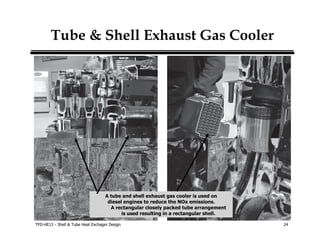
Atube andshell exhaust gas cooleris usedon
diesel engines to reduce the NOxemissions.
Arectangularcloselypackedtube arrangement
is usedresultingin arectangularshell.
TFD-HE13 - Shell & Tube Heat Exchager Design 26
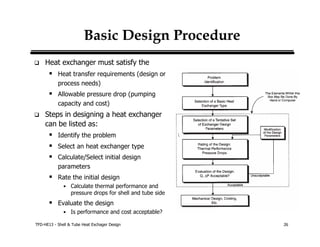
Basic DesignProcedure
q Heat exchanger must satisfythe
§ Heat transfer requirements (design or
process needs)
§ Allowable pressure drop (pumping
capacityand cost)
q Steps in designing a heat exchanger
can be listed as:
§ Identifythe problem
§ Select an heat exchanger type
§ Calculate/Select initial design
parameters
§ Rate the initial design
• Calculate thermal performance and
pressure drops for shell and tube side
§ Evaluate the design
• Is performance and cost acceptable?
TFD-HE13 - Shell & Tube Heat Exchager Design 27
Size ofHeatExchanger
q The initial size (surface area) of a
heat exchanger can be estimated from cflmomo
o
TFU
q
TU
q
A
,D
=
D
=
§ where
• Ao Outside tube surface area
• q Heat duty– heat exchange between tube and shell side
• Uo Overall heat transfer coefficient
• F Correction factor F=1.0 for cross flow heat exchanger
• ?Tm True mean temperature à ? Tm =F ? Tlm
• ?Tlm Log mean temperature difference (Est of true mean temperature)
§ Correction FactorFis be covered in module TFD-HE4 Log-Mean
Temperature Difference
TFD-HE13 - Shell & Tube Heat Exchager Design 28
Overall HeatTransfer Coefficient
q The overall heat transfercoefficient Uo based on the outside
diameter of tubes can be estimated from:
§ The individual heat transfer coefficients (h)
§ Shell wall, outside & inside tube fouling resistances (Rw, Rfo, Rfi)
§ Overall surface efficiency(?i & ?o)
ooo
fo
wo
i
fi
iii
o
o h
R
RA
R
hA
A
U ηηηη
111
+++÷÷
ø
ö
çç
è
æ
+=
TFD-HE13 - Shell & Tube Heat Exchager Design 29
HeatBalance of
Shell & Tube HeatExchanger
q Heat load of a heat exchanger can be estimated from heat balance:
Tube
outlet
Tube
inlet
Shell
outlet
Shell
inlet
Tc,i
Tc,o
Th,oTh,i
( ) ( ) ( ) ( )ohihhpicoccp TTcmTTcmq ,,,, -=-= &&
§ If three of the temperatures are given, the fourth can be calculated
using the above equation.
§ The above equation assumes no phase change in anyof the fluids.
TFD-HE13 - Shell & Tube Heat Exchager Design 30
Other TFD M odules Supporting
Shell & Tube HeatExchangers
q Overall heat transfer coefficient is covered in module TFD-HE01
q Log-mean temperature difference is covered in module TFD-HE4
q Heat transfer from finned surfaces is covered in module TFD-HE11
TFD-HE13 - Shell & Tube Heat Exchager Design 31
Total Number ofTubes
q Once the total tube outside surface area Ao is estimated a cost
effective heat exchanger configuration needs to be calculated.
q Numberoftubes Nt is dependent on tube side flow conditions. It
is related to the shell diameter(Ds), tube length (L) and tube
diameter(do) together with the allowable pressure drop and the
total tube side flow rate hence the heat transfer coefficient.
LNdA too π=
TFD-HE13 - Shell & Tube Heat Exchager Design 32
Total Number ofTubes
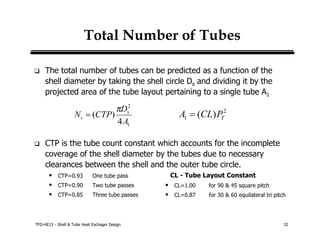
q The total number of tubes can be predicted as a function of the
shell diameter bytaking the shell circle Ds and dividing it bythe
projected area of the tube layout pertaining to a single tube A1
§ CTP=0.93 One tube pass
§ CTP=0.90 Two tube passes
§ CTP=0.85 Three tube passes
§ CL=1.00 for 90 & 45 square pitch
§ CL=0.87 for 30 & 60 equilateral tri pitch
CL- Tube Layout Constant
q CTP is the tube count constant which accounts for the incomplete
coverage of the shell diameter bythe tubes due to necessary
clearances between the shell and the outer tube circle.
1
2
4
)(
A
D
CTPN s
t
π
=
2
1 )( TPCLA =
TFD-HE13 - Shell & Tube Heat Exchager Design 33
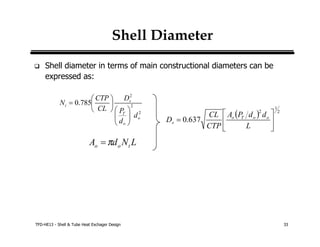
Shell Diameter
2
2
2
785.0
o
o
T
s
t
d
d
P
D
CL
CTP
N
÷÷
ø
ö
çç
è
æ
÷
ø
ö
ç
è
æ
=
LNdA too π=
( ) 2
1
2
637.0 ú
û
ù
ê
ë
é
=
L
ddPA
CTP
CL
D ooTo
s
q Shell diameter in terms of main constructional diameters can be
expressed as:
TFD-HE13 - Shell & Tube Heat Exchager Design 34
Ratingofthe HeatExchanger Design
q Ratingan exchangermeans to evaluate the thermo-hydraulic
performance of a fullyspecifiedexchanger.
q Input to the rating process is heat exchanger geometry(constructional
design parameters), process conditions (flow rate, temperature,
pressure) and material/fluidproperties (density, thermal conductivity)
q First output from the rating process is either the outlet temperature for
fixed tube length or the tube length itself to meet the outlet temperature
requirement.
q Secondoutput from the rating process is the pressure drop for both fluid
streams hence the pumping energyrequirements and size.
TFD-HE13 - Shell & Tube Heat Exchager Design 35
InsufficientThermal Rating
q If the output of the rating analysis is not acceptable, a geometrical
modification should be made
q If the required amount of heat cannot be transferred to satisfy
specific outlet temperature, one should find a wayto increase the
heat transfer coefficient or increase exchanger surface area
§ One can increase the tube side heat transfer coefficient byincreasing
the fluid velocity- Increase number of tube passes
§ One can increase the shell side heat transfer coefficient bydecreasing
baffle spacing and/or baffle cut
§ One can increase the surface area by
• Increasing the heat exchanger length
• Increasing the shell diameter
• Multiple shells in series
TFD-HE13 - Shell & Tube Heat Exchager Design 36
InsufficientPressure DropRating
q If the pressure drop on the tube side is greater than the allowable
pressure drop, then
§ the number of tube passes can be decreased or
§ the tube diameter can be increased which mayresult to
• decrease the tube length – (Same surface area)
• increase the shell diameter and the number of tubes
q If the shell side pressure drop is greater than the allowable pressure
drop then baffle spacing, tube pitch, and baffle cut can be increased
or one can change the baffle type.
THEREIS ALWAYS ATRADE-OFFBETWEEN
THERMAL& PRESSUREDROP RATINGS!
TFD-HE13 - Shell & Tube Heat Exchager Design 37
The Trade-Off
BetweenThermal Balance & Flow Loss
q Heat transfer and fluid friction losses tend to compete with one
another.
q The total energyloss can be minimized byadjusting the size of one
irreversibilityagainst the other .
q These adjustments can be made byproperlyselecting physical
dimensions of the solid parts (fins, ducts, heat exchanger surface).
q It must be understood, however, that the result is at best a
thermodynamic optimum.
§ Constraints such as cost, size, and reliabilityenter into the
determination of trulyoptimal designs.
TFD-HE13 - Shell & Tube Heat Exchager Design 38
Shell Side HeatTransfer Coefficient
q There are three ratingmethods to calculate the shell side heat
transfer coefficient:
§ Kern methodis a simplified approach suitable for shell side flow without
baffles
§ Taborekmethod
§ Bell Delaware method is the most complex but accurate wayof rating a
heat exchanger with baffles
TFD-HE13 - Shell & Tube Heat Exchager Design 39
SHELL SIDE
HEAT TRANSFER COEFFICIENT
W ITH BAFFLES
TFD-HE13 - Shell & Tube Heat Exchager Design 40
Shell Side HeatTransfer
BaffledFlow
q When the tube bundle employs baffles, the heat transfer
coefficient is higher than the coefficient for undisturbed flow
around tubes without baffles.
q For a baffled heat exchanger
§ the higher heat transfer coefficients result from the increased
turbulence.
§ the velocityoffluidfluctuates because of the constricted area
between adjacent tubes across the bundle.
q Onlypart ofthe fluidtakes the desiredpath through the tube
bundle (Stream B), whereas a potentiallysubstantial portion flows
through the ‘leakage’ areas (Streams A, C, E & F)
§ However, these clearances are inherent to the manufacturing and
assemblyprocess of shell-and-tube exchangers, and the flow
distribution within the exchanger must be taken into account.
TFD-HE13 - Shell & Tube Heat Exchager Design 41
M ain& Leakage Flow Streams
BaffledHeat Exchanger
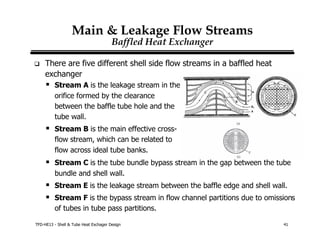
q There are five different shell side flow streams in a baffled heat
exchanger
§ Stream Ais the leakage stream in the
orifice formed bythe clearance
between the baffle tube hole and the
tube wall.
§ Stream Bis the main effective cross-
flow stream, which can be related to
flow across ideal tube banks.
§ Stream Cis the tube bundle bypass stream in the gap between the tube
bundle and shell wall.
§ Stream Eis the leakage stream between the baffle edge and shell wall.
§ Stream Fis the bypass stream in flow channel partitions due to omissions
of tubes in tube pass partitions.
TFD-HE13 - Shell & Tube Heat Exchager Design 42
M ain& Leakage Flow Streams
BaffledHeat Exchanger
Stream C
Stream A
Stream E
Stream F
Pass 1Pass 2
Stream Fhappens in a
multiple pass (1-2, 1-4)
heat exchanger
TFD-HE13 - Shell & Tube Heat Exchager Design 43
Bell Delaware M ethod
Heat Transfer Coefficient & CorrectionFactors
q In the Delaware method, the fluid flow in the shell is divided into a
number of individual streams A through F as defined before.
q Each of the above streams introduces a correction factor to the
heat transfer correlation for ideal cross-flow across a bankof tubes.
rsblcidealo JJJJJhh =
14.0
,
3
2
÷
÷
ø
ö
ç
ç
è
æ
÷
÷
ø
ö
ç
ç
è
æ
÷÷
ø
ö
çç
è
æ
=
ws
s
sps
s
s
s
psiideal
c
k
A
m
cjh
µ
µ
µ
&
§ ji Colburn j-factor
§ As Cross flow area at the centerline
of shell for one cross flow
between two baffles
§ s Stands for shell
§ w Wall temperature
§ hideal heat transfer coefficient for pure
cross-flow in an ideal tube bank
§ Jc for baffle cut and spacing
§ Jl for leakage effects
§ Jb bundle bypass flow C& F streams
§ Js for variable baffle spacing in the
inlet and outlet sections
§ Jr for adverse temperature gradient
build-up
The combinedeffects ofall these correction factors forareasonable
well-designedshell-and-tube heat exchangeris ofthe orderof0.60
TFD-HE13 - Shell & Tube Heat Exchager Design 44
Bell Delaware M ethod
Jc CorrectionFactor
q Jc is the correction factor for baffle cut and spacing. This factor
takes into account the heat transfer in the window and calculates
the overall average heat transfer coefficient for the entire heat
exchanger.
q It depends on the shell diameter and the baffle cut distance from
the baffle tip to the shell inside diameter.
§ For a large baffle cut, this value maydecrease to a value of 0.53
§ it is equal to 1.0 for a heat exchanger with no tubes in the window
§ It mayincrease to a value as high as 1.15 for small windows with a
high window velocity.
TFD-HE13 - Shell & Tube Heat Exchager Design 45
Bell Delaware M ethod
Jl CorrectionFactor
q Jl is the correlation factor for baffle leakage effects including tube-
to-baffle and shell-to-baffle leakage (A- and E-streams).
q If the baffles are put too close together, then the fraction of the
flow in the leakage streams increases compared with the cross flow.
q JI is a function of the
§ ratio of total leakage area per baffle to the cross flow area between
adjacent baffles
§ ratio of the shell-to-baffle leakage area to the tube-to-baffle leakage
area.
q A typical value of Jl is in the range of 0.7 and 0.8.
TFD-HE13 - Shell & Tube Heat Exchager Design 46
Bell Delaware M ethod
Jb CorrectionFactor
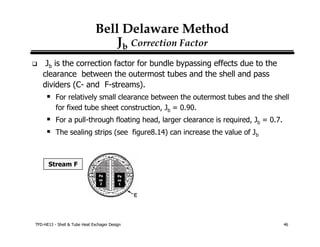
q Jb is the correction factor for bundle bypassing effects due to the
clearance between the outermost tubes and the shell and pass
dividers (C- and F-streams).
§ For relativelysmall clearance between the outermost tubes and the shell
for fixed tube sheet construction, Jb =0.90.
§ For a pull-through floating head, larger clearance is required, Jb =0.7.
§ The sealing strips (see figure8.14) can increase the value of Jb
Stream F
Pa
ss
1
Pa
ss
2
TFD-HE13 - Shell & Tube Heat Exchager Design 47
Bell Delaware M ethod
Js & Jr CorrectionFactors
q Js is the correction factor for variable baffle spacing at the inlet and
outlet. Because of the nozzle spacing at the inlet and outlet and the
changes in local velocities, the average heat transfer coefficient on
the shell side will change.
q The Js value will usuallybe between 0.85 and 1.00.
q Jr applies if the shell-side Reynolds number, Res, is less than 100.
§ If Res <20, it is fullyeffective.
§ This factor is equal to 1.00 if Res>100.
The combinedeffect of
all these correction factors
forawell-designedshell-and-tube heat exchanger
is ofthe orderof0.60
TFD-HE13 - Shell & Tube Heat Exchager Design 48
Bell Delaware M ethod
Heat Transfer Coefficient - Colburnj-factor
q Colburn-j factor is used in heat transfer in general and free and
forced convection calculations in particular.
§ It is equivalent to (St.Pr2/3) where St is Stanton number
where Stanton Number is defined as
q Colburn j-factor is a function of:
§ Shell side Reynolds numberbased on the
outside tube diameter and on the minimum cross
section flow area at the shell diameter
§ Tube layout
§ Pitch size
ss
so
s
A
md
µ
&
=Re
( )
p
pp
t
c
A
m
h
cV
h
Gc
h
S
min
max
&
===
ρ
§ G is the mass velocity
§ Amin is the min free flow x-sec
area regardless where it occurs
TFD-HE13 - Shell & Tube Heat Exchager Design 49
Bell Delaware M ethod
Numerical Formsof Colburn(j)& Friction(f)Factors
q Although the ideal values of j and f are available in graphical forms,
for computer analysis, a set of curve-fit correlations are obtained in
the following forms:
( ) 2
Re
33.1
1
a
s
a
oT
i
dP
aj ÷÷
ø
ö
çç
è
æ
=
( ) 4
Re14.01
3
a
s
a
a
+
=
( ) 2
Re
33.1
1
b
s
b
oT dP
bf ÷÷
ø
ö
çç
è
æ
=
( ) 4
Re14.01
3
b
s
b
b
+
=
Colburn j-factor
Friction factor
TFD-HE13 - Shell & Tube Heat Exchager Design 50
SHELL SIDE
HEAT TRANSFER COEFFICIENT
W ITHOUT BAFFLES
SHELL-and-TUBE HEAT EXCHANGER
TFD-HE13 - Shell & Tube Heat Exchager Design 51
Shell Side HeatTransfer Coefficient
W ithout Baffles– Flow Alongthe Tube Axis
q The heat transfer coefficient outside the tube bundle is referred to
as the shell-side heat transfer coefficient.
q If there are no baffles, the flow will be along the heat exchanger
inside the shell. Then, the heat transfer coefficient can be based on
the equivalent diameter, De (Same as a double-pipe heat exchanger)
14.03/155.0
36.0 ú
û
ù
ê
ë
é
ú
û
ù
ê
ë
é
ú
û
ù
ê
ë
é
=
w
bpseeo
k
cGD
k
Dh
µ
µµ
µ
14.0
3/155.0
PrRe36.0 ú
û
ù
ê
ë
é
=
w
beo
k
Dh
µ
µ
63
10Re102 <=<´
µ
se
s
GD
q De Equivalent shell diameter
q Gs Shell side mass velocity
q b Bulkfluid temperature
q w Wall temperature
TFD-HE13 - Shell & Tube Heat Exchager Design 52
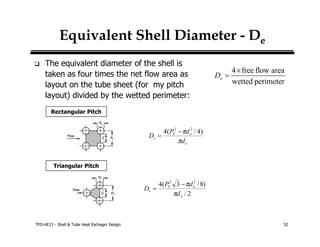
EquivalentShell Diameter - De
q The equivalent diameter of the shell is
taken as four times the net flow area as
layout on the tube sheet (for mypitch
layout) divided bythe wetted perimeter:
perimeterwetted
areaflowfree4´
=eD
RectangularPitch
TriangularPitch
o
oT
e
d
dP
D
π
π )4/(4 22
-
=
2/
)8/3(4 22
o
oT
e
d
dP
D
π
π-
=
TFD-HE13 - Shell & Tube Heat Exchager Design 53
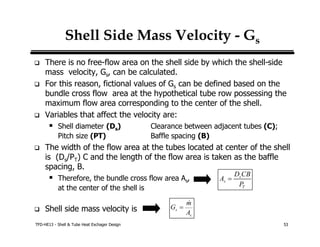
Shell Side M ass Velocity- Gs
q There is no free-flow area on the shell side bywhich the shell-side
mass velocity, Gs, can be calculated.
q For this reason, fictional values of Gs can be defined based on the
bundle cross flow area at the hypothetical tube row possessing the
maximum flow area corresponding to the center of the shell.
q Variables that affect the velocityare:
§ Shell diameter (Ds) Clearance between adjacent tubes (C);
Pitch size (PT) Baffle spacing (B)
q The width of the flow area at the tubes located at center of the shell
is (Ds/PT) Cand the length of the flow area is taken as the baffle
spacing, B.
§ Therefore, the bundle cross flow area As,
at the center of the shell is
q Shell side mass velocityis
T
s
s
P
CBD
A =
s
s
A
m
G
&
=
TFD-HE13 - Shell & Tube Heat Exchager Design 54
Shell Side Pressure Drop
q The shell-side pressure drop depends on the number of tubes the
fluid passes through in the tube bundle between the baffles as well
as the length of each crossing.
§ If the length of a bundle is divided byfour baffles, for example, all the
fluid travels across the bundle five times.
( ) 14.0
2
2
11
wbe
ss
s
D
D
B
L
fG
p
µµρ
þ
ý
ü
î
í
ì
+÷
ø
ö
ç
è
æ
-
=D
)}ln(Re19.0576.0exp{ sf -=
q A correlation has been obtained using
the product of distance across the
bundle, taken as the inside diameter
of the shell, Ds and the number of
times the bundle is crossed.
§ Lis the heat exchanger length, Bis the
baffle spacing
q Shell side friction coefficient f
includes the entrance and exit losses
TFD-HE13 - Shell & Tube Heat Exchager Design 55
TUBE SIDE
HEAT TRANSFER COEFFICENT
&
FRICTION FACTOR
SHELL-and-TUBE HEAT EXCHAGER
TFD-HE13 - Shell & Tube Heat Exchager Design 56
Tube Side HeatTransfer Correlations
q Extensive experimental andtheoretical efforts have been made to
obtain the solutions for turbulent forced convection heat transfer and flow
friction problems in ducts because of their frequent occurrence and
application in heat transfer engineering.
q There are a large numberofcorrelations available in the literature for
the fullydeveloped (hydro-dynamicallyand thermally) turbulent flow of
single-phase Newtonian fluids in smooth, straight, circular ducts with
constant and temperature-dependent physical properties.
q The objective of this section is to highlight some ofthe existing
correlations to be used in the design of heat exchange equipment and to
emphasize the conditions orlimitations imposed on the applicabilityof
these correlations.
q Extensive efforts have been made to obtain empirical correlations that
represent a best-fit curve to experimental data or to adjust coefficients in
the theoretical equations to best fit the experimental data.
TFD-HE13 - Shell & Tube Heat Exchager Design 57
Flow M aldistribution& Header Design
q One of the common assumptions in basic heat exchanger design
theoryis that fluid be distributed uniformlyat the inlet of the
exchanger on each fluid side and throughout the core.
§ However, in practice, flow maldistribution is more common and can
significantlyreduce the desired heat exchanger performance.
q Flow maldistribution can be induced byheat exchanger
§ Geometry- mechanical design features such as the basic geometry,
manufacturing imperfections, and tolerances
§ Operating conditions - viscosityor densityinduced mal distribution,
multi phase flow, and fouling phenomena
TFD-HE13 - Shell & Tube Heat Exchager Design 58
Tube-to-Tube VelocityVariation
q In most cases, geometric flow
entry& exit conditions to the
headers promote a tube-2-tube
velocityvariation
Flow velocitydistribution over the header
plate before tube entrance for a
rectangular x-sec heat exchanger
X-sectional areaofthe inlet
pipe to the headerplate may
be smallercomparedto the
headerplate area
90degree flow turn creates
non-uniform velocity
distribution inside the tubes
Header Plate
q Nusselt correlations presented
in this module assume an
equallydistributedflow
between tubes
§ Same velocityin each tube!
TFD-HE13 - Shell & Tube Heat Exchager Design 59
Tube Side HeatTransfer Coefficient
q Petukhov& Popov’s theoretical calculations for the case of fully
developed turbulent flow with constant properties in a circular tube
with constant heat flux boundaryconditions fielded a correlation,
which was based on the three-layer turbulent boundarylayer model
with constants adjusted to match the experimental data.
§ Petukhovalso gave a simplified form of this correlation as
( )
( ) ( )1Pr2/7.1207.1
PrRe2/
325.0
-+
=
f
f
Nu bb
b
( ) 2
28.3Reln58.1
-
-= bfWhere the friction factor f is defined as:
q This equation predicts results in the range of
§ 104 <Re <5x10⁶ & 0.5 <Pr <200 with 6% error
§ 104 <Re <5x10⁶ & 0.5 <Pr <2000 with 10% error
TFD-HE13 - Shell & Tube Heat Exchager Design 60
Tube Side Pressure Drop
q The tube-side pressure dropcan be calculated byknowing the
§ Number of tube passes, Np
§ Length of the heat exchanger, L
§ Mean fluid velocityinside the tube, um
2
2
14 m
i
p
t u
d
LN
fp ρ´=D
ρ2
4
2
tube
i
p
t
G
d
LN
fp ´=D
q The change of direction in the passes introduces
an additional pressure drop, ?Pr due to sudden
expansions and contractions that the tube fluid
experiences during a return
§ This is accounted with four velocityheads per pass
q Total pressure drop than becomes
2
2
14 mrr uNp ρ´=D
2
2
144 mp
i
p
total uN
d
LN
fp ρ´ú
û
ù
ê
ë
é
+=D
TFD-HE13 - Shell & Tube Heat Exchager Design 61
RoadmapToIncrease HeatTransfer
q Increase heat transfer coefficent
§ Tube Side
• Increase number of tubes
• Decrease tube outside diameter
§ Shell Side
• Decrease the baffle spacing
• Decrease baffle cut
q Increase surface area
§ Increase tube length
§ Increase shell diameter à increased number of tubes
§ Employmultiple shells in series or parallel
q Increase LMTD correction factor and heat exchanger effectiveness
§ Use counterflow configuration
§ Use multiple shell configuration
TFD-HE13 - Shell & Tube Heat Exchager Design 62
RoadmapToReduce Pressure Drop
q Tube side
§ Decrease number of tube passes
§ Increase tube diameter
§ Decrease tube length and increase shell diameter and number of tubes
q Shell side
§ Increase the baffle cut
§ Increase the baffle spacing
§ Increase tube pitch
§ Use double or triple segmental baffles
TFD-HE13 - Shell & Tube Heat Exchager Design 63
References
q Fundamentals of Heat Exchanger Design
Ramesh K. Shah & Dusan Sekulic
John Wiley& Sons, 2003
q Compact Heat Exchangers, 3rd Edition
W.M. Kays & A.L. London
q Heat Exchangers, Selection Rating & Design
SadikKakac & Hongtan Liu
CRCPress, 2nd Edition, 2002
q Shell & Tube Heat Exchanger Design Software for Educational
Applications. Int. J. Engng. Ed. Vol. 14, No. 3, p 217-224, 1998
K.C. Leong, K.C. Toh, Y.C. Leong
q Wolverine Tube Heat Transfer Data Book
www.wolverine.com
TFD-HE13 - Shell & Tube Heat Exchager Design 64
APPENDIX
TFD-HE13 - Shell & Tube Heat Exchager Design 65
Dimensional DataFor Commercial Tubing
TFD-HE13 - Shell & Tube Heat Exchager Design 66
Dimensional DataFor Commercial Tubing

Shell&amp;tube exchanger design

  • 1.
    TFD-HE13 - Shell& Tube Heat Exchager Design 1 SHELL & TUBE HEAT EXCHANGER DESIGN
  • 2.
    TFD-HE13 - Shell& Tube Heat Exchager Design 2 Introduction q Shell & tube heat exchangers are the most versatile type of heat exchangers. § Theyare used in process industries, in conventional and nuclear power stations, steam generators, etc § Theyare used in manyalternative energyapplications including ocean, thermal and geothermal. q Shell & tube heat exchangers provide relativelylarge ratios of heat transfer area to volume. q Theycan be easilycleaned.
  • 3.
    TFD-HE13 - Shell& Tube Heat Exchager Design 3 Shell & Tube HeatExchangers q Shell & tube type heat exchangers are built of tubes (round or rectangular in general) mounted in shells (cylindrical, rectangular or arbitraryshape). q Manyvariations of this basic type is available. § The differences lie mainlyin the detailed features of construction and provisions for differential thermal expansion between the tubes and the shell. Tube outlet Tube inlet Shell outlet Shell inlet
  • 4.
    TFD-HE13 - Shell& Tube Heat Exchager Design 4 Shell & Tube HeatExchangers U-Tube, baffled, single pass shell & tube heat exchanger Two pass tube, baffledsingle pass shell & tube heat exchanger Two pass tube, floatinghead, baffled single pass shell & tube heat exchanger
  • 5.
    TFD-HE13 - Shell& Tube Heat Exchager Design 5 Shell Types q TEMA (the Tubular Exchangers Manufacturers Association) publishes standards defining how shell and tube exchangers should be built. They define a naming system that is commonlyused. q Shells are also typicallypurchased in standard sizes to control costs. Inside the shell, baffles (dividers) are installed to direct the flow around the tubes, increase velocity, and promote cross flow. Theyalso help support the tubes. The baffle cut is the ratio of the baffle window height to the shell diameter. Typically, baffle cut is about 20 percent. It effects both heat transfer and pressure drop. Designers also need to specifythe baffle spacing; the maximum spacing depends on how much support the tubes need.
  • 6.
    TFD-HE13 - Shell& Tube Heat Exchager Design 6 M ultiShell & Tube Passes
  • 7.
    TFD-HE13 - Shell& Tube Heat Exchager Design 7 Tube toHeader Plate Connection q Tubes are arranged in a bundle and held in place byheaderplate (tube sheet). q The number of tubes that can be placed within a shell depends on § Tube layout, tube outside diameter, pitch, number of passes and the shell diameter. q When the tubes are to close to each other, the header plate becomes to weak. q Methods of attaching tubes to the header plate Header Plate HeaderPlate Tube
  • 8.
    TFD-HE13 - Shell& Tube Heat Exchager Design 8 Baffle Type & Geometry q Baffles serve two functions: § Support the tubes for structural rigidity, preventing tube vibration and sagging § Divert the flow across the bundle to obtain a higher heat transfer coefficient.
  • 9.
    TFD-HE13 - Shell& Tube Heat Exchager Design 9 Segmental CutBaffles Baffle Type & Geometry q The single and double segmental baffles are most frequentlyused. They divert the flow most effectivelyacross the tubes. q The baffle spacing must be chosen with care. § Optimal baffle spacing is somewhere between 40% - 60% of the shell diameter. § Baffle cut of 25%-35% is usuallyrecommended. q The triple segmental baffles are used for low pressure applications.
  • 10.
    TFD-HE13 - Shell& Tube Heat Exchager Design 10 Disc & RingBaffles Baffle Type & Geometry q Disc and ring baffles are composed of alternating outer rings and inner discs, which direct the flow radiallyacross the tube field. § The potential bundle-to-shell bypass stream is eliminated § This baffle type is veryeffective in pressure drop to heat transfer conversion q Disc
  • 11.
    TFD-HE13 - Shell& Tube Heat Exchager Design 11 Orifice Baffle Baffle Type & Geometry q In an orifice baffle shell-side-fluid flows through the clearance between tube outside diameter and baffle-hole diameter.
  • 12.
    TFD-HE13 - Shell& Tube Heat Exchager Design 12 Number ofTubes q The number of tubes in an exchanger depends on the § Fluid flow rates § Available pressure drop. q The number of tubes is selected such that the § Tube side velocityfor water and similar liquids ranges from 0.9 to 2.4 m/s (3 to 8 ft/sec) § Shell-side velocityfrom 0.6 to 1.5 m/s (2 to 5 ft/sec). q The lower velocitylimit corresponds to limiting the fouling, and the upper velocitylimit corresponds to limiting the rate of erosion. q When sand and silt are present, the velocityis kept high enough to prevent settling.
  • 13.
    TFD-HE13 - Shell& Tube Heat Exchager Design 13 Tube Passes q Apass is when liquid flows all the wayacross from one end to the other of the exchanger. We will count shell passes and tube passes. § An exchanger with one shell pass and two tube passes is a 1-2 exchanger. Almost always, the tube passes will be in multiples of two (1-2, 1-4, 2-4, etc.) § Odd numbers of tube passes have more complicated mechanical stresses, etc. An exception: 1-1 exchangers are sometimes used for vaporizers and condensers. q A large number of tube passes are used to increase the tube side fluid velocityand heat transfer coefficient and minimize fouling. § This can onlybe done when there is enough pumping power since the increased velocityand additional turns increases the pressure drop significantly.
  • 14.
    TFD-HE13 - Shell& Tube Heat Exchager Design 14 Tube Passes - Continued q The number of tube passes depends on the available pressure drop. § Higher velocities in the tube result in higher heat transfer coefficients, at the expense of increased pressure drop. q Therefore, if a higher pressure drop is acceptable, it is desirable to have fewer but longer tubes (reduced flow area and increased flow length). § Long tubes are accommodated in a short shell exchanger bymultiple tube passes. q The number of tube passes in a shell generallyrange from 1 to 10 § The standard design has one, two, or four tube passes. § An odd number of passes is uncommon and mayresult in mechanical and thermal problems in fabrication and operation.
  • 15.
    TFD-HE13 - Shell& Tube Heat Exchager Design 15 Tube M aterials q Materials selection and compatibilitybetween construction materials and working fluids are important issues, in particular with regard to corrosion and/or operation at elevatedtemperatures. q Requirement for low cost, light weight, high conductivity, and good joining characteristics often leads to the selection of aluminum for the heat transfer surface. q On the other side, stainless steel is used for food processing or fluids that require corrosion resistance. q In general, one of the selection criteria for exchanger material depends on the corrosiveness of the working fluid. q A summaryTable is provided as a reference fo rcorrosive and non- corrosive environments
  • 16.
    TFD-HE13 - Shell& Tube Heat Exchager Design 16 M aterials for Corrosive & Noncorrosive Service
  • 17.
    TFD-HE13 - Shell& Tube Heat Exchager Design 17 Tube W all Thickness q The wall thickness of heat exchanger tubes is standardized in terms of Birmingham Wire Gage BWG of the tube. q Small tube diameters (8 to 15mm) are preferred for greater area to volume densitybut are limited for the purposes of cleaning. q Large tube diameters are often required for condensers and boilers.
  • 18.
    TFD-HE13 - Shell& Tube Heat Exchager Design 18 Tube Outside Diameter q The most common plain tube sizes have 15.88,19.05, and 25.40 mm (5/8, ¾, 1 inche) tube outside diameters. q From the heat transfer viewpoint, smaller-diameter tubes yield higher heat transfer coefficients and result in a more compact exchanger. q However, larger-diameter tubes are easier to clean and more rugged. q The foregoing common sizes represent a compromise. § For mechanical cleaning, the smallest practical size is 19.05 mm. § For chemical cleaning, smaller sizes can be used provided that the tubes never plug completely.
  • 19.
    TFD-HE13 - Shell& Tube Heat Exchager Design 19 Tube Length q Tube length affects the cost and operation of heat exchangers. § Longer the tube length (for anygiven surface area), • Fewer tubes are needed, requiring less complicated header plate with fewer holes drilled • Shell diameter decreases resulting in lower cost q Typicallytubes are employed in 8, 12, 15, and 20 foot lengths. Mechanical cleaning is limited to tubes 20 ft and shorter, although standard exchangers can be built with tubes up to 40 ft. q There are, like with anything limits of how long the tubes can be. § Shell-diameter-to-tube-length ratio should be within limits of 1/5 to 1/15 q Maximum tube length is dictated by § Architectural layouts § Transportation (to about 30m.) • The diameter of the two booster rockets is dictated bythe smallest highway tunnel size between the location of manufacturer and Florida. Scientific hah!
  • 20.
    TFD-HE13 - Shell& Tube Heat Exchager Design 20 Tube Length Tube & Header Plate Deformation q Thermal expansion of tubes needs to be taken into account for heat exchangers operating at elevated temperatures q Tube elongation due to thermal expansion causes: § Header plate deformation § Shell wall deformation near the header plate q Fatigue strength of the tube, header plate and shell joint needs to be considered when using § Longer tubes § High operating tube side temperatures § Cyclic thermal loads Undeformed Header Plate Shape Undeformed Shell Wall HeaderPlate Deformation Shell Wall Deformation MagnifiedDisplacement ofaShell & Tube Heat ExchangerElements UnderThermal Load
  • 21.
    TFD-HE13 - Shell& Tube Heat Exchager Design 21 Tube Layout q Tube layout is characterized bythe included angle between tubes. § Two standard types of tube layouts are the square and the equilateral triangle. • Triangular pitch (30o layout) is better for heat transfer and surface area per unit length (greatest tube density.) • Square pitch (45 & 90 layouts) is needed for mechanical cleaning. § Note that the 30°,45° and 60° are staggered, and 90° is in line. PT q For the identical tube pitch and flow rates, the tube layouts in decreasing order of shell-side heat transfer coefficient and pressure drop are: 30°,45°,60°, 90°. Triangular Square RotatedSquare RotatedTriangle Triangular PT
  • 22.
    TFD-HE13 - Shell& Tube Heat Exchager Design 22 Tube Layout- Continued q The 90° layout will have the lowest heat transfer coefficient and the lowest pressure drop. q The square pitch (90° or 45°) is used when jet or mechanical cleaning is necessaryon the shell side. In that case, a minimum cleaning lane of ¼ in. (6.35 mm) is provided. § The square pitch is generallynot used in the fixed header sheet design because cleaning is not feasible. q The triangularpitch provides a more compact arrangement, usuallyresulting in smaller shell, and the strongest header sheet for a specified shell-side flow area. § It is preferred when the operating pressure difference between the two fluids is large.
  • 23.
    TFD-HE13 - Shell& Tube Heat Exchager Design 23 Tube Pitch q The selection oftube pitch is a compromise between a § Close pitch (small values of Pt/do) for increased shell-side heat transfer and surface compactness, and an § Open pitch (large values of Pt/do) for decreased shell-side plugging and ease in shell-side cleaning. q Tube pitch PT is chosen so that the pitch ratio is 1.25 <PT/do <1.5 § When the tubes are to close to each other (Pt/do less than 1.25) , the header plate (tube sheet) becomes to weakfor proper rolling of the tubes and cause leakyjoints. q Tube layout and tube locations are standardized for industrial heat exchangers. § However, these are general rules of thumb and can be “violated” for custom heat exchanger designs.
  • 24.
    TFD-HE13 - Shell& Tube Heat Exchager Design 24 Tube & Shell ExhaustGas Cooler Atube andshell exhaust gas cooleris usedon diesel engines to reduce the NOxemissions. Arectangularcloselypackedtube arrangement is usedresultingin arectangularshell.
  • 26.
    TFD-HE13 - Shell& Tube Heat Exchager Design 26 Basic DesignProcedure q Heat exchanger must satisfythe § Heat transfer requirements (design or process needs) § Allowable pressure drop (pumping capacityand cost) q Steps in designing a heat exchanger can be listed as: § Identifythe problem § Select an heat exchanger type § Calculate/Select initial design parameters § Rate the initial design • Calculate thermal performance and pressure drops for shell and tube side § Evaluate the design • Is performance and cost acceptable?
  • 27.
    TFD-HE13 - Shell& Tube Heat Exchager Design 27 Size ofHeatExchanger q The initial size (surface area) of a heat exchanger can be estimated from cflmomo o TFU q TU q A ,D = D = § where • Ao Outside tube surface area • q Heat duty– heat exchange between tube and shell side • Uo Overall heat transfer coefficient • F Correction factor F=1.0 for cross flow heat exchanger • ?Tm True mean temperature à ? Tm =F ? Tlm • ?Tlm Log mean temperature difference (Est of true mean temperature) § Correction FactorFis be covered in module TFD-HE4 Log-Mean Temperature Difference
  • 28.
    TFD-HE13 - Shell& Tube Heat Exchager Design 28 Overall HeatTransfer Coefficient q The overall heat transfercoefficient Uo based on the outside diameter of tubes can be estimated from: § The individual heat transfer coefficients (h) § Shell wall, outside & inside tube fouling resistances (Rw, Rfo, Rfi) § Overall surface efficiency(?i & ?o) ooo fo wo i fi iii o o h R RA R hA A U ηηηη 111 +++÷÷ ø ö çç è æ +=
  • 29.
    TFD-HE13 - Shell& Tube Heat Exchager Design 29 HeatBalance of Shell & Tube HeatExchanger q Heat load of a heat exchanger can be estimated from heat balance: Tube outlet Tube inlet Shell outlet Shell inlet Tc,i Tc,o Th,oTh,i ( ) ( ) ( ) ( )ohihhpicoccp TTcmTTcmq ,,,, -=-= && § If three of the temperatures are given, the fourth can be calculated using the above equation. § The above equation assumes no phase change in anyof the fluids.
  • 30.
    TFD-HE13 - Shell& Tube Heat Exchager Design 30 Other TFD M odules Supporting Shell & Tube HeatExchangers q Overall heat transfer coefficient is covered in module TFD-HE01 q Log-mean temperature difference is covered in module TFD-HE4 q Heat transfer from finned surfaces is covered in module TFD-HE11
  • 31.
    TFD-HE13 - Shell& Tube Heat Exchager Design 31 Total Number ofTubes q Once the total tube outside surface area Ao is estimated a cost effective heat exchanger configuration needs to be calculated. q Numberoftubes Nt is dependent on tube side flow conditions. It is related to the shell diameter(Ds), tube length (L) and tube diameter(do) together with the allowable pressure drop and the total tube side flow rate hence the heat transfer coefficient. LNdA too π=
  • 32.
    TFD-HE13 - Shell& Tube Heat Exchager Design 32 Total Number ofTubes q The total number of tubes can be predicted as a function of the shell diameter bytaking the shell circle Ds and dividing it bythe projected area of the tube layout pertaining to a single tube A1 § CTP=0.93 One tube pass § CTP=0.90 Two tube passes § CTP=0.85 Three tube passes § CL=1.00 for 90 & 45 square pitch § CL=0.87 for 30 & 60 equilateral tri pitch CL- Tube Layout Constant q CTP is the tube count constant which accounts for the incomplete coverage of the shell diameter bythe tubes due to necessary clearances between the shell and the outer tube circle. 1 2 4 )( A D CTPN s t π = 2 1 )( TPCLA =
  • 33.
    TFD-HE13 - Shell& Tube Heat Exchager Design 33 Shell Diameter 2 2 2 785.0 o o T s t d d P D CL CTP N ÷÷ ø ö çç è æ ÷ ø ö ç è æ = LNdA too π= ( ) 2 1 2 637.0 ú û ù ê ë é = L ddPA CTP CL D ooTo s q Shell diameter in terms of main constructional diameters can be expressed as:
  • 34.
    TFD-HE13 - Shell& Tube Heat Exchager Design 34 Ratingofthe HeatExchanger Design q Ratingan exchangermeans to evaluate the thermo-hydraulic performance of a fullyspecifiedexchanger. q Input to the rating process is heat exchanger geometry(constructional design parameters), process conditions (flow rate, temperature, pressure) and material/fluidproperties (density, thermal conductivity) q First output from the rating process is either the outlet temperature for fixed tube length or the tube length itself to meet the outlet temperature requirement. q Secondoutput from the rating process is the pressure drop for both fluid streams hence the pumping energyrequirements and size.
  • 35.
    TFD-HE13 - Shell& Tube Heat Exchager Design 35 InsufficientThermal Rating q If the output of the rating analysis is not acceptable, a geometrical modification should be made q If the required amount of heat cannot be transferred to satisfy specific outlet temperature, one should find a wayto increase the heat transfer coefficient or increase exchanger surface area § One can increase the tube side heat transfer coefficient byincreasing the fluid velocity- Increase number of tube passes § One can increase the shell side heat transfer coefficient bydecreasing baffle spacing and/or baffle cut § One can increase the surface area by • Increasing the heat exchanger length • Increasing the shell diameter • Multiple shells in series
  • 36.
    TFD-HE13 - Shell& Tube Heat Exchager Design 36 InsufficientPressure DropRating q If the pressure drop on the tube side is greater than the allowable pressure drop, then § the number of tube passes can be decreased or § the tube diameter can be increased which mayresult to • decrease the tube length – (Same surface area) • increase the shell diameter and the number of tubes q If the shell side pressure drop is greater than the allowable pressure drop then baffle spacing, tube pitch, and baffle cut can be increased or one can change the baffle type. THEREIS ALWAYS ATRADE-OFFBETWEEN THERMAL& PRESSUREDROP RATINGS!
  • 37.
    TFD-HE13 - Shell& Tube Heat Exchager Design 37 The Trade-Off BetweenThermal Balance & Flow Loss q Heat transfer and fluid friction losses tend to compete with one another. q The total energyloss can be minimized byadjusting the size of one irreversibilityagainst the other . q These adjustments can be made byproperlyselecting physical dimensions of the solid parts (fins, ducts, heat exchanger surface). q It must be understood, however, that the result is at best a thermodynamic optimum. § Constraints such as cost, size, and reliabilityenter into the determination of trulyoptimal designs.
  • 38.
    TFD-HE13 - Shell& Tube Heat Exchager Design 38 Shell Side HeatTransfer Coefficient q There are three ratingmethods to calculate the shell side heat transfer coefficient: § Kern methodis a simplified approach suitable for shell side flow without baffles § Taborekmethod § Bell Delaware method is the most complex but accurate wayof rating a heat exchanger with baffles
  • 39.
    TFD-HE13 - Shell& Tube Heat Exchager Design 39 SHELL SIDE HEAT TRANSFER COEFFICIENT W ITH BAFFLES
  • 40.
    TFD-HE13 - Shell& Tube Heat Exchager Design 40 Shell Side HeatTransfer BaffledFlow q When the tube bundle employs baffles, the heat transfer coefficient is higher than the coefficient for undisturbed flow around tubes without baffles. q For a baffled heat exchanger § the higher heat transfer coefficients result from the increased turbulence. § the velocityoffluidfluctuates because of the constricted area between adjacent tubes across the bundle. q Onlypart ofthe fluidtakes the desiredpath through the tube bundle (Stream B), whereas a potentiallysubstantial portion flows through the ‘leakage’ areas (Streams A, C, E & F) § However, these clearances are inherent to the manufacturing and assemblyprocess of shell-and-tube exchangers, and the flow distribution within the exchanger must be taken into account.
  • 41.
    TFD-HE13 - Shell& Tube Heat Exchager Design 41 M ain& Leakage Flow Streams BaffledHeat Exchanger q There are five different shell side flow streams in a baffled heat exchanger § Stream Ais the leakage stream in the orifice formed bythe clearance between the baffle tube hole and the tube wall. § Stream Bis the main effective cross- flow stream, which can be related to flow across ideal tube banks. § Stream Cis the tube bundle bypass stream in the gap between the tube bundle and shell wall. § Stream Eis the leakage stream between the baffle edge and shell wall. § Stream Fis the bypass stream in flow channel partitions due to omissions of tubes in tube pass partitions.
  • 42.
    TFD-HE13 - Shell& Tube Heat Exchager Design 42 M ain& Leakage Flow Streams BaffledHeat Exchanger Stream C Stream A Stream E Stream F Pass 1Pass 2 Stream Fhappens in a multiple pass (1-2, 1-4) heat exchanger
  • 43.
    TFD-HE13 - Shell& Tube Heat Exchager Design 43 Bell Delaware M ethod Heat Transfer Coefficient & CorrectionFactors q In the Delaware method, the fluid flow in the shell is divided into a number of individual streams A through F as defined before. q Each of the above streams introduces a correction factor to the heat transfer correlation for ideal cross-flow across a bankof tubes. rsblcidealo JJJJJhh = 14.0 , 3 2 ÷ ÷ ø ö ç ç è æ ÷ ÷ ø ö ç ç è æ ÷÷ ø ö çç è æ = ws s sps s s s psiideal c k A m cjh µ µ µ & § ji Colburn j-factor § As Cross flow area at the centerline of shell for one cross flow between two baffles § s Stands for shell § w Wall temperature § hideal heat transfer coefficient for pure cross-flow in an ideal tube bank § Jc for baffle cut and spacing § Jl for leakage effects § Jb bundle bypass flow C& F streams § Js for variable baffle spacing in the inlet and outlet sections § Jr for adverse temperature gradient build-up The combinedeffects ofall these correction factors forareasonable well-designedshell-and-tube heat exchangeris ofthe orderof0.60
  • 44.
    TFD-HE13 - Shell& Tube Heat Exchager Design 44 Bell Delaware M ethod Jc CorrectionFactor q Jc is the correction factor for baffle cut and spacing. This factor takes into account the heat transfer in the window and calculates the overall average heat transfer coefficient for the entire heat exchanger. q It depends on the shell diameter and the baffle cut distance from the baffle tip to the shell inside diameter. § For a large baffle cut, this value maydecrease to a value of 0.53 § it is equal to 1.0 for a heat exchanger with no tubes in the window § It mayincrease to a value as high as 1.15 for small windows with a high window velocity.
  • 45.
    TFD-HE13 - Shell& Tube Heat Exchager Design 45 Bell Delaware M ethod Jl CorrectionFactor q Jl is the correlation factor for baffle leakage effects including tube- to-baffle and shell-to-baffle leakage (A- and E-streams). q If the baffles are put too close together, then the fraction of the flow in the leakage streams increases compared with the cross flow. q JI is a function of the § ratio of total leakage area per baffle to the cross flow area between adjacent baffles § ratio of the shell-to-baffle leakage area to the tube-to-baffle leakage area. q A typical value of Jl is in the range of 0.7 and 0.8.
  • 46.
    TFD-HE13 - Shell& Tube Heat Exchager Design 46 Bell Delaware M ethod Jb CorrectionFactor q Jb is the correction factor for bundle bypassing effects due to the clearance between the outermost tubes and the shell and pass dividers (C- and F-streams). § For relativelysmall clearance between the outermost tubes and the shell for fixed tube sheet construction, Jb =0.90. § For a pull-through floating head, larger clearance is required, Jb =0.7. § The sealing strips (see figure8.14) can increase the value of Jb Stream F Pa ss 1 Pa ss 2
  • 47.
    TFD-HE13 - Shell& Tube Heat Exchager Design 47 Bell Delaware M ethod Js & Jr CorrectionFactors q Js is the correction factor for variable baffle spacing at the inlet and outlet. Because of the nozzle spacing at the inlet and outlet and the changes in local velocities, the average heat transfer coefficient on the shell side will change. q The Js value will usuallybe between 0.85 and 1.00. q Jr applies if the shell-side Reynolds number, Res, is less than 100. § If Res <20, it is fullyeffective. § This factor is equal to 1.00 if Res>100. The combinedeffect of all these correction factors forawell-designedshell-and-tube heat exchanger is ofthe orderof0.60
  • 48.
    TFD-HE13 - Shell& Tube Heat Exchager Design 48 Bell Delaware M ethod Heat Transfer Coefficient - Colburnj-factor q Colburn-j factor is used in heat transfer in general and free and forced convection calculations in particular. § It is equivalent to (St.Pr2/3) where St is Stanton number where Stanton Number is defined as q Colburn j-factor is a function of: § Shell side Reynolds numberbased on the outside tube diameter and on the minimum cross section flow area at the shell diameter § Tube layout § Pitch size ss so s A md µ & =Re ( ) p pp t c A m h cV h Gc h S min max & === ρ § G is the mass velocity § Amin is the min free flow x-sec area regardless where it occurs
  • 49.
    TFD-HE13 - Shell& Tube Heat Exchager Design 49 Bell Delaware M ethod Numerical Formsof Colburn(j)& Friction(f)Factors q Although the ideal values of j and f are available in graphical forms, for computer analysis, a set of curve-fit correlations are obtained in the following forms: ( ) 2 Re 33.1 1 a s a oT i dP aj ÷÷ ø ö çç è æ = ( ) 4 Re14.01 3 a s a a + = ( ) 2 Re 33.1 1 b s b oT dP bf ÷÷ ø ö çç è æ = ( ) 4 Re14.01 3 b s b b + = Colburn j-factor Friction factor
  • 50.
    TFD-HE13 - Shell& Tube Heat Exchager Design 50 SHELL SIDE HEAT TRANSFER COEFFICIENT W ITHOUT BAFFLES SHELL-and-TUBE HEAT EXCHANGER
  • 51.
    TFD-HE13 - Shell& Tube Heat Exchager Design 51 Shell Side HeatTransfer Coefficient W ithout Baffles– Flow Alongthe Tube Axis q The heat transfer coefficient outside the tube bundle is referred to as the shell-side heat transfer coefficient. q If there are no baffles, the flow will be along the heat exchanger inside the shell. Then, the heat transfer coefficient can be based on the equivalent diameter, De (Same as a double-pipe heat exchanger) 14.03/155.0 36.0 ú û ù ê ë é ú û ù ê ë é ú û ù ê ë é = w bpseeo k cGD k Dh µ µµ µ 14.0 3/155.0 PrRe36.0 ú û ù ê ë é = w beo k Dh µ µ 63 10Re102 <=<´ µ se s GD q De Equivalent shell diameter q Gs Shell side mass velocity q b Bulkfluid temperature q w Wall temperature
  • 52.
    TFD-HE13 - Shell& Tube Heat Exchager Design 52 EquivalentShell Diameter - De q The equivalent diameter of the shell is taken as four times the net flow area as layout on the tube sheet (for mypitch layout) divided bythe wetted perimeter: perimeterwetted areaflowfree4´ =eD RectangularPitch TriangularPitch o oT e d dP D π π )4/(4 22 - = 2/ )8/3(4 22 o oT e d dP D π π- =
  • 53.
    TFD-HE13 - Shell& Tube Heat Exchager Design 53 Shell Side M ass Velocity- Gs q There is no free-flow area on the shell side bywhich the shell-side mass velocity, Gs, can be calculated. q For this reason, fictional values of Gs can be defined based on the bundle cross flow area at the hypothetical tube row possessing the maximum flow area corresponding to the center of the shell. q Variables that affect the velocityare: § Shell diameter (Ds) Clearance between adjacent tubes (C); Pitch size (PT) Baffle spacing (B) q The width of the flow area at the tubes located at center of the shell is (Ds/PT) Cand the length of the flow area is taken as the baffle spacing, B. § Therefore, the bundle cross flow area As, at the center of the shell is q Shell side mass velocityis T s s P CBD A = s s A m G & =
  • 54.
    TFD-HE13 - Shell& Tube Heat Exchager Design 54 Shell Side Pressure Drop q The shell-side pressure drop depends on the number of tubes the fluid passes through in the tube bundle between the baffles as well as the length of each crossing. § If the length of a bundle is divided byfour baffles, for example, all the fluid travels across the bundle five times. ( ) 14.0 2 2 11 wbe ss s D D B L fG p µµρ þ ý ü î í ì +÷ ø ö ç è æ - =D )}ln(Re19.0576.0exp{ sf -= q A correlation has been obtained using the product of distance across the bundle, taken as the inside diameter of the shell, Ds and the number of times the bundle is crossed. § Lis the heat exchanger length, Bis the baffle spacing q Shell side friction coefficient f includes the entrance and exit losses
  • 55.
    TFD-HE13 - Shell& Tube Heat Exchager Design 55 TUBE SIDE HEAT TRANSFER COEFFICENT & FRICTION FACTOR SHELL-and-TUBE HEAT EXCHAGER
  • 56.
    TFD-HE13 - Shell& Tube Heat Exchager Design 56 Tube Side HeatTransfer Correlations q Extensive experimental andtheoretical efforts have been made to obtain the solutions for turbulent forced convection heat transfer and flow friction problems in ducts because of their frequent occurrence and application in heat transfer engineering. q There are a large numberofcorrelations available in the literature for the fullydeveloped (hydro-dynamicallyand thermally) turbulent flow of single-phase Newtonian fluids in smooth, straight, circular ducts with constant and temperature-dependent physical properties. q The objective of this section is to highlight some ofthe existing correlations to be used in the design of heat exchange equipment and to emphasize the conditions orlimitations imposed on the applicabilityof these correlations. q Extensive efforts have been made to obtain empirical correlations that represent a best-fit curve to experimental data or to adjust coefficients in the theoretical equations to best fit the experimental data.
  • 57.
    TFD-HE13 - Shell& Tube Heat Exchager Design 57 Flow M aldistribution& Header Design q One of the common assumptions in basic heat exchanger design theoryis that fluid be distributed uniformlyat the inlet of the exchanger on each fluid side and throughout the core. § However, in practice, flow maldistribution is more common and can significantlyreduce the desired heat exchanger performance. q Flow maldistribution can be induced byheat exchanger § Geometry- mechanical design features such as the basic geometry, manufacturing imperfections, and tolerances § Operating conditions - viscosityor densityinduced mal distribution, multi phase flow, and fouling phenomena
  • 58.
    TFD-HE13 - Shell& Tube Heat Exchager Design 58 Tube-to-Tube VelocityVariation q In most cases, geometric flow entry& exit conditions to the headers promote a tube-2-tube velocityvariation Flow velocitydistribution over the header plate before tube entrance for a rectangular x-sec heat exchanger X-sectional areaofthe inlet pipe to the headerplate may be smallercomparedto the headerplate area 90degree flow turn creates non-uniform velocity distribution inside the tubes Header Plate q Nusselt correlations presented in this module assume an equallydistributedflow between tubes § Same velocityin each tube!
  • 59.
    TFD-HE13 - Shell& Tube Heat Exchager Design 59 Tube Side HeatTransfer Coefficient q Petukhov& Popov’s theoretical calculations for the case of fully developed turbulent flow with constant properties in a circular tube with constant heat flux boundaryconditions fielded a correlation, which was based on the three-layer turbulent boundarylayer model with constants adjusted to match the experimental data. § Petukhovalso gave a simplified form of this correlation as ( ) ( ) ( )1Pr2/7.1207.1 PrRe2/ 325.0 -+ = f f Nu bb b ( ) 2 28.3Reln58.1 - -= bfWhere the friction factor f is defined as: q This equation predicts results in the range of § 104 <Re <5x10⁶ & 0.5 <Pr <200 with 6% error § 104 <Re <5x10⁶ & 0.5 <Pr <2000 with 10% error
  • 60.
    TFD-HE13 - Shell& Tube Heat Exchager Design 60 Tube Side Pressure Drop q The tube-side pressure dropcan be calculated byknowing the § Number of tube passes, Np § Length of the heat exchanger, L § Mean fluid velocityinside the tube, um 2 2 14 m i p t u d LN fp ρ´=D ρ2 4 2 tube i p t G d LN fp ´=D q The change of direction in the passes introduces an additional pressure drop, ?Pr due to sudden expansions and contractions that the tube fluid experiences during a return § This is accounted with four velocityheads per pass q Total pressure drop than becomes 2 2 14 mrr uNp ρ´=D 2 2 144 mp i p total uN d LN fp ρ´ú û ù ê ë é +=D
  • 61.
    TFD-HE13 - Shell& Tube Heat Exchager Design 61 RoadmapToIncrease HeatTransfer q Increase heat transfer coefficent § Tube Side • Increase number of tubes • Decrease tube outside diameter § Shell Side • Decrease the baffle spacing • Decrease baffle cut q Increase surface area § Increase tube length § Increase shell diameter à increased number of tubes § Employmultiple shells in series or parallel q Increase LMTD correction factor and heat exchanger effectiveness § Use counterflow configuration § Use multiple shell configuration
  • 62.
    TFD-HE13 - Shell& Tube Heat Exchager Design 62 RoadmapToReduce Pressure Drop q Tube side § Decrease number of tube passes § Increase tube diameter § Decrease tube length and increase shell diameter and number of tubes q Shell side § Increase the baffle cut § Increase the baffle spacing § Increase tube pitch § Use double or triple segmental baffles
  • 63.
    TFD-HE13 - Shell& Tube Heat Exchager Design 63 References q Fundamentals of Heat Exchanger Design Ramesh K. Shah & Dusan Sekulic John Wiley& Sons, 2003 q Compact Heat Exchangers, 3rd Edition W.M. Kays & A.L. London q Heat Exchangers, Selection Rating & Design SadikKakac & Hongtan Liu CRCPress, 2nd Edition, 2002 q Shell & Tube Heat Exchanger Design Software for Educational Applications. Int. J. Engng. Ed. Vol. 14, No. 3, p 217-224, 1998 K.C. Leong, K.C. Toh, Y.C. Leong q Wolverine Tube Heat Transfer Data Book www.wolverine.com
  • 64.
    TFD-HE13 - Shell& Tube Heat Exchager Design 64 APPENDIX
  • 65.
    TFD-HE13 - Shell& Tube Heat Exchager Design 65 Dimensional DataFor Commercial Tubing
  • 66.
    TFD-HE13 - Shell& Tube Heat Exchager Design 66 Dimensional DataFor Commercial Tubing