
Salient factorsthat impact expatriateteachers working in Bermuda


                              By

                       Sheila V. Holder

Dissertation Proposal submitted to Northern Caribbean University
     In partial fulfillment of the doctor of philosophy degree
                                  At
                   Northern Caribbean University


                        February 5,2012
i


                                                            Table of Contents

Chapter 1 ......................................................................................................................................... 1

Introduction ..................................................................................................................................... 1

   Rationale...................................................................................................................................... 3

   The Background to the Problem.................................................................................................. 6

   Problem Statement .................................................................................................................... 11

   Purpose Statement ..................................................................................................................... 12

   Research Questions ................................................................................................................... 12

   Significance of the Study .......................................................................................................... 12

   Theoretical Framework ............................................................................................................. 14

   Delimitations/Limitations of the Study ..................................................................................... 19

   Definition of Terms ................................................................................................................... 20

   Ethical Considerations............................................................................................................... 21

   Organization of the Study ......................................................................................................... 22

Chapter 2 ....................................................................................................................................... 23

Review of Literature ..................................................................................................................... 23

   Introduction ............................................................................................................................... 23

   Expatriates in Biblical Settings ................................................................................................. 24

   Socialization .............................................................................................................................. 27

   Culture ....................................................................................................................................... 29

   Culture Shock ............................................................................................................................ 30

   Intercultural Competence .......................................................................................................... 34

   Cross Cultural Adjustment ........................................................................................................ 36
ii


      Social learning theory. ........................................................................................................... 39

      Self-efficacy theory. .............................................................................................................. 41

      Transformational learning theory. ......................................................................................... 42

   Critical Factors that Impact Expatriate Teachers during their Work Experience ..................... 44

      Inadequate preparation for work overseas. ............................................................................ 44

      Personality characteristics. .................................................................................................... 45

      Stress, tolerance, and coping. ................................................................................................ 46

      Homesickness and loneliness. ............................................................................................... 48

   Behavior of Students ................................................................................................................. 48

   Family Related Situations ......................................................................................................... 50

   Summary ................................................................................................................................... 51

Chapter 3 ....................................................................................................................................... 54

Methodology ................................................................................................................................. 54

   Introduction ............................................................................................................................... 54

   Research Design ........................................................................................................................ 54

   Proposed Sample ....................................................................................................................... 56

   Criteria for Selection of Teachers ............................................................................................. 57

   Principals ................................................................................................................................... 57

   Data Gathering .......................................................................................................................... 58

   Interviews .................................................................................................................................. 59

   Data Analysis ............................................................................................................................ 60

   Reliability and Validity ............................................................................................................. 62

References ..................................................................................................................................... 65
iii


Appendix A ................................................................................................................................... 74

   Letter of Consent to Principal ................................................................................................... 74

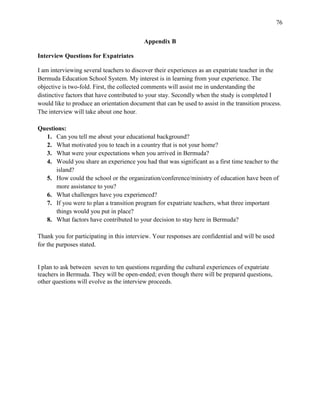
Appendix B ................................................................................................................................... 76

   Interview.................................................................................................................................... 76

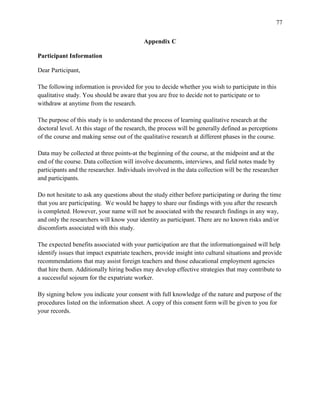
Appendix C ................................................................................................................................... 77

   Participant Information ............................................................................................................. 77
1


                                             Chapter 1

                                           Introduction

       The island of Bermuda, which has a total land area of 21 square miles and often called

the pearl of the Atlantic, is a self governing colony, located off the east coast of the United

States. It is positioned in the North Atlantic Ocean and lies 640 miles to the southeast of Cape

Hatteras, North Carolina. Bermuda is 853 miles south of Halifax Nova Scotia, and 1,100 miles

northeast of Miami Florida. One of the nine smallest populated places in the world, Bermuda

was discovered in 1505 by Juan de Bermudez, a Spanish navigator. The island lay dormant

without settlers until 1609 when English sailors, shipwrecked by a terrible storm, landed on its

shores. The island was colonized by the English in 1612 and became a crown colony of Britain

in1684.Its status changed to an overseas territory in 2002. Its economy is based on international

business and tourism. Its gross national product per capita is reported to be among the worlds‘

highest.

       The island has a hilly terrain and is a mile and a half at its widest point. It has nine

parishes and two municipalities one of which is the capital city of Hamilton. The other

municipality is the town of St. George‘s. The humid sub-tropical climate is warmed by the Gulf

Stream because of the prevailing westerlies that carry winds eastward causing mild winters with

an average temperature of 68 degrees, although the humidity and the wind chill often make the

temperature feel much colder. The average summer temperature is 84 degrees. Prior to 1965, the

Bermuda school system was racially segregated. When the desegregation of schools act was

enacted in 1965, two of the formally maintained ―white‖ schools and both single-sex schools

opted to become private schools. One of the formally single-sex schools is now categorized as

coeducational. The rest became part of the public school system and were either aided or
2


maintained. At present, there are 26 schools in the Bermuda Public School System, 18of which

are primary schools,five are middle schools, two are senior schools, and one special school.

There are two aided primary schools, two aided middle schools, and one aided senior school.

There are six private schools in all with two of them being classified as religious schools.

       The educational system in Bermuda is deemed as independent because it is not aligned

with any other country such as Britain, Canada, or the United States. There are no bilingual

schools because the population is mainly English speaking and there has been no real demand for

them even with our growing multi-cultural population.Bermuda‘s educational structure as

outlined by the Education Act of 1996 states that only three categories of schools can operate in

the Bermuda Education System. The categories are as follows:

       Aided school- has all or a part of its property vested in a body of trustees or board of

       governors and is partially maintained by public funding or, since 1965 and the

       desegregation of schools, has received a grant-in-aid out of public funds.

       Maintained school- has the whole of its property belonging to the Government and is

       fully maintained by public funds.

       Private school- not maintained by public funds and has not, since 1965 and the

       desegregation of schools, received any capital grant-in-aid out of public funds. The

       private school sector consists of sixtraditional private schools; two of which are religious

       schools, and the remaining four are secular with one of these being a single gender

       school. Within the private sector there are a number of home schools that must be

       registered with the government. They receive minimal government regulation.

       There are insufficient Bermudian teachers to satisfyall of the teaching vacancies that

occur in the system.At the time this study was conducted the Ministry of Education
3


employed746 teachers. One hundred forty of these teachers are recorded as non-Bermudian. It

should be noted here that the term non-Bermudian encompasses two distinct categories: The

first category being the spouse of a Bermudian whose status will change after 10years if the

person remains married to their Bermudian spouseand the secondcategory being a person who

has been recruited and is employed on the island for a specific skill set with definite time limits

and restrictions.

       Many of the expatriate teachers have been recruited mainly from Canada, United States,

United Kingdom, and the Caribbean islands. A fewer number are now arriving from the

Philippines and India. Expatriates teachers are employed at every level of the public school

educational system from pre-primary to secondary.All teachers in Bermuda, Bermudian or

expatriate, must hold a valid license from the Bermuda Educators‘ Council to teach in the public

or private schools.

       The Employment Survey of Department of Statistics reports that most of the expatriate

teachers, 40%, are employed at the secondary level of education. This can be contrasted with a

mere two percent teaching at the pre-primary level(Bermuda Government of Annual

Employment Survey 2010).

       A brief overview of the education system has been provided here as a backdrop into the

complexities of the country that will be encountered by the expatriate teachers. They will be

referred to as an expat on occasion. By introducing a snapshot of the host culture one can achieve

an understanding not only of the Bermudian populace but an awareness and appreciation of the

perspectives, perceptions,and way of life confronted by expatriate teachers who live in the

country of Bermuda.

Rationale
4


       Immigrating from coast to coast and country to country and teaching in a foreign country

can present opportunities and challenges for expatriate teachers as they confront critical issues

that impact their tenure while fulfilling their professional responsibilities and adjusting to an

unfamiliar social-cultural and academic environment. When expats first arrive in a host country

they are thrust into an unfamiliar environment–their senses are bombarded with novelsounds,

smells, sights, and way of life in this new the social environment.

       All of these factors have a direct impact on the mind-set, viewpoint,andactivities of the

expatriate teacher. Just trying to understand the culture into which they‘ve entered is a complex

undertaking. They‘ve arrived in the host country with head knowledge, but no practical

knowledge about the socialization of the new society orhow they will adequatelyfit into the new

culture. One expatriate teacher noted, ―Even though I checked the Internet and knew prices were

high, nothing prepared me for the first time I bought groceries. The culture shock I felt when I

was at the checkout counter and the cashier said ‗$252.00‘ and all I had was four bags of

grocerieswas mind boggling.‖Garson (2005) an American educator, writing, about her first
arrival in Cairo commentedthat nothing in her preparation had prepared her for her entrance into

this vibrant,frenetic, and chaotic 24/7 city. Yet expatriates are expected to adjust to a different

culture almost immediately, perform their job responsibilities capably, and be ready for the

nuances that a different culture can bring. Some expatriate teachers stay in the host country for a

relatively short period of time, a year or less, and others extend their stay beyond the expected

initial norm that is the contractedtenure.

       My interest in these experiences of expatriate teachers developed from current and past

professional experiences. In 1994, I became the principal of a K-12 private school with a student

population of about 500 students. I had always taught with expatriate teachers on the staff,
5


however,as a principal I was immediately confronted with expatriate teachers on a different

echelon. One of my pressing challenges was locating qualified teachers who would fill vacant

positions in the elementary and secondary sections of the school. I was not only concerned with

the effectiveness of the expatriate teacher‘sstay in the school system, but also their length of stay.

I wanted to ascertain the factors and conditions that would contribute to a long and successful

sojourn.

       Because I was unable to secure enough Bermudian teachers at the school, expatriate

teachers had to be hired who could adapt to the Bermudian culture and contribute to the ultimate

academic success of students. I recognized that all students are deserving of a quality education

and as such I wanted teachers in the school who would contribute to that goal. I felt more

accountable for the continuing success of the expatriate teachers. Their success in the classroom

and their acclimation to the island was paramount to the academic success of the students. I

wanted to achieve better success in this aspect of my administration.

       I already had firsthand knowledge of expatriate teachers who arrived on the island, settled

in, and accepted the challenges of adapting to a different culture. They interacted successfully

with other faculty members, parents, and students. They acclimated into the school environment

successfully. The students were successful in their relationships with them and in their academic

studies. Alternatively, I had encountered expatriate teachers who just seemed unable to deal with

the nuances of their new environment. There seemed to be too many challenges-culturally,

socially, and academically for them to overcome. The realities of teaching in the host country did

notresonate with their expectations. Their coping competencedid not allow the expatriate

teachers to adequately address, cope with, or deal with the stressors they accounted. Some of

these teachers had difficulty adapting to the school environment or the Bermudian way of life in
6


general. After a year, or two at the most, they decided to leave the island even though they were

contracted for three years or six years and would take a financial loss and possibly lose face

among their colleagues.

The Background to the Problem

       There are strict guidelines and conditions that govern the working status of all expatriate

workers in Bermuda. Expatriates initially come to the island on a one, two, or three year contract.

If at the end of the contracted period a qualified Bermudian is available and has applied for the

position then the contract of the expatriate is not renewed. In many cases it does not matter if the

expat has performed with excellence or with mediocrity, the position is awarded to the

Bermudian applicant.This stipulation holds for the public or private sector and for the field of

education there is no exception. One can immediately see that the expatriate worker can view

this matter with concernbecause it can impact their job security. If the expatriate worker is

unsure that their contract will be renewed at the end of the contracted period it can influence

their feelings of security, commitment, and wellbeing. It has to be taken into account that the

expatriate has uprooted himself from his country, sold his car, and if he/she owned a house put it

up or sale or rent; all for a three year contract that may or may not be renewed for another three

years. The contract may be renewed for another three years. After that,special appeal would

have tobe made to the Minister of Immigration for another extended period of three years.

        One can immediately see that this situation can cause a quandary when dealing with

expatriate teachers and the school system. An experienced expatriate teacher may not want to

give up job security in their home country and sojourn to a country where time limits are placed

on their employment and their job security is in question.This type of situation is more suited and
7


more appealing to the younger and less experienced teacher who may not have family

responsibilities of marriage and children.

        Another dilemma that seriously impacts the stability in the school system is that the

expatriate teachers may have years of teaching experience and the Bermudian teachers may be

just beginning their career and come to the system right out of college or university. There are

however exceptions to this rule. If the employer can make a case that the expatriate teachers

areserving in key positions and their departure could adversely affect the school then the school

may apply for a further extension. In the case of schools there are certain subject areas where

there are difficulties in finding Bermudian teachers for particular subject areas, mainly, those

subject areas of Mathematics and Science. Then an exception may be granted.

       A third factor that can impact expatriate teachers (and other foreign workers) is the fact

that they are not allowed to secure a second job without the express permission of the

immigration department. Further they may not even volunteer their services in areas other than

what they were contracted for, if in volunteering they make it possible that byso doing they

prevent a Bermudian from being employed.

        Bermuda is in somewhat of a unique position in regards to teacher retention and teacher

turnover when the focus is on the expatriate teacher. On one hand the country must make

allowances for the employment of its own people and yet still provide some job security for

those workers who have come to the island to provide assistance for the country. These are the

background issues that the government education department or a private school system must

face as they grapple with the issues of teacher turnover within the schools. Just when the

expatriate teacher has begun to adapt to the new environment they may have to leave because of
8


governmental regulations. This uncertainty about their future job security not only causesjob

stress but also may reduce commitment to the school system.

       One of the privateschools on the island operates a K-12 school. It employs about

50faculty and staff with about 35 of those persons being teachers. About one fourth of the

teachers who are employed in that school are recruited from the United States, Canada, or the

Caribbean. The school relies heavily on recommendations from other superintendents and

telephone interviews in the hiring process. Most recently the personnel committee has begun

using Skype so that the interviewee and interviewers can see each other during the interviewing

process. All expatriate teachersin this school system are hired initially on a three year contract,

without having a face-to-face conversation with the educational superintendent, or personnel

committee. This commitment is made without a visit to the island before accepting

employment.That has been expressed as anexpense that the school feels it cannot afford.The

expatriates have not been introduced or oriented neither to the customs and mores of the people

in the host country; nor have they been oriented to the educational system at the time of hiring.

Most teachers who arrive from overseas come within a week or two of the opening of the new

school year or worse still, after school year has already commenced. In such cases they are

immediately confronted with the normal pressuresthat occur at the beginning of a school year

and the additional socio-cultural challenges. These circumstances often overwhelm the teacher

right from the inception of the process and do not allow for a smooth start. While some

expatriate teachers cope admirably with this problematic start to their Bermudian experience,

others have found it to be a negatively challenging experience.

       While the aforementioned scenario is my personal experience at one private, relatively

small school, this scene is similarly played out in the public school system. Every year the
9


Ministry of Education in Bermuda hires scores of teachers from various parts of the world to

work in the school system. Too often, expatriate teachers have a chaotic beginning at the onset of

their experience.Coupled with the challenges that have been already mentioned, these teachers

are without personal transportation because Bermuda does not allow them to obtain avehicle

license immediately upon arrival;therefore they must traverse the public bus system or rely on

being picked upprivately by assigned teachers. These teachers must negotiate andcollaborate

with other teachers to find out where essential services such as grocery stores, postoffices, and

banking facilities are. They must find a way to get from place to place to conduct personal

business, while adjusting to a new school environment.

       These educators often come from dissimilar cultures and arrive in Bermuda where they

are confronted by a culture that is in many ways unlike their own.The attitudes and behaviors of

the nationals for the most part, differ from their own experience.In the educational circles in

Bermuda discussions are often centered onthe dishearteningattitudes a sizeablenumber of

Bermudian students display toward their education. Many appear passive and disinterested in

learning.Seemingly, school achievement and academic success are not important factors on the

students‘ horizon. They live in a country that is economically stable and has been rated as

number two in the world, just behind Switzerland when it comes to income per capita. Many

students andtheir parents have not had to work hard for anything. They are given what they want

with few strings attached. Some students do not see the importance or the need of getting a first

class education.Some studentswill cheerfully and gleefully telltheir teachers that one day they

will make more money than they do because of what their family owns. And more

importantly,that it will become theirs (student) one day. This greatly impacts the way in which

students relate to school in general and contributes to the students‘ attitudes towards learning and
10


teachers, both Bermudian and expatriate. However, most often, it is the expatriate teacher who is

confronted with poor behaviors, careless attitudes, and a lack of seriousness toward learning on

the part of students they teach.

       A majority of expatriate teachers have managed to successfully adapt to

thepreviouslymentioned conditions but unfortunately too many leave with a rather negative

feeling about Bermuda and their teaching experience on the island. This really becomes an acute

problem when these teachers leave during the school year,or after teaching for only one or two

years.Suitable and qualified replacements are difficult to find. This affects the quality of

education that the student may receive in the short term while the replacement is being

sought.Research has shown that there is a correlation between teacher turnover and student

achievementColgan,(2004).Gaps in student learningexperience emerge which contribute to

instability and lowers students‘ academic performance. Thousands of dollars are spent in

replacing teachers and unfortunately the replacement may not be as qualified in the subject area

as the previousteacher was. When the expatriate teachers leave the island after only teaching for

a year or two acute problems occur for both the teachers and the employer. It is financiallycostly

and emotionallydraining for both parties.The teacher has had to sell their car, rent or sell their

home, and leave behind family and friends. If they are married the spousemay not be able to

secure work immediately, thereby causing financial constraints. The cost of living in Bermuda is

high;all these factors produce stress in the expatriate worker.

       The employer has financial costs also. It has been estimated by one of the private schools

that it takes at least three years for the organization to recover the expenses incurred in securing a

teacher from overseas and settling them on the island.When party, the teacher, or the school

administrators‘experience failure, it is at a financial lossto both the teacher and the organization.
11


       An additional precipitousfactor that occurs is that parents begin to be

anxiousandapprehensive about their children‘s education. Parents become dissatisfied and the

reputation of the school comes under question when there are numerous teacher turnovers in a

short space of time. This in turn can and does affect the enrolment of the school for subsequent

years. Students do not develop lasting and meaningful relationships that can contribute to the

quality of student learning. The actual motives for the expatriate teachers coming to teaching in

Bermuda falls into question and distrust begins to breed among the nationals and disillusionment

spreads among the expatriate teachers.

Problem Statement

       A great deal of research can be obtained concerning the successful socialization of

teachers into the workplace of their own country. However little data can be found that addresses

the expatriate teacher moving from their home country and adjusting to a host country and a

foreign culture while negotiating how to work in the subculture of a new school. The perpetual

practice of expatriate teachers coming to Bermuda for relatively short periods of time and

leaving at the end of one contractual term of three years, or even before the end of that

designated period causes a lack of academic continuity, serious disruptions, and gaps in student

learning. High costs are also associated with the hiring and reparation of expatriate teachers. The

lack of longevity contributes to distrust among the expatriate teachers themselves and among the

Bermudian stakeholders. The parents and students and some administrators have misgivings and

express skepticism about the motives of the foreign teachers and the reasons why they have

come to Bermuda to teach. Many administrators, colleagues,and students often wonder how long

the expatriate teacher will stay. They may openly question, who will benefit more, the students

or the expatriate teacher?
12


Purpose Statement

       The purpose of this qualitative research study is to examine the perceptions and

experiences of expatriate teachers who teach in Bermuda, in both the public and private school

systems.

Research Questions

       Thestudy will be guided by five salient questions:

   1. How do the expatriate teachers describe the effect of the Bermuda cultural experiences on

       their sojourn in the country?

   2. What are the specific factors thatdetermine the success of the expatriate teacher?

   3. What are the specific factors that impede the success of the expatriate teachers?

   4. What do the expatriate teachers in the study describe as stressors that occurred during

       their tenure?

   5. What can the Bermuda educational system do to facilitate the longevity and success of

       expatriate teachers?

   Significance of the Study

       It is hoped that this research studywill make a significant contribution to discovering

ways to reduce expatriate teacher attrition whether in public or private education in Bermuda.

While anecdotal information may exist, such information is not formalized into a body of

organized knowledge. The findings could contribute in a very significant way when recruiters

and administrators are seeking to provide overseas teachers to fill the teaching vacancies in their

schools.

           The outcomes of the study can give assistance to administrators in understanding the

challenges and measures of success for expatriate teachers. Better success in this area will
13


accomplish better stability in the classroom. An improved retention rate among the expatriate

teachers will be a factor in achieving better success rate among students.An additional beneficial

outcome will be more effective orientation programs forbeginning expatriate teachers. There is a

paucity of information on this topic and no documented studies have been reported in the island

of Bermuda where the focus of this research will be conducted. The research that is available

concerns itself primarily with the student-teacher experience overseas, or with the experience of

teachers in higher education. Very little research has been completedor even explored regarding

expatriate teachers in the elementary or high schools. Further the research has been confined to

larger countries such as Australia, Japan, and Singapore. Thus, the K-12 focus will add to the

body of professional knowledge on the subject.

         It is hoped that those who recruit expatriate teachers will have research-based

information that will enable them to be more aware of challenges that such teachers encounter

and reveal how to deal with them in a proactive manner. This information may provide a

resource to identify processes to assist administrators and others who recruit teachers from

countries other than Bermuda.The researchwill providewell-identified processes that will

contribute toa better match between teachers with their new assignment in Bermuda. One

proposed outcome from this study will be to outline and recommend a well organized induction

program and create an orientation handbook thatwill assists schools in developing programs for

this vital segment of expatriate teachers in Bermuda. Additionally recruiters can work to resolve

the troubling cultural situations that plague the expatriate teachers. This will lead to a more

stabilized teaching force;and thereby, provide better learning conditions in the classroom, which

in turn will strengthen the school system and benefit the students.
14


       One meansof achieving more appropriate hiring and induction practices is by developing

policies that will assist in reducing the cost of repatriation and disruptions caused by sudden

departures or brief stays of expatriate teachers. The study will also take into account the

resources, time, and effort that is expanded in finding teachers overseas, the financial expenses

occurred by the employers and the employees, and the learning gap that occurs for the students

when teachers are only present with them there for short periods of time.

        This study may generate further development and improvement in cross-cultural

socialization and the successful acculturation process. For the expatriate teacher, this program

will provide information about services and resources that are available to them as teachers. An

introduction to the culture, practices, and traditions and customs of the Bermudian people will

also be provided.

Theoretical Framework

       My research was guided by researchers such as Deardorff(2009 and Fantini (2000) who

have contributed theoretical models to enhance the knowledge and visual perception of

intercultural competences to the field of cultural intelligence.Deardorff has stated that

intercultural competence can beaptly describedas thecapacity one has to enhance his or her

knowledge, to examine theirattitudes and behaviors so that they are exposedto andare flexible to

other cultures. She contends that for people to survive in today‘s global populaces people need

not only to understand differences but intercultural competence but need to adjust to working and

social environments that are different from their own.

       Fantini (2000) further develops this idea of intercultural competence by articulating that

intercultural competence isnot just being aware of the differences that are a part of multicultural

ism but it is the fundamental and ultimate acceptance of people who are different to one‘s self
15


outside of one‘s own culture. It is the ability to interact and interrelate with them in a genuinely

constructive and positive manner that is free from negative and preconceived attitude. He takes

the definition deeper by adding that intercultural competence is the ability to create a synthesis as

it, were, something that is neither ―mine‖(the native) or ―yours: (the expatriate) but something

genuinely new‖.These thoughts of Alvino Fantini and others are summed up in literature used for

training by companies that are involved in cultural awareness studies.

       This research is also based on the work of Varhegyi (2008)and Stephanie Nann(2008).

Vera Varhegyi the cofounder of Élan Interculturel, has stated that intercultural transition refers

to a set of concrete phenomena: how we feel, behave, and change when we encounter a new

cultural environment. Out of their field research Varhegyi (2008)and Nann (2008) produced and

submitted a framework model for intercultural competences for the Intercultool Project. Further

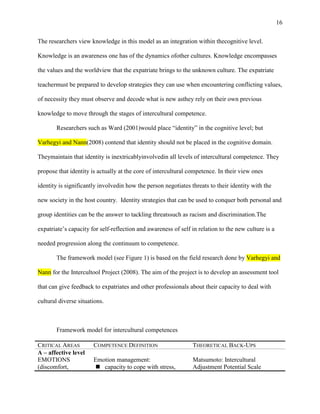
their work has defined intercultural competence as having three critical areas:

    1. The affective level that deals with ones emotions such as loneliness, stress, and

        discomfort and the capacity to observe, interact, and analyze one‘s emotions.

    2. The behavioral level that encompasses interaction, communication style, ritual, and

        body language. That is the ability to communicate effectively in situations where

        communication is carried out in anticipated style and secondly one has the capacity to

        develop trust in a novel environment.

    3. The cognitive level has a duel focus where the person can make sense of situations by

        being aware of biases and stereotypes that may be present and then mobilizing their

        former knowledge and relying on what they see. Also on the cognitive level one is aware

        of the dynamics of culture and is prepared to decode within a new context regarding

        cultural mechanisms.
16


The researchers view knowledge in this model as an integration within thecognitive level.

Knowledge is an awareness one has of the dynamics ofother cultures. Knowledge encompasses

the values and the worldview that the expatriate brings to the unknown culture. The expatriate

teachermust be prepared to develop strategies they can use when encountering conflicting values,

of necessity they must observe and decode what is new asthey rely on their own previous

knowledge to move through the stages of intercultural competence.

       Researchers such as Ward (2001)would place ―identity‖ in the cognitive level; but

Varhegyi and Nann(2008) contend that identity should not be placed in the cognitive domain.

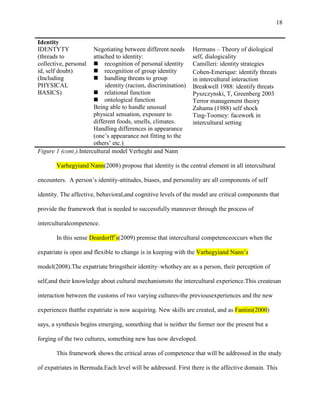
Theymaintain that identity is inextricablyinvolvedin all levels of intercultural competence. They

propose that identity is actually at the core of intercultural competence. In their view ones

identity is significantly involvedin how the person negotiates threats to their identity with the

new society in the host country. Identity strategies that can be used to conquer both personal and

group identities can be the answer to tackling threatssuch as racism and discrimination.The

expatriate‘s capacity for self-reflection and awareness of self in relation to the new culture is a

needed progression along the continuum to competence.

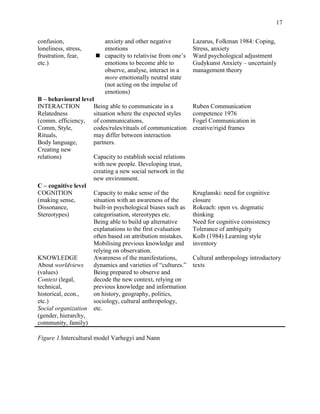
       The framework model (see Figure 1) is based on the field research done by Varhegyi and

Nann for the Intercultool Project (2008). The aim of the project is to develop an assessment tool

that can give feedback to expatriates and other professionals about their capacity to deal with

cultural diverse situations.


       Framework model for intercultural competences

CRITICAL AREAS         COMPETENCE DEFINITION                    THEORETICAL BACK-UPS
A – affective level
EMOTIONS               Emotion management:                      Matsumoto: Intercultural
(discomfort,            capacity to cope with stress,          Adjustment Potential Scale
17


confusion,              anxiety and other negative            Lazarus, Folkman 1984: Coping,
loneliness, stress,     emotions                              Stress, anxiety
frustration, fear,     capacity to relativise from one‘s     Ward psychological adjustment
etc.)                   emotions to become able to            Gudykunst Anxiety – uncertainly
                        observe, analyse, interact in a       management theory
                        more emotionally neutral state
                        (not acting on the impulse of
                        emotions)
B – behavioural level
INTERACTION          Being able to communicate in a           Ruben Communication
Relatedness          situation where the expected styles      competence 1976
(comm. efficiency, of communications,                         Fogel Communication in
Comm, Style,         codes/rules/rituals of communication     creative/rigid frames
Rituals,             may differ between interaction
Body language,       partners.
Creating new
relations)           Capacity to establish social relations
                     with new people. Developing trust,
                     creating a new social network in the
                     new environment.
C – cognitive level
COGNITION            Capacity to make sense of the            Kruglanski: need for cognitive
(making sense,       situation with an awareness of the       closure
Dissonance,          built-in psychological biases such as    Rokeach: open vs. dogmatic
Stereotypes)         categorisation, stereotypes etc.         thinking
                     Being able to build up alternative       Need for cognitive consistency
                     explanations to the first evaluation     Tolerance of ambiguity
                     often based on attribution mistakes.     Kolb (1984) Learning style
                     Mobilising previous knowledge and        inventory
                     relying on observation.
KNOWLEDGE            Awareness of the manifestations,         Cultural anthropology introductory
About worldviews     dynamics and varieties of ―cultures.‖    texts
(values)             Being prepared to observe and
Context (legal,      decode the new context, relying on
technical,           previous knowledge and information
historical, econ.,   on history, geography, politics,
etc.)                sociology, cultural anthropology,
Social organization etc.
(gender, hierarchy,
community, family)

Figure 1.Intercultural model Varhegyi and Nann
18


Identity
IDENTYTY               Negotiating between different needs      Hermans – Theory of diological
(threads to            attached to identity:                    self, dialogicality
collective, personal    recognition of personal identity       Camilleri: identity strategies
id, self doubt)         recognition of group identity          Cohen-Emerique: identify threats
(Including              handling threats to group              in intercultural interaction
PHYSICAL                    identity (racism, discrimination)   Breakwell 1988: identify threats
BASICS)                 relational function                    Pyszczynski, T, Greenberg 2003
                        ontological function                   Terror management theory
                       Being able to handle unusual             Zahama (1988) self shock
                       physical sensation, exposure to          Ting-Toomey: facework in
                       different foods, smells, climates.       intercultural setting
                       Handling differences in appearance
                       (one‘s appearance not fitting to the
                       others‘ etc.)
Figure 1 (cont.).Intercultural model Verheghi and Nann

       Varhegyiand Nann(2008) propose that identity is the central element in all intercultural

encounters. A person‘s identity-attitudes, biases, and personality are all components of self

identity. The affective, behavioral,and cognitive levels of the model are critical components that

provide the framework that is needed to successfully maneuver through the process of

interculturalcompetence.

       In this sense Deardorff‘s(2009) premise that intercultural competenceoccurs when the

expatriate is open and flexible to change is in keeping with the Varhegyiand Nann‘s

model(2008).The expatriate bringstheir identity–whothey are as a person, their perception of

self,and their knowledge about cultural mechanismsto the intercultural experience.This createsan

interaction between the customs of two varying cultures-the previousexperiences and the new

experiences thatthe expatriate is now acquiring. New skills are created, and as Fantini(2000)

says, a synthesis begins emerging, something that is neither the former nor the present but a

forging of the two cultures, something new has now developed.

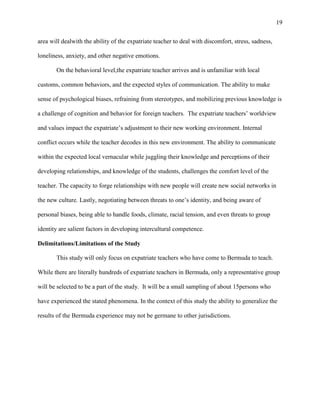
       This framework shows the critical areas of competence that will be addressed in the study

of expatriates in Bermuda.Each level will be addressed. First there is the affective domain. This
19


area will dealwith the ability of the expatriate teacher to deal with discomfort, stress, sadness,

loneliness, anxiety, and other negative emotions.

       On the behavioral level,the expatriate teacher arrives and is unfamiliar with local

customs, common behaviors, and the expected styles of communication. The ability to make

sense of psychological biases, refraining from stereotypes, and mobilizing previous knowledge is

a challenge of cognition and behavior for foreign teachers. The expatriate teachers‘ worldview

and values impact the expatriate‘s adjustment to their new working environment. Internal

conflict occurs while the teacher decodes in this new environment. The ability to communicate

within the expected local vernacular while juggling their knowledge and perceptions of their

developing relationships, and knowledge of the students, challenges the comfort level of the

teacher. The capacity to forge relationships with new people will create new social networks in

the new culture. Lastly, negotiating between threats to one‘s identity, and being aware of

personal biases, being able to handle foods, climate, racial tension, and even threats to group

identity are salient factors in developing intercultural competence.

Delimitations/Limitations of the Study

       This study will only focus on expatriate teachers who have come to Bermuda to teach.

While there are literally hundreds of expatriate teachers in Bermuda, only a representative group

will be selected to be a part of the study. It will be a small sampling of about 15persons who

have experienced the stated phenomena. In the context of this study the ability to generalize the

results of the Bermuda experience may not be germane to other jurisdictions.
20


Definition ofTerms

       Acculturation.This isdefined as the phenomena of sequential psychological changes as a

result of continuous and direct contact between individuals having different

cultures(Berry,2006).

       Assimilation.This is when immigrants become absorbed into the native population

through acquisition of cultural values and personal traits of the national culture (Kim, 2001).

       Cross-cultural adjustment.This term has been conceptualized as the degree of

comfort,familiarity, and ease that an individual feels toward a new cultural environment

(Takeuchi, Yun, Seokhwa, & Russell,2002). Cross-cultural adjustment, expatriate adjustment, or

simply adjustment, will be usedinterchangeably throughout the paper.

       Cultural intelligence.Cultural intelligence is defined as a person‘s ability to function

effectively in situations that are characterized by cultural diversity which is becoming typical of

today‘s global work settings Ang& Van Dyne, (2008)

       Culture shock.The anxiety that results from losing familiar signs and symbols of social

intercourse and reflected in culture based adjustment difficulties in functioning satisfactorily in

the host country is defined as culture shock (Pires, Stanton,& Ostenfeld, 2006).

       Cultural transitions.This is a movement from a place where the rules are known and

where things feel right and comfortable, to one where nothing seems to make much sense at first.

       Expatriate.A person who has citizenship in at least one country but who is living in

another. Most expatriates only stay in the foreign country for a certain period of time..Business

Dictionary

       Host country.The primary culture or country where the expatriate is living and working.
21


       Intercultural competence. A fundamental acceptance of people who are different to

one‘s self outside of one‘s own culture.The ability to interact with them ina genuinely

constructive manner that is free of negative attitude (Fantini, 2000).

       Identity theory. A theory which considers how group membership affects an individual‘s

identify and sense of belonging in particular groups.

       National. For the purpose of this study, a national is referred to as acitizen ofBermuda

who holds a passport and is entitled to its rights and protection of the country.

       Stress tolerance. The ability to engage in goal-oriented activities despite the existence of

pressures such as workload or time pressures.

       Successful expatriate experience.To complete an expatriate assignment meeting the

professional objectives of that assignment and the ability to adapt to the host culture.

Ethical Considerations

       There are several ethical considerations that may influence this research.The researcher

will not reflect discrimination in any of its forms in the study. The study will be characterized by

openness and honesty. An informed consent form will be requiredfor each participant that will be

a part of the research documentation.A copy of the consent form will be placed in the appendix.

Approval where needed will be sought from the Ministry of Education, and governingschool

boards for private schools. These important stakeholders will know what the study will entail, the

methods that will be used, and the purpose for the study.

       The benefits of the study are both professional and personal. Those who participate will

receive feedback on the outcome of the study. The information received will be confidential and

the results reported objectively. Confidentiality will be assured by assigning pseudo names to the

participants. Furthermore, the information will be coded.The participants may feel free to
22


withdraw at any time if they feel uncomfortable with the process. There are no known risks or

vulnerable populations that will be asked to participate in the study. While there will be

purposeful sampling no one will be forced to participate and all will have the opportunity to

volunteer.

Organization of the Study

       The introductory chapter of this research project will provide a general background of the

study.A statement of the problem and the purpose statement will be included. Research

questions and the significance of the study will be provided. A rationale for conducting the study

has been given.This chapter willdelineatethe delimitations and limitations of the study and

discuss key terms used throughout the research.The ethical considerations and organization of

the study will be outlined.

        Chapter 2will present a review of the literature that has influenced the study. A brief

historical perspective will be undertaken. The literature will inform the theories that govern the

study. Models of social-cultural adaptations will be explored. The chapter will present themes

such as acculturation, culture shock, transformational learning, and a lack of orientation of

expatriate teachers thathas emerged from current literature.

         Chapter 3will provide the methodology of the study. It will outline how the research

datawill be collected and the research design of the study. A list of participants and their

characteristics will be presented. It will present a section on data analyses.

       Chapter 4will present the findings and results of the study.It will also restate research

questions andpresent the findings and the interpretation of the analysis of the data. Issues of

validity and reliability will be included.
23


       The fifth and final chapterwill give a summary of the results.Conclusions will be drawn

from the findings and recommendations for further research will be posed. Recommendations to

important stakeholders for best practice will be shared.

                                             Chapter 2

                                       Review of Literature

Introduction

       This literature review will examine major theories and provide comparisons and

similarities of previous empirical research. It will facilitate an understanding and provide

syntheses and further interpretation of already known information about the topic under review.

The research will investigate a broad range of topics pertaining to expatriates in the workplace,

inclusive of: (a) biblical perspectives, (b) socialization of humans in society, (c) culture and

culture shock, (d) intercultural competence and adaptation, (e) theories of learning, (f) and

factors that impact success or failure of expatriates.

       There has been a steady increase in the magnitude of traveling from country to country as

the trend of globalization has made international travel more commonplace. Employment

opportunities in overseas countries have become more prevalent. Living and working in a

country other than what is considered the home country is now considered a normal part of a

person‘s career development. A professional in the field of business or industry, an educator, a

governmental worker, or a person seeking to better themselves economically or seeking personal

development may take advantage of the opportunity to live and work abroad.

       Just as the world has become more assessable to travelers and job opportunities become

more abundant, so has the body of literature become more prolific that examines the way

expatriates encounter and adapt to the nuances of a host culture (Sims &Schrader, 2004;Moseley,
24


Reeder,&Armstrong, 2008;Furnham, 2010). A number of researchers, such as Lee and Sukoco

(2008),Brown and Holloway (2008),Armes and Ward (2001) have addressed the adaptation of

expatriates in the business sector, while the successful adaptation of expatriate teachers has

attracted some research from Brislin (1981), Bennett (1986), and Armes and Ward (2001),

Connellan (2000) point out that Hogan and Goodson (1990) suggest a significant factor in the

failure of business expatriates to meet their overseas expectations is their lack of understanding

of the host country‘s culture by the expatriate worker as well as a lack of effort on the part of the

expatriate to adapt to cultural nuances or social patterns of the host country.

       The literature review presented in this study has been drawn from a variety of

sources.These include refereed journals, books, dissertations, online journals, and the Internet.

Expatriates in Biblical Settings

        While one may think that leaving your home culture and traveling to another is a fairly

recent phenomenon, since Biblical times the custom of leaving your natural home and moving to

a new culture has been in existence. There are numerous recorded instances where persons in the

Bible journeyed from their home and relocated to another country. One such well known biblical

character was Abraham. God called Abraham to leave his family of origin and all that he

treasured and migrate to an unknown country. ―Now the Lord had said to Abram: Get out of

your country, from your family, and from your father‘s house to a land that I will show you‖

(Genesis 12:1).He, along with his wife Sarah, and his nephew, Lot travelled for hundreds of

miles and lived in a new land(Genesis 12:4). It is recorded that Abraham and his nephew Lot

prospered in the new land (Genesis 13:8-10).Lot also began a family and never returned to his

country of origin. He adapted to his city environment and adopted many of the practices and

values of his new environment (Genesis, chapter 19).
25


       Moses is another example of a well known biblical figure who was an expatriate. His

parents, Jochebed and Amram had been transplanted from their homeland to a foreign land.

Their son, Moses, though born in Egypt, was not considered an Egyptian (this is similar to many

immigration laws today) and was in grave danger as were all infant Hebrew boys who were

targeted to be put to death. Moses was hidden on the Nile River by his mother as a baby but

found by the king‘s daughter. The biblical record indicates that she claimed him as her son but he

continued to live with a Hebrew family (Exodus 2:7-9) throughout his childhood.About the age

of 12he was taken to the royal palace to live (Exodus 2:10). Although having lived in Egypt all

of his life, and now living in the palace, Moses did not embrace all the customs, traditions, or

values of Egypt even though he lived in the king‘s palace where he received the highest civil and

military training in preparation to be the successor on Pharaoh‘s throne(White,1939). Yet, when

he witnessed an Egyptian mistreating a Hebrew man,whom Moses considered to be his people,

he killed him(Exodus 2:11-12).

       He escaped to the country of Midan where he lived, worked, married, and had children.

Upon the birth of his son Gresham he declared, ―I have been a foreigner in a foreign land‖

(Exodus 3:22). Remaining in Midan for a total of 40years he tended sheep until God revealed to

him that it was time to return to Egypt, his original home (Exodus 3:10; Hebrews 11:24-

26;White, 1939).Following God‘s leading Moses became a phenomenal servant leader and led

the exiled Israelites successfully from Egypt to the borders of Canaan.

       Paul, a prominent Jew mentioned in the New Testament, fits the description of an

expatriate. He traveled to many countries such as Macedonia, Syria, Phoenicia, and Cilicia to

preach and teach the gospel of Christ. On another journey he travelled to Rome, Italy and

remained there for two years (Acts 13:2).He continued preaching the gospel and lived for short
26


periods of time in places such as Greece and other countries in Asia. While in Corinth, Paul

became acquainted with Aquila and his wife. ―Because he was tentmaker as they were, he

stayed and worked with this couple...‖(Acts 18:1-3).These trips commonly known as missionary

journeys are recorded in the Bible and are the names of many of the books in the in the New

Testament, such as Romans, Corinthians, Galatians, Ephesians, etc. These are cities in whichPaul

lived and worked but he wrote letters known as epistles to the churches in these places.

       Not only did men have the experience of expatriation but the Bible records the journey of

two women who sojourned from one country to another. The story is recounted in the book of

Ruth. Elimelech and Naomi, his wife, traveled from Bethlehem, their home country, with their

two sons to the country of Moab. The family made the trip because of a famine in their homeland

and became resident foreigners of Moab. The family remained there until Naomi‘s husband,

Elimelech died. The sons also married women from that country and continued to live there until

they also died.

       Then Naomi, widowed and childless, decided to return to her home country of Bethlehem

in Judea(now Israel). Her daughters-in-law, Ruth and Orpah, desirous of remaining with their

mother-in-law, began the journey with her. During the journey Orpah turned back at the urging

of her mother in law. Ruth, however would not be persuaded. She travelled to Bethlehem with

her mother-in-law and then became a foreigner in Naomi‘s homeland. She later married Boaz

and settled in his country (Ruth 4:13).

       In today‘s common vernacular the previouslymentioned individuals and other persons in

the Bible such as Joseph, Esther, Mordecai, and Daniel would be known as expatriates. They

served with distinction in a country other than their homeland. Crossing physical and cultural

barriers, they sojourned from the country of their birth, and became resident foreigners in other
27


distinctivecultures. These biblical men and women endured the loss of the familiar and

broadened their horizons to embrace a new future. They encountered new meaning and values

and embraced the culture of countries. They lived and worked and brought up their families (if

they had one) with the challenges that come along with a new society.

        In each instance these biblical characters attempted to preserve their own culture; yet to a

greater or lesser degree they all assimilated into the culture of the new society. Hendricks (2003)

states the call from God to travel to unfamiliar and unknown countries are a ―call to transmit

meaning-the meaning of life at its deepest level.‖ -

        While no known theoretical research has been recorded on these biblical characters, the

researcher can assume that the circumstantialities of culture and culture shock, social and

transformational learning, cross-cultural experiences, and intercultural competences were all

deeply embedded in their human contacts with the host nationals.

Socialization

        A great deal of research has been written concerning the successful socialization of

humans. Socialization, defined can be viewed as the conscious and unconscious process whereby

humans learn behavior patterns and norms that enable them to function appropriately in their

environment. It is based on the need to belong and the desire to be accepted (Finsterbusch,

2009). Socialization is really social interaction between people. It is a process of learning and

adapting to the roles of society from both a formal and informal exposure that occurs within an

individual‘s home and within society (Bandura, 1986).


        Socialization has also been defined as the process of transmitting values, beliefs, and

culture that is essential to a society‘s survival. It occurs naturally from the earliest days of a

person‘s life. Humans learn what is acceptable and appropriate as they interact with others.
28


Bandura (1986) writes that socialization is a learning process and can be formal such as what is

learned in school and what is learned on the job; but socialization can also be informal in terms

of what a person observes and experiences in everyday living. For example, girls are socialized

to the roles of what it means to be daughters, sisters, mothers, aunts, and wives; similarly boys

learn to be sons, brothers, fathers, uncles, and husbands. It is not necessary to take formal classes

to learn how to perform in gender roles and how males and females should act and behave in

their role. People observe and experience what socialization means and what society expects of

male and female roles and begin to fulfill the expectations of the roles from the time they are

children.

       Hofstede (1980) addressed the role that socialization plays in culture. He contends that

people rarely adapt the values of those from cultures other than their own by mere observation,

but over time through interaction with various environments such as economic, ecological, and

technological they are more apt to change. He states that it takes a prolonged period of residence

for the expatriate to realize not just differences in culture but the subtle nuances of the host

country.

       Socialization is also linked with the adaptation process when an expatriate sojourns to a

different environment or country. This process of adapting to a new culture is similar to what one

experiences when they were being socialized to their home culture. The expatriate becomes

socialized to their new environment as they become comfortable within the host country. They

observe and adopt customs and values of their new environment. Total socialization to a new

environment is not easily attained because socialization in any culture occurs over an expansion

of time. Living, working, socializing, and adopting the habits of the people, singing their songs,

dancing their dances, attending their churches, and observing their holidays are all a part of the
29


socialization process. It is a learning experience that a successful expatriate will willingly engage

in during the process of being acculturated in the host country.

       Socialization is highly germane to an expatriate‘s adjustment because it involves

understanding of how organizations function. Newcomers to the culture learn about their jobs

and the new environment through this process. Socialization has also been linked to several

important organizational outcomes. Among these are: job satisfaction (Ashforth, Saks, &Lee,

1998; Major et al., 1995), organizational commitment (Ashford & Taylor, 1990; Ashforth et al.,

1998; Klein & Weaver, 2000), and performance (Ashford & Taylor, 1990).

Culture

       Culture is extricably bound to socialization.Finsterbusch (2009) declares culture ―is the

ordinary, everyday objects of living and the daily routines of life that is regularly punctuated by

festivals, celebrations and other special events (p.1). Han and Northoff (2008) put forwardthat

our brains and minds are shaped by the experiences that occur in the context of the culture in

which we develop and live. ―Culture somehow implies that rituals, climate, values and behavior

tie together into a coherent whole‖ (Schein,1994, p.15). We understand ourselves, others and the

environment within which we operate. People are socialized according to their culture-the way

they behave in their own environmental setting. It is based on a country‘s framework of where

and how people fit in the community; it is how one views education, religion, family, and

friends. Culture then is the sum total of all the beliefs, customs, values, traditions, and attitudes

that distinguish one group of people from another.

       Culture is the very essence of a people and determines what is important to

them.―Routine and special times are the stuff of culture, for culture is the sum total of all the

elements of one‘s social inheritance‖ (Finsterbusch, 2009, p.1).One can see evidences of a
30


country‘s culture but culture cannot be touched. A person can feel the effect of the culture but it

can‘t be packaged up.

         As such encountering a foreign culture, such as expatriates do, is very much like

encountering a secret code. Until you are able to unlock the code, little of what you see or

experience will make much sense. Peter Conrad, (1991) described it this way:

         Society has always seemed to me an idea dreamed up by conspirators. The tribe adheres

         thanks to shared understandings, which never need to be voiced; it celebrates its

         uniqueness by the exchange of private jokes, by perfecting a dialect of signals. I used to

         be amazed, before I could understand the language, by the sight of a whole world which

         conversed in Portuguese. Everything was unintelligible: I couldn‘t even read the gestures,

         and because of their vehemence having come from the land of laconicism, where only

         madmen or migrants talked with their hands -- I used to assume that people were

         quarreling when they were only being exuberant.

         The ability of expatriates to adapt across cultures is regarded as one of the three most

important factors for expatriate performance (Lee &Sikoco, 2010). When expatriates do not

achieve cultural adjustment, they tend to have much more difficulty in adapting to the

environment and are more likely to fail (Caligiuri, 2000). As a result researchers have began

focusing on identifying factors that influence cultural adjustment (Black, Mendenhall &Oddou,

1991).

Culture Shock

         When a person is exposed to a culture that is different from what they are accustomed to,

whether voluntarily as a tourist, or as an expatriate worker, it is common to feel somewhat

frustrated, nervous, and overwhelmed. It is what has been termed as culture shock. Over the
31


years researchers have tried to refine the definition of the term culture shock, by looking at very

specific psychological factors or facets that make up the experience (Winkelman, 2003; &Xia,

2009). It has been seen as a loss of one‘s culture, a marker of moving from one culture to another

and a resocialization into another culture. There remains no clear definition of the term culture

shock, but the first usage was attributed to the anthropologist Oberg (1960) over 50 years ago

(Ward et al., 2001). Culture shock describes the anxiety of not knowing exactly what to do in a

new culture. It is the process of initial adjustment to an unfamiliar environment.

       When an expatriate worker is first exposed to a new country and experiences a feeling of

ambivalence—a feeling of not knowing what to do, how to act, not feeling readily accepted in

the new culture, and experiences a lack of direction, they are experiencing what is known as

culture shock. Lysgaard (1955) proposes a way to deal with culture shock which he calls the U

curve of adjustment. He describes it in the following words:

       [We] observed that adjustment as a process over time seems to follow a U-shaped curve:

       adjustment is felt to be easy and successful to begin with; then follows a ‗crisis‘ in which

       one feels less well adjusted, somewhat lonely and unhappy; finally one begins to feel

       better adjusted again, becoming more integrated into the foreign community. (p. 15)

       Another researcher, Alfred Adler (1975), has identified four or five stages of adjustment

that persons living and working abroad can expect to encounter. The first stage of initial contact

is the honeymoon stage that is characterized by enthusiasm, expectancy, and exhilaration.

Expatriate workers in this honeymoon stage will demonstrate an eagerness to please and are

fascinated by the newness of the experience. Inevitability misunderstandings begin to mount and

the individual moves along to the second stage that is known as the hostility stage. Many times

this stage is characterized by frustration and anger, judgmental, and sometimes depression. Many
32


times the expatriate feels misunderstood and typically is overwhelmed by the new culture‘s

requirements.

        The third stage of adjustment involves that of reintegration and acceptance. The

expatriate begins to relax in the new environment and begins to reach out and make new friends

and find ways to take advantage of the recreational outlets and even change their original

expectations.

        The fourth stage continues the process of reintegration toward autonomy and the

increased ability to have a balanced approach and perspective to interpret both the positive and

negative aspects of the former and new culture. Adler (1975) specifies the fifth stage as

reciprocal interdependence. This is where the expatriate has moved to a place of culturality,

where she is comfortable with both cultures.

        This sequence of adjustment to a new culture is experienced by just about all persons

who sojourn to new countries. The process has been referred to as a U-curve or a W-curve

because it moves from higher to lower levels or adjustment and then returns to higher levels.

Church(1982) discusses empirical studies in support of the U-curve hypothesis yet there are

studies that refute this theory.

        Furnham and Bochner (1986) cite several problems with the U-curve hypothesis. They

consider variables such as loneliness, homesickness, depression, and other attitudes that impact a

person‘s adjustment. Kim(1988) reports the most serious weakness of a U-curve is the inference

that the process is a smooth move along each stage. In reality it is not so and the process can be

awkward and unpredictable.

        Every person experiences the world through his or her own culturally influenced values,

assumptions, and beliefs. Therefore when persons encounter another culture their values, beliefs,
33


and assumptions clash with what they are now confronting.The encounter with a new culture

often poses a threat to one‘s way of life. Adler‘s (1975) view is that culture shock is very

significant in the understanding of change, including the changes that come when people move

from one place to another. What he calls ―transitional experiences‖ hold a great potential for

growth and development for all individuals that would naturally include expatriates.

       One approach that has emerged in the study of culture shock is the social/learning

behavior model that emphasizes culture-specific knowledge, skills, and assimilation.

Researchers Black and Mendenhall (1991) put forward Bandura‘s (1977) social learning theory

as a way of comprehending the process. Basically, they posit that the degree to which individuals

believe they can succeed in learning another‘s culture influences their willingness to persist in

imitating the other culture behavior. The intensity of what is known as culture shock is not the

same in each individual. Depending on an individual‘s home culture, specific family, and work

situations determines how well or how poorly the expatriate will adjust to the new environment.

       Culture shock as it relates to expatriation is a process that affects all people who relocate

to other countries. The changes in food, socializing, climate, transportation, and daily interaction

with people, may have a profound effect on the expatriate worker. The ability of the expatriate

teacher to understand and to master culture of the host country is an important factor in

determining if the teacher will be successful. Furnham (2010) notes,

       While the term ‗culture shock‘ may have originated in the academicliterature it very

       quickly took root in the popular imagination. Guides on how to mitigate the effects of

       culture shock are offered to allsorts of travelers. People recognize it immediately though

       they are surprised by it. There are many related definitions but they nearly all convey a

       similar meaning. The concepts quoted are: ‗disorientation‘, ‗anxious confusion‘,‗disease‘
34


       or ‗mental shock‘ or ‗transition shock‘:it is agreed that culture shock is a disorientating

       experienceof suddenly finding that the perspectives, behaviors and experienceof an

       individual or group, or whole society are not shared by others.

Intercultural Competence

       Intercultural competence focuses on a person‘s ability to communicate appropriately and

effectively in intercultural contexts. The importance of effective intercultural competence has

been well recognized in research studies. Hammer, Bennett, &Wiseman (2003) distinguish

between the terms ―intercultural sensitivity‖ and ―intercultural competence‖. They refer to the

first as the ability to discriminate and experience relevant cultural differences and the latter as the

ability to think and act in appropriate ways in the context in cross cultural experiences. They

argue that the expatriate to allow for greater intercultural competence to be experienced must

exercise both of these behaviors.

       Bennett (1986, 1993- ) has suggested a theoretical framework for conceptualizing

intercultural sensitivity and intercultural competence that is the well-known Developmental

Model of Intercultural Sensitivity (DMIS). It has six stages, which identify issues that may be

important to individuals at various stages of developmental levels. The DMIS as it is commonly

called,was created to give explanation to how people interpret cultural differences. The

underlying assumptions being that the development of intercultural sensitivity moves along a

continuum of stages of personal growth, moving from ethnocentrism-the first three stages which

is one‘s own culture as being central to understanding another‘s culture, to ethno relativism (the

last three) where one‘s own culture is experienced within the contexts of other cultures (Bennett,

1986). He further contends, the more one‘s cultural experiences become sophisticated, the more

one‘s competence in intercultural relationships is strengthened.
35


       There are data that specifically address the experiences of teachers in higher education,

journeying from their home country and adjusting to a host country and a foreign culture while

negotiating how to work in the subculture of their new temporary home. There are instances

where universities send their faculty abroad on international assignment. Keller (as cited by

Circarello, 2004) states as a result of data her research.Four themes emerged from her study for a

successful sojourn in a foreign country particularly pertaining to expatriate educators: (a) every

educator is not necessarily suited for an overseas assignment one must choose the ―right‖

teacher; (b) after choosing the candidate the teacher should receive in-depth training, this

occurring before they leave their home country; (c) even after the teachers are situated in their

new country and have begun their assignment, they should continued to receive support from the

university; (d) it is critical for universities to maintain open lines of communication with faculty

who are assigned abroad.

       Varner&Palmer (2005) argued that the ability to adapt to a host country‘s culture plays a

critical role for an expatriate to have a positive experience.This is also the beginning of

intercultural competence.
36


Cross Cultural Adjustment

       Cross-cultural adjustment is the state of being at ease, and the familiarity that an

expatriate feels toward their host country as they adjust to their new environment.Firmin,

MacKay,&Firmin(2007) in their study of student teachers who complete their training overseas,

declare that cultural challenges are one of three critical factors that have the greatest impact on

overseas teacher internships. According to Firmin et al.(2007),expatriate teachers need to know

how to be appropriate in their behavior in the classroom and with persons on the street or in

church. Successfully adapting to cultural differences was listed as an important skill to be

mastered.

       A number of terms have been used to describe this process of adapting successfully to a

new country and thus a new culture: cross-cultural, acculturation, cultural diversity, cultural

transmission and assimilation are but a few. ―Cultures exist to serve the vital, practical,

requirements of human life‖(Sowell, 2009,p.77). Every society is interwoven with social

differences: both those that are the result of real difference in access to resources and those that

are more the product of people‘s imagination. For nationals and expatriates living together in a

common society calls for intercultural competence on the part of both entities involved. Simply

stated one could say that a level of openness to accept differences of each is needed for

intercultural competence to be possible.

        Every expatriate who arrives in a host country experiences a period of adjustment.

Adjustment refers to the process of well being to a life situation. Researchers such as Kamal and

Maruyama (1998) have included a range of outcomes that give a measure adjustment. They

included the work of previous researchers in outlining a comprehensive measure of expatriate

adjustment, including self-awareness and self-esteem (Kamal & Maruyama, 1990), mood states
37


(Stone Feinstein & Ward, 1990), and health status (Wardas cited in Babiker, Cox, & Miller,

1980). Other typical measures of adjustment involve other subjective experiential constructs that

refer to well-being such as anxiety, mood, depression, subjective well-being, satisfaction, and

happiness.

       Friedman,Dyke,& Murphy (2009) point out that the most widely cited model of cross-

cultural adjustment is the model developed by Black et al. (1991). It draws on the research on

expatriate adjustment and domestic work adjustments. Black et al. suggest that adjustment

occurs twice: first, prior to the expatriates‘ arrival into the country that is termed anticipatory

adjustment. In this stage it occurs as a function of the training and accuracy of their expectation

and any previous international experience. This adjustment period is further influenced by any

mechanisms or criteria that have been utilized by the organization. Secondly, there are in-country

factors which impact adjustment. These can be determined as individual skills such as relational

and perceptual skills factors, job characteristics organizational socialization, non-work

environment, and spousal and other family members family issues if such factors pertain.

       While there is some academic research on cultural differences on international business

and organizational cultural, the expatriates‘ experience is largely impacted by variables that are

specific to a person‘s personality, their abilities, personal history, and the organization(Friedman

et al.,). Phenomenological research which is the description of the experiential meanings as we

live them will be a most appropriate way to capture the richness and descriptive phenomenon as

experienced by the expatriate worker as it will provide the reader an understanding of the lived

experience.

       According to Marsumoto, Hirayama & Le Roux,&Brislin (1981) three factors of

adjustment have been identified including (a) having successful relationships with people from
38


other cultures; (b) feeling that interactions are warm, cordial, respectful, and cooperative; and (c)

accomplishing tasks in an effective and efficient manner. Hammer, Gudykunst, & Wiseman

(1978) focused on these factors, and also added the ability to manage psychological stress

effectively. Black and Stephens (1989)

       Even so, there is some ambiguity as to what a successful adjustment to the host country

really means. Several models have been put forward. Ward and Kennedy (1999),Gullahorn and

Gullahorn (1960),Oberg (1960), andAdler (1975) all delineate phases of excitement, shock

culture stress, and adaptation. What all the models seem to have in common is the first stage

when there is positive feeling, fascination, excitement, and euphoria about the host country.

Although some models give time lines for the phases there is in fact little indication as to how

long each phase will last and therefore this is absent from most models. Brown and Holloway

point to the work of Furnham and Erdmann (1995) who say it is important to distinguish between

psychological and socio-cultural adjustment. They further state that distinguishing between the

two may have significant implications for those who offer support. As such, some may focus on

the expatriate acquiring skills to assisting in the socio-cultural adjustment while others may need

a course of action that addresses low self esteem or depression.

       While most of the research has been advising expatriate teachers to heartily embrace their

new culture, conversely, authors Herman &Bailey (1991) urge a degree of caution in the cultural

exchange process. They quote Briere (1984) and Horowitz (1987) as supporting their argument,

citing that an overly enthusiastic admiration of a foreign culture is as dangerous as a negative

perception regarding a new culture.

       Most of the literature corroborates the impact that acculturation has on the entire process.

Acculturation refers to the process of intercultural adaptation. Wichert, (1996 ) noted that Kim‘s
39


early work in 1977 noted that as immigrants moved from one culture to another their values and

behaviors may be maladaptive to the new. Kim also characterizes acculturation as the

phenomena whereby ―sooner or later, immigrants come to understand better the norms and

values, and to adopt salient reference groups of the host society‖. Cross-cultural adaptation

refers to the ―process over time that takes place within individuals who have completed their

primary socialization in one culture and then come into continuous and prolonged firsthand

contact with a new culture (Kim, p.37).(Stenbacka, 2001)

        Professional studies and scholarly literature on this important topic is still being

developed. As an increased number of teachers, both experienced and student teachers, venture

overseas, they experience the opportunities that international teaching brings therefore more

research is being produced.

       Several theories address the transition between the home culture and the introspective and

transformational journey from known customs, beliefs,values, and traditions to the unknown

waters of a new culture. The process of acculturation of the expatriate will be viewed through the

lenses of social learning, self-efficacy, and transformational learning.

       Social learning theory.

       Albert Bandura (1977), a leading proponent of the social learning theory explains human

behavior in terms of the mutualinteraction between cognitive, behavioral, and environmental

influences. This theory referenced by Ormond (1999) focuses on learning that occurs within a

social context. It considers that people learn from one another and includes concepts such as

modeling, imitation, and observational learning.Bandura, the leading proponent of this theory,

puts forward several principles and provides implications to explain the theory.
40


The primary principles of the social learning theory are: (a) People can learn by observing the

behavior of others and as such by the outcomes of those behaviors. Learning can occur without a

change in behavior. This concept is in direct opposition to the behaviorist view that says for

learning to occur there has to be a permanent change in behavior. Rather, says social theorists

learning may or may not result in a behavior change. (b) Cognition plays a role in learning. And

that awareness and expectations of reinforcement or punishments can have a major result on the

behaviors that people exhibit,and (c) as such the social learning theory serves as a transitional

bridge between the behaviorist‘s theories and the cognitive learning theories.

       Bandura (1977) has suggested that the environment reinforces modeling in several ways.

He suggests that imitated behavior in and of itselfleads an observer to reinforcing consequences

and the behavior is learned through modeling and is thereby reinforced.Bandura (1977) has

further proposed that social learning theory can be used to explain cultural differences and it is

incumbent for a new comer in the host culture to become competent in new learning in order to

ensure adjustment in the new environment.

       Researchers, Black and Mendenhall (1991), discuss Bandura‘s social learning theory and

put forwardthat learning can occur as a result of modeling and observing other people‘s

behavior. They argue that the extent to which individuals believe they can succeed is significant

to the amount of success they experience. Their willingness to persevere in mirroring ―the other‖

culture impacts and influences their lived experience. Mendenhall and Oddou (1985) contend

that expatriates often learn culturally appropriate behavior through social learning. Further,

Bandura (1986) addressed the topic of social-cultural diffusion and adaptation for people of

different cultures. He noted that there is some pressure to adapt to a new culture and to reshape

behaviors in a diffusion process. There are a range of stages that expatriates experience as they
41


maneuver through the stages of adjustment to a new culture. There are obstacles to a smooth

transitional change of lifestyle and such as being forced to learn a new way and the time it takes

to journey through it is the cross-cultural learning process.

       Self-efficacy theory.

       Another theory that has meaningful context to this study and is related to the theory of

social learning is the theory of self-efficacy.Theself efficacy theory can be defined as the belief

in one‘s capabilities to organize and execute the courses of action required to manage perspective

situations. According to Bandura, a person‘s attitudes, abilities, and cognitive skills comprise

what is known as the self-system. This system plays a major role in how we perceive situations

and how we behave in response to different situations. Self-efficacy determines how people feel,

think,and behave toward situations and motivate themselves. A strong sense of self-efficacy

enhances an individual‘s personal well-being.Possessing such a strong sense of efficacy fosters

an optimistic outlook and engenders deep engrossment and interest in activities.

       In contrast, says Bandura, those who doubt their capabilities often do not attempt what

they perceive to be difficult tasks. They have low aspirations and a less than robust belief in their

ability to overcome adversity and fall victim to stress and depression.

       Bandura (1986) records that there are four major sources of efficacy expectations:(a)

performance accomplishments: the most influential source of efficacy formation, because it

provides the most authentic evidence; (b) vicarious experience: less influential than performance

accomplishments. Although seeing the success of others similar to one‘s self can raise a person‘s

self efficacy; (c) verbal persuasion: although this does not provide authentic evidence, it does

raise favorable logical arguments that may raise self efficacy; (d). emotional arousal: especially
42


in threatening situations, desensitization, and massive exposure treatments may produce some

reduction in avoidance behaviors.

         Another study suggests that there is a strong correlation between expatriates‘

effectiveness and how well they adjust their behavior within a host culture. This study of

99expatriates occurred in Europe and was related to the variables of self efficacy and self

monitoring. Results of this particular study indicated that participants with high general self-

efficacy expressed significantly greater degrees of interaction and work adjustment than those

with low or weak self-efficacy(Harrison, Chadwick, & Scales, 1996).

         Transformational learning theory.

         Another theory that relates to this study of expatriate adaptation and effectiveness is that

of transformational learning. The study of transformational learning emerged with the work of

Jack Mezirow (1994, 1997). Transformational learning is defined as learning that induces more

far-reaching change in the learner than other kinds of learning; especially learning experiences

which shape the learner and produce a significant impact, or paradigm shift, which affects the

learner‘s subsequent experiences (Clark,1993). Transformative learning is concerned with ―how

learners construe, validate, and reformulate themeaning of theirexperience‖ (Cranton, 1994,

p.22).

         When a learner is confronted with a new situation and becomes open to doing things a

different way, accepting of new ideas, are less defensive about their own view, and reflective

they are then in a transformational learning mode. Mezirow (1997) also posits that individuals do

not make transformative changes in the way they learn as long as the new material fits

comfortably in their existing frames of reference. The theory specifically asserts that learning

centers upon making meaning of life experiences.
43


        Teaching overseas and becoming immersed in diverse cultures is a means of learning

more about one‘s self. The experience of international teaching opens a window for personal

growth and increased professional competence. A theoretical framework known as

transformational learning, as suggested by McKay & Montgomery (1995), Wilson (1993), and

Taylor (1998) explains how a person‘s expectations directly influence the meaning they derive

from their experiences (Cranton, 1994, p.22). Garson (2005) calls it a reduction of one‘s own

ideas, attitudes, and behaviors while maintaining academic integrity. Student teachers seem

more open to incorporate their values, ideas, and beliefs and critically examine the assumptions

on which they were based. This affirms the research that states younger people adapt easier to

change than older persons. Clement and Outlaw (2002) suggest that the overseas internship

experience is a learning process on multiple levels. Students learn about themselves, the culture,

and about teaching.

       Mezirow (1997) stated that a frame of reference is the collection of the assumptions

through which we interpret and understand the world we live in. A frame of reference includes

two elements: habits of mind and a point of view. Habits of mind are always affected and

shaped by assumptions which build on cultural, social, educational, and political codes. While, a

specific point of view is originated from habits of mind (Mezirow, 1997). When people begin to

critically reflect and examine their predetermined assumptions and beliefs, they would become

more open, inclusive, reflective, and willing to change (Choy, 2010). However, not every

experience can cause transformation. Effective learning does not follow from a positive

experience unless the learner participates in a reflective process. Thus, according to

Mezirow,critical reflection is central to transformational learning.
44


       Reflection is an important concept in adult learning. It is understood to be the activity in

the brain where people recapture their experiences, think about them, mull them over, and

evaluate them (Boud, Keogh, &Walker,1985c, p.33).Cognitive reflection is a key tool through

which individuals extract knowledge from concrete experience(Fenwick,2001). Mezirow(1997)

employs the theory of reflection in his concept of transformational learning citing it as a process

―grounded in cognition and content‖ through which adults can transform meaning perspectives.

This is a process that is essential for transformation. This process of reflection is useful and

essential for the ultimate success of the expatriate worker.

       As an increased number of teachers—both experienced and student teachers—venture

overseas to experience the opportunities that international teaching brings, more research is

being produced. Further research in this area regarding self-identity and personal growth is

needed. The concepts could be further tested and this body of knowledge could make an

important contribution to the transformational experience of the international worker. One of the

articles that I read, I Don’t Eat White,took an alternate view of those who choose to teach

overseas. The researchers Moseley, Reeder, &Armstrong described the process of cultural

immersion, institutional and peer support, and social dynamics as transformational learning.

This process they contend is a means of the overseas teachers learning more about themselves.

Critical Factors that Impact Expatriate Teachers during their Work Experience

       Several factors impact the expatriate teacher during their work experience:

       Inadequate preparation for work overseas.

       Research shows that universities and other institutions are beginning to put more effort

into training programs designed for teachers who work overseas. These programs are usually

limited and just focus on basic issues and do not address the teachers‘ needs fully (Bengu, 2009).
45


       In fact, most of the literature centers on the experiences of student teachers rather than the

experiences of the veteran teachers. However there did not appear to be much difference

between the two in the process of adaption to the new environment. The student teacher and the

experienced teacher seemed to meet with the same challenges and voice the same concerns.

Garson (2005), an experienced professor, writing from personal teaching experience in Cairo,

cites frustration, intolerance, nervousness, and uncertainty as contributing to her early departure

while other researchers report similar types of fears and concerns experienced by student

teachers.Stachowski and Visconti (1997) report that student teachers, while performing their

overseas internships, express the same types of feelings as they encounter unexpected challenges.

       While preparation and orientation are needed to address specific academic

challenges,attention must be given to provide communal support as part of the groundwork in

preparing the expatriate worker to meet the nuances of living in the host country. Studies show

that while teachers sought to develop relationships with their colleagues and the people around

them communication with family and friends back home remained a key factor. Firmin, Mackay,

&Firmin (2007) state that other colleagues on staff often become a significant source of support.

       Personality characteristics.

       Personality can be defined as an attitudinal, emotional, experiential, and interpersonal

style that explains persons‘ behavior as it relates to situations and people (Rose, Ramula, Uli,

&Kumar, 2010). Psychologists such as Erikson and Maslow define personality as the pattern of

behavior and thinking that prevails across time and contexts and differentiates one person from

another.

       The authors, Herman and Bailey (1991) purport that a combination of factors:

personality, language barriers, instructional concerns, and cultural context issues, impact the
46


level of success of the foreign teachers‘ experience. Herman and Bailey (1991) found that

cultivating a spirit of patience and trust; being flexible; possessing humility, understanding, and

sensitivity captures desirable characteristics that make adapting to a new culture less stressful.

Herman and Bailey also contend that all teachers are not suited for overseas service, despite how

much teaching experiences or how many overseas assignments they‘ve executed. It is a matter

of the teacher having a healthy mental attitude and adjusting to new situations quickly.

        One study not confined to just expatriate teachers but expatriates in general by Rose,

Ramula, Uli, and Kumar (2010) examined the ―Big Five personality traits‖ and its dimensions on

expatriate job performance. Organizational psychology suggests that personality characteristics

can be categorized in five basic trait dimensions: extraversion, conscientiousness, agreeableness,

openness to experience, and neuroticism (Rose et al., 2010). These personality traits have been

labeled as the Big Five Personality as cited by Hough (1992) and Digman (1997) by Rose et al

(2010). While the traits are not just predictors of employment success across cultures, the results

are congruent with both domestic and overseas cultures. Caligiuri (2000) linked three of the Big

Five as key to the expatriate‘s willingness to stay in the host country, that of agreeableness,

extroversion, and emotional stability. According to Caligiuri,(2000) expatriates with a higher

level of positive personality characteristics will adjust easier and their performance ratings will

be more in the positive range.

        Yet, a study by Lee and Sukoco(2008) indicated that personality has no direct effect on

the success of expatriation. Rather this study suggests that companies should look to provide

psychological comfort to workers because this can directly influence expatriate performance.

       Stress, tolerance, and coping.
47


       Hofstede (1980) suggests that those expatriates who take on an assignment in a foreign

cultural environment are placed under an inordinate amount of stress. There is an obvious

adjustment period because the expatriate does not have control over the infrastructure and

patterns and behaviors of the people in the host country and this causes the expatriate to

experience emotional stress.

       Another study by researcher Forster (1994)reveals that expatriates suffer stress in the

early stages of their arrival into the new country. Using the Goldberg Health Questionnaire as an

indicator of stress he found 25% of employees and 30% of their partners scoredabove normal

stress levels on international assignment before they departed on their assignment but their

threshold increased to levels of 48% and 51% respectively just four months into the new

assignment.Several other studies are mentioned by Brown (2008) as linking increased levels of

psychosocial stress to overseas assignments (Torbiorn;Furnham;Ward,Bochner,

&Furnham,2010).

       Coping an emotion related to stress is an area of research that really needs further probing

in regards to the expatriates‘ adaptation experience. From a process standpoint, coping is defined

as an ongoing cognitive and behavior effort to manage specific external and or internal demands

that are viewed as taxing or exceeding the resources of the person Lazarus, 1993.The ability to

cope quickly needs to be coupled with other noted factors of adjustment. Lazarus, 1993 further

states that whether a coping process is good or bad in reference to adaptation depends on the

particular person and the specific type of encounter in the short or long run. What is needed in

the coping measurement is to describe what the person is thinking and doing in an effort to cope

with the stressful encounter. Researchers noted that: ―patience, humility, flexibility,

understanding and sensitivity capture attitudes and behaviors that enhance the foreign teachers‘
48


experience.‖ These seemingly obvious observations would indicate that a teacher who possessed

these characteristics would have a better chance of coping in a new environment.

       Homesickness and loneliness.

       Much of the literature on key issues that face expatriates does not cite homesickness on

the part of the expatriate as an adjustment difficulty Black, Mendenhall, and Oddou

(1991);Briscoe and Schuler (2004). It seems to be a forgotten phenomenon in the area of studies

on international resource management. Yet Hack-Polay(2009) presents evidence that

homesickness is an illness and detrimental to the well-being of individuals displaced from their

homes. Homesickness can be defined as ―the commonly experienced state of distress among

those who have left their house and home and find themselves in a new and unfamiliar

environment‖ (Van Tilburb,Vingerhoets,&Van Heck, 1996).

       A number of behavioral symptoms have been identified and associated with

homesickness. Apathy, listlessness, lack of initiative, and little interest in the new environment

are typical symptoms. Fisher (1989) also identifies a state of absent mindedness in the affected

people. He reveals in his study that homesickness has a tendency to produce simultaneously

negative thoughts about the new environment and idealizing home and repressing the problems

that were present. A voluntary study by Ward and Kennedy (2001) revealed that homesickness

and loneliness were two of the factors that were associated with external locus of control.These

factors were predictors of social-cultural adjustment and were linked to satisfaction with the host

country. Therefore, homesickness in expatriates should be addressed by international agencies if

the success rate in labor transfers is to improve reports (Hack-Paloy,2009).

       Behavior of Students.
49


       A study by Maylor et al. (2006) revealed that an area that seemed to cause the expatriate

teachers gross concern was the level of poor behavior encountered in the classroom. One teacher

referred to one of the classes she taught as ―the stereotypical class from hell.‖ Another teacher

said he was ―spat on‖, ―sworn at‖, and ―downright verbally abused….‖ Experiencing such

behavior in the classroom led many of the teachers just to hope for survival as opposed to how

they could best teach the students.Herman and Bailey (1991) would argue that those teachers did

not possess the personality traits to enhance their teaching in the classroom. They say that the

students would read ―one‘s heart‖ first and ―one‘s behavior‖ second. The authors base their view

on the theoretical writings of Carl Rogers (1980, 1983). They contend that the teacher should

operate in the ―role of facilitator of learning‖ where teachers help students to become active

learners through taking responsibility for their learning and discovering personal meaning in

their studies‖ This would enhance their experience in the classroom.

       In a pilot study conducted by this researcher the expatriate teachers at a local parochial

school have often cited the less than ideal behavior of the students as a major factor that causes

them some concern and may even be a factor in their decision-making when contemplating

whether to continue their contract or whether to leave. While not using such descriptive

language as ―stereotypical class from hell‖ they have made comments such as ―constant talking‖

―disrespectful‖ and ―rude‖ to describe the poor behavior of the students. Because many of the

teachers who come to the school are relatively inexperienced (many come right out of college)

the Bermuda experience at this particular school indicates that more background checks and

information need to be conducted before actually bringing overseas teachers to our shores. A

study of personality traits, instructional concerns, and impact of the cultureHerman &Bailey,

(1991)exploring teacher perceptions, developing greater clarity about the new culture, knowing
50


curriculum requirements are factors that need to be considered before final decisions are made

concerning hiring expatriate teachers(Maylor et al.,(2006).

       Family Related Situations.

       About 70% of expatriates have children and most of them bring their families along with

them on their international assignments Van der Zee, Ali, &Haaksma,(2007). The ability of the

expatriate‘s family members to adjust and perform effectively in the new environment is a key

component in the rate and level of adjustment of the expatriate worker. One of the major

problems cited by human resources departments is the inadequate attention paid to this variable

in the adjustment process Mendenhall &Oddou, (1995). Pressures faced by spouses can make

culture shock more intense if the spouse cannot adjust to the new culture Black,

Mendenhall,&Oddou,(1995).

          In much the same way that the employee has to adjust to the new environment so do the

spouse and children of the expatriate worker. Children have had to leave their friends and

become accustomed to a new school, different teachers, and unfamiliar systems. Often times they

may have to learn a new language (Van der Zeeet al., 2007).This is a family stressor that is oft

times overlooked or under emphasized when relocation is in progress.According to Van der Zee

et al.,this lack of attention is somewhat hard to comprehend since the well being of the children

(and the spouse) may strongly affect the satisfaction and work performance of the expatriate

worker.

       In an earlier work by Caligiuri et al. (1998) and Parker and McEvoy (1995) that focused

on expatriate family adjustment,determinants family, adaptability, and cohesion,

communications ranked high in the adjustment process. Insight into these family factors may

help hiring organizations better assist families in the relocation process.
51


Summary

         The globalization of our world has facilitated the ease with which persons can travel from

one country to another. This literature review specifically addressed the physiological,

psychological, and sociological factors that are determinants in the unfamiliar cultures

encountered by expatriate workers and the salient factors that contributed to their success or

failure while they maneuvered in their new environment. The theoretical and social-cultural

aspects of socialization, culture, and culture shock as viewed by researchers such as Adler

(1975), Bandura (1977), Bennett (1986), Caligiuri (2000), and others have been a major focus in

this work and present an overarching theme in this study.

         While this research is not exhaustive, it has examined many possible variables of

acculturation and adaptation of expatriates and represents a better understanding of their

experiences. Cornwell and Stoddard (as cited in Bennett &Bennett, 1999) have called for a

greater integration of international and intercultural education. For while intercultural

competence is often listed among the most important goals for the success of international

workers, all researchers do not share that view.

         Miranda (2009) for instance takes an opposing stance and cites the importance of

learning styles and how it impacts the expatriates‘ ability to relate with other team members. Her

work focuses on the direct impact of placing expatriates with appropriate team members so they

can complement each other. David Kolb (1984) and Yamazaki (2007) (as cited in Miranda,

(2009)contends that learning takes place through the use of feeling, reflecting, thinking, and

doing.

         The underlying factors of lack of preparation,(Stachowski &Viscounti,(1997); stress

tolerance and coping(Hofstede, 1980); the impact of personality characteristic experiences of
52


loneliness and homesicknessHack-Polay,(2008);and the cooperation and adjustment of other

family members Van Der Zee, Ali, &Haaksma, (2007) all challenge the expatriate workers‘

success. If the expatriate is employed in the educational arena, the behavior of students in the

classroom has been recorded as an additional challenge Maylor,(2006)faced by expatriate

workers and has impacted the length of stay and job performance of their experience.


       Finally, the current theoretical outcomes of the literature review re-affirm past theoretical

concepts and empirical studies that will pave the way for expatriates to experience future

success. For the expatriation process to impact positively educators and other expatriate

workers, astringent efforts should be made to identify the salient factors that contribute to failure

in foreign assessments. Lack of communication and inadequate selection criteria, has been well

documented as impactful determinants in expatriation process but not from the context of

cultural differences Adler, 2001;Mintzberg &Gosling, (2002). It is clear that other extenuating

consideration factors are essential for expatriate success. Based on current studies the idea of the

expatriate training in cross-cultural skills has become important in ensuring expatriate success.

A continual understanding of intercultural competence development along with improved social

and academic networks for expatriate workers will allow further success in achieving an

improved outcome with expatriate workers as they encounter unexpected significant factors that

impact their worldview and actual sojourn in the host country.
53
54


                                             Chapter 3

                                           Methodology

Introduction

       The aim of this study is to explore the experiences and perceptions of expatriate teachers

who live and work in Bermuda. This chapter will explain the research design, the population

sample, the process for data collection, and the proposed data analysis that will be used.

Research Design

       This will be a qualitative research study. Qualitative research basically encompasses a

number of philosophical orientations. It is emergent, flexible, and responsive to the changing

conditions that are present in a qualitative study. It focuses on meaning and understanding of the

phonomena and seeks to make sense of the process (Merriam, 2009). Qualitative research

focuses on the process as well as the product of the outcome(, (Creswell, 2007). Patton (as cited

by Merriam, 2009) explains that:

       qualitative research is an effort to understand situations in their uniqueness as part of a

       context…to understand the nature of that setting-what it means for participants to be in

       that setting, what their lives are like, what‘s going on for them, what their meanings are,

       what the world looks like in that particular setting- and in the analysysis be able to

       communicate that phenomenona faithfully to others who are interested in that setting...

       (p. 14)

In qualitative research, Best & Kahn (1998)statethat there are six assumptions included in

qualitative research: it is descriptive; it involves fieldwork;it is concerned primarily with process

rather than outcomes; it is inductive in that it builds abstractions, concepts theory, and

hypotheses from detail; it is primarily interested in meaning and the researcher is the primary
55


instrument for data collection and analysis.The qualitative researcher is the primary instrument

for data collection and analysis. The researcher will execute good research practice, make well

informed choices, and substantiate them.

          The research design e conducted in this study will be a phenomenological inquiry. It is a

type of qualitative research with its own focus and methodological strategies. The basic purpose

will be to reduce the experiences of the participants to the very quintessence of the phenomenom.

It will describe the ―what‖ and the ―how for all of the participants. The task for the researcher

will be to depict essences of meaning in the experiences. The intent of the researcher is to

describe as accurately as possible the phenomenon. The researcher has to examine his own

experiences to be aware of any previous prejudcies, biases, viewpoints, or assumptions he may

have. ―Prior beliefs about a phenomenon are temporialy put aside or bracketed, so as not to

interfere with seeing or intuiting the elements or structure of the phenomenon‖(Merriam, 2009,

p. 25).

          According to Creswell (2007),a phenomemological research study describes ―the

meaning for several individuals of their lived experiences of a concept or a phenomenon‖(p.57).

It focuses on what the participants have in common. ―Phenomenology is both a twentieth century

school of philosophy associated with Husserl (1970) and a type of qualitative

research‖(Merriam, 2009, p.24). According to Welman and Kruger (1999) ―the

phenomenologists are concerned with understanding social and psychological phenomena from

the perspectives of people involved‖ (p.189).

          Van Manen(1990)declares that phenomenology aims at gaining a deeper understanding

of our everyday experiences. One is always asking what kind of experience. It attempts, he says

to gain an insightful description of the way we experience the world.
56


       Sometimes in describing an approach it is important to state what that methodology is

not. As such, phenomenology does not describe actual states of affaires that is it is not a science

of empirical facts. It goes beyond mere particulars. It cannot be used to show or to prove or

problem solve or seek solutions or to pursue winning strategies or tecniques. It is all about the

meaning and significance of the phenomena. Van Manen (1990)states ―Phenomenological

questions are meaning questions. they can be better or more deeply understood, so that on the

basis of this understanding, I may be able to act more thoughtfully in certain situations‖ (p.23).

Proposed Sample

       This study will have participants from both the public and private schools in Bermuda.

Because almost half of the expatraite teachers who are employed by the Ministry of Education

teach in the two public secondary schools on the island, I will chose a larger percentage of

teachers from the two public schools to be participants in the study. The first public secondary

school that has been chosen has a population of 860 students with a teaching faculty of eighty.

There are a number of teachers there that are considered expatriates. The second public school

has a student population of about 650, also with a large population of expatriates.

       Two schools will also be chosen from the private sector. One of these private instutions

chosen will be a schoolowned and operated by the church. It receives no public funding from the

Bermuda Government. Even though it is located in Bermuda the school operates on the

Americam system of education. That is,it has adopted an American curriculm.The Ministry of

Education has no jursidiction over its adopted curriculm. The grades encompass kindergarden to

Grade 12. The students earn a high school diploma upon completion of Grade 12. The total

number of students enrolled at this particular school fluctuate between 345 and 380. There are

32 teachers on the staff. Of that number 13of the teachers are expatriates.
57


       The second private school operates on a British system of education. It is a well

established private school and many consider it a privilege to be accepted into the school. The

grades encompass primary one to secondary four. The school receives no public funding from

the Bermuda Government. The Ministry of Education has no juridiction over its adopted

curriculum, which is the United Kingdom National Curriculm. The school has a population of

500.The school also has an optional Sixth Form Centre that contains two more grade levels.

(Grades 12 &13). There ratio of Bermudian teachers to expatriate teachers on the

staffisunknown at this time.

Criteria for Selection of Teachers

       The criterion that will be used to select the participants will be germaine to the study

being investigated. To facilitate this process the following criteria will be utilized. A sample of

eight expatriate teachers will be chosen from the two public secondary schools and six from two

private schools making a total of 14. All participants must have completed teaching for a

minimum of one full school year. They must have been recruited from overseas and not lived in

Bermuda before being hired. They may or may not be married. Both male and female

participants will be chosen. All participants will be selected because they have experienced the

phenomenom being studied and they are willing to share their thoughts and can articulate their

concious experiences.

Principals

       There is no set criterion for principals because they will be chosen on the basis of their

schools being part of the study. At this time the national status of each of the principals is

unknown.
58


Data Gathering

       According to Merriam (2009),―Data are nothing more than ordinary bits and pieces of

information found in the environment.‖ ―They can be concrete and measurable… or invisible

and difficult.‖… ―Whether or not a bit of information becomes data in a research study depends

solely on the interest and perspective of the investigator‖ (p.85). To collect the data for this

study exact words, perceived perceptions, and felt feelings about the lived experiences will be

extracted from the chosenteachers.

       An introductory letter will be sent to the principals which will give the particulars of the

study. A personal interview will be requested. During a face-to-face meeting with each of the

principals from the four schools,I will reiterate the purpose and goals of my research. I will seek

permission to engage a meeting with the non-Bermudian teachers in their school. Once approval

has been granted, I will meet with the teachers.I will explain the focus of my research and ask

for volunteers who would like to to be part of the study. If more than the pre-determined number

of 14express an interest, then the names of the teachers will be randomly chosen. A total of

eight expatriate teachers will be chosen from the two public secondary schools, with four being

chosen from each public school. A total of six teachers will be chosen from the private sector.

Three teachers will be chosen from each of the two private schools. This will make a total of

14teachers. Once all the participants have been verified, a letter will be sent which will confirm

their participation and provide pertinent information such as the purpose of the study and the

time and place of the interviews (seeAppendix B).As a researcher, I will be seeking in-depth

information about the phenomenon the expatriate teachers are experiencing (seeAppendix D).

       The principals will be asked to share their perceptions and experiences as they relate to

expatriate teachers‘ perceived success or non-success. They will be asked to specify how they
59


see the expatriate teacher responding to the cultural challenges and social issues that may occur

on a recurring basis and that inevitably arise in a school setting. All information that is obtained

will be coded, confidential, and anonymous.This will be considered a secondary source for

obtaining data.

       In depth, face-to-face interviews will be the preferred primary source to obtain data. It

will be the responsibility of the researcher to glean information on the dynamics of the research

problem in an intentional way. The researcher will seek to understand the essence and

underlying structure of the phenomenon, based on their everyday experiences and social

interactions. The objective of the interview will be to be aware of the experience and identify the

emotions the participant is relaying when they reflect and report on their own experiences.

The researcher‘s field notes will be another important source of gathering data for the study.

Field notes are a written account of the researchers‘ observations that will be written during and

as soon after the interview as possible.

Interviews

       Interviewing is probably the most common method of data collection.Merriam (2009)

states that: ―As a means of collecting information, interviewing has been with us for centuries‖

(p. 9). The interview is a very important aspect of qualitative research. It plays a central role in

the collection of data. The data that is collected is based on the participants‘ perspective. Even

though the researcher is conducting the interview, the voice of the interviewee must speak. The

interview must not contain the biases of the interviewer. The interviewer wants to find out what

is on the participants‘ mind with the purpose being to enter into the other person‘s perspective.

The objective is to collect thick,rich, in-depth data. As Patton explains (2002):
60


       We interview people to find out from them those things we cannot directly observe….

       We cannot observe feelings, thoughts and intentions. We cannot observe behaviors that

       took place at some previous point in time. We cannot observe situations that preclude the

       presence of an observer. We cannot observe how people have organized the world and

       the meanings they attach to what goes on in the world.(pp. 20-21)

       Not just the words themselves are important but the very environment is the key to the

process. Where the interviewer stands and sits whether the interview is conducted on the

telephone or face-to-face will contribute to the quality of the responses. These interviews will be

held where the participant is most comfortable. Interviews will be conducted in a quiet setting

free from distractions. A neutral place will be sought out, ideally in a school setting.

       Merriam (2009) and Creswell (2007) record that good interview questions are open-

ended and yield descriptive data. The interviews will be semi-structured, guided by a set of

proposed questionshowever; the order of the questions nor the exact wording will not be the

same for each interviewee. This form of interviewing will be more conducive to achieving the

desired outcome (see Appendix B).

       For this research study the aim is to interview all participants face-to-face. To achieve

uniformity of questioning an interview protocol has been created. It will contain open-ended

questions; even though there will be prepared questions, other questions may evolve as the

interview proceeds. As much as possible teachers will be chosen who have come from different

countries and who have been teaching for varying lengths of time. Each interview will be

recorded on a digital device.

Data Analysis
61


       Data analysis is the process that the researcher uses to make sense out of the data. As

Merriam 1988states,the researcher must ask herself if the information gained answers the

purpose statement. After obtaining the interview, the first step will be to organize the data. In

organizing the data the researcher will transcribe the audio data. Each participant‘s file will be

transcribed. Notes and reflections will be added along the way. Once the data has been

organized the researcher moves on to the next step where the researcher must interpret the

findings. The data will be analyzed for significant statements made by the interviewees.

Therefore the researcher must consolidate, reduce, and interpret what the participants have said

and what the researcher has seen and read Merriam,(1988). The collected data will be transcribed

from a digital audio recorder. As the interviewer I will also write my reflections immediately

following the interview to aid the process of analyzing the information itself. The information

will be organized into chunks and segments (coding). Phenomenological research uses the

analysis of significant statements and the development of what Moustakes (1994) calls an

essence of the description.To gain a better understanding of the essence or nature of an

experience Van Manen(1990) explains, ―the essence or nature of an experience has been

adequately described in language if the description reawakens or shows us the lived quality and

significance of the experience in a fuller or deeper manner‖ (p. 10)

       Holloway (1997) recommends that the researchers listen a number of times to the digital

recorder to become familiar with the words and feelings of the interviewee to develop a holistic

sense, the ―gestalt‖. The researcher must bracket his presuppositions in order to remain true to

the phenomenon.

       Common themes, patterns, and categories will emerge out of the interviews. For the

phenomenologist, they are typically formed by grouping units of meaning together (Creswell,
62


1998) and the researcher identifies topics that are significant to the study. There may be some

overlap but that is not unusual considering the nature of human phenomena. The researcher will

be careful not to cluster common themes together if significant differences exist.

Reliability and Validity

       In qualitative research the requirements of validity and reliability are under active, on-

going discussion.Patton (2001) states that validity and reliability are two factors which any

qualitative researcher should be concerned with when designing a qualitative study. To insure

reliability in qualitative research the examination of trustworthiness is critical. Further, Seale

(1999)reports that ―trustworthiness of a research report lies at the heart of issues conventionally

discussed as validity and reliability‖ (p. 266).Trustworthiness of the research must be considered

when justifying the results and quality of the study.

       Not all researchers agree with these views. In contrast, Stenbacka (2001) argues that

since reliability issues reflect measurements and therefore has no relevance in qualitative

research. She further adds―the issue of reliability is an irrelevant matter in the judgment of the

quality of qualitative research‖ (p.552).

       For the purpose of this phenomenological research, each participant will be given an

opportunity to ask questions and seek clarification. A copy of their responses will be given to the

participants and they will be asked to verify that their recorded responses to the questions

accurately reflected their responses and sentiments. This will be done to comply with member

checking this procedure and will give credibility to the interpretation. I will meet with other peer

researchers in my study group to collaborate on best methods and for them to provide a critical

review and feedback. Additionally, the participants can be privy to the results of the study.
63


Triangulation and generalizability will be employed strategies that will be used. Table 1, adapted

from Johnson (1997) summarizes this research paradigm.

Table 1. Strategies used to Promote Qualitative Research Validity (Johnson 1997).

Strategy                Description                         My study

Field notes             Field notes are secondary data      Field notes will be an integral

                        storage. Method. Notes will not     part of each interview. I will

                        only be taken during the            pay special attention to tone of

                        interview but as soon as            the voice, loudness and

                        possible after the interview the    softness. I also will be attentive

                        researcher willrecorded what        to body language and may note

                        happened and what was               of it in my field notes.

                        involved.

Triangulation           Information will be cross-          I will employ multiple forms of

                        checked through the use of          data gathering. Interviews with

                        multiple data sources and the       the teachers, the principals, and

                        use of multiple research            my field notes will form the

                        methods to study a                  sources of information, thus

                        phenomenon.                         triangulation will occur.

Participant feedback    Otherwise known as member-          After recording the responses of

                        checking., the interpretations of   the participants, the researcher

                        the researcher will be verified     will interpret it and then return

                        by the actual participant.          it to the participant to check for

                                                            accuracy. i
64


Peer review        Discussion of the researcher‘s     I will take advantage of my

                   interpretations with others in a   local study group to accomplish

                   study group to provide feedback this. I will also utilize the input

                   and critical review.               of a colleague who has also

                                                      employed phenomenological

                                                      research.

Generalizability   The degree to which the            My findings regarding

                   findings can be can be             expatriate can be generalized

                   generalized from the sample        for all schools in the Bermuda

                   study to the entire population.    circumstances where a large

                                                      number of expatriate teach in

                                                      the educational system in both

                                                      public and private schools.

Reflexivity        Self awareness and self            I am aware I hold some

                   reflection by the researcher by    personal views regarding

                   being aware of potential biases    expatriate teachers. A definite

                   and predispositions.               effort will be made to separate

                                                      my assumptions from my

                                                      findings. Further I will let a

                                                      professional read my research.

                                                      Discussion s of my paper will

                                                      be had with members in my

                                                      study group. A disinterested
65


                                                             peer will also be asked to read

                                                             the research and play devil‘s

                                                             advocate for any interpretations

                                                             or conclusions that have been

                                                             made by the researcher.


       The researcher will bracket or suspend her views, experiences, and presuppositions to try

to really understand in terms of the perspectives of the expatriate teachers that were interviewed

for the phenomenon that will be studied. This is a critical process in phenomenological research.

I am aware that I hold some personal views regarding the acculturation of expatriate teachers. I

will be sensitive to my personal views in reference to expatriate teachers. A definite effort will

be made to separate my assumptions from findings of my study.

       Each participant will be an authority on his or her own story. By using their own words

and expressions, and reporting their perceptions, lived experiences, and their felt feelings and

emotions will give authenticity to the experiences of expatriate teachers in the study.


                                            References
66


Adler, P. S. (1975). The transitional Experience: An alternative view of cultural shock. Journal

       of Humanistic Psychology,15, 13-23.

Armes, K. & Ward, C. (1989). Cross-cultural transitions and sojourner adjustment in Singapore,
Journal of Social Psychology, 129, (2), 273-275.

Bandura, A. (1986). Social foundations of thought and action: A social cognitive theory.

Englewood Cliffs, NJ: Prentice-Hall.

Bandura, A. (1977). Social learning theory. Englewood Cliffs, NJ: Prentice-Hall.

Bennett, M. (1986). A developmental approach to training for intercultural sensitivity.

       International Journal of Intercultural Relations, 10, (1)179-196.

Berry, J. W. (2006). Acculturation:A conceptual overview. In M.C. Bornstein & Coke, l. R.

       Accultural and parent-child relationships: Measurement and development (pp. 13-

       30),Mahwah,N.J. Lawrence Erlbaun.

Best, J. W. (1998).Research in education (8th ed). Boston, MA: Allyn and Bacon.

Black, J. &Mendenhall,.M. (1991). The U-curve adjustment hypothesis revisited; A review and

       theoretical framework. Journal of International Business Studies,22,(2) 225 - 247.

Black, J. S. (1990). Locus of control, social support, stress, and adjustment in international

       transfers. Asia Pacific Journal of Management, 7, 1-29.

Black, J. S. (1989). The influence of the spouse on American expatriate adjustment and intent to

       stay in Pacific Rim overseas assignments. Journal of Management, 15, 529-544.

Bodycott, P. W. (2000). Teaching abroad: Lessons learned about intercultural understanding for

       teachers in higher education. Teaching in Higher Education, 5(1), 79-94.

Boyle, J. (2000, July).Education for teachers of English in China. Journal of Education for

       Teaching, 26(2), 147-155. Retrieved from EBSCO.

Brislin, R. (1981). Cross-cultural encounters.New York: Pergamon References.
67


Brown, L. &. Holloway, I.(2008). The initial stage of the international sojourn: excitement and

       culture shock? British Journal of Guidance & Counselling, 36(1), 33-49.

Brown, R. J. (2008). Dominant stressors on expatriate couples during international assignments.

       The International Journal of Human Resource Management, 19(6), 1018-1034.

Caligiuri.P.M. (2000). The Big Five personality characteristics as predictors of expatriate's desire

       to terminate the assignment and supervisor-rated performance. Personnell Psychology,

       53, 67-88.

Caligiuri, P. M. (1997). Assessing expatriate success: Beyond just "being there". In D. M.

       Aycan, New approaches to employee management (pp. 117.140). Greenwich, CT: JAI

       Press.

Caligiuri, P. M. (2000). The Big Five personality characteristics as predictors of expatriate's

       desire to terminate the assignment and supervisor-rated performance. Personnel

       Psychology, 53, 67-88.

Church, A. (1982). Sojourner adjustment. Psychological Bulletin, 91, 540-572.

Coates, T. (2005, November 28).Looking abroad for a few good teachers. Time, 166(2), 64.

       Retrieved fromwww.time.com/time/magazine/article/0,9171,1132834,00.html

Creswell, J. W. (2007). Qualitative inquiry & research design: Choosing among five approaches

       (2nd ed.). Thousand Oaks, CA: Sage Publications Inc.

Creswell, J. W. (2009).Research design: Qualitative quantative and mixed methods approaches

       (3rd ed.). Thousand Oaks, CA: Sage Publications Inc.

Ministry of Education. (1996). Bermuda's education in public or private schools. Retrieved from

       www. bermuda-online.org/education.htm.
68


Deardorff, D. K. (2004). The identification and assessment of intercultural competence as a

       student outcome of international at institutions of higher education in the United

       States.Thousand Oaks, CA:The Sage Handbook of Intercultural Competence.

Fantini, (2000) Central Concern: Developing Intercultural Competence, SIT Occasional papers,

       Issue No. 1. Retrived from http://www.sit.edu/publications/docs/compentence.pdf.

Firmin, M. M. (2007).Intrinsic factors affecting overseas student teaching. Education 128, 138-

       147. Phi Delta Kappan, 88(5), 368-373. Retrieved from

       www.questia.com/PM.qst?a=0&d=5023490056.

Firmin, M. W. (2008). Extrinsic factors affecting overseas student teaching. Journal of

       Ethonographic & Qualitative Research, 2, 91-99.

Fletcher, S. &. (2004, December).Developing effective beginning teachers through mentor-based

       induction. Mentoring & Tutoring: Partnership in Learning, 12(3), 321-333. Retrieved

       from EBSCO.

Friedman, T. L. (2006).The world is flat: A brief history of the twenty-first century. New York,:

       Farrar, Straus and Giroux.

Furnham, A. (2000). Culture Shock: Literature review, personal statement and relevance for the

       South Pacific. Journal of Pacific Rim Psychology, 4(2), 87-94

Furnham, A. (2000). Culture shock: Literature review, personal statement and relevance for the

       South Pacific. Journal of Pacific Rim Psychology, 4(2), 87-94.

Garson, B. (2005). Teaching abroad: A cross-cultural journey. Journal of Education for

       Business, 80(6), 322-327.

Glatthorn, A. A. (2005).Writing the winning thesis or dissertations: A step-by-step guide.

       Thousand Oaks, CA: Corwin Press.
69


Gorden, R. (1992).Coding interview responses. Retrieved from

       http://74.125.47.132/search?q=cache:J3uhpO9yU0QJ:www.indiana.edu/~educy520/

Guihermes Pires, J. (1994). Improving expatriate adjustment and effectivemess in ethnically

diversecountries marketing insights. Cross Cultural Management: An International Journal,

13(2), 156-170.

Hack-Polay, P. D. (2009). Thematic articles – Migrants‘ integration in host societies. Journal of

       Identity and Migration Studies, 3(1).

Hahs-Vaughn, D. &. (2008, Fall).Beginning English teacher attrition, mobility, and retention.

       Journal of Experimental Education, 77(34), 21. Retrieved from MAS Ultra - School

       Edition.

Hendricks, B. (2003). The impact of transition. The Way. 42(1) .

Herman, W. E. (1991, Summer).College teaching: Recommendations for teaching overseas.

       Retrieved from http://ns2.ncu.edu

Hofstede, G. (1980). Culture's consequences: International differences in work-related values.

       Newbury Park, CA: Sage Publications.

Holy Bible. (1966). Philadelphia, PA: National Bible Press, King James Version.

Hutchison, C. B.& Jazzar M. (2007, January).Mentors for teachers from outside the U S Phi

       Delta Kappan, 88(5), 368-373. Retrieved from

       www.kappanmagazine.org/content/88/5/368.abstract.

Johnson, S. M. &Kardos, S. M. (2002March ).Keeping new teachers in mind. Educational

       Leadership, 59(5), 12. Retrieved from www.ascd.org/publications/educational-

       leadership/mar02/vol59/nu5.
70


Karen I. Van Der Zee, A. J. (2007, March). Determinants of effective coping with cultural

       transition among expatriate children and adolescents. Anxiety,Stress, and Coping, 25-45.

Lee, L. & Sukoco, B. M. (2008). The mediating effects of expatriate adjustment and operational

       capability on the success of expatriation. Social Behavior and Personality, 36(9), 1191-

       1204.

Lazarus. R. S.,&Folkman, S. (1984).Stress, coping and appraisal. New York, Springer.

Matsumoto, D. L. (2004). Personality and behavioral correlates of intercultural adjustment

       potential. International Journal of Intercultural Relations, 28(3-4), 281-309.

McCormack, A. &. (2003, July). Is survival enough? Induction experiences of beginning

       teachers within a New South Wales context. Asia-Pacific Journal of Teacher Education,

       31(2), 125. Retrieved from EBSCO.

McKay, J. Montgomery,J., (1995).Changes in perceptions: A comparative study of the

experiential learning of international student teachers.Retrived from

www.eric.ed.gov:80/PDFS/ED384582.pdf

Merriam, S. B. (1988).Case study research in education: A qualitative approach. San Francisco,

CA: Jossey Bass.

Merriam, S. D. (2009). Qualitative research: A guide to design and implementation revised and

       expanded from qualitative research and case study application in education.San

       Francisco, CA: JosseyBass.

Mezirow, J. (1997). Transformational learning: Theory to practice. Transformative learning in

       action: Insights from practice, New directions for adult and continuing education. (P.

       Cranton, Ed.) San Francisco, CA: JosseyBass.
71


Midgley, S. (2002, April 5).Strangers in a foreign land. Times Educational Supplement.

       Retrievedfromwww.tes.co.uk/publications.aspx.

Moseley. Reeder, S. Armstrong. (2008). I don’t eat white. Curriculum and Teaching Dialogue

       10, 55-71.

Moustakes, C. (1994). Phenomenological research methods. Thousand Oaks, CA: Sage

       Publications.

O'Brien, J. &. (2005, August). Characteristics of support for beginning teachers: Evidence from

       the new Teacher Induction Scheme in Scotland. Mentoring & Tutoring: Partnership in

       Learning, 13(2), 189-203. Retrieved from EBSCO.

Owen, G. (2002). Third world teachers give up on Britain. Times, The (United Kingdom).

       Retrieved from UK/EIRE Reference center.

Patton, M. Q. (1985). Quality in qualitative research: Methodological principles and recent

       developments invited address to Division J of the American Educational Research

       Association. Chicago, IL:.

Pires, G., Stanton,J., &Ostenfeld,S. (2006). Improving expatriate adjustment and effectiveness in

       ethnically diverse countries: Marketing insights. Cross-cultural Management, 13(2), 156-

       170.

Rudmin, F. W. (2003a). Correction to Rudmin. Critical history of the acculturation psychology

       of assimilation, separation, integration, and marginalization. Review of General

       Psychology, 7(1), 3-37.

Schram, T. H. (2003). Conceptualizing qualitative inquiry. Upper Saddle River, NJ: Merril

       Prentice Hall.

Scott, C. (2007). The joys of teaching overseas. Independent School, 66(2), 6.
72


Shin, H. (1999). The homesickness and contentment scale: Developing a culturally sensitive

       measure of adjustment for Asians. Research on Social Work Practice, 9(1), 45-60.

Stachowski, L. L. (2007, Winter). Thirty years and 2,000 student teachers later: An overseas

       student teaching project that is popular, successful and replicable. Teacher Education

       Quarterly, pp. 115-132.

Stachowski, L. V. (1997). Adaptations for success: US student teachers living and teaching

       abroad. International Eduation, 29, 5-16.

Takeuchi, R. , Yun, Seokhwa, &Russell, E. E. (2002). An examination of crossover and

       spillover effects comes of spousal and expatriates' cross-cultural adjustments on

       expatriate out. Journal of Applied Psychology, 87, 655-666.

Varhegyi, V.,&Nann, S.(2000). Framework for intercultural competences.Retrieved from

       www.intercultool.edu/framework.pdf.

Varner, I. & Palmer (2005). Role of cultural self-knowledge in successful expatriation.

       Singapore Management Review, 27(1), 1-24.

Ward, C. A. (2001). Coping with cross-cultural transition. Journal of Cross-Cultural

       Psychology, 32(5), 636-642.

Williams, A. &. (2002, January).The induction tutor: Mentor, manager or both? Mentoring

       &Tutoring: Partnership in Learning, 10(1), 35-46. Retrieved from EBSCO.

Wong, H. (2002, March).Induction: The best form of professional development. Educational

       Leadership, 59(3), 52. Retrieved from MAS Ultra - School Edition. Retrived from www.

       new teacher.com/pdf./induction.

Woods, C. (2007). Researching and developing interdisciplinary teaching: Towards a conceptual

       framework for classroom communication. High Education, 54, 853-866.
73
74


                                           Appendix A

Letter of Consent to Principal


Date

Name and address of Principal

Dear Mr./(Mrs.) --------

Allow me to introduce myself. I am an educator and have been so for over thirty five years.
Presently I serve as the Superintendent of schools for the Bermuda Conference of Seventh-day
Adventists. I have previously served as a primary school teacher (16 years), a guidance counselor
(8 years), school principal (8 years) and now as Superintendent for six years.

I am currently involved in a doctoral program at Northern Caribbean University where the focus
of my study is the experiences of expatriate teachers in the public and private systems of
education in Bermuda. I specifically am exploring factors that make them successful, or factors
that impede that success. I‘d like to know what they consider to be the stressors during their stay
in Bermuda.

As such I would like permission to interview three or four teachers from your school who would
fit the following criteria:
     1. The teacher has completed at least one full school year teaching in the private system.
     2. The teacher resides in Bermuda;
     3. The teacher was recruited from another country; (Not living in Bermuda before they were
         recruited)
     4. The teacher may be married (or not) to a Bermudian. A single teacher will also be
         acceptable.
Each interview will last approximately 45 minutes to an hour.

If I am permitted to contact teachers at your school and to interview them, I am at your discretion
as to how to make an initial contact. You can make recommendations or I can be made privy to a
pool of teachers from which I can make contact.

Furthermore, I would like a face-to-face interview with you to gain some impressions and
insights as to how the expatriate teachers acclimate to the island and to the school. The questions
can be sent ahead if that is preferred.
Lastly, I would like to know the total number of teachers in your school, and the number of
Bermudians to non-Bermudians.
75


My research chair is Dr. Elsie Jackson. If you have any questions or comments you may contact
either one of us. I can be contacted in the following ways: telephone: 292 0629 (home), 292 4110
(work) 505-7707 (cell) fax 295 4993, or by email: sholder@bermudaconference.bm. Dr. Jackson
can be contacted by email: elsie.jackson@ncu.edu.jm or telephone: 281-993 8889.

 I will keep the information that I collect during this investigation confidential. I will not
disclose the identity of the participants unless otherwise indicated by the participants. However,
I will be willing to share the final results with you, if requested.

If you are in agreement please sign the document below and return by fax, scan and email, or by
placing it in the self addressed envelope.

---------------------------------------------------------------------------------------------------------------------
I hereby give my permission for teachers from my school to participate in this study: Call me at
______________so that we can work out the details. I will also be available for a face-to-face
interview.


Print your Name:___________________________ Signature:___________________________

Thank you for volunteering to participate in my research project.
76


                                           Appendix B

Interview Questions for Expatriates

I am interviewing several teachers to discover their experiences as an expatriate teacher in the
Bermuda Education School System. My interest is in learning from your experience. The
objective is two-fold. First, the collected comments will assist me in understanding the
distinctive factors that have contributed to your stay. Secondly when the study is completed I
would like to produce an orientation document that can be used to assist in the transition process.
The interview will take about one hour.

Questions:
  1. Can you tell me about your educational background?
  2. What motivated you to teach in a country that is not your home?
  3. What were your expectations when you arrived in Bermuda?
  4. Would you share an experience you had that was significant as a first time teacher to the
      island?
  5. How could the school or the organization/conference/ministry of education have been of
      more assistance to you?
  6. What challenges have you experienced?
  7. If you were to plan a transition program for expatriate teachers, what three important
      things would you put in place?
  8. What factors have contributed to your decision to stay here in Bermuda?

Thank you for participating in this interview. Your responses are confidential and will be used
for the purposes stated.


I plan to ask between seven to ten questions regarding the cultural experiences of expatriate
teachers in Bermuda. They will be open-ended; even though there will be prepared questions,
other questions will evolve as the interview proceeds.
77


                                           Appendix C

Participant Information

Dear Participant,

The following information is provided for you to decide whether you wish to participate in this
qualitative study. You should be aware that you are free to decide not to participate or to
withdraw at anytime from the research.

The purpose of this study is to understand the process of learning qualitative research at the
doctoral level. At this stage of the research, the process will be generally defined as perceptions
of the course and making sense out of the qualitative research at different phases in the course.

Data may be collected at three points-at the beginning of the course, at the midpoint and at the
end of the course. Data collection will involve documents, interviews, and field notes made by
participants and the researcher. Individuals involved in the data collection will be the researcher
and participants.

Do not hesitate to ask any questions about the study either before participating or during the time
that you are participating. We would be happy to share our findings with you after the research
is completed. However, your name will not be associated with the research findings in any way,
and only the researchers will know your identity as participant. There are no known risks and/or
discomforts associated with this study.

The expected benefits associated with your participation are that the informationgained will help
identify issues that impact expatriate teachers, provide insight into cultural situations and provide
recommendations that may assist foreign teachers and those educational employment agencies
that hire them. Additionally hiring bodies may develop effective strategies that may contribute to
a successful sojourn for the expatriate worker.

By signing below you indicate your consent with full knowledge of the nature and purpose of the
procedures listed on the information sheet. A copy of this consent form will be given to you for
your records.
78


                                        The Participant

       Understands the information on the information sheet
       Is free to withdraw at any time during the process
       Is free to ask questions
       Agrees to participate in the study
       Agrees to being recorded on a digital device
       Has no objection to further contact for clarification

_____________________________________                     _________________________
Name and Signature of Participant                         Date


Sheila V. Holder
Researcher
79


     (Cranton P. , 2006)(Clement & Outlaw, 2002)(Rose R. C., 2010)(Hough, 1992)(Stachowski L.

     &., 1997)(Digman, 1997)(Caligiuri P. M., The big five personality charististics as predictors of

                                expatriate success., 2000)(Forster, 1994)
ii


Works Cited
(n.d.).

. (n.d.). Human Relations .

Ward, C. A. (2001). Coping with cross-cultural transition. Journal of Cross-Cultural Psychology, 32 (5), 636
- 642.

Ward, C. B. (2001). The Psychology of Culture Shock. London: Routledge.

Wichert, R. (1996). Acculturation and intercultural identity in the post-modern world. Retrieved 2011,
from www. wichert.org/icid.html

Williams, A. &. (2002, January). The induction tutor: mentor, manager or both? Mentoring & tutoring:
Partnership in learning, 10(1), 35-46. Retrieved October 22, 2008, from EBSCO.

White, E. (1939). The Story of Patriarchs and Prophets. Mountain View, California: The Ellen G. White
Publications.

Wong, H. (2002, March). Induction: The best form of professional development. Educational Leadership,
59(3), 52. Retrieved November 15, 2008, from MAS Ultra - School Edition.

Woods, C. (2007). Researching and developing interdisciplinary teaching: towards a conceptual
framework for classroom communication. High Education, 54, 853 - 866.

Van Der Zee, K. I. (2007, March). Determinants of effective coping with cultural transition among
expatriate children and adolescents. Anxiety,Stress, and Coping , 25-45.

Van der Zee, K. I. (2007). Determinants of effective coping with cultural transition among expatriate
children and adolescents. Anxirty, Stress and Coping , 20 (1), 25-45.
80

Van Manen, M. (1990). Researching lived experience: Human science for an action sensitive pedagogy.
New York: Stste University of New York.

Varner, I. &. (2005). Role of cultural self-knowledge in successful expatriation. Singapore Management
Review, 27 (1), 1-24.

Adelman, M. B. (1988). Cross-cultural adjustment: A theoretical perspective on social support.
International Journal of Intercultural Relations, 12, 183-204.

Adler, N. J. (2001). International dimension of organizational behavior. (4th ed.). Cincinati , Ohio: South-
Western.

Adler, P. S. (1975). "The Transitional Experience: An Alternative View of Cultural Shock". Journal of
Humanistic Psychology, 15, 13-23.

Albrecht, T. L. (1987). Communicating social support: A theoretical perspective. In T. L. (Eds.),
Communicating social support (pp. 18-40). Newbury Park, California, United States of America: Sage.

Ashford, B. E. (1998). Socialization and newcomer adjustment: The role of organization content. Human
Relations, 51, 897- 926.

Armes K. Ward, C. (1989). Cross-cultural transitions and sojourner adjustment in Singapore. Journal of
Social Psychology, 129, 273-275.

B., G. (2005). Teaching Abroad: A Cross Cultural Journey. Journal of Education for Business, 80 (6), 322-
327.

Babiker, I. C. (1980). The measurement of cultural distance and its relationship to medical consultations,
symptomatology and examination of performance of overseas students at Edinburgh University. Social
Psychiatry, 15, 109-116.

Bandura, A. Self-efficacy: Toward a unifying theory of behavioral change. Psychological Review, 84 (2),
191-215.

Bandura, A. (1986). Social foundations of thought and action: a social cognitive theory. Englewood Cliffs,
New Jersey, United States of America: Prentice-Hall.

Bandura, A. (1977). Social learning theory. Englewood Cliffs, New Jersey, United States of America:
Prentice-Hall.

Bennett, M. (1986). A developmental approach to training for intercultural sensitivity. . International
Journal of Intercultural Relations, 10, 179-196.

Best, J. W. (1998). Research in education. Eighth Edition. Boston, Massachusettes, United States of
America: Allyn and Bacon.
81

Bermuda, Goverment of. (2010). Annual Employment Survey. Retrieved 2011 from Department of
Statistics: www.gov.bm/portal/servicer.pt./gateway

Berry, J. W. (2006). Acculturation: A conceptual Overview. In M. C. Bornstein (Ed.), Acculturation and
parent-child relationships: Measurement and development (pp. 13-30). N.J.: Lawerence Erlbaun.

Berry, J. (1994). Acculturation and psychological adaptation. . In F. J. A. M. Bouvy, Journeys into corss-
cultural psychology (pp. 129-141). Lisse, Netherlands, Sweden: Swets and Zeitlinger.

Black, J. &. (1991). The U-curve adjustment hypothesis revisited; A review and theoretical framework.
Journal of International Business Studies , 225 - 247.

Black, J. S. (1990). Locus of control, social support, stress, and adjustment in international transfers. Asia
Pacific Journal of Management, 7, 1-29.

Black, J. S. (1989). The influence of the spouse on American expatriate adjustment and intent to stay in
Pacific Rim overseas assignments. Journal of Management, 15, 529-544.

Black, J. S. (1991). Toward A Comprehensive Model of International Adjustment: An integration of
multiple theoretical perspectives. Academy of Management View, 16 (2), 291-317.

Boyle, J. (2000, July). Education for teachers of English in China. Journal of Education for Teaching, 26(2),
147-155. Retrieved October 29, 2008, from EBSCO.

Bodycott, P. W. (2000). Teaching abroad: Lessons learned about intercultural understanding for teachers
in higher education. Teaching in Higher Education, 5 (1), 79 - 94.

Briere, J. (1984). Cultural understanding through cross-cultural analysis. Retrieved 2011, from ERIC:
http://www.eric.ed.gov./PDFS/ED 262577

Briscoe, D. S. (2004). International Human resources management ( Global HRM) (2nd ed.). New York:
Routledge.

Brislin, R. (1981). Cross-cultural encounters. New York: Pergamon References.

Brown, L. &. (2008). The initial stage of the international sojourn: excitement and culture shock? British
Journal of Guidance & Counselling, 36 (1), 33 - 49.

Brown, L. H. (2008). The initial stage of the international sojourn: excitement and culture shock? British
Journal of Guidance & Counselling, 36 (1), 33 - 49.

Brown, R. J. (2008). Dominant stressors on expatriate couples during international assignments. The
International Journal of Human Resource Management, 19 (6), 1018 - 1034.

Caligiuri. (2000). The Big Five personality characteristics as predictors of expatriate's desire to terminate
the assignment and supervisor-rated performance. Personnell Psychology, 53, 67-88.
82

Caligiuri, P. M. (1997). Assessing expatriate success: Beyong just "being there.". In D. M. Aycan, New
approaches to employee management (p. 117.140). Greenwich, Connecticut, United States of America:
JAI Press.

Caligiuri, P. M. (2000). The Big Five personality characteristics as predictors of expatriate's desire to
terminate the assignment and supervisor-rated performance. Personnel Psychology, 53, 67-88.

Caligiuri, P. M. (2000). The big five personality charististics as predictors of expatriate success.
Personality Psychology, 53, 67-88.

Church, A. (1982). Sojourner Adjustment. Psychological Bulletin, 91, 540 - 572.

Clark, C. (1993, Spring). Transformational Learning.

Clark, M. C. (1993). Transformational Learning. New Directions for Adult and Continuing Education, 1993
(57), 47-56.

Clement, C. M. (2002). Student teaching abroad: Learning about teaching, culture and self. . Kappa Delta
Pi Record, 38 (4), 180-183.

Clement, M. C. (2000). Student teaching abroad : Learning about teaching culture and self. Kappa Delta
Pi Record, 38, pp. 180-183.

Coates, T. (2005, November 28). Looking abroad for a few good teachers. Time, 166(2), 64. Retrieved
October 29, 2008, from MAS Ultra - School Edition database.

Colgan, C. (August 2004). Is there a teacher retention crisis? American School Board Journal , 22-25.

Conrad, P. (1991). Where I Fell to Earth A life in Four Cities. New York: Simon & Schuster.

Conrad, P. (1991). Where I fell to earth: A Life in Four Cities. New York: Simon & Schuster.

Cranton, P. (2006). Understanding and Promoting Transformative Learning: A quick guide for educators
of adults (2nd ed.). San Francisco: Jossey-Bass.

Cranton, P. (1994). Understanding and Promoting Transformational Learning: A guide for Educators of
Adults. San Francisco: Jossey-Bass.

Creswell, J. W. (2007). Qualitative inquiry & research design: Choosing among five approaches (2nd ed.).
Thousand Oaks, California, United States of America: Sage.

Creswell, J. W. (2009). Research Design: Qualitative quantative and mixed methods approaches. Third
Edition. Thousand Oaks, California, United States of America: Sage Publications Inc.

Education, M. o. (1996). Bermuda Education Act 1996. Retrieved from Department of Education.
83

Davis, N. &. (2005 йил April). Inttionercultural competence for future leaders of educational technology
and its evaluation. Retrieved 2012 йил 15-January from Interactive Educational Multimedia:
http://www. ub.edu./multimedia/iem

Digman, J. M. (1997). Higher order factors of the big five. Journal of Personality and Social Psychology,
73, 1246-1256.

Furnha, A. (2000). Culture Shock: Literature review, personal statement and relevance for the South
Pacific. Journal of Pacific Rim Psychology, 4 (2), 87 - 94.

Furnham, A. &. (1995). Psychological and socioculturals variables as predictors of adjustment in cross-
cultural transitions. . Psychologia, 38, 238-251.

Furnham, A. (2000). Culture Shock: Literature review, personal statement and relevance for the South
Pacific. Journal of Pacific Rim Psychology, 4 (2), 87 - 94.

Furmham A. & Bocher, S. (1986). Culture shock: psychological reactions to unfamiliar environments. New
York: Methuen & Co.

Fantini, A. E. (2000). A Central Concern: Developing Intercultural Competence. Retrieved May 2011, from
http://www.sit.edu/SIT OccasionalPapers/feil_appendix_f.pdf

Fantini, A. E. (22). A central concern:Developing intercultural competence. Retrieved 2010 йил 18-
September from SIT Occasional Papers, Issue no. 1:
http.//www.sit.edu/publishers/docs/compentence.pdf

Farrell, M. (2003, September 26). Racism exposed in secondaries. Retrieved October 29, 2008, from
Professional Development Collection.

Finsterbusch, K. (2009). Annual Editions: Sociology. Boston: Mc-graw-Hill.

Firmin, M. W. (2008). Extrinsic Factors Affecting Overseas Student Teaching. Journal of Ethonographic &
Qualitative Research, 2, 91 - 99.

Firmin, M. M. (2007). Intrinsic factors affecting overseas student teaching. Education 128, 138-147. Phi
Delta Kappan, 88(5), 368-373. Retrieved October 29, 2008, from Professional Development Collection.

Fletcher, S. &. (2004, December). Developing effective beginning teachers through mentor-based
induction. Mentoring & Tutoring: Partnership in Learning, 12(3), 321-333. Retrieved October 22, 2008,
from EBSCO.

Forbes, K. (2011, June June). Bermuda's Education in Public or Private Schools. Retrieved August 15, 1,
from Welcome to Bermuda: www.bermuda-online.org/education.htm

Forster, N. (1994). The forgotten employers? The experiences of expatriates staff returning to the UK. .
MThe international journal of Human Resource Management, 5 (2), 405-425.
84

Friedman, T. L. (2006). The world is flat: A brief history of the twenty-first century. New York, New York,
United States of American: Farrar, Straus and Giroux.

Guihermes Pires, J. (1994). Improving expatriate adjustment and effectivemess in ethnically diverse
countries marketing insights. Cross Cultural Management: An International Journal, 13 (2), 156 - 170.

Gallahon, J. T. (1963). An extension of the u-curve hypothesis. Journal of Social Issues., 19 (3), 33-47.

Garson, B. (2005). Teaching Abroad: A Cross-Cultural Journey. Journal of Education for Business, 80 (6),
322-327.

Glatthorn, A. A. (2005). Writing the winning thesis or dissertations: A step-by-step guide. Thousand Oaks,
California, United States of America: Corwin Press.

Gorden, R. (1992). Coding interview responses. Retrieved February 12, 2009, from Basic interviewing
skills: http://74.125.47.132/search?q=cache:J3uhpO9yU0QJ:www.indiana.edu/~educy520/

Hutchison, C. &. (2007, January). Mentors for teachers from Outside the U. S. Phi Delta Kappan, 88(5),
368-373. Retrieved October 29, 2008, from Professional Development Collection.

Hack, P. D. (2009). Thematic Articles - Migrants integration in host societies. Journal of Identity and
Migration Studies, 3 (1).

Hahs-Vaughn, D. &. (2008, Fall). Beginning English teacher attrition, mobility, and retention. Journal of
Experimental Education, 77(34), 21. Retrieved November 15, 2008, from MAS Ultra - School Edition.

Han, S. &. (2008). Culture-sensitive neural substrates of human cognition: a transcultural neuroimaging
approach. Nature Reviews Neuroscience, 9, 646- 659.

Hammer, M. R. (1978). Dimensionss of intercultural effectiveness: An exploratory study. . International
Journal of Intercultural Relations, 2, 382-392.

Hammer, M. R. (2003). Measuring intercultural sensitivity :The intercultural development inventory .
International Journal of Intercultural Relations, 27, 421-443.

Harrison, J. K. (1996). The relationship between cross-cultural adjustment and the personality variables
of self-efficacy and self monitoring. International Journal of Intercultural Relations , 20 (2), 167-182.

Hendricks, B. (2003). The Way. 42(1) .

Hendricks, B. (2003, January). The impact of transition. The Way , 34-43.

Herman, W. E. (1991, Summer). College Teaching: recommendations for teaching overseas. Retrieved
November 14, 2009, from EBSCO: http://ns2.ncu.edu

Herman, W. E. (1991). Recommendations for teaching overseas. College Teaching, 39 (3).
85

Hough, L. M. (1992). The "big five" personality varibles- construct confusion: Description versus
prediction. Human Performance, 5, 139-155.

Howe, E. (2005, September). PhD Abstract: Japan's teacher acculturation: a comparative ethnographic
narrative of teacher induction. Compare: A Journal of Comparative Education, 35(3), 339-339. Retrieved
November 15, 2008, from EBSCO.

Hofstede, G. (1980). Culture's consequences: International differences in work-related values. Newbury
Park, California, United States of America: Sage Publications.

Hogan, G. &. (1990). The key to expatriate success. Training and Development Journal, 44 (1), 50-53.

Holy Bible. (1966). Philadelphia, Pennsylvania, United States of America: National Bible Press, King James
Version.

Johnson, B. R. (1997). Examining the validuty structure of qualitative research. Education, 118 (3), 282-
292.

Johnson, S. &. (2002, March). Keeping new teachers in mind. Educational Leadership, 59(5), 12.
Retrieved November 15, 2008, from MAS Ultra - School Edition.

Klein, H. J. (2000). The effectiveness of an organizational-level orientation training program in the
socialization of new hires. Personnel Psychology, 53, 47-66.

Kolb, D. A. (1984). Experiential Learning: Experiences as the source of learning and development.
Englewood Cliffs: Prentice- Hall.

Levine, J. M. (n.d.). Group Socialization: Theory and Research. 1994.

Lee, L. S. (2008). The mediating effects of expatriate adjustment and operational capability on the
success of expatriation. Social Behavior and Personality, 36 (9), 1191 - 1204.

Lee, L.-Y. &. (2008). The mediating effects of expatriate adjustment and operational capability on the
success of expatriation. Social Behavior and Personality, 36 (9), 1191 - 1204.

Maylor, U. J. (2006). Culture Clash: The experiences of overseas-trained supply teachers in english
schools. British Educational Research Association (pp. 1-11). London: Institute for policy studies in
education.

Manen, V. (1990). Researching lived experience: Human science for an action sensitive pedagogy. State
University of New York, New York.

Matsumoto, D. L. (2004). Personality and behavioral correlates of intercultural adjustment potential.
International Journal of Intercultural Relations, 28 (3-4), 281-309.

McCoubrey, S. (2001). Recruiting teachers from abroad. Techniques: Connecting Education & Careers,
76(5), 33. Retrieved November 11, 2008, from Professional Development Collection.
86

McCormack, A. &. (2003, July). Is survival enough? Induction experiences of beginning teachers within a
New South Wales context. Asia-Pacific Journal of Teacher Education, 31(2), 125. Retrieved October 22,
2008, from EBSCO.

McEvoy, G. P. (1995). Expatriate Adjustment: Causes and Consequences in Selmer, J. Expatriate
Management , 97-114.

McKay, J. M. (1995). Changes in perceptions: A comparative study of the experiential learning of
international student teachers. San Francisco, California, United States of American: Publisher ?????

McKay, J. M. (1995). Changes in perceptions: A comparative study of the experiential learning of
international student teachers. San Francisco.

Mezirow, J. (1997). Transformational learning: Theory to practice. Transformative learning in action:
Insights from practice, New directions for adult and continuing education. (P. Cranton, Ed.) San
Francisco, California, United States of America: Jossey-Bass.

Mendenhall, M. O. (1985). The Demensions of expatriate acculturation: A review. Academy of
Management Review, 10, 39-48.

Merriam, S. B. (1988). Case study research in education: A qualitative approach. San Francisco,
California, United States of America: Jossey Bass.

Merriam, S. D. (2009). Qualitative Research: A guide to design and implementation revised and
expanded from qualitative research and case study application in education. Jossey-Bass.

Midgley, S. (2002, April 5). Strangers in a foreign land. Times Educational Supplement, . Retrieved
October 29, 2008, from Professional Development Collection.

Mintzberg, H. G. (2002). Educating beyond borders. . Academy of management Learning & Education, 1
(1), 64-76.

Mintzberg, H. G. (September 2002). Educating managers beyond borders. Academy of Management
Learning & Education, 1 (1), 64--76.

Miranda, J. (2009, January). An Exploratory research on learning styles of expatriates in Malaysia.
Retrieved October 2011, from UNITAR E Journal: www. teo-education.com/teo
photos/album/userpics/exploratory_Research,PDF

Moustakes, C. (1994). Phenomenological Research Methods. Thousand Oaks, California, United States of
America: Sage Publications.

Owen, G. (2002). Third World teachers give up on Britain. Times, The (United Kingdom). Retrieved
November 11, 2008, from UK/EIRE Reference center.

Oberg, K. (1960). Culture shock: Adjustment to new environments. Practical Anthropolodgy, 7, 177-182.
87

O'Brien, J. &. (2005, August). Characteristics of support for beginning teachers: evidence from the new
Teacher Induction Scheme in Scotland. Mentoring & Tutoring: Partnership in Learning, 13(2), 189-203.
Retrieved October 13, 2008, from EBSCO.

Patton, M. Q. (1985). Quality in qualitative research: Methodological principles and recent developments
invited address to Division J of the American Educational Research Association. Chicago, Illinois, United
States of America: ?????

Patton, M. Q. (2002). Qualitative evaluation and research methods (3rd ed.). Thousand Oaks: Sage
Publications,Inc.

Pires, S. &. (2006). Improving expatriate adjustment and effectiveness in ethnically diverse countries:
marketing insights. Cross-cultural Management, 13 (2), 156-.

Schein, E. H. (2004). Organizational culture and leadership. San Francisco: Jossey-Bass.

Schein, E. (2004). Organizational Culture and Leadership. San Francisco: Jossey-Bass.

Schram, T. H. (2003). Conceptualizing qualitative inquiry. Upper Saddle River, New Jersey, United States
of America: Merril Prentice Hall.

Scott, C. (2005). The Joys of Teaching Overseas. Retrieved April 15, 2010, from Ephost@net.com:
academic search database

Scott, C. (2007). The Joys of Teaching Overseas. Independent School, 66 (2), 6.

Seale, C. (1999). Quality in qualitative research. Qualitative Inquiry, 5 (4), 465-478.

Seale, C. (1999). The quality of qualitative work. London: Sage.

Seale, C. (1999). The quality of qualitative research. London: Sage.

Shin, H. &. (1999). The homesickness and contentment scale: Developing a culturally sensitive measure
of adjustment for Asians. Research on Social Work Practice, 9 (1), 45 - 60.

Stachowski, L. &. (1997). Adaptation for success: U. S. student teachers living and teaching abroad.
International Education, 26, 5-20.

Stachowski, L. V. (1997). Adaptations for success: US student teachers living and teaching abroad.
International Eduation, 29, 5 - 16.

Stachowski, L. L. (2007, Winter). Thirty Years and 2,000 student teachers later: An overseas student
teaching project that is popular, successful and replicable. Teacher Education Quarterly , pp. 115 - 132.

Stenbacka, C. (2001). Qualitative research requires quality concepts of its own. Management Decision,
39 (7), 551-555.
88

Rudmin, F. W. (2003(a) - Correction to Rudmin (2003)). "Critical history of the acculturation psychology
of assimilation, separation, integration, and marginalization". Review of General Psychology, 7 (1), 3 - 37.

Rogers, C. (1980). A way of being. Boston: Houghton-Mifflin.

Rogers, C. R. (1983). Freedom to learn for the 80s. Columbus, Ohio: Charles Merrill.

Rogers, C. R. (1980). The Way of Being. Boston: Houghton-Mifflin Company.

Rose, R. C. (2010, August). Expatriate performance in international assignments: The role of cultural
intellenge as dynamaic intercultural competency. Retrieved from www.ccsent.org/ijbm

Rose, R. J. (2010). Expatriate performance in overseas assignments: The Role of the big five personality.
Asian Social Science, 6 (6), 104-113.

Taylor, E. W. (1994). The Theory and Practice of Transformational Learning: A critical review Information
Series 374. Retrieved September 1, 2010, from ERIC: http://eric.ed.gov.PDFS/Ed423422.pdf

Takeuchi, R. &. (2002). An examination of crossover and spillover effects comes of spousal and
expatriates' cross-cultural adjustments on expatriate out. Journal of Applied Psychology, 87, 655 - 666.

Takeuchi, R. (2002). Antecedents and consequences of the perceived adjustment of Japanese expatrates
in the USA. International Journal of Human Resource Management, 13 (8).

Taormina, R. J. (1999). Predicting employee commitment and satisfaction: The relative effects of
socialization and demographics. International Journal of Human Resource management, 10 (6), 1066-
1076.

Torbiorn, I. (1982). Living Abroad: Personal Adjustment and Personnel policy in the overseas setting (2nd
ed.). New York: Wiley.


Bibliog (Hendricks B. , 2003) (Ashford, 1998) (Klein, 2000)
(Taormina, 1999) (Con91) (Con91) (Con91)raphy
Ward, C. A. (2001). Coping with cross-cultural transition. Journal of Cross-Cultural Psychology, 32 (5), 636
- 642.

Ward, C. B. (2001). The Psychology of Culture Shock. London: Routledge.

Williams, A. &. (2002, January). The induction tutor: mentor, manager or both? Mentoring & tutoring:
Partnership in learning, 10(1), 35-46. Retrieved October 22, 2008, from EBSCO.

White, E. (1939). The Story of Patriarchs and Prophets. Mountain View, California: The Ellen G. White
Publications.
89

Wong, H. (2002, March). Induction: The best form of professional development. Educational Leadership,
59(3), 52. Retrieved November 15, 2008, from MAS Ultra - School Edition.

Woods, C. (2007). Researching and developing interdisciplinary teaching: towards a conceptual
framework for classroom communication. High Education, 54, 853 - 866.

Van Der Zee, K. I. (2007, March). Determinants of effective coping with cultural transition among
expatriate children and adolescents. Anxiety,Stress, and Coping , 25-45.

Van Manen, M. (1990). Researching lived experience: Human science for an action sensitive pedagogy.
New York: Stste University of New York.

Varner, I. &. Palmer(2005). Role of cultural self-knowledge in successful expatriation. Singapore
Management Review, 27 (1), 1-24.

Adelman, M. B. (1988). Cross-cultural adjustment: A theoretical perspective on social support.
International Journal of Intercultural Relations, 12, 183-204.

Adler, P. S. (1975). "The Transitional Experience: An Alternative View of Cultural Shock". Journal of
Humanistic Psychology, 15, 13-23.

Albrecht, T. L. (1987). Communicating social support: A theoretical perspective. In T. L. (Eds.),
Communicating social support (pp. 18-40). Newbury Park, California, United States of America: Sage.

Association, A. P. (2010). Publication Manual of the American Psychological Association Sixth Edition.
Washington D. C., United States of American.

Armes K.' Ward, C. (n.d.).

Armes K. Ward, C. (1989). Cross-cultural transitions and sojourner adjustment in Singapore. Journal of
Social Psychology, 129, 273-275.

B., G. (2005). Teaching Abroad: A Cross Cultural Journey. Journal of Education for Business, 80 (6), 322-
327.

Babiker, I. C. (1980). The measurement of cultural distance and its relationship to medical consultations,
symptomatology and examination of performance of overseas students at Edinburgh University. Social
Psychiatry, 15, 109-116.

Bandura, A. (1986). Social foundations of thought and action: a social cognitive theory. Englewood Cliffs,
New Jersey, United States of America: Prentice-Hall.

Bandura, A. (1977). Social learning theory. Englewood Cliffs, New Jersey, United States of America:
Prentice-Hall.

Bennett, M. (1986). A developmental approach to training for intercultural sensitivity. . International
Journal of Intercultural Relations, 10, 179-196.
90

Best, J. W. (1998). Research in education. Eighth Edition. Boston, Massachusettes, United States of
America: Allyn and Bacon.

Bermuda, G. o. (2010). Annual Employment Survey. Retrieved 2011 from Department of Statistics:
www.gov.bm/portal/servicer.pt./gateway

Berry, J. W. (2006). Acculturation: A conceptual Overview. In M. C. Bornstein (Ed.), Acculturation and
parent-child relationships: Measurement and development (pp. 13-30). N.J.: Lawerence Erlbaun.

Berry, J. (1994). Acculturation and psychological adaptation. . In F. J. A. M. Bouvy, Journeys into corss-
cultural psychology (pp. 129-141). Lisse, Netherlands, Sweden: Swets and Zeitlinger.

Black, J. &. (1991). The U-curve adjustment hypothesis revisited; A review and theoretical framework.
Journal of International Business Studies , 225 - 247.

Black, J. S. (1990). Locus of control, social support, stress, and adjustment in international transfers. Asia
Pacific Journal of Management, 7, 1-29.

Black, J. S. (1989). The influence of the spouse on American expatriate adjustment and intent to stay in
Pacific Rim overseas assignments. Journal of Management, 15, 529-544.

Boyle, J. (2000, July). Education for teachers of English in China. Journal of Education for Teaching, 26(2),
147-155. Retrieved October 29, 2008, from EBSCO.

Bodycott, P. W. (2000). Teaching abroad: Lessons learned about intercultural understanding for teachers
in higher education. Teaching in Higher Education, 5 (1), 79 - 94.

Briscoe, D. S. (2004). International Human resources management ( Global HRM) (2nd ed.). New York:
Routledge.

Brislin, R. (1981). Cross-cultural encounters. New York: Pergamon References.

Brown, L. &. (2008). The initial stage of the international sojourn: excitement and culture shock? British
Journal of Guidance & Counselling, 36 (1), 33 - 49.

Brown, L. H. (2008). The initial stage of the international sojourn: excitement and culture shock? British
Journal of Guidance & Counselling, 36 (1), 33 - 49.

Brown, R. J. (2008). Dominant stressors on expatriate couples during international assignments. The
International Journal of Human Resource Management, 19 (6), 1018 - 1034.

Caligiuri. (2000). The Big Five personality characteristics as predictors of expatriate's desire to terminate
the assignment and supervisor-rated performance. Personnell Psychology, 53, 67-88.

Caligiuri, P. M. (1997). Assessing expatriate success: Beyong just "being there.". In D. M. Aycan, New
approaches to employee management (p. 117.140). Greenwich, Connecticut, United States of America:
JAI Press.
91

Caligiuri, P. M. (2000). The Big Five personality characteristics as predictors of expatriate's desire to
terminate the assignment and supervisor-rated performance. Personnel Psychology, 53, 67-88.

Church, A. (1982). Sojourner Adjustment. Psychological Bulletin, 91, 540 - 572.

Clark, C. (1993, Spring). Transformational Learning.

Clement, M. C. (2000). Student teaching abroad : Learning about teaching culture and self. Kappa Delta
Pi Record, 38, pp. 180-183.

Coates, T. (2005, November 28). Looking abroad for a few good teachers. Time, 166(2), 64. Retrieved
October 29, 2008, from MAS Ultra - School Edition database.

Colgan, C. (August 2004). Is there a teacher retention crisis? American School Board Journal , 22-25.

Conrad, P. (1991). Where I Fell to Earth A life in Four Cities. New York: Simon & Schuster.

Cranton, P. (1994). Understanding and Promoting Transformational Learning: A guide for Educators of
Adults. San Francisco: Jossey-Bass.

Creswell, J. W. (2007). Qualitative inquiry & research design: Choosing among five approaches (2nd ed.).
Thousand Oaks, California, United States of America: Sage.

Creswell, J. W. (2009). Research Design: Qualitative quantative and mixed methods approaches. Third
Edition. Thousand Oaks, California, United States of America: Sage Publications Inc.

Education, M. o. (1996). Bermuda Education Act 1996. Retrieved from Department of Education.

Davis, N. &. (2005 йил April). Inttionercultural competence for future leaders of educational technology
and its evaluation. Retrieved 2012 йил 15-January from Interactive Educational Multimedia:
http://www. ub.edu./multimedia/iem

Furnha, A. (2000). Culture Shock: Literature review, personal statement and relevance for the South
Pacific. Journal of Pacific Rim Psychology, 4 (2), 87 - 94.

Furnham, A. (2000). Culture Shock: Literature review, personal statement and relevance for the South
Pacific. Journal of Pacific Rim Psychology, 4 (2), 87 - 94.

Fantini, A. E. (2000). A Central Concern: Developing Intercultural Competence. Retrieved May 2011, from
http://www.sit.edu/SIT OccasionalPapers/feil_appendix_f.pdf

Fantini, A. E. (22). A central concern:Developing intercultural competence. Retrieved 2010 йил 18-
September from SIT Occasional Papers, Issue no. 1:
http.//www.sit.edu/publishers/docs/compentence.pdf

Farrell, M. (2003, September 26). Racism exposed in secondaries. Retrieved October 29, 2008, from
Professional Development Collection.
92

Finsterbusch, K. (2008). Annual Editions: Sociology. Boston: Mc-graw-Hill.

Firmin, M. W. (2008). Extrinsic Factors Affecting Overseas Student Teaching. Journal of Ethonographic &
Qualitative Research, 2, 91 - 99.

Firmin, M. M. (2007). Intrinsic factors affecting overseas student teaching. Education 128, 138-147. Phi
Delta Kappan, 88(5), 368-373. Retrieved October 29, 2008, from Professional Development Collection.

Fletcher, S. &. (2004, December). Developing effective beginning teachers through mentor-based
induction. Mentoring & Tutoring: Partnership in Learning, 12(3), 321-333. Retrieved October 22, 2008,
from EBSCO.

Forbes, K. (2011, June June). Bermuda's Education in Public or Private Schools. Retrieved August 15, 1,
from Welcome to Bermuda: www.bermuda-online.org/education.htm

Friedman, T. L. (2006). The world is flat: A brief history of the twenty-first century. New York, New York,
United States of American: Farrar, Straus and Giroux.

Guihermes Pires, J. (1994). Improving expatriate adjustment and effectivemess in ethnically diverse
countries marketing insights. Cross Cultural Management: An International Journal, 13 (2), 156 - 170.

Garson, B. (2005). Teaching Abroad: A Cross-Cultural Journey. Journal of Education for Business, 80 (6),
322-327.

Glatthorn, A. A. (2005). Writing the winning thesis or dissertations: A step-by-step guide. Thousand Oaks,
California, United States of America: Corwin Press.

Gorden, R. (1992). Coding interview responses. Retrieved February 12, 2009, from Basic interviewing
skills: http://74.125.47.132/search?q=cache:J3uhpO9yU0QJ:www.indiana.edu/~educy520/

Hutchison, C. &. (2007, January). Mentors for teachers from Outside the U. S. Phi Delta Kappan, 88(5),
368-373. Retrieved October 29, 2008, from Professional Development Collection.

Hack, P. D. (2009). Thematic Articles - Migrants integration in host societies. Journal of Identity and
Migration Studies, 3 (1).

Hahs-Vaughn, D. &. (2008, Fall). Beginning English teacher attrition, mobility, and retention. Journal of
Experimental Education, 77(34), 21. Retrieved November 15, 2008, from MAS Ultra - School Edition.

Hendricks, B. (2003). The Way. 42(1) .

Herman, W. E. (1991, Summer). College Teaching: recommendations for teaching overseas. Retrieved
November 14, 2009, from EBSCO: http://ns2.ncu.edu

Howe, E. (2005, September). PhD Abstract: Japan's teacher acculturation: a comparative ethnographic
narrative of teacher induction. Compare: A Journal of Comparative Education, 35(3), 339-339. Retrieved
November 15, 2008, from EBSCO.
93

Hofstede, G. (1980). Culture's consequences: International differences in work-related values. Newbury
Park, California, United States of America: Sage Publications.

Hogan, G. &. (1990). The key to expatriate success. Training and Development Journal, 44 (1), 50-53.

Holy Bible. (1966). Philadelphia, Pennsylvania, United States of America: National Bible Press, King James
Version.

Johnson, B. R. (1997). Examining the validuty structure of qualitative research. Education, 118 (3), 282-
292.

Johnson, S. &. (2002, March). Keeping new teachers in mind. Educational Leadership, 59(5), 12.
Retrieved November 15, 2008, from MAS Ultra - School Edition.

Lee, L. S. (2008). The mediating effects of expatriate adjustment and operational capability on the
success of expatriation. Social Behavior and Personality, 36 (9), 1191 - 1204.

Lee, L.-Y. &. (2008). The mediating effects of expatriate adjustment and operational capability on the
success of expatriation. Social Behavior and Personality, 36 (9), 1191 - 1204.

Maylor, U. J. (2006). Culture Clash: The experiences of overseas-trained supply teachers in english
schools. British Educational Research Association (pp. 1-11). London: Institute for policy studies in
education.

Manen, V. (1990). Researching lived experience: Human science for an action sensitive pedagogy. State
University of New York, New York.

Matsumoto, D. L. (2004). Personality and behavioral correlates of intercultural adjustment potential.
International Journal of Intercultural Relations, 28 (3-4), 281-309.

McCoubrey, S. (2001). Recruiting teachers from abroad. Techniques: Connecting Education & Careers,
76(5), 33. Retrieved November 11, 2008, from Professional Development Collection.

McCormack, A. &. (2003, July). Is survival enough? Induction experiences of beginning teachers within a
New South Wales context. Asia-Pacific Journal of Teacher Education, 31(2), 125. Retrieved October 22,
2008, from EBSCO.

McKay, J. M. (1995). Changes in perceptions: A comparative study of the experiential learning of
international student teachers. San Francisco, California, United States of American: Publisher ?????

McKay, J. M. (1995). Changes in perceptions: A comparative study of the experiential learning of
international student teachers. San Francisco.

Mezirow, J. (1997). Transformational learning: Theory to practice. Transformative learning in action:
Insights from practice, New directions for adult and continuing education. (P. Cranton, Ed.) San
Francisco, California, United States of America: Jossey-Bass.
94

Mendenhall, M. O. (1985). The Demensions of expatriate acculturation: A review. Academy of
Management Review, 10, 39-48.

Merriam, S. B. (1988). Case study research in education: A qualitative approach. San Francisco,
California, United States of America: Jossey Bass.

Merriam, S. D. (2009). Qualitative Research: A guide to design and implementation revised and
expanded from qualitative research and case study application in education. Jossey-Bass.

Midgley, S. (2002, April 5). Strangers in a foreign land. Times Educational Supplement, . Retrieved
October 29, 2008, from Professional Development Collection.

Mintzberg, H. G. (September 2002). Educating managers beyond borders. Academy of Management
Learning & Education, 1 (1), 64--76.

Moustakes, C. (1994). Phenomenological Research Methods. Thousand Oaks, California, United States of
America: Sage Publications.

Owen, G. (2002). Third World teachers give up on Britain. Times, The (United Kingdom). Retrieved
November 11, 2008, from UK/EIRE Reference center.

O'Brien, J. &. (2005, August). Characteristics of support for beginning teachers: evidence from the new
Teacher Induction Scheme in Scotland. Mentoring & Tutoring: Partnership in Learning, 13(2), 189-203.
Retrieved October 13, 2008, from EBSCO.

Patton, M. Q. (1985). Quality in qualitative research: Methodological principles and recent developments
invited address to Division J of the American Educational Research Association. Chicago, Illinois, United
States of America: ?????

Patton, M. Q. (2002). Qualitative evaluation and research methods (3rd ed.). Thousand Oaks: Sage
Publications,Inc.

Pires, S. &. (2006). Improving expatriate adjustment and effectiveness in ethnically diverse countries:
marketing insights. Cross-cultural Management, 13 (2), 156-.

Schein, E. H. (2004). Organizational culture and leadership. San Francisco: Jossey-Bass.

Schein, E. (2004). Organizational Culture and Leadership. San Francisco: Jossey-Bass.

Schram, T. H. (2003). Conceptualizing qualitative inquiry. Upper Saddle River, New Jersey, United States
of America: Merril Prentice Hall.

Scott, C. (2005). The Joys of Teaching Overseas. Retrieved April 15, 2010, from Ephost@net.com:
academic search database

Scott, C. (2007). The Joys of Teaching Overseas. Independent School, 66 (2), 6.
95

Seale, C. (1999). Quality in qualitative research. Qualitative Inquiry, 5 (4), 465-478.

Seale, C. (1999). The quality of qualitative work. London: Sage.

Seale, C. (1999). The quality of qualitative research. London: Sage.

Shin, H. &. (1999). The homesickness and contentment scale: Developing a culturally sensitive measure
of adjustment for Asians. Research on Social Work Practice, 9 (1), 45 - 60.

Stachowski, L. V. (1997). Adaptations for success: US student teachers living and teaching abroad.
International Eduation, 29, 5 - 16.

Stachowski, L. L. (2007, Winter). Thirty Years and 2,000 student teachers later: An overseas student
teaching project that is popular, successful and replicable. Teacher Education Quarterly , pp. 115 - 132.

Stenbacka, C. (2001). Qualitative research requires quality concepts of its own. Management Decision,
39 (7), 551-555.

Rudmin, F. W. (2003(a) - Correction to Rudmin (2003)). "Critical history of the acculturation psychology
of assimilation, separation, integration, and marginalization". Review of General Psychology, 7 (1), 3 - 37.

Rogers, C. (1980). A way of being. Boston: Houghton-Mifflin.

Rose, R. J. (2010). Expatriate performance in overseas assignments: The Role of the big five personality.
Asian Social Science, 6 (6), 104-113.

Taylor, E. W. (1994). The Theory and Practice of Transformational Learning: A critical review Information
Series 374. Retrieved September 1, 2010, from ERIC: http://eric.ed.gov.PDFS/Ed423422.pdf

Takeuchi, R. &. (2002). An examination of crossover and spillover effects comes of spousal and
expatriates' cross-cultural adjustments on expatriate out. Journal of Applied Psychology, 87, 655 - 666.

Takeuchi, R. (2002). Antecedents and consequences of the perceived adjustment of Japanese expatrates
in the USA. International Journal of Human Resource Management, 13 (8).

Torbiorn, I. (1982). Living Abroad: Personal Adjustment and Personnel policy in the overseas setting (2nd
ed.). New York: Wiley.

Sheila holder's disseration proposal 2.3a

  • 1.
    Salient factorsthat impactexpatriateteachers working in Bermuda By Sheila V. Holder Dissertation Proposal submitted to Northern Caribbean University In partial fulfillment of the doctor of philosophy degree At Northern Caribbean University February 5,2012
  • 2.
    i Table of Contents Chapter 1 ......................................................................................................................................... 1 Introduction ..................................................................................................................................... 1 Rationale...................................................................................................................................... 3 The Background to the Problem.................................................................................................. 6 Problem Statement .................................................................................................................... 11 Purpose Statement ..................................................................................................................... 12 Research Questions ................................................................................................................... 12 Significance of the Study .......................................................................................................... 12 Theoretical Framework ............................................................................................................. 14 Delimitations/Limitations of the Study ..................................................................................... 19 Definition of Terms ................................................................................................................... 20 Ethical Considerations............................................................................................................... 21 Organization of the Study ......................................................................................................... 22 Chapter 2 ....................................................................................................................................... 23 Review of Literature ..................................................................................................................... 23 Introduction ............................................................................................................................... 23 Expatriates in Biblical Settings ................................................................................................. 24 Socialization .............................................................................................................................. 27 Culture ....................................................................................................................................... 29 Culture Shock ............................................................................................................................ 30 Intercultural Competence .......................................................................................................... 34 Cross Cultural Adjustment ........................................................................................................ 36
  • 3.
    ii Social learning theory. ........................................................................................................... 39 Self-efficacy theory. .............................................................................................................. 41 Transformational learning theory. ......................................................................................... 42 Critical Factors that Impact Expatriate Teachers during their Work Experience ..................... 44 Inadequate preparation for work overseas. ............................................................................ 44 Personality characteristics. .................................................................................................... 45 Stress, tolerance, and coping. ................................................................................................ 46 Homesickness and loneliness. ............................................................................................... 48 Behavior of Students ................................................................................................................. 48 Family Related Situations ......................................................................................................... 50 Summary ................................................................................................................................... 51 Chapter 3 ....................................................................................................................................... 54 Methodology ................................................................................................................................. 54 Introduction ............................................................................................................................... 54 Research Design ........................................................................................................................ 54 Proposed Sample ....................................................................................................................... 56 Criteria for Selection of Teachers ............................................................................................. 57 Principals ................................................................................................................................... 57 Data Gathering .......................................................................................................................... 58 Interviews .................................................................................................................................. 59 Data Analysis ............................................................................................................................ 60 Reliability and Validity ............................................................................................................. 62 References ..................................................................................................................................... 65
  • 4.
    iii Appendix A ...................................................................................................................................74 Letter of Consent to Principal ................................................................................................... 74 Appendix B ................................................................................................................................... 76 Interview.................................................................................................................................... 76 Appendix C ................................................................................................................................... 77 Participant Information ............................................................................................................. 77
  • 5.
    1 Chapter 1 Introduction The island of Bermuda, which has a total land area of 21 square miles and often called the pearl of the Atlantic, is a self governing colony, located off the east coast of the United States. It is positioned in the North Atlantic Ocean and lies 640 miles to the southeast of Cape Hatteras, North Carolina. Bermuda is 853 miles south of Halifax Nova Scotia, and 1,100 miles northeast of Miami Florida. One of the nine smallest populated places in the world, Bermuda was discovered in 1505 by Juan de Bermudez, a Spanish navigator. The island lay dormant without settlers until 1609 when English sailors, shipwrecked by a terrible storm, landed on its shores. The island was colonized by the English in 1612 and became a crown colony of Britain in1684.Its status changed to an overseas territory in 2002. Its economy is based on international business and tourism. Its gross national product per capita is reported to be among the worlds‘ highest. The island has a hilly terrain and is a mile and a half at its widest point. It has nine parishes and two municipalities one of which is the capital city of Hamilton. The other municipality is the town of St. George‘s. The humid sub-tropical climate is warmed by the Gulf Stream because of the prevailing westerlies that carry winds eastward causing mild winters with an average temperature of 68 degrees, although the humidity and the wind chill often make the temperature feel much colder. The average summer temperature is 84 degrees. Prior to 1965, the Bermuda school system was racially segregated. When the desegregation of schools act was enacted in 1965, two of the formally maintained ―white‖ schools and both single-sex schools opted to become private schools. One of the formally single-sex schools is now categorized as coeducational. The rest became part of the public school system and were either aided or
  • 6.
    2 maintained. At present,there are 26 schools in the Bermuda Public School System, 18of which are primary schools,five are middle schools, two are senior schools, and one special school. There are two aided primary schools, two aided middle schools, and one aided senior school. There are six private schools in all with two of them being classified as religious schools. The educational system in Bermuda is deemed as independent because it is not aligned with any other country such as Britain, Canada, or the United States. There are no bilingual schools because the population is mainly English speaking and there has been no real demand for them even with our growing multi-cultural population.Bermuda‘s educational structure as outlined by the Education Act of 1996 states that only three categories of schools can operate in the Bermuda Education System. The categories are as follows: Aided school- has all or a part of its property vested in a body of trustees or board of governors and is partially maintained by public funding or, since 1965 and the desegregation of schools, has received a grant-in-aid out of public funds. Maintained school- has the whole of its property belonging to the Government and is fully maintained by public funds. Private school- not maintained by public funds and has not, since 1965 and the desegregation of schools, received any capital grant-in-aid out of public funds. The private school sector consists of sixtraditional private schools; two of which are religious schools, and the remaining four are secular with one of these being a single gender school. Within the private sector there are a number of home schools that must be registered with the government. They receive minimal government regulation. There are insufficient Bermudian teachers to satisfyall of the teaching vacancies that occur in the system.At the time this study was conducted the Ministry of Education
  • 7.
    3 employed746 teachers. Onehundred forty of these teachers are recorded as non-Bermudian. It should be noted here that the term non-Bermudian encompasses two distinct categories: The first category being the spouse of a Bermudian whose status will change after 10years if the person remains married to their Bermudian spouseand the secondcategory being a person who has been recruited and is employed on the island for a specific skill set with definite time limits and restrictions. Many of the expatriate teachers have been recruited mainly from Canada, United States, United Kingdom, and the Caribbean islands. A fewer number are now arriving from the Philippines and India. Expatriates teachers are employed at every level of the public school educational system from pre-primary to secondary.All teachers in Bermuda, Bermudian or expatriate, must hold a valid license from the Bermuda Educators‘ Council to teach in the public or private schools. The Employment Survey of Department of Statistics reports that most of the expatriate teachers, 40%, are employed at the secondary level of education. This can be contrasted with a mere two percent teaching at the pre-primary level(Bermuda Government of Annual Employment Survey 2010). A brief overview of the education system has been provided here as a backdrop into the complexities of the country that will be encountered by the expatriate teachers. They will be referred to as an expat on occasion. By introducing a snapshot of the host culture one can achieve an understanding not only of the Bermudian populace but an awareness and appreciation of the perspectives, perceptions,and way of life confronted by expatriate teachers who live in the country of Bermuda. Rationale
  • 8.
    4 Immigrating from coast to coast and country to country and teaching in a foreign country can present opportunities and challenges for expatriate teachers as they confront critical issues that impact their tenure while fulfilling their professional responsibilities and adjusting to an unfamiliar social-cultural and academic environment. When expats first arrive in a host country they are thrust into an unfamiliar environment–their senses are bombarded with novelsounds, smells, sights, and way of life in this new the social environment. All of these factors have a direct impact on the mind-set, viewpoint,andactivities of the expatriate teacher. Just trying to understand the culture into which they‘ve entered is a complex undertaking. They‘ve arrived in the host country with head knowledge, but no practical knowledge about the socialization of the new society orhow they will adequatelyfit into the new culture. One expatriate teacher noted, ―Even though I checked the Internet and knew prices were high, nothing prepared me for the first time I bought groceries. The culture shock I felt when I was at the checkout counter and the cashier said ‗$252.00‘ and all I had was four bags of grocerieswas mind boggling.‖Garson (2005) an American educator, writing, about her first arrival in Cairo commentedthat nothing in her preparation had prepared her for her entrance into this vibrant,frenetic, and chaotic 24/7 city. Yet expatriates are expected to adjust to a different culture almost immediately, perform their job responsibilities capably, and be ready for the nuances that a different culture can bring. Some expatriate teachers stay in the host country for a relatively short period of time, a year or less, and others extend their stay beyond the expected initial norm that is the contractedtenure. My interest in these experiences of expatriate teachers developed from current and past professional experiences. In 1994, I became the principal of a K-12 private school with a student population of about 500 students. I had always taught with expatriate teachers on the staff,
  • 9.
    5 however,as a principalI was immediately confronted with expatriate teachers on a different echelon. One of my pressing challenges was locating qualified teachers who would fill vacant positions in the elementary and secondary sections of the school. I was not only concerned with the effectiveness of the expatriate teacher‘sstay in the school system, but also their length of stay. I wanted to ascertain the factors and conditions that would contribute to a long and successful sojourn. Because I was unable to secure enough Bermudian teachers at the school, expatriate teachers had to be hired who could adapt to the Bermudian culture and contribute to the ultimate academic success of students. I recognized that all students are deserving of a quality education and as such I wanted teachers in the school who would contribute to that goal. I felt more accountable for the continuing success of the expatriate teachers. Their success in the classroom and their acclimation to the island was paramount to the academic success of the students. I wanted to achieve better success in this aspect of my administration. I already had firsthand knowledge of expatriate teachers who arrived on the island, settled in, and accepted the challenges of adapting to a different culture. They interacted successfully with other faculty members, parents, and students. They acclimated into the school environment successfully. The students were successful in their relationships with them and in their academic studies. Alternatively, I had encountered expatriate teachers who just seemed unable to deal with the nuances of their new environment. There seemed to be too many challenges-culturally, socially, and academically for them to overcome. The realities of teaching in the host country did notresonate with their expectations. Their coping competencedid not allow the expatriate teachers to adequately address, cope with, or deal with the stressors they accounted. Some of these teachers had difficulty adapting to the school environment or the Bermudian way of life in
  • 10.
    6 general. After ayear, or two at the most, they decided to leave the island even though they were contracted for three years or six years and would take a financial loss and possibly lose face among their colleagues. The Background to the Problem There are strict guidelines and conditions that govern the working status of all expatriate workers in Bermuda. Expatriates initially come to the island on a one, two, or three year contract. If at the end of the contracted period a qualified Bermudian is available and has applied for the position then the contract of the expatriate is not renewed. In many cases it does not matter if the expat has performed with excellence or with mediocrity, the position is awarded to the Bermudian applicant.This stipulation holds for the public or private sector and for the field of education there is no exception. One can immediately see that the expatriate worker can view this matter with concernbecause it can impact their job security. If the expatriate worker is unsure that their contract will be renewed at the end of the contracted period it can influence their feelings of security, commitment, and wellbeing. It has to be taken into account that the expatriate has uprooted himself from his country, sold his car, and if he/she owned a house put it up or sale or rent; all for a three year contract that may or may not be renewed for another three years. The contract may be renewed for another three years. After that,special appeal would have tobe made to the Minister of Immigration for another extended period of three years. One can immediately see that this situation can cause a quandary when dealing with expatriate teachers and the school system. An experienced expatriate teacher may not want to give up job security in their home country and sojourn to a country where time limits are placed on their employment and their job security is in question.This type of situation is more suited and
  • 11.
    7 more appealing tothe younger and less experienced teacher who may not have family responsibilities of marriage and children. Another dilemma that seriously impacts the stability in the school system is that the expatriate teachers may have years of teaching experience and the Bermudian teachers may be just beginning their career and come to the system right out of college or university. There are however exceptions to this rule. If the employer can make a case that the expatriate teachers areserving in key positions and their departure could adversely affect the school then the school may apply for a further extension. In the case of schools there are certain subject areas where there are difficulties in finding Bermudian teachers for particular subject areas, mainly, those subject areas of Mathematics and Science. Then an exception may be granted. A third factor that can impact expatriate teachers (and other foreign workers) is the fact that they are not allowed to secure a second job without the express permission of the immigration department. Further they may not even volunteer their services in areas other than what they were contracted for, if in volunteering they make it possible that byso doing they prevent a Bermudian from being employed. Bermuda is in somewhat of a unique position in regards to teacher retention and teacher turnover when the focus is on the expatriate teacher. On one hand the country must make allowances for the employment of its own people and yet still provide some job security for those workers who have come to the island to provide assistance for the country. These are the background issues that the government education department or a private school system must face as they grapple with the issues of teacher turnover within the schools. Just when the expatriate teacher has begun to adapt to the new environment they may have to leave because of
  • 12.
    8 governmental regulations. Thisuncertainty about their future job security not only causesjob stress but also may reduce commitment to the school system. One of the privateschools on the island operates a K-12 school. It employs about 50faculty and staff with about 35 of those persons being teachers. About one fourth of the teachers who are employed in that school are recruited from the United States, Canada, or the Caribbean. The school relies heavily on recommendations from other superintendents and telephone interviews in the hiring process. Most recently the personnel committee has begun using Skype so that the interviewee and interviewers can see each other during the interviewing process. All expatriate teachersin this school system are hired initially on a three year contract, without having a face-to-face conversation with the educational superintendent, or personnel committee. This commitment is made without a visit to the island before accepting employment.That has been expressed as anexpense that the school feels it cannot afford.The expatriates have not been introduced or oriented neither to the customs and mores of the people in the host country; nor have they been oriented to the educational system at the time of hiring. Most teachers who arrive from overseas come within a week or two of the opening of the new school year or worse still, after school year has already commenced. In such cases they are immediately confronted with the normal pressuresthat occur at the beginning of a school year and the additional socio-cultural challenges. These circumstances often overwhelm the teacher right from the inception of the process and do not allow for a smooth start. While some expatriate teachers cope admirably with this problematic start to their Bermudian experience, others have found it to be a negatively challenging experience. While the aforementioned scenario is my personal experience at one private, relatively small school, this scene is similarly played out in the public school system. Every year the
  • 13.
    9 Ministry of Educationin Bermuda hires scores of teachers from various parts of the world to work in the school system. Too often, expatriate teachers have a chaotic beginning at the onset of their experience.Coupled with the challenges that have been already mentioned, these teachers are without personal transportation because Bermuda does not allow them to obtain avehicle license immediately upon arrival;therefore they must traverse the public bus system or rely on being picked upprivately by assigned teachers. These teachers must negotiate andcollaborate with other teachers to find out where essential services such as grocery stores, postoffices, and banking facilities are. They must find a way to get from place to place to conduct personal business, while adjusting to a new school environment. These educators often come from dissimilar cultures and arrive in Bermuda where they are confronted by a culture that is in many ways unlike their own.The attitudes and behaviors of the nationals for the most part, differ from their own experience.In the educational circles in Bermuda discussions are often centered onthe dishearteningattitudes a sizeablenumber of Bermudian students display toward their education. Many appear passive and disinterested in learning.Seemingly, school achievement and academic success are not important factors on the students‘ horizon. They live in a country that is economically stable and has been rated as number two in the world, just behind Switzerland when it comes to income per capita. Many students andtheir parents have not had to work hard for anything. They are given what they want with few strings attached. Some students do not see the importance or the need of getting a first class education.Some studentswill cheerfully and gleefully telltheir teachers that one day they will make more money than they do because of what their family owns. And more importantly,that it will become theirs (student) one day. This greatly impacts the way in which students relate to school in general and contributes to the students‘ attitudes towards learning and
  • 14.
    10 teachers, both Bermudianand expatriate. However, most often, it is the expatriate teacher who is confronted with poor behaviors, careless attitudes, and a lack of seriousness toward learning on the part of students they teach. A majority of expatriate teachers have managed to successfully adapt to thepreviouslymentioned conditions but unfortunately too many leave with a rather negative feeling about Bermuda and their teaching experience on the island. This really becomes an acute problem when these teachers leave during the school year,or after teaching for only one or two years.Suitable and qualified replacements are difficult to find. This affects the quality of education that the student may receive in the short term while the replacement is being sought.Research has shown that there is a correlation between teacher turnover and student achievementColgan,(2004).Gaps in student learningexperience emerge which contribute to instability and lowers students‘ academic performance. Thousands of dollars are spent in replacing teachers and unfortunately the replacement may not be as qualified in the subject area as the previousteacher was. When the expatriate teachers leave the island after only teaching for a year or two acute problems occur for both the teachers and the employer. It is financiallycostly and emotionallydraining for both parties.The teacher has had to sell their car, rent or sell their home, and leave behind family and friends. If they are married the spousemay not be able to secure work immediately, thereby causing financial constraints. The cost of living in Bermuda is high;all these factors produce stress in the expatriate worker. The employer has financial costs also. It has been estimated by one of the private schools that it takes at least three years for the organization to recover the expenses incurred in securing a teacher from overseas and settling them on the island.When party, the teacher, or the school administrators‘experience failure, it is at a financial lossto both the teacher and the organization.
  • 15.
    11 An additional precipitousfactor that occurs is that parents begin to be anxiousandapprehensive about their children‘s education. Parents become dissatisfied and the reputation of the school comes under question when there are numerous teacher turnovers in a short space of time. This in turn can and does affect the enrolment of the school for subsequent years. Students do not develop lasting and meaningful relationships that can contribute to the quality of student learning. The actual motives for the expatriate teachers coming to teaching in Bermuda falls into question and distrust begins to breed among the nationals and disillusionment spreads among the expatriate teachers. Problem Statement A great deal of research can be obtained concerning the successful socialization of teachers into the workplace of their own country. However little data can be found that addresses the expatriate teacher moving from their home country and adjusting to a host country and a foreign culture while negotiating how to work in the subculture of a new school. The perpetual practice of expatriate teachers coming to Bermuda for relatively short periods of time and leaving at the end of one contractual term of three years, or even before the end of that designated period causes a lack of academic continuity, serious disruptions, and gaps in student learning. High costs are also associated with the hiring and reparation of expatriate teachers. The lack of longevity contributes to distrust among the expatriate teachers themselves and among the Bermudian stakeholders. The parents and students and some administrators have misgivings and express skepticism about the motives of the foreign teachers and the reasons why they have come to Bermuda to teach. Many administrators, colleagues,and students often wonder how long the expatriate teacher will stay. They may openly question, who will benefit more, the students or the expatriate teacher?
  • 16.
    12 Purpose Statement The purpose of this qualitative research study is to examine the perceptions and experiences of expatriate teachers who teach in Bermuda, in both the public and private school systems. Research Questions Thestudy will be guided by five salient questions: 1. How do the expatriate teachers describe the effect of the Bermuda cultural experiences on their sojourn in the country? 2. What are the specific factors thatdetermine the success of the expatriate teacher? 3. What are the specific factors that impede the success of the expatriate teachers? 4. What do the expatriate teachers in the study describe as stressors that occurred during their tenure? 5. What can the Bermuda educational system do to facilitate the longevity and success of expatriate teachers? Significance of the Study It is hoped that this research studywill make a significant contribution to discovering ways to reduce expatriate teacher attrition whether in public or private education in Bermuda. While anecdotal information may exist, such information is not formalized into a body of organized knowledge. The findings could contribute in a very significant way when recruiters and administrators are seeking to provide overseas teachers to fill the teaching vacancies in their schools. The outcomes of the study can give assistance to administrators in understanding the challenges and measures of success for expatriate teachers. Better success in this area will
  • 17.
    13 accomplish better stabilityin the classroom. An improved retention rate among the expatriate teachers will be a factor in achieving better success rate among students.An additional beneficial outcome will be more effective orientation programs forbeginning expatriate teachers. There is a paucity of information on this topic and no documented studies have been reported in the island of Bermuda where the focus of this research will be conducted. The research that is available concerns itself primarily with the student-teacher experience overseas, or with the experience of teachers in higher education. Very little research has been completedor even explored regarding expatriate teachers in the elementary or high schools. Further the research has been confined to larger countries such as Australia, Japan, and Singapore. Thus, the K-12 focus will add to the body of professional knowledge on the subject. It is hoped that those who recruit expatriate teachers will have research-based information that will enable them to be more aware of challenges that such teachers encounter and reveal how to deal with them in a proactive manner. This information may provide a resource to identify processes to assist administrators and others who recruit teachers from countries other than Bermuda.The researchwill providewell-identified processes that will contribute toa better match between teachers with their new assignment in Bermuda. One proposed outcome from this study will be to outline and recommend a well organized induction program and create an orientation handbook thatwill assists schools in developing programs for this vital segment of expatriate teachers in Bermuda. Additionally recruiters can work to resolve the troubling cultural situations that plague the expatriate teachers. This will lead to a more stabilized teaching force;and thereby, provide better learning conditions in the classroom, which in turn will strengthen the school system and benefit the students.
  • 18.
    14 One meansof achieving more appropriate hiring and induction practices is by developing policies that will assist in reducing the cost of repatriation and disruptions caused by sudden departures or brief stays of expatriate teachers. The study will also take into account the resources, time, and effort that is expanded in finding teachers overseas, the financial expenses occurred by the employers and the employees, and the learning gap that occurs for the students when teachers are only present with them there for short periods of time. This study may generate further development and improvement in cross-cultural socialization and the successful acculturation process. For the expatriate teacher, this program will provide information about services and resources that are available to them as teachers. An introduction to the culture, practices, and traditions and customs of the Bermudian people will also be provided. Theoretical Framework My research was guided by researchers such as Deardorff(2009 and Fantini (2000) who have contributed theoretical models to enhance the knowledge and visual perception of intercultural competences to the field of cultural intelligence.Deardorff has stated that intercultural competence can beaptly describedas thecapacity one has to enhance his or her knowledge, to examine theirattitudes and behaviors so that they are exposedto andare flexible to other cultures. She contends that for people to survive in today‘s global populaces people need not only to understand differences but intercultural competence but need to adjust to working and social environments that are different from their own. Fantini (2000) further develops this idea of intercultural competence by articulating that intercultural competence isnot just being aware of the differences that are a part of multicultural ism but it is the fundamental and ultimate acceptance of people who are different to one‘s self
  • 19.
    15 outside of one‘sown culture. It is the ability to interact and interrelate with them in a genuinely constructive and positive manner that is free from negative and preconceived attitude. He takes the definition deeper by adding that intercultural competence is the ability to create a synthesis as it, were, something that is neither ―mine‖(the native) or ―yours: (the expatriate) but something genuinely new‖.These thoughts of Alvino Fantini and others are summed up in literature used for training by companies that are involved in cultural awareness studies. This research is also based on the work of Varhegyi (2008)and Stephanie Nann(2008). Vera Varhegyi the cofounder of Élan Interculturel, has stated that intercultural transition refers to a set of concrete phenomena: how we feel, behave, and change when we encounter a new cultural environment. Out of their field research Varhegyi (2008)and Nann (2008) produced and submitted a framework model for intercultural competences for the Intercultool Project. Further their work has defined intercultural competence as having three critical areas: 1. The affective level that deals with ones emotions such as loneliness, stress, and discomfort and the capacity to observe, interact, and analyze one‘s emotions. 2. The behavioral level that encompasses interaction, communication style, ritual, and body language. That is the ability to communicate effectively in situations where communication is carried out in anticipated style and secondly one has the capacity to develop trust in a novel environment. 3. The cognitive level has a duel focus where the person can make sense of situations by being aware of biases and stereotypes that may be present and then mobilizing their former knowledge and relying on what they see. Also on the cognitive level one is aware of the dynamics of culture and is prepared to decode within a new context regarding cultural mechanisms.
  • 20.
    16 The researchers viewknowledge in this model as an integration within thecognitive level. Knowledge is an awareness one has of the dynamics ofother cultures. Knowledge encompasses the values and the worldview that the expatriate brings to the unknown culture. The expatriate teachermust be prepared to develop strategies they can use when encountering conflicting values, of necessity they must observe and decode what is new asthey rely on their own previous knowledge to move through the stages of intercultural competence. Researchers such as Ward (2001)would place ―identity‖ in the cognitive level; but Varhegyi and Nann(2008) contend that identity should not be placed in the cognitive domain. Theymaintain that identity is inextricablyinvolvedin all levels of intercultural competence. They propose that identity is actually at the core of intercultural competence. In their view ones identity is significantly involvedin how the person negotiates threats to their identity with the new society in the host country. Identity strategies that can be used to conquer both personal and group identities can be the answer to tackling threatssuch as racism and discrimination.The expatriate‘s capacity for self-reflection and awareness of self in relation to the new culture is a needed progression along the continuum to competence. The framework model (see Figure 1) is based on the field research done by Varhegyi and Nann for the Intercultool Project (2008). The aim of the project is to develop an assessment tool that can give feedback to expatriates and other professionals about their capacity to deal with cultural diverse situations. Framework model for intercultural competences CRITICAL AREAS COMPETENCE DEFINITION THEORETICAL BACK-UPS A – affective level EMOTIONS Emotion management: Matsumoto: Intercultural (discomfort,  capacity to cope with stress, Adjustment Potential Scale
  • 21.
    17 confusion, anxiety and other negative Lazarus, Folkman 1984: Coping, loneliness, stress, emotions Stress, anxiety frustration, fear,  capacity to relativise from one‘s Ward psychological adjustment etc.) emotions to become able to Gudykunst Anxiety – uncertainly observe, analyse, interact in a management theory more emotionally neutral state (not acting on the impulse of emotions) B – behavioural level INTERACTION Being able to communicate in a Ruben Communication Relatedness situation where the expected styles competence 1976 (comm. efficiency, of communications, Fogel Communication in Comm, Style, codes/rules/rituals of communication creative/rigid frames Rituals, may differ between interaction Body language, partners. Creating new relations) Capacity to establish social relations with new people. Developing trust, creating a new social network in the new environment. C – cognitive level COGNITION Capacity to make sense of the Kruglanski: need for cognitive (making sense, situation with an awareness of the closure Dissonance, built-in psychological biases such as Rokeach: open vs. dogmatic Stereotypes) categorisation, stereotypes etc. thinking Being able to build up alternative Need for cognitive consistency explanations to the first evaluation Tolerance of ambiguity often based on attribution mistakes. Kolb (1984) Learning style Mobilising previous knowledge and inventory relying on observation. KNOWLEDGE Awareness of the manifestations, Cultural anthropology introductory About worldviews dynamics and varieties of ―cultures.‖ texts (values) Being prepared to observe and Context (legal, decode the new context, relying on technical, previous knowledge and information historical, econ., on history, geography, politics, etc.) sociology, cultural anthropology, Social organization etc. (gender, hierarchy, community, family) Figure 1.Intercultural model Varhegyi and Nann
  • 22.
    18 Identity IDENTYTY Negotiating between different needs Hermans – Theory of diological (threads to attached to identity: self, dialogicality collective, personal  recognition of personal identity Camilleri: identity strategies id, self doubt)  recognition of group identity Cohen-Emerique: identify threats (Including  handling threats to group in intercultural interaction PHYSICAL identity (racism, discrimination) Breakwell 1988: identify threats BASICS)  relational function Pyszczynski, T, Greenberg 2003  ontological function Terror management theory Being able to handle unusual Zahama (1988) self shock physical sensation, exposure to Ting-Toomey: facework in different foods, smells, climates. intercultural setting Handling differences in appearance (one‘s appearance not fitting to the others‘ etc.) Figure 1 (cont.).Intercultural model Verheghi and Nann Varhegyiand Nann(2008) propose that identity is the central element in all intercultural encounters. A person‘s identity-attitudes, biases, and personality are all components of self identity. The affective, behavioral,and cognitive levels of the model are critical components that provide the framework that is needed to successfully maneuver through the process of interculturalcompetence. In this sense Deardorff‘s(2009) premise that intercultural competenceoccurs when the expatriate is open and flexible to change is in keeping with the Varhegyiand Nann‘s model(2008).The expatriate bringstheir identity–whothey are as a person, their perception of self,and their knowledge about cultural mechanismsto the intercultural experience.This createsan interaction between the customs of two varying cultures-the previousexperiences and the new experiences thatthe expatriate is now acquiring. New skills are created, and as Fantini(2000) says, a synthesis begins emerging, something that is neither the former nor the present but a forging of the two cultures, something new has now developed. This framework shows the critical areas of competence that will be addressed in the study of expatriates in Bermuda.Each level will be addressed. First there is the affective domain. This
  • 23.
    19 area will dealwiththe ability of the expatriate teacher to deal with discomfort, stress, sadness, loneliness, anxiety, and other negative emotions. On the behavioral level,the expatriate teacher arrives and is unfamiliar with local customs, common behaviors, and the expected styles of communication. The ability to make sense of psychological biases, refraining from stereotypes, and mobilizing previous knowledge is a challenge of cognition and behavior for foreign teachers. The expatriate teachers‘ worldview and values impact the expatriate‘s adjustment to their new working environment. Internal conflict occurs while the teacher decodes in this new environment. The ability to communicate within the expected local vernacular while juggling their knowledge and perceptions of their developing relationships, and knowledge of the students, challenges the comfort level of the teacher. The capacity to forge relationships with new people will create new social networks in the new culture. Lastly, negotiating between threats to one‘s identity, and being aware of personal biases, being able to handle foods, climate, racial tension, and even threats to group identity are salient factors in developing intercultural competence. Delimitations/Limitations of the Study This study will only focus on expatriate teachers who have come to Bermuda to teach. While there are literally hundreds of expatriate teachers in Bermuda, only a representative group will be selected to be a part of the study. It will be a small sampling of about 15persons who have experienced the stated phenomena. In the context of this study the ability to generalize the results of the Bermuda experience may not be germane to other jurisdictions.
  • 24.
    20 Definition ofTerms Acculturation.This isdefined as the phenomena of sequential psychological changes as a result of continuous and direct contact between individuals having different cultures(Berry,2006). Assimilation.This is when immigrants become absorbed into the native population through acquisition of cultural values and personal traits of the national culture (Kim, 2001). Cross-cultural adjustment.This term has been conceptualized as the degree of comfort,familiarity, and ease that an individual feels toward a new cultural environment (Takeuchi, Yun, Seokhwa, & Russell,2002). Cross-cultural adjustment, expatriate adjustment, or simply adjustment, will be usedinterchangeably throughout the paper. Cultural intelligence.Cultural intelligence is defined as a person‘s ability to function effectively in situations that are characterized by cultural diversity which is becoming typical of today‘s global work settings Ang& Van Dyne, (2008) Culture shock.The anxiety that results from losing familiar signs and symbols of social intercourse and reflected in culture based adjustment difficulties in functioning satisfactorily in the host country is defined as culture shock (Pires, Stanton,& Ostenfeld, 2006). Cultural transitions.This is a movement from a place where the rules are known and where things feel right and comfortable, to one where nothing seems to make much sense at first. Expatriate.A person who has citizenship in at least one country but who is living in another. Most expatriates only stay in the foreign country for a certain period of time..Business Dictionary Host country.The primary culture or country where the expatriate is living and working.
  • 25.
    21 Intercultural competence. A fundamental acceptance of people who are different to one‘s self outside of one‘s own culture.The ability to interact with them ina genuinely constructive manner that is free of negative attitude (Fantini, 2000). Identity theory. A theory which considers how group membership affects an individual‘s identify and sense of belonging in particular groups. National. For the purpose of this study, a national is referred to as acitizen ofBermuda who holds a passport and is entitled to its rights and protection of the country. Stress tolerance. The ability to engage in goal-oriented activities despite the existence of pressures such as workload or time pressures. Successful expatriate experience.To complete an expatriate assignment meeting the professional objectives of that assignment and the ability to adapt to the host culture. Ethical Considerations There are several ethical considerations that may influence this research.The researcher will not reflect discrimination in any of its forms in the study. The study will be characterized by openness and honesty. An informed consent form will be requiredfor each participant that will be a part of the research documentation.A copy of the consent form will be placed in the appendix. Approval where needed will be sought from the Ministry of Education, and governingschool boards for private schools. These important stakeholders will know what the study will entail, the methods that will be used, and the purpose for the study. The benefits of the study are both professional and personal. Those who participate will receive feedback on the outcome of the study. The information received will be confidential and the results reported objectively. Confidentiality will be assured by assigning pseudo names to the participants. Furthermore, the information will be coded.The participants may feel free to
  • 26.
    22 withdraw at anytime if they feel uncomfortable with the process. There are no known risks or vulnerable populations that will be asked to participate in the study. While there will be purposeful sampling no one will be forced to participate and all will have the opportunity to volunteer. Organization of the Study The introductory chapter of this research project will provide a general background of the study.A statement of the problem and the purpose statement will be included. Research questions and the significance of the study will be provided. A rationale for conducting the study has been given.This chapter willdelineatethe delimitations and limitations of the study and discuss key terms used throughout the research.The ethical considerations and organization of the study will be outlined. Chapter 2will present a review of the literature that has influenced the study. A brief historical perspective will be undertaken. The literature will inform the theories that govern the study. Models of social-cultural adaptations will be explored. The chapter will present themes such as acculturation, culture shock, transformational learning, and a lack of orientation of expatriate teachers thathas emerged from current literature. Chapter 3will provide the methodology of the study. It will outline how the research datawill be collected and the research design of the study. A list of participants and their characteristics will be presented. It will present a section on data analyses. Chapter 4will present the findings and results of the study.It will also restate research questions andpresent the findings and the interpretation of the analysis of the data. Issues of validity and reliability will be included.
  • 27.
    23 The fifth and final chapterwill give a summary of the results.Conclusions will be drawn from the findings and recommendations for further research will be posed. Recommendations to important stakeholders for best practice will be shared. Chapter 2 Review of Literature Introduction This literature review will examine major theories and provide comparisons and similarities of previous empirical research. It will facilitate an understanding and provide syntheses and further interpretation of already known information about the topic under review. The research will investigate a broad range of topics pertaining to expatriates in the workplace, inclusive of: (a) biblical perspectives, (b) socialization of humans in society, (c) culture and culture shock, (d) intercultural competence and adaptation, (e) theories of learning, (f) and factors that impact success or failure of expatriates. There has been a steady increase in the magnitude of traveling from country to country as the trend of globalization has made international travel more commonplace. Employment opportunities in overseas countries have become more prevalent. Living and working in a country other than what is considered the home country is now considered a normal part of a person‘s career development. A professional in the field of business or industry, an educator, a governmental worker, or a person seeking to better themselves economically or seeking personal development may take advantage of the opportunity to live and work abroad. Just as the world has become more assessable to travelers and job opportunities become more abundant, so has the body of literature become more prolific that examines the way expatriates encounter and adapt to the nuances of a host culture (Sims &Schrader, 2004;Moseley,
  • 28.
    24 Reeder,&Armstrong, 2008;Furnham, 2010).A number of researchers, such as Lee and Sukoco (2008),Brown and Holloway (2008),Armes and Ward (2001) have addressed the adaptation of expatriates in the business sector, while the successful adaptation of expatriate teachers has attracted some research from Brislin (1981), Bennett (1986), and Armes and Ward (2001), Connellan (2000) point out that Hogan and Goodson (1990) suggest a significant factor in the failure of business expatriates to meet their overseas expectations is their lack of understanding of the host country‘s culture by the expatriate worker as well as a lack of effort on the part of the expatriate to adapt to cultural nuances or social patterns of the host country. The literature review presented in this study has been drawn from a variety of sources.These include refereed journals, books, dissertations, online journals, and the Internet. Expatriates in Biblical Settings While one may think that leaving your home culture and traveling to another is a fairly recent phenomenon, since Biblical times the custom of leaving your natural home and moving to a new culture has been in existence. There are numerous recorded instances where persons in the Bible journeyed from their home and relocated to another country. One such well known biblical character was Abraham. God called Abraham to leave his family of origin and all that he treasured and migrate to an unknown country. ―Now the Lord had said to Abram: Get out of your country, from your family, and from your father‘s house to a land that I will show you‖ (Genesis 12:1).He, along with his wife Sarah, and his nephew, Lot travelled for hundreds of miles and lived in a new land(Genesis 12:4). It is recorded that Abraham and his nephew Lot prospered in the new land (Genesis 13:8-10).Lot also began a family and never returned to his country of origin. He adapted to his city environment and adopted many of the practices and values of his new environment (Genesis, chapter 19).
  • 29.
    25 Moses is another example of a well known biblical figure who was an expatriate. His parents, Jochebed and Amram had been transplanted from their homeland to a foreign land. Their son, Moses, though born in Egypt, was not considered an Egyptian (this is similar to many immigration laws today) and was in grave danger as were all infant Hebrew boys who were targeted to be put to death. Moses was hidden on the Nile River by his mother as a baby but found by the king‘s daughter. The biblical record indicates that she claimed him as her son but he continued to live with a Hebrew family (Exodus 2:7-9) throughout his childhood.About the age of 12he was taken to the royal palace to live (Exodus 2:10). Although having lived in Egypt all of his life, and now living in the palace, Moses did not embrace all the customs, traditions, or values of Egypt even though he lived in the king‘s palace where he received the highest civil and military training in preparation to be the successor on Pharaoh‘s throne(White,1939). Yet, when he witnessed an Egyptian mistreating a Hebrew man,whom Moses considered to be his people, he killed him(Exodus 2:11-12). He escaped to the country of Midan where he lived, worked, married, and had children. Upon the birth of his son Gresham he declared, ―I have been a foreigner in a foreign land‖ (Exodus 3:22). Remaining in Midan for a total of 40years he tended sheep until God revealed to him that it was time to return to Egypt, his original home (Exodus 3:10; Hebrews 11:24- 26;White, 1939).Following God‘s leading Moses became a phenomenal servant leader and led the exiled Israelites successfully from Egypt to the borders of Canaan. Paul, a prominent Jew mentioned in the New Testament, fits the description of an expatriate. He traveled to many countries such as Macedonia, Syria, Phoenicia, and Cilicia to preach and teach the gospel of Christ. On another journey he travelled to Rome, Italy and remained there for two years (Acts 13:2).He continued preaching the gospel and lived for short
  • 30.
    26 periods of timein places such as Greece and other countries in Asia. While in Corinth, Paul became acquainted with Aquila and his wife. ―Because he was tentmaker as they were, he stayed and worked with this couple...‖(Acts 18:1-3).These trips commonly known as missionary journeys are recorded in the Bible and are the names of many of the books in the in the New Testament, such as Romans, Corinthians, Galatians, Ephesians, etc. These are cities in whichPaul lived and worked but he wrote letters known as epistles to the churches in these places. Not only did men have the experience of expatriation but the Bible records the journey of two women who sojourned from one country to another. The story is recounted in the book of Ruth. Elimelech and Naomi, his wife, traveled from Bethlehem, their home country, with their two sons to the country of Moab. The family made the trip because of a famine in their homeland and became resident foreigners of Moab. The family remained there until Naomi‘s husband, Elimelech died. The sons also married women from that country and continued to live there until they also died. Then Naomi, widowed and childless, decided to return to her home country of Bethlehem in Judea(now Israel). Her daughters-in-law, Ruth and Orpah, desirous of remaining with their mother-in-law, began the journey with her. During the journey Orpah turned back at the urging of her mother in law. Ruth, however would not be persuaded. She travelled to Bethlehem with her mother-in-law and then became a foreigner in Naomi‘s homeland. She later married Boaz and settled in his country (Ruth 4:13). In today‘s common vernacular the previouslymentioned individuals and other persons in the Bible such as Joseph, Esther, Mordecai, and Daniel would be known as expatriates. They served with distinction in a country other than their homeland. Crossing physical and cultural barriers, they sojourned from the country of their birth, and became resident foreigners in other
  • 31.
    27 distinctivecultures. These biblicalmen and women endured the loss of the familiar and broadened their horizons to embrace a new future. They encountered new meaning and values and embraced the culture of countries. They lived and worked and brought up their families (if they had one) with the challenges that come along with a new society. In each instance these biblical characters attempted to preserve their own culture; yet to a greater or lesser degree they all assimilated into the culture of the new society. Hendricks (2003) states the call from God to travel to unfamiliar and unknown countries are a ―call to transmit meaning-the meaning of life at its deepest level.‖ - While no known theoretical research has been recorded on these biblical characters, the researcher can assume that the circumstantialities of culture and culture shock, social and transformational learning, cross-cultural experiences, and intercultural competences were all deeply embedded in their human contacts with the host nationals. Socialization A great deal of research has been written concerning the successful socialization of humans. Socialization, defined can be viewed as the conscious and unconscious process whereby humans learn behavior patterns and norms that enable them to function appropriately in their environment. It is based on the need to belong and the desire to be accepted (Finsterbusch, 2009). Socialization is really social interaction between people. It is a process of learning and adapting to the roles of society from both a formal and informal exposure that occurs within an individual‘s home and within society (Bandura, 1986). Socialization has also been defined as the process of transmitting values, beliefs, and culture that is essential to a society‘s survival. It occurs naturally from the earliest days of a person‘s life. Humans learn what is acceptable and appropriate as they interact with others.
  • 32.
    28 Bandura (1986) writesthat socialization is a learning process and can be formal such as what is learned in school and what is learned on the job; but socialization can also be informal in terms of what a person observes and experiences in everyday living. For example, girls are socialized to the roles of what it means to be daughters, sisters, mothers, aunts, and wives; similarly boys learn to be sons, brothers, fathers, uncles, and husbands. It is not necessary to take formal classes to learn how to perform in gender roles and how males and females should act and behave in their role. People observe and experience what socialization means and what society expects of male and female roles and begin to fulfill the expectations of the roles from the time they are children. Hofstede (1980) addressed the role that socialization plays in culture. He contends that people rarely adapt the values of those from cultures other than their own by mere observation, but over time through interaction with various environments such as economic, ecological, and technological they are more apt to change. He states that it takes a prolonged period of residence for the expatriate to realize not just differences in culture but the subtle nuances of the host country. Socialization is also linked with the adaptation process when an expatriate sojourns to a different environment or country. This process of adapting to a new culture is similar to what one experiences when they were being socialized to their home culture. The expatriate becomes socialized to their new environment as they become comfortable within the host country. They observe and adopt customs and values of their new environment. Total socialization to a new environment is not easily attained because socialization in any culture occurs over an expansion of time. Living, working, socializing, and adopting the habits of the people, singing their songs, dancing their dances, attending their churches, and observing their holidays are all a part of the
  • 33.
    29 socialization process. Itis a learning experience that a successful expatriate will willingly engage in during the process of being acculturated in the host country. Socialization is highly germane to an expatriate‘s adjustment because it involves understanding of how organizations function. Newcomers to the culture learn about their jobs and the new environment through this process. Socialization has also been linked to several important organizational outcomes. Among these are: job satisfaction (Ashforth, Saks, &Lee, 1998; Major et al., 1995), organizational commitment (Ashford & Taylor, 1990; Ashforth et al., 1998; Klein & Weaver, 2000), and performance (Ashford & Taylor, 1990). Culture Culture is extricably bound to socialization.Finsterbusch (2009) declares culture ―is the ordinary, everyday objects of living and the daily routines of life that is regularly punctuated by festivals, celebrations and other special events (p.1). Han and Northoff (2008) put forwardthat our brains and minds are shaped by the experiences that occur in the context of the culture in which we develop and live. ―Culture somehow implies that rituals, climate, values and behavior tie together into a coherent whole‖ (Schein,1994, p.15). We understand ourselves, others and the environment within which we operate. People are socialized according to their culture-the way they behave in their own environmental setting. It is based on a country‘s framework of where and how people fit in the community; it is how one views education, religion, family, and friends. Culture then is the sum total of all the beliefs, customs, values, traditions, and attitudes that distinguish one group of people from another. Culture is the very essence of a people and determines what is important to them.―Routine and special times are the stuff of culture, for culture is the sum total of all the elements of one‘s social inheritance‖ (Finsterbusch, 2009, p.1).One can see evidences of a
  • 34.
    30 country‘s culture butculture cannot be touched. A person can feel the effect of the culture but it can‘t be packaged up. As such encountering a foreign culture, such as expatriates do, is very much like encountering a secret code. Until you are able to unlock the code, little of what you see or experience will make much sense. Peter Conrad, (1991) described it this way: Society has always seemed to me an idea dreamed up by conspirators. The tribe adheres thanks to shared understandings, which never need to be voiced; it celebrates its uniqueness by the exchange of private jokes, by perfecting a dialect of signals. I used to be amazed, before I could understand the language, by the sight of a whole world which conversed in Portuguese. Everything was unintelligible: I couldn‘t even read the gestures, and because of their vehemence having come from the land of laconicism, where only madmen or migrants talked with their hands -- I used to assume that people were quarreling when they were only being exuberant. The ability of expatriates to adapt across cultures is regarded as one of the three most important factors for expatriate performance (Lee &Sikoco, 2010). When expatriates do not achieve cultural adjustment, they tend to have much more difficulty in adapting to the environment and are more likely to fail (Caligiuri, 2000). As a result researchers have began focusing on identifying factors that influence cultural adjustment (Black, Mendenhall &Oddou, 1991). Culture Shock When a person is exposed to a culture that is different from what they are accustomed to, whether voluntarily as a tourist, or as an expatriate worker, it is common to feel somewhat frustrated, nervous, and overwhelmed. It is what has been termed as culture shock. Over the
  • 35.
    31 years researchers havetried to refine the definition of the term culture shock, by looking at very specific psychological factors or facets that make up the experience (Winkelman, 2003; &Xia, 2009). It has been seen as a loss of one‘s culture, a marker of moving from one culture to another and a resocialization into another culture. There remains no clear definition of the term culture shock, but the first usage was attributed to the anthropologist Oberg (1960) over 50 years ago (Ward et al., 2001). Culture shock describes the anxiety of not knowing exactly what to do in a new culture. It is the process of initial adjustment to an unfamiliar environment. When an expatriate worker is first exposed to a new country and experiences a feeling of ambivalence—a feeling of not knowing what to do, how to act, not feeling readily accepted in the new culture, and experiences a lack of direction, they are experiencing what is known as culture shock. Lysgaard (1955) proposes a way to deal with culture shock which he calls the U curve of adjustment. He describes it in the following words: [We] observed that adjustment as a process over time seems to follow a U-shaped curve: adjustment is felt to be easy and successful to begin with; then follows a ‗crisis‘ in which one feels less well adjusted, somewhat lonely and unhappy; finally one begins to feel better adjusted again, becoming more integrated into the foreign community. (p. 15) Another researcher, Alfred Adler (1975), has identified four or five stages of adjustment that persons living and working abroad can expect to encounter. The first stage of initial contact is the honeymoon stage that is characterized by enthusiasm, expectancy, and exhilaration. Expatriate workers in this honeymoon stage will demonstrate an eagerness to please and are fascinated by the newness of the experience. Inevitability misunderstandings begin to mount and the individual moves along to the second stage that is known as the hostility stage. Many times this stage is characterized by frustration and anger, judgmental, and sometimes depression. Many
  • 36.
    32 times the expatriatefeels misunderstood and typically is overwhelmed by the new culture‘s requirements. The third stage of adjustment involves that of reintegration and acceptance. The expatriate begins to relax in the new environment and begins to reach out and make new friends and find ways to take advantage of the recreational outlets and even change their original expectations. The fourth stage continues the process of reintegration toward autonomy and the increased ability to have a balanced approach and perspective to interpret both the positive and negative aspects of the former and new culture. Adler (1975) specifies the fifth stage as reciprocal interdependence. This is where the expatriate has moved to a place of culturality, where she is comfortable with both cultures. This sequence of adjustment to a new culture is experienced by just about all persons who sojourn to new countries. The process has been referred to as a U-curve or a W-curve because it moves from higher to lower levels or adjustment and then returns to higher levels. Church(1982) discusses empirical studies in support of the U-curve hypothesis yet there are studies that refute this theory. Furnham and Bochner (1986) cite several problems with the U-curve hypothesis. They consider variables such as loneliness, homesickness, depression, and other attitudes that impact a person‘s adjustment. Kim(1988) reports the most serious weakness of a U-curve is the inference that the process is a smooth move along each stage. In reality it is not so and the process can be awkward and unpredictable. Every person experiences the world through his or her own culturally influenced values, assumptions, and beliefs. Therefore when persons encounter another culture their values, beliefs,
  • 37.
    33 and assumptions clashwith what they are now confronting.The encounter with a new culture often poses a threat to one‘s way of life. Adler‘s (1975) view is that culture shock is very significant in the understanding of change, including the changes that come when people move from one place to another. What he calls ―transitional experiences‖ hold a great potential for growth and development for all individuals that would naturally include expatriates. One approach that has emerged in the study of culture shock is the social/learning behavior model that emphasizes culture-specific knowledge, skills, and assimilation. Researchers Black and Mendenhall (1991) put forward Bandura‘s (1977) social learning theory as a way of comprehending the process. Basically, they posit that the degree to which individuals believe they can succeed in learning another‘s culture influences their willingness to persist in imitating the other culture behavior. The intensity of what is known as culture shock is not the same in each individual. Depending on an individual‘s home culture, specific family, and work situations determines how well or how poorly the expatriate will adjust to the new environment. Culture shock as it relates to expatriation is a process that affects all people who relocate to other countries. The changes in food, socializing, climate, transportation, and daily interaction with people, may have a profound effect on the expatriate worker. The ability of the expatriate teacher to understand and to master culture of the host country is an important factor in determining if the teacher will be successful. Furnham (2010) notes, While the term ‗culture shock‘ may have originated in the academicliterature it very quickly took root in the popular imagination. Guides on how to mitigate the effects of culture shock are offered to allsorts of travelers. People recognize it immediately though they are surprised by it. There are many related definitions but they nearly all convey a similar meaning. The concepts quoted are: ‗disorientation‘, ‗anxious confusion‘,‗disease‘
  • 38.
    34 or ‗mental shock‘ or ‗transition shock‘:it is agreed that culture shock is a disorientating experienceof suddenly finding that the perspectives, behaviors and experienceof an individual or group, or whole society are not shared by others. Intercultural Competence Intercultural competence focuses on a person‘s ability to communicate appropriately and effectively in intercultural contexts. The importance of effective intercultural competence has been well recognized in research studies. Hammer, Bennett, &Wiseman (2003) distinguish between the terms ―intercultural sensitivity‖ and ―intercultural competence‖. They refer to the first as the ability to discriminate and experience relevant cultural differences and the latter as the ability to think and act in appropriate ways in the context in cross cultural experiences. They argue that the expatriate to allow for greater intercultural competence to be experienced must exercise both of these behaviors. Bennett (1986, 1993- ) has suggested a theoretical framework for conceptualizing intercultural sensitivity and intercultural competence that is the well-known Developmental Model of Intercultural Sensitivity (DMIS). It has six stages, which identify issues that may be important to individuals at various stages of developmental levels. The DMIS as it is commonly called,was created to give explanation to how people interpret cultural differences. The underlying assumptions being that the development of intercultural sensitivity moves along a continuum of stages of personal growth, moving from ethnocentrism-the first three stages which is one‘s own culture as being central to understanding another‘s culture, to ethno relativism (the last three) where one‘s own culture is experienced within the contexts of other cultures (Bennett, 1986). He further contends, the more one‘s cultural experiences become sophisticated, the more one‘s competence in intercultural relationships is strengthened.
  • 39.
    35 There are data that specifically address the experiences of teachers in higher education, journeying from their home country and adjusting to a host country and a foreign culture while negotiating how to work in the subculture of their new temporary home. There are instances where universities send their faculty abroad on international assignment. Keller (as cited by Circarello, 2004) states as a result of data her research.Four themes emerged from her study for a successful sojourn in a foreign country particularly pertaining to expatriate educators: (a) every educator is not necessarily suited for an overseas assignment one must choose the ―right‖ teacher; (b) after choosing the candidate the teacher should receive in-depth training, this occurring before they leave their home country; (c) even after the teachers are situated in their new country and have begun their assignment, they should continued to receive support from the university; (d) it is critical for universities to maintain open lines of communication with faculty who are assigned abroad. Varner&Palmer (2005) argued that the ability to adapt to a host country‘s culture plays a critical role for an expatriate to have a positive experience.This is also the beginning of intercultural competence.
  • 40.
    36 Cross Cultural Adjustment Cross-cultural adjustment is the state of being at ease, and the familiarity that an expatriate feels toward their host country as they adjust to their new environment.Firmin, MacKay,&Firmin(2007) in their study of student teachers who complete their training overseas, declare that cultural challenges are one of three critical factors that have the greatest impact on overseas teacher internships. According to Firmin et al.(2007),expatriate teachers need to know how to be appropriate in their behavior in the classroom and with persons on the street or in church. Successfully adapting to cultural differences was listed as an important skill to be mastered. A number of terms have been used to describe this process of adapting successfully to a new country and thus a new culture: cross-cultural, acculturation, cultural diversity, cultural transmission and assimilation are but a few. ―Cultures exist to serve the vital, practical, requirements of human life‖(Sowell, 2009,p.77). Every society is interwoven with social differences: both those that are the result of real difference in access to resources and those that are more the product of people‘s imagination. For nationals and expatriates living together in a common society calls for intercultural competence on the part of both entities involved. Simply stated one could say that a level of openness to accept differences of each is needed for intercultural competence to be possible. Every expatriate who arrives in a host country experiences a period of adjustment. Adjustment refers to the process of well being to a life situation. Researchers such as Kamal and Maruyama (1998) have included a range of outcomes that give a measure adjustment. They included the work of previous researchers in outlining a comprehensive measure of expatriate adjustment, including self-awareness and self-esteem (Kamal & Maruyama, 1990), mood states
  • 41.
    37 (Stone Feinstein &Ward, 1990), and health status (Wardas cited in Babiker, Cox, & Miller, 1980). Other typical measures of adjustment involve other subjective experiential constructs that refer to well-being such as anxiety, mood, depression, subjective well-being, satisfaction, and happiness. Friedman,Dyke,& Murphy (2009) point out that the most widely cited model of cross- cultural adjustment is the model developed by Black et al. (1991). It draws on the research on expatriate adjustment and domestic work adjustments. Black et al. suggest that adjustment occurs twice: first, prior to the expatriates‘ arrival into the country that is termed anticipatory adjustment. In this stage it occurs as a function of the training and accuracy of their expectation and any previous international experience. This adjustment period is further influenced by any mechanisms or criteria that have been utilized by the organization. Secondly, there are in-country factors which impact adjustment. These can be determined as individual skills such as relational and perceptual skills factors, job characteristics organizational socialization, non-work environment, and spousal and other family members family issues if such factors pertain. While there is some academic research on cultural differences on international business and organizational cultural, the expatriates‘ experience is largely impacted by variables that are specific to a person‘s personality, their abilities, personal history, and the organization(Friedman et al.,). Phenomenological research which is the description of the experiential meanings as we live them will be a most appropriate way to capture the richness and descriptive phenomenon as experienced by the expatriate worker as it will provide the reader an understanding of the lived experience. According to Marsumoto, Hirayama & Le Roux,&Brislin (1981) three factors of adjustment have been identified including (a) having successful relationships with people from
  • 42.
    38 other cultures; (b)feeling that interactions are warm, cordial, respectful, and cooperative; and (c) accomplishing tasks in an effective and efficient manner. Hammer, Gudykunst, & Wiseman (1978) focused on these factors, and also added the ability to manage psychological stress effectively. Black and Stephens (1989) Even so, there is some ambiguity as to what a successful adjustment to the host country really means. Several models have been put forward. Ward and Kennedy (1999),Gullahorn and Gullahorn (1960),Oberg (1960), andAdler (1975) all delineate phases of excitement, shock culture stress, and adaptation. What all the models seem to have in common is the first stage when there is positive feeling, fascination, excitement, and euphoria about the host country. Although some models give time lines for the phases there is in fact little indication as to how long each phase will last and therefore this is absent from most models. Brown and Holloway point to the work of Furnham and Erdmann (1995) who say it is important to distinguish between psychological and socio-cultural adjustment. They further state that distinguishing between the two may have significant implications for those who offer support. As such, some may focus on the expatriate acquiring skills to assisting in the socio-cultural adjustment while others may need a course of action that addresses low self esteem or depression. While most of the research has been advising expatriate teachers to heartily embrace their new culture, conversely, authors Herman &Bailey (1991) urge a degree of caution in the cultural exchange process. They quote Briere (1984) and Horowitz (1987) as supporting their argument, citing that an overly enthusiastic admiration of a foreign culture is as dangerous as a negative perception regarding a new culture. Most of the literature corroborates the impact that acculturation has on the entire process. Acculturation refers to the process of intercultural adaptation. Wichert, (1996 ) noted that Kim‘s
  • 43.
    39 early work in1977 noted that as immigrants moved from one culture to another their values and behaviors may be maladaptive to the new. Kim also characterizes acculturation as the phenomena whereby ―sooner or later, immigrants come to understand better the norms and values, and to adopt salient reference groups of the host society‖. Cross-cultural adaptation refers to the ―process over time that takes place within individuals who have completed their primary socialization in one culture and then come into continuous and prolonged firsthand contact with a new culture (Kim, p.37).(Stenbacka, 2001) Professional studies and scholarly literature on this important topic is still being developed. As an increased number of teachers, both experienced and student teachers, venture overseas, they experience the opportunities that international teaching brings therefore more research is being produced. Several theories address the transition between the home culture and the introspective and transformational journey from known customs, beliefs,values, and traditions to the unknown waters of a new culture. The process of acculturation of the expatriate will be viewed through the lenses of social learning, self-efficacy, and transformational learning. Social learning theory. Albert Bandura (1977), a leading proponent of the social learning theory explains human behavior in terms of the mutualinteraction between cognitive, behavioral, and environmental influences. This theory referenced by Ormond (1999) focuses on learning that occurs within a social context. It considers that people learn from one another and includes concepts such as modeling, imitation, and observational learning.Bandura, the leading proponent of this theory, puts forward several principles and provides implications to explain the theory.
  • 44.
    40 The primary principlesof the social learning theory are: (a) People can learn by observing the behavior of others and as such by the outcomes of those behaviors. Learning can occur without a change in behavior. This concept is in direct opposition to the behaviorist view that says for learning to occur there has to be a permanent change in behavior. Rather, says social theorists learning may or may not result in a behavior change. (b) Cognition plays a role in learning. And that awareness and expectations of reinforcement or punishments can have a major result on the behaviors that people exhibit,and (c) as such the social learning theory serves as a transitional bridge between the behaviorist‘s theories and the cognitive learning theories. Bandura (1977) has suggested that the environment reinforces modeling in several ways. He suggests that imitated behavior in and of itselfleads an observer to reinforcing consequences and the behavior is learned through modeling and is thereby reinforced.Bandura (1977) has further proposed that social learning theory can be used to explain cultural differences and it is incumbent for a new comer in the host culture to become competent in new learning in order to ensure adjustment in the new environment. Researchers, Black and Mendenhall (1991), discuss Bandura‘s social learning theory and put forwardthat learning can occur as a result of modeling and observing other people‘s behavior. They argue that the extent to which individuals believe they can succeed is significant to the amount of success they experience. Their willingness to persevere in mirroring ―the other‖ culture impacts and influences their lived experience. Mendenhall and Oddou (1985) contend that expatriates often learn culturally appropriate behavior through social learning. Further, Bandura (1986) addressed the topic of social-cultural diffusion and adaptation for people of different cultures. He noted that there is some pressure to adapt to a new culture and to reshape behaviors in a diffusion process. There are a range of stages that expatriates experience as they
  • 45.
    41 maneuver through thestages of adjustment to a new culture. There are obstacles to a smooth transitional change of lifestyle and such as being forced to learn a new way and the time it takes to journey through it is the cross-cultural learning process. Self-efficacy theory. Another theory that has meaningful context to this study and is related to the theory of social learning is the theory of self-efficacy.Theself efficacy theory can be defined as the belief in one‘s capabilities to organize and execute the courses of action required to manage perspective situations. According to Bandura, a person‘s attitudes, abilities, and cognitive skills comprise what is known as the self-system. This system plays a major role in how we perceive situations and how we behave in response to different situations. Self-efficacy determines how people feel, think,and behave toward situations and motivate themselves. A strong sense of self-efficacy enhances an individual‘s personal well-being.Possessing such a strong sense of efficacy fosters an optimistic outlook and engenders deep engrossment and interest in activities. In contrast, says Bandura, those who doubt their capabilities often do not attempt what they perceive to be difficult tasks. They have low aspirations and a less than robust belief in their ability to overcome adversity and fall victim to stress and depression. Bandura (1986) records that there are four major sources of efficacy expectations:(a) performance accomplishments: the most influential source of efficacy formation, because it provides the most authentic evidence; (b) vicarious experience: less influential than performance accomplishments. Although seeing the success of others similar to one‘s self can raise a person‘s self efficacy; (c) verbal persuasion: although this does not provide authentic evidence, it does raise favorable logical arguments that may raise self efficacy; (d). emotional arousal: especially
  • 46.
    42 in threatening situations,desensitization, and massive exposure treatments may produce some reduction in avoidance behaviors. Another study suggests that there is a strong correlation between expatriates‘ effectiveness and how well they adjust their behavior within a host culture. This study of 99expatriates occurred in Europe and was related to the variables of self efficacy and self monitoring. Results of this particular study indicated that participants with high general self- efficacy expressed significantly greater degrees of interaction and work adjustment than those with low or weak self-efficacy(Harrison, Chadwick, & Scales, 1996). Transformational learning theory. Another theory that relates to this study of expatriate adaptation and effectiveness is that of transformational learning. The study of transformational learning emerged with the work of Jack Mezirow (1994, 1997). Transformational learning is defined as learning that induces more far-reaching change in the learner than other kinds of learning; especially learning experiences which shape the learner and produce a significant impact, or paradigm shift, which affects the learner‘s subsequent experiences (Clark,1993). Transformative learning is concerned with ―how learners construe, validate, and reformulate themeaning of theirexperience‖ (Cranton, 1994, p.22). When a learner is confronted with a new situation and becomes open to doing things a different way, accepting of new ideas, are less defensive about their own view, and reflective they are then in a transformational learning mode. Mezirow (1997) also posits that individuals do not make transformative changes in the way they learn as long as the new material fits comfortably in their existing frames of reference. The theory specifically asserts that learning centers upon making meaning of life experiences.
  • 47.
    43 Teaching overseas and becoming immersed in diverse cultures is a means of learning more about one‘s self. The experience of international teaching opens a window for personal growth and increased professional competence. A theoretical framework known as transformational learning, as suggested by McKay & Montgomery (1995), Wilson (1993), and Taylor (1998) explains how a person‘s expectations directly influence the meaning they derive from their experiences (Cranton, 1994, p.22). Garson (2005) calls it a reduction of one‘s own ideas, attitudes, and behaviors while maintaining academic integrity. Student teachers seem more open to incorporate their values, ideas, and beliefs and critically examine the assumptions on which they were based. This affirms the research that states younger people adapt easier to change than older persons. Clement and Outlaw (2002) suggest that the overseas internship experience is a learning process on multiple levels. Students learn about themselves, the culture, and about teaching. Mezirow (1997) stated that a frame of reference is the collection of the assumptions through which we interpret and understand the world we live in. A frame of reference includes two elements: habits of mind and a point of view. Habits of mind are always affected and shaped by assumptions which build on cultural, social, educational, and political codes. While, a specific point of view is originated from habits of mind (Mezirow, 1997). When people begin to critically reflect and examine their predetermined assumptions and beliefs, they would become more open, inclusive, reflective, and willing to change (Choy, 2010). However, not every experience can cause transformation. Effective learning does not follow from a positive experience unless the learner participates in a reflective process. Thus, according to Mezirow,critical reflection is central to transformational learning.
  • 48.
    44 Reflection is an important concept in adult learning. It is understood to be the activity in the brain where people recapture their experiences, think about them, mull them over, and evaluate them (Boud, Keogh, &Walker,1985c, p.33).Cognitive reflection is a key tool through which individuals extract knowledge from concrete experience(Fenwick,2001). Mezirow(1997) employs the theory of reflection in his concept of transformational learning citing it as a process ―grounded in cognition and content‖ through which adults can transform meaning perspectives. This is a process that is essential for transformation. This process of reflection is useful and essential for the ultimate success of the expatriate worker. As an increased number of teachers—both experienced and student teachers—venture overseas to experience the opportunities that international teaching brings, more research is being produced. Further research in this area regarding self-identity and personal growth is needed. The concepts could be further tested and this body of knowledge could make an important contribution to the transformational experience of the international worker. One of the articles that I read, I Don’t Eat White,took an alternate view of those who choose to teach overseas. The researchers Moseley, Reeder, &Armstrong described the process of cultural immersion, institutional and peer support, and social dynamics as transformational learning. This process they contend is a means of the overseas teachers learning more about themselves. Critical Factors that Impact Expatriate Teachers during their Work Experience Several factors impact the expatriate teacher during their work experience: Inadequate preparation for work overseas. Research shows that universities and other institutions are beginning to put more effort into training programs designed for teachers who work overseas. These programs are usually limited and just focus on basic issues and do not address the teachers‘ needs fully (Bengu, 2009).
  • 49.
    45 In fact, most of the literature centers on the experiences of student teachers rather than the experiences of the veteran teachers. However there did not appear to be much difference between the two in the process of adaption to the new environment. The student teacher and the experienced teacher seemed to meet with the same challenges and voice the same concerns. Garson (2005), an experienced professor, writing from personal teaching experience in Cairo, cites frustration, intolerance, nervousness, and uncertainty as contributing to her early departure while other researchers report similar types of fears and concerns experienced by student teachers.Stachowski and Visconti (1997) report that student teachers, while performing their overseas internships, express the same types of feelings as they encounter unexpected challenges. While preparation and orientation are needed to address specific academic challenges,attention must be given to provide communal support as part of the groundwork in preparing the expatriate worker to meet the nuances of living in the host country. Studies show that while teachers sought to develop relationships with their colleagues and the people around them communication with family and friends back home remained a key factor. Firmin, Mackay, &Firmin (2007) state that other colleagues on staff often become a significant source of support. Personality characteristics. Personality can be defined as an attitudinal, emotional, experiential, and interpersonal style that explains persons‘ behavior as it relates to situations and people (Rose, Ramula, Uli, &Kumar, 2010). Psychologists such as Erikson and Maslow define personality as the pattern of behavior and thinking that prevails across time and contexts and differentiates one person from another. The authors, Herman and Bailey (1991) purport that a combination of factors: personality, language barriers, instructional concerns, and cultural context issues, impact the
  • 50.
    46 level of successof the foreign teachers‘ experience. Herman and Bailey (1991) found that cultivating a spirit of patience and trust; being flexible; possessing humility, understanding, and sensitivity captures desirable characteristics that make adapting to a new culture less stressful. Herman and Bailey also contend that all teachers are not suited for overseas service, despite how much teaching experiences or how many overseas assignments they‘ve executed. It is a matter of the teacher having a healthy mental attitude and adjusting to new situations quickly. One study not confined to just expatriate teachers but expatriates in general by Rose, Ramula, Uli, and Kumar (2010) examined the ―Big Five personality traits‖ and its dimensions on expatriate job performance. Organizational psychology suggests that personality characteristics can be categorized in five basic trait dimensions: extraversion, conscientiousness, agreeableness, openness to experience, and neuroticism (Rose et al., 2010). These personality traits have been labeled as the Big Five Personality as cited by Hough (1992) and Digman (1997) by Rose et al (2010). While the traits are not just predictors of employment success across cultures, the results are congruent with both domestic and overseas cultures. Caligiuri (2000) linked three of the Big Five as key to the expatriate‘s willingness to stay in the host country, that of agreeableness, extroversion, and emotional stability. According to Caligiuri,(2000) expatriates with a higher level of positive personality characteristics will adjust easier and their performance ratings will be more in the positive range. Yet, a study by Lee and Sukoco(2008) indicated that personality has no direct effect on the success of expatriation. Rather this study suggests that companies should look to provide psychological comfort to workers because this can directly influence expatriate performance. Stress, tolerance, and coping.
  • 51.
    47 Hofstede (1980) suggests that those expatriates who take on an assignment in a foreign cultural environment are placed under an inordinate amount of stress. There is an obvious adjustment period because the expatriate does not have control over the infrastructure and patterns and behaviors of the people in the host country and this causes the expatriate to experience emotional stress. Another study by researcher Forster (1994)reveals that expatriates suffer stress in the early stages of their arrival into the new country. Using the Goldberg Health Questionnaire as an indicator of stress he found 25% of employees and 30% of their partners scoredabove normal stress levels on international assignment before they departed on their assignment but their threshold increased to levels of 48% and 51% respectively just four months into the new assignment.Several other studies are mentioned by Brown (2008) as linking increased levels of psychosocial stress to overseas assignments (Torbiorn;Furnham;Ward,Bochner, &Furnham,2010). Coping an emotion related to stress is an area of research that really needs further probing in regards to the expatriates‘ adaptation experience. From a process standpoint, coping is defined as an ongoing cognitive and behavior effort to manage specific external and or internal demands that are viewed as taxing or exceeding the resources of the person Lazarus, 1993.The ability to cope quickly needs to be coupled with other noted factors of adjustment. Lazarus, 1993 further states that whether a coping process is good or bad in reference to adaptation depends on the particular person and the specific type of encounter in the short or long run. What is needed in the coping measurement is to describe what the person is thinking and doing in an effort to cope with the stressful encounter. Researchers noted that: ―patience, humility, flexibility, understanding and sensitivity capture attitudes and behaviors that enhance the foreign teachers‘
  • 52.
    48 experience.‖ These seeminglyobvious observations would indicate that a teacher who possessed these characteristics would have a better chance of coping in a new environment. Homesickness and loneliness. Much of the literature on key issues that face expatriates does not cite homesickness on the part of the expatriate as an adjustment difficulty Black, Mendenhall, and Oddou (1991);Briscoe and Schuler (2004). It seems to be a forgotten phenomenon in the area of studies on international resource management. Yet Hack-Polay(2009) presents evidence that homesickness is an illness and detrimental to the well-being of individuals displaced from their homes. Homesickness can be defined as ―the commonly experienced state of distress among those who have left their house and home and find themselves in a new and unfamiliar environment‖ (Van Tilburb,Vingerhoets,&Van Heck, 1996). A number of behavioral symptoms have been identified and associated with homesickness. Apathy, listlessness, lack of initiative, and little interest in the new environment are typical symptoms. Fisher (1989) also identifies a state of absent mindedness in the affected people. He reveals in his study that homesickness has a tendency to produce simultaneously negative thoughts about the new environment and idealizing home and repressing the problems that were present. A voluntary study by Ward and Kennedy (2001) revealed that homesickness and loneliness were two of the factors that were associated with external locus of control.These factors were predictors of social-cultural adjustment and were linked to satisfaction with the host country. Therefore, homesickness in expatriates should be addressed by international agencies if the success rate in labor transfers is to improve reports (Hack-Paloy,2009). Behavior of Students.
  • 53.
    49 A study by Maylor et al. (2006) revealed that an area that seemed to cause the expatriate teachers gross concern was the level of poor behavior encountered in the classroom. One teacher referred to one of the classes she taught as ―the stereotypical class from hell.‖ Another teacher said he was ―spat on‖, ―sworn at‖, and ―downright verbally abused….‖ Experiencing such behavior in the classroom led many of the teachers just to hope for survival as opposed to how they could best teach the students.Herman and Bailey (1991) would argue that those teachers did not possess the personality traits to enhance their teaching in the classroom. They say that the students would read ―one‘s heart‖ first and ―one‘s behavior‖ second. The authors base their view on the theoretical writings of Carl Rogers (1980, 1983). They contend that the teacher should operate in the ―role of facilitator of learning‖ where teachers help students to become active learners through taking responsibility for their learning and discovering personal meaning in their studies‖ This would enhance their experience in the classroom. In a pilot study conducted by this researcher the expatriate teachers at a local parochial school have often cited the less than ideal behavior of the students as a major factor that causes them some concern and may even be a factor in their decision-making when contemplating whether to continue their contract or whether to leave. While not using such descriptive language as ―stereotypical class from hell‖ they have made comments such as ―constant talking‖ ―disrespectful‖ and ―rude‖ to describe the poor behavior of the students. Because many of the teachers who come to the school are relatively inexperienced (many come right out of college) the Bermuda experience at this particular school indicates that more background checks and information need to be conducted before actually bringing overseas teachers to our shores. A study of personality traits, instructional concerns, and impact of the cultureHerman &Bailey, (1991)exploring teacher perceptions, developing greater clarity about the new culture, knowing
  • 54.
    50 curriculum requirements arefactors that need to be considered before final decisions are made concerning hiring expatriate teachers(Maylor et al.,(2006). Family Related Situations. About 70% of expatriates have children and most of them bring their families along with them on their international assignments Van der Zee, Ali, &Haaksma,(2007). The ability of the expatriate‘s family members to adjust and perform effectively in the new environment is a key component in the rate and level of adjustment of the expatriate worker. One of the major problems cited by human resources departments is the inadequate attention paid to this variable in the adjustment process Mendenhall &Oddou, (1995). Pressures faced by spouses can make culture shock more intense if the spouse cannot adjust to the new culture Black, Mendenhall,&Oddou,(1995). In much the same way that the employee has to adjust to the new environment so do the spouse and children of the expatriate worker. Children have had to leave their friends and become accustomed to a new school, different teachers, and unfamiliar systems. Often times they may have to learn a new language (Van der Zeeet al., 2007).This is a family stressor that is oft times overlooked or under emphasized when relocation is in progress.According to Van der Zee et al.,this lack of attention is somewhat hard to comprehend since the well being of the children (and the spouse) may strongly affect the satisfaction and work performance of the expatriate worker. In an earlier work by Caligiuri et al. (1998) and Parker and McEvoy (1995) that focused on expatriate family adjustment,determinants family, adaptability, and cohesion, communications ranked high in the adjustment process. Insight into these family factors may help hiring organizations better assist families in the relocation process.
  • 55.
    51 Summary The globalization of our world has facilitated the ease with which persons can travel from one country to another. This literature review specifically addressed the physiological, psychological, and sociological factors that are determinants in the unfamiliar cultures encountered by expatriate workers and the salient factors that contributed to their success or failure while they maneuvered in their new environment. The theoretical and social-cultural aspects of socialization, culture, and culture shock as viewed by researchers such as Adler (1975), Bandura (1977), Bennett (1986), Caligiuri (2000), and others have been a major focus in this work and present an overarching theme in this study. While this research is not exhaustive, it has examined many possible variables of acculturation and adaptation of expatriates and represents a better understanding of their experiences. Cornwell and Stoddard (as cited in Bennett &Bennett, 1999) have called for a greater integration of international and intercultural education. For while intercultural competence is often listed among the most important goals for the success of international workers, all researchers do not share that view. Miranda (2009) for instance takes an opposing stance and cites the importance of learning styles and how it impacts the expatriates‘ ability to relate with other team members. Her work focuses on the direct impact of placing expatriates with appropriate team members so they can complement each other. David Kolb (1984) and Yamazaki (2007) (as cited in Miranda, (2009)contends that learning takes place through the use of feeling, reflecting, thinking, and doing. The underlying factors of lack of preparation,(Stachowski &Viscounti,(1997); stress tolerance and coping(Hofstede, 1980); the impact of personality characteristic experiences of
  • 56.
    52 loneliness and homesicknessHack-Polay,(2008);andthe cooperation and adjustment of other family members Van Der Zee, Ali, &Haaksma, (2007) all challenge the expatriate workers‘ success. If the expatriate is employed in the educational arena, the behavior of students in the classroom has been recorded as an additional challenge Maylor,(2006)faced by expatriate workers and has impacted the length of stay and job performance of their experience. Finally, the current theoretical outcomes of the literature review re-affirm past theoretical concepts and empirical studies that will pave the way for expatriates to experience future success. For the expatriation process to impact positively educators and other expatriate workers, astringent efforts should be made to identify the salient factors that contribute to failure in foreign assessments. Lack of communication and inadequate selection criteria, has been well documented as impactful determinants in expatriation process but not from the context of cultural differences Adler, 2001;Mintzberg &Gosling, (2002). It is clear that other extenuating consideration factors are essential for expatriate success. Based on current studies the idea of the expatriate training in cross-cultural skills has become important in ensuring expatriate success. A continual understanding of intercultural competence development along with improved social and academic networks for expatriate workers will allow further success in achieving an improved outcome with expatriate workers as they encounter unexpected significant factors that impact their worldview and actual sojourn in the host country.
  • 57.
  • 58.
    54 Chapter 3 Methodology Introduction The aim of this study is to explore the experiences and perceptions of expatriate teachers who live and work in Bermuda. This chapter will explain the research design, the population sample, the process for data collection, and the proposed data analysis that will be used. Research Design This will be a qualitative research study. Qualitative research basically encompasses a number of philosophical orientations. It is emergent, flexible, and responsive to the changing conditions that are present in a qualitative study. It focuses on meaning and understanding of the phonomena and seeks to make sense of the process (Merriam, 2009). Qualitative research focuses on the process as well as the product of the outcome(, (Creswell, 2007). Patton (as cited by Merriam, 2009) explains that: qualitative research is an effort to understand situations in their uniqueness as part of a context…to understand the nature of that setting-what it means for participants to be in that setting, what their lives are like, what‘s going on for them, what their meanings are, what the world looks like in that particular setting- and in the analysysis be able to communicate that phenomenona faithfully to others who are interested in that setting... (p. 14) In qualitative research, Best & Kahn (1998)statethat there are six assumptions included in qualitative research: it is descriptive; it involves fieldwork;it is concerned primarily with process rather than outcomes; it is inductive in that it builds abstractions, concepts theory, and hypotheses from detail; it is primarily interested in meaning and the researcher is the primary
  • 59.
    55 instrument for datacollection and analysis.The qualitative researcher is the primary instrument for data collection and analysis. The researcher will execute good research practice, make well informed choices, and substantiate them. The research design e conducted in this study will be a phenomenological inquiry. It is a type of qualitative research with its own focus and methodological strategies. The basic purpose will be to reduce the experiences of the participants to the very quintessence of the phenomenom. It will describe the ―what‖ and the ―how for all of the participants. The task for the researcher will be to depict essences of meaning in the experiences. The intent of the researcher is to describe as accurately as possible the phenomenon. The researcher has to examine his own experiences to be aware of any previous prejudcies, biases, viewpoints, or assumptions he may have. ―Prior beliefs about a phenomenon are temporialy put aside or bracketed, so as not to interfere with seeing or intuiting the elements or structure of the phenomenon‖(Merriam, 2009, p. 25). According to Creswell (2007),a phenomemological research study describes ―the meaning for several individuals of their lived experiences of a concept or a phenomenon‖(p.57). It focuses on what the participants have in common. ―Phenomenology is both a twentieth century school of philosophy associated with Husserl (1970) and a type of qualitative research‖(Merriam, 2009, p.24). According to Welman and Kruger (1999) ―the phenomenologists are concerned with understanding social and psychological phenomena from the perspectives of people involved‖ (p.189). Van Manen(1990)declares that phenomenology aims at gaining a deeper understanding of our everyday experiences. One is always asking what kind of experience. It attempts, he says to gain an insightful description of the way we experience the world.
  • 60.
    56 Sometimes in describing an approach it is important to state what that methodology is not. As such, phenomenology does not describe actual states of affaires that is it is not a science of empirical facts. It goes beyond mere particulars. It cannot be used to show or to prove or problem solve or seek solutions or to pursue winning strategies or tecniques. It is all about the meaning and significance of the phenomena. Van Manen (1990)states ―Phenomenological questions are meaning questions. they can be better or more deeply understood, so that on the basis of this understanding, I may be able to act more thoughtfully in certain situations‖ (p.23). Proposed Sample This study will have participants from both the public and private schools in Bermuda. Because almost half of the expatraite teachers who are employed by the Ministry of Education teach in the two public secondary schools on the island, I will chose a larger percentage of teachers from the two public schools to be participants in the study. The first public secondary school that has been chosen has a population of 860 students with a teaching faculty of eighty. There are a number of teachers there that are considered expatriates. The second public school has a student population of about 650, also with a large population of expatriates. Two schools will also be chosen from the private sector. One of these private instutions chosen will be a schoolowned and operated by the church. It receives no public funding from the Bermuda Government. Even though it is located in Bermuda the school operates on the Americam system of education. That is,it has adopted an American curriculm.The Ministry of Education has no jursidiction over its adopted curriculm. The grades encompass kindergarden to Grade 12. The students earn a high school diploma upon completion of Grade 12. The total number of students enrolled at this particular school fluctuate between 345 and 380. There are 32 teachers on the staff. Of that number 13of the teachers are expatriates.
  • 61.
    57 The second private school operates on a British system of education. It is a well established private school and many consider it a privilege to be accepted into the school. The grades encompass primary one to secondary four. The school receives no public funding from the Bermuda Government. The Ministry of Education has no juridiction over its adopted curriculum, which is the United Kingdom National Curriculm. The school has a population of 500.The school also has an optional Sixth Form Centre that contains two more grade levels. (Grades 12 &13). There ratio of Bermudian teachers to expatriate teachers on the staffisunknown at this time. Criteria for Selection of Teachers The criterion that will be used to select the participants will be germaine to the study being investigated. To facilitate this process the following criteria will be utilized. A sample of eight expatriate teachers will be chosen from the two public secondary schools and six from two private schools making a total of 14. All participants must have completed teaching for a minimum of one full school year. They must have been recruited from overseas and not lived in Bermuda before being hired. They may or may not be married. Both male and female participants will be chosen. All participants will be selected because they have experienced the phenomenom being studied and they are willing to share their thoughts and can articulate their concious experiences. Principals There is no set criterion for principals because they will be chosen on the basis of their schools being part of the study. At this time the national status of each of the principals is unknown.
  • 62.
    58 Data Gathering According to Merriam (2009),―Data are nothing more than ordinary bits and pieces of information found in the environment.‖ ―They can be concrete and measurable… or invisible and difficult.‖… ―Whether or not a bit of information becomes data in a research study depends solely on the interest and perspective of the investigator‖ (p.85). To collect the data for this study exact words, perceived perceptions, and felt feelings about the lived experiences will be extracted from the chosenteachers. An introductory letter will be sent to the principals which will give the particulars of the study. A personal interview will be requested. During a face-to-face meeting with each of the principals from the four schools,I will reiterate the purpose and goals of my research. I will seek permission to engage a meeting with the non-Bermudian teachers in their school. Once approval has been granted, I will meet with the teachers.I will explain the focus of my research and ask for volunteers who would like to to be part of the study. If more than the pre-determined number of 14express an interest, then the names of the teachers will be randomly chosen. A total of eight expatriate teachers will be chosen from the two public secondary schools, with four being chosen from each public school. A total of six teachers will be chosen from the private sector. Three teachers will be chosen from each of the two private schools. This will make a total of 14teachers. Once all the participants have been verified, a letter will be sent which will confirm their participation and provide pertinent information such as the purpose of the study and the time and place of the interviews (seeAppendix B).As a researcher, I will be seeking in-depth information about the phenomenon the expatriate teachers are experiencing (seeAppendix D). The principals will be asked to share their perceptions and experiences as they relate to expatriate teachers‘ perceived success or non-success. They will be asked to specify how they
  • 63.
    59 see the expatriateteacher responding to the cultural challenges and social issues that may occur on a recurring basis and that inevitably arise in a school setting. All information that is obtained will be coded, confidential, and anonymous.This will be considered a secondary source for obtaining data. In depth, face-to-face interviews will be the preferred primary source to obtain data. It will be the responsibility of the researcher to glean information on the dynamics of the research problem in an intentional way. The researcher will seek to understand the essence and underlying structure of the phenomenon, based on their everyday experiences and social interactions. The objective of the interview will be to be aware of the experience and identify the emotions the participant is relaying when they reflect and report on their own experiences. The researcher‘s field notes will be another important source of gathering data for the study. Field notes are a written account of the researchers‘ observations that will be written during and as soon after the interview as possible. Interviews Interviewing is probably the most common method of data collection.Merriam (2009) states that: ―As a means of collecting information, interviewing has been with us for centuries‖ (p. 9). The interview is a very important aspect of qualitative research. It plays a central role in the collection of data. The data that is collected is based on the participants‘ perspective. Even though the researcher is conducting the interview, the voice of the interviewee must speak. The interview must not contain the biases of the interviewer. The interviewer wants to find out what is on the participants‘ mind with the purpose being to enter into the other person‘s perspective. The objective is to collect thick,rich, in-depth data. As Patton explains (2002):
  • 64.
    60 We interview people to find out from them those things we cannot directly observe…. We cannot observe feelings, thoughts and intentions. We cannot observe behaviors that took place at some previous point in time. We cannot observe situations that preclude the presence of an observer. We cannot observe how people have organized the world and the meanings they attach to what goes on in the world.(pp. 20-21) Not just the words themselves are important but the very environment is the key to the process. Where the interviewer stands and sits whether the interview is conducted on the telephone or face-to-face will contribute to the quality of the responses. These interviews will be held where the participant is most comfortable. Interviews will be conducted in a quiet setting free from distractions. A neutral place will be sought out, ideally in a school setting. Merriam (2009) and Creswell (2007) record that good interview questions are open- ended and yield descriptive data. The interviews will be semi-structured, guided by a set of proposed questionshowever; the order of the questions nor the exact wording will not be the same for each interviewee. This form of interviewing will be more conducive to achieving the desired outcome (see Appendix B). For this research study the aim is to interview all participants face-to-face. To achieve uniformity of questioning an interview protocol has been created. It will contain open-ended questions; even though there will be prepared questions, other questions may evolve as the interview proceeds. As much as possible teachers will be chosen who have come from different countries and who have been teaching for varying lengths of time. Each interview will be recorded on a digital device. Data Analysis
  • 65.
    61 Data analysis is the process that the researcher uses to make sense out of the data. As Merriam 1988states,the researcher must ask herself if the information gained answers the purpose statement. After obtaining the interview, the first step will be to organize the data. In organizing the data the researcher will transcribe the audio data. Each participant‘s file will be transcribed. Notes and reflections will be added along the way. Once the data has been organized the researcher moves on to the next step where the researcher must interpret the findings. The data will be analyzed for significant statements made by the interviewees. Therefore the researcher must consolidate, reduce, and interpret what the participants have said and what the researcher has seen and read Merriam,(1988). The collected data will be transcribed from a digital audio recorder. As the interviewer I will also write my reflections immediately following the interview to aid the process of analyzing the information itself. The information will be organized into chunks and segments (coding). Phenomenological research uses the analysis of significant statements and the development of what Moustakes (1994) calls an essence of the description.To gain a better understanding of the essence or nature of an experience Van Manen(1990) explains, ―the essence or nature of an experience has been adequately described in language if the description reawakens or shows us the lived quality and significance of the experience in a fuller or deeper manner‖ (p. 10) Holloway (1997) recommends that the researchers listen a number of times to the digital recorder to become familiar with the words and feelings of the interviewee to develop a holistic sense, the ―gestalt‖. The researcher must bracket his presuppositions in order to remain true to the phenomenon. Common themes, patterns, and categories will emerge out of the interviews. For the phenomenologist, they are typically formed by grouping units of meaning together (Creswell,
  • 66.
    62 1998) and theresearcher identifies topics that are significant to the study. There may be some overlap but that is not unusual considering the nature of human phenomena. The researcher will be careful not to cluster common themes together if significant differences exist. Reliability and Validity In qualitative research the requirements of validity and reliability are under active, on- going discussion.Patton (2001) states that validity and reliability are two factors which any qualitative researcher should be concerned with when designing a qualitative study. To insure reliability in qualitative research the examination of trustworthiness is critical. Further, Seale (1999)reports that ―trustworthiness of a research report lies at the heart of issues conventionally discussed as validity and reliability‖ (p. 266).Trustworthiness of the research must be considered when justifying the results and quality of the study. Not all researchers agree with these views. In contrast, Stenbacka (2001) argues that since reliability issues reflect measurements and therefore has no relevance in qualitative research. She further adds―the issue of reliability is an irrelevant matter in the judgment of the quality of qualitative research‖ (p.552). For the purpose of this phenomenological research, each participant will be given an opportunity to ask questions and seek clarification. A copy of their responses will be given to the participants and they will be asked to verify that their recorded responses to the questions accurately reflected their responses and sentiments. This will be done to comply with member checking this procedure and will give credibility to the interpretation. I will meet with other peer researchers in my study group to collaborate on best methods and for them to provide a critical review and feedback. Additionally, the participants can be privy to the results of the study.
  • 67.
    63 Triangulation and generalizabilitywill be employed strategies that will be used. Table 1, adapted from Johnson (1997) summarizes this research paradigm. Table 1. Strategies used to Promote Qualitative Research Validity (Johnson 1997). Strategy Description My study Field notes Field notes are secondary data Field notes will be an integral storage. Method. Notes will not part of each interview. I will only be taken during the pay special attention to tone of interview but as soon as the voice, loudness and possible after the interview the softness. I also will be attentive researcher willrecorded what to body language and may note happened and what was of it in my field notes. involved. Triangulation Information will be cross- I will employ multiple forms of checked through the use of data gathering. Interviews with multiple data sources and the the teachers, the principals, and use of multiple research my field notes will form the methods to study a sources of information, thus phenomenon. triangulation will occur. Participant feedback Otherwise known as member- After recording the responses of checking., the interpretations of the participants, the researcher the researcher will be verified will interpret it and then return by the actual participant. it to the participant to check for accuracy. i
  • 68.
    64 Peer review Discussion of the researcher‘s I will take advantage of my interpretations with others in a local study group to accomplish study group to provide feedback this. I will also utilize the input and critical review. of a colleague who has also employed phenomenological research. Generalizability The degree to which the My findings regarding findings can be can be expatriate can be generalized generalized from the sample for all schools in the Bermuda study to the entire population. circumstances where a large number of expatriate teach in the educational system in both public and private schools. Reflexivity Self awareness and self I am aware I hold some reflection by the researcher by personal views regarding being aware of potential biases expatriate teachers. A definite and predispositions. effort will be made to separate my assumptions from my findings. Further I will let a professional read my research. Discussion s of my paper will be had with members in my study group. A disinterested
  • 69.
    65 peer will also be asked to read the research and play devil‘s advocate for any interpretations or conclusions that have been made by the researcher. The researcher will bracket or suspend her views, experiences, and presuppositions to try to really understand in terms of the perspectives of the expatriate teachers that were interviewed for the phenomenon that will be studied. This is a critical process in phenomenological research. I am aware that I hold some personal views regarding the acculturation of expatriate teachers. I will be sensitive to my personal views in reference to expatriate teachers. A definite effort will be made to separate my assumptions from findings of my study. Each participant will be an authority on his or her own story. By using their own words and expressions, and reporting their perceptions, lived experiences, and their felt feelings and emotions will give authenticity to the experiences of expatriate teachers in the study. References
  • 70.
    66 Adler, P. S.(1975). The transitional Experience: An alternative view of cultural shock. Journal of Humanistic Psychology,15, 13-23. Armes, K. & Ward, C. (1989). Cross-cultural transitions and sojourner adjustment in Singapore, Journal of Social Psychology, 129, (2), 273-275. Bandura, A. (1986). Social foundations of thought and action: A social cognitive theory. Englewood Cliffs, NJ: Prentice-Hall. Bandura, A. (1977). Social learning theory. Englewood Cliffs, NJ: Prentice-Hall. Bennett, M. (1986). A developmental approach to training for intercultural sensitivity. International Journal of Intercultural Relations, 10, (1)179-196. Berry, J. W. (2006). Acculturation:A conceptual overview. In M.C. Bornstein & Coke, l. R. Accultural and parent-child relationships: Measurement and development (pp. 13- 30),Mahwah,N.J. Lawrence Erlbaun. Best, J. W. (1998).Research in education (8th ed). Boston, MA: Allyn and Bacon. Black, J. &Mendenhall,.M. (1991). The U-curve adjustment hypothesis revisited; A review and theoretical framework. Journal of International Business Studies,22,(2) 225 - 247. Black, J. S. (1990). Locus of control, social support, stress, and adjustment in international transfers. Asia Pacific Journal of Management, 7, 1-29. Black, J. S. (1989). The influence of the spouse on American expatriate adjustment and intent to stay in Pacific Rim overseas assignments. Journal of Management, 15, 529-544. Bodycott, P. W. (2000). Teaching abroad: Lessons learned about intercultural understanding for teachers in higher education. Teaching in Higher Education, 5(1), 79-94. Boyle, J. (2000, July).Education for teachers of English in China. Journal of Education for Teaching, 26(2), 147-155. Retrieved from EBSCO. Brislin, R. (1981). Cross-cultural encounters.New York: Pergamon References.
  • 71.
    67 Brown, L. &.Holloway, I.(2008). The initial stage of the international sojourn: excitement and culture shock? British Journal of Guidance & Counselling, 36(1), 33-49. Brown, R. J. (2008). Dominant stressors on expatriate couples during international assignments. The International Journal of Human Resource Management, 19(6), 1018-1034. Caligiuri.P.M. (2000). The Big Five personality characteristics as predictors of expatriate's desire to terminate the assignment and supervisor-rated performance. Personnell Psychology, 53, 67-88. Caligiuri, P. M. (1997). Assessing expatriate success: Beyond just "being there". In D. M. Aycan, New approaches to employee management (pp. 117.140). Greenwich, CT: JAI Press. Caligiuri, P. M. (2000). The Big Five personality characteristics as predictors of expatriate's desire to terminate the assignment and supervisor-rated performance. Personnel Psychology, 53, 67-88. Church, A. (1982). Sojourner adjustment. Psychological Bulletin, 91, 540-572. Coates, T. (2005, November 28).Looking abroad for a few good teachers. Time, 166(2), 64. Retrieved fromwww.time.com/time/magazine/article/0,9171,1132834,00.html Creswell, J. W. (2007). Qualitative inquiry & research design: Choosing among five approaches (2nd ed.). Thousand Oaks, CA: Sage Publications Inc. Creswell, J. W. (2009).Research design: Qualitative quantative and mixed methods approaches (3rd ed.). Thousand Oaks, CA: Sage Publications Inc. Ministry of Education. (1996). Bermuda's education in public or private schools. Retrieved from www. bermuda-online.org/education.htm.
  • 72.
    68 Deardorff, D. K.(2004). The identification and assessment of intercultural competence as a student outcome of international at institutions of higher education in the United States.Thousand Oaks, CA:The Sage Handbook of Intercultural Competence. Fantini, (2000) Central Concern: Developing Intercultural Competence, SIT Occasional papers, Issue No. 1. Retrived from http://www.sit.edu/publications/docs/compentence.pdf. Firmin, M. M. (2007).Intrinsic factors affecting overseas student teaching. Education 128, 138- 147. Phi Delta Kappan, 88(5), 368-373. Retrieved from www.questia.com/PM.qst?a=0&d=5023490056. Firmin, M. W. (2008). Extrinsic factors affecting overseas student teaching. Journal of Ethonographic & Qualitative Research, 2, 91-99. Fletcher, S. &. (2004, December).Developing effective beginning teachers through mentor-based induction. Mentoring & Tutoring: Partnership in Learning, 12(3), 321-333. Retrieved from EBSCO. Friedman, T. L. (2006).The world is flat: A brief history of the twenty-first century. New York,: Farrar, Straus and Giroux. Furnham, A. (2000). Culture Shock: Literature review, personal statement and relevance for the South Pacific. Journal of Pacific Rim Psychology, 4(2), 87-94 Furnham, A. (2000). Culture shock: Literature review, personal statement and relevance for the South Pacific. Journal of Pacific Rim Psychology, 4(2), 87-94. Garson, B. (2005). Teaching abroad: A cross-cultural journey. Journal of Education for Business, 80(6), 322-327. Glatthorn, A. A. (2005).Writing the winning thesis or dissertations: A step-by-step guide. Thousand Oaks, CA: Corwin Press.
  • 73.
    69 Gorden, R. (1992).Codinginterview responses. Retrieved from http://74.125.47.132/search?q=cache:J3uhpO9yU0QJ:www.indiana.edu/~educy520/ Guihermes Pires, J. (1994). Improving expatriate adjustment and effectivemess in ethnically diversecountries marketing insights. Cross Cultural Management: An International Journal, 13(2), 156-170. Hack-Polay, P. D. (2009). Thematic articles – Migrants‘ integration in host societies. Journal of Identity and Migration Studies, 3(1). Hahs-Vaughn, D. &. (2008, Fall).Beginning English teacher attrition, mobility, and retention. Journal of Experimental Education, 77(34), 21. Retrieved from MAS Ultra - School Edition. Hendricks, B. (2003). The impact of transition. The Way. 42(1) . Herman, W. E. (1991, Summer).College teaching: Recommendations for teaching overseas. Retrieved from http://ns2.ncu.edu Hofstede, G. (1980). Culture's consequences: International differences in work-related values. Newbury Park, CA: Sage Publications. Holy Bible. (1966). Philadelphia, PA: National Bible Press, King James Version. Hutchison, C. B.& Jazzar M. (2007, January).Mentors for teachers from outside the U S Phi Delta Kappan, 88(5), 368-373. Retrieved from www.kappanmagazine.org/content/88/5/368.abstract. Johnson, S. M. &Kardos, S. M. (2002March ).Keeping new teachers in mind. Educational Leadership, 59(5), 12. Retrieved from www.ascd.org/publications/educational- leadership/mar02/vol59/nu5.
  • 74.
    70 Karen I. VanDer Zee, A. J. (2007, March). Determinants of effective coping with cultural transition among expatriate children and adolescents. Anxiety,Stress, and Coping, 25-45. Lee, L. & Sukoco, B. M. (2008). The mediating effects of expatriate adjustment and operational capability on the success of expatriation. Social Behavior and Personality, 36(9), 1191- 1204. Lazarus. R. S.,&Folkman, S. (1984).Stress, coping and appraisal. New York, Springer. Matsumoto, D. L. (2004). Personality and behavioral correlates of intercultural adjustment potential. International Journal of Intercultural Relations, 28(3-4), 281-309. McCormack, A. &. (2003, July). Is survival enough? Induction experiences of beginning teachers within a New South Wales context. Asia-Pacific Journal of Teacher Education, 31(2), 125. Retrieved from EBSCO. McKay, J. Montgomery,J., (1995).Changes in perceptions: A comparative study of the experiential learning of international student teachers.Retrived from www.eric.ed.gov:80/PDFS/ED384582.pdf Merriam, S. B. (1988).Case study research in education: A qualitative approach. San Francisco, CA: Jossey Bass. Merriam, S. D. (2009). Qualitative research: A guide to design and implementation revised and expanded from qualitative research and case study application in education.San Francisco, CA: JosseyBass. Mezirow, J. (1997). Transformational learning: Theory to practice. Transformative learning in action: Insights from practice, New directions for adult and continuing education. (P. Cranton, Ed.) San Francisco, CA: JosseyBass.
  • 75.
    71 Midgley, S. (2002,April 5).Strangers in a foreign land. Times Educational Supplement. Retrievedfromwww.tes.co.uk/publications.aspx. Moseley. Reeder, S. Armstrong. (2008). I don’t eat white. Curriculum and Teaching Dialogue 10, 55-71. Moustakes, C. (1994). Phenomenological research methods. Thousand Oaks, CA: Sage Publications. O'Brien, J. &. (2005, August). Characteristics of support for beginning teachers: Evidence from the new Teacher Induction Scheme in Scotland. Mentoring & Tutoring: Partnership in Learning, 13(2), 189-203. Retrieved from EBSCO. Owen, G. (2002). Third world teachers give up on Britain. Times, The (United Kingdom). Retrieved from UK/EIRE Reference center. Patton, M. Q. (1985). Quality in qualitative research: Methodological principles and recent developments invited address to Division J of the American Educational Research Association. Chicago, IL:. Pires, G., Stanton,J., &Ostenfeld,S. (2006). Improving expatriate adjustment and effectiveness in ethnically diverse countries: Marketing insights. Cross-cultural Management, 13(2), 156- 170. Rudmin, F. W. (2003a). Correction to Rudmin. Critical history of the acculturation psychology of assimilation, separation, integration, and marginalization. Review of General Psychology, 7(1), 3-37. Schram, T. H. (2003). Conceptualizing qualitative inquiry. Upper Saddle River, NJ: Merril Prentice Hall. Scott, C. (2007). The joys of teaching overseas. Independent School, 66(2), 6.
  • 76.
    72 Shin, H. (1999).The homesickness and contentment scale: Developing a culturally sensitive measure of adjustment for Asians. Research on Social Work Practice, 9(1), 45-60. Stachowski, L. L. (2007, Winter). Thirty years and 2,000 student teachers later: An overseas student teaching project that is popular, successful and replicable. Teacher Education Quarterly, pp. 115-132. Stachowski, L. V. (1997). Adaptations for success: US student teachers living and teaching abroad. International Eduation, 29, 5-16. Takeuchi, R. , Yun, Seokhwa, &Russell, E. E. (2002). An examination of crossover and spillover effects comes of spousal and expatriates' cross-cultural adjustments on expatriate out. Journal of Applied Psychology, 87, 655-666. Varhegyi, V.,&Nann, S.(2000). Framework for intercultural competences.Retrieved from www.intercultool.edu/framework.pdf. Varner, I. & Palmer (2005). Role of cultural self-knowledge in successful expatriation. Singapore Management Review, 27(1), 1-24. Ward, C. A. (2001). Coping with cross-cultural transition. Journal of Cross-Cultural Psychology, 32(5), 636-642. Williams, A. &. (2002, January).The induction tutor: Mentor, manager or both? Mentoring &Tutoring: Partnership in Learning, 10(1), 35-46. Retrieved from EBSCO. Wong, H. (2002, March).Induction: The best form of professional development. Educational Leadership, 59(3), 52. Retrieved from MAS Ultra - School Edition. Retrived from www. new teacher.com/pdf./induction. Woods, C. (2007). Researching and developing interdisciplinary teaching: Towards a conceptual framework for classroom communication. High Education, 54, 853-866.
  • 77.
  • 78.
    74 Appendix A Letter of Consent to Principal Date Name and address of Principal Dear Mr./(Mrs.) -------- Allow me to introduce myself. I am an educator and have been so for over thirty five years. Presently I serve as the Superintendent of schools for the Bermuda Conference of Seventh-day Adventists. I have previously served as a primary school teacher (16 years), a guidance counselor (8 years), school principal (8 years) and now as Superintendent for six years. I am currently involved in a doctoral program at Northern Caribbean University where the focus of my study is the experiences of expatriate teachers in the public and private systems of education in Bermuda. I specifically am exploring factors that make them successful, or factors that impede that success. I‘d like to know what they consider to be the stressors during their stay in Bermuda. As such I would like permission to interview three or four teachers from your school who would fit the following criteria: 1. The teacher has completed at least one full school year teaching in the private system. 2. The teacher resides in Bermuda; 3. The teacher was recruited from another country; (Not living in Bermuda before they were recruited) 4. The teacher may be married (or not) to a Bermudian. A single teacher will also be acceptable. Each interview will last approximately 45 minutes to an hour. If I am permitted to contact teachers at your school and to interview them, I am at your discretion as to how to make an initial contact. You can make recommendations or I can be made privy to a pool of teachers from which I can make contact. Furthermore, I would like a face-to-face interview with you to gain some impressions and insights as to how the expatriate teachers acclimate to the island and to the school. The questions can be sent ahead if that is preferred. Lastly, I would like to know the total number of teachers in your school, and the number of Bermudians to non-Bermudians.
  • 79.
    75 My research chairis Dr. Elsie Jackson. If you have any questions or comments you may contact either one of us. I can be contacted in the following ways: telephone: 292 0629 (home), 292 4110 (work) 505-7707 (cell) fax 295 4993, or by email: sholder@bermudaconference.bm. Dr. Jackson can be contacted by email: elsie.jackson@ncu.edu.jm or telephone: 281-993 8889. I will keep the information that I collect during this investigation confidential. I will not disclose the identity of the participants unless otherwise indicated by the participants. However, I will be willing to share the final results with you, if requested. If you are in agreement please sign the document below and return by fax, scan and email, or by placing it in the self addressed envelope. --------------------------------------------------------------------------------------------------------------------- I hereby give my permission for teachers from my school to participate in this study: Call me at ______________so that we can work out the details. I will also be available for a face-to-face interview. Print your Name:___________________________ Signature:___________________________ Thank you for volunteering to participate in my research project.
  • 80.
    76 Appendix B Interview Questions for Expatriates I am interviewing several teachers to discover their experiences as an expatriate teacher in the Bermuda Education School System. My interest is in learning from your experience. The objective is two-fold. First, the collected comments will assist me in understanding the distinctive factors that have contributed to your stay. Secondly when the study is completed I would like to produce an orientation document that can be used to assist in the transition process. The interview will take about one hour. Questions: 1. Can you tell me about your educational background? 2. What motivated you to teach in a country that is not your home? 3. What were your expectations when you arrived in Bermuda? 4. Would you share an experience you had that was significant as a first time teacher to the island? 5. How could the school or the organization/conference/ministry of education have been of more assistance to you? 6. What challenges have you experienced? 7. If you were to plan a transition program for expatriate teachers, what three important things would you put in place? 8. What factors have contributed to your decision to stay here in Bermuda? Thank you for participating in this interview. Your responses are confidential and will be used for the purposes stated. I plan to ask between seven to ten questions regarding the cultural experiences of expatriate teachers in Bermuda. They will be open-ended; even though there will be prepared questions, other questions will evolve as the interview proceeds.
  • 81.
    77 Appendix C Participant Information Dear Participant, The following information is provided for you to decide whether you wish to participate in this qualitative study. You should be aware that you are free to decide not to participate or to withdraw at anytime from the research. The purpose of this study is to understand the process of learning qualitative research at the doctoral level. At this stage of the research, the process will be generally defined as perceptions of the course and making sense out of the qualitative research at different phases in the course. Data may be collected at three points-at the beginning of the course, at the midpoint and at the end of the course. Data collection will involve documents, interviews, and field notes made by participants and the researcher. Individuals involved in the data collection will be the researcher and participants. Do not hesitate to ask any questions about the study either before participating or during the time that you are participating. We would be happy to share our findings with you after the research is completed. However, your name will not be associated with the research findings in any way, and only the researchers will know your identity as participant. There are no known risks and/or discomforts associated with this study. The expected benefits associated with your participation are that the informationgained will help identify issues that impact expatriate teachers, provide insight into cultural situations and provide recommendations that may assist foreign teachers and those educational employment agencies that hire them. Additionally hiring bodies may develop effective strategies that may contribute to a successful sojourn for the expatriate worker. By signing below you indicate your consent with full knowledge of the nature and purpose of the procedures listed on the information sheet. A copy of this consent form will be given to you for your records.
  • 82.
    78 The Participant Understands the information on the information sheet Is free to withdraw at any time during the process Is free to ask questions Agrees to participate in the study Agrees to being recorded on a digital device Has no objection to further contact for clarification _____________________________________ _________________________ Name and Signature of Participant Date Sheila V. Holder Researcher
  • 83.
    79 (Cranton P. , 2006)(Clement & Outlaw, 2002)(Rose R. C., 2010)(Hough, 1992)(Stachowski L. &., 1997)(Digman, 1997)(Caligiuri P. M., The big five personality charististics as predictors of expatriate success., 2000)(Forster, 1994) ii Works Cited (n.d.). . (n.d.). Human Relations . Ward, C. A. (2001). Coping with cross-cultural transition. Journal of Cross-Cultural Psychology, 32 (5), 636 - 642. Ward, C. B. (2001). The Psychology of Culture Shock. London: Routledge. Wichert, R. (1996). Acculturation and intercultural identity in the post-modern world. Retrieved 2011, from www. wichert.org/icid.html Williams, A. &. (2002, January). The induction tutor: mentor, manager or both? Mentoring & tutoring: Partnership in learning, 10(1), 35-46. Retrieved October 22, 2008, from EBSCO. White, E. (1939). The Story of Patriarchs and Prophets. Mountain View, California: The Ellen G. White Publications. Wong, H. (2002, March). Induction: The best form of professional development. Educational Leadership, 59(3), 52. Retrieved November 15, 2008, from MAS Ultra - School Edition. Woods, C. (2007). Researching and developing interdisciplinary teaching: towards a conceptual framework for classroom communication. High Education, 54, 853 - 866. Van Der Zee, K. I. (2007, March). Determinants of effective coping with cultural transition among expatriate children and adolescents. Anxiety,Stress, and Coping , 25-45. Van der Zee, K. I. (2007). Determinants of effective coping with cultural transition among expatriate children and adolescents. Anxirty, Stress and Coping , 20 (1), 25-45.
  • 84.
    80 Van Manen, M.(1990). Researching lived experience: Human science for an action sensitive pedagogy. New York: Stste University of New York. Varner, I. &. (2005). Role of cultural self-knowledge in successful expatriation. Singapore Management Review, 27 (1), 1-24. Adelman, M. B. (1988). Cross-cultural adjustment: A theoretical perspective on social support. International Journal of Intercultural Relations, 12, 183-204. Adler, N. J. (2001). International dimension of organizational behavior. (4th ed.). Cincinati , Ohio: South- Western. Adler, P. S. (1975). "The Transitional Experience: An Alternative View of Cultural Shock". Journal of Humanistic Psychology, 15, 13-23. Albrecht, T. L. (1987). Communicating social support: A theoretical perspective. In T. L. (Eds.), Communicating social support (pp. 18-40). Newbury Park, California, United States of America: Sage. Ashford, B. E. (1998). Socialization and newcomer adjustment: The role of organization content. Human Relations, 51, 897- 926. Armes K. Ward, C. (1989). Cross-cultural transitions and sojourner adjustment in Singapore. Journal of Social Psychology, 129, 273-275. B., G. (2005). Teaching Abroad: A Cross Cultural Journey. Journal of Education for Business, 80 (6), 322- 327. Babiker, I. C. (1980). The measurement of cultural distance and its relationship to medical consultations, symptomatology and examination of performance of overseas students at Edinburgh University. Social Psychiatry, 15, 109-116. Bandura, A. Self-efficacy: Toward a unifying theory of behavioral change. Psychological Review, 84 (2), 191-215. Bandura, A. (1986). Social foundations of thought and action: a social cognitive theory. Englewood Cliffs, New Jersey, United States of America: Prentice-Hall. Bandura, A. (1977). Social learning theory. Englewood Cliffs, New Jersey, United States of America: Prentice-Hall. Bennett, M. (1986). A developmental approach to training for intercultural sensitivity. . International Journal of Intercultural Relations, 10, 179-196. Best, J. W. (1998). Research in education. Eighth Edition. Boston, Massachusettes, United States of America: Allyn and Bacon.
  • 85.
    81 Bermuda, Goverment of.(2010). Annual Employment Survey. Retrieved 2011 from Department of Statistics: www.gov.bm/portal/servicer.pt./gateway Berry, J. W. (2006). Acculturation: A conceptual Overview. In M. C. Bornstein (Ed.), Acculturation and parent-child relationships: Measurement and development (pp. 13-30). N.J.: Lawerence Erlbaun. Berry, J. (1994). Acculturation and psychological adaptation. . In F. J. A. M. Bouvy, Journeys into corss- cultural psychology (pp. 129-141). Lisse, Netherlands, Sweden: Swets and Zeitlinger. Black, J. &. (1991). The U-curve adjustment hypothesis revisited; A review and theoretical framework. Journal of International Business Studies , 225 - 247. Black, J. S. (1990). Locus of control, social support, stress, and adjustment in international transfers. Asia Pacific Journal of Management, 7, 1-29. Black, J. S. (1989). The influence of the spouse on American expatriate adjustment and intent to stay in Pacific Rim overseas assignments. Journal of Management, 15, 529-544. Black, J. S. (1991). Toward A Comprehensive Model of International Adjustment: An integration of multiple theoretical perspectives. Academy of Management View, 16 (2), 291-317. Boyle, J. (2000, July). Education for teachers of English in China. Journal of Education for Teaching, 26(2), 147-155. Retrieved October 29, 2008, from EBSCO. Bodycott, P. W. (2000). Teaching abroad: Lessons learned about intercultural understanding for teachers in higher education. Teaching in Higher Education, 5 (1), 79 - 94. Briere, J. (1984). Cultural understanding through cross-cultural analysis. Retrieved 2011, from ERIC: http://www.eric.ed.gov./PDFS/ED 262577 Briscoe, D. S. (2004). International Human resources management ( Global HRM) (2nd ed.). New York: Routledge. Brislin, R. (1981). Cross-cultural encounters. New York: Pergamon References. Brown, L. &. (2008). The initial stage of the international sojourn: excitement and culture shock? British Journal of Guidance & Counselling, 36 (1), 33 - 49. Brown, L. H. (2008). The initial stage of the international sojourn: excitement and culture shock? British Journal of Guidance & Counselling, 36 (1), 33 - 49. Brown, R. J. (2008). Dominant stressors on expatriate couples during international assignments. The International Journal of Human Resource Management, 19 (6), 1018 - 1034. Caligiuri. (2000). The Big Five personality characteristics as predictors of expatriate's desire to terminate the assignment and supervisor-rated performance. Personnell Psychology, 53, 67-88.
  • 86.
    82 Caligiuri, P. M.(1997). Assessing expatriate success: Beyong just "being there.". In D. M. Aycan, New approaches to employee management (p. 117.140). Greenwich, Connecticut, United States of America: JAI Press. Caligiuri, P. M. (2000). The Big Five personality characteristics as predictors of expatriate's desire to terminate the assignment and supervisor-rated performance. Personnel Psychology, 53, 67-88. Caligiuri, P. M. (2000). The big five personality charististics as predictors of expatriate success. Personality Psychology, 53, 67-88. Church, A. (1982). Sojourner Adjustment. Psychological Bulletin, 91, 540 - 572. Clark, C. (1993, Spring). Transformational Learning. Clark, M. C. (1993). Transformational Learning. New Directions for Adult and Continuing Education, 1993 (57), 47-56. Clement, C. M. (2002). Student teaching abroad: Learning about teaching, culture and self. . Kappa Delta Pi Record, 38 (4), 180-183. Clement, M. C. (2000). Student teaching abroad : Learning about teaching culture and self. Kappa Delta Pi Record, 38, pp. 180-183. Coates, T. (2005, November 28). Looking abroad for a few good teachers. Time, 166(2), 64. Retrieved October 29, 2008, from MAS Ultra - School Edition database. Colgan, C. (August 2004). Is there a teacher retention crisis? American School Board Journal , 22-25. Conrad, P. (1991). Where I Fell to Earth A life in Four Cities. New York: Simon & Schuster. Conrad, P. (1991). Where I fell to earth: A Life in Four Cities. New York: Simon & Schuster. Cranton, P. (2006). Understanding and Promoting Transformative Learning: A quick guide for educators of adults (2nd ed.). San Francisco: Jossey-Bass. Cranton, P. (1994). Understanding and Promoting Transformational Learning: A guide for Educators of Adults. San Francisco: Jossey-Bass. Creswell, J. W. (2007). Qualitative inquiry & research design: Choosing among five approaches (2nd ed.). Thousand Oaks, California, United States of America: Sage. Creswell, J. W. (2009). Research Design: Qualitative quantative and mixed methods approaches. Third Edition. Thousand Oaks, California, United States of America: Sage Publications Inc. Education, M. o. (1996). Bermuda Education Act 1996. Retrieved from Department of Education.
  • 87.
    83 Davis, N. &.(2005 йил April). Inttionercultural competence for future leaders of educational technology and its evaluation. Retrieved 2012 йил 15-January from Interactive Educational Multimedia: http://www. ub.edu./multimedia/iem Digman, J. M. (1997). Higher order factors of the big five. Journal of Personality and Social Psychology, 73, 1246-1256. Furnha, A. (2000). Culture Shock: Literature review, personal statement and relevance for the South Pacific. Journal of Pacific Rim Psychology, 4 (2), 87 - 94. Furnham, A. &. (1995). Psychological and socioculturals variables as predictors of adjustment in cross- cultural transitions. . Psychologia, 38, 238-251. Furnham, A. (2000). Culture Shock: Literature review, personal statement and relevance for the South Pacific. Journal of Pacific Rim Psychology, 4 (2), 87 - 94. Furmham A. & Bocher, S. (1986). Culture shock: psychological reactions to unfamiliar environments. New York: Methuen & Co. Fantini, A. E. (2000). A Central Concern: Developing Intercultural Competence. Retrieved May 2011, from http://www.sit.edu/SIT OccasionalPapers/feil_appendix_f.pdf Fantini, A. E. (22). A central concern:Developing intercultural competence. Retrieved 2010 йил 18- September from SIT Occasional Papers, Issue no. 1: http.//www.sit.edu/publishers/docs/compentence.pdf Farrell, M. (2003, September 26). Racism exposed in secondaries. Retrieved October 29, 2008, from Professional Development Collection. Finsterbusch, K. (2009). Annual Editions: Sociology. Boston: Mc-graw-Hill. Firmin, M. W. (2008). Extrinsic Factors Affecting Overseas Student Teaching. Journal of Ethonographic & Qualitative Research, 2, 91 - 99. Firmin, M. M. (2007). Intrinsic factors affecting overseas student teaching. Education 128, 138-147. Phi Delta Kappan, 88(5), 368-373. Retrieved October 29, 2008, from Professional Development Collection. Fletcher, S. &. (2004, December). Developing effective beginning teachers through mentor-based induction. Mentoring & Tutoring: Partnership in Learning, 12(3), 321-333. Retrieved October 22, 2008, from EBSCO. Forbes, K. (2011, June June). Bermuda's Education in Public or Private Schools. Retrieved August 15, 1, from Welcome to Bermuda: www.bermuda-online.org/education.htm Forster, N. (1994). The forgotten employers? The experiences of expatriates staff returning to the UK. . MThe international journal of Human Resource Management, 5 (2), 405-425.
  • 88.
    84 Friedman, T. L.(2006). The world is flat: A brief history of the twenty-first century. New York, New York, United States of American: Farrar, Straus and Giroux. Guihermes Pires, J. (1994). Improving expatriate adjustment and effectivemess in ethnically diverse countries marketing insights. Cross Cultural Management: An International Journal, 13 (2), 156 - 170. Gallahon, J. T. (1963). An extension of the u-curve hypothesis. Journal of Social Issues., 19 (3), 33-47. Garson, B. (2005). Teaching Abroad: A Cross-Cultural Journey. Journal of Education for Business, 80 (6), 322-327. Glatthorn, A. A. (2005). Writing the winning thesis or dissertations: A step-by-step guide. Thousand Oaks, California, United States of America: Corwin Press. Gorden, R. (1992). Coding interview responses. Retrieved February 12, 2009, from Basic interviewing skills: http://74.125.47.132/search?q=cache:J3uhpO9yU0QJ:www.indiana.edu/~educy520/ Hutchison, C. &. (2007, January). Mentors for teachers from Outside the U. S. Phi Delta Kappan, 88(5), 368-373. Retrieved October 29, 2008, from Professional Development Collection. Hack, P. D. (2009). Thematic Articles - Migrants integration in host societies. Journal of Identity and Migration Studies, 3 (1). Hahs-Vaughn, D. &. (2008, Fall). Beginning English teacher attrition, mobility, and retention. Journal of Experimental Education, 77(34), 21. Retrieved November 15, 2008, from MAS Ultra - School Edition. Han, S. &. (2008). Culture-sensitive neural substrates of human cognition: a transcultural neuroimaging approach. Nature Reviews Neuroscience, 9, 646- 659. Hammer, M. R. (1978). Dimensionss of intercultural effectiveness: An exploratory study. . International Journal of Intercultural Relations, 2, 382-392. Hammer, M. R. (2003). Measuring intercultural sensitivity :The intercultural development inventory . International Journal of Intercultural Relations, 27, 421-443. Harrison, J. K. (1996). The relationship between cross-cultural adjustment and the personality variables of self-efficacy and self monitoring. International Journal of Intercultural Relations , 20 (2), 167-182. Hendricks, B. (2003). The Way. 42(1) . Hendricks, B. (2003, January). The impact of transition. The Way , 34-43. Herman, W. E. (1991, Summer). College Teaching: recommendations for teaching overseas. Retrieved November 14, 2009, from EBSCO: http://ns2.ncu.edu Herman, W. E. (1991). Recommendations for teaching overseas. College Teaching, 39 (3).
  • 89.
    85 Hough, L. M.(1992). The "big five" personality varibles- construct confusion: Description versus prediction. Human Performance, 5, 139-155. Howe, E. (2005, September). PhD Abstract: Japan's teacher acculturation: a comparative ethnographic narrative of teacher induction. Compare: A Journal of Comparative Education, 35(3), 339-339. Retrieved November 15, 2008, from EBSCO. Hofstede, G. (1980). Culture's consequences: International differences in work-related values. Newbury Park, California, United States of America: Sage Publications. Hogan, G. &. (1990). The key to expatriate success. Training and Development Journal, 44 (1), 50-53. Holy Bible. (1966). Philadelphia, Pennsylvania, United States of America: National Bible Press, King James Version. Johnson, B. R. (1997). Examining the validuty structure of qualitative research. Education, 118 (3), 282- 292. Johnson, S. &. (2002, March). Keeping new teachers in mind. Educational Leadership, 59(5), 12. Retrieved November 15, 2008, from MAS Ultra - School Edition. Klein, H. J. (2000). The effectiveness of an organizational-level orientation training program in the socialization of new hires. Personnel Psychology, 53, 47-66. Kolb, D. A. (1984). Experiential Learning: Experiences as the source of learning and development. Englewood Cliffs: Prentice- Hall. Levine, J. M. (n.d.). Group Socialization: Theory and Research. 1994. Lee, L. S. (2008). The mediating effects of expatriate adjustment and operational capability on the success of expatriation. Social Behavior and Personality, 36 (9), 1191 - 1204. Lee, L.-Y. &. (2008). The mediating effects of expatriate adjustment and operational capability on the success of expatriation. Social Behavior and Personality, 36 (9), 1191 - 1204. Maylor, U. J. (2006). Culture Clash: The experiences of overseas-trained supply teachers in english schools. British Educational Research Association (pp. 1-11). London: Institute for policy studies in education. Manen, V. (1990). Researching lived experience: Human science for an action sensitive pedagogy. State University of New York, New York. Matsumoto, D. L. (2004). Personality and behavioral correlates of intercultural adjustment potential. International Journal of Intercultural Relations, 28 (3-4), 281-309. McCoubrey, S. (2001). Recruiting teachers from abroad. Techniques: Connecting Education & Careers, 76(5), 33. Retrieved November 11, 2008, from Professional Development Collection.
  • 90.
    86 McCormack, A. &.(2003, July). Is survival enough? Induction experiences of beginning teachers within a New South Wales context. Asia-Pacific Journal of Teacher Education, 31(2), 125. Retrieved October 22, 2008, from EBSCO. McEvoy, G. P. (1995). Expatriate Adjustment: Causes and Consequences in Selmer, J. Expatriate Management , 97-114. McKay, J. M. (1995). Changes in perceptions: A comparative study of the experiential learning of international student teachers. San Francisco, California, United States of American: Publisher ????? McKay, J. M. (1995). Changes in perceptions: A comparative study of the experiential learning of international student teachers. San Francisco. Mezirow, J. (1997). Transformational learning: Theory to practice. Transformative learning in action: Insights from practice, New directions for adult and continuing education. (P. Cranton, Ed.) San Francisco, California, United States of America: Jossey-Bass. Mendenhall, M. O. (1985). The Demensions of expatriate acculturation: A review. Academy of Management Review, 10, 39-48. Merriam, S. B. (1988). Case study research in education: A qualitative approach. San Francisco, California, United States of America: Jossey Bass. Merriam, S. D. (2009). Qualitative Research: A guide to design and implementation revised and expanded from qualitative research and case study application in education. Jossey-Bass. Midgley, S. (2002, April 5). Strangers in a foreign land. Times Educational Supplement, . Retrieved October 29, 2008, from Professional Development Collection. Mintzberg, H. G. (2002). Educating beyond borders. . Academy of management Learning & Education, 1 (1), 64-76. Mintzberg, H. G. (September 2002). Educating managers beyond borders. Academy of Management Learning & Education, 1 (1), 64--76. Miranda, J. (2009, January). An Exploratory research on learning styles of expatriates in Malaysia. Retrieved October 2011, from UNITAR E Journal: www. teo-education.com/teo photos/album/userpics/exploratory_Research,PDF Moustakes, C. (1994). Phenomenological Research Methods. Thousand Oaks, California, United States of America: Sage Publications. Owen, G. (2002). Third World teachers give up on Britain. Times, The (United Kingdom). Retrieved November 11, 2008, from UK/EIRE Reference center. Oberg, K. (1960). Culture shock: Adjustment to new environments. Practical Anthropolodgy, 7, 177-182.
  • 91.
    87 O'Brien, J. &.(2005, August). Characteristics of support for beginning teachers: evidence from the new Teacher Induction Scheme in Scotland. Mentoring & Tutoring: Partnership in Learning, 13(2), 189-203. Retrieved October 13, 2008, from EBSCO. Patton, M. Q. (1985). Quality in qualitative research: Methodological principles and recent developments invited address to Division J of the American Educational Research Association. Chicago, Illinois, United States of America: ????? Patton, M. Q. (2002). Qualitative evaluation and research methods (3rd ed.). Thousand Oaks: Sage Publications,Inc. Pires, S. &. (2006). Improving expatriate adjustment and effectiveness in ethnically diverse countries: marketing insights. Cross-cultural Management, 13 (2), 156-. Schein, E. H. (2004). Organizational culture and leadership. San Francisco: Jossey-Bass. Schein, E. (2004). Organizational Culture and Leadership. San Francisco: Jossey-Bass. Schram, T. H. (2003). Conceptualizing qualitative inquiry. Upper Saddle River, New Jersey, United States of America: Merril Prentice Hall. Scott, C. (2005). The Joys of Teaching Overseas. Retrieved April 15, 2010, from Ephost@net.com: academic search database Scott, C. (2007). The Joys of Teaching Overseas. Independent School, 66 (2), 6. Seale, C. (1999). Quality in qualitative research. Qualitative Inquiry, 5 (4), 465-478. Seale, C. (1999). The quality of qualitative work. London: Sage. Seale, C. (1999). The quality of qualitative research. London: Sage. Shin, H. &. (1999). The homesickness and contentment scale: Developing a culturally sensitive measure of adjustment for Asians. Research on Social Work Practice, 9 (1), 45 - 60. Stachowski, L. &. (1997). Adaptation for success: U. S. student teachers living and teaching abroad. International Education, 26, 5-20. Stachowski, L. V. (1997). Adaptations for success: US student teachers living and teaching abroad. International Eduation, 29, 5 - 16. Stachowski, L. L. (2007, Winter). Thirty Years and 2,000 student teachers later: An overseas student teaching project that is popular, successful and replicable. Teacher Education Quarterly , pp. 115 - 132. Stenbacka, C. (2001). Qualitative research requires quality concepts of its own. Management Decision, 39 (7), 551-555.
  • 92.
    88 Rudmin, F. W.(2003(a) - Correction to Rudmin (2003)). "Critical history of the acculturation psychology of assimilation, separation, integration, and marginalization". Review of General Psychology, 7 (1), 3 - 37. Rogers, C. (1980). A way of being. Boston: Houghton-Mifflin. Rogers, C. R. (1983). Freedom to learn for the 80s. Columbus, Ohio: Charles Merrill. Rogers, C. R. (1980). The Way of Being. Boston: Houghton-Mifflin Company. Rose, R. C. (2010, August). Expatriate performance in international assignments: The role of cultural intellenge as dynamaic intercultural competency. Retrieved from www.ccsent.org/ijbm Rose, R. J. (2010). Expatriate performance in overseas assignments: The Role of the big five personality. Asian Social Science, 6 (6), 104-113. Taylor, E. W. (1994). The Theory and Practice of Transformational Learning: A critical review Information Series 374. Retrieved September 1, 2010, from ERIC: http://eric.ed.gov.PDFS/Ed423422.pdf Takeuchi, R. &. (2002). An examination of crossover and spillover effects comes of spousal and expatriates' cross-cultural adjustments on expatriate out. Journal of Applied Psychology, 87, 655 - 666. Takeuchi, R. (2002). Antecedents and consequences of the perceived adjustment of Japanese expatrates in the USA. International Journal of Human Resource Management, 13 (8). Taormina, R. J. (1999). Predicting employee commitment and satisfaction: The relative effects of socialization and demographics. International Journal of Human Resource management, 10 (6), 1066- 1076. Torbiorn, I. (1982). Living Abroad: Personal Adjustment and Personnel policy in the overseas setting (2nd ed.). New York: Wiley. Bibliog (Hendricks B. , 2003) (Ashford, 1998) (Klein, 2000) (Taormina, 1999) (Con91) (Con91) (Con91)raphy Ward, C. A. (2001). Coping with cross-cultural transition. Journal of Cross-Cultural Psychology, 32 (5), 636 - 642. Ward, C. B. (2001). The Psychology of Culture Shock. London: Routledge. Williams, A. &. (2002, January). The induction tutor: mentor, manager or both? Mentoring & tutoring: Partnership in learning, 10(1), 35-46. Retrieved October 22, 2008, from EBSCO. White, E. (1939). The Story of Patriarchs and Prophets. Mountain View, California: The Ellen G. White Publications.
  • 93.
    89 Wong, H. (2002,March). Induction: The best form of professional development. Educational Leadership, 59(3), 52. Retrieved November 15, 2008, from MAS Ultra - School Edition. Woods, C. (2007). Researching and developing interdisciplinary teaching: towards a conceptual framework for classroom communication. High Education, 54, 853 - 866. Van Der Zee, K. I. (2007, March). Determinants of effective coping with cultural transition among expatriate children and adolescents. Anxiety,Stress, and Coping , 25-45. Van Manen, M. (1990). Researching lived experience: Human science for an action sensitive pedagogy. New York: Stste University of New York. Varner, I. &. Palmer(2005). Role of cultural self-knowledge in successful expatriation. Singapore Management Review, 27 (1), 1-24. Adelman, M. B. (1988). Cross-cultural adjustment: A theoretical perspective on social support. International Journal of Intercultural Relations, 12, 183-204. Adler, P. S. (1975). "The Transitional Experience: An Alternative View of Cultural Shock". Journal of Humanistic Psychology, 15, 13-23. Albrecht, T. L. (1987). Communicating social support: A theoretical perspective. In T. L. (Eds.), Communicating social support (pp. 18-40). Newbury Park, California, United States of America: Sage. Association, A. P. (2010). Publication Manual of the American Psychological Association Sixth Edition. Washington D. C., United States of American. Armes K.' Ward, C. (n.d.). Armes K. Ward, C. (1989). Cross-cultural transitions and sojourner adjustment in Singapore. Journal of Social Psychology, 129, 273-275. B., G. (2005). Teaching Abroad: A Cross Cultural Journey. Journal of Education for Business, 80 (6), 322- 327. Babiker, I. C. (1980). The measurement of cultural distance and its relationship to medical consultations, symptomatology and examination of performance of overseas students at Edinburgh University. Social Psychiatry, 15, 109-116. Bandura, A. (1986). Social foundations of thought and action: a social cognitive theory. Englewood Cliffs, New Jersey, United States of America: Prentice-Hall. Bandura, A. (1977). Social learning theory. Englewood Cliffs, New Jersey, United States of America: Prentice-Hall. Bennett, M. (1986). A developmental approach to training for intercultural sensitivity. . International Journal of Intercultural Relations, 10, 179-196.
  • 94.
    90 Best, J. W.(1998). Research in education. Eighth Edition. Boston, Massachusettes, United States of America: Allyn and Bacon. Bermuda, G. o. (2010). Annual Employment Survey. Retrieved 2011 from Department of Statistics: www.gov.bm/portal/servicer.pt./gateway Berry, J. W. (2006). Acculturation: A conceptual Overview. In M. C. Bornstein (Ed.), Acculturation and parent-child relationships: Measurement and development (pp. 13-30). N.J.: Lawerence Erlbaun. Berry, J. (1994). Acculturation and psychological adaptation. . In F. J. A. M. Bouvy, Journeys into corss- cultural psychology (pp. 129-141). Lisse, Netherlands, Sweden: Swets and Zeitlinger. Black, J. &. (1991). The U-curve adjustment hypothesis revisited; A review and theoretical framework. Journal of International Business Studies , 225 - 247. Black, J. S. (1990). Locus of control, social support, stress, and adjustment in international transfers. Asia Pacific Journal of Management, 7, 1-29. Black, J. S. (1989). The influence of the spouse on American expatriate adjustment and intent to stay in Pacific Rim overseas assignments. Journal of Management, 15, 529-544. Boyle, J. (2000, July). Education for teachers of English in China. Journal of Education for Teaching, 26(2), 147-155. Retrieved October 29, 2008, from EBSCO. Bodycott, P. W. (2000). Teaching abroad: Lessons learned about intercultural understanding for teachers in higher education. Teaching in Higher Education, 5 (1), 79 - 94. Briscoe, D. S. (2004). International Human resources management ( Global HRM) (2nd ed.). New York: Routledge. Brislin, R. (1981). Cross-cultural encounters. New York: Pergamon References. Brown, L. &. (2008). The initial stage of the international sojourn: excitement and culture shock? British Journal of Guidance & Counselling, 36 (1), 33 - 49. Brown, L. H. (2008). The initial stage of the international sojourn: excitement and culture shock? British Journal of Guidance & Counselling, 36 (1), 33 - 49. Brown, R. J. (2008). Dominant stressors on expatriate couples during international assignments. The International Journal of Human Resource Management, 19 (6), 1018 - 1034. Caligiuri. (2000). The Big Five personality characteristics as predictors of expatriate's desire to terminate the assignment and supervisor-rated performance. Personnell Psychology, 53, 67-88. Caligiuri, P. M. (1997). Assessing expatriate success: Beyong just "being there.". In D. M. Aycan, New approaches to employee management (p. 117.140). Greenwich, Connecticut, United States of America: JAI Press.
  • 95.
    91 Caligiuri, P. M.(2000). The Big Five personality characteristics as predictors of expatriate's desire to terminate the assignment and supervisor-rated performance. Personnel Psychology, 53, 67-88. Church, A. (1982). Sojourner Adjustment. Psychological Bulletin, 91, 540 - 572. Clark, C. (1993, Spring). Transformational Learning. Clement, M. C. (2000). Student teaching abroad : Learning about teaching culture and self. Kappa Delta Pi Record, 38, pp. 180-183. Coates, T. (2005, November 28). Looking abroad for a few good teachers. Time, 166(2), 64. Retrieved October 29, 2008, from MAS Ultra - School Edition database. Colgan, C. (August 2004). Is there a teacher retention crisis? American School Board Journal , 22-25. Conrad, P. (1991). Where I Fell to Earth A life in Four Cities. New York: Simon & Schuster. Cranton, P. (1994). Understanding and Promoting Transformational Learning: A guide for Educators of Adults. San Francisco: Jossey-Bass. Creswell, J. W. (2007). Qualitative inquiry & research design: Choosing among five approaches (2nd ed.). Thousand Oaks, California, United States of America: Sage. Creswell, J. W. (2009). Research Design: Qualitative quantative and mixed methods approaches. Third Edition. Thousand Oaks, California, United States of America: Sage Publications Inc. Education, M. o. (1996). Bermuda Education Act 1996. Retrieved from Department of Education. Davis, N. &. (2005 йил April). Inttionercultural competence for future leaders of educational technology and its evaluation. Retrieved 2012 йил 15-January from Interactive Educational Multimedia: http://www. ub.edu./multimedia/iem Furnha, A. (2000). Culture Shock: Literature review, personal statement and relevance for the South Pacific. Journal of Pacific Rim Psychology, 4 (2), 87 - 94. Furnham, A. (2000). Culture Shock: Literature review, personal statement and relevance for the South Pacific. Journal of Pacific Rim Psychology, 4 (2), 87 - 94. Fantini, A. E. (2000). A Central Concern: Developing Intercultural Competence. Retrieved May 2011, from http://www.sit.edu/SIT OccasionalPapers/feil_appendix_f.pdf Fantini, A. E. (22). A central concern:Developing intercultural competence. Retrieved 2010 йил 18- September from SIT Occasional Papers, Issue no. 1: http.//www.sit.edu/publishers/docs/compentence.pdf Farrell, M. (2003, September 26). Racism exposed in secondaries. Retrieved October 29, 2008, from Professional Development Collection.
  • 96.
    92 Finsterbusch, K. (2008).Annual Editions: Sociology. Boston: Mc-graw-Hill. Firmin, M. W. (2008). Extrinsic Factors Affecting Overseas Student Teaching. Journal of Ethonographic & Qualitative Research, 2, 91 - 99. Firmin, M. M. (2007). Intrinsic factors affecting overseas student teaching. Education 128, 138-147. Phi Delta Kappan, 88(5), 368-373. Retrieved October 29, 2008, from Professional Development Collection. Fletcher, S. &. (2004, December). Developing effective beginning teachers through mentor-based induction. Mentoring & Tutoring: Partnership in Learning, 12(3), 321-333. Retrieved October 22, 2008, from EBSCO. Forbes, K. (2011, June June). Bermuda's Education in Public or Private Schools. Retrieved August 15, 1, from Welcome to Bermuda: www.bermuda-online.org/education.htm Friedman, T. L. (2006). The world is flat: A brief history of the twenty-first century. New York, New York, United States of American: Farrar, Straus and Giroux. Guihermes Pires, J. (1994). Improving expatriate adjustment and effectivemess in ethnically diverse countries marketing insights. Cross Cultural Management: An International Journal, 13 (2), 156 - 170. Garson, B. (2005). Teaching Abroad: A Cross-Cultural Journey. Journal of Education for Business, 80 (6), 322-327. Glatthorn, A. A. (2005). Writing the winning thesis or dissertations: A step-by-step guide. Thousand Oaks, California, United States of America: Corwin Press. Gorden, R. (1992). Coding interview responses. Retrieved February 12, 2009, from Basic interviewing skills: http://74.125.47.132/search?q=cache:J3uhpO9yU0QJ:www.indiana.edu/~educy520/ Hutchison, C. &. (2007, January). Mentors for teachers from Outside the U. S. Phi Delta Kappan, 88(5), 368-373. Retrieved October 29, 2008, from Professional Development Collection. Hack, P. D. (2009). Thematic Articles - Migrants integration in host societies. Journal of Identity and Migration Studies, 3 (1). Hahs-Vaughn, D. &. (2008, Fall). Beginning English teacher attrition, mobility, and retention. Journal of Experimental Education, 77(34), 21. Retrieved November 15, 2008, from MAS Ultra - School Edition. Hendricks, B. (2003). The Way. 42(1) . Herman, W. E. (1991, Summer). College Teaching: recommendations for teaching overseas. Retrieved November 14, 2009, from EBSCO: http://ns2.ncu.edu Howe, E. (2005, September). PhD Abstract: Japan's teacher acculturation: a comparative ethnographic narrative of teacher induction. Compare: A Journal of Comparative Education, 35(3), 339-339. Retrieved November 15, 2008, from EBSCO.
  • 97.
    93 Hofstede, G. (1980).Culture's consequences: International differences in work-related values. Newbury Park, California, United States of America: Sage Publications. Hogan, G. &. (1990). The key to expatriate success. Training and Development Journal, 44 (1), 50-53. Holy Bible. (1966). Philadelphia, Pennsylvania, United States of America: National Bible Press, King James Version. Johnson, B. R. (1997). Examining the validuty structure of qualitative research. Education, 118 (3), 282- 292. Johnson, S. &. (2002, March). Keeping new teachers in mind. Educational Leadership, 59(5), 12. Retrieved November 15, 2008, from MAS Ultra - School Edition. Lee, L. S. (2008). The mediating effects of expatriate adjustment and operational capability on the success of expatriation. Social Behavior and Personality, 36 (9), 1191 - 1204. Lee, L.-Y. &. (2008). The mediating effects of expatriate adjustment and operational capability on the success of expatriation. Social Behavior and Personality, 36 (9), 1191 - 1204. Maylor, U. J. (2006). Culture Clash: The experiences of overseas-trained supply teachers in english schools. British Educational Research Association (pp. 1-11). London: Institute for policy studies in education. Manen, V. (1990). Researching lived experience: Human science for an action sensitive pedagogy. State University of New York, New York. Matsumoto, D. L. (2004). Personality and behavioral correlates of intercultural adjustment potential. International Journal of Intercultural Relations, 28 (3-4), 281-309. McCoubrey, S. (2001). Recruiting teachers from abroad. Techniques: Connecting Education & Careers, 76(5), 33. Retrieved November 11, 2008, from Professional Development Collection. McCormack, A. &. (2003, July). Is survival enough? Induction experiences of beginning teachers within a New South Wales context. Asia-Pacific Journal of Teacher Education, 31(2), 125. Retrieved October 22, 2008, from EBSCO. McKay, J. M. (1995). Changes in perceptions: A comparative study of the experiential learning of international student teachers. San Francisco, California, United States of American: Publisher ????? McKay, J. M. (1995). Changes in perceptions: A comparative study of the experiential learning of international student teachers. San Francisco. Mezirow, J. (1997). Transformational learning: Theory to practice. Transformative learning in action: Insights from practice, New directions for adult and continuing education. (P. Cranton, Ed.) San Francisco, California, United States of America: Jossey-Bass.
  • 98.
    94 Mendenhall, M. O.(1985). The Demensions of expatriate acculturation: A review. Academy of Management Review, 10, 39-48. Merriam, S. B. (1988). Case study research in education: A qualitative approach. San Francisco, California, United States of America: Jossey Bass. Merriam, S. D. (2009). Qualitative Research: A guide to design and implementation revised and expanded from qualitative research and case study application in education. Jossey-Bass. Midgley, S. (2002, April 5). Strangers in a foreign land. Times Educational Supplement, . Retrieved October 29, 2008, from Professional Development Collection. Mintzberg, H. G. (September 2002). Educating managers beyond borders. Academy of Management Learning & Education, 1 (1), 64--76. Moustakes, C. (1994). Phenomenological Research Methods. Thousand Oaks, California, United States of America: Sage Publications. Owen, G. (2002). Third World teachers give up on Britain. Times, The (United Kingdom). Retrieved November 11, 2008, from UK/EIRE Reference center. O'Brien, J. &. (2005, August). Characteristics of support for beginning teachers: evidence from the new Teacher Induction Scheme in Scotland. Mentoring & Tutoring: Partnership in Learning, 13(2), 189-203. Retrieved October 13, 2008, from EBSCO. Patton, M. Q. (1985). Quality in qualitative research: Methodological principles and recent developments invited address to Division J of the American Educational Research Association. Chicago, Illinois, United States of America: ????? Patton, M. Q. (2002). Qualitative evaluation and research methods (3rd ed.). Thousand Oaks: Sage Publications,Inc. Pires, S. &. (2006). Improving expatriate adjustment and effectiveness in ethnically diverse countries: marketing insights. Cross-cultural Management, 13 (2), 156-. Schein, E. H. (2004). Organizational culture and leadership. San Francisco: Jossey-Bass. Schein, E. (2004). Organizational Culture and Leadership. San Francisco: Jossey-Bass. Schram, T. H. (2003). Conceptualizing qualitative inquiry. Upper Saddle River, New Jersey, United States of America: Merril Prentice Hall. Scott, C. (2005). The Joys of Teaching Overseas. Retrieved April 15, 2010, from Ephost@net.com: academic search database Scott, C. (2007). The Joys of Teaching Overseas. Independent School, 66 (2), 6.
  • 99.
    95 Seale, C. (1999).Quality in qualitative research. Qualitative Inquiry, 5 (4), 465-478. Seale, C. (1999). The quality of qualitative work. London: Sage. Seale, C. (1999). The quality of qualitative research. London: Sage. Shin, H. &. (1999). The homesickness and contentment scale: Developing a culturally sensitive measure of adjustment for Asians. Research on Social Work Practice, 9 (1), 45 - 60. Stachowski, L. V. (1997). Adaptations for success: US student teachers living and teaching abroad. International Eduation, 29, 5 - 16. Stachowski, L. L. (2007, Winter). Thirty Years and 2,000 student teachers later: An overseas student teaching project that is popular, successful and replicable. Teacher Education Quarterly , pp. 115 - 132. Stenbacka, C. (2001). Qualitative research requires quality concepts of its own. Management Decision, 39 (7), 551-555. Rudmin, F. W. (2003(a) - Correction to Rudmin (2003)). "Critical history of the acculturation psychology of assimilation, separation, integration, and marginalization". Review of General Psychology, 7 (1), 3 - 37. Rogers, C. (1980). A way of being. Boston: Houghton-Mifflin. Rose, R. J. (2010). Expatriate performance in overseas assignments: The Role of the big five personality. Asian Social Science, 6 (6), 104-113. Taylor, E. W. (1994). The Theory and Practice of Transformational Learning: A critical review Information Series 374. Retrieved September 1, 2010, from ERIC: http://eric.ed.gov.PDFS/Ed423422.pdf Takeuchi, R. &. (2002). An examination of crossover and spillover effects comes of spousal and expatriates' cross-cultural adjustments on expatriate out. Journal of Applied Psychology, 87, 655 - 666. Takeuchi, R. (2002). Antecedents and consequences of the perceived adjustment of Japanese expatrates in the USA. International Journal of Human Resource Management, 13 (8). Torbiorn, I. (1982). Living Abroad: Personal Adjustment and Personnel policy in the overseas setting (2nd ed.). New York: Wiley.