LAMDRE
Dawn of Enlightenment
        Lama Choedak Yuthok


                    e
                        DHANET
                      UD      '
                  B


                                    S


                    BO                   Y
                         O K LIB R A R


         E-mail: bdea@buddhanet.net
         Web site: www.buddhanet.net

 Buddha Dharma Education Association Inc.
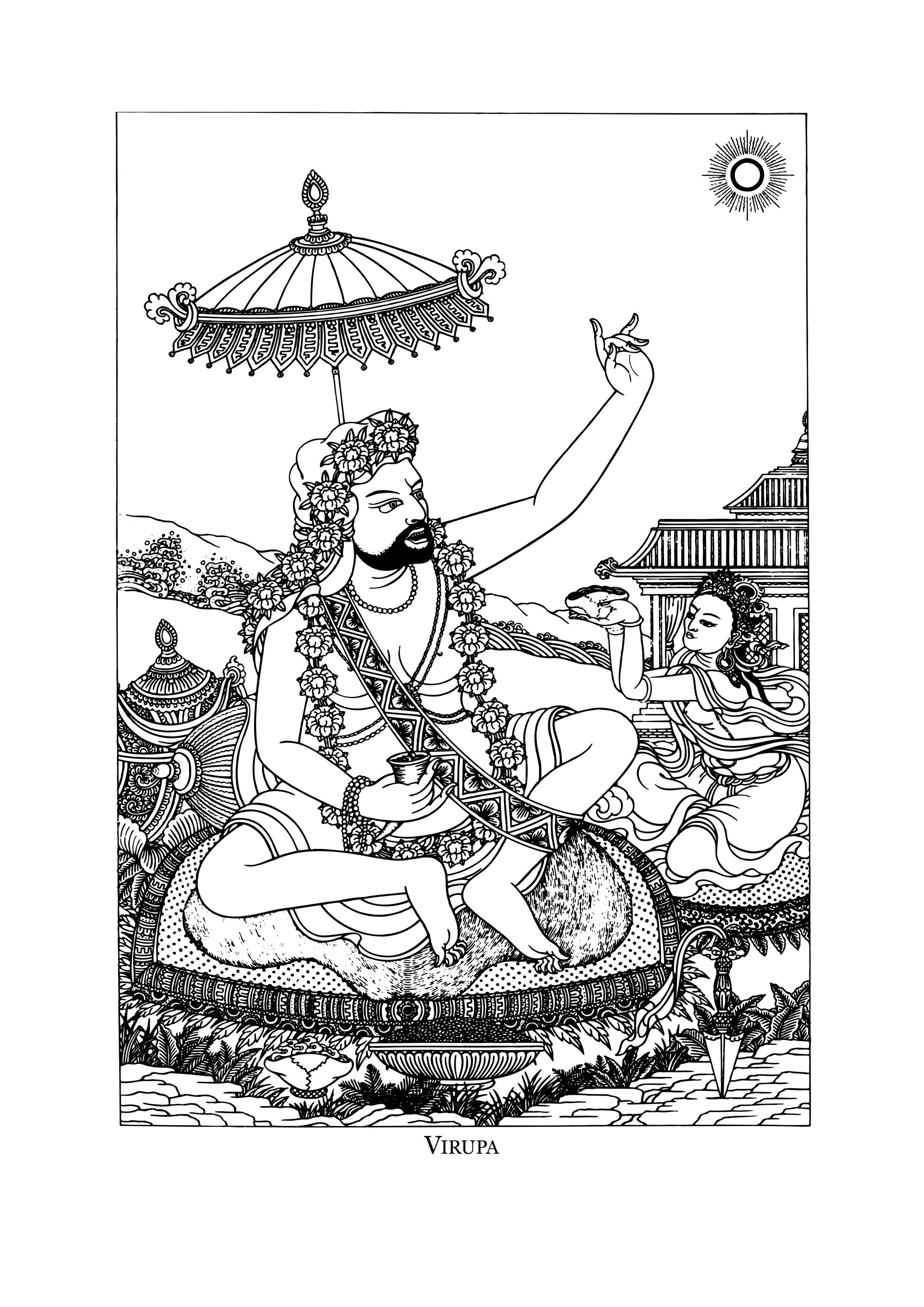
VIRUPA
OVERVIEW

T   HIS BOOK IS BASED ON introductory talks given by Lama
    Choedak to prepare students for Lamdre. These teach-
ings are prized by students and masters of all Tibetan tra-
ditions, and this book will interest all students of Tibetan
Buddhism, especially those aspiring to take higher ini-
tiations.
    L AMDRE — DAWN OF ENLIGHTENMENT is a unique work
which describes the actual teachings disciples will receive.
Special features of this work include:
— The origins of the lineage and the special
  characteristics of the Lamdre system.
— An integrated perspective on the three vehicles:
  Theravada, Mahayana and Vajrayana.
— The respective roles of teachers and disciples within
  Buddhism, with particular reference to the Vajrayana.
— How disciples can benefit by incorporating the Lamdre
  approach into every aspect of their spiritual practice
  and their daily lives.
Lama Choedak was born in Tibet and escaped to Nepal in
the early 1960s. Following eight years of monastic train-
ing, he undertook a three and a half year Lamdre retreat
at Lumbini.
    He has taught in many Buddhist centres worldwide and
translated for some of the greatest living Buddhist masters.
He is a graduate of the Australian National University and
author of a thesis on the origin of the Lamdre tradition in
India.

                            iii
LAMDRE
            DAWN OF ENLIGHTENMENT
                BY   L AMA CHOEDAK YUTHOK

SERIES OF LECTURES ON THE PRECIOUS L AMDRE TEACHINGS OF
       THE SAKYA TRADITION OF TIBETAN BUDDHISM

                    GORUM PUBLICATIONS
                 CANBERRA, AUSTRALIA, 1997

Published and distributed by
Gorum Publications
PO Box 3430
Manuka ACT 2603
Australia
© Lama Choedak Yuthok 1997
All rights reserved. No part of this book may be reproduced in any form
or by any means, electronic or mechanical, including photocopying,
recording or by any information storage and retrieval system, without
permission in writing from the publisher.
Transcribed and edited by Pauline Westwood with valued assistance
from Ot Rastsaphong, Rob Small, Brett Wagland and Whitethorn.
Cover design by Rob Small.
Cataloguing in Publication Data
Yuthok, Lama Choedak
          Lamdre: dawn of enlightenment: series of lectures on the
precious Lamdre teachings of the Sakya tradition of Tibetan Buddhism.
ISBN 0 9587085 0 9
1. Lam-’bras (Sa-skya-pa) 2. Vajrayana.
BQ7672.Y88 1997       294.3’44
ISBN 0 9587085 0 9
For æons you have stayed in retreat
          from the city of defilements
        In the seclusion of unobjectified,
              awakening maturity
   Through your teachings gods and humans
             blossom with qualities
To the great Lamdre-pa, the crown of Lotsawas,
                 I pay homage!


        THE GREAT TRANSLATOR DROGMI
            LOTSAWA SHAKYA YESHE
Contents


OVERVIEW ..........................................................................................................              III

PREFACE           ............................................................................................................... IX

1.       THE EXTRAORDINARY QUALITIES OF L AMDRE ....................... 1
2.       THE FOUR AUTHENTICITIES ............................................................ 11
         THE FOUR AUTHENTICITIES IN THE ORDER TAUGHT IN THE TANTRA .............. 11
         THE FOUR AUTHENTICITIES IN THE ORDER OF THE SEQUENCE OF EVENTS ..... 14
         THE FOUR AUTHENTICITIES IN THE ORDER
         IN WHICH THE DISCIPLE FOLLOWS THE PRACTICES                                     18
                                                                                    ..........................................
        THE FOUR AUTHENTICITIES IN THE ORDER OF VALIDATION .......................... 19
        THE FOUR PARAMETERS OF A WHISPERED LINEAGE ..................................... 20
        1. THE STREAM OF INITIATING WATER MUST NOT RUN DRY ........................... 21
        2. THE CONTINUITY OF THE BLESSINGS MUST NOT BE BROKEN ..................... 22
        3. THE ORDER OF THE INSTRUCTIONS MUST NOT BE INTERFERED WITH ....... 23
        4. ONE MUST BE CONTENTED BY ONE’S DEVOTION TO THE TEACHINGS .......... 24

3.       THE LIFE OF VIRUPA ......................................................................... 26
4.       A N OVERVIEW OF L AMDRE TEACHINGS ................................. 50
5.       THE VISION OF EXPERIENCE ......................................................... 66
6.       PERSONALISING THE VISION OF EXPERIENCE ...................... 83
7.       PURE VISION ........................................................................................ 104
         INEXHAUSTIBLE ORNAMENTAL A RRAY
         OF THE QUALITIES OF THE BUDDHA’S BODY ................................................. 107

         INEXHAUSTIBLE ORNAMENTAL QUALITIES OF THE BUDDHA’S SPEECH ......... 112
         THE INFINITE INEXHAUSTIBLE QUALITIES
         OF THE BUDDHA’S OMNISCIENT DHARMAKAYA ............................................ 119

         ENLIGHTENED ACTIVITIES OF THE BUDDHA ................................................ 120


                                                              vii
8.      CAUSAL TANTRA ................................................................................ 123
         STORE CONSCIOUSNESS ................................................................................. 125
         BUDDHA NATURE ......................................................................................... 126
         THE FIVE BUDDHA FAMILIES ...................................................................... 129
        A BANDONABLE FACTORS ............................................................................... 131
         THE FIVE DEFILEMENTS .............................................................................. 132
         INITIATION ................................................................................................... 135
         THE NATURE OF MIND ................................................................................. 138
         PATH TANTRA ............................................................................................. 140

9.      THE HEVAJRA INITIATION                                  ...........................................................   145

10. THE NATURE OF MIND ................................................................... 157
11. THE ROLE OF THE TEACHER ....................................................... 168
12. DISCIPLESHIP IN BUDDHISM ......................................................... 185
         THE FOUR MAIN OBSTACLES FACED BY DISCIPLES ..................................... 188

13. SETTING OUT ON THE PATH .......................................................... 201
14. THE SUBSIDIARY PRACTICES ........................................................ 221
         1. GYU-LU (ILLUSORY BODY) ....................................................................... 228
         2. DREAM YOGA ......................................................................................... 229
         3. CLEAR LIGHT ......................................................................................... 232
        4. DAKAMA ................................................................................................. 234
         5. BARDO ................................................................................................... 234
         6. R EBIRTH ................................................................................................ 236

15. THE R ESULT                    ........................................................................................   240

POSTSCRIPT ..................................................................................................... 259
GLOSSARY ........................................................................................................ 260
FURTHER R EADING .................................................................................... 274

                                                           viii
Preface


I   NITIATION INTO THE HEVAJRA MANDALA, the king of tantras
   has long been associated with conversion of the Mongol
emperor Kublai Khan to Buddhism and the establishment
of priest rulership in Tibet. This lasted from the early
thirteenth century up to the present Dalai Lama. We all owe
this to one hard working Tibetan savant known as Drogmi
Lotsawa Shakya Yeshe (993–1074) who introduced the mag-
nificent Lamdre teachings to Tibet during the 11th century.
    Those fortunate enough to be able to attend Lamdre are
in for a big spiritual bonanza. The comprehensive teachings
on the Triple Vision, which deal with the preliminary teach-
ings common to both Theravada and Mahayana Buddhism,
followed by the Bodhisattva vow are more than enough
for most beginners. After that come the Hevajra cause and
path initiations, teachings on the Triple Tantra and guid-
ance about how to perform the Sadhana practices of Hevajra-
tantra. The “oral teachings on the view” are imparted in the
most thorough manner, coupled with transmissions and
blessings from all the Lamdre lineage masters. More eso-
teric teachings associated with the three higher initiations,
known as the six yogas in other traditions will be taught
in the proper sequence. Lamdre is the most complete form
of Tibetan Buddhist path. Lamdre teachings are the father
teachings of the Sakyapa school of Tibetan Buddhism. They
are coveted by many traditions. The Sakyapa school has
preserved the noble tradition of maintaining the integrity
of the Hevajra initiation, which to this day is restricted to
twenty-five or fewer disciples. Because of the purity of this
lineage, most prominent masters of all schools of Tibetan

                             ix
Buddhism including Marpa, Milarepa, Longchen Rabjampa
 and Tsongkhapa have been practitioners of this tantra.
     Over the past fifteen years I have been directly involved
 at a number of Lamdre teachings given by His Holiness
 Sakya Trizin, His Eminence Chogye Trichen Rinpoche
 and His Eminence Luding Khen Rinpoche in the capac-
 ity of translator and facilitator. Due to the orthodox and
 formal setting of the presentation of the Lamdre teach-
 ings, a number of non-Tibetan disciples with little or no
 understanding of these teachings have sought to look into
“Lamdre” from a practical and pragmatic point of view. It
 has not been an easy task to interpret my limited under-
 standing of these ancient wisdom teachings to the rather
 demanding and inquiring (if not sceptical) minds of mod-
 ern disciples.
     Although Hevajratantra was one of the first Buddhist
 tantras to be translated into English, the core teaching of
 this tantra known as “Lamdre” is a still unexplored area
 of Buddhist scholarship. Until recently, there were no
 books available in English for non-Tibetan initiates. Yet the
 Lamdre teachings are given every few years around the
 world. However, the Triple Vision, the preliminary teach-
 ings on Lamdre by Ngorchen Konchok Lhundup, was trans-
 lated into English and is now available in most major book-
 shops. The late Dezhung Tulku Rinpoche’s excellent oral
 commentary, translated by my late friend Jared Rhoton
 (Inji Sonam) is now readily available. My own translation
 of Panchen Ngawang Choedak’s Triple Tantra is currently
 being edited for publication.
     In the past, monks from far eastern parts of Tibet,
 Ladakh and Mustang would travel many months on foot to

                              x
Sakya, Ngor, Nalendra and Yarlung Tashi Choe-de in cen-
tral Tibet to receive Lamdre. One who receives Lamdre is
considered to be officially initiated into the Sakya lineage.
Those who attend the Lamdre teachings are required to do
the Hevajra Sadhana every day. This assists disciples to ful-
fil their Pratimoksha, Bodhisattva and Vajrayana vows. In
the past, monasteries where Lamdre teachings were given
would strengthen their ties with the master who gave the
Lamdre and his lineage, and make a strong commitment
to maintain regular formal Hevajra practices. Because of
the profundity of these teachings, prominent teachers from
other Tibetan lineages make great efforts to receive the
Lamdre transmission.
     The work contained in this book is based on fifteen talks
I gave on Sundays in late 1996 at Sakya Losal Choe Dzong
in Canberra, Australia at the request of many long time
Dharma students who are genuinely interested in receiving
the profound Lamdre teachings from His Holiness Sakya
Trizin. The editor of this book, Pauline Westwood, dedi-
cated many hours of her time each week to transcribing
my talks and subsequently organised and worked with a
number of other students to read, proof-read and improve
the text. Out of great enthusiasm and team work largely
inspired by Pauline herself, this book has finally materi-
alised. I am very pleased that now we can make this an
offering for other like-minded people who are interested
in learning about Vajrayana Buddhism and Lamdre teach-
ings in particular.
     It is hoped that the book will serve as an introduction
to the Lamdre teachings and their unique method of deliv-
ery. If readers discover anything beneficial, it is the power

                             xi
of the activities of the enlightened speech of the Buddhas,
Bodhisattvas and Lamdre lineage masters, whose bless-
ings have been made accessible through the transmission
of the joint effort of many people involved. On my part,
this was not an attempt to write or comment on such pre-
cious teaching as “Lamdre.” My words were spoken in joy,
honour and praise of the pure and faithful Lamdre line-
age and its remarkable masters who are the shining gems
of Tibetan Buddhism. The Sakyapa lineage and its adher-
ents are small in number. However, the standards required
of a master who maintains its strict requirements are high
indeed. This is the only way to preserve the purity of the
precious Lamdre teachings.
    I hope that the present work will help to introduce some
of the fundamentals of Vajrayana Buddhism to its readers
and inspire disciples to appreciate the purity of the Lamdre
teachings. I am responsible for any errors exposed by “my
mouth karma” in this book and all the merits are due to the
kindness, generosity and inspiration of my precious teach-
ers, parents, family and students. As a result of being blown
by my karmic winds to wander in this part of the world
here in ‘downunder Australia,’ I have discovered a greater
joy in sharing my little knowledge of the precious Dharma
teachings than I ever envisaged during my novice days in
Lumbini. Like the small boy Jaya, who presented a hand-
ful of dirt to Buddha and was later reborn as king Ashoka,
I consider this work as a small offering to help purify all
negative obstacles on the path of establishing Dharma in
Australia. I trust that this will repay some of the great kind-
ness I have received and serve to fulfil some of the wishes
of my precious teachers and their forefathers.

                             xii
May all the sincere wishes of those who have directly
or indirectly contributed to the production of this book be
fulfilled by the blessings of the Lamdre lineage masters!
          May all beings be free from suffering
                  and causes of sufferings!
         May they enjoy long-lasting happiness
         derived from the practice of altruism!
        May they experience the calm, clear and
                 empty nature of all things!
        May they be guided by qualified masters
              on the right path life after life
       Until all sentient beings are happy and safe!
                    With sincere prayers
                               Lama Choedak T. Yuthok
                      Sakya Losal Choe Dzong, Canberra
                                   “Fire-Ox Losar” 1997


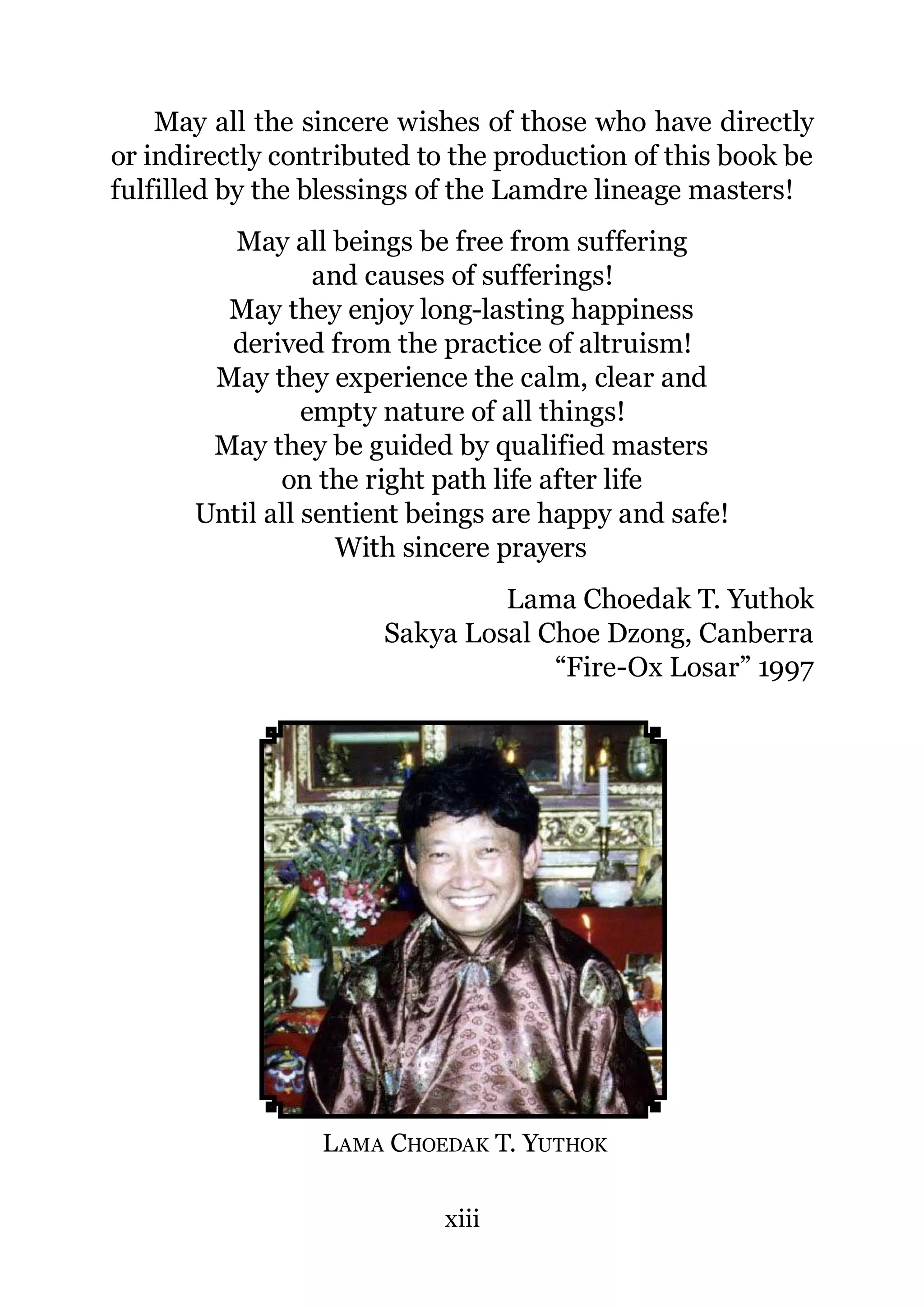
                 L AMA CHOEDAK T. YUTHOK

                            xiii
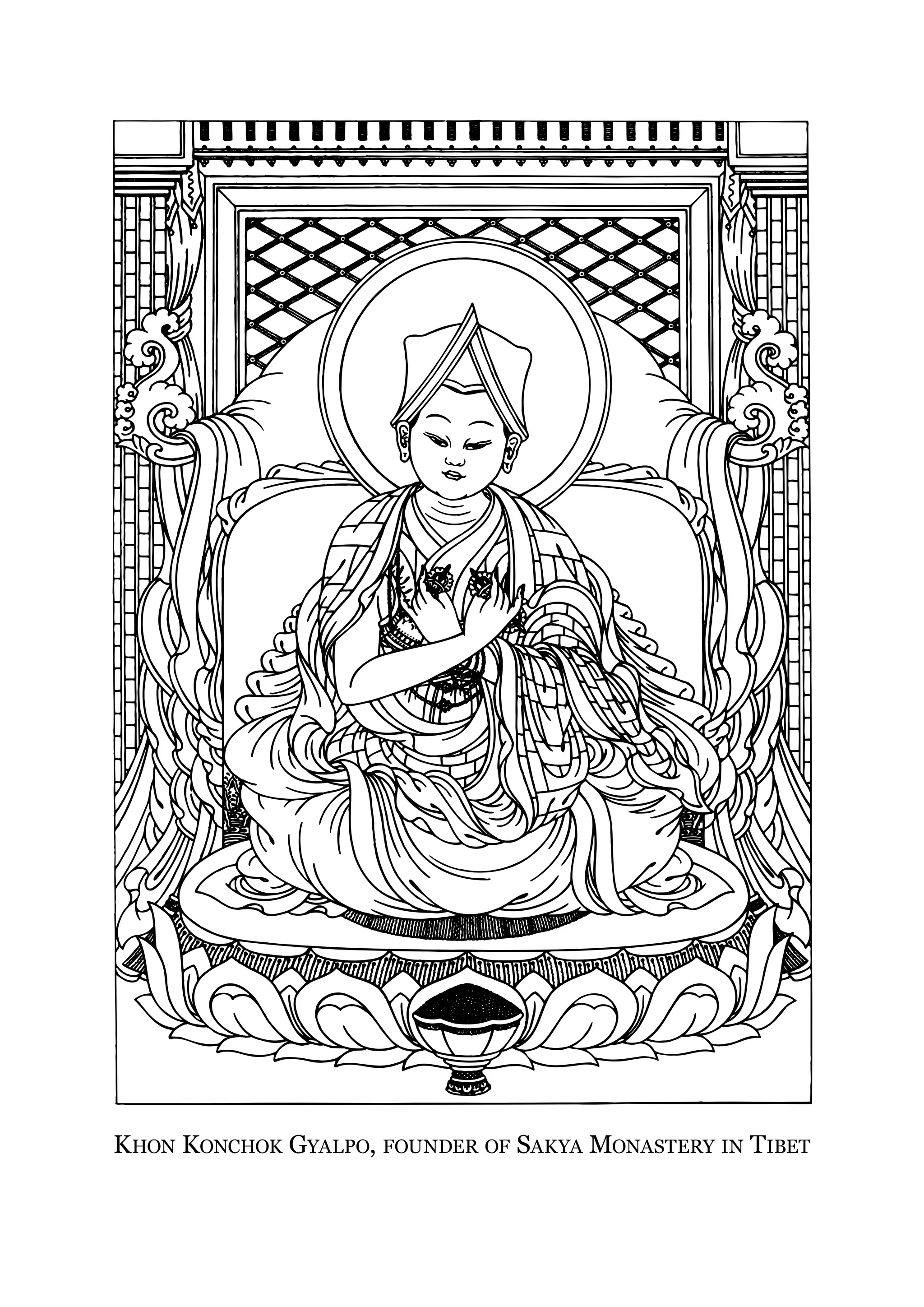
K HON KONCHOK GYALPO, FOUNDER OF SAKYA MONASTERY IN TIBET
1
THE EXTRAORDINARY QUALITIES OF L AMDRE
1.


L    AMDRE TEACHINGS ARE BASED ON      the Hevajra Tantra.
     They were initially received by the 7 th century Indian
Mahasiddha Virupa, who founded the lineage and trans-
mitted the teachings to a line of disciples in India. Virupa
also wrote pith instructions known as Vajragatha. How-
ever, as these were heavily encoded and difficult to under-
stand, Lamdre was transmitted as an oral tradition for some
centuries. The teachings were brought to Tibet by Drogmi
Lotsawa in the middle of the tenth century and were later
codified in the twelfth century by Sachen Kunga Nyingpo,
who also wrote eleven commentaries.
    Lamdre is a complete path to enlightenment. It is
taught in a single place by a single teacher over a period
of several weeks. It is not offered in separate segments.
It is a transmission of both exoteric and esoteric teach-
ings by an officially recognised lineage holder. It cannot
be offered by self-proclaimed teachers who just happen to
attract crowds. Within the Sakyapa lineage, which is the
Lamdre lineage, we have only a handful of lineage hold-
ers in any generation.
    It is important to be aware that although some people
may be very learned in the teachings and know the topic very
well, they are not necessarily qualified to give the transmis-
sion. When His Holiness Sakya Trizin visits in 1997, it will
be the first time the uncommon Lamdre (Lobshe) teach-
ings have been given in Australia. His Holiness agreed to
this because during his visit in 1988 to give the common

                              1
teachings (Tshogshe), he was asked to return one day to
give the uncommon Lamdre. The request has since been
renewed many times.
     The term Lamdre is Tibetan. Lam means path, dre
means result. The word as a whole means ‘the path including
its result.’ Lamdre is intimately involved with the Hevajra
Tantra, one of the principal tantras in the class of high-
est Buddhist Anuttara Yoga tantras. It contains the entire
Buddhist teachings at both the ordinary and extraordinary
levels. In this talk I will focus on the extraordinary char-
acteristics of Lamdre, what the teachings are about and
how students will benefit from them. Traditionally, these
extraordinary qualities are known as the ‘Eleven Great-
nesses of Lamdre.’
     Normally, we tend to draw a firm distinction between
path and goal or result. The path often seems so difficult,
and our progress so slow! We find ourselves longing for
the result, desperate for a quicker way to reach that elusive
goal. We don’t always realise that what we experience on
the path actually amounts to the goal.
     The first major characteristic of Lamdre is the fact
that the path actually includes its result. The result is not
something that occurs at the finishing line. It is happen-
ing continuously from the moment we begin. Therefore we
don’t need to wait for results. They arise every day from our
practice. Lamdre is all about practice. It is our experience
during practice which authenticates the path. On the other
hand, people who do not practise have no way of experi-
encing the result. They may develop an intellectual under-
standing of the Lamdre teachings, but that will be all. In
fact any religious path which does not include practice is

                             2
devoid of real experience and is therefore of limited benefit.
We must never forget that the path is the result. Other-
wise, when we begin to practise prostrations, for example,
we may feel daunted by how many are still to be done. But
we should try to develop enough humility to be happy with
what we manage to do each day, instead of striving for great
numbers. Once we receive the Lamdre and begin to incor-
porate it into our daily lives, we are no longer intimidated
by the gulf between what we are doing and what remains to
be done. We cease to distinguish between path and result.
    The second extraordinary characteristic is not seeing
the result as greater than the path. Just as the path is not
separate from the result, the result is not separate from the
path. At a higher level of understanding, this is the realisa-
tion of the non-existence of any dichotomy between good
and evil. Dualistic concepts produce so much of our suffer-
ing. Much of our pain may be nullified when we realise this
inseparability of path and result. Every individual’s path is
of course different. If your own path is actualised, it is the
realisation of path into result for you. The person who has
realised the result will not assume that he has laid down a
path for others to follow. There is no highway to enlighten-
ment, only tracks. Some very bold people manage to cre-
ate their own new paths through their experiences. We may
read their biographies and gain great inspiration, but we
will never travel exactly the same road. For example, we
cannot totally duplicate the Buddha’s activities. But we can
use his teachings as a guide to pave our own pathway. This
is an important characteristic of Buddhism. The teaching
is our refuge, and we use it to make our own paths. But we
do not try to make it into a highway for others.

                              3
The third characteristic is the instruction that enables
us to transform all our perceptions through an understand-
ing of the nature of mind. When a person knows the nature
of the mind, he or she can transform anything. Once we
learn how to govern our mind, we will no longer be control-
led by the mind’s reflection of events and circumstances.
We can transform all our perceptions. On the other hand,
one who is unable to govern his mind always sees things as
discriminatory. People, places and events have great power
over him. Sometimes we may catch a glimpse of this trans-
forming ability. We may even be able to practise it on the
odd occasion, but not consistently. How liberating to be
freed from the tyranny of events and circumstances! I am
sure that the Buddha must have had this realisation when
he sat under the Bodhi tree. Although faced with all kinds
of adverse circumstances, he remained undaunted. He
could turn everything to his advantage.
    Within Buddhism there exists a school of thought known
as ‘mind only’ or Cittamatra. Lamdre includes elements of
this philosophy, teaching that all events and perceptions
are nothing but a reflection of our own mind. Imagine how
much benefit this realisation can be to people in simply fac-
ing their everyday problems!
    The fourth characteristic is the ability to transmute
faults into qualities. We may have developed skills over the
years in avoiding difficult situations and people, in the mis-
taken belief that we protect ourselves by keeping away from
them. But this technique involves quite the opposite. We
must actually be close to difficult situations and people so
that we can transform all faults, obstacles and adversities
into qualities and opportunities. The fact is that all faults

                             4
are impregnated with qualities. Our good qualities hide
behind our faults. Faults are more visible than virtues. We
remember people’s faults far better than their good points.
But if we look carefully at our negative experiences, we dis-
cover that they have taught us much more than the positive
ones. Much more than all the laughter, hugs and presents
we give each other. We don’t learn much from them. On
the other hand, we learn a great deal from difficult rela-
tionships. It may not seem so to us at the time. But after a
painful experience we usually resolve to do things slightly
differently in future. Lamdre teachings equip us with the
ability not to shun people’s faults, which really means shun-
ning the people, too. We learn to accept both good quali-
ties and faults in others. Particularly once we come to see
their faults as no more than our own mind’s reflection! If
we want a person to be caring towards us, we will normally
see him as uncaring. This is because we have expectations
of people and things. But if we expect nothing, we may be
pleasantly surprised. Faults are inseparable from virtues.
They are two sides of the same coin. This is an important
feature of the path including its result. Lamdre teaches us
to learn from problems, not reject them.
    The fifth characteristic is the ability to accept all obs-
tacles and interferences and transform them into attain-
ments. We can be sure that if we persevere in the face of obs-
tacles we will attain something important. In fact, unless
we strive for our achievements, we tend to take them for
granted. Obstacles test our passion for the result. If we are
only halfhearted, of course they will block us. The great-
est trial on the path occurs the night before enlightenment.
This is what happened to the Buddha. After meditating

                              5
for six years, he was attacked by an army of monsters the
 night before he attained enlightenment. They wielded the
 most fearsome weapons. They pelted him with mountains
 of rocks and lakes of molten lava. This is what we call the
 Conquest of the Maras. If he had reacted by asking himself
‘Is this all I get after six years of practice?’ and given up, his
 attainment would have been delayed. But instead of being
 threatened by the Maras, the Buddha saw them as objects
 of compassion. As a result, he subdued them all. He con-
 verted their weapons into garlands of flowers. If you prac-
 tise for ten years, and then during the eleventh year face
 a great obstacle, you must persevere. To withdraw at that
 stage would be a waste of ten years’ energy.
     When we feel under attack from obstacles, it is impor-
 tant not to let ourselves be overwhelmed. The best thing
 to do is just to be there. Let the obstacles keep on com-
 ing. We can explain to ourselves that if we bear these, it
 will take away the negativities which persisted throughout
 our ten years of practice. In this way, we can make greater
 strides in one year than we did during the preceding ten
 years. This test comes every now and then in practitioners’
 lives. Transforming obstacles into attainments requires us
 to exercise patience with ourselves and to develop a degree
 of humility. It is a culmination, almost like a graduation
 after many years’ effort.
     The sixth characteristic is being able to recognise every
 experience. The pattern of experiences will be reflected in
 the pattern of samadhi. Consistency of practice enables
 us to identify hindrances. To use calm abiding meditation
 as an example, people may feel that they have no physical
 discomfort, and that the body is no longer a problem. Now

                               6
the only problem appears to be with the mind. The mind
feels dull. But the chances are that the dullness is actually
physical. The meditator may not understand this. He may
think he is sitting so well that the problem can’t possibly
be with his body. This is when we should be aware that it is
very difficult to remove the physical aggregates. Sometimes
people blame past lives. They don’t recognise that the real
problem is their attachment to the physical body and its
comforts. Once they discover this, they can pinpoint pos-
tural problems. For example, if the back is not straight, the
mind will become sluggish. It is easy to blame some myste-
rious mental or spiritual difficulty when we can’t focus the
mind. Usually, though, it is a physical problem. It is very
difficult for us to transcend our physicality. The body and
the senses are deceptive, and they mislead the mind. We
must always return to the physical level — the level we are
at, rather than seeking further afield for the source of the
problem.
    The seventh characteristic is that by recognising obs-
tacles, we can remove hindrances caused by evil spirits.
Meditators attract evil spirits. As we learn more about hin-
drances, we won’t blame external things such as the climate,
a heavy meal or an empty stomach. We normally tend to
look for excuses outside ourselves. Now the meditator can
see the obstacles at a much subtler level. Take the example
of craving for food. Evil spirits usually invade the weak-
est points of the practitioner. They may come in the form
of food to tempt us. They may come in the form of people
to lure us away from our practice. Of course people are not
evil beings, but evil beings sometimes enter peoples’ psy-
che. Don’t you ever feel that you are not really you when

                             7
you are doing something, as though some force seemed
 to have taken over? When we are thinking about negative
 things, evil spirits give us a hand. They are known as Maras.
‘Mara’ means ‘kill.’ They kill our conscience and take us
 over so that we do things we would not normally do. It is
 said that if we recognise these obstacles on the path, we
 won’t blame concrete objects. We will recognise our weak
 points and accept the level we have reached. If we think
 negative thoughts, we will definitely attract negative vibra-
 tions. Negative thoughts also attract accidents and misfor-
 tune. On the other hand, positive thoughts attract miracles.
 In some of the meditations our visualisations give us the
 ability to commune with Buddhas.
     The eighth characteristic is the quality of transform-
 ing other people’s faults into our own spiritual attainments.
When we have passed through the preceding levels and
 transformed our own faults, we may notice that others still
 have faults. The real transformation comes about when we
 can perceive other people’s faults as qualities. Of course we
 don’t actually tell someone “you are great, you are such a
 short-tempered person.” But if we tell ourselves that a par-
 ticular person is very short-tempered and we can’t bear him,
 it won’t help us to develop. We just become exactly like the
 person we are criticising. The fault ceases to be only in the
 other person and infects us. It will become part of us. So
 what’s the best way to cope? Once we have learned how to
 transform our own faults into qualities, we must begin try-
 ing to transform the faults of others, too. One way is to look
 at the other person’s negative behaviour and tell ourselves
“This reminds me of how I used to behave. What I used to
 be, I am seeing in the other person now.” When we have

                              8
transformed our own faults, we will have a loftier view of
the follies of others. We will not be threatened by them. We
will make no judgements about them. The faults of others
now enable us to become more focussed. They become an
inspiration. We begin to accept them as challenges rather
than obstacles.
    After people return from long retreats, they have to try
to sustain their new vision of others. We can become pretty
harmless, living a solitary life in a small hut and inter-
acting with nobody. But what happens when we emerge?
The tiger is harmless in his cage, but what about when he
escapes? The challenge for us as practitioners is to find the
faults of others just as useful as our own. Once we achieve
this, we will not resent ‘difficult’ people. After all, they help
us to learn! We can emulate what the Buddha did under
the Bodhi tree when he subdued the Maras. It was only
through defeating the Maras that Buddha could gain vic-
tory. To become victorious, we must defeat our most power-
ful opponents. These are none other than our perceptions
of other people’s faults. We must churn the butter of reali-
sation from the milk of our problems.
    The ninth characteristic of Lamdre is that it enables
us to see the non-contradiction between Sutra and Tantra,
morality and metaphysical knowledge. Otherwise, many
people see a contradiction between theoretical knowledge
and practice. Some may be happy with their practice, but
easily affected by the judgements of others. Actually we
need criticism from time to time. It tests us. If we are eas-
ily put off, it shows we must be very shallow practitioners.
Criticism is a wonderful opportunity to develop faith. If we
become discouraged, it is because we are attached to mun-

                               9
dane forms and concepts, rather than to the inner mean-
ings of the teachings.
     It is said that a person blessed by the transmission of
Lamdre will not see any contradiction between sutra and
tantra, morality and spirituality, monkhood and layhood.
He will not practise anything contrary to the basic teach-
ings of the Buddha. For example, in certain Vajrayana cere-
monies it is permissible to drink a little alcohol as an inte-
gral part of the ritual. But some practitioners drink whole
bottles. This transgresses one of the five basic Buddhist
precepts. How can one hope to reach a lofty realisation of
Vajrayana without the firm foundation of the five precepts?
It is important to follow a complete path, rather than focus
exclusively on one level. An individual’s practice may be
a source of either inspiration or humiliation to others. A
practitioner of Lamdre will have equal regard for both sutra
and Vinaya levels. One may not be suited to these levels, but
one will still respect each of them, and lead a spiritual life
founded on a firm basis of morality.
     The tenth characteristic is that just like the elixir which
transforms all base metals into gold, one receives teach-
ings of pure gold which transform all of life’s problems. No
longer do we see problems as rigid. All obstacles become
transformable, irrespective of how they originated. We will
treasure the teachings as we would a priceless jewel.
     The eleventh characteristic is that the benefits of the
teachings surpass the qualities of the mundane material
world in every respect. It is important however not to expect
to demonstrate all of these qualities as soon as we receive the
six weeks of Lamdre teachings. We will develop them grad-
ually, but only through diligence and consistent practice.

                              10
2
            THE FOUR AUTHENTICITIES
            2.


P   EOPLE OFTEN MAKE CLAIMS THAT a particular set of teach-
     ings offers the best or the quickest result. But there are
a lot of charlatans around these days using religion for their
own ends, as we have seen over the years in the United
States and more recently in Japan. In the Lamdre tradi-
tion four criteria are used to ensure that a particular set of
teachings adheres to strictly defined parameters of validity.
We will briefly look at how these parameters may be used
to authenticate Lamdre.

THE FOUR AUTHENTICITIES
IN THE ORDER TAUGHT IN THE   TANTRA
The first authenticity in this order is valid teachings.
Exegeses are commentarial texts which clarify and explain
teachings found in the Buddhist sutra or tantra. Many Bud-
dhist texts cannot be easily understood by lay people, even in
the best translations, unless there are accompanying com-
mentaries. Commentarial literature is known as shashtra
in Sanskrit. One who is capable of writing such a commen-
tary must either have been predicted by the Buddha, or been
blessed by Dakinis or enlightened beings. He must be able
to verify his enlightened experience. Otherwise his name
must be prophesied in the Buddhist sutras. In this partic-
ular Lamdre system, the authentic shashtras or scriptures
were written by Virupa, one of the eighty-four Mahasid-
dhas who appeared in India during the seventh century.
His dating is a matter of dispute, depending on whether we

                              11
follow the hagiographical literature or rely purely on histor-
ical sources. There is great difficulty in reconciling the two
approaches. Those who follow the traditional Lamdre dat-
ing would date Virupa from the seventh century. Authentic
shastra must be based on a canonical text which is actually
contained in the Buddhist canon. Virupa’s work, entitled
Vajragatha, meaning Vajra Verses, elucidates the Hevajra
Tantra. There must be traceability of the teacher and his
background as well as of the text.
    The second is valid teacher, Acharya, or Vajra Master.
Out of the thirty-one volumes containing the entire teach-
ings of the Lamdre, eleven are devoted to the biographies
of the lineage masters, from Virupa down to the present
day living masters. One of the shortest of these biogra-
phies is that of Virupa. He is the earliest of the masters,
and the details of his life are sketchy. However, there is
much more detail available about subsequent generations.
The method of authenticating the line of teachers is by
reading their biographies, mainly their secret biographies.
Biographies are of three kinds — outer, inner or secret.
Outer biography consists of what people did, where they
went and whom they met. Such details are common know-
ledge. Inner biography is about what the person actually
experienced. Realisation of the inner biography becomes
the religious biography — the sacred biography, hagiog-
raphy, or secret biography. This is not easily understood
by ordinary people. It is very sacred and mystical. Some
of the biographical details about Virupa are definitely of
that nature. They are part of his secret biography. Dur-
ing the teachings, al these biographies are read in Tibetan.
The teacher usually reads very quickly. In the west most

                             12
teachers give the gist of the life stories in English, in ad-
dition to reading the complete stories in Tibetan.
     The third is valid transmission. The teacher must
be a valid teacher who has himself received the teach-
ings from the mouth of an authentic teacher (not through
books). Sacred knowledge can never be transmitted
through books. Books may be used as an aid, but that
is all. Teachings must come from the ‘warm voice of the
Guru.’ The teacher must be fully trained and authorised to
give the transmission. Amongst the Tibetan community,
there may be several thousand people practising Lamdre
today. Only about half a dozen are authorised to impart
the transmission. The teacher must be an undisputed lin-
eage holder. He must have received the oral transmission
of the text. He must have seen the text and studied it. The
text must be extant. This is strictly enforced. A teacher
who is able to prove these qualifications holds the authen-
tic transmission all the way back to Virupa, from Virupa to
Vajra Nairatmya and thence as far back as the Buddha.
     Hevajra Tantra is in the form of a dialogue between the
Buddha and Vajragarba. It is rather like the Heart Sutra.
In the Sakya Lamdre tradition, monks may be required to
memorise the entire root text of the Hevajra Tantra: It is
not very long, really, only seven hundred and fifty verses and
twenty three chapters. In some monasteries the ordained
monks chant these by heart. There are twelve great Indian
commentaries and fifty commentaries indigenous to Tibet
which are all studied and discussed. Because of this wealth
of commentarial literature together with the maintenance
of the oral tradition, the teachings remain part of the liv-
ing tradition down to the present day.

                             13
The fourth is valid experience. This is not necessarily
the correct order. It is the order taught in the tantra. This
order is used in the tantra so that sceptics and people who
do not practise and study will be confused, and not eas-
ily gain access to the knowledge simply through reading a
text. People must receive guided oral transmission. That is
why tantric texts are written in very cryptic language and
totally mixed up order. When people talk about tantra, they
often have pretty weird ideas. Most people do not under-
stand the notion of authentic transmission. Many associate
tantra with sex. This is ridiculous. Some iconography may
depict postures of a sexual nature, but that is not the issue.
But so be it. Unless people are admitted properly, they will
misunderstand. Tantra likes to guard the secrecy of those
things intended to be kept secret.

THE FOUR AUTHENTICITIES
IN THE ORDER OF THE SEQUENCE OF EVENTS

First is the valid transmission. In the ‘sequence of events’ sys-
tem, one first establishes the authentic transmission, which
was given by the Buddha in the form of a dialogue. If the
tantra in which these four Authenticities are taught teaches in
a mixed-up order, how do we work out the correct order? Just
as a cool stream coursing through the valley has its source
in snow-peaked mountains, all authentic teachings derive
from lofty spiritual heights. They must come from the root
text. The text itself may not have been written down for sev-
eral hundred years. We have no way of establishing exactly
when it was written. The earliest recorded knowledge dates
from the eighth century. Buddha came nearly twelve hun-
dred years before that. Therefore, in the intervening period,

                              14
the transmission must have been kept orally.
    Second is valid teachings. After transmission the text
was standardised. Third is experience. Fourth is valid
teacher. Virupa wrote a very short text. By that time, of
course, the Hevajra Tantra was already in circulation. As
Virupa’s text is much shorter than the Tantra itself, it is not
really regarded as exegetical or commentarial in nature,
but more of an extract. It forms an entirely new set of teach-
ings called Lamdre, or marga phala in Sanskrit. Marga
means path, phala means result. Therefore the transmis-
sion came first and then the exegesis — at least to people
who could understand Virupa’s writing! One might wonder
why Virupa wrote this at all, because it doesn’t seem to be
any easier to understand than the root text itself! The only
people who could actually understand Virupa’s meaning
were his disciples. These disciples then validated the fact
that their teacher Virupa was an enlightened teacher, the
Buddha through whom they received the teachings. They
became his successors. Virupa had only two successors,
each of whom specialised in a different area.
    The earliest history of Lamdre was purely oral. It remained
that way until the thirteenth century, after it was brought to
Tibet. Because of that, there was no intention to recruit many
adherents. Usually just one at a time. A disciple must be one
who is able to uphold the teachings. He or she must have had
valid experiences involving heat, signs and enlightened expe-
riences. The requisite levels of experiences are explained in
the text. They must be attained through practice. Until the
individual himself undergoes the experiences, the foregoing
Authenticities remain at a superficial level.
    A meditator must reach the point of sitting still without

                              15
worrying about time. His body must be like a well-recruited
assistant. His mind must totally overcome matter, rather
than the body ruling the mind. This is one of the first con-
vincing experiences. When this stage is reached, the phys-
ical and emotional self is governed by spiritual yearning.
Sensory needs dwindle to nothing. Craving and desire dis-
appear. One can sit still like the Buddha under the Bodhi
tree no matter what circumstances arise. These experiences
uplift the meditator as he perseveres with the practices in
the prescribed order, against all adversity. This transcend-
ence of physicality is what makes a person truly spiritual,
not what he believes. He will see beyond what the phys-
ical eye can see, hear beyond what the physical ear can
hear, touch beyond what the body can touch and be beyond
where he is. Concepts of space, time and knowledge which
dictate everything in the mundane world are completely
nullified. The notion of a self existing independent of others
is almost transcended.
    When a person reaches this stage, he experiences fif-
teen levels of heat. These represent stages of development
on the path of Lamdre. Until then his faith in the Guru
amounted to seeing his Guru’s kindness towards him —
in other words, it was self-oriented and very personal. He
respected the Guru simply because he had helped him. But
when our experiences uplift us, our perception of the Guru
shifts to the point of seeing the Guru as the Buddha in flesh.
We will see only the enlightened characteristics of the Guru.
Our devotion will become the most powerful force imag-
inable. The command of the Guru becomes all that mat-
ters. There is nothing else worth doing. We will follow in
the footsteps of the Guru. We will begin to see the possi-

                             16
bility of developing the Guru within. Previously we saw the
Guru’s resemblance to the Buddha. Now we will see the
resemblance of the Buddha and the Guru to us. This per-
ception is what empowers us to cultivate the Guru within.
As a result we develop unflagging faith in the transmis-
sion, the teachings and the text. We establish all of Four
Authenticities through our own experience. The higher our
experience, the greater the degree of authentication. On
the other hand, if our experience stagnates at a low level,
we will never penetrate beyond outer biography, however
many biographical details we memorise. No realisation will
be imprinted on our mind stream.
     There will be times when disciples may wonder why
they should see their teacher as the Buddha, when he is
obviously not a Buddha. They see that he gets angry just like
they do. He seems to be no different from others, except that
he can talk about Dharma. These are typical projections. I
am talking from my own experience here! But this percep-
tion will change. Devotion arises naturally from uplifting
spiritual experiences. A strong feature of Lamdre is that it
throws responsibility back onto the individual. While there
must initially be faith and devotion to the teachings and
the teacher, ultimately what really counts is the individu-
al’s experience through his or her practice. The notion of
devotion to the Guru then becomes a matter of basic human
courtesy. At some stage we must leave and cut any depend-
ency on the physical presence of our Guru. We come to feel
that it is more challenging to go away. We do not necessar-
ily want to be with him all the time. The further away from
the Guru we are, the stronger our faith should become. Only
then can the true realisation be confirmed.

                             17
THE FOUR AUTHENTICITIES
IN THE ORDER IN WHICH THE DISCIPLE FOLLOWS THE PRACTICES

The third order depends on how a disciple actually follows
the practices. It will vary from one individual to another.
The disciple’s first link with the teachings is his teacher.
The teacher may talk about the text and about Virupa, but
the disciple’s first point of contact with the Lamdre teach-
ings is the teacher who gives the transmission. One must
therefore validate that he or she is a qualified teacher, or at
least satisfies the outer criteria for a qualified teacher. He or
she must also be undisputedly accepted within the lineage
as an expounder of that lineage. The teacher must not teach
merely from his head. There must be heart-level, experi-
ential teachings that are absorbed into our consciousness,
right into our marrow. Teachers may spend years lectur-
ing on various interesting topics at the academic level, but
there may be no personal feeling transmitted to the lis-
teners. A teacher must be able to imprint upon the deeper
levels of our psyche, in order to awaken the latent or sleep-
ing spirituality.
    First is valid teacher. We must first of all authenticate
the teacher. He must be formally qualified, sanctioned by
the lineage and able to reach our deepest level of conscious-
ness. One who has not practised will not be able to benefit
others or influence their psyche. We must be able to feel
that the person holds the lineage. We must feel a blessing
or a power over and above the person’s individual ability
coming through. Second is valid transmission. Third is
valid teaching. Fourth is valid experience. It is our expe-
rience, of course, which validates the other three. Confir-
mation always depends on our own experience.

                              18
THE FOUR AUTHENTICITIES IN THE ORDER OF VALIDATION
The fourth and last system is known as the order of valida-
tion. This is the order that validates all the Authenticities.
According to this, it is only when the individual himself or
herself experiences the teachings that the other Authenti-
cities will really be validated. We must of course follow the
teachings sincerely, according to the prescribed instruc-
tions. We must not make any outrageous concessions or
compromises. For example, some people believe that as we
live in different times we don’t need to do the Ngondro prac-
tices these days. Such outlandish compromises are really
taboo within the Lamdre tradition. Everybody must follow
from step one onwards. Some people may have been great
masters in a previous life, but they must prove it in this life
through the prescribed practices. They can’t queue jump.
Picking and choosing is not the way in Lamdre. Lamdre
requires total obedience. One must take the teachings to
heart and follow the practices faithfully. Not because they
are interesting or entertaining, but because they remedy
the real causes of suffering. Only when a person estab-
lishes a relationship between himself as a sick being and
the teachings as the treatment, can he have valid experi-
ences. The efficacy of a medicine can be tested only when
it is administered to the sick.
     If we don’t experience the benefits of a teaching, we will
be dominated by doubts, suspicions and fears. When we
practise, the practice itself slows the mind’s habitual fluctu-
ations between hope and fear, doubt and certainty. The dou-
ble-edged mind will not prevail. The practice will benefit
us in all circumstances of life. We don’t necessarily have
to show our malas or make it clear that we are mumbling

                              19
something in order to practise. But we can definitely invoke
certain blessings when we need them to make the teachings
relevant and adaptable to all circumstances. When practice
and experience meet, we know we are on the path. There
are no more doubts. The order of the Authenticities in the
order of validation starts with experience. As a result of
experience, one develops devotion to the teacher, then to
the transmission and then to the text or exegesis. To sum-
marise: First is valid experience. Second is valid teacher.
Third is valid transmission. Fourth is valid teaching.

THE FOUR PARAMETERS OF A WHISPERED LINEAGE
Even if these Four Authenticities can be established on
the basis of our own experience, how do we know that the
teachings have been kept orally as a whispered transmis-
sion? There may be lineages which feel obliged to propa-
gate their teachings widely, to gain as many adherents as
possible. Such an approach is not adopted in Lamdre. It
would not maintain the whispered lineage. It would require
the use of loud speakers. In Lamdre, as we have already
discussed, the main initiations are given to no more than
twenty-five people at one time, so that everybody can hear
the words and the voice of the teacher directly. The empha-
sis must be on cultivating quality, rather than quantity.
    To understand the importance of the whispered lineage
we should familiarise ourselves with the story of Ngorchen.
No matter how hard he tried with his visualisation, he could
not initiate more than twenty-five students at one time. Of
course in those days there were no loud speakers. So the
tradition developed that the Hevajra cause and path initia-
tions, which are the main initiations in Lamdre, are given

                            20
to no more than twenty-five students in any session. So if
there are fifty, seventy-five or a hundred, the teacher can
still initiate only up to twenty-five at one time. Initiations
work only if there is receptive communication between
the initiates and initiator. Since Ngorchen believed that he
could initiate only twenty-five, none of his followers would
be willing to initiate a greater number. There are mass ini-
tiations in the Tibetan tradition. But in order for the power
circuit to be connected, there is a limit of twenty-five stu-
dents, and there must always be an uneven number. One
meaning of the whispered lineage is that even when there
are as many as twenty-five students, they all feel that they
are being given a whispered lineage — not something which
is for everybody. This instils a feeling that the teachings are
sacred and special.

1. THE STREAM OF INITIATING WATER MUST NOT RUN DRY
There are four parameters for establishing whispered lin-
eage. Firstly, the stream of initiating water must not run
dry. We receive the causal stream of water of initiation from
our teacher. We drink the water and there is a ceremony in
which the blessing takes place. Different people will receive
the blessings in different ways. During the showering of
transcendental wisdom, some may react physically, others
verbally while others may experience a deep emotional reac-
tion. The teacher prepares the ceremony on the basis of a
mandala, usually either cloth or sand painted. The power
of the ritual, the teacher and the faith of the disciple must
all gel together to make the initiation successful. Every par-
ticipant receives a causal transmission of the undried water.
The path-time water of initiation is kept undried when the

                              21
individual practises the sadhana regularly. If he practises
every day he will develop the experience each time. He is
re-initiated every day, without the need of a physical Guru,
mandala or ritual. The result time water of initiation is
kept undried if one attains actual enlightenment. Many
biographies of accomplished masters give accounts of how
they received resultant initiation in a vision in the result-
ant mandala, directly from the five Buddhas.

2. THE CONTINUITY OF THE BLESSINGS MUST NOT BE BROKEN
The second parameter of whispered lineage is that the
continuity of the blessing must not be broken. There are
some monasteries in Tibet where the Lamdre teachings
are given every year. When the Chinese invaded, this par-
ticular way of keeping up the transmission was interrupted.
Nevertheless, there are some teachers who give Lamdre
every few years. But the continuity of the blessings still
depends on the individual lineage upholder maintaining
his practice. My teacher, H.E. Chogye Trichen Rinpoche
practises staunchly four times a day. He spends sixteen
hours each day practising. There is no way that his conti-
nuity will be broken. Sometimes other teachers who have
missed doing the sadhana for a day will rush to see him
and ask for another initiation so that they can causally be
given the transmission again. Rinpoche smiles whenever
this happens, and he gives them a hard time. His concern
is mainly for those who have responsibility to carry on the
lineage, not for ordinary monks who may have missed a
day’s practice. During initiations in the old days, many dis-
ciples were enlightened on the spot. Today it is said that it
may take a whole lifetime, or even as many as sixteen life-

                            22
times, which is still considered quite rapid! Some may gain
enlightenment in Bardo; those with sharp intelligence in
this lifetime. However, to ensure eventual enlightenment,
disciples must maintain the continuity of the blessings by
doing the practice every day.

3. THE ORDER OF THE INSTRUCTIONS
   MUST NOT BE INTERFERED WITH

The third parameter of whispered lineage is that the order
of the instructions must not be interfered with. That is what
I was referring to before when I said that you cannot give
lofty teachings to people who have not done certain prac-
tices. When we receive Lamdre, the teachings are delivered
over a six week period in the order of sequence of the prac-
tice. The first week or ten days is spent largely on the fun-
damental teachings of the Three Visions — about the nature
of worldly existence and why we experience the things we
do. This is very much at the sutra level of Theravada and
Mahayana teachings. People must master this level before
they move on. From the second week onwards, the teachings
begin to cover the tantric dimension, such as the Three Tan-
tras. Various initiations follow. We receive the Bodhisattva
vow at a particular juncture. Then we receive the Vajrayana
initiation and the vows of the Vajrayana, then the teach-
ings, followed by the commentaries and then the instruc-
tions. At this stage, subsidiary teachings such as Phowa are
taught. The Sakyapa lineage is very cautious about giving
such teachings. To give the transmission is one thing, but
if instructions are imparted, people may use the practice
to commit suicide. For this reason, Phowa is taught only to
disciples who have matured to a certain degree.

                             23
Lamdre follows the gradual school rather than the sud-
den school. There is no emphasis on ultimate view. At this
stage, people are still stuck at the gross level. The teachings
deal with where people are at, rather than attempting to
impart a lofty view from the enlightened perspective. It is
very important for people firstly to deal with the level they
have reached, rather than to try to understand things for
which they are not prepared. The order of the instructions
must not be compromised or overly adapted simply for the
sake of attracting new adherents.

4. ONE MUST BE CONTENTED BY ONE’S DEVOTION
    TO THE TEACHINGS

The fourth and last parameter of a whispered lineage is
that a person must be contented by his own arising devo-
tion for the teachings. No great effort should be required
to convince disciples. They must develop devotion within
themselves. Those who develop such contentment miss
nothing. Food becomes merely fuel to keep the body strong.
Everything is seen as temporary. They may give time to
mundane affairs when necessary, but these things will not
involve the heart and soul. Their priorities become strongly
defined.
     Such a practitioner is unfazed by worldly calamities. He
sees all these things as ephemeral. His goals are elsewhere
now. There is no longer any problem in dealing with phe-
nomena such as separation, sickness, old age and death.
The basic sufferings discussed in the Three Visions have
been overcome by this rising devotion, which totally ful-
fils all needs. One is humbled. Life is full and whole. A dis-
ciple who receives the transmission of the whispered line-

                             24
age will feel these blessings. They will become the centre
of his life. All else becomes circumference. Perceptions are
totally overhauled. His relationship with society is trans-
formed. He will not be affected by the ups and downs of
day-to-day existence. Selfishness evaporates totally. Things
no longer cause him to worry, because he sees that they no
longer have substance. By the same token, nothing in the
external world can enrich him.
     When we reach that level of attainment, the lamp of
devotion to Lamdre is kindled in our hearts and the bene-
fits flow out to others. Our self-esteem rises. We see that
we are able to help others much more on this spiritual
level than we ever could on the material level. Our trans-
formation from a material person to a spiritual person is
now complete, as a result of honouring and cherishing the
teachings. Every time we think of them, we transcend our
hurt, worry, desire and enmity. The teachings have every-
thing. They are a wishfulfilling gem. All our wishes are ful-
filled. All our problems are solved. We can withstand any-
thing.
     Those are the four criteria of a whispered lineage. To
recap on these, the water of initiation must not be dried,
the continuity of the blessings must not be broken, the
order of the instruction must not be mixed up or compro-
mised and the person must be fully contented by his devo-
tion. If a lineage possesses these four qualities, it prepares
disciples to practise at a very deep level and therefore the
fourth authenticity, that is valid experience, is likely to be
cultivated. In the absence of these, a set of teachings may
remain purely external — a mere intellectual system rather
than a living reality.

                             25
3
                 THE LIFE OF VIRUPA
                 3.


I   N THE PREVIOUS TALK WE discussed the Four Authenticities
   required to validate a set of teachings as authentic liv-
ing teachings of the Buddha. One of these is the authentic-
ity of the teachers. How can we be sure that the teachings
have been handed down by qualified, enlightened masters?
It is beyond the scope of this series to relate the stories of
all of the sixty or so Lamdre masters. However, as a token
of biographical background, I will briefly sketch the life of
Mahasiddha Virupa, the first human teacher of Lamdre.
     Buddhist teachings, whether sutric or tantric, must
always be traceable to an historical person. The teach-
ings as a whole can be traced back to the Buddha himself.
There is a record of when he taught, where he taught, what
sort of audience he had and who requested the teachings.
Tantric teachings were usually taught and expounded by
later masters. Although dating is extremely difficult, as in
all religious traditions, Mahasiddha Virupa is reputed to
have lived some time in the middle of the seventh century.
All those who transmitted tantric teachings in India must
not only have been practitioners, they must have been pre-
dicted by the Buddha or blessed by Dakinis. We will see
how Mahasiddha Virupa’s life story satisfies these criteria,
and how he therefore became a Mahasiddha. Maha means
great, siddha means adept or ascetic.
     It is said that Virupa’s life began as a prince who grew
up in southern India. In accordance with the custom of the
times, his parents consulted an astrologer about the future

                             26
of their child. He predicted that their son would one day
illuminate the teachings of the Buddha. Therefore he was
given the name Silver Wheel, meaning that he would illu-
minate the Wheel of Dharma by emitting rays of white or
silver light. Greatly encouraged by this prediction, his par-
ents took him to a monastery known as Sompur in northern
Bengal, which is in present day Bangla Desh. He studied
there until his teacher passed away. Following his teach-
er’s demise, he prepared a special ceremony, and offered
a great feast. After this he came to realise that the place
where he was studying was too small, so he decided to move
to a greater establishment of Buddhist learning. Accord-
ingly he travelled to the University of Nalanda. This is in
present day Bihar State, site of the ancient kingdom of
Magadha. This was one of the greatest institutions of learn-
ing in existence at the time. Its ruins have been preserved
and may be visited to this day. Virupa studied there and
was ordained as a Bhikshu, meaning fully ordained monk,
under the Abbot Dharmamitra. He was given the monas-
tic name ‘Dharmapala.’
     Outwardly, the monastic teachings were restricted to
the sutric level. In other words they dealt with the sutras
and the philosophy of Buddhism. Dharmapala had not yet
acquired the name Virupa. We will come to that later on.
Although he was involved in day-time sutric studies, his
main focus was on nocturnal esoteric teachings. Just before
his new teacher died, he announced that Dharmapala
should be appointed as his successor. When he passed away,
Dharmapala had to shoulder the responsibility of teaching
all the classes formerly taught by his teacher, as well as his
own day-time classes. He really didn’t have much time to

                             27
practise during the day, so he devoted his nights to Vajra-
yana. For twelve years he continued in this way, teaching by
day and carrying out esoteric Vajrayana practices by night.
His main practices are said to have been Chakrasamvara
and Hevajra. He continued in this way until he reached the
age of seventy.
    Not surprisingly, Dharmapala expected to notice some
signs of achievement. However, as he grew older he was
becoming very ill and he was increasingly disappointed
by his lack of realisation. He was weighed down both by
his failing physical health and by the onerous duties he
had to perform. He began to have some very disturbing
dreams. One night he saw a huge fire burning the lower
part of the valley where he was living, and a flood of water
rushing from the upper end. He was caught in the middle
of this conflict between two opposing elements. He saw
hailstones falling onto his head. He saw icicles. He saw his
Guru, yidams and deities and other spiritual friends upside
down. All had their faces cut off, their eyes gauged out and
there was blood dripping everywhere.
    It was disturbing for him to have such dreams after so
many years of faithful practice, particularly when his phys-
ical condition was so poor. He began to suspect he had no
karmic connection with the esoteric teachings in that life-
time. He decided he might be better off focussing on the
basic teachings, after all. So on the twenty-second day of
the fourth lunar month, he awoke early in the morning
and took the decision once and for all to abandon Vajra-
yana practices. He picked up his mala and threw it into the
toilet. He had not realised that the dream was no ordinary
dream. Dreams usually occur due to hopes and fears gen-

                            28
erated by our habitual tendencies. This one involved the
total transformation of the anatomical and psychic body.
When certain psychic channels and chakras open due to
one’s realisation, the phenomenon is easy to misinterpret,
unless one has received detailed explanations about what to
expect. That is what happened to Dharmapala. There were
many subtle changes taking place within his body, but he
had not received the teachings which would have enabled
him to interpret these changes. So he took everything lit-
erally. This is why he reacted by being completely discour-
aged and throwing his mala into the latrine.
    This is what was really happening. There are three ways
in which subtle airs can enter the central channel. These
are called first entering, medial entering and third enter-
ing. Each entrance of this air into a particular vein or into
the central channel causes a different reaction, changing
the chemistry and altering the flow of energy. This can
throw one’s ordinary experience into chaos. Because his
abbot had passed away and he had not received the appro-
priate teachings, Dharmapala acted hastily. After throw-
ing away the mala, he went to bed. A little later he was
awakened by a blue lady, who we now know was the god-
dess Nairatmya. She appeared in the most beautiful form
imaginable and said, ‘It is not fitting for you to behave in
this manner when you are about to attain siddhi. All the
Buddhas have non-discriminatory compassion. However, I
am the deity with whom you have the closest karmic affin-
ity and I shall help you to quickly attain Enlightenment.
Go and recover your mala beads. Wash them with scented
water, confess your misdeeds and resume your practice.’
Then she disappeared.

                             29
Dharmapala went straight to the toilet as he had been
told, recovered his mala and with a mixture of regret and joy,
washed it and resumed his practice. As soon as he did this,
the same goddess reappeared. She manifested the whole
mandala of Goddess Nairatmya, and he was given the ini-
tiation. At the completion of this, he attained first bhumi
enlightenment. The next day he attained the second bhumi,
the third day, the third bhumi and so on until at the end
of six days, on the twenty-ninth of the fourth lunar month,
he had reached the sixth bhumi. Hevajra ceremonies are
held annually in Sakya Monasteries to celebrate this attain-
ment of six bhumis by Dharmapala in six consecutive days.
When he reached this stage, he was able to reinterpret his
dream. He realised that the rough appearances of various
beings had been manifestations of his own mind. These
images were produced by the vital energies entering into
the ksa and ma veins lying below the navel, which in turn
resulted from the untying of the vein knots. In the ordi-
nary physical body, these veins are normally clogged. They
do not allow the passage of energy, and therefore there is
no spiritual experience. When the knots were untied, he
experienced psychic heat. This is what he had seen in his
dream as the fire burning from the opposite end of the val-
ley. What he had interpreted as an external conflagration
was actually this internal fire which had been kindled.
    Meditators who reach higher levels of meditation nor-
mally discover a lot of heat in the body. It is quite natural.
His conscious mind was trying to interpret this at the con-
ventional level, although the experience had nothing to do
with conventional fire. When the conceptual mind mis-
takenly interpreted the fire as an external phenomenon, it

                             30
automatically conjured up the opposite of fire. Hence the
flood. Had he understood the real significance of the fire as
psychic heat, his mind would not have produced the image
of the flood. The forceful circulation of the droplets caused
the energy to flow very fast, almost like a flood.
    In Lamdre we are taught that every extreme reaction
at the emotional level produces gross inner energies. This
leads to experiences which we externalise and believe to
be true. We are merely projecting. If we are paranoid, frus-
trated, angry or passionate, we set up patterns to govern
our perception of the world around us. Our mundane per-
ceptions of the world are not real. They can be overturned
by changes occurring within us. The torn faces of the Gurus
and yidams were meditative experiences representing the
three sequential stages of the merging of the elements
within his body. He saw his teachers’ faces as torn apart
and dripping with blood. This was because his attachment
to them was actually hurting him. His attachment to his
teachers had to be realised as no different from any other
form of grasping. The tearing apart and hanging upside
down really meant that he should let go. The objects to
which we are most devoted must also be relinquished.
    Dharmapala was now a Bodhisattva dwelling on the
sixth bhumi. Earlier on I discussed the four criteria for
whispered lineage. Receiving the empowerments directly
from Vajra Nairatmya established the fact that the stream
of initiation was not dry — it was still flowing. The attain-
ment of six bhumis in six consecutive nights confirmed that
the lineage of the blessings he had received was unbroken,
and therefore was a living tradition. His failure to show
physical signs of attainment and his misinterpretation of

                             31
the signs when they came indicated that he had not received
the pith instructions. Disciples often do not receive com-
plete instructions. There are always a lot of missing tips.
Without the missing tips, a person without realisation will
not be able to leap forward. Some instructions are best kept
secret. The actual experience of the student will enable him
to fit the missing pieces into the puzzle.
    Dharmapala now acquired the confidence born of devo-
tion. He was totally contented. He became the repository
of all the four whispered lineage teachings. He therefore
needed to ensure that the transmission of this whispered
lineage be carried out in a secretive manner. At this stage,
Dharmapala had long been regarded as great abbot, and
people flocked from great distances to receive teachings
from him. But he found himself in a difficult situation,
because the transmission that he was now authorised to
impart had to be given to only one disciple and with the
utmost secrecy. How could he pass on his realisation? This
was a real dilemma for him.
    At this stage, Dharmapala prepared a great feast offer-
ing to give thanks to his Guru and yidams. Amongst the
substances required for the ceremony were meat and wine,
albeit in small quantities. This caused some apprehen-
sion amongst the monks. They wondered why their very
devout abbot was all of a sudden openly indulging in cer-
emonies which involved consuming meat and wine. One
night a group of them decided to eavesdrop outside his door.
According to the level of purity or otherwise of their indi-
vidual minds, some saw him surrounded by fifteen women,
others saw eight, still others saw him surrounded by fifteen
or eight lamps. Such reports caused considerable contro-

                            32
versy within the monastic community.
    Aware that his behaviour had aroused much suspicion
amongst the monks, Dharmapala decided not to remain
as abbot. His role had changed. Despite their suspicions
about his behaviour, the monks still didn’t dare to speak out
openly, because elsewhere their abbot’s reputation was still
that of a brilliant teacher. In the meantime, Dharmapala
assembled all the monks and informed them that he was
wicked. In order to avoid damaging the credibility of the
whole doctrine and risking the reputation of Nalanda, he
would leave. He removed his Dharma robe and put down
his begging bowl. He offered these to the Buddhas and
said “I am Virupa,” which means ‘shameless’ or ‘formless.’
Rupa means ‘form,’ vi means ‘without.’ Then he donned
flowers and leaves, but no clothes. He took the flowers and
leaves from the local florist. He stuffed his mouth with
radishes, put some more radishes under his arm pits and
ran around crying out “I’m wicked.” He began to frequent
taverns, drinking wine and home-made rice beer. This of
course further scandalised the monks. Everybody clapped
hands, thereby officially dismissing him from the monas-
tery. In response to his official dismissal, Virupa sang a
very famous doha song. Most of the Mahasiddhas in the
Vajrayana tradition have written dohas. For the sake of the
Dharma, he wasn’t going to lower the teachings. He wanted
to uplift them. To recapture the faith of those who had lost
faith in him, he had accepted himself as wicked. He was
no longer Dharmapala. From that time forth, he would be
known as ‘Virupa.’
    Following these events, Virupa left Nalanda and headed
towards Varanasi. Eventually he arrived at the River Ganges.

                             33
Here he encountered a group of monks. They chased him
away, beating tins and doing whatever they could to drive
him from their presence. As soon as he came near the bank
of the Ganges he exclaimed “You are pure, I am not. I am
wicked. So let me pass without touching your holy water.
Give me a dry path.” In response, the river parted, and he
walked across. He looked back at the monks, who now real-
ised that he was a fully enlightened being. They begged him
to stay among them, but he refused. He left, and the monks
went back saying, we were right, but we were wrong! But
they couldn’t cross the river!
    Virupa wandered as far as Varanasi, where he remained
for some time. Some sources say he was there for sixteen
years, others say for sixteen months. The peasants, who
were largely followers of Brahmanism, noticed this rather
unusual looking wandering yogi, and reported his presence
to the king. They could not tell whether he was a Hindu or
Buddhist yogi. Now the King of Varanasi, Govinda Chan-
dala, was a staunch Hindu. He wanted to offer some com-
fort to the wanderer if he turned out to be a Hindu, yet
feared that the man might bring harm to his citizens if
he were a Buddhist. He therefore ordered his ministers to
identify the yogi. But the ministers could find no clues as
to who he might be. He had none of the physical signs of
a Hindu yogi, yet he was heard to be chanting Vedic scrip-
tures most eloquently.
    The king ordered that the holy man be brought to him.
He would personally solve the riddle of this strange yogi.
When they brought Virupa to the king, everyone noticed
that he did not bow down to the Vishnu shrine. He simply
ignored it. They began to doubt therefore whether he could

                           34
be a Hindu. He must be a Buddhist. The king accordingly
 ordered that Virupa be cast into the Ganges. Shortly after
 the king’s ministers had done this, Virupa was back again
 before the king. The process was repeated many times until
 the king decided that this yogi knew a magical spell to con-
 trol the water element. So the king decided to test the yogi’s
 powers with other elements. Next he ordered that a big
 ditch be dug and that that the yogi be buried beneath the
 earth. Accordingly, Virupa was thrown into the ditch, cov-
 ered with soil and trampled over by many elephants. But
 yet again, before the minister returned, Virupa was sitting
 before the king, unharmed. Next the king ordered all the
 butchers in the town to bring their knives and stab Virupa.
 But none of the knives could penetrate his body. They sim-
 ply broke, hurting only those who wielded them. Virupa
 again appeared before the king, unharmed. Seeing this, the
 king became convinced about Virupa’s spiritual power and
 confessed his misdeeds to him.
     Subsequently Virupa converted all the citizens of Var-
 anasi to Vajrayana. At this time, he announced that he
 would leave Varanasi. He travelled to the Ganges again. On
 this occasion, he did not wish to part the river. Instead, he
 asked a boatman to ferry him across. The boatman, who
 later became a favoured disciple, replied that it was not his
 policy to take wandering yogis or people who did not pay.
“You must pay me,” he cautioned. Virupa promised him the
 river itself. “Isn’t that enough payment for you?” he asked.
“Without the river, you have no livelihood. With such a wide
 river here, you will always have many passengers for your
 boat.” He asked the boatman whether he preferred the river
 wide or narrow. The boatman replied that he would like

                              35
it always to remain wide. Virupa replied that that would
go against nature, as rivers always contract in winter. But
the Ganges remains wide enough in all seasons to require
a boat to cross over. He told the boatman that to ask for
the river to remain wide all year round could cause some
people to be flooded. “Ask for a moderately-sized Ganges,”
he cautioned the boatman. The boatman answered that he
had the river all the time anyway, and that Virupa lacked
the power either to give it or to take it away. Virupa became
fed up with all this. So he ordered the Ganges to open up,
and once again a dry path appeared before him. He crossed
the river on foot.
    The opening of a dry path across the Ganges caused
many villages to be flooded. When the local king heard
what had happened, he sent messages to Virupa asking him
to stop the flooding and offering silver, gold, cattle, or even
radishes if he wished in return. People began to arrive car-
rying loads of offerings to request Virupa to change the
course of the river and stop the flooding. Then Virupa sang
another doha song, explaining that he did not want any of
the things people were offering him. However, with a snap
of his fingers, he replaced the river in its course, and the
villagers were saved.
    Virupa’s reputation as a miracle worker spread far and
wide. The boatman who had originally refused Virupa’s
request now came to him and asked to be accepted as a
disciple. This was Dombi Heruka, who was to become one
of the two main disciples of Virupa. Later on, Virupa told
Dombi Heruka that he needed to go to south India, as a
lot of people there were practising animal sacrifice and he
must stop it. On the way he entered a tavern and began to

                             36
drink copious amounts of beer. When the waitress asked
him to pay, he replied that first of all she should serve him
all he wanted to drink, and then he would pay whatever
it cost. He kept on drinking, until the tavern keeper had
run out of beer. The lady had to get beer from the taverns
of eighty other cities to meet Virupa’s demands, but there
was still no end to his thirst. Eventually the tavern keeper
told him that he must agree to pay at a particular time. So
he agreed to make a time for payment.
    In those days, of course, there were no watches. Virupa
drew a shadow line and promised to pay when the shadow
of the house was aligned with this. Meanwhile, the sun
remained motionless. He had stopped the sun! He just kept
on drinking. He held the sun for three consecutive days.
Everybody lost track of time. People were falling over from
weariness because they had not gone to bed or slept for
so long. This phenomenon was widely reported. When the
king heard about it, he asked Virupa to let the sun go, and
promised to pay his drinking bill in return. Virupa agreed,
and released the sun to resume its course. People flocked
from everywhere to catch a glimpse of Virupa, but at the
same time they were afraid of what he might do.
    Virupa’s reputation was now well established. He was
known as the man who had twice parted the waters of the
Ganges, stopped the sun in its course and drunk eighty tav-
erns dry in one session. He travelled south to a place called
Daksinipata. This was ruled by a Hindu king named Nara-
pati, who was carrying out a lot of animal sacrifice. He was a
great devotee of Vishnu. He maintained five hundred great
yogis, who prayed to Vishnu every day under his sponsor-
ship. As Virupa arrived, they were all worshipping at a huge

                             37
Shivalinga. Virupa began to sing a Vedic eulogy to Shiva.
This caused, great interest. The king was so impressed that
he appointed Virupa to head the five hundred worshippers
at the Shivalinga. But Virupa never actually prayed to the
Shivalinga, although they thought he did. Every day, as
he led the others in prayer, it was observed that Virupa
always did something unusual before prayers began. He
would quickly reach into his hair, bring out a book, bow
down to it, then tuck the book back into his hair and chant
with the others as though nothing had happened. The sen-
ior yogis reported this strange behaviour to the king. They
cast doubt upon his devotion to Vishnu. They had never
seen him bowing down to Shiva, only to the book (which
happened to be the Hevajra Tantra). However, they could
not explain how he knew all the prayers by heart.
    The king accused the yogis of being jealous, and refused
to pay attention to their allegations. But there were so many
rumours that eventually the king himself became doubtful
and decided to get to the bottom of this mystery. Accord-
ingly he questioned Virupa about his failure to bow down to
Vishnu. Virupa replied that he was a sinful king to ask him
to pay homage to a stone image. He said he would never pay
homage to a Shivalinga, and told the king he must be look-
ing for trouble to ask this of him. The king was amazed. He
asked how Virupa could dare to call him a sinful king, when
he was sponsoring so much devotion. He ordered Virupa to
bow down. Virupa replied that if he were to bow down, the
king would suffer the consequences. The king still insisted.
Then Virupa put his hand to his head and recited “Namo
Buddhaya.” (I pay homage to the Buddha). As he did this,
the top of the Shivalinga cracked. Then he put his hands

                            38
together at his throat and recited “Namo Dharmaya” (I pay
homage to the Dharma). The middle part of the Shivalinga
then broke. As he recited “Namo Sanghaya” (I pay homage to
the Sangha) the entire statue shattered. As he bowed down,
the statue crumbled to the ground before everybody’s eyes.
The king beseeched him not to continue. Virupa reminded
the king that he had warned him not to ask him to bow to
this worldly god, who was not worthy of his respect. “He is
not enlightened,” Virupa explained. “You people are wor-
shipping a powerless stone image.” He announced that he
was leaving. As he walked away, the broken fragments of
the Shivalinga followed him. The king nearly died. Now he
bowed down at Virupa’s feet, begging him to put the Shiva-
linga back together again. Virupa agreed, but only on con-
dition that the king keep an image of Virupa himself, or of
Avalokiteshvara on top of it. He remarked that it was much
more difficult to put the statue together than to destroy it,
and that he would impose further demands. He demanded
that all animal sacrifice be immediately stopped. Hence-
forward, offerings were to be only of vegetarian food. After
the king agreed to these demands, Virupa restored the bro-
ken statue, and the image of Avalokiteshvara was placed
upon its head.
    One of the five hundred yogis, a man named Krishna,
gave up his Hindu beliefs in order to follow Virupa. He
became one of Virupa’s two principal disciples. It was to
him that Virupa gave the whispered lineage teachings,
whereas the commentary was given to Dombi Heruka.
Dombi Heruka was the disciple who looked after his tex-
tual commentaries, whereas Krishna became the recipient
of the whispered lineage teachings. At some point, Virupa

                             39
wrote a small text called Vajragatha, meaning ‘vajra verses,’
which formed the basis of the Lamdre teachings. He gave
these to Krishna, who became the upholder of the lineage.
    Finally Virupa travelled to the western Indian prov-
ince known today as Gujarat. There was a huge shrine
there, where many buffaloes were sacrificed. On his way,
Somnatha the Hindu god from the shrine in Saurastra in
Gujarat foresaw what would happen. He disguised himself
as an ordinary pilgrim and went to greet Virupa. Of course
Virupa knew that he was the disguised form of the god.
He met Virupa and asked him where he was going. Virupa
replied that he was going to crush some evil people who
were sacrificing animals. The disguised god replied that the
god was no longer there, that he had recently moved on to
the northern continent. Virupa continued pretending that
he had not recognised the god. He explained that he would
attend to the god later, but first would deal with the people
carrying out the animal sacrifices. Then he said that he
would find the god, wherever he might be, and would sub-
due him. At this, the Hindu god became fearful and con-
fessed his true identity. He asked Virupa, as a kind and
compassionate Buddhist, not to destroy the shrine. Virupa
replied that because he was very kind and compassionate
he wished to put a stop to these practices of sacrificing ani-
mals. Instead, he asked that only vegetarian sacrifices be
offered, and that the killing be stopped. Somnatha vowed
that he would do as Virupa had commanded.
    It is said that Virupa remained in deep meditation, posed
in the gesture of holding back the sun. He later posed hold-
ing a particular elixir which transforms all metal into gold.
He meditated in this posture, and turned into rock. A shrine

                             40
was constructed on this spot, and many people flocked to it.
They took along base metal to have it transformed into gold.
Within two or three generations, the local king sent one of
his servants to cut the hand off the statue and bring it to
him, so no-one else could make gold from it. As soon as the
king’s man touched the statue, he died. He couldn’t cut off
the hand. It is believed that the shrine is still in existence
somewhere in western Gujarat, but no longer recognised as
Virupa’s. It is said that even today, people with pure vision
who recite a special prayer can see Virupa.
    There is another mysterious thing about this image of
Virupa. It is said that when people with faith, be they tall
or short, old or young, bow down and offer flowers, they
can reach the statue’s lap. It is said that the wishes of the
faithful are immediately fulfilled. In front of this image is a
skull cup which never overfills, even if you pour hundreds
of gallons of wine into it. It is also said that there is a dumb
boy minding this skull cup, who is an emanation of Vajra-
pani. There is a special connection between Virupa and
Vajrapani, because Virupa is the totally realised power of
enlightened courage, and Vajrapani is the Buddha of power.
There is also an emanation of Vajravarahi in front of the
statue, sometimes appearing as a female leper, sometimes
as a dumb girl. These are Virupa’s mysterious companions.
According to traditional accounts, people see such emana-
tions wherever Virupa goes.
    It is said that Virupa never died. He has appeared to
many Lamdre practitioners throughout the centuries. One
very convincing story about this concerns Sachen Kunga
Nyingpo, one of the first five Sakyapa masters, who lived in
the eleventh century. Now Virupa lived in the seventh cen-

                              41
tury, and six lineage holders came after him. The last of the
Indian masters who actually came to Tibet was Gayadhara.
He gave the teachings to Drogmi Lotsawa. Drogmi Lotsawa
was Sachen Kunga Nyingpo’s father’s teacher. But Sachen
never met Drogmi. All of these teachings were imparted
in a most secretive manner on a one to one level. There
were no texts or books to consult in those days. So if you
received teachings, you practised. If anything happened to
your memory, you were out of luck. One day Sachen suf-
fered from a pneumonic disease. He was so sick that he
couldn’t practise for a long time. Consequently he forgot
the teachings. He was really depressed, because he was
the sole holder of the lineage. There was nobody he could
ask. He was not even supposed to mention the name of
the teachings. So he prayed. His teacher, Zhangton Choe-
bar had died a long time before. One night he dreamed he
saw his teacher from behind. Then he prayed more fer-
vently, and saw his teacher coming towards him. The morn-
ing after he saw his teacher’s face in the dream he began
to remember some of the teachings. So he kept practising
what he could remember.
    Now his teacher, Zhangton Choebar, had been a hidden
yogi. He used to do menial jobs like digging manure, mind-
ing people’s cattle and things like that. At night he would
do his practice. He had told Sachen that he was not to men-
tion these texts until eighteen years had passed, nor was
he to write about the teachings nor talk about them to any-
one. He was told that he must practise totally alone. After
eighteen years, he would be the sole possessor of the teach-
ings. From then on he could do as he chose. There would
be no restrictions thereafter. But Sachen had forgotten this.

                            42
Then one day when he was practising, still unable to recall
all the teachings, he decided that he should not call only on
his teacher, but on all the past teachers of Lamdre includ-
ing Virupa himself. He prayed and prayed. One day, Virupa
appeared. Now there is a land in Sakya in Tibet which is
surrounded by mountains. He saw Virupa standing on two
mountains, with a leg on each. Sachen Kunga Nyingpo com-
posed a eulogy in response to this sight. It is still chanted by
the faithful to this day. It will be chanted during the Lamdre
teachings, at least three times, to invoke the presence of
Virupa into the teacher. It is said that Sachen wrote these
lines while he was dressing. He was actually searching for
his belt as he chanted. The tune conjures an image of some-
one who is looking for something. At least, that was the orig-
inal tune. But tunes tend to change, also. We might not get
quite the same feeling today. Virupa remained in Sachen’s
perception for three months, although he was invisible to
others. He gave Sachen the entire Lamdre teaching from
beginning to end. Sachen completely recovered the mem-
ory he had lost. Then he became the repository of Lamdre.
He wrote eleven commentaries at the behest of various dis-
ciples, because he was given permission by his teacher to
write whatever he chose after the elapsed time. All eleven
texts survive to this day. They are kept as golden teachings
of the Sakya tradition. The transmission of these eleven
texts is given in the course of Lamdre teachings.
     From Virupa up until today, there have been about fifty
masters, who are upholders of the Lamdre lineage. Every
so often there were very noticeable signs of a particular
master manifesting just the same character and personal-
ity as Virupa. Lamdre followers do not believe that Virupa

                              43
ever passed away. He is constantly present. There is a spe-
cial Guru Yoga one can receive during Lamdre. It is said
that if invoked, Virupa will appear to practitioners experi-
encing memory lapses, worries or doubts. The Tibetan
word for spiritual biographies of the masters is nam than,
which means ‘complete liberation.’ This is because we can
be liberated simply by hearing the life story of an enlight-
ened master. The purpose of recounting these biographies
is to arouse and inspire otherwise lethargic disciples. Such
stories demonstrate that liberation is possible. We all have
the potential to attain enlightenment, provided we practise
diligently. Because there are individuals who have prac-
tised so hard for the sake of other beings, their lives must
be recounted. Their stories must be told. We are not talk-
ing about history here. We are talking about hagiography,
or sacred history. This deals with inner experiences and
realisation.
    An important message for us all is that every experi-
ence we undergo signals physical and psychic changes in
the body, resulting from chemical changes which cause the
veins to be either knotted or loosened. As a result of that,
energy flows or does not flow. It is said that within the
body there are veins of anger, veins of forgiveness, veins of
compassion, love and attachment. Our air tends to flow in
the particular zones to which we are habituated. We repeat
these experiences every day because we have no other way
of channelling energy elsewhere. Most of us have no know-
ledge or practices which enable us to activate other veins.
     There are four mandalas within each of us. Our physi-
cal manifestation is based on a network of veins and arter-
ies. This is overlaid with bones, flesh and skin. All the veins

                             44
are in the shape of different cosmic letters. Not the partic-
ular letters of any given language, but the sounds of those
letters. These are psychic, enlightened sounds we all carry
within us. There are particular shapes and forms. Some
are misformed, depending on how we think at the subtle
level. The energy that stays in those veins is influenced by
our thoughts. The way we think creates particular chemis-
try, and that chemistry fills the veins. It is the mind which
causes it either to circulate or to stagnate. Individual experi-
ences are all reflections of the four mandalas.
     Right now we define ourselves by our habitual tenden-
cies. We probably want to drink our coffee and tea the way
we always drank it. We can’t imagine enjoying any other
style of drink. We limit our perceptions. This affects the
veins, the energy that flows within them and thereby the
consciousness itself. Initiation into a mandala is instru-
mental in altering these patterns and introducing substan-
tial changes. All of Virupa’s confusion was lifted the moment
he received the initiation from a completely sanctified man-
dala. Each of the physical vein mandalas is depicted in the
painted mandala. The vein letter mandala is also depicted
with the various seed syllables that are drawn within it. The
energy which flows in each of the letters is depicted by col-
ours, symbols, letters, numbers and so forth. Within the
ordinary human mind, there are some concepts that seem
so real, while others are absent altogether. All ordinary
constructs of reality are shattered by the mandala. In con-
junction with the initiation, the transmission of the bless-
ings and the experiences relating to it, the mandala maps
out a whole new realisation of reality and of the nature of
the self.

                              45
It is only through initiation that the blessings of such a
mandala may be stamped on the individual’s mindstream.
Initiation can be given and received only when the time, loca-
tion and circumstances are appropriate. Only an enlight-
ened, undisputed master may bestow it. The initiation is
not given to large crowds of people. It may be received only
by disciples who are receptive by virtue of their faith and
devotion. If the transmission is successful, disciples will
experience it at some level. This may be physical, mental
or verbal. People who receive the physical form of blessing
sometimes move about and shake. Those who receive ver-
bal blessings may utter all sorts of mantras that they never
heard before, which block out their perception of normal
sounds. When the mindstream is blessed, the mind is inun-
dated with a new vision of reality. Initiations normally rely
on an external mandala, usually painted in sand or on cloth.
Once a disciple is initiated, he must re-initiate himself daily
through regular practice. Eventually, this will lead him or
her to realisation. It is good to reflect that the time elapsed
between Virupa’s lifetime and the present day is but a few
hundred years. He is not a figure from the remote past. In
any event, realisation knows no barriers of time, space or
knowledge. When a true devotee hears the words of one of
the masters, he will be profoundly affected. A true disciple
will be inspired by listening to hagiographies.
    Once the biographical teachings have been given, the
actual teachings commence. These include the Three
Visions and the Triple Tantra. The Three Visions teach-
ings deal successively with impure vision, the vision of
experience and pure vision. They cover the dimensions of
the mind and why it sees what it sees. They teach how our

                             46
perceptions depend upon our physical constructs and the
mental attitudes that go with them. If we are not happy to
see particular things and think particular things, how can
we stop ourselves? How can we suspend modes of thought,
action and speech which are unhelpful to us? Most people
do not gain control over their body, speech and mind. They
are victims of their past and present circumstances. Once
a disciple is initiated, on the other hand, each day’s prac-
tice provides the opportunity to dissolve the past by enact-
ing enlightened activities. When one performs the sadhana
after receiving initiation, the practice enacts all the twelve
major deeds of the Buddha within a single session. It puri-
fies all the previous lives’ deaths and all the karma. One’s
birth, youth, adulthood, even the impending death is puri-
fied. When we hear biographies, our faith, or lack of it is
challenged. Do we trust them? Do we feel that they are
just stratagems designed to evoke our faith? What is the
intention behind them? The way we react says a lot about
the level we have reached. Why do we believe some things
easily, but not others? That says a lot about us too. Lamdre
is a process of instilling faith and removing doubts. The
main point is not the details of the teacher’s external biog-
raphy. There must be some spiritual impact. It must alter
our experience. This is the function of such biographies.
If there is no effect upon us, if we remain as thick as ever,
this means we have no karmic link. But if we are inspired
by a biography, this is an inference of a spiritual fire about
to be kindled. Some people actually memorise biographies.
Sometimes hearing about other people’s lives, whatever the
richness of our own experience, can induce greater realisa-
tion. This is because it can open us up to experiences other

                             47
than our own. To look at the experience of others from our
viewpoint can be more enlightening than always looking at
our own experience from our own viewpoint. These biog-
raphies are not easily obtainable. We must delve into the
Buddhist scriptures to find them.
     Many of us have found that no matter how much we
strive and no matter what we achieve in life we never feel
really fulfilled. This is largely because we neglect to look
inside at the things we already have. We all have enough
raw material within us to produce enlightened experiences.
It just needs to be fitted into the right pattern. The prac-
tices extract the meaning from the raw material of our lives.
They churn the milk of life into the butter of enlighten-
ment. If we thirst for a spiritual message, we will get one
even from watching movies, whereas artists may receive
an artistic message. The point is that there is no one mes-
sage applicable to everyone. There is never anything that
is inherently real and which remains unaltered. We must
be able to dismantle the things we grasp onto.
    Virupa’s story demonstrates that we are not what we
thought we were. It is our attachment to our egos that
ensnares us. We must learn how to break our existing con-
structs. We can do this by exposing ourselves to totally dif-
ferent constructs, be it spiritual or mundane. Spiritual reali-
sation can be aroused by ordinary life experiences. Imagine
the experience of Virupa, a fully ordained monk function-
ing as an abbot and teaching many other monks. All of a
sudden, he turns into someone who appears to have com-
pletely opposite qualities. What kind of courage and confi-
dence did this take? Or take the passion of the young prince
Siddhartha, running away from the palace where he was

                             48
so admired and pampered, to live the life of a renunciate
and a mendicant.
    Nyingma, Kagyu and Sakya lineages all trace their teach-
ings back to Indian masters. The Kagyupas trace back to
Naropa and Tilopa, Nyingmapas back to Padmasambhava.
Padmasambhava is an historical figure who became not
only the founder of a lineage, but by far the most promi-
nent of the early masters who brought Buddhism to Tibet.
Although he is not one of the eighty four Mahasiddhas, he is
reputed to have been a great enlightened being. The Sakya
tradition, of course, traces its lineage back to Virupa and
Drombi Heruka, and then to Krishna who actually carried
the secret lineage. From Krishna it went to Damarupa, from
him to Avadhutipa and then to Gayadhara. Gayadhara was
the last Indian teacher of the Lamdre tradition who came
to Tibet.
    Biographies, as I said earlier, help to inspire lethargic
disciples who find little inspiration in the world around
them. No new spiritual traditions are being created these
days. Therefore we must cherish and preserve these sto-
ries from the past, which contain more benefit than what is
being written today. How could we maintain spiritual tra-
ditions without learning about the lives and experiences of
past masters? That is why Lamdre devotes so much time
to these biographies.


                             49
4
      4.   A N OVERVIEW OF L AMDRE TEACHINGS

I   N THIS SESSION I WILL give a brief outline of what is included
    in the Lamdre teachings. It is useful first of all to look
 at the background of the teachings and how they came to
 be offered to us here in Australia in 1997. Lamdre is given
 only if specially requested. In fact, the request must be
 made three times, never just once. Teachers who receive
 such requests may reply that they do not have the texts with
 them, or that they have forgotten the teachings. At the sec-
 ond request, the teacher might respond that he might find
 the text. The request for the uncommon Lamdre was first
 made in 1988 by students who attended the uncommon
 Lamdre teachings conducted by His Holiness Sakya Trizin
 in Australia that year. The request has since been repeated
 more than three times, and it has taken this many years for
 His Holiness to return.
      Sakya teachings, particularly Lamdre, are known as
‘Golden Teachings.’ They are not given to everybody. There
 is no attempt to recruit a large number of followers. This is
 because of their secretive nature. It is said that lion’s milk
 should not be put into an ordinary vessel. Similarly, eso-
 teric teachings must be given only to matured and rip-
 ened disciples. Lamdre does not consist only of prelim-
 inary teachings. It is a complete set of instructions. The
 first part covers the sutric teachings of the Buddha shared
 by Thervadins and all other Buddhists. The second part
 contains the esoteric or tantric teachings. These tantric
 teachings blend harmoniously with the sutric teachings.

                                50
I mention this because some traditions tend to ignore the
sutric teachings on morality to concentrate exclusively on
tantric practices.
    Once upon a time, in addition to requesting the teach-
ings three times, disciples were required to make offerings
of solid gold. In the eleventh century there was a Tibetan
teacher by the name of Drogmi. He refused to give teachings
until students not only made three requests, but also brought
him bars of gold. People with impure vision thought that
he was greedy. Understandably, he attracted only a limited
number of adherents. Of course, this is what he intended.
Out of his eighteen successors, only one was going to be
his principal successor. Until this particular student was
fully trained, he kept asking him for more gold. But when
this student was fully developed, he no longer wanted any
gold from anyone. By this time people had begun to real-
ise that he was a great teacher. They began to flock to him,
bringing handsome offerings of gold. Now he told them
that he did not need their gold. His wife complained to him,
reminding him that he had previously rejected students
who didn’t bring gold. Why when they now brought lots of
gold to him did he no longer want it? What was going on?
He replied that he did not need any more, because he had
already passed his gold on to the one who was supposed to
receive it.
    These days there is a lot less gold in circulation! At the
end of the teaching the main sponsor may make a token
gold offering. But the approach from the lineage holders
has remained golden, in the sense of keeping the teach-
ings sacred and special and not giving them to huge crowds.
Even when there are large numbers of students, they are

                             51
divided into groups of no more than twenty-five. When the
 Lamdre is to be given, there is much preparation to be done
 by the sponsors and teachers. The would-be disciples are
 also asked to familiarise themselves with the basic teach-
 ings and maybe try to do some of the preliminary practices,
 to help prepare themselves so that they will be receptive to
 the teachings.
      The Lamdre teachings are divided into two sections —
 first the preliminary section and then the tantric section.
 The preliminary section focuses on the Three Visions. The
‘three visions’ referred to are the impure vision, the vision
 of experience and the pure vision. One may have three dif-
 ferent perceptions of the same subject, depending on the
 state of one’s mind. A person who fears snakes may perceive
 a coiled garden hose as a coiled snake. This deluded per-
 ception arises from the person’s unresolved fear of snakes.
According to the teachings of the Triple Vision, all our ordi-
 nary perception is like this. It is ‘impure,’ contaminated by
 our karma and defilements. Our defilements obscure the
 true picture. What we see is really a projection of our own
 minds. If someone were to bring along a torch and show
 the man with the fear of snakes that the supposed snake
 was really a garden hose, his fear would disappear. Not
 only would he lose his fear of the garden hose, he would
 discover his own inner fear of snakes. This is an example
 of the vision of experience.
     ‘Vision’ may not be the best translation. It might be more
 appropriate to use the term ‘perception.’ Impure perception,
 then, refers to the basic nature shared by all human be-
 ings. All our experiences are just reflections of our mind.
 The mind disguises itself at different times in the form of

                             52
people, food, enjoyment or whatever. Usually, instead of rec-
ognising these things as reflections of our mind, we grasp
onto them. Then we try to extend them longer than their
normal span. As a consequence we are ruled largely by our
own perceptions. The first thing to learn is that every per-
ception is our experience. The way things manifest in our
minds influences the way we react to them. Our minds then
perpetuate experiences, making them increasingly worse,
if you like. It is a bit like when children spin around and
around and then stop. They see everything around them
revolving. In this way, with impure vision, all the things we
experience around us are reflections of the mind.
     Not realising the paramount importance of the self in
creating our experiences, we usually perceive things as
coming from the outside world towards us. But everything
really comes from within us. What we actually see is the
reflection from the mirror which is the world. Beings are
largely caught or ensnared by their own perceptions. No
matter what sufferings we may have, collectively or indi-
vidually, they are usually a projection of our own neuro-
sis, our own anger, our own greed, our own arrogance, our
own ignorance. So the whole world, or what we may call
samsara is nothing but a reflection of the unresolved mind.
When the mind finally does resolve itself, it is released from
those emotive conditions and can turn everything into nir-
vana. One of the basic Lamdre teachings is the indivisibil-
ity of samsara and nirvana. It is all just in a flip of the mind,
really. We tend to have a much more stable relationship with
the samsaric flip, and lack the flexibility to turn it around.
If nirvana is just the other side of the coin, we have every-
thing we need. We just need to learn how to flip it over!

                               53
Lamdre teaches that the result is in the path. There-
fore samsara is inherently nirvana. We cannot attain nir-
vana without realising samsara. In order to realise sam-
sara we don’t need to travel all over the world, measuring
the seas and mountains, etc. Realising the world is really
all about getting to know the reflector which causes phe-
nomena to manifest in a particular way. The real substra-
tum of all experience is the self and its responses. Every-
thing hinges on the way the mind leads us to receive such
things as praise and blame. Why do we sometimes see criti-
cism as constructive and at other times just feel threat-
ened and hurt? Why don’t we have the mental flippability
to see all criticism as constructive? We all have enough raw
material to work with. When it has the right sort of chem-
istry, the mind can accept criticism as a great teaching. It
can see it as a form of encouragement. If we could manage
this more often, it would be an improvement, but only a rel-
ative improvement. Our perception would still be classed
as impure. That it is because we are still grasping towards
attainments.
    The teachings describe in great detail how each and
every sentient being in each of the six realms perceives. We
are already familiar with the human realm and we have
some familiarity with the animal realm. These are the two
realms of existence we can verify with our own senses. But
what about the hungry ghost realm? We may find it difficult
to conceive of such a realm, but it would take more effort
to convince the hungry ghosts that there is a human realm.
That is because they have much greater suffering and there-
fore less room in their minds to understand these things.
But we do have the opportunity to understand them.

                            54
The teachings go into great detail about the experience
of beings in the hell realms, the hungry ghost realm, realm
of the titans (Asuras, or demi-gods) and of the long life
gods. Asuras share some godly features, but at the same
time they share some of the problems which humans face.
Geographically, humans and animals would have no prob-
lem in accepting one another’s existence. However, it is
said that there are more invisible animals than visible
ones. There are some living in between continents. We see
only the ones that share a continent with us and which are
large enough for the scope of our vision. If we compare the
number of animals in existence with the number of human
beings, we find that humans are as rare as a speck of dust
on the finger nail. On the other hand animals are as numer-
ous as atoms in the universe. Human life is much sparser
than animal life, and much more precious. Even amongst
human lives, some are much more precious than others.
There are varying levels of ability. Just think of the collec-
tive samsara that human beings have built because they
share a collective perception or mind. Because we share a
collective mind which wants particular things and doesn’t
want others, phenomena manifest more or less uniformly
to all of us. The basic structure of samsara consists of those
defilements which we discussed earlier on. The individual
realms, such as the hell realm are no different, really, from
what we are constructing right now. Hell is just an inten-
sified, prolonged form of anger. We can see from our own
bodily reactions that when we are angry everything takes
on a hellish appearance. If this intense anger were to carry
on without interruption for several months, just imag-
ine how the world would look to us! Unfortunately, some

                             55
beings are born in that particular form in consequence of
many lifetimes’ accumulated anger. There are descriptions
in the teachings of what particular sufferings beings must
undergo when they are born in such a realm.
    The human life-span is quite short when compared with
beings in most other realms, apart from the animal realms.
Our human experience is a mixed bag. We may have five
minutes of raging anger followed perhaps by twenty min-
utes of regret, and then we calm ourselves down. We have
dark clouds one moment, but sooner or later the sun re-
appears. Our experiences are quite transient. In the lower
realms, beings may suffer without respite. We humans at
least have interruptions from suffering. Under most cir-
cumstances, if we feel cold, we don a jacket. If we get hot,
we take it off again. This variability at least interrupts the
suffering, even though the change itself may later become
yet another source of suffering. There is no inherent hap-
piness in wearing a jacket. Sooner or later it will cause dis-
comfort. It is the condition of the mind and body that de-
termines these perceived requirements. Some people may
need to wear three blankets, whereas others won’t need any
at all. Even though we share collective human experiences,
we also have individual experiences.
    When we discuss impure vision, one of the first things
we must learn to do is tolerate the use of the word ‘impure’
in connection with our own experience. People often reject
the term. But our vision is tainted. It is tarnished. Never-
theless, it is at one and the same time pure, because it is
the impurity itself which contains the seeds of purity. It
is not a matter of rejecting the impurity within us in order
to seek purity elsewhere. We always had the potential. Our

                             56
angry mind creates the impression that everyone around
us is hostile. When we realise how mistaken we are to have
such a hateful mind, those upon whom we projected hos-
tile feelings will manifest quite differently. Our attitude to
them changes when we realise we have simply been pol-
luted by our own anger.
     Such anger poisons our relationships and blinds us to
all the good things in our lives. In addition to anger, greed,
ignorance, jealousy and arrogance also need to be trans-
muted. It is not a matter of replacing them with pious qual-
ities we don’t have. There is no concept of ultimate good
and evil in Buddhism. There is no inherent evil other than
the transient, unresolved mind which projects anger and
hostility. When we feel angry, this is just a distorted mani-
festation of what we truly want to be. If we are learning to
dance, our feet have to learn the steps. It makes no sense to
reject them when they make a mistake. Despite our hopes,
we won’t get a new pair of feet to dance with next time!
     Many spiritual teachings kill the real essence. It is very
important for us to remember that impure vision is really
the essence of our path. It is our raw material. If you are
an angry person, cherish that reality. I am not saying that
you should inflame your anger. That would be foolish. But
remember that it is through your anger and the way you
deal with it that you are going to grow. Denying anger, or
feeling guilty about it will not help. We were all born with
our own character and personality. It is also our potential.
This is the Buddha nature in hiding. In the olden days, an
unborn prince was already thought of as the king. If we
lose a piece of jewellery in the mud, and then we find it, we
should appreciate the muddiness. After all, the mud pro-

                              57
vided the background for the gold to stand out. If we reject
the mud and refuse to look through it, we will never find
the precious jewel!
    It is important to see how impure visions are created and
how they manifest. What kind of mood do we need to see
things the way we do? Why do we wake up in the morning
and have a sudden flare of emotion when a moment before
we were asleep? How would this happen unless it had been
carried over from the night before? Everything is banked
overnight. The impure vision is not to be interpreted in a
negative way. We must try to understand it at a deeper level.
Our impure reflection gives us the potential for pure reflec-
tion. Unless we accept the impurity, we won’t be capable of
accepting its opposite. Labelling is very important. If we
are angry, everything manifests as hostile. Angry people
are restless people. It is as if worms were eating them. The
internal foes are much more harmful than the beings out-
side us who appear to be causing all the trouble. We hurt
ourselves far more than others can ever hurt us.
    Transient gods live in a relatively trouble-free environ-
ment. There is no old age, no sickness, they have no crav-
ing, they don’t need to do anything. But they live in a con-
dition of very contaminated bliss. Some people live in a
similar situation right here in the human realm. They may
be well-off, with no apparent problems. They can’t con-
ceive that anything bad may ever happen. They live in an
illusory world. They do not know that the very wealth they
grasp onto is the seed of great problems. They are walking
across a bridge made from a plantain tree. It will collapse
when they take the next step.
    Next time you begin to experience anger, try watch-

                            58
ing the process and then suspending it. This is the way to
change impure vision. Beings in samsaric life live such stu-
pidity to its full extent, like animals with no idea of what
is clean and what is not. Just the way pigs stick their noses
into everything indiscriminately, even into manure. Imag-
ine being an animal, with no way of knowing what is hap-
pening, unaware that you may be walking into a trap or
some other lurking danger. We humans have our own share
of stupidity, but not quite as much as animals. We may
not walk into physical traps so easily, but we do walk into
the traps we set for ourselves. When animals get caught,
they shake their limbs to try to escape, but it is too late. By
comparison, humans have a pinch of superior intelligence.
There is great suffering in the hungry ghost realm. Their
craving is unimaginable. Even if they are made to sit be-
fore food, they won’t see it. Even the trees in front of them
will dry up. Their suffering is actually the result of past in-
satiable craving, which makes them feel they lack every-
thing they need. Trees turn into dry rocks. No vegetation
or other life form will manifest to them.
     It is not a matter of a particular geographical location.
There might be hungry ghosts in this room right now. They
exceed the number of animals, and they are invisible. Of
course, they would not see us. We might be rocks to them.
If you have ever felt overwhelmed by a particular craving,
it will give you some idea of the life of a hungry ghost. Try
not eating for a day. Just imagine beings having to live their
whole lives like this. We are able by and large to get what
we want and stop when we want. But in the case of certain
hungry ghosts, if they are given gallons of water, it will dis-
appear before it reaches their mouths. These are known as

                              59
‘externally distorted’ hungry ghosts. Others are ‘internally
 distorted.’ At least these ones will see water as water. But
 as soon as they drink it turns into fire, which destroys all
 their internal organs. It is very important not to localise
 these realms. The experiences of the other realms are not
 fundamentally different from our human experiences.
     When we deal with our impure perceptions, we are
 largely concerned about how to avoid transmitting them
 to others. Imagine you are a radio announcer, listening to
 your own voice. How can you stop yourself saying certain
 things? We have all at some time or another felt hurt by what
 others have said. We can make a start by looking at ways
 we may have contributed to the long-felt hurt. When we do
 this, our perception of that reality will change. Our hatred,
 anger and attachment will also be transformed. Attachment
 is a good example of impure vision. When we are attached
 to people or things, we exaggerate the non-existent quali-
 ties of the object of our attachment. It becomes, for a time,
 the best, even the only worthwhile thing in existence. We
 believe in it, we listen to it and do whatever it misleads us
 into doing. If we experiment by physically separating our-
 selves from the object, we will discover that our minds con-
 tinue to grasp onto it. This shows that it is not so much the
 object itself which causes the grasping, but our longing for
 it. Maybe the object itself is already decaying. When monks
 wish to strengthen their commitment to celibacy, they med-
 itate on the decaying bodies of women. Some actually man-
 age to see the bodies as skeletons, without beautification.
 In other words, the power of their meditation transforms
 their perception.
      The Buddha’s father tried to keep him in the palace

                             60
by providing him with all kinds of objects of gratification.
All of these objects were designed to reinforce the impure
vision, so to speak. Of course the Prince had a strong long-
ing to get away. When he was able to leave the palace, he saw
what we now know as the four sights of Prince Siddhartha.
He witnessed old age, sickness and death and for the first
time saw a monk. When he saw old age and sickness, he
lost his attachment to mundane beauty, strength and power.
On his return to the palace, he saw all the inhabitants as
nothing more than skeletons. Such was the change in his
vision of reality. He no longer saw the exaggerated quali-
ties in the things around him.
     The meditator’s mind foresees things. Many people may
be afraid to meditate on the impure vision. While there is
beauty and health, they want to enjoy these things, rather
than think about people becoming skeletons. But some-
times it is quite liberating to see people this way. Although
we may enjoy youth and health, we are better off if we see
beyond them rather than being ensnared by them. Their
loss need be no loss to us, provided we can let go. Human
life gives us many opportunities to enjoy momentary hap-
piness, whereas many other beings do not have this oppor-
tunity. It is said that the tears cried by all the mothers we
have had would exceed all the oceans on earth. A lot of
crying has gone into bringing us to where we are now. But
of course, our mothers have also experienced great joy. In
other forms of life, they don’t have this joyous intervention.
Therefore it is in this particular form of life that we are able
to discuss the impure vision in detail and study the way
things manifest.
     There are no real hungry ghosts, devas or titans out-

                              61
side of us. We have all this paraphernalia within us, oper-
ating every day. Sometimes we really feel like a deva. We
just want to go to a beautiful hotel or shopping centre and
wander around, with no worries at all. At other times we
might be in those same places, but feel empty. We can see
all the beautiful things around us but we do not enjoy the
beauty and wealth of others. We just crave. Some people
walking in such places will feel like hungry ghosts, because
they don’t feel that they own what they see. They cannot
simply appreciate the fact that such things exist. They lack
the courage to think ‘This is all mine.’ If craving contin-
ues from day to day, that hungry ghost mentality will arise.
We may become stingy and tight-fisted, like rats who are
always collecting things and hiding them away. If only they
knew, their hiding place is not safe, either! It is like hord-
ing money in a bank. Banks can go bust, too. This is the
hungry ghost mentality in action. Hatred is the example of
the hell realm mentality. If we can overcome it with com-
passion and patience, it becomes the exact opposite of hell.
We can feel how soothing it is to invoke compassion and
patience in the midst of a fit of anger. Reading about com-
passion is one thing. But when we apply it where it is actu-
ally needed, it becomes a panacea. It can cure all lingering
sicknesses and pain.
     The impure vision is the largest topic included in the
Three Visions. The topic that we will talk about later on,
the vision of experience, is quite difficult to relate. Many
people like to talk about what they experience during medi-
tation. But we have no way of proving its lasting benefit. It
stands out clearly in our minds, but that may be all there
is to it. The real issue is how much it helped us to minimise

                             62
our impure vision. On the other hand, the more we look
at the impure vision and try to learn from it, the greater
our gains from the vision of experience.
    The vision of experience can be very valuable, because
we have the opportunity to change it, particularly during
meditation sessions. For example, we can transform the pain
of sitting in the meditation posture. It is important to give
full meaning to the pain in our knees, in order to learn what
meditation is really all about. That very pain can help us
boost our diligence and determination. It becomes a bless-
ing. Try to imagine when the Buddha sat under the Bodhi
tree for six years. He knew all about impure vision. But it
was not this impure vision that sustained him. Because of
his level of determination, he was able to use impure per-
ceptions to transform his impure vision into the vision of
experience. There are many sutras which describe experi-
ences by which a person can transform hatred, anger, para-
noia and other neuroses into deep realisation.
    The first level of the Three Visions teachings is very
important. It includes detailed and graphic descriptions of
the other realms of existence. This enables us to feel empa-
thy for the beings who dwell there. For example, when we
read about the hungry ghost realms, where everything is
dry and there is no water or food to be had, we don’t just
leave it out there for the hungry ghosts to deal with. Instead,
we must make an effort to feel this hungry ghost element
within ourselves. It is said that when hungry ghosts do
manage to get hold of anything, they grab it so tightly that
it disappears. When we put something away very carefully,
to be sure of not losing it, we may never find it again. This
is because we are grasping onto it too hard. This message

                              63
is eloquently captured in the writings of Virupa himself.
They are very cryptic. Nobody can read and understand
them straight from the shelf. They are written in heavily
coded, esoteric language.
    It took over two and a half centuries for the early Sakya
masters to make the Vajragatha intelligible. Until the mid-
thirteenth century there was no single text which could elo-
quently express its meaning. It was then that Sachen Kunga
Nyingpo wrote his eleven commentaries at the request of
various disciples. This was after he had recovered from
his illness. You will recall that he had forgotten the teach-
ings, then had a vision of Virupa who gave him the three
months’ instruction and the permission to write and speak
about them. Numerous commentaries by other writers fol-
lowed, including works by Sakya Pandita. Nowadays there
is a highly prized set of thirty one volumes covering the
entire teachings. These form the basis of the instructions
given during Lamdre. The teachings on the first vision take
about three to four days. Each teaching is given four times.
It takes about an hour for the teacher to cover the day’s
topic. Then he repeats the teachings. Later on he repeats
them again, more briefly. The teachings are repeated twice
on the day they are first given. The next day, before the new
topic starts, the previous day’s topic is revised yet again.
    In the afternoons and evenings experienced students
give guided meditations on the day’s topics. Not only do we
hear the teachings several times during the day, we con-
template them as well. As you enjoy your beautiful meal
prepared by the highly prized cooks, you may find yourself
wondering whether you really should be enjoying it so much.
You may ponder on the teachings about hungry ghosts. They

                            64
really start to affect you. Students often have moving expe-
riences. So many problems not dealt with in the past come
up and are dealt with there. After all, the whole transmis-
sion is for the purpose of purifying the stains which cover
us. But they must come to the surface to be seen. It is just
like washing dirty clothes. The dirt has to rise to the surface
for the clothes to be washed clean. So if we notice this hap-
pening, it is an indication that the teachings are working!
    The esoteric teachings may seem remote. You may find
yourself doubting whether you will ever be able to mas-
ter them. But the more you hear the preliminary teachings,
the better the ground will be prepared. I recommend that
you read and familiarise yourselves with two books: The
Beautiful Ornament of the Three Visions and the commen-
tary entitled The Three Levels of Spiritual Perception. The
more familiar we are with these topics and the more we
meditate on them, the more we will benefit from Lamdre.
These books contain details to help develop our contempla-
tion. For example, imagine how a fish would feel if he were
brought into this room. How would he see it? He wouldn’t
survive long. It would be like being thrown into hot sand.
The fish’s perception is not purely a matter of biology, as
many may suppose. There are many factors at work which
came into play long before the fish biology developed.


                              65
5
             THE VISION OF EXPERIENCE
             5.


T   ODAY I WOULD LIKE TO talk about the possibility of devel-
     oping a new kind of perception. This is less mundane
 than the way we normally see things in everyday life. If
 people are not having a happy day or are dissatisfied with
 a relationship, are not happy with their health or work or
 whatever, this unhappiness is created by their perceptions.
 In the last talk I referred to this level as ‘deluded’ or ‘impure’
 perception. It will determine how we react to praise of other
 people and how we receive praise or criticism of ourselves.
 If we receive criticism with a sense of appreciation, we won’t
 feel threatened. Instead, we find room to improve. It is our
 attitude which dictates our experiences, rather than the
 things which happen around us.
     This is a fundamentally important discovery. It helps
 us to realise that we could have been happier about things
 in the past if we had known about this, instead of rejecting
‘unpleasant’ experiences. Many of our sufferings appeared
 as sufferings only because of our habitual modes of thought.
 Our attitude was such that we couldn’t do better at the time,
 and similar experiences manifested again and again with
 different people and at different places. The mirrors may
 have changed, but the reflection we saw was always the
 same. Objects function as mirrors. One who doesn’t know
 the true nature of the mind usually blames the mirror for
 reflecting his own image.
     The three visions is a huge topic. All shared experiences
 of sentient beings are impure vision — just reflections of

                               66
their own karmic making. People seek out religious teach-
ings to try to improve their habitual patterns and learn to
do things differently. This brings us to the topic of today’s
talk, the vision of experience. The richness of our spir-
itual experience depends solely on how we evaluate our
deluded perceptions. We can learn to alter the way we see
things. We can develop some flexibility once we understand
that we are the authors of our perceptions. It follows that
if we change ourselves, the things around us will change.
This realisation produces a great sense of freedom. If we
can’t change our thoughts, if we can’t forgive, we will be liv-
ing in a state of constant delusion. A person who has for-
given someone feels free from the person, instead of being
trapped by his experiences with that person. Most people
are victims of the past and of their perpetuated and exag-
gerated perception of it. The longer deluded perceptions
drag on, the more gigantic they become, and the harder it
is to let go of them.
    We need to find ways to forgive the past, and to forgive
ourselves for having been such poor projectors. We need to
see our potential for changing our projections. I am sure
we have all had brief glimpses of the vision of experience —
when our whole attitude was changed by a flip of the mind.
Sometimes two people are at loggerheads. It doesn’t take
much to change this. All it needs is for one or the other to
say ‘sorry.’ The hurt has been done, but how people con-
tinue to perceive each other afterwards is the real prob-
lem. This often causes more hurt than the original events
themselves. If we focus on self-pity and persist in regard-
ing ourselves as victims, our deluded perceptions gain even
greater strength. Usually people who have a poor opinion

                              67
of themselves will continue with a very deluded perception
of the world and the people around them. Because they are
unhappy with themselves they cannot see anything posi-
tive in the outside world.
    In the course of the teachings on impure vision there is
much discussion about the precious human rebirth. Once
we start reflecting upon our great good fortune in being
born as human beings with access to these teachings, the
minor complaints and hurts fade into insignificance. We
have so many things to appreciate! These totally outweigh
anything we may think we lack. Compared with other
humans around the world, we have health, wealth, educa-
tion, safety and freedom. The list could go on and on.
    If people do not understand the precious human rebirth
teachings, they will always feel that there is something
wrong with their lives. They will think that they are the
only ones who are missing out. As soon as we realise how
precious our life is and stop coveting things we don’t have,
we become much happier. We begin to perceive all our rela-
tionships differently. Many of us keep coming and doing
the practices again and again. This is because we have had
a glimpse of intellectual clarity. But long-lasting perception
is what we are after. We want to be kinder, more forgiving,
wiser, more patient. Today’s topic takes us a little further
on. A person must initiate himself to allow these experi-
ences to occur. People who go for short retreats definitely
feel some immediate benefit. The experiences are enrich-
ing. It is not just a matter of belief or faith.
    The vision of experience consolidates the teachings. It
is only through such experiences that we can know whether
we are out or in, on the path or off the path. Being on the

                             68
path doesn’t mean that we have to do practices all the time.
We could be doing all sorts of things and still be on the
path. In fact as our vision of experience develops, we feel
that we are on the path all the time. We don’t feel that
things are taking us away from the path. One of the first
and fundamental aspects of the vision of experience is that
our whole perception of priorities changes. We work hard
to make time for doing various practices. We can priori-
tise our time and discipline ourselves to maintain them
irrespective of outside stresses or commitments. When we
do not allow time for formal practice, we spend the time
on mundane activities. These activities usually allow for
only mundane reality. That is unless we have a very pow-
erful practice which allows us to transform everything we
do — so that everything is done with pure vision.
    There is a story about a Lamdre master, a teacher of
Sachen Kunga Nyingpo by the name of Zhangton Choebar.
He was very impressed by the thematic approach of the
Lamdre teachings. As he progressed, he discovered that he
was still in the first vision, that is the impure vision, most
of the time. In other words there were very few periods in
which his mind was pure. This being the case, he decided
that he would work with these impure manifestations, and
try to change his perception of them. With this in mind,
he found work as a manure digger. He did all the worst
possible jobs which no-one else would do. He found the
experience highly enlightening. Instead of choosing what
he wanted to do, he simply did the jobs others rejected. He
became extremely skilful in transforming things around
him.
    Of course, nobody knew he was a practitioner. He was

                             69
not discovered, as it were, until Sachen Kunga Nyingpo
began looking for a lineage holder to give him the teach-
ings. Sachen had heard of Zhangton Choebar. But since
Zhangton Choebar had become a manure digger, he had
been hidden away. He had no monastery and no followers,
just a little hut. People would come to his house and ask
his wife where ‘Akhu’ was. He was known as ‘Akhu,’ which
means uncle. Because of his lowly station in life, people
did not bother with his full name. He was always over-
looked. In fact, Akhu was manifesting in many places at
one time. Although he never gave any teachings, Sachen
Kunga Nyingpo had heard his name, and set out to find
him.
    Sachen’s investigations led him to a nearby village,
where he asked for Zhangton Choebar. The villagers said
they had never heard of him. They had an ‘Akhu Choe-
bar’ living there, who just played with children and dug
manure. But he was a person of no importance. He didn’t
do any responsible job. Finally, when he persisted, Sachen
was taken to see Choebar. Choebar asked Sachen what he
wanted. Sachen replied that he had heard a lot about him,
but because he had lived in such a discreet manner, he
had been extremely difficult to locate. He then made token
offerings of gold, a mule, salt and bags of food, request-
ing Choebar to impart the Lamdre transmission to him.
Zhangton Choebar replied, ‘You must be joking. You are
quite mistaken. I am not the person you are looking for. You
have the wrong person and the wrong place. People call me
Choebar, but I know nothing of the teachings you are talk-
ing about.’ So he refused. But Sachen insisted, saying that
he had heard that Choebar held the lineage and that this

                            70
was a whispered lineage teaching he had been entrusted to
continue after Choebar. But Choebar replied, ‘I know only
some dzogchen teachings about nadis. But I lost all the
texts years ago, and I wouldn’t be able to give any teach-
ings. In fact, I have almost forgotten my own practice. You
really have come to the wrong place. You should continue
your search elsewhere.’
    After this response, Sachen was reluctant to pursue the
matter further. He replied that maybe he had indeed got
the place wrong, but the name was certainly correct. He
said he would go back and double-check his information.
Meanwhile, some of his companions who were very astute
observers had noticed something unique about this ‘Akhu
Choebar.’ As the party prepared to depart, one of them said
he had a hunch they should not leave yet. He suggested they
return to the house and try again. He related a tradition in
Lamdre that one must request teachings three times. So
Sachen returned and repeated his request. Finally Zhang-
ton Choebar admitted that yes, he had received the teach-
ings in the distant past, but for him to give the complete
teachings would take years. However, as Sachen belonged
to such a rich spiritual family, he was reluctant to reject his
request outright. He asked him to go away and do prepa-
rations for three years. By the end of that time, he thought
he might be able to find his texts.
    Of course Zhangton Choebar knew the practice by heart,
and as all the teachings were whispered lineage there were
no texts to consult. He was doing this very practice the
whole time he dug manure. To cut the story short, Sachen
returned after three years and was given the teachings. This
took a further three years. At the end of that time, Choebar

                              71
spoke to Sachen, saying “As you know, you are the only one
who came to seek teachings from me, so it is your karma to
see me as a worthy teacher. But not many people can see me
that way. I am just a manure digger. Because of your pure
perception of me, I must give you some convincing demon-
stration.” Choebar took Sachen to a deserted valley, known
as Sakthang Deng, where he said he would demonstrate
some of the achievements of meditation. He removed the
sheep-skin gown he always wore, and put it on inside out,
so the fur of the sheep skin was on the outside. On the tip of
each hair Sachen saw one manifestation of Choebar. Finally,
he took off the coat and shook it. All of the Choebars turned
into birds. The whole flock of birds flew off into space as
he put the cloak back on. Because Choebar was a manure
digger, he always carried a bamboo basket with him. He
said to himself “I’ll make good use of this today.” He turned
the basket upside down and placed the gown on top of it.
Then he disappeared. Sachen couldn’t believe his eyes. He
was in tears over his good fortune in coming across such a
realised master. He never considered it was his own vision
of experience at work. He thought it was purely his teach-
er’s power. All the birds flew back and landed on the bas-
ket. One bird dissolved into another until only a single bird
remained, and that dissolved into the gown. The gown dis-
solved into the basket and the basket dissolved into Zhang-
ton Choebar. The master then said, “I haven’t been a really
great practitioner, but I did try a little bit harder than most
people. If you do that too, you will be able to do this also.
But you must not disclose these teachings to anyone until
eighteen years have passed During those eighteen years,
you must practise diligently.”

                             72
When people have unshakeable faith, they can expe-
rience that kind of perception. They can see the miracles
their teachers display. These are not necessarily instantane-
ous pure vision on the part of the disciples. They may occur
mainly through the power of the teacher. If anybody else
had been there, he would not have seen these things in the
same way. The vision of experience is usually a culmination
of both one’s practice and one’s devotion. In deep medita-
tion retreats or in deep sessions of imparting initiation, dis-
ciples may see a lot. These visions of experience cannot be
validated. It is not possible to compare with others. A lot of
people perceive teachers in different forms. That is mainly
the power of the ritual and the concentration of the teacher.
Not all will have the same perception from the same ritual.
A very important segment of the Lamdre teachings is the
Hevajra Cause and Path initiations. During these initia-
tions there is a section called the ‘showering of transcen-
dental wisdom,’ which is a part of the transmission. It is
said that even the dullest person who lacks faith will per-
ceive the blessings in at least some form. Some will have
physical, some verbal, some mental reactions.
    Sometimes the perception is so rapid, a person may
have no memory of it, but may have experienced a tingling
sensation in the body at the time. The bodily showering of
the blessings usually produces shivering. Deep down in the
heart and mind there may be nothing. Verbally, a person
may utter some words. Some may utter mantras they have
never heard before. The mental blessings could lead to an
experience of totally dissolving the place into a pure man-
dala, like Virupa’s vision of Vajra Nairatmya.
    Those are dramatic visions of experience, which rely

                              73
heavily on particular rituals, teachers or ceremonies. They
are short-lived, but their inspiration may be long-lasting.
The real vision of experience occurs only when one spends
considerable time in calm abiding meditation. Calm abid-
ing meditation is regarded as indispensable for developing
concentration. Unless we develop our concentration, we
can not tune into and maintain a particular state of mind
which will endure in spite of distractions. As long as we
continue to see distractions as external, we will not have
good experiences. If we can see distractions as internal, we
are more likely to gain some vision of experience. How do
we see distractions? Our perceptions of them change. This
demonstrates that distractions lack inherent existence.
    Distractions are perceived differently depending on
our level of meditative attainment. At the beginning, we
feel that we shouldn’t be experiencing any distractions at
all. Then we start to learn to accept them. We begin to
see them not as events separate from the meditation, but
rather as important components. We now use distractions
as milestones to gauge our progress. They no longer pose
a threat. We try to maintain our calmness in spite of them.
We try to think calmly while being aware of the distrac-
tions. They are no longer inherently existent. We realise
they are transient. Once we realise their transient nature,
they collapse. If we can hear music in the background, for
example, we will continue to hear it, but we will hear it dif-
ferently. It becomes more of a focus than an object to be
avoided. We can actually shift our concentration from the
object of meditation to the distraction. This is where the
vision of experience comes in. It develops very gradually, as
a direct result of our progress in calm abiding meditation.

                             74
We may have a basic understanding of the law of karma,
perceive the unsatisfactory nature of worldly existence and
know the law of impermanence and death. But we won’t
be able to develop a long-lasting vision of experience sim-
ply through an intellectual grasp of these ideas. They just
make us think like a Buddhist ideologist. Mere ideas don’t
help us much. We need to consolidate intellectual ideas into
religious experiences. Religious experiences are possible
only when we do this systematic practice of focussing and
transforming the mind.
     Calm abiding meditation is very important for every
aspect of the path. A lot of people meditate. Merely medi-
tating will not lead us to a pure vision of experience. Some
people are just trying to run away from real life. They medi-
tate to get a bit of peace. They just want to turn on some music
and tap into it. There is no vision of experience involved,
just a total numbing of the senses. This is regarded as medi-
tation in conventional society. Many people use such tech-
niques. No doubt there is some immediate benefit in ena-
bling people to take time out from their pressing problems.
But in the long run, it doesn’t deal with the root cause. It is
just like not hearing, not touching, not looking and block-
ing off all the senses. If that were the real issue, we could
all just stop looking, put dark patches over our eyes, cover
our ears and cut off sensory contacts. But the senses are
actually very important devices which should be actively
utilised.
     Trying to shut off sensory perception is a very shallow
approach to meditation. Shamatha meditation is a good
introductory practice for people, provided they gradually
develop some understanding of the theory. The teachings

                              75
help us to think clearly, sharply and logically. Any practice
which is geared towards focussing our concentration should
have the same effect. Shamatha is the systematic approach
to developing concentration. During Lamdre retreats, six
months are devoted exclusively to shamatha meditation. As
meditators progress from stage 1 to stage 9, they develop an
increasingly clear realisation of the way the mind projects
onto its surroundings.
     The vision of experience is like a tamed elephant per-
ception. A tamed elephant no longer attacks the mahout.
He listens to him. Of course he could trample on him if
he wanted to, but he no longer wants to. He has the same
physical strength, but he is using it in a much more intel-
ligent way. Whereas a wild elephant perceives everyone as
an attacker, the tamed elephant has a vision of experience.
Perception changes when it is tamed. The mind begins as
a wild elephant. The stages of shamatha meditation actu-
ally correspond to the nine stages of taming an elephant.
When a person passes through these stages, he learns to
govern his perceptions. Perceptions are transformable not
only from A to B, but at the same time A is B and B is A. It
is just a matter of which we choose. We are no longer habit-
uated to having vision A all the time. We can turn off vision
A and have vision B. Because we are tuned into vision A by
our society and the people around us all the time, we must
deliberately practise alternative ways of perceiving reality.
The more formal practices we do, the more opportunities
there are for us to develop our vision of experience. The way
a person deals with pain and distraction during shamatha
reveals a lot about the way he deals with his deluded per-
ceptions. We must proceed gradually. After all, if we try

                            76
to stop a car suddenly, we are in trouble. We have to slow
down before we apply the brakes. Samsara is like a roller
coaster — we are all speeded up. We usually have no choice
about how we react to abuse and other disturbances. We
just keep reacting in the same old way.
    The vision of experience can apply to all levels of intel-
ligence, from the lowest, through mediocre right up to the
highest. Beings at different levels will have differing visions
of experience. The important thing for us to remember is
that even if we have a very high level of concentration and
are able to achieve shamatha, it will have no real value as
long as we are still doing it for selfish gain. The Mahayana
vision of experience is about subduing our self-cherishing
nature. We must develop the fundamental impulse to cher-
ish others. Then our entire vision will change. When we
reach this stage, we will no longer need special meditation
sessions. The constant vision of experience completely sur-
passes formal practice.
    This is the Mahayana way of interpreting the vision of
experience. Of course shamatha meditation is a must at all
levels. But if we forget altruism, then no matter how good
our concentration is, however long we can sit and how-
ever well we deal with distraction and pain, our meditation
will be of very limited benefit. We will continue to be self-
ish and not to care about others. There will be no vision of
experience. We must have a vision of experience to be able
to cherish other living beings more dearly than ourselves.
When we shift our care from ourselves to others, there will
be constant joy, because there will be more people made
happy than just ourselves. Our happiness is thereby multi-
plied. We will also be more concerned about the sufferings

                              77
of others, because their suffering is much greater than our
own. Our own suffering becomes insignificant.
    According to Mahayana, we tend to focus on the self and
on its own perceptions all the time and not on why the self
perceives the way it does. When a person shifts his focus
from himself to other living beings, whether he does for-
mal meditation or not, his vision of experience will improve
dramatically. As a result of that, he or she will have a long-
lasting vision of experience which is more likely to develop
into pure vision. The vision of experience tends to come
and go. It is elusive. On the other hand, deluded perception
remains constant and strong. Once we shift our vision to
the vision of experience, we naturally want to avoid relaps-
ing into deluded vision.
    The vision of experience is simply a stage. It is a step-
ping stone along the path to pure vision. We want the vision
of experience to keep on growing. The Mahayana approach
is therefore indispensable, because if we don’t have altru-
ism, then no matter how much patience we develop, it will
be easy for us to fall back. The ego is very powerful. If
people achieve high levels of shamatha, without progress-
ing beyond the stage of remaining in deep trance for years,
they transcend the ordinary notion of the self, yet continue
to grasp onto its achievements. That state is referred to in
the Mahayana as ‘the pitfall of the lower vehicles.’ There is
a danger when people keep talking about a particular expe-
rience. They are grasping on to it rather than following it
up. So it is said that when we have visions of experience,
we should keep them to ourselves. If you need clarification
from your teachers or fellow practitioners, you can by all
means discuss it with them, but not everybody’s uncom-

                             78
mon experiences should be shared. To do so may encour-
age clinging, and so block further development. Altruism
guards us against getting stuck. Even when we don’t feel up
to doing some practice we are committed to, we must never-
theless do it. We can overcome our reluctance by developing
altruism at the very beginning. When we start with the ded-
ication, it gives us the courage and patience to continue.
    It takes us out of our egotistic limitations and gives us
a purpose for carrying on. Then at the end we dedicate the
practice. As long as we have pure motivation, if we find our-
selves unable to continue, we won’t see this as a failure. We
will be able to stop gracefully, and dedicate what we have
done. The Mahayana approach provides us with a great
degree of flexibility. Now there is a constant vision of expe-
rience taking place. Our own sufferings become a source of
this vision. When we have sickness and pain we can say as
we take our medicine, “May all the pain in the world fall on
my pain.” We now can welcome pain. Many people cannot
do that. That is why we call beings who have this altruism
Bodhisattvas, because of their great courage.
     So long as we continually practise altruism, we have a
lot to do. We don’t have to keep on doing formal practices.
The vision of experience has become an everyday business.
Our own pain becomes the means of transforming pain.
We use our pain to relieve other beings. We give meaning
to pain. Not liking pain is not a good reason for avoiding it
or trying to get rid of it. Maybe that is why it comes along in
the first place, because we are unable to accept it. I am not
saying that we should invite pain. But when it comes along,
we can be resourceful in dealing with it. Some people come
up with amazing experiences when they are involved in dif-

                              79
ficulties. It is like trouble shooting. Of course to be a trouble-
shooter, you need to be skilled and experienced.
    To sum up, altruism is the key to developing a lasting
vision of experience. We should dedicate even the tiniest
things we do. Therefore we should love what we do, what-
ever it is. This applies to our work and to everything else.
We make a wish that our jobs, and all the things we do dur-
ing the day may benefit other beings. After all experience is
dictated by what we think, not what we do. It is very liber-
ating to remember that we construct our own experiences.
What is this freedom that people talk about so much these
days? There can be no greater freedom than being able to
construct our own experiences!
    In order to make the shift from deluded perception to
the perception of experience, we must be able to decon-
struct. We use the same bricks, but arrange them accord-
ing to a new design. Gold is often used to make statues of
the Buddha. When the same gold is used to make a cham-
ber pot, it becomes a less desirable object. This vision of
experience turns us into goldsmiths. That is why Vajrayana
meditations are so skilful. When we do deity yoga we first
of all recite the Refuge Prayer, then the prayer of altruism,
after which we recite the mantra and dissolve the impure
vision of ourselves into emptiness. This is very important,
because it was this impure vision that caused all our prob-
lems in the first place.
    It is very uplifting to bring down what we construct.
Then we can remake ourselves brand new, with enlight-
ened characteristics. Such flexibility is an expression of
true freedom. If we do not feel that sense of freedom, we
will not develop a lasting vision of experience. It would just

                               80
be a matter of overlapping the deluded vision with a short-
lived vision of experience. This will quickly fade away and
be replaced once again by our habitual deluded percep-
tion. How do we ensure this doesn’t happen? The answer
is by doing the preliminary practices, which are the direct
method for purifying the stains of negativities. For instance
say we are doing prostrations to cultivate humility. We do a
few, three, seven, twenty-one perhaps. Nothing much hap-
pens. But when we do a hundred or a couple of hundred,
it is a totally different matter. It really boosts our chances
of developing visionary experiences. Whereas if we with-
draw after ten or twelve, we are not challenged enough to
develop these experiences.
     Spiritual realisation can be a very lonely experience.
Very few people seem to understand us. Visionary experi-
ence is the courage to walk alone along lonely roads. But we
have to do it on our own. The preliminary practices must
be performed many times. It is not the preceding prostra-
tion that counts, but the prostration that we are doing right
now. Most people do not give up because of their physi-
cal limitations. They stop because they have become dis-
couraged. They have become overly focussed on counting
what they have done and seek the rewards far too early.
We can become so focussed on getting our reward, that
we are unable to pay attention to what we are doing right
now. This will limit the benefits of the practice considera-
bly. Of course karmically speaking, we will be rewarded in
the long run. Nobody can cheat us. The numbers will build
up. It is a bit like trying to remove stickers from a pane of
glass. We try once, and it doesn’t come off. So we try again,
and a little is removed. And then again, until eventually all

                             81
traces have disappeared. Likewise, our latencies are deeply
imprinted on our consciousness, and they have to be slowly
and deliberately removed. We must keep on trying. That in
itself will provide us with a vision of experience.
    If we become resourceful enough to transform every-
thing we do, we probably won’t need to perform one hun-
dred thousand prostrations. As we wash dishes, we can
visualise washing away the impurities of all beings. While
we are walking down a road we can concentrate on walk-
ing for the lonely, or for the sad and dejected. It is wonder-
ful to be able to integrate everything we do into our spirit-
ual journey. But until we are able to do this, we must follow
certain prescribed practices. Doing these will help us even-
tually to learn how to integrate other things we do into our
spiritual path.
    The vision of experience is a major shift away from
deluded perception. Many of us have momentary flashes
of this vision, usually in the course of formal of practice,
or when we listen to teachings. Long-lasting perception of
experience usually develops gradually over time, as a result
of undergoing formal training and doing the prescribed
practices regularly. As we strengthen our bond with the
teachings and develop inner conviction, our vision of expe-
rience will be progressively enriched.


                             82
6
 6.   PERSONALISING THE VISION OF EXPERIENCE

T      ODAY I WOULD LIKE TO talk about how we can personalise
     the vision of experience. How can we tell when we have
moved from impure vision to the vision of experience? For
example, there might have been some adverse situations in
our lives years ago that we see quite differently now. With-
out necessarily having to be religious people, as the years
pass we may find that our perception of past experiences
alters with time and increasing maturity. The mind can
be quite flexible, even without delving into religion. Even
without attaining trance level in meditation, we have all
lived through the trance of life’s sufferings. We should not
assume that the vision of experience is restricted to people
who do full-time yogic meditation. The vision of experi-
ence takes only one second to happen. It does not hap-
pen only in the middle of a retreat. It could happen while
we are carrying out an everyday chore. But we can help to
develop this vision by learning, contemplating and medi-
tating.
     Most of us do not accept teachings fully until we con-
template them and test them in our lives. Amongst a hand-
ful of things we have heard, we may select just a few to
test. We will tend to value most those which work for us.
It is only through our experience that teachings become
real to us. If we can’t apply them, they remain no more to
us than a set of doctrinal assertions. Or we may just iden-
tify with a particular group of people and go along to swell
the numbers and be one of the crowd. But when we bond

                               83
with the teachings and put them to use in solving our own
problems, we don’t just learn them, we absorb them. We
may have listened to teachings on the law of karma or com-
passion, and find no difficulty whatever in accepting them,
because we can see these processes operating in our own
lives. When the teachings have been thoroughly integrated,
we no longer require intellectual clarity to reinforce them.
Neither do we need to reassure ourselves by convincing
others. We are satisfied at the heart level. This is the vision
of experience operating with the teachings. It takes learn-
ing, contemplation and practice to reach this stage. Experi-
ences will follow in the course of our meditation. Although
we may be unskilled in the art of intellectually expound-
ing the teachings, once we have absorbed them, we begin
to communicate them to others in subtle ways, individu-
ally tailored to their needs.
    It is said that one who teaches about Buddhism from
an intellectual perspective is different from one who
teaches from a basis of meditative realisation. Remember
that many of the teachings the Buddha gave did not in-
volve methodical verbal expositions. Most of the time the
Buddha was silent. Much of the communication between
him and his disciples took place at a subtler level. It is ac-
tually at the gross human level that we have to use a lot
of language. But real communication does not necessar-
ily require words. There is a lot of subtle level communi-
cation that takes place between people, whether they are
religious or not.
    When a person learns how to meditate he or she will
know how to apply appropriate antidotes to any distractions
which arise. The way she learns to apply these antidotes

                             84
may be quite different from what she initially expected. The
first time we use a tool, it always feels awkward. But as we
become accustomed to it, we become more efficient and it
seems easier to use. A meditator seems to improve his pos-
ture, manage his time better, and develop levels of disci-
pline which most people lack. In making room for regular
meditative experience, the meditator transforms his entire
way of life. He develops a high degree of self-confidence. On
the other hand, those who make a commitment to meditate
but fail to fulfil it are left feeling dissatisfied with them-
selves. If a beginner misses one day or one week, it may
take time for her to recapture her previous level. This is
largely because of her unforgiving attitude towards missing
a practice. Once we reach a mature level of realisation, on
the other hand, we will understand there is nothing to be
missed. We will integrate our practice with everything we
do. When we develop that degree of flexibility, there will be
fewer hindrances to our vision of experience. All the time
we spend in formal meditation will be beneficial. We will
not waste time worrying about things which went amiss in
the past. Each session will be a progression from the previ-
ous one, even if there have been gaps of time in between.
    Meditators encounter five levels of the vision of expe-
rience. The first thing most people notice when they begin
any form of meditation is that they have too many thoughts.
Some people become almost anti-thought as a reaction to
this discovery. When the body is well relaxed and the mind
begins to focus, this is the first overriding impression. The
beginner will also regard the thoughts as things apart from
herself. She wants to be something other than the thoughts.
This stage is known as ‘recognition of thoughts.’ It is a

                             85
very valuable stage. It is not an evolved level of realisation,
because the thoughts are seen as external. But it is never-
theless a very important stage. It is a wonderful illustra-
tion of the impure vision. Normally we don’t recognise that
thoughts are us — we see them as separate things, with
their own inherent existence. It is then that most medita-
tors begin struggling to bring their minds back to the object
of meditation. They don’t yet realise that the object is sim-
ply a reference point. The reference point has no value in
itself, other than its relationship with the distraction. The
mind will spend very little time on the object of medita-
tion, no matter how much one values it, and more time on
the distraction, which the beginner wants to reject. The
meditator now faces the dilemma of what to make of the
distraction. When meditators have sufficient experience
and proper instruction, they will learn to see that thoughts
are not external to them. But detailed instructions are not
enough for us to achieve this realisation. It takes a lot of
practice on the cushion before we get there.
    We will reach a stage where, although we may still see
thoughts as external, we feel that we have dampened their
impact. They don’t seem to arise as often as before. When
our concentration improves, the stream of thoughts con-
tracts. A feeling of elation may arise. This is the second
level, known as ‘exhausting the thoughts.’ We still haven’t
realised that thoughts are part of us. We see them as sep-
arate entities which we are beginning to learn to control.
Because thoughts rise infrequently now, we begin to won-
der whether there were ever any thoughts outside of us. We
start to realise the thoughts were part of us. Now there is an
overhaul of the actual perceiver, rather than the perceived.

                             86
The meditator becomes more contemplative, because she is
starting to watch herself more than the thoughts. This real-
isation totally extinguishes all thoughts, but only temporar-
ily. This is the third stage, known as the ‘annihilation of
thoughts.’ We feel we have reached the point of transcend-
ing thought, and can now really start to make progress
in meditation. When she reaches that level, the meditator
begins to experience elation. Consequently, she relaxes her
effort. She considers she has come a long way, and need not
try so hard any more. But this relaxation is premature. This
sudden cessation of thoughts is really no time for relaxa-
tion. The thoughts are actually tricking us. Unfortunately, as
soon as the meditator relaxes, another current of thoughts
will arise, as if from nowhere. This sudden influx shakes
the meditator. But as soon as he or she focuses on them,
they disappear. If the meditator has developed some matu-
rity, she will recognise that the thoughts have no substance.
They are transient, they are all her mind. These thoughts
tend to be very graphic, very emotional. They may move
us to tears. At this stage we are in many ways bending the
thought pattern. Because of that, the current of thoughts
tries to flow with our energy, through our channels, but it
is being stopped. This is what causes the high level of emo-
tional activity.
     The fourth level is when we cannot accept that we are
our thoughts, but neither are we any longer certain that
our thoughts are external. They appear to rise and fall.
We seem to go through extremes. Sometimes we have no
thoughts, at other times we are inundated by them. It is
like the waves of the ocean. This is called the experience
of the ocean with waves. The mind wants to sustain a deep,

                             87
ocean like level of concentration, but is unable to sustain
its stillness, or stop the waves. The meditator still regards
the waves as avoidable. She can’t tolerate them as part of
the ocean. A sense of loneliness and sadness creeps in. It
is very much a repetition of our everyday emotions that we
normally don’t deal with very well. Certain emotions come
that way, just out of nowhere, like waves. It is as if a very
deep rooted pattern were trying to reveal itself on the sur-
face of the mind.
     The way we tolerate this is very important. We have
reached the point of seeing the mind as deep as the ocean,
with the waves being a problem. Of course waves are a
special characteristic of a deep ocean. Being able to accept
the waves will enable the meditator to remain in medi-
tation. Until one accepts distraction as necessary, partic-
ularly at this level, one must feel that one is the distrac-
tion. As long as we persist in seeing distractions as external
and unwanted, they will remain a constant problem. It is
healthy to see them as our habitual self trying to stop func-
tioning. Because it hasn’t been stopped before, when we try
to stop it for the first time it will jerk, just as when we are
driving a car and put the brakes on suddenly. Everything
will be shaken up. The passengers will think they are still
going forward.
    At this stage, the impure vision is still current, but it is
trying to be transformed by the vision of experience. When
we awaken from a nightmare, we are left with a residue
of the dream, even though we know nothing really hap-
pened. We are now approaching the fifth stage of medi-
tation, where the meditator no longer notices the differ-
ence between the ocean and the waves. The ocean doesn’t

                              88
notice its own waves. It is the people who want the ocean
to be calm who notice the waves. When we don’t think of
things as fundamental problems, they don’t manifest as
problems at all. This is where the meditator recognises the
distractions and the thoughts as himself. Therefore she
is not interrupting the thoughts as they arise. Instead,
she is recognising herself. She is preventing the continu-
ation of the old habitual self in the meditation. Now the
old habitual self and the yogic person doing the medita-
tion have become two quite different characters. The medi-
tator cannot help but remember the past, so she is wear-
ing two sets of shoes at the same time. She is in the body
of the old self, with many of its experiences, but with the
sessional experience of a yogi. It is like a person being pos-
sessed by a spirit from New Guinea, and speaking a New
Guinea tongue. It takes a while to remove the spirit. When
a medium returns to consciousness, it takes a while for
him to re-establish his old territory. Similarly, meditation
is a deep trance level transformation of consciousness. If
one hasn’t entered into one of the four levels of dhyana,
the old self will still be lurking. If so, it will interfere with
the smooth development of the five stages.
    The five experiences do not necessarily develop in one
session, sequentially. We might find that sometimes we are
in the middle of the third experience, without having gone
through the first and second. If we have years of medita-
tion practice, we may never come across the first, second
and third. We might always be at the fourth and fifth. Some
people may be reaching the fourth and fifth level, but still
get stuck in the first sometimes. That doesn’t mean they
have relapsed. It is the conditioning of the ordinary mind

                              89
by the ordinary perception, which hinders it from entering
into the meditative mood.
    The fifth level is the one which brings about the ninth
level of calm abiding meditation, which produces vipash-
yana. At this level the mind lacks anything that is relat-
able to the self. There is no object that can take the mind
away from us. Objects have lost their magnetic quality. We
can now focus our mind where we want it to be. The self
is empty. There is almost a sense of realising ‘no-self.’ We
can now remain in a trance state, and enter the four levels
of trance. At this stage, if we have not developed the Maha-
yanist attitude, and we use the vision of experience for our
own liberation, our attainment will be very limited. This
is the ‘trap of cessation of self.’ The Mahayanist approach
avoids falling into this trap through the altruistic inten-
tion to liberate all sentient beings. This altruism reminds
us to extend beyond our own realisation of the insight. Our
concern is about how best to exemplify this and pass the
benefit onto others.
    According to the Mahayana scheme, there are ten
bhumis or levels of enlightenment which may be achieved
after one attains vipashyana. The first bhumi is the actual
vipashyana experience, in which one sees ‘no-self.’ But there
is a great deal of grasping onto this attainment. There is a
tendency to feel that there is nothing higher than this. It is
a very contradictory stage. On the one hand, one has real-
ised no-self, yet at the same time one wishes to cling to
what seems to be a very desirable state. This contradiction
causes many to get stuck at this level. That is why it is often
referred to as ‘the trap of no-self.’ One who lacks sufficient
accumulated wisdom and merit will fall into this trap and

                             90
go no further. There is much debate amongst Buddhist and
non-Buddhist schools about what the ‘no-self’ experience
actually amounts to.
    The vision of experience involves not only realising that
samsara is not really samsara as we previously thought, but
also that the perceiver of samsara does not himself exist.
If the self does not exist, it follows that everything the self
contains is valueless. This is quite a shocking realisation
for most people, because they don’t know where to go from
there. That is why many schools emphasise the importance
of adhering to a strict sequence of teachings. The notion
of no-self is not taught to beginners, who may be unable
to cope with it. They may respond by embracing nihilism.
The Buddha did not intend this. When carried to its logi-
cal conclusion, nihilism could overthrow the law of cause
and effect. Until students accumulate sufficient merit and
wisdom to digest the realisation of emptiness, there is a
danger that they may abandon morality, the law of cause
and effect and the concept of rebirth. Consequently Maha-
yanists teach that daily shamatha or vipashyana medita-
tion when practised on its own may be good to prevent fur-
ther accumulation of stress, but have few other benefits. In
order to attain realisation leading to enlightenment, one
must accumulate sufficient merit and wisdom. Negative
karma must be purified before any true realisation can be
attained. That is why the training includes practices which
purify negative karma and accumulate virtue. The prelim-
inary or Ngondro practices must precede the attainment
of the ultimate view. To use the analogy of a meal in a res-
taurant, the preliminary practices are the entree and the
realisation of emptiness is the main course. But spiritual

                              91
practices won’t work if we skip the entree! So in Lamdre,
the teachings on the preliminary practices are given imme-
diately after the teachings on shamatha and vipashyana,
before giving the teachings on view.
    The first ten or so days of the Lamdre teachings will
be devoted to impure vision, the vision of experience and
then pure vision. The teachings on altruism and the six
Paramitas are included in the vision of experience teach-
ings. The pure vision teachings are very short. This topic
can’t really be elaborated. Straight after this, the teacher
gives Bodhisattva vows. First the teacher will explain to the
students that having learned about the Mahayana, those
who wish to follow on must take Bodhisattva vows. This
is because even if one has realised renunciation and devel-
oped faith in the law of cause and effect, taken Refuge in
the Triple Gem and practised shamatha, one might still
be motivated by the aim of personal liberation. That is the
danger. That is why one must take the Bodhisattva vow
prior to going deeper into the practices. The intention must
be corrected so that we don’t develop narrow selfish aspi-
rations for this life or a future rebirth for ourselves only.
    The Mahayana and Theravada paths diverge at this
point. There is no difference between the two schools on
topics such as the law of karma or the Triple Gem or the
shortcomings of samsara. The difference comes about over
whether a practitioner should use altruism as his or her
main motivation for progressing along the path. The Thera-
vadins would argue that each person must help himself.
Nobody can help anyone else. But sooner or later they will
realise the real significance of mettabhavana or loving
kindness in Theravadin teachings, although they may not

                            92
focus on this at the early stages. It is not merely a matter
of being able to renounce the world and live an ascetic life.
That is not enough. Many people make all kinds of sacri-
fices without necessarily making great spiritual strides.
    Motivation is crucial if we wish to progress from impure
vision to the vision of experience. The teachings tell us that
samsara is full of suffering, but how can we alter this? The
answer is through receiving the Mahayana teachings. When
we receive the Bodhisattva vow, the teacher will explain
that now we should practise the Six Paramitas — gener-
osity, morality, patience, enthusiasm, meditation and wis-
dom in every day life. This is a very long path. It takes
three uncountable æons to gain enlightenment on the path
of causal Paramitayana. But the Buddha taught a quicker
path. This is the secret Vajrayana path. The Guru may
ask the disciples whether they want to learn about this. It
involves actualising the altruistic motivation through the
methodology of esoteric devices. The following day, stu-
dents who wish to continue must formally request the
teacher to accept them as disciples. Prior to that, there is
no commitment between teacher and disciple. There has
been no Guru-disciple relationship. Within Buddhism, the
concept of Guru exists only in Vajrayana. There is no such
concept in Mahayana or Theravada. There are teachers
and preceptors or Kalyanamitra (virtuous friends), but no
Guru. Within Vajrayana, it applies only once one develops
a tantric relationship with the teacher. That afternoon the
remaining students in unison request to be accepted as dis-
ciples. The teacher very hesitantly assents. When one asks
to become a disciple in the Vajrayana context, it means to
request the initiation. This initiation will give the disciples

                              93
the transmission to experience no-self. It is by the bless-
ings of that transmission that the teacher will proceed to
teach about emptiness and the notion of voidness from the
Vajrayana perspective.
     Up to the Bodhisattva vow, anyone may stay and listen
to the teachings. But students who have not attended the
first part of the teachings may not attend the second part,
which consists of the Triple Tantra. Tantra means ‘conti-
nuity.’ We will discuss the three tantras or continua later.
It is during the transmission of this initiation that disci-
ples will gain a vision of experience. It is their attempt to
maintain that vision thereafter which constitutes tantra.
After the initiation, we attempt to relive the experience by
re-initiating ourselves every day from then onwards. The
vision of experience, in the formal tantric, sense is daily
practice.
     From then on disciples will not meditate as ‘ordinary’
people. They will use meditation techniques to dissolve
the ordinary self and to recreate themselves in the form
of the initiation deity. It is not a matter of gradually pass-
ing through the various stages of shamatha. Reciting the
mantra at the beginning of the session dissolves the ordi-
nary self into emptiness. There is no longer any ordinary
form, feeling, perception or anything else left to be emp-
tied. We meditate in the form of the deity with his colours
and shapes, his gestures and mandala, within his palace.
The whole manifestation of a pure realm around us is our
own creation. We come to understand that not only are we
allowed to do that, but that is exactly what we did in the
past to create our ordinary self. Everything is a mandala.
Everything was a mandala, meaning everything is a cir-

                             94
cumference of the centre. If the centre is happy, the circum-
ference is happy. If the centre is crooked, the entire circum-
ference will also be crooked.
    The vision of experience is invoked by this kind of medi-
tation. We are not trying to change our ordinary experi-
ence into something better. We have already joined our
experiences into one, making no distinction between the
two kinds. We don’t wait for the experience in Vajrayana
meditation. We don’t have to climb step by step. We just
become it. We simply visualise ourselves as the Buddha of
Compassion, rather than trying to be a little kinder to our
parents, sisters, and so on. The sutric level of compassion
involves attempting to build up love and compassion grad-
ually, at the individual level. It is laborious and ineffective.
Whereas if we just turn ourselves into the compassionate
Buddha, there is no discrimination amongst beings as to
who is worthy and who is not worthy, or who needs our
compassion and who doesn’t.
    This is manipulative meditation. We manipulate the
ordinary ego, not by dismissing it as something unfit or un-
sound, but by thinking of it as totally perfect. If we are able
to see it this way, it becomes totally perfect. When we think
of ourselves as imperfect, of course we will be imperfect.
Everything is a reflection of the perceiver. If a person thinks
of himself as Mary or John having distractions, she or he will
always have the Mary or John distractions coming in. The
Mary or John past will keep on intruding. But a person who
thinks of himself as Avalokiteshvara will have only the past
of Avalokiteshvara to deal with.
    How do we realise emptiness? First we must empty our-
selves. This is not a nihilistic concept. It is a creative empti-

                               95
ness which says if we are zero we can become any number.
The meditation becomes the vision of experience. Not just
the vision of experience appropriate to our level of intelli-
gence, but the vision of experience of all of the twelve great
deeds of the Buddha. These can be enacted in one session
of meditation, if we know how each of the practices in the
sadhana relates to each great deed of the Buddha. It will
purify our past lives, childhood, rebirth, death and this
life’s rebirth and childhood within one meditation session.
The vision of experience is directly realised in every session.
It is not like using the shamatha technique to try to go from
stage one to stage nine and then achieve vipashyana.
     At the very beginning of the sadhana there is a seg-
ment which includes all the preliminary practices — Refuge,
Bodhicitta and Vajrasattva. These three take care of any
impurities that may be hindering our path to realisation.
When we instantly dissolve ourselves into emptiness, it
purifies our deaths in past lives. The dissolution of the
ordinary self manifests in the form of a syllable, mantra
or lotus representing the consciousness of the dying being
who sought rebirth in the first place. Then the seed syllable
instantly manifests in the form of a deity. This is the con-
ception of the consciousness in the mother’s womb. It is a
regression, a spiritually correct regression if you like! So
we don’t have to go through past lives regression. We are
already doing this in every session. Because of their indi-
vidual karma, some people have a lot of trouble inside their
mother’s womb, in addition to the normal suffering of birth.
It is said that the more clearly we visualise a particular seed
syllable or lotus, the more we will purify negativities gath-
ered during a difficult gestation period, difficult births or

                             96
difficult childhood relationships. In fact whatever problems
we had in our childhood up until now will be purified.
    All those stages are successively purified by each of the
meditations we do. Then we call ourselves by a new name,
we have a different colour, we are holding certain imple-
ments, etc. We are now identifying ourselves with the en-
lightened characteristics of the deity. The Sadhana medita-
tion remedies our grasping at mundane, impure perceptions,
by replacing them with these visionary realisations. If we
spend one and a half hours doing a Sadhana, it is as real as
whatever else we do, once our concentration has developed.
Imagination plays a major role. If we cannot imagine our-
selves transcending distractions, distractions will weaken
our concentration. Whether or not the quality of medita-
tion improves over time will depend entirely on the cour-
age of the meditator.
    Vajrayana is a much swifter method than any other. Ego
is the cause of all problems. It must be purified. It must
be transcended by the use of meditational techniques.
Consider that if John has a problem because of John, he
must get rid of John. As long as he continues to live as John,
he will continue to have the problems of John. In every ses-
sion of Vajrayana meditation we try to kill our past. Until
we do this, there will be no fresh present to emerge. The
courage required to dissolve one’s ordinary self into emp-
tiness removes all danger of nihilism. The trap of nihilism
is that if we dissolve the self, the self is replaced by noth-
ing. But with Vajrayana, the self instantly reappears in the
form of the deity. Whether or not people feel comfortable
doing this depends very much on their level of intelligence.
Not many people feel at ease when they first visualise them-

                             97
selves as Avalokiteshvara. They would rather do practi-
cal things. They would prefer to deal with what they see as
their own particular problems. They can’t think of them-
selves with four arms. They can hardly manage the two
they have! Often this will depend on how much the person
has developed through the preliminary practices. The more
one develops through these practices, the more comfort-
able a person will feel doing these meditations. Many of the
fears and uncertainties of disciples are removed during the
initiation ceremony by the wave of blessings. The entire self
is submerged. That is why it is so important that the initi-
ation be carried out by an undisputed lineage holder. Not
just someone who wrote a book or has a personal follow-
ing. That is why there are so few within the Sakya tradition
who can transmit the Hevajra Initiation.
    There is an historical explanation for the limit of twenty-
five disciples. There was a fifteenth century master known
as Ngorchen Kunga Zanpo, who was reputed to have a very
powerful ability to transmit initiations. But he believed that
he could not transmit to more than twenty-five disciples at
one time. He was greatly revered, so naturally none of those
who followed after him dared take on more than twenty-
five disciples at once. It was this very initiation ceremony
which was carried out by Chogyal Phakpa when he gave the
initiation to Kublai Khan and many of his ministers and
queens. This is how Tibet was returned to its people from
Mongol control. It was this initiation which began the intro-
duction of Buddhism to Mongolia.
    Meditation groups may spring up to talk about their
experiences, but the members may be completely mis-
guided without proper instruction from a qualified master.

                             98
Meditation can become a form of drug. People can become
dependent on it. They may spend a lot of time talking about
their experiences and totally lose touch with reality. The
vision of experience is very important. But valid experi-
ences should be kept to oneself, or clarified with the help of
fellow practitioners and teachers. Experiences often have
meanings which are totally contrary to the obvious surface
meaning. Like Virupa’s dream of his teacher’s eyes drop-
ping out, which turned out to mean something very dif-
ferent from what he had originally thought. Some visions
of experience can frighten and discourage practitioners
unless they are interpreted by a qualified teacher.
    One of the most important things to remember about
the vision of experience is not to grasp onto the pleasant
experiences, nor fear the frightening ones. They are sim-
ply transient, without inherent existence. The meditator
should use all visions to help convince himself that noth-
ing is static, that all is changeable including those very medi-
tation experiences. When he reacts this way, everything
may be regarded as the vision of experience. There is no
point in trying to decide which is and which is not. Other-
wise we are likely to grasp onto certain ones. Grasping is
not a desirable outcome of the vision of experience. If we
grasp, we regress.
    Meditators do not usually experience downfall by their
inability to meditate, but by their inability to interpret their
experience. The vision of experience really highlights the
need to have a continuing relationship with one teacher.
This is because different schools highlight different areas
and different techniques. If we hear several variations from
teachers specialising in different styles, they will not always

                              99
agree. While various tracks may lead to the same desti-
nation, we will not make much headway if we criss-cross
between different tracks. While all the teachings are valid
teachings of the Buddha, not all teachings are suited to all,
and not all practices discussed by various teachers will be
familiar to the practitioner. Students who compare teachers
and methods will inevitably develop confusion. Of course,
it is up to the individual to decide what set of teachings to
follow. But having done so, he should stick to them consist-
ently. For example instructions on the five experiences we
talked about earlier may be taught only by people who have
fully mastered shamatha meditation. Some teachers may
not use any of those techniques or instructions. They may
use different techniques, with different methods of inter-
preting the vision of experience. One of the four reliances
is never to take anything literally, whether from books or
from teachers. If we do, we will see clashes and conflicts,
and we won’t know which instructions to follow. It is very
important to ensure that we hear teachings from qualified
teachers, with the authority of a lineage behind them.
     It is said that if we understand one lineage soundly, our
faith in the other lineages will increase. But if we do not
have a solid grasp of one lineage, we will not be able to
maintain a pure interpretation of the teachings. We will
not develop a sound foundation. We will have conflicting
teachings and will not be able to focus. Whereas if we know
one set of teachings well, the others will agree. Not literally,
but intentionally. Don’t become attached to the words and
letters, don’t become attached to individual people, don’t
become attached to forms, rather adhere to the essence and
the meaning and to the teachings themselves.

                             100
There are many versions of correct view to help dis-
ciples establish a vision of experience. Once they do, this
vision will always be relevant when they deal with their
impure vision. They will see the vision of experience as
a transition from their impure vision. Until one can deal
with one’s own anger, one will always see other people as
angry — that it is the impure vision of anger. On the other
hand a person who is developing the vision of experience
from the Mahayanist point of view will see his own impa-
tience as the main cause of his anger. He will see that anger
in himself and others is a reflection of his own impatience.
He will deal with his own level of anger when he witnesses
anger in others.
     Other people’s anger need not alarm us, as long as we
are not angered by it. If we respond with anger, we are just
the same as the angry person. If we remain unprovoked
and see the person who is being angry or unpleasant as
one who is suffering, we will develop empathy. This trans-
forms the vision of hatred into compassion. It is mutual
compassion, because we were on the point of joining the
other in his anger. But instead we managed to perform the
shift from anger to compassion. The threat is neutralised.
When we are praised we become elated. It may not be easy
to see that our happiness requires any transformation. But
that is the nub of the problem. When we feel too comfort-
able, we really need to make a change. We must alter not
only the unattractive aspects of impure vision, but also the
attractive ones. This Mahayana form of the vision is the
most practical for everyday use.
     It is very difficult to transform hatred into compassion.
It is easier to practise transforming praise and elation into

                             101
humility. One way to do this is to remember what other
people did and minimise our own input. Some people are
humbled by praise. Others go the opposite way. The impor-
tant point is that we must be able to transform the vision
of habituated emotive perception into a manipulated pure
vision. We must deliberately transform it into its opposite.
Usually the opposite is the truth. What comes naturally is
the thing to be avoided, because it is nothing other than
our habitual tendency.
    There is a lot of creative satisfaction to be derived from
transforming objects. Imagine being able to turn a cup
into a clock, for example. We can alter our vision simply
by changing our position in the room. The vision of expe-
rience requires the courage to change the most familiar
objects into their opposite. When we dare to do this, our
own reaction will produce the experience. The nature of the
experience we have will tell us a lot about the level we have
reached. Not only will different people doing the same kind
of reversal have different experiences, but we ourselves will
have different experiences with the same reversal accord-
ing to our mood and disposition at the particular time.
    When we come home after a day’s work and sum up
our day, we are really summing up our experience. A whole
day’s impure vision could be changed by one short session
into the vision of experience. In this way, one day’s impure
perception will not carry over into the next day and so on
thereafter. In this way, every meditation session we do
becomes a purificatory practice. Even if we can’t have the
vision of experience on the spot, we can create it a little
later on. We should not waste energy blaming ourselves
because it came too late. When we develop skill in altering

                            102
our perception after the event, we will gradually find our-
selves able to do it on the spot. We will be able to restrain
harsh words before we say them. A new controlling power
is developing. We are able to predict the consequences of
our actions and make the necessary modifications to our
behaviour.
     One of the expectations people have from meditation
is the gift of foreknowledge. This expectation is not un-
realistic. A meditator’s mind becomes so pure, it can almost
tell what’s going to happen next. This really strengthens his
skill in operating his mental control panel. Such sensitivity
has its origin in deep meditative experiences. We improve
with practice. It takes time and effort. Our altered percep-
tion takes us along a completely new route. When the pro-
jectionist is in control, the screen is just there to help him
adjust the picture. Many people are frightened by magical
shows. But people who have the vision of experience are
unaffected. They are not easily taken in, because they can
see behind the tricks.


                             103
7
                      7.   PURE VISION

T   HIS IS THE THIRD OF     the three visions. We have already
     discussed the impure vision and the vision of experi-
ence. The three are interconnected. They are simply per-
ceptions of identical phenomena by three different states of
mind. It is more correct to speak of ‘triple vision.’ Pure vision
surpasses both impure vision and the vision of experience.
Pure visions culminate in the complete purification of im-
pure vision. Visions of experience do not always make us
better people. We may simply regard them as interesting.
It is the pure vision which distinguishes an ordinary per-
son from an enlightened one.
     It is difficult to relate pure visions. Pure vision is what
enlightened beings perceive. It is the way enlightened be-
ings see the world. Of course, when we talk about pure
vision, we are really talking about the perceiver’s state of
mind — the kind of mood the perceiver must have in order
to perceive these qualities. Many of the Vajrayana medi-
tation techniques are manipulative in the sense that they
try to facilitate these experiences. For example there are
practices in which we visualise ourselves in a pure realm,
such as Sukhavati, rather than here in Canberra, feeling
cold. We visualise the place we are in as a celestial realm,
where there is no old age, sickness or death. No imperfec-
tions manifest. All beings are elated. All worldly worries
and anxieties are removed, and we are free just to enjoy
these amazing phenomena. Everywhere we see the signs of
enlightenment. They are not tangible, but they are never-

                               104
theless enjoyable. One may wonder why we do this. It is
said that we did the same thing to create all this in the first
place, so in order to ‘uncreate’ it, we must visualise a pure
state of mind.
    It is difficult to shake ourselves free from our impure
perception. It has become so natural and comfortable. It is
shared by billions of other people, so how can it be wrong?
Everyone seems to agree that this table is a table. This
shared vision that we have is known as ‘karmic percep-
tion.’ Because everybody shares it, we have every reason to
authenticate it as being valid and real. That is why we don’t
normally question it. But when it comes to a person’s state
of mind, whether he is happy or unhappy, it is quite indi-
vidual. This shows that the relatively solid world that we
share is a karmic base upon which we construct our own
individual projections of reality.
    There is very little inherently existing in other people
or in the world which is either pure or impure in its own
right. It is simply a labelling base. It is up to us to choose the
label. So why not label the place a pure realm? Let us dare
to visualise our surroundings as a pure realm, where the
trees are enlightened characteristics, the birds sing songs of
truth, we ourselves are no longer ordinary but in the form
of an enlightened being such as Avalokiteshvara. This chal-
lenges our attachment to impure labels. Vajrayana medi-
tation techniques are quite provocative. They cause us to
remove old labels and replace them with new ones. When
we think of ourselves as Avalokiteshvara; we might have
four arms, or maybe even a thousand arms. This is quite a
daunting task. We talk about miracles in the area of med-
ical organ transplants. Such medical advances pale into

                              105
insignificance when compared with these meditative tech-
niques. They give us a whole new life, which is not subject
to death and decay.
     Most people cannot appreciate these techniques, because
they would rather deal with things on their own level. They
are still attached to the old label, although they are dissat-
isfied with some of the things it contains. They want to fix
those things only, while still retaining the label. Pure vision
is a very important part of Vajrayana practices. Those who
do deity yoga practise this vision daily. When we medi-
tate on the deity, we become the deity. We transform our
bodies and everything around us. The practices show us
how to create pure vision. They teach us that there is noth-
ing in phenomena that exists solidly and that the way in
which phenomena manifest depends entirely on our mind.
When the Buddha attained enlightenment, his experiences
became totally different from those of ordinary people.
    Enlightened beings can alter other people’s vision, too,
and transform it into pure vision. This is why so many
people became enlightened in the presence of the Buddha.
Enlightened beings have various qualities of body speech
and mind. It is said that the Buddha’s physical body has
an inexhaustible array of qualities. The Buddha’s body
displayed one hundred and twelve specific characteris-
tics which are beyond human biology. This is the Supreme
Nirmanakaya, or ‘emanation form’ of the Buddha. When
he assumed human form, while he was still a small child,
the soothsayers were able to tell from the many signs on
his body that he was an enlightened being.
    It is said that at the time of his birth, the whole world
became illuminated many more times than the combined

                             106
light from hundreds and thousands of suns could produce.
Many people remembered that light. It is said that the sick
were cured and that old people were rejuvenated. Five hun-
dred treasures were discovered. There are many stories
about miracles which coincided with the Buddha’s birth.
Many other events were to be discovered subsequently, such
as that his wife, Yashodhara, was born on the same day.
His attendant, Chandaka was also born on the same day, as
was his horse, Kanthaka. It is said also that the Bodhi tree
under which he was to gain enlightenment thirty-seven
years later germinated on that day. It is said that many
conflicts were pacified at the time of his birth. Because of
his joy at the birth of such a son, his father gave him the
name Siddhartha, meaning ‘one who has accomplished all
wishes.’

INEXHAUSTIBLE ORNAMENTAL A RRAY
OF THE QUALITIES OF THE BUDDHA’S BODY

Most prominent people who die will be commemorated for
a few generations. But the immeasurable benefits of the
Buddha’s teachings have continued for well over two thou-
sand years to the present day. If even a drop of Dharma
enters our lives we are benefited and our sufferings decrease.
That gives an indication of the infinite pure qualities of the
Buddha’s birth and all his subsequent activities. We don’t
have the privilege today of seeing the living body of the
Buddha. But those who did reported that they gained satis-
faction beyond human imagination by merely looking upon
him. It was enough to alter their whole vision of life. This
happened to all sorts of people. Merchants with no spirit-
ual aspirations would catch sight of the Buddha, and their

                             107
lives would be changed by the experience. This is known
as the ‘inexhaustible ornamental array of the qualities of
the Buddha’s body.’ These acts did not require any partic-
ular intention on the part of the Buddha. His mere pres-
ence produced infinite blessings for all.
    Some people thought that they could measure the
Buddha’s size. One of his qualities was the protuberance,
or ‘golden pinnacle,’ on the top of his head. One follower
wanted to look at the pinnacle from all possible angles. He
had a few miraculous powers himself. He travelled to dif-
ferent realms and no matter how far away he went, the
manifestation of the Buddha’s qualities remained the same.
The Buddha was seen to be at different places simultane-
ously, manifesting in different forms. This phenomenon is
one of the infinite qualities of a Buddha’s body. It is said
that when a person attains the first bhumi of enlighten-
ment, he can manifest himself a hundredfold. When a per-
son is fully enlightened, these powers are unimaginable.
He can manifest as many times as there are atoms in the
world to benefit sentient beings when their faith is ripened.
He can create pure vision in people’s minds.
    The notion that we have to look at the Buddha’s image
to receive the benefit of the inexhaustible array of the
ornamental qualities of the Buddha’s body is a misunder-
standing. Some people do not need images. They see every
physical form as a manifestation of the Buddha. One of
the main practices in Vajrayana involves sitting in a place
which manifests as a pure realm. One imagines oneself as
an enlightened being. One recites the mantra as an expres-
sion of the voice of the Buddha and sees one’s mind as the
Dharmakaya. At the end of the session, the instruction is

                            108
to hear all sounds as the mantra, and see all forms as the
Buddha. As long as we integrate Vajrayana practice into our
lives, there is no room for impurities to enter our hearts.
    It is very radical and powerful to see everything, not
just Buddha images, as the Buddha. A dung hill could be a
Buddha. On the other hand, one who is not pure may own a
precious statue of the Buddha, but never manage to see it as
anything more profound than an item of personal wealth,
or as a ‘work of art.’ It is not so much the form, shape or
label that matters. It is all about how people manage to inte-
grate their practice into their daily lives. If we try to feel
compassionate for one hour a day and forget about it for the
rest of the time, we may not make much headway. We really
have to remain Buddhas seeing other Buddhas for the rest
of the time. We must try to emulate enlightened beings
whenever we act, speak or think. Once we start to live this
way, it is very difficult for anyone or anything to hurt or
injure us. How else would we make the radical changes to
our perception needed to shift from impure karmic vision
to a vision of enlightened experiences?
    There is a joke told about the Fifth Dalai Lama. He was
known to be a great admirer of Padmasambhava. Of course
Dalai Lamas were always Gelugpa. Some staunch Gelugpa
dialecticians do not always praise Padmasambhava, they
say he was a magical being. For them, the real teacher is
Tsong Khapa. According to the story, one day a friend payed
a visit to the Dalai Lama. He knocked on the door, and the
Dalai Lama asked who was there. The friend replied “Every-
body says you are omniscient. Don’t you know who I am?
If you don’t even know who is behind the door, what do
you know?” The Dalai Lama replied, “Come in, the door is

                             109
open.” But the friend replied “No.” Now there is a saying in
Tibet that Padmasambhava sleeps on the doorstep of the
faithful. So the friend answered, “There’s Padmasambhava
sleeping on your doorstep. I don’t want to step over him. I’ll
come through the window.” He was just joking, of course.
    Whatever people think becomes their experience and
their reality. The suggestion of turning impure vision into
pure vision needs serious consideration. How can people
become enlightened? What are the techniques? Spending
years in a cave perhaps? Actually, there are many tech-
niques available. But the essence of enlightenment, in a
nutshell, is altering everyday perception into enlightened
perception. A person who is blessed with Vajrayana teach-
ings, who performs deity yoga, visualising himself as an
enlightened being in a pure realm, who recites the man-
tra and does the meditation practices, will produce a very
altered state of consciousness during each session. There
is no crime attached to altering our ordinary state of con-
sciousness. It is actually a great benefit.
    The idea may frighten some people. I was recently asked
to give a tutorial at the Australian National University as
part of a unit on mysticism that was being offered. The stu-
dents were a bit worried about what people do when they
become enlightened. So I explained that enlightenment is
ultimate craziness. Ordinary people cannot relate to some-
one who is enlightened. These days, people seem to want to
be different, to ‘boldly go’ where no-one else has been, to
search for new experiences, so why not have altered con-
sciousness? You never know, I told them, you might even
break some kind of record!
    The path of turning impure vision into pure vision is a

                            110
very lonely one. Very few people will understand you. As
 long as you stick to impure vision, people seem to be on
 the same wavelength. Pure vision requires a lot of work to
 maintain. No matter how many hours of formal medita-
 tion we may do, unless we integrate this with training our
 body, speech and mind, it will be very difficult to have pure
 vision. It is said that the pure vision of the Buddha’s body
 manifested differently to individuals depending on their
 level of consciousness. When people reach the level of the
‘all Buddha form’ all things manifest with enlightened char-
 acteristics. There is no need for a physical form shaped like
 a Buddha. In Vajrayana iconography, there are Buddhas
 depicted in thousands of different forms. This indicates
 that there is no one physical form that is enlightened. It
 is the characteristics which exist within the mind of the
 Buddha that are important.
     It is said that when people pay homage to a consecrated
 image of the Buddha and meditate before it, this can have
 a most powerful effect upon them. This is provided that
 they remember the infinite qualities of the Buddha’s physi-
 cal form and that the statue is made according to the meas-
 urements prescribed in the texts. Some of you may know
 that Winston Churchill always took a small Buddha image
 wherever he went. This was given to him during the war.
 He was told that whenever he found himself worried or un-
 able to maintain calm, he should put this image on the table
 in front of him and look at it. And he did. Jawarhal Nehru,
 the great Indian leader, spent many years in jail, writing to
 his daughter Indira Gandhi about the plight of the Indian
 people and how they could be liberated. He always carried
 a small sandalwood Buddha wherever he went. He was not

                             111
a Buddhist. He was a staunch Hindu, and no doubt thought
of the Buddha as part of Hinduism. But interestingly, he
never carried any Hindu deities with him, only the Buddha
image. He used it to focus his mind and receive blessings.
That man achieved a great deal. It is said that if people who
possess power do not use essential techniques for training
their minds, they invariably misuse their power.
    Buddhists do not have missionaries, but Buddha images
perform a missionary function. First the images travel.
Then people begin to investigate what the images are about.
They seem to have a spiritual quality which is instinctively
recognised by people from all backgrounds. When such
images begin to exert their influence on a person, it is said
that he or she experiences a form of ‘isolated’ pure vision.
Once people progress to a certain point, of course, they no
longer need images.

INEXHAUSTIBLE ORNAMENTAL QUALITIES
OF THE BUDDHA’S SPEECH

The next topic is the inexhaustible ornamental qualities
of the Buddha’s speech. One must try to hear all sounds as
the Dharma. When people can integrate their practice to
that level, they are dawning pure vision. No abusive lan-
guage can hurt them. Usually the most hurtful sounds are
teachings. Of course sounds depend a lot on the way we
hear things. There are certain sounds we do not hear at all,
either because of selective hearing or because we are not
paying attention. Speech can be a very destructive tool in
our lives. This is why in Vajrayana there is so much empha-
sis on mantra recitation, which is a powerful means of puri-
fying speech.

                            112
There is a lot of talk these days about nuclear weap-
ons and how harmful they are. But nuclear weapons do
not affect most of us in our daily lives. On the other hand,
we suffer a lot every day from the misuse of speech. To
purify this, we must think of the infinite qualities of the
Buddha’s speech. We may not yet manage to hear all sounds
as the Dharma. After all, we must first of all hear or read
the Dharma. There is no part of the teachings we can’t use.
When the pure teachings are expounded, it is said that
people will hear exactly what is relevant to them. It is as
though the Buddha were reading our minds and speaking
to each of us directly. This is a form of pure vision. It is very
overpowering, it really rinses out our hearts. This speech is
not written by speech writers or contrived by psychologists.
It is the spontaneous outpouring of an enlightened being.
An enlightened being knows not only the predisposition of
his listeners, he also knows the fundamental needs of each
person. He is able to tell us the very things we don’t want
to hear, with the very strong intention of benefiting us.
     When the Buddha became enlightened, he was so
excited that he wanted to teach what he had discovered.
However, nobody came to him, because he was known to
have been alone for six years. Everybody had slipped away
from him, including the five mendicants. But his intention
was very strong. Then it appeared to him that although he
had realised the nectar which was the universal panacea,
the truthful teachings that would help every single being,
nobody was ready to hear them. So he decided to leave
that place and go out into the countryside. Accordingly, he
went off into what we call the ‘seven week observation of
the Buddha.’

                              113
If you go to Bodhgaya today, you will see signposts
marking the different places where he spent those seven
weeks. One week he spent with the Nagas, and so on, just
giving people time to come to him. He never went out to
people to ask them to listen to his teachings. It is said that
Brahma, a very highly revered transient god in the Hindu
and Buddhist traditions, read the Buddha’s mind. He felt
pity for other beings. He decided that it was up to him to
represent them. Accordingly, he came down and presented
himself before the Buddha. Offering a thousand-spoked
golden wheel of Dharma and a conch shell, he requested
the Buddha on behalf of sentient beings to turn the wheel
of Dharma.
    The Buddha assented. However, he wondered whom he
should teach first. He thought of his two meditation teach-
ers. But he discovered by his clairvoyance that they had
both died. Then he decided to give his first teachings to the
five mendicants who had abandoned him. He travelled to
Varanasi, where he found them. Of course, these five had
become confused at what they took to be Siddhartha’s incon-
sistency. They had not understood why he fasted sometimes
and at other times resumed eating normally. They had dis-
missed his behaviour as unreliable, and for this reason they
had left him. When they saw the Buddha approaching them,
their initial vision of him was extremely impure. They said
to each other, “Here comes the Gautama. Let us ignore him.”
In other words, they planned to dispense with the usual
courtesy of the time, which was to rise, offer a seat and
bring water. But as the Buddha came closer, they began to
notice something special about him that they had never
seen before. So great was his impact upon them, that they

                            114
began to pay all sorts of respect to him that they had never
payed to anyone else. They quickly arranged a seat for him.
The one named Kaudaniya, who was the senior, addressed
the Buddha, saying Ayusma (One with Life) which is old
Indian equivalent of ‘Mister.’ The Buddha replied that he
was not to be addressed in this way any more. He was the
Buddha and must henceforward be addressed as ‘Enlight-
ened One.’ He then taught them the Four Noble Truths.
Their vision was instantly altered and Kaudaniya attained
Arhatship during that very first sermon.
    You will recall how the Buddha came to be associated
with these five men. Some time after Siddhartha had left
the palace, his family learned of his whereabouts. They
sent five hundred men with food, horses and clothes to
ensure his well-being. Of course, the Prince did not want
any of these things. But neither did he wish to hurt his
family’s feelings. He therefore instructed the men to go
back. But they pleaded with him, explaining that if they
returned to the palace they would be punished. Then the
prince told them to take all the provisions and go their
own way. He agreed that five could stay as caretakers.
These men were to become the five mendicants, who later
deserted him.
    When these five men who had been so opposed to him
saw the effect of the Buddha’s enlightenment, their per-
ception changed instantly and dramatically. All of them
attained Arhatship within a few days of reuniting with the
Buddha. This was because of the inexhaustible qualities of
the Buddha’s speech. It is said that the speech of the Buddha
is peaceful, because he talks about how to be peaceful, tol-
erant and compassionate. There is not a single being who

                            115
does not need these qualities. Every being can relate to
these teachings. It is said that beings close to the Buddha
never found his voice too loud, while those far away never
found it too soft. His voice always reached his listeners per-
fectly. It is also said that there was no barrier of language.
All beings heard his teachings in their own tongue. Before
commencing his sermons, the Buddha always uttered a
verse of homage in a language which could be understood
by the devas, nagas, yakshas, rakshas, gnomes and goblins,
in fact all visible and invisible beings. He spoke with such
confidence and so clearly that he never needed translators.
The world was showered with blessings.
    In those days there was considerable animosity between
the Kingdom of Shakya and other neighbouring kingdoms.
Furthermore, the Buddha’s family had been angered by
what they saw as their son’s abandonment of them. But
as soon as the Buddha returned home and gave teachings
to his family members, all their hostility melted away. He
enjoined them never again to wage war. His teachings were
so powerful that the entire Shakya clan would later accept
annihilation rather than disobey him. In consequence, his
whole family line ceased not long after his passing away.
With the exception of Nanda, all were to be destroyed by
their enemies. Everything was reduced to dust. If you go to
Kapilavastu today, you will see that there is nothing there
except for a few cows. The Buddha gave a lot of teachings
about why that had to happen. If people could claim suc-
cession to a Buddha, the ruler of the whole world, they
would misuse the connection for worldly gain. That is one
of the main reasons why the Shakyas could not continue
as a clan.

                            116
The Buddha did not speak from a text he had memor-
ised, nor did he repeat things he had heard from others.
His teachings were realisational. Every person who heard
them benefited profoundly, because these were words which
came straight from the heart. People cannot be really pow-
erful even in the worldly sphere without powerful speech.
Let us consider the barriers of language and culture which
existed at that time. Everybody lived in a tiny world. Many
languages were spoken, and they were all so different. Few
people were literate. Yet people studied the language of the
teachings so earnestly and translated them with such care
and subtlety! From the most complicated languages like
Sanskrit, they translated them into Chinese and Tibetan.
Why did they do this? These teachings were not selling
like modern-day fiction. There were no promoters about
in those days. Why were those Dharma texts so willingly
and enthusiastically translated and printed? It was because
of the infinite qualities of the Buddha’s speech. His teach-
ings contained timeless truths. They are even more rele-
vant today than they were then!
    I have given only a very cursory account of the Buddha’s
qualities. Why do you think he had such long ear lobes?
They represent the perfection of listening. For three un-
countable æons, he studied and listened to his teachers
with obedience. Not many of us listen that well. We are
selective listeners. In old cultural traditions, many people
artificially lengthened their ear lobes, because long ear-
lobes were prized. Elephants have long ears, too. They
can be very dangerous creatures, but they are quite dif-
ferent once they learn to listen to the mahout and obey
his commands.

                            117
When we form a bond with the Buddha’s speech, we
begin to hear its echoes within our minds. The more the
teachings echo, the purer our minds become. Our hearts
are rinsed clean. Of course, we will be inspired to read
more and chant more. But even at other times, our minds
become so pure we can integrate all sounds as the echo of
the Dharma. There is a story about some Tibetan nuns who
were incarcerated in a Chinese prison. They were beaten
regularly, and in between beatings they could hear the ago-
nised cries of their friends being tortured. Many of them
had to use this practice, otherwise their lives would have
become totally unbearable. They focussed on the sound
of Dharma, the prevalence of suffering and the imperma-
nence of all compounded phenomena. When we are in the
midst of great difficulties, we tend to forget about every-
thing else. We often lose sight of the fact that similar things
are happening right now to other beings.
    When we refer to the sounds of the Dharma, we are not
talking about a murmuring sound. It means that when we
hear cries, for example, we hear the cries within ourselves.
Maybe we have been unable to shed tears because we have
repressed our feelings. Maybe we can’t shed tears in front
of other people, but have wet a lot of pillows! Pure vision
is not only about what we see and hear, but about how a
particular kind of thought can change our perceptions. If
people read the Dharma again and again, and replay it so
to speak, it will become fresher each time. Often we don’t
seem to have the opportunity for these play backs. We seem
to be constricted by circumstances and events which con-
trol us. But we can change our attitude if we apply these
ideas consistently to our daily lives.

                             118
THE INFINITE INEXHAUSTIBLE QUALITIES
OF THE BUDDHA’S OMNISCIENT DHARMAKAYA

Last in the list but of the great importance are the infi-
nite inexhaustible qualities of the Buddha’s omniscient
Dharmakaya. It seems futile to try to describe this using
ordinary language. Many poets and devotees have written
eulogies about the qualities of the Buddha. But they have
never written with confidence. They all knew their lan-
guage was inadequate. Just as clearly as we see the lines
on the palms of our hands, the Buddha’s omniscient mind
can see the individual suffering of each and every human
being and predict its future course. He knows the ‘that-
ness’ or ultimate nature of all things as well as the specific
nature of each individual thing. He can see the particular
circumstances brought about by the karmic conditioning
of every being.
    Buddha told various stories about the specific karmic
influences at work in people’s lives. There is one about a
senior monk who had a large black birth mark on his left
cheek. Some of the younger monks asked the Buddha why
this disfigurement had occured. The Buddha explained
that many lifetimes beforehand the monk, who had been a
monk in those days also, failed to take his mattress to the
assembly area to do puja. He had used the community’s
mattress, instead. This was in breach of one of the strict
Vinaya vows that monks should take their own mattresses
with them to pujas. I don’t think that this vow is followed
very strictly today, so perhaps there will be many black
cheeked monks around in the future! Many people can’t
see the karmic connection between not bringing a mat-
tress and the birth mark. It takes an enlightened being to

                             119
understand the law of karma that well and to have the con-
fidence to tell such a story to ordinary beings, without fear
of provoking their incredulity.

ENLIGHTENED ACTIVITIES OF THE BUDDHA
Everything that we learn from the Dharma comes under
the heading ‘enlightened activities of the Buddha.’ However,
to be effective, these activities need to be conjoined with
the disciple’s maturity and faith. Buddhism is very dis-
organised, in many ways. There is no Buddhist pope, for
example. People ask about our Bible. We don’t have one.
The Buddha’s teachings are scattered around in hundreds
of little booklets. By and large, these have remained un-
changed throughout the centuries. The only additions are
the words ‘thus I have heard. The Lord was dwelling in
such and such a place with the company of such and such
and he said…’ That was all that was added by the organi-
sational structure, or Buddhist Council. (There were three
Buddhist Councils after the Buddha passed away). They
also added at the end ‘…that all who attended praised and
were happy.’ There was no change in the language, tone
or presentation. There was no attempt to abbreviate the
teaching or to make it more intelligible or anything of that
nature. Nobody is worried about not having one central
book. Actually someone did produce a Buddhist ‘Bible’ once.
But it doesn’t have any authority. It doesn’t really matter, as
long as the message gets across. We are concerned about
content, not form.
    This lack of regimentation is one of the activities of the
Buddha. The teachings are natural, like water. They flow
where they will. A teaching must be like nature. It must

                             120
not restrict peoples’ lives. If people feel like taking pre-
cepts, let them take precepts. Let them spread their wings.
Let them bind themselves, or let them feel free. It is up to
them. There are no rules about what people must do every
day. When people become Buddhists, it is traditional for
them to ask to be admitted, rather than being told that they
should be. It is not about putting one’s name down and join-
ing a group. The person himself must feel the need. When
people develop the desire to become Buddhists, it is a result
of the enlightened activities of the Buddha conjoined with
the maturity of their individual karma. It doesn’t matter
where people go afterwards, whether they stick to a partic-
ular group or not. From then onwards they will carry the
message within them wherever they go.
    It is good for us to see our own introduction to the
Dharma as part of the enlightened activities of the Buddha,
rather than just some teachings which suited us for a few
years. We must realise that the touch of the Dharma is in
our psyche. One must have such a strong feeling in order
to take Refuge. It must not be pushed onto anyone. Until
a devotee has heard about the qualities of the Buddha and
the Triple Gem, it would be difficult for him to develop
pure vision, although he may undergo experiential vision.
Pure vision gives us a sense of peace and happiness, a know-
ledge that we don’t need anything. Pure vision shows us
that we have everything we require. We begin to feel very
comfortable within ourselves. We are whole and complete.
This feeling dawns when we start to appreciate the enlight-
ened qualities. Our perceptions change completely. The
quality of our meditation will also progress dramatically.
    We must familiarise ourselves with the enlightened

                            121
qualities of the Buddha. We will come to realise that these
qualities are not unique to the historical Buddha. They are
shared by anyone who becomes awakened. We will find
them developing within ourselves, too. People who expe-
rience pure vision generate a particular aura. When they
reach this stage of development, they will be able to alter
others’ perceptions.
    The topic of the three visions — impure vision, vision
of experience and pure vision, is vast indeed. In later
chapters we will cover practices which help us to develop
pure vision. At the present stage, our aim is to encourage
people — to inspire them with faith in the Buddha and
his infinite qualities. The real development of pure vision,
however, depends on carrying out various practices. For
instance, visualising this place as a totally pure realm. Not
just this room, but everything. Even New Age people have
learned something about how to do this. They are catch-
ing up on us!


                            122
8
                   CAUSAL TANTRA
                   8.


T   ODAY’S TOPIC COVERS SOME OF    the more esoteric aspects
    of Lamdre. This builds on the introductory outline con-
tained in the teachings on the Three Visions. To recap, the
impure vision consists of everyday perceptions of phenom-
ena. These reflect our mind. The impure mind is defiled by
hatred, greed and ignorance, and it will manifest these poi-
sons in every situation. In addition to our collective percep-
tion, this vision is individually created. We all see things
differently depending on our individual mental make-up.
Beings experience whatever is on their minds.
    The second vision, the vision of experience, introduces
the possibility of altering the mind so that it can do things
differently, and change its perceptions. There are specific
practices to correct our attitudes or thought patterns. We
use devices which have been designed by realised masters
and awakened Buddhas. We find that when we apply this
methodology, as expounded by the Buddha and his follow-
ers, the mind’s performance begins to improve. We begin to
project a totally different picture of reality, way beyond the
scope of our normal, habitual self. These experiences may
come about as a result of study, meditation or discussion.
The likelihood of developing these experiences is enhanced
if we apply what we know to everyday life. A person with a
short temper, for example, has an impure vision in daily life.
Whenever hatred dawns in our minds, everything around
us looks hostile. But as soon as we adopt teachings on tol-
erance and empathy, and place the needs of other people

                             123
before our own, experiences manifest differently. The per-
son we hated now seems to be in need of the sort of atten-
tion we once wanted from others. Our perception of the
other person changes now that we are able to think differ-
ently. Hateful perception gives way to empathy and forgive-
ness. There is no room left for hatred. Instead, we begin
to feel compassion for ourselves and for the other person,
too. Relationships are transformed. We begin to remem-
ber the good and happy things. We realise how foolish we
were to keep dwelling on a few negative memories rather
than focusing on the many positive ones. We feel ashamed
for the way we acted in the past.
    Such a change gives us a more profound realisation of
all perceptions. It no longer seems worth hanging onto the
negative feelings we nurtured for so long. We need to eject
them by whatever means it takes. We may decide to study
more, practise harder or deepen our devotion. All this effort
is a direct investment in our expanding vision of experi-
ence. It is very important to grasp the idea that whatever we
think becomes reality. There are millions of choices avail-
able to us at any one time. But as long as our ingrained ten-
dencies constrict us to just one or two habitual responses,
we will not be free. I am talking about real freedom. The
Sanskrit word for this is moksha. Short of enlightenment,
there is no true freedom. We will not reach enlightenment
until the mind becomes wise enough to sever itself from all
the threads which bind us to our mental addictions. Every
time the mind enacts its freedom, it cuts through some of
these threads.
    This vision of experience is very humbling. It instils tre-
mendous faith. We feel so grateful that our minute attempts

                             124
to make progress have borne some fruit. We are awed by
the thought of what even we might achieve through greater
diligence. This inspires us to redouble our efforts. Although
I have already mentioned this, I want to reiterate the fact
that there are not really three separate visions. They are
three in one. The same reality may instil any of these three
levels of perception, depending on the state of the perceiv-
er’s mind. The first vision provides the most important raw
material, so to speak. The second and third visions have
merely been outlined. From now on, we will focus on how
to access the vision of experience and pure vision more
efficiently. We will learn more about ways to transform
our impure vision. But it is very important for us always to
value whatever vision we are experiencing at any point in
time. We shouldn’t ignore it or despise it. The whole point
is to give meaning to it.

STORE CONSCIOUSNESS
Tantra is a Sanskrit word. Tan means ‘loom.’ This sym-
bolises continuity. It is the thread which sets the frame-
work. We fit into it the patterns we want to design. After it
is woven, we tend to forget about the loom. The texts talk
about loom-like basic consciousness. This is also known
as alaya vijnana, or ‘store consciousness.’ This is our dor-
mant nature. It is also known as ‘causal continuity’ which
makes us think of ourselves as a single entity moving from
one day to the next. When we describe malas we usually
mention the number of beads, whether there are one hun-
dred and eight, sixteen or twenty beads. Nobody talks about
the string holding the beads together. That’s the problem.
People are excessively caught up in their personalities and

                            125
emotions. Rather than looking at the loom, they tend to
focus on the pattern that they weave upon it.
    Cause tantra deals with this store consciousness, our
basic fundamental nature. It has nothing to do with per-
sonality, race, colour or sex. If we dump our names and
our entire collection of identities, such as mother, sister,
teacher and every other label we can think of, what would
remain? If we were to undo the pattern of a carpet, we
would be left with the loom. But because of the eye catch-
ing patterns woven on the surface, nobody bothers to give
a thought to this loom. Yet it is the loom which holds the
whole fabric together. The loom I am referring to is Buddha
nature, which is dormant and hidden within us. There are
two aspects to this. There is the naturally abiding Buddha
nature and the cultivated Buddha nature.

BUDDHA NATURE
All sentient beings have Buddha nature. As far as cause
is concerned, no being is superior to any other, from the
tiniest ant to the most exalted king. Therefore all sentient
beings are equally worthy of enlightenment. Some lives do
not have the cultivatable Buddha nature right now, because
of the hindrances inherent in their current rebirth. But the
germ of Buddha nature is present in all living things.
     How do we know that we have Buddha nature? After
all, we’re so thick that we don’t feel it! It is said that when
we hear the teachings of the Dharma or the qualities of the
Buddha and the shortcomings of the mundane world, we
generate an urge to change and do things differently. We
begin to feel other people’s suffering as much as we feel our
own. That is known as an ‘inference’ of the Buddha nature.

                             126
Sometimes we are totally immersed in worldly affairs and
it seems we have no time to think about these things. But
when we make the effort to stop and think about others, our
own concerns appear so petty. We see our part in causing
problems and realise that we could have solved many of
our difficulties long ago if we had understood our role. We
develop the kind of empathy that a mother feels towards
her child. A mother is clairvoyant about her child’s needs.
     When we think of others we become both resource-
ful and worry free! We grow in wisdom. We solve a lot of
problems. As we start to put this new orientation into prac-
tice we become progressively more like sacred beings. All
sorts of positive qualities begin to appear. These are signs
of Buddha nature. If we do not cultivate our Buddha nature,
it will remain like a seed stored within a jar. As long as it
remains in the jar it will not grow. In order to germinate, the
seed must come into contact with the right conditions, such
as the right soil, the right moisture content and the right
temperature. Individuals who make the attempt to study,
to practise and to see the spiritual significance of life, find
their own lives completely transformed. They are cultivat-
ing this sacred self, and it is growing within them. Listening,
meditating, practising Dharma and applying it to everyday
life brings the seed closer to the well-prepared soil.
     Everybody is compassionate. As soon as we think about
others in need, we gain inspiration. Even crippled people
seem to be able to move swiftly to save another’s life. We
don’t need material wealth or great talent to give to others
in need. That is the causal self in operation. Then there is
the lineal self that has certain characteristics associated
with one of the five Buddha families. How do we know

                             127
which Buddha family we belong to? It is said that we all
have the basic Buddha mind, but it is hidden by adventi-
tious obscurations. To return to the analogy of the loom, we
will not be able to see the loom clearly until we undo all the
woven patterns. The unassuming loom! Our obscurations
are like clouds. Clouds are inseparable from the sky itself.
Although it is the nature of the sky to contain clouds, the
sky itself is unaffected by their presence. Clouds are consid-
ered hindrances only by those who are under them. That is
why it is important for us not to belong to our personality,
nor to our negative emotions. We have them, of course, but
they come and go. Whereas if we think of ourselves as per-
manently hateful, greedy or ignorant people, we will always
manifest in these ways. We will have no choice about it.
    When we release ownership of these negative emotions,
we can transmute them. We must not reject them as un-
desirable. Hatred, for example, is raw material, not total
garbage. It is a transmutable object which we can trans-
form into its equivalent form of wisdom. It is just like raw
material which might be used to make either a statue or a
chamber pot. The material itself contains the potential to
become either of the two. When we see brass made into a
chamber pot, we shouldn’t think of it as a dirty object. If
we have enough courage, we can turn it into a statue. The
material is still worthy. The ‘lineal’ or outer characteristic
is what we make it But how do we dismantle the ‘bowlness’
of a bowl, or alter the ‘potness’ of a chamber pot? We have
to deconstruct the whole concept. Until we do that, the ob-
ject will continue to manifest as a pot or a bowl.
    Our personality is our own construction. We must
not think of it as something rigid produced by external

                            128
causes such as our parents, our childhood experiences or
the society in which we grew up. These are just ridiculous
excuses not to change. We don’t always realise how flexi-
ble the material world is, either. These days even scientists
manipulate matter. Let us experiment with the example of
the bowl. Is there anything wrong with being a bowl? If we
are not happy with it, we can look at other possibilities. Can
it become something different? Why not? Because ‘bowl’ is
merely labelled just as we are, we keep grasping onto the
label. If we try to dismantle the label and stop grasping it,
we can start to cultivate the previously dormant seed we
were talking about. With time, the seed will begin to sprout
and to produce shoots.
    It is very important for us to value what we are, rather
than rejecting what we are not, and trying to become some-
thing that we don’t understand. First we have to understand
our causal nature. Consider the time when we were given
our name. What were we before that? The time before we
became school teachers, artists, or doctors, what were we
then? Prior to becoming a mother or an uncle or a friend
or a stranger, what were we?

THE FIVE BUDDHA FAMILIES
If we regress a little to the time preceding each of our labels,
we will become aware that before we acquired it, we were
free of the labelled characteristics. We were better off when
we had fewer labels attached to us. The circumstances of
our upbringing have conditioned the way we are, the way
we think and the way we cultivate our experiences. In
terms of the family or lineage of the self, I referred to the
fact that everybody belongs to a particular family. This is

                              129
fairly generic. There are five Buddha families. It is said that
a person’s colour, height, the patterns on the palms of his
hands, moles, even his fondness for a particular colour all
indicate to which of the five Buddha families he belongs.
Some people always like to wear black, others would not
think of it. But we have no way of confirming this our-
selves. The only way we can confirm this is during an ini-
tiation. This confirmation takes place in the course of the
Hevajra Initiation. When the disciples are admitted into the
mandala, they are asked to throw their flowers right into
its midst, wishing them to fall onto the particular Buddha
family they belong to. As each flower falls, the vajra master
usually announces each disciple’s family. All students may
be given the same practice to do, but their experiences will
vary depending on their family and other factors.
     The last Indian Lamdre master was Gayadhara. Gaya-
dhara practised Hevajra. Hevajra is a deity blue in colour, so
nobody visualised him in any other hue. But when Gayadhara
went into deep meditation, no matter how hard he tried to
manifest Hevajra in blue, the deity always manifested as
yellow. This not only confirmed his Buddha family, but made
him remember that the flower that fell during his initiation
was on the southern side of the mandala, which indicates
membership of the Ratnasambhava Buddha family. This
was very convincing proof, especially as his visualisation was
otherwise so accurate. It is said that Ghayadhara was noted
for his greed. He always wanted gold. He would not give teach-
ings or admit disciples to his classes until they brought gold
to him. That has a lot to do with the yellow Buddha. Yellow
is the colour of prosperity or unfulfilled greed. We may emu-
late such experiences in our own practice.

                             130
A BANDONABLE FACTORS
Causally the family may be confirmed by the initiation cere-
mony and thereafter by our practice. Another way for us to
confirm the causal self is through identifying the factors
within our personality which are abandonable. These are
the negative aspects we wish to discard. People may hate
their hatred, but still feel that they are hatred. Not only
do they experience hatred, but they hate being hateful. Yet
they are not getting any better. This is known as an ‘aban-
donable factor.’ Abandonable factors must not be owned.
The reason why they are difficult for us to abandon is that
we identify so closely with them. We feel that the reasons
for our anger are so strong, the circumstances so unforgiv-
able, that we justify being angry. But we must learn not to
listen to these justifications. They are irrelevant. They miss
the point and hold us back. Some people are so attached
to their anger that they become angry ghosts after death.
There are many of them in Tibet. They haunt the people
who angered them. Even after death, they are still thirst-
ing for revenge!
    We must identify our ‘abandonable factors’ without pos-
sessing them. We must realise how harmful they are and
how futile it is to hold on to them. If we don’t let them go,
they will develop into a chronic illness. The practices we
do must be designed to purify those abandonable factors.
It helps to remind ourselves that these qualities are aban-
donable. They are not our intrinsic characteristics. They
have been acquired.
    You can prove this for yourself. You will notice that
when you are in the middle of feeling angry and you make
an effort to develop compassion for the object of your anger,

                             131
the anger will simply disappear. We must check our moods
regularly. Angry moods must be recognised and identi-
fied straight away, while the feeling is still present. Even if
we can’t do anything to stop the anger when it arises, just
recognising it and identifying it will weaken its force. As
we repeat the procedure, our power of restraint will grow
stronger. We can begin to witness the rise and fall of feel-
ings as phenomena quite distinct from ourselves.
    As we make progress, we may still have the latencies or
predispositions which produce anger, but the anger itself
will no longer arise. It is similar to giving up habits like
smoking and drinking. At the time it seems so difficult. But
as time passes, the urge slowly fades away. We no longer
reach out for the cigarette! The pattern has been suspended.
Yet there might be some latencies left. We may still feel an
urge to smoke when we become excited or depressed. But it
is no longer overpowering, and we no longer keep the cig-
arettes or the drinks handy. We have removed layers and
layers of the gross patterns, and there is now only a tiny bit
left. If we were to do that with every single pattern we are
not happy about, we would experience wonderful growth
at the spiritual level.

THE FIVE DEFILEMENTS
The most easily recognised abandonable factors are the five
defilements: greed, hatred, ignorance, jealousy and arro-
gance. These are the five most important characteristics to
identify in ourselves. We must investigate the way they dic-
tate and dominate our lives. They construct all the experi-
ences which we call impure vision. Interestingly, once we
start to work on any one of these, it seems to influence the

                             132
rest too. Therefore we can be happy to work with which-
ever of the five patterns is easiest for us to subdue. It is said
that ignorance is at the most subtle level. It is not possible
to deal directly with it. Greed and attachment are the most
gross. They overwhelm us completely. Hatred is really a
criticism or complaint registered by unfulfilled greed. It
feels justified to us, because it is a protest against not ful-
filling our desires. Unfulfilled desire turns into violence.
     It is not easy to deal directly with hatred, either. First we
have to deal with our greed. We need to simplify and reduce
our wants. Each of our desires is associated with hatred.
It follows that the fewer desires we have, the less hatred we
will generate. If we are set on getting certain things done,
we will generate hatred around them. The hatred will lead to
anger, jealousy and arrogance. But when our demands are
few and non-specific, we cannot be bothered being hateful.
We don’t have the raw material to feed our anger. To sum up,
one who has a lot of desire generates a lot of hatred, and all
the other defilements follow on.
     The first step is to reduce the number of desire objects.
That is why much of the training involves going to solitary
places where there is not much to distract us. We don’t go
to shopping centres, so our eyes are not drawn to glitter-
ing objects, packaged to look a lot shinier than they really
are! When we retreat to quiet places, away from distract-
ing objects, our needs are fewer, our demands decrease and
our senses are less distracted. We relax the senses and our
level of hatred decreases. We distance ourselves from the
conditions which provoke unfulfilled desires.
     In the Buddhist tradition, retreats are very important for
helping us to deal with abandonable characteristics. These

                              133
characteristics we are talking about are not only abandon-
able, they are unnecessary and they are certainly not bene-
ficial. Hatred, jealousy and arrogance all arise from frus-
trated desire. Ignorance is more subtle, so we won’t talk
much about it here. But ignorance is such a dominating
factor. It operates at all levels, all the time. It is said that
whoever identifies the operation of these five defilements
within himself and decides that he would be better off with-
out them is showing a strong inference of Buddha nature.
Such a person has realised the fact that these things are
abandonable, just as the sky can be free of clouds.
    As soon as we start trying to transcend any of our defile-
ments, we become noticeably more contented. In conse-
quence, our mind awakens. The tree I referred to earlier
is beginning to grow. The small seed has developed into
a strong trunk, with branches and leaves that give energy
to others. The tree analogy must not be ignored. Trees are
extremely important in the life of the Buddha. Right from
the first event in his life, which was birth, up to his death,
all of the most important events occurred under trees. He
abandoned big palaces to sit under a tree. Trees have a cool-
ing influence. They are also a very revealing expression of
impermanence.
    When we live inside a building, people come to paint
and renovate every few years, so it may always continue
to look OK. We may never notice the impermanence of
the walls or the paintwork. But when we are outdoors, we
can’t easily ignore the workings of nature. It is much eas-
ier to accept old age, decay and death when we observe the
beauty and resilience of the natural world. Once we recog-
nise the five abandonable characteristics, we will deal with

                             134
them as well as we can. From then on the teachings will
seem to have specific relevance to our hatred, greed, jeal-
ousy and arrogance. Our connection with the Dharma is
truly sealed. This is very important, because if we do not
develop this bonding with the Dharma, we are more likely
to become attached to particular teachers, or hierarchy, or
position. The bonding occurs only when we see the teach-
ings as a remedy for our own five defilements. This bond
is like the string knotted on the loom.

INITIATION
The way we abandon these factors depends on circum-
stances, or the power of situation. We change according
to changing circumstances. We may be able to recall par-
ticular events which affected us dramatically. These may
have been one-off changes. But there are deliberate situ-
ational powers, what we call empowerments, or initiation
ceremonies, during which those abandonable factors are
transformed. This is called cause initiation. This involves
the Guru or vajra master who is conducting the initiation
entering first into a meditation in which he assumes the
form of the Buddha who is to bestow the initiation. With
this sense of pride and confidence, he gives initiation to the
disciples. He sees the disciples as raw materials, as causal
Buddhas. Then, through the power of the initiation, the
power of the ritual, the power of the mantra, the power of
the disciples’ faith, the power of the master’s concentration
and the power of the lineage blessings, he initiates them
to feel likewise. This creates the power of situation. The
power of situation ripens the seed previously dormant in
the jar. During the process, transcendental wisdom show-

                             135
ers down. This takes place at the intuitive level, but is facili-
tated by drinking water. The water reaches the seed, which
would otherwise be left dry. That water of initiation is what
I referred to in an earlier talk when I mentioned the undried
stream of initiation. The initiate maintains the process by
carrying out the practice from then on.
     Before major initiations, there is a ceremony of shower-
ing transcendental wisdom, during which musical instru-
ments are played and a special concoction of incense is
wafted around. Participants visualise the blessings being
showered. The Guru touches the vajra to different parts of
the body of each disciple to bless heart, forehead and throat.
This is to ensure that the disciples themselves are protected.
It is quite a complex ceremony. Preparation from the disci-
ples’ side must include appreciating the forthcoming oppor-
tunity to be blessed by a realised master. They must develop
faith and devotion. I have not said much about the first day.
A lot of preparatory examination is carried out on the first
night. Disciples are sent home to bed and asked to notice
any dreams they may have. Protective strings are distrib-
uted, to be tied around the disciples’ arms. This will be
explained further during the course of the initiation.
     During the ceremony, each of the five aggregates, that
is to say form, feeling, perception, volition and conscious-
ness is introduced and purified as one of the five Buddhas.
Each of the five defilements, namely greed, hatred, igno-
rance, jealousy and arrogance is introduced as one of the
five potential wisdoms. They are symbolically transformed
into five symbols, including vajra, bell, crown and various
other objects. These are handed to and held by the disci-
ples to ensure that the initiation takes place. As a result, the

                              136
Guru totally reconstructs each disciple’s five aggregates.
Each is purified during the ceremony.
    Depending on their individual level of intelligence and
faith, disciples may have conscious experiences during
the transmission. Once the initiation is complete, the dis-
ciple’s whole identity changes. He or she receives a secret
name. This is the name we ought to have. It is the name that
should have been ours in the first place. It is the name of
the Buddha that we will be. In the Sakya tradition, this
name is kept secret. It mustn’t be divulged to anybody. We
remember it each time we do the practice, and identify our-
selves with it, rather than with the old self. The more we
identify with this name, the less we will continue to be the
person we used to be. The changes we want to make then
become automatic, because our identity has been trans-
formed at the intuitive level. People will still call us Peter,
or whatever, but it is now just a label for their convenience,
to distinguish us from John, for example. We are not per-
sonally attached to it any more.
    During the initiation ceremony, the teacher symbol-
ically nominates the person’s Buddha family. The Guru
will perceive this through meditation. It will very much
relate to where on the mandala the disciple’s flower falls.
The ceremony causes the disciple to submit himself com-
pletely to the ritual. In normal life, we are not very sub-
missive. We are always hesitating, holding back, as though
we have something to lose. During the initiation, there is
a ritual killing of the old self, followed by a ritual rebirth
of the true self. Whether or not we can see this happening
will depend on our faith and devotion. During this part
of the initiation, our adventitious defilements are ritually

                             137
destroyed. Just imagine a situation where you want to com-
pletely sever your links with the past and start a new life.
Imagine that you are destroying files and getting rid of all
your old connections. You feel really free and fresh. People
do that sometimes. But they usually remain tied to the past
by their emotional attachments. Emotional links are not
easily severed without the power of situation which the ini-
tiation provides.
    An initiation is a deep level, spiritually hypnotic expe-
rience. It has a lot to do with total submission. The bless-
ings we receive once we let go are not restricted to the cere-
mony itself. We receive a deep transmission that stays with
us wherever we go. In the Sakyapa tradition we are very
meticulous about who may give such initiations. It is not any
lama, any Rinpoche, or any teacher with a large following
and a big organisation. Not only are there strict guidelines
about who may give initiations, but even the most undis-
puted master must restrict the transmission to twenty-five
disciples. It is said to be impossible for a teacher to trans-
mit the blessings fully to a greater number. After all, there
is a lot at stake here. We are talking about the rebirth of
the individual.

THE NATURE OF MIND
When the initiation (the cause tantra) is completed, the dis-
ciples hear teachings on the nature of mind. This is the prin-
cipal subject matter of the Triple Tantra. First are the pith
instructions on the non-differentiation of all dualities, based
on our prime consciousness. Specific teachings are given,
using analogies to introduce the nature of the mind. This is
a major difference between Sakya and the other lineages.

                             138
Some traditions introduce teachings on the nature of
mind to the uninitiated, in the name of ultimate teachings
on Mahamudra and Dzogchen. Even as early as the thir-
teenth century, at the time of Sakya Pandita, it was consid-
ered taboo amongst Sakyapas to teach about the ultimate
nature of mind to students who did not know about faith,
morality, devotion, renunciation, the life of the Buddha and
the history of the teachings. If one introduces teachings on
emptiness, which is the nature of the mind, to the unini-
tiated they may fall into the pitfall of nihilism. They may
not bother to follow the Vinaya or observe the precepts.
They will be interested only in the intellectual part of the
Madhyamika philosophy. They will place too much empha-
sis on the emptiness aspect. This leads to the attitude, ‘Oh
well, everything is empty, so who cares.’
    This approach is totally contrary to the basic teachings.
Such immature disciples often lead lives which provide a
poor example of a Buddhist community. They may act like
crazy yogis without having realised even a modicum of wis-
dom. Rather than developing a sense of community, they
will pursue individualism and lack responsibility. All this
amounts to a hippy-type approach which goes against the
mainstream lineages and their instructions. By comparison
with some other lineages, the Sakya lineage is very conven-
tional and conservative when if comes to admitting disci-
ples into the Vajrayana path. The Sakyapas insist scrupu-
lously on maintaining Vajrayana, Mahayana and Theravada
teachings as part of an harmonious whole. It is said that a
person’s outward behaviour must accord with Theravada,
his intention with Mahayana and his secret practices with
Vajrayana.

                            139
We want to improve peoples’ conduct, not promote
license. There is conventional merit in conforming to social
rules and regulations. Religious precepts and vows must
be respected and maintained. Of course, there are indi-
viduals who are beyond certain conventional precepts. But
they will have skilful means to inspire and benefit others.
They won’t have to break the basic precepts in order to
attract adherents. This is another reason for restricting the
number of disciples within the Sakya lineage. It is said that
the teachers themselves can become excessively proud of
how many students they are able to attract. In concentrat-
ing on the quantity of followers, they may forget to focus on
the quality of the training they provide. It was none other
than Nagarjuna himself who admitted that his philosophy
of emptiness was unsuited to beginners, or people of lesser
intelligence. Such people should not receive instructions on
absolutism and ultimate truth, lest they risk falling into the
error of nihilism and denial of the law of cause and effect. It
was to correct this error that the Madhyamika was taught
in the first place.

PATH TANTRA
When a powerful master gives the transmission to disci-
ples who have faith and devotion, they will really be initi-
ated. They will feel the causal transmission within their
continuum. When that continuum has been transformed
by the causal initiation, the path initiation, path tantra
will follow. Path tantra is about the body, the veins, the
channels, the droplets and the winds that flow through our
nervous system. It is about the elements or liquids that flow
through those veins and the energy with which they circu-

                             140
late. These phenomena become objects through which the
practitioner can introspectively revere the entire construct
which is his body. Respecting the body is about the body-
vein mandala. The body is a pattern of veins. Some people’s
veins are crooked, other people’s are clogged. This depends
on the moods and characteristics they have lent themselves
to. The veins themselves are actually in the form of letters, or
archetypal shapes and symbols. Those shapes and symbols
are affected by the way we think. All the diseases of the var-
ious organs, such as heart, lung and kidney, are associated
with specific defilements. Surgeons might well be interested
to learn about the connection between organs and defile-
ments. All diseases are caused by our thoughts. If we worry
all the time, certain thought patterns flow through particu-
lar parts of the body. Our breathing pattern is affected the
instant we begin to worry. The vein in which the worried
thought circulates causes the chemistry to change. As soon
as we stop worrying the chemistry changes again. It is like
the person who initially sees a coil of rope as a snake and
continues to be alarmed by it until he learns its true iden-
tity. Every extreme thought we develop not only troubles
our mind, but also changes the energies that flow to differ-
ent parts of the body. This in turn affects the veins and the
circulation of energy. Our thought patterns largely deter-
mine whether our veins are clogged or clear.
     The shapes and designs of our veins change. My teacher,
H.E. Chogye Trichen Rinpoche, is considered to be an ex-
pert in this area. He never uses any gross medicines to
cure his illnesses. He always uses meditation. He has done
this to cure other people’s illnesses, too. The element which
flows, the actual contents of the veins, is known as the

                              141
‘element nectar mandala.’ The element may be blood or
 various other constituents which fill the veins. Although it
 will not be distinguishable through modern clinical test-
 ing, the quality of the liquid will differ considerably from
 one individual to another. The very essence of all our liq-
 uid element flows continuously in a very discreet manner.
 Our health is controlled by this channelling. The energy
 which makes up the intrinsic nature of all those constit-
 uents is Bodhicitta. When we activate altruism, the con-
 tents of the veins changes. As a result, our feelings and ex-
 periences also change. But what causes the circulation is
 not the body, nor the letters, nor the contents. It is the sub-
 tle air. It is good to think of everything as air. Nothing is
 tangible. A good meditator becomes air, it might be said.
 Then he transcends ordinary matter and elements. There-
 fore he is not subject to death and decay, nor does he need
 food constantly.
     There are four of these mandalas, which are discussed
 in detail during the teachings. They are associated with the
 body, the veins, the constituents and with air. A good medi-
 tator does not dwell on external phenomena. He focuses
 his attention internally so as to alter these constituents.
As he meditates at this esoteric level, he not only converts
 his ordinary emotions into wisdom, he may even trans-
 form gross physical objects. When great masters die, many
 parts of their bodies are found to be in the shapes of sylla-
 bles, or even deities. There have been cases where all the
 vertebrae of a master have turned into stupas after death.
 Usually their bodies shrink to a very small size. There is
 hardly anything left to be cremated or buried. What is left
 is a relic.

                             142
The cult of relics which developed did not arise through
attachment to particular objects. The value of these relics
derives from the sacred elements which they radiate. The
bodies of great masters are clusters of deities. Therefore
their bodies are great temples. When a great master medi-
tates constantly, just imagine the blessed feeling he gen-
erates. To receive blessings from such master, it is enough
to make touch or eye contact. Their eyes and veins are
pure. Of course, some teachers do not have the power to
bless. You may listen to them every day, but still receive
no blessings.
    Whether we look at others with kindness or with worry
determines the kind of look we give. The eyes tell the story.
The communication between the body and the psychic level
is very powerful. We don’t know how it operates, but the
moment we feel angry, our look says it. Likewise, when
we feel happy, our look reveals it. The subtle changes in
the chemistry take place simultaneously. This is called the
path of co-emergence. Everything happens simultaneously.
Things don’t happen one after the other.
    When the whole body and veins and all the constituents
and the air are blessed, every phenomenon is reflected. For
example, the eyes are blessed by the goddess Rupavajra. We
are more likely to see everything as pure. A spiritual oper-
ation takes place during every single meditation, correct-
ing the veins and the nadis. ‘Nadi’ means river, but in this
context it refers to arteries. If we feel pain in the body we
can focus on love and compassion and send those feelings
to the painful part. The pain is cured through the ‘river of
veins.’ The purificatory process is a meditation. The medi-
tation which creates the correspondence between the puri-

                            143
fying basis, the purifier and the process of purification
is the co-emergence. Let us say that anger is the purify-
ing basis of compassion. Meditation on compassion is the
purifier of anger. The result of the meditation is trans-
formation of hatred itself into compassion. There is no
eradication of hatred as a component. Rather it is trans-
muted. This notion of transmutation is very important in
the Triple Tantra teachings, which describe how the cause
tantra becomes path, and path becomes result. I spoke at
the very beginning of this series about the cause being in
the path and the path being in the result.
    There is an analogy which helps to explain this. Say you
are going to a particular place, and you have to be there by
a particular time. Whatever happens there will be the result
of the cause. But if you go with the resolve that every sin-
gle step you take, and every hour you drive is part of the
process which will culminate in the event, the whole trip
is enjoyable right from the start. This is better than just
rushing along and then waiting for a big thing to happen. It
doesn’t work that way. If we have causal sanity we don’t try
to achieve what we are not. We are really trying to see what
we are. Following the path is about trying to see what we
are, rather than trying to become what we are not.
    The teachings on cause tantra expound the non-
differentiation of all dualities, based on understanding
the nature of mind. This section of the Lamdre introduces
the ultimate view. Path tantra deals largely with the four
mandalas I referred to earlier. Result tantra deals with
attaining the realisation of those four mandalas and of
the five defilements or aggregates in the form of the five
Buddhas.

                           144
9
             THE HEVAJRA INITIATION
             9.


I   N THE LAST TALK WE    discussed causal tantra at some
   length. We saw that each of us is not John or Mary
or any of the labels we are given. There is a fundamen-
tal cause within us, albeit dormant, which is the Buddha
nature. Those factors within us which are awakened right
now are what constitute our habitual self. I mentioned
that the means to awaken that dormant Buddha nature is
through initiation. In this talk I am going to discuss the
process of initiation, because during the ceremony itself
you don’t get to hear all the details.
    In the Vajrayana or tantric tradition, empowerment
is given for the purpose of accepting disciples. The Guru-
disciple relationship commences only when there is a major
initiation, and disciples are admitted into Vajrayana by
the teacher. Initiation is most important. Without it, there
are many practices which one is not allowed to do. As a
minimum requirement to receive initiation, the disciples
must make a formal request. No initiation should ever be
given without having been requested. The request should
be made by the disciples kneeling at the feet of the teacher
and requesting ‘Please initiate us.’
    What kind of teacher can give the initiation? Firstly, the
teacher must himself have been initiated and must have
undergone the appropriate retreat. There are three types of
retreat. The first requires completion by reciting a certain
number of mantras, say four hundred thousand. The sec-
ond kind is determined by time, for example a six month

                             145
retreat. This is regarded as the mediocre level. At the supe-
rior level is the retreat with signs, in which the retreatant
continues until he displays certain signs of achievement.
    When an initiation is about to be held in a particular
place for the first time, a land taming ritual is carried out
beforehand. The actual initiation ceremony requires two
full days. The first day is the preparatory initiation, the sec-
ond is the major initiation. During the preparation period,
the teacher prepares all the initiatory objects and sub-
stances. Each article is blessed. While the initiation itself
takes about three hours, the preparation takes about six
hours to complete. First of all the vase is blessed, then the
vajras, the bell and the other objects. The teacher will also
bless the site where the mandala is to be drawn and the
holy water.
    Once the land taming ritual and blessing of the sacred
articles is complete, the main lines of the mandala are
drawn on the floor. The sequence of drawing the mandala
is important. It must begin with the centre and work out
to the circumference. Drops of colour are placed on the
mandala. They will be ornamented later. The monks who
assist meditate while they perform the manual work. There
are basically three types of mandala: cloth painted, sand
painted or body mandala (where the Guru creates his body
as a mandala). This last is usually for a more advanced
stage. The mandala is itself a design of enlightened dimen-
sions, a dwelling place for enlightened beings. An invita-
tion into the mandala is an invitation into enlightenment.
One must be enlightened to enter a residence of enlight-
ened beings. On the first day, the disciples are prepared for
admission into the mandala. Admission itself does not take

                             146
place until the second day. The mandala will not be ready
until the morning of the second day. Four or five monks
spend the whole night drawing it. It must be completed by
four or five in the morning. In the Sakyapa tradition, we
don’t consider that mandalas should take more than one
night to construct. When they begin drawing, the monks’
heads are touching. Then they slowly move outwards from
the centre. By next morning, they are exhausted, but the
mandala is finished. The significance of the mandala is
explained during the initiation. Later on, all the disciples
are allowed to see it. It is erased that evening. Non-initiates
are not permitted to see it.
    The mandala is blessed by the teacher in the morning.
He blesses each colour, each design and each symbol to
complete the creation of the mandala as the real celestial
mansion with its resident deities. A curtain is placed around
it so nobody may see it during that morning. The prepa-
ration involves the Guru meditating as the deity, then by
his visualisation he creates the celestial mansion. Until the
Guru creates the mandala through visualisation, it is not
yet a mandala. Once the mandala itself is blessed, the resi-
dent deities are created inside. They are asked to remain
during the course of the initiation. Then all the vases and
other objects of initiation are consecrated, and all the offer-
ings, such as butter lamps, flowers and incense are placed
around the mandala as offerings to the in-dwelling divine
beings. The Guru also visualises a miniature mandala
inside each of the vases. The water in the vase is created
as resident deities. Later on, when water is given during
the initiation, it is given to us to drink as the deities. At the
close of the preparatory period, the teacher has blessed all

                              147
the objects, including the water, the crown, the vajra, the
bell and the name for which there is no symbol. These are
the five main articles to be consecrated and blessed for use
in the main initiation.
    The actual initiation consists of four parts. The first
initiation is the vase initiation. During the vase initiation
we receive the initiation of the five Buddhas. There are
several parts to the vase initiation. The water initiation is
given first. This corresponds to the five Buddhas as well as
the five defilements, that is greed, hatred, ignorance, jeal-
ousy and arrogance. During each of these initiations, each
defilement and each aggregate is purified. Our five sense
organs are purified, together with our attachment to sen-
sory objects. The vase initiation used in conjunction with
water is first because water makes up the greater part of
our physical body. So first that gross part must be washed.
After that the initiation of the crown is given, because the
head is the next most important constituent of the body.
There are five points on the crown, each of which represents
one of the five aggregates, the five defilements, the fives
kinds of sickness, the five evil spirits, any sets of five that
we have will be purified. There are thirteen of these catego-
ries of five. I have mentioned only a few of them. After that
comes the vajra, then the bell and then the name initiation.
The symbolic articles are the tools through which the puri-
fication will be carried out. Each person is given a secret
name, after which the teacher rings a bell. That name is not
to be divulged to others. But there is a practice to be done
every day during which we remember the secret name. It is
said that whenever we become frightened, we must remem-
ber the Guru, and call his name. And we must remember

                             148
him using that new name for ourselves, but without utter-
ing it. If we keep the name secret throughout our life, and
remember it during the practice, the secret name will be
announced at Bardo, when we die. The Guru will call us,
using this name. If we remember it throughout our life, we
will not have any problems, because all the problems con-
cern our ordinary name, rather than the secret name.
    Sakyapas place a lot of importance on keeping the name
secret. They look at it and then swallow the piece of paper,
like a secret code. Some people forget the name after a few
years. That shows that they did not practise every day. It
can then be renewed only by taking another initiation.
    Many of our problems are brought about by our attach-
ment to names and labels. The new name helps us to detach
ourselves from the old self. Once we receive the secret initi-
ation plus the initiation of meditation, there are a number
of subsidiary initiations given, like the one to teach and
to benefit others. Various implements are used. A text on
Hevajra Tantra is placed inside our left arm, a bell is held
in the left hand, a wheel is put under our right foot and
a conch shell is placed in our right hand. These symbol-
ise that we should teach the Dharma as we would blow
through a conch and turn the wheel of Dharma accord-
ing to the scriptures. These are the permissive initiations.
These initiate us to help others once we fulfil the require-
ments of doing the retreats, not straight away.
    The vase initiation is given on the body-vein mandala.
Our bodies contain an intricate network of veins. This is
the ground of purification. The veins need to be purified,
otherwise we will just keep on producing the old habit-
ual chemistry. They are symbolically purified by the vase

                             149
initiation. Therefore, the gross body is purified. As a result
of that, the seed of Nirmanakaya will be implanted. The
Nirmanakaya is the form body of the Buddha. We can see
that we could one day become enlightened and have a body
like the Buddha, with one hundred and twelve enlightened
characteristics. This initiation confers permission to study
the Dharma and the Lamdre scriptures.
    The second initiation is the Secret Initiation. This is
given on the basis of vein letter mandala. The nectar used
during this initiation is usually kept in a skull cup. This
is a real skull cup. Skull cups represent the realisation of
egolessness, or selflessness. Skull is ego. We must let go of
the ordinary ego in order to realise emptiness or selfless-
ness. The Guru gives the nectar to disciples to taste. They
each hold it in their hand, and then drink it while reciting
a mantra. As they drink, the disciples are asked to circulate
this nectar throughout their veins. They will use the new
sets of veins given in the preceding initiation. They circu-
late the nectar to all parts of the body, imagining it going
to the throat chakra, heart chakra, navel chakra and secret
chakra. The whole network of veins is filled with this nec-
tar. It is like spiritual surgery. They now have a new body,
a new set of veins, and a new set of constituents.
    Many people want a new life. This way, with the help
of a powerful ritual, the spiritual master and their own
faith, they can have one. The nectar is considered to be
the dissolution of the syllables YA, R A L A and VA. These
are the syllables corresponding to the elements. The con-
stituents circulate because the elements are in harmony.
When a body collapses, nothing flows. One visualises the
syllables dissolving into the skull cup with milk and sugar

                            150
and whatever comprises the liquid. Then it is given to the
disciples to taste. There are four periods of filling, associ-
ated with four joys. (Normally we are subject to four suf-
ferings rather than four joys). The initiation manipulates
these veins, causing ascension of the liquid, which produces
great joy. Disciples who practise this may be able to con-
trol their white and red elements. Good tantric practition-
ers can use their veins and the energy that flows through
them very effectively, because they are living at that level
rather than the emotional and gross physical level.
    The veins are in the shapes of various letters. Not nec-
essarily A, B, C, D, though. There are discreet, archetypal
letters, in our body. No microscope can locate them. They
are sacred letters which adorn all our veins. The sounds we
make are the gross echoes of these letters. When the nectar
initiation has been given, it reshapes those letters, which
are otherwise bent, crooked or clogged, thus rechannel-
ling all the energy within them. This corrects all the psy-
chic channels within the body. Imagine you have a curly
pipe. All of a sudden you fill it with water, and it straight-
ens out. Right now all the veins are deflated. Now they are
refilled by tasting the nectar. All the sounds we make came
from the initial sound AH we said as babies. We have to
make our sound producing energy into AH. When we refill
ourselves with the nectar we utter different sounds. The
ground of purification is speech. Speech is one of the thir-
teen sets of things which are purified. The nectar ascends
and descends, filling the body from the throat down to the
heart, heart to navel, navel to the secret chakra and then
ascending to the navel, heart, throat and crown chakra.
    As the nectar descends and ascends through the chan-

                             151
nels, we experience different things. Some of us are navel
people, others heart people, others genital. Much of our
energy is controlled by our emotions. The emotions are
related to each of the five chakras in the body. The circu-
lation of the nectar to various parts of the body evens us
out, so that we are no longer extreme heart people or navel
people. A navel person is very creative and active. He or she
cannot sit still. She always feels she has to do something
to make herself feel worthy. A heart person is easily hurt,
emotional and usually very kind. A throat person is very
talkative. He is always gossiping. He may have no energy
for other things, but when it comes to gossip, he can lead
and inspire others. A crown chakra person is always intel-
lectualising. It is very difficult for him to accept things at
a spiritual level. Everything must be rationalised. He will
always see logical problems. He will always find loopholes
in the most logical presentations. A genital person on the
other hand is dominated by his sexual urges.
    The third initiation is the initiation of Transcendental
Wisdom and Knowledge. The Guru gives the disciple the
same nectar from the skullcup to taste, but tells him that
it comes from the bliss obtained by the union of the male
and female deity during their spiritual climax of enlight-
enment. This is the Bodhicitta nectar. The disciple tastes it
and tries to experience the bliss. He will try to sustain the
bliss as long as possible, and may have the power to move
it about the body. This transcends the ordinary attachment
to sex and other mundane pleasures. It is the realisation of
the ultimate Bodhicitta which gives rise to this. Here it is
symbolically given in the form of a liquid, but it is actually
altruism. The person who is truly altruistic, who is always

                            152
thinking of the benefit of others, never suffers. He is always
blissful, joyful, energetic and able to give. He is never low.
He will always give courage and sustenance to others.
    This third transcendental wisdom initiation is given
on the element nectar mandala. The nectars which flow
through our veins are purified. When we engage in sex-
ual activity, we produce a form of elixir. The emission of
this brings about temporary bliss, and that’s about it. In
this case that nectar is being tasted without resorting to
physical sexual activity, using meditation to produce bliss.
People are taught that the greatest experience of religion is
bliss. But how do we achieve it? Vajrayana techniques say
that this is through the third initiation. The nectar comes
from the union of father and mother. Their experience of
climax is given to us to taste. This is where most people
misunderstand Vajrayana. They think tantra is something
to do with sex. But this is not about physically engaging in
sex at all. This third initiation purifies the mind.
    We now have permission to visualise the deity in the
male and female form, which we call yab-yum. Even if we
are female, we visualise ourselves as a male deity embracing
a female. This dislodges our sense of maleness or female-
ness. This is very important, because we tend to get stuck in
this duality. This initiation purifies masculinity and femi-
ninity, together with any associated conflicts and all related
dualities.
    The fourth and final initiation is called simply the fourth
initiation. There is no other term to describe it. The bliss
is not expressible in any language. It is inconceivable, it is
unborn and never ceases. It is like space. There is no cen-
tre and no circumference. It is self-cognition. It is simply

                             153
a sphere of wisdom. This is not a bliss we grasp. It is bliss
that is empty of inherent existence. The teacher leads a
short meditation about this, and it is during this medita-
tion that the initiation is given.
    The fourth initiation is given on the essence air
mandala. It purifies the breath. The breath gives out and
receives sicknesses. The blessing of the breath will pro-
tect our own breath from harm by others, and will give us
breath that will bless the breath of others. Great Masters
like H.E. Chogye Trichen spend many hours every morn-
ing practising. His attendant places a jar of water in the
room and leaves it there for the whole morning until he
finishes his session. Then Rinpoche breathes on the water.
The water is then taken and distributed. It is used to make
blessing pills. A person who breathes compassion, wis-
dom and forgiveness leaves behind blessed remains when
he dies, whereas a person who breathes hatred and anger
emits negative energy. The way we breathe reveals a lot
about our emotions, our health and our state of mind.
Tibetan doctors don’t need much equipment to diagnose
illnesses. They just listen to the person closely and read
the pulse. Pulse reading is very much a matter of read-
ing the breath. Using these techniques, they can diagnose
diseases beyond the scope of modern western diagnostic
techniques.
    Our breath is so significant. That is why we spend time
in our meditation sessions calming the breath. We become
aware of the inhalation and exhalation. We use the inhala-
tion to bring in all the positive things and the exhalation to
breathe out all negativities. We work on changing the whole
breathing pattern. Changes to the breathing pattern change

                            154
our thinking pattern. All other associated patterns are there-
by changed. The ground of purification here is the residue of
latencies of negative karma of body, speech and mind.
    When this initiation is completed, the Guru will ask
the disciples to perform particular mudras, or gestures,
explaining that these are the five Buddhas. For example
the mudra of Ratnasambhava, the mudra of Vairocana,
mudra of Amithaba, mudra of Amogasiddhi and mudra of
Akshobya. The gestures symbolise the fact that the disci-
ples have been initiated in each of those forms. Then they
are asked to see their body as a temple of deities. They must
henceforward respect their bodies and not make them suf-
fer. But at the same time, they must use the body for spir-
itual progress, not as an impediment or an excuse to avoid
practice. The body thus becomes an object of our adoration.
Henceforward when we eat, the food becomes an offering
to the resident deities. Anything that we say or hear be-
comes the mantra. When we have troublesome thoughts,
we transform them into the indescribable bliss of the fourth
initiation.
     The main responsibility of the disciple is to do the prac-
tice every day. Once all the initiations are concluded, disci-
ples make a special thanksgiving offering to the Guru for
bestowing the initiation. They promise to do the Sadhana
of Hevajra or recite so many mantras every day, depending
on how strict the teacher decides to be. Having received the
initiation, which is an empowerment, disciples must ensure
that they remain empowered. Then they will be able to benefit
other sentient beings. There are subsidiary initiations to each
of the four, but we will not talk about these now.
     The concluding part of the initiation involves making

                             155
offerings to the Guru. All the deities are asked to depart.
They are requested in the following terms: ‘Your Holinesses,
Deities, please depart before we dismantle this mandala.’
Once they have departed, the mandala is swept up. The
sweeping of the mandala is just as important as its crea-
tion. Each of the deities is individually asked to depart, in
due order, having benefited sentient beings. Offerings are
made, and there are requests for forgiveness made to the
mandala on the part of the disciples as well as the master,
in case part of the ritual was performed incorrectly due to
distractions or whatever other cause. Then a tshog offer-
ing may be made, and disciples can enjoy the feast. Some
tantric dohas may be sung, if time permits. Then the dis-
ciples are given the transmission of the practice and the
text. They are advised to seek follow-up teachings. Then
the Guru himself, who has previously been in the form of
Hevajra, goes into the dissolution visualisation and returns
to himself.
    A person who has received the Hevajra cause initiation
is qualified to receive teachings on the ultimate nature of
the mind, detailed teachings on the clarity and emptiness
aspects of the mind and the indivisibility of clarity and
emptiness. These teachings will be given in association
with the teachings on the Triple Tantra.


                            156
10

                 THE NATURE OF MIND
                10.


I   N THE LAST TALK WE discussed the Hevajra initiation. You
    will recall that the purpose of initiation is to germinate
 the seed of Buddha nature, the otherwise dormant poten-
 tiality, which exists within all of us. This germination is
 brought about through the showering of blessings by a real-
 ised master. It occurs through his compassion conjoined
 with the faith of disciples and the power of the lineage and
 the transmissions. The Hevajra initiation is followed by
 about eight days of teaching on the Three Tantras. The first
 tantra is cause tantra, which means causal continuum.
 This is the basic continuity of our mental experience from
 one day to the next. Most of the time we operate on the
 basis of our habitual nature, emotions and the personal-
 ity we have constructed since birth. We are not really tap-
 ping the true causal continuity, or Buddha nature. Funda-
 mental to Buddhist philosophy is the tenet that every being
 may become Buddha. There is no one Buddha. There are
‘would be’ Buddhas everywhere, and a few ‘was Buddhas.’
A Buddha is a fully enlightened being who has exhausted
 all follies and mistakes, accomplished all the qualities, and
 who leads a life of compassion and wisdom. The teachings
 which follow the initiation focus on how to realise that basic
 nature of the mind. Some traditions term this Mahamudra
 or Dzogchen. Other terms such as ultimate truth, absolute
 truth or Dharmakaya mind are also used. In the Lamdre
 system, there are four factors used to describe this state.

                             157
The first factor states that all perceptions are reflec-
tions of the mind. Once we realise that our experiences do
not arise from outside ourselves, but are merely reflections
of our own mind, we will begin to wonder whether we can
change the reflector. If we can do this, we may be able to
actually choose what we experience. We understand now
that we have been poor reflectors in the past, with little
control over what we reflected. To actually realise the truth
of this statement, as opposed to simply accepting a doctri-
nal assertion, we must practise meditation.
    By meditating we can observe how the mind causes our
every-day perception. We become familiar with the con-
duct of the mind, and observe what it is projecting, and how
its projections alter the day’s experiences. Once we have
practised meditation sufficiently, we can verify the truth
of the first factor for ourselves. We come to realise that
mind is the substratum of all experiences and that there is
no one state of mind that is ‘us.’ We are sometimes angry,
sometimes happy, sometimes generous, sometimes re-
gretful. The mind is constantly changing from one state
to another. The teachings say that there are eighty-four
thousand possible states of mind. We should not despise
being angry or bad-tempered, because these states are
short-lived. However, there is no point in prolonging them
or in reliving them later on. If we relive anger, we will
project angry and hostile experiences. This will prevent us
from enjoying simple pleasures, such as tasting our food,
and all the other circumstantial factors which bring us a
degree of happiness.
    When the mind is troubled by a particular defilement,
all our experiences will reflect that defilement. We might

                            158
well ask why the mind produces such negativity, particu-
larly as we are told that we have Buddha nature. But the
mind just keeps on reflecting emotions and negativities.
Actually, when we investigate further we discover that it is
those very negativities and emotions which indicate that
Buddha nature is present. They are in fact inferences of the
existence of Buddha nature. Defilements are the disguised
aspects or reverse face of the various personifications of
the Buddha. Let us imagine that we are extremely angry,
and we want to change. Anger is all we have to work with
at this point. Instead of rejecting it, we should befriend it.
We can remind ourselves that anger is unsuccessful love.
Our initial intention was not anger. Deep down everybody
really wants to express love. So we might say that causally,
we were right, but methodologically, we were wrong. We
were just unable to apply our intention correctly.
    The causal continuity of the mind is Buddha nature.
Everybody has it. Everybody has sincere motivation. It is
very harmful to judge people’s intentions. The intention is
good, but the skill to execute it is missing. Anger has its
own antithesis in a particular kind of wisdom. There is
no point in brushing away our anger, seeing our projec-
tions as wrong and seeking a better feeling from some-
where else. We should remind ourselves that just as the
path and the result are indivisible, so are samsara and nir-
vana. In the same way, so is anger and its wisdom. Anger
does not arise from nowhere. It is causally produced over a
period of time. The initial cause of our anger and the cur-
rent trigger are two totally different things. Just as a block
of cheese was not always the way we see it now before us.
It was once grass, then it was a cow, then it was cream and

                             159
lastly it was processed to become cheese. It is important
to see the wholeness of things, not just the latest label they
wear. Anger is simply unresolved compassion.
     It can be overwhelming to dwell at length on the prop-
osition that all our experiences are the reflections of our
own minds. There is a danger that we might spend the rest
of our lives blaming ourselves for everything that happens
around us. Even when our memories of experiences seem
far from perfect, it is a good idea to remind ourselves that
wisdom is hidden. In fact, it is our tolerance towards our
own anger which will change our perception. A common
approach is to run away from the circumstances and people
who provoke us. This will give us some relief and we may
even tell ourselves that we, have overcome the problem. But
it is our very lack of patience which produces our anger.
     Our Buddha nature was once white. Now we have col-
oured it and we cannot see the white any more. But if we
were to remove the colour, the white would reappear. If
we did not have anger, we’d have something else to worry
about. That is certain. We are very good at finding things to
worry about. Life is not smooth sailing. It is full of difficult
and challenging experiences. There is a saying in Tibetan
that when people are walking on open fields, where there
are no bandits, they are carefree, and sing as they go. But
when they pass through narrow gorges, where there is a
risk of ambush, they call on Padmasambhava. We usually
ask for wisdom and help only when we are in trouble. But if
our mind seems to reflect only negative emotions, we need
to call on ourselves for help. I’m referring, of course, to our
Buddha nature. Smoke helps us locate fire. In other words,
it is an inference of fire. If we try to avoid the smoke com-

                             160
pletely, we will never locate the fire and we will not be able
to extinguish it. Likewise, inferences of negative emotions
help us to locate them and find ways to overcome them.
    Once we understand the nature of anger and why we
cultivate it in the first place, the reflection changes. When
we realise how confused and knotted up the processes have
been, we can forgive them and begin to unravel the knots.
Others’ anger towards us is also easily undone through our
own realisation of the nature of anger. It is not a matter
of overcoming our own anger and leaving other people to
sort theirs out, because other people’s anger is nothing but
our own reflection. The realisation that all perceptions are
nothing but the reflection of our own mind is no longer
daunting. It becomes the basis for approaching life in a very
responsible and powerful way.
    The second factor or statement is that the mental pat-
terns through which the reflections are made are them-
selves illusory. We cannot realise the second statement
until we have a very thorough realisation of the first. There
are eight sets of analogies to expound the nature of the
mind. The mind’s reflections are illusory. We are given the
analogy of magical performances. Imagine that a magi-
cian is putting on a show. He has brought a few articles
with him to use as props. He plays a musical instrument
and utters some mantras. He begins to confound our mind
by making things turn into other things. While we watch
the illusion, we have the impression that it is real. We gen-
erate emotions just as if this were real life. For a while,
we are probably completely taken in by the show. But the
magician does not see what the audience sees. When we
realise the second statement, we will begin to act like the

                             161
magician. We will learn to change hatred into forgiveness
and so on. It’s all in our hands now. There’s really no great
difficulty about it.
     This level of perception is not easily taught, nor is it eas-
ily understood. Everybody has karmic obscurations and
defilements. That is why in the Tibetan tradition, everyone
is advised to complete the preliminary practices or Ngondro.
It is usually done as early as possible to remove the gross
impurities of karma and defilements we have accumulated.
Once they are purified, this level of meditation is more pro-
found and more easily realised. Until those preliminaries
are concluded, even if we understand these teachings, it
will be at a merely intellectual level. But when it comes to
our everyday life, the hatred will still be there. And it won’t
look like illusion, it will look real. When it arises, we will
hatch it. Irrespective of our level of theoretical knowledge,
we just won’t have the ability to dismantle it.
     Modern life is filled with illusion. We have many more
illusions in our lives than any magician could ever hope to
produce. Television is a good example. To begin with, the
images are not real. Then people who are not there, that is
the actors, are just pretending. But we are drawn in. We
become excited by the images. We may support clubs or
groups which have got nothing whatever to do with us, sim-
ply because we see them on our sets. There is a story about
a Tibetan boy and his Indian friend in Dharamsala who
were watching a cricket match between India and Pakistan
on television. They were very good friends. Just for fun, the
Tibetan decided to side with Pakistan. A fight developed,
during which the Tibetan killed the Indian. This caused a
major crisis. This story is a good example of how illusion

                              162
can rule people’s lives. But we can use our knowledge about
illusions to help ourselves in difficult situations. Say we are
in the middle of an argument. If we stop for a moment and
remind ourselves that it is all illusion, it is so much easier
to control. We let the other person continue. He can tire
himself out, but at least we do not add to it.
    Even if we cannot yet realise that our mental reflec-
tions are just Buddha nature gone wrong, even if anger
lingers, the knowledge that it is impermanent makes it a
lot easier for us to end it. Every moment is fresh and new.
Every moment is untainted. If our mind can move on day
by day, it will approach nearer and nearer to enlightenment.
Otherwise, it will just keep on going around and around
in the same vicious cycle. As long as we fail to understand
the mind we will continue to blame outside people and
events for all our problems. The number of the year might
change, but we just keep living the same year over and
over again. We don’t move on. The notion of ‘the creation’
can be quite harmful, because it implies that everything is
done out there to us. This is why the Buddha asserted the
notion of ‘no creation’ so strongly. Creation, yes, but by us.
By us, yes, but interdependently. Not by us inherently or
independently.
    The third statement is that illusory perceptions are
interdependent. Even when we understand that all percep-
tions are illusory, there are still some we can enjoy. We don’t
necessarily want to dissolve all of them. We might even like
to prolong some. But we must be able to dissolve the good
ones as well, before they expire. In the same way, we must
consider death before death comes. Then it is easier for us
to die with dignity. To get back to the analogy of the magi-

                             163
cian, how do we actually dissolve the illusion? Magicians
usually want to be sure that we keep our attention riveted
to one spot, that we don’t move around the room. Even
when we are in the midst of an enjoyable magical illusion
we should try to undo it. Try to remember that you are
the watcher. You can dismantle the experience. You can
really feel like an individual, knowing that you are seeing
differently from everybody else. Of course, we might not
like being the odd one out. Perhaps we want to see what
others see. That is up to us. But the person with the courage
to achieve some realisation is usually considered strange.
Wisdom is crazy. True wisdom is not wisdom at all from
the perspective of the conventional world. Returning to
the analogy of the magic show, it is obvious that if we were
not part of the audience, if the magician were not perform-
ing the tricks, if he did not use props, none of the manifes-
tations would have occurred. This demonstrates that our
experience is all interdependent. No-one deserves all the
credit, nor all the blame. This knowledge helps us to avoid
falling into the trap of self-doubt and self-hatred.
    The fourth statement is that it is beyond words. We are
great commentators. Normally our comments go a lot fur-
ther than the actual events we comment about. Our ver-
bosity wastes a lot of energy, and creates karma. Karma
whips up defilements, and the vicious cycle continues. This
fourth level places a seal on our mouths. We will cherish
silence. We gain a lot of power by restraining our speech.
Some people are so busy pointing out problems in other
people. We have a saying in Tibetan: ‘When you are alone,
watch your mind, when you are with others, watch your
mouth.’ Before saying anything, we should ask ourselves

                            164
whether what we are about to say will benefit others or are
we on the point of mouthing our own illusions in the guise
of conversation. This notion of inexpressibility is like the
sky. There is neither centre nor circumference, good nor
bad. As these dualities no longer appear to our minds, we
do not give expression to them. Thereby we avoid creating
further negative karma. This conserves a lot of time and
energy. Mind and speech are both purified. There is greater
output of wisdom. As a result, we move closer to the point
of realising the nature of the mind and executing compas-
sionate deeds.
    We should try always to remember these four state-
ments. They are the keys to solving all life’s problems. Using
these keys will help us develop positive qualities, gain high
meditative realisation and realise the ten stages and five
paths of enlightenment. These develop smoothly thereafter.
We will have no hesitation in visualising ourselves as the
deity during our practice of the sadhana. We will really be
able to engage ourselves in enacting the Buddha’s activi-
ties. The sadhana covers all levels of our development from
the time of conception, to birth, childhood and adult life.
All of these stages and events are enacted as enlightened
activities. All the samsaric phenomena of our conception
and childhood up to the present are reversed. They can no
longer impose a pattern on our mind. Imagine the effect of
doing these practices day by day in the light of these prin-
ciples and how profoundly they would alter our perception.
We can see how enlightenment is possible.
    The meditative practices of the sadhana are given only
to initiates. When a person does the practice every day, that
is called the path. As a result of doing this, it is said that the

                               165
four stages or four statements of the view which we have
been discussing will be realised. So we have path, which
is the generation stage of ourselves in the form of the deity,
and then the view. Maybe we will stay at the first stage for a
few years. Never mind. Soon we will reach the fourth stage,
by the skilful use of all of the thirty-two examples we will
be given (eight examples for each stage). That means each
of the thirty-two, one by one. For example, we should not
use example twelve only, simply because we like it. We must
begin with the first, moving on to the second only after we
have realised the first, and so on. Finally we will realise the
view. That is to say, the view of the non-distinction between
samsara and nirvana, oneself and others, good and evil. All
dualities are neutralised.
    It is said that people of high intelligence and faith who
adopt this practice will gain enlightenment in one lifetime.
If a person of medium intelligence cannot gain enlighten-
ment in one lifetime, he should still keep doing the prac-
tice every day until death. He should not drop it through
discouragement after a few years. In order to avoid this,
there is a practice called Gyu-lu, meaning ‘illusory body.’
This practice is quite long, but it is important to do it every
day. It is the practice of Maya. Maya means illusion. We
don’t have to wait until we are in trouble to use the teach-
ings about illusion. We should use them everywhere, espe-
cially in places where we don’t really feel the need of them,
in order to balance the mind. When a person reaches the
point of seeing everything as illusion, we give the teach-
ings on dream yoga. A person who treats everything that
happens during his waking hours as illusion, when given
the dream yoga practice, will definitely recognise dreams

                             166
as dreams. The practice involves recognising the dream as
dream, transforming the contents of the dream, the fea-
tures of the dream, the role players in the dream and then
multiplying the role players and oneself as the dreamer.
    Everything we do becomes a practice. We don’t have
to spend all our time on a cushion meditating. There are
eleven yogas for us to practise day and night. In case we do
not succeed during our waking hours, dream yoga is given.
In case a person dies along the way, we give the teachings
on Phowa. Phowa is the transference of one’s conscious-
ness into clear light. This is to ensure that when we die we
know that we are dead, and can sustain a state of purity
even as the gross elements of the body dissolve. When the
consciousness itself is about to leave the body, our mind
reaches its purest state. The clear light referred to is the
same clear light that people report after near-death expe-
riences. Before ejecting the consciousness some people
manage to realise enlightenment. In case this fails, there
are teachings on Bardo, which is the intermediate state
of consciousness after we leave this body and wander in
limbo. When this happens, we have no body to restrict us,
and no family to hold us.


                            167
11
            THE ROLE OF THE TEACHER
           11.


T   HE TERM   ‘GURU’ IS NOT well understood these days. The
     notion derived from the ancient Sanskrit term Kalyana-
mitra. Kalyana means virtuous, Mitra means friend. Taken
together, the term denoted a person who was a ‘virtuous
friend.’ By associating with such a person, one developed
positive spiritual qualities which could not be acquired
through any other means. This term did not apply to just
any friendships formed along the spiritual path. We should
take care not to overuse the word ‘Guru.’
     We must understand at what stage a master actually
becomes our Guru, and what qualifies him to be known as
a Guru. I have noticed, maybe some of you have too, that
these days when people go to see and hear various mas-
ters, they discuss their qualities and decide which one they
would like to choose as their Guru. But this is not what it
is all about. We cannot pick and choose, merely because
we are attracted to someone’s personality or charisma, or
because of their reputation or fame. Such criteria are merely
emotional. They are too shallow to be the bases for a long-
standing relationship. Of course, it is natural for newcom-
ers who lack knowledge or guidelines to begin their search
for a Guru by looking at such superficial qualities. But in
order to establish the essential qualities of a Guru, we must
rely upon the scriptures. It is important at the outset to
point out that the term Guru is not a general Buddhist term.
It is used frequently in Hinduism, but within Buddhism
its use is restricted to tantra. It applies only in the con-

                            168
text of esoteric doctrines and teachings. The person who
gives Refuge to you does not become your Guru. Neither
does the person who ordains you. Similarly, the person
who gives you the Bodhisattva vows is not a Guru. None of
these vows involve Vajrayana or esoteric doctrines. A per-
son who has taught you during numerous workshops and
meditation sessions is not a Guru. He is a teacher, perhaps
also a spiritual friend. Etymologically speaking, the word
Guru derives directly from the Sanskrit word Guhyarucita.
Guhya means secret, rucita means holder. So the entire
word could be translated as ‘holder of secret knowledge.’
A person cannot be our Guru until he passes on to us secret
knowledge in the prescribed manner.
    At this point I would like to discuss the reasons why we
need a Guru. Even in everyday life there are many things
we must learn from others. When we embark on the search
for enlightenment we are seeking secret knowledge not just
for our own benefit, but in order to benefit others. It fol-
lows that we must find a person with the highest creden-
tials to teach us. Even for mundane matters such as repairs
to kitchen pipes, we will want to ensure that the person who
does the repairs is a registered plumber. But many people
don’t seem to bother about credentials when they choose a
Guru. They often decide simply on the basis of a person’s
reputation or ability to attract crowds. This is not to say that
one should not attend teachings by popular teachers. But
here we are referring specifically to the role of Guru. “It is
on the basis of the Guru’s guidance that one will gain spirit-
ual practice, spiritual knowledge and spiritual realisations.
When we try to acquire knowledge or practices from books,
we are not prepared for any ensuing experiences which may

                              169
arise. Many students become confused because they have
a Guru on the other side of the world. whom they rarely
see. They cannot develop a close relationship. They have a
merely emotional link, or pact if you like. They do not have
the closeness to learn detailed knowledge about practices
and meditative experiences.
    If you have certain experiences and you cannot talk to a
teacher whom you regard as your Guru, the circumstances
are not in place for a Guru-disciple relationship. A great
danger in searching for a Guru is the temptation to search
for someone who is high and famous. Followers of such a
Guru may feel as though they are part of something impor-
tant, but they will not get much out of it because he is not
easily accessible. One does not get close enough to learn the
basics. It is said that one’s teacher must be someone who is
accessible, with whom one can do everything, not just spir-
itual things. There must be many years of built up friend-
ship. We are talking about a master who will assist, encour-
age and guide us, not do the opposite. One who does not
assist the student is not a Guru. One who does not continue
to inspire is not a Guru. One who is not available is not a
Guru. He must not be just an object, a mere idol. He must
be a qualified master. He must himself have been a deeply
dedicated disciple at some time. He must have a proven
record of discipleship with a living master. He must con-
tinue to see this master as we see our Guru, and continue
to emulate his example.
    There is a danger when people rely solely on non-
human guidance. Some people may talk about receiving
transmissions directly from some mystical being. But as
long as their relationship remains purely on this mystic

                            170
plane, with someone they have never dealt with on the
human level, they will not develop the respect and obedi-
ence that a disciple needs to show. Such people have no ex-
perience of discipleship with a human teacher. One must
experience the weak points of the Guru just as much as
his spiritual qualities. We must be able to find the golden
ring amid the pile of manure. The point here is that one
must be able to appreciate the gold along with its accom-
panying manure, not just the gold. Those who deal only
with the gold will not develop a deep relationship. Nor
will it endure. It will tend to remain at the level of out-
er Guru, when what we really need is to develop our inner
Guru. This is what happens when we grow up. But we can-
not do this without the help of a special person acting as
a model and guide. We need this special help to develop
our budding inner spiritual self, which we realise is a lot
saner than the ordinary self. When we have developed a
real Guru-disciple relationship, the Guru will inspire us
to develop our inner Guru. We will find that the voice of
this inner Guru is no different from the voice of the outer
Guru.
    Often at some level we know what we should do, but
we do not listen to what that gentle inner voice is saying
to us. This means that our outer Guru’s influence has not
yet been fully received. Until we have the ability to listen
to our hearts and act with true maturity, we will continue
to require the presence of the outer Guru. The outer Guru
plays a very important role. But he is not a liberator. He
does not rescue us. We have to learn to rescue ourselves.
Otherwise we might expect the Guru to do everything for
us: we pray, and he acts. This is very much like believing in

                            171
an all-powerful god. The qualities of the Guru are listed in
the scriptures. The list is very long, and some of the quali-
ties included may not make a lot of sense to us because they
are highly technical.
    The first step is to be convinced that we need a spir-
itual teacher, just as we know we need a teacher to learn
to play piano, for example. When we feel a strong enough
spiritual urge, it is said that the teacher will manifest. If
our urge is not so strong, then even if we are with a great
teacher, we will not believe that we need him. When this
urge is strong, we regret the way we wasted our lives in the
past. We wish that we had been taught much earlier. We feel
a vacuum within us. We discover that we need to be taught
how to walk all over again, after years of walking in the
wrong direction. Until we really feel this sense of urgency,
the teacher will not manifest as a teacher. Some people go
from Guru to Guru. They never feel the sense of urgency,
so they do not develop the proper relationship.
    The teacher is himself a devotee of some Guru. It is im-
portant to picture that in our minds. He is not someone who
is going to liberate us. People sometimes say that they re-
gret not having been around at the time of the Buddha. But
we should remember that there were many people around
during the Buddha’s time, and only very few had the karmic
conditions to be liberated or even to become his disciples!
Many, including his own family members, had a poor opin-
ion of the Buddha. He was widely criticised for abandoning
his family. They could not see him as one who would liberate
the world. I mention this to underline the fact that the Guru
never manifests with infinite qualities pleasing to everyone.
Unless we remember this we may develop unreasonably high

                            172
expectations, and if we are disappointed we will fall from a
great height and hit the ground very hard!
    Whereas some religious traditions place a lot of empha-
sis on a god, Vajrayana Buddhism stresses the importance
of the Guru. It is said that the sun’s rays may be likened
to the Buddha’s teachings. We may liken ourselves to wet
tinder — not quite ready to light, but possessing the poten-
tial to burn. The relationship between the wet tinder and
the sun is very distant. The sun may dry the wet tinder,
but only if conditions are favourable, for example if the sky
is free from clouds and it does not rain. But there is little
or no chance of the tinder actually catching alight in the
sun’s rays. The Guru plays the role of a magnifying glass in
this relationship. Our own karma and various other factors
must mature to a certain extent in order to bring about the
clear sky. However hot the sun may be, if it is obscured by
clouds, even the most powerful magnifying glass will not
work. To clear the clouds, we must have dealt with a lot of
the obstacles which operate in our lives to block our desire
to be burned. Only then will the magnifying glass work.
    Practitioners at the Theravada and Mahayana level
may continue practising despite the presence of clouds.
They know that there is still a sun. They may not give up.
But they may not know that they can be burned, nor, for
that matter, may they be willing to burn. Those who real-
ise they may be burned possess a kind of secret know-
ledge that they are awakenable. They have come to know
the potency of the sun’s quality, which is fire. To realise
the Buddha nature, we must be aware of this relationship
between the sun, the cloudless sky, the tinder and the mag-
nifying glass. This occurs during initiation. When the initi-

                            173
ation has been given and received, that relationship has
been cultivated. Gradually one begins to realise the role
of the Guru within the practice one has been given. Even-
tually we make the discovery that we are not really the
person we always thought we were. The being we previ-
ously identified with, its name and all its characteristics
are revealed as illusory. We were merely labelled. As soon
as we let go of this merely labelled, illusory identity devoid
of inherent existence, we cease to be it.
    The function of the initiation process is to undo the ordi-
nary self and reintroduce the disciple to his true self in the
form of the divine, enlightened characteristics he represents.
The disciple is given a new rebirth. He then needs to learn
to identify with this new ‘label,’ which does not seem as real
to him as the old one did. We are all grasping at mere labels
and ideas. If we become attached to worldly, emotional ideas
it will produce more and more suffering. If on the other
hand, we learn to identify with the divine and enlightened
entity within us, we begin to free ourselves from suffering.
We might say that a major function of the Guru is to flip the
self over, to turn over its ordinary aspect and bring its divin-
ity to the surface. The Guru does this by giving the trans-
mission followed by instruction and guidance.
    The process will not work unless we are ready for it. We
must really feel that we are dried kindling which is willing
and able to be burned. Of course, the magnifying glass is
not the sun’s rays. But it is through the medium of the mag-
nifying glass that the sun’s rays will reach us and cause us
to burn. Once we realise that, we can see the distinction
between ourselves and the Guru. We will not simply try to
copy everything the Guru does. There is a Tibetan story

                             174
about a very obedient pet dog who always wanted to go with
his master. Sometimes the master did not find it convenient
to take him, but the dog was so keen that the master often
relented and took the dog with him on long journeys. Now
after travelling around in Tibet, people usually feel pretty
cold. So at the end of the day’s journey, the master would
unload his animals and start a fire to warm everybody up.
People would stand before the fire and turn round to heat
themselves on all sides. They would face away from the fire
to warm their backs. The dog copied this, but he was forget-
ting he had a tail. He was painfully reminded of this when
it protruded into the fire. The point of this story is that we
should not try to do everything exactly as the Guru does,
because the Guru may or may not have a tail like ours. It
is very important to recognise our own individuality and
tailor the teachings accordingly, rather than trying to take
everything literally.
    Unfortunately many people do take the teachings too
literally. Consequently they find contradictions between
different teachers and become confused. We must focus on
the gist. We must look at the meanings rather than at mere
words and labels. If we are not skilful in how we handle our
relationship with our Guru, the Guru himself may become
like our possession, just a piece of property. We may grasp
onto him and try to hold him. That is why it is important
for us to take care not to spoil the relationship by trying
to use it for mundane purposes. We must always remem-
ber that it is a spiritual relationship. Of course there may
be times when we relate to our Guru in a non-spiritual way,
when we are involved with him at the mundane level. This
can be a good experience.

                             175
It is important to be able to relate on all levels. In the
most mundane circumstances, it is really good for us to
relate to our teacher as an ordinary human being, yet try
to recall at all times that he is our teacher. It is impor-
tant to see how we can modify our reactions. This is not so
much the power of the Guru, as the power of our own devo-
tion. It is through this power of our devotion that we can
transform our various impure perceptions. No Guru has
such influence inherently. The power of the Guru increases
as our devotion increases. There is no particular power in
the Guru that is perceivable by everybody. This is because
it is not inherently there. It arises interdependently from
the quality of the Guru-disciple relationship. It is like the
bond between a mother and child. No matter how much the
mother loves her child, if the child does not love the mother,
a close mutual relationship will not develop. Strong devo-
tion changes perception. Devotion is strengthened through
following the practices.
     There are certain qualities which the Guru must pos-
sess. He must be learned in the subjects he is supposed to
impart. He must be disciplined and live according to the
standards required of a Guru. He must not make a lot of
compromises and modifications based on excuses of time
and place. Of course he will have the wisdom to make any
adaptations necessary to suit the prevailing circumstances,
but not to the extent of missing the whole point. He will
not neglect his own morality and discipline. He will main-
tain his stature as a respected teacher. It is said that if a
Guru does not lead a moral life he changes totally when
he goes to different parts of the world. He must not simply
have the role of guiding a small group, he must also influ-

                             176
ence the larger community, albeit on a different level. He
should be deeply involved in training monks and nuns who
are the future of the Dharma. The true lineage holders of
the Tibetan tradition are not living in the west. They are
living in monasteries in India and Nepal. They are doing
the hard things. They usually work with a minimum of
fifty monks. They treat them as their own children, raising
them and training them often from an early age. They are
the ones who earn all the qualities of a master. A Vajrayana
master must have received all the initiations he gives, and
have completed all the necessary retreats on the practices.
It is easy to receive initiations, but difficult to keep up the
practices. There are a number of lists of the qualities of the
master. I don’t have time to mention all of them here.
     It is said that a disciple who sees his Guru with devo-
tion will increase his faith and develop a close bond with
the teacher. As a result of this, the more he associates
with his teacher, the more qualities he will learn from him.
He will never feel that the teacher is taking too much of
his time and energy. He will understand that finding his
teacher has taken many lifetimes of virtue which is now
ripening. He will realise how difficult it will be for him
to find another life as precious as this. Even if he did, he
might never again be able to find such a teacher. This real-
isation leads to great devotion. Remember that devotion is
not for the Guru’s benefit. Such a relationship can develop
only following initiation. A great teacher may influence
many people, but only few will receive initiation, develop
true devotion and be inspired in their practices. A teacher
whose influence inspires his students and causes them to
consolidate their practice is a great teacher indeed.

                             177
The Guru is one who introduces us into a secret man-
dala. It may be a sand or cloth painted mandala. He leads
us into the mandala and explains the meanings to us. The
qualities of the Guru consist largely of technical knowledge
associated with performing rituals, practices, initiations,
mandalas, earth taming rituals and so on. He must be well
read in the scriptures and associated teachings. He must be
able to explain the deep inner and secret meanings of these
scriptures. It is not sufficient simply to be able to perform
the outer rituals perfectly.
     Not only must he have studied extensively, he must have
achieved a high level of realisation. He must be extremely
compassionate and generous. He must not be concerned
with amassing material wealth. He must be fearless in
expressing his emotions. He must be patient, not easily sad-
dened or depressed. He is always able to find ways of ful-
filling the wishes of sentient beings. He is not biased, rigid
or narrow. He is not limited in means for clarifying the
doubts of disciples. This requires mastery of a broad range
of texts, not simply good knowledge of a few. Such a teacher
is skilled not only in imparting the knowledge and teach-
ings, but also in holding his own vows and precepts more
dearly than his own life.
     The qualities I have mentioned so far are general quali-
ties which would apply to Sutrayana and Mahayana masters
in addition to Vajrayana masters. On the Sutrayana level,
one who ordains monks must have been a fully ordained
monk for at least twenty years. There are similar qualifica-
tions for the Bodhisattvayana. Bodhisattva vows must be
given only by those who have held the vows for a specific
number of years and who have practised the teachings for

                            178
a considerable period of time. He must be familiar with
the lineage, the teachings and the texts associated with the
Bodhisattvayana tradition.
    In the Vajrayana tradition, with which we are princi-
pally concerned, it is said that the qualities already men-
tioned must be present. In addition such a person must be
subdued, humble, peaceful, possess profound qualities and
have deep knowledge. He must excel in all good qualities
and be able to expound the teachings eloquently and com-
passionately, without seeking rewards such as respect or
material gain in return. He must be untiring in benefiting
others. He must not discriminate amongst his students on
the basis of their wealth or power or for any other reason,
such as the length of his relationship. He will try to attend
to everybody as impartially as a mother attending to her
children. He must never claim to be able to put the teach-
ings into practice. He is humble enough to admit his own
limitations, mistakes and follies. He will tell his students
not to necessarily take everything he says as right. This
attitude was also present in the Buddha, who told his stu-
dents not to accept his teachings without putting them to
the test. He must be enriched with scriptural knowledge
and quotations. Yet he does not bore his disciples. He can
vary the teachings according to his audience. He can deliver
the teachings to a level at which every person present feels
that he has received instructions tailored precisely to his
own needs.
    He will never feel that he has learned everything. He
still seeks knowledge. He is extremely intelligent and gen-
erous, not only with material things but with teachings. He
exudes loving kindness and compassion and can forbear

                            179
any difficulties for the sake of Dharma. He never complains.
He can always show a positive connotation of whatever neg-
ative expression people produce. He is knowledgeable in the
lineages and traditions of others, not only his own lineage.
He has a lot of positive things to say about other lineages.
    These qualities are still at the Bodhisattvic level. I am
a little reluctant to talk too much about the specifically
Vajrayana qualities, because they are extremely techni-
cal. The master is called the Vajra master. He is stable and
subdued. He is intelligent and patient. He is not deceit-
ful. He is extremely knowledgeable in the mantra and
tantra meanings and mudras. He is compassionate. He
is endowed with the ‘ten qualities.’ He is extremely well-
versed in the creation of a mandala. He does not need to
hire monks from other monasteries to construct it. If need
be, he can physically do it all himself. Of course, there
is no way that one teacher can make a mandala in one
evening. Traditionally, of course, a mandala must be con-
structed in one evening and be ready the next morning
for the initiation. He knows the explicit meanings of each
and every symbol in the mandala. He can conduct the cere-
mony with the utmost efficiency.
    There are ten specific qualities, known as the ‘ten com-
mon qualities of a Vajrayana master.’ Such a master’s body,
speech and mind are not nervous when conducting ceremo-
nies. His mind is so subdued that as he constructs the man-
dala, it develops as a play of his mind. He can easily erase
the mandala if need be, and start all over again. He does not
become attached to his creations. He conducts the ritual
with compassion and concern in such a way as to achieve
the maximum benefit for his disciples. He is skilled in the

                            180
four activities of Vajrayana masters. These are the activi-
ties of peace, increase, power and wrath. This means that
he is skilled in performing peaceful deity retreats for paci-
fying sickness and negativities, retreats for prosperity and
wrathful retreats to chastise evil spirits who may be harm-
ing some practitioners. He knows how to vary the mantra
depending on specific requirements. He will be skilled in
solving mundane problems in addition to helping beings
towards enlightenment. He will be able to listen to prob-
lems and ailments of any mundane kind. Such skills are
not easily developed. They cannot be learned from books.
They require specific transmissions followed up by many
years of devoted practice. He is able to weigh the differ-
ent levels of intelligence and predispositions of disciples.
He gives teachings appropriate to his disciples’ level. He
will not give lofty teachings to those who cannot under-
stand them. He will give deep level teachings when it is
time for disciples to move on. He will be skilled not only
in the mandala, but also in mantra and mudra. He will be
skilled in dancing, recitations, chanting, fire rituals, con-
structing tormas and all associated activities. His visuali-
sation is as clear in creation as in dissolution.
    We do not choose our teacher out of several teachers
we may have encountered in our lives. Some people have
a lot of difficulty deciding who their teacher is. It is not
really a matter of choice. If you think you can choose your
teacher, it means you haven’t found one yet. You have not
understood the meaning of the Guru-disciple relationship.
In the Vajrayana context, the Guru is someone from whom
we have received a major initiation, which normally takes
two days and involves admission into the mandala. Hence-

                            181
forward, we are required to maintain the practice which
has been assigned. As part of the ritual admitting one into
the mandala, one has vowed to accept the Guru as the
deity.
    The Guru instructs the disciples henceforward not to
see him in his ordinary form, but as the Buddha, in the
resultant form. That person is our Guru, whether we hap-
pen to like him or not. Probably he should be someone we
don’t like. In any case, he now plays the role of Guru in our
lives. He is not only our Guru, he is our root Guru. This is
because he is the root of the transmission we have received.
He is the root of our knowledge of the practice and the root
of our realisation. The term ‘root Guru’ does not mean first
Guru or the one we like the most. When we take a major
tantric initiation we receive Pratimoksha, as minimum lay
Buddhist vows, and Bodhisattva vows in addition to Vajra-
yana vows. So from the point of view of morality, all of our
precepts have been received from him.
    He is the root. Others who give teachings but not major
initiations are not our root Gurus. They are more correctly
described as teachers or spiritual friends.
    When we practise our sadhanas, we meditate on the
Guru in the form of the deity. During the Refuge Prayer for
example, we visualise the whole merit field as the Guru mani-
fested in that form, and then we perform prostrations. If we
purify any negativities or attain any realisation, it will be
rooted in the Guru. The root Guru is intimately involved in
our daily practice. Whatever deity we visualise, it is always
the Guru assuming different forms. We may spend forty
hours each week working just to earn some money. We may
not enjoy it. Yet the two hours of practice we do each day

                            182
makes us feel so satisfied, so positive about ourselves. Of
course we owe this experience to the outer Guru.
     As our practice matures, we develop the inner Guru.
The development of the inner Guru is a gift to us from the
root Guru. When we reach the stage of realising the nature
of the mind itself, that is the secret Guru. Over time, we
will begin to see everything as a manifestation of the mind.
Everything appears not only as our own reflection, but
the play of the enlightened mind. Our perception becomes
pure. If we become overly dependent on the outer Guru,
we become weak and vulnerable when separated from him.
We are easily affected by whether the Guru looks at us or
not. Our practice falls apart when he is away from us. This
happens when we fail to develop the inner Guru. Once we
develop the inner Guru, our practice becomes stronger at
times when we are separated from the outer Guru. After
all, when the magnifying glass is removed, the sun’s rays
do not pass away. Disciples who have reached this stage
are capable of playing the role of Guru themselves in the
future.
     In the Tibetan tradition, a Guru will often send away
a disciple he feels is becoming too close to him. He will
begin to avoid him. Following the same principle, it is good
for us sometimes to do a solitary retreat for a while, away
from the crowd and away from the Guru. It is interesting to
see how we react. Another translation of the word Guru is
heavy. This signifies that the Guru’s influence is very deep.
It is not a surface relationship. This deep-seated influence
does not apply simply to the relationship between ourselves
and the teacher. It will affect all our relationships. Others
begin to notice changes in our behaviour and the way we

                            183
deal with life. We are no longer light and easily affected by
things. We become more stable. We are no longer so emo-
tionally volatile. We can now restrain and even transform
our emotions. We have gained the spiritual weight to con-
trol our own negativities. It follows that we can also control
our actions, speech and thoughts. This gives us the power
to alter our perception of the world. Without these abili-
ties we were mere victims of our own mental projections.
Now we have transformed our environment into a more
peaceful place, where forgiveness, tolerance and compas-
sion prevail.
    If we maintain and cherish our practice more dearly
than our own lives, we will take it with us at death. Because
of the gift of the teachings and practices, death will hold
no horrors for us. We are not talking about day to day
mundane happiness. The teachings and practices are all-
encompassing. They are a form of preventative medicine
which will completely overhaul every aspect of our present
and future lives.


                            184
12
             12.   DISCIPLESHIP IN BUDDHISM

I   N THE PREVIOUS TALK WE discussed in some detail the role
   of the Guru. One should bear in mind that the qualities
of the Guru will be exercised only where there are disciples
present. A student who does not understand and practise
the role of a disciple will not have a Guru, no matter how
qualified his teacher may be. Discipleship is very impor-
tant for all who seek a spiritual path. A disciple is one who
submits himself totally to the discipline and guidance of a
master or teacher. He is one who dedicates his life to being
trained in the path which the teacher follows.
    We will now discuss discipleship from the point of view
of Buddhism, or more specifically Mahayana Buddhism.
We will focus more specifically still on discipleship within
Vajrayana. At the outset, it should be said that a person
cannot fulfil the requirements of a Mahayana or Vajra-
yana disciple unless he meets the requirements for a Bud-
dhist disciple. One must first of all adhere to the Buddhist
faith, and complement that by entering the Mahayana and
ultimately the Vajrayana. It is said that one who enters the
Buddhist path feels in accord with the teachings and ten-
ets of Buddhism. He identifies with Buddhist ideas and
desires to live in accordance with the teachings. Such a
person becomes a vessel, ready to receive the teachings.
He is karmically or intuitively attracted to them. He will
not see the teachings as a philosophy to be analysed, but
rather as a part of himself which he has neglected for too
long. This is known as ‘the identity of a worthy vessel.’

                             185
There are certain qualities which disciples must strive
to acquire in order to become worthy of the Guru. It is easy
to focus on the extraordinary qualities a master must have.
If we are extremely discerning we may even decide that
very few teachers qualify. But it is even more important for
us to look within ourselves to see whether we would be wor-
thy of such a master if we did find him. We will probably
discover that that there is a lot we must do to prepare our-
selves for discipleship. At the outset, we must be able to see
ourselves as a pot which is free of the three impurities.
    The first impurity is the upside down pot. A pot which
is upside down will never hold the teachings. No matter
how much you pour into it, it will not stay there. This rep-
resents the student who does not listen. He forgets what
the teacher has said almost as soon as he hears it. This
particular impurity is not so common in the west. West-
ern audiences are generally very attentive. This is proba-
bly because they are very highly educated. They are accus-
tomed to studying and attending lectures, and after each
lecture they expect to come away with a certain amount of
knowledge. They are quite good at taking the data down.
Their faith will develop with time.
    The second impurity is the broken or leaky pot. A broken
pot will leak, no matter how much the teacher pours in. This
is a student who is absent-minded. He listens, but he fails
to concentrate and does not take the teachings in properly.
    The third impurity is the dirty pot. This pot is the right
way up and unbroken, yet dirty. This represents a student
with tainted motivation. He may listen attentively to the
teachings, but excessive pride hinders his receptivity. He
will not be able to trust in their validity. He will always have

                             186
reservations. There are many “buts” lurking in his mind.
Some students will be blocked by feelings of sadness and
inadequacy. They may attend to the teachings and have
faith in them, but lack the confidence to really benefit from
what they learn and to try to put it into practice. This is a
sort of ‘opting out.’ These are known as the hindrances of
disciples who are present at the teachings.
    These days such impurities may not be so relevant. For
example, people will be attentive, otherwise they won’t
have enough interest to turn up. If they are absent-minded
it does not matter so much, because everything is proba-
bly going to be available on tape. Maybe these are outdated
impurities! We in the west are so critical, perhaps we need
to concentrate most of all on keeping an open mind. If we
are prejudiced, what we hear will be highly coloured by
our preconceptions. For example we may hear one teacher
and then go along to another one with the attitude that we
should compare what they say and point out what seem
to be anomalies. This can produce feelings of conflict and
confusion in the student, and prevent him from absorb-
ing the totality of a teaching. We can counteract this dan-
ger by using the four reliances which the Buddha taught.
In particular, we should not rely on the person or on the
words. We tend to become very attached to people, words
and labels. This can cause a lot of confusion. The terminol-
ogy used in various teachings can be quite different. Words
have different levels of meanings. It takes a long time for
people to really understand the Buddhist jargon within a
particular set of teachings. I mentioned earlier that trans-
mission of the teachings does not depend on the words of
the teacher being understood. The transmission occurs at

                            187
a deeper, intuitive level. The transmission may not be felt
at all at the conscious level. It may not manifest until some
time later.
    One who aspires to become a disciple must take a vow.
He must have a sense of urgency, a feeling of mission. He is
certain that the teachings will benefit him. His vigilance will
not be obstructed by mundane obstacles. A person without
this sense of mission will be put off even by minor obstacles.
He will find all sorts of excuses not to seek knowledge and
do the practices, and his progress will therefore be lim-
ited. A disciple who faces obstacles will overcome them. A
disciple who withdraws is not a disciple. He is simply one
who tried, but failed.

THE FOUR MAIN OBSTACLES FACED BY DISCIPLES
The first is ignorance. A disciple’s progress may be slowed
because he does not understand the teachings. This igno-
rance is a barrier to gaining further knowledge, thus per-
petuating the condition.
    The second major obstacle is disrespect. This occurs
where the person does not really respect himself, and
therefore cannot develop respect for the teachings or the
teacher.
    The third obstacle is carelessness. This occurs where a
person is not conscientious. His determination is weak and
he is easily swayed by other factors. This leads to instabil-
ity in his practice and study.
    The fourth is known as the excessiveness of defilements,
that is greed, hatred, ignorance, jealousy and arrogance.
The person may feel that the teachings are too lofty for
him, and that he is not fit to incorporate them into his life.

                             188
He may try to use other means of tackling his negativities,
because he thinks the teachings are too pure to be used.
    If we persevere, these obstacles will gradually fall away.
The teachings will clarify this ignorance and confusion. As
a result, our faith in the teachings will increase. This in turn
will boost our self-esteem and confidence and our deter-
mination to learn more. Any lingering disrespect we may
have felt for the teacher and the teachings will disappear.
Our respect for those about us in the Dharma community
will also increase and we really begin to value our prac-
tice and all the other activities associated with the commu-
nity. Carelessness will be overcome. The teachings will be
firmly imprinted on our mind. They will start to bless our
conduct at the level of body, speech and mind. The fourth
obstacle will be overcome, as the defilements are trimmed
away. Previously many of our actions resulted from habit-
ual tendencies which we were unable to understand. Now
we are less governed: by the gross defilements, and we have
become more aware of our subtle behaviour patterns. We
begin to deal with the more subtle defilements, too. We de-
velop faith in our ability to overcome them, based on our
own experience.
    It is said that one who has bonded himself to overcome
these four kinds of defilements will have a sense of disci-
pleship. This will be reflected in his devotion, respect and
regard for his teacher and co-disciples. He will be very
respectful to the vows and precepts he has taken. He will
become more focussed and more committed to his daily
practices and study. He will increase in knowledge and faith
and become more mindful, as his mind becomes increas-
ingly subdued. He will constantly watch his actions, speech

                             189
and thoughts. The more he is trained in the path, the more
he will watch his own characteristics. He will be able to
control his emotions and all of their old habitual patterns
much more effectively than he could before. He will be
more patient and tolerant. He will develop persistence in
study. He may reach the point of being almost a nuisance
to his teacher, as he tries to gain as much wisdom as pos-
sible. He will grow in friendship with the teacher as they
develop mutual respect for each other. One does not become
a disciple simply through undertaking a short ceremony
with someone one never sees again. Discipleship involves
maintaining a long-term relationship with a teacher. The
changes in the disciple will be so marked that even outside
acquaintances will notice a difference in his character and
behaviour. He will be able to bear the admonitions of his
teacher, no matter how wrathful he may appear.
    These are the basic conditions for discipleship within
the Buddhist teachings. In Mahayana, in addition to these
qualities, a person must have a special affinity with the
concept of compassion. He must feel that developing com-
passion is of paramount importance and that by increasing
his capacity for compassion he will make real progress. He
sees compassion as far more significant for him than renun-
ciation. That is not to say that renunciation has no role in
Mahayana. Of, course it does. But if one focuses primarily
on non-attachment to the world and the sentient beings
who occupy it, there is a danger of becoming isolated and
withdrawn. from the sufferings of others. One who is on
the Mahayana path may withdraw for periods to refine his
practice and strengthen his capacity for detachment from
particular circumstances; but he will not renounce other

                           190
beings. Even while physically withdrawn from them, they
will be central to his practice. The guiding principle in all
his training, even in isolation, will be to develop compas-
sion, not to renounce other beings. A person on the Maha-
yana path will transform his relationship with his mother.
This is a major sign that one is becoming a Mahayana dis-
ciple. Even if his relationship has soured over the years., he
will develop a new closeness with her. The mother becomes
the dearest person in his life. He feels more indebted to her
than to any other being.
    Along with developing compassion, a Mahayana disciple
will see the need to develop wisdom and realise emptiness.
He will not want to grasp at the object of compassion. He
will be aware that compassion itself, the object of compas-
sion and the one who feels compassion are not rigid objects.
For example, one will realise that one’s growing compas-
sion towards one’s mother must be extended to all beings.
After all, if our compassion extends no further than our
own mother, we have simply become Motheryanists, rather
than Mahayanists! Maha means great. Great compassion
must be extended to all beings. Even the mother is not an
object to cling to. The objects we want to grasp onto are
precisely the ones we must let go. Compassion itself must
be nurtured, but attachment must be purified.
    The Mahayanist disciples’ main emphasis will be on
the first perfection, generosity. They will give time, energy,
things, ideas, support, in fact whatever they are able to
give, as part of their vow to show their compassion. Even
the morality they practise will be to help and inspire
other beings. Even if they themselves have gone beyond
the bounds of particular precepts, they will practice them

                             191
meticulously as an example to others. They will act joyously.
The more they have to do, the more joyous they feel and
the more energy and wisdom they can call upon. Whatever
practices the disciples do, be it formal practices or mun-
dane activities, they will never forget to dedicate them to
the benefit of all beings. At the beginning they will not for-
get to do the practice for the long-term benefit of sentient
beings. Such a disciple is not easily disturbed by not fulfill-
ing his own wishes, because his mission is to benefit other
sentient beings. He is embarked on a greater path, with a
greater mission. It is said that even if he has to endure great
difficulties, the Mahayanist will never show a sour face. He
will use difficulties as challenges to stimulate his develop-
ment as a Mahayanist disciple. He will never give up. He is
courageous. He will do the things nobody else wants to do.
It is said that a person who can sustain these qualities is
already an awakened one. He is already born as a child of
the Buddha. He may not yet have all the qualities one would
expect from a Buddha, but in terms of his relentless com-
passion and courage he is a little Buddha, one might say. It
is better to be a little Buddha than a big almost anything.
     A disciple on either the Mahayana or the Theravada
path will go to great lengths to seek knowledge. A mature
disciple is always a learner. He will never feel that he has
learned enough.
     The experience he develops from putting his know-
ledge into practice is more important than raw knowledge
or information. Therefore a disciple never ceases to be a
disciple. He always has a teacher.
     The qualities of a Vajrayana disciple are a bit more spe-
cific. He or she is extremely devoted to his or her Guru. He

                             192
or she treasures the secret teachings and does not disclose
them. This is not to say that he desires to hide teachings
from others, but that he knows the correct way to impart
such teachings. He will know who can do it, when it can be
done and how it should be done. He will not take delight in
passing on knowledge simply to show that he knows things
which others do not.
    He is broad minded. He keeps his Samaya, his spiritual
relationship as the most important relationship in his life.
He regards his relationship with his teacher and fellow dis-
ciples as paramount. He will guard his vows not only for his
own sake, but to avoid giving a bad name to the commu-
nity he belongs to. He will positively fear the effect break-
ing a vow might have on other disciples and students on the
path. She has no doubts about the Vajrayana teachings and
their authenticity. She is always willing to learn. He knows
both the subsumed (synopsis) and eloborated (commen-
tarial) meanings of the teachings. He will see no contra-
diction between the two levels. He will know how to sum
up a detailed teaching in a few short words. He will also be
able to elaborate on a synopsis. He or she is not limited by
words or ideas. He is enriched with a full knowledge. He
maintains great regard and respect for the teacher who has
initiated him into the mandala, and thereby caused him
to mature on the Vajrayana path. One who is matured on
the path will sooner or later be liberated through the prac-
tices he has been given. Even when some practices are diffi-
cult to understand, he will always regard these practices as
containing the keys to enlightenment. He will not drop his
practice even at the cost of his own life. He has firm faith
and devotion and a pure vision of his teacher, the Guru and

                            193
the activities of the Guru. He is devoted to the Guru as if
the Guru were the Buddha.
     Earlier on we discussed at some length the analogy of
the sun, the dry kindling and the magnifying glass. We
mentioned that the kindling could not be burned unless
it was ready to burn. We pointed out that the rays of the
sun could not set the kindling alight without the medium
of the magnifying glass. We were not around when the
Buddha was here. Or even if we were, we are still here! We
are therefore extremely indebted to the Guru who is with
us today. He is in the right place at the right time just for
us, to adjust the magnifying glass exactly to suit our sit-
uation so the sun can burn our negativities. When a dis-
ciple has had this experience with a Guru, he will develop
boundless respect and devotion for him. His devotion will
continue to increase as his practice increases. So from
the Vajrayana point of view, the Guru-disciple relation-
ship is a good indicator of the disciple’s progress or lack of
it. If his faith and devotion grow, his practice will flourish.
If his faith and devotion dwindle, his practice will wane.
     It is said that first we should visualise the Guru as the
Buddha. We actually replace the Guru with the Buddha,
even if we are not yet able to see the Guru as Buddha. But
we know that the relationship between ourselves and the
Guru is much closer than that between us and the Buddha.
We now start to think of the Buddha and the Guru as sim-
ilar. Being able to see the Guru as similar to the Buddha
enables us to move to the third level, that of seeing our
own mind as similar to the Guru. The more we can see
the Guru in the form of the Buddha, the more we can
see the Guru as the Buddha. The more clearly we see this,

                             194
the more clearly we will start to see our own minds as
indistinguishable from the Guru’s. The fourth and final
level, which follows the practice of Guru yoga, is when the
disciple comes to realise that his own mind is the Buddha.
This is what occurs during Guru yoga.
     First we reflect outwardly, replacing the things we see.
Secondly we realise that the mind which does all this must
have this intrinsic quality. So the role of the Guru is to see
the quality of the sun in the fuel which was burned. Because
if the quality of sun is fire, it exists within the tinder which
is to be burned. Any lingering impure perception of our-
self as wet tinder is just adventitious. If we are labelled as
dung hills, we will tend to think of ourselves as dung hills.
Then perhaps we should try thinking of ourselves as a pile
of fire. Gradually we will be able to create the fire within
the very tinder itself. So the role of Guru yoga is indispens-
able. We have a saying in Tibetan that without the Guru,
even the notion of Buddha seems too shallow. Every great
master, including the Buddha himself had teachers.
     The teaching is represented by the Guru, because it is
through the Guru’s influence that one receives it. The dis-
ciple’s love for the teachings is therefore inextricably linked
with his or her devotion to the Guru. ‘It is said, that when
a Vajrayana disciple has a Guru yoga practice, the disciple
sees beauty even in the stupid things that the Guru may do.
Her faith is so powerful, that she sees something attractive
in everything the Guru does. Through her faith, her percep-
tion can transform reality. A disciple who has reached this
stage will display many of the qualities of the teacher. He
becomes one who begins to hold the knowledge, the teach-
ings and the wisdom of his teacher. The Tibetan word for

                              195
disciple is lob ma. Lob means learning, ma means mother.
In other words, the disciple is the mother of all learning. He
or she is able to give birth to the offspring of knowledge and
can train others. A disciple who cannot pass his knowledge
on to others has not functioned well as a disciple. A good
disciple of a good master feels indebted and will do all he
can to extend the teachings. He will feel himself an exten-
sion of the teacher. The fulfilment of discipleship is to be
able to fulfil the wishes of the teacher. The teacher’s main
wish will usually be to continue the teachings.
    Buddhism was wiped out of India in the tenth century.
Nevertheless the concept of teacher and disciple lingered.
Buddhism spread to alien lands in the north, east and south,
where it remains strong to this day. This is not because of
governmental or institutional power. Buddhism is the least
institutionalised of all religions. There is no head of the
Buddhist faith. The teachings flourish through individual
relationships between teachers and disciples. There was
no organised missionary activity. Buddhism spread when
disciples travelled and shared their knowledge. In parts of
south-east Asia there are a few Buddhist organisations who
carry out some missionaryy type activity. But it never really
seems to work. Because this is not the way Buddhism devel-
ops. It is all about disciples learning, then living the teach-
ings. These disciples then naturally spread them to others.
They will in turn produce further disciples.
    The knowledge and wisdom is not claimed by any one
person. There is no copyright on the teachings. A disciple
who has learned from the mouth of the teacher has the right
to practise, to teach and to implement. One who does this
will be able to benefit others. He may come to regard all the

                             196
things he did previously in his life as quite pathetic. But he
 will not regret a moment of what he has done to develop his
 own practice and to benefit others. Discipleship does not
 involve a desire merely to acquire knowledge for its own
 sake. A disciple is able to implement what he has learned
 in solving the practical problems of life. He uses the know-
 ledge to oil the rusty bits of his mind. He acquires skill in
 living, rather than a particular talent or a profession. It is
 not a hobby. The teachings are needed at all times, just as
 water needs to flow, or it becomes stagnant. Learning about
 the teachings must be a matter of needing, not simply want-
 ing. Such a person will be able to transmit the spirit of the
 teachings.
     This covers the qualifications of disciples in general Bud-
 dhistic terms, in Mahayana terms and in Vajrayana. There
 are more specific vows and precepts. General Buddhist
 vows vary from a one precept lay person to fully ordained
 monks’ and nuns’ vows. It is only in the Pratimoksha or
 individual liberation vows, that there is such a wide vari-
 ation, tailored to the needs of individuals. In some coun-
 tries people take monks’ and nuns’ vows for short periods.
‘Prati’ means ‘one by one.’ ‘Moksha’ means ‘liberation.’
     In Mahayana everyone takes the Bodhisattva vow, so
 there is no distinction between monks and nuns and lay
 people, one vow holder or five vow holder. The only qual-
 ification for taking the Bodhisattva vow is to have taken
 Refuge. Those who have not yet taken Refuge vows will
 be given Refuge first, as part of the Bodhisattva vow cere-
 mony. To take the Vajrayana vow, one must first have taken
 Refuge and the Bodhisattva vow. The three most universal
 Vajrayana vows and precepts entail our perception. They

                              197
deal with the way we view all forms, including our body,
how we hear all sounds, including our own voice and how
we perceive all thoughts. We vow to see all forms as the
nature of the deity, the enlightened form. We must remove
all labels, and see all things as empty bottles. We must be
able to see the space in each of the bottles as all one space.
This is called the deity. The spirit is the consciousness,
which is the awakening Buddha. This is quite difficult. By
comparison, restrictions on eating and various other activ-
ities imposed by the Pratimoksha vows are much easier to
maintain. The eleventh century Indian master, Atisha, was
asked about how he had fared in maintaining these three
vows. He replied that he had never failed in maintaining
his Pratimoksha vows, nor the Bodhisattva vows. However,
when it came to these Vajrayana ‘vows, he transgressed
them every day, largely because he was not always able to
see everybody as a deity. To fulfil the Vajrayana vows, one
must hear all sounds as the echo of the mantra, rather than
investing them with any other meaning. This includes the
sound of hurricanes, waves, fine, crumbling rocks. It is not
a matter of desperately grasping at the mantra when some-
one says something terrible to us. Even the neutral sounds
of nature must be reflected as the echo of the mantra.
    All thoughts must be perceived as empty of inherent
existence. They merely come and go. They lack substance.
One need no longer be bothered by certain thoughts, and
become depressed, angry or excited. Some people are so
dominated by their thoughts that they believe them to be
real facts. They become paranoid. Whatever they think
becomes real. In maintaining this vow we are not concerned
about the content or nature of the thoughts which arise. We

                            198
just let them come and go. The problem arises only when
we give expression to them. This is what causes the traces
to be set up and the negativities to be implanted.
     These vows are not impractical. Although difficult; they
are very useful. They help to air out our minds. Vows should
not bind us. Their function is to liberate us. In formal prac-
tices we must visualise certain things, although we may
at first feel quite unreal about it. We have this gross body
image, and all of a sudden we have to manifest in a divine
form. We feel restricted as to what we are allowed to think.
In the post-meditation period we should feel released. This
is the polarity between meditation and non-meditation. We
must round the session off. We must feel bound during the
session and released at the conclusion. We must feel the
release of the tension by applying the ideas in every day
life.
     The vows and precepts vary quite a lot at the Prati-
moksha level, less at the Bodhisattva and Vajrayana levels.
Although of course if we take specific Vajrayana initiations
we may have to make a commitment to do certain prac-
tices. At the Vajrayana level, the gist is to transform forms,
sounds and thoughts. It is difficult to maintain this at all
times, but we should try it several times a day. It has a
more powerful impact than the sadhanas we do, because
we are actually learning to implement the practices into our
everyday lives. We can learn more by doing this than in the
formal class situation. Our quest will culminate in enlight-
enment. We will get to the point where there is nothing to
know, the point of total illumination. At this stage there is
no distinction between the self, the object and the concept.
We no longer need to collect knowledge. What we now need

                             199
is the ability to interpret the knowledge we have and apply
it to our lives. This is known as the slowing process in the
developed disciple. In terms of intellectual exercise, it is
said that when disciples reach this point, they feel they have
learned enough theory. They feel the need to come down to
the heart level, where true realisation will occur.
     The topics in this and the previous chapter are not spe-
cific to the Lamdre teachings. The roles of Guru and dis-
ciple are relevant to anyone who is following the Vajrayana
path. They are very important for all of us, because there is
never a time when we should cease to feel like students. It
is easy to start as a student, but not so easy to continue as
one. That is why it is so important for people to understand
the benefits and joys in store for one who begins and main-
tains his discipleship. Of course, I am speaking much more
broadly than the monastic concept of discipleship. But out-
side the monastic system, people do embark on a spiritual
quest. They feel the presence of the potness, the cupness,
into which something can be poured. Is the cup full yet?


                            200
13
            13.   SETTING OUT ON THE PATH

T   ODAY WE ARE GOING TO    discuss what should follow after
    a disciple receives initiation from a qualified master.
After the initiation, the disciple must endeavour to learn
the practices and teachings she has been given. She must
endeavour to develop a spiritual discipline. The purpose
of becoming a disciple is not to develop a new social rela-
tionship, but rather to develop a much needed quality one
previously lacked. In the Vajrayana tradition, when a dis-
ciple is initiated she is admitted into a mandala. A man-
dala is a cosmic diagram representing our mind as the cen-
tre and everything that we see as nothing other than the
mind’s circumference. The state of our mind determines
the way we see the world around us. Everything in our lives
including our health, relationships, in fact whatever goes on
around us manifests according to the way the centre func-
tions. When we are admitted into a mandala during initia-
tion, we are introduced to the idea that it is each one of us
who makes the world manifest the way it does, rather than
the world manifesting independently. If we are capable and
receptive, we will be initiated into the mandala to repro-
gram the way we perceive the world around us. This initi-
ation injects us with the capacity to see an image of our-
selves quite different from the one we are accustomed to
seeing.
    The initiation process causes the ritual death of our
old self. A new name is given to the disciple along with a set
of daily practices. Every time the disciple does the practice

                             201
he attempts to re-identify himself, to deify himself. The
question nqw becomes whether he or she is able to adopt
his new identity or whether he continues to see the old self.
The sadhana challenges the disciple by testing whether he
can assume his new identity, seeing the divinity that has
been installed within him, or whether he will continue to
see himself as the old self. The task of the disciple becomes
largely a matter of changing his self-image.
    The master has undergone extensive training to qual-
ify him to perform initiations. So from his side, the proc-
ess is properly carried out. As to the disciples, some who
are very intuitive may even feel the initiation taking place.
They may feel that they have received some kind of bless-
ing, some glimpse of transcendental wisdom. Some may
feel a physical sensation, but nothing at the deeper level.
Irrespective of whether or not they experience anything at
the time, a seed is planted within the disciples’ mindstream.
This is achieved through the combined power of the mudra,
the mantra, the disciple’s faith and the power of the teacher.
This seed will gradually begin to sprout, provided the disci-
ples continue to practise the daily sadhana. Those who do
will experience the revelation of the true self, manifesting
in an awakened form. Those who do not may fail to acquire
the image of the true self for a very long time.
    The more we keep up our daily practice, the less bur-
dened we will be by problems from the past. We gradually
free ourselves from our emotional baggage. We are able to
detach ourselves from our negativities. As we develop this
new sense of self, we alter our perception of reality. We must
rehearse our practice every day. We can liken it to learning
the script for a play. First of all we have to read the script.

                             202
We might even memorise it. But if we don’t rehearse many,
many times, we really don’t get into it. There is no point
in just receiving the initiation. This would be like some-
one giving a brief description of the contents of a play and
leaving it at that. We cannot play our part unless we fol-
low this up by reading the script and rehearsing. Doing the
sadhana is the rehearsal of enlightenment. Just as an actor
will never make opening night if he doesn’t learn his part,
we will never realise enlightenment unless we rehearse it.
Likewise, if we spend the rest of our time as the normal self,
we are unlikely to bring about the death of the old self.
     Following any major initiation, the student will be given
a practice or set of practices to do. It may range from one
or two pages to many pages, depending on how elaborate it
is. The longer the practice is, the more difficult it is, but the
better the chance of instilling the new sense of identity. The
identity we are familiar with is the false identity. The iden-
tity to which we are now introduced is the true nature of
ourselves. Sometimes we may remark that we don’t know a
certain person very well. The truth is we don’t even know
ourselves well. We know only the false self. The true self is
too humble, too timid and shy to be known. This deep spir-
itual self which is constantly yearning to emerge never even
gets to register its complaints. It never gets noticed. On
the other hand the false identity is clearly labelled as John,
Mary or whatever. But before we got the label, who were we?
We are just hanging on to concepts, labels and ideas which
have nothing to do with our true identity. Our true self is
much deeper, It is much more difficult for people to know.
They know only the probationary, conventional label.
     But when we do a sadhana every day, we re-identify

                              203
our whole being. We completely re-create ourselves, even
the physical appearance, from the colour of our hair, our
clothing to the implements we hold in our hands. We are
representing the ideal self. This is much more effective than
going through something like a weight loss program, doing
a lot of work just to lose a few pounds of body weight. We
are talking about a complete transformation of every aspect
of the self. Any program which deals with the ordinary self
and its image problem has merely transitory benefits. In
any case, such image-altering programs are aimed more
at the perceiver than at us. For example there may be a
great emphasis in society on people looking slim. But by
the time we lose the weight, it might be fashionable to be
chubby. In this way, we are largely controlled by the per-
ceptions of other people, rather than our own identity, or
our own image of the self.
     It is good to be able to accept ourselves. It is wise to
remember that not many people born in this physical form
are totally happy with their appearance. If we were to listen
to each person’s detailed complaints about this, we would
find many have longer lists than we have. Imagine that
you go to a foreign country and stay for a while. The local
people may find your name impossible to pronounce. They
may give you a new name. Over time, you start becoming
the new name, and begin to forget the old one. It’s a bit like
that with the practice. You try to become increasingly iden-
tified with the person of the deity.
     The symbolism describing our new colour, form, hair,
hairdo and clothes is a reminder of enlightened characteris-
tics. We are not merely trying to create a new self-image for
its own sake. We are generating ourselves in the form of an

                            204
enlightened being. The forms and gestures exist out there.
The importance of the mandala is that when the centre
sees itself in terms of those enlightened characteristics, its
perception of the world changes. Just try to describe your-
selves physically in the ordinary sense. Are you attractive?
What does your nose represent? What does your hair repre-
sent? Is it long, is it grey? You won’t find many things to
list which have enlightened characteristics. You might not
be happy with some of your features. Some people change
their hair colour, have a nose job, change the shape of their
cheeks and just about every other part of the body. We live
in a very ephemeral world. It is already illusory, and we try
to create more illusion, by putting a patch here and taking
a bit off there.
     Practising a daily sadhana gives us the opportunity to
experience an ideal image of ourselves through meditation.
A person who does the practice every day builds up a con-
stant memory that he is really the deity. We begin to fulfil
the commitment of a disciple to hear all sounds as the man-
tra. We don’t have to purify abusive language, for example,
if we hear all sounds as the echo of our own unexpressed
words. If we are feeling compassionate and patient, we will
not hear unpleasant remarks as a threat. Our reaction dem-
onstrates that we really are the centre and the other per-
son and his actions are part of the circumference. It is a
great relief to be able to hear angry speech as the echo of
our unexpressed words, a signal that we were just about
to say the same thing. It makes us ashamed of our initial
impulse to correct the other person. We realise that it is a
waste of time. Instead of blaming him, we come to regard
him as our helper.

                            205
We can see that the sadhana is not just something we
do for some far-off future benefit. The skills we learn and
practise come to our aid in every circumstance. A good part
of our sadhana practice is spent reciting — uttering sacred
spells, prayers and recitations. This purifies our speech. It
also reminds us of the meaning of the mantra, that all sounds
are echoes of our own unexpressed thoughts. Keeping up
a daily practice gives us confidence in ourselves. With this
new self-esteem, even the ordinary self starts to feel a lot
better than it did. We begin to develop a sense that all time
is our time. We cease dividing our day up into the demands
of work, social life and practice. When we are working, it is
our work. Everything we do is the product of our own vol-
untary discipline. It is not a discipline imposed by an exter-
nal master. Our teacher won’t be around to check up on us.
He has his own practice to attend to.
    When we first start, we might be a bit apprehensive at
the thought that the practice may take up an hour of our
day. But as we grow in confidence, we realise the benefit
of the practice and that all time is our own. We gradually
notice changes in ourselves. We become a little more sub-
dued. We seem to have fewer sensory demands. This is
because the practice alters the chemistry in our bodies, fos-
ters a new mental attitude and blesses our speech. Let us
just think for a moment about what we do when we are not
practising. How do we employ the body and its energy, our
speech and its energy, the mind and its energy? If we look at
what else we do we will probably realise that we waste a lot
of energy. We do a lot of things, but there is no long-lasting
satisfaction in them. That is why a disciple who is admitted
into the mandala is not only thankful for the initiation, but

                            206
feels grateful to be able to do the practice every day. Each
day he maintains it, he feels happier. That inspires him for
the following day, and so on.
    As our practice develops, our attitude to life and its
problems begins to change. We are no longer easily hurt
or upset. We become progressively stronger. ‘Adverse real-
ity’ can no longer intimidate us. Adversities and obstacles
become attainments. As an example, if we succeed in jump-
ing two meters, but have done it many times before, it may
be easy for us, but we don’t feel any great sense of achieve-
ment, do we? But if the bar is shifted upwards and we man-
age to jump higher than ever before, we really feel we have
achieved something great! We broke our record! We feel
good about breaking other people’s records, too. That’s how
human beings encourage themselves. Whoever is able to
transcend his opponents, his difficulties, his obstacles feels
that he has had a great success. Sports are a good indica-
tor of this tendency. People may be jumping just a couple
of inches higher, but they are a lot happier! We may ask
how human beings can feel so happy just about jumping
two inches higher! It all depends on what meaning we give
to things. Once we have broken a world record, we really
have no great challenge any more until someone breaks
the record we set. Then that person becomes our obstacle
or our challenge. On the other hand if we become weak
and jealous because someone is outdoing us, our earlier
achievement becomes our downfall.
    What we are really talking about here is our perception
and what antidotes we can apply to remedy our poor per-
ception of the world around us. The sadhana gives us a tech-
nique to transcend all obstacles and adversities and trans-

                            207
form them into attainments. We will never see obstacles’
as discouraging. Obstacles actually encourage us. This
must be so. Vajrayana practitioners belong to the Maha-
yana, which is known as the ‘path of the courageous ones.’
Nothing should weaken our courage. There may be times
when we have to examine ourselves very carefully, but in
the process we will develop more courage. The sadhana
is a master plan for reaching enlightenment. If we want
to build even a simple house, we need a design. Sadhanas
are blueprints prepared by enlightened beings, passed on
from master to disciple up to the present day. The plan has
been used by so many generations of practitioners, and we
are no different from those who have gone before. We have
the same Buddha nature. We can be awakened. There is no
notion of god involved. There is no-one born with supreme
power, there are none born to be mere worshippers. Every-
body is equal. We all have Buddha nature, but we are adven-
titiously obscured. Any spiritual discipline which helps to
peel away these adventitious obscurations is enlightened.
We are not acquiring something from outside. We are being
introduced to the image of our true selves:
    When we practise our sadhanas, we become like artists.
We create an image out there somewhere. We refine it. We
repeat it until we are satisfied with it. Meditation is great
art. But we don’t do it for money. We do it to recreate our-
selves. Just as monks construct elaborate sand mandalas
and then sweep them up almost as soon as they have fin-
ished, we must be able to create a happy mandala every day
and then dissolve it later on. We must not cling onto it. We
may have unhappy mandalas sometimes and we need to
be able to dissolve them just as readily as we dissolve the

                            208
happy ones. In the course of the sadhana we spend quite
a lot of time creating ourselves as the deity, then we spend
some time reciting the mantra, and then we dissolve every-
thing, just as an actress washes off her make-up after a
performance. Even enlightened manifestations are not to
be grasped. Because they flow so easily, like water, they
can be generated any time. It is not difficult to manifest
the enlightened mind, as long as the mind is enlightened.
We can manifest as different forms of the deity in differ-
ent sadhanas. This shows the multiplicity of our personal-
ity. Sometimes we are happy, sometimes depressed. That is
the nature of reality. But we are no longer bogged down by
our moods. We.come to realise that we don’t have to drag
on a tedious personality.
     The longer we hang on to a negative personality, the
more harmful it is for us. We can generate and dissolve
countless personalities, one after another. The speed with
which this can be done demonsftates the fluidity and free-
dom of our nature. There is a lot of talk about freedom,
these days. What we are describing is true freedom. It is
the freedom to change and develop dissolve and recreate
our personalities. People like to change themselves, to put
on a new image. That is why they dye their hair and try all
sorts of different ways to change their appearance. What
we are talking about is making really fundamental changes
to the substratum, to the mind, which is the real origin of
all our feelings, regardless of hairdo or hair colouring. In
fact, as long as we do not make changes to the mind itself,
no amount of changing our appearance will bring us last-
ing happiness.
     Sadhanas habituate the mind to manifest enlightened

                           209
characteristics. Once the disciple receives the sadhana from
his teacher, what really matters is what he does with it from
then on. The time which has already been spent in build-
ing up the relationship between the teacher and the stu-
dent is just preliminary. Devotion to the teacher is really
only a minimum requirement when it comes to the prac-
tice. If one does not practice the teachings that the teacher.
gives, the devotion may just develop into another form of
attachment. If one’s relationship of devotion and faith does
not instil a spiritual discipline from then onwards, it is just
another human relationship. We know that human rela-
tionships are unreliable, that all human activities are futile.
The more a disciple practices a sadhana that he has been
given by the teacher, the more he will be able to promote
the growth of the lineage.
    As our practice deepens, our lives change in many ways.
Hobbies which were once very important seem to lose their
attraction. We have more important things to do. We do
not feel so committed to group habits and pastimes. Our
time is truly our own. Some people may call this selfish-
ness. Others may criticise us for withdrawing into a room
by ourselves. But we are confident in the benefits of our
practice, not only for ourselves, but also for those around
us. We are more relaxed, wiser and better company. People
will come to see the changes in us over time. If we show
genuine consistency, and it is clear that we are not just fol-
lowing some fad or other, we will gain respect and admi-
ration. People will come to see us as reliable. Besides, we
can’t follow two ideals simultaneously. At some point we
have to choose between conventional and spiritual ideals.
They may be poles apart, like hot and cold.

                             210
If we face opposition, we can tell ourselves that while
others have the right to their own perception, we have the
right not to be affected by it. We don’t need to panic. There
is already too much panic in this world. How often do we
see a small fire down the road, but hear alarms going off
in all directions? We are a very alarmist society. It is all
based on fear. To overcome fear we must not feel that there
is a frightening object out there that is greater than our
own delusion, anger, impatience or ignorance. Fear usually
arises from ignorance. There is a story about a coil of rope
in the corner of a dark room. A man saw it and thought it
was a snake. He immediately jumped up and warned every-
body that there was a snake in the room. He didn’t bother
to take a closer look and check the facts before he reacted.
Unless the conditions giving rise to his ignorance, such as
the darkness of room and the similarity of the rope to the
snake are removed, the person will continue to see a rope
as a snake rather than a rope as a rope. All our fear comes
from grasping onto the ordinary image of the self. The way
to dispel this ignorance is to engage in a play of enlighten-
ment. This counteracts what we are involved in the rest of
the time, which is a play of ephemeral, illusory samsara.
    Inability to practise through illness does not break our
commitment. We resume as soon as our health improves.
But if we omit the practice deliberately out of negligence, care-
lessness, or disrespect it will break the commitment and
we will not feel good about it later on. Commitment arises
from understanding the practice. Understanding the prac-
tice comes from the initiation, the transmission and the in-
structions. We may not get all of these from one teacher. We
have to follow up get the instructions. We must get to the

                              211
point where we know the practice so well that we don’t need
anybody’s conceptual guidance. When we reach this stage,
we have matured enough to go on retreat. Until we reach
this level of familiarity we cannot really do a retreat. It is not
just a matter of doing so many repetitions of a mantra. We
must know the meaning, the symbolism and the background
of the teachings. We should not be quick to boast about the
amount of practice or the number or repetitions we complete.
What is important is for us to be thorough in receiving the
transmission, the initiation and the instructions. It is said
that for us to go on a long retreat without understanding the
instructions is like a crippled person trying to climb a rock.
    When we receive transmissions and teachings from
qualified masters, we can be certain that they are old teach-
ings which have stood the test of time and been proven
many times. We know the historicity of the practice and
the significance of teachings. Even though they are esoteric
practices, we can understand them on the basis of funda-
mental Buddhism. Once we know the essence of Vajrayana,
we can explain the whole body of Buddhist teachings. It is
not that we have detoured into Vajrayana without know-
ing anything about Mahayana. I have seen books which
warn disciples away from Vajrayana, without discussing
the benefits. There is little to be gained by telling people
that it is dangerous to practise Vajrayana until one has mas-
tered the basic Buddhist teachings. Of course, there is some
truth in such arguments, but they are often put totally out
of context.
    A better approach than looking at possible dangers is to
look at the requirements for being a Vajrayana practitioner
and then make sure that we have these qualities. The three

                              212
yanas need not necessarily be followed sequentially step
by step. I that were the case, King Indrabhuti to whom the
Buddha first gave the Guhysamaja initiation would have
been told that he must first follow the basic practices of
renunciation, and give up his palace and his kingdom. But
the Buddha did not ask this of him. The King had told the
Buddha he was sure his teachings were flexible enough to
suit those engaged in worldly responsibilities so that those
in his situation would also be able to practise. The Buddha.
recognised that people’s circumstances, aptitudes and dis-
positions vary greatly. It is said that Vajrayana is not for the
mediocre. It is either for the dumb beginners or the intel-
lectual who feels that he is too intelligent to start at the
beginning. Most of us are quite extreme in many respects.
The practices must gel with our personality. That is why
we have so many different deities, ranging from peaceful
to wrathful, two-handed, sixteen-handed, one face, many
faces and so on.
    To sum up, a disciple who is admitted into a mandala
will be given a practice. If he follows the practice every day,
he may proudly describe the teacher as his Guru. If he does
not do the practice, there is no link between them. It is
already severed. A disciple who keeps up the practice will
not let down the lineage. He will slowly repay the kindness
of his teacher and the lineage. Keeping up the practice is
the greatest repayment a disciple can make.
    It is said that there are three types of disciple: one
who provides everything physically and materially for the
teacher is the most inferior level, in that even the least dis-
ciple will do that. One who is not very effective in doing
mundane things but who quietly practises without actively

                              213
doing things to help the teacher and his activities is called
the mediocre level of disciple. The best disciple follows
the practice so well, as if he understands more than the
teacher has taught. He knows all the details. He follows
all the commands and wishes of the teacher down to the
very last detail. Such a disciple will please the Guru. A per-
son’s generosity, towards the teacher may be tested by the
teacher to see how devoted the disciple is. But this will not
ultimately please the teacher or the Buddhas for that matter.
Letting go of few material things is a sign of a disciple’s will-
ingness to adhere to the path. At the early stages, it is said
that a good test jor the developing relationship between
the teacher and the disciple is how generous they are with
each other. If the teacher gives his time and energy to the
disciple, the disciple will feel close to him or her. He will
feel happier to give things rather than keep them. We are
not talking about sacrificing, but about how a disciple finds
ways to fulfil his side of the relationship. If the mutual rela-
tionship is beneficial, it probably benefits others as well.
    Often when we think of relationships between ourselves
and another, we think in terms of just two people. But our
relationships have much more far-reaching effects. When
we realise this, we can become very resourceful in main-
taining them. We find the patience, tolerance and wisdom.
Knowing how our conduct will affect others is called sen-
sitivity. When we modify our behaviour out of considera-
tion for others we are not suppressing our energy. We are
transforming it then and there. It is not a matter of sim-
ply being very polite and submitting to everything. That
is not the idea of a disciple either. We should think logi-
cally. What is the use of my behaving in this way? Is it good

                              214
for my teacher? Is it good for me? Is it good for third per-
sons? If the answer to all of these is ‘no,’ we should ask our-
selves why we are behaving in a certain way. When we ana-
lyse all this, we are transcending, not suppressing. On the
other hand, if we restrain our behaviour purely out of fear
of being judged by others or losing our popularity, we are
just suppressing our emotions. Those repressed emotions
will eventually blow up. Emotions should be dealt with at
the time, using an analytical process. It is not a matter of
thinking that we should not say a certain thing now, but
maybe we will say it later. It is probably better not to say
it at all. When we see this, we are wielding a sharp sword
of wisdom. We have severed the root, instead of just trim-
ming away at the edges. When the disciple begins to act
this way, he demonstrates that he is making progress. The
disciple is one who not only carries out a particular for-
mal practice, reading so many pages or doing a particular
visualisation. He is also tailoring the discipleship in every
adversarial circumstance of life. He will ask himself con-
tinually ‘How should I as a disciple respond to this? When
I was not a disciple, I responded in a certain way. How will
I do it better now?’ We begin to expect ourselves to try a
little harder. Circumstances are very volatile. How do we
change them?
     There is a story about a group of people who were given
the task of chopping down a tree. They discussed how to
go about it. The tree was too big to chop with the axes
which were available at the time. One suggested cutting
the branches, to reduce the weight of the tree, and making
the tree look smaller. Another said, no, use the axe to cut
the trunk at the surface of the ground, as low as possible.

                             215
Then one man suggested searching for the root of the tree.
He suggested that if they poured poison over the root, the
tree would soon collapse.
    A person who does not know the mechanics of stop-
ping the problem will try all sorts of techniques to no avail.
Shantideva said that unless we have the wisdom to sever
our grasping to the ego, practices such as generosity, moral-
ity, and so on will have only short lived results. We need
wisdom to maintain the benefits. We need to realise the
empty nature of the self. People of intellectual bent will
tend to analyse the existence or non-existence of the self.
Many treatises have been written on this topic. In the Vajra-
yana tradition, emptiness may be realised through reciting
particular prayers and mantras. By invoking the power of
their faith, the recitation and the blessings, practitioners
try to see themselves as no longer existing in their ordi-
nary form.
     We want to be able to see ourselves as the centre of
all our perceptions. Not only the centre, but the cause. If
our experience is determined by our perceptions, the issue
becomes how we can vary our perceptions, rather than how
we change our surroundings. If our perceptions are rigid,
we will have difficulty in varying them, and therefore in
altering our experiences. On the other hand, if we are flex-
ible in varying our perceptions and our grasping to the ego
is not so strong, our own point of view becomes simply a
reference point, but not the point of view. We may start with
this reference point, but we know we will not end with it.
Normally we start with the ego, and we want to end with it,
too. On the other hand, if we start here and end somewhere
over there, we are doing very well. That means we have

                            216
been flexible. We have been learning and searching. One
who is on a quest ends up in all sorts of places. Scientists
in search of knowledge must often travel to distant lands.
It is the same for one who is seeking spiritual knowledge.
     Our suffering is caused by our perceptions. There is a
saying in Tibetan nang wa dra lang; which means what
happens when our perceptions turn into enemies. This is
what occurs when we become paranoid. We are convinced
that what we think we see is right. We are not willing to
listen to anything else. In this state, we will see snakes in
the room. And they might even bite us. The moment we
question whether or not they are snakes, we reduce the
likelihood of being bitten. If we question, we will really try
to find out whether it is a snake or not. It might even be a
harmless snake. In Buddhism, the snake is regarded as a
symbol of anger. In the centre of the diagram of the wheel
of life, we see depicted a snake, a rooster and a pig. The
snake represents human anger, and paranoia. Anger is so
deceptive. It totally transforms reality. It projects things
which just don’t exist. If a rope manifests as a snake on the
road, but not on the glass in a room, this is because of cer-
tain predispositions in the mind. If the person were totally
paranoid, he would see the snake on the glass too. This
point demonstrates that we should not be too hard on our-
selves. There are contributing circumstances. It may have
been dark and perhaps we did not have a torch. There were
many other factors leading to the manifestation other than
our own state of mind. We can forgive and understand. The
rule is that no matter how gruelling our emotional state, we
will emerge better off in the end. But until we learn how to
achieve a positive outcome, we will continue to blame our-

                             217
selves. The disciple will learn how to apply the teachings
to every aspect of life. Our formal practice has an impact
on our attitudes towards everything around us. The teach-
ings become our philosophy. We put them into practice in
all situations. The gap which once seemed to loom between
our sitting meditation practice and the outside world dis-
appears.
    A disciple is not a disciple only when he is with his
teacher or when he is following a particular text. He is a
disciple as long as he sees the teacher element within him-
self. Visualising the Guru in our hearts when we sleep and
on our crown throughout the day makes us feel one with
the wisdom element that shines from the Guru into our
minds. As I mentioned earlier, the Guru is the magnifying
glass between us and the sun. But the effects of the magni-
fying glass will depend largely on how we hold it. We need
the sun, the magnifying glass and the one who holds the
magnifying glass all to play their role before the kindling
can be burned. The magnifying glass cannot do much on
its own, otherwise it would burn everything in sight. Our
commitment to the practice is the way we hold the magni-
fying glass.
     When we start to focus the mind on a day-to-day level,
it will seem blurry to us at first, like a magnifying glass out
of focus. The next time, we may overdo the concentration.
With time our perception changes as our focus improves. It
is good to think of ourselves as cameramen, seeing every-
thing through the lenses of different emotions. We should
try to recognise that in the past we have been seeing things
through the lens of this or that emotion, and as a result we
have seen the picture in a particular way. The mind is very

                             218
flexible. It is always ready to listen, provided the matured
self is present and ready to give directions to the old self.
When the matured self begins to predominate, the percep-
tion of reality will change. The Lamdre teachings which fol-
low the Hevajra initiation concentrate mainly on these gen-
eration stage practices, where we generate ourselves as the
deity and learn how to view our own mandala. The prac-
tice itself goes into detail about the mansion we inhabit,
the various doors and windows, how they manifest and
what they represent. The more familiar we become with
the designs and patterns and their symbolism, the more
we familiarise ourselves with the concept of an enlightened
realm. By merely imagining the ground of enlightenment,
the one who resides within has no opportunity to do any-
thing other than perceive enlightened reality. He does this
in a sessional situation and then in the post-meditation
period he continues to follow a set of instructions along the
lines discussed earlier on.
     There are esoteric practices carried out just before death
and at the time of death. These are used just in case the
disciple fails to reach enlightenment during this lifetime.
It is very difficult to break apart this gross reality that sur-
rounds us. It looks so real and rigid. A person who realises
enlightenment during one lifetime is a person of the high-
est intelligence. Those of mediocre intelligence will gain
enlightenment only at death or at Bardo. Very few of the
Tibetan masters we learn about became enlightened in one
lifetime. But they died in style. Due to certain karmic fac-
tors, they were unable to show these qualities during their
lives. Even when the Buddha demonstrated enlightenment
at the age of thirty-five, there were still people who did not

                              219
see him as enlightened. There are many stories about what
happens at the death of enlightened beings. It is not like
the death of an ordinary person, who, it is said, dies like a
cow. Even some great practitioners die in difficult circum-
stances, almost as if their practice were not working well.
But then they achieve enlightenment during Bardo.
    Lamdre is the most elaborate set of instructions about
these topics. Many of the recipients of Lamdre will not be
able to follow them until they perfect the generation stage of
the deity practice. The last ten days of the six week Lamdre
teachings will concentrate on these areas.


                            220
14
            THE SUBSIDIARY PRACTICES
           14.


D   URING THE     L AMDRE TEACHINGS WE will receive the
     Hevajra cause and path initiation and the teachings of
the outer and inner generation stage. I should explain here
that the outer generation stage deals largely with the visu-
alisation of the world, the place of meditation and oneself
situated within the mandala. A mandala is a perfect cosmo-
gram which depicts what an enlightened mind would see.
In the conventional realm, our own mandala is the way we
perceive the world around us. We are the centre. Every-
thing around us goes to make up the circumference. If we
are calm, the mandala we create will reflect our calmness.
We will produce a totally different mandala if we are angry
or paranoid. The Tibetan word for mandala is dkyil ‘khor.
dkyil means centre, ‘khor means circumference. We are
each at the centre of our universe and we each create our
own experience.
    Both cause and path initiations are rituals performed
by the Guru for the disciples, to admit them into the man-
dala. The result initiation, on the other hand, is one which
the disciple himself must execute. He does this by prac-
tising the sadhana he has been given, not just occasion-
ally or when he is in the mood, but every day from then on.
In this way, the disciple actually rehearses full enlighten-
ment every day within the practice session. It could be said
that in performing the sadhana, the disciple emulates the
twelve great deeds of the Buddha in one short session. In
addition to emulating the twelve great nirvanic deeds of the

                            221
Buddha, enacting the sadhana also purifies the disciple’s
ordinary mundane activities from the time of his concep-
tion, up to and including his impending death. The sadhana
may be likened to a plan or design that needs to be under-
stood, practised and digested day by day. Over time, this
reconditions our view of reality, and our everyday percep-
tion changes. Earlier in this series we discussed the three
visions: impure vision, vision of experience and pure vision.
Right now we have impure vision, so our mandala is also
impure. Doing the sadhana amounts to deliberately chang-
ing our thought patterns through particular techniques of
creative visualisation. We think of ourselves in the form
of the enlightened one. We send rays of light out to all ten
directions, to perform a multiplicity of actions to benefit
sentient beings. By doing this every day we create a new
power of habit, a reprogramming of our thoughts, which
will produce an experiential vision. We begin to re-identify
ourselves as we come to understand about the false notion
of the self and what it truly amounts to. Ordinary notions
such as man or woman, young or old, good or bad, rich or
poor to which we normally attach our problems, become
irrelevant.
     Shamatha meditation is very beneficial, because until
we learn to focus the mind, we will not be able to develop
clear visualisation. We need clear visualisation to see our-
selves as the deity in the centre, and the whole universe
as a mandala. We need clarity to visualise the mandala as
big as this earth, if not bigger, or as small as a sesame seed,
with no loss of precision. The ability to meditate enables us
to nullify all dualities. Faithful, thorough and regular repe-
tition of the practice leads us to develop what is known as

                             222
a conceptual imprint. This is not quite intuitive or experi-
ential yet. But the mind is now lending itself completely to
the visualisation in all its details. It is a bit like learning to
dance. At first we are awkward. We may even be afraid of
falling over, but over time we develop skill and dexterity,
provided, of course, that we keep on practising.
    As we become acculturated to this new way of think-
ing, we may even dream of doing the practice. After all,
dreams are simply reflections of our waking thoughts. We
may have been enacting the practice without much sense
of reality during our waking hours, but in the dream it will
seem real. This is a powerful indication that we are pro-
gressing towards the level of the vision of experience. If our
dedication to the practice increases over the years, we will
realise the non-differentiation of ourselves and the deity.
    The outer generation stage referred to earlier involves
seeing everything as the deity and his mandala, hearing
all sounds as the mantra and considering all thoughts as
wisdom. This is associated with the cause initiation. But
once we have realised this non-differentiation, it is time
for us to proceed to the inner generation stage mandala.
This is given only to disciples who have received the inner
path initiation. Receiving the path initiation permits the
disciple to learn the body mandala. This consists of the
veins, chakras, energy and subtle air, which cause the
energy to flow into particular parts of the body. We have
reached the stage where we can visualise the outer man-
dala very clearly. We now interiorise this visualisation to
our body. The body, with its veins, droplets and chakras
will no longer seem solid. Right now we don’t think of our-
selves as containing much of the deity within us. We tend

                              223
to think in terms of the ‘I’ or ‘me’ whose needs seem to
demand our constant attention. The chakras are associ-
ated with the ‘five personalities’ — greed, hatred, ignorance,
jealousy and arrogance.
    During the initiation, our five personalities have been
introduced to us as the potential nature of the five Buddhas.
For example when we truly recognise hatred for what it is
instead of denying and suppressing it or acting it out, we
can transcend our hatred and transform it into its puri-
fied form. In the same way, all negativities can be trans-
formed into their purified form. If our meditation is highly
developed, we can channel the mind to different chakras
throughout the body, manipulating the veins through which
we send the regenerative energies. Channelling the visual-
isation through the veins and airs can cure physical ail-
ments. We learn to visualise each of the chakras — the
crown chakra, throat chakra, heart chakra, navel chakra
and secret chakra. We practise visualising each of them
successively in ascending and then descending order.
    Right now, there is not much ascension going on in our
bodies, but there is a lot of downward-pushing air. The
upward pushing we experience is restricted to activities
such as vomiting, when we need to throw something out.
Otherwise, most activity is downwards. Now we must learn
to reverse the process. In the preliminary practices, we nor-
mally visualise the blessings coming downwards to us. It is
easy to imagine that. When we move on to the inner body
mandala practices, there is a lot of blazing upwards to cause
melting to occur downwards. This involves using each of the
physical channels to realise the bliss through the body vein
mandala, the vein letter mandala, etc. All the veins in our

                            224
bodies consist of psychic letters. They are not visible by any
physical measuring system, but they are present in the body
and they have certain subtle forms and shapes. They are syl-
lables which produce cosmic sounds. In Sanskrit, they are
called aksharas, which means ‘unchangeable.’
    When we say sounds such as A, E, O, we don’t do any
harm to any one, but doing this can awaken us. This is pure
unalterable sound, untainted by emotions. The vein let-
ter mandala tries to enliven those dormant, almost dead,
vowels and consonants. All of these chakras are marked
by circles of vowels and circles of consonants, either clock-
wise or anticlockwise. We array the chakras in our body
with this visualisation of syllables in the most precise way.
We see them in the form of shapes, and we can send energy
in a particular sequential order, or in reverse order. All of
the chakras are related to each other. What happens up in
the crown chakra will dictate what happens in the throat
chakra, which will in turn dictate what happens at the heart
chakra, and thus to the navel chakra and so on. The chakras
in the middle don’t have a lot of choice. It is really the top
or crown Chakra and the lowest or secret Chakra which
control the whole thing. The normal human feeling of bliss
and climax is very short-lived. If we crave excessively, it
will be even shorter. When we exercise these techniques of
ascending and descending, prolonging the experience, our
extended span of concentration causes the bliss to increase.
Practitioners who do deep inner body mandala meditation
find that the outer sensory world is no longer a problem for
them.
    When disciples receive the cause and the path initiation,
they receive instruction on these inner body mandala prac-

                            225
tices. But these practices cannot be simply taught. We need
to practise them conscientiously for many years before we
really understand them. They must be done sequentially,
and only under very strict guidance and instructions, moni-
tored by an experienced practitioner. Once we do the inner
generation practices not only will we see the deities, we
will see the body as a mandala and the veins as a mandala.
Veins are all letters, as I mentioned before. In some tradi-
tions there are initiations which involve drawing all the syl-
lables on the different parts of the body. This is done also
in Hindu tantra.
    Each of our emotions is identified with a particu-
lar chakra. For example hatred is associated with the
heart chakra. The more clearly we visualise these chakras
in the different centres of the body, the more we can affect
the function or influence of the negative energy. The nega-
tive energy of hatred is transmuted into the form of sylla-
bles. The veins consist of syllables. Inside are the deities.
Our concentration was previously on the outer form of
the mandala. We focussed on the doors, windows and pil-
lars, the significance of the various elements, the gods and
goddesses, what they hold, etc. When our practice really
begins to deepen, we can begin to do the interiorisation.
We still retain the outer mandala as part of the practice,
but our focus shifts inwards. The practices of outer and
then inner generation stage are followed by the completion
stage practices. The deities inside send energy up through
the veins. It passes through the body and reaches out to
the universe, benefiting sentient beings and making offer-
ings to all the Buddhas. Although the interior mandalas
may seem small to our minds, their activities are just as

                            226
great as those of the outer mandalas. What began as our
single self has multiplied. It emerges that what we thought
was fluid running through our veins actually consists of
many deities.
     The passage of the generative fluid is not the blood flow-
ing, it is the movement of these deities. Normally we gen-
erate thought in a very monotonous way. For example the
way we generate anger is just an habitual pattern. The flow
of energy to different locations, letters and chakras is con-
stantly repeated. If our practice develops sufficiently, we
can change this. The practices involve controlling the direc-
tion of the air flow. This leads to the opening of the cen-
tral channel. When the concentration is strong enough, the
airs are inserted at the base of the central channel through
the secret organ. This causes the cessation of all dualities.
Until our minds, thoughts and energies enter the central
channel, we will remain in duality. We will see a distinction
between ourselves and others, possessor and possession,
self and the world, self and deity. Our whole world view will
be based on separation. The sense of oneness comes about
only when the energy enters the central channel. Such prac-
tices cannot be carried out in everyday life. They need to be
performed in fairly confined retreat situations. But Lamdre
confers the permission and gives the transmission.
     In case a practitioner does not manage to attain enlight-
enment despite following these practices throughout his
life, there are subsidiary practices available. These are the
famous teachings known as the Six Yogas. They are also
known as the Six Yogas of Naropa. But these teachings
are actually much older than Naropa. Naropa lived in the
eleventh century, when these teachings had already been

                             227
around for a long time. They are also sometimes referred
to as the Six Yogas of Niguma. Niguma was Naropa’s sister.
Lamdre does not attribute the practices to any particular
master. They are referred to simply as the subsidiary prac-
tices. You will recall that earlier on we mentioned the four
initiations: vase initiation, secret initiation, transcendental
wisdom initiation and the fourth initiation. These subsid-
iary practices can be subsidiary to each of these four. The
generation and completion practices we do belong to the
vase initiation. First of all we try to attain enlightenment
through the vase initiation. We cannot pick and choose. We
must begin with the vase initiation before proceeding to
secret initiation practices, and so forth. The six yogas are
associated with each of these four initiations, although they
are modified slightly along the way.

1. GYU-LU (ILLUSORY BODY)
 The first of these subsidiary practices is called gyu-lu, or
‘illusory body.’ This is a teaching we put into practice at
 times when we are not performing the sadhana. It involves
 never thinking of this human body as real and seeing all
 phenomena as intangible and impermanent. We endeavour
 not to grasp at phenomena and to see everything as merely
 labelled. We try to see what is happening around us as a
 display of magical illusions we have created and concep-
 tualised. The more frequently we actualise these thoughts,
 the easier it will be to visualise this body being dissolved
 into emptiness and ourselves appearing in the form of the
 deity. Unless we realise the illusory nature of all things, we
 will find ourselves in the situation of feeling the pain in our
 knee as real pain, yet trying to actualise a visualisation of

                             228
a sixteen-handed deity. The visualisation is just not going
to happen! We can barely manage the few limbs we already
have! While we remain at this stage, we will feel the real
physicality of all problems. It is not enough just to use the
technique to deal with problems, though. We should try it
on all sorts of occasions.
    When we notice an object, whether beautiful or ugly,
we should think of it as mere illusion before we allow our-
selves to form an opinion about our perception. Even if our
daily sadhana practice is not going well, and we are more or
less just keeping up our commitment without much inspi-
ration, it is good to do this practice during the rest of the
time. When people say hurtful things, we can try to see
their words as just illusions. Otherwise, after the person
finishes speaking and the situation is ended, we make it
more real and much more lasting by clinging on to it. We
normally give an extended life span to words and situa-
tions which may not have lasted longer than a few minutes
or seconds. Using this practice, we can cancel all this on
the spot.

2. DREAM YOGA
We mentioned earlier that if we do sadhanas regularly and
faithfully we will begin to dream about doing them. In
the same way, if we practise illusory body we will begin
to dream about it, too. There is a great correspondence
between dream yoga and illusory body. The more we think
of illusory body, the more dreams we will have. We will see
them as dreams, rather than mistaking them for real life.
We can do many things in dreams which we are unable to
do while awake. The sorry state of our lives came about

                            229
largely because we were unable to fulfil our dreams in the
past. But in the dream practice, we can at last fulfil those
dreams. People who have practised dream yoga have been
able to visit teachers they missed and travel to lands they
never managed to get to in the waking state. The dream
state is a very pure state of mind. When we are sleeping
we are not harming anybody. (Although, of course, some
people still keep talking in their sleep. They can’t stop!) In
the state of deep dream consciousness, the sub-conscious
mind rises to the surface. The conscious body and the self
go to sleep. The subconscious mind can leave the body and
do all the things we want to do. Good practitioners find
sleeping and dream yoga practices most important. Some-
times, despite hours a day spent practising, we may feel we
have made little progress. But the dream yoga teachings
give us the whole night to compensate for this. There are
various techniques we can use when we know we are hav-
ing a dream, including fang wa, gyur wa and pel wa.
    The first of these techniques is fang wa, which means
training to know dreams as dreams. Actually, we cannot
know that dreams are dreams until we realise that all day-
time experiences are illusions. Treating all phenomena as
illusion doesn’t mean that we simply escape from difficult
situations by telling ourselves that they are not really hap-
pening. Even in the midst of the most favourable, the most
joyous circumstances we must take the time to remind our-
selves that it is all just illusion. Once we recognise our day-
time experiences as illusion, we can change them. This is
usually referred to as transformation. If someone is angry
with us, it is good to realise that an impatient person will be
more acutely aware of others’ anger. We can begin to under-

                             230
stand that our own impatience and hostility is causing our
surroundings to manifest as angry. We can then dislodge
the illusion of anger a little. Once we reach this stage, we
may be ready to transform the anger.
    The second technique is gyur wa, which means trans-
forming dreams. Once we can transform our waking situ-
ations we can learn to transform dreams. Imagine that
we are dreaming about being chased by dogs. We could
change this dream so that we were actually riding the dogs.
Unpleasant places may be transformed into pure realms.
But we will not be able to transform our dreams until we
become skilled in changing our waking experiences.
    The third technique is pel wa or multiplication. In the
course of our dreams, we multiply ourselves and things
we like and we decrease or even dissolve things we don’t
like. For example, if we see our Guru in a dream, we can
visualise that there are Gurus everywhere. Transforming
and multiplying is something we can do in our every day
lives and while we are dreaming, in times between prac-
tices. Some people actually gain enlightenment during
dreams. Some practitioners while in the middle of dreams
which they recognised as dreams, invited great lineage mas-
ters of past ages. They came and gave teachings, and some
of these practitioners became enlightened as a result. There
are a lot of whispered teachings like this. They are known
as ‘near lineage’ teachings. Some practitioners who received
these could write, teach and transmit the teachings with
amazing eloquence. They did not have to bother about stud-
ying any texts. One master received three months worth of
teachings in the course of a single three hour dream.
    Vajrayana is not against sleeping or dreaming. We are

                            231
encouraged to use the opportunity of sleeping and dream-
ing to advance our practice. There are yogas for every kind
of activity: sleeping yoga, dream yoga, eating yoga or for
that matter even sexual yoga. Often there are more warn-
ings than encouragement about this. People who under-
stand these practices can transform all their activities and
experiences. All we need to do to make our dream yoga suc-
cessful is to follow the sleeping yoga. Sleeping yoga is not a
subsidiary of the six, but is part of dream yoga. We can do
sleeping yoga every day without necessarily learning how
to perform dream yoga.

3. CLEAR LIGHT
If we have not reached enlightenment by the time of the
death of the physical body, the dying experience itself offers
a further opportunity. When the consciousness is about to
leave the body, our mind reaches its purest state. The clear
light referred to is the same clear light that people report
after near-death experiences. Before they eject the con-
sciousness they may manage to realise enlightenment. We
have been trying to dissolve the physical body every day
in our practice and maybe it has not worked. But eventu-
ally the physical body reaches the stage of giving up. Now
we will experience a natural dissolution of the elements. If
the mind remains clear and focussed enough to observe
this dissolution, it is possible to gain enlightenment at the
time of death. This is known as ‘clear light of death.’ There
are eight stages of dissolution, five clinical and three spir-
itual. If we have practised the sadhana every day and car-
ried out sleeping and dream yoga, we will have the neces-
sary clarity for clear light practices. Our motivation should

                            232
be really high, because this is just about our last opportu-
nity. The dissolution of the deity which we do at the end
of each sadhana practice prepares us for this. In a way, it
has been a kind of rehearsal for observing the death proc-
ess very clearly. We will not suffer the terror and anger so
often associated with the human death experience. Clear
light death practices are the third of the subsidiary prac-
tices taught in Lamdre.
    Of course, some people still do not manage to gain
enlightenment at death. Perhaps they failed to recognise
the stages of dissolution properly, or maybe they were
frightened and tried to cling onto some person or thing.
Even though they were dying, they were unwilling to let go.
People do not die willingly unless they have this clear light
death yoga practice. Most ordinary beings die and then
wake up again at the end of a week. The time between the
death and the reawakening is called Bardo, which means
neither here nor there. It is a state of limbo. Bardo beings
try to resume their old relationships and return to their
homes, only to find that their bodies have been disposed of
and they cannot make their presence known to their loved
ones. They are completely disconnected from their old lives.
They do not belong to this world any longer, although they
feel very much a part of it still. There is a lot of confusion
in their minds. One reason why in the Tibetan tradition
we often read aloud from the so-called Tibetan Book of the
Dead, is to help the dead or dying person to understand
what is happening. This is mainly done for the benefit of
people who were not practitioners during their lives. In the
case of a practitioner who knows how to do clear light yoga,
it would be more beneficial to read from his practice.

                            233
We can normally tell when a person has achieved en-
lightenment by the appearance of the body. Some practi-
tioners remain in samadhi for several days or even a week.
Sometimes very old practitioners who could hardly sit in
the meditation posture during their lives may be seen sit-
ting in perfect meditation, with their bodies exuding a kind
of lustre which had long ago faded from them during their
declining years. Various auspicious signs will manifest.

4. DAKAMA
This is transference of consciousness, also known as Phowa.
Mastery of this practice enables the dying person to avoid
the Bardo state completely and proceed immediately to his
next rebirth.

5. BARDO
Bardo beings tend to cling to the people, places and things
they knew when they still had a body. If they had received all
the teachings we have described, they would have remem-
bered that their own bodies were illusory. The Bardo being
can see his body lying lifeless. Everybody is walking away
from it. Even loved ones walk away. What a sudden change
of life into no life! Unless the Bardo being has received these
teachings he will be utterly confused and wretched. All the
negative emotions will rise unchecked, now that the gross
body is gone. That is why most dead beings end up as hun-
gry ghosts. Although hungry ghosts have longer lifespans
than humans, they eventually expire and pass on to other
rebirths.
     The Bardo teachings are designed to help deceased be-
ings through the process of gaining a new rebirth to enable

                             234
them to try again in another body. This is both tedious
and risky. The chance of being reborn as a human is very
rare, it is said. It is not just a matter of acquiring a human
body. To continue studying the teachings we require a re-
birth with at least the same aptitude, faith and devotion
that we have now, and an environment where the Dharma
is taught. It is said that a person who dies without achiev-
ing enlightenment in this lifetime, but who has remained
faithful and devoted, protecting his vows and precepts as
far as possible, will attain enlightenment over several life-
times. It is said that within sixteen lifetimes even the dull-
est person will attain enlightenment. A person of medium
intelligence will take eight lifetimes. The most intelligent
will succeed within one.
    Most beings have a quick rebirth after about a week.
This is considered quite a mild experience of Bardo. The
maximum period is said to be forty-nine days. But even in
Bardo, one may die up to seven times, approximately once
every seven days. Some continue indefinitely in the Bardo
state, and become ghosts. Until the forty-nine days are over,
they are still referred to as Bardo beings. Of course if the
person manages to guide his consciousness according to
the Phowa teachings, visualising his Guru and following
the instructions, he does not have to undergo Bardo. But if
this fails, he must turn to the Bardo teachings.
    A number of eminent Tibetan masters are reputed
to have achieved enlightenment during Bardo, including
Drogmi, one of the earliest Tibetan masters who went to
India and brought the Lamdre teachings back to Tibet.
Another of these was Marpa. While such eminent teachers
may have manifested as enlightened, as the Guru, as the

                             235
Buddha to their disciples, from the standpoint of their own
mental continuum, they had not completely manifested
that way during their lives. They may have had flashes of
enlightened experiences, either waking or in dreams, but
actual enlightenment comes only at a particular juncture.
Lamdre has very thorough teachings on Bardo, especially
the uncommon Lamdre.
    Our experience of Bardo may be lightened both by what
we do and by what practices our family members or survi-
vors may carry out. If there is excessive attachment felt by
either the dead person or the survivors, the Bardo experi-
ence will be commensurately heavier. From the survivors’
point of view, they can help to minimise the Bardo expe-
rience by cutting off their attachment, treating the person
as dead, and performing the prayers and ceremonies pro-
vided in the scriptures. That is why Tibetans seek advice
from astrologers on precisely what is best for the particular
deceased person. They try to dispose of all his wealth and
personal possessions in the most useful way before the forty-
nine day period has passed. The name of the deceased is
no longer used after the forty-nine days are over. There are
many such cultural practices current in Tibetan society.

6. R EBIRTH
The last is the practice of rebirth. If a person has performed
many sadhanas in previous lives and has a clear visualisa-
tion of the lotus and the seed syllables, there is a good chance
of gaining enlightenment at the time of conception. When
this happens, the mother will experience a miscarriage. So
we should not be too hasty to lament all miscarriages.
    Some practitioners are reborn with the memory of past

                             236
lives. They have very clear minds. Their mental continuum
is that of a trained practitioner. These are people who take
rebirth as a deliberate decision because they have a partic-
ular purpose in mind. They have taken a new body to con-
tinue their practice. This is illustrated to some extent by the
Tibetan system of tulkus. Most realised masters come back
in this way, whether they are recognised tulkus or not.
    Babies are not reconstructions of their parents’ genes.
We come into to the world with our consciousness and our
whole karmic package intact. Nothing is missing, even if we
can’t remember it. What we studied in previous lives will
affect our ability in this life. If we studied languages, we will
have good linguistic ability in this life. We are born with all
the residuals of past knowledge, past debts, past wisdom
and past practice. Of course, we have to learn again. If we
have taken initiations in past lives, we need to take them
again and undergo all the conventional realities.
    There are two types of wisdom: jang top kyi she rab is
wisdom acquired through study; kye top kyi she rab is wis-
dom that has been with us from birth. Some people don’t
have to study much. It just comes naturally to them. Others
try very hard, but don’t seem to get anywhere. This is why
at the end of the Hevajra Sadhana the disciple asks that if
he fails to attain enlightenment in this lifetime, he be born
in a pure family where his life will be blessed with these
practices again. And so it will be, because we reap what we
sow. Wherever we are born, even if we are born into a coun-
try where most people do not follow the Dharma, we will
find it again. If it is meant to come, it will come. When this
happens, the teachings don’t seem alien or culturally dif-
ferent. These are karmic blessings. Not only will we regain

                              237
a precious human rebirth, but also be able to continue the
practices.
    Those who follow Dharma but do not have a daily prac-
tice have no way of imprinting the mind day by day. They
will pick and choose practices and traditions, easily drop-
ping one to try another. They will not be able to rely on
themselves. No teachings will ever seem to have the answer,
because they are continually looking outside rather than
focussing on developing something within. Without con-
sistency, the practices cannot imprint on our mind stream.
We must be able to develop faith in ourselves by bringing
the Dharma into our lives and cultivating the Buddha and
Sangha within. To avoid confusion, we need to develop the
sadhana within us. After all, the sadhana is the means of
accomplishment.
    It is very difficult to find the opportunity to receive
the complete Theravada, Mahayana and Vajrayana teach-
ings under one teacher, under one roof and at one time.
The Sakya lineage provides this opportunity to people by
means of the Lamdre. It is not given by just any Sakya mas-
ters or teachers. It is given by one of a very few qualified
masters. There are fewer than a dozen of these. The fact
that the teachings are given in one place by one teacher on
one occasion is very important. We may use the analogy of
a hen trying to hatch an egg. She doesn’t try a bit here, then
later on a bit there. The egg has to be hatched all in one go.
Likewise, in retreat situations, it is very important to keep
up the continuity of the practice.
    When I was a monk doing retreats, we were told not
to leave the meditation seat long enough for it to lose its
warmth. We even used to form our prayer beads into the

                            238
shape of a vajra to help keep the seat warm when we had
to rise for any reason. The sadhana is the tool for the dis-
ciple to use after receiving the whole Lamdre. Even if he
does not understand much about it, he must keep on doing
it faithfully. Then gradually, like a constant drip of water, it
will make its imprint. A single drop has no power to wear
through any surface. But if it keeps on dropping consist-
ently, it will wear through the hardest rock.
     These are the subsidiary practices. Those described are
for the vase initiation. Then comes the secret initiation,
the transcendental wisdom initiation and the fourth initi-
ation. Each of the six subsidiary practices may be modi-
fied for each of the initiations. The variations are not great.
Once one has understood the first, it is quite easy to fol-
low the second, third and fourth. However, one cannot
choose the second, third or fourth option unless one has
already tried the first.


                             239
15
                       THE R ESULT
                      15.


A   T THIS STAGE   I WOULD like to recap a little on the back-
     ground to the Lamdre teachings. They are normally
presented over a period of about a month and a half. Prior
to the fifteenth century the teachings were extended over
whatever period it took for the teacher to impart them to
the disciple. The teacher would present the teachings grad-
ually, one section at a time. He would not introduce the next
stage of the teachings until he was satisfied that his disciple
had made significant progress with the instructions already
given. Although there were no strict time-frames, it is gen-
erally estimated that the average duration of Lamdre teach-
ings was about three years. This was usually carried out
in retreat in a monastery or hermitage. Up to the fifteenth
century, the Lamdre was regarded as an exclusive set of
teachings, restricted to those who showed the aptitude and
were able to undertake three year retreats. Students were
also required to carry out whatever preparation might be
specified by the teacher. Then the great teacher Dagchen
Lodro Gyaltsen decided that the teachings could be modi-
fied to provide for a common teaching suited to large groups,
while retaining the uncommon teachings which were to be
imparted on a one to one level. Today I would like to focus
on the end result of Lamdre and what a person might expect
to achieve from receiving the teachings.
    If we look at the sutric level of teachings prevalent in
Theravadin countries such as Thailand, Burma and Sri
Lanka, we will see that the emphasis is very much on renun-

                             240
ciation. In particular, the teachings place a lot of impor-
tance on renouncing this world, or rather our attachment to
it. Isolating oneself from society may not, however, help us
to achieve non-attachment. We could go to live in monas-
teries and hermitages and still be attached to the things we
left behind. But isolation can sometimes be merely a form
of running away. Of course, seclusion is a legitimate tech-
nique that we all use at one time or another in an attempt to
develop non-attachment to worldly things. However, even
those who shave their hair, take monks or nuns’ vows and
try to separate themselves from the objects of attachment
may still experience a lingering feeling of grasping until
they reach a certain level of realisation.
     We can use the analogy of a moth in a dark room which
is irresistibly attracted to a burning lamp. It sees the lamp
as so beautiful. It does not mind banging its head against
the glass time after time as long as it can hope to reach the
light. It doesn’t know that if it actually makes contact with
the flame, it will be incinerated. When it does, of course, it
is too late. Once we really understand the process of attach-
ment we can begin to let go of attachment itself, irrespec-
tive of the objects around us. We need to know that that
attractive flame is just going to burn us unless we turn
away from it. We don’t have to worry about the lamp. It
doesn’t need us to go on burning. It is very important for us
as lay people to appreciate this. Of course there can be no
spiritual progress without some degree of renunciation. We
need to understand at a deep level how useless it is for us to
cling to feelings of resentment, hatred and attachment. We
must see that they provide absolutely no benefit. Next we
need to find a technique for letting go. The teachings help

                             241
us to understand intellectually. Meditation is an invalua-
ble experiential technique which leads us to a deeper level
of understanding.
     We are not just people standing by the roadside watch-
ing others who have chosen a renounced path, always ready
to provide the sangha with food and money when they need
it. Simply giving away material things is not renunciation.
However, there is no necessity for us to don robes and live
in monasteries. Even the refuge vows we take involve a
commitment to renounce certain forms of behaviour, such
as harming sentient beings. Of course there are different
levels of commitment, from the single precept holding lay
person to fully ordained sangha who take over two hundred
and fifty vows. It is not the number of vows which counts.
We must not compare ourselves with others. We need to
focus on the level which suits our situation.
     We are quite successful these days in banning the use
of certain destructive weapons. This certainly helps limit
our capacity for physical destruction of our world. But even
more destructive are the weapons we carry inside us. I am
referring to the weapons of hatred, jealousy and anger.
Rather than sharpening these, we need to try to make them
gradually blunter. If we study the teachings, meditate and
practise letting go of our attachments, we know we are on
the path.
     There was a period from the seventh up until the twelfth
centuries when monasticism was at its peak. But today we
live in a society which displays what one might term anti-
monastic sentiments. Increasingly, monasteries are being
converted into academic institutions. There is almost a
feeling of disapproval when someone decides to become

                            242
a monk or nun. I was recently in Taiwan. There are many
monks and nuns there, and I witnessed a large ordination.
Of course, it was a joyful occasion. But at the same time,
there was a lot of fuss in the media about a case where some
sixty young people had gone to a summer camp where they
received teachings from a prominent abbot. By the end of
the weekend forty of the young women on the camp had
become nuns. They had not asked for their parents’ con-
sent, in fact their parents had no idea this would happen.
The girls did not return home after the ordination, so the
parents had not seen them since they left for the camp. The
parents checked with the monastery and were told that the
monastery did not reveal any personal information.
    Naturally the parents were worried, and some of them
contacted the police. It developed into a headline case. There
were endless media debates between factions supporting
the monastery and factions supporting the parents. Actually,
the girls were not minors. They were in their mid-twenties,
so there was probably nothing much that the parents could
do. Leaving aside the way this particular ordination took
place, the point I really want to emphasise is the parents’
attitude. Their main complaint was that their daughters’
lives would be wasted. The parents were so caught up in the
materialism of Taiwanese life, that they could not under-
stand the notion of renunciation which had inspired their
daughters. One of the daughters actually appeared on the
media to put the case for the girls. She pointed out that it
was ridiculous for the parents to behave in that way. These
women were adults choosing a spiritual path, as they had
every right to do. She asked whether the parents would
have made so much fuss if they had gone to a youth camp

                            243
and been discovered smoking dope. She said she thought
not. Although there are so many monks and nuns in Taiwan,
and it is a Buddhist society which is supposed to support
members of the sangha, there is a widespread attitude that
taking robes is really nothing but a waste of time. It seems
that it is fine for other people, but not for family members.
This is what can happen when people think of renunciation
as total abandonment of society. This was similar to the
attitude people had to the Buddha when he left the palace.
Many people felt that he had abandoned his family and the
world. In fact he was to return after six years with abundant
gifts for everyone, in the form of teachings and blessings.
    Each time we transcend an emotion such as anger, we
are developing greater compassion. The path of renuncia-
tion need not stress abandonment. It can become a posi-
tive path. It can become the path of patience and compas-
sion. It is good to see it in this way. Otherwise the path
of renunciation may amount to no more than a protest
against society and a rejection of other people. This atti-
tude returns nothing. On the other hand if we practise com-
passion and patience in the face of hatred, it becomes our
gift to the world. It is mutually beneficial. In this way the
Buddha’s renunciation helped not only the people around
who thought they had been hurt, but an infinite number of
beings. This was not limited to beings who were around at
the time. The blessings of his gifts continue to shower down
to the present day.
    Every time we renounce something, we pass through
a difficult period until we heal the separation. If we leave
another person, we feel lonely for a time. The other per-
son may feel rejected. He or she may even become more

                            244
attached to us. But this very sense of abandonment can be
a gift of freedom. Sometimes it is appropriate for people
to separate. One must show the courage to point out that
the relationship has ceased to be of benefit to either per-
son and that the time has come to part ways. If this is said
sincerely for the benefit of both, there will be no lingering
resentment. The experience will be a catalyst to realisation
for both people. I am not talking about running off to look
for a better husband or wife. I am referring to the oppor-
tunity to recognise that one’s spiritual growth may be lim-
ited within the confines of a particular partnership. If this
is the case, it is better to retreat before one is totally van-
quished.
    The topic of renunciation is a very important element
of the Lamdre teachings. Of course it is easy for people to
feel inspired by more esoteric sounding topics such as the
subsidiary practices. But we must remember that there is
no realisation without renunciation. Unless we work with
the things happening in our lives which cause us problems,
we remain too steeped in illusion to benefit from any of
the esoteric practices. It is beneficial for us to be inspired
from time to time by higher level teachings. But we must
always ensure that we apply our practice to the level we are
at. Even if our present capacity for renunciation is limited,
we will be able to admire those who achieve higher levels
than we can. We will appreciate having examples to inspire
us and to emulate.
    Once we have achieved a certain level of renunciation, it
is natural for us to develop altruism. This is a progression
from the Theravada to the Mahayana level. It is not difficult
to understand why this occurs. Once we have relieved our-

                             245
selves to a large extent of our greed, hatred, jealousy and
arrogance we create a great space within us that is avail-
able to be filled. That empty space can now be filled with
something more meaningful than all those negative emo-
tions. This is a bit like sweeping and cleaning our room
before we bring in beautiful furnishings. Whenever we put
our energy into helping others rather than focussing on our
own problems, we become happier. This new happiness
does not allow room for negativities to creep back.
    Mahayana teachings suggest that we practise altruism
first with our mother, whether she is living or dead. Then we
may try with our fathers, our partners and work up to the
other people in our lives. Our feelings towards our mothers
can be quite complex. They are usually very strong. When
we practise loving kindness towards her, we overhaul our
past relationship. We will probably feel deep regret about
the way we behaved in the past. We will want to remedy it.
We will feel indebted for all the hardships and sacrifices
she endured for our sake. The practice will bring us much
closer to our mother than we have ever been before. The
experience improves our ability to heal every other rela-
tionship we have had. We learn to revisit all our damaged
relationships with the techniques of altruistic meditation
which worked so effectively with our mothers. This builds
on our skills of renunciation.
    Rather than running away from hurts and old scars, we
are returning to past situations, at least symbolically, bear-
ing gifts to repair the hurts. We no longer blame others.
We have taken responsibility for what happened. I am not
talking about a debilitating feeling of guilt. Responsibility
is more about having the courage to acknowledge our own

                            246
part in what happened and to take control of the healing,
rather than ignoring the situation or expecting others to do
the job for us. We must allow others to grow with the pas-
sage of time, rather than holding onto a rigid picture of the
way we once saw them. When we realise this, it is a further
incentive for us to take the initiative and do our part, too.
     Sometimes we need to put a bit of distance between
ourselves and others. Meditation is a good way to do this.
It will require us to put aside some time which we might
otherwise have spent with family and friends. Others may
label this selfish. But we must be assertive, in the know-
ledge that our meditation will benefit not only us, but at
least in the long term, others also. In the short term, we will
be more relaxed around people if we maintain the bene-
fits of our practice. It is important to remember this altru-
istic motivation, and not to become discouraged by short-
sighted opposition from others.
     The altruistic motivation helps us at all levels of our
lives. Even in difficult relationships, we can help to smooth
over problems if we empathise with the other person, rather
than simply worrying about ourselves. We can try to con-
centrate on giving the other person all the space he needs
for his hatred to move into. We become large enough to
absorb it. Then we are really functioning as a partner. If
we can bear our partner’s difficulties, we can develop truly
loving unselfish relationships. Such relationships can be a
wonderful way for us to grow in patience, compassion and
faith.
     Some relationships are physical, others symbolic.
Because he is not physically present, it is easier for us to
bow down before the Buddha than to bow down to people

                             247
who are closer to us. After all, the Buddha never arouses our
anger. It is always easier to have faith in people or things
which don’t provoke us. It is easy to pray to the sun, the
moon, the trees or the river, because there is no response.
But two way relationships are more difficult. They can be
very creative, but they may be destructive, too. We can’t
really exist without having relationships in some form or
another. But they will never be healthy unless we regard the
other person as at least as important as we are. We must
come to understand how the teachings on renunciation and
altruism fit together.
    We can practise compassion with all kinds of creatures
and try to develop an understanding of their lot in life.
Imagine for example the pitiful life of a cow. Not to even
mention the time that she has to walk towards the slaugh-
terhouse. But just her life as a cow. Outside in all weathers,
eating grass, exposed to nature and at the beck and call of
people. It is not an easy life. If we sit and meditate, and do
some role-playing as a cow, we could develop a tremendous
sense of compassion. We can use this technique to develop
compassion for other creatures, too. It is very important
to alternate the object of altruism. We must learn to prac-
tise altruism with beings who are neutral to us. This is the
way to make progress. If we practise only with people who
cause us emotional problems, it can become just a crisis
measure. We must be able to practise altruism naturally
with every other being.
    There are some Lamdre practitioners who do this as
their main practice. One of the early Lamdre traditions
is called HAUMA. There is a story about a meditator who
was famous for practising the meditation of exchanging self

                            248
with others. He meditated on dogs. During the meditation
he would continually say HAU. He really felt what it would
be like to be a dog. That sound was the only way he could
express himself. It was the only way he could verbalise his
anger or his craving. Just imagine being able to express
only one sound! Think of the suffering! It is said that there
are certain seed syllables, veins and elements in the body
which cause rebirth as a dog. Once we achieve that deep
level of empathy in meditation, we will never take a dog
rebirth, and so on. The more such meditations we do, the
more we eradicate the biological properties which deter-
mine our future incarnations.
    Meditations on loving kindness can bring us so close
to the sufferings of other beings that we experience them
as our own. That ability is a very profound realisation of
altruism. There will then be no times when we do not think
of other beings. As long as we are thinking of the welfare of
others, we will be happy and radiate happiness to those
around us. When two people suffer in a relationship, it is
because they are both selfish. But the moment one of them
thinks about the other’s happiness, his suffering will be
reversed. Ultimate happiness comes from caring for other
beings. Returning to the topic of renunciation, which is
inextricably bound up with altruism, we find that we have
reached a deeper perspective. Renunciation is not really
about renouncing material things or other beings, after all.
True renunciation is all about renouncing the self. The illu-
sory self, that is. It is this illusory self who misuses the
emotions. When a person realises altruism, he discovers
that in renouncing emotions such as greed, hatred, jeal-
ousy and arrogance he has been using temporary meas-

                            249
ures, based on the wrong notion of self. It was the illusory
self who acted like a servant to these emotions. Now he is
rising above the illusory self and is able to universalise his
experience. He is no longer a single entity concerned only
about his own welfare. He now sees himself as everybody
and everybody as himself.
     Once a person reaches this point she will never feel
tired or discouraged. Think of the example of Mother
Theresa. Many people of her age would probably just want
to sit around in a retirement village. But because she is
motivated by the welfare of other beings, she has so much
energy. She is happy to live in Calcutta. Most westerners of
her age would not stay around such a city. But she has uni-
versalised herself. She doesn’t have to go to a quieter, bet-
ter, cleaner place to feel good. She is happy being where she
is most needed. When people hear about mother Theresa,
they don’t think anything negative. She generates happi-
ness and inspiration. This is the power of altruism, the
power of compassion. She doesn’t have to meet each and
every being to spread this feeling.
     Renunciation and altruism, are the first two important
elements of the teachings. The last is selflessness. We must
come to realise that neither the object of altruism, nor the
being who develops it, nor the process of altruism itself
are inherently existent. There is no great self who has mas-
tered this massive teaching and is installed as permanently
good and wise, and able to meditate on altruism. This is
very important to remember, because at this stage there is
a real danger of developing immense spiritual pride. There
is still grasping at the ‘I’ who has now become so pure. As
long as there is grasping to the object of love and the one

                            250
who develops love, the root of samsara will not be cut. We
may do a lot of good in the world by exercising kindness
and compassion. But we must realise that the self, the good
deeds and the object of compassion are all empty of inher-
ent existent. They are interdependent. The self which is
realising all this is not inherent. It is merely labelled.
    As long as there remains a self which is happy with its
achievements, it is still illusory. The merit of caring about
others may have purified the gross element of grasping to
the physical, sensory self, but unless there is realisation of
emptiness of inherent existence of the self, the subtle feel-
ing of a permanent ‘I’ will persist. One can use reason to
prove that the self is not there. One can ask where is the
I, what is the I, when did this I start? It cannot be located.
Which of our organs can be identified as I? Our lungs, liver,
ribs, backbone, perhaps? Perhaps the skin, maybe the nose?
Think of the proudest part of your body. Is that you? Appar-
ently the physical aggregate does not embody the I. It is
simply a bottle which has been labelled. Prior to the label-
ling, it was a mere bottle. If our name is Peter, is that us?
There are millions of Peters. We are attached to our names,
which are mere labels. We are the labelled, others are the
labellers. But prior to this label, what were we?
    This is the kind of investigation we need to carry out
to convince ourselves of the lack of permanent existence of
the self. There is a body, there is hunger, there are all these
feelings, but there is no intrinsic self. When we examine
the body systematically including all the bones, joints, lig-
aments, etc. we must conclude that it is a remarkable piece
of biology. Whatever self there is must reside within this
organism, it would seem. Yet there are times when we feel

                             251
and think things which are happening outside the body.
So the self is not the body. Then why do we feel hurt when
someone hits us? If the self is outside the body, why do we
feel pain in the body? It is said that one who grasps at the
physical self will feel pain. On the other hand, one who does
not grasp at the body will not experience any physical pain.
It was for this reason that the Buddha could transcend all
adversities. When one ceases to identify with the body, the
mind can control the physical aspect. The body becomes a
mere vehicle.
    We can continue the investigation. If the self is not the
body, how about the feelings? We know when we feel happy,
or sad, hot or cold. But which of the feelings am I? The fact
is that feelings are so fluctuating, so transitory. There is no
permanent self to be found. There are aggregates of feel-
ings, bundles of them. There are so many, they are strong
enough for us to feel the ‘me.’ But no single feeling is sub-
stantial enough, on its own, to be me. During meditation,
we tend to magnify our pain. We start to think “Oh, no,
pain. Oh, my aching body.” We really allow ourselves to
become alarmed by it, as though every part of our body
were suffering intensely, even though the pain may be only
on the tips of our knees.
     If we look calmly at pain as it arises, we notice that it
rises and falls. Everything which rises must fall. It is the
untrained mind which prolongs experiences unnecessarily
by grasping onto the condition of painlessness. On the other
hand, if we simply allow the body to be painful, the pain
level will drop. This is because we have ceased to magnify
it. The process is similar with emotions. Normally, if we
feel anger, we have to express it somehow. We seem to have

                             252
no choice. But if we see the anger coming before we actu-
ally express it, we can see that it is so trivial and so shame-
ful. The triggers of our anger seem so insignificant when
we examine them calmly. To respond with unkind remarks
seems quite unreasonable. Because we have not aggregated
the feeling, we will not retaliate. This is explained in the
teachings on skandas. We tend to aggregate our bodies and
our emotions. Instead we should dissect, using the reduc-
tionist theory. After all, if we have a pain in a tendon, lets
us remind ourselves that is only one out of nine hundred
tendons. The other eight hundred and ninety-nine are not
in pain! If we think that way, we will be strong.
    We are ruled largely by our perceptions. There is noth-
ing inherent in objects themselves that is good, or beauti-
ful or bad. It is all what we imagine. The wavelength of our
mind projects the object onto the screen. That is why one
person can be perceived so differently by different people.
We will see what we think. Objects have no power. They are
just like mirrors. There is an empty screen out there, and
we use it to substantiate our illusions. We are watching all
this, saying to ourselves, “There we are, that happened, he
said that, didn’t he?” and so on. Perceptions are so power-
ful. If we know that our minds are projecting all this stuff,
we may be able to refocus it, to vary the perception. The
variability of our perception, faced with the same exter-
nal circumstance is what makes our minds manoeuvrable.
The more different perspectives we can develop on the one
object, the less there is to become attached to or to be hurt
by. This is because it is becoming apparent that there is no
inherent object outside us. Nor is there an inherent self that
will always see the same thing, because we have already

                             253
shown that we are able to vary what we see. This way we
are not aggregating our perceptions. We are dismantling
certain perceptions by exchanging them for others. This
way we don’t belong to the perception and become its serv-
ant. We might also talk about the aggregates of volition and
consciousness. These two added to the physical, emotional
and perception aggregates make up the five aggregates.
    It transpires that the objects we were using to practise
renunciation and compassion are all just part of a magical
play. There is none who deserves less love nor more love.
Objects don’t exist as they appear. They are just reflections
of our confused mind. Whether or not we practise renun-
ciation or loving kindness, beings still have to look after
their own suffering. All the practices we did for others were
really for the sake of our own progress on the path. We
may have lightened certain karmic blockages between our-
selves and others. But it is still the beings themselves who
must realise selflessness just as we have to. This is a load
off our shoulders. We are no longer to think that we have to
do everything for other beings, that they can’t do it them-
selves. It is just as well, because this could lead to feelings
of grandiosity and martyrdom, and to a great expansion of
the ego. Spiritual elation is dangerous stuff if we allow it
to go unchecked. We may be tempted to think of ourselves
as already another Buddha, about to fix the whole world.
This leads to a missionary type approach. Everybody must
think the way we do! This of course would be just another
illusion. That is why the Buddhist teachings on the lack of
inherent existence of the self are so important.
    Having received teachings at the Theravada level on
renunciation followed by the Mahayana level teachings on

                             254
altruism and emptiness, we will receive Vajrayana teach-
ings if we choose to continue. These are based on the Three
Tantras. These are cause tantra, path tantra and result
tantra. The cause tantra teachings focus on the lack of
inherent existence of the self. This involves an initiation
which reveals to us that our mind has always been pure
and untainted. We have simply failed to recognise this in
the past. We try to recognise the true self, which is not the
way it appears. The self which appears is not the self. But
there is a mode of existence of the self which is incompre-
hensible. That incomprehensible self is articulated in the
form of deities, using gestures and symbolism to help us
identify with this ideal self. We try to meditate in that form,
rather than as the ordinary self.
    We assume the role of a Buddha, who can express dif-
ferent moods and shapes, hold different implements and
express divine enlightened qualities. Therefore we do not
meditate on the ‘nihilistic’ concept of emptiness which
focuses on non-existence. We employ a creative concept
of emptiness which makes everything possible. We create
a world, a celestial mansion. The meditator himself is the
Buddha. The whole process becomes an expression of the
ideal self, which is no different from the universal con-
sciousness of all enlightened beings. When we do that the
universalisation that we mentioned earlier with reference
to compassion, culminates in the magical play. This is a
play of an enlightened being. We do this during sessional
practice. Out of sessions we hear all sounds as the man-
tra, all thoughts as transcendental wisdom and all forms
as the deity. Now there are no beings to renounce. There
are no beings to be objects of compassion. The duality of

                             255
samsara and nirvana, self and others is transcended. The
experiences are expressions of the resultant self, which is
the resultant Buddha, rather than us wanting the result
to come. That is why we talk about the path in which the
result is inherent. The practice of the Sadhana in which we
manifest as the deity is seen as the result. We are not wait-
ing to do any particular number of sadhanas in order to
get some result. This is not about linear progress to a des-
tination. It is not a goal oriented practice. It is goal radia-
tion, goal manifestation, goal actualisation. The result is
the ability to actualise it, rather than achieving realisation
some time later.
     This brings us to the third level, which is the result
tantra. When a person reaches this level, which is enlight-
enment, he will see all beings as Buddhas and Bodhisatt-
vas. This is also known as resultant Mahamudra. Within
the Sakya tradition we use the term Mahamudra only when
discussing ultimate realisation. At this stage, there is noth-
ing to think. No language, no matter how eloquent, could
express this state. It is better not expressed. It transcends
all knowledge. It is not knowledge. It cannot be shared. It
is so deep that one cannot see its beginning. It does not
cease. It is permanent. It is like the sky. It is self-cognisant.
There is no feeling of omniscience in the enlightened per-
son, because there is no knowable thing outside of himself.
Self-cognisant means self-realising. The realised person
knows that the knowing of anything is the knowing of self.
The world is no other than self. The self is no other than the
world. There is no feeling that one knows the world and that
there is a group of people waiting that one wants to teach.
It is not expressible. There is no output, there is no input. It

                              256
is just as it is. But it is flexible. It can play. It can manifest
anything. It neither increases nor decreases. It is like space.
If we break a bottle or knock down a building, the space
inside the universe neither increases nor decreases. It is the
barriers which previously differentiated one from others
that have been removed. It is not that a particular being is
enlightened and all others have become pitiful creatures
stuck down there somewhere, waiting for the enlightened
one to come down and help them. There are no salvageable
beings left. There is no ‘other’ in the enlightened mind.
    The enlightened person can, however, still think and
know other beings in the relative sense. Therefore he can
manifest in many ways. If the manifestation of the ultimate
being comes into the world and helps others to become
enlightened, it does not increase the omniscience and
knowledge of the enlightened ones. It does not increase,
because the mindstream of all beings is one, ultimately
speaking. They are separated temporarily, but only by their
own machinations. Whoever ponders these themes is tast-
ing what it is like to be enlightened.
    A skilled meditator who enters deep absorption can
have a taste of what this is like for a limited period. The pro-
longation of this experience using various techniques can
make this realisable to the extent that the meditator feels
no pain in the body, lacks any sense of perception and does
not distinguish between hot and cold. One of our problems
is that we see too much. Enlightenment is not seeing. The
light of illumination cannot dawn until we are no longer
blinded by seeing things.
    Lamdre induces within us a mind which can use the
daily practices to stimulate these realisations. It is a quick

                              257
method. The realisations we obtain are not new. However,
in our normal state they are cloaked by veils of ignorance
and grasping. It is the removal of these veils which we call
realisation. It is not knowledge that comes to us from out-
side. If we are angry with someone and we transcend that
anger, all angry feeling between us and the other person
will disappear. It is not about removing the other person. He
could go to another continent and we might still feel angry.
Lamdre is the path of transformation. Intelligent disciples
may realise this truth in one lifetime. Some may gain real-
isation at the time of death. Others may take longer, until
Bardo. There are documented stories about great masters
who gained realisation in Bardo. These include Marpa, the
teacher of Milarepa and Drogmi, the founder of Lamdre in
Tibet.
     Not everyone has the highest intelligence. We would
all like to have it, of course, but aspiration is one thing and
ability is another!


                             258
POSTSCRIPT

O    NE OF THE PROOF-READERS NOTICED that something was
      left unexplained at the end of this book. While I would
prefer to keep the “undescribed vacuity” as vast as the space
left for the readers to fill with follow up practices, I have
decided to put in the following quote from a Mahayana
sutra for the average reader. This is not an attempt to show
the completeness of the book, but rather its lack of inher-
ent existence. As an exercise, perhaps it would seem fair to
suggest that after reading each chapter, we should try to
eliminate the incoherent points and also our “grasping” to
the coherent point[s]. When you are turning the last page
of the book, remember that you are no longer the same per-
son who read the preceding pages!
Gandavyuhasutra:
    This is the abode of those who abide
    In emptiness, signlessness and wishlessness.
    This is the abode of those who abide
    In the non-discrimination of dharmas,
    This is the abode of those who abide
    In the non-difference of the Dharmadhatu,
    This is the abode of those who abide
    In the non-support of any support…


                            259
GLOSSARY
Aggregates See Five aggregates.
Alaya vijnana (Skt); kun gzhi rnam shes (Tib). Also known
as the ‘store consciousness,’ it is the base consciousness which
stores mental impressions and habitual tendencies. It is regarded
as the root consciousness, from which the other seven forms of
consciousness develop.
Anuttara Yoga Tantra (Skt); rnal ’byor bla na med pa’i rgyud
(Tib). This is the highest of the four classes of tantra, dealing with
subjects such as clear light and illusory body. The other three
classes are Kriya Yoga tantra, Carya Yoga tantra and Yoga tantra.
Avalokiteshvara (Skt); ‘jig rten dbang phyug (Tib). A medi-
tational deity who embodies the compassionate aspect of all the
Buddhas.
Bardo; bar do (Tib) Antarbhava (Skt). Intermediate state
between death of the physical body and its rebirth. Bardo is esti-
mated to last up to forty-nine days, after which period rebirth is
usually assumed to have taken place.
Bhumi (Skt); sa (Tib). Literally, earth, soil, ground or level.
Refers to the successive levels of realisation on the path to enlight-
enment. Within the Mahayana path, ten such levels are recog-
nised. Vajrayana identifies thirteen bhumis.
Bodhicitta (Skt); byang chub kyi sems (Tib). This is the altru-
istic intention to gain full enlightenment in order to benefit other
sentient beings, which is most important in Mahayana Bud-
dhism. Conventional Bodhicitta may be classified into two suc-
cessive stages: aspirational, which is the wish to benefit others
and engaging, which entails activities of actual benefit. Ultimate
Bodhicitta is the attainment of the mind which realises empti-
ness. In Vajrayana, Bodhicitta is also used to describe both male
and female seminal fluids.

                                260
Bodhisattva (Skt); byang chub sems dpa’ (Tib). A Bodhisattva
is a ‘courageous being’ who has undertaken to remain within
samsara until all sentient beings have been liberated, rather than
seeking individual liberation. The Bodhisattva ideal is of par-
amount importance in Mahayana Buddhism, the sutric path of
which is often referred to as the Bodhisattvayana.
Brahmanism. A cult of Hinduism associated with worship of
the god Brahma.
Buddha nature; Buddha gotra (Skt); sang rgyas kyi khams/
rigs (Tib). This is the potential for achieving Buddha-hood which
is present within all sentient beings. It consists of the mind which
is vast, pure and unsullied. Beings are held back by their adven-
titious defilements and obscurations. Once these are removed,
the true mind, characterised by both clarity and emptiness, will
emerge.
Calm abiding meditation See Shamatha.
Cause initiation; rgyu dbang (Tib). Ripening initiation which
includes admission into a Mandala and bestowal of Vajra Mas-
ter and Vajra disciple initiations.
Central channel See Channels.
Chakra (Cakra, Skt); ’khor lo / rtsa ’khor (Tib). This literally
means wheel. In the Vajrayana context, it refers to the energy
centres which occur at the junction of the three nadis. There are
seven Chakras generally recognised. Within Vajrayana, five of
these are regarded as especially significant. These are the crown,
throat, heart, navel and secret chakras.
Channels; rtsa (Tib). The human body contains 72,000 subtle
channels or nadis which carry energy throughout the body. The
energy which flows through these channels affects every aspect
of our physical and emotional well-being. The nature of the
energy and its circulation depends largely on our states of mind.

                               261
There are three main channels, which extend from the top of the
head to the groin area.
Cittamatra See Mind Only.
Dharma (Skt); chos (Tib). This word has many uses and inter-
pretations. A simple classification of its uses is (1) Buddhist teach-
ings; (2) Objects, matter, existence; (3) accepted principles.
Dharmakaya (Skt); chos sku (Tib) See Kaya.
Dhyana (Skt); bsam gtan (Tib). One-pointed concentration or
meditative absorption. Diamond vehicle See Vajrayana.
Doha (Skt). Songs generated by tantric Buddhist mystical experi-
ences. See Kvaerne, Per. An Anthology of Buddhist Tantric Songs;
Shahidullah, Chants Mystiques; P.C. Bagchi, Dohakosha.
Dorje See Vajra.
Dzogchen; rdzogs chen (Tib). The Great Perfection. A technical
term of Nyingma lineage describing a state of stabilised intrin-
sic awareness.
Eternalism; shasvata vadin (Skt); rtag lta (Tib). One of the two
extreme philosophical views said to hamper practitioners from
achieving realisation of emptiness. Historically, this described
the position of certain early Indian philosophical schools. The
term is applied to a philosophical or religious view which pos-
tulates the existence of an eternal soul. See also Nihilism and
Madhyamika.
Five aggregates; Pancaskanda (Skt); phung po lnga (Tib).
Buddhist philosophy identifies five components of a sentient
being. These are form, feeling, perception/discrimination,
volitional action and consciousness.
Five Buddha families; Pancabuddhakula (Skt); sangs rgyas
kyi rigs lnga (Tib). Each of the five Buddha families is headed
by a Buddha who represents the purified form of one of the
five aggregates and a female Buddha who represents one of

                                262
the five elements in purified form. Vairocana (Wheel family)
represents purified form; Akshobya (Vajra family) purified
consciousness; Ratnasambhava (Ratna family) the puri-
fied aspect of feeling; Amitabha (Padma family) perception /
discrimination); Amoghasiddhi (Karma family) conditioning
and motivational factors.
Five defilements; pancaklesha (Skt); nyong mongs lnga (Tib).
These are greed; hatred, ignorance, jealousy and pride or arro-
gance. The purified form of each of these is one of the five wis-
doms, which are in turn represented by one of the Five Buddha
Families.
Five wisdoms; pancajnana (Skt); ye shes lgna (Tib). The five wis-
doms are: (1) Pristine cognitions of reality (dharmadhatujnana);
(2) mirror-like pristine cognition (adharshajnana); (3) the pristine
cognition of sameness (samatajnana); (4) pristine cognition of dis-
cernment (pratyavekshanajnana) (5) pristine cognition of accom-
plishment (krityupasthanajnana).
Four reliances; rton pa bzhi (Tib). Doctrine is the refuge, not
the person. Spirit is the refuge, not the words or letters. Ultimate
meaning is the refuge, not interpretative meaning. Direct wis-
dom is the refuge, not the discursive consciousness.
Gelugpa; dge lugs pa (Tib). One of the four principal traditions
of Tibetan Buddhism. It was founded by the fourteenth cen-
tury philosopher Tsong Khapa. During the seventeenth century
it became the dominant political force in Central Tibet.
Guhysamaja (Skt); gsang ba ‘dus pa (Tib). Name of the male
Tantric deity representing Mahayoga, according to the Nyingma
schools, and Anuttarayogatantra according to the Sarma
(new) schools.
Guru (Skt); bla ma (Tib). Spiritual teacher. The Sanskrit word
literally means ‘heavy.’ The Tibetan word ‘bla ma’ (pronounced
la ma) means unsurpassed or supreme. A teacher requires

                               263
specific qualifications to be regarded as a guru. These vary
according to the level of practice.
Heart Sutra; Prajnaparamitahrdayasutra (Skt); shes rab sny-
ing po ’i mdo (Tib). One of the most important of the Mahayana
sutras. The principal subject matter is emptiness of self and all
phenomena. It is recited regularly in Tibetan monasteries.
Heruka; khrag ’thung (Tib). Epithet used for all wrathful deities
with consort. The Tibetan term literally means ‘blood drinker,’
signifying one who has dried the blood of rebirth and death.
Hevajra; kye rdo rje (Tib). A meditational deity of the non-
dual class of Anuttarayogatantra. This deity is the basis of the
esoteric Lamdre teachings which form the principal practice of
the Sakya tradition of Tibetan Buddhism. Hevajra was the main
deity of Sachen, Marpa, Milarepa, etc.
Hinayana (Skt); theg pa dman pa (Tib). One of the three Bud-
dhist ‘vehicles’ or yanas. Hinayana is the vehicle which stresses
individual liberation (moksha) from suffering. It describes a self-
oriented vehicle. See also Theravada.
Kagyu; bka’ brgyud (Tib). One of the four schools of Tibetan
Buddhism. It stems from the Indian Mahasiddhas such as Tilopa
and Naropa. It was founded by Marpa, Milarepa and Gampopa.
Karma (Skt); las (Tib). The law of ‘cause and effect.’ Accord-
ing to this law, all our actions, whether physical, verbal or men-
tal produce consequences and also leave imprints on the mind-
stream. This sets up a causal chain which continues from one
rebirth to another. Karmic seeds ripen when they encounter
appropriate conditions. One never experiences consequences
without having committed a causal act. One cannot avoid con-
sequences of negative actions unless one applies remedies.
Kaya (Skt); sku (Tib). The body of a Buddha. Mahayana litera-
ture distinguishes three bodies: the Dharmakaya, or truth body,

                              264
which is invisible and the Rupakaya or form bodies, which are of
two kinds. These are the Nirmanakaya, the physical emanation
of a Buddha, visible to ordinary beings and the Sambhogakaya,
or enjoyment body of the Buddha visible only to enlightened
beings. Tantric Buddhism adds a fourth body, the Svabhavakaya,
characterised as the underlying, indivisible essence of the other
three kayas. Some of the higher Tantras speak of five kayas. This
includes the Wisdom Dharma body, the all pervasive nature
which binds everything.
Lama See Guru.
Lamdre; lam ’bras (Tib). This is a complete set of meditative
practices which cover the entire path to enlightenment. The
Lamdre is unique in the way it progressively introduces and inte-
grates teachings from each of the three vehicles into an harmo-
nious system of instruction. Lamdre culminates with esoteric
teachings based on the deity Hevajra. The Lamdre teachings were
first given to the Indian Mahasiddha Virupa, and introduced to
Tibet by Drogmi Lotsawa. There are two lineages: Tsogshe, or
common teachings and Lobshe, or uncommon teachings.
Lobshe; slob bshad (Tib). See Lamdre.
 Madhyamika (Skt); dbu ma pa (Tib). The Mahayana philos-
 ophy of the Middle way between the two extremes of Nihilism
 and Eternalism. The doctrine of emptiness expounded by the
 Madhyamika school asserts that all phenomena, whether men-
 tal or physical lack inherent existence. Their existence is rela-
 tive, and depends on causes and conditions, including the labels
 assigned to them. Nevertheless, relative existence is accepted,
 unlike the Nihilist view, which does not accept even relative
 existence. Madhyamika differs from the Eternalist viewpoint by
 rejecting the existence of ultimate, permanent existence, par-
 ticularly with regard to the existence of a permanent individual
‘soul.’ See also Eternalism and Nihilism.

                               265
Mahamudra (Skt); phyag rgya chen po (Tib). This literally
means ‘the great seal.’ This is a state of ultimate attainment. It
is categorised differently in the sutric and tantric level teachings.
According to sutric level teachings, it is understanding emptiness
as the ultimate nature of reality. This view characterises all phe-
nomena as ultimately lacking inherent existence. In the tantric
system, Mahamudra refers to Buddhahood, which is the supreme
accomplishment. In this context, ‘mudra’ refers to the realisa-
tion of the three kayas, which is sealed with the accomplishment
of supreme and unceasing bliss. There is neither increase nor
decrease in this state.
Mahasiddha (Skt); grub thob chen po (Tib). In Sanskrit, maha
means ‘great,’ and siddha means ‘one who has accomplished
Siddhi,’ which in turn means great spiritual attainment. The
term usually refers to the eighty-four Indian Mahasiddhas, who
were great masters of Tantric or Vajrayana Buddhism.
Mahayoga (Skt); rnal ‘byor chen po (Tib). The first of the three
inner classes of tantra according to Nyingma tradition. This Yoga
focuses on the generation stage, and the gradual visualisation of
complex deity mandalas.
Mahayana (Skt); theg pa chen po (Tib). The Sanskrit word Maha
means great, and yang means vehicle. Mahayana is often trans-
lated into English as the ‘Great Vehicle’ to distinguish it from the
Hinayana, or ‘Lesser Vehicle.’ While the Hinayana stresses the
importance of individual liberation from cyclic existence, postu-
lating that it is not possible to help other beings short of enlight-
enment, the Mahayana emphasises altruism as the major moti-
vation for following the Buddhist path. Mahayana includes both
sutric (or Bodhisattvayana) and tantric (or Vajrayana) levels.
Mahout Indian word denoting elephant trainer.
Mala (Skt). Indian word meaning ‘garland.’ Malas are used

                               266
extensively in the Vajrayana tradition as prayer beads, to count
the repetitions of practices and mantras.
 Mandala (Skt); dkyil ‘khor (Tib). The Sanskrit word means
‘wheel’ or cosmogram. It is a symbolic representation of the phe-
 nomenal world of Tantric Buddhas; the abode of deities.
Mantra (Skt); sngags (Tib). Literally this word means ‘protec-
tion of the mind.’ Repetition of a mantra protects the practition-
er’s mind from being swamped by ordinary perceptions.
Mantrayana (Skt); sngags kyi theg pa (Tib). See Vajrayana.
Maras (Skt); bdud (Tib). These are evil forces which act as
obstacles to practitioners on the path. There are four kinds
of Mara: the Mara of aggregates, related to the physical body,
the Mara of defilements, associated with emotions; the Mara of
the son of the god, associated with ego, and the Mara of death,
associated with physical death. One who has subdued these
four is a blessed one for he is not tainted by these evils.
Mettabhavana (Pali); Maitribhavana (Skt). Meditation on
loving kindness.
Mind Only; Cittamatra (Skt); sems tsam pa (Tib). This is one
of the four major schools of early Indian Buddhism. It is often
referred to by its Sanskrit name, Cittamatra (citta means ‘mind,’
matra means ‘only’). The school was founded in the fourth
century AD by Asanga. One of its central teachings is that all
phenomena are creations of mind and have no form of existence
beyond the mind’s perceptions.
Moksha (Skt); than pa (Tib). Liberation from cyclic existence,
or samsara.
Mudra (Skt); phyag rgya (Tib). This word has several uses in
Buddhism. Most commonly it is used to describe gestures, prin-
cipally hand gestures used during Tantric practices.
Nadi (Skt) See Channels.

                              267
Nam thar; rnam thar (Tib). Hagiographies of great masters.
Ngondro; sngon ’gro (Tib). The preliminary practices of Tibetan
Buddhism. These prepare aspirants for higher Tantric practices.
Although details vary amongst the different schools, typically
there are four to six practices, each to be done approximately
100,000 times.
Nihilism; chad lta ba (Tib). One of the two extreme philo-
sophical views said to hamper practitioners from achieving real-
isation of emptiness. This view denies the existence of objects.
Taken to its logical conclusion, it also denies the law of karma
and dependent origination central to the Madhyamika School.
See also Eternalism, Madhyamika.
Nirmanakaya (Skt); sprul sku (Tib). See Kaya.
Nirvana (Skt); myang ’das (Tib). The cessation of suffering.
The state which is beyond sorrow.
Nyingma; rnying ma (Tib). The oldest School of Tibetan
Buddhism, which was founded during the early diffusion
of Buddhism in Tibet during the eighth century.
Padmasambhava (Skt); pad ma ’byung gnas (Tib). An early
master who was instrumental in establishing Buddhism within
Tibet. He is renowned for pacifying evil spirits and helping to
make Tibet a suitable environment in which the Dharma could
flourish.
Paramitas (Skt); phar phyin (Tib). The six perfections are
the basis of the Bodhisattva’s path. They include: (1) generosity;
(2) ethical discipline; (3) patience; (4) joyous effort; (5) meditative
concentration and (6) wisdom. Sometimes ten perfections are
listed. In addition to the six already listed, this system includes
skilful means, power, aspiration and pristine cognition.
Paramitayana (Skt); phar phyn theg pa (Tib). See Mahayana.

                                268
Phowa; ’pho ba (Tib). A term used to describe the transference
of consciousness at the time of the death of the physical body.
Pratimoksha (Skt); so so thar pa (Tib). Vows of individual lib-
eration.
Preliminary practices See Ngondro.
Pure realms; dag zhing (Tib). These are realms of existence
which are totally free from all kinds of suffering.
Ratnasambhava (Skt); rin chen ’byung gnas (Tib). One of
the Five Buddha Families. He represents the perfected state
of feeling. He is depicted as yellow in colour.
Rinpoche; rin po the (Tib). This means ‘precious.’ It is often
used as an honorific form of address to incarnate lamas or to
teachers who are held in very high esteem by their students.
Sadhana (Skt); sgrub thabs (Tib). Literally translated, this term
means ‘means of attainment.’ It is used to describe the instruc-
tions for gaining meditative realisation in connection with a
specific mandala of deities.
Sakya; sa skya (Tib). This is the name for one of the four main
schools of Tibetan Buddhism. The name derives from a monas-
tery in western Tibet, founded in the eleventh century by Khon
Konchok Gyalpo. The literal meaning is ‘pale earth.’
Samadhi (Skt); ting nge ’dzin (Tib). Profound state of medita-
tive concentration, during which the mind is single-pointedly
concentrated upon the object of meditation.
Samatha (Skt) See Shamatha.
Sambhogakaya (Skt) longs sku (Tib). See Kaya.
Samsara (Skt); ’khor ba (Tib). Cyclic existence. The recurring
pattern of birth, death and rebirth in which all sentient beings
are trapped. Buddhist teachings are designed to teach beings how
to release themselves from this vicious cycle.

                              269
Sangha (Skt); dge ’dun (Tib). This term has several meanings.
It may refer to the ordained communities of monks and nuns
(ordinary sangha) or to objects of refuge, i.e. to the third of the
three Precious Jewels. These are the sublime, or arya sangha
who have attained direct realisation of emptiness.
Shamatha (Skt); zhi gnas (Tib). A technique of meditation also
known as ‘calm abiding’ meditation.
Shiva (Skt). A god of the Hindu pantheon.
Shiva linga (Skt). Statue of phallus in honour of Shiva.
Siddhi (Skt); dngos grub (Tib). Spiritual attainments. Uncom-
mon siddhi refers to achieving Buddhahood. Ordinary siddhis
consist of various powers which include, amongst others, heal-
ing, walking beneath the ground, flying and prolonging life.
Six yogas; chos drug (Tib). The six yogas attributed to the
Indian master Naropa include (1) inner heat (gtum mo) (2) clear
light (’od gsal) (3) illusory body (sgyu-lu) (4) intermediate state
(bar do), (5) transfer of consciousness (’pho ba), (6) yoga of
resurrection (grong ’jug).
Skandas (Skt); phung po (Tib). See Five aggregates.
Stupa (Skt); mchod rten (Tib). The first earthly stupa was built
to contain the relics of Shakyamuni Buddha. Stupas are usu-
ally built in the shape of a dome on a square base. There are a
number of layers which correspond to events in the life of Shakya-
muni Buddha. Stupas contain very rich symbolism, represent-
ing many aspects of the teachings, including the stages on the
path to enlightenment.
Sukhavati (Skt); bde ba can (Tib). The pure realm of Buddha
Amitabha.
Sutra (Skt); mdo (Tib). Discourses taught by the Buddha to his
disciples. These were compiled by Ananda, after the Buddha’s

                               270
Mahaparinirvana. Sutras may be categorised as belonging to the
first, second or third turning of the wheel of Dharma.
Sutrayana (Skt); mdo ’i theg pa (Tib). This is one of the two
subdivisions of Mahayana. Sutrayana follows the causal methods
expounded in the sutras. The other subdivision, Tantrayana or
Vajrayana, follows the resultant methods. See also Vajrayana.
Tantra (Skt); rgyud (Tib). This word literally means contin-
uum. It refers to the continuum of ground, path and result. The
word is also used to describe the texts which expound the tantric
teachings. It is sometimes described as the path of transforma-
tion, because it teaches techniques which enable practitioners to
transmute emotions and to progress quickly from an ordinary
state to a state of enlightenment. See also Vajrayana.
Tantrayana (Skt); rgyud kyi theg pa (Tib) See Vajrayana.
Theravada (Skt); gnas brtan sde pa’ (Tib). The way of the elders.
This is the first of the three vehicles, which stresses morality, dis-
cipline and the attainment of individual liberation. The followers
of this tradition concentrate on the Hinayana sutras, which arose
out of the first turning of the Wheel of Dharma. These were codi-
fied to form a canon in the Pali language. See also Hinayana.
Three kayas See Kaya.
 Three Tantras. The esoteric section of the Lamdre teachings,
 consisting of cause, path and result. Ngag dbang chos grags,
‘Three Tantras’ is due to be published in 1997. Contact Gorum
 Publications for further information.
Three Visions. The three visions referred to are the impure
vision, the vision of experience and pure vision. See Recom-
mended Reading for bibliographical details of the English trans-
lation of The Beautiful Ornament of the Three Visions.
Torma; gtor ma (Tib); bali (Skt). Food offering, often made
from butter and roasted barley flour.

                                271
Triple Gem; Triratna (Skt); dkon mchog gsum (Tib). Also
known as the Three Jewels. The Objects of Refuge: the Buddha,
Dharma and Sangha. Vajrayana adds a fourth object, the Guru,
who is seen as the essence of the Three Jewels.
Tshog; tshogs (Tib); Ganachakra (Skt). This term has various
meanings, but is most commonly used in the Vajrayana context
to denote a ritual feast offering, used to pacify obstacles, appease
Dharma protectors and confer accomplishment.
Tsogshe See Lamdre.
Tsong Khapa; tsong kha pa (Tib). Founder of the Gelug school
of Tibetan Buddhism. He lived from 1357 to 1419. He was also
the founder of Ganden University in Tibet.
Tulku; sprul sku (Tib). This is a term used to describe the eman-
ation body of a Buddha. It is also used in the Tibetan tradition
as a title for recognised reincarnations of realised masters.
Upasaka (Skt); dge bsnyen (Tib). One who has taken one or all
of the Five Precepts for a period longer than twenty-four hours,
up to the duration of this life.
Vajra (Skt); rdo rje (Tib). Literally, diamond. Symbolically, this
refers to the indestructible qualities of a Buddha. In tantric rituals,
this is represented by a hand implement shaped something like a
sceptre, which is used in conjunction with a bell. The vajra repre-
sents skilful means or method, and the bell represents wisdom.
Vajra Master. The master who confers the tantric initiation.
Vajra Nairatmya (Skt). Female wisdom deity. Consort of
Hevajra.
Vajrasattva (Skt); rdo rje sems dpa’ (Tib). Literally, Diamond
Being. Vajrasattva is a deity associated with various levels of prac-
tices. His practices are widespread across all the Tibetan traditions.
As part of the preliminary practices or Ngondro, all traditions recite
Vajrasattva’s One hundred syllable mantra of purification.

                                272
Vajrayana (Skt); rdo rje theg pa (Tib). This is a subdivision
of Mahayana, which may be divided into Sutrayana and Vajra-
yana (or Tantrayana). Vajrayana is regarded as a swifter path. It
is considered superior to Sutrayana because whereas Sutrayana
focuses on the causal method, Vajrayana teaches the Result-
ant method. because it incudes the ‘four purities.’ (1) purity of
environment (2) purity of the body (3) purity of resources and
(4) purity of deeds. This path is also known as Diamond Path or
Mantrayana. See also Tantra.
Vinaya (Skt); ’dul ba (Tib). The literal meaning of the Sanskrit
word is ‘discipline.’ It is used to describe the monastic vows taken
by Buddhist monks and nuns and also lay Buddhist vows. It is
also the term used for one of the Three Baskets, or Trikaya, into
which the Buddha’s teachings were categorised. The other two
baskets are the Sutras, which are collections of the Buddha’s dis-
courses, and Abhidharma, which consists largely of metaphys-
ical teachings.
Vipashyana (Skt); lhag mthong (Tib). A meditative state of pene-
trative insight into the ultimate nature of reality. This state is
reached by advanced practitioners of calm abiding or Shamatha
meditation.
Vipassana (Pali) See Vipashyana (Skt).
Vishnu. A Hindu deity.
Yidam; yi dam (Tib); istadeva (Skt) A meditational deity who
represents certain enlightened characteristics is the Yidam to
a practitioner who has a special relationship with him or her
through receiving tantric initiations and practices.


                               273
FURTHER R EADING

Chogay Trichen, Rinpoche. The History of the Sakya Tradition:
a Feast for the Minds of the Fortunate, translated from Tibetan
into French by Ven. Phende Rinpoche and Jamyang Khandro;
translated from French into English by Jennifer Stott. (Bristol:
Ganesha Press, 1983)

Dowman, Keith. Masters of Enchantment: the Lives and Legends
of the Mahasiddhas, translated by Keith Dowman, illustrated by
Robert Beer. (London: Arkana, 1988)

Kunga Tenpay Nyima, Deshung Rinpoche, The Three Levels of
Spiritual Perception: an Oral Commentary on the Three Visions
(Nang Sum) of Ngorchen Konchog Lhundrub, translated by
Jared Rhoton. (Boston: Wisdom Publications, 1995)

 Lhundrub, Ngorchen Konchog, The Beautiful Ornament of the
 Three Visions: an Exposition of the Preliminary Practices of
 the Path Which Extensively Explains the Instructions of the
‘Path Including Its Result’, in Accordance with the Root Trea-
 tise of the Vajra Verses of Virupa, translated by Lobsang Dagpa,
 Ngawang Samten Chopel and Jared Roton. (Singapore: Golden
 Vase, 1987)


                              274

Lamdre

  • 1.
    LAMDRE Dawn of Enlightenment Lama Choedak Yuthok e DHANET UD ' B S BO Y O K LIB R A R E-mail: bdea@buddhanet.net Web site: www.buddhanet.net Buddha Dharma Education Association Inc.
  • 2.
  • 3.
    OVERVIEW T HIS BOOK IS BASED ON introductory talks given by Lama Choedak to prepare students for Lamdre. These teach- ings are prized by students and masters of all Tibetan tra- ditions, and this book will interest all students of Tibetan Buddhism, especially those aspiring to take higher ini- tiations. L AMDRE — DAWN OF ENLIGHTENMENT is a unique work which describes the actual teachings disciples will receive. Special features of this work include: — The origins of the lineage and the special characteristics of the Lamdre system. — An integrated perspective on the three vehicles: Theravada, Mahayana and Vajrayana. — The respective roles of teachers and disciples within Buddhism, with particular reference to the Vajrayana. — How disciples can benefit by incorporating the Lamdre approach into every aspect of their spiritual practice and their daily lives. Lama Choedak was born in Tibet and escaped to Nepal in the early 1960s. Following eight years of monastic train- ing, he undertook a three and a half year Lamdre retreat at Lumbini. He has taught in many Buddhist centres worldwide and translated for some of the greatest living Buddhist masters. He is a graduate of the Australian National University and author of a thesis on the origin of the Lamdre tradition in India. iii
  • 5.
    LAMDRE DAWN OF ENLIGHTENMENT BY L AMA CHOEDAK YUTHOK SERIES OF LECTURES ON THE PRECIOUS L AMDRE TEACHINGS OF THE SAKYA TRADITION OF TIBETAN BUDDHISM GORUM PUBLICATIONS CANBERRA, AUSTRALIA, 1997 Published and distributed by Gorum Publications PO Box 3430 Manuka ACT 2603 Australia © Lama Choedak Yuthok 1997 All rights reserved. No part of this book may be reproduced in any form or by any means, electronic or mechanical, including photocopying, recording or by any information storage and retrieval system, without permission in writing from the publisher. Transcribed and edited by Pauline Westwood with valued assistance from Ot Rastsaphong, Rob Small, Brett Wagland and Whitethorn. Cover design by Rob Small. Cataloguing in Publication Data Yuthok, Lama Choedak Lamdre: dawn of enlightenment: series of lectures on the precious Lamdre teachings of the Sakya tradition of Tibetan Buddhism. ISBN 0 9587085 0 9 1. Lam-’bras (Sa-skya-pa) 2. Vajrayana. BQ7672.Y88 1997 294.3’44 ISBN 0 9587085 0 9
  • 6.
    For æons youhave stayed in retreat from the city of defilements In the seclusion of unobjectified, awakening maturity Through your teachings gods and humans blossom with qualities To the great Lamdre-pa, the crown of Lotsawas, I pay homage! THE GREAT TRANSLATOR DROGMI LOTSAWA SHAKYA YESHE
  • 7.
    Contents OVERVIEW .......................................................................................................... III PREFACE ............................................................................................................... IX 1. THE EXTRAORDINARY QUALITIES OF L AMDRE ....................... 1 2. THE FOUR AUTHENTICITIES ............................................................ 11 THE FOUR AUTHENTICITIES IN THE ORDER TAUGHT IN THE TANTRA .............. 11 THE FOUR AUTHENTICITIES IN THE ORDER OF THE SEQUENCE OF EVENTS ..... 14 THE FOUR AUTHENTICITIES IN THE ORDER IN WHICH THE DISCIPLE FOLLOWS THE PRACTICES 18 .......................................... THE FOUR AUTHENTICITIES IN THE ORDER OF VALIDATION .......................... 19 THE FOUR PARAMETERS OF A WHISPERED LINEAGE ..................................... 20 1. THE STREAM OF INITIATING WATER MUST NOT RUN DRY ........................... 21 2. THE CONTINUITY OF THE BLESSINGS MUST NOT BE BROKEN ..................... 22 3. THE ORDER OF THE INSTRUCTIONS MUST NOT BE INTERFERED WITH ....... 23 4. ONE MUST BE CONTENTED BY ONE’S DEVOTION TO THE TEACHINGS .......... 24 3. THE LIFE OF VIRUPA ......................................................................... 26 4. A N OVERVIEW OF L AMDRE TEACHINGS ................................. 50 5. THE VISION OF EXPERIENCE ......................................................... 66 6. PERSONALISING THE VISION OF EXPERIENCE ...................... 83 7. PURE VISION ........................................................................................ 104 INEXHAUSTIBLE ORNAMENTAL A RRAY OF THE QUALITIES OF THE BUDDHA’S BODY ................................................. 107 INEXHAUSTIBLE ORNAMENTAL QUALITIES OF THE BUDDHA’S SPEECH ......... 112 THE INFINITE INEXHAUSTIBLE QUALITIES OF THE BUDDHA’S OMNISCIENT DHARMAKAYA ............................................ 119 ENLIGHTENED ACTIVITIES OF THE BUDDHA ................................................ 120 vii
  • 8.
    8. CAUSAL TANTRA ................................................................................ 123 STORE CONSCIOUSNESS ................................................................................. 125 BUDDHA NATURE ......................................................................................... 126 THE FIVE BUDDHA FAMILIES ...................................................................... 129 A BANDONABLE FACTORS ............................................................................... 131 THE FIVE DEFILEMENTS .............................................................................. 132 INITIATION ................................................................................................... 135 THE NATURE OF MIND ................................................................................. 138 PATH TANTRA ............................................................................................. 140 9. THE HEVAJRA INITIATION ........................................................... 145 10. THE NATURE OF MIND ................................................................... 157 11. THE ROLE OF THE TEACHER ....................................................... 168 12. DISCIPLESHIP IN BUDDHISM ......................................................... 185 THE FOUR MAIN OBSTACLES FACED BY DISCIPLES ..................................... 188 13. SETTING OUT ON THE PATH .......................................................... 201 14. THE SUBSIDIARY PRACTICES ........................................................ 221 1. GYU-LU (ILLUSORY BODY) ....................................................................... 228 2. DREAM YOGA ......................................................................................... 229 3. CLEAR LIGHT ......................................................................................... 232 4. DAKAMA ................................................................................................. 234 5. BARDO ................................................................................................... 234 6. R EBIRTH ................................................................................................ 236 15. THE R ESULT ........................................................................................ 240 POSTSCRIPT ..................................................................................................... 259 GLOSSARY ........................................................................................................ 260 FURTHER R EADING .................................................................................... 274 viii
  • 9.
    Preface I NITIATION INTO THE HEVAJRA MANDALA, the king of tantras has long been associated with conversion of the Mongol emperor Kublai Khan to Buddhism and the establishment of priest rulership in Tibet. This lasted from the early thirteenth century up to the present Dalai Lama. We all owe this to one hard working Tibetan savant known as Drogmi Lotsawa Shakya Yeshe (993–1074) who introduced the mag- nificent Lamdre teachings to Tibet during the 11th century. Those fortunate enough to be able to attend Lamdre are in for a big spiritual bonanza. The comprehensive teachings on the Triple Vision, which deal with the preliminary teach- ings common to both Theravada and Mahayana Buddhism, followed by the Bodhisattva vow are more than enough for most beginners. After that come the Hevajra cause and path initiations, teachings on the Triple Tantra and guid- ance about how to perform the Sadhana practices of Hevajra- tantra. The “oral teachings on the view” are imparted in the most thorough manner, coupled with transmissions and blessings from all the Lamdre lineage masters. More eso- teric teachings associated with the three higher initiations, known as the six yogas in other traditions will be taught in the proper sequence. Lamdre is the most complete form of Tibetan Buddhist path. Lamdre teachings are the father teachings of the Sakyapa school of Tibetan Buddhism. They are coveted by many traditions. The Sakyapa school has preserved the noble tradition of maintaining the integrity of the Hevajra initiation, which to this day is restricted to twenty-five or fewer disciples. Because of the purity of this lineage, most prominent masters of all schools of Tibetan ix
  • 10.
    Buddhism including Marpa,Milarepa, Longchen Rabjampa and Tsongkhapa have been practitioners of this tantra. Over the past fifteen years I have been directly involved at a number of Lamdre teachings given by His Holiness Sakya Trizin, His Eminence Chogye Trichen Rinpoche and His Eminence Luding Khen Rinpoche in the capac- ity of translator and facilitator. Due to the orthodox and formal setting of the presentation of the Lamdre teach- ings, a number of non-Tibetan disciples with little or no understanding of these teachings have sought to look into “Lamdre” from a practical and pragmatic point of view. It has not been an easy task to interpret my limited under- standing of these ancient wisdom teachings to the rather demanding and inquiring (if not sceptical) minds of mod- ern disciples. Although Hevajratantra was one of the first Buddhist tantras to be translated into English, the core teaching of this tantra known as “Lamdre” is a still unexplored area of Buddhist scholarship. Until recently, there were no books available in English for non-Tibetan initiates. Yet the Lamdre teachings are given every few years around the world. However, the Triple Vision, the preliminary teach- ings on Lamdre by Ngorchen Konchok Lhundup, was trans- lated into English and is now available in most major book- shops. The late Dezhung Tulku Rinpoche’s excellent oral commentary, translated by my late friend Jared Rhoton (Inji Sonam) is now readily available. My own translation of Panchen Ngawang Choedak’s Triple Tantra is currently being edited for publication. In the past, monks from far eastern parts of Tibet, Ladakh and Mustang would travel many months on foot to x
  • 11.
    Sakya, Ngor, Nalendraand Yarlung Tashi Choe-de in cen- tral Tibet to receive Lamdre. One who receives Lamdre is considered to be officially initiated into the Sakya lineage. Those who attend the Lamdre teachings are required to do the Hevajra Sadhana every day. This assists disciples to ful- fil their Pratimoksha, Bodhisattva and Vajrayana vows. In the past, monasteries where Lamdre teachings were given would strengthen their ties with the master who gave the Lamdre and his lineage, and make a strong commitment to maintain regular formal Hevajra practices. Because of the profundity of these teachings, prominent teachers from other Tibetan lineages make great efforts to receive the Lamdre transmission. The work contained in this book is based on fifteen talks I gave on Sundays in late 1996 at Sakya Losal Choe Dzong in Canberra, Australia at the request of many long time Dharma students who are genuinely interested in receiving the profound Lamdre teachings from His Holiness Sakya Trizin. The editor of this book, Pauline Westwood, dedi- cated many hours of her time each week to transcribing my talks and subsequently organised and worked with a number of other students to read, proof-read and improve the text. Out of great enthusiasm and team work largely inspired by Pauline herself, this book has finally materi- alised. I am very pleased that now we can make this an offering for other like-minded people who are interested in learning about Vajrayana Buddhism and Lamdre teach- ings in particular. It is hoped that the book will serve as an introduction to the Lamdre teachings and their unique method of deliv- ery. If readers discover anything beneficial, it is the power xi
  • 12.
    of the activitiesof the enlightened speech of the Buddhas, Bodhisattvas and Lamdre lineage masters, whose bless- ings have been made accessible through the transmission of the joint effort of many people involved. On my part, this was not an attempt to write or comment on such pre- cious teaching as “Lamdre.” My words were spoken in joy, honour and praise of the pure and faithful Lamdre line- age and its remarkable masters who are the shining gems of Tibetan Buddhism. The Sakyapa lineage and its adher- ents are small in number. However, the standards required of a master who maintains its strict requirements are high indeed. This is the only way to preserve the purity of the precious Lamdre teachings. I hope that the present work will help to introduce some of the fundamentals of Vajrayana Buddhism to its readers and inspire disciples to appreciate the purity of the Lamdre teachings. I am responsible for any errors exposed by “my mouth karma” in this book and all the merits are due to the kindness, generosity and inspiration of my precious teach- ers, parents, family and students. As a result of being blown by my karmic winds to wander in this part of the world here in ‘downunder Australia,’ I have discovered a greater joy in sharing my little knowledge of the precious Dharma teachings than I ever envisaged during my novice days in Lumbini. Like the small boy Jaya, who presented a hand- ful of dirt to Buddha and was later reborn as king Ashoka, I consider this work as a small offering to help purify all negative obstacles on the path of establishing Dharma in Australia. I trust that this will repay some of the great kind- ness I have received and serve to fulfil some of the wishes of my precious teachers and their forefathers. xii
  • 13.
    May all thesincere wishes of those who have directly or indirectly contributed to the production of this book be fulfilled by the blessings of the Lamdre lineage masters! May all beings be free from suffering and causes of sufferings! May they enjoy long-lasting happiness derived from the practice of altruism! May they experience the calm, clear and empty nature of all things! May they be guided by qualified masters on the right path life after life Until all sentient beings are happy and safe! With sincere prayers Lama Choedak T. Yuthok Sakya Losal Choe Dzong, Canberra “Fire-Ox Losar” 1997 L AMA CHOEDAK T. YUTHOK xiii
  • 14.
    K HON KONCHOKGYALPO, FOUNDER OF SAKYA MONASTERY IN TIBET
  • 15.
    1 THE EXTRAORDINARY QUALITIESOF L AMDRE 1. L AMDRE TEACHINGS ARE BASED ON the Hevajra Tantra. They were initially received by the 7 th century Indian Mahasiddha Virupa, who founded the lineage and trans- mitted the teachings to a line of disciples in India. Virupa also wrote pith instructions known as Vajragatha. How- ever, as these were heavily encoded and difficult to under- stand, Lamdre was transmitted as an oral tradition for some centuries. The teachings were brought to Tibet by Drogmi Lotsawa in the middle of the tenth century and were later codified in the twelfth century by Sachen Kunga Nyingpo, who also wrote eleven commentaries. Lamdre is a complete path to enlightenment. It is taught in a single place by a single teacher over a period of several weeks. It is not offered in separate segments. It is a transmission of both exoteric and esoteric teach- ings by an officially recognised lineage holder. It cannot be offered by self-proclaimed teachers who just happen to attract crowds. Within the Sakyapa lineage, which is the Lamdre lineage, we have only a handful of lineage hold- ers in any generation. It is important to be aware that although some people may be very learned in the teachings and know the topic very well, they are not necessarily qualified to give the transmis- sion. When His Holiness Sakya Trizin visits in 1997, it will be the first time the uncommon Lamdre (Lobshe) teach- ings have been given in Australia. His Holiness agreed to this because during his visit in 1988 to give the common 1
  • 16.
    teachings (Tshogshe), hewas asked to return one day to give the uncommon Lamdre. The request has since been renewed many times. The term Lamdre is Tibetan. Lam means path, dre means result. The word as a whole means ‘the path including its result.’ Lamdre is intimately involved with the Hevajra Tantra, one of the principal tantras in the class of high- est Buddhist Anuttara Yoga tantras. It contains the entire Buddhist teachings at both the ordinary and extraordinary levels. In this talk I will focus on the extraordinary char- acteristics of Lamdre, what the teachings are about and how students will benefit from them. Traditionally, these extraordinary qualities are known as the ‘Eleven Great- nesses of Lamdre.’ Normally, we tend to draw a firm distinction between path and goal or result. The path often seems so difficult, and our progress so slow! We find ourselves longing for the result, desperate for a quicker way to reach that elusive goal. We don’t always realise that what we experience on the path actually amounts to the goal. The first major characteristic of Lamdre is the fact that the path actually includes its result. The result is not something that occurs at the finishing line. It is happen- ing continuously from the moment we begin. Therefore we don’t need to wait for results. They arise every day from our practice. Lamdre is all about practice. It is our experience during practice which authenticates the path. On the other hand, people who do not practise have no way of experi- encing the result. They may develop an intellectual under- standing of the Lamdre teachings, but that will be all. In fact any religious path which does not include practice is 2
  • 17.
    devoid of realexperience and is therefore of limited benefit. We must never forget that the path is the result. Other- wise, when we begin to practise prostrations, for example, we may feel daunted by how many are still to be done. But we should try to develop enough humility to be happy with what we manage to do each day, instead of striving for great numbers. Once we receive the Lamdre and begin to incor- porate it into our daily lives, we are no longer intimidated by the gulf between what we are doing and what remains to be done. We cease to distinguish between path and result. The second extraordinary characteristic is not seeing the result as greater than the path. Just as the path is not separate from the result, the result is not separate from the path. At a higher level of understanding, this is the realisa- tion of the non-existence of any dichotomy between good and evil. Dualistic concepts produce so much of our suffer- ing. Much of our pain may be nullified when we realise this inseparability of path and result. Every individual’s path is of course different. If your own path is actualised, it is the realisation of path into result for you. The person who has realised the result will not assume that he has laid down a path for others to follow. There is no highway to enlighten- ment, only tracks. Some very bold people manage to cre- ate their own new paths through their experiences. We may read their biographies and gain great inspiration, but we will never travel exactly the same road. For example, we cannot totally duplicate the Buddha’s activities. But we can use his teachings as a guide to pave our own pathway. This is an important characteristic of Buddhism. The teaching is our refuge, and we use it to make our own paths. But we do not try to make it into a highway for others. 3
  • 18.
    The third characteristicis the instruction that enables us to transform all our perceptions through an understand- ing of the nature of mind. When a person knows the nature of the mind, he or she can transform anything. Once we learn how to govern our mind, we will no longer be control- led by the mind’s reflection of events and circumstances. We can transform all our perceptions. On the other hand, one who is unable to govern his mind always sees things as discriminatory. People, places and events have great power over him. Sometimes we may catch a glimpse of this trans- forming ability. We may even be able to practise it on the odd occasion, but not consistently. How liberating to be freed from the tyranny of events and circumstances! I am sure that the Buddha must have had this realisation when he sat under the Bodhi tree. Although faced with all kinds of adverse circumstances, he remained undaunted. He could turn everything to his advantage. Within Buddhism there exists a school of thought known as ‘mind only’ or Cittamatra. Lamdre includes elements of this philosophy, teaching that all events and perceptions are nothing but a reflection of our own mind. Imagine how much benefit this realisation can be to people in simply fac- ing their everyday problems! The fourth characteristic is the ability to transmute faults into qualities. We may have developed skills over the years in avoiding difficult situations and people, in the mis- taken belief that we protect ourselves by keeping away from them. But this technique involves quite the opposite. We must actually be close to difficult situations and people so that we can transform all faults, obstacles and adversities into qualities and opportunities. The fact is that all faults 4
  • 19.
    are impregnated withqualities. Our good qualities hide behind our faults. Faults are more visible than virtues. We remember people’s faults far better than their good points. But if we look carefully at our negative experiences, we dis- cover that they have taught us much more than the positive ones. Much more than all the laughter, hugs and presents we give each other. We don’t learn much from them. On the other hand, we learn a great deal from difficult rela- tionships. It may not seem so to us at the time. But after a painful experience we usually resolve to do things slightly differently in future. Lamdre teachings equip us with the ability not to shun people’s faults, which really means shun- ning the people, too. We learn to accept both good quali- ties and faults in others. Particularly once we come to see their faults as no more than our own mind’s reflection! If we want a person to be caring towards us, we will normally see him as uncaring. This is because we have expectations of people and things. But if we expect nothing, we may be pleasantly surprised. Faults are inseparable from virtues. They are two sides of the same coin. This is an important feature of the path including its result. Lamdre teaches us to learn from problems, not reject them. The fifth characteristic is the ability to accept all obs- tacles and interferences and transform them into attain- ments. We can be sure that if we persevere in the face of obs- tacles we will attain something important. In fact, unless we strive for our achievements, we tend to take them for granted. Obstacles test our passion for the result. If we are only halfhearted, of course they will block us. The great- est trial on the path occurs the night before enlightenment. This is what happened to the Buddha. After meditating 5
  • 20.
    for six years,he was attacked by an army of monsters the night before he attained enlightenment. They wielded the most fearsome weapons. They pelted him with mountains of rocks and lakes of molten lava. This is what we call the Conquest of the Maras. If he had reacted by asking himself ‘Is this all I get after six years of practice?’ and given up, his attainment would have been delayed. But instead of being threatened by the Maras, the Buddha saw them as objects of compassion. As a result, he subdued them all. He con- verted their weapons into garlands of flowers. If you prac- tise for ten years, and then during the eleventh year face a great obstacle, you must persevere. To withdraw at that stage would be a waste of ten years’ energy. When we feel under attack from obstacles, it is impor- tant not to let ourselves be overwhelmed. The best thing to do is just to be there. Let the obstacles keep on com- ing. We can explain to ourselves that if we bear these, it will take away the negativities which persisted throughout our ten years of practice. In this way, we can make greater strides in one year than we did during the preceding ten years. This test comes every now and then in practitioners’ lives. Transforming obstacles into attainments requires us to exercise patience with ourselves and to develop a degree of humility. It is a culmination, almost like a graduation after many years’ effort. The sixth characteristic is being able to recognise every experience. The pattern of experiences will be reflected in the pattern of samadhi. Consistency of practice enables us to identify hindrances. To use calm abiding meditation as an example, people may feel that they have no physical discomfort, and that the body is no longer a problem. Now 6
  • 21.
    the only problemappears to be with the mind. The mind feels dull. But the chances are that the dullness is actually physical. The meditator may not understand this. He may think he is sitting so well that the problem can’t possibly be with his body. This is when we should be aware that it is very difficult to remove the physical aggregates. Sometimes people blame past lives. They don’t recognise that the real problem is their attachment to the physical body and its comforts. Once they discover this, they can pinpoint pos- tural problems. For example, if the back is not straight, the mind will become sluggish. It is easy to blame some myste- rious mental or spiritual difficulty when we can’t focus the mind. Usually, though, it is a physical problem. It is very difficult for us to transcend our physicality. The body and the senses are deceptive, and they mislead the mind. We must always return to the physical level — the level we are at, rather than seeking further afield for the source of the problem. The seventh characteristic is that by recognising obs- tacles, we can remove hindrances caused by evil spirits. Meditators attract evil spirits. As we learn more about hin- drances, we won’t blame external things such as the climate, a heavy meal or an empty stomach. We normally tend to look for excuses outside ourselves. Now the meditator can see the obstacles at a much subtler level. Take the example of craving for food. Evil spirits usually invade the weak- est points of the practitioner. They may come in the form of food to tempt us. They may come in the form of people to lure us away from our practice. Of course people are not evil beings, but evil beings sometimes enter peoples’ psy- che. Don’t you ever feel that you are not really you when 7
  • 22.
    you are doingsomething, as though some force seemed to have taken over? When we are thinking about negative things, evil spirits give us a hand. They are known as Maras. ‘Mara’ means ‘kill.’ They kill our conscience and take us over so that we do things we would not normally do. It is said that if we recognise these obstacles on the path, we won’t blame concrete objects. We will recognise our weak points and accept the level we have reached. If we think negative thoughts, we will definitely attract negative vibra- tions. Negative thoughts also attract accidents and misfor- tune. On the other hand, positive thoughts attract miracles. In some of the meditations our visualisations give us the ability to commune with Buddhas. The eighth characteristic is the quality of transform- ing other people’s faults into our own spiritual attainments. When we have passed through the preceding levels and transformed our own faults, we may notice that others still have faults. The real transformation comes about when we can perceive other people’s faults as qualities. Of course we don’t actually tell someone “you are great, you are such a short-tempered person.” But if we tell ourselves that a par- ticular person is very short-tempered and we can’t bear him, it won’t help us to develop. We just become exactly like the person we are criticising. The fault ceases to be only in the other person and infects us. It will become part of us. So what’s the best way to cope? Once we have learned how to transform our own faults into qualities, we must begin try- ing to transform the faults of others, too. One way is to look at the other person’s negative behaviour and tell ourselves “This reminds me of how I used to behave. What I used to be, I am seeing in the other person now.” When we have 8
  • 23.
    transformed our ownfaults, we will have a loftier view of the follies of others. We will not be threatened by them. We will make no judgements about them. The faults of others now enable us to become more focussed. They become an inspiration. We begin to accept them as challenges rather than obstacles. After people return from long retreats, they have to try to sustain their new vision of others. We can become pretty harmless, living a solitary life in a small hut and inter- acting with nobody. But what happens when we emerge? The tiger is harmless in his cage, but what about when he escapes? The challenge for us as practitioners is to find the faults of others just as useful as our own. Once we achieve this, we will not resent ‘difficult’ people. After all, they help us to learn! We can emulate what the Buddha did under the Bodhi tree when he subdued the Maras. It was only through defeating the Maras that Buddha could gain vic- tory. To become victorious, we must defeat our most power- ful opponents. These are none other than our perceptions of other people’s faults. We must churn the butter of reali- sation from the milk of our problems. The ninth characteristic of Lamdre is that it enables us to see the non-contradiction between Sutra and Tantra, morality and metaphysical knowledge. Otherwise, many people see a contradiction between theoretical knowledge and practice. Some may be happy with their practice, but easily affected by the judgements of others. Actually we need criticism from time to time. It tests us. If we are eas- ily put off, it shows we must be very shallow practitioners. Criticism is a wonderful opportunity to develop faith. If we become discouraged, it is because we are attached to mun- 9
  • 24.
    dane forms andconcepts, rather than to the inner mean- ings of the teachings. It is said that a person blessed by the transmission of Lamdre will not see any contradiction between sutra and tantra, morality and spirituality, monkhood and layhood. He will not practise anything contrary to the basic teach- ings of the Buddha. For example, in certain Vajrayana cere- monies it is permissible to drink a little alcohol as an inte- gral part of the ritual. But some practitioners drink whole bottles. This transgresses one of the five basic Buddhist precepts. How can one hope to reach a lofty realisation of Vajrayana without the firm foundation of the five precepts? It is important to follow a complete path, rather than focus exclusively on one level. An individual’s practice may be a source of either inspiration or humiliation to others. A practitioner of Lamdre will have equal regard for both sutra and Vinaya levels. One may not be suited to these levels, but one will still respect each of them, and lead a spiritual life founded on a firm basis of morality. The tenth characteristic is that just like the elixir which transforms all base metals into gold, one receives teach- ings of pure gold which transform all of life’s problems. No longer do we see problems as rigid. All obstacles become transformable, irrespective of how they originated. We will treasure the teachings as we would a priceless jewel. The eleventh characteristic is that the benefits of the teachings surpass the qualities of the mundane material world in every respect. It is important however not to expect to demonstrate all of these qualities as soon as we receive the six weeks of Lamdre teachings. We will develop them grad- ually, but only through diligence and consistent practice. 10
  • 25.
    2 THE FOUR AUTHENTICITIES 2. P EOPLE OFTEN MAKE CLAIMS THAT a particular set of teach- ings offers the best or the quickest result. But there are a lot of charlatans around these days using religion for their own ends, as we have seen over the years in the United States and more recently in Japan. In the Lamdre tradi- tion four criteria are used to ensure that a particular set of teachings adheres to strictly defined parameters of validity. We will briefly look at how these parameters may be used to authenticate Lamdre. THE FOUR AUTHENTICITIES IN THE ORDER TAUGHT IN THE TANTRA The first authenticity in this order is valid teachings. Exegeses are commentarial texts which clarify and explain teachings found in the Buddhist sutra or tantra. Many Bud- dhist texts cannot be easily understood by lay people, even in the best translations, unless there are accompanying com- mentaries. Commentarial literature is known as shashtra in Sanskrit. One who is capable of writing such a commen- tary must either have been predicted by the Buddha, or been blessed by Dakinis or enlightened beings. He must be able to verify his enlightened experience. Otherwise his name must be prophesied in the Buddhist sutras. In this partic- ular Lamdre system, the authentic shashtras or scriptures were written by Virupa, one of the eighty-four Mahasid- dhas who appeared in India during the seventh century. His dating is a matter of dispute, depending on whether we 11
  • 26.
    follow the hagiographicalliterature or rely purely on histor- ical sources. There is great difficulty in reconciling the two approaches. Those who follow the traditional Lamdre dat- ing would date Virupa from the seventh century. Authentic shastra must be based on a canonical text which is actually contained in the Buddhist canon. Virupa’s work, entitled Vajragatha, meaning Vajra Verses, elucidates the Hevajra Tantra. There must be traceability of the teacher and his background as well as of the text. The second is valid teacher, Acharya, or Vajra Master. Out of the thirty-one volumes containing the entire teach- ings of the Lamdre, eleven are devoted to the biographies of the lineage masters, from Virupa down to the present day living masters. One of the shortest of these biogra- phies is that of Virupa. He is the earliest of the masters, and the details of his life are sketchy. However, there is much more detail available about subsequent generations. The method of authenticating the line of teachers is by reading their biographies, mainly their secret biographies. Biographies are of three kinds — outer, inner or secret. Outer biography consists of what people did, where they went and whom they met. Such details are common know- ledge. Inner biography is about what the person actually experienced. Realisation of the inner biography becomes the religious biography — the sacred biography, hagiog- raphy, or secret biography. This is not easily understood by ordinary people. It is very sacred and mystical. Some of the biographical details about Virupa are definitely of that nature. They are part of his secret biography. Dur- ing the teachings, al these biographies are read in Tibetan. The teacher usually reads very quickly. In the west most 12
  • 27.
    teachers give thegist of the life stories in English, in ad- dition to reading the complete stories in Tibetan. The third is valid transmission. The teacher must be a valid teacher who has himself received the teach- ings from the mouth of an authentic teacher (not through books). Sacred knowledge can never be transmitted through books. Books may be used as an aid, but that is all. Teachings must come from the ‘warm voice of the Guru.’ The teacher must be fully trained and authorised to give the transmission. Amongst the Tibetan community, there may be several thousand people practising Lamdre today. Only about half a dozen are authorised to impart the transmission. The teacher must be an undisputed lin- eage holder. He must have received the oral transmission of the text. He must have seen the text and studied it. The text must be extant. This is strictly enforced. A teacher who is able to prove these qualifications holds the authen- tic transmission all the way back to Virupa, from Virupa to Vajra Nairatmya and thence as far back as the Buddha. Hevajra Tantra is in the form of a dialogue between the Buddha and Vajragarba. It is rather like the Heart Sutra. In the Sakya Lamdre tradition, monks may be required to memorise the entire root text of the Hevajra Tantra: It is not very long, really, only seven hundred and fifty verses and twenty three chapters. In some monasteries the ordained monks chant these by heart. There are twelve great Indian commentaries and fifty commentaries indigenous to Tibet which are all studied and discussed. Because of this wealth of commentarial literature together with the maintenance of the oral tradition, the teachings remain part of the liv- ing tradition down to the present day. 13
  • 28.
    The fourth isvalid experience. This is not necessarily the correct order. It is the order taught in the tantra. This order is used in the tantra so that sceptics and people who do not practise and study will be confused, and not eas- ily gain access to the knowledge simply through reading a text. People must receive guided oral transmission. That is why tantric texts are written in very cryptic language and totally mixed up order. When people talk about tantra, they often have pretty weird ideas. Most people do not under- stand the notion of authentic transmission. Many associate tantra with sex. This is ridiculous. Some iconography may depict postures of a sexual nature, but that is not the issue. But so be it. Unless people are admitted properly, they will misunderstand. Tantra likes to guard the secrecy of those things intended to be kept secret. THE FOUR AUTHENTICITIES IN THE ORDER OF THE SEQUENCE OF EVENTS First is the valid transmission. In the ‘sequence of events’ sys- tem, one first establishes the authentic transmission, which was given by the Buddha in the form of a dialogue. If the tantra in which these four Authenticities are taught teaches in a mixed-up order, how do we work out the correct order? Just as a cool stream coursing through the valley has its source in snow-peaked mountains, all authentic teachings derive from lofty spiritual heights. They must come from the root text. The text itself may not have been written down for sev- eral hundred years. We have no way of establishing exactly when it was written. The earliest recorded knowledge dates from the eighth century. Buddha came nearly twelve hun- dred years before that. Therefore, in the intervening period, 14
  • 29.
    the transmission musthave been kept orally. Second is valid teachings. After transmission the text was standardised. Third is experience. Fourth is valid teacher. Virupa wrote a very short text. By that time, of course, the Hevajra Tantra was already in circulation. As Virupa’s text is much shorter than the Tantra itself, it is not really regarded as exegetical or commentarial in nature, but more of an extract. It forms an entirely new set of teach- ings called Lamdre, or marga phala in Sanskrit. Marga means path, phala means result. Therefore the transmis- sion came first and then the exegesis — at least to people who could understand Virupa’s writing! One might wonder why Virupa wrote this at all, because it doesn’t seem to be any easier to understand than the root text itself! The only people who could actually understand Virupa’s meaning were his disciples. These disciples then validated the fact that their teacher Virupa was an enlightened teacher, the Buddha through whom they received the teachings. They became his successors. Virupa had only two successors, each of whom specialised in a different area. The earliest history of Lamdre was purely oral. It remained that way until the thirteenth century, after it was brought to Tibet. Because of that, there was no intention to recruit many adherents. Usually just one at a time. A disciple must be one who is able to uphold the teachings. He or she must have had valid experiences involving heat, signs and enlightened expe- riences. The requisite levels of experiences are explained in the text. They must be attained through practice. Until the individual himself undergoes the experiences, the foregoing Authenticities remain at a superficial level. A meditator must reach the point of sitting still without 15
  • 30.
    worrying about time.His body must be like a well-recruited assistant. His mind must totally overcome matter, rather than the body ruling the mind. This is one of the first con- vincing experiences. When this stage is reached, the phys- ical and emotional self is governed by spiritual yearning. Sensory needs dwindle to nothing. Craving and desire dis- appear. One can sit still like the Buddha under the Bodhi tree no matter what circumstances arise. These experiences uplift the meditator as he perseveres with the practices in the prescribed order, against all adversity. This transcend- ence of physicality is what makes a person truly spiritual, not what he believes. He will see beyond what the phys- ical eye can see, hear beyond what the physical ear can hear, touch beyond what the body can touch and be beyond where he is. Concepts of space, time and knowledge which dictate everything in the mundane world are completely nullified. The notion of a self existing independent of others is almost transcended. When a person reaches this stage, he experiences fif- teen levels of heat. These represent stages of development on the path of Lamdre. Until then his faith in the Guru amounted to seeing his Guru’s kindness towards him — in other words, it was self-oriented and very personal. He respected the Guru simply because he had helped him. But when our experiences uplift us, our perception of the Guru shifts to the point of seeing the Guru as the Buddha in flesh. We will see only the enlightened characteristics of the Guru. Our devotion will become the most powerful force imag- inable. The command of the Guru becomes all that mat- ters. There is nothing else worth doing. We will follow in the footsteps of the Guru. We will begin to see the possi- 16
  • 31.
    bility of developingthe Guru within. Previously we saw the Guru’s resemblance to the Buddha. Now we will see the resemblance of the Buddha and the Guru to us. This per- ception is what empowers us to cultivate the Guru within. As a result we develop unflagging faith in the transmis- sion, the teachings and the text. We establish all of Four Authenticities through our own experience. The higher our experience, the greater the degree of authentication. On the other hand, if our experience stagnates at a low level, we will never penetrate beyond outer biography, however many biographical details we memorise. No realisation will be imprinted on our mind stream. There will be times when disciples may wonder why they should see their teacher as the Buddha, when he is obviously not a Buddha. They see that he gets angry just like they do. He seems to be no different from others, except that he can talk about Dharma. These are typical projections. I am talking from my own experience here! But this percep- tion will change. Devotion arises naturally from uplifting spiritual experiences. A strong feature of Lamdre is that it throws responsibility back onto the individual. While there must initially be faith and devotion to the teachings and the teacher, ultimately what really counts is the individu- al’s experience through his or her practice. The notion of devotion to the Guru then becomes a matter of basic human courtesy. At some stage we must leave and cut any depend- ency on the physical presence of our Guru. We come to feel that it is more challenging to go away. We do not necessar- ily want to be with him all the time. The further away from the Guru we are, the stronger our faith should become. Only then can the true realisation be confirmed. 17
  • 32.
    THE FOUR AUTHENTICITIES INTHE ORDER IN WHICH THE DISCIPLE FOLLOWS THE PRACTICES The third order depends on how a disciple actually follows the practices. It will vary from one individual to another. The disciple’s first link with the teachings is his teacher. The teacher may talk about the text and about Virupa, but the disciple’s first point of contact with the Lamdre teach- ings is the teacher who gives the transmission. One must therefore validate that he or she is a qualified teacher, or at least satisfies the outer criteria for a qualified teacher. He or she must also be undisputedly accepted within the lineage as an expounder of that lineage. The teacher must not teach merely from his head. There must be heart-level, experi- ential teachings that are absorbed into our consciousness, right into our marrow. Teachers may spend years lectur- ing on various interesting topics at the academic level, but there may be no personal feeling transmitted to the lis- teners. A teacher must be able to imprint upon the deeper levels of our psyche, in order to awaken the latent or sleep- ing spirituality. First is valid teacher. We must first of all authenticate the teacher. He must be formally qualified, sanctioned by the lineage and able to reach our deepest level of conscious- ness. One who has not practised will not be able to benefit others or influence their psyche. We must be able to feel that the person holds the lineage. We must feel a blessing or a power over and above the person’s individual ability coming through. Second is valid transmission. Third is valid teaching. Fourth is valid experience. It is our expe- rience, of course, which validates the other three. Confir- mation always depends on our own experience. 18
  • 33.
    THE FOUR AUTHENTICITIESIN THE ORDER OF VALIDATION The fourth and last system is known as the order of valida- tion. This is the order that validates all the Authenticities. According to this, it is only when the individual himself or herself experiences the teachings that the other Authenti- cities will really be validated. We must of course follow the teachings sincerely, according to the prescribed instruc- tions. We must not make any outrageous concessions or compromises. For example, some people believe that as we live in different times we don’t need to do the Ngondro prac- tices these days. Such outlandish compromises are really taboo within the Lamdre tradition. Everybody must follow from step one onwards. Some people may have been great masters in a previous life, but they must prove it in this life through the prescribed practices. They can’t queue jump. Picking and choosing is not the way in Lamdre. Lamdre requires total obedience. One must take the teachings to heart and follow the practices faithfully. Not because they are interesting or entertaining, but because they remedy the real causes of suffering. Only when a person estab- lishes a relationship between himself as a sick being and the teachings as the treatment, can he have valid experi- ences. The efficacy of a medicine can be tested only when it is administered to the sick. If we don’t experience the benefits of a teaching, we will be dominated by doubts, suspicions and fears. When we practise, the practice itself slows the mind’s habitual fluctu- ations between hope and fear, doubt and certainty. The dou- ble-edged mind will not prevail. The practice will benefit us in all circumstances of life. We don’t necessarily have to show our malas or make it clear that we are mumbling 19
  • 34.
    something in orderto practise. But we can definitely invoke certain blessings when we need them to make the teachings relevant and adaptable to all circumstances. When practice and experience meet, we know we are on the path. There are no more doubts. The order of the Authenticities in the order of validation starts with experience. As a result of experience, one develops devotion to the teacher, then to the transmission and then to the text or exegesis. To sum- marise: First is valid experience. Second is valid teacher. Third is valid transmission. Fourth is valid teaching. THE FOUR PARAMETERS OF A WHISPERED LINEAGE Even if these Four Authenticities can be established on the basis of our own experience, how do we know that the teachings have been kept orally as a whispered transmis- sion? There may be lineages which feel obliged to propa- gate their teachings widely, to gain as many adherents as possible. Such an approach is not adopted in Lamdre. It would not maintain the whispered lineage. It would require the use of loud speakers. In Lamdre, as we have already discussed, the main initiations are given to no more than twenty-five people at one time, so that everybody can hear the words and the voice of the teacher directly. The empha- sis must be on cultivating quality, rather than quantity. To understand the importance of the whispered lineage we should familiarise ourselves with the story of Ngorchen. No matter how hard he tried with his visualisation, he could not initiate more than twenty-five students at one time. Of course in those days there were no loud speakers. So the tradition developed that the Hevajra cause and path initia- tions, which are the main initiations in Lamdre, are given 20
  • 35.
    to no morethan twenty-five students in any session. So if there are fifty, seventy-five or a hundred, the teacher can still initiate only up to twenty-five at one time. Initiations work only if there is receptive communication between the initiates and initiator. Since Ngorchen believed that he could initiate only twenty-five, none of his followers would be willing to initiate a greater number. There are mass ini- tiations in the Tibetan tradition. But in order for the power circuit to be connected, there is a limit of twenty-five stu- dents, and there must always be an uneven number. One meaning of the whispered lineage is that even when there are as many as twenty-five students, they all feel that they are being given a whispered lineage — not something which is for everybody. This instils a feeling that the teachings are sacred and special. 1. THE STREAM OF INITIATING WATER MUST NOT RUN DRY There are four parameters for establishing whispered lin- eage. Firstly, the stream of initiating water must not run dry. We receive the causal stream of water of initiation from our teacher. We drink the water and there is a ceremony in which the blessing takes place. Different people will receive the blessings in different ways. During the showering of transcendental wisdom, some may react physically, others verbally while others may experience a deep emotional reac- tion. The teacher prepares the ceremony on the basis of a mandala, usually either cloth or sand painted. The power of the ritual, the teacher and the faith of the disciple must all gel together to make the initiation successful. Every par- ticipant receives a causal transmission of the undried water. The path-time water of initiation is kept undried when the 21
  • 36.
    individual practises thesadhana regularly. If he practises every day he will develop the experience each time. He is re-initiated every day, without the need of a physical Guru, mandala or ritual. The result time water of initiation is kept undried if one attains actual enlightenment. Many biographies of accomplished masters give accounts of how they received resultant initiation in a vision in the result- ant mandala, directly from the five Buddhas. 2. THE CONTINUITY OF THE BLESSINGS MUST NOT BE BROKEN The second parameter of whispered lineage is that the continuity of the blessing must not be broken. There are some monasteries in Tibet where the Lamdre teachings are given every year. When the Chinese invaded, this par- ticular way of keeping up the transmission was interrupted. Nevertheless, there are some teachers who give Lamdre every few years. But the continuity of the blessings still depends on the individual lineage upholder maintaining his practice. My teacher, H.E. Chogye Trichen Rinpoche practises staunchly four times a day. He spends sixteen hours each day practising. There is no way that his conti- nuity will be broken. Sometimes other teachers who have missed doing the sadhana for a day will rush to see him and ask for another initiation so that they can causally be given the transmission again. Rinpoche smiles whenever this happens, and he gives them a hard time. His concern is mainly for those who have responsibility to carry on the lineage, not for ordinary monks who may have missed a day’s practice. During initiations in the old days, many dis- ciples were enlightened on the spot. Today it is said that it may take a whole lifetime, or even as many as sixteen life- 22
  • 37.
    times, which isstill considered quite rapid! Some may gain enlightenment in Bardo; those with sharp intelligence in this lifetime. However, to ensure eventual enlightenment, disciples must maintain the continuity of the blessings by doing the practice every day. 3. THE ORDER OF THE INSTRUCTIONS MUST NOT BE INTERFERED WITH The third parameter of whispered lineage is that the order of the instructions must not be interfered with. That is what I was referring to before when I said that you cannot give lofty teachings to people who have not done certain prac- tices. When we receive Lamdre, the teachings are delivered over a six week period in the order of sequence of the prac- tice. The first week or ten days is spent largely on the fun- damental teachings of the Three Visions — about the nature of worldly existence and why we experience the things we do. This is very much at the sutra level of Theravada and Mahayana teachings. People must master this level before they move on. From the second week onwards, the teachings begin to cover the tantric dimension, such as the Three Tan- tras. Various initiations follow. We receive the Bodhisattva vow at a particular juncture. Then we receive the Vajrayana initiation and the vows of the Vajrayana, then the teach- ings, followed by the commentaries and then the instruc- tions. At this stage, subsidiary teachings such as Phowa are taught. The Sakyapa lineage is very cautious about giving such teachings. To give the transmission is one thing, but if instructions are imparted, people may use the practice to commit suicide. For this reason, Phowa is taught only to disciples who have matured to a certain degree. 23
  • 38.
    Lamdre follows thegradual school rather than the sud- den school. There is no emphasis on ultimate view. At this stage, people are still stuck at the gross level. The teachings deal with where people are at, rather than attempting to impart a lofty view from the enlightened perspective. It is very important for people firstly to deal with the level they have reached, rather than to try to understand things for which they are not prepared. The order of the instructions must not be compromised or overly adapted simply for the sake of attracting new adherents. 4. ONE MUST BE CONTENTED BY ONE’S DEVOTION TO THE TEACHINGS The fourth and last parameter of a whispered lineage is that a person must be contented by his own arising devo- tion for the teachings. No great effort should be required to convince disciples. They must develop devotion within themselves. Those who develop such contentment miss nothing. Food becomes merely fuel to keep the body strong. Everything is seen as temporary. They may give time to mundane affairs when necessary, but these things will not involve the heart and soul. Their priorities become strongly defined. Such a practitioner is unfazed by worldly calamities. He sees all these things as ephemeral. His goals are elsewhere now. There is no longer any problem in dealing with phe- nomena such as separation, sickness, old age and death. The basic sufferings discussed in the Three Visions have been overcome by this rising devotion, which totally ful- fils all needs. One is humbled. Life is full and whole. A dis- ciple who receives the transmission of the whispered line- 24
  • 39.
    age will feelthese blessings. They will become the centre of his life. All else becomes circumference. Perceptions are totally overhauled. His relationship with society is trans- formed. He will not be affected by the ups and downs of day-to-day existence. Selfishness evaporates totally. Things no longer cause him to worry, because he sees that they no longer have substance. By the same token, nothing in the external world can enrich him. When we reach that level of attainment, the lamp of devotion to Lamdre is kindled in our hearts and the bene- fits flow out to others. Our self-esteem rises. We see that we are able to help others much more on this spiritual level than we ever could on the material level. Our trans- formation from a material person to a spiritual person is now complete, as a result of honouring and cherishing the teachings. Every time we think of them, we transcend our hurt, worry, desire and enmity. The teachings have every- thing. They are a wishfulfilling gem. All our wishes are ful- filled. All our problems are solved. We can withstand any- thing. Those are the four criteria of a whispered lineage. To recap on these, the water of initiation must not be dried, the continuity of the blessings must not be broken, the order of the instruction must not be mixed up or compro- mised and the person must be fully contented by his devo- tion. If a lineage possesses these four qualities, it prepares disciples to practise at a very deep level and therefore the fourth authenticity, that is valid experience, is likely to be cultivated. In the absence of these, a set of teachings may remain purely external — a mere intellectual system rather than a living reality. 25
  • 40.
    3 THE LIFE OF VIRUPA 3. I N THE PREVIOUS TALK WE discussed the Four Authenticities required to validate a set of teachings as authentic liv- ing teachings of the Buddha. One of these is the authentic- ity of the teachers. How can we be sure that the teachings have been handed down by qualified, enlightened masters? It is beyond the scope of this series to relate the stories of all of the sixty or so Lamdre masters. However, as a token of biographical background, I will briefly sketch the life of Mahasiddha Virupa, the first human teacher of Lamdre. Buddhist teachings, whether sutric or tantric, must always be traceable to an historical person. The teach- ings as a whole can be traced back to the Buddha himself. There is a record of when he taught, where he taught, what sort of audience he had and who requested the teachings. Tantric teachings were usually taught and expounded by later masters. Although dating is extremely difficult, as in all religious traditions, Mahasiddha Virupa is reputed to have lived some time in the middle of the seventh century. All those who transmitted tantric teachings in India must not only have been practitioners, they must have been pre- dicted by the Buddha or blessed by Dakinis. We will see how Mahasiddha Virupa’s life story satisfies these criteria, and how he therefore became a Mahasiddha. Maha means great, siddha means adept or ascetic. It is said that Virupa’s life began as a prince who grew up in southern India. In accordance with the custom of the times, his parents consulted an astrologer about the future 26
  • 41.
    of their child.He predicted that their son would one day illuminate the teachings of the Buddha. Therefore he was given the name Silver Wheel, meaning that he would illu- minate the Wheel of Dharma by emitting rays of white or silver light. Greatly encouraged by this prediction, his par- ents took him to a monastery known as Sompur in northern Bengal, which is in present day Bangla Desh. He studied there until his teacher passed away. Following his teach- er’s demise, he prepared a special ceremony, and offered a great feast. After this he came to realise that the place where he was studying was too small, so he decided to move to a greater establishment of Buddhist learning. Accord- ingly he travelled to the University of Nalanda. This is in present day Bihar State, site of the ancient kingdom of Magadha. This was one of the greatest institutions of learn- ing in existence at the time. Its ruins have been preserved and may be visited to this day. Virupa studied there and was ordained as a Bhikshu, meaning fully ordained monk, under the Abbot Dharmamitra. He was given the monas- tic name ‘Dharmapala.’ Outwardly, the monastic teachings were restricted to the sutric level. In other words they dealt with the sutras and the philosophy of Buddhism. Dharmapala had not yet acquired the name Virupa. We will come to that later on. Although he was involved in day-time sutric studies, his main focus was on nocturnal esoteric teachings. Just before his new teacher died, he announced that Dharmapala should be appointed as his successor. When he passed away, Dharmapala had to shoulder the responsibility of teaching all the classes formerly taught by his teacher, as well as his own day-time classes. He really didn’t have much time to 27
  • 42.
    practise during theday, so he devoted his nights to Vajra- yana. For twelve years he continued in this way, teaching by day and carrying out esoteric Vajrayana practices by night. His main practices are said to have been Chakrasamvara and Hevajra. He continued in this way until he reached the age of seventy. Not surprisingly, Dharmapala expected to notice some signs of achievement. However, as he grew older he was becoming very ill and he was increasingly disappointed by his lack of realisation. He was weighed down both by his failing physical health and by the onerous duties he had to perform. He began to have some very disturbing dreams. One night he saw a huge fire burning the lower part of the valley where he was living, and a flood of water rushing from the upper end. He was caught in the middle of this conflict between two opposing elements. He saw hailstones falling onto his head. He saw icicles. He saw his Guru, yidams and deities and other spiritual friends upside down. All had their faces cut off, their eyes gauged out and there was blood dripping everywhere. It was disturbing for him to have such dreams after so many years of faithful practice, particularly when his phys- ical condition was so poor. He began to suspect he had no karmic connection with the esoteric teachings in that life- time. He decided he might be better off focussing on the basic teachings, after all. So on the twenty-second day of the fourth lunar month, he awoke early in the morning and took the decision once and for all to abandon Vajra- yana practices. He picked up his mala and threw it into the toilet. He had not realised that the dream was no ordinary dream. Dreams usually occur due to hopes and fears gen- 28
  • 43.
    erated by ourhabitual tendencies. This one involved the total transformation of the anatomical and psychic body. When certain psychic channels and chakras open due to one’s realisation, the phenomenon is easy to misinterpret, unless one has received detailed explanations about what to expect. That is what happened to Dharmapala. There were many subtle changes taking place within his body, but he had not received the teachings which would have enabled him to interpret these changes. So he took everything lit- erally. This is why he reacted by being completely discour- aged and throwing his mala into the latrine. This is what was really happening. There are three ways in which subtle airs can enter the central channel. These are called first entering, medial entering and third enter- ing. Each entrance of this air into a particular vein or into the central channel causes a different reaction, changing the chemistry and altering the flow of energy. This can throw one’s ordinary experience into chaos. Because his abbot had passed away and he had not received the appro- priate teachings, Dharmapala acted hastily. After throw- ing away the mala, he went to bed. A little later he was awakened by a blue lady, who we now know was the god- dess Nairatmya. She appeared in the most beautiful form imaginable and said, ‘It is not fitting for you to behave in this manner when you are about to attain siddhi. All the Buddhas have non-discriminatory compassion. However, I am the deity with whom you have the closest karmic affin- ity and I shall help you to quickly attain Enlightenment. Go and recover your mala beads. Wash them with scented water, confess your misdeeds and resume your practice.’ Then she disappeared. 29
  • 44.
    Dharmapala went straightto the toilet as he had been told, recovered his mala and with a mixture of regret and joy, washed it and resumed his practice. As soon as he did this, the same goddess reappeared. She manifested the whole mandala of Goddess Nairatmya, and he was given the ini- tiation. At the completion of this, he attained first bhumi enlightenment. The next day he attained the second bhumi, the third day, the third bhumi and so on until at the end of six days, on the twenty-ninth of the fourth lunar month, he had reached the sixth bhumi. Hevajra ceremonies are held annually in Sakya Monasteries to celebrate this attain- ment of six bhumis by Dharmapala in six consecutive days. When he reached this stage, he was able to reinterpret his dream. He realised that the rough appearances of various beings had been manifestations of his own mind. These images were produced by the vital energies entering into the ksa and ma veins lying below the navel, which in turn resulted from the untying of the vein knots. In the ordi- nary physical body, these veins are normally clogged. They do not allow the passage of energy, and therefore there is no spiritual experience. When the knots were untied, he experienced psychic heat. This is what he had seen in his dream as the fire burning from the opposite end of the val- ley. What he had interpreted as an external conflagration was actually this internal fire which had been kindled. Meditators who reach higher levels of meditation nor- mally discover a lot of heat in the body. It is quite natural. His conscious mind was trying to interpret this at the con- ventional level, although the experience had nothing to do with conventional fire. When the conceptual mind mis- takenly interpreted the fire as an external phenomenon, it 30
  • 45.
    automatically conjured upthe opposite of fire. Hence the flood. Had he understood the real significance of the fire as psychic heat, his mind would not have produced the image of the flood. The forceful circulation of the droplets caused the energy to flow very fast, almost like a flood. In Lamdre we are taught that every extreme reaction at the emotional level produces gross inner energies. This leads to experiences which we externalise and believe to be true. We are merely projecting. If we are paranoid, frus- trated, angry or passionate, we set up patterns to govern our perception of the world around us. Our mundane per- ceptions of the world are not real. They can be overturned by changes occurring within us. The torn faces of the Gurus and yidams were meditative experiences representing the three sequential stages of the merging of the elements within his body. He saw his teachers’ faces as torn apart and dripping with blood. This was because his attachment to them was actually hurting him. His attachment to his teachers had to be realised as no different from any other form of grasping. The tearing apart and hanging upside down really meant that he should let go. The objects to which we are most devoted must also be relinquished. Dharmapala was now a Bodhisattva dwelling on the sixth bhumi. Earlier on I discussed the four criteria for whispered lineage. Receiving the empowerments directly from Vajra Nairatmya established the fact that the stream of initiation was not dry — it was still flowing. The attain- ment of six bhumis in six consecutive nights confirmed that the lineage of the blessings he had received was unbroken, and therefore was a living tradition. His failure to show physical signs of attainment and his misinterpretation of 31
  • 46.
    the signs whenthey came indicated that he had not received the pith instructions. Disciples often do not receive com- plete instructions. There are always a lot of missing tips. Without the missing tips, a person without realisation will not be able to leap forward. Some instructions are best kept secret. The actual experience of the student will enable him to fit the missing pieces into the puzzle. Dharmapala now acquired the confidence born of devo- tion. He was totally contented. He became the repository of all the four whispered lineage teachings. He therefore needed to ensure that the transmission of this whispered lineage be carried out in a secretive manner. At this stage, Dharmapala had long been regarded as great abbot, and people flocked from great distances to receive teachings from him. But he found himself in a difficult situation, because the transmission that he was now authorised to impart had to be given to only one disciple and with the utmost secrecy. How could he pass on his realisation? This was a real dilemma for him. At this stage, Dharmapala prepared a great feast offer- ing to give thanks to his Guru and yidams. Amongst the substances required for the ceremony were meat and wine, albeit in small quantities. This caused some apprehen- sion amongst the monks. They wondered why their very devout abbot was all of a sudden openly indulging in cer- emonies which involved consuming meat and wine. One night a group of them decided to eavesdrop outside his door. According to the level of purity or otherwise of their indi- vidual minds, some saw him surrounded by fifteen women, others saw eight, still others saw him surrounded by fifteen or eight lamps. Such reports caused considerable contro- 32
  • 47.
    versy within themonastic community. Aware that his behaviour had aroused much suspicion amongst the monks, Dharmapala decided not to remain as abbot. His role had changed. Despite their suspicions about his behaviour, the monks still didn’t dare to speak out openly, because elsewhere their abbot’s reputation was still that of a brilliant teacher. In the meantime, Dharmapala assembled all the monks and informed them that he was wicked. In order to avoid damaging the credibility of the whole doctrine and risking the reputation of Nalanda, he would leave. He removed his Dharma robe and put down his begging bowl. He offered these to the Buddhas and said “I am Virupa,” which means ‘shameless’ or ‘formless.’ Rupa means ‘form,’ vi means ‘without.’ Then he donned flowers and leaves, but no clothes. He took the flowers and leaves from the local florist. He stuffed his mouth with radishes, put some more radishes under his arm pits and ran around crying out “I’m wicked.” He began to frequent taverns, drinking wine and home-made rice beer. This of course further scandalised the monks. Everybody clapped hands, thereby officially dismissing him from the monas- tery. In response to his official dismissal, Virupa sang a very famous doha song. Most of the Mahasiddhas in the Vajrayana tradition have written dohas. For the sake of the Dharma, he wasn’t going to lower the teachings. He wanted to uplift them. To recapture the faith of those who had lost faith in him, he had accepted himself as wicked. He was no longer Dharmapala. From that time forth, he would be known as ‘Virupa.’ Following these events, Virupa left Nalanda and headed towards Varanasi. Eventually he arrived at the River Ganges. 33
  • 48.
    Here he encountereda group of monks. They chased him away, beating tins and doing whatever they could to drive him from their presence. As soon as he came near the bank of the Ganges he exclaimed “You are pure, I am not. I am wicked. So let me pass without touching your holy water. Give me a dry path.” In response, the river parted, and he walked across. He looked back at the monks, who now real- ised that he was a fully enlightened being. They begged him to stay among them, but he refused. He left, and the monks went back saying, we were right, but we were wrong! But they couldn’t cross the river! Virupa wandered as far as Varanasi, where he remained for some time. Some sources say he was there for sixteen years, others say for sixteen months. The peasants, who were largely followers of Brahmanism, noticed this rather unusual looking wandering yogi, and reported his presence to the king. They could not tell whether he was a Hindu or Buddhist yogi. Now the King of Varanasi, Govinda Chan- dala, was a staunch Hindu. He wanted to offer some com- fort to the wanderer if he turned out to be a Hindu, yet feared that the man might bring harm to his citizens if he were a Buddhist. He therefore ordered his ministers to identify the yogi. But the ministers could find no clues as to who he might be. He had none of the physical signs of a Hindu yogi, yet he was heard to be chanting Vedic scrip- tures most eloquently. The king ordered that the holy man be brought to him. He would personally solve the riddle of this strange yogi. When they brought Virupa to the king, everyone noticed that he did not bow down to the Vishnu shrine. He simply ignored it. They began to doubt therefore whether he could 34
  • 49.
    be a Hindu.He must be a Buddhist. The king accordingly ordered that Virupa be cast into the Ganges. Shortly after the king’s ministers had done this, Virupa was back again before the king. The process was repeated many times until the king decided that this yogi knew a magical spell to con- trol the water element. So the king decided to test the yogi’s powers with other elements. Next he ordered that a big ditch be dug and that that the yogi be buried beneath the earth. Accordingly, Virupa was thrown into the ditch, cov- ered with soil and trampled over by many elephants. But yet again, before the minister returned, Virupa was sitting before the king, unharmed. Next the king ordered all the butchers in the town to bring their knives and stab Virupa. But none of the knives could penetrate his body. They sim- ply broke, hurting only those who wielded them. Virupa again appeared before the king, unharmed. Seeing this, the king became convinced about Virupa’s spiritual power and confessed his misdeeds to him. Subsequently Virupa converted all the citizens of Var- anasi to Vajrayana. At this time, he announced that he would leave Varanasi. He travelled to the Ganges again. On this occasion, he did not wish to part the river. Instead, he asked a boatman to ferry him across. The boatman, who later became a favoured disciple, replied that it was not his policy to take wandering yogis or people who did not pay. “You must pay me,” he cautioned. Virupa promised him the river itself. “Isn’t that enough payment for you?” he asked. “Without the river, you have no livelihood. With such a wide river here, you will always have many passengers for your boat.” He asked the boatman whether he preferred the river wide or narrow. The boatman replied that he would like 35
  • 50.
    it always toremain wide. Virupa replied that that would go against nature, as rivers always contract in winter. But the Ganges remains wide enough in all seasons to require a boat to cross over. He told the boatman that to ask for the river to remain wide all year round could cause some people to be flooded. “Ask for a moderately-sized Ganges,” he cautioned the boatman. The boatman answered that he had the river all the time anyway, and that Virupa lacked the power either to give it or to take it away. Virupa became fed up with all this. So he ordered the Ganges to open up, and once again a dry path appeared before him. He crossed the river on foot. The opening of a dry path across the Ganges caused many villages to be flooded. When the local king heard what had happened, he sent messages to Virupa asking him to stop the flooding and offering silver, gold, cattle, or even radishes if he wished in return. People began to arrive car- rying loads of offerings to request Virupa to change the course of the river and stop the flooding. Then Virupa sang another doha song, explaining that he did not want any of the things people were offering him. However, with a snap of his fingers, he replaced the river in its course, and the villagers were saved. Virupa’s reputation as a miracle worker spread far and wide. The boatman who had originally refused Virupa’s request now came to him and asked to be accepted as a disciple. This was Dombi Heruka, who was to become one of the two main disciples of Virupa. Later on, Virupa told Dombi Heruka that he needed to go to south India, as a lot of people there were practising animal sacrifice and he must stop it. On the way he entered a tavern and began to 36
  • 51.
    drink copious amountsof beer. When the waitress asked him to pay, he replied that first of all she should serve him all he wanted to drink, and then he would pay whatever it cost. He kept on drinking, until the tavern keeper had run out of beer. The lady had to get beer from the taverns of eighty other cities to meet Virupa’s demands, but there was still no end to his thirst. Eventually the tavern keeper told him that he must agree to pay at a particular time. So he agreed to make a time for payment. In those days, of course, there were no watches. Virupa drew a shadow line and promised to pay when the shadow of the house was aligned with this. Meanwhile, the sun remained motionless. He had stopped the sun! He just kept on drinking. He held the sun for three consecutive days. Everybody lost track of time. People were falling over from weariness because they had not gone to bed or slept for so long. This phenomenon was widely reported. When the king heard about it, he asked Virupa to let the sun go, and promised to pay his drinking bill in return. Virupa agreed, and released the sun to resume its course. People flocked from everywhere to catch a glimpse of Virupa, but at the same time they were afraid of what he might do. Virupa’s reputation was now well established. He was known as the man who had twice parted the waters of the Ganges, stopped the sun in its course and drunk eighty tav- erns dry in one session. He travelled south to a place called Daksinipata. This was ruled by a Hindu king named Nara- pati, who was carrying out a lot of animal sacrifice. He was a great devotee of Vishnu. He maintained five hundred great yogis, who prayed to Vishnu every day under his sponsor- ship. As Virupa arrived, they were all worshipping at a huge 37
  • 52.
    Shivalinga. Virupa beganto sing a Vedic eulogy to Shiva. This caused, great interest. The king was so impressed that he appointed Virupa to head the five hundred worshippers at the Shivalinga. But Virupa never actually prayed to the Shivalinga, although they thought he did. Every day, as he led the others in prayer, it was observed that Virupa always did something unusual before prayers began. He would quickly reach into his hair, bring out a book, bow down to it, then tuck the book back into his hair and chant with the others as though nothing had happened. The sen- ior yogis reported this strange behaviour to the king. They cast doubt upon his devotion to Vishnu. They had never seen him bowing down to Shiva, only to the book (which happened to be the Hevajra Tantra). However, they could not explain how he knew all the prayers by heart. The king accused the yogis of being jealous, and refused to pay attention to their allegations. But there were so many rumours that eventually the king himself became doubtful and decided to get to the bottom of this mystery. Accord- ingly he questioned Virupa about his failure to bow down to Vishnu. Virupa replied that he was a sinful king to ask him to pay homage to a stone image. He said he would never pay homage to a Shivalinga, and told the king he must be look- ing for trouble to ask this of him. The king was amazed. He asked how Virupa could dare to call him a sinful king, when he was sponsoring so much devotion. He ordered Virupa to bow down. Virupa replied that if he were to bow down, the king would suffer the consequences. The king still insisted. Then Virupa put his hand to his head and recited “Namo Buddhaya.” (I pay homage to the Buddha). As he did this, the top of the Shivalinga cracked. Then he put his hands 38
  • 53.
    together at histhroat and recited “Namo Dharmaya” (I pay homage to the Dharma). The middle part of the Shivalinga then broke. As he recited “Namo Sanghaya” (I pay homage to the Sangha) the entire statue shattered. As he bowed down, the statue crumbled to the ground before everybody’s eyes. The king beseeched him not to continue. Virupa reminded the king that he had warned him not to ask him to bow to this worldly god, who was not worthy of his respect. “He is not enlightened,” Virupa explained. “You people are wor- shipping a powerless stone image.” He announced that he was leaving. As he walked away, the broken fragments of the Shivalinga followed him. The king nearly died. Now he bowed down at Virupa’s feet, begging him to put the Shiva- linga back together again. Virupa agreed, but only on con- dition that the king keep an image of Virupa himself, or of Avalokiteshvara on top of it. He remarked that it was much more difficult to put the statue together than to destroy it, and that he would impose further demands. He demanded that all animal sacrifice be immediately stopped. Hence- forward, offerings were to be only of vegetarian food. After the king agreed to these demands, Virupa restored the bro- ken statue, and the image of Avalokiteshvara was placed upon its head. One of the five hundred yogis, a man named Krishna, gave up his Hindu beliefs in order to follow Virupa. He became one of Virupa’s two principal disciples. It was to him that Virupa gave the whispered lineage teachings, whereas the commentary was given to Dombi Heruka. Dombi Heruka was the disciple who looked after his tex- tual commentaries, whereas Krishna became the recipient of the whispered lineage teachings. At some point, Virupa 39
  • 54.
    wrote a smalltext called Vajragatha, meaning ‘vajra verses,’ which formed the basis of the Lamdre teachings. He gave these to Krishna, who became the upholder of the lineage. Finally Virupa travelled to the western Indian prov- ince known today as Gujarat. There was a huge shrine there, where many buffaloes were sacrificed. On his way, Somnatha the Hindu god from the shrine in Saurastra in Gujarat foresaw what would happen. He disguised himself as an ordinary pilgrim and went to greet Virupa. Of course Virupa knew that he was the disguised form of the god. He met Virupa and asked him where he was going. Virupa replied that he was going to crush some evil people who were sacrificing animals. The disguised god replied that the god was no longer there, that he had recently moved on to the northern continent. Virupa continued pretending that he had not recognised the god. He explained that he would attend to the god later, but first would deal with the people carrying out the animal sacrifices. Then he said that he would find the god, wherever he might be, and would sub- due him. At this, the Hindu god became fearful and con- fessed his true identity. He asked Virupa, as a kind and compassionate Buddhist, not to destroy the shrine. Virupa replied that because he was very kind and compassionate he wished to put a stop to these practices of sacrificing ani- mals. Instead, he asked that only vegetarian sacrifices be offered, and that the killing be stopped. Somnatha vowed that he would do as Virupa had commanded. It is said that Virupa remained in deep meditation, posed in the gesture of holding back the sun. He later posed hold- ing a particular elixir which transforms all metal into gold. He meditated in this posture, and turned into rock. A shrine 40
  • 55.
    was constructed onthis spot, and many people flocked to it. They took along base metal to have it transformed into gold. Within two or three generations, the local king sent one of his servants to cut the hand off the statue and bring it to him, so no-one else could make gold from it. As soon as the king’s man touched the statue, he died. He couldn’t cut off the hand. It is believed that the shrine is still in existence somewhere in western Gujarat, but no longer recognised as Virupa’s. It is said that even today, people with pure vision who recite a special prayer can see Virupa. There is another mysterious thing about this image of Virupa. It is said that when people with faith, be they tall or short, old or young, bow down and offer flowers, they can reach the statue’s lap. It is said that the wishes of the faithful are immediately fulfilled. In front of this image is a skull cup which never overfills, even if you pour hundreds of gallons of wine into it. It is also said that there is a dumb boy minding this skull cup, who is an emanation of Vajra- pani. There is a special connection between Virupa and Vajrapani, because Virupa is the totally realised power of enlightened courage, and Vajrapani is the Buddha of power. There is also an emanation of Vajravarahi in front of the statue, sometimes appearing as a female leper, sometimes as a dumb girl. These are Virupa’s mysterious companions. According to traditional accounts, people see such emana- tions wherever Virupa goes. It is said that Virupa never died. He has appeared to many Lamdre practitioners throughout the centuries. One very convincing story about this concerns Sachen Kunga Nyingpo, one of the first five Sakyapa masters, who lived in the eleventh century. Now Virupa lived in the seventh cen- 41
  • 56.
    tury, and sixlineage holders came after him. The last of the Indian masters who actually came to Tibet was Gayadhara. He gave the teachings to Drogmi Lotsawa. Drogmi Lotsawa was Sachen Kunga Nyingpo’s father’s teacher. But Sachen never met Drogmi. All of these teachings were imparted in a most secretive manner on a one to one level. There were no texts or books to consult in those days. So if you received teachings, you practised. If anything happened to your memory, you were out of luck. One day Sachen suf- fered from a pneumonic disease. He was so sick that he couldn’t practise for a long time. Consequently he forgot the teachings. He was really depressed, because he was the sole holder of the lineage. There was nobody he could ask. He was not even supposed to mention the name of the teachings. So he prayed. His teacher, Zhangton Choe- bar had died a long time before. One night he dreamed he saw his teacher from behind. Then he prayed more fer- vently, and saw his teacher coming towards him. The morn- ing after he saw his teacher’s face in the dream he began to remember some of the teachings. So he kept practising what he could remember. Now his teacher, Zhangton Choebar, had been a hidden yogi. He used to do menial jobs like digging manure, mind- ing people’s cattle and things like that. At night he would do his practice. He had told Sachen that he was not to men- tion these texts until eighteen years had passed, nor was he to write about the teachings nor talk about them to any- one. He was told that he must practise totally alone. After eighteen years, he would be the sole possessor of the teach- ings. From then on he could do as he chose. There would be no restrictions thereafter. But Sachen had forgotten this. 42
  • 57.
    Then one daywhen he was practising, still unable to recall all the teachings, he decided that he should not call only on his teacher, but on all the past teachers of Lamdre includ- ing Virupa himself. He prayed and prayed. One day, Virupa appeared. Now there is a land in Sakya in Tibet which is surrounded by mountains. He saw Virupa standing on two mountains, with a leg on each. Sachen Kunga Nyingpo com- posed a eulogy in response to this sight. It is still chanted by the faithful to this day. It will be chanted during the Lamdre teachings, at least three times, to invoke the presence of Virupa into the teacher. It is said that Sachen wrote these lines while he was dressing. He was actually searching for his belt as he chanted. The tune conjures an image of some- one who is looking for something. At least, that was the orig- inal tune. But tunes tend to change, also. We might not get quite the same feeling today. Virupa remained in Sachen’s perception for three months, although he was invisible to others. He gave Sachen the entire Lamdre teaching from beginning to end. Sachen completely recovered the mem- ory he had lost. Then he became the repository of Lamdre. He wrote eleven commentaries at the behest of various dis- ciples, because he was given permission by his teacher to write whatever he chose after the elapsed time. All eleven texts survive to this day. They are kept as golden teachings of the Sakya tradition. The transmission of these eleven texts is given in the course of Lamdre teachings. From Virupa up until today, there have been about fifty masters, who are upholders of the Lamdre lineage. Every so often there were very noticeable signs of a particular master manifesting just the same character and personal- ity as Virupa. Lamdre followers do not believe that Virupa 43
  • 58.
    ever passed away.He is constantly present. There is a spe- cial Guru Yoga one can receive during Lamdre. It is said that if invoked, Virupa will appear to practitioners experi- encing memory lapses, worries or doubts. The Tibetan word for spiritual biographies of the masters is nam than, which means ‘complete liberation.’ This is because we can be liberated simply by hearing the life story of an enlight- ened master. The purpose of recounting these biographies is to arouse and inspire otherwise lethargic disciples. Such stories demonstrate that liberation is possible. We all have the potential to attain enlightenment, provided we practise diligently. Because there are individuals who have prac- tised so hard for the sake of other beings, their lives must be recounted. Their stories must be told. We are not talk- ing about history here. We are talking about hagiography, or sacred history. This deals with inner experiences and realisation. An important message for us all is that every experi- ence we undergo signals physical and psychic changes in the body, resulting from chemical changes which cause the veins to be either knotted or loosened. As a result of that, energy flows or does not flow. It is said that within the body there are veins of anger, veins of forgiveness, veins of compassion, love and attachment. Our air tends to flow in the particular zones to which we are habituated. We repeat these experiences every day because we have no other way of channelling energy elsewhere. Most of us have no know- ledge or practices which enable us to activate other veins. There are four mandalas within each of us. Our physi- cal manifestation is based on a network of veins and arter- ies. This is overlaid with bones, flesh and skin. All the veins 44
  • 59.
    are in theshape of different cosmic letters. Not the partic- ular letters of any given language, but the sounds of those letters. These are psychic, enlightened sounds we all carry within us. There are particular shapes and forms. Some are misformed, depending on how we think at the subtle level. The energy that stays in those veins is influenced by our thoughts. The way we think creates particular chemis- try, and that chemistry fills the veins. It is the mind which causes it either to circulate or to stagnate. Individual experi- ences are all reflections of the four mandalas. Right now we define ourselves by our habitual tenden- cies. We probably want to drink our coffee and tea the way we always drank it. We can’t imagine enjoying any other style of drink. We limit our perceptions. This affects the veins, the energy that flows within them and thereby the consciousness itself. Initiation into a mandala is instru- mental in altering these patterns and introducing substan- tial changes. All of Virupa’s confusion was lifted the moment he received the initiation from a completely sanctified man- dala. Each of the physical vein mandalas is depicted in the painted mandala. The vein letter mandala is also depicted with the various seed syllables that are drawn within it. The energy which flows in each of the letters is depicted by col- ours, symbols, letters, numbers and so forth. Within the ordinary human mind, there are some concepts that seem so real, while others are absent altogether. All ordinary constructs of reality are shattered by the mandala. In con- junction with the initiation, the transmission of the bless- ings and the experiences relating to it, the mandala maps out a whole new realisation of reality and of the nature of the self. 45
  • 60.
    It is onlythrough initiation that the blessings of such a mandala may be stamped on the individual’s mindstream. Initiation can be given and received only when the time, loca- tion and circumstances are appropriate. Only an enlight- ened, undisputed master may bestow it. The initiation is not given to large crowds of people. It may be received only by disciples who are receptive by virtue of their faith and devotion. If the transmission is successful, disciples will experience it at some level. This may be physical, mental or verbal. People who receive the physical form of blessing sometimes move about and shake. Those who receive ver- bal blessings may utter all sorts of mantras that they never heard before, which block out their perception of normal sounds. When the mindstream is blessed, the mind is inun- dated with a new vision of reality. Initiations normally rely on an external mandala, usually painted in sand or on cloth. Once a disciple is initiated, he must re-initiate himself daily through regular practice. Eventually, this will lead him or her to realisation. It is good to reflect that the time elapsed between Virupa’s lifetime and the present day is but a few hundred years. He is not a figure from the remote past. In any event, realisation knows no barriers of time, space or knowledge. When a true devotee hears the words of one of the masters, he will be profoundly affected. A true disciple will be inspired by listening to hagiographies. Once the biographical teachings have been given, the actual teachings commence. These include the Three Visions and the Triple Tantra. The Three Visions teach- ings deal successively with impure vision, the vision of experience and pure vision. They cover the dimensions of the mind and why it sees what it sees. They teach how our 46
  • 61.
    perceptions depend uponour physical constructs and the mental attitudes that go with them. If we are not happy to see particular things and think particular things, how can we stop ourselves? How can we suspend modes of thought, action and speech which are unhelpful to us? Most people do not gain control over their body, speech and mind. They are victims of their past and present circumstances. Once a disciple is initiated, on the other hand, each day’s prac- tice provides the opportunity to dissolve the past by enact- ing enlightened activities. When one performs the sadhana after receiving initiation, the practice enacts all the twelve major deeds of the Buddha within a single session. It puri- fies all the previous lives’ deaths and all the karma. One’s birth, youth, adulthood, even the impending death is puri- fied. When we hear biographies, our faith, or lack of it is challenged. Do we trust them? Do we feel that they are just stratagems designed to evoke our faith? What is the intention behind them? The way we react says a lot about the level we have reached. Why do we believe some things easily, but not others? That says a lot about us too. Lamdre is a process of instilling faith and removing doubts. The main point is not the details of the teacher’s external biog- raphy. There must be some spiritual impact. It must alter our experience. This is the function of such biographies. If there is no effect upon us, if we remain as thick as ever, this means we have no karmic link. But if we are inspired by a biography, this is an inference of a spiritual fire about to be kindled. Some people actually memorise biographies. Sometimes hearing about other people’s lives, whatever the richness of our own experience, can induce greater realisa- tion. This is because it can open us up to experiences other 47
  • 62.
    than our own.To look at the experience of others from our viewpoint can be more enlightening than always looking at our own experience from our own viewpoint. These biog- raphies are not easily obtainable. We must delve into the Buddhist scriptures to find them. Many of us have found that no matter how much we strive and no matter what we achieve in life we never feel really fulfilled. This is largely because we neglect to look inside at the things we already have. We all have enough raw material within us to produce enlightened experiences. It just needs to be fitted into the right pattern. The prac- tices extract the meaning from the raw material of our lives. They churn the milk of life into the butter of enlighten- ment. If we thirst for a spiritual message, we will get one even from watching movies, whereas artists may receive an artistic message. The point is that there is no one mes- sage applicable to everyone. There is never anything that is inherently real and which remains unaltered. We must be able to dismantle the things we grasp onto. Virupa’s story demonstrates that we are not what we thought we were. It is our attachment to our egos that ensnares us. We must learn how to break our existing con- structs. We can do this by exposing ourselves to totally dif- ferent constructs, be it spiritual or mundane. Spiritual reali- sation can be aroused by ordinary life experiences. Imagine the experience of Virupa, a fully ordained monk function- ing as an abbot and teaching many other monks. All of a sudden, he turns into someone who appears to have com- pletely opposite qualities. What kind of courage and confi- dence did this take? Or take the passion of the young prince Siddhartha, running away from the palace where he was 48
  • 63.
    so admired andpampered, to live the life of a renunciate and a mendicant. Nyingma, Kagyu and Sakya lineages all trace their teach- ings back to Indian masters. The Kagyupas trace back to Naropa and Tilopa, Nyingmapas back to Padmasambhava. Padmasambhava is an historical figure who became not only the founder of a lineage, but by far the most promi- nent of the early masters who brought Buddhism to Tibet. Although he is not one of the eighty four Mahasiddhas, he is reputed to have been a great enlightened being. The Sakya tradition, of course, traces its lineage back to Virupa and Drombi Heruka, and then to Krishna who actually carried the secret lineage. From Krishna it went to Damarupa, from him to Avadhutipa and then to Gayadhara. Gayadhara was the last Indian teacher of the Lamdre tradition who came to Tibet. Biographies, as I said earlier, help to inspire lethargic disciples who find little inspiration in the world around them. No new spiritual traditions are being created these days. Therefore we must cherish and preserve these sto- ries from the past, which contain more benefit than what is being written today. How could we maintain spiritual tra- ditions without learning about the lives and experiences of past masters? That is why Lamdre devotes so much time to these biographies. 49
  • 64.
    4 4. A N OVERVIEW OF L AMDRE TEACHINGS I N THIS SESSION I WILL give a brief outline of what is included in the Lamdre teachings. It is useful first of all to look at the background of the teachings and how they came to be offered to us here in Australia in 1997. Lamdre is given only if specially requested. In fact, the request must be made three times, never just once. Teachers who receive such requests may reply that they do not have the texts with them, or that they have forgotten the teachings. At the sec- ond request, the teacher might respond that he might find the text. The request for the uncommon Lamdre was first made in 1988 by students who attended the uncommon Lamdre teachings conducted by His Holiness Sakya Trizin in Australia that year. The request has since been repeated more than three times, and it has taken this many years for His Holiness to return. Sakya teachings, particularly Lamdre, are known as ‘Golden Teachings.’ They are not given to everybody. There is no attempt to recruit a large number of followers. This is because of their secretive nature. It is said that lion’s milk should not be put into an ordinary vessel. Similarly, eso- teric teachings must be given only to matured and rip- ened disciples. Lamdre does not consist only of prelim- inary teachings. It is a complete set of instructions. The first part covers the sutric teachings of the Buddha shared by Thervadins and all other Buddhists. The second part contains the esoteric or tantric teachings. These tantric teachings blend harmoniously with the sutric teachings. 50
  • 65.
    I mention thisbecause some traditions tend to ignore the sutric teachings on morality to concentrate exclusively on tantric practices. Once upon a time, in addition to requesting the teach- ings three times, disciples were required to make offerings of solid gold. In the eleventh century there was a Tibetan teacher by the name of Drogmi. He refused to give teachings until students not only made three requests, but also brought him bars of gold. People with impure vision thought that he was greedy. Understandably, he attracted only a limited number of adherents. Of course, this is what he intended. Out of his eighteen successors, only one was going to be his principal successor. Until this particular student was fully trained, he kept asking him for more gold. But when this student was fully developed, he no longer wanted any gold from anyone. By this time people had begun to real- ise that he was a great teacher. They began to flock to him, bringing handsome offerings of gold. Now he told them that he did not need their gold. His wife complained to him, reminding him that he had previously rejected students who didn’t bring gold. Why when they now brought lots of gold to him did he no longer want it? What was going on? He replied that he did not need any more, because he had already passed his gold on to the one who was supposed to receive it. These days there is a lot less gold in circulation! At the end of the teaching the main sponsor may make a token gold offering. But the approach from the lineage holders has remained golden, in the sense of keeping the teach- ings sacred and special and not giving them to huge crowds. Even when there are large numbers of students, they are 51
  • 66.
    divided into groupsof no more than twenty-five. When the Lamdre is to be given, there is much preparation to be done by the sponsors and teachers. The would-be disciples are also asked to familiarise themselves with the basic teach- ings and maybe try to do some of the preliminary practices, to help prepare themselves so that they will be receptive to the teachings. The Lamdre teachings are divided into two sections — first the preliminary section and then the tantric section. The preliminary section focuses on the Three Visions. The ‘three visions’ referred to are the impure vision, the vision of experience and the pure vision. One may have three dif- ferent perceptions of the same subject, depending on the state of one’s mind. A person who fears snakes may perceive a coiled garden hose as a coiled snake. This deluded per- ception arises from the person’s unresolved fear of snakes. According to the teachings of the Triple Vision, all our ordi- nary perception is like this. It is ‘impure,’ contaminated by our karma and defilements. Our defilements obscure the true picture. What we see is really a projection of our own minds. If someone were to bring along a torch and show the man with the fear of snakes that the supposed snake was really a garden hose, his fear would disappear. Not only would he lose his fear of the garden hose, he would discover his own inner fear of snakes. This is an example of the vision of experience. ‘Vision’ may not be the best translation. It might be more appropriate to use the term ‘perception.’ Impure perception, then, refers to the basic nature shared by all human be- ings. All our experiences are just reflections of our mind. The mind disguises itself at different times in the form of 52
  • 67.
    people, food, enjoymentor whatever. Usually, instead of rec- ognising these things as reflections of our mind, we grasp onto them. Then we try to extend them longer than their normal span. As a consequence we are ruled largely by our own perceptions. The first thing to learn is that every per- ception is our experience. The way things manifest in our minds influences the way we react to them. Our minds then perpetuate experiences, making them increasingly worse, if you like. It is a bit like when children spin around and around and then stop. They see everything around them revolving. In this way, with impure vision, all the things we experience around us are reflections of the mind. Not realising the paramount importance of the self in creating our experiences, we usually perceive things as coming from the outside world towards us. But everything really comes from within us. What we actually see is the reflection from the mirror which is the world. Beings are largely caught or ensnared by their own perceptions. No matter what sufferings we may have, collectively or indi- vidually, they are usually a projection of our own neuro- sis, our own anger, our own greed, our own arrogance, our own ignorance. So the whole world, or what we may call samsara is nothing but a reflection of the unresolved mind. When the mind finally does resolve itself, it is released from those emotive conditions and can turn everything into nir- vana. One of the basic Lamdre teachings is the indivisibil- ity of samsara and nirvana. It is all just in a flip of the mind, really. We tend to have a much more stable relationship with the samsaric flip, and lack the flexibility to turn it around. If nirvana is just the other side of the coin, we have every- thing we need. We just need to learn how to flip it over! 53
  • 68.
    Lamdre teaches thatthe result is in the path. There- fore samsara is inherently nirvana. We cannot attain nir- vana without realising samsara. In order to realise sam- sara we don’t need to travel all over the world, measuring the seas and mountains, etc. Realising the world is really all about getting to know the reflector which causes phe- nomena to manifest in a particular way. The real substra- tum of all experience is the self and its responses. Every- thing hinges on the way the mind leads us to receive such things as praise and blame. Why do we sometimes see criti- cism as constructive and at other times just feel threat- ened and hurt? Why don’t we have the mental flippability to see all criticism as constructive? We all have enough raw material to work with. When it has the right sort of chem- istry, the mind can accept criticism as a great teaching. It can see it as a form of encouragement. If we could manage this more often, it would be an improvement, but only a rel- ative improvement. Our perception would still be classed as impure. That it is because we are still grasping towards attainments. The teachings describe in great detail how each and every sentient being in each of the six realms perceives. We are already familiar with the human realm and we have some familiarity with the animal realm. These are the two realms of existence we can verify with our own senses. But what about the hungry ghost realm? We may find it difficult to conceive of such a realm, but it would take more effort to convince the hungry ghosts that there is a human realm. That is because they have much greater suffering and there- fore less room in their minds to understand these things. But we do have the opportunity to understand them. 54
  • 69.
    The teachings gointo great detail about the experience of beings in the hell realms, the hungry ghost realm, realm of the titans (Asuras, or demi-gods) and of the long life gods. Asuras share some godly features, but at the same time they share some of the problems which humans face. Geographically, humans and animals would have no prob- lem in accepting one another’s existence. However, it is said that there are more invisible animals than visible ones. There are some living in between continents. We see only the ones that share a continent with us and which are large enough for the scope of our vision. If we compare the number of animals in existence with the number of human beings, we find that humans are as rare as a speck of dust on the finger nail. On the other hand animals are as numer- ous as atoms in the universe. Human life is much sparser than animal life, and much more precious. Even amongst human lives, some are much more precious than others. There are varying levels of ability. Just think of the collec- tive samsara that human beings have built because they share a collective perception or mind. Because we share a collective mind which wants particular things and doesn’t want others, phenomena manifest more or less uniformly to all of us. The basic structure of samsara consists of those defilements which we discussed earlier on. The individual realms, such as the hell realm are no different, really, from what we are constructing right now. Hell is just an inten- sified, prolonged form of anger. We can see from our own bodily reactions that when we are angry everything takes on a hellish appearance. If this intense anger were to carry on without interruption for several months, just imag- ine how the world would look to us! Unfortunately, some 55
  • 70.
    beings are bornin that particular form in consequence of many lifetimes’ accumulated anger. There are descriptions in the teachings of what particular sufferings beings must undergo when they are born in such a realm. The human life-span is quite short when compared with beings in most other realms, apart from the animal realms. Our human experience is a mixed bag. We may have five minutes of raging anger followed perhaps by twenty min- utes of regret, and then we calm ourselves down. We have dark clouds one moment, but sooner or later the sun re- appears. Our experiences are quite transient. In the lower realms, beings may suffer without respite. We humans at least have interruptions from suffering. Under most cir- cumstances, if we feel cold, we don a jacket. If we get hot, we take it off again. This variability at least interrupts the suffering, even though the change itself may later become yet another source of suffering. There is no inherent hap- piness in wearing a jacket. Sooner or later it will cause dis- comfort. It is the condition of the mind and body that de- termines these perceived requirements. Some people may need to wear three blankets, whereas others won’t need any at all. Even though we share collective human experiences, we also have individual experiences. When we discuss impure vision, one of the first things we must learn to do is tolerate the use of the word ‘impure’ in connection with our own experience. People often reject the term. But our vision is tainted. It is tarnished. Never- theless, it is at one and the same time pure, because it is the impurity itself which contains the seeds of purity. It is not a matter of rejecting the impurity within us in order to seek purity elsewhere. We always had the potential. Our 56
  • 71.
    angry mind createsthe impression that everyone around us is hostile. When we realise how mistaken we are to have such a hateful mind, those upon whom we projected hos- tile feelings will manifest quite differently. Our attitude to them changes when we realise we have simply been pol- luted by our own anger. Such anger poisons our relationships and blinds us to all the good things in our lives. In addition to anger, greed, ignorance, jealousy and arrogance also need to be trans- muted. It is not a matter of replacing them with pious qual- ities we don’t have. There is no concept of ultimate good and evil in Buddhism. There is no inherent evil other than the transient, unresolved mind which projects anger and hostility. When we feel angry, this is just a distorted mani- festation of what we truly want to be. If we are learning to dance, our feet have to learn the steps. It makes no sense to reject them when they make a mistake. Despite our hopes, we won’t get a new pair of feet to dance with next time! Many spiritual teachings kill the real essence. It is very important for us to remember that impure vision is really the essence of our path. It is our raw material. If you are an angry person, cherish that reality. I am not saying that you should inflame your anger. That would be foolish. But remember that it is through your anger and the way you deal with it that you are going to grow. Denying anger, or feeling guilty about it will not help. We were all born with our own character and personality. It is also our potential. This is the Buddha nature in hiding. In the olden days, an unborn prince was already thought of as the king. If we lose a piece of jewellery in the mud, and then we find it, we should appreciate the muddiness. After all, the mud pro- 57
  • 72.
    vided the backgroundfor the gold to stand out. If we reject the mud and refuse to look through it, we will never find the precious jewel! It is important to see how impure visions are created and how they manifest. What kind of mood do we need to see things the way we do? Why do we wake up in the morning and have a sudden flare of emotion when a moment before we were asleep? How would this happen unless it had been carried over from the night before? Everything is banked overnight. The impure vision is not to be interpreted in a negative way. We must try to understand it at a deeper level. Our impure reflection gives us the potential for pure reflec- tion. Unless we accept the impurity, we won’t be capable of accepting its opposite. Labelling is very important. If we are angry, everything manifests as hostile. Angry people are restless people. It is as if worms were eating them. The internal foes are much more harmful than the beings out- side us who appear to be causing all the trouble. We hurt ourselves far more than others can ever hurt us. Transient gods live in a relatively trouble-free environ- ment. There is no old age, no sickness, they have no crav- ing, they don’t need to do anything. But they live in a con- dition of very contaminated bliss. Some people live in a similar situation right here in the human realm. They may be well-off, with no apparent problems. They can’t con- ceive that anything bad may ever happen. They live in an illusory world. They do not know that the very wealth they grasp onto is the seed of great problems. They are walking across a bridge made from a plantain tree. It will collapse when they take the next step. Next time you begin to experience anger, try watch- 58
  • 73.
    ing the processand then suspending it. This is the way to change impure vision. Beings in samsaric life live such stu- pidity to its full extent, like animals with no idea of what is clean and what is not. Just the way pigs stick their noses into everything indiscriminately, even into manure. Imag- ine being an animal, with no way of knowing what is hap- pening, unaware that you may be walking into a trap or some other lurking danger. We humans have our own share of stupidity, but not quite as much as animals. We may not walk into physical traps so easily, but we do walk into the traps we set for ourselves. When animals get caught, they shake their limbs to try to escape, but it is too late. By comparison, humans have a pinch of superior intelligence. There is great suffering in the hungry ghost realm. Their craving is unimaginable. Even if they are made to sit be- fore food, they won’t see it. Even the trees in front of them will dry up. Their suffering is actually the result of past in- satiable craving, which makes them feel they lack every- thing they need. Trees turn into dry rocks. No vegetation or other life form will manifest to them. It is not a matter of a particular geographical location. There might be hungry ghosts in this room right now. They exceed the number of animals, and they are invisible. Of course, they would not see us. We might be rocks to them. If you have ever felt overwhelmed by a particular craving, it will give you some idea of the life of a hungry ghost. Try not eating for a day. Just imagine beings having to live their whole lives like this. We are able by and large to get what we want and stop when we want. But in the case of certain hungry ghosts, if they are given gallons of water, it will dis- appear before it reaches their mouths. These are known as 59
  • 74.
    ‘externally distorted’ hungryghosts. Others are ‘internally distorted.’ At least these ones will see water as water. But as soon as they drink it turns into fire, which destroys all their internal organs. It is very important not to localise these realms. The experiences of the other realms are not fundamentally different from our human experiences. When we deal with our impure perceptions, we are largely concerned about how to avoid transmitting them to others. Imagine you are a radio announcer, listening to your own voice. How can you stop yourself saying certain things? We have all at some time or another felt hurt by what others have said. We can make a start by looking at ways we may have contributed to the long-felt hurt. When we do this, our perception of that reality will change. Our hatred, anger and attachment will also be transformed. Attachment is a good example of impure vision. When we are attached to people or things, we exaggerate the non-existent quali- ties of the object of our attachment. It becomes, for a time, the best, even the only worthwhile thing in existence. We believe in it, we listen to it and do whatever it misleads us into doing. If we experiment by physically separating our- selves from the object, we will discover that our minds con- tinue to grasp onto it. This shows that it is not so much the object itself which causes the grasping, but our longing for it. Maybe the object itself is already decaying. When monks wish to strengthen their commitment to celibacy, they med- itate on the decaying bodies of women. Some actually man- age to see the bodies as skeletons, without beautification. In other words, the power of their meditation transforms their perception. The Buddha’s father tried to keep him in the palace 60
  • 75.
    by providing himwith all kinds of objects of gratification. All of these objects were designed to reinforce the impure vision, so to speak. Of course the Prince had a strong long- ing to get away. When he was able to leave the palace, he saw what we now know as the four sights of Prince Siddhartha. He witnessed old age, sickness and death and for the first time saw a monk. When he saw old age and sickness, he lost his attachment to mundane beauty, strength and power. On his return to the palace, he saw all the inhabitants as nothing more than skeletons. Such was the change in his vision of reality. He no longer saw the exaggerated quali- ties in the things around him. The meditator’s mind foresees things. Many people may be afraid to meditate on the impure vision. While there is beauty and health, they want to enjoy these things, rather than think about people becoming skeletons. But some- times it is quite liberating to see people this way. Although we may enjoy youth and health, we are better off if we see beyond them rather than being ensnared by them. Their loss need be no loss to us, provided we can let go. Human life gives us many opportunities to enjoy momentary hap- piness, whereas many other beings do not have this oppor- tunity. It is said that the tears cried by all the mothers we have had would exceed all the oceans on earth. A lot of crying has gone into bringing us to where we are now. But of course, our mothers have also experienced great joy. In other forms of life, they don’t have this joyous intervention. Therefore it is in this particular form of life that we are able to discuss the impure vision in detail and study the way things manifest. There are no real hungry ghosts, devas or titans out- 61
  • 76.
    side of us.We have all this paraphernalia within us, oper- ating every day. Sometimes we really feel like a deva. We just want to go to a beautiful hotel or shopping centre and wander around, with no worries at all. At other times we might be in those same places, but feel empty. We can see all the beautiful things around us but we do not enjoy the beauty and wealth of others. We just crave. Some people walking in such places will feel like hungry ghosts, because they don’t feel that they own what they see. They cannot simply appreciate the fact that such things exist. They lack the courage to think ‘This is all mine.’ If craving contin- ues from day to day, that hungry ghost mentality will arise. We may become stingy and tight-fisted, like rats who are always collecting things and hiding them away. If only they knew, their hiding place is not safe, either! It is like hord- ing money in a bank. Banks can go bust, too. This is the hungry ghost mentality in action. Hatred is the example of the hell realm mentality. If we can overcome it with com- passion and patience, it becomes the exact opposite of hell. We can feel how soothing it is to invoke compassion and patience in the midst of a fit of anger. Reading about com- passion is one thing. But when we apply it where it is actu- ally needed, it becomes a panacea. It can cure all lingering sicknesses and pain. The impure vision is the largest topic included in the Three Visions. The topic that we will talk about later on, the vision of experience, is quite difficult to relate. Many people like to talk about what they experience during medi- tation. But we have no way of proving its lasting benefit. It stands out clearly in our minds, but that may be all there is to it. The real issue is how much it helped us to minimise 62
  • 77.
    our impure vision.On the other hand, the more we look at the impure vision and try to learn from it, the greater our gains from the vision of experience. The vision of experience can be very valuable, because we have the opportunity to change it, particularly during meditation sessions. For example, we can transform the pain of sitting in the meditation posture. It is important to give full meaning to the pain in our knees, in order to learn what meditation is really all about. That very pain can help us boost our diligence and determination. It becomes a bless- ing. Try to imagine when the Buddha sat under the Bodhi tree for six years. He knew all about impure vision. But it was not this impure vision that sustained him. Because of his level of determination, he was able to use impure per- ceptions to transform his impure vision into the vision of experience. There are many sutras which describe experi- ences by which a person can transform hatred, anger, para- noia and other neuroses into deep realisation. The first level of the Three Visions teachings is very important. It includes detailed and graphic descriptions of the other realms of existence. This enables us to feel empa- thy for the beings who dwell there. For example, when we read about the hungry ghost realms, where everything is dry and there is no water or food to be had, we don’t just leave it out there for the hungry ghosts to deal with. Instead, we must make an effort to feel this hungry ghost element within ourselves. It is said that when hungry ghosts do manage to get hold of anything, they grab it so tightly that it disappears. When we put something away very carefully, to be sure of not losing it, we may never find it again. This is because we are grasping onto it too hard. This message 63
  • 78.
    is eloquently capturedin the writings of Virupa himself. They are very cryptic. Nobody can read and understand them straight from the shelf. They are written in heavily coded, esoteric language. It took over two and a half centuries for the early Sakya masters to make the Vajragatha intelligible. Until the mid- thirteenth century there was no single text which could elo- quently express its meaning. It was then that Sachen Kunga Nyingpo wrote his eleven commentaries at the request of various disciples. This was after he had recovered from his illness. You will recall that he had forgotten the teach- ings, then had a vision of Virupa who gave him the three months’ instruction and the permission to write and speak about them. Numerous commentaries by other writers fol- lowed, including works by Sakya Pandita. Nowadays there is a highly prized set of thirty one volumes covering the entire teachings. These form the basis of the instructions given during Lamdre. The teachings on the first vision take about three to four days. Each teaching is given four times. It takes about an hour for the teacher to cover the day’s topic. Then he repeats the teachings. Later on he repeats them again, more briefly. The teachings are repeated twice on the day they are first given. The next day, before the new topic starts, the previous day’s topic is revised yet again. In the afternoons and evenings experienced students give guided meditations on the day’s topics. Not only do we hear the teachings several times during the day, we con- template them as well. As you enjoy your beautiful meal prepared by the highly prized cooks, you may find yourself wondering whether you really should be enjoying it so much. You may ponder on the teachings about hungry ghosts. They 64
  • 79.
    really start toaffect you. Students often have moving expe- riences. So many problems not dealt with in the past come up and are dealt with there. After all, the whole transmis- sion is for the purpose of purifying the stains which cover us. But they must come to the surface to be seen. It is just like washing dirty clothes. The dirt has to rise to the surface for the clothes to be washed clean. So if we notice this hap- pening, it is an indication that the teachings are working! The esoteric teachings may seem remote. You may find yourself doubting whether you will ever be able to mas- ter them. But the more you hear the preliminary teachings, the better the ground will be prepared. I recommend that you read and familiarise yourselves with two books: The Beautiful Ornament of the Three Visions and the commen- tary entitled The Three Levels of Spiritual Perception. The more familiar we are with these topics and the more we meditate on them, the more we will benefit from Lamdre. These books contain details to help develop our contempla- tion. For example, imagine how a fish would feel if he were brought into this room. How would he see it? He wouldn’t survive long. It would be like being thrown into hot sand. The fish’s perception is not purely a matter of biology, as many may suppose. There are many factors at work which came into play long before the fish biology developed. 65
  • 80.
    5 THE VISION OF EXPERIENCE 5. T ODAY I WOULD LIKE TO talk about the possibility of devel- oping a new kind of perception. This is less mundane than the way we normally see things in everyday life. If people are not having a happy day or are dissatisfied with a relationship, are not happy with their health or work or whatever, this unhappiness is created by their perceptions. In the last talk I referred to this level as ‘deluded’ or ‘impure’ perception. It will determine how we react to praise of other people and how we receive praise or criticism of ourselves. If we receive criticism with a sense of appreciation, we won’t feel threatened. Instead, we find room to improve. It is our attitude which dictates our experiences, rather than the things which happen around us. This is a fundamentally important discovery. It helps us to realise that we could have been happier about things in the past if we had known about this, instead of rejecting ‘unpleasant’ experiences. Many of our sufferings appeared as sufferings only because of our habitual modes of thought. Our attitude was such that we couldn’t do better at the time, and similar experiences manifested again and again with different people and at different places. The mirrors may have changed, but the reflection we saw was always the same. Objects function as mirrors. One who doesn’t know the true nature of the mind usually blames the mirror for reflecting his own image. The three visions is a huge topic. All shared experiences of sentient beings are impure vision — just reflections of 66
  • 81.
    their own karmicmaking. People seek out religious teach- ings to try to improve their habitual patterns and learn to do things differently. This brings us to the topic of today’s talk, the vision of experience. The richness of our spir- itual experience depends solely on how we evaluate our deluded perceptions. We can learn to alter the way we see things. We can develop some flexibility once we understand that we are the authors of our perceptions. It follows that if we change ourselves, the things around us will change. This realisation produces a great sense of freedom. If we can’t change our thoughts, if we can’t forgive, we will be liv- ing in a state of constant delusion. A person who has for- given someone feels free from the person, instead of being trapped by his experiences with that person. Most people are victims of the past and of their perpetuated and exag- gerated perception of it. The longer deluded perceptions drag on, the more gigantic they become, and the harder it is to let go of them. We need to find ways to forgive the past, and to forgive ourselves for having been such poor projectors. We need to see our potential for changing our projections. I am sure we have all had brief glimpses of the vision of experience — when our whole attitude was changed by a flip of the mind. Sometimes two people are at loggerheads. It doesn’t take much to change this. All it needs is for one or the other to say ‘sorry.’ The hurt has been done, but how people con- tinue to perceive each other afterwards is the real prob- lem. This often causes more hurt than the original events themselves. If we focus on self-pity and persist in regard- ing ourselves as victims, our deluded perceptions gain even greater strength. Usually people who have a poor opinion 67
  • 82.
    of themselves willcontinue with a very deluded perception of the world and the people around them. Because they are unhappy with themselves they cannot see anything posi- tive in the outside world. In the course of the teachings on impure vision there is much discussion about the precious human rebirth. Once we start reflecting upon our great good fortune in being born as human beings with access to these teachings, the minor complaints and hurts fade into insignificance. We have so many things to appreciate! These totally outweigh anything we may think we lack. Compared with other humans around the world, we have health, wealth, educa- tion, safety and freedom. The list could go on and on. If people do not understand the precious human rebirth teachings, they will always feel that there is something wrong with their lives. They will think that they are the only ones who are missing out. As soon as we realise how precious our life is and stop coveting things we don’t have, we become much happier. We begin to perceive all our rela- tionships differently. Many of us keep coming and doing the practices again and again. This is because we have had a glimpse of intellectual clarity. But long-lasting perception is what we are after. We want to be kinder, more forgiving, wiser, more patient. Today’s topic takes us a little further on. A person must initiate himself to allow these experi- ences to occur. People who go for short retreats definitely feel some immediate benefit. The experiences are enrich- ing. It is not just a matter of belief or faith. The vision of experience consolidates the teachings. It is only through such experiences that we can know whether we are out or in, on the path or off the path. Being on the 68
  • 83.
    path doesn’t meanthat we have to do practices all the time. We could be doing all sorts of things and still be on the path. In fact as our vision of experience develops, we feel that we are on the path all the time. We don’t feel that things are taking us away from the path. One of the first and fundamental aspects of the vision of experience is that our whole perception of priorities changes. We work hard to make time for doing various practices. We can priori- tise our time and discipline ourselves to maintain them irrespective of outside stresses or commitments. When we do not allow time for formal practice, we spend the time on mundane activities. These activities usually allow for only mundane reality. That is unless we have a very pow- erful practice which allows us to transform everything we do — so that everything is done with pure vision. There is a story about a Lamdre master, a teacher of Sachen Kunga Nyingpo by the name of Zhangton Choebar. He was very impressed by the thematic approach of the Lamdre teachings. As he progressed, he discovered that he was still in the first vision, that is the impure vision, most of the time. In other words there were very few periods in which his mind was pure. This being the case, he decided that he would work with these impure manifestations, and try to change his perception of them. With this in mind, he found work as a manure digger. He did all the worst possible jobs which no-one else would do. He found the experience highly enlightening. Instead of choosing what he wanted to do, he simply did the jobs others rejected. He became extremely skilful in transforming things around him. Of course, nobody knew he was a practitioner. He was 69
  • 84.
    not discovered, asit were, until Sachen Kunga Nyingpo began looking for a lineage holder to give him the teach- ings. Sachen had heard of Zhangton Choebar. But since Zhangton Choebar had become a manure digger, he had been hidden away. He had no monastery and no followers, just a little hut. People would come to his house and ask his wife where ‘Akhu’ was. He was known as ‘Akhu,’ which means uncle. Because of his lowly station in life, people did not bother with his full name. He was always over- looked. In fact, Akhu was manifesting in many places at one time. Although he never gave any teachings, Sachen Kunga Nyingpo had heard his name, and set out to find him. Sachen’s investigations led him to a nearby village, where he asked for Zhangton Choebar. The villagers said they had never heard of him. They had an ‘Akhu Choe- bar’ living there, who just played with children and dug manure. But he was a person of no importance. He didn’t do any responsible job. Finally, when he persisted, Sachen was taken to see Choebar. Choebar asked Sachen what he wanted. Sachen replied that he had heard a lot about him, but because he had lived in such a discreet manner, he had been extremely difficult to locate. He then made token offerings of gold, a mule, salt and bags of food, request- ing Choebar to impart the Lamdre transmission to him. Zhangton Choebar replied, ‘You must be joking. You are quite mistaken. I am not the person you are looking for. You have the wrong person and the wrong place. People call me Choebar, but I know nothing of the teachings you are talk- ing about.’ So he refused. But Sachen insisted, saying that he had heard that Choebar held the lineage and that this 70
  • 85.
    was a whisperedlineage teaching he had been entrusted to continue after Choebar. But Choebar replied, ‘I know only some dzogchen teachings about nadis. But I lost all the texts years ago, and I wouldn’t be able to give any teach- ings. In fact, I have almost forgotten my own practice. You really have come to the wrong place. You should continue your search elsewhere.’ After this response, Sachen was reluctant to pursue the matter further. He replied that maybe he had indeed got the place wrong, but the name was certainly correct. He said he would go back and double-check his information. Meanwhile, some of his companions who were very astute observers had noticed something unique about this ‘Akhu Choebar.’ As the party prepared to depart, one of them said he had a hunch they should not leave yet. He suggested they return to the house and try again. He related a tradition in Lamdre that one must request teachings three times. So Sachen returned and repeated his request. Finally Zhang- ton Choebar admitted that yes, he had received the teach- ings in the distant past, but for him to give the complete teachings would take years. However, as Sachen belonged to such a rich spiritual family, he was reluctant to reject his request outright. He asked him to go away and do prepa- rations for three years. By the end of that time, he thought he might be able to find his texts. Of course Zhangton Choebar knew the practice by heart, and as all the teachings were whispered lineage there were no texts to consult. He was doing this very practice the whole time he dug manure. To cut the story short, Sachen returned after three years and was given the teachings. This took a further three years. At the end of that time, Choebar 71
  • 86.
    spoke to Sachen,saying “As you know, you are the only one who came to seek teachings from me, so it is your karma to see me as a worthy teacher. But not many people can see me that way. I am just a manure digger. Because of your pure perception of me, I must give you some convincing demon- stration.” Choebar took Sachen to a deserted valley, known as Sakthang Deng, where he said he would demonstrate some of the achievements of meditation. He removed the sheep-skin gown he always wore, and put it on inside out, so the fur of the sheep skin was on the outside. On the tip of each hair Sachen saw one manifestation of Choebar. Finally, he took off the coat and shook it. All of the Choebars turned into birds. The whole flock of birds flew off into space as he put the cloak back on. Because Choebar was a manure digger, he always carried a bamboo basket with him. He said to himself “I’ll make good use of this today.” He turned the basket upside down and placed the gown on top of it. Then he disappeared. Sachen couldn’t believe his eyes. He was in tears over his good fortune in coming across such a realised master. He never considered it was his own vision of experience at work. He thought it was purely his teach- er’s power. All the birds flew back and landed on the bas- ket. One bird dissolved into another until only a single bird remained, and that dissolved into the gown. The gown dis- solved into the basket and the basket dissolved into Zhang- ton Choebar. The master then said, “I haven’t been a really great practitioner, but I did try a little bit harder than most people. If you do that too, you will be able to do this also. But you must not disclose these teachings to anyone until eighteen years have passed During those eighteen years, you must practise diligently.” 72
  • 87.
    When people haveunshakeable faith, they can expe- rience that kind of perception. They can see the miracles their teachers display. These are not necessarily instantane- ous pure vision on the part of the disciples. They may occur mainly through the power of the teacher. If anybody else had been there, he would not have seen these things in the same way. The vision of experience is usually a culmination of both one’s practice and one’s devotion. In deep medita- tion retreats or in deep sessions of imparting initiation, dis- ciples may see a lot. These visions of experience cannot be validated. It is not possible to compare with others. A lot of people perceive teachers in different forms. That is mainly the power of the ritual and the concentration of the teacher. Not all will have the same perception from the same ritual. A very important segment of the Lamdre teachings is the Hevajra Cause and Path initiations. During these initia- tions there is a section called the ‘showering of transcen- dental wisdom,’ which is a part of the transmission. It is said that even the dullest person who lacks faith will per- ceive the blessings in at least some form. Some will have physical, some verbal, some mental reactions. Sometimes the perception is so rapid, a person may have no memory of it, but may have experienced a tingling sensation in the body at the time. The bodily showering of the blessings usually produces shivering. Deep down in the heart and mind there may be nothing. Verbally, a person may utter some words. Some may utter mantras they have never heard before. The mental blessings could lead to an experience of totally dissolving the place into a pure man- dala, like Virupa’s vision of Vajra Nairatmya. Those are dramatic visions of experience, which rely 73
  • 88.
    heavily on particularrituals, teachers or ceremonies. They are short-lived, but their inspiration may be long-lasting. The real vision of experience occurs only when one spends considerable time in calm abiding meditation. Calm abid- ing meditation is regarded as indispensable for developing concentration. Unless we develop our concentration, we can not tune into and maintain a particular state of mind which will endure in spite of distractions. As long as we continue to see distractions as external, we will not have good experiences. If we can see distractions as internal, we are more likely to gain some vision of experience. How do we see distractions? Our perceptions of them change. This demonstrates that distractions lack inherent existence. Distractions are perceived differently depending on our level of meditative attainment. At the beginning, we feel that we shouldn’t be experiencing any distractions at all. Then we start to learn to accept them. We begin to see them not as events separate from the meditation, but rather as important components. We now use distractions as milestones to gauge our progress. They no longer pose a threat. We try to maintain our calmness in spite of them. We try to think calmly while being aware of the distrac- tions. They are no longer inherently existent. We realise they are transient. Once we realise their transient nature, they collapse. If we can hear music in the background, for example, we will continue to hear it, but we will hear it dif- ferently. It becomes more of a focus than an object to be avoided. We can actually shift our concentration from the object of meditation to the distraction. This is where the vision of experience comes in. It develops very gradually, as a direct result of our progress in calm abiding meditation. 74
  • 89.
    We may havea basic understanding of the law of karma, perceive the unsatisfactory nature of worldly existence and know the law of impermanence and death. But we won’t be able to develop a long-lasting vision of experience sim- ply through an intellectual grasp of these ideas. They just make us think like a Buddhist ideologist. Mere ideas don’t help us much. We need to consolidate intellectual ideas into religious experiences. Religious experiences are possible only when we do this systematic practice of focussing and transforming the mind. Calm abiding meditation is very important for every aspect of the path. A lot of people meditate. Merely medi- tating will not lead us to a pure vision of experience. Some people are just trying to run away from real life. They medi- tate to get a bit of peace. They just want to turn on some music and tap into it. There is no vision of experience involved, just a total numbing of the senses. This is regarded as medi- tation in conventional society. Many people use such tech- niques. No doubt there is some immediate benefit in ena- bling people to take time out from their pressing problems. But in the long run, it doesn’t deal with the root cause. It is just like not hearing, not touching, not looking and block- ing off all the senses. If that were the real issue, we could all just stop looking, put dark patches over our eyes, cover our ears and cut off sensory contacts. But the senses are actually very important devices which should be actively utilised. Trying to shut off sensory perception is a very shallow approach to meditation. Shamatha meditation is a good introductory practice for people, provided they gradually develop some understanding of the theory. The teachings 75
  • 90.
    help us tothink clearly, sharply and logically. Any practice which is geared towards focussing our concentration should have the same effect. Shamatha is the systematic approach to developing concentration. During Lamdre retreats, six months are devoted exclusively to shamatha meditation. As meditators progress from stage 1 to stage 9, they develop an increasingly clear realisation of the way the mind projects onto its surroundings. The vision of experience is like a tamed elephant per- ception. A tamed elephant no longer attacks the mahout. He listens to him. Of course he could trample on him if he wanted to, but he no longer wants to. He has the same physical strength, but he is using it in a much more intel- ligent way. Whereas a wild elephant perceives everyone as an attacker, the tamed elephant has a vision of experience. Perception changes when it is tamed. The mind begins as a wild elephant. The stages of shamatha meditation actu- ally correspond to the nine stages of taming an elephant. When a person passes through these stages, he learns to govern his perceptions. Perceptions are transformable not only from A to B, but at the same time A is B and B is A. It is just a matter of which we choose. We are no longer habit- uated to having vision A all the time. We can turn off vision A and have vision B. Because we are tuned into vision A by our society and the people around us all the time, we must deliberately practise alternative ways of perceiving reality. The more formal practices we do, the more opportunities there are for us to develop our vision of experience. The way a person deals with pain and distraction during shamatha reveals a lot about the way he deals with his deluded per- ceptions. We must proceed gradually. After all, if we try 76
  • 91.
    to stop acar suddenly, we are in trouble. We have to slow down before we apply the brakes. Samsara is like a roller coaster — we are all speeded up. We usually have no choice about how we react to abuse and other disturbances. We just keep reacting in the same old way. The vision of experience can apply to all levels of intel- ligence, from the lowest, through mediocre right up to the highest. Beings at different levels will have differing visions of experience. The important thing for us to remember is that even if we have a very high level of concentration and are able to achieve shamatha, it will have no real value as long as we are still doing it for selfish gain. The Mahayana vision of experience is about subduing our self-cherishing nature. We must develop the fundamental impulse to cher- ish others. Then our entire vision will change. When we reach this stage, we will no longer need special meditation sessions. The constant vision of experience completely sur- passes formal practice. This is the Mahayana way of interpreting the vision of experience. Of course shamatha meditation is a must at all levels. But if we forget altruism, then no matter how good our concentration is, however long we can sit and how- ever well we deal with distraction and pain, our meditation will be of very limited benefit. We will continue to be self- ish and not to care about others. There will be no vision of experience. We must have a vision of experience to be able to cherish other living beings more dearly than ourselves. When we shift our care from ourselves to others, there will be constant joy, because there will be more people made happy than just ourselves. Our happiness is thereby multi- plied. We will also be more concerned about the sufferings 77
  • 92.
    of others, becausetheir suffering is much greater than our own. Our own suffering becomes insignificant. According to Mahayana, we tend to focus on the self and on its own perceptions all the time and not on why the self perceives the way it does. When a person shifts his focus from himself to other living beings, whether he does for- mal meditation or not, his vision of experience will improve dramatically. As a result of that, he or she will have a long- lasting vision of experience which is more likely to develop into pure vision. The vision of experience tends to come and go. It is elusive. On the other hand, deluded perception remains constant and strong. Once we shift our vision to the vision of experience, we naturally want to avoid relaps- ing into deluded vision. The vision of experience is simply a stage. It is a step- ping stone along the path to pure vision. We want the vision of experience to keep on growing. The Mahayana approach is therefore indispensable, because if we don’t have altru- ism, then no matter how much patience we develop, it will be easy for us to fall back. The ego is very powerful. If people achieve high levels of shamatha, without progress- ing beyond the stage of remaining in deep trance for years, they transcend the ordinary notion of the self, yet continue to grasp onto its achievements. That state is referred to in the Mahayana as ‘the pitfall of the lower vehicles.’ There is a danger when people keep talking about a particular expe- rience. They are grasping on to it rather than following it up. So it is said that when we have visions of experience, we should keep them to ourselves. If you need clarification from your teachers or fellow practitioners, you can by all means discuss it with them, but not everybody’s uncom- 78
  • 93.
    mon experiences shouldbe shared. To do so may encour- age clinging, and so block further development. Altruism guards us against getting stuck. Even when we don’t feel up to doing some practice we are committed to, we must never- theless do it. We can overcome our reluctance by developing altruism at the very beginning. When we start with the ded- ication, it gives us the courage and patience to continue. It takes us out of our egotistic limitations and gives us a purpose for carrying on. Then at the end we dedicate the practice. As long as we have pure motivation, if we find our- selves unable to continue, we won’t see this as a failure. We will be able to stop gracefully, and dedicate what we have done. The Mahayana approach provides us with a great degree of flexibility. Now there is a constant vision of expe- rience taking place. Our own sufferings become a source of this vision. When we have sickness and pain we can say as we take our medicine, “May all the pain in the world fall on my pain.” We now can welcome pain. Many people cannot do that. That is why we call beings who have this altruism Bodhisattvas, because of their great courage. So long as we continually practise altruism, we have a lot to do. We don’t have to keep on doing formal practices. The vision of experience has become an everyday business. Our own pain becomes the means of transforming pain. We use our pain to relieve other beings. We give meaning to pain. Not liking pain is not a good reason for avoiding it or trying to get rid of it. Maybe that is why it comes along in the first place, because we are unable to accept it. I am not saying that we should invite pain. But when it comes along, we can be resourceful in dealing with it. Some people come up with amazing experiences when they are involved in dif- 79
  • 94.
    ficulties. It islike trouble shooting. Of course to be a trouble- shooter, you need to be skilled and experienced. To sum up, altruism is the key to developing a lasting vision of experience. We should dedicate even the tiniest things we do. Therefore we should love what we do, what- ever it is. This applies to our work and to everything else. We make a wish that our jobs, and all the things we do dur- ing the day may benefit other beings. After all experience is dictated by what we think, not what we do. It is very liber- ating to remember that we construct our own experiences. What is this freedom that people talk about so much these days? There can be no greater freedom than being able to construct our own experiences! In order to make the shift from deluded perception to the perception of experience, we must be able to decon- struct. We use the same bricks, but arrange them accord- ing to a new design. Gold is often used to make statues of the Buddha. When the same gold is used to make a cham- ber pot, it becomes a less desirable object. This vision of experience turns us into goldsmiths. That is why Vajrayana meditations are so skilful. When we do deity yoga we first of all recite the Refuge Prayer, then the prayer of altruism, after which we recite the mantra and dissolve the impure vision of ourselves into emptiness. This is very important, because it was this impure vision that caused all our prob- lems in the first place. It is very uplifting to bring down what we construct. Then we can remake ourselves brand new, with enlight- ened characteristics. Such flexibility is an expression of true freedom. If we do not feel that sense of freedom, we will not develop a lasting vision of experience. It would just 80
  • 95.
    be a matterof overlapping the deluded vision with a short- lived vision of experience. This will quickly fade away and be replaced once again by our habitual deluded percep- tion. How do we ensure this doesn’t happen? The answer is by doing the preliminary practices, which are the direct method for purifying the stains of negativities. For instance say we are doing prostrations to cultivate humility. We do a few, three, seven, twenty-one perhaps. Nothing much hap- pens. But when we do a hundred or a couple of hundred, it is a totally different matter. It really boosts our chances of developing visionary experiences. Whereas if we with- draw after ten or twelve, we are not challenged enough to develop these experiences. Spiritual realisation can be a very lonely experience. Very few people seem to understand us. Visionary experi- ence is the courage to walk alone along lonely roads. But we have to do it on our own. The preliminary practices must be performed many times. It is not the preceding prostra- tion that counts, but the prostration that we are doing right now. Most people do not give up because of their physi- cal limitations. They stop because they have become dis- couraged. They have become overly focussed on counting what they have done and seek the rewards far too early. We can become so focussed on getting our reward, that we are unable to pay attention to what we are doing right now. This will limit the benefits of the practice considera- bly. Of course karmically speaking, we will be rewarded in the long run. Nobody can cheat us. The numbers will build up. It is a bit like trying to remove stickers from a pane of glass. We try once, and it doesn’t come off. So we try again, and a little is removed. And then again, until eventually all 81
  • 96.
    traces have disappeared.Likewise, our latencies are deeply imprinted on our consciousness, and they have to be slowly and deliberately removed. We must keep on trying. That in itself will provide us with a vision of experience. If we become resourceful enough to transform every- thing we do, we probably won’t need to perform one hun- dred thousand prostrations. As we wash dishes, we can visualise washing away the impurities of all beings. While we are walking down a road we can concentrate on walk- ing for the lonely, or for the sad and dejected. It is wonder- ful to be able to integrate everything we do into our spirit- ual journey. But until we are able to do this, we must follow certain prescribed practices. Doing these will help us even- tually to learn how to integrate other things we do into our spiritual path. The vision of experience is a major shift away from deluded perception. Many of us have momentary flashes of this vision, usually in the course of formal of practice, or when we listen to teachings. Long-lasting perception of experience usually develops gradually over time, as a result of undergoing formal training and doing the prescribed practices regularly. As we strengthen our bond with the teachings and develop inner conviction, our vision of expe- rience will be progressively enriched. 82
  • 97.
    6 6. PERSONALISING THE VISION OF EXPERIENCE T ODAY I WOULD LIKE TO talk about how we can personalise the vision of experience. How can we tell when we have moved from impure vision to the vision of experience? For example, there might have been some adverse situations in our lives years ago that we see quite differently now. With- out necessarily having to be religious people, as the years pass we may find that our perception of past experiences alters with time and increasing maturity. The mind can be quite flexible, even without delving into religion. Even without attaining trance level in meditation, we have all lived through the trance of life’s sufferings. We should not assume that the vision of experience is restricted to people who do full-time yogic meditation. The vision of experi- ence takes only one second to happen. It does not hap- pen only in the middle of a retreat. It could happen while we are carrying out an everyday chore. But we can help to develop this vision by learning, contemplating and medi- tating. Most of us do not accept teachings fully until we con- template them and test them in our lives. Amongst a hand- ful of things we have heard, we may select just a few to test. We will tend to value most those which work for us. It is only through our experience that teachings become real to us. If we can’t apply them, they remain no more to us than a set of doctrinal assertions. Or we may just iden- tify with a particular group of people and go along to swell the numbers and be one of the crowd. But when we bond 83
  • 98.
    with the teachingsand put them to use in solving our own problems, we don’t just learn them, we absorb them. We may have listened to teachings on the law of karma or com- passion, and find no difficulty whatever in accepting them, because we can see these processes operating in our own lives. When the teachings have been thoroughly integrated, we no longer require intellectual clarity to reinforce them. Neither do we need to reassure ourselves by convincing others. We are satisfied at the heart level. This is the vision of experience operating with the teachings. It takes learn- ing, contemplation and practice to reach this stage. Experi- ences will follow in the course of our meditation. Although we may be unskilled in the art of intellectually expound- ing the teachings, once we have absorbed them, we begin to communicate them to others in subtle ways, individu- ally tailored to their needs. It is said that one who teaches about Buddhism from an intellectual perspective is different from one who teaches from a basis of meditative realisation. Remember that many of the teachings the Buddha gave did not in- volve methodical verbal expositions. Most of the time the Buddha was silent. Much of the communication between him and his disciples took place at a subtler level. It is ac- tually at the gross human level that we have to use a lot of language. But real communication does not necessar- ily require words. There is a lot of subtle level communi- cation that takes place between people, whether they are religious or not. When a person learns how to meditate he or she will know how to apply appropriate antidotes to any distractions which arise. The way she learns to apply these antidotes 84
  • 99.
    may be quitedifferent from what she initially expected. The first time we use a tool, it always feels awkward. But as we become accustomed to it, we become more efficient and it seems easier to use. A meditator seems to improve his pos- ture, manage his time better, and develop levels of disci- pline which most people lack. In making room for regular meditative experience, the meditator transforms his entire way of life. He develops a high degree of self-confidence. On the other hand, those who make a commitment to meditate but fail to fulfil it are left feeling dissatisfied with them- selves. If a beginner misses one day or one week, it may take time for her to recapture her previous level. This is largely because of her unforgiving attitude towards missing a practice. Once we reach a mature level of realisation, on the other hand, we will understand there is nothing to be missed. We will integrate our practice with everything we do. When we develop that degree of flexibility, there will be fewer hindrances to our vision of experience. All the time we spend in formal meditation will be beneficial. We will not waste time worrying about things which went amiss in the past. Each session will be a progression from the previ- ous one, even if there have been gaps of time in between. Meditators encounter five levels of the vision of expe- rience. The first thing most people notice when they begin any form of meditation is that they have too many thoughts. Some people become almost anti-thought as a reaction to this discovery. When the body is well relaxed and the mind begins to focus, this is the first overriding impression. The beginner will also regard the thoughts as things apart from herself. She wants to be something other than the thoughts. This stage is known as ‘recognition of thoughts.’ It is a 85
  • 100.
    very valuable stage.It is not an evolved level of realisation, because the thoughts are seen as external. But it is never- theless a very important stage. It is a wonderful illustra- tion of the impure vision. Normally we don’t recognise that thoughts are us — we see them as separate things, with their own inherent existence. It is then that most medita- tors begin struggling to bring their minds back to the object of meditation. They don’t yet realise that the object is sim- ply a reference point. The reference point has no value in itself, other than its relationship with the distraction. The mind will spend very little time on the object of medita- tion, no matter how much one values it, and more time on the distraction, which the beginner wants to reject. The meditator now faces the dilemma of what to make of the distraction. When meditators have sufficient experience and proper instruction, they will learn to see that thoughts are not external to them. But detailed instructions are not enough for us to achieve this realisation. It takes a lot of practice on the cushion before we get there. We will reach a stage where, although we may still see thoughts as external, we feel that we have dampened their impact. They don’t seem to arise as often as before. When our concentration improves, the stream of thoughts con- tracts. A feeling of elation may arise. This is the second level, known as ‘exhausting the thoughts.’ We still haven’t realised that thoughts are part of us. We see them as sep- arate entities which we are beginning to learn to control. Because thoughts rise infrequently now, we begin to won- der whether there were ever any thoughts outside of us. We start to realise the thoughts were part of us. Now there is an overhaul of the actual perceiver, rather than the perceived. 86
  • 101.
    The meditator becomesmore contemplative, because she is starting to watch herself more than the thoughts. This real- isation totally extinguishes all thoughts, but only temporar- ily. This is the third stage, known as the ‘annihilation of thoughts.’ We feel we have reached the point of transcend- ing thought, and can now really start to make progress in meditation. When she reaches that level, the meditator begins to experience elation. Consequently, she relaxes her effort. She considers she has come a long way, and need not try so hard any more. But this relaxation is premature. This sudden cessation of thoughts is really no time for relaxa- tion. The thoughts are actually tricking us. Unfortunately, as soon as the meditator relaxes, another current of thoughts will arise, as if from nowhere. This sudden influx shakes the meditator. But as soon as he or she focuses on them, they disappear. If the meditator has developed some matu- rity, she will recognise that the thoughts have no substance. They are transient, they are all her mind. These thoughts tend to be very graphic, very emotional. They may move us to tears. At this stage we are in many ways bending the thought pattern. Because of that, the current of thoughts tries to flow with our energy, through our channels, but it is being stopped. This is what causes the high level of emo- tional activity. The fourth level is when we cannot accept that we are our thoughts, but neither are we any longer certain that our thoughts are external. They appear to rise and fall. We seem to go through extremes. Sometimes we have no thoughts, at other times we are inundated by them. It is like the waves of the ocean. This is called the experience of the ocean with waves. The mind wants to sustain a deep, 87
  • 102.
    ocean like levelof concentration, but is unable to sustain its stillness, or stop the waves. The meditator still regards the waves as avoidable. She can’t tolerate them as part of the ocean. A sense of loneliness and sadness creeps in. It is very much a repetition of our everyday emotions that we normally don’t deal with very well. Certain emotions come that way, just out of nowhere, like waves. It is as if a very deep rooted pattern were trying to reveal itself on the sur- face of the mind. The way we tolerate this is very important. We have reached the point of seeing the mind as deep as the ocean, with the waves being a problem. Of course waves are a special characteristic of a deep ocean. Being able to accept the waves will enable the meditator to remain in medi- tation. Until one accepts distraction as necessary, partic- ularly at this level, one must feel that one is the distrac- tion. As long as we persist in seeing distractions as external and unwanted, they will remain a constant problem. It is healthy to see them as our habitual self trying to stop func- tioning. Because it hasn’t been stopped before, when we try to stop it for the first time it will jerk, just as when we are driving a car and put the brakes on suddenly. Everything will be shaken up. The passengers will think they are still going forward. At this stage, the impure vision is still current, but it is trying to be transformed by the vision of experience. When we awaken from a nightmare, we are left with a residue of the dream, even though we know nothing really hap- pened. We are now approaching the fifth stage of medi- tation, where the meditator no longer notices the differ- ence between the ocean and the waves. The ocean doesn’t 88
  • 103.
    notice its ownwaves. It is the people who want the ocean to be calm who notice the waves. When we don’t think of things as fundamental problems, they don’t manifest as problems at all. This is where the meditator recognises the distractions and the thoughts as himself. Therefore she is not interrupting the thoughts as they arise. Instead, she is recognising herself. She is preventing the continu- ation of the old habitual self in the meditation. Now the old habitual self and the yogic person doing the medita- tion have become two quite different characters. The medi- tator cannot help but remember the past, so she is wear- ing two sets of shoes at the same time. She is in the body of the old self, with many of its experiences, but with the sessional experience of a yogi. It is like a person being pos- sessed by a spirit from New Guinea, and speaking a New Guinea tongue. It takes a while to remove the spirit. When a medium returns to consciousness, it takes a while for him to re-establish his old territory. Similarly, meditation is a deep trance level transformation of consciousness. If one hasn’t entered into one of the four levels of dhyana, the old self will still be lurking. If so, it will interfere with the smooth development of the five stages. The five experiences do not necessarily develop in one session, sequentially. We might find that sometimes we are in the middle of the third experience, without having gone through the first and second. If we have years of medita- tion practice, we may never come across the first, second and third. We might always be at the fourth and fifth. Some people may be reaching the fourth and fifth level, but still get stuck in the first sometimes. That doesn’t mean they have relapsed. It is the conditioning of the ordinary mind 89
  • 104.
    by the ordinaryperception, which hinders it from entering into the meditative mood. The fifth level is the one which brings about the ninth level of calm abiding meditation, which produces vipash- yana. At this level the mind lacks anything that is relat- able to the self. There is no object that can take the mind away from us. Objects have lost their magnetic quality. We can now focus our mind where we want it to be. The self is empty. There is almost a sense of realising ‘no-self.’ We can now remain in a trance state, and enter the four levels of trance. At this stage, if we have not developed the Maha- yanist attitude, and we use the vision of experience for our own liberation, our attainment will be very limited. This is the ‘trap of cessation of self.’ The Mahayanist approach avoids falling into this trap through the altruistic inten- tion to liberate all sentient beings. This altruism reminds us to extend beyond our own realisation of the insight. Our concern is about how best to exemplify this and pass the benefit onto others. According to the Mahayana scheme, there are ten bhumis or levels of enlightenment which may be achieved after one attains vipashyana. The first bhumi is the actual vipashyana experience, in which one sees ‘no-self.’ But there is a great deal of grasping onto this attainment. There is a tendency to feel that there is nothing higher than this. It is a very contradictory stage. On the one hand, one has real- ised no-self, yet at the same time one wishes to cling to what seems to be a very desirable state. This contradiction causes many to get stuck at this level. That is why it is often referred to as ‘the trap of no-self.’ One who lacks sufficient accumulated wisdom and merit will fall into this trap and 90
  • 105.
    go no further.There is much debate amongst Buddhist and non-Buddhist schools about what the ‘no-self’ experience actually amounts to. The vision of experience involves not only realising that samsara is not really samsara as we previously thought, but also that the perceiver of samsara does not himself exist. If the self does not exist, it follows that everything the self contains is valueless. This is quite a shocking realisation for most people, because they don’t know where to go from there. That is why many schools emphasise the importance of adhering to a strict sequence of teachings. The notion of no-self is not taught to beginners, who may be unable to cope with it. They may respond by embracing nihilism. The Buddha did not intend this. When carried to its logi- cal conclusion, nihilism could overthrow the law of cause and effect. Until students accumulate sufficient merit and wisdom to digest the realisation of emptiness, there is a danger that they may abandon morality, the law of cause and effect and the concept of rebirth. Consequently Maha- yanists teach that daily shamatha or vipashyana medita- tion when practised on its own may be good to prevent fur- ther accumulation of stress, but have few other benefits. In order to attain realisation leading to enlightenment, one must accumulate sufficient merit and wisdom. Negative karma must be purified before any true realisation can be attained. That is why the training includes practices which purify negative karma and accumulate virtue. The prelim- inary or Ngondro practices must precede the attainment of the ultimate view. To use the analogy of a meal in a res- taurant, the preliminary practices are the entree and the realisation of emptiness is the main course. But spiritual 91
  • 106.
    practices won’t workif we skip the entree! So in Lamdre, the teachings on the preliminary practices are given imme- diately after the teachings on shamatha and vipashyana, before giving the teachings on view. The first ten or so days of the Lamdre teachings will be devoted to impure vision, the vision of experience and then pure vision. The teachings on altruism and the six Paramitas are included in the vision of experience teach- ings. The pure vision teachings are very short. This topic can’t really be elaborated. Straight after this, the teacher gives Bodhisattva vows. First the teacher will explain to the students that having learned about the Mahayana, those who wish to follow on must take Bodhisattva vows. This is because even if one has realised renunciation and devel- oped faith in the law of cause and effect, taken Refuge in the Triple Gem and practised shamatha, one might still be motivated by the aim of personal liberation. That is the danger. That is why one must take the Bodhisattva vow prior to going deeper into the practices. The intention must be corrected so that we don’t develop narrow selfish aspi- rations for this life or a future rebirth for ourselves only. The Mahayana and Theravada paths diverge at this point. There is no difference between the two schools on topics such as the law of karma or the Triple Gem or the shortcomings of samsara. The difference comes about over whether a practitioner should use altruism as his or her main motivation for progressing along the path. The Thera- vadins would argue that each person must help himself. Nobody can help anyone else. But sooner or later they will realise the real significance of mettabhavana or loving kindness in Theravadin teachings, although they may not 92
  • 107.
    focus on thisat the early stages. It is not merely a matter of being able to renounce the world and live an ascetic life. That is not enough. Many people make all kinds of sacri- fices without necessarily making great spiritual strides. Motivation is crucial if we wish to progress from impure vision to the vision of experience. The teachings tell us that samsara is full of suffering, but how can we alter this? The answer is through receiving the Mahayana teachings. When we receive the Bodhisattva vow, the teacher will explain that now we should practise the Six Paramitas — gener- osity, morality, patience, enthusiasm, meditation and wis- dom in every day life. This is a very long path. It takes three uncountable æons to gain enlightenment on the path of causal Paramitayana. But the Buddha taught a quicker path. This is the secret Vajrayana path. The Guru may ask the disciples whether they want to learn about this. It involves actualising the altruistic motivation through the methodology of esoteric devices. The following day, stu- dents who wish to continue must formally request the teacher to accept them as disciples. Prior to that, there is no commitment between teacher and disciple. There has been no Guru-disciple relationship. Within Buddhism, the concept of Guru exists only in Vajrayana. There is no such concept in Mahayana or Theravada. There are teachers and preceptors or Kalyanamitra (virtuous friends), but no Guru. Within Vajrayana, it applies only once one develops a tantric relationship with the teacher. That afternoon the remaining students in unison request to be accepted as dis- ciples. The teacher very hesitantly assents. When one asks to become a disciple in the Vajrayana context, it means to request the initiation. This initiation will give the disciples 93
  • 108.
    the transmission toexperience no-self. It is by the bless- ings of that transmission that the teacher will proceed to teach about emptiness and the notion of voidness from the Vajrayana perspective. Up to the Bodhisattva vow, anyone may stay and listen to the teachings. But students who have not attended the first part of the teachings may not attend the second part, which consists of the Triple Tantra. Tantra means ‘conti- nuity.’ We will discuss the three tantras or continua later. It is during the transmission of this initiation that disci- ples will gain a vision of experience. It is their attempt to maintain that vision thereafter which constitutes tantra. After the initiation, we attempt to relive the experience by re-initiating ourselves every day from then onwards. The vision of experience, in the formal tantric, sense is daily practice. From then on disciples will not meditate as ‘ordinary’ people. They will use meditation techniques to dissolve the ordinary self and to recreate themselves in the form of the initiation deity. It is not a matter of gradually pass- ing through the various stages of shamatha. Reciting the mantra at the beginning of the session dissolves the ordi- nary self into emptiness. There is no longer any ordinary form, feeling, perception or anything else left to be emp- tied. We meditate in the form of the deity with his colours and shapes, his gestures and mandala, within his palace. The whole manifestation of a pure realm around us is our own creation. We come to understand that not only are we allowed to do that, but that is exactly what we did in the past to create our ordinary self. Everything is a mandala. Everything was a mandala, meaning everything is a cir- 94
  • 109.
    cumference of thecentre. If the centre is happy, the circum- ference is happy. If the centre is crooked, the entire circum- ference will also be crooked. The vision of experience is invoked by this kind of medi- tation. We are not trying to change our ordinary experi- ence into something better. We have already joined our experiences into one, making no distinction between the two kinds. We don’t wait for the experience in Vajrayana meditation. We don’t have to climb step by step. We just become it. We simply visualise ourselves as the Buddha of Compassion, rather than trying to be a little kinder to our parents, sisters, and so on. The sutric level of compassion involves attempting to build up love and compassion grad- ually, at the individual level. It is laborious and ineffective. Whereas if we just turn ourselves into the compassionate Buddha, there is no discrimination amongst beings as to who is worthy and who is not worthy, or who needs our compassion and who doesn’t. This is manipulative meditation. We manipulate the ordinary ego, not by dismissing it as something unfit or un- sound, but by thinking of it as totally perfect. If we are able to see it this way, it becomes totally perfect. When we think of ourselves as imperfect, of course we will be imperfect. Everything is a reflection of the perceiver. If a person thinks of himself as Mary or John having distractions, she or he will always have the Mary or John distractions coming in. The Mary or John past will keep on intruding. But a person who thinks of himself as Avalokiteshvara will have only the past of Avalokiteshvara to deal with. How do we realise emptiness? First we must empty our- selves. This is not a nihilistic concept. It is a creative empti- 95
  • 110.
    ness which saysif we are zero we can become any number. The meditation becomes the vision of experience. Not just the vision of experience appropriate to our level of intelli- gence, but the vision of experience of all of the twelve great deeds of the Buddha. These can be enacted in one session of meditation, if we know how each of the practices in the sadhana relates to each great deed of the Buddha. It will purify our past lives, childhood, rebirth, death and this life’s rebirth and childhood within one meditation session. The vision of experience is directly realised in every session. It is not like using the shamatha technique to try to go from stage one to stage nine and then achieve vipashyana. At the very beginning of the sadhana there is a seg- ment which includes all the preliminary practices — Refuge, Bodhicitta and Vajrasattva. These three take care of any impurities that may be hindering our path to realisation. When we instantly dissolve ourselves into emptiness, it purifies our deaths in past lives. The dissolution of the ordinary self manifests in the form of a syllable, mantra or lotus representing the consciousness of the dying being who sought rebirth in the first place. Then the seed syllable instantly manifests in the form of a deity. This is the con- ception of the consciousness in the mother’s womb. It is a regression, a spiritually correct regression if you like! So we don’t have to go through past lives regression. We are already doing this in every session. Because of their indi- vidual karma, some people have a lot of trouble inside their mother’s womb, in addition to the normal suffering of birth. It is said that the more clearly we visualise a particular seed syllable or lotus, the more we will purify negativities gath- ered during a difficult gestation period, difficult births or 96
  • 111.
    difficult childhood relationships.In fact whatever problems we had in our childhood up until now will be purified. All those stages are successively purified by each of the meditations we do. Then we call ourselves by a new name, we have a different colour, we are holding certain imple- ments, etc. We are now identifying ourselves with the en- lightened characteristics of the deity. The Sadhana medita- tion remedies our grasping at mundane, impure perceptions, by replacing them with these visionary realisations. If we spend one and a half hours doing a Sadhana, it is as real as whatever else we do, once our concentration has developed. Imagination plays a major role. If we cannot imagine our- selves transcending distractions, distractions will weaken our concentration. Whether or not the quality of medita- tion improves over time will depend entirely on the cour- age of the meditator. Vajrayana is a much swifter method than any other. Ego is the cause of all problems. It must be purified. It must be transcended by the use of meditational techniques. Consider that if John has a problem because of John, he must get rid of John. As long as he continues to live as John, he will continue to have the problems of John. In every ses- sion of Vajrayana meditation we try to kill our past. Until we do this, there will be no fresh present to emerge. The courage required to dissolve one’s ordinary self into emp- tiness removes all danger of nihilism. The trap of nihilism is that if we dissolve the self, the self is replaced by noth- ing. But with Vajrayana, the self instantly reappears in the form of the deity. Whether or not people feel comfortable doing this depends very much on their level of intelligence. Not many people feel at ease when they first visualise them- 97
  • 112.
    selves as Avalokiteshvara.They would rather do practi- cal things. They would prefer to deal with what they see as their own particular problems. They can’t think of them- selves with four arms. They can hardly manage the two they have! Often this will depend on how much the person has developed through the preliminary practices. The more one develops through these practices, the more comfort- able a person will feel doing these meditations. Many of the fears and uncertainties of disciples are removed during the initiation ceremony by the wave of blessings. The entire self is submerged. That is why it is so important that the initi- ation be carried out by an undisputed lineage holder. Not just someone who wrote a book or has a personal follow- ing. That is why there are so few within the Sakya tradition who can transmit the Hevajra Initiation. There is an historical explanation for the limit of twenty- five disciples. There was a fifteenth century master known as Ngorchen Kunga Zanpo, who was reputed to have a very powerful ability to transmit initiations. But he believed that he could not transmit to more than twenty-five disciples at one time. He was greatly revered, so naturally none of those who followed after him dared take on more than twenty- five disciples at once. It was this very initiation ceremony which was carried out by Chogyal Phakpa when he gave the initiation to Kublai Khan and many of his ministers and queens. This is how Tibet was returned to its people from Mongol control. It was this initiation which began the intro- duction of Buddhism to Mongolia. Meditation groups may spring up to talk about their experiences, but the members may be completely mis- guided without proper instruction from a qualified master. 98
  • 113.
    Meditation can becomea form of drug. People can become dependent on it. They may spend a lot of time talking about their experiences and totally lose touch with reality. The vision of experience is very important. But valid experi- ences should be kept to oneself, or clarified with the help of fellow practitioners and teachers. Experiences often have meanings which are totally contrary to the obvious surface meaning. Like Virupa’s dream of his teacher’s eyes drop- ping out, which turned out to mean something very dif- ferent from what he had originally thought. Some visions of experience can frighten and discourage practitioners unless they are interpreted by a qualified teacher. One of the most important things to remember about the vision of experience is not to grasp onto the pleasant experiences, nor fear the frightening ones. They are sim- ply transient, without inherent existence. The meditator should use all visions to help convince himself that noth- ing is static, that all is changeable including those very medi- tation experiences. When he reacts this way, everything may be regarded as the vision of experience. There is no point in trying to decide which is and which is not. Other- wise we are likely to grasp onto certain ones. Grasping is not a desirable outcome of the vision of experience. If we grasp, we regress. Meditators do not usually experience downfall by their inability to meditate, but by their inability to interpret their experience. The vision of experience really highlights the need to have a continuing relationship with one teacher. This is because different schools highlight different areas and different techniques. If we hear several variations from teachers specialising in different styles, they will not always 99
  • 114.
    agree. While varioustracks may lead to the same desti- nation, we will not make much headway if we criss-cross between different tracks. While all the teachings are valid teachings of the Buddha, not all teachings are suited to all, and not all practices discussed by various teachers will be familiar to the practitioner. Students who compare teachers and methods will inevitably develop confusion. Of course, it is up to the individual to decide what set of teachings to follow. But having done so, he should stick to them consist- ently. For example instructions on the five experiences we talked about earlier may be taught only by people who have fully mastered shamatha meditation. Some teachers may not use any of those techniques or instructions. They may use different techniques, with different methods of inter- preting the vision of experience. One of the four reliances is never to take anything literally, whether from books or from teachers. If we do, we will see clashes and conflicts, and we won’t know which instructions to follow. It is very important to ensure that we hear teachings from qualified teachers, with the authority of a lineage behind them. It is said that if we understand one lineage soundly, our faith in the other lineages will increase. But if we do not have a solid grasp of one lineage, we will not be able to maintain a pure interpretation of the teachings. We will not develop a sound foundation. We will have conflicting teachings and will not be able to focus. Whereas if we know one set of teachings well, the others will agree. Not literally, but intentionally. Don’t become attached to the words and letters, don’t become attached to individual people, don’t become attached to forms, rather adhere to the essence and the meaning and to the teachings themselves. 100
  • 115.
    There are manyversions of correct view to help dis- ciples establish a vision of experience. Once they do, this vision will always be relevant when they deal with their impure vision. They will see the vision of experience as a transition from their impure vision. Until one can deal with one’s own anger, one will always see other people as angry — that it is the impure vision of anger. On the other hand a person who is developing the vision of experience from the Mahayanist point of view will see his own impa- tience as the main cause of his anger. He will see that anger in himself and others is a reflection of his own impatience. He will deal with his own level of anger when he witnesses anger in others. Other people’s anger need not alarm us, as long as we are not angered by it. If we respond with anger, we are just the same as the angry person. If we remain unprovoked and see the person who is being angry or unpleasant as one who is suffering, we will develop empathy. This trans- forms the vision of hatred into compassion. It is mutual compassion, because we were on the point of joining the other in his anger. But instead we managed to perform the shift from anger to compassion. The threat is neutralised. When we are praised we become elated. It may not be easy to see that our happiness requires any transformation. But that is the nub of the problem. When we feel too comfort- able, we really need to make a change. We must alter not only the unattractive aspects of impure vision, but also the attractive ones. This Mahayana form of the vision is the most practical for everyday use. It is very difficult to transform hatred into compassion. It is easier to practise transforming praise and elation into 101
  • 116.
    humility. One wayto do this is to remember what other people did and minimise our own input. Some people are humbled by praise. Others go the opposite way. The impor- tant point is that we must be able to transform the vision of habituated emotive perception into a manipulated pure vision. We must deliberately transform it into its opposite. Usually the opposite is the truth. What comes naturally is the thing to be avoided, because it is nothing other than our habitual tendency. There is a lot of creative satisfaction to be derived from transforming objects. Imagine being able to turn a cup into a clock, for example. We can alter our vision simply by changing our position in the room. The vision of expe- rience requires the courage to change the most familiar objects into their opposite. When we dare to do this, our own reaction will produce the experience. The nature of the experience we have will tell us a lot about the level we have reached. Not only will different people doing the same kind of reversal have different experiences, but we ourselves will have different experiences with the same reversal accord- ing to our mood and disposition at the particular time. When we come home after a day’s work and sum up our day, we are really summing up our experience. A whole day’s impure vision could be changed by one short session into the vision of experience. In this way, one day’s impure perception will not carry over into the next day and so on thereafter. In this way, every meditation session we do becomes a purificatory practice. Even if we can’t have the vision of experience on the spot, we can create it a little later on. We should not waste energy blaming ourselves because it came too late. When we develop skill in altering 102
  • 117.
    our perception afterthe event, we will gradually find our- selves able to do it on the spot. We will be able to restrain harsh words before we say them. A new controlling power is developing. We are able to predict the consequences of our actions and make the necessary modifications to our behaviour. One of the expectations people have from meditation is the gift of foreknowledge. This expectation is not un- realistic. A meditator’s mind becomes so pure, it can almost tell what’s going to happen next. This really strengthens his skill in operating his mental control panel. Such sensitivity has its origin in deep meditative experiences. We improve with practice. It takes time and effort. Our altered percep- tion takes us along a completely new route. When the pro- jectionist is in control, the screen is just there to help him adjust the picture. Many people are frightened by magical shows. But people who have the vision of experience are unaffected. They are not easily taken in, because they can see behind the tricks. 103
  • 118.
    7 7. PURE VISION T HIS IS THE THIRD OF the three visions. We have already discussed the impure vision and the vision of experi- ence. The three are interconnected. They are simply per- ceptions of identical phenomena by three different states of mind. It is more correct to speak of ‘triple vision.’ Pure vision surpasses both impure vision and the vision of experience. Pure visions culminate in the complete purification of im- pure vision. Visions of experience do not always make us better people. We may simply regard them as interesting. It is the pure vision which distinguishes an ordinary per- son from an enlightened one. It is difficult to relate pure visions. Pure vision is what enlightened beings perceive. It is the way enlightened be- ings see the world. Of course, when we talk about pure vision, we are really talking about the perceiver’s state of mind — the kind of mood the perceiver must have in order to perceive these qualities. Many of the Vajrayana medi- tation techniques are manipulative in the sense that they try to facilitate these experiences. For example there are practices in which we visualise ourselves in a pure realm, such as Sukhavati, rather than here in Canberra, feeling cold. We visualise the place we are in as a celestial realm, where there is no old age, sickness or death. No imperfec- tions manifest. All beings are elated. All worldly worries and anxieties are removed, and we are free just to enjoy these amazing phenomena. Everywhere we see the signs of enlightenment. They are not tangible, but they are never- 104
  • 119.
    theless enjoyable. Onemay wonder why we do this. It is said that we did the same thing to create all this in the first place, so in order to ‘uncreate’ it, we must visualise a pure state of mind. It is difficult to shake ourselves free from our impure perception. It has become so natural and comfortable. It is shared by billions of other people, so how can it be wrong? Everyone seems to agree that this table is a table. This shared vision that we have is known as ‘karmic percep- tion.’ Because everybody shares it, we have every reason to authenticate it as being valid and real. That is why we don’t normally question it. But when it comes to a person’s state of mind, whether he is happy or unhappy, it is quite indi- vidual. This shows that the relatively solid world that we share is a karmic base upon which we construct our own individual projections of reality. There is very little inherently existing in other people or in the world which is either pure or impure in its own right. It is simply a labelling base. It is up to us to choose the label. So why not label the place a pure realm? Let us dare to visualise our surroundings as a pure realm, where the trees are enlightened characteristics, the birds sing songs of truth, we ourselves are no longer ordinary but in the form of an enlightened being such as Avalokiteshvara. This chal- lenges our attachment to impure labels. Vajrayana medi- tation techniques are quite provocative. They cause us to remove old labels and replace them with new ones. When we think of ourselves as Avalokiteshvara; we might have four arms, or maybe even a thousand arms. This is quite a daunting task. We talk about miracles in the area of med- ical organ transplants. Such medical advances pale into 105
  • 120.
    insignificance when comparedwith these meditative tech- niques. They give us a whole new life, which is not subject to death and decay. Most people cannot appreciate these techniques, because they would rather deal with things on their own level. They are still attached to the old label, although they are dissat- isfied with some of the things it contains. They want to fix those things only, while still retaining the label. Pure vision is a very important part of Vajrayana practices. Those who do deity yoga practise this vision daily. When we medi- tate on the deity, we become the deity. We transform our bodies and everything around us. The practices show us how to create pure vision. They teach us that there is noth- ing in phenomena that exists solidly and that the way in which phenomena manifest depends entirely on our mind. When the Buddha attained enlightenment, his experiences became totally different from those of ordinary people. Enlightened beings can alter other people’s vision, too, and transform it into pure vision. This is why so many people became enlightened in the presence of the Buddha. Enlightened beings have various qualities of body speech and mind. It is said that the Buddha’s physical body has an inexhaustible array of qualities. The Buddha’s body displayed one hundred and twelve specific characteris- tics which are beyond human biology. This is the Supreme Nirmanakaya, or ‘emanation form’ of the Buddha. When he assumed human form, while he was still a small child, the soothsayers were able to tell from the many signs on his body that he was an enlightened being. It is said that at the time of his birth, the whole world became illuminated many more times than the combined 106
  • 121.
    light from hundredsand thousands of suns could produce. Many people remembered that light. It is said that the sick were cured and that old people were rejuvenated. Five hun- dred treasures were discovered. There are many stories about miracles which coincided with the Buddha’s birth. Many other events were to be discovered subsequently, such as that his wife, Yashodhara, was born on the same day. His attendant, Chandaka was also born on the same day, as was his horse, Kanthaka. It is said also that the Bodhi tree under which he was to gain enlightenment thirty-seven years later germinated on that day. It is said that many conflicts were pacified at the time of his birth. Because of his joy at the birth of such a son, his father gave him the name Siddhartha, meaning ‘one who has accomplished all wishes.’ INEXHAUSTIBLE ORNAMENTAL A RRAY OF THE QUALITIES OF THE BUDDHA’S BODY Most prominent people who die will be commemorated for a few generations. But the immeasurable benefits of the Buddha’s teachings have continued for well over two thou- sand years to the present day. If even a drop of Dharma enters our lives we are benefited and our sufferings decrease. That gives an indication of the infinite pure qualities of the Buddha’s birth and all his subsequent activities. We don’t have the privilege today of seeing the living body of the Buddha. But those who did reported that they gained satis- faction beyond human imagination by merely looking upon him. It was enough to alter their whole vision of life. This happened to all sorts of people. Merchants with no spirit- ual aspirations would catch sight of the Buddha, and their 107
  • 122.
    lives would bechanged by the experience. This is known as the ‘inexhaustible ornamental array of the qualities of the Buddha’s body.’ These acts did not require any partic- ular intention on the part of the Buddha. His mere pres- ence produced infinite blessings for all. Some people thought that they could measure the Buddha’s size. One of his qualities was the protuberance, or ‘golden pinnacle,’ on the top of his head. One follower wanted to look at the pinnacle from all possible angles. He had a few miraculous powers himself. He travelled to dif- ferent realms and no matter how far away he went, the manifestation of the Buddha’s qualities remained the same. The Buddha was seen to be at different places simultane- ously, manifesting in different forms. This phenomenon is one of the infinite qualities of a Buddha’s body. It is said that when a person attains the first bhumi of enlighten- ment, he can manifest himself a hundredfold. When a per- son is fully enlightened, these powers are unimaginable. He can manifest as many times as there are atoms in the world to benefit sentient beings when their faith is ripened. He can create pure vision in people’s minds. The notion that we have to look at the Buddha’s image to receive the benefit of the inexhaustible array of the ornamental qualities of the Buddha’s body is a misunder- standing. Some people do not need images. They see every physical form as a manifestation of the Buddha. One of the main practices in Vajrayana involves sitting in a place which manifests as a pure realm. One imagines oneself as an enlightened being. One recites the mantra as an expres- sion of the voice of the Buddha and sees one’s mind as the Dharmakaya. At the end of the session, the instruction is 108
  • 123.
    to hear allsounds as the mantra, and see all forms as the Buddha. As long as we integrate Vajrayana practice into our lives, there is no room for impurities to enter our hearts. It is very radical and powerful to see everything, not just Buddha images, as the Buddha. A dung hill could be a Buddha. On the other hand, one who is not pure may own a precious statue of the Buddha, but never manage to see it as anything more profound than an item of personal wealth, or as a ‘work of art.’ It is not so much the form, shape or label that matters. It is all about how people manage to inte- grate their practice into their daily lives. If we try to feel compassionate for one hour a day and forget about it for the rest of the time, we may not make much headway. We really have to remain Buddhas seeing other Buddhas for the rest of the time. We must try to emulate enlightened beings whenever we act, speak or think. Once we start to live this way, it is very difficult for anyone or anything to hurt or injure us. How else would we make the radical changes to our perception needed to shift from impure karmic vision to a vision of enlightened experiences? There is a joke told about the Fifth Dalai Lama. He was known to be a great admirer of Padmasambhava. Of course Dalai Lamas were always Gelugpa. Some staunch Gelugpa dialecticians do not always praise Padmasambhava, they say he was a magical being. For them, the real teacher is Tsong Khapa. According to the story, one day a friend payed a visit to the Dalai Lama. He knocked on the door, and the Dalai Lama asked who was there. The friend replied “Every- body says you are omniscient. Don’t you know who I am? If you don’t even know who is behind the door, what do you know?” The Dalai Lama replied, “Come in, the door is 109
  • 124.
    open.” But thefriend replied “No.” Now there is a saying in Tibet that Padmasambhava sleeps on the doorstep of the faithful. So the friend answered, “There’s Padmasambhava sleeping on your doorstep. I don’t want to step over him. I’ll come through the window.” He was just joking, of course. Whatever people think becomes their experience and their reality. The suggestion of turning impure vision into pure vision needs serious consideration. How can people become enlightened? What are the techniques? Spending years in a cave perhaps? Actually, there are many tech- niques available. But the essence of enlightenment, in a nutshell, is altering everyday perception into enlightened perception. A person who is blessed with Vajrayana teach- ings, who performs deity yoga, visualising himself as an enlightened being in a pure realm, who recites the man- tra and does the meditation practices, will produce a very altered state of consciousness during each session. There is no crime attached to altering our ordinary state of con- sciousness. It is actually a great benefit. The idea may frighten some people. I was recently asked to give a tutorial at the Australian National University as part of a unit on mysticism that was being offered. The stu- dents were a bit worried about what people do when they become enlightened. So I explained that enlightenment is ultimate craziness. Ordinary people cannot relate to some- one who is enlightened. These days, people seem to want to be different, to ‘boldly go’ where no-one else has been, to search for new experiences, so why not have altered con- sciousness? You never know, I told them, you might even break some kind of record! The path of turning impure vision into pure vision is a 110
  • 125.
    very lonely one.Very few people will understand you. As long as you stick to impure vision, people seem to be on the same wavelength. Pure vision requires a lot of work to maintain. No matter how many hours of formal medita- tion we may do, unless we integrate this with training our body, speech and mind, it will be very difficult to have pure vision. It is said that the pure vision of the Buddha’s body manifested differently to individuals depending on their level of consciousness. When people reach the level of the ‘all Buddha form’ all things manifest with enlightened char- acteristics. There is no need for a physical form shaped like a Buddha. In Vajrayana iconography, there are Buddhas depicted in thousands of different forms. This indicates that there is no one physical form that is enlightened. It is the characteristics which exist within the mind of the Buddha that are important. It is said that when people pay homage to a consecrated image of the Buddha and meditate before it, this can have a most powerful effect upon them. This is provided that they remember the infinite qualities of the Buddha’s physi- cal form and that the statue is made according to the meas- urements prescribed in the texts. Some of you may know that Winston Churchill always took a small Buddha image wherever he went. This was given to him during the war. He was told that whenever he found himself worried or un- able to maintain calm, he should put this image on the table in front of him and look at it. And he did. Jawarhal Nehru, the great Indian leader, spent many years in jail, writing to his daughter Indira Gandhi about the plight of the Indian people and how they could be liberated. He always carried a small sandalwood Buddha wherever he went. He was not 111
  • 126.
    a Buddhist. Hewas a staunch Hindu, and no doubt thought of the Buddha as part of Hinduism. But interestingly, he never carried any Hindu deities with him, only the Buddha image. He used it to focus his mind and receive blessings. That man achieved a great deal. It is said that if people who possess power do not use essential techniques for training their minds, they invariably misuse their power. Buddhists do not have missionaries, but Buddha images perform a missionary function. First the images travel. Then people begin to investigate what the images are about. They seem to have a spiritual quality which is instinctively recognised by people from all backgrounds. When such images begin to exert their influence on a person, it is said that he or she experiences a form of ‘isolated’ pure vision. Once people progress to a certain point, of course, they no longer need images. INEXHAUSTIBLE ORNAMENTAL QUALITIES OF THE BUDDHA’S SPEECH The next topic is the inexhaustible ornamental qualities of the Buddha’s speech. One must try to hear all sounds as the Dharma. When people can integrate their practice to that level, they are dawning pure vision. No abusive lan- guage can hurt them. Usually the most hurtful sounds are teachings. Of course sounds depend a lot on the way we hear things. There are certain sounds we do not hear at all, either because of selective hearing or because we are not paying attention. Speech can be a very destructive tool in our lives. This is why in Vajrayana there is so much empha- sis on mantra recitation, which is a powerful means of puri- fying speech. 112
  • 127.
    There is alot of talk these days about nuclear weap- ons and how harmful they are. But nuclear weapons do not affect most of us in our daily lives. On the other hand, we suffer a lot every day from the misuse of speech. To purify this, we must think of the infinite qualities of the Buddha’s speech. We may not yet manage to hear all sounds as the Dharma. After all, we must first of all hear or read the Dharma. There is no part of the teachings we can’t use. When the pure teachings are expounded, it is said that people will hear exactly what is relevant to them. It is as though the Buddha were reading our minds and speaking to each of us directly. This is a form of pure vision. It is very overpowering, it really rinses out our hearts. This speech is not written by speech writers or contrived by psychologists. It is the spontaneous outpouring of an enlightened being. An enlightened being knows not only the predisposition of his listeners, he also knows the fundamental needs of each person. He is able to tell us the very things we don’t want to hear, with the very strong intention of benefiting us. When the Buddha became enlightened, he was so excited that he wanted to teach what he had discovered. However, nobody came to him, because he was known to have been alone for six years. Everybody had slipped away from him, including the five mendicants. But his intention was very strong. Then it appeared to him that although he had realised the nectar which was the universal panacea, the truthful teachings that would help every single being, nobody was ready to hear them. So he decided to leave that place and go out into the countryside. Accordingly, he went off into what we call the ‘seven week observation of the Buddha.’ 113
  • 128.
    If you goto Bodhgaya today, you will see signposts marking the different places where he spent those seven weeks. One week he spent with the Nagas, and so on, just giving people time to come to him. He never went out to people to ask them to listen to his teachings. It is said that Brahma, a very highly revered transient god in the Hindu and Buddhist traditions, read the Buddha’s mind. He felt pity for other beings. He decided that it was up to him to represent them. Accordingly, he came down and presented himself before the Buddha. Offering a thousand-spoked golden wheel of Dharma and a conch shell, he requested the Buddha on behalf of sentient beings to turn the wheel of Dharma. The Buddha assented. However, he wondered whom he should teach first. He thought of his two meditation teach- ers. But he discovered by his clairvoyance that they had both died. Then he decided to give his first teachings to the five mendicants who had abandoned him. He travelled to Varanasi, where he found them. Of course, these five had become confused at what they took to be Siddhartha’s incon- sistency. They had not understood why he fasted sometimes and at other times resumed eating normally. They had dis- missed his behaviour as unreliable, and for this reason they had left him. When they saw the Buddha approaching them, their initial vision of him was extremely impure. They said to each other, “Here comes the Gautama. Let us ignore him.” In other words, they planned to dispense with the usual courtesy of the time, which was to rise, offer a seat and bring water. But as the Buddha came closer, they began to notice something special about him that they had never seen before. So great was his impact upon them, that they 114
  • 129.
    began to payall sorts of respect to him that they had never payed to anyone else. They quickly arranged a seat for him. The one named Kaudaniya, who was the senior, addressed the Buddha, saying Ayusma (One with Life) which is old Indian equivalent of ‘Mister.’ The Buddha replied that he was not to be addressed in this way any more. He was the Buddha and must henceforward be addressed as ‘Enlight- ened One.’ He then taught them the Four Noble Truths. Their vision was instantly altered and Kaudaniya attained Arhatship during that very first sermon. You will recall how the Buddha came to be associated with these five men. Some time after Siddhartha had left the palace, his family learned of his whereabouts. They sent five hundred men with food, horses and clothes to ensure his well-being. Of course, the Prince did not want any of these things. But neither did he wish to hurt his family’s feelings. He therefore instructed the men to go back. But they pleaded with him, explaining that if they returned to the palace they would be punished. Then the prince told them to take all the provisions and go their own way. He agreed that five could stay as caretakers. These men were to become the five mendicants, who later deserted him. When these five men who had been so opposed to him saw the effect of the Buddha’s enlightenment, their per- ception changed instantly and dramatically. All of them attained Arhatship within a few days of reuniting with the Buddha. This was because of the inexhaustible qualities of the Buddha’s speech. It is said that the speech of the Buddha is peaceful, because he talks about how to be peaceful, tol- erant and compassionate. There is not a single being who 115
  • 130.
    does not needthese qualities. Every being can relate to these teachings. It is said that beings close to the Buddha never found his voice too loud, while those far away never found it too soft. His voice always reached his listeners per- fectly. It is also said that there was no barrier of language. All beings heard his teachings in their own tongue. Before commencing his sermons, the Buddha always uttered a verse of homage in a language which could be understood by the devas, nagas, yakshas, rakshas, gnomes and goblins, in fact all visible and invisible beings. He spoke with such confidence and so clearly that he never needed translators. The world was showered with blessings. In those days there was considerable animosity between the Kingdom of Shakya and other neighbouring kingdoms. Furthermore, the Buddha’s family had been angered by what they saw as their son’s abandonment of them. But as soon as the Buddha returned home and gave teachings to his family members, all their hostility melted away. He enjoined them never again to wage war. His teachings were so powerful that the entire Shakya clan would later accept annihilation rather than disobey him. In consequence, his whole family line ceased not long after his passing away. With the exception of Nanda, all were to be destroyed by their enemies. Everything was reduced to dust. If you go to Kapilavastu today, you will see that there is nothing there except for a few cows. The Buddha gave a lot of teachings about why that had to happen. If people could claim suc- cession to a Buddha, the ruler of the whole world, they would misuse the connection for worldly gain. That is one of the main reasons why the Shakyas could not continue as a clan. 116
  • 131.
    The Buddha didnot speak from a text he had memor- ised, nor did he repeat things he had heard from others. His teachings were realisational. Every person who heard them benefited profoundly, because these were words which came straight from the heart. People cannot be really pow- erful even in the worldly sphere without powerful speech. Let us consider the barriers of language and culture which existed at that time. Everybody lived in a tiny world. Many languages were spoken, and they were all so different. Few people were literate. Yet people studied the language of the teachings so earnestly and translated them with such care and subtlety! From the most complicated languages like Sanskrit, they translated them into Chinese and Tibetan. Why did they do this? These teachings were not selling like modern-day fiction. There were no promoters about in those days. Why were those Dharma texts so willingly and enthusiastically translated and printed? It was because of the infinite qualities of the Buddha’s speech. His teach- ings contained timeless truths. They are even more rele- vant today than they were then! I have given only a very cursory account of the Buddha’s qualities. Why do you think he had such long ear lobes? They represent the perfection of listening. For three un- countable æons, he studied and listened to his teachers with obedience. Not many of us listen that well. We are selective listeners. In old cultural traditions, many people artificially lengthened their ear lobes, because long ear- lobes were prized. Elephants have long ears, too. They can be very dangerous creatures, but they are quite dif- ferent once they learn to listen to the mahout and obey his commands. 117
  • 132.
    When we forma bond with the Buddha’s speech, we begin to hear its echoes within our minds. The more the teachings echo, the purer our minds become. Our hearts are rinsed clean. Of course, we will be inspired to read more and chant more. But even at other times, our minds become so pure we can integrate all sounds as the echo of the Dharma. There is a story about some Tibetan nuns who were incarcerated in a Chinese prison. They were beaten regularly, and in between beatings they could hear the ago- nised cries of their friends being tortured. Many of them had to use this practice, otherwise their lives would have become totally unbearable. They focussed on the sound of Dharma, the prevalence of suffering and the imperma- nence of all compounded phenomena. When we are in the midst of great difficulties, we tend to forget about every- thing else. We often lose sight of the fact that similar things are happening right now to other beings. When we refer to the sounds of the Dharma, we are not talking about a murmuring sound. It means that when we hear cries, for example, we hear the cries within ourselves. Maybe we have been unable to shed tears because we have repressed our feelings. Maybe we can’t shed tears in front of other people, but have wet a lot of pillows! Pure vision is not only about what we see and hear, but about how a particular kind of thought can change our perceptions. If people read the Dharma again and again, and replay it so to speak, it will become fresher each time. Often we don’t seem to have the opportunity for these play backs. We seem to be constricted by circumstances and events which con- trol us. But we can change our attitude if we apply these ideas consistently to our daily lives. 118
  • 133.
    THE INFINITE INEXHAUSTIBLEQUALITIES OF THE BUDDHA’S OMNISCIENT DHARMAKAYA Last in the list but of the great importance are the infi- nite inexhaustible qualities of the Buddha’s omniscient Dharmakaya. It seems futile to try to describe this using ordinary language. Many poets and devotees have written eulogies about the qualities of the Buddha. But they have never written with confidence. They all knew their lan- guage was inadequate. Just as clearly as we see the lines on the palms of our hands, the Buddha’s omniscient mind can see the individual suffering of each and every human being and predict its future course. He knows the ‘that- ness’ or ultimate nature of all things as well as the specific nature of each individual thing. He can see the particular circumstances brought about by the karmic conditioning of every being. Buddha told various stories about the specific karmic influences at work in people’s lives. There is one about a senior monk who had a large black birth mark on his left cheek. Some of the younger monks asked the Buddha why this disfigurement had occured. The Buddha explained that many lifetimes beforehand the monk, who had been a monk in those days also, failed to take his mattress to the assembly area to do puja. He had used the community’s mattress, instead. This was in breach of one of the strict Vinaya vows that monks should take their own mattresses with them to pujas. I don’t think that this vow is followed very strictly today, so perhaps there will be many black cheeked monks around in the future! Many people can’t see the karmic connection between not bringing a mat- tress and the birth mark. It takes an enlightened being to 119
  • 134.
    understand the lawof karma that well and to have the con- fidence to tell such a story to ordinary beings, without fear of provoking their incredulity. ENLIGHTENED ACTIVITIES OF THE BUDDHA Everything that we learn from the Dharma comes under the heading ‘enlightened activities of the Buddha.’ However, to be effective, these activities need to be conjoined with the disciple’s maturity and faith. Buddhism is very dis- organised, in many ways. There is no Buddhist pope, for example. People ask about our Bible. We don’t have one. The Buddha’s teachings are scattered around in hundreds of little booklets. By and large, these have remained un- changed throughout the centuries. The only additions are the words ‘thus I have heard. The Lord was dwelling in such and such a place with the company of such and such and he said…’ That was all that was added by the organi- sational structure, or Buddhist Council. (There were three Buddhist Councils after the Buddha passed away). They also added at the end ‘…that all who attended praised and were happy.’ There was no change in the language, tone or presentation. There was no attempt to abbreviate the teaching or to make it more intelligible or anything of that nature. Nobody is worried about not having one central book. Actually someone did produce a Buddhist ‘Bible’ once. But it doesn’t have any authority. It doesn’t really matter, as long as the message gets across. We are concerned about content, not form. This lack of regimentation is one of the activities of the Buddha. The teachings are natural, like water. They flow where they will. A teaching must be like nature. It must 120
  • 135.
    not restrict peoples’lives. If people feel like taking pre- cepts, let them take precepts. Let them spread their wings. Let them bind themselves, or let them feel free. It is up to them. There are no rules about what people must do every day. When people become Buddhists, it is traditional for them to ask to be admitted, rather than being told that they should be. It is not about putting one’s name down and join- ing a group. The person himself must feel the need. When people develop the desire to become Buddhists, it is a result of the enlightened activities of the Buddha conjoined with the maturity of their individual karma. It doesn’t matter where people go afterwards, whether they stick to a partic- ular group or not. From then onwards they will carry the message within them wherever they go. It is good for us to see our own introduction to the Dharma as part of the enlightened activities of the Buddha, rather than just some teachings which suited us for a few years. We must realise that the touch of the Dharma is in our psyche. One must have such a strong feeling in order to take Refuge. It must not be pushed onto anyone. Until a devotee has heard about the qualities of the Buddha and the Triple Gem, it would be difficult for him to develop pure vision, although he may undergo experiential vision. Pure vision gives us a sense of peace and happiness, a know- ledge that we don’t need anything. Pure vision shows us that we have everything we require. We begin to feel very comfortable within ourselves. We are whole and complete. This feeling dawns when we start to appreciate the enlight- ened qualities. Our perceptions change completely. The quality of our meditation will also progress dramatically. We must familiarise ourselves with the enlightened 121
  • 136.
    qualities of theBuddha. We will come to realise that these qualities are not unique to the historical Buddha. They are shared by anyone who becomes awakened. We will find them developing within ourselves, too. People who expe- rience pure vision generate a particular aura. When they reach this stage of development, they will be able to alter others’ perceptions. The topic of the three visions — impure vision, vision of experience and pure vision, is vast indeed. In later chapters we will cover practices which help us to develop pure vision. At the present stage, our aim is to encourage people — to inspire them with faith in the Buddha and his infinite qualities. The real development of pure vision, however, depends on carrying out various practices. For instance, visualising this place as a totally pure realm. Not just this room, but everything. Even New Age people have learned something about how to do this. They are catch- ing up on us! 122
  • 137.
    8 CAUSAL TANTRA 8. T ODAY’S TOPIC COVERS SOME OF the more esoteric aspects of Lamdre. This builds on the introductory outline con- tained in the teachings on the Three Visions. To recap, the impure vision consists of everyday perceptions of phenom- ena. These reflect our mind. The impure mind is defiled by hatred, greed and ignorance, and it will manifest these poi- sons in every situation. In addition to our collective percep- tion, this vision is individually created. We all see things differently depending on our individual mental make-up. Beings experience whatever is on their minds. The second vision, the vision of experience, introduces the possibility of altering the mind so that it can do things differently, and change its perceptions. There are specific practices to correct our attitudes or thought patterns. We use devices which have been designed by realised masters and awakened Buddhas. We find that when we apply this methodology, as expounded by the Buddha and his follow- ers, the mind’s performance begins to improve. We begin to project a totally different picture of reality, way beyond the scope of our normal, habitual self. These experiences may come about as a result of study, meditation or discussion. The likelihood of developing these experiences is enhanced if we apply what we know to everyday life. A person with a short temper, for example, has an impure vision in daily life. Whenever hatred dawns in our minds, everything around us looks hostile. But as soon as we adopt teachings on tol- erance and empathy, and place the needs of other people 123
  • 138.
    before our own,experiences manifest differently. The per- son we hated now seems to be in need of the sort of atten- tion we once wanted from others. Our perception of the other person changes now that we are able to think differ- ently. Hateful perception gives way to empathy and forgive- ness. There is no room left for hatred. Instead, we begin to feel compassion for ourselves and for the other person, too. Relationships are transformed. We begin to remem- ber the good and happy things. We realise how foolish we were to keep dwelling on a few negative memories rather than focusing on the many positive ones. We feel ashamed for the way we acted in the past. Such a change gives us a more profound realisation of all perceptions. It no longer seems worth hanging onto the negative feelings we nurtured for so long. We need to eject them by whatever means it takes. We may decide to study more, practise harder or deepen our devotion. All this effort is a direct investment in our expanding vision of experi- ence. It is very important to grasp the idea that whatever we think becomes reality. There are millions of choices avail- able to us at any one time. But as long as our ingrained ten- dencies constrict us to just one or two habitual responses, we will not be free. I am talking about real freedom. The Sanskrit word for this is moksha. Short of enlightenment, there is no true freedom. We will not reach enlightenment until the mind becomes wise enough to sever itself from all the threads which bind us to our mental addictions. Every time the mind enacts its freedom, it cuts through some of these threads. This vision of experience is very humbling. It instils tre- mendous faith. We feel so grateful that our minute attempts 124
  • 139.
    to make progresshave borne some fruit. We are awed by the thought of what even we might achieve through greater diligence. This inspires us to redouble our efforts. Although I have already mentioned this, I want to reiterate the fact that there are not really three separate visions. They are three in one. The same reality may instil any of these three levels of perception, depending on the state of the perceiv- er’s mind. The first vision provides the most important raw material, so to speak. The second and third visions have merely been outlined. From now on, we will focus on how to access the vision of experience and pure vision more efficiently. We will learn more about ways to transform our impure vision. But it is very important for us always to value whatever vision we are experiencing at any point in time. We shouldn’t ignore it or despise it. The whole point is to give meaning to it. STORE CONSCIOUSNESS Tantra is a Sanskrit word. Tan means ‘loom.’ This sym- bolises continuity. It is the thread which sets the frame- work. We fit into it the patterns we want to design. After it is woven, we tend to forget about the loom. The texts talk about loom-like basic consciousness. This is also known as alaya vijnana, or ‘store consciousness.’ This is our dor- mant nature. It is also known as ‘causal continuity’ which makes us think of ourselves as a single entity moving from one day to the next. When we describe malas we usually mention the number of beads, whether there are one hun- dred and eight, sixteen or twenty beads. Nobody talks about the string holding the beads together. That’s the problem. People are excessively caught up in their personalities and 125
  • 140.
    emotions. Rather thanlooking at the loom, they tend to focus on the pattern that they weave upon it. Cause tantra deals with this store consciousness, our basic fundamental nature. It has nothing to do with per- sonality, race, colour or sex. If we dump our names and our entire collection of identities, such as mother, sister, teacher and every other label we can think of, what would remain? If we were to undo the pattern of a carpet, we would be left with the loom. But because of the eye catch- ing patterns woven on the surface, nobody bothers to give a thought to this loom. Yet it is the loom which holds the whole fabric together. The loom I am referring to is Buddha nature, which is dormant and hidden within us. There are two aspects to this. There is the naturally abiding Buddha nature and the cultivated Buddha nature. BUDDHA NATURE All sentient beings have Buddha nature. As far as cause is concerned, no being is superior to any other, from the tiniest ant to the most exalted king. Therefore all sentient beings are equally worthy of enlightenment. Some lives do not have the cultivatable Buddha nature right now, because of the hindrances inherent in their current rebirth. But the germ of Buddha nature is present in all living things. How do we know that we have Buddha nature? After all, we’re so thick that we don’t feel it! It is said that when we hear the teachings of the Dharma or the qualities of the Buddha and the shortcomings of the mundane world, we generate an urge to change and do things differently. We begin to feel other people’s suffering as much as we feel our own. That is known as an ‘inference’ of the Buddha nature. 126
  • 141.
    Sometimes we aretotally immersed in worldly affairs and it seems we have no time to think about these things. But when we make the effort to stop and think about others, our own concerns appear so petty. We see our part in causing problems and realise that we could have solved many of our difficulties long ago if we had understood our role. We develop the kind of empathy that a mother feels towards her child. A mother is clairvoyant about her child’s needs. When we think of others we become both resource- ful and worry free! We grow in wisdom. We solve a lot of problems. As we start to put this new orientation into prac- tice we become progressively more like sacred beings. All sorts of positive qualities begin to appear. These are signs of Buddha nature. If we do not cultivate our Buddha nature, it will remain like a seed stored within a jar. As long as it remains in the jar it will not grow. In order to germinate, the seed must come into contact with the right conditions, such as the right soil, the right moisture content and the right temperature. Individuals who make the attempt to study, to practise and to see the spiritual significance of life, find their own lives completely transformed. They are cultivat- ing this sacred self, and it is growing within them. Listening, meditating, practising Dharma and applying it to everyday life brings the seed closer to the well-prepared soil. Everybody is compassionate. As soon as we think about others in need, we gain inspiration. Even crippled people seem to be able to move swiftly to save another’s life. We don’t need material wealth or great talent to give to others in need. That is the causal self in operation. Then there is the lineal self that has certain characteristics associated with one of the five Buddha families. How do we know 127
  • 142.
    which Buddha familywe belong to? It is said that we all have the basic Buddha mind, but it is hidden by adventi- tious obscurations. To return to the analogy of the loom, we will not be able to see the loom clearly until we undo all the woven patterns. The unassuming loom! Our obscurations are like clouds. Clouds are inseparable from the sky itself. Although it is the nature of the sky to contain clouds, the sky itself is unaffected by their presence. Clouds are consid- ered hindrances only by those who are under them. That is why it is important for us not to belong to our personality, nor to our negative emotions. We have them, of course, but they come and go. Whereas if we think of ourselves as per- manently hateful, greedy or ignorant people, we will always manifest in these ways. We will have no choice about it. When we release ownership of these negative emotions, we can transmute them. We must not reject them as un- desirable. Hatred, for example, is raw material, not total garbage. It is a transmutable object which we can trans- form into its equivalent form of wisdom. It is just like raw material which might be used to make either a statue or a chamber pot. The material itself contains the potential to become either of the two. When we see brass made into a chamber pot, we shouldn’t think of it as a dirty object. If we have enough courage, we can turn it into a statue. The material is still worthy. The ‘lineal’ or outer characteristic is what we make it But how do we dismantle the ‘bowlness’ of a bowl, or alter the ‘potness’ of a chamber pot? We have to deconstruct the whole concept. Until we do that, the ob- ject will continue to manifest as a pot or a bowl. Our personality is our own construction. We must not think of it as something rigid produced by external 128
  • 143.
    causes such asour parents, our childhood experiences or the society in which we grew up. These are just ridiculous excuses not to change. We don’t always realise how flexi- ble the material world is, either. These days even scientists manipulate matter. Let us experiment with the example of the bowl. Is there anything wrong with being a bowl? If we are not happy with it, we can look at other possibilities. Can it become something different? Why not? Because ‘bowl’ is merely labelled just as we are, we keep grasping onto the label. If we try to dismantle the label and stop grasping it, we can start to cultivate the previously dormant seed we were talking about. With time, the seed will begin to sprout and to produce shoots. It is very important for us to value what we are, rather than rejecting what we are not, and trying to become some- thing that we don’t understand. First we have to understand our causal nature. Consider the time when we were given our name. What were we before that? The time before we became school teachers, artists, or doctors, what were we then? Prior to becoming a mother or an uncle or a friend or a stranger, what were we? THE FIVE BUDDHA FAMILIES If we regress a little to the time preceding each of our labels, we will become aware that before we acquired it, we were free of the labelled characteristics. We were better off when we had fewer labels attached to us. The circumstances of our upbringing have conditioned the way we are, the way we think and the way we cultivate our experiences. In terms of the family or lineage of the self, I referred to the fact that everybody belongs to a particular family. This is 129
  • 144.
    fairly generic. Thereare five Buddha families. It is said that a person’s colour, height, the patterns on the palms of his hands, moles, even his fondness for a particular colour all indicate to which of the five Buddha families he belongs. Some people always like to wear black, others would not think of it. But we have no way of confirming this our- selves. The only way we can confirm this is during an ini- tiation. This confirmation takes place in the course of the Hevajra Initiation. When the disciples are admitted into the mandala, they are asked to throw their flowers right into its midst, wishing them to fall onto the particular Buddha family they belong to. As each flower falls, the vajra master usually announces each disciple’s family. All students may be given the same practice to do, but their experiences will vary depending on their family and other factors. The last Indian Lamdre master was Gayadhara. Gaya- dhara practised Hevajra. Hevajra is a deity blue in colour, so nobody visualised him in any other hue. But when Gayadhara went into deep meditation, no matter how hard he tried to manifest Hevajra in blue, the deity always manifested as yellow. This not only confirmed his Buddha family, but made him remember that the flower that fell during his initiation was on the southern side of the mandala, which indicates membership of the Ratnasambhava Buddha family. This was very convincing proof, especially as his visualisation was otherwise so accurate. It is said that Ghayadhara was noted for his greed. He always wanted gold. He would not give teach- ings or admit disciples to his classes until they brought gold to him. That has a lot to do with the yellow Buddha. Yellow is the colour of prosperity or unfulfilled greed. We may emu- late such experiences in our own practice. 130
  • 145.
    A BANDONABLE FACTORS Causallythe family may be confirmed by the initiation cere- mony and thereafter by our practice. Another way for us to confirm the causal self is through identifying the factors within our personality which are abandonable. These are the negative aspects we wish to discard. People may hate their hatred, but still feel that they are hatred. Not only do they experience hatred, but they hate being hateful. Yet they are not getting any better. This is known as an ‘aban- donable factor.’ Abandonable factors must not be owned. The reason why they are difficult for us to abandon is that we identify so closely with them. We feel that the reasons for our anger are so strong, the circumstances so unforgiv- able, that we justify being angry. But we must learn not to listen to these justifications. They are irrelevant. They miss the point and hold us back. Some people are so attached to their anger that they become angry ghosts after death. There are many of them in Tibet. They haunt the people who angered them. Even after death, they are still thirst- ing for revenge! We must identify our ‘abandonable factors’ without pos- sessing them. We must realise how harmful they are and how futile it is to hold on to them. If we don’t let them go, they will develop into a chronic illness. The practices we do must be designed to purify those abandonable factors. It helps to remind ourselves that these qualities are aban- donable. They are not our intrinsic characteristics. They have been acquired. You can prove this for yourself. You will notice that when you are in the middle of feeling angry and you make an effort to develop compassion for the object of your anger, 131
  • 146.
    the anger willsimply disappear. We must check our moods regularly. Angry moods must be recognised and identi- fied straight away, while the feeling is still present. Even if we can’t do anything to stop the anger when it arises, just recognising it and identifying it will weaken its force. As we repeat the procedure, our power of restraint will grow stronger. We can begin to witness the rise and fall of feel- ings as phenomena quite distinct from ourselves. As we make progress, we may still have the latencies or predispositions which produce anger, but the anger itself will no longer arise. It is similar to giving up habits like smoking and drinking. At the time it seems so difficult. But as time passes, the urge slowly fades away. We no longer reach out for the cigarette! The pattern has been suspended. Yet there might be some latencies left. We may still feel an urge to smoke when we become excited or depressed. But it is no longer overpowering, and we no longer keep the cig- arettes or the drinks handy. We have removed layers and layers of the gross patterns, and there is now only a tiny bit left. If we were to do that with every single pattern we are not happy about, we would experience wonderful growth at the spiritual level. THE FIVE DEFILEMENTS The most easily recognised abandonable factors are the five defilements: greed, hatred, ignorance, jealousy and arro- gance. These are the five most important characteristics to identify in ourselves. We must investigate the way they dic- tate and dominate our lives. They construct all the experi- ences which we call impure vision. Interestingly, once we start to work on any one of these, it seems to influence the 132
  • 147.
    rest too. Thereforewe can be happy to work with which- ever of the five patterns is easiest for us to subdue. It is said that ignorance is at the most subtle level. It is not possible to deal directly with it. Greed and attachment are the most gross. They overwhelm us completely. Hatred is really a criticism or complaint registered by unfulfilled greed. It feels justified to us, because it is a protest against not ful- filling our desires. Unfulfilled desire turns into violence. It is not easy to deal directly with hatred, either. First we have to deal with our greed. We need to simplify and reduce our wants. Each of our desires is associated with hatred. It follows that the fewer desires we have, the less hatred we will generate. If we are set on getting certain things done, we will generate hatred around them. The hatred will lead to anger, jealousy and arrogance. But when our demands are few and non-specific, we cannot be bothered being hateful. We don’t have the raw material to feed our anger. To sum up, one who has a lot of desire generates a lot of hatred, and all the other defilements follow on. The first step is to reduce the number of desire objects. That is why much of the training involves going to solitary places where there is not much to distract us. We don’t go to shopping centres, so our eyes are not drawn to glitter- ing objects, packaged to look a lot shinier than they really are! When we retreat to quiet places, away from distract- ing objects, our needs are fewer, our demands decrease and our senses are less distracted. We relax the senses and our level of hatred decreases. We distance ourselves from the conditions which provoke unfulfilled desires. In the Buddhist tradition, retreats are very important for helping us to deal with abandonable characteristics. These 133
  • 148.
    characteristics we aretalking about are not only abandon- able, they are unnecessary and they are certainly not bene- ficial. Hatred, jealousy and arrogance all arise from frus- trated desire. Ignorance is more subtle, so we won’t talk much about it here. But ignorance is such a dominating factor. It operates at all levels, all the time. It is said that whoever identifies the operation of these five defilements within himself and decides that he would be better off with- out them is showing a strong inference of Buddha nature. Such a person has realised the fact that these things are abandonable, just as the sky can be free of clouds. As soon as we start trying to transcend any of our defile- ments, we become noticeably more contented. In conse- quence, our mind awakens. The tree I referred to earlier is beginning to grow. The small seed has developed into a strong trunk, with branches and leaves that give energy to others. The tree analogy must not be ignored. Trees are extremely important in the life of the Buddha. Right from the first event in his life, which was birth, up to his death, all of the most important events occurred under trees. He abandoned big palaces to sit under a tree. Trees have a cool- ing influence. They are also a very revealing expression of impermanence. When we live inside a building, people come to paint and renovate every few years, so it may always continue to look OK. We may never notice the impermanence of the walls or the paintwork. But when we are outdoors, we can’t easily ignore the workings of nature. It is much eas- ier to accept old age, decay and death when we observe the beauty and resilience of the natural world. Once we recog- nise the five abandonable characteristics, we will deal with 134
  • 149.
    them as wellas we can. From then on the teachings will seem to have specific relevance to our hatred, greed, jeal- ousy and arrogance. Our connection with the Dharma is truly sealed. This is very important, because if we do not develop this bonding with the Dharma, we are more likely to become attached to particular teachers, or hierarchy, or position. The bonding occurs only when we see the teach- ings as a remedy for our own five defilements. This bond is like the string knotted on the loom. INITIATION The way we abandon these factors depends on circum- stances, or the power of situation. We change according to changing circumstances. We may be able to recall par- ticular events which affected us dramatically. These may have been one-off changes. But there are deliberate situ- ational powers, what we call empowerments, or initiation ceremonies, during which those abandonable factors are transformed. This is called cause initiation. This involves the Guru or vajra master who is conducting the initiation entering first into a meditation in which he assumes the form of the Buddha who is to bestow the initiation. With this sense of pride and confidence, he gives initiation to the disciples. He sees the disciples as raw materials, as causal Buddhas. Then, through the power of the initiation, the power of the ritual, the power of the mantra, the power of the disciples’ faith, the power of the master’s concentration and the power of the lineage blessings, he initiates them to feel likewise. This creates the power of situation. The power of situation ripens the seed previously dormant in the jar. During the process, transcendental wisdom show- 135
  • 150.
    ers down. Thistakes place at the intuitive level, but is facili- tated by drinking water. The water reaches the seed, which would otherwise be left dry. That water of initiation is what I referred to in an earlier talk when I mentioned the undried stream of initiation. The initiate maintains the process by carrying out the practice from then on. Before major initiations, there is a ceremony of shower- ing transcendental wisdom, during which musical instru- ments are played and a special concoction of incense is wafted around. Participants visualise the blessings being showered. The Guru touches the vajra to different parts of the body of each disciple to bless heart, forehead and throat. This is to ensure that the disciples themselves are protected. It is quite a complex ceremony. Preparation from the disci- ples’ side must include appreciating the forthcoming oppor- tunity to be blessed by a realised master. They must develop faith and devotion. I have not said much about the first day. A lot of preparatory examination is carried out on the first night. Disciples are sent home to bed and asked to notice any dreams they may have. Protective strings are distrib- uted, to be tied around the disciples’ arms. This will be explained further during the course of the initiation. During the ceremony, each of the five aggregates, that is to say form, feeling, perception, volition and conscious- ness is introduced and purified as one of the five Buddhas. Each of the five defilements, namely greed, hatred, igno- rance, jealousy and arrogance is introduced as one of the five potential wisdoms. They are symbolically transformed into five symbols, including vajra, bell, crown and various other objects. These are handed to and held by the disci- ples to ensure that the initiation takes place. As a result, the 136
  • 151.
    Guru totally reconstructseach disciple’s five aggregates. Each is purified during the ceremony. Depending on their individual level of intelligence and faith, disciples may have conscious experiences during the transmission. Once the initiation is complete, the dis- ciple’s whole identity changes. He or she receives a secret name. This is the name we ought to have. It is the name that should have been ours in the first place. It is the name of the Buddha that we will be. In the Sakya tradition, this name is kept secret. It mustn’t be divulged to anybody. We remember it each time we do the practice, and identify our- selves with it, rather than with the old self. The more we identify with this name, the less we will continue to be the person we used to be. The changes we want to make then become automatic, because our identity has been trans- formed at the intuitive level. People will still call us Peter, or whatever, but it is now just a label for their convenience, to distinguish us from John, for example. We are not per- sonally attached to it any more. During the initiation ceremony, the teacher symbol- ically nominates the person’s Buddha family. The Guru will perceive this through meditation. It will very much relate to where on the mandala the disciple’s flower falls. The ceremony causes the disciple to submit himself com- pletely to the ritual. In normal life, we are not very sub- missive. We are always hesitating, holding back, as though we have something to lose. During the initiation, there is a ritual killing of the old self, followed by a ritual rebirth of the true self. Whether or not we can see this happening will depend on our faith and devotion. During this part of the initiation, our adventitious defilements are ritually 137
  • 152.
    destroyed. Just imaginea situation where you want to com- pletely sever your links with the past and start a new life. Imagine that you are destroying files and getting rid of all your old connections. You feel really free and fresh. People do that sometimes. But they usually remain tied to the past by their emotional attachments. Emotional links are not easily severed without the power of situation which the ini- tiation provides. An initiation is a deep level, spiritually hypnotic expe- rience. It has a lot to do with total submission. The bless- ings we receive once we let go are not restricted to the cere- mony itself. We receive a deep transmission that stays with us wherever we go. In the Sakyapa tradition we are very meticulous about who may give such initiations. It is not any lama, any Rinpoche, or any teacher with a large following and a big organisation. Not only are there strict guidelines about who may give initiations, but even the most undis- puted master must restrict the transmission to twenty-five disciples. It is said to be impossible for a teacher to trans- mit the blessings fully to a greater number. After all, there is a lot at stake here. We are talking about the rebirth of the individual. THE NATURE OF MIND When the initiation (the cause tantra) is completed, the dis- ciples hear teachings on the nature of mind. This is the prin- cipal subject matter of the Triple Tantra. First are the pith instructions on the non-differentiation of all dualities, based on our prime consciousness. Specific teachings are given, using analogies to introduce the nature of the mind. This is a major difference between Sakya and the other lineages. 138
  • 153.
    Some traditions introduceteachings on the nature of mind to the uninitiated, in the name of ultimate teachings on Mahamudra and Dzogchen. Even as early as the thir- teenth century, at the time of Sakya Pandita, it was consid- ered taboo amongst Sakyapas to teach about the ultimate nature of mind to students who did not know about faith, morality, devotion, renunciation, the life of the Buddha and the history of the teachings. If one introduces teachings on emptiness, which is the nature of the mind, to the unini- tiated they may fall into the pitfall of nihilism. They may not bother to follow the Vinaya or observe the precepts. They will be interested only in the intellectual part of the Madhyamika philosophy. They will place too much empha- sis on the emptiness aspect. This leads to the attitude, ‘Oh well, everything is empty, so who cares.’ This approach is totally contrary to the basic teachings. Such immature disciples often lead lives which provide a poor example of a Buddhist community. They may act like crazy yogis without having realised even a modicum of wis- dom. Rather than developing a sense of community, they will pursue individualism and lack responsibility. All this amounts to a hippy-type approach which goes against the mainstream lineages and their instructions. By comparison with some other lineages, the Sakya lineage is very conven- tional and conservative when if comes to admitting disci- ples into the Vajrayana path. The Sakyapas insist scrupu- lously on maintaining Vajrayana, Mahayana and Theravada teachings as part of an harmonious whole. It is said that a person’s outward behaviour must accord with Theravada, his intention with Mahayana and his secret practices with Vajrayana. 139
  • 154.
    We want toimprove peoples’ conduct, not promote license. There is conventional merit in conforming to social rules and regulations. Religious precepts and vows must be respected and maintained. Of course, there are indi- viduals who are beyond certain conventional precepts. But they will have skilful means to inspire and benefit others. They won’t have to break the basic precepts in order to attract adherents. This is another reason for restricting the number of disciples within the Sakya lineage. It is said that the teachers themselves can become excessively proud of how many students they are able to attract. In concentrat- ing on the quantity of followers, they may forget to focus on the quality of the training they provide. It was none other than Nagarjuna himself who admitted that his philosophy of emptiness was unsuited to beginners, or people of lesser intelligence. Such people should not receive instructions on absolutism and ultimate truth, lest they risk falling into the error of nihilism and denial of the law of cause and effect. It was to correct this error that the Madhyamika was taught in the first place. PATH TANTRA When a powerful master gives the transmission to disci- ples who have faith and devotion, they will really be initi- ated. They will feel the causal transmission within their continuum. When that continuum has been transformed by the causal initiation, the path initiation, path tantra will follow. Path tantra is about the body, the veins, the channels, the droplets and the winds that flow through our nervous system. It is about the elements or liquids that flow through those veins and the energy with which they circu- 140
  • 155.
    late. These phenomenabecome objects through which the practitioner can introspectively revere the entire construct which is his body. Respecting the body is about the body- vein mandala. The body is a pattern of veins. Some people’s veins are crooked, other people’s are clogged. This depends on the moods and characteristics they have lent themselves to. The veins themselves are actually in the form of letters, or archetypal shapes and symbols. Those shapes and symbols are affected by the way we think. All the diseases of the var- ious organs, such as heart, lung and kidney, are associated with specific defilements. Surgeons might well be interested to learn about the connection between organs and defile- ments. All diseases are caused by our thoughts. If we worry all the time, certain thought patterns flow through particu- lar parts of the body. Our breathing pattern is affected the instant we begin to worry. The vein in which the worried thought circulates causes the chemistry to change. As soon as we stop worrying the chemistry changes again. It is like the person who initially sees a coil of rope as a snake and continues to be alarmed by it until he learns its true iden- tity. Every extreme thought we develop not only troubles our mind, but also changes the energies that flow to differ- ent parts of the body. This in turn affects the veins and the circulation of energy. Our thought patterns largely deter- mine whether our veins are clogged or clear. The shapes and designs of our veins change. My teacher, H.E. Chogye Trichen Rinpoche, is considered to be an ex- pert in this area. He never uses any gross medicines to cure his illnesses. He always uses meditation. He has done this to cure other people’s illnesses, too. The element which flows, the actual contents of the veins, is known as the 141
  • 156.
    ‘element nectar mandala.’The element may be blood or various other constituents which fill the veins. Although it will not be distinguishable through modern clinical test- ing, the quality of the liquid will differ considerably from one individual to another. The very essence of all our liq- uid element flows continuously in a very discreet manner. Our health is controlled by this channelling. The energy which makes up the intrinsic nature of all those constit- uents is Bodhicitta. When we activate altruism, the con- tents of the veins changes. As a result, our feelings and ex- periences also change. But what causes the circulation is not the body, nor the letters, nor the contents. It is the sub- tle air. It is good to think of everything as air. Nothing is tangible. A good meditator becomes air, it might be said. Then he transcends ordinary matter and elements. There- fore he is not subject to death and decay, nor does he need food constantly. There are four of these mandalas, which are discussed in detail during the teachings. They are associated with the body, the veins, the constituents and with air. A good medi- tator does not dwell on external phenomena. He focuses his attention internally so as to alter these constituents. As he meditates at this esoteric level, he not only converts his ordinary emotions into wisdom, he may even trans- form gross physical objects. When great masters die, many parts of their bodies are found to be in the shapes of sylla- bles, or even deities. There have been cases where all the vertebrae of a master have turned into stupas after death. Usually their bodies shrink to a very small size. There is hardly anything left to be cremated or buried. What is left is a relic. 142
  • 157.
    The cult ofrelics which developed did not arise through attachment to particular objects. The value of these relics derives from the sacred elements which they radiate. The bodies of great masters are clusters of deities. Therefore their bodies are great temples. When a great master medi- tates constantly, just imagine the blessed feeling he gen- erates. To receive blessings from such master, it is enough to make touch or eye contact. Their eyes and veins are pure. Of course, some teachers do not have the power to bless. You may listen to them every day, but still receive no blessings. Whether we look at others with kindness or with worry determines the kind of look we give. The eyes tell the story. The communication between the body and the psychic level is very powerful. We don’t know how it operates, but the moment we feel angry, our look says it. Likewise, when we feel happy, our look reveals it. The subtle changes in the chemistry take place simultaneously. This is called the path of co-emergence. Everything happens simultaneously. Things don’t happen one after the other. When the whole body and veins and all the constituents and the air are blessed, every phenomenon is reflected. For example, the eyes are blessed by the goddess Rupavajra. We are more likely to see everything as pure. A spiritual oper- ation takes place during every single meditation, correct- ing the veins and the nadis. ‘Nadi’ means river, but in this context it refers to arteries. If we feel pain in the body we can focus on love and compassion and send those feelings to the painful part. The pain is cured through the ‘river of veins.’ The purificatory process is a meditation. The medi- tation which creates the correspondence between the puri- 143
  • 158.
    fying basis, thepurifier and the process of purification is the co-emergence. Let us say that anger is the purify- ing basis of compassion. Meditation on compassion is the purifier of anger. The result of the meditation is trans- formation of hatred itself into compassion. There is no eradication of hatred as a component. Rather it is trans- muted. This notion of transmutation is very important in the Triple Tantra teachings, which describe how the cause tantra becomes path, and path becomes result. I spoke at the very beginning of this series about the cause being in the path and the path being in the result. There is an analogy which helps to explain this. Say you are going to a particular place, and you have to be there by a particular time. Whatever happens there will be the result of the cause. But if you go with the resolve that every sin- gle step you take, and every hour you drive is part of the process which will culminate in the event, the whole trip is enjoyable right from the start. This is better than just rushing along and then waiting for a big thing to happen. It doesn’t work that way. If we have causal sanity we don’t try to achieve what we are not. We are really trying to see what we are. Following the path is about trying to see what we are, rather than trying to become what we are not. The teachings on cause tantra expound the non- differentiation of all dualities, based on understanding the nature of mind. This section of the Lamdre introduces the ultimate view. Path tantra deals largely with the four mandalas I referred to earlier. Result tantra deals with attaining the realisation of those four mandalas and of the five defilements or aggregates in the form of the five Buddhas. 144
  • 159.
    9 THE HEVAJRA INITIATION 9. I N THE LAST TALK WE discussed causal tantra at some length. We saw that each of us is not John or Mary or any of the labels we are given. There is a fundamen- tal cause within us, albeit dormant, which is the Buddha nature. Those factors within us which are awakened right now are what constitute our habitual self. I mentioned that the means to awaken that dormant Buddha nature is through initiation. In this talk I am going to discuss the process of initiation, because during the ceremony itself you don’t get to hear all the details. In the Vajrayana or tantric tradition, empowerment is given for the purpose of accepting disciples. The Guru- disciple relationship commences only when there is a major initiation, and disciples are admitted into Vajrayana by the teacher. Initiation is most important. Without it, there are many practices which one is not allowed to do. As a minimum requirement to receive initiation, the disciples must make a formal request. No initiation should ever be given without having been requested. The request should be made by the disciples kneeling at the feet of the teacher and requesting ‘Please initiate us.’ What kind of teacher can give the initiation? Firstly, the teacher must himself have been initiated and must have undergone the appropriate retreat. There are three types of retreat. The first requires completion by reciting a certain number of mantras, say four hundred thousand. The sec- ond kind is determined by time, for example a six month 145
  • 160.
    retreat. This isregarded as the mediocre level. At the supe- rior level is the retreat with signs, in which the retreatant continues until he displays certain signs of achievement. When an initiation is about to be held in a particular place for the first time, a land taming ritual is carried out beforehand. The actual initiation ceremony requires two full days. The first day is the preparatory initiation, the sec- ond is the major initiation. During the preparation period, the teacher prepares all the initiatory objects and sub- stances. Each article is blessed. While the initiation itself takes about three hours, the preparation takes about six hours to complete. First of all the vase is blessed, then the vajras, the bell and the other objects. The teacher will also bless the site where the mandala is to be drawn and the holy water. Once the land taming ritual and blessing of the sacred articles is complete, the main lines of the mandala are drawn on the floor. The sequence of drawing the mandala is important. It must begin with the centre and work out to the circumference. Drops of colour are placed on the mandala. They will be ornamented later. The monks who assist meditate while they perform the manual work. There are basically three types of mandala: cloth painted, sand painted or body mandala (where the Guru creates his body as a mandala). This last is usually for a more advanced stage. The mandala is itself a design of enlightened dimen- sions, a dwelling place for enlightened beings. An invita- tion into the mandala is an invitation into enlightenment. One must be enlightened to enter a residence of enlight- ened beings. On the first day, the disciples are prepared for admission into the mandala. Admission itself does not take 146
  • 161.
    place until thesecond day. The mandala will not be ready until the morning of the second day. Four or five monks spend the whole night drawing it. It must be completed by four or five in the morning. In the Sakyapa tradition, we don’t consider that mandalas should take more than one night to construct. When they begin drawing, the monks’ heads are touching. Then they slowly move outwards from the centre. By next morning, they are exhausted, but the mandala is finished. The significance of the mandala is explained during the initiation. Later on, all the disciples are allowed to see it. It is erased that evening. Non-initiates are not permitted to see it. The mandala is blessed by the teacher in the morning. He blesses each colour, each design and each symbol to complete the creation of the mandala as the real celestial mansion with its resident deities. A curtain is placed around it so nobody may see it during that morning. The prepa- ration involves the Guru meditating as the deity, then by his visualisation he creates the celestial mansion. Until the Guru creates the mandala through visualisation, it is not yet a mandala. Once the mandala itself is blessed, the resi- dent deities are created inside. They are asked to remain during the course of the initiation. Then all the vases and other objects of initiation are consecrated, and all the offer- ings, such as butter lamps, flowers and incense are placed around the mandala as offerings to the in-dwelling divine beings. The Guru also visualises a miniature mandala inside each of the vases. The water in the vase is created as resident deities. Later on, when water is given during the initiation, it is given to us to drink as the deities. At the close of the preparatory period, the teacher has blessed all 147
  • 162.
    the objects, includingthe water, the crown, the vajra, the bell and the name for which there is no symbol. These are the five main articles to be consecrated and blessed for use in the main initiation. The actual initiation consists of four parts. The first initiation is the vase initiation. During the vase initiation we receive the initiation of the five Buddhas. There are several parts to the vase initiation. The water initiation is given first. This corresponds to the five Buddhas as well as the five defilements, that is greed, hatred, ignorance, jeal- ousy and arrogance. During each of these initiations, each defilement and each aggregate is purified. Our five sense organs are purified, together with our attachment to sen- sory objects. The vase initiation used in conjunction with water is first because water makes up the greater part of our physical body. So first that gross part must be washed. After that the initiation of the crown is given, because the head is the next most important constituent of the body. There are five points on the crown, each of which represents one of the five aggregates, the five defilements, the fives kinds of sickness, the five evil spirits, any sets of five that we have will be purified. There are thirteen of these catego- ries of five. I have mentioned only a few of them. After that comes the vajra, then the bell and then the name initiation. The symbolic articles are the tools through which the puri- fication will be carried out. Each person is given a secret name, after which the teacher rings a bell. That name is not to be divulged to others. But there is a practice to be done every day during which we remember the secret name. It is said that whenever we become frightened, we must remem- ber the Guru, and call his name. And we must remember 148
  • 163.
    him using thatnew name for ourselves, but without utter- ing it. If we keep the name secret throughout our life, and remember it during the practice, the secret name will be announced at Bardo, when we die. The Guru will call us, using this name. If we remember it throughout our life, we will not have any problems, because all the problems con- cern our ordinary name, rather than the secret name. Sakyapas place a lot of importance on keeping the name secret. They look at it and then swallow the piece of paper, like a secret code. Some people forget the name after a few years. That shows that they did not practise every day. It can then be renewed only by taking another initiation. Many of our problems are brought about by our attach- ment to names and labels. The new name helps us to detach ourselves from the old self. Once we receive the secret initi- ation plus the initiation of meditation, there are a number of subsidiary initiations given, like the one to teach and to benefit others. Various implements are used. A text on Hevajra Tantra is placed inside our left arm, a bell is held in the left hand, a wheel is put under our right foot and a conch shell is placed in our right hand. These symbol- ise that we should teach the Dharma as we would blow through a conch and turn the wheel of Dharma accord- ing to the scriptures. These are the permissive initiations. These initiate us to help others once we fulfil the require- ments of doing the retreats, not straight away. The vase initiation is given on the body-vein mandala. Our bodies contain an intricate network of veins. This is the ground of purification. The veins need to be purified, otherwise we will just keep on producing the old habit- ual chemistry. They are symbolically purified by the vase 149
  • 164.
    initiation. Therefore, thegross body is purified. As a result of that, the seed of Nirmanakaya will be implanted. The Nirmanakaya is the form body of the Buddha. We can see that we could one day become enlightened and have a body like the Buddha, with one hundred and twelve enlightened characteristics. This initiation confers permission to study the Dharma and the Lamdre scriptures. The second initiation is the Secret Initiation. This is given on the basis of vein letter mandala. The nectar used during this initiation is usually kept in a skull cup. This is a real skull cup. Skull cups represent the realisation of egolessness, or selflessness. Skull is ego. We must let go of the ordinary ego in order to realise emptiness or selfless- ness. The Guru gives the nectar to disciples to taste. They each hold it in their hand, and then drink it while reciting a mantra. As they drink, the disciples are asked to circulate this nectar throughout their veins. They will use the new sets of veins given in the preceding initiation. They circu- late the nectar to all parts of the body, imagining it going to the throat chakra, heart chakra, navel chakra and secret chakra. The whole network of veins is filled with this nec- tar. It is like spiritual surgery. They now have a new body, a new set of veins, and a new set of constituents. Many people want a new life. This way, with the help of a powerful ritual, the spiritual master and their own faith, they can have one. The nectar is considered to be the dissolution of the syllables YA, R A L A and VA. These are the syllables corresponding to the elements. The con- stituents circulate because the elements are in harmony. When a body collapses, nothing flows. One visualises the syllables dissolving into the skull cup with milk and sugar 150
  • 165.
    and whatever comprisesthe liquid. Then it is given to the disciples to taste. There are four periods of filling, associ- ated with four joys. (Normally we are subject to four suf- ferings rather than four joys). The initiation manipulates these veins, causing ascension of the liquid, which produces great joy. Disciples who practise this may be able to con- trol their white and red elements. Good tantric practition- ers can use their veins and the energy that flows through them very effectively, because they are living at that level rather than the emotional and gross physical level. The veins are in the shapes of various letters. Not nec- essarily A, B, C, D, though. There are discreet, archetypal letters, in our body. No microscope can locate them. They are sacred letters which adorn all our veins. The sounds we make are the gross echoes of these letters. When the nectar initiation has been given, it reshapes those letters, which are otherwise bent, crooked or clogged, thus rechannel- ling all the energy within them. This corrects all the psy- chic channels within the body. Imagine you have a curly pipe. All of a sudden you fill it with water, and it straight- ens out. Right now all the veins are deflated. Now they are refilled by tasting the nectar. All the sounds we make came from the initial sound AH we said as babies. We have to make our sound producing energy into AH. When we refill ourselves with the nectar we utter different sounds. The ground of purification is speech. Speech is one of the thir- teen sets of things which are purified. The nectar ascends and descends, filling the body from the throat down to the heart, heart to navel, navel to the secret chakra and then ascending to the navel, heart, throat and crown chakra. As the nectar descends and ascends through the chan- 151
  • 166.
    nels, we experiencedifferent things. Some of us are navel people, others heart people, others genital. Much of our energy is controlled by our emotions. The emotions are related to each of the five chakras in the body. The circu- lation of the nectar to various parts of the body evens us out, so that we are no longer extreme heart people or navel people. A navel person is very creative and active. He or she cannot sit still. She always feels she has to do something to make herself feel worthy. A heart person is easily hurt, emotional and usually very kind. A throat person is very talkative. He is always gossiping. He may have no energy for other things, but when it comes to gossip, he can lead and inspire others. A crown chakra person is always intel- lectualising. It is very difficult for him to accept things at a spiritual level. Everything must be rationalised. He will always see logical problems. He will always find loopholes in the most logical presentations. A genital person on the other hand is dominated by his sexual urges. The third initiation is the initiation of Transcendental Wisdom and Knowledge. The Guru gives the disciple the same nectar from the skullcup to taste, but tells him that it comes from the bliss obtained by the union of the male and female deity during their spiritual climax of enlight- enment. This is the Bodhicitta nectar. The disciple tastes it and tries to experience the bliss. He will try to sustain the bliss as long as possible, and may have the power to move it about the body. This transcends the ordinary attachment to sex and other mundane pleasures. It is the realisation of the ultimate Bodhicitta which gives rise to this. Here it is symbolically given in the form of a liquid, but it is actually altruism. The person who is truly altruistic, who is always 152
  • 167.
    thinking of thebenefit of others, never suffers. He is always blissful, joyful, energetic and able to give. He is never low. He will always give courage and sustenance to others. This third transcendental wisdom initiation is given on the element nectar mandala. The nectars which flow through our veins are purified. When we engage in sex- ual activity, we produce a form of elixir. The emission of this brings about temporary bliss, and that’s about it. In this case that nectar is being tasted without resorting to physical sexual activity, using meditation to produce bliss. People are taught that the greatest experience of religion is bliss. But how do we achieve it? Vajrayana techniques say that this is through the third initiation. The nectar comes from the union of father and mother. Their experience of climax is given to us to taste. This is where most people misunderstand Vajrayana. They think tantra is something to do with sex. But this is not about physically engaging in sex at all. This third initiation purifies the mind. We now have permission to visualise the deity in the male and female form, which we call yab-yum. Even if we are female, we visualise ourselves as a male deity embracing a female. This dislodges our sense of maleness or female- ness. This is very important, because we tend to get stuck in this duality. This initiation purifies masculinity and femi- ninity, together with any associated conflicts and all related dualities. The fourth and final initiation is called simply the fourth initiation. There is no other term to describe it. The bliss is not expressible in any language. It is inconceivable, it is unborn and never ceases. It is like space. There is no cen- tre and no circumference. It is self-cognition. It is simply 153
  • 168.
    a sphere ofwisdom. This is not a bliss we grasp. It is bliss that is empty of inherent existence. The teacher leads a short meditation about this, and it is during this medita- tion that the initiation is given. The fourth initiation is given on the essence air mandala. It purifies the breath. The breath gives out and receives sicknesses. The blessing of the breath will pro- tect our own breath from harm by others, and will give us breath that will bless the breath of others. Great Masters like H.E. Chogye Trichen spend many hours every morn- ing practising. His attendant places a jar of water in the room and leaves it there for the whole morning until he finishes his session. Then Rinpoche breathes on the water. The water is then taken and distributed. It is used to make blessing pills. A person who breathes compassion, wis- dom and forgiveness leaves behind blessed remains when he dies, whereas a person who breathes hatred and anger emits negative energy. The way we breathe reveals a lot about our emotions, our health and our state of mind. Tibetan doctors don’t need much equipment to diagnose illnesses. They just listen to the person closely and read the pulse. Pulse reading is very much a matter of read- ing the breath. Using these techniques, they can diagnose diseases beyond the scope of modern western diagnostic techniques. Our breath is so significant. That is why we spend time in our meditation sessions calming the breath. We become aware of the inhalation and exhalation. We use the inhala- tion to bring in all the positive things and the exhalation to breathe out all negativities. We work on changing the whole breathing pattern. Changes to the breathing pattern change 154
  • 169.
    our thinking pattern.All other associated patterns are there- by changed. The ground of purification here is the residue of latencies of negative karma of body, speech and mind. When this initiation is completed, the Guru will ask the disciples to perform particular mudras, or gestures, explaining that these are the five Buddhas. For example the mudra of Ratnasambhava, the mudra of Vairocana, mudra of Amithaba, mudra of Amogasiddhi and mudra of Akshobya. The gestures symbolise the fact that the disci- ples have been initiated in each of those forms. Then they are asked to see their body as a temple of deities. They must henceforward respect their bodies and not make them suf- fer. But at the same time, they must use the body for spir- itual progress, not as an impediment or an excuse to avoid practice. The body thus becomes an object of our adoration. Henceforward when we eat, the food becomes an offering to the resident deities. Anything that we say or hear be- comes the mantra. When we have troublesome thoughts, we transform them into the indescribable bliss of the fourth initiation. The main responsibility of the disciple is to do the prac- tice every day. Once all the initiations are concluded, disci- ples make a special thanksgiving offering to the Guru for bestowing the initiation. They promise to do the Sadhana of Hevajra or recite so many mantras every day, depending on how strict the teacher decides to be. Having received the initiation, which is an empowerment, disciples must ensure that they remain empowered. Then they will be able to benefit other sentient beings. There are subsidiary initiations to each of the four, but we will not talk about these now. The concluding part of the initiation involves making 155
  • 170.
    offerings to theGuru. All the deities are asked to depart. They are requested in the following terms: ‘Your Holinesses, Deities, please depart before we dismantle this mandala.’ Once they have departed, the mandala is swept up. The sweeping of the mandala is just as important as its crea- tion. Each of the deities is individually asked to depart, in due order, having benefited sentient beings. Offerings are made, and there are requests for forgiveness made to the mandala on the part of the disciples as well as the master, in case part of the ritual was performed incorrectly due to distractions or whatever other cause. Then a tshog offer- ing may be made, and disciples can enjoy the feast. Some tantric dohas may be sung, if time permits. Then the dis- ciples are given the transmission of the practice and the text. They are advised to seek follow-up teachings. Then the Guru himself, who has previously been in the form of Hevajra, goes into the dissolution visualisation and returns to himself. A person who has received the Hevajra cause initiation is qualified to receive teachings on the ultimate nature of the mind, detailed teachings on the clarity and emptiness aspects of the mind and the indivisibility of clarity and emptiness. These teachings will be given in association with the teachings on the Triple Tantra. 156
  • 171.
    10 THE NATURE OF MIND 10. I N THE LAST TALK WE discussed the Hevajra initiation. You will recall that the purpose of initiation is to germinate the seed of Buddha nature, the otherwise dormant poten- tiality, which exists within all of us. This germination is brought about through the showering of blessings by a real- ised master. It occurs through his compassion conjoined with the faith of disciples and the power of the lineage and the transmissions. The Hevajra initiation is followed by about eight days of teaching on the Three Tantras. The first tantra is cause tantra, which means causal continuum. This is the basic continuity of our mental experience from one day to the next. Most of the time we operate on the basis of our habitual nature, emotions and the personal- ity we have constructed since birth. We are not really tap- ping the true causal continuity, or Buddha nature. Funda- mental to Buddhist philosophy is the tenet that every being may become Buddha. There is no one Buddha. There are ‘would be’ Buddhas everywhere, and a few ‘was Buddhas.’ A Buddha is a fully enlightened being who has exhausted all follies and mistakes, accomplished all the qualities, and who leads a life of compassion and wisdom. The teachings which follow the initiation focus on how to realise that basic nature of the mind. Some traditions term this Mahamudra or Dzogchen. Other terms such as ultimate truth, absolute truth or Dharmakaya mind are also used. In the Lamdre system, there are four factors used to describe this state. 157
  • 172.
    The first factorstates that all perceptions are reflec- tions of the mind. Once we realise that our experiences do not arise from outside ourselves, but are merely reflections of our own mind, we will begin to wonder whether we can change the reflector. If we can do this, we may be able to actually choose what we experience. We understand now that we have been poor reflectors in the past, with little control over what we reflected. To actually realise the truth of this statement, as opposed to simply accepting a doctri- nal assertion, we must practise meditation. By meditating we can observe how the mind causes our every-day perception. We become familiar with the con- duct of the mind, and observe what it is projecting, and how its projections alter the day’s experiences. Once we have practised meditation sufficiently, we can verify the truth of the first factor for ourselves. We come to realise that mind is the substratum of all experiences and that there is no one state of mind that is ‘us.’ We are sometimes angry, sometimes happy, sometimes generous, sometimes re- gretful. The mind is constantly changing from one state to another. The teachings say that there are eighty-four thousand possible states of mind. We should not despise being angry or bad-tempered, because these states are short-lived. However, there is no point in prolonging them or in reliving them later on. If we relive anger, we will project angry and hostile experiences. This will prevent us from enjoying simple pleasures, such as tasting our food, and all the other circumstantial factors which bring us a degree of happiness. When the mind is troubled by a particular defilement, all our experiences will reflect that defilement. We might 158
  • 173.
    well ask whythe mind produces such negativity, particu- larly as we are told that we have Buddha nature. But the mind just keeps on reflecting emotions and negativities. Actually, when we investigate further we discover that it is those very negativities and emotions which indicate that Buddha nature is present. They are in fact inferences of the existence of Buddha nature. Defilements are the disguised aspects or reverse face of the various personifications of the Buddha. Let us imagine that we are extremely angry, and we want to change. Anger is all we have to work with at this point. Instead of rejecting it, we should befriend it. We can remind ourselves that anger is unsuccessful love. Our initial intention was not anger. Deep down everybody really wants to express love. So we might say that causally, we were right, but methodologically, we were wrong. We were just unable to apply our intention correctly. The causal continuity of the mind is Buddha nature. Everybody has it. Everybody has sincere motivation. It is very harmful to judge people’s intentions. The intention is good, but the skill to execute it is missing. Anger has its own antithesis in a particular kind of wisdom. There is no point in brushing away our anger, seeing our projec- tions as wrong and seeking a better feeling from some- where else. We should remind ourselves that just as the path and the result are indivisible, so are samsara and nir- vana. In the same way, so is anger and its wisdom. Anger does not arise from nowhere. It is causally produced over a period of time. The initial cause of our anger and the cur- rent trigger are two totally different things. Just as a block of cheese was not always the way we see it now before us. It was once grass, then it was a cow, then it was cream and 159
  • 174.
    lastly it wasprocessed to become cheese. It is important to see the wholeness of things, not just the latest label they wear. Anger is simply unresolved compassion. It can be overwhelming to dwell at length on the prop- osition that all our experiences are the reflections of our own minds. There is a danger that we might spend the rest of our lives blaming ourselves for everything that happens around us. Even when our memories of experiences seem far from perfect, it is a good idea to remind ourselves that wisdom is hidden. In fact, it is our tolerance towards our own anger which will change our perception. A common approach is to run away from the circumstances and people who provoke us. This will give us some relief and we may even tell ourselves that we, have overcome the problem. But it is our very lack of patience which produces our anger. Our Buddha nature was once white. Now we have col- oured it and we cannot see the white any more. But if we were to remove the colour, the white would reappear. If we did not have anger, we’d have something else to worry about. That is certain. We are very good at finding things to worry about. Life is not smooth sailing. It is full of difficult and challenging experiences. There is a saying in Tibetan that when people are walking on open fields, where there are no bandits, they are carefree, and sing as they go. But when they pass through narrow gorges, where there is a risk of ambush, they call on Padmasambhava. We usually ask for wisdom and help only when we are in trouble. But if our mind seems to reflect only negative emotions, we need to call on ourselves for help. I’m referring, of course, to our Buddha nature. Smoke helps us locate fire. In other words, it is an inference of fire. If we try to avoid the smoke com- 160
  • 175.
    pletely, we willnever locate the fire and we will not be able to extinguish it. Likewise, inferences of negative emotions help us to locate them and find ways to overcome them. Once we understand the nature of anger and why we cultivate it in the first place, the reflection changes. When we realise how confused and knotted up the processes have been, we can forgive them and begin to unravel the knots. Others’ anger towards us is also easily undone through our own realisation of the nature of anger. It is not a matter of overcoming our own anger and leaving other people to sort theirs out, because other people’s anger is nothing but our own reflection. The realisation that all perceptions are nothing but the reflection of our own mind is no longer daunting. It becomes the basis for approaching life in a very responsible and powerful way. The second factor or statement is that the mental pat- terns through which the reflections are made are them- selves illusory. We cannot realise the second statement until we have a very thorough realisation of the first. There are eight sets of analogies to expound the nature of the mind. The mind’s reflections are illusory. We are given the analogy of magical performances. Imagine that a magi- cian is putting on a show. He has brought a few articles with him to use as props. He plays a musical instrument and utters some mantras. He begins to confound our mind by making things turn into other things. While we watch the illusion, we have the impression that it is real. We gen- erate emotions just as if this were real life. For a while, we are probably completely taken in by the show. But the magician does not see what the audience sees. When we realise the second statement, we will begin to act like the 161
  • 176.
    magician. We willlearn to change hatred into forgiveness and so on. It’s all in our hands now. There’s really no great difficulty about it. This level of perception is not easily taught, nor is it eas- ily understood. Everybody has karmic obscurations and defilements. That is why in the Tibetan tradition, everyone is advised to complete the preliminary practices or Ngondro. It is usually done as early as possible to remove the gross impurities of karma and defilements we have accumulated. Once they are purified, this level of meditation is more pro- found and more easily realised. Until those preliminaries are concluded, even if we understand these teachings, it will be at a merely intellectual level. But when it comes to our everyday life, the hatred will still be there. And it won’t look like illusion, it will look real. When it arises, we will hatch it. Irrespective of our level of theoretical knowledge, we just won’t have the ability to dismantle it. Modern life is filled with illusion. We have many more illusions in our lives than any magician could ever hope to produce. Television is a good example. To begin with, the images are not real. Then people who are not there, that is the actors, are just pretending. But we are drawn in. We become excited by the images. We may support clubs or groups which have got nothing whatever to do with us, sim- ply because we see them on our sets. There is a story about a Tibetan boy and his Indian friend in Dharamsala who were watching a cricket match between India and Pakistan on television. They were very good friends. Just for fun, the Tibetan decided to side with Pakistan. A fight developed, during which the Tibetan killed the Indian. This caused a major crisis. This story is a good example of how illusion 162
  • 177.
    can rule people’slives. But we can use our knowledge about illusions to help ourselves in difficult situations. Say we are in the middle of an argument. If we stop for a moment and remind ourselves that it is all illusion, it is so much easier to control. We let the other person continue. He can tire himself out, but at least we do not add to it. Even if we cannot yet realise that our mental reflec- tions are just Buddha nature gone wrong, even if anger lingers, the knowledge that it is impermanent makes it a lot easier for us to end it. Every moment is fresh and new. Every moment is untainted. If our mind can move on day by day, it will approach nearer and nearer to enlightenment. Otherwise, it will just keep on going around and around in the same vicious cycle. As long as we fail to understand the mind we will continue to blame outside people and events for all our problems. The number of the year might change, but we just keep living the same year over and over again. We don’t move on. The notion of ‘the creation’ can be quite harmful, because it implies that everything is done out there to us. This is why the Buddha asserted the notion of ‘no creation’ so strongly. Creation, yes, but by us. By us, yes, but interdependently. Not by us inherently or independently. The third statement is that illusory perceptions are interdependent. Even when we understand that all percep- tions are illusory, there are still some we can enjoy. We don’t necessarily want to dissolve all of them. We might even like to prolong some. But we must be able to dissolve the good ones as well, before they expire. In the same way, we must consider death before death comes. Then it is easier for us to die with dignity. To get back to the analogy of the magi- 163
  • 178.
    cian, how dowe actually dissolve the illusion? Magicians usually want to be sure that we keep our attention riveted to one spot, that we don’t move around the room. Even when we are in the midst of an enjoyable magical illusion we should try to undo it. Try to remember that you are the watcher. You can dismantle the experience. You can really feel like an individual, knowing that you are seeing differently from everybody else. Of course, we might not like being the odd one out. Perhaps we want to see what others see. That is up to us. But the person with the courage to achieve some realisation is usually considered strange. Wisdom is crazy. True wisdom is not wisdom at all from the perspective of the conventional world. Returning to the analogy of the magic show, it is obvious that if we were not part of the audience, if the magician were not perform- ing the tricks, if he did not use props, none of the manifes- tations would have occurred. This demonstrates that our experience is all interdependent. No-one deserves all the credit, nor all the blame. This knowledge helps us to avoid falling into the trap of self-doubt and self-hatred. The fourth statement is that it is beyond words. We are great commentators. Normally our comments go a lot fur- ther than the actual events we comment about. Our ver- bosity wastes a lot of energy, and creates karma. Karma whips up defilements, and the vicious cycle continues. This fourth level places a seal on our mouths. We will cherish silence. We gain a lot of power by restraining our speech. Some people are so busy pointing out problems in other people. We have a saying in Tibetan: ‘When you are alone, watch your mind, when you are with others, watch your mouth.’ Before saying anything, we should ask ourselves 164
  • 179.
    whether what weare about to say will benefit others or are we on the point of mouthing our own illusions in the guise of conversation. This notion of inexpressibility is like the sky. There is neither centre nor circumference, good nor bad. As these dualities no longer appear to our minds, we do not give expression to them. Thereby we avoid creating further negative karma. This conserves a lot of time and energy. Mind and speech are both purified. There is greater output of wisdom. As a result, we move closer to the point of realising the nature of the mind and executing compas- sionate deeds. We should try always to remember these four state- ments. They are the keys to solving all life’s problems. Using these keys will help us develop positive qualities, gain high meditative realisation and realise the ten stages and five paths of enlightenment. These develop smoothly thereafter. We will have no hesitation in visualising ourselves as the deity during our practice of the sadhana. We will really be able to engage ourselves in enacting the Buddha’s activi- ties. The sadhana covers all levels of our development from the time of conception, to birth, childhood and adult life. All of these stages and events are enacted as enlightened activities. All the samsaric phenomena of our conception and childhood up to the present are reversed. They can no longer impose a pattern on our mind. Imagine the effect of doing these practices day by day in the light of these prin- ciples and how profoundly they would alter our perception. We can see how enlightenment is possible. The meditative practices of the sadhana are given only to initiates. When a person does the practice every day, that is called the path. As a result of doing this, it is said that the 165
  • 180.
    four stages orfour statements of the view which we have been discussing will be realised. So we have path, which is the generation stage of ourselves in the form of the deity, and then the view. Maybe we will stay at the first stage for a few years. Never mind. Soon we will reach the fourth stage, by the skilful use of all of the thirty-two examples we will be given (eight examples for each stage). That means each of the thirty-two, one by one. For example, we should not use example twelve only, simply because we like it. We must begin with the first, moving on to the second only after we have realised the first, and so on. Finally we will realise the view. That is to say, the view of the non-distinction between samsara and nirvana, oneself and others, good and evil. All dualities are neutralised. It is said that people of high intelligence and faith who adopt this practice will gain enlightenment in one lifetime. If a person of medium intelligence cannot gain enlighten- ment in one lifetime, he should still keep doing the prac- tice every day until death. He should not drop it through discouragement after a few years. In order to avoid this, there is a practice called Gyu-lu, meaning ‘illusory body.’ This practice is quite long, but it is important to do it every day. It is the practice of Maya. Maya means illusion. We don’t have to wait until we are in trouble to use the teach- ings about illusion. We should use them everywhere, espe- cially in places where we don’t really feel the need of them, in order to balance the mind. When a person reaches the point of seeing everything as illusion, we give the teach- ings on dream yoga. A person who treats everything that happens during his waking hours as illusion, when given the dream yoga practice, will definitely recognise dreams 166
  • 181.
    as dreams. Thepractice involves recognising the dream as dream, transforming the contents of the dream, the fea- tures of the dream, the role players in the dream and then multiplying the role players and oneself as the dreamer. Everything we do becomes a practice. We don’t have to spend all our time on a cushion meditating. There are eleven yogas for us to practise day and night. In case we do not succeed during our waking hours, dream yoga is given. In case a person dies along the way, we give the teachings on Phowa. Phowa is the transference of one’s conscious- ness into clear light. This is to ensure that when we die we know that we are dead, and can sustain a state of purity even as the gross elements of the body dissolve. When the consciousness itself is about to leave the body, our mind reaches its purest state. The clear light referred to is the same clear light that people report after near-death expe- riences. Before ejecting the consciousness some people manage to realise enlightenment. In case this fails, there are teachings on Bardo, which is the intermediate state of consciousness after we leave this body and wander in limbo. When this happens, we have no body to restrict us, and no family to hold us. 167
  • 182.
    11 THE ROLE OF THE TEACHER 11. T HE TERM ‘GURU’ IS NOT well understood these days. The notion derived from the ancient Sanskrit term Kalyana- mitra. Kalyana means virtuous, Mitra means friend. Taken together, the term denoted a person who was a ‘virtuous friend.’ By associating with such a person, one developed positive spiritual qualities which could not be acquired through any other means. This term did not apply to just any friendships formed along the spiritual path. We should take care not to overuse the word ‘Guru.’ We must understand at what stage a master actually becomes our Guru, and what qualifies him to be known as a Guru. I have noticed, maybe some of you have too, that these days when people go to see and hear various mas- ters, they discuss their qualities and decide which one they would like to choose as their Guru. But this is not what it is all about. We cannot pick and choose, merely because we are attracted to someone’s personality or charisma, or because of their reputation or fame. Such criteria are merely emotional. They are too shallow to be the bases for a long- standing relationship. Of course, it is natural for newcom- ers who lack knowledge or guidelines to begin their search for a Guru by looking at such superficial qualities. But in order to establish the essential qualities of a Guru, we must rely upon the scriptures. It is important at the outset to point out that the term Guru is not a general Buddhist term. It is used frequently in Hinduism, but within Buddhism its use is restricted to tantra. It applies only in the con- 168
  • 183.
    text of esotericdoctrines and teachings. The person who gives Refuge to you does not become your Guru. Neither does the person who ordains you. Similarly, the person who gives you the Bodhisattva vows is not a Guru. None of these vows involve Vajrayana or esoteric doctrines. A per- son who has taught you during numerous workshops and meditation sessions is not a Guru. He is a teacher, perhaps also a spiritual friend. Etymologically speaking, the word Guru derives directly from the Sanskrit word Guhyarucita. Guhya means secret, rucita means holder. So the entire word could be translated as ‘holder of secret knowledge.’ A person cannot be our Guru until he passes on to us secret knowledge in the prescribed manner. At this point I would like to discuss the reasons why we need a Guru. Even in everyday life there are many things we must learn from others. When we embark on the search for enlightenment we are seeking secret knowledge not just for our own benefit, but in order to benefit others. It fol- lows that we must find a person with the highest creden- tials to teach us. Even for mundane matters such as repairs to kitchen pipes, we will want to ensure that the person who does the repairs is a registered plumber. But many people don’t seem to bother about credentials when they choose a Guru. They often decide simply on the basis of a person’s reputation or ability to attract crowds. This is not to say that one should not attend teachings by popular teachers. But here we are referring specifically to the role of Guru. “It is on the basis of the Guru’s guidance that one will gain spirit- ual practice, spiritual knowledge and spiritual realisations. When we try to acquire knowledge or practices from books, we are not prepared for any ensuing experiences which may 169
  • 184.
    arise. Many studentsbecome confused because they have a Guru on the other side of the world. whom they rarely see. They cannot develop a close relationship. They have a merely emotional link, or pact if you like. They do not have the closeness to learn detailed knowledge about practices and meditative experiences. If you have certain experiences and you cannot talk to a teacher whom you regard as your Guru, the circumstances are not in place for a Guru-disciple relationship. A great danger in searching for a Guru is the temptation to search for someone who is high and famous. Followers of such a Guru may feel as though they are part of something impor- tant, but they will not get much out of it because he is not easily accessible. One does not get close enough to learn the basics. It is said that one’s teacher must be someone who is accessible, with whom one can do everything, not just spir- itual things. There must be many years of built up friend- ship. We are talking about a master who will assist, encour- age and guide us, not do the opposite. One who does not assist the student is not a Guru. One who does not continue to inspire is not a Guru. One who is not available is not a Guru. He must not be just an object, a mere idol. He must be a qualified master. He must himself have been a deeply dedicated disciple at some time. He must have a proven record of discipleship with a living master. He must con- tinue to see this master as we see our Guru, and continue to emulate his example. There is a danger when people rely solely on non- human guidance. Some people may talk about receiving transmissions directly from some mystical being. But as long as their relationship remains purely on this mystic 170
  • 185.
    plane, with someonethey have never dealt with on the human level, they will not develop the respect and obedi- ence that a disciple needs to show. Such people have no ex- perience of discipleship with a human teacher. One must experience the weak points of the Guru just as much as his spiritual qualities. We must be able to find the golden ring amid the pile of manure. The point here is that one must be able to appreciate the gold along with its accom- panying manure, not just the gold. Those who deal only with the gold will not develop a deep relationship. Nor will it endure. It will tend to remain at the level of out- er Guru, when what we really need is to develop our inner Guru. This is what happens when we grow up. But we can- not do this without the help of a special person acting as a model and guide. We need this special help to develop our budding inner spiritual self, which we realise is a lot saner than the ordinary self. When we have developed a real Guru-disciple relationship, the Guru will inspire us to develop our inner Guru. We will find that the voice of this inner Guru is no different from the voice of the outer Guru. Often at some level we know what we should do, but we do not listen to what that gentle inner voice is saying to us. This means that our outer Guru’s influence has not yet been fully received. Until we have the ability to listen to our hearts and act with true maturity, we will continue to require the presence of the outer Guru. The outer Guru plays a very important role. But he is not a liberator. He does not rescue us. We have to learn to rescue ourselves. Otherwise we might expect the Guru to do everything for us: we pray, and he acts. This is very much like believing in 171
  • 186.
    an all-powerful god.The qualities of the Guru are listed in the scriptures. The list is very long, and some of the quali- ties included may not make a lot of sense to us because they are highly technical. The first step is to be convinced that we need a spir- itual teacher, just as we know we need a teacher to learn to play piano, for example. When we feel a strong enough spiritual urge, it is said that the teacher will manifest. If our urge is not so strong, then even if we are with a great teacher, we will not believe that we need him. When this urge is strong, we regret the way we wasted our lives in the past. We wish that we had been taught much earlier. We feel a vacuum within us. We discover that we need to be taught how to walk all over again, after years of walking in the wrong direction. Until we really feel this sense of urgency, the teacher will not manifest as a teacher. Some people go from Guru to Guru. They never feel the sense of urgency, so they do not develop the proper relationship. The teacher is himself a devotee of some Guru. It is im- portant to picture that in our minds. He is not someone who is going to liberate us. People sometimes say that they re- gret not having been around at the time of the Buddha. But we should remember that there were many people around during the Buddha’s time, and only very few had the karmic conditions to be liberated or even to become his disciples! Many, including his own family members, had a poor opin- ion of the Buddha. He was widely criticised for abandoning his family. They could not see him as one who would liberate the world. I mention this to underline the fact that the Guru never manifests with infinite qualities pleasing to everyone. Unless we remember this we may develop unreasonably high 172
  • 187.
    expectations, and ifwe are disappointed we will fall from a great height and hit the ground very hard! Whereas some religious traditions place a lot of empha- sis on a god, Vajrayana Buddhism stresses the importance of the Guru. It is said that the sun’s rays may be likened to the Buddha’s teachings. We may liken ourselves to wet tinder — not quite ready to light, but possessing the poten- tial to burn. The relationship between the wet tinder and the sun is very distant. The sun may dry the wet tinder, but only if conditions are favourable, for example if the sky is free from clouds and it does not rain. But there is little or no chance of the tinder actually catching alight in the sun’s rays. The Guru plays the role of a magnifying glass in this relationship. Our own karma and various other factors must mature to a certain extent in order to bring about the clear sky. However hot the sun may be, if it is obscured by clouds, even the most powerful magnifying glass will not work. To clear the clouds, we must have dealt with a lot of the obstacles which operate in our lives to block our desire to be burned. Only then will the magnifying glass work. Practitioners at the Theravada and Mahayana level may continue practising despite the presence of clouds. They know that there is still a sun. They may not give up. But they may not know that they can be burned, nor, for that matter, may they be willing to burn. Those who real- ise they may be burned possess a kind of secret know- ledge that they are awakenable. They have come to know the potency of the sun’s quality, which is fire. To realise the Buddha nature, we must be aware of this relationship between the sun, the cloudless sky, the tinder and the mag- nifying glass. This occurs during initiation. When the initi- 173
  • 188.
    ation has beengiven and received, that relationship has been cultivated. Gradually one begins to realise the role of the Guru within the practice one has been given. Even- tually we make the discovery that we are not really the person we always thought we were. The being we previ- ously identified with, its name and all its characteristics are revealed as illusory. We were merely labelled. As soon as we let go of this merely labelled, illusory identity devoid of inherent existence, we cease to be it. The function of the initiation process is to undo the ordi- nary self and reintroduce the disciple to his true self in the form of the divine, enlightened characteristics he represents. The disciple is given a new rebirth. He then needs to learn to identify with this new ‘label,’ which does not seem as real to him as the old one did. We are all grasping at mere labels and ideas. If we become attached to worldly, emotional ideas it will produce more and more suffering. If on the other hand, we learn to identify with the divine and enlightened entity within us, we begin to free ourselves from suffering. We might say that a major function of the Guru is to flip the self over, to turn over its ordinary aspect and bring its divin- ity to the surface. The Guru does this by giving the trans- mission followed by instruction and guidance. The process will not work unless we are ready for it. We must really feel that we are dried kindling which is willing and able to be burned. Of course, the magnifying glass is not the sun’s rays. But it is through the medium of the mag- nifying glass that the sun’s rays will reach us and cause us to burn. Once we realise that, we can see the distinction between ourselves and the Guru. We will not simply try to copy everything the Guru does. There is a Tibetan story 174
  • 189.
    about a veryobedient pet dog who always wanted to go with his master. Sometimes the master did not find it convenient to take him, but the dog was so keen that the master often relented and took the dog with him on long journeys. Now after travelling around in Tibet, people usually feel pretty cold. So at the end of the day’s journey, the master would unload his animals and start a fire to warm everybody up. People would stand before the fire and turn round to heat themselves on all sides. They would face away from the fire to warm their backs. The dog copied this, but he was forget- ting he had a tail. He was painfully reminded of this when it protruded into the fire. The point of this story is that we should not try to do everything exactly as the Guru does, because the Guru may or may not have a tail like ours. It is very important to recognise our own individuality and tailor the teachings accordingly, rather than trying to take everything literally. Unfortunately many people do take the teachings too literally. Consequently they find contradictions between different teachers and become confused. We must focus on the gist. We must look at the meanings rather than at mere words and labels. If we are not skilful in how we handle our relationship with our Guru, the Guru himself may become like our possession, just a piece of property. We may grasp onto him and try to hold him. That is why it is important for us to take care not to spoil the relationship by trying to use it for mundane purposes. We must always remem- ber that it is a spiritual relationship. Of course there may be times when we relate to our Guru in a non-spiritual way, when we are involved with him at the mundane level. This can be a good experience. 175
  • 190.
    It is importantto be able to relate on all levels. In the most mundane circumstances, it is really good for us to relate to our teacher as an ordinary human being, yet try to recall at all times that he is our teacher. It is impor- tant to see how we can modify our reactions. This is not so much the power of the Guru, as the power of our own devo- tion. It is through this power of our devotion that we can transform our various impure perceptions. No Guru has such influence inherently. The power of the Guru increases as our devotion increases. There is no particular power in the Guru that is perceivable by everybody. This is because it is not inherently there. It arises interdependently from the quality of the Guru-disciple relationship. It is like the bond between a mother and child. No matter how much the mother loves her child, if the child does not love the mother, a close mutual relationship will not develop. Strong devo- tion changes perception. Devotion is strengthened through following the practices. There are certain qualities which the Guru must pos- sess. He must be learned in the subjects he is supposed to impart. He must be disciplined and live according to the standards required of a Guru. He must not make a lot of compromises and modifications based on excuses of time and place. Of course he will have the wisdom to make any adaptations necessary to suit the prevailing circumstances, but not to the extent of missing the whole point. He will not neglect his own morality and discipline. He will main- tain his stature as a respected teacher. It is said that if a Guru does not lead a moral life he changes totally when he goes to different parts of the world. He must not simply have the role of guiding a small group, he must also influ- 176
  • 191.
    ence the largercommunity, albeit on a different level. He should be deeply involved in training monks and nuns who are the future of the Dharma. The true lineage holders of the Tibetan tradition are not living in the west. They are living in monasteries in India and Nepal. They are doing the hard things. They usually work with a minimum of fifty monks. They treat them as their own children, raising them and training them often from an early age. They are the ones who earn all the qualities of a master. A Vajrayana master must have received all the initiations he gives, and have completed all the necessary retreats on the practices. It is easy to receive initiations, but difficult to keep up the practices. There are a number of lists of the qualities of the master. I don’t have time to mention all of them here. It is said that a disciple who sees his Guru with devo- tion will increase his faith and develop a close bond with the teacher. As a result of this, the more he associates with his teacher, the more qualities he will learn from him. He will never feel that the teacher is taking too much of his time and energy. He will understand that finding his teacher has taken many lifetimes of virtue which is now ripening. He will realise how difficult it will be for him to find another life as precious as this. Even if he did, he might never again be able to find such a teacher. This real- isation leads to great devotion. Remember that devotion is not for the Guru’s benefit. Such a relationship can develop only following initiation. A great teacher may influence many people, but only few will receive initiation, develop true devotion and be inspired in their practices. A teacher whose influence inspires his students and causes them to consolidate their practice is a great teacher indeed. 177
  • 192.
    The Guru isone who introduces us into a secret man- dala. It may be a sand or cloth painted mandala. He leads us into the mandala and explains the meanings to us. The qualities of the Guru consist largely of technical knowledge associated with performing rituals, practices, initiations, mandalas, earth taming rituals and so on. He must be well read in the scriptures and associated teachings. He must be able to explain the deep inner and secret meanings of these scriptures. It is not sufficient simply to be able to perform the outer rituals perfectly. Not only must he have studied extensively, he must have achieved a high level of realisation. He must be extremely compassionate and generous. He must not be concerned with amassing material wealth. He must be fearless in expressing his emotions. He must be patient, not easily sad- dened or depressed. He is always able to find ways of ful- filling the wishes of sentient beings. He is not biased, rigid or narrow. He is not limited in means for clarifying the doubts of disciples. This requires mastery of a broad range of texts, not simply good knowledge of a few. Such a teacher is skilled not only in imparting the knowledge and teach- ings, but also in holding his own vows and precepts more dearly than his own life. The qualities I have mentioned so far are general quali- ties which would apply to Sutrayana and Mahayana masters in addition to Vajrayana masters. On the Sutrayana level, one who ordains monks must have been a fully ordained monk for at least twenty years. There are similar qualifica- tions for the Bodhisattvayana. Bodhisattva vows must be given only by those who have held the vows for a specific number of years and who have practised the teachings for 178
  • 193.
    a considerable periodof time. He must be familiar with the lineage, the teachings and the texts associated with the Bodhisattvayana tradition. In the Vajrayana tradition, with which we are princi- pally concerned, it is said that the qualities already men- tioned must be present. In addition such a person must be subdued, humble, peaceful, possess profound qualities and have deep knowledge. He must excel in all good qualities and be able to expound the teachings eloquently and com- passionately, without seeking rewards such as respect or material gain in return. He must be untiring in benefiting others. He must not discriminate amongst his students on the basis of their wealth or power or for any other reason, such as the length of his relationship. He will try to attend to everybody as impartially as a mother attending to her children. He must never claim to be able to put the teach- ings into practice. He is humble enough to admit his own limitations, mistakes and follies. He will tell his students not to necessarily take everything he says as right. This attitude was also present in the Buddha, who told his stu- dents not to accept his teachings without putting them to the test. He must be enriched with scriptural knowledge and quotations. Yet he does not bore his disciples. He can vary the teachings according to his audience. He can deliver the teachings to a level at which every person present feels that he has received instructions tailored precisely to his own needs. He will never feel that he has learned everything. He still seeks knowledge. He is extremely intelligent and gen- erous, not only with material things but with teachings. He exudes loving kindness and compassion and can forbear 179
  • 194.
    any difficulties forthe sake of Dharma. He never complains. He can always show a positive connotation of whatever neg- ative expression people produce. He is knowledgeable in the lineages and traditions of others, not only his own lineage. He has a lot of positive things to say about other lineages. These qualities are still at the Bodhisattvic level. I am a little reluctant to talk too much about the specifically Vajrayana qualities, because they are extremely techni- cal. The master is called the Vajra master. He is stable and subdued. He is intelligent and patient. He is not deceit- ful. He is extremely knowledgeable in the mantra and tantra meanings and mudras. He is compassionate. He is endowed with the ‘ten qualities.’ He is extremely well- versed in the creation of a mandala. He does not need to hire monks from other monasteries to construct it. If need be, he can physically do it all himself. Of course, there is no way that one teacher can make a mandala in one evening. Traditionally, of course, a mandala must be con- structed in one evening and be ready the next morning for the initiation. He knows the explicit meanings of each and every symbol in the mandala. He can conduct the cere- mony with the utmost efficiency. There are ten specific qualities, known as the ‘ten com- mon qualities of a Vajrayana master.’ Such a master’s body, speech and mind are not nervous when conducting ceremo- nies. His mind is so subdued that as he constructs the man- dala, it develops as a play of his mind. He can easily erase the mandala if need be, and start all over again. He does not become attached to his creations. He conducts the ritual with compassion and concern in such a way as to achieve the maximum benefit for his disciples. He is skilled in the 180
  • 195.
    four activities ofVajrayana masters. These are the activi- ties of peace, increase, power and wrath. This means that he is skilled in performing peaceful deity retreats for paci- fying sickness and negativities, retreats for prosperity and wrathful retreats to chastise evil spirits who may be harm- ing some practitioners. He knows how to vary the mantra depending on specific requirements. He will be skilled in solving mundane problems in addition to helping beings towards enlightenment. He will be able to listen to prob- lems and ailments of any mundane kind. Such skills are not easily developed. They cannot be learned from books. They require specific transmissions followed up by many years of devoted practice. He is able to weigh the differ- ent levels of intelligence and predispositions of disciples. He gives teachings appropriate to his disciples’ level. He will not give lofty teachings to those who cannot under- stand them. He will give deep level teachings when it is time for disciples to move on. He will be skilled not only in the mandala, but also in mantra and mudra. He will be skilled in dancing, recitations, chanting, fire rituals, con- structing tormas and all associated activities. His visuali- sation is as clear in creation as in dissolution. We do not choose our teacher out of several teachers we may have encountered in our lives. Some people have a lot of difficulty deciding who their teacher is. It is not really a matter of choice. If you think you can choose your teacher, it means you haven’t found one yet. You have not understood the meaning of the Guru-disciple relationship. In the Vajrayana context, the Guru is someone from whom we have received a major initiation, which normally takes two days and involves admission into the mandala. Hence- 181
  • 196.
    forward, we arerequired to maintain the practice which has been assigned. As part of the ritual admitting one into the mandala, one has vowed to accept the Guru as the deity. The Guru instructs the disciples henceforward not to see him in his ordinary form, but as the Buddha, in the resultant form. That person is our Guru, whether we hap- pen to like him or not. Probably he should be someone we don’t like. In any case, he now plays the role of Guru in our lives. He is not only our Guru, he is our root Guru. This is because he is the root of the transmission we have received. He is the root of our knowledge of the practice and the root of our realisation. The term ‘root Guru’ does not mean first Guru or the one we like the most. When we take a major tantric initiation we receive Pratimoksha, as minimum lay Buddhist vows, and Bodhisattva vows in addition to Vajra- yana vows. So from the point of view of morality, all of our precepts have been received from him. He is the root. Others who give teachings but not major initiations are not our root Gurus. They are more correctly described as teachers or spiritual friends. When we practise our sadhanas, we meditate on the Guru in the form of the deity. During the Refuge Prayer for example, we visualise the whole merit field as the Guru mani- fested in that form, and then we perform prostrations. If we purify any negativities or attain any realisation, it will be rooted in the Guru. The root Guru is intimately involved in our daily practice. Whatever deity we visualise, it is always the Guru assuming different forms. We may spend forty hours each week working just to earn some money. We may not enjoy it. Yet the two hours of practice we do each day 182
  • 197.
    makes us feelso satisfied, so positive about ourselves. Of course we owe this experience to the outer Guru. As our practice matures, we develop the inner Guru. The development of the inner Guru is a gift to us from the root Guru. When we reach the stage of realising the nature of the mind itself, that is the secret Guru. Over time, we will begin to see everything as a manifestation of the mind. Everything appears not only as our own reflection, but the play of the enlightened mind. Our perception becomes pure. If we become overly dependent on the outer Guru, we become weak and vulnerable when separated from him. We are easily affected by whether the Guru looks at us or not. Our practice falls apart when he is away from us. This happens when we fail to develop the inner Guru. Once we develop the inner Guru, our practice becomes stronger at times when we are separated from the outer Guru. After all, when the magnifying glass is removed, the sun’s rays do not pass away. Disciples who have reached this stage are capable of playing the role of Guru themselves in the future. In the Tibetan tradition, a Guru will often send away a disciple he feels is becoming too close to him. He will begin to avoid him. Following the same principle, it is good for us sometimes to do a solitary retreat for a while, away from the crowd and away from the Guru. It is interesting to see how we react. Another translation of the word Guru is heavy. This signifies that the Guru’s influence is very deep. It is not a surface relationship. This deep-seated influence does not apply simply to the relationship between ourselves and the teacher. It will affect all our relationships. Others begin to notice changes in our behaviour and the way we 183
  • 198.
    deal with life.We are no longer light and easily affected by things. We become more stable. We are no longer so emo- tionally volatile. We can now restrain and even transform our emotions. We have gained the spiritual weight to con- trol our own negativities. It follows that we can also control our actions, speech and thoughts. This gives us the power to alter our perception of the world. Without these abili- ties we were mere victims of our own mental projections. Now we have transformed our environment into a more peaceful place, where forgiveness, tolerance and compas- sion prevail. If we maintain and cherish our practice more dearly than our own lives, we will take it with us at death. Because of the gift of the teachings and practices, death will hold no horrors for us. We are not talking about day to day mundane happiness. The teachings and practices are all- encompassing. They are a form of preventative medicine which will completely overhaul every aspect of our present and future lives. 184
  • 199.
    12 12. DISCIPLESHIP IN BUDDHISM I N THE PREVIOUS TALK WE discussed in some detail the role of the Guru. One should bear in mind that the qualities of the Guru will be exercised only where there are disciples present. A student who does not understand and practise the role of a disciple will not have a Guru, no matter how qualified his teacher may be. Discipleship is very impor- tant for all who seek a spiritual path. A disciple is one who submits himself totally to the discipline and guidance of a master or teacher. He is one who dedicates his life to being trained in the path which the teacher follows. We will now discuss discipleship from the point of view of Buddhism, or more specifically Mahayana Buddhism. We will focus more specifically still on discipleship within Vajrayana. At the outset, it should be said that a person cannot fulfil the requirements of a Mahayana or Vajra- yana disciple unless he meets the requirements for a Bud- dhist disciple. One must first of all adhere to the Buddhist faith, and complement that by entering the Mahayana and ultimately the Vajrayana. It is said that one who enters the Buddhist path feels in accord with the teachings and ten- ets of Buddhism. He identifies with Buddhist ideas and desires to live in accordance with the teachings. Such a person becomes a vessel, ready to receive the teachings. He is karmically or intuitively attracted to them. He will not see the teachings as a philosophy to be analysed, but rather as a part of himself which he has neglected for too long. This is known as ‘the identity of a worthy vessel.’ 185
  • 200.
    There are certainqualities which disciples must strive to acquire in order to become worthy of the Guru. It is easy to focus on the extraordinary qualities a master must have. If we are extremely discerning we may even decide that very few teachers qualify. But it is even more important for us to look within ourselves to see whether we would be wor- thy of such a master if we did find him. We will probably discover that that there is a lot we must do to prepare our- selves for discipleship. At the outset, we must be able to see ourselves as a pot which is free of the three impurities. The first impurity is the upside down pot. A pot which is upside down will never hold the teachings. No matter how much you pour into it, it will not stay there. This rep- resents the student who does not listen. He forgets what the teacher has said almost as soon as he hears it. This particular impurity is not so common in the west. West- ern audiences are generally very attentive. This is proba- bly because they are very highly educated. They are accus- tomed to studying and attending lectures, and after each lecture they expect to come away with a certain amount of knowledge. They are quite good at taking the data down. Their faith will develop with time. The second impurity is the broken or leaky pot. A broken pot will leak, no matter how much the teacher pours in. This is a student who is absent-minded. He listens, but he fails to concentrate and does not take the teachings in properly. The third impurity is the dirty pot. This pot is the right way up and unbroken, yet dirty. This represents a student with tainted motivation. He may listen attentively to the teachings, but excessive pride hinders his receptivity. He will not be able to trust in their validity. He will always have 186
  • 201.
    reservations. There aremany “buts” lurking in his mind. Some students will be blocked by feelings of sadness and inadequacy. They may attend to the teachings and have faith in them, but lack the confidence to really benefit from what they learn and to try to put it into practice. This is a sort of ‘opting out.’ These are known as the hindrances of disciples who are present at the teachings. These days such impurities may not be so relevant. For example, people will be attentive, otherwise they won’t have enough interest to turn up. If they are absent-minded it does not matter so much, because everything is proba- bly going to be available on tape. Maybe these are outdated impurities! We in the west are so critical, perhaps we need to concentrate most of all on keeping an open mind. If we are prejudiced, what we hear will be highly coloured by our preconceptions. For example we may hear one teacher and then go along to another one with the attitude that we should compare what they say and point out what seem to be anomalies. This can produce feelings of conflict and confusion in the student, and prevent him from absorb- ing the totality of a teaching. We can counteract this dan- ger by using the four reliances which the Buddha taught. In particular, we should not rely on the person or on the words. We tend to become very attached to people, words and labels. This can cause a lot of confusion. The terminol- ogy used in various teachings can be quite different. Words have different levels of meanings. It takes a long time for people to really understand the Buddhist jargon within a particular set of teachings. I mentioned earlier that trans- mission of the teachings does not depend on the words of the teacher being understood. The transmission occurs at 187
  • 202.
    a deeper, intuitivelevel. The transmission may not be felt at all at the conscious level. It may not manifest until some time later. One who aspires to become a disciple must take a vow. He must have a sense of urgency, a feeling of mission. He is certain that the teachings will benefit him. His vigilance will not be obstructed by mundane obstacles. A person without this sense of mission will be put off even by minor obstacles. He will find all sorts of excuses not to seek knowledge and do the practices, and his progress will therefore be lim- ited. A disciple who faces obstacles will overcome them. A disciple who withdraws is not a disciple. He is simply one who tried, but failed. THE FOUR MAIN OBSTACLES FACED BY DISCIPLES The first is ignorance. A disciple’s progress may be slowed because he does not understand the teachings. This igno- rance is a barrier to gaining further knowledge, thus per- petuating the condition. The second major obstacle is disrespect. This occurs where the person does not really respect himself, and therefore cannot develop respect for the teachings or the teacher. The third obstacle is carelessness. This occurs where a person is not conscientious. His determination is weak and he is easily swayed by other factors. This leads to instabil- ity in his practice and study. The fourth is known as the excessiveness of defilements, that is greed, hatred, ignorance, jealousy and arrogance. The person may feel that the teachings are too lofty for him, and that he is not fit to incorporate them into his life. 188
  • 203.
    He may tryto use other means of tackling his negativities, because he thinks the teachings are too pure to be used. If we persevere, these obstacles will gradually fall away. The teachings will clarify this ignorance and confusion. As a result, our faith in the teachings will increase. This in turn will boost our self-esteem and confidence and our deter- mination to learn more. Any lingering disrespect we may have felt for the teacher and the teachings will disappear. Our respect for those about us in the Dharma community will also increase and we really begin to value our prac- tice and all the other activities associated with the commu- nity. Carelessness will be overcome. The teachings will be firmly imprinted on our mind. They will start to bless our conduct at the level of body, speech and mind. The fourth obstacle will be overcome, as the defilements are trimmed away. Previously many of our actions resulted from habit- ual tendencies which we were unable to understand. Now we are less governed: by the gross defilements, and we have become more aware of our subtle behaviour patterns. We begin to deal with the more subtle defilements, too. We de- velop faith in our ability to overcome them, based on our own experience. It is said that one who has bonded himself to overcome these four kinds of defilements will have a sense of disci- pleship. This will be reflected in his devotion, respect and regard for his teacher and co-disciples. He will be very respectful to the vows and precepts he has taken. He will become more focussed and more committed to his daily practices and study. He will increase in knowledge and faith and become more mindful, as his mind becomes increas- ingly subdued. He will constantly watch his actions, speech 189
  • 204.
    and thoughts. Themore he is trained in the path, the more he will watch his own characteristics. He will be able to control his emotions and all of their old habitual patterns much more effectively than he could before. He will be more patient and tolerant. He will develop persistence in study. He may reach the point of being almost a nuisance to his teacher, as he tries to gain as much wisdom as pos- sible. He will grow in friendship with the teacher as they develop mutual respect for each other. One does not become a disciple simply through undertaking a short ceremony with someone one never sees again. Discipleship involves maintaining a long-term relationship with a teacher. The changes in the disciple will be so marked that even outside acquaintances will notice a difference in his character and behaviour. He will be able to bear the admonitions of his teacher, no matter how wrathful he may appear. These are the basic conditions for discipleship within the Buddhist teachings. In Mahayana, in addition to these qualities, a person must have a special affinity with the concept of compassion. He must feel that developing com- passion is of paramount importance and that by increasing his capacity for compassion he will make real progress. He sees compassion as far more significant for him than renun- ciation. That is not to say that renunciation has no role in Mahayana. Of, course it does. But if one focuses primarily on non-attachment to the world and the sentient beings who occupy it, there is a danger of becoming isolated and withdrawn. from the sufferings of others. One who is on the Mahayana path may withdraw for periods to refine his practice and strengthen his capacity for detachment from particular circumstances; but he will not renounce other 190
  • 205.
    beings. Even whilephysically withdrawn from them, they will be central to his practice. The guiding principle in all his training, even in isolation, will be to develop compas- sion, not to renounce other beings. A person on the Maha- yana path will transform his relationship with his mother. This is a major sign that one is becoming a Mahayana dis- ciple. Even if his relationship has soured over the years., he will develop a new closeness with her. The mother becomes the dearest person in his life. He feels more indebted to her than to any other being. Along with developing compassion, a Mahayana disciple will see the need to develop wisdom and realise emptiness. He will not want to grasp at the object of compassion. He will be aware that compassion itself, the object of compas- sion and the one who feels compassion are not rigid objects. For example, one will realise that one’s growing compas- sion towards one’s mother must be extended to all beings. After all, if our compassion extends no further than our own mother, we have simply become Motheryanists, rather than Mahayanists! Maha means great. Great compassion must be extended to all beings. Even the mother is not an object to cling to. The objects we want to grasp onto are precisely the ones we must let go. Compassion itself must be nurtured, but attachment must be purified. The Mahayanist disciples’ main emphasis will be on the first perfection, generosity. They will give time, energy, things, ideas, support, in fact whatever they are able to give, as part of their vow to show their compassion. Even the morality they practise will be to help and inspire other beings. Even if they themselves have gone beyond the bounds of particular precepts, they will practice them 191
  • 206.
    meticulously as anexample to others. They will act joyously. The more they have to do, the more joyous they feel and the more energy and wisdom they can call upon. Whatever practices the disciples do, be it formal practices or mun- dane activities, they will never forget to dedicate them to the benefit of all beings. At the beginning they will not for- get to do the practice for the long-term benefit of sentient beings. Such a disciple is not easily disturbed by not fulfill- ing his own wishes, because his mission is to benefit other sentient beings. He is embarked on a greater path, with a greater mission. It is said that even if he has to endure great difficulties, the Mahayanist will never show a sour face. He will use difficulties as challenges to stimulate his develop- ment as a Mahayanist disciple. He will never give up. He is courageous. He will do the things nobody else wants to do. It is said that a person who can sustain these qualities is already an awakened one. He is already born as a child of the Buddha. He may not yet have all the qualities one would expect from a Buddha, but in terms of his relentless com- passion and courage he is a little Buddha, one might say. It is better to be a little Buddha than a big almost anything. A disciple on either the Mahayana or the Theravada path will go to great lengths to seek knowledge. A mature disciple is always a learner. He will never feel that he has learned enough. The experience he develops from putting his know- ledge into practice is more important than raw knowledge or information. Therefore a disciple never ceases to be a disciple. He always has a teacher. The qualities of a Vajrayana disciple are a bit more spe- cific. He or she is extremely devoted to his or her Guru. He 192
  • 207.
    or she treasuresthe secret teachings and does not disclose them. This is not to say that he desires to hide teachings from others, but that he knows the correct way to impart such teachings. He will know who can do it, when it can be done and how it should be done. He will not take delight in passing on knowledge simply to show that he knows things which others do not. He is broad minded. He keeps his Samaya, his spiritual relationship as the most important relationship in his life. He regards his relationship with his teacher and fellow dis- ciples as paramount. He will guard his vows not only for his own sake, but to avoid giving a bad name to the commu- nity he belongs to. He will positively fear the effect break- ing a vow might have on other disciples and students on the path. She has no doubts about the Vajrayana teachings and their authenticity. She is always willing to learn. He knows both the subsumed (synopsis) and eloborated (commen- tarial) meanings of the teachings. He will see no contra- diction between the two levels. He will know how to sum up a detailed teaching in a few short words. He will also be able to elaborate on a synopsis. He or she is not limited by words or ideas. He is enriched with a full knowledge. He maintains great regard and respect for the teacher who has initiated him into the mandala, and thereby caused him to mature on the Vajrayana path. One who is matured on the path will sooner or later be liberated through the prac- tices he has been given. Even when some practices are diffi- cult to understand, he will always regard these practices as containing the keys to enlightenment. He will not drop his practice even at the cost of his own life. He has firm faith and devotion and a pure vision of his teacher, the Guru and 193
  • 208.
    the activities ofthe Guru. He is devoted to the Guru as if the Guru were the Buddha. Earlier on we discussed at some length the analogy of the sun, the dry kindling and the magnifying glass. We mentioned that the kindling could not be burned unless it was ready to burn. We pointed out that the rays of the sun could not set the kindling alight without the medium of the magnifying glass. We were not around when the Buddha was here. Or even if we were, we are still here! We are therefore extremely indebted to the Guru who is with us today. He is in the right place at the right time just for us, to adjust the magnifying glass exactly to suit our sit- uation so the sun can burn our negativities. When a dis- ciple has had this experience with a Guru, he will develop boundless respect and devotion for him. His devotion will continue to increase as his practice increases. So from the Vajrayana point of view, the Guru-disciple relation- ship is a good indicator of the disciple’s progress or lack of it. If his faith and devotion grow, his practice will flourish. If his faith and devotion dwindle, his practice will wane. It is said that first we should visualise the Guru as the Buddha. We actually replace the Guru with the Buddha, even if we are not yet able to see the Guru as Buddha. But we know that the relationship between ourselves and the Guru is much closer than that between us and the Buddha. We now start to think of the Buddha and the Guru as sim- ilar. Being able to see the Guru as similar to the Buddha enables us to move to the third level, that of seeing our own mind as similar to the Guru. The more we can see the Guru in the form of the Buddha, the more we can see the Guru as the Buddha. The more clearly we see this, 194
  • 209.
    the more clearlywe will start to see our own minds as indistinguishable from the Guru’s. The fourth and final level, which follows the practice of Guru yoga, is when the disciple comes to realise that his own mind is the Buddha. This is what occurs during Guru yoga. First we reflect outwardly, replacing the things we see. Secondly we realise that the mind which does all this must have this intrinsic quality. So the role of the Guru is to see the quality of the sun in the fuel which was burned. Because if the quality of sun is fire, it exists within the tinder which is to be burned. Any lingering impure perception of our- self as wet tinder is just adventitious. If we are labelled as dung hills, we will tend to think of ourselves as dung hills. Then perhaps we should try thinking of ourselves as a pile of fire. Gradually we will be able to create the fire within the very tinder itself. So the role of Guru yoga is indispens- able. We have a saying in Tibetan that without the Guru, even the notion of Buddha seems too shallow. Every great master, including the Buddha himself had teachers. The teaching is represented by the Guru, because it is through the Guru’s influence that one receives it. The dis- ciple’s love for the teachings is therefore inextricably linked with his or her devotion to the Guru. ‘It is said, that when a Vajrayana disciple has a Guru yoga practice, the disciple sees beauty even in the stupid things that the Guru may do. Her faith is so powerful, that she sees something attractive in everything the Guru does. Through her faith, her percep- tion can transform reality. A disciple who has reached this stage will display many of the qualities of the teacher. He becomes one who begins to hold the knowledge, the teach- ings and the wisdom of his teacher. The Tibetan word for 195
  • 210.
    disciple is lobma. Lob means learning, ma means mother. In other words, the disciple is the mother of all learning. He or she is able to give birth to the offspring of knowledge and can train others. A disciple who cannot pass his knowledge on to others has not functioned well as a disciple. A good disciple of a good master feels indebted and will do all he can to extend the teachings. He will feel himself an exten- sion of the teacher. The fulfilment of discipleship is to be able to fulfil the wishes of the teacher. The teacher’s main wish will usually be to continue the teachings. Buddhism was wiped out of India in the tenth century. Nevertheless the concept of teacher and disciple lingered. Buddhism spread to alien lands in the north, east and south, where it remains strong to this day. This is not because of governmental or institutional power. Buddhism is the least institutionalised of all religions. There is no head of the Buddhist faith. The teachings flourish through individual relationships between teachers and disciples. There was no organised missionary activity. Buddhism spread when disciples travelled and shared their knowledge. In parts of south-east Asia there are a few Buddhist organisations who carry out some missionaryy type activity. But it never really seems to work. Because this is not the way Buddhism devel- ops. It is all about disciples learning, then living the teach- ings. These disciples then naturally spread them to others. They will in turn produce further disciples. The knowledge and wisdom is not claimed by any one person. There is no copyright on the teachings. A disciple who has learned from the mouth of the teacher has the right to practise, to teach and to implement. One who does this will be able to benefit others. He may come to regard all the 196
  • 211.
    things he didpreviously in his life as quite pathetic. But he will not regret a moment of what he has done to develop his own practice and to benefit others. Discipleship does not involve a desire merely to acquire knowledge for its own sake. A disciple is able to implement what he has learned in solving the practical problems of life. He uses the know- ledge to oil the rusty bits of his mind. He acquires skill in living, rather than a particular talent or a profession. It is not a hobby. The teachings are needed at all times, just as water needs to flow, or it becomes stagnant. Learning about the teachings must be a matter of needing, not simply want- ing. Such a person will be able to transmit the spirit of the teachings. This covers the qualifications of disciples in general Bud- dhistic terms, in Mahayana terms and in Vajrayana. There are more specific vows and precepts. General Buddhist vows vary from a one precept lay person to fully ordained monks’ and nuns’ vows. It is only in the Pratimoksha or individual liberation vows, that there is such a wide vari- ation, tailored to the needs of individuals. In some coun- tries people take monks’ and nuns’ vows for short periods. ‘Prati’ means ‘one by one.’ ‘Moksha’ means ‘liberation.’ In Mahayana everyone takes the Bodhisattva vow, so there is no distinction between monks and nuns and lay people, one vow holder or five vow holder. The only qual- ification for taking the Bodhisattva vow is to have taken Refuge. Those who have not yet taken Refuge vows will be given Refuge first, as part of the Bodhisattva vow cere- mony. To take the Vajrayana vow, one must first have taken Refuge and the Bodhisattva vow. The three most universal Vajrayana vows and precepts entail our perception. They 197
  • 212.
    deal with theway we view all forms, including our body, how we hear all sounds, including our own voice and how we perceive all thoughts. We vow to see all forms as the nature of the deity, the enlightened form. We must remove all labels, and see all things as empty bottles. We must be able to see the space in each of the bottles as all one space. This is called the deity. The spirit is the consciousness, which is the awakening Buddha. This is quite difficult. By comparison, restrictions on eating and various other activ- ities imposed by the Pratimoksha vows are much easier to maintain. The eleventh century Indian master, Atisha, was asked about how he had fared in maintaining these three vows. He replied that he had never failed in maintaining his Pratimoksha vows, nor the Bodhisattva vows. However, when it came to these Vajrayana ‘vows, he transgressed them every day, largely because he was not always able to see everybody as a deity. To fulfil the Vajrayana vows, one must hear all sounds as the echo of the mantra, rather than investing them with any other meaning. This includes the sound of hurricanes, waves, fine, crumbling rocks. It is not a matter of desperately grasping at the mantra when some- one says something terrible to us. Even the neutral sounds of nature must be reflected as the echo of the mantra. All thoughts must be perceived as empty of inherent existence. They merely come and go. They lack substance. One need no longer be bothered by certain thoughts, and become depressed, angry or excited. Some people are so dominated by their thoughts that they believe them to be real facts. They become paranoid. Whatever they think becomes real. In maintaining this vow we are not concerned about the content or nature of the thoughts which arise. We 198
  • 213.
    just let themcome and go. The problem arises only when we give expression to them. This is what causes the traces to be set up and the negativities to be implanted. These vows are not impractical. Although difficult; they are very useful. They help to air out our minds. Vows should not bind us. Their function is to liberate us. In formal prac- tices we must visualise certain things, although we may at first feel quite unreal about it. We have this gross body image, and all of a sudden we have to manifest in a divine form. We feel restricted as to what we are allowed to think. In the post-meditation period we should feel released. This is the polarity between meditation and non-meditation. We must round the session off. We must feel bound during the session and released at the conclusion. We must feel the release of the tension by applying the ideas in every day life. The vows and precepts vary quite a lot at the Prati- moksha level, less at the Bodhisattva and Vajrayana levels. Although of course if we take specific Vajrayana initiations we may have to make a commitment to do certain prac- tices. At the Vajrayana level, the gist is to transform forms, sounds and thoughts. It is difficult to maintain this at all times, but we should try it several times a day. It has a more powerful impact than the sadhanas we do, because we are actually learning to implement the practices into our everyday lives. We can learn more by doing this than in the formal class situation. Our quest will culminate in enlight- enment. We will get to the point where there is nothing to know, the point of total illumination. At this stage there is no distinction between the self, the object and the concept. We no longer need to collect knowledge. What we now need 199
  • 214.
    is the abilityto interpret the knowledge we have and apply it to our lives. This is known as the slowing process in the developed disciple. In terms of intellectual exercise, it is said that when disciples reach this point, they feel they have learned enough theory. They feel the need to come down to the heart level, where true realisation will occur. The topics in this and the previous chapter are not spe- cific to the Lamdre teachings. The roles of Guru and dis- ciple are relevant to anyone who is following the Vajrayana path. They are very important for all of us, because there is never a time when we should cease to feel like students. It is easy to start as a student, but not so easy to continue as one. That is why it is so important for people to understand the benefits and joys in store for one who begins and main- tains his discipleship. Of course, I am speaking much more broadly than the monastic concept of discipleship. But out- side the monastic system, people do embark on a spiritual quest. They feel the presence of the potness, the cupness, into which something can be poured. Is the cup full yet? 200
  • 215.
    13 13. SETTING OUT ON THE PATH T ODAY WE ARE GOING TO discuss what should follow after a disciple receives initiation from a qualified master. After the initiation, the disciple must endeavour to learn the practices and teachings she has been given. She must endeavour to develop a spiritual discipline. The purpose of becoming a disciple is not to develop a new social rela- tionship, but rather to develop a much needed quality one previously lacked. In the Vajrayana tradition, when a dis- ciple is initiated she is admitted into a mandala. A man- dala is a cosmic diagram representing our mind as the cen- tre and everything that we see as nothing other than the mind’s circumference. The state of our mind determines the way we see the world around us. Everything in our lives including our health, relationships, in fact whatever goes on around us manifests according to the way the centre func- tions. When we are admitted into a mandala during initia- tion, we are introduced to the idea that it is each one of us who makes the world manifest the way it does, rather than the world manifesting independently. If we are capable and receptive, we will be initiated into the mandala to repro- gram the way we perceive the world around us. This initi- ation injects us with the capacity to see an image of our- selves quite different from the one we are accustomed to seeing. The initiation process causes the ritual death of our old self. A new name is given to the disciple along with a set of daily practices. Every time the disciple does the practice 201
  • 216.
    he attempts tore-identify himself, to deify himself. The question nqw becomes whether he or she is able to adopt his new identity or whether he continues to see the old self. The sadhana challenges the disciple by testing whether he can assume his new identity, seeing the divinity that has been installed within him, or whether he will continue to see himself as the old self. The task of the disciple becomes largely a matter of changing his self-image. The master has undergone extensive training to qual- ify him to perform initiations. So from his side, the proc- ess is properly carried out. As to the disciples, some who are very intuitive may even feel the initiation taking place. They may feel that they have received some kind of bless- ing, some glimpse of transcendental wisdom. Some may feel a physical sensation, but nothing at the deeper level. Irrespective of whether or not they experience anything at the time, a seed is planted within the disciples’ mindstream. This is achieved through the combined power of the mudra, the mantra, the disciple’s faith and the power of the teacher. This seed will gradually begin to sprout, provided the disci- ples continue to practise the daily sadhana. Those who do will experience the revelation of the true self, manifesting in an awakened form. Those who do not may fail to acquire the image of the true self for a very long time. The more we keep up our daily practice, the less bur- dened we will be by problems from the past. We gradually free ourselves from our emotional baggage. We are able to detach ourselves from our negativities. As we develop this new sense of self, we alter our perception of reality. We must rehearse our practice every day. We can liken it to learning the script for a play. First of all we have to read the script. 202
  • 217.
    We might evenmemorise it. But if we don’t rehearse many, many times, we really don’t get into it. There is no point in just receiving the initiation. This would be like some- one giving a brief description of the contents of a play and leaving it at that. We cannot play our part unless we fol- low this up by reading the script and rehearsing. Doing the sadhana is the rehearsal of enlightenment. Just as an actor will never make opening night if he doesn’t learn his part, we will never realise enlightenment unless we rehearse it. Likewise, if we spend the rest of our time as the normal self, we are unlikely to bring about the death of the old self. Following any major initiation, the student will be given a practice or set of practices to do. It may range from one or two pages to many pages, depending on how elaborate it is. The longer the practice is, the more difficult it is, but the better the chance of instilling the new sense of identity. The identity we are familiar with is the false identity. The iden- tity to which we are now introduced is the true nature of ourselves. Sometimes we may remark that we don’t know a certain person very well. The truth is we don’t even know ourselves well. We know only the false self. The true self is too humble, too timid and shy to be known. This deep spir- itual self which is constantly yearning to emerge never even gets to register its complaints. It never gets noticed. On the other hand the false identity is clearly labelled as John, Mary or whatever. But before we got the label, who were we? We are just hanging on to concepts, labels and ideas which have nothing to do with our true identity. Our true self is much deeper, It is much more difficult for people to know. They know only the probationary, conventional label. But when we do a sadhana every day, we re-identify 203
  • 218.
    our whole being.We completely re-create ourselves, even the physical appearance, from the colour of our hair, our clothing to the implements we hold in our hands. We are representing the ideal self. This is much more effective than going through something like a weight loss program, doing a lot of work just to lose a few pounds of body weight. We are talking about a complete transformation of every aspect of the self. Any program which deals with the ordinary self and its image problem has merely transitory benefits. In any case, such image-altering programs are aimed more at the perceiver than at us. For example there may be a great emphasis in society on people looking slim. But by the time we lose the weight, it might be fashionable to be chubby. In this way, we are largely controlled by the per- ceptions of other people, rather than our own identity, or our own image of the self. It is good to be able to accept ourselves. It is wise to remember that not many people born in this physical form are totally happy with their appearance. If we were to listen to each person’s detailed complaints about this, we would find many have longer lists than we have. Imagine that you go to a foreign country and stay for a while. The local people may find your name impossible to pronounce. They may give you a new name. Over time, you start becoming the new name, and begin to forget the old one. It’s a bit like that with the practice. You try to become increasingly iden- tified with the person of the deity. The symbolism describing our new colour, form, hair, hairdo and clothes is a reminder of enlightened characteris- tics. We are not merely trying to create a new self-image for its own sake. We are generating ourselves in the form of an 204
  • 219.
    enlightened being. Theforms and gestures exist out there. The importance of the mandala is that when the centre sees itself in terms of those enlightened characteristics, its perception of the world changes. Just try to describe your- selves physically in the ordinary sense. Are you attractive? What does your nose represent? What does your hair repre- sent? Is it long, is it grey? You won’t find many things to list which have enlightened characteristics. You might not be happy with some of your features. Some people change their hair colour, have a nose job, change the shape of their cheeks and just about every other part of the body. We live in a very ephemeral world. It is already illusory, and we try to create more illusion, by putting a patch here and taking a bit off there. Practising a daily sadhana gives us the opportunity to experience an ideal image of ourselves through meditation. A person who does the practice every day builds up a con- stant memory that he is really the deity. We begin to fulfil the commitment of a disciple to hear all sounds as the man- tra. We don’t have to purify abusive language, for example, if we hear all sounds as the echo of our own unexpressed words. If we are feeling compassionate and patient, we will not hear unpleasant remarks as a threat. Our reaction dem- onstrates that we really are the centre and the other per- son and his actions are part of the circumference. It is a great relief to be able to hear angry speech as the echo of our unexpressed words, a signal that we were just about to say the same thing. It makes us ashamed of our initial impulse to correct the other person. We realise that it is a waste of time. Instead of blaming him, we come to regard him as our helper. 205
  • 220.
    We can seethat the sadhana is not just something we do for some far-off future benefit. The skills we learn and practise come to our aid in every circumstance. A good part of our sadhana practice is spent reciting — uttering sacred spells, prayers and recitations. This purifies our speech. It also reminds us of the meaning of the mantra, that all sounds are echoes of our own unexpressed thoughts. Keeping up a daily practice gives us confidence in ourselves. With this new self-esteem, even the ordinary self starts to feel a lot better than it did. We begin to develop a sense that all time is our time. We cease dividing our day up into the demands of work, social life and practice. When we are working, it is our work. Everything we do is the product of our own vol- untary discipline. It is not a discipline imposed by an exter- nal master. Our teacher won’t be around to check up on us. He has his own practice to attend to. When we first start, we might be a bit apprehensive at the thought that the practice may take up an hour of our day. But as we grow in confidence, we realise the benefit of the practice and that all time is our own. We gradually notice changes in ourselves. We become a little more sub- dued. We seem to have fewer sensory demands. This is because the practice alters the chemistry in our bodies, fos- ters a new mental attitude and blesses our speech. Let us just think for a moment about what we do when we are not practising. How do we employ the body and its energy, our speech and its energy, the mind and its energy? If we look at what else we do we will probably realise that we waste a lot of energy. We do a lot of things, but there is no long-lasting satisfaction in them. That is why a disciple who is admitted into the mandala is not only thankful for the initiation, but 206
  • 221.
    feels grateful tobe able to do the practice every day. Each day he maintains it, he feels happier. That inspires him for the following day, and so on. As our practice develops, our attitude to life and its problems begins to change. We are no longer easily hurt or upset. We become progressively stronger. ‘Adverse real- ity’ can no longer intimidate us. Adversities and obstacles become attainments. As an example, if we succeed in jump- ing two meters, but have done it many times before, it may be easy for us, but we don’t feel any great sense of achieve- ment, do we? But if the bar is shifted upwards and we man- age to jump higher than ever before, we really feel we have achieved something great! We broke our record! We feel good about breaking other people’s records, too. That’s how human beings encourage themselves. Whoever is able to transcend his opponents, his difficulties, his obstacles feels that he has had a great success. Sports are a good indica- tor of this tendency. People may be jumping just a couple of inches higher, but they are a lot happier! We may ask how human beings can feel so happy just about jumping two inches higher! It all depends on what meaning we give to things. Once we have broken a world record, we really have no great challenge any more until someone breaks the record we set. Then that person becomes our obstacle or our challenge. On the other hand if we become weak and jealous because someone is outdoing us, our earlier achievement becomes our downfall. What we are really talking about here is our perception and what antidotes we can apply to remedy our poor per- ception of the world around us. The sadhana gives us a tech- nique to transcend all obstacles and adversities and trans- 207
  • 222.
    form them intoattainments. We will never see obstacles’ as discouraging. Obstacles actually encourage us. This must be so. Vajrayana practitioners belong to the Maha- yana, which is known as the ‘path of the courageous ones.’ Nothing should weaken our courage. There may be times when we have to examine ourselves very carefully, but in the process we will develop more courage. The sadhana is a master plan for reaching enlightenment. If we want to build even a simple house, we need a design. Sadhanas are blueprints prepared by enlightened beings, passed on from master to disciple up to the present day. The plan has been used by so many generations of practitioners, and we are no different from those who have gone before. We have the same Buddha nature. We can be awakened. There is no notion of god involved. There is no-one born with supreme power, there are none born to be mere worshippers. Every- body is equal. We all have Buddha nature, but we are adven- titiously obscured. Any spiritual discipline which helps to peel away these adventitious obscurations is enlightened. We are not acquiring something from outside. We are being introduced to the image of our true selves: When we practise our sadhanas, we become like artists. We create an image out there somewhere. We refine it. We repeat it until we are satisfied with it. Meditation is great art. But we don’t do it for money. We do it to recreate our- selves. Just as monks construct elaborate sand mandalas and then sweep them up almost as soon as they have fin- ished, we must be able to create a happy mandala every day and then dissolve it later on. We must not cling onto it. We may have unhappy mandalas sometimes and we need to be able to dissolve them just as readily as we dissolve the 208
  • 223.
    happy ones. Inthe course of the sadhana we spend quite a lot of time creating ourselves as the deity, then we spend some time reciting the mantra, and then we dissolve every- thing, just as an actress washes off her make-up after a performance. Even enlightened manifestations are not to be grasped. Because they flow so easily, like water, they can be generated any time. It is not difficult to manifest the enlightened mind, as long as the mind is enlightened. We can manifest as different forms of the deity in differ- ent sadhanas. This shows the multiplicity of our personal- ity. Sometimes we are happy, sometimes depressed. That is the nature of reality. But we are no longer bogged down by our moods. We.come to realise that we don’t have to drag on a tedious personality. The longer we hang on to a negative personality, the more harmful it is for us. We can generate and dissolve countless personalities, one after another. The speed with which this can be done demonsftates the fluidity and free- dom of our nature. There is a lot of talk about freedom, these days. What we are describing is true freedom. It is the freedom to change and develop dissolve and recreate our personalities. People like to change themselves, to put on a new image. That is why they dye their hair and try all sorts of different ways to change their appearance. What we are talking about is making really fundamental changes to the substratum, to the mind, which is the real origin of all our feelings, regardless of hairdo or hair colouring. In fact, as long as we do not make changes to the mind itself, no amount of changing our appearance will bring us last- ing happiness. Sadhanas habituate the mind to manifest enlightened 209
  • 224.
    characteristics. Once thedisciple receives the sadhana from his teacher, what really matters is what he does with it from then on. The time which has already been spent in build- ing up the relationship between the teacher and the stu- dent is just preliminary. Devotion to the teacher is really only a minimum requirement when it comes to the prac- tice. If one does not practice the teachings that the teacher. gives, the devotion may just develop into another form of attachment. If one’s relationship of devotion and faith does not instil a spiritual discipline from then onwards, it is just another human relationship. We know that human rela- tionships are unreliable, that all human activities are futile. The more a disciple practices a sadhana that he has been given by the teacher, the more he will be able to promote the growth of the lineage. As our practice deepens, our lives change in many ways. Hobbies which were once very important seem to lose their attraction. We have more important things to do. We do not feel so committed to group habits and pastimes. Our time is truly our own. Some people may call this selfish- ness. Others may criticise us for withdrawing into a room by ourselves. But we are confident in the benefits of our practice, not only for ourselves, but also for those around us. We are more relaxed, wiser and better company. People will come to see the changes in us over time. If we show genuine consistency, and it is clear that we are not just fol- lowing some fad or other, we will gain respect and admi- ration. People will come to see us as reliable. Besides, we can’t follow two ideals simultaneously. At some point we have to choose between conventional and spiritual ideals. They may be poles apart, like hot and cold. 210
  • 225.
    If we faceopposition, we can tell ourselves that while others have the right to their own perception, we have the right not to be affected by it. We don’t need to panic. There is already too much panic in this world. How often do we see a small fire down the road, but hear alarms going off in all directions? We are a very alarmist society. It is all based on fear. To overcome fear we must not feel that there is a frightening object out there that is greater than our own delusion, anger, impatience or ignorance. Fear usually arises from ignorance. There is a story about a coil of rope in the corner of a dark room. A man saw it and thought it was a snake. He immediately jumped up and warned every- body that there was a snake in the room. He didn’t bother to take a closer look and check the facts before he reacted. Unless the conditions giving rise to his ignorance, such as the darkness of room and the similarity of the rope to the snake are removed, the person will continue to see a rope as a snake rather than a rope as a rope. All our fear comes from grasping onto the ordinary image of the self. The way to dispel this ignorance is to engage in a play of enlighten- ment. This counteracts what we are involved in the rest of the time, which is a play of ephemeral, illusory samsara. Inability to practise through illness does not break our commitment. We resume as soon as our health improves. But if we omit the practice deliberately out of negligence, care- lessness, or disrespect it will break the commitment and we will not feel good about it later on. Commitment arises from understanding the practice. Understanding the prac- tice comes from the initiation, the transmission and the in- structions. We may not get all of these from one teacher. We have to follow up get the instructions. We must get to the 211
  • 226.
    point where weknow the practice so well that we don’t need anybody’s conceptual guidance. When we reach this stage, we have matured enough to go on retreat. Until we reach this level of familiarity we cannot really do a retreat. It is not just a matter of doing so many repetitions of a mantra. We must know the meaning, the symbolism and the background of the teachings. We should not be quick to boast about the amount of practice or the number or repetitions we complete. What is important is for us to be thorough in receiving the transmission, the initiation and the instructions. It is said that for us to go on a long retreat without understanding the instructions is like a crippled person trying to climb a rock. When we receive transmissions and teachings from qualified masters, we can be certain that they are old teach- ings which have stood the test of time and been proven many times. We know the historicity of the practice and the significance of teachings. Even though they are esoteric practices, we can understand them on the basis of funda- mental Buddhism. Once we know the essence of Vajrayana, we can explain the whole body of Buddhist teachings. It is not that we have detoured into Vajrayana without know- ing anything about Mahayana. I have seen books which warn disciples away from Vajrayana, without discussing the benefits. There is little to be gained by telling people that it is dangerous to practise Vajrayana until one has mas- tered the basic Buddhist teachings. Of course, there is some truth in such arguments, but they are often put totally out of context. A better approach than looking at possible dangers is to look at the requirements for being a Vajrayana practitioner and then make sure that we have these qualities. The three 212
  • 227.
    yanas need notnecessarily be followed sequentially step by step. I that were the case, King Indrabhuti to whom the Buddha first gave the Guhysamaja initiation would have been told that he must first follow the basic practices of renunciation, and give up his palace and his kingdom. But the Buddha did not ask this of him. The King had told the Buddha he was sure his teachings were flexible enough to suit those engaged in worldly responsibilities so that those in his situation would also be able to practise. The Buddha. recognised that people’s circumstances, aptitudes and dis- positions vary greatly. It is said that Vajrayana is not for the mediocre. It is either for the dumb beginners or the intel- lectual who feels that he is too intelligent to start at the beginning. Most of us are quite extreme in many respects. The practices must gel with our personality. That is why we have so many different deities, ranging from peaceful to wrathful, two-handed, sixteen-handed, one face, many faces and so on. To sum up, a disciple who is admitted into a mandala will be given a practice. If he follows the practice every day, he may proudly describe the teacher as his Guru. If he does not do the practice, there is no link between them. It is already severed. A disciple who keeps up the practice will not let down the lineage. He will slowly repay the kindness of his teacher and the lineage. Keeping up the practice is the greatest repayment a disciple can make. It is said that there are three types of disciple: one who provides everything physically and materially for the teacher is the most inferior level, in that even the least dis- ciple will do that. One who is not very effective in doing mundane things but who quietly practises without actively 213
  • 228.
    doing things tohelp the teacher and his activities is called the mediocre level of disciple. The best disciple follows the practice so well, as if he understands more than the teacher has taught. He knows all the details. He follows all the commands and wishes of the teacher down to the very last detail. Such a disciple will please the Guru. A per- son’s generosity, towards the teacher may be tested by the teacher to see how devoted the disciple is. But this will not ultimately please the teacher or the Buddhas for that matter. Letting go of few material things is a sign of a disciple’s will- ingness to adhere to the path. At the early stages, it is said that a good test jor the developing relationship between the teacher and the disciple is how generous they are with each other. If the teacher gives his time and energy to the disciple, the disciple will feel close to him or her. He will feel happier to give things rather than keep them. We are not talking about sacrificing, but about how a disciple finds ways to fulfil his side of the relationship. If the mutual rela- tionship is beneficial, it probably benefits others as well. Often when we think of relationships between ourselves and another, we think in terms of just two people. But our relationships have much more far-reaching effects. When we realise this, we can become very resourceful in main- taining them. We find the patience, tolerance and wisdom. Knowing how our conduct will affect others is called sen- sitivity. When we modify our behaviour out of considera- tion for others we are not suppressing our energy. We are transforming it then and there. It is not a matter of sim- ply being very polite and submitting to everything. That is not the idea of a disciple either. We should think logi- cally. What is the use of my behaving in this way? Is it good 214
  • 229.
    for my teacher?Is it good for me? Is it good for third per- sons? If the answer to all of these is ‘no,’ we should ask our- selves why we are behaving in a certain way. When we ana- lyse all this, we are transcending, not suppressing. On the other hand, if we restrain our behaviour purely out of fear of being judged by others or losing our popularity, we are just suppressing our emotions. Those repressed emotions will eventually blow up. Emotions should be dealt with at the time, using an analytical process. It is not a matter of thinking that we should not say a certain thing now, but maybe we will say it later. It is probably better not to say it at all. When we see this, we are wielding a sharp sword of wisdom. We have severed the root, instead of just trim- ming away at the edges. When the disciple begins to act this way, he demonstrates that he is making progress. The disciple is one who not only carries out a particular for- mal practice, reading so many pages or doing a particular visualisation. He is also tailoring the discipleship in every adversarial circumstance of life. He will ask himself con- tinually ‘How should I as a disciple respond to this? When I was not a disciple, I responded in a certain way. How will I do it better now?’ We begin to expect ourselves to try a little harder. Circumstances are very volatile. How do we change them? There is a story about a group of people who were given the task of chopping down a tree. They discussed how to go about it. The tree was too big to chop with the axes which were available at the time. One suggested cutting the branches, to reduce the weight of the tree, and making the tree look smaller. Another said, no, use the axe to cut the trunk at the surface of the ground, as low as possible. 215
  • 230.
    Then one mansuggested searching for the root of the tree. He suggested that if they poured poison over the root, the tree would soon collapse. A person who does not know the mechanics of stop- ping the problem will try all sorts of techniques to no avail. Shantideva said that unless we have the wisdom to sever our grasping to the ego, practices such as generosity, moral- ity, and so on will have only short lived results. We need wisdom to maintain the benefits. We need to realise the empty nature of the self. People of intellectual bent will tend to analyse the existence or non-existence of the self. Many treatises have been written on this topic. In the Vajra- yana tradition, emptiness may be realised through reciting particular prayers and mantras. By invoking the power of their faith, the recitation and the blessings, practitioners try to see themselves as no longer existing in their ordi- nary form. We want to be able to see ourselves as the centre of all our perceptions. Not only the centre, but the cause. If our experience is determined by our perceptions, the issue becomes how we can vary our perceptions, rather than how we change our surroundings. If our perceptions are rigid, we will have difficulty in varying them, and therefore in altering our experiences. On the other hand, if we are flex- ible in varying our perceptions and our grasping to the ego is not so strong, our own point of view becomes simply a reference point, but not the point of view. We may start with this reference point, but we know we will not end with it. Normally we start with the ego, and we want to end with it, too. On the other hand, if we start here and end somewhere over there, we are doing very well. That means we have 216
  • 231.
    been flexible. Wehave been learning and searching. One who is on a quest ends up in all sorts of places. Scientists in search of knowledge must often travel to distant lands. It is the same for one who is seeking spiritual knowledge. Our suffering is caused by our perceptions. There is a saying in Tibetan nang wa dra lang; which means what happens when our perceptions turn into enemies. This is what occurs when we become paranoid. We are convinced that what we think we see is right. We are not willing to listen to anything else. In this state, we will see snakes in the room. And they might even bite us. The moment we question whether or not they are snakes, we reduce the likelihood of being bitten. If we question, we will really try to find out whether it is a snake or not. It might even be a harmless snake. In Buddhism, the snake is regarded as a symbol of anger. In the centre of the diagram of the wheel of life, we see depicted a snake, a rooster and a pig. The snake represents human anger, and paranoia. Anger is so deceptive. It totally transforms reality. It projects things which just don’t exist. If a rope manifests as a snake on the road, but not on the glass in a room, this is because of cer- tain predispositions in the mind. If the person were totally paranoid, he would see the snake on the glass too. This point demonstrates that we should not be too hard on our- selves. There are contributing circumstances. It may have been dark and perhaps we did not have a torch. There were many other factors leading to the manifestation other than our own state of mind. We can forgive and understand. The rule is that no matter how gruelling our emotional state, we will emerge better off in the end. But until we learn how to achieve a positive outcome, we will continue to blame our- 217
  • 232.
    selves. The disciplewill learn how to apply the teachings to every aspect of life. Our formal practice has an impact on our attitudes towards everything around us. The teach- ings become our philosophy. We put them into practice in all situations. The gap which once seemed to loom between our sitting meditation practice and the outside world dis- appears. A disciple is not a disciple only when he is with his teacher or when he is following a particular text. He is a disciple as long as he sees the teacher element within him- self. Visualising the Guru in our hearts when we sleep and on our crown throughout the day makes us feel one with the wisdom element that shines from the Guru into our minds. As I mentioned earlier, the Guru is the magnifying glass between us and the sun. But the effects of the magni- fying glass will depend largely on how we hold it. We need the sun, the magnifying glass and the one who holds the magnifying glass all to play their role before the kindling can be burned. The magnifying glass cannot do much on its own, otherwise it would burn everything in sight. Our commitment to the practice is the way we hold the magni- fying glass. When we start to focus the mind on a day-to-day level, it will seem blurry to us at first, like a magnifying glass out of focus. The next time, we may overdo the concentration. With time our perception changes as our focus improves. It is good to think of ourselves as cameramen, seeing every- thing through the lenses of different emotions. We should try to recognise that in the past we have been seeing things through the lens of this or that emotion, and as a result we have seen the picture in a particular way. The mind is very 218
  • 233.
    flexible. It isalways ready to listen, provided the matured self is present and ready to give directions to the old self. When the matured self begins to predominate, the percep- tion of reality will change. The Lamdre teachings which fol- low the Hevajra initiation concentrate mainly on these gen- eration stage practices, where we generate ourselves as the deity and learn how to view our own mandala. The prac- tice itself goes into detail about the mansion we inhabit, the various doors and windows, how they manifest and what they represent. The more familiar we become with the designs and patterns and their symbolism, the more we familiarise ourselves with the concept of an enlightened realm. By merely imagining the ground of enlightenment, the one who resides within has no opportunity to do any- thing other than perceive enlightened reality. He does this in a sessional situation and then in the post-meditation period he continues to follow a set of instructions along the lines discussed earlier on. There are esoteric practices carried out just before death and at the time of death. These are used just in case the disciple fails to reach enlightenment during this lifetime. It is very difficult to break apart this gross reality that sur- rounds us. It looks so real and rigid. A person who realises enlightenment during one lifetime is a person of the high- est intelligence. Those of mediocre intelligence will gain enlightenment only at death or at Bardo. Very few of the Tibetan masters we learn about became enlightened in one lifetime. But they died in style. Due to certain karmic fac- tors, they were unable to show these qualities during their lives. Even when the Buddha demonstrated enlightenment at the age of thirty-five, there were still people who did not 219
  • 234.
    see him asenlightened. There are many stories about what happens at the death of enlightened beings. It is not like the death of an ordinary person, who, it is said, dies like a cow. Even some great practitioners die in difficult circum- stances, almost as if their practice were not working well. But then they achieve enlightenment during Bardo. Lamdre is the most elaborate set of instructions about these topics. Many of the recipients of Lamdre will not be able to follow them until they perfect the generation stage of the deity practice. The last ten days of the six week Lamdre teachings will concentrate on these areas. 220
  • 235.
    14 THE SUBSIDIARY PRACTICES 14. D URING THE L AMDRE TEACHINGS WE will receive the Hevajra cause and path initiation and the teachings of the outer and inner generation stage. I should explain here that the outer generation stage deals largely with the visu- alisation of the world, the place of meditation and oneself situated within the mandala. A mandala is a perfect cosmo- gram which depicts what an enlightened mind would see. In the conventional realm, our own mandala is the way we perceive the world around us. We are the centre. Every- thing around us goes to make up the circumference. If we are calm, the mandala we create will reflect our calmness. We will produce a totally different mandala if we are angry or paranoid. The Tibetan word for mandala is dkyil ‘khor. dkyil means centre, ‘khor means circumference. We are each at the centre of our universe and we each create our own experience. Both cause and path initiations are rituals performed by the Guru for the disciples, to admit them into the man- dala. The result initiation, on the other hand, is one which the disciple himself must execute. He does this by prac- tising the sadhana he has been given, not just occasion- ally or when he is in the mood, but every day from then on. In this way, the disciple actually rehearses full enlighten- ment every day within the practice session. It could be said that in performing the sadhana, the disciple emulates the twelve great deeds of the Buddha in one short session. In addition to emulating the twelve great nirvanic deeds of the 221
  • 236.
    Buddha, enacting thesadhana also purifies the disciple’s ordinary mundane activities from the time of his concep- tion, up to and including his impending death. The sadhana may be likened to a plan or design that needs to be under- stood, practised and digested day by day. Over time, this reconditions our view of reality, and our everyday percep- tion changes. Earlier in this series we discussed the three visions: impure vision, vision of experience and pure vision. Right now we have impure vision, so our mandala is also impure. Doing the sadhana amounts to deliberately chang- ing our thought patterns through particular techniques of creative visualisation. We think of ourselves in the form of the enlightened one. We send rays of light out to all ten directions, to perform a multiplicity of actions to benefit sentient beings. By doing this every day we create a new power of habit, a reprogramming of our thoughts, which will produce an experiential vision. We begin to re-identify ourselves as we come to understand about the false notion of the self and what it truly amounts to. Ordinary notions such as man or woman, young or old, good or bad, rich or poor to which we normally attach our problems, become irrelevant. Shamatha meditation is very beneficial, because until we learn to focus the mind, we will not be able to develop clear visualisation. We need clear visualisation to see our- selves as the deity in the centre, and the whole universe as a mandala. We need clarity to visualise the mandala as big as this earth, if not bigger, or as small as a sesame seed, with no loss of precision. The ability to meditate enables us to nullify all dualities. Faithful, thorough and regular repe- tition of the practice leads us to develop what is known as 222
  • 237.
    a conceptual imprint.This is not quite intuitive or experi- ential yet. But the mind is now lending itself completely to the visualisation in all its details. It is a bit like learning to dance. At first we are awkward. We may even be afraid of falling over, but over time we develop skill and dexterity, provided, of course, that we keep on practising. As we become acculturated to this new way of think- ing, we may even dream of doing the practice. After all, dreams are simply reflections of our waking thoughts. We may have been enacting the practice without much sense of reality during our waking hours, but in the dream it will seem real. This is a powerful indication that we are pro- gressing towards the level of the vision of experience. If our dedication to the practice increases over the years, we will realise the non-differentiation of ourselves and the deity. The outer generation stage referred to earlier involves seeing everything as the deity and his mandala, hearing all sounds as the mantra and considering all thoughts as wisdom. This is associated with the cause initiation. But once we have realised this non-differentiation, it is time for us to proceed to the inner generation stage mandala. This is given only to disciples who have received the inner path initiation. Receiving the path initiation permits the disciple to learn the body mandala. This consists of the veins, chakras, energy and subtle air, which cause the energy to flow into particular parts of the body. We have reached the stage where we can visualise the outer man- dala very clearly. We now interiorise this visualisation to our body. The body, with its veins, droplets and chakras will no longer seem solid. Right now we don’t think of our- selves as containing much of the deity within us. We tend 223
  • 238.
    to think interms of the ‘I’ or ‘me’ whose needs seem to demand our constant attention. The chakras are associ- ated with the ‘five personalities’ — greed, hatred, ignorance, jealousy and arrogance. During the initiation, our five personalities have been introduced to us as the potential nature of the five Buddhas. For example when we truly recognise hatred for what it is instead of denying and suppressing it or acting it out, we can transcend our hatred and transform it into its puri- fied form. In the same way, all negativities can be trans- formed into their purified form. If our meditation is highly developed, we can channel the mind to different chakras throughout the body, manipulating the veins through which we send the regenerative energies. Channelling the visual- isation through the veins and airs can cure physical ail- ments. We learn to visualise each of the chakras — the crown chakra, throat chakra, heart chakra, navel chakra and secret chakra. We practise visualising each of them successively in ascending and then descending order. Right now, there is not much ascension going on in our bodies, but there is a lot of downward-pushing air. The upward pushing we experience is restricted to activities such as vomiting, when we need to throw something out. Otherwise, most activity is downwards. Now we must learn to reverse the process. In the preliminary practices, we nor- mally visualise the blessings coming downwards to us. It is easy to imagine that. When we move on to the inner body mandala practices, there is a lot of blazing upwards to cause melting to occur downwards. This involves using each of the physical channels to realise the bliss through the body vein mandala, the vein letter mandala, etc. All the veins in our 224
  • 239.
    bodies consist ofpsychic letters. They are not visible by any physical measuring system, but they are present in the body and they have certain subtle forms and shapes. They are syl- lables which produce cosmic sounds. In Sanskrit, they are called aksharas, which means ‘unchangeable.’ When we say sounds such as A, E, O, we don’t do any harm to any one, but doing this can awaken us. This is pure unalterable sound, untainted by emotions. The vein let- ter mandala tries to enliven those dormant, almost dead, vowels and consonants. All of these chakras are marked by circles of vowels and circles of consonants, either clock- wise or anticlockwise. We array the chakras in our body with this visualisation of syllables in the most precise way. We see them in the form of shapes, and we can send energy in a particular sequential order, or in reverse order. All of the chakras are related to each other. What happens up in the crown chakra will dictate what happens in the throat chakra, which will in turn dictate what happens at the heart chakra, and thus to the navel chakra and so on. The chakras in the middle don’t have a lot of choice. It is really the top or crown Chakra and the lowest or secret Chakra which control the whole thing. The normal human feeling of bliss and climax is very short-lived. If we crave excessively, it will be even shorter. When we exercise these techniques of ascending and descending, prolonging the experience, our extended span of concentration causes the bliss to increase. Practitioners who do deep inner body mandala meditation find that the outer sensory world is no longer a problem for them. When disciples receive the cause and the path initiation, they receive instruction on these inner body mandala prac- 225
  • 240.
    tices. But thesepractices cannot be simply taught. We need to practise them conscientiously for many years before we really understand them. They must be done sequentially, and only under very strict guidance and instructions, moni- tored by an experienced practitioner. Once we do the inner generation practices not only will we see the deities, we will see the body as a mandala and the veins as a mandala. Veins are all letters, as I mentioned before. In some tradi- tions there are initiations which involve drawing all the syl- lables on the different parts of the body. This is done also in Hindu tantra. Each of our emotions is identified with a particu- lar chakra. For example hatred is associated with the heart chakra. The more clearly we visualise these chakras in the different centres of the body, the more we can affect the function or influence of the negative energy. The nega- tive energy of hatred is transmuted into the form of sylla- bles. The veins consist of syllables. Inside are the deities. Our concentration was previously on the outer form of the mandala. We focussed on the doors, windows and pil- lars, the significance of the various elements, the gods and goddesses, what they hold, etc. When our practice really begins to deepen, we can begin to do the interiorisation. We still retain the outer mandala as part of the practice, but our focus shifts inwards. The practices of outer and then inner generation stage are followed by the completion stage practices. The deities inside send energy up through the veins. It passes through the body and reaches out to the universe, benefiting sentient beings and making offer- ings to all the Buddhas. Although the interior mandalas may seem small to our minds, their activities are just as 226
  • 241.
    great as thoseof the outer mandalas. What began as our single self has multiplied. It emerges that what we thought was fluid running through our veins actually consists of many deities. The passage of the generative fluid is not the blood flow- ing, it is the movement of these deities. Normally we gen- erate thought in a very monotonous way. For example the way we generate anger is just an habitual pattern. The flow of energy to different locations, letters and chakras is con- stantly repeated. If our practice develops sufficiently, we can change this. The practices involve controlling the direc- tion of the air flow. This leads to the opening of the cen- tral channel. When the concentration is strong enough, the airs are inserted at the base of the central channel through the secret organ. This causes the cessation of all dualities. Until our minds, thoughts and energies enter the central channel, we will remain in duality. We will see a distinction between ourselves and others, possessor and possession, self and the world, self and deity. Our whole world view will be based on separation. The sense of oneness comes about only when the energy enters the central channel. Such prac- tices cannot be carried out in everyday life. They need to be performed in fairly confined retreat situations. But Lamdre confers the permission and gives the transmission. In case a practitioner does not manage to attain enlight- enment despite following these practices throughout his life, there are subsidiary practices available. These are the famous teachings known as the Six Yogas. They are also known as the Six Yogas of Naropa. But these teachings are actually much older than Naropa. Naropa lived in the eleventh century, when these teachings had already been 227
  • 242.
    around for along time. They are also sometimes referred to as the Six Yogas of Niguma. Niguma was Naropa’s sister. Lamdre does not attribute the practices to any particular master. They are referred to simply as the subsidiary prac- tices. You will recall that earlier on we mentioned the four initiations: vase initiation, secret initiation, transcendental wisdom initiation and the fourth initiation. These subsid- iary practices can be subsidiary to each of these four. The generation and completion practices we do belong to the vase initiation. First of all we try to attain enlightenment through the vase initiation. We cannot pick and choose. We must begin with the vase initiation before proceeding to secret initiation practices, and so forth. The six yogas are associated with each of these four initiations, although they are modified slightly along the way. 1. GYU-LU (ILLUSORY BODY) The first of these subsidiary practices is called gyu-lu, or ‘illusory body.’ This is a teaching we put into practice at times when we are not performing the sadhana. It involves never thinking of this human body as real and seeing all phenomena as intangible and impermanent. We endeavour not to grasp at phenomena and to see everything as merely labelled. We try to see what is happening around us as a display of magical illusions we have created and concep- tualised. The more frequently we actualise these thoughts, the easier it will be to visualise this body being dissolved into emptiness and ourselves appearing in the form of the deity. Unless we realise the illusory nature of all things, we will find ourselves in the situation of feeling the pain in our knee as real pain, yet trying to actualise a visualisation of 228
  • 243.
    a sixteen-handed deity.The visualisation is just not going to happen! We can barely manage the few limbs we already have! While we remain at this stage, we will feel the real physicality of all problems. It is not enough just to use the technique to deal with problems, though. We should try it on all sorts of occasions. When we notice an object, whether beautiful or ugly, we should think of it as mere illusion before we allow our- selves to form an opinion about our perception. Even if our daily sadhana practice is not going well, and we are more or less just keeping up our commitment without much inspi- ration, it is good to do this practice during the rest of the time. When people say hurtful things, we can try to see their words as just illusions. Otherwise, after the person finishes speaking and the situation is ended, we make it more real and much more lasting by clinging on to it. We normally give an extended life span to words and situa- tions which may not have lasted longer than a few minutes or seconds. Using this practice, we can cancel all this on the spot. 2. DREAM YOGA We mentioned earlier that if we do sadhanas regularly and faithfully we will begin to dream about doing them. In the same way, if we practise illusory body we will begin to dream about it, too. There is a great correspondence between dream yoga and illusory body. The more we think of illusory body, the more dreams we will have. We will see them as dreams, rather than mistaking them for real life. We can do many things in dreams which we are unable to do while awake. The sorry state of our lives came about 229
  • 244.
    largely because wewere unable to fulfil our dreams in the past. But in the dream practice, we can at last fulfil those dreams. People who have practised dream yoga have been able to visit teachers they missed and travel to lands they never managed to get to in the waking state. The dream state is a very pure state of mind. When we are sleeping we are not harming anybody. (Although, of course, some people still keep talking in their sleep. They can’t stop!) In the state of deep dream consciousness, the sub-conscious mind rises to the surface. The conscious body and the self go to sleep. The subconscious mind can leave the body and do all the things we want to do. Good practitioners find sleeping and dream yoga practices most important. Some- times, despite hours a day spent practising, we may feel we have made little progress. But the dream yoga teachings give us the whole night to compensate for this. There are various techniques we can use when we know we are hav- ing a dream, including fang wa, gyur wa and pel wa. The first of these techniques is fang wa, which means training to know dreams as dreams. Actually, we cannot know that dreams are dreams until we realise that all day- time experiences are illusions. Treating all phenomena as illusion doesn’t mean that we simply escape from difficult situations by telling ourselves that they are not really hap- pening. Even in the midst of the most favourable, the most joyous circumstances we must take the time to remind our- selves that it is all just illusion. Once we recognise our day- time experiences as illusion, we can change them. This is usually referred to as transformation. If someone is angry with us, it is good to realise that an impatient person will be more acutely aware of others’ anger. We can begin to under- 230
  • 245.
    stand that ourown impatience and hostility is causing our surroundings to manifest as angry. We can then dislodge the illusion of anger a little. Once we reach this stage, we may be ready to transform the anger. The second technique is gyur wa, which means trans- forming dreams. Once we can transform our waking situ- ations we can learn to transform dreams. Imagine that we are dreaming about being chased by dogs. We could change this dream so that we were actually riding the dogs. Unpleasant places may be transformed into pure realms. But we will not be able to transform our dreams until we become skilled in changing our waking experiences. The third technique is pel wa or multiplication. In the course of our dreams, we multiply ourselves and things we like and we decrease or even dissolve things we don’t like. For example, if we see our Guru in a dream, we can visualise that there are Gurus everywhere. Transforming and multiplying is something we can do in our every day lives and while we are dreaming, in times between prac- tices. Some people actually gain enlightenment during dreams. Some practitioners while in the middle of dreams which they recognised as dreams, invited great lineage mas- ters of past ages. They came and gave teachings, and some of these practitioners became enlightened as a result. There are a lot of whispered teachings like this. They are known as ‘near lineage’ teachings. Some practitioners who received these could write, teach and transmit the teachings with amazing eloquence. They did not have to bother about stud- ying any texts. One master received three months worth of teachings in the course of a single three hour dream. Vajrayana is not against sleeping or dreaming. We are 231
  • 246.
    encouraged to usethe opportunity of sleeping and dream- ing to advance our practice. There are yogas for every kind of activity: sleeping yoga, dream yoga, eating yoga or for that matter even sexual yoga. Often there are more warn- ings than encouragement about this. People who under- stand these practices can transform all their activities and experiences. All we need to do to make our dream yoga suc- cessful is to follow the sleeping yoga. Sleeping yoga is not a subsidiary of the six, but is part of dream yoga. We can do sleeping yoga every day without necessarily learning how to perform dream yoga. 3. CLEAR LIGHT If we have not reached enlightenment by the time of the death of the physical body, the dying experience itself offers a further opportunity. When the consciousness is about to leave the body, our mind reaches its purest state. The clear light referred to is the same clear light that people report after near-death experiences. Before they eject the con- sciousness they may manage to realise enlightenment. We have been trying to dissolve the physical body every day in our practice and maybe it has not worked. But eventu- ally the physical body reaches the stage of giving up. Now we will experience a natural dissolution of the elements. If the mind remains clear and focussed enough to observe this dissolution, it is possible to gain enlightenment at the time of death. This is known as ‘clear light of death.’ There are eight stages of dissolution, five clinical and three spir- itual. If we have practised the sadhana every day and car- ried out sleeping and dream yoga, we will have the neces- sary clarity for clear light practices. Our motivation should 232
  • 247.
    be really high,because this is just about our last opportu- nity. The dissolution of the deity which we do at the end of each sadhana practice prepares us for this. In a way, it has been a kind of rehearsal for observing the death proc- ess very clearly. We will not suffer the terror and anger so often associated with the human death experience. Clear light death practices are the third of the subsidiary prac- tices taught in Lamdre. Of course, some people still do not manage to gain enlightenment at death. Perhaps they failed to recognise the stages of dissolution properly, or maybe they were frightened and tried to cling onto some person or thing. Even though they were dying, they were unwilling to let go. People do not die willingly unless they have this clear light death yoga practice. Most ordinary beings die and then wake up again at the end of a week. The time between the death and the reawakening is called Bardo, which means neither here nor there. It is a state of limbo. Bardo beings try to resume their old relationships and return to their homes, only to find that their bodies have been disposed of and they cannot make their presence known to their loved ones. They are completely disconnected from their old lives. They do not belong to this world any longer, although they feel very much a part of it still. There is a lot of confusion in their minds. One reason why in the Tibetan tradition we often read aloud from the so-called Tibetan Book of the Dead, is to help the dead or dying person to understand what is happening. This is mainly done for the benefit of people who were not practitioners during their lives. In the case of a practitioner who knows how to do clear light yoga, it would be more beneficial to read from his practice. 233
  • 248.
    We can normallytell when a person has achieved en- lightenment by the appearance of the body. Some practi- tioners remain in samadhi for several days or even a week. Sometimes very old practitioners who could hardly sit in the meditation posture during their lives may be seen sit- ting in perfect meditation, with their bodies exuding a kind of lustre which had long ago faded from them during their declining years. Various auspicious signs will manifest. 4. DAKAMA This is transference of consciousness, also known as Phowa. Mastery of this practice enables the dying person to avoid the Bardo state completely and proceed immediately to his next rebirth. 5. BARDO Bardo beings tend to cling to the people, places and things they knew when they still had a body. If they had received all the teachings we have described, they would have remem- bered that their own bodies were illusory. The Bardo being can see his body lying lifeless. Everybody is walking away from it. Even loved ones walk away. What a sudden change of life into no life! Unless the Bardo being has received these teachings he will be utterly confused and wretched. All the negative emotions will rise unchecked, now that the gross body is gone. That is why most dead beings end up as hun- gry ghosts. Although hungry ghosts have longer lifespans than humans, they eventually expire and pass on to other rebirths. The Bardo teachings are designed to help deceased be- ings through the process of gaining a new rebirth to enable 234
  • 249.
    them to tryagain in another body. This is both tedious and risky. The chance of being reborn as a human is very rare, it is said. It is not just a matter of acquiring a human body. To continue studying the teachings we require a re- birth with at least the same aptitude, faith and devotion that we have now, and an environment where the Dharma is taught. It is said that a person who dies without achiev- ing enlightenment in this lifetime, but who has remained faithful and devoted, protecting his vows and precepts as far as possible, will attain enlightenment over several life- times. It is said that within sixteen lifetimes even the dull- est person will attain enlightenment. A person of medium intelligence will take eight lifetimes. The most intelligent will succeed within one. Most beings have a quick rebirth after about a week. This is considered quite a mild experience of Bardo. The maximum period is said to be forty-nine days. But even in Bardo, one may die up to seven times, approximately once every seven days. Some continue indefinitely in the Bardo state, and become ghosts. Until the forty-nine days are over, they are still referred to as Bardo beings. Of course if the person manages to guide his consciousness according to the Phowa teachings, visualising his Guru and following the instructions, he does not have to undergo Bardo. But if this fails, he must turn to the Bardo teachings. A number of eminent Tibetan masters are reputed to have achieved enlightenment during Bardo, including Drogmi, one of the earliest Tibetan masters who went to India and brought the Lamdre teachings back to Tibet. Another of these was Marpa. While such eminent teachers may have manifested as enlightened, as the Guru, as the 235
  • 250.
    Buddha to theirdisciples, from the standpoint of their own mental continuum, they had not completely manifested that way during their lives. They may have had flashes of enlightened experiences, either waking or in dreams, but actual enlightenment comes only at a particular juncture. Lamdre has very thorough teachings on Bardo, especially the uncommon Lamdre. Our experience of Bardo may be lightened both by what we do and by what practices our family members or survi- vors may carry out. If there is excessive attachment felt by either the dead person or the survivors, the Bardo experi- ence will be commensurately heavier. From the survivors’ point of view, they can help to minimise the Bardo expe- rience by cutting off their attachment, treating the person as dead, and performing the prayers and ceremonies pro- vided in the scriptures. That is why Tibetans seek advice from astrologers on precisely what is best for the particular deceased person. They try to dispose of all his wealth and personal possessions in the most useful way before the forty- nine day period has passed. The name of the deceased is no longer used after the forty-nine days are over. There are many such cultural practices current in Tibetan society. 6. R EBIRTH The last is the practice of rebirth. If a person has performed many sadhanas in previous lives and has a clear visualisa- tion of the lotus and the seed syllables, there is a good chance of gaining enlightenment at the time of conception. When this happens, the mother will experience a miscarriage. So we should not be too hasty to lament all miscarriages. Some practitioners are reborn with the memory of past 236
  • 251.
    lives. They havevery clear minds. Their mental continuum is that of a trained practitioner. These are people who take rebirth as a deliberate decision because they have a partic- ular purpose in mind. They have taken a new body to con- tinue their practice. This is illustrated to some extent by the Tibetan system of tulkus. Most realised masters come back in this way, whether they are recognised tulkus or not. Babies are not reconstructions of their parents’ genes. We come into to the world with our consciousness and our whole karmic package intact. Nothing is missing, even if we can’t remember it. What we studied in previous lives will affect our ability in this life. If we studied languages, we will have good linguistic ability in this life. We are born with all the residuals of past knowledge, past debts, past wisdom and past practice. Of course, we have to learn again. If we have taken initiations in past lives, we need to take them again and undergo all the conventional realities. There are two types of wisdom: jang top kyi she rab is wisdom acquired through study; kye top kyi she rab is wis- dom that has been with us from birth. Some people don’t have to study much. It just comes naturally to them. Others try very hard, but don’t seem to get anywhere. This is why at the end of the Hevajra Sadhana the disciple asks that if he fails to attain enlightenment in this lifetime, he be born in a pure family where his life will be blessed with these practices again. And so it will be, because we reap what we sow. Wherever we are born, even if we are born into a coun- try where most people do not follow the Dharma, we will find it again. If it is meant to come, it will come. When this happens, the teachings don’t seem alien or culturally dif- ferent. These are karmic blessings. Not only will we regain 237
  • 252.
    a precious humanrebirth, but also be able to continue the practices. Those who follow Dharma but do not have a daily prac- tice have no way of imprinting the mind day by day. They will pick and choose practices and traditions, easily drop- ping one to try another. They will not be able to rely on themselves. No teachings will ever seem to have the answer, because they are continually looking outside rather than focussing on developing something within. Without con- sistency, the practices cannot imprint on our mind stream. We must be able to develop faith in ourselves by bringing the Dharma into our lives and cultivating the Buddha and Sangha within. To avoid confusion, we need to develop the sadhana within us. After all, the sadhana is the means of accomplishment. It is very difficult to find the opportunity to receive the complete Theravada, Mahayana and Vajrayana teach- ings under one teacher, under one roof and at one time. The Sakya lineage provides this opportunity to people by means of the Lamdre. It is not given by just any Sakya mas- ters or teachers. It is given by one of a very few qualified masters. There are fewer than a dozen of these. The fact that the teachings are given in one place by one teacher on one occasion is very important. We may use the analogy of a hen trying to hatch an egg. She doesn’t try a bit here, then later on a bit there. The egg has to be hatched all in one go. Likewise, in retreat situations, it is very important to keep up the continuity of the practice. When I was a monk doing retreats, we were told not to leave the meditation seat long enough for it to lose its warmth. We even used to form our prayer beads into the 238
  • 253.
    shape of avajra to help keep the seat warm when we had to rise for any reason. The sadhana is the tool for the dis- ciple to use after receiving the whole Lamdre. Even if he does not understand much about it, he must keep on doing it faithfully. Then gradually, like a constant drip of water, it will make its imprint. A single drop has no power to wear through any surface. But if it keeps on dropping consist- ently, it will wear through the hardest rock. These are the subsidiary practices. Those described are for the vase initiation. Then comes the secret initiation, the transcendental wisdom initiation and the fourth initi- ation. Each of the six subsidiary practices may be modi- fied for each of the initiations. The variations are not great. Once one has understood the first, it is quite easy to fol- low the second, third and fourth. However, one cannot choose the second, third or fourth option unless one has already tried the first. 239
  • 254.
    15 THE R ESULT 15. A T THIS STAGE I WOULD like to recap a little on the back- ground to the Lamdre teachings. They are normally presented over a period of about a month and a half. Prior to the fifteenth century the teachings were extended over whatever period it took for the teacher to impart them to the disciple. The teacher would present the teachings grad- ually, one section at a time. He would not introduce the next stage of the teachings until he was satisfied that his disciple had made significant progress with the instructions already given. Although there were no strict time-frames, it is gen- erally estimated that the average duration of Lamdre teach- ings was about three years. This was usually carried out in retreat in a monastery or hermitage. Up to the fifteenth century, the Lamdre was regarded as an exclusive set of teachings, restricted to those who showed the aptitude and were able to undertake three year retreats. Students were also required to carry out whatever preparation might be specified by the teacher. Then the great teacher Dagchen Lodro Gyaltsen decided that the teachings could be modi- fied to provide for a common teaching suited to large groups, while retaining the uncommon teachings which were to be imparted on a one to one level. Today I would like to focus on the end result of Lamdre and what a person might expect to achieve from receiving the teachings. If we look at the sutric level of teachings prevalent in Theravadin countries such as Thailand, Burma and Sri Lanka, we will see that the emphasis is very much on renun- 240
  • 255.
    ciation. In particular,the teachings place a lot of impor- tance on renouncing this world, or rather our attachment to it. Isolating oneself from society may not, however, help us to achieve non-attachment. We could go to live in monas- teries and hermitages and still be attached to the things we left behind. But isolation can sometimes be merely a form of running away. Of course, seclusion is a legitimate tech- nique that we all use at one time or another in an attempt to develop non-attachment to worldly things. However, even those who shave their hair, take monks or nuns’ vows and try to separate themselves from the objects of attachment may still experience a lingering feeling of grasping until they reach a certain level of realisation. We can use the analogy of a moth in a dark room which is irresistibly attracted to a burning lamp. It sees the lamp as so beautiful. It does not mind banging its head against the glass time after time as long as it can hope to reach the light. It doesn’t know that if it actually makes contact with the flame, it will be incinerated. When it does, of course, it is too late. Once we really understand the process of attach- ment we can begin to let go of attachment itself, irrespec- tive of the objects around us. We need to know that that attractive flame is just going to burn us unless we turn away from it. We don’t have to worry about the lamp. It doesn’t need us to go on burning. It is very important for us as lay people to appreciate this. Of course there can be no spiritual progress without some degree of renunciation. We need to understand at a deep level how useless it is for us to cling to feelings of resentment, hatred and attachment. We must see that they provide absolutely no benefit. Next we need to find a technique for letting go. The teachings help 241
  • 256.
    us to understandintellectually. Meditation is an invalua- ble experiential technique which leads us to a deeper level of understanding. We are not just people standing by the roadside watch- ing others who have chosen a renounced path, always ready to provide the sangha with food and money when they need it. Simply giving away material things is not renunciation. However, there is no necessity for us to don robes and live in monasteries. Even the refuge vows we take involve a commitment to renounce certain forms of behaviour, such as harming sentient beings. Of course there are different levels of commitment, from the single precept holding lay person to fully ordained sangha who take over two hundred and fifty vows. It is not the number of vows which counts. We must not compare ourselves with others. We need to focus on the level which suits our situation. We are quite successful these days in banning the use of certain destructive weapons. This certainly helps limit our capacity for physical destruction of our world. But even more destructive are the weapons we carry inside us. I am referring to the weapons of hatred, jealousy and anger. Rather than sharpening these, we need to try to make them gradually blunter. If we study the teachings, meditate and practise letting go of our attachments, we know we are on the path. There was a period from the seventh up until the twelfth centuries when monasticism was at its peak. But today we live in a society which displays what one might term anti- monastic sentiments. Increasingly, monasteries are being converted into academic institutions. There is almost a feeling of disapproval when someone decides to become 242
  • 257.
    a monk ornun. I was recently in Taiwan. There are many monks and nuns there, and I witnessed a large ordination. Of course, it was a joyful occasion. But at the same time, there was a lot of fuss in the media about a case where some sixty young people had gone to a summer camp where they received teachings from a prominent abbot. By the end of the weekend forty of the young women on the camp had become nuns. They had not asked for their parents’ con- sent, in fact their parents had no idea this would happen. The girls did not return home after the ordination, so the parents had not seen them since they left for the camp. The parents checked with the monastery and were told that the monastery did not reveal any personal information. Naturally the parents were worried, and some of them contacted the police. It developed into a headline case. There were endless media debates between factions supporting the monastery and factions supporting the parents. Actually, the girls were not minors. They were in their mid-twenties, so there was probably nothing much that the parents could do. Leaving aside the way this particular ordination took place, the point I really want to emphasise is the parents’ attitude. Their main complaint was that their daughters’ lives would be wasted. The parents were so caught up in the materialism of Taiwanese life, that they could not under- stand the notion of renunciation which had inspired their daughters. One of the daughters actually appeared on the media to put the case for the girls. She pointed out that it was ridiculous for the parents to behave in that way. These women were adults choosing a spiritual path, as they had every right to do. She asked whether the parents would have made so much fuss if they had gone to a youth camp 243
  • 258.
    and been discoveredsmoking dope. She said she thought not. Although there are so many monks and nuns in Taiwan, and it is a Buddhist society which is supposed to support members of the sangha, there is a widespread attitude that taking robes is really nothing but a waste of time. It seems that it is fine for other people, but not for family members. This is what can happen when people think of renunciation as total abandonment of society. This was similar to the attitude people had to the Buddha when he left the palace. Many people felt that he had abandoned his family and the world. In fact he was to return after six years with abundant gifts for everyone, in the form of teachings and blessings. Each time we transcend an emotion such as anger, we are developing greater compassion. The path of renuncia- tion need not stress abandonment. It can become a posi- tive path. It can become the path of patience and compas- sion. It is good to see it in this way. Otherwise the path of renunciation may amount to no more than a protest against society and a rejection of other people. This atti- tude returns nothing. On the other hand if we practise com- passion and patience in the face of hatred, it becomes our gift to the world. It is mutually beneficial. In this way the Buddha’s renunciation helped not only the people around who thought they had been hurt, but an infinite number of beings. This was not limited to beings who were around at the time. The blessings of his gifts continue to shower down to the present day. Every time we renounce something, we pass through a difficult period until we heal the separation. If we leave another person, we feel lonely for a time. The other per- son may feel rejected. He or she may even become more 244
  • 259.
    attached to us.But this very sense of abandonment can be a gift of freedom. Sometimes it is appropriate for people to separate. One must show the courage to point out that the relationship has ceased to be of benefit to either per- son and that the time has come to part ways. If this is said sincerely for the benefit of both, there will be no lingering resentment. The experience will be a catalyst to realisation for both people. I am not talking about running off to look for a better husband or wife. I am referring to the oppor- tunity to recognise that one’s spiritual growth may be lim- ited within the confines of a particular partnership. If this is the case, it is better to retreat before one is totally van- quished. The topic of renunciation is a very important element of the Lamdre teachings. Of course it is easy for people to feel inspired by more esoteric sounding topics such as the subsidiary practices. But we must remember that there is no realisation without renunciation. Unless we work with the things happening in our lives which cause us problems, we remain too steeped in illusion to benefit from any of the esoteric practices. It is beneficial for us to be inspired from time to time by higher level teachings. But we must always ensure that we apply our practice to the level we are at. Even if our present capacity for renunciation is limited, we will be able to admire those who achieve higher levels than we can. We will appreciate having examples to inspire us and to emulate. Once we have achieved a certain level of renunciation, it is natural for us to develop altruism. This is a progression from the Theravada to the Mahayana level. It is not difficult to understand why this occurs. Once we have relieved our- 245
  • 260.
    selves to alarge extent of our greed, hatred, jealousy and arrogance we create a great space within us that is avail- able to be filled. That empty space can now be filled with something more meaningful than all those negative emo- tions. This is a bit like sweeping and cleaning our room before we bring in beautiful furnishings. Whenever we put our energy into helping others rather than focussing on our own problems, we become happier. This new happiness does not allow room for negativities to creep back. Mahayana teachings suggest that we practise altruism first with our mother, whether she is living or dead. Then we may try with our fathers, our partners and work up to the other people in our lives. Our feelings towards our mothers can be quite complex. They are usually very strong. When we practise loving kindness towards her, we overhaul our past relationship. We will probably feel deep regret about the way we behaved in the past. We will want to remedy it. We will feel indebted for all the hardships and sacrifices she endured for our sake. The practice will bring us much closer to our mother than we have ever been before. The experience improves our ability to heal every other rela- tionship we have had. We learn to revisit all our damaged relationships with the techniques of altruistic meditation which worked so effectively with our mothers. This builds on our skills of renunciation. Rather than running away from hurts and old scars, we are returning to past situations, at least symbolically, bear- ing gifts to repair the hurts. We no longer blame others. We have taken responsibility for what happened. I am not talking about a debilitating feeling of guilt. Responsibility is more about having the courage to acknowledge our own 246
  • 261.
    part in whathappened and to take control of the healing, rather than ignoring the situation or expecting others to do the job for us. We must allow others to grow with the pas- sage of time, rather than holding onto a rigid picture of the way we once saw them. When we realise this, it is a further incentive for us to take the initiative and do our part, too. Sometimes we need to put a bit of distance between ourselves and others. Meditation is a good way to do this. It will require us to put aside some time which we might otherwise have spent with family and friends. Others may label this selfish. But we must be assertive, in the know- ledge that our meditation will benefit not only us, but at least in the long term, others also. In the short term, we will be more relaxed around people if we maintain the bene- fits of our practice. It is important to remember this altru- istic motivation, and not to become discouraged by short- sighted opposition from others. The altruistic motivation helps us at all levels of our lives. Even in difficult relationships, we can help to smooth over problems if we empathise with the other person, rather than simply worrying about ourselves. We can try to con- centrate on giving the other person all the space he needs for his hatred to move into. We become large enough to absorb it. Then we are really functioning as a partner. If we can bear our partner’s difficulties, we can develop truly loving unselfish relationships. Such relationships can be a wonderful way for us to grow in patience, compassion and faith. Some relationships are physical, others symbolic. Because he is not physically present, it is easier for us to bow down before the Buddha than to bow down to people 247
  • 262.
    who are closerto us. After all, the Buddha never arouses our anger. It is always easier to have faith in people or things which don’t provoke us. It is easy to pray to the sun, the moon, the trees or the river, because there is no response. But two way relationships are more difficult. They can be very creative, but they may be destructive, too. We can’t really exist without having relationships in some form or another. But they will never be healthy unless we regard the other person as at least as important as we are. We must come to understand how the teachings on renunciation and altruism fit together. We can practise compassion with all kinds of creatures and try to develop an understanding of their lot in life. Imagine for example the pitiful life of a cow. Not to even mention the time that she has to walk towards the slaugh- terhouse. But just her life as a cow. Outside in all weathers, eating grass, exposed to nature and at the beck and call of people. It is not an easy life. If we sit and meditate, and do some role-playing as a cow, we could develop a tremendous sense of compassion. We can use this technique to develop compassion for other creatures, too. It is very important to alternate the object of altruism. We must learn to prac- tise altruism with beings who are neutral to us. This is the way to make progress. If we practise only with people who cause us emotional problems, it can become just a crisis measure. We must be able to practise altruism naturally with every other being. There are some Lamdre practitioners who do this as their main practice. One of the early Lamdre traditions is called HAUMA. There is a story about a meditator who was famous for practising the meditation of exchanging self 248
  • 263.
    with others. Hemeditated on dogs. During the meditation he would continually say HAU. He really felt what it would be like to be a dog. That sound was the only way he could express himself. It was the only way he could verbalise his anger or his craving. Just imagine being able to express only one sound! Think of the suffering! It is said that there are certain seed syllables, veins and elements in the body which cause rebirth as a dog. Once we achieve that deep level of empathy in meditation, we will never take a dog rebirth, and so on. The more such meditations we do, the more we eradicate the biological properties which deter- mine our future incarnations. Meditations on loving kindness can bring us so close to the sufferings of other beings that we experience them as our own. That ability is a very profound realisation of altruism. There will then be no times when we do not think of other beings. As long as we are thinking of the welfare of others, we will be happy and radiate happiness to those around us. When two people suffer in a relationship, it is because they are both selfish. But the moment one of them thinks about the other’s happiness, his suffering will be reversed. Ultimate happiness comes from caring for other beings. Returning to the topic of renunciation, which is inextricably bound up with altruism, we find that we have reached a deeper perspective. Renunciation is not really about renouncing material things or other beings, after all. True renunciation is all about renouncing the self. The illu- sory self, that is. It is this illusory self who misuses the emotions. When a person realises altruism, he discovers that in renouncing emotions such as greed, hatred, jeal- ousy and arrogance he has been using temporary meas- 249
  • 264.
    ures, based onthe wrong notion of self. It was the illusory self who acted like a servant to these emotions. Now he is rising above the illusory self and is able to universalise his experience. He is no longer a single entity concerned only about his own welfare. He now sees himself as everybody and everybody as himself. Once a person reaches this point she will never feel tired or discouraged. Think of the example of Mother Theresa. Many people of her age would probably just want to sit around in a retirement village. But because she is motivated by the welfare of other beings, she has so much energy. She is happy to live in Calcutta. Most westerners of her age would not stay around such a city. But she has uni- versalised herself. She doesn’t have to go to a quieter, bet- ter, cleaner place to feel good. She is happy being where she is most needed. When people hear about mother Theresa, they don’t think anything negative. She generates happi- ness and inspiration. This is the power of altruism, the power of compassion. She doesn’t have to meet each and every being to spread this feeling. Renunciation and altruism, are the first two important elements of the teachings. The last is selflessness. We must come to realise that neither the object of altruism, nor the being who develops it, nor the process of altruism itself are inherently existent. There is no great self who has mas- tered this massive teaching and is installed as permanently good and wise, and able to meditate on altruism. This is very important to remember, because at this stage there is a real danger of developing immense spiritual pride. There is still grasping at the ‘I’ who has now become so pure. As long as there is grasping to the object of love and the one 250
  • 265.
    who develops love,the root of samsara will not be cut. We may do a lot of good in the world by exercising kindness and compassion. But we must realise that the self, the good deeds and the object of compassion are all empty of inher- ent existent. They are interdependent. The self which is realising all this is not inherent. It is merely labelled. As long as there remains a self which is happy with its achievements, it is still illusory. The merit of caring about others may have purified the gross element of grasping to the physical, sensory self, but unless there is realisation of emptiness of inherent existence of the self, the subtle feel- ing of a permanent ‘I’ will persist. One can use reason to prove that the self is not there. One can ask where is the I, what is the I, when did this I start? It cannot be located. Which of our organs can be identified as I? Our lungs, liver, ribs, backbone, perhaps? Perhaps the skin, maybe the nose? Think of the proudest part of your body. Is that you? Appar- ently the physical aggregate does not embody the I. It is simply a bottle which has been labelled. Prior to the label- ling, it was a mere bottle. If our name is Peter, is that us? There are millions of Peters. We are attached to our names, which are mere labels. We are the labelled, others are the labellers. But prior to this label, what were we? This is the kind of investigation we need to carry out to convince ourselves of the lack of permanent existence of the self. There is a body, there is hunger, there are all these feelings, but there is no intrinsic self. When we examine the body systematically including all the bones, joints, lig- aments, etc. we must conclude that it is a remarkable piece of biology. Whatever self there is must reside within this organism, it would seem. Yet there are times when we feel 251
  • 266.
    and think thingswhich are happening outside the body. So the self is not the body. Then why do we feel hurt when someone hits us? If the self is outside the body, why do we feel pain in the body? It is said that one who grasps at the physical self will feel pain. On the other hand, one who does not grasp at the body will not experience any physical pain. It was for this reason that the Buddha could transcend all adversities. When one ceases to identify with the body, the mind can control the physical aspect. The body becomes a mere vehicle. We can continue the investigation. If the self is not the body, how about the feelings? We know when we feel happy, or sad, hot or cold. But which of the feelings am I? The fact is that feelings are so fluctuating, so transitory. There is no permanent self to be found. There are aggregates of feel- ings, bundles of them. There are so many, they are strong enough for us to feel the ‘me.’ But no single feeling is sub- stantial enough, on its own, to be me. During meditation, we tend to magnify our pain. We start to think “Oh, no, pain. Oh, my aching body.” We really allow ourselves to become alarmed by it, as though every part of our body were suffering intensely, even though the pain may be only on the tips of our knees. If we look calmly at pain as it arises, we notice that it rises and falls. Everything which rises must fall. It is the untrained mind which prolongs experiences unnecessarily by grasping onto the condition of painlessness. On the other hand, if we simply allow the body to be painful, the pain level will drop. This is because we have ceased to magnify it. The process is similar with emotions. Normally, if we feel anger, we have to express it somehow. We seem to have 252
  • 267.
    no choice. Butif we see the anger coming before we actu- ally express it, we can see that it is so trivial and so shame- ful. The triggers of our anger seem so insignificant when we examine them calmly. To respond with unkind remarks seems quite unreasonable. Because we have not aggregated the feeling, we will not retaliate. This is explained in the teachings on skandas. We tend to aggregate our bodies and our emotions. Instead we should dissect, using the reduc- tionist theory. After all, if we have a pain in a tendon, lets us remind ourselves that is only one out of nine hundred tendons. The other eight hundred and ninety-nine are not in pain! If we think that way, we will be strong. We are ruled largely by our perceptions. There is noth- ing inherent in objects themselves that is good, or beauti- ful or bad. It is all what we imagine. The wavelength of our mind projects the object onto the screen. That is why one person can be perceived so differently by different people. We will see what we think. Objects have no power. They are just like mirrors. There is an empty screen out there, and we use it to substantiate our illusions. We are watching all this, saying to ourselves, “There we are, that happened, he said that, didn’t he?” and so on. Perceptions are so power- ful. If we know that our minds are projecting all this stuff, we may be able to refocus it, to vary the perception. The variability of our perception, faced with the same exter- nal circumstance is what makes our minds manoeuvrable. The more different perspectives we can develop on the one object, the less there is to become attached to or to be hurt by. This is because it is becoming apparent that there is no inherent object outside us. Nor is there an inherent self that will always see the same thing, because we have already 253
  • 268.
    shown that weare able to vary what we see. This way we are not aggregating our perceptions. We are dismantling certain perceptions by exchanging them for others. This way we don’t belong to the perception and become its serv- ant. We might also talk about the aggregates of volition and consciousness. These two added to the physical, emotional and perception aggregates make up the five aggregates. It transpires that the objects we were using to practise renunciation and compassion are all just part of a magical play. There is none who deserves less love nor more love. Objects don’t exist as they appear. They are just reflections of our confused mind. Whether or not we practise renun- ciation or loving kindness, beings still have to look after their own suffering. All the practices we did for others were really for the sake of our own progress on the path. We may have lightened certain karmic blockages between our- selves and others. But it is still the beings themselves who must realise selflessness just as we have to. This is a load off our shoulders. We are no longer to think that we have to do everything for other beings, that they can’t do it them- selves. It is just as well, because this could lead to feelings of grandiosity and martyrdom, and to a great expansion of the ego. Spiritual elation is dangerous stuff if we allow it to go unchecked. We may be tempted to think of ourselves as already another Buddha, about to fix the whole world. This leads to a missionary type approach. Everybody must think the way we do! This of course would be just another illusion. That is why the Buddhist teachings on the lack of inherent existence of the self are so important. Having received teachings at the Theravada level on renunciation followed by the Mahayana level teachings on 254
  • 269.
    altruism and emptiness,we will receive Vajrayana teach- ings if we choose to continue. These are based on the Three Tantras. These are cause tantra, path tantra and result tantra. The cause tantra teachings focus on the lack of inherent existence of the self. This involves an initiation which reveals to us that our mind has always been pure and untainted. We have simply failed to recognise this in the past. We try to recognise the true self, which is not the way it appears. The self which appears is not the self. But there is a mode of existence of the self which is incompre- hensible. That incomprehensible self is articulated in the form of deities, using gestures and symbolism to help us identify with this ideal self. We try to meditate in that form, rather than as the ordinary self. We assume the role of a Buddha, who can express dif- ferent moods and shapes, hold different implements and express divine enlightened qualities. Therefore we do not meditate on the ‘nihilistic’ concept of emptiness which focuses on non-existence. We employ a creative concept of emptiness which makes everything possible. We create a world, a celestial mansion. The meditator himself is the Buddha. The whole process becomes an expression of the ideal self, which is no different from the universal con- sciousness of all enlightened beings. When we do that the universalisation that we mentioned earlier with reference to compassion, culminates in the magical play. This is a play of an enlightened being. We do this during sessional practice. Out of sessions we hear all sounds as the man- tra, all thoughts as transcendental wisdom and all forms as the deity. Now there are no beings to renounce. There are no beings to be objects of compassion. The duality of 255
  • 270.
    samsara and nirvana,self and others is transcended. The experiences are expressions of the resultant self, which is the resultant Buddha, rather than us wanting the result to come. That is why we talk about the path in which the result is inherent. The practice of the Sadhana in which we manifest as the deity is seen as the result. We are not wait- ing to do any particular number of sadhanas in order to get some result. This is not about linear progress to a des- tination. It is not a goal oriented practice. It is goal radia- tion, goal manifestation, goal actualisation. The result is the ability to actualise it, rather than achieving realisation some time later. This brings us to the third level, which is the result tantra. When a person reaches this level, which is enlight- enment, he will see all beings as Buddhas and Bodhisatt- vas. This is also known as resultant Mahamudra. Within the Sakya tradition we use the term Mahamudra only when discussing ultimate realisation. At this stage, there is noth- ing to think. No language, no matter how eloquent, could express this state. It is better not expressed. It transcends all knowledge. It is not knowledge. It cannot be shared. It is so deep that one cannot see its beginning. It does not cease. It is permanent. It is like the sky. It is self-cognisant. There is no feeling of omniscience in the enlightened per- son, because there is no knowable thing outside of himself. Self-cognisant means self-realising. The realised person knows that the knowing of anything is the knowing of self. The world is no other than self. The self is no other than the world. There is no feeling that one knows the world and that there is a group of people waiting that one wants to teach. It is not expressible. There is no output, there is no input. It 256
  • 271.
    is just asit is. But it is flexible. It can play. It can manifest anything. It neither increases nor decreases. It is like space. If we break a bottle or knock down a building, the space inside the universe neither increases nor decreases. It is the barriers which previously differentiated one from others that have been removed. It is not that a particular being is enlightened and all others have become pitiful creatures stuck down there somewhere, waiting for the enlightened one to come down and help them. There are no salvageable beings left. There is no ‘other’ in the enlightened mind. The enlightened person can, however, still think and know other beings in the relative sense. Therefore he can manifest in many ways. If the manifestation of the ultimate being comes into the world and helps others to become enlightened, it does not increase the omniscience and knowledge of the enlightened ones. It does not increase, because the mindstream of all beings is one, ultimately speaking. They are separated temporarily, but only by their own machinations. Whoever ponders these themes is tast- ing what it is like to be enlightened. A skilled meditator who enters deep absorption can have a taste of what this is like for a limited period. The pro- longation of this experience using various techniques can make this realisable to the extent that the meditator feels no pain in the body, lacks any sense of perception and does not distinguish between hot and cold. One of our problems is that we see too much. Enlightenment is not seeing. The light of illumination cannot dawn until we are no longer blinded by seeing things. Lamdre induces within us a mind which can use the daily practices to stimulate these realisations. It is a quick 257
  • 272.
    method. The realisationswe obtain are not new. However, in our normal state they are cloaked by veils of ignorance and grasping. It is the removal of these veils which we call realisation. It is not knowledge that comes to us from out- side. If we are angry with someone and we transcend that anger, all angry feeling between us and the other person will disappear. It is not about removing the other person. He could go to another continent and we might still feel angry. Lamdre is the path of transformation. Intelligent disciples may realise this truth in one lifetime. Some may gain real- isation at the time of death. Others may take longer, until Bardo. There are documented stories about great masters who gained realisation in Bardo. These include Marpa, the teacher of Milarepa and Drogmi, the founder of Lamdre in Tibet. Not everyone has the highest intelligence. We would all like to have it, of course, but aspiration is one thing and ability is another! 258
  • 273.
    POSTSCRIPT O NE OF THE PROOF-READERS NOTICED that something was left unexplained at the end of this book. While I would prefer to keep the “undescribed vacuity” as vast as the space left for the readers to fill with follow up practices, I have decided to put in the following quote from a Mahayana sutra for the average reader. This is not an attempt to show the completeness of the book, but rather its lack of inher- ent existence. As an exercise, perhaps it would seem fair to suggest that after reading each chapter, we should try to eliminate the incoherent points and also our “grasping” to the coherent point[s]. When you are turning the last page of the book, remember that you are no longer the same per- son who read the preceding pages! Gandavyuhasutra: This is the abode of those who abide In emptiness, signlessness and wishlessness. This is the abode of those who abide In the non-discrimination of dharmas, This is the abode of those who abide In the non-difference of the Dharmadhatu, This is the abode of those who abide In the non-support of any support… 259
  • 274.
    GLOSSARY Aggregates See Fiveaggregates. Alaya vijnana (Skt); kun gzhi rnam shes (Tib). Also known as the ‘store consciousness,’ it is the base consciousness which stores mental impressions and habitual tendencies. It is regarded as the root consciousness, from which the other seven forms of consciousness develop. Anuttara Yoga Tantra (Skt); rnal ’byor bla na med pa’i rgyud (Tib). This is the highest of the four classes of tantra, dealing with subjects such as clear light and illusory body. The other three classes are Kriya Yoga tantra, Carya Yoga tantra and Yoga tantra. Avalokiteshvara (Skt); ‘jig rten dbang phyug (Tib). A medi- tational deity who embodies the compassionate aspect of all the Buddhas. Bardo; bar do (Tib) Antarbhava (Skt). Intermediate state between death of the physical body and its rebirth. Bardo is esti- mated to last up to forty-nine days, after which period rebirth is usually assumed to have taken place. Bhumi (Skt); sa (Tib). Literally, earth, soil, ground or level. Refers to the successive levels of realisation on the path to enlight- enment. Within the Mahayana path, ten such levels are recog- nised. Vajrayana identifies thirteen bhumis. Bodhicitta (Skt); byang chub kyi sems (Tib). This is the altru- istic intention to gain full enlightenment in order to benefit other sentient beings, which is most important in Mahayana Bud- dhism. Conventional Bodhicitta may be classified into two suc- cessive stages: aspirational, which is the wish to benefit others and engaging, which entails activities of actual benefit. Ultimate Bodhicitta is the attainment of the mind which realises empti- ness. In Vajrayana, Bodhicitta is also used to describe both male and female seminal fluids. 260
  • 275.
    Bodhisattva (Skt); byangchub sems dpa’ (Tib). A Bodhisattva is a ‘courageous being’ who has undertaken to remain within samsara until all sentient beings have been liberated, rather than seeking individual liberation. The Bodhisattva ideal is of par- amount importance in Mahayana Buddhism, the sutric path of which is often referred to as the Bodhisattvayana. Brahmanism. A cult of Hinduism associated with worship of the god Brahma. Buddha nature; Buddha gotra (Skt); sang rgyas kyi khams/ rigs (Tib). This is the potential for achieving Buddha-hood which is present within all sentient beings. It consists of the mind which is vast, pure and unsullied. Beings are held back by their adven- titious defilements and obscurations. Once these are removed, the true mind, characterised by both clarity and emptiness, will emerge. Calm abiding meditation See Shamatha. Cause initiation; rgyu dbang (Tib). Ripening initiation which includes admission into a Mandala and bestowal of Vajra Mas- ter and Vajra disciple initiations. Central channel See Channels. Chakra (Cakra, Skt); ’khor lo / rtsa ’khor (Tib). This literally means wheel. In the Vajrayana context, it refers to the energy centres which occur at the junction of the three nadis. There are seven Chakras generally recognised. Within Vajrayana, five of these are regarded as especially significant. These are the crown, throat, heart, navel and secret chakras. Channels; rtsa (Tib). The human body contains 72,000 subtle channels or nadis which carry energy throughout the body. The energy which flows through these channels affects every aspect of our physical and emotional well-being. The nature of the energy and its circulation depends largely on our states of mind. 261
  • 276.
    There are threemain channels, which extend from the top of the head to the groin area. Cittamatra See Mind Only. Dharma (Skt); chos (Tib). This word has many uses and inter- pretations. A simple classification of its uses is (1) Buddhist teach- ings; (2) Objects, matter, existence; (3) accepted principles. Dharmakaya (Skt); chos sku (Tib) See Kaya. Dhyana (Skt); bsam gtan (Tib). One-pointed concentration or meditative absorption. Diamond vehicle See Vajrayana. Doha (Skt). Songs generated by tantric Buddhist mystical experi- ences. See Kvaerne, Per. An Anthology of Buddhist Tantric Songs; Shahidullah, Chants Mystiques; P.C. Bagchi, Dohakosha. Dorje See Vajra. Dzogchen; rdzogs chen (Tib). The Great Perfection. A technical term of Nyingma lineage describing a state of stabilised intrin- sic awareness. Eternalism; shasvata vadin (Skt); rtag lta (Tib). One of the two extreme philosophical views said to hamper practitioners from achieving realisation of emptiness. Historically, this described the position of certain early Indian philosophical schools. The term is applied to a philosophical or religious view which pos- tulates the existence of an eternal soul. See also Nihilism and Madhyamika. Five aggregates; Pancaskanda (Skt); phung po lnga (Tib). Buddhist philosophy identifies five components of a sentient being. These are form, feeling, perception/discrimination, volitional action and consciousness. Five Buddha families; Pancabuddhakula (Skt); sangs rgyas kyi rigs lnga (Tib). Each of the five Buddha families is headed by a Buddha who represents the purified form of one of the five aggregates and a female Buddha who represents one of 262
  • 277.
    the five elementsin purified form. Vairocana (Wheel family) represents purified form; Akshobya (Vajra family) purified consciousness; Ratnasambhava (Ratna family) the puri- fied aspect of feeling; Amitabha (Padma family) perception / discrimination); Amoghasiddhi (Karma family) conditioning and motivational factors. Five defilements; pancaklesha (Skt); nyong mongs lnga (Tib). These are greed; hatred, ignorance, jealousy and pride or arro- gance. The purified form of each of these is one of the five wis- doms, which are in turn represented by one of the Five Buddha Families. Five wisdoms; pancajnana (Skt); ye shes lgna (Tib). The five wis- doms are: (1) Pristine cognitions of reality (dharmadhatujnana); (2) mirror-like pristine cognition (adharshajnana); (3) the pristine cognition of sameness (samatajnana); (4) pristine cognition of dis- cernment (pratyavekshanajnana) (5) pristine cognition of accom- plishment (krityupasthanajnana). Four reliances; rton pa bzhi (Tib). Doctrine is the refuge, not the person. Spirit is the refuge, not the words or letters. Ultimate meaning is the refuge, not interpretative meaning. Direct wis- dom is the refuge, not the discursive consciousness. Gelugpa; dge lugs pa (Tib). One of the four principal traditions of Tibetan Buddhism. It was founded by the fourteenth cen- tury philosopher Tsong Khapa. During the seventeenth century it became the dominant political force in Central Tibet. Guhysamaja (Skt); gsang ba ‘dus pa (Tib). Name of the male Tantric deity representing Mahayoga, according to the Nyingma schools, and Anuttarayogatantra according to the Sarma (new) schools. Guru (Skt); bla ma (Tib). Spiritual teacher. The Sanskrit word literally means ‘heavy.’ The Tibetan word ‘bla ma’ (pronounced la ma) means unsurpassed or supreme. A teacher requires 263
  • 278.
    specific qualifications tobe regarded as a guru. These vary according to the level of practice. Heart Sutra; Prajnaparamitahrdayasutra (Skt); shes rab sny- ing po ’i mdo (Tib). One of the most important of the Mahayana sutras. The principal subject matter is emptiness of self and all phenomena. It is recited regularly in Tibetan monasteries. Heruka; khrag ’thung (Tib). Epithet used for all wrathful deities with consort. The Tibetan term literally means ‘blood drinker,’ signifying one who has dried the blood of rebirth and death. Hevajra; kye rdo rje (Tib). A meditational deity of the non- dual class of Anuttarayogatantra. This deity is the basis of the esoteric Lamdre teachings which form the principal practice of the Sakya tradition of Tibetan Buddhism. Hevajra was the main deity of Sachen, Marpa, Milarepa, etc. Hinayana (Skt); theg pa dman pa (Tib). One of the three Bud- dhist ‘vehicles’ or yanas. Hinayana is the vehicle which stresses individual liberation (moksha) from suffering. It describes a self- oriented vehicle. See also Theravada. Kagyu; bka’ brgyud (Tib). One of the four schools of Tibetan Buddhism. It stems from the Indian Mahasiddhas such as Tilopa and Naropa. It was founded by Marpa, Milarepa and Gampopa. Karma (Skt); las (Tib). The law of ‘cause and effect.’ Accord- ing to this law, all our actions, whether physical, verbal or men- tal produce consequences and also leave imprints on the mind- stream. This sets up a causal chain which continues from one rebirth to another. Karmic seeds ripen when they encounter appropriate conditions. One never experiences consequences without having committed a causal act. One cannot avoid con- sequences of negative actions unless one applies remedies. Kaya (Skt); sku (Tib). The body of a Buddha. Mahayana litera- ture distinguishes three bodies: the Dharmakaya, or truth body, 264
  • 279.
    which is invisibleand the Rupakaya or form bodies, which are of two kinds. These are the Nirmanakaya, the physical emanation of a Buddha, visible to ordinary beings and the Sambhogakaya, or enjoyment body of the Buddha visible only to enlightened beings. Tantric Buddhism adds a fourth body, the Svabhavakaya, characterised as the underlying, indivisible essence of the other three kayas. Some of the higher Tantras speak of five kayas. This includes the Wisdom Dharma body, the all pervasive nature which binds everything. Lama See Guru. Lamdre; lam ’bras (Tib). This is a complete set of meditative practices which cover the entire path to enlightenment. The Lamdre is unique in the way it progressively introduces and inte- grates teachings from each of the three vehicles into an harmo- nious system of instruction. Lamdre culminates with esoteric teachings based on the deity Hevajra. The Lamdre teachings were first given to the Indian Mahasiddha Virupa, and introduced to Tibet by Drogmi Lotsawa. There are two lineages: Tsogshe, or common teachings and Lobshe, or uncommon teachings. Lobshe; slob bshad (Tib). See Lamdre. Madhyamika (Skt); dbu ma pa (Tib). The Mahayana philos- ophy of the Middle way between the two extremes of Nihilism and Eternalism. The doctrine of emptiness expounded by the Madhyamika school asserts that all phenomena, whether men- tal or physical lack inherent existence. Their existence is rela- tive, and depends on causes and conditions, including the labels assigned to them. Nevertheless, relative existence is accepted, unlike the Nihilist view, which does not accept even relative existence. Madhyamika differs from the Eternalist viewpoint by rejecting the existence of ultimate, permanent existence, par- ticularly with regard to the existence of a permanent individual ‘soul.’ See also Eternalism and Nihilism. 265
  • 280.
    Mahamudra (Skt); phyagrgya chen po (Tib). This literally means ‘the great seal.’ This is a state of ultimate attainment. It is categorised differently in the sutric and tantric level teachings. According to sutric level teachings, it is understanding emptiness as the ultimate nature of reality. This view characterises all phe- nomena as ultimately lacking inherent existence. In the tantric system, Mahamudra refers to Buddhahood, which is the supreme accomplishment. In this context, ‘mudra’ refers to the realisa- tion of the three kayas, which is sealed with the accomplishment of supreme and unceasing bliss. There is neither increase nor decrease in this state. Mahasiddha (Skt); grub thob chen po (Tib). In Sanskrit, maha means ‘great,’ and siddha means ‘one who has accomplished Siddhi,’ which in turn means great spiritual attainment. The term usually refers to the eighty-four Indian Mahasiddhas, who were great masters of Tantric or Vajrayana Buddhism. Mahayoga (Skt); rnal ‘byor chen po (Tib). The first of the three inner classes of tantra according to Nyingma tradition. This Yoga focuses on the generation stage, and the gradual visualisation of complex deity mandalas. Mahayana (Skt); theg pa chen po (Tib). The Sanskrit word Maha means great, and yang means vehicle. Mahayana is often trans- lated into English as the ‘Great Vehicle’ to distinguish it from the Hinayana, or ‘Lesser Vehicle.’ While the Hinayana stresses the importance of individual liberation from cyclic existence, postu- lating that it is not possible to help other beings short of enlight- enment, the Mahayana emphasises altruism as the major moti- vation for following the Buddhist path. Mahayana includes both sutric (or Bodhisattvayana) and tantric (or Vajrayana) levels. Mahout Indian word denoting elephant trainer. Mala (Skt). Indian word meaning ‘garland.’ Malas are used 266
  • 281.
    extensively in theVajrayana tradition as prayer beads, to count the repetitions of practices and mantras. Mandala (Skt); dkyil ‘khor (Tib). The Sanskrit word means ‘wheel’ or cosmogram. It is a symbolic representation of the phe- nomenal world of Tantric Buddhas; the abode of deities. Mantra (Skt); sngags (Tib). Literally this word means ‘protec- tion of the mind.’ Repetition of a mantra protects the practition- er’s mind from being swamped by ordinary perceptions. Mantrayana (Skt); sngags kyi theg pa (Tib). See Vajrayana. Maras (Skt); bdud (Tib). These are evil forces which act as obstacles to practitioners on the path. There are four kinds of Mara: the Mara of aggregates, related to the physical body, the Mara of defilements, associated with emotions; the Mara of the son of the god, associated with ego, and the Mara of death, associated with physical death. One who has subdued these four is a blessed one for he is not tainted by these evils. Mettabhavana (Pali); Maitribhavana (Skt). Meditation on loving kindness. Mind Only; Cittamatra (Skt); sems tsam pa (Tib). This is one of the four major schools of early Indian Buddhism. It is often referred to by its Sanskrit name, Cittamatra (citta means ‘mind,’ matra means ‘only’). The school was founded in the fourth century AD by Asanga. One of its central teachings is that all phenomena are creations of mind and have no form of existence beyond the mind’s perceptions. Moksha (Skt); than pa (Tib). Liberation from cyclic existence, or samsara. Mudra (Skt); phyag rgya (Tib). This word has several uses in Buddhism. Most commonly it is used to describe gestures, prin- cipally hand gestures used during Tantric practices. Nadi (Skt) See Channels. 267
  • 282.
    Nam thar; rnamthar (Tib). Hagiographies of great masters. Ngondro; sngon ’gro (Tib). The preliminary practices of Tibetan Buddhism. These prepare aspirants for higher Tantric practices. Although details vary amongst the different schools, typically there are four to six practices, each to be done approximately 100,000 times. Nihilism; chad lta ba (Tib). One of the two extreme philo- sophical views said to hamper practitioners from achieving real- isation of emptiness. This view denies the existence of objects. Taken to its logical conclusion, it also denies the law of karma and dependent origination central to the Madhyamika School. See also Eternalism, Madhyamika. Nirmanakaya (Skt); sprul sku (Tib). See Kaya. Nirvana (Skt); myang ’das (Tib). The cessation of suffering. The state which is beyond sorrow. Nyingma; rnying ma (Tib). The oldest School of Tibetan Buddhism, which was founded during the early diffusion of Buddhism in Tibet during the eighth century. Padmasambhava (Skt); pad ma ’byung gnas (Tib). An early master who was instrumental in establishing Buddhism within Tibet. He is renowned for pacifying evil spirits and helping to make Tibet a suitable environment in which the Dharma could flourish. Paramitas (Skt); phar phyin (Tib). The six perfections are the basis of the Bodhisattva’s path. They include: (1) generosity; (2) ethical discipline; (3) patience; (4) joyous effort; (5) meditative concentration and (6) wisdom. Sometimes ten perfections are listed. In addition to the six already listed, this system includes skilful means, power, aspiration and pristine cognition. Paramitayana (Skt); phar phyn theg pa (Tib). See Mahayana. 268
  • 283.
    Phowa; ’pho ba(Tib). A term used to describe the transference of consciousness at the time of the death of the physical body. Pratimoksha (Skt); so so thar pa (Tib). Vows of individual lib- eration. Preliminary practices See Ngondro. Pure realms; dag zhing (Tib). These are realms of existence which are totally free from all kinds of suffering. Ratnasambhava (Skt); rin chen ’byung gnas (Tib). One of the Five Buddha Families. He represents the perfected state of feeling. He is depicted as yellow in colour. Rinpoche; rin po the (Tib). This means ‘precious.’ It is often used as an honorific form of address to incarnate lamas or to teachers who are held in very high esteem by their students. Sadhana (Skt); sgrub thabs (Tib). Literally translated, this term means ‘means of attainment.’ It is used to describe the instruc- tions for gaining meditative realisation in connection with a specific mandala of deities. Sakya; sa skya (Tib). This is the name for one of the four main schools of Tibetan Buddhism. The name derives from a monas- tery in western Tibet, founded in the eleventh century by Khon Konchok Gyalpo. The literal meaning is ‘pale earth.’ Samadhi (Skt); ting nge ’dzin (Tib). Profound state of medita- tive concentration, during which the mind is single-pointedly concentrated upon the object of meditation. Samatha (Skt) See Shamatha. Sambhogakaya (Skt) longs sku (Tib). See Kaya. Samsara (Skt); ’khor ba (Tib). Cyclic existence. The recurring pattern of birth, death and rebirth in which all sentient beings are trapped. Buddhist teachings are designed to teach beings how to release themselves from this vicious cycle. 269
  • 284.
    Sangha (Skt); dge’dun (Tib). This term has several meanings. It may refer to the ordained communities of monks and nuns (ordinary sangha) or to objects of refuge, i.e. to the third of the three Precious Jewels. These are the sublime, or arya sangha who have attained direct realisation of emptiness. Shamatha (Skt); zhi gnas (Tib). A technique of meditation also known as ‘calm abiding’ meditation. Shiva (Skt). A god of the Hindu pantheon. Shiva linga (Skt). Statue of phallus in honour of Shiva. Siddhi (Skt); dngos grub (Tib). Spiritual attainments. Uncom- mon siddhi refers to achieving Buddhahood. Ordinary siddhis consist of various powers which include, amongst others, heal- ing, walking beneath the ground, flying and prolonging life. Six yogas; chos drug (Tib). The six yogas attributed to the Indian master Naropa include (1) inner heat (gtum mo) (2) clear light (’od gsal) (3) illusory body (sgyu-lu) (4) intermediate state (bar do), (5) transfer of consciousness (’pho ba), (6) yoga of resurrection (grong ’jug). Skandas (Skt); phung po (Tib). See Five aggregates. Stupa (Skt); mchod rten (Tib). The first earthly stupa was built to contain the relics of Shakyamuni Buddha. Stupas are usu- ally built in the shape of a dome on a square base. There are a number of layers which correspond to events in the life of Shakya- muni Buddha. Stupas contain very rich symbolism, represent- ing many aspects of the teachings, including the stages on the path to enlightenment. Sukhavati (Skt); bde ba can (Tib). The pure realm of Buddha Amitabha. Sutra (Skt); mdo (Tib). Discourses taught by the Buddha to his disciples. These were compiled by Ananda, after the Buddha’s 270
  • 285.
    Mahaparinirvana. Sutras maybe categorised as belonging to the first, second or third turning of the wheel of Dharma. Sutrayana (Skt); mdo ’i theg pa (Tib). This is one of the two subdivisions of Mahayana. Sutrayana follows the causal methods expounded in the sutras. The other subdivision, Tantrayana or Vajrayana, follows the resultant methods. See also Vajrayana. Tantra (Skt); rgyud (Tib). This word literally means contin- uum. It refers to the continuum of ground, path and result. The word is also used to describe the texts which expound the tantric teachings. It is sometimes described as the path of transforma- tion, because it teaches techniques which enable practitioners to transmute emotions and to progress quickly from an ordinary state to a state of enlightenment. See also Vajrayana. Tantrayana (Skt); rgyud kyi theg pa (Tib) See Vajrayana. Theravada (Skt); gnas brtan sde pa’ (Tib). The way of the elders. This is the first of the three vehicles, which stresses morality, dis- cipline and the attainment of individual liberation. The followers of this tradition concentrate on the Hinayana sutras, which arose out of the first turning of the Wheel of Dharma. These were codi- fied to form a canon in the Pali language. See also Hinayana. Three kayas See Kaya. Three Tantras. The esoteric section of the Lamdre teachings, consisting of cause, path and result. Ngag dbang chos grags, ‘Three Tantras’ is due to be published in 1997. Contact Gorum Publications for further information. Three Visions. The three visions referred to are the impure vision, the vision of experience and pure vision. See Recom- mended Reading for bibliographical details of the English trans- lation of The Beautiful Ornament of the Three Visions. Torma; gtor ma (Tib); bali (Skt). Food offering, often made from butter and roasted barley flour. 271
  • 286.
    Triple Gem; Triratna(Skt); dkon mchog gsum (Tib). Also known as the Three Jewels. The Objects of Refuge: the Buddha, Dharma and Sangha. Vajrayana adds a fourth object, the Guru, who is seen as the essence of the Three Jewels. Tshog; tshogs (Tib); Ganachakra (Skt). This term has various meanings, but is most commonly used in the Vajrayana context to denote a ritual feast offering, used to pacify obstacles, appease Dharma protectors and confer accomplishment. Tsogshe See Lamdre. Tsong Khapa; tsong kha pa (Tib). Founder of the Gelug school of Tibetan Buddhism. He lived from 1357 to 1419. He was also the founder of Ganden University in Tibet. Tulku; sprul sku (Tib). This is a term used to describe the eman- ation body of a Buddha. It is also used in the Tibetan tradition as a title for recognised reincarnations of realised masters. Upasaka (Skt); dge bsnyen (Tib). One who has taken one or all of the Five Precepts for a period longer than twenty-four hours, up to the duration of this life. Vajra (Skt); rdo rje (Tib). Literally, diamond. Symbolically, this refers to the indestructible qualities of a Buddha. In tantric rituals, this is represented by a hand implement shaped something like a sceptre, which is used in conjunction with a bell. The vajra repre- sents skilful means or method, and the bell represents wisdom. Vajra Master. The master who confers the tantric initiation. Vajra Nairatmya (Skt). Female wisdom deity. Consort of Hevajra. Vajrasattva (Skt); rdo rje sems dpa’ (Tib). Literally, Diamond Being. Vajrasattva is a deity associated with various levels of prac- tices. His practices are widespread across all the Tibetan traditions. As part of the preliminary practices or Ngondro, all traditions recite Vajrasattva’s One hundred syllable mantra of purification. 272
  • 287.
    Vajrayana (Skt); rdorje theg pa (Tib). This is a subdivision of Mahayana, which may be divided into Sutrayana and Vajra- yana (or Tantrayana). Vajrayana is regarded as a swifter path. It is considered superior to Sutrayana because whereas Sutrayana focuses on the causal method, Vajrayana teaches the Result- ant method. because it incudes the ‘four purities.’ (1) purity of environment (2) purity of the body (3) purity of resources and (4) purity of deeds. This path is also known as Diamond Path or Mantrayana. See also Tantra. Vinaya (Skt); ’dul ba (Tib). The literal meaning of the Sanskrit word is ‘discipline.’ It is used to describe the monastic vows taken by Buddhist monks and nuns and also lay Buddhist vows. It is also the term used for one of the Three Baskets, or Trikaya, into which the Buddha’s teachings were categorised. The other two baskets are the Sutras, which are collections of the Buddha’s dis- courses, and Abhidharma, which consists largely of metaphys- ical teachings. Vipashyana (Skt); lhag mthong (Tib). A meditative state of pene- trative insight into the ultimate nature of reality. This state is reached by advanced practitioners of calm abiding or Shamatha meditation. Vipassana (Pali) See Vipashyana (Skt). Vishnu. A Hindu deity. Yidam; yi dam (Tib); istadeva (Skt) A meditational deity who represents certain enlightened characteristics is the Yidam to a practitioner who has a special relationship with him or her through receiving tantric initiations and practices. 273
  • 288.
    FURTHER R EADING ChogayTrichen, Rinpoche. The History of the Sakya Tradition: a Feast for the Minds of the Fortunate, translated from Tibetan into French by Ven. Phende Rinpoche and Jamyang Khandro; translated from French into English by Jennifer Stott. (Bristol: Ganesha Press, 1983) Dowman, Keith. Masters of Enchantment: the Lives and Legends of the Mahasiddhas, translated by Keith Dowman, illustrated by Robert Beer. (London: Arkana, 1988) Kunga Tenpay Nyima, Deshung Rinpoche, The Three Levels of Spiritual Perception: an Oral Commentary on the Three Visions (Nang Sum) of Ngorchen Konchog Lhundrub, translated by Jared Rhoton. (Boston: Wisdom Publications, 1995) Lhundrub, Ngorchen Konchog, The Beautiful Ornament of the Three Visions: an Exposition of the Preliminary Practices of the Path Which Extensively Explains the Instructions of the ‘Path Including Its Result’, in Accordance with the Root Trea- tise of the Vajra Verses of Virupa, translated by Lobsang Dagpa, Ngawang Samten Chopel and Jared Roton. (Singapore: Golden Vase, 1987) 274