GAME SENSE
During PDHPE lessons this year I will be using a game sense approach. A game sense approach can
best be described as modifying a game to suit a range of abilities by highlighting the main
objectives and increasing participation. Although it is not necessarily looking at individual skill
development it is breaking down the game for understanding and creating an inclusive
environment.
Game sense links to the following outcomes in the PDHPE NSW syllabus (2018)
• PD3-2 – demonstrating resilience
• PD3-3- inclusion of themselves and others
• PD3-9- self management skills
• PD3-10- interpersonal skills
• PD3-4, PD3-11and PD3-5 adapting, manipulating and modifying skills and assessing skills
GAME SENSE EXPLAINED
• The aim of implementing game sense in to the classroom is to allow
students to use their basic skills for achievement, following into a more
complex version.
• The teacher will move from the ideology of a coach in to a guide by
questioning students and allowing them to reflect.
• From this students will consider what works and what does not work and
how they can change it to suit their own individual needs. By using trial and
error students can connect to their learning and create meaningful
understandings.
• When considering what aspect they may change of the game, this could be a
skill, rule or strategy. Students are encouraged to adapt the game to suit
themselves or their team.
• When students are questioned they move away from the ideology that
PDHPE is not important as they are questioning and discovering in their
learning.
Georgakis & light 2007
Griffin & Butler 2005
GAME SENSE EXPLAINED
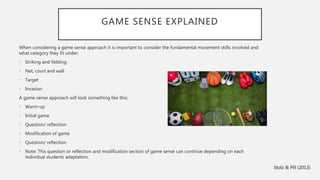
When considering a game sense approach it is important to consider the fundamental movement skills involved and
what category they fit under:
• Striking and fielding
• Net, court and wall
• Target
• Invasion
A game sense approach will look something like this:
• Warm-up
• Initial game
• Question/ reflection
• Modification of game
• Question/ reflection
• Note: This question or reflection and modification section of game sense can continue depending on each
individual students adaptation.
Stolz & Pill (2013)
WHY USE GAME SENSE?
• Game sense allows students to participate in a safe environment. This
builds confidence and deeper understanding in many aspects of PDHPE.
• By improving fundamental movement skills students gain more
confidence in their strengths which in turn creates more participation.
• When students are reflecting on what they have done and what they
could do to improve they are applying a strategy that is helpful for all
tasks in life. Along with this students are able to communicate ideas and
share knowledge amongst one another to create a meaningful learning
experience.
Griffin & Butler 2005
WHAT ARE THE BENEFITS OF GAME
SENSE?
• Game sense allows inclusion for all students, each game is adjusted for an
individual and is up to their own discretion. This cements the safe learning
environment that game sense creates.
• Students autonomy plays an important role in a game sense approach.
Students are faced with questions for reflection by the teacher rather than
the teacher giving direct feedback. This allows the student to consider their
own approach and modify the game to fit their own ability. By giving
students this autonomy they are more likely to participate.
• By using problem solving skills students can apply trial and error in each
game, along with this students will make decisions and communicate with
their peers in order to improve the overall game.
Light (2012)
HOW IS GAME SENSE IMPLEMENTED?
• The structure of a game sense approach is used by choosing a simple game to begin with and over time increasing the
complexity.
• After each activity the teacher will pause the game to use reflection. As the teacher is no longer the coach and has
moved on to the ideology of a guide the teacher will pose questions to the students
• These questions will be focused on individual skills, rules of the game or strategies each student is using.
• A teacher can use a range of questions for students to consider the aspects of rules, skills and strategies to improve
the game, some questions could be:
• What did you do to hit the ball?
• Is there a better way to hit the ball?
• What will you do next time to try and hit the ball more often?
• As a fielder what were you doing to catch the ball?
• What would make it easier to catch the ball?
• What can you do differently as a fielder?
REFERENCES
• Georgakis, S., & Light, R. (2007). ACHPER Australia Healthy Lifestyles Journal. The
Effect of Game Sense Pedagogy on Primary School Pre-Service Teachers'
Attitudes to Teaching Physical Education, 54(1).
• Griffin, L. L., & Butler, J. (2005). Teaching games for understanding: theory,
research, and practice. Champaign, IL: Human Kinetics.
• Light, R. (2012). Game Sense. Pedagogy for Performance, Participation and
Enjoyment. doi: 10.4324/9780203114643
• Stolz, S., & Pill, S. (2013). Teaching games and sport for understanding. European
Physical Education Review, 20(1), 36–71. doi: 10.1177/1356336x13496001

Game sense

  • 1.
    GAME SENSE During PDHPElessons this year I will be using a game sense approach. A game sense approach can best be described as modifying a game to suit a range of abilities by highlighting the main objectives and increasing participation. Although it is not necessarily looking at individual skill development it is breaking down the game for understanding and creating an inclusive environment. Game sense links to the following outcomes in the PDHPE NSW syllabus (2018) • PD3-2 – demonstrating resilience • PD3-3- inclusion of themselves and others • PD3-9- self management skills • PD3-10- interpersonal skills • PD3-4, PD3-11and PD3-5 adapting, manipulating and modifying skills and assessing skills
  • 2.
    GAME SENSE EXPLAINED •The aim of implementing game sense in to the classroom is to allow students to use their basic skills for achievement, following into a more complex version. • The teacher will move from the ideology of a coach in to a guide by questioning students and allowing them to reflect. • From this students will consider what works and what does not work and how they can change it to suit their own individual needs. By using trial and error students can connect to their learning and create meaningful understandings. • When considering what aspect they may change of the game, this could be a skill, rule or strategy. Students are encouraged to adapt the game to suit themselves or their team. • When students are questioned they move away from the ideology that PDHPE is not important as they are questioning and discovering in their learning. Georgakis & light 2007 Griffin & Butler 2005
  • 3.
    GAME SENSE EXPLAINED Whenconsidering a game sense approach it is important to consider the fundamental movement skills involved and what category they fit under: • Striking and fielding • Net, court and wall • Target • Invasion A game sense approach will look something like this: • Warm-up • Initial game • Question/ reflection • Modification of game • Question/ reflection • Note: This question or reflection and modification section of game sense can continue depending on each individual students adaptation. Stolz & Pill (2013)
  • 4.
    WHY USE GAMESENSE? • Game sense allows students to participate in a safe environment. This builds confidence and deeper understanding in many aspects of PDHPE. • By improving fundamental movement skills students gain more confidence in their strengths which in turn creates more participation. • When students are reflecting on what they have done and what they could do to improve they are applying a strategy that is helpful for all tasks in life. Along with this students are able to communicate ideas and share knowledge amongst one another to create a meaningful learning experience. Griffin & Butler 2005
  • 5.
    WHAT ARE THEBENEFITS OF GAME SENSE? • Game sense allows inclusion for all students, each game is adjusted for an individual and is up to their own discretion. This cements the safe learning environment that game sense creates. • Students autonomy plays an important role in a game sense approach. Students are faced with questions for reflection by the teacher rather than the teacher giving direct feedback. This allows the student to consider their own approach and modify the game to fit their own ability. By giving students this autonomy they are more likely to participate. • By using problem solving skills students can apply trial and error in each game, along with this students will make decisions and communicate with their peers in order to improve the overall game. Light (2012)
  • 6.
    HOW IS GAMESENSE IMPLEMENTED? • The structure of a game sense approach is used by choosing a simple game to begin with and over time increasing the complexity. • After each activity the teacher will pause the game to use reflection. As the teacher is no longer the coach and has moved on to the ideology of a guide the teacher will pose questions to the students • These questions will be focused on individual skills, rules of the game or strategies each student is using. • A teacher can use a range of questions for students to consider the aspects of rules, skills and strategies to improve the game, some questions could be: • What did you do to hit the ball? • Is there a better way to hit the ball? • What will you do next time to try and hit the ball more often? • As a fielder what were you doing to catch the ball? • What would make it easier to catch the ball? • What can you do differently as a fielder?
  • 7.
    REFERENCES • Georgakis, S.,& Light, R. (2007). ACHPER Australia Healthy Lifestyles Journal. The Effect of Game Sense Pedagogy on Primary School Pre-Service Teachers' Attitudes to Teaching Physical Education, 54(1). • Griffin, L. L., & Butler, J. (2005). Teaching games for understanding: theory, research, and practice. Champaign, IL: Human Kinetics. • Light, R. (2012). Game Sense. Pedagogy for Performance, Participation and Enjoyment. doi: 10.4324/9780203114643 • Stolz, S., & Pill, S. (2013). Teaching games and sport for understanding. European Physical Education Review, 20(1), 36–71. doi: 10.1177/1356336x13496001