Sharing Experience
      Preparing for
      Confirmation
      Seminar
                                  By
                                  Yenny Tjoe
                                  PhD Candidate
                                  Griffith Business School
                                  International Business & Asian Studies
                                  Y.Tjoe@griffith.edu.au


27/03/2013           CEPH PhD Meeting                                      1
“I want to learn and
                make it better”


27/03/2013         Yenny Tjoe, CEPH PhD Meeting   2
What I needed to fix
Power Point Slides:
• From Introduction until Methodology
• No linkages between contextual fields
• No details about sampling and data collection
  methods
• Too many slides

Time management:
• Spent more than 30 minutes                      Image: www.collegeparent101.com


27/03/2013         Yenny Tjoe, CEPH PhD Meeting                                     3
fix the problems
             (5 days to confirmation seminar)

48 Slides reduced to 31 (plus 10 hidden slides)
Important improvement:
      1. Linkages between contextual fields:

      State one sentence to provide a good transition from
      one contextual field to the other

      2. Methodology part:
      Sampling method rationale
      Step-by-step data collection analysis method
27/03/2013               Yenny Tjoe, CEPH PhD Meeting        4
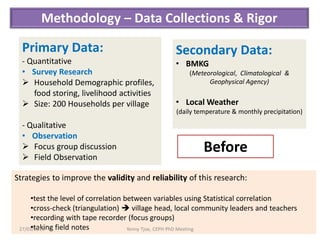
Methodology – Data Collections & Rigor

  Primary Data:                                  Secondary Data:
  - Quantitative                                 • BMKG
  • Survey Research                                  (Meteorological, Climatological &
   Household Demographic profiles,                        Geophysical Agency)
     food storing, livelihood activities
   Size: 200 Households per village             • Local Weather
                                                 (daily temperature & monthly precipitation)
  - Qualitative
  • Observation
   Focus group discussion                                Before
   Field Observation

Strategies to improve the validity and reliability of this research:

     •test the level of correlation between variables using Statistical correlation
     •cross-check (triangulation)  village head, local community leaders and teachers
     •recording with tape recorder (focus groups)
     •taking field notes
 27/03/2013                          Yenny Tjoe, CEPH PhD Meeting                      5
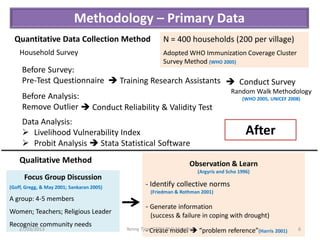
Methodology – Primary Data
  Quantitative Data Collection Method                   N = 400 households (200 per village)
    Household Survey                                    Adopted WHO Immunization Coverage Cluster
                                                        Survey Method (WHO 2005)
     Before Survey:
     Pre-Test Questionnaire  Training Research Assistants  Conduct Survey
                                                                                    Random Walk Methodology
     Before Analysis:                                                                   (WHO 2005, UNICEF 2008)
     Remove Outlier  Conduct Reliability & Validity Test
     Data Analysis:
      Livelihood Vulnerability Index                                                     After
      Probit Analysis  Stata Statistical Software
    Qualitative Method                                            Observation & Learn
                                                                     (Argyris and Scho 1996)
      Focus Group Discussion
(Goff, Gregg, & May 2001; Sankaran 2005)          - Identify collective norms
                                                   (Friedman & Rothman 2001)
A group: 4-5 members
                                                  - Generate information
Women; Teachers; Religious Leader
                                                   (success & failure in coping with drought)
Recognize community needs
    27/03/2013                                     - Create model 
                                           Yenny Tjoe, CEPH PhD Meeting “problem   reference”(Harris 2001)    6
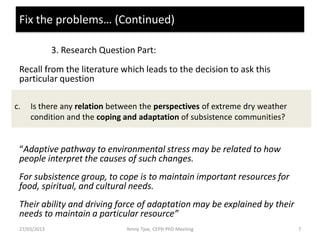
Fix the problems… (Continued)

              3. Research Question Part:
 Recall from the literature which leads to the decision to ask this
 particular question

c.   Is there any relation between the perspectives of extreme dry weather
     condition and the coping and adaptation of subsistence communities?


 “Adaptive pathway to environmental stress may be related to how
 people interpret the causes of such changes.
 For subsistence group, to cope is to maintain important resources for
 food, spiritual, and cultural needs.
 Their ability and driving force of adaptation may be explained by their
 needs to maintain a particular resource”
 27/03/2013                     Yenny Tjoe, CEPH PhD Meeting                 7
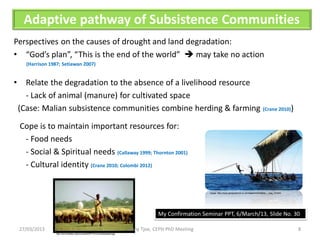
Adaptive pathway of Subsistence Communities
Perspectives on the causes of drought and land degradation:
• “God’s plan”, “This is the end of the world”  may take no action
      (Harrison 1987; Setiawan 2007)


•     Relate the degradation to the absence of a livelihood resource
      - Lack of animal (manure) for cultivated space
    (Case: Malian subsistence communities combine herding & farming (Crane 2010))

    Cope is to maintain important resources for:
     - Food needs
     - Social & Spiritual needs (Callaway 1999; Thornton 2001)
     - Cultural identity (Crane 2010; Colombi 2012)


                                                                                                               Image: http://www.geographical.co.uk/magazine/lembata_-_aug_10.html


                                                                                            My Confirmation Seminar PPT, 6/March/13, Slide No. 30

    27/03/2013                                                                 Yenny Tjoe, CEPH PhD Meeting                                                                          8
                  http://are.berkeley.edu/courses/EEP151/current/peasant.jpg
On the day of Confirmation Seminar


                                                                     Image: http://www.instant.ly/blog/2013/03/4-
                                                                     unexpected-strategies-for-understanding-your-
    Image: ethnicwords.blogspot.com


Know your audience


                                                                     customers/
Introduce yourself briefly and thank the people
for coming to the seminar

Have a small talk with them (Assessor, HDR
Convenor)
27/03/2013                            Yenny Tjoe, CEPH PhD Meeting                                                   9
Summary: Preparing for Confirmation Seminar

 • Show your PPT slides to others:
      - PhD meeting
      - Your colleagues, partner, friends
        (who support you all the way)

 • Be flexible  fix it (change it when necessary)

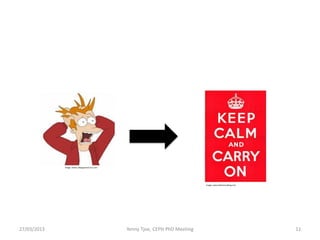
 • Change your mindset
        “This is a learning process” instead of
        “This is an examination”

 27/03/2013                Yenny Tjoe, CEPH PhD Meeting   10
Image: www.collegeparent101.com


                                                                              Image: www.thehistoryblog.com


27/03/2013                                     Yenny Tjoe, CEPH PhD Meeting                                   11

Sharing my experience: preparing for confirmation seminar

  • 1.
    Sharing Experience Preparing for Confirmation Seminar By Yenny Tjoe PhD Candidate Griffith Business School International Business & Asian Studies Y.Tjoe@griffith.edu.au 27/03/2013 CEPH PhD Meeting 1
  • 2.
    “I want tolearn and make it better” 27/03/2013 Yenny Tjoe, CEPH PhD Meeting 2
  • 3.
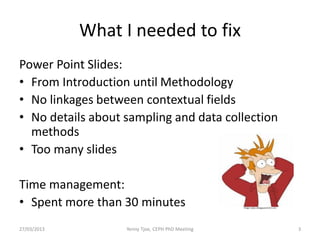
    What I neededto fix Power Point Slides: • From Introduction until Methodology • No linkages between contextual fields • No details about sampling and data collection methods • Too many slides Time management: • Spent more than 30 minutes Image: www.collegeparent101.com 27/03/2013 Yenny Tjoe, CEPH PhD Meeting 3
  • 4.
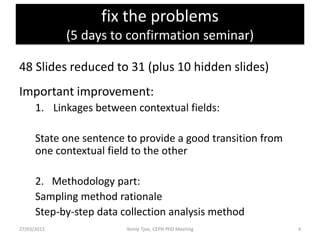
    fix the problems (5 days to confirmation seminar) 48 Slides reduced to 31 (plus 10 hidden slides) Important improvement: 1. Linkages between contextual fields: State one sentence to provide a good transition from one contextual field to the other 2. Methodology part: Sampling method rationale Step-by-step data collection analysis method 27/03/2013 Yenny Tjoe, CEPH PhD Meeting 4
  • 5.
    Methodology – DataCollections & Rigor Primary Data: Secondary Data: - Quantitative • BMKG • Survey Research (Meteorological, Climatological &  Household Demographic profiles, Geophysical Agency) food storing, livelihood activities  Size: 200 Households per village • Local Weather (daily temperature & monthly precipitation) - Qualitative • Observation  Focus group discussion Before  Field Observation Strategies to improve the validity and reliability of this research: •test the level of correlation between variables using Statistical correlation •cross-check (triangulation)  village head, local community leaders and teachers •recording with tape recorder (focus groups) •taking field notes 27/03/2013 Yenny Tjoe, CEPH PhD Meeting 5
  • 6.
    Methodology – PrimaryData Quantitative Data Collection Method N = 400 households (200 per village) Household Survey Adopted WHO Immunization Coverage Cluster Survey Method (WHO 2005) Before Survey: Pre-Test Questionnaire  Training Research Assistants  Conduct Survey Random Walk Methodology Before Analysis: (WHO 2005, UNICEF 2008) Remove Outlier  Conduct Reliability & Validity Test Data Analysis:  Livelihood Vulnerability Index After  Probit Analysis  Stata Statistical Software Qualitative Method Observation & Learn (Argyris and Scho 1996) Focus Group Discussion (Goff, Gregg, & May 2001; Sankaran 2005) - Identify collective norms (Friedman & Rothman 2001) A group: 4-5 members - Generate information Women; Teachers; Religious Leader (success & failure in coping with drought) Recognize community needs 27/03/2013 - Create model  Yenny Tjoe, CEPH PhD Meeting “problem reference”(Harris 2001) 6
  • 7.
    Fix the problems…(Continued) 3. Research Question Part: Recall from the literature which leads to the decision to ask this particular question c. Is there any relation between the perspectives of extreme dry weather condition and the coping and adaptation of subsistence communities? “Adaptive pathway to environmental stress may be related to how people interpret the causes of such changes. For subsistence group, to cope is to maintain important resources for food, spiritual, and cultural needs. Their ability and driving force of adaptation may be explained by their needs to maintain a particular resource” 27/03/2013 Yenny Tjoe, CEPH PhD Meeting 7
  • 8.
    Adaptive pathway ofSubsistence Communities Perspectives on the causes of drought and land degradation: • “God’s plan”, “This is the end of the world”  may take no action (Harrison 1987; Setiawan 2007) • Relate the degradation to the absence of a livelihood resource - Lack of animal (manure) for cultivated space (Case: Malian subsistence communities combine herding & farming (Crane 2010)) Cope is to maintain important resources for: - Food needs - Social & Spiritual needs (Callaway 1999; Thornton 2001) - Cultural identity (Crane 2010; Colombi 2012) Image: http://www.geographical.co.uk/magazine/lembata_-_aug_10.html My Confirmation Seminar PPT, 6/March/13, Slide No. 30 27/03/2013 Yenny Tjoe, CEPH PhD Meeting 8 http://are.berkeley.edu/courses/EEP151/current/peasant.jpg
  • 9.
    On the dayof Confirmation Seminar Image: http://www.instant.ly/blog/2013/03/4- unexpected-strategies-for-understanding-your- Image: ethnicwords.blogspot.com Know your audience customers/ Introduce yourself briefly and thank the people for coming to the seminar Have a small talk with them (Assessor, HDR Convenor) 27/03/2013 Yenny Tjoe, CEPH PhD Meeting 9
  • 10.
    Summary: Preparing forConfirmation Seminar • Show your PPT slides to others: - PhD meeting - Your colleagues, partner, friends (who support you all the way) • Be flexible  fix it (change it when necessary) • Change your mindset “This is a learning process” instead of “This is an examination” 27/03/2013 Yenny Tjoe, CEPH PhD Meeting 10
  • 11.
    Image: www.collegeparent101.com Image: www.thehistoryblog.com 27/03/2013 Yenny Tjoe, CEPH PhD Meeting 11