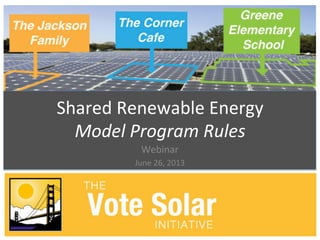
Shared	
  Renewable	
  Energy	
  
Model	
  Program	
  Rules	
  
Webinar	
  
June	
  26,	
  2013	
  
Photo	
  credit:	
  Clean	
  Energy	
  Collec@ve	
  
Why	
  do	
  we	
  need	
  shared	
  renewables?	
  
•  People	
  really	
  want	
  to	
  green	
  their	
  energy	
  supply	
  
•  But,	
  only	
  about	
  25%	
  of	
  residents	
  and	
  businesses	
  
are	
  able	
  to	
  install	
  solar	
  or	
  other	
  renewables	
  on	
  
their	
  own	
  property	


How	
  does	
  Shared	
  Renewables	
  work?	
  
The ‘No Roof’ Solution = Everyone Can Participate
We can stop leaving customers out of the renewable energy market
How	
  shared	
  renewables	
  can	
  help	
  
•  Shared	
  renewables	
  works	
  for	
  the	
  other	
  75%	
  
•  Gives	
  renters,	
  many	
  schools	
  and	
  public	
  buildings,	
  
millions	
  of	
  home	
  and	
  business	
  owners	
  affordable	
  
access	
  to	
  clean	
  energy	
  for	
  the	
  first	
  @me	
  
•  Simple	
  for	
  customers	
  to	
  par@cipate	
  
•  Crowdfunding	
  can	
  help	
  solve	
  financing	
  challenges	
  for	
  
developers	
  
•  Systems	
  can	
  be	
  installed	
  in	
  op@mal	
  loca@ons	
  and	
  
achieve	
  lower	
  cost/WaP	
  through	
  economies	
  of	
  scale	
  
•  5%	
  of	
  U.S.	
  households	
  subscribing	
  to	
  5kW	
  of	
  shared	
  
solar	
  =	
  28GW	
  of	
  new	
  clean	
  energy	
  capacity	
  
4	
  
Shared	
  Renewables:	
  An	
  Idea	
  Whose	
  Time	
  Has	
  Come	
  
“The	
  Power	
  of	
  Sharing	
  in	
  the	
  Internet	
  Economy”	
  -­‐	
  Forbes	
  
	
  “The	
  Sky’s	
  the	
  Limit	
  for	
  the	
  Sharing	
  Economy”	
  -­‐	
  Fast	
  Company	
  
	
  “The	
  New	
  Sharing	
  Economy	
  Values	
  Access	
  Over	
  Ownership”	
  
	
  -­‐	
  CS	
  Monitor	


U0lity	
  associa0ons	
  are	
  telling	
  their	
  members…	
  
Model Rules for Shared
Renewable Energy Programs
Laurel Passera
IREC Webinar
June 26, 2013
About IREC
•  Participated in
regulatory
proceedings in over
35 states
•  Works to expand
consumer access to
clean energy
20132010
Why an Update Now?
Guiding Principles for Shared Renewables
1
2
3
4
Shared Renewables– Shares
Aspects with other Programs
Net Metering
Donation-based models
Group Purchasing
Crowd funding
Critical Elements of the Model
• Program Administration
• Allocating the benefits of participation
• Valuation of the energy produced
• Facility and Program Size
• Facility ownership
• Additional Considerations (# of
participants, portability/transferability, low
income, restructured states)
Program Administration
Who can administer a program?
– Utility—most existing shared renewables
programs are administered by utilities
– Third party—for example, Clean Energy
Collective
– Participants—for example, Vermont’s group
billing
IREC does not specify a program administration
recommendation
Allocating the Benefits of
Participation
By check
–  Simplicity is initially appealing
–  However, raises security and tax considerations
that can complicate things
By bill credit mechanism
–  kWh credit vs. dollar credit
–  Relatively easy to administer
–  Avoids security and tax concerns
–  Familiar to participants and utilities
IREC recommends a monetary bill credit
Valuation of the Generation
•  Embedded-cost approach—based on participants’
retail rate
–  Credit based on generation, transmission and/or
distribution rate components (similar to NEM)
–  Can get even more complicated with TOU rates and
non-kWh rate components, e.g., demand charges
•  Value-based approach—based on the value of the
generation to the utility
–  Costs = lost revenue, administrative costs, incentives
–  Benefits = avoided generation costs, avoided line
losses, capacity benefits avoided T&D costs, avoided
environmental compliance costs, others?
IREC provides language for both approaches
Ownership
Ownership directly affects financing. Typical
options being used:
•  Direct ownership (residential, commercial,
non-profit, and/or governmental)
•  Third-party ownership—for example,
Clean Energy Collective
•  Utility ownership—for example, Florida
Keyes Electric Cooperative (participants
lease panels from the utility)
IREC recommends allowing all forms of ownership
Facility and Program Size
Size and location depend on stakeholder
goals and priorities
– Smaller systems can usually take advantage
of faster interconnection (e.g., < 2 MW)
– Program could encourage locations that
maximize grid benefits and/or
environmental benefits
IREC recommends unlimited program size and does not
make a recommendation on facility size
Additional Recommendations
•  Minimum of 2 program participants
•  Allow both portability and transferability of
participation
•  Minimum subscription size – one panel
•  Maximum size - 120% of a participant’s
annual electrical consumption
•  Encourage low-income consumer
participation
Restructured States
Policy is not generally necessary to create programs in
these states, but could potentially facilitate programs
Some considerations include:
•  More complex billing arrangements
•  State requirements to offer RE programs do not
always transfer to retail suppliers
•  Contracts length and penalties for early termination
•  Customers served by different suppliers
Shared	
  Renewables	
  Policies	
  and	
  Campaigns	
  
www.sharedrenewables.org	
  
Shared	
  Renewables	
  Projects	
  
www.sharedrenewables.org	
  
Policy	
  &	
  Project	
  Highlights	
  
•  Colorado	
  Solar	
  Gardens	
  well	
  into	
  implementa@on,	
  with	
  
thousands	
  of	
  customers	
  par@cipa@ng.	
  
•  CA	
  SB	
  43	
  poised	
  to	
  create	
  600MW	
  pilot	
  program	
  
•  MN	
  passed	
  bill	
  crea@ng	
  Solar	
  Gardens	
  program	
  
•  NY	
  likely	
  to	
  consider	
  shared	
  renewables	
  legisla@on	
  in	
  2014	
  
•  U@li@es	
  proac@vely	
  launching	
  shared	
  renewables	
  programs	
  
to	
  meet	
  customer	
  preferences.	


For	
  more	
  informa4on:	


Laurel	
  Passera	
  
IREC	
  
lpassera@kfwlaw.com	
  
510-­‐314-­‐8384	


Erica	
  Schroeder	
  
IREC	
  
eschroeder@kfwlaw.com	
  
510-­‐314-­‐8206	


Hannah	
  Masterjohn	
  
Vote	
  Solar	
  
hannah@votesolar.org	
  
607-­‐431-­‐8811	
  
23	
  
Resources	


•  IREC’s	
  Model	
  Program	
  Rules	
  serve	
  as	
  a	
  star@ng	
  point	
  for	
  
stakeholders	
  looking	
  to	
  launch	
  programs	
  in	
  their	
  state/community	
  
•  SharedRenewables.org	
  is	
  a	
  central	
  info	
  source	
  on	
  shared	
  
renewables	
  policies	
  and	
  projects	
  
•  IREC	
  is	
  available	
  for	
  technical	
  assistance	
  on	
  program	
  design	
  and	
  implementa@on	
  
•  Contact	
  Vote	
  Solar	
  regarding	
  legisla@ve	
  campaigns	
  
APPENDIX	
  
SHARED	
  RENEWABLES	
  
Mul4ple	
  customers/accounts	
  sharing	
  the	
  power	
  and	
  
economic	
  benefits	
  from	
  one	
  solar	
  project,	
  via	
  their	
  
individual	
  u4lity	
  bills	


Broadening	
  Access	
  to	
  Renewable	
  Energy	
  
How	
  do	
  we	
  bring	
  clean	
  energy	
  to	
  ALL	
  customers?	
  
Note:	
  Each	
  of	
  these	
  structures	
  represents	
  a	
  complex	
  set	
  of	
  rapidly	
  evolving	
  business	
  models	
  –	
  this	
  
summary	
  is	
  designed	
  to	
  provide	
  a	
  basic	
  understanding	
  of	
  the	
  “typical”	
  structures	
  in	
  use	
  today	
  
Company	
  (e.g.	
  Mosaic)	
  
manages	
  individuals’	
  
investments	
  in	
  renewable	
  
energy	
  projects,	
  offers	
  
aPrac@ve	
  returns	


While	
  this	
  business	
  model	
  does	
  not	
  
involve	
  customers’	
  energy	
  bills,	
  it	
  does	
  
enable	
  individuals	
  to	
  directly	
  support	
  
solar	
  projects	


RENEWABLE	
  ENERGY	
  
PROJECT	
  INVESTMENTS	
  

Shared re modelruleswebinar

  • 1.
    Shared  Renewable  Energy   Model  Program  Rules   Webinar   June  26,  2013   Photo  credit:  Clean  Energy  Collec@ve  
  • 2.
    Why  do  we  need  shared  renewables?   •  People  really  want  to  green  their  energy  supply   •  But,  only  about  25%  of  residents  and  businesses   are  able  to  install  solar  or  other  renewables  on   their  own  property    
  • 3.
    How  does  Shared  Renewables  work?   The ‘No Roof’ Solution = Everyone Can Participate We can stop leaving customers out of the renewable energy market
  • 4.
    How  shared  renewables  can  help   •  Shared  renewables  works  for  the  other  75%   •  Gives  renters,  many  schools  and  public  buildings,   millions  of  home  and  business  owners  affordable   access  to  clean  energy  for  the  first  @me   •  Simple  for  customers  to  par@cipate   •  Crowdfunding  can  help  solve  financing  challenges  for   developers   •  Systems  can  be  installed  in  op@mal  loca@ons  and   achieve  lower  cost/WaP  through  economies  of  scale   •  5%  of  U.S.  households  subscribing  to  5kW  of  shared   solar  =  28GW  of  new  clean  energy  capacity   4  
  • 5.
    Shared  Renewables:  An  Idea  Whose  Time  Has  Come   “The  Power  of  Sharing  in  the  Internet  Economy”  -­‐  Forbes    “The  Sky’s  the  Limit  for  the  Sharing  Economy”  -­‐  Fast  Company    “The  New  Sharing  Economy  Values  Access  Over  Ownership”    -­‐  CS  Monitor     U0lity  associa0ons  are  telling  their  members…  
  • 6.
    Model Rules forShared Renewable Energy Programs Laurel Passera IREC Webinar June 26, 2013
  • 7.
    About IREC •  Participatedin regulatory proceedings in over 35 states •  Works to expand consumer access to clean energy
  • 8.
  • 9.
  • 10.
    Guiding Principles forShared Renewables 1 2 3 4
  • 11.
    Shared Renewables– Shares Aspectswith other Programs Net Metering Donation-based models Group Purchasing Crowd funding
  • 12.
    Critical Elements ofthe Model • Program Administration • Allocating the benefits of participation • Valuation of the energy produced • Facility and Program Size • Facility ownership • Additional Considerations (# of participants, portability/transferability, low income, restructured states)
  • 13.
    Program Administration Who canadminister a program? – Utility—most existing shared renewables programs are administered by utilities – Third party—for example, Clean Energy Collective – Participants—for example, Vermont’s group billing IREC does not specify a program administration recommendation
  • 14.
    Allocating the Benefitsof Participation By check –  Simplicity is initially appealing –  However, raises security and tax considerations that can complicate things By bill credit mechanism –  kWh credit vs. dollar credit –  Relatively easy to administer –  Avoids security and tax concerns –  Familiar to participants and utilities IREC recommends a monetary bill credit
  • 15.
    Valuation of theGeneration •  Embedded-cost approach—based on participants’ retail rate –  Credit based on generation, transmission and/or distribution rate components (similar to NEM) –  Can get even more complicated with TOU rates and non-kWh rate components, e.g., demand charges •  Value-based approach—based on the value of the generation to the utility –  Costs = lost revenue, administrative costs, incentives –  Benefits = avoided generation costs, avoided line losses, capacity benefits avoided T&D costs, avoided environmental compliance costs, others? IREC provides language for both approaches
  • 16.
    Ownership Ownership directly affectsfinancing. Typical options being used: •  Direct ownership (residential, commercial, non-profit, and/or governmental) •  Third-party ownership—for example, Clean Energy Collective •  Utility ownership—for example, Florida Keyes Electric Cooperative (participants lease panels from the utility) IREC recommends allowing all forms of ownership
  • 17.
    Facility and ProgramSize Size and location depend on stakeholder goals and priorities – Smaller systems can usually take advantage of faster interconnection (e.g., < 2 MW) – Program could encourage locations that maximize grid benefits and/or environmental benefits IREC recommends unlimited program size and does not make a recommendation on facility size
  • 18.
    Additional Recommendations •  Minimumof 2 program participants •  Allow both portability and transferability of participation •  Minimum subscription size – one panel •  Maximum size - 120% of a participant’s annual electrical consumption •  Encourage low-income consumer participation
  • 19.
    Restructured States Policy isnot generally necessary to create programs in these states, but could potentially facilitate programs Some considerations include: •  More complex billing arrangements •  State requirements to offer RE programs do not always transfer to retail suppliers •  Contracts length and penalties for early termination •  Customers served by different suppliers
  • 20.
    Shared  Renewables  Policies  and  Campaigns   www.sharedrenewables.org  
  • 21.
    Shared  Renewables  Projects   www.sharedrenewables.org  
  • 22.
    Policy  &  Project  Highlights   •  Colorado  Solar  Gardens  well  into  implementa@on,  with   thousands  of  customers  par@cipa@ng.   •  CA  SB  43  poised  to  create  600MW  pilot  program   •  MN  passed  bill  crea@ng  Solar  Gardens  program   •  NY  likely  to  consider  shared  renewables  legisla@on  in  2014   •  U@li@es  proac@vely  launching  shared  renewables  programs   to  meet  customer  preferences.      
  • 23.
    For  more  informa4on:     Laurel  Passera   IREC   lpassera@kfwlaw.com   510-­‐314-­‐8384         Erica  Schroeder   IREC   eschroeder@kfwlaw.com   510-­‐314-­‐8206         Hannah  Masterjohn   Vote  Solar   hannah@votesolar.org   607-­‐431-­‐8811   23   Resources     •  IREC’s  Model  Program  Rules  serve  as  a  star@ng  point  for   stakeholders  looking  to  launch  programs  in  their  state/community   •  SharedRenewables.org  is  a  central  info  source  on  shared   renewables  policies  and  projects   •  IREC  is  available  for  technical  assistance  on  program  design  and  implementa@on   •  Contact  Vote  Solar  regarding  legisla@ve  campaigns  
  • 24.
  • 25.
    SHARED  RENEWABLES   Mul4ple  customers/accounts  sharing  the  power  and   economic  benefits  from  one  solar  project,  via  their   individual  u4lity  bills       Broadening  Access  to  Renewable  Energy   How  do  we  bring  clean  energy  to  ALL  customers?   Note:  Each  of  these  structures  represents  a  complex  set  of  rapidly  evolving  business  models  –  this   summary  is  designed  to  provide  a  basic  understanding  of  the  “typical”  structures  in  use  today   Company  (e.g.  Mosaic)   manages  individuals’   investments  in  renewable   energy  projects,  offers   aPrac@ve  returns                     While  this  business  model  does  not   involve  customers’  energy  bills,  it  does   enable  individuals  to  directly  support   solar  projects     RENEWABLE  ENERGY   PROJECT  INVESTMENTS