Introduction
• Streptokinase isa bacterial protein used to
dissolve blood clots that have formed in the blood
vessels. It is used immediately after symptoms of a
heart attack(Myocardial infarction)occur to
improve patient survival. This medicine may also
be used to treat blood clots in the lungs
(pulmonary embolism) and in the legs (deep
venous thrombosis) .It is produced by beta
haemolytic Streptococci.
3.
• Streptokinase hasa molecular weight of 47 kDa
and is made up of single-chain polypeptide of 414
amino acid residues. It is composed of three
distinct domains, denoted as α (residues 1–150), β
(residues 151–287) and γ (residues 288–414).
4.
Mode of action
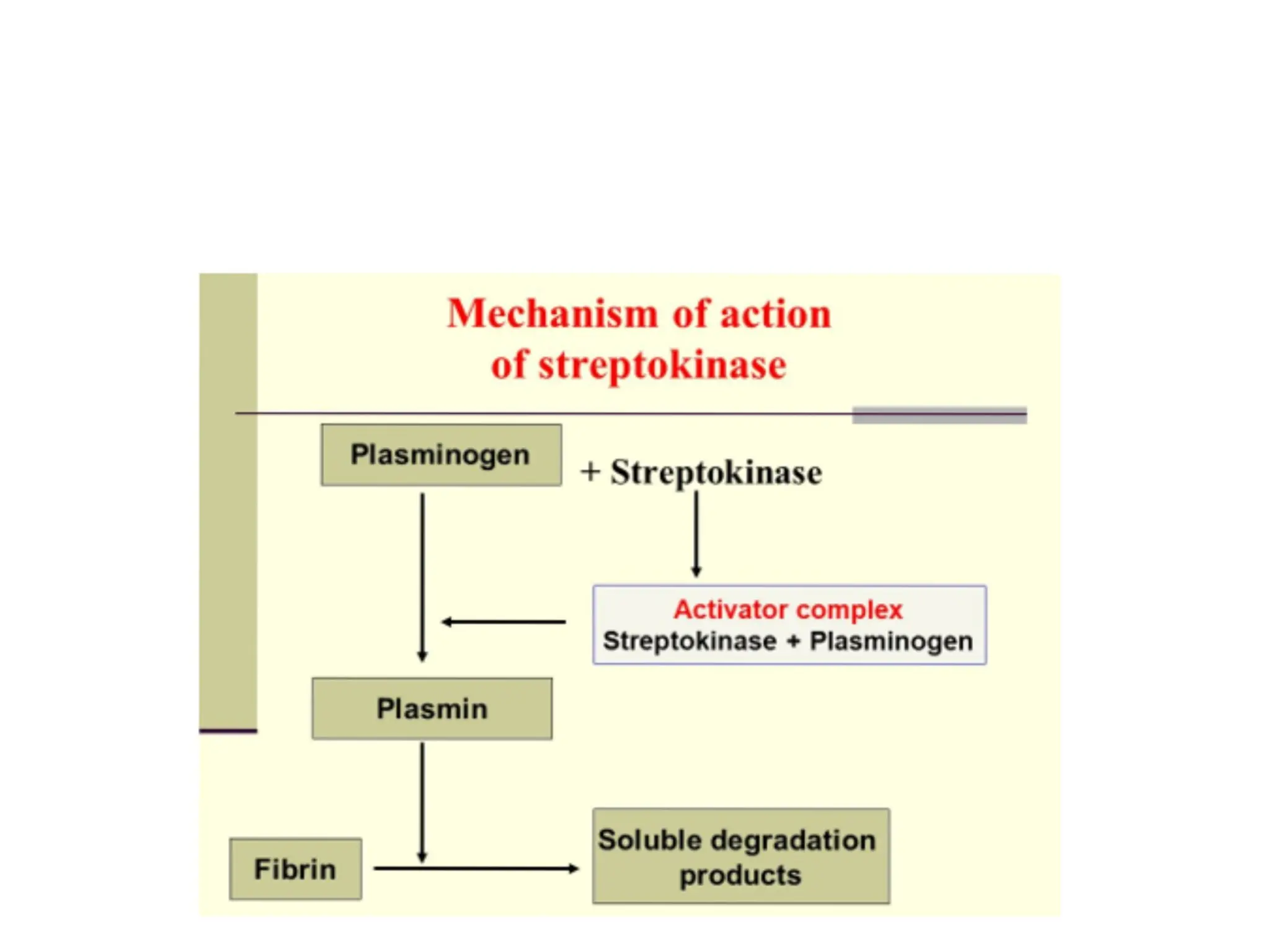
•it acts as plasminogen activator. Plasminogen is
inactive proteolytic enzyme present in plasma
which is converted to plasmin by plasminogen
activator. The plasmin formed is needed to
breakdown fibrin which is major component of
blood thrombus. This results in dissolution of
blood clot.
6.
Microbial production
• Itis produced by fermentation process
• ‘ which involves the following steps:-
• 1. Preparation of medium
• 2. Fermentation
• 3. Purification of the product.
7.
Production by rDNAtechnology
• This involved the following steps: 1) Isolation of
Streptococcus pyogenes from throat swabs
collected from pharyngitis patients. 2)
Amplification of the SK gene using bacterial DNA.
3) Cloning of the SK gene and its in vitro
transcription in eukaryotic expression vector that
was transformed into yeast. 4) Purification and
characterization of the produced rSK protein. 5)
Testing of the purified rSK protein for its
thrombolytic activity in vitro compared with a
standard commercial SK.
9.
Administration
• Thrombolytic therapyshould be initiated as soon as the
symptoms are present and no later than 6 hours. Clinicians ought
to pay special attention to the dosing of streptokinase. Dosing
varies based on each specific pathological setting.
• Myocardial infarction: The recommended dose for streptokinase
in the setting of acute ST-segment elevation myocardial infarction
is 1.5 million units intravenously over 30 to 60 minutes.
• Pulmonary embolism: The recommended dose in the setting of
pulmonary embolism is a loading dose of 250000 units
intravenously over 30 minutes. This is followed by 100000 units
per hour for 24 hours.
• Deep vein thrombosis: The recommended dose in the setting of
deep vein thrombosis is a loading dose of 250000 units
intravenously over 30 minutes