
Shakespeare’s
Sonnets


English I Honors
Mrs. Pilgreen
Rhyme Scheme
Those hours, that with gentle work did frame A
The lovely gaze where every eye doth dwell, B
Will play the tyrants to the very same A
And that unfair which fairly doth excel; B
For never-resting time leads summer on C
To hideous winter, and confounds him there; D
Sap checked with frost, and lusty leaves quite gone, C
Beauty o'er-snowed and bareness every where: D
Then were not summer's distillation left, E
A liquid prisoner pent in walls of glass,F
Beauty's effect with beauty were bereft, E
Nor it, nor no remembrance what it was: F
  But flowers distilled, though they with winter meet, G
  Leese but their show; their substance still lives sweet. G
Line Structure
• 14 total lines
• 3 quatrains: group of 4 lines
• Followed by a couplet: group of 2 lines
• Lyric poetry: expresses the thoughts &
  emotions of a single speaker, usually love
• Contains a volta at the 3rd stanza: change in
  tone or attitude
Metrical Patterns
• unstressed syllable: u   •   1 foot: monometer
• Stressed syllable: /     •   2 feet: dimeter
                           •   3 feet: trimeter
•   Iamb: u /              •   4 feet: tetrameter
•   Trochee: / u           •   5 feet: pentameter
•   Anapest: u u /         •   6 feet: hexameter
•   Dactyl: / u u          •   7 feet: heptameter
•   Spondee: / /           •   8 feet: octameter
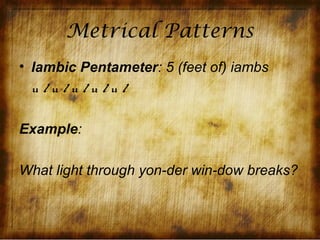
Metrical Patterns
• Iambic Pentameter: 5 (feet of) iambs
  u /u /u /u /u /

Example:

What light through yon-der win-dow breaks?
The Sonnets
• Sonnets 1-126 addressed to a “fair youth”
  – urging him to marry and have children so that
    he can leave behind a duplicate of his beauty
  – love & admiration
• Sonnet 127-152 addressed to a “dark
  lady,” the speaker’s mistress
  – The fair youth has stolen the dark lady from
    the speaker
  – Object of infatuation & lust
The Sonnets
• Sonnets 1-126 addressed to a “fair youth”
  – urging him to marry and have children so that
    he can leave behind a duplicate of his beauty
  – love & admiration
• Sonnet 127-152 addressed to a “dark
  lady,” the speaker’s mistress
  – The fair youth has stolen the dark lady from
    the speaker
  – Object of infatuation & lust

Shakespeare’s Sonnets

  • 1.
  • 2.
    Rhyme Scheme Those hours,that with gentle work did frame A The lovely gaze where every eye doth dwell, B Will play the tyrants to the very same A And that unfair which fairly doth excel; B For never-resting time leads summer on C To hideous winter, and confounds him there; D Sap checked with frost, and lusty leaves quite gone, C Beauty o'er-snowed and bareness every where: D Then were not summer's distillation left, E A liquid prisoner pent in walls of glass,F Beauty's effect with beauty were bereft, E Nor it, nor no remembrance what it was: F But flowers distilled, though they with winter meet, G Leese but their show; their substance still lives sweet. G
  • 3.
    Line Structure • 14total lines • 3 quatrains: group of 4 lines • Followed by a couplet: group of 2 lines • Lyric poetry: expresses the thoughts & emotions of a single speaker, usually love • Contains a volta at the 3rd stanza: change in tone or attitude
  • 4.
    Metrical Patterns • unstressedsyllable: u • 1 foot: monometer • Stressed syllable: / • 2 feet: dimeter • 3 feet: trimeter • Iamb: u / • 4 feet: tetrameter • Trochee: / u • 5 feet: pentameter • Anapest: u u / • 6 feet: hexameter • Dactyl: / u u • 7 feet: heptameter • Spondee: / / • 8 feet: octameter
  • 5.
    Metrical Patterns • IambicPentameter: 5 (feet of) iambs u /u /u /u /u / Example: What light through yon-der win-dow breaks?
  • 6.
    The Sonnets • Sonnets1-126 addressed to a “fair youth” – urging him to marry and have children so that he can leave behind a duplicate of his beauty – love & admiration • Sonnet 127-152 addressed to a “dark lady,” the speaker’s mistress – The fair youth has stolen the dark lady from the speaker – Object of infatuation & lust
  • 7.
    The Sonnets • Sonnets1-126 addressed to a “fair youth” – urging him to marry and have children so that he can leave behind a duplicate of his beauty – love & admiration • Sonnet 127-152 addressed to a “dark lady,” the speaker’s mistress – The fair youth has stolen the dark lady from the speaker – Object of infatuation & lust