MAL1303: STATISTICAL HYDROLOGY
Stochastic Methods in Hydrology
Dr. Shamsuddin Shahid
Department of Hydraulics and Hydrology
Faculty of Civil Engineering, Universiti Teknologi Malaysia
Room No.: M46-332; Phone: 07-5531624; Mobile: 0182051586
Email: sshahid@utm.my
11/23/2015 Shamsuddin Shahid, FKA, UTM
You created this PDF from an application that is not licensed to print to novaPDF printer (http://www.novapdf.com)
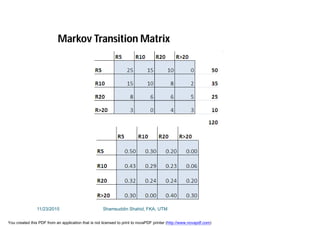
Markov Transition Matrix
11/23/2015 Shamsuddin Shahid, FKA, UTM
You created this PDF from an application that is not licensed to print to novaPDF printer (http://www.novapdf.com)
For four class, there will be four cumulative distribution functions.
Cumulative distribution functions for each class is calculated as,
Fj (x) = P [next day rainfall < x; when rainfall today belongs to class Cj].
For Example,
FR5(x) = P [next day rainfall < x; when rainfall today belongs to class R5].
Cumulative Distribution Functions
11/23/2015 Shamsuddin Shahid, FKA, UTM
You created this PDF from an application that is not licensed to print to novaPDF printer (http://www.novapdf.com)
Fj (x) = P [next day rainfall < x;
when rainfall today belongs to class Cj].
For Example:
FR5(x) = P [next day rainfall < x;
when rainfall today belongs to class R5].
P [next day rainfall < 5] = 2
P [next day rainfall < 4] = 2
P [next day rainfall < 3] = 2
P [next day rainfall < 2] = 1
P [next day rainfall < 1] = 1
Rainfall
10
5
1
6
23
4
3
2
0
20
5
2
3
0
4
3
1
0
Cumulative Distribution Functions
11/23/2015 Shamsuddin Shahid, FKA, UTM
You created this PDF from an application that is not licensed to print to novaPDF printer (http://www.novapdf.com)
FR5(x) = P [next day rainfall < x;
when rainfall today belongs to class R5].
P [next day rainfall < 5] = 2
P [next day rainfall < 4] = 2
P [next day rainfall < 3] = 2
P [next day rainfall < 2] = 1
P [next day rainfall < 1] = 1
Cumulative Distribution Functions
Find the distribution
and distribution
parameters.
Consider, we found
distribution is
exponential,
FR5(x) =  exp (-)
Where,
 = 0.105
11/23/2015 Shamsuddin Shahid, FKA, UTM
You created this PDF from an application that is not licensed to print to novaPDF printer (http://www.novapdf.com)
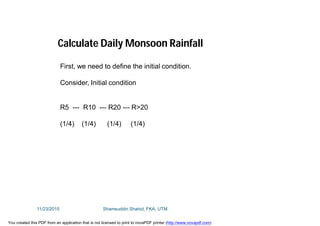
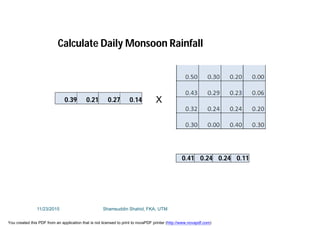
Calculate Daily Monsoon Rainfall
First, we need to define the initial condition.
Consider, Initial condition
R5 --- R10 --- R20 --- R>20
(1/4) (1/4) (1/4) (1/4)
11/23/2015 Shamsuddin Shahid, FKA, UTM
You created this PDF from an application that is not licensed to print to novaPDF printer (http://www.novapdf.com)
Calculate Daily Monsoon Rainfall
(1/4) (1/4) (1/4) (1/4)
[0.25 0.25 0.25 0.25] X
0.39 0.21 0.27 0.14
11/23/2015 Shamsuddin Shahid, FKA, UTM
You created this PDF from an application that is not licensed to print to novaPDF printer (http://www.novapdf.com)
R5 R10 R20 R>20
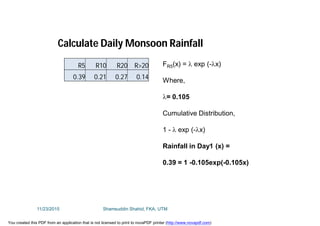
0.39 0.21 0.27 0.14
FR5(x) =  exp (-x)
Where,
= 0.105
Cumulative Distribution,
1 -  exp (-x)
Rainfall in Day1 (x) =
0.39 = 1 -0.105exp(-0.105x)
Calculate Daily Monsoon Rainfall
11/23/2015 Shamsuddin Shahid, FKA, UTM
You created this PDF from an application that is not licensed to print to novaPDF printer (http://www.novapdf.com)
Calculate Daily Monsoon Rainfall
0.39 0.21 0.27 0.14 X
0.41 0.24 0.24 0.11
11/23/2015 Shamsuddin Shahid, FKA, UTM
You created this PDF from an application that is not licensed to print to novaPDF printer (http://www.novapdf.com)
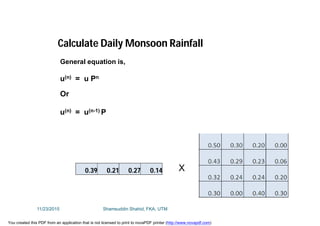
General equation is,
u(n) = u Pn
Or
u(n) = u(n-1) P
Calculate Daily Monsoon Rainfall
0.39 0.21 0.27 0.14 X
11/23/2015 Shamsuddin Shahid, FKA, UTM
You created this PDF from an application that is not licensed to print to novaPDF printer (http://www.novapdf.com)
Stochastic refers to systems whose behaviour is intrinsically non-
deterministic. A stochastic process is one whose behavior is non-
deterministic, in that a system's subsequent state is determined
both by the process's predictable actions and by a random element.
Stochastic hydrology is mainly concerned with the assessment of
uncertainty in model predictions
Stochastic Process
11/23/2015 Shamsuddin Shahid, FKA, UTM
You created this PDF from an application that is not licensed to print to novaPDF printer (http://www.novapdf.com)
Application of Stochastic Process in Hydrology
Stochastic hydrology is an essential base of water resources
systems analysis, due to the inherent randomness of the input,
and consequently of the results.
Stochastic process is applied for forecasting of hydrological
phenomena such as, flood, droughts, etc.
Stochastic process is applied for forecasting rainfall, river
discharge, etc.
Stochastic hydrology is very important in decision-making
process regarding the planning and management of water
systems.
11/23/2015 Shamsuddin Shahid, FKA, UTM
You created this PDF from an application that is not licensed to print to novaPDF printer (http://www.novapdf.com)
A stationary time series is one whose statistical properties such as
mean, variance, autocorrelation, etc. are all constant over time.
Most statistical forecasting methods are based on the assumption
that the time series can be rendered approximately stationary through
the use of mathematical transformations.
A stationarized series is relatively easy to predict: you simply predict
that its statistical properties will be the same in the future as they
have been in the past.
Stationary Time Series
11/23/2015 Shamsuddin Shahid, FKA, UTM
You created this PDF from an application that is not licensed to print to novaPDF printer (http://www.novapdf.com)
Linear Stochastic Models
1. Moving Average (MA)
2. Auto Regression (AR)
3. Auto Regressive Moving Average (ARMA)
4. Auto Regressive Integrated Moving Average (ARIMA)
Stochastic Models
11/23/2015 Shamsuddin Shahid, FKA, UTM
You created this PDF from an application that is not licensed to print to novaPDF printer (http://www.novapdf.com)
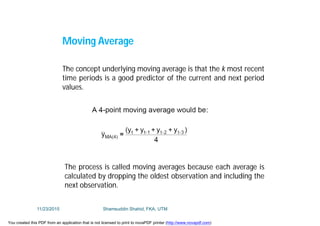
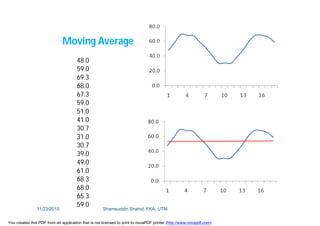
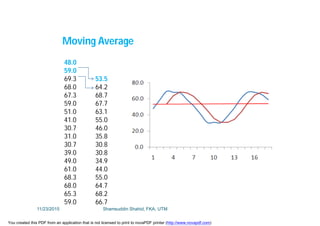
Moving Average
The concept underlying moving average is that the k most recent
time periods is a good predictor of the current and next period
values.
The process is called moving averages because each average is
calculated by dropping the oldest observation and including the
next observation.
11/23/2015 Shamsuddin Shahid, FKA, UTM
You created this PDF from an application that is not licensed to print to novaPDF printer (http://www.novapdf.com)
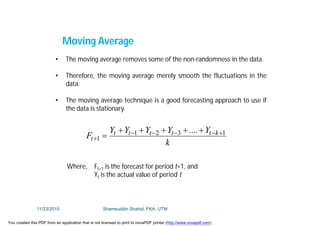
• The moving average removes some of the non-randomness in the data.
• Therefore, the moving average merely smooth the fluctuations in the
data.
• The moving average technique is a good forecasting approach to use if
the data is stationary.
k
Y....YYYY
F kttttt
t
1321
1




Where, Ft+1 is the forecast for period t+1, and
Yt is the actual value of period t
Moving Average
11/23/2015 Shamsuddin Shahid, FKA, UTM
You created this PDF from an application that is not licensed to print to novaPDF printer (http://www.novapdf.com)
Moving Average
48.0
59.0
69.3
68.0
67.3
59.0
51.0
41.0
30.7
31.0
30.7
39.0
49.0
61.0
68.3
68.0
65.3
59.0
11/23/2015 Shamsuddin Shahid, FKA, UTM
You created this PDF from an application that is not licensed to print to novaPDF printer (http://www.novapdf.com)
Moving Average
48.0
59.0
69.3 53.5
68.0 64.2
67.3 68.7
59.0 67.7
51.0 63.1
41.0 55.0
30.7 46.0
31.0 35.8
30.7 30.8
39.0 30.8
49.0 34.9
61.0 44.0
68.3 55.0
68.0 64.7
65.3 68.2
59.0 66.7
11/23/2015 Shamsuddin Shahid, FKA, UTM
You created this PDF from an application that is not licensed to print to novaPDF printer (http://www.novapdf.com)
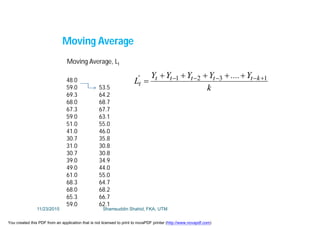
Moving Average
k
Y....YYYY
L kttttt'
t
1321  

Moving Average, Lt
48.0
59.0 53.5
69.3 64.2
68.0 68.7
67.3 67.7
59.0 63.1
51.0 55.0
41.0 46.0
30.7 35.8
31.0 30.8
30.7 30.8
39.0 34.9
49.0 44.0
61.0 55.0
68.3 64.7
68.0 68.2
65.3 66.7
59.0 62.1
11/23/2015 Shamsuddin Shahid, FKA, UTM
You created this PDF from an application that is not licensed to print to novaPDF printer (http://www.novapdf.com)
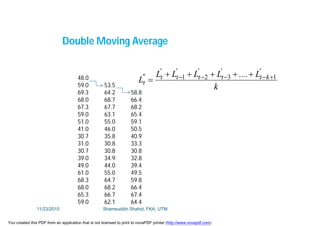
Double Moving Average
k
L....LLLL
L
'
kt
'
t
'
t
'
t
'
t"
t
1321  
48.0
59.0 53.5
69.3 64.2 58.8
68.0 68.7 66.4
67.3 67.7 68.2
59.0 63.1 65.4
51.0 55.0 59.1
41.0 46.0 50.5
30.7 35.8 40.9
31.0 30.8 33.3
30.7 30.8 30.8
39.0 34.9 32.8
49.0 44.0 39.4
61.0 55.0 49.5
68.3 64.7 59.8
68.0 68.2 66.4
65.3 66.7 67.4
59.0 62.1 64.4
11/23/2015 Shamsuddin Shahid, FKA, UTM
You created this PDF from an application that is not licensed to print to novaPDF printer (http://www.novapdf.com)
Double Moving Average
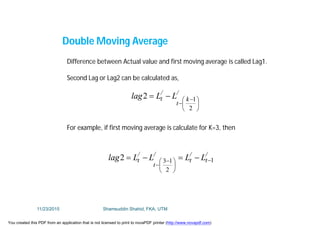
Difference between Actual value and first moving average is called Lag1.
Second Lag or Lag2 can be calculated as,
/
k
t
/
t LLlag





 


2
12
For example, if first moving average is calculate for K=3, then
/
t
/
t
/
t
/
t LLLLlag 1
2
132 





 


11/23/2015 Shamsuddin Shahid, FKA, UTM
You created this PDF from an application that is not licensed to print to novaPDF printer (http://www.novapdf.com)
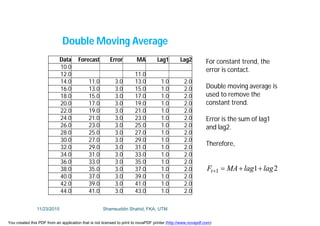
Data Forecast Error MA Lag1 Lag2
10.0
12.0 11.0
14.0 11.0 3.0 13.0 1.0 2.0
16.0 13.0 3.0 15.0 1.0 2.0
18.0 15.0 3.0 17.0 1.0 2.0
20.0 17.0 3.0 19.0 1.0 2.0
22.0 19.0 3.0 21.0 1.0 2.0
24.0 21.0 3.0 23.0 1.0 2.0
26.0 23.0 3.0 25.0 1.0 2.0
28.0 25.0 3.0 27.0 1.0 2.0
30.0 27.0 3.0 29.0 1.0 2.0
32.0 29.0 3.0 31.0 1.0 2.0
34.0 31.0 3.0 33.0 1.0 2.0
36.0 33.0 3.0 35.0 1.0 2.0
38.0 35.0 3.0 37.0 1.0 2.0
40.0 37.0 3.0 39.0 1.0 2.0
42.0 39.0 3.0 41.0 1.0 2.0
44.0 41.0 3.0 43.0 1.0 2.0
Double Moving Average
For constant trend, the
error is contact.
Double moving average is
used to remove the
constant trend.
Error is the sum of lag1
and lag2.
Therefore,
211 laglagMAFt 
11/23/2015 Shamsuddin Shahid, FKA, UTM
You created this PDF from an application that is not licensed to print to novaPDF printer (http://www.novapdf.com)
Double Moving Average: Forecasting
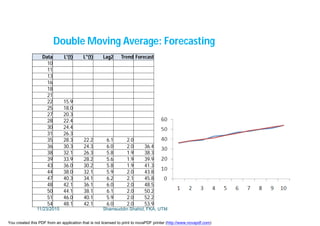
Double moving average can be used for forecasting using following
formulas:
mbaF ttt 1
Where,
 //
t
/
tt
//
t
/
t
/
tt
LL
k
b
and
]LL[La




1
2
11/23/2015 Shamsuddin Shahid, FKA, UTM
You created this PDF from an application that is not licensed to print to novaPDF printer (http://www.novapdf.com)
Data L'(t) L"(t) Lag2 Trend Forecast Error
10.0
12.0 11.0
14.0 13.0 12.0 1.0 2.0
16.0 15.0 14.0 1.0 2.0 16.0 0.0
18.0 17.0 16.0 1.0 2.0 18.0 0.0
20.0 19.0 18.0 1.0 2.0 20.0 0.0
22.0 21.0 20.0 1.0 2.0 22.0 0.0
24.0 23.0 22.0 1.0 2.0 24.0 0.0
26.0 25.0 24.0 1.0 2.0 26.0 0.0
28.0 27.0 26.0 1.0 2.0 28.0 0.0
30.0 29.0 28.0 1.0 2.0 30.0 0.0
32.0 31.0 30.0 1.0 2.0 32.0 0.0
34.0 33.0 32.0 1.0 2.0 34.0 0.0
36.0 35.0 34.0 1.0 2.0 36.0 0.0
38.0 37.0 36.0 1.0 2.0 38.0 0.0
40.0 39.0 38.0 1.0 2.0 40.0 0.0
42.0 41.0 40.0 1.0 2.0 42.0 0.0
44.0 43.0 42.0 1.0 2.0 44.0 0.0
Double Moving Average: Forecasting
 //
t
/
tt
//
t
/
t
/
tt
LL
k
b
and
]LL[La




1
2
ttt baF 1
11/23/2015 Shamsuddin Shahid, FKA, UTM
You created this PDF from an application that is not licensed to print to novaPDF printer (http://www.novapdf.com)
Data L'(t) L"(t) Lag2 Trend Forecast
10
11
13
16
18
21
22 15.9
25 18.0
27 20.3
28 22.4
30 24.4
31 26.3
35 28.3 22.2 6.1 2.0
36 30.3 24.3 6.0 2.0 36.4
38 32.1 26.3 5.8 1.9 38.3
39 33.9 28.2 5.6 1.9 39.9
43 36.0 30.2 5.8 1.9 41.3
44 38.0 32.1 5.9 2.0 43.8
47 40.3 34.1 6.2 2.1 45.8
48 42.1 36.1 6.0 2.0 48.5
50 44.1 38.1 6.1 2.0 50.2
51 46.0 40.1 5.9 2.0 52.2
54 48.1 42.1 6.0 2.0 53.9
Double Moving Average: Forecasting
11/23/2015 Shamsuddin Shahid, FKA, UTM
You created this PDF from an application that is not licensed to print to novaPDF printer (http://www.novapdf.com)
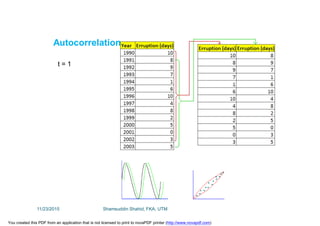
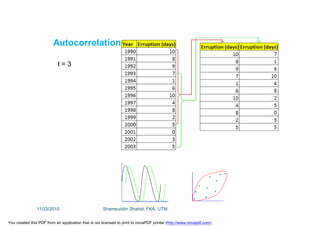
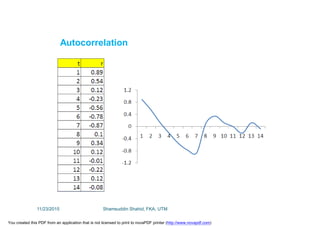
Autocorrelation
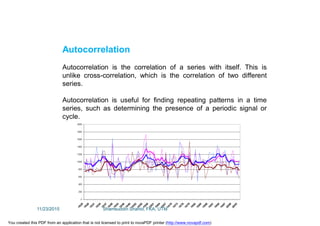
Autocorrelation is the correlation of a series with itself. This is
unlike cross-correlation, which is the correlation of two different
series.
Autocorrelation is useful for finding repeating patterns in a time
series, such as determining the presence of a periodic signal or
cycle.
11/23/2015 Shamsuddin Shahid, FKA, UTM
You created this PDF from an application that is not licensed to print to novaPDF printer (http://www.novapdf.com)
Autocorrelation
t = 1
11/23/2015 Shamsuddin Shahid, FKA, UTM
You created this PDF from an application that is not licensed to print to novaPDF printer (http://www.novapdf.com)
Autocorrelation
t = 3
11/23/2015 Shamsuddin Shahid, FKA, UTM
You created this PDF from an application that is not licensed to print to novaPDF printer (http://www.novapdf.com)
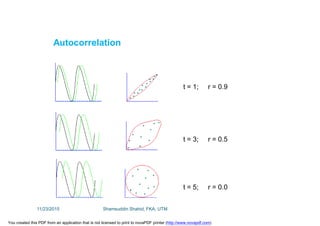
Autocorrelation
t = 1; r = 0.9
t = 3; r = 0.5
t = 5; r = 0.0
11/23/2015 Shamsuddin Shahid, FKA, UTM
You created this PDF from an application that is not licensed to print to novaPDF printer (http://www.novapdf.com)
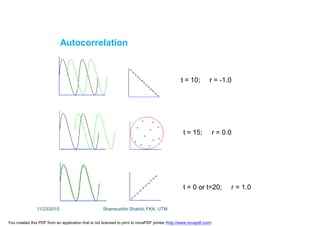
Autocorrelation
t = 0 or t=20; r = 1.0
t = 15; r = 0.0
t = 10; r = -1.0
11/23/2015 Shamsuddin Shahid, FKA, UTM
You created this PDF from an application that is not licensed to print to novaPDF printer (http://www.novapdf.com)
Autocorrelation
11/23/2015 Shamsuddin Shahid, FKA, UTM
You created this PDF from an application that is not licensed to print to novaPDF printer (http://www.novapdf.com)
Autocorrelation
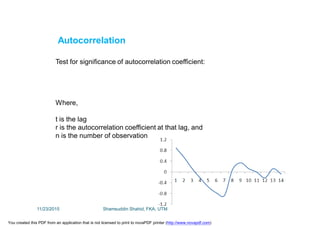
Test for significance of autocorrelation coefficient:
Where,
t is the lag
r is the autocorrelation coefficient at that lag, and
n is the number of observation
11/23/2015 Shamsuddin Shahid, FKA, UTM
You created this PDF from an application that is not licensed to print to novaPDF printer (http://www.novapdf.com)
Autocorrelation
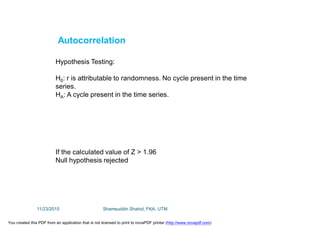
Hypothesis Testing:
H0: r is attributable to randomness. No cycle present in the time
series.
HA: A cycle present in the time series.
If the calculated value of Z > 1.96
Null hypothesis rejected
11/23/2015 Shamsuddin Shahid, FKA, UTM
You created this PDF from an application that is not licensed to print to novaPDF printer (http://www.novapdf.com)
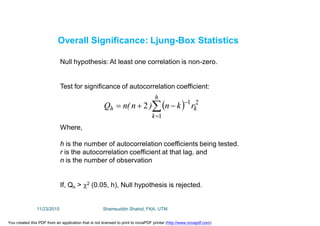
Overall Significance: Ljung-Box Statistics
Null hypothesis: At least one correlation is non-zero.
Test for significance of autocorrelation coefficient:
Where,
h is the number of autocorrelation coefficients being tested.
r is the autocorrelation coefficient at that lag, and
n is the number of observation
If, Qh > 2 (0.05, h), Null hypothesis is rejected.
 



h
k
kh rkn)n(nQ
1
21
2
11/23/2015 Shamsuddin Shahid, FKA, UTM
You created this PDF from an application that is not licensed to print to novaPDF printer (http://www.novapdf.com)
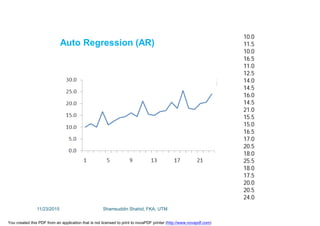
10.0
11.5
10.0
16.5
11.0
12.5
14.0
14.5
16.0
14.5
21.0
15.5
15.0
16.5
17.0
20.5
18.0
25.5
18.0
17.5
20.0
20.5
24.0
Auto Regression (AR)
11/23/2015 Shamsuddin Shahid, FKA, UTM
You created this PDF from an application that is not licensed to print to novaPDF printer (http://www.novapdf.com)
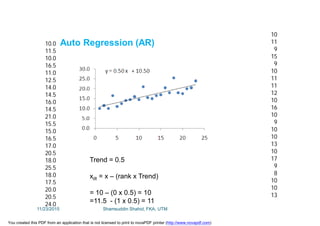
10.0
11.5
10.0
16.5
11.0
12.5
14.0
14.5
16.0
14.5
21.0
15.5
15.0
16.5
17.0
20.5
18.0
25.5
18.0
17.5
20.0
20.5
24.0
Auto Regression (AR)
10
11
9
15
9
10
11
11
12
10
16
10
9
10
10
13
10
17
9
8
10
10
13
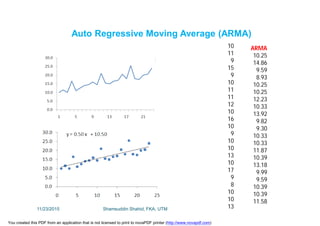
Trend = 0.5
xdt = x – (rank x Trend)
= 10 – (0 x 0.5) = 10
=11.5 - (1 x 0.5) = 11
11/23/2015 Shamsuddin Shahid, FKA, UTM
You created this PDF from an application that is not licensed to print to novaPDF printer (http://www.novapdf.com)
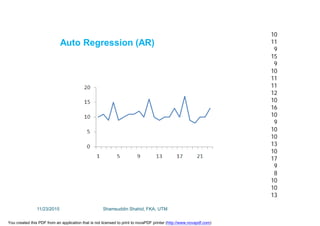
10
11
9
15
9
10
11
11
12
10
16
10
9
10
10
13
10
17
9
8
10
10
13
Auto Regression (AR)
11/23/2015 Shamsuddin Shahid, FKA, UTM
You created this PDF from an application that is not licensed to print to novaPDF printer (http://www.novapdf.com)
10
11
9
15
9
10
11
11
12
10
16
10
9
10
10
13
10
17
9
8
10
10
13
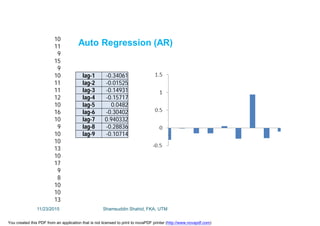
lag-1 -0.34061
lag-2 -0.01525
lag-3 -0.14931
lag-4 -0.15717
lag-5 0.0482
lag-6 -0.30402
lag-7 0.940332
lag-8 -0.28836
lag-9 -0.10714
Auto Regression (AR)
11/23/2015 Shamsuddin Shahid, FKA, UTM
You created this PDF from an application that is not licensed to print to novaPDF printer (http://www.novapdf.com)
 



h
k
kh rkn)n(nQ
1
21
2
Auto Regression (AR)
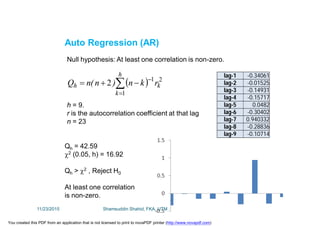
h = 9.
r is the autocorrelation coefficient at that lag
n = 23
Null hypothesis: At least one correlation is non-zero.
Qh = 42.59
2 (0.05, h) = 16.92
Qh > 2 , Reject H0
At least one correlation
is non-zero.
lag-1 -0.34061
lag-2 -0.01525
lag-3 -0.14931
lag-4 -0.15717
lag-5 0.0482
lag-6 -0.30402
lag-7 0.940332
lag-8 -0.28836
lag-9 -0.10714
11/23/2015 Shamsuddin Shahid, FKA, UTM
You created this PDF from an application that is not licensed to print to novaPDF printer (http://www.novapdf.com)
Auto Regression (AR)
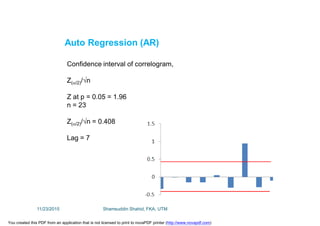
Confidence interval of correlogram,
Z(/2)/n
Z at p = 0.05 = 1.96
n = 23
Z(/2)/n = 0.408
Lag = 7
11/23/2015 Shamsuddin Shahid, FKA, UTM
You created this PDF from an application that is not licensed to print to novaPDF printer (http://www.novapdf.com)
Auto Regression (AR)
11/23/2015 Shamsuddin Shahid, FKA, UTM
You created this PDF from an application that is not licensed to print to novaPDF printer (http://www.novapdf.com)
Auto Regression (AR)
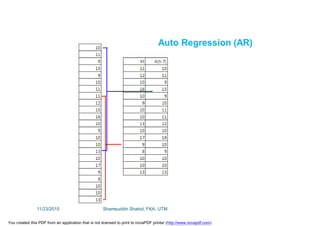
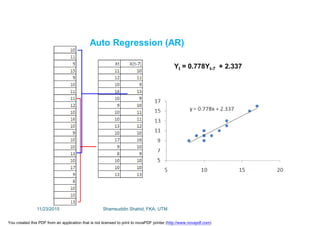
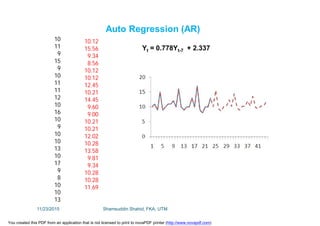
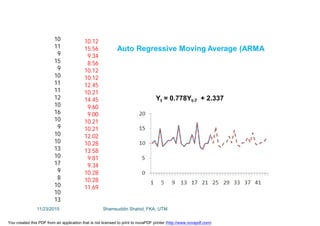
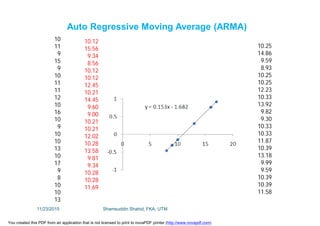
Yt = 0.778Yt-7 + 2.337
11/23/2015 Shamsuddin Shahid, FKA, UTM
You created this PDF from an application that is not licensed to print to novaPDF printer (http://www.novapdf.com)
10
11
9
15
9
10
11
11
12
10
16
10
9
10
10
13
10
17
9
8
10
10
13
10.12
15.56
9.34
8.56
10.12
10.12
12.45
10.21
14.45
9.60
9.00
10.21
10.21
12.02
10.28
13.58
9.81
9.34
10.28
10.28
11.69
Yt = 0.778Yt-7 + 2.337
Auto Regression (AR)
11/23/2015 Shamsuddin Shahid, FKA, UTM
You created this PDF from an application that is not licensed to print to novaPDF printer (http://www.novapdf.com)
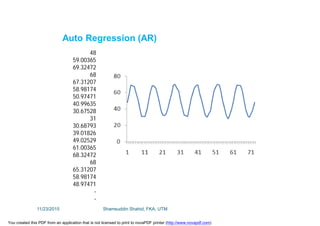
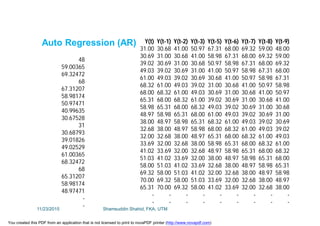
48
59.00365
69.32472
68
67.31207
58.98174
50.97471
40.99635
30.67528
31
30.68793
39.01826
49.02529
61.00365
68.32472
68
65.31207
58.98174
48.97471
-
-
Auto Regression (AR)
11/23/2015 Shamsuddin Shahid, FKA, UTM
You created this PDF from an application that is not licensed to print to novaPDF printer (http://www.novapdf.com)
Auto Regression (AR)
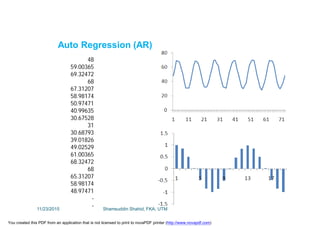
48
59.00365
69.32472
68
67.31207
58.98174
50.97471
40.99635
30.67528
31
30.68793
39.01826
49.02529
61.00365
68.32472
68
65.31207
58.98174
48.97471
-
-11/23/2015 Shamsuddin Shahid, FKA, UTM
You created this PDF from an application that is not licensed to print to novaPDF printer (http://www.novapdf.com)
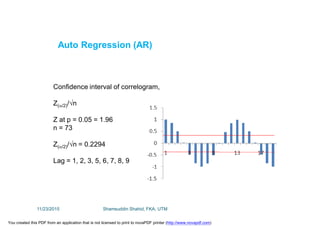
Confidence interval of correlogram,
Z(/2)/n
Z at p = 0.05 = 1.96
n = 73
Z(/2)/n = 0.2294
Lag = 1, 2, 3, 5, 6, 7, 8, 9
Auto Regression (AR)
11/23/2015 Shamsuddin Shahid, FKA, UTM
You created this PDF from an application that is not licensed to print to novaPDF printer (http://www.novapdf.com)
Y(t) Y(t-1) Y(t-2) Y(t-3) Y(t-5) Y(t-6) Y(t-7) Y(t-8) Y(t-9)
31.00 30.68 41.00 50.97 67.31 68.00 69.32 59.00 48.00
30.69 31.00 30.68 41.00 58.98 67.31 68.00 69.32 59.00
39.02 30.69 31.00 30.68 50.97 58.98 67.31 68.00 69.32
49.03 39.02 30.69 31.00 41.00 50.97 58.98 67.31 68.00
61.00 49.03 39.02 30.69 30.68 41.00 50.97 58.98 67.31
68.32 61.00 49.03 39.02 31.00 30.68 41.00 50.97 58.98
68.00 68.32 61.00 49.03 30.69 31.00 30.68 41.00 50.97
65.31 68.00 68.32 61.00 39.02 30.69 31.00 30.68 41.00
58.98 65.31 68.00 68.32 49.03 39.02 30.69 31.00 30.68
48.97 58.98 65.31 68.00 61.00 49.03 39.02 30.69 31.00
38.00 48.97 58.98 65.31 68.32 61.00 49.03 39.02 30.69
32.68 38.00 48.97 58.98 68.00 68.32 61.00 49.03 39.02
32.00 32.68 38.00 48.97 65.31 68.00 68.32 61.00 49.03
33.69 32.00 32.68 38.00 58.98 65.31 68.00 68.32 61.00
41.02 33.69 32.00 32.68 48.97 58.98 65.31 68.00 68.32
51.03 41.02 33.69 32.00 38.00 48.97 58.98 65.31 68.00
58.00 51.03 41.02 33.69 32.68 38.00 48.97 58.98 65.31
69.32 58.00 51.03 41.02 32.00 32.68 38.00 48.97 58.98
70.00 69.32 58.00 51.03 33.69 32.00 32.68 38.00 48.97
65.31 70.00 69.32 58.00 41.02 33.69 32.00 32.68 38.00
- - - - - - - - -
- - - - - - - - -
48
59.00365
69.32472
68
67.31207
58.98174
50.97471
40.99635
30.67528
31
30.68793
39.01826
49.02529
61.00365
68.32472
68
65.31207
58.98174
48.97471
-
-
Auto Regression (AR)
11/23/2015 Shamsuddin Shahid, FKA, UTM
You created this PDF from an application that is not licensed to print to novaPDF printer (http://www.novapdf.com)
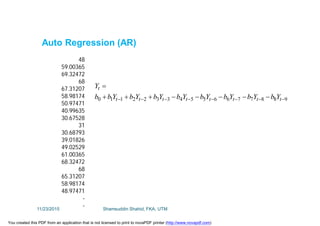
Auto Regression (AR)
98877665543322110  

tttttttt
t
YbYbYbYbYbYbYbYbb
Y
48
59.00365
69.32472
68
67.31207
58.98174
50.97471
40.99635
30.67528
31
30.68793
39.01826
49.02529
61.00365
68.32472
68
65.31207
58.98174
48.97471
-
-11/23/2015 Shamsuddin Shahid, FKA, UTM
You created this PDF from an application that is not licensed to print to novaPDF printer (http://www.novapdf.com)
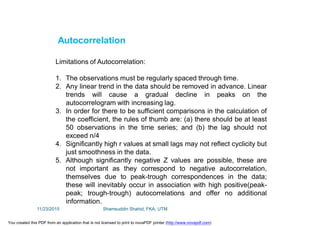
Autocorrelation
Limitations of Autocorrelation:
1. The observations must be regularly spaced through time.
2. Any linear trend in the data should be removed in advance. Linear
trends will cause a gradual decline in peaks on the
autocorrelogram with increasing lag.
3. In order for there to be sufficient comparisons in the calculation of
the coefficient, the rules of thumb are: (a) there should be at least
50 observations in the time series; and (b) the lag should not
exceed n/4
4. Significantly high r values at small lags may not reflect cyclicity but
just smoothness in the data.
5. Although significantly negative Z values are possible, these are
not important as they correspond to negative autocorrelation,
themselves due to peak-trough correspondences in the data;
these will inevitably occur in association with high positive(peak-
peak; trough-trough) autocorrelations and offer no additional
information.
11/23/2015 Shamsuddin Shahid, FKA, UTM
You created this PDF from an application that is not licensed to print to novaPDF printer (http://www.novapdf.com)
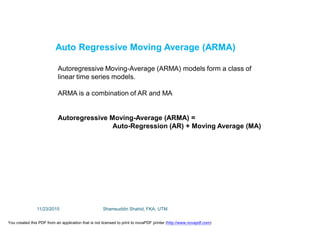
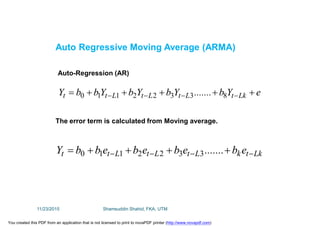
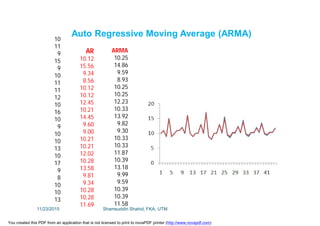
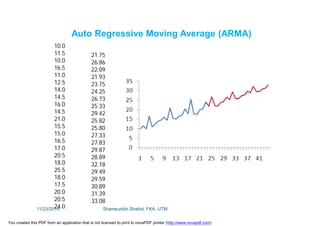
Autoregressive Moving-Average (ARMA) models form a class of
linear time series models.
ARMA is a combination of AR and MA
Autoregressive Moving-Average (ARMA) =
Auto-Regression (AR) + Moving Average (MA)
Auto Regressive Moving Average (ARMA)
11/23/2015 Shamsuddin Shahid, FKA, UTM
You created this PDF from an application that is not licensed to print to novaPDF printer (http://www.novapdf.com)
eYb.......YbYbYbbY LktLtLtLtt   83322110
LktkLtLtLtt eb.......ebebebbY   3322110
Auto Regressive Moving Average (ARMA)
Auto-Regression (AR)
The error term is calculated from Moving average.
11/23/2015 Shamsuddin Shahid, FKA, UTM
You created this PDF from an application that is not licensed to print to novaPDF printer (http://www.novapdf.com)
10
11
9
15
9
10
11
11
12
10
16
10
9
10
10
13
10
17
9
8
10
10
13
10.12
15.56
9.34
8.56
10.12
10.12
12.45
10.21
14.45
9.60
9.00
10.21
10.21
12.02
10.28
13.58
9.81
9.34
10.28
10.28
11.69
Yt = 0.778Yt-7 + 2.337
Auto Regressive Moving Average (ARMA
11/23/2015 Shamsuddin Shahid, FKA, UTM
You created this PDF from an application that is not licensed to print to novaPDF printer (http://www.novapdf.com)
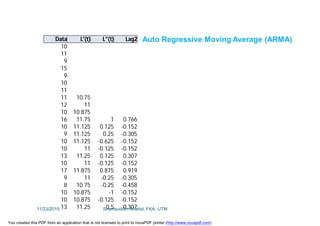
Data L'(t) L"(t) Lag2
10
11
9
15
9
10
11
11 10.75
12 11
10 10.875
16 11.75 1 0.766
10 11.125 0.125 -0.152
9 11.125 0.25 -0.305
10 11.125 -0.625 -0.152
10 11 -0.125 -0.152
13 11.25 0.125 0.307
10 11 -0.125 -0.152
17 11.875 0.875 0.919
9 11 -0.25 -0.305
8 10.75 -0.25 -0.458
10 10.875 -1 -0.152
10 10.875 -0.125 -0.152
13 11.25 0.5 0.307
Auto Regressive Moving Average (ARMA)
11/23/2015 Shamsuddin Shahid, FKA, UTM
You created this PDF from an application that is not licensed to print to novaPDF printer (http://www.novapdf.com)
Auto Regressive Moving Average (ARMA)
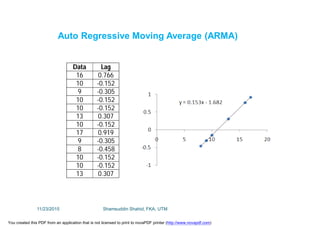
Data Lag
16 0.766
10 -0.152
9 -0.305
10 -0.152
10 -0.152
13 0.307
10 -0.152
17 0.919
9 -0.305
8 -0.458
10 -0.152
10 -0.152
13 0.307
11/23/2015 Shamsuddin Shahid, FKA, UTM
You created this PDF from an application that is not licensed to print to novaPDF printer (http://www.novapdf.com)
10
11
9
15
9
10
11
11
12
10
16
10
9
10
10
13
10
17
9
8
10
10
13
10.12
15.56
9.34
8.56
10.12
10.12
12.45
10.21
14.45
9.60
9.00
10.21
10.21
12.02
10.28
13.58
9.81
9.34
10.28
10.28
11.69
Auto Regressive Moving Average (ARMA)
10.25
14.86
9.59
8.93
10.25
10.25
12.23
10.33
13.92
9.82
9.30
10.33
10.33
11.87
10.39
13.18
9.99
9.59
10.39
10.39
11.58
11/23/2015 Shamsuddin Shahid, FKA, UTM
You created this PDF from an application that is not licensed to print to novaPDF printer (http://www.novapdf.com)
ARMA
10.25
14.86
9.59
8.93
10.25
10.25
12.23
10.33
13.92
9.82
9.30
10.33
10.33
11.87
10.39
13.18
9.99
9.59
10.39
10.39
11.58
10
11
9
15
9
10
11
11
12
10
16
10
9
10
10
13
10
17
9
8
10
10
13
AR
10.12
15.56
9.34
8.56
10.12
10.12
12.45
10.21
14.45
9.60
9.00
10.21
10.21
12.02
10.28
13.58
9.81
9.34
10.28
10.28
11.69
Auto Regressive Moving Average (ARMA)
11/23/2015 Shamsuddin Shahid, FKA, UTM
You created this PDF from an application that is not licensed to print to novaPDF printer (http://www.novapdf.com)
Auto Regressive Moving Average (ARMA)
10
11
9
15
9
10
11
11
12
10
16
10
9
10
10
13
10
17
9
8
10
10
13
ARMA
10.25
14.86
9.59
8.93
10.25
10.25
12.23
10.33
13.92
9.82
9.30
10.33
10.33
11.87
10.39
13.18
9.99
9.59
10.39
10.39
11.58
11/23/2015 Shamsuddin Shahid, FKA, UTM
You created this PDF from an application that is not licensed to print to novaPDF printer (http://www.novapdf.com)
21.75
26.86
22.09
21.93
23.75
24.25
26.73
25.33
29.42
25.82
25.80
27.33
27.83
29.87
28.89
32.18
29.49
29.59
30.89
31.39
33.08
10.0
11.5
10.0
16.5
11.0
12.5
14.0
14.5
16.0
14.5
21.0
15.5
15.0
16.5
17.0
20.5
18.0
25.5
18.0
17.5
20.0
20.5
24.0
Auto Regressive Moving Average (ARMA)
11/23/2015 Shamsuddin Shahid, FKA, UTM
You created this PDF from an application that is not licensed to print to novaPDF printer (http://www.novapdf.com)
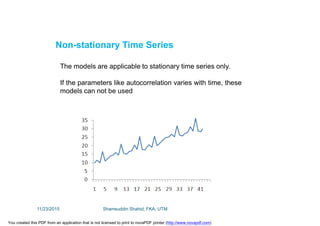
Non-stationary Time Series
The models are applicable to stationary time series only.
If the parameters like autocorrelation varies with time, these
models can not be used
11/23/2015 Shamsuddin Shahid, FKA, UTM
You created this PDF from an application that is not licensed to print to novaPDF printer (http://www.novapdf.com)
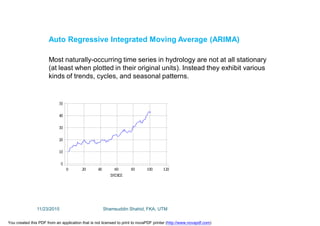
Auto Regressive Integrated Moving Average (ARIMA)
Most naturally-occurring time series in hydrology are not at all stationary
(at least when plotted in their original units). Instead they exhibit various
kinds of trends, cycles, and seasonal patterns.
11/23/2015 Shamsuddin Shahid, FKA, UTM
You created this PDF from an application that is not licensed to print to novaPDF printer (http://www.novapdf.com)
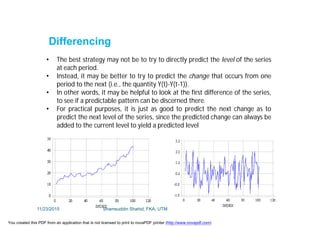
• The best strategy may not be to try to directly predict the level of the series
at each period.
• Instead, it may be better to try to predict the change that occurs from one
period to the next (i.e., the quantity Y(t)-Y(t-1)).
• In other words, it may be helpful to look at the first difference of the series,
to see if a predictable pattern can be discerned there.
• For practical purposes, it is just as good to predict the next change as to
predict the next level of the series, since the predicted change can always be
added to the current level to yield a predicted level
Differencing
11/23/2015 Shamsuddin Shahid, FKA, UTM
You created this PDF from an application that is not licensed to print to novaPDF printer (http://www.novapdf.com)
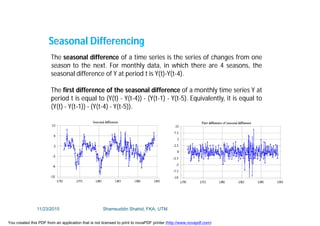
The seasonal difference of a time series is the series of changes from one
season to the next. For monthly data, in which there are 4 seasons, the
seasonal difference of Y at period t is Y(t)-Y(t-4).
The first difference of the seasonal difference of a monthly time series Y at
period t is equal to (Y(t) - Y(t-4)) - (Y(t-1) - Y(t-5). Equivalently, it is equal to
(Y(t) - Y(t-1)) - (Y(t-4) - Y(t-5)).
Seasonal Differencing
11/23/2015 Shamsuddin Shahid, FKA, UTM
You created this PDF from an application that is not licensed to print to novaPDF printer (http://www.novapdf.com)
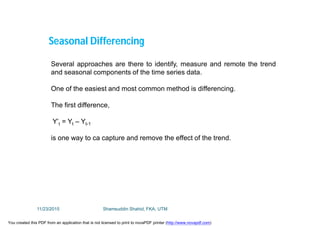
Several approaches are there to identify, measure and remote the trend
and seasonal components of the time series data.
One of the easiest and most common method is differencing.
The first difference,
Y’t = Yt – Yt-1
is one way to ca capture and remove the effect of the trend.
Seasonal Differencing
11/23/2015 Shamsuddin Shahid, FKA, UTM
You created this PDF from an application that is not licensed to print to novaPDF printer (http://www.novapdf.com)
ARIMA models are, in theory, the most general class of models for
forecasting a time series which can be stationarized by
transformations such as differencing and logging.
A ARIMA model is classified as an ARIMA(p,d,q) model, where:
p is the number of autoregressive terms,
d is the number of nonseasonal differences, and
q is the number of lagged forecast errors in the prediction equation.
ARIMA(1,1,1)
ARIMA(1,0,1)
ARIMA(2,1,2)
Auto Regressive Integrated Moving Average (ARIMA)
11/23/2015 Shamsuddin Shahid, FKA, UTM
You created this PDF from an application that is not licensed to print to novaPDF printer (http://www.novapdf.com)
Auto Regressive Integrated Moving Average (ARIMA)
Box-Jenkins methodology.
1. Model Selection
2. Parameter Estimations
3. Model Checking
Many cases it is a iterative processes.
11/23/2015 Shamsuddin Shahid, FKA, UTM
You created this PDF from an application that is not licensed to print to novaPDF printer (http://www.novapdf.com)

Shahid Lecture-12- MKAG1273

  • 1.
    MAL1303: STATISTICAL HYDROLOGY StochasticMethods in Hydrology Dr. Shamsuddin Shahid Department of Hydraulics and Hydrology Faculty of Civil Engineering, Universiti Teknologi Malaysia Room No.: M46-332; Phone: 07-5531624; Mobile: 0182051586 Email: sshahid@utm.my 11/23/2015 Shamsuddin Shahid, FKA, UTM You created this PDF from an application that is not licensed to print to novaPDF printer (http://www.novapdf.com)
  • 2.
    Markov Transition Matrix 11/23/2015Shamsuddin Shahid, FKA, UTM You created this PDF from an application that is not licensed to print to novaPDF printer (http://www.novapdf.com)
  • 3.
    For four class,there will be four cumulative distribution functions. Cumulative distribution functions for each class is calculated as, Fj (x) = P [next day rainfall < x; when rainfall today belongs to class Cj]. For Example, FR5(x) = P [next day rainfall < x; when rainfall today belongs to class R5]. Cumulative Distribution Functions 11/23/2015 Shamsuddin Shahid, FKA, UTM You created this PDF from an application that is not licensed to print to novaPDF printer (http://www.novapdf.com)
  • 4.
    Fj (x) =P [next day rainfall < x; when rainfall today belongs to class Cj]. For Example: FR5(x) = P [next day rainfall < x; when rainfall today belongs to class R5]. P [next day rainfall < 5] = 2 P [next day rainfall < 4] = 2 P [next day rainfall < 3] = 2 P [next day rainfall < 2] = 1 P [next day rainfall < 1] = 1 Rainfall 10 5 1 6 23 4 3 2 0 20 5 2 3 0 4 3 1 0 Cumulative Distribution Functions 11/23/2015 Shamsuddin Shahid, FKA, UTM You created this PDF from an application that is not licensed to print to novaPDF printer (http://www.novapdf.com)
  • 5.
    FR5(x) = P[next day rainfall < x; when rainfall today belongs to class R5]. P [next day rainfall < 5] = 2 P [next day rainfall < 4] = 2 P [next day rainfall < 3] = 2 P [next day rainfall < 2] = 1 P [next day rainfall < 1] = 1 Cumulative Distribution Functions Find the distribution and distribution parameters. Consider, we found distribution is exponential, FR5(x) =  exp (-) Where,  = 0.105 11/23/2015 Shamsuddin Shahid, FKA, UTM You created this PDF from an application that is not licensed to print to novaPDF printer (http://www.novapdf.com)
  • 6.
    Calculate Daily MonsoonRainfall First, we need to define the initial condition. Consider, Initial condition R5 --- R10 --- R20 --- R>20 (1/4) (1/4) (1/4) (1/4) 11/23/2015 Shamsuddin Shahid, FKA, UTM You created this PDF from an application that is not licensed to print to novaPDF printer (http://www.novapdf.com)
  • 7.
    Calculate Daily MonsoonRainfall (1/4) (1/4) (1/4) (1/4) [0.25 0.25 0.25 0.25] X 0.39 0.21 0.27 0.14 11/23/2015 Shamsuddin Shahid, FKA, UTM You created this PDF from an application that is not licensed to print to novaPDF printer (http://www.novapdf.com)
  • 8.
    R5 R10 R20R>20 0.39 0.21 0.27 0.14 FR5(x) =  exp (-x) Where, = 0.105 Cumulative Distribution, 1 -  exp (-x) Rainfall in Day1 (x) = 0.39 = 1 -0.105exp(-0.105x) Calculate Daily Monsoon Rainfall 11/23/2015 Shamsuddin Shahid, FKA, UTM You created this PDF from an application that is not licensed to print to novaPDF printer (http://www.novapdf.com)
  • 9.
    Calculate Daily MonsoonRainfall 0.39 0.21 0.27 0.14 X 0.41 0.24 0.24 0.11 11/23/2015 Shamsuddin Shahid, FKA, UTM You created this PDF from an application that is not licensed to print to novaPDF printer (http://www.novapdf.com)
  • 10.
    General equation is, u(n)= u Pn Or u(n) = u(n-1) P Calculate Daily Monsoon Rainfall 0.39 0.21 0.27 0.14 X 11/23/2015 Shamsuddin Shahid, FKA, UTM You created this PDF from an application that is not licensed to print to novaPDF printer (http://www.novapdf.com)
  • 11.
    Stochastic refers tosystems whose behaviour is intrinsically non- deterministic. A stochastic process is one whose behavior is non- deterministic, in that a system's subsequent state is determined both by the process's predictable actions and by a random element. Stochastic hydrology is mainly concerned with the assessment of uncertainty in model predictions Stochastic Process 11/23/2015 Shamsuddin Shahid, FKA, UTM You created this PDF from an application that is not licensed to print to novaPDF printer (http://www.novapdf.com)
  • 12.
    Application of StochasticProcess in Hydrology Stochastic hydrology is an essential base of water resources systems analysis, due to the inherent randomness of the input, and consequently of the results. Stochastic process is applied for forecasting of hydrological phenomena such as, flood, droughts, etc. Stochastic process is applied for forecasting rainfall, river discharge, etc. Stochastic hydrology is very important in decision-making process regarding the planning and management of water systems. 11/23/2015 Shamsuddin Shahid, FKA, UTM You created this PDF from an application that is not licensed to print to novaPDF printer (http://www.novapdf.com)
  • 13.
    A stationary timeseries is one whose statistical properties such as mean, variance, autocorrelation, etc. are all constant over time. Most statistical forecasting methods are based on the assumption that the time series can be rendered approximately stationary through the use of mathematical transformations. A stationarized series is relatively easy to predict: you simply predict that its statistical properties will be the same in the future as they have been in the past. Stationary Time Series 11/23/2015 Shamsuddin Shahid, FKA, UTM You created this PDF from an application that is not licensed to print to novaPDF printer (http://www.novapdf.com)
  • 14.
    Linear Stochastic Models 1.Moving Average (MA) 2. Auto Regression (AR) 3. Auto Regressive Moving Average (ARMA) 4. Auto Regressive Integrated Moving Average (ARIMA) Stochastic Models 11/23/2015 Shamsuddin Shahid, FKA, UTM You created this PDF from an application that is not licensed to print to novaPDF printer (http://www.novapdf.com)
  • 15.
    Moving Average The conceptunderlying moving average is that the k most recent time periods is a good predictor of the current and next period values. The process is called moving averages because each average is calculated by dropping the oldest observation and including the next observation. 11/23/2015 Shamsuddin Shahid, FKA, UTM You created this PDF from an application that is not licensed to print to novaPDF printer (http://www.novapdf.com)
  • 16.
    • The movingaverage removes some of the non-randomness in the data. • Therefore, the moving average merely smooth the fluctuations in the data. • The moving average technique is a good forecasting approach to use if the data is stationary. k Y....YYYY F kttttt t 1321 1     Where, Ft+1 is the forecast for period t+1, and Yt is the actual value of period t Moving Average 11/23/2015 Shamsuddin Shahid, FKA, UTM You created this PDF from an application that is not licensed to print to novaPDF printer (http://www.novapdf.com)
  • 17.
    Moving Average 48.0 59.0 69.3 68.0 67.3 59.0 51.0 41.0 30.7 31.0 30.7 39.0 49.0 61.0 68.3 68.0 65.3 59.0 11/23/2015 ShamsuddinShahid, FKA, UTM You created this PDF from an application that is not licensed to print to novaPDF printer (http://www.novapdf.com)
  • 18.
    Moving Average 48.0 59.0 69.3 53.5 68.064.2 67.3 68.7 59.0 67.7 51.0 63.1 41.0 55.0 30.7 46.0 31.0 35.8 30.7 30.8 39.0 30.8 49.0 34.9 61.0 44.0 68.3 55.0 68.0 64.7 65.3 68.2 59.0 66.7 11/23/2015 Shamsuddin Shahid, FKA, UTM You created this PDF from an application that is not licensed to print to novaPDF printer (http://www.novapdf.com)
  • 19.
    Moving Average k Y....YYYY L kttttt' t 1321   Moving Average, Lt 48.0 59.0 53.5 69.3 64.2 68.0 68.7 67.3 67.7 59.0 63.1 51.0 55.0 41.0 46.0 30.7 35.8 31.0 30.8 30.7 30.8 39.0 34.9 49.0 44.0 61.0 55.0 68.3 64.7 68.0 68.2 65.3 66.7 59.0 62.1 11/23/2015 Shamsuddin Shahid, FKA, UTM You created this PDF from an application that is not licensed to print to novaPDF printer (http://www.novapdf.com)
  • 20.
    Double Moving Average k L....LLLL L ' kt ' t ' t ' t ' t" t 1321  48.0 59.0 53.5 69.3 64.2 58.8 68.0 68.7 66.4 67.3 67.7 68.2 59.0 63.1 65.4 51.0 55.0 59.1 41.0 46.0 50.5 30.7 35.8 40.9 31.0 30.8 33.3 30.7 30.8 30.8 39.0 34.9 32.8 49.0 44.0 39.4 61.0 55.0 49.5 68.3 64.7 59.8 68.0 68.2 66.4 65.3 66.7 67.4 59.0 62.1 64.4 11/23/2015 Shamsuddin Shahid, FKA, UTM You created this PDF from an application that is not licensed to print to novaPDF printer (http://www.novapdf.com)
  • 21.
    Double Moving Average Differencebetween Actual value and first moving average is called Lag1. Second Lag or Lag2 can be calculated as, / k t / t LLlag          2 12 For example, if first moving average is calculate for K=3, then / t / t / t / t LLLLlag 1 2 132           11/23/2015 Shamsuddin Shahid, FKA, UTM You created this PDF from an application that is not licensed to print to novaPDF printer (http://www.novapdf.com)
  • 22.
    Data Forecast ErrorMA Lag1 Lag2 10.0 12.0 11.0 14.0 11.0 3.0 13.0 1.0 2.0 16.0 13.0 3.0 15.0 1.0 2.0 18.0 15.0 3.0 17.0 1.0 2.0 20.0 17.0 3.0 19.0 1.0 2.0 22.0 19.0 3.0 21.0 1.0 2.0 24.0 21.0 3.0 23.0 1.0 2.0 26.0 23.0 3.0 25.0 1.0 2.0 28.0 25.0 3.0 27.0 1.0 2.0 30.0 27.0 3.0 29.0 1.0 2.0 32.0 29.0 3.0 31.0 1.0 2.0 34.0 31.0 3.0 33.0 1.0 2.0 36.0 33.0 3.0 35.0 1.0 2.0 38.0 35.0 3.0 37.0 1.0 2.0 40.0 37.0 3.0 39.0 1.0 2.0 42.0 39.0 3.0 41.0 1.0 2.0 44.0 41.0 3.0 43.0 1.0 2.0 Double Moving Average For constant trend, the error is contact. Double moving average is used to remove the constant trend. Error is the sum of lag1 and lag2. Therefore, 211 laglagMAFt  11/23/2015 Shamsuddin Shahid, FKA, UTM You created this PDF from an application that is not licensed to print to novaPDF printer (http://www.novapdf.com)
  • 23.
    Double Moving Average:Forecasting Double moving average can be used for forecasting using following formulas: mbaF ttt 1 Where,  // t / tt // t / t / tt LL k b and ]LL[La     1 2 11/23/2015 Shamsuddin Shahid, FKA, UTM You created this PDF from an application that is not licensed to print to novaPDF printer (http://www.novapdf.com)
  • 24.
    Data L'(t) L"(t)Lag2 Trend Forecast Error 10.0 12.0 11.0 14.0 13.0 12.0 1.0 2.0 16.0 15.0 14.0 1.0 2.0 16.0 0.0 18.0 17.0 16.0 1.0 2.0 18.0 0.0 20.0 19.0 18.0 1.0 2.0 20.0 0.0 22.0 21.0 20.0 1.0 2.0 22.0 0.0 24.0 23.0 22.0 1.0 2.0 24.0 0.0 26.0 25.0 24.0 1.0 2.0 26.0 0.0 28.0 27.0 26.0 1.0 2.0 28.0 0.0 30.0 29.0 28.0 1.0 2.0 30.0 0.0 32.0 31.0 30.0 1.0 2.0 32.0 0.0 34.0 33.0 32.0 1.0 2.0 34.0 0.0 36.0 35.0 34.0 1.0 2.0 36.0 0.0 38.0 37.0 36.0 1.0 2.0 38.0 0.0 40.0 39.0 38.0 1.0 2.0 40.0 0.0 42.0 41.0 40.0 1.0 2.0 42.0 0.0 44.0 43.0 42.0 1.0 2.0 44.0 0.0 Double Moving Average: Forecasting  // t / tt // t / t / tt LL k b and ]LL[La     1 2 ttt baF 1 11/23/2015 Shamsuddin Shahid, FKA, UTM You created this PDF from an application that is not licensed to print to novaPDF printer (http://www.novapdf.com)
  • 25.
    Data L'(t) L"(t)Lag2 Trend Forecast 10 11 13 16 18 21 22 15.9 25 18.0 27 20.3 28 22.4 30 24.4 31 26.3 35 28.3 22.2 6.1 2.0 36 30.3 24.3 6.0 2.0 36.4 38 32.1 26.3 5.8 1.9 38.3 39 33.9 28.2 5.6 1.9 39.9 43 36.0 30.2 5.8 1.9 41.3 44 38.0 32.1 5.9 2.0 43.8 47 40.3 34.1 6.2 2.1 45.8 48 42.1 36.1 6.0 2.0 48.5 50 44.1 38.1 6.1 2.0 50.2 51 46.0 40.1 5.9 2.0 52.2 54 48.1 42.1 6.0 2.0 53.9 Double Moving Average: Forecasting 11/23/2015 Shamsuddin Shahid, FKA, UTM You created this PDF from an application that is not licensed to print to novaPDF printer (http://www.novapdf.com)
  • 26.
    Autocorrelation Autocorrelation is thecorrelation of a series with itself. This is unlike cross-correlation, which is the correlation of two different series. Autocorrelation is useful for finding repeating patterns in a time series, such as determining the presence of a periodic signal or cycle. 11/23/2015 Shamsuddin Shahid, FKA, UTM You created this PDF from an application that is not licensed to print to novaPDF printer (http://www.novapdf.com)
  • 27.
    Autocorrelation t = 1 11/23/2015Shamsuddin Shahid, FKA, UTM You created this PDF from an application that is not licensed to print to novaPDF printer (http://www.novapdf.com)
  • 28.
    Autocorrelation t = 3 11/23/2015Shamsuddin Shahid, FKA, UTM You created this PDF from an application that is not licensed to print to novaPDF printer (http://www.novapdf.com)
  • 29.
    Autocorrelation t = 1;r = 0.9 t = 3; r = 0.5 t = 5; r = 0.0 11/23/2015 Shamsuddin Shahid, FKA, UTM You created this PDF from an application that is not licensed to print to novaPDF printer (http://www.novapdf.com)
  • 30.
    Autocorrelation t = 0or t=20; r = 1.0 t = 15; r = 0.0 t = 10; r = -1.0 11/23/2015 Shamsuddin Shahid, FKA, UTM You created this PDF from an application that is not licensed to print to novaPDF printer (http://www.novapdf.com)
  • 31.
    Autocorrelation 11/23/2015 Shamsuddin Shahid,FKA, UTM You created this PDF from an application that is not licensed to print to novaPDF printer (http://www.novapdf.com)
  • 32.
    Autocorrelation Test for significanceof autocorrelation coefficient: Where, t is the lag r is the autocorrelation coefficient at that lag, and n is the number of observation 11/23/2015 Shamsuddin Shahid, FKA, UTM You created this PDF from an application that is not licensed to print to novaPDF printer (http://www.novapdf.com)
  • 33.
    Autocorrelation Hypothesis Testing: H0: ris attributable to randomness. No cycle present in the time series. HA: A cycle present in the time series. If the calculated value of Z > 1.96 Null hypothesis rejected 11/23/2015 Shamsuddin Shahid, FKA, UTM You created this PDF from an application that is not licensed to print to novaPDF printer (http://www.novapdf.com)
  • 34.
    Overall Significance: Ljung-BoxStatistics Null hypothesis: At least one correlation is non-zero. Test for significance of autocorrelation coefficient: Where, h is the number of autocorrelation coefficients being tested. r is the autocorrelation coefficient at that lag, and n is the number of observation If, Qh > 2 (0.05, h), Null hypothesis is rejected.      h k kh rkn)n(nQ 1 21 2 11/23/2015 Shamsuddin Shahid, FKA, UTM You created this PDF from an application that is not licensed to print to novaPDF printer (http://www.novapdf.com)
  • 35.
    10.0 11.5 10.0 16.5 11.0 12.5 14.0 14.5 16.0 14.5 21.0 15.5 15.0 16.5 17.0 20.5 18.0 25.5 18.0 17.5 20.0 20.5 24.0 Auto Regression (AR) 11/23/2015Shamsuddin Shahid, FKA, UTM You created this PDF from an application that is not licensed to print to novaPDF printer (http://www.novapdf.com)
  • 36.
    10.0 11.5 10.0 16.5 11.0 12.5 14.0 14.5 16.0 14.5 21.0 15.5 15.0 16.5 17.0 20.5 18.0 25.5 18.0 17.5 20.0 20.5 24.0 Auto Regression (AR) 10 11 9 15 9 10 11 11 12 10 16 10 9 10 10 13 10 17 9 8 10 10 13 Trend= 0.5 xdt = x – (rank x Trend) = 10 – (0 x 0.5) = 10 =11.5 - (1 x 0.5) = 11 11/23/2015 Shamsuddin Shahid, FKA, UTM You created this PDF from an application that is not licensed to print to novaPDF printer (http://www.novapdf.com)
  • 37.
    10 11 9 15 9 10 11 11 12 10 16 10 9 10 10 13 10 17 9 8 10 10 13 Auto Regression (AR) 11/23/2015Shamsuddin Shahid, FKA, UTM You created this PDF from an application that is not licensed to print to novaPDF printer (http://www.novapdf.com)
  • 38.
    10 11 9 15 9 10 11 11 12 10 16 10 9 10 10 13 10 17 9 8 10 10 13 lag-1 -0.34061 lag-2 -0.01525 lag-3-0.14931 lag-4 -0.15717 lag-5 0.0482 lag-6 -0.30402 lag-7 0.940332 lag-8 -0.28836 lag-9 -0.10714 Auto Regression (AR) 11/23/2015 Shamsuddin Shahid, FKA, UTM You created this PDF from an application that is not licensed to print to novaPDF printer (http://www.novapdf.com)
  • 39.
         h k kh rkn)n(nQ 1 21 2 AutoRegression (AR) h = 9. r is the autocorrelation coefficient at that lag n = 23 Null hypothesis: At least one correlation is non-zero. Qh = 42.59 2 (0.05, h) = 16.92 Qh > 2 , Reject H0 At least one correlation is non-zero. lag-1 -0.34061 lag-2 -0.01525 lag-3 -0.14931 lag-4 -0.15717 lag-5 0.0482 lag-6 -0.30402 lag-7 0.940332 lag-8 -0.28836 lag-9 -0.10714 11/23/2015 Shamsuddin Shahid, FKA, UTM You created this PDF from an application that is not licensed to print to novaPDF printer (http://www.novapdf.com)
  • 40.
    Auto Regression (AR) Confidenceinterval of correlogram, Z(/2)/n Z at p = 0.05 = 1.96 n = 23 Z(/2)/n = 0.408 Lag = 7 11/23/2015 Shamsuddin Shahid, FKA, UTM You created this PDF from an application that is not licensed to print to novaPDF printer (http://www.novapdf.com)
  • 41.
    Auto Regression (AR) 11/23/2015Shamsuddin Shahid, FKA, UTM You created this PDF from an application that is not licensed to print to novaPDF printer (http://www.novapdf.com)
  • 42.
    Auto Regression (AR) Yt= 0.778Yt-7 + 2.337 11/23/2015 Shamsuddin Shahid, FKA, UTM You created this PDF from an application that is not licensed to print to novaPDF printer (http://www.novapdf.com)
  • 43.
    10 11 9 15 9 10 11 11 12 10 16 10 9 10 10 13 10 17 9 8 10 10 13 10.12 15.56 9.34 8.56 10.12 10.12 12.45 10.21 14.45 9.60 9.00 10.21 10.21 12.02 10.28 13.58 9.81 9.34 10.28 10.28 11.69 Yt = 0.778Yt-7+ 2.337 Auto Regression (AR) 11/23/2015 Shamsuddin Shahid, FKA, UTM You created this PDF from an application that is not licensed to print to novaPDF printer (http://www.novapdf.com)
  • 44.
    48 59.00365 69.32472 68 67.31207 58.98174 50.97471 40.99635 30.67528 31 30.68793 39.01826 49.02529 61.00365 68.32472 68 65.31207 58.98174 48.97471 - - Auto Regression (AR) 11/23/2015Shamsuddin Shahid, FKA, UTM You created this PDF from an application that is not licensed to print to novaPDF printer (http://www.novapdf.com)
  • 45.
    Auto Regression (AR) 48 59.00365 69.32472 68 67.31207 58.98174 50.97471 40.99635 30.67528 31 30.68793 39.01826 49.02529 61.00365 68.32472 68 65.31207 58.98174 48.97471 - -11/23/2015Shamsuddin Shahid, FKA, UTM You created this PDF from an application that is not licensed to print to novaPDF printer (http://www.novapdf.com)
  • 46.
    Confidence interval ofcorrelogram, Z(/2)/n Z at p = 0.05 = 1.96 n = 73 Z(/2)/n = 0.2294 Lag = 1, 2, 3, 5, 6, 7, 8, 9 Auto Regression (AR) 11/23/2015 Shamsuddin Shahid, FKA, UTM You created this PDF from an application that is not licensed to print to novaPDF printer (http://www.novapdf.com)
  • 47.
    Y(t) Y(t-1) Y(t-2)Y(t-3) Y(t-5) Y(t-6) Y(t-7) Y(t-8) Y(t-9) 31.00 30.68 41.00 50.97 67.31 68.00 69.32 59.00 48.00 30.69 31.00 30.68 41.00 58.98 67.31 68.00 69.32 59.00 39.02 30.69 31.00 30.68 50.97 58.98 67.31 68.00 69.32 49.03 39.02 30.69 31.00 41.00 50.97 58.98 67.31 68.00 61.00 49.03 39.02 30.69 30.68 41.00 50.97 58.98 67.31 68.32 61.00 49.03 39.02 31.00 30.68 41.00 50.97 58.98 68.00 68.32 61.00 49.03 30.69 31.00 30.68 41.00 50.97 65.31 68.00 68.32 61.00 39.02 30.69 31.00 30.68 41.00 58.98 65.31 68.00 68.32 49.03 39.02 30.69 31.00 30.68 48.97 58.98 65.31 68.00 61.00 49.03 39.02 30.69 31.00 38.00 48.97 58.98 65.31 68.32 61.00 49.03 39.02 30.69 32.68 38.00 48.97 58.98 68.00 68.32 61.00 49.03 39.02 32.00 32.68 38.00 48.97 65.31 68.00 68.32 61.00 49.03 33.69 32.00 32.68 38.00 58.98 65.31 68.00 68.32 61.00 41.02 33.69 32.00 32.68 48.97 58.98 65.31 68.00 68.32 51.03 41.02 33.69 32.00 38.00 48.97 58.98 65.31 68.00 58.00 51.03 41.02 33.69 32.68 38.00 48.97 58.98 65.31 69.32 58.00 51.03 41.02 32.00 32.68 38.00 48.97 58.98 70.00 69.32 58.00 51.03 33.69 32.00 32.68 38.00 48.97 65.31 70.00 69.32 58.00 41.02 33.69 32.00 32.68 38.00 - - - - - - - - - - - - - - - - - - 48 59.00365 69.32472 68 67.31207 58.98174 50.97471 40.99635 30.67528 31 30.68793 39.01826 49.02529 61.00365 68.32472 68 65.31207 58.98174 48.97471 - - Auto Regression (AR) 11/23/2015 Shamsuddin Shahid, FKA, UTM You created this PDF from an application that is not licensed to print to novaPDF printer (http://www.novapdf.com)
  • 48.
    Auto Regression (AR) 98877665543322110   tttttttt t YbYbYbYbYbYbYbYbb Y 48 59.00365 69.32472 68 67.31207 58.98174 50.97471 40.99635 30.67528 31 30.68793 39.01826 49.02529 61.00365 68.32472 68 65.31207 58.98174 48.97471 - -11/23/2015 Shamsuddin Shahid, FKA, UTM You created this PDF from an application that is not licensed to print to novaPDF printer (http://www.novapdf.com)
  • 49.
    Autocorrelation Limitations of Autocorrelation: 1.The observations must be regularly spaced through time. 2. Any linear trend in the data should be removed in advance. Linear trends will cause a gradual decline in peaks on the autocorrelogram with increasing lag. 3. In order for there to be sufficient comparisons in the calculation of the coefficient, the rules of thumb are: (a) there should be at least 50 observations in the time series; and (b) the lag should not exceed n/4 4. Significantly high r values at small lags may not reflect cyclicity but just smoothness in the data. 5. Although significantly negative Z values are possible, these are not important as they correspond to negative autocorrelation, themselves due to peak-trough correspondences in the data; these will inevitably occur in association with high positive(peak- peak; trough-trough) autocorrelations and offer no additional information. 11/23/2015 Shamsuddin Shahid, FKA, UTM You created this PDF from an application that is not licensed to print to novaPDF printer (http://www.novapdf.com)
  • 50.
    Autoregressive Moving-Average (ARMA)models form a class of linear time series models. ARMA is a combination of AR and MA Autoregressive Moving-Average (ARMA) = Auto-Regression (AR) + Moving Average (MA) Auto Regressive Moving Average (ARMA) 11/23/2015 Shamsuddin Shahid, FKA, UTM You created this PDF from an application that is not licensed to print to novaPDF printer (http://www.novapdf.com)
  • 51.
    eYb.......YbYbYbbY LktLtLtLtt  83322110 LktkLtLtLtt eb.......ebebebbY   3322110 Auto Regressive Moving Average (ARMA) Auto-Regression (AR) The error term is calculated from Moving average. 11/23/2015 Shamsuddin Shahid, FKA, UTM You created this PDF from an application that is not licensed to print to novaPDF printer (http://www.novapdf.com)
  • 52.
    10 11 9 15 9 10 11 11 12 10 16 10 9 10 10 13 10 17 9 8 10 10 13 10.12 15.56 9.34 8.56 10.12 10.12 12.45 10.21 14.45 9.60 9.00 10.21 10.21 12.02 10.28 13.58 9.81 9.34 10.28 10.28 11.69 Yt = 0.778Yt-7+ 2.337 Auto Regressive Moving Average (ARMA 11/23/2015 Shamsuddin Shahid, FKA, UTM You created this PDF from an application that is not licensed to print to novaPDF printer (http://www.novapdf.com)
  • 53.
    Data L'(t) L"(t)Lag2 10 11 9 15 9 10 11 11 10.75 12 11 10 10.875 16 11.75 1 0.766 10 11.125 0.125 -0.152 9 11.125 0.25 -0.305 10 11.125 -0.625 -0.152 10 11 -0.125 -0.152 13 11.25 0.125 0.307 10 11 -0.125 -0.152 17 11.875 0.875 0.919 9 11 -0.25 -0.305 8 10.75 -0.25 -0.458 10 10.875 -1 -0.152 10 10.875 -0.125 -0.152 13 11.25 0.5 0.307 Auto Regressive Moving Average (ARMA) 11/23/2015 Shamsuddin Shahid, FKA, UTM You created this PDF from an application that is not licensed to print to novaPDF printer (http://www.novapdf.com)
  • 54.
    Auto Regressive MovingAverage (ARMA) Data Lag 16 0.766 10 -0.152 9 -0.305 10 -0.152 10 -0.152 13 0.307 10 -0.152 17 0.919 9 -0.305 8 -0.458 10 -0.152 10 -0.152 13 0.307 11/23/2015 Shamsuddin Shahid, FKA, UTM You created this PDF from an application that is not licensed to print to novaPDF printer (http://www.novapdf.com)
  • 55.
    10 11 9 15 9 10 11 11 12 10 16 10 9 10 10 13 10 17 9 8 10 10 13 10.12 15.56 9.34 8.56 10.12 10.12 12.45 10.21 14.45 9.60 9.00 10.21 10.21 12.02 10.28 13.58 9.81 9.34 10.28 10.28 11.69 Auto Regressive MovingAverage (ARMA) 10.25 14.86 9.59 8.93 10.25 10.25 12.23 10.33 13.92 9.82 9.30 10.33 10.33 11.87 10.39 13.18 9.99 9.59 10.39 10.39 11.58 11/23/2015 Shamsuddin Shahid, FKA, UTM You created this PDF from an application that is not licensed to print to novaPDF printer (http://www.novapdf.com)
  • 56.
  • 57.
    Auto Regressive MovingAverage (ARMA) 10 11 9 15 9 10 11 11 12 10 16 10 9 10 10 13 10 17 9 8 10 10 13 ARMA 10.25 14.86 9.59 8.93 10.25 10.25 12.23 10.33 13.92 9.82 9.30 10.33 10.33 11.87 10.39 13.18 9.99 9.59 10.39 10.39 11.58 11/23/2015 Shamsuddin Shahid, FKA, UTM You created this PDF from an application that is not licensed to print to novaPDF printer (http://www.novapdf.com)
  • 58.
  • 59.
    Non-stationary Time Series Themodels are applicable to stationary time series only. If the parameters like autocorrelation varies with time, these models can not be used 11/23/2015 Shamsuddin Shahid, FKA, UTM You created this PDF from an application that is not licensed to print to novaPDF printer (http://www.novapdf.com)
  • 60.
    Auto Regressive IntegratedMoving Average (ARIMA) Most naturally-occurring time series in hydrology are not at all stationary (at least when plotted in their original units). Instead they exhibit various kinds of trends, cycles, and seasonal patterns. 11/23/2015 Shamsuddin Shahid, FKA, UTM You created this PDF from an application that is not licensed to print to novaPDF printer (http://www.novapdf.com)
  • 61.
    • The beststrategy may not be to try to directly predict the level of the series at each period. • Instead, it may be better to try to predict the change that occurs from one period to the next (i.e., the quantity Y(t)-Y(t-1)). • In other words, it may be helpful to look at the first difference of the series, to see if a predictable pattern can be discerned there. • For practical purposes, it is just as good to predict the next change as to predict the next level of the series, since the predicted change can always be added to the current level to yield a predicted level Differencing 11/23/2015 Shamsuddin Shahid, FKA, UTM You created this PDF from an application that is not licensed to print to novaPDF printer (http://www.novapdf.com)
  • 62.
    The seasonal differenceof a time series is the series of changes from one season to the next. For monthly data, in which there are 4 seasons, the seasonal difference of Y at period t is Y(t)-Y(t-4). The first difference of the seasonal difference of a monthly time series Y at period t is equal to (Y(t) - Y(t-4)) - (Y(t-1) - Y(t-5). Equivalently, it is equal to (Y(t) - Y(t-1)) - (Y(t-4) - Y(t-5)). Seasonal Differencing 11/23/2015 Shamsuddin Shahid, FKA, UTM You created this PDF from an application that is not licensed to print to novaPDF printer (http://www.novapdf.com)
  • 63.
    Several approaches arethere to identify, measure and remote the trend and seasonal components of the time series data. One of the easiest and most common method is differencing. The first difference, Y’t = Yt – Yt-1 is one way to ca capture and remove the effect of the trend. Seasonal Differencing 11/23/2015 Shamsuddin Shahid, FKA, UTM You created this PDF from an application that is not licensed to print to novaPDF printer (http://www.novapdf.com)
  • 64.
    ARIMA models are,in theory, the most general class of models for forecasting a time series which can be stationarized by transformations such as differencing and logging. A ARIMA model is classified as an ARIMA(p,d,q) model, where: p is the number of autoregressive terms, d is the number of nonseasonal differences, and q is the number of lagged forecast errors in the prediction equation. ARIMA(1,1,1) ARIMA(1,0,1) ARIMA(2,1,2) Auto Regressive Integrated Moving Average (ARIMA) 11/23/2015 Shamsuddin Shahid, FKA, UTM You created this PDF from an application that is not licensed to print to novaPDF printer (http://www.novapdf.com)
  • 65.
    Auto Regressive IntegratedMoving Average (ARIMA) Box-Jenkins methodology. 1. Model Selection 2. Parameter Estimations 3. Model Checking Many cases it is a iterative processes. 11/23/2015 Shamsuddin Shahid, FKA, UTM You created this PDF from an application that is not licensed to print to novaPDF printer (http://www.novapdf.com)