Secure Hashing Algorithm
(SHA)
3/11/2021
SHA
• Secure Hash Algorithm (SHA) was developed
by NIST along with NSA.
• In 1993, SHA was published as a Federal
Information Processing Standard.
• It was revised to FIPS PUB 180-1 in 1995 and
the name was changed to SHA-1.
• It is the modified version of MD5.
3/11/2021
SHA
• Input message is less than 2^64 bits
• Output of SHA is 160 bits in length
• SHA is designed to be computationally
infeasible to
a) Obtain the original message, given its
message digest
b) Find two message producing the same
message digest
How SHA-1 works?
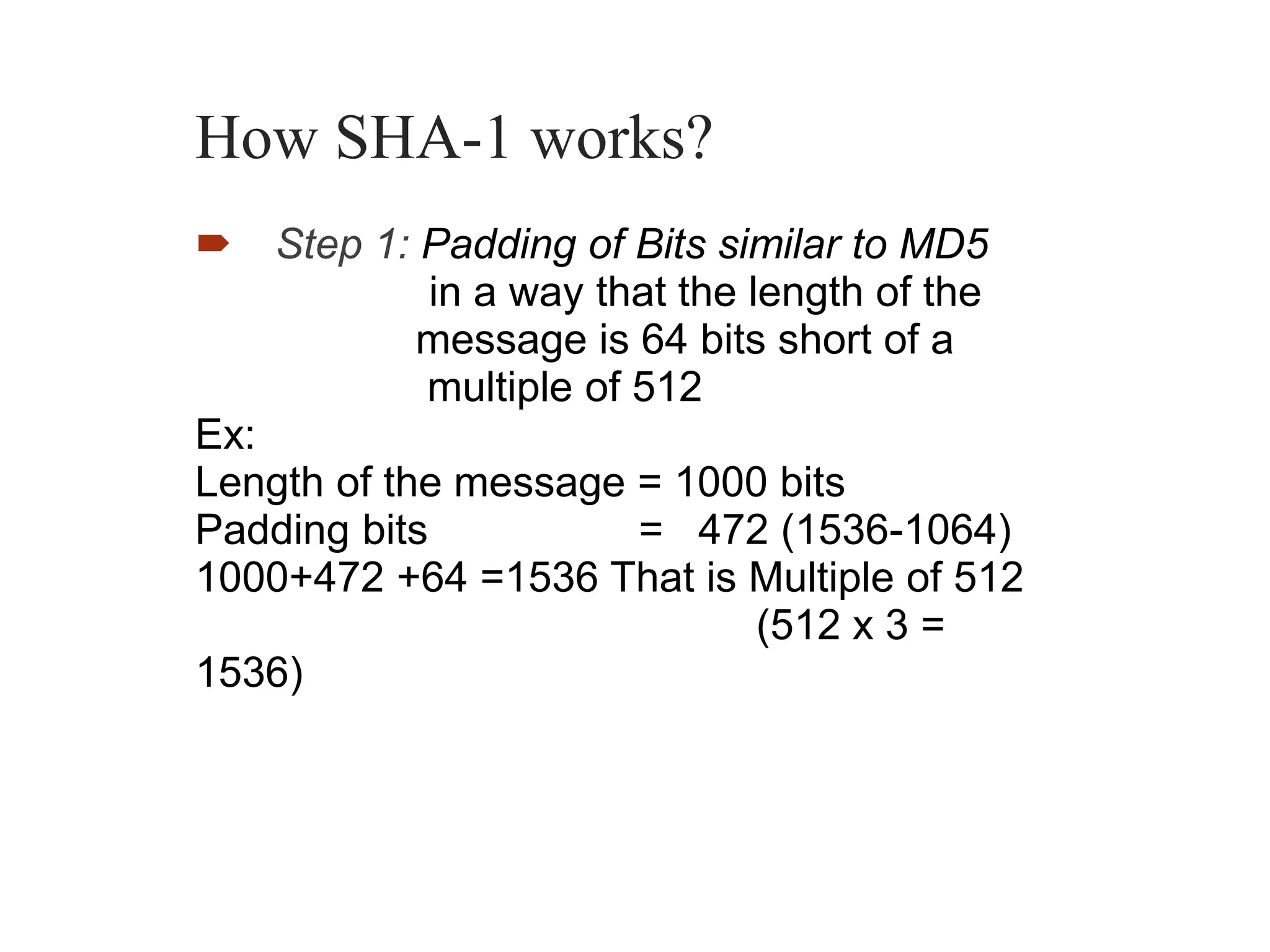
 Step 1: Padding of Bits similar to MD5
in a way that the length of the
message is 64 bits short of a
multiple of 512
Ex:
Length of the message = 1000 bits
Padding bits = 472 (1536-1064)
1000+472 +64 =1536 That is Multiple of 512
(512 x 3 =
1536)
How SHA-1 works?
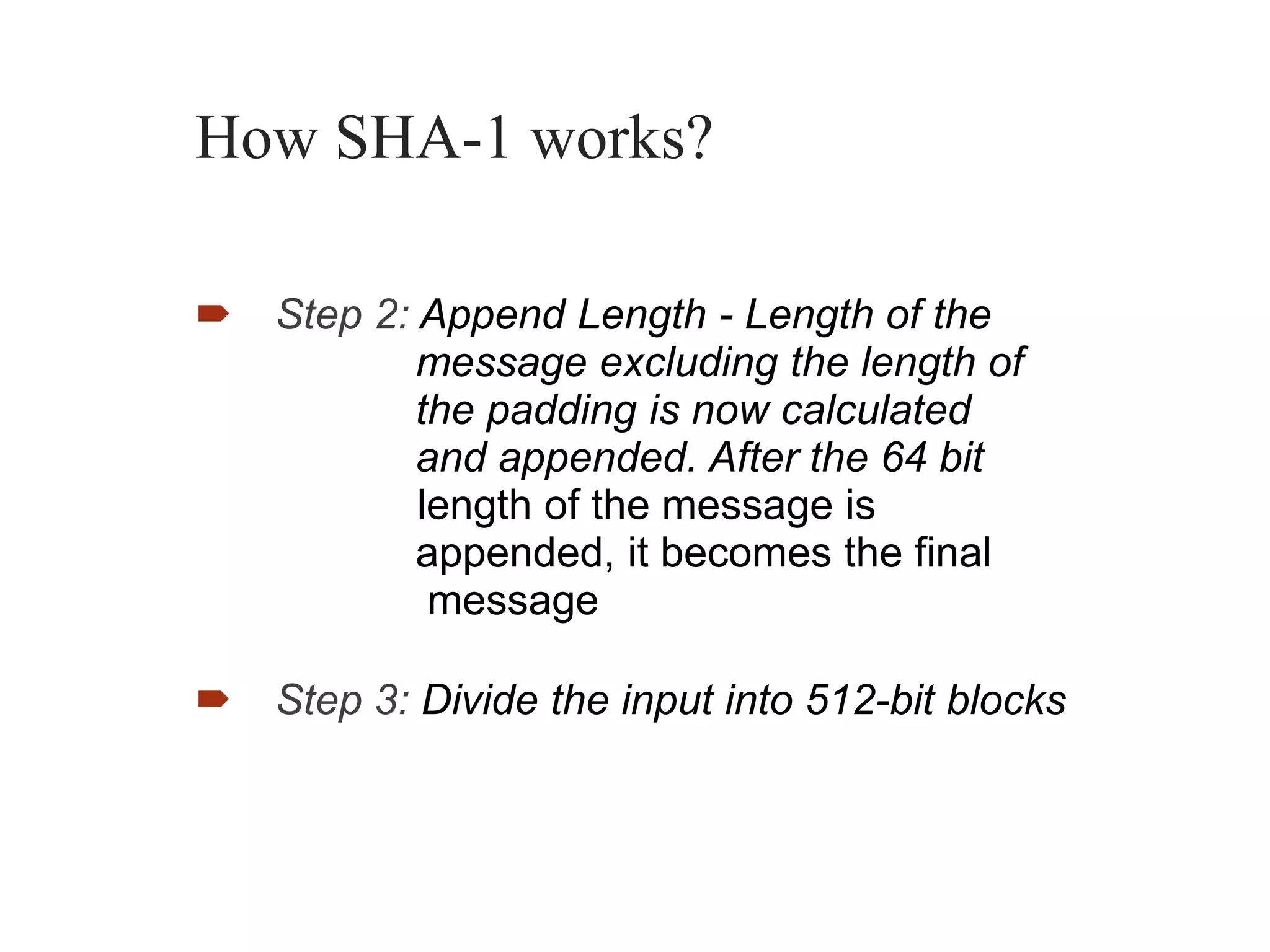
 Step 2: Append Length - Length of the
message excluding the length of
the padding is now calculated
and appended. After the 64 bit
length of the message is
appended, it becomes the final
message
 Step 3: Divide the input into 512-bit blocks
How SHA-1 works?
 Step 4: Initialize chaining variables
Chaining Variables Hex values
A 01 23 45 67
B 89 AB CD EF
C FE DC BA 98
D 76 54 32 10
E C3 D2 E1 F0
 Step 5: Process Blocks- Now the actual
algorithm begins….
How SHA-1 works?
 Step 5.1 : Copy chaining variables A-E into
variables a-e.
 Step 5.2 : Divide current 512-bit block into 16
sub- blocks of 32-bits.
 Step 5.3 : SHA has 4 rounds, each consisting of
20 steps. Each round takes 3 inputs-



512-bit block,
The register abcde
A constant K[t] (where t= 0 to 79)
3/11/2021
Value of K[t]
Round Value of t
between
K[t] in
heaxadecimal
1 1 and 19 5A 92 79 99
2 20 and 39 6E D9 EB A1
3 40 and 59 9F 1B BC DC
4 60 and 79 CA 62 C1 D6
5 30
t
How SHA-1 works?
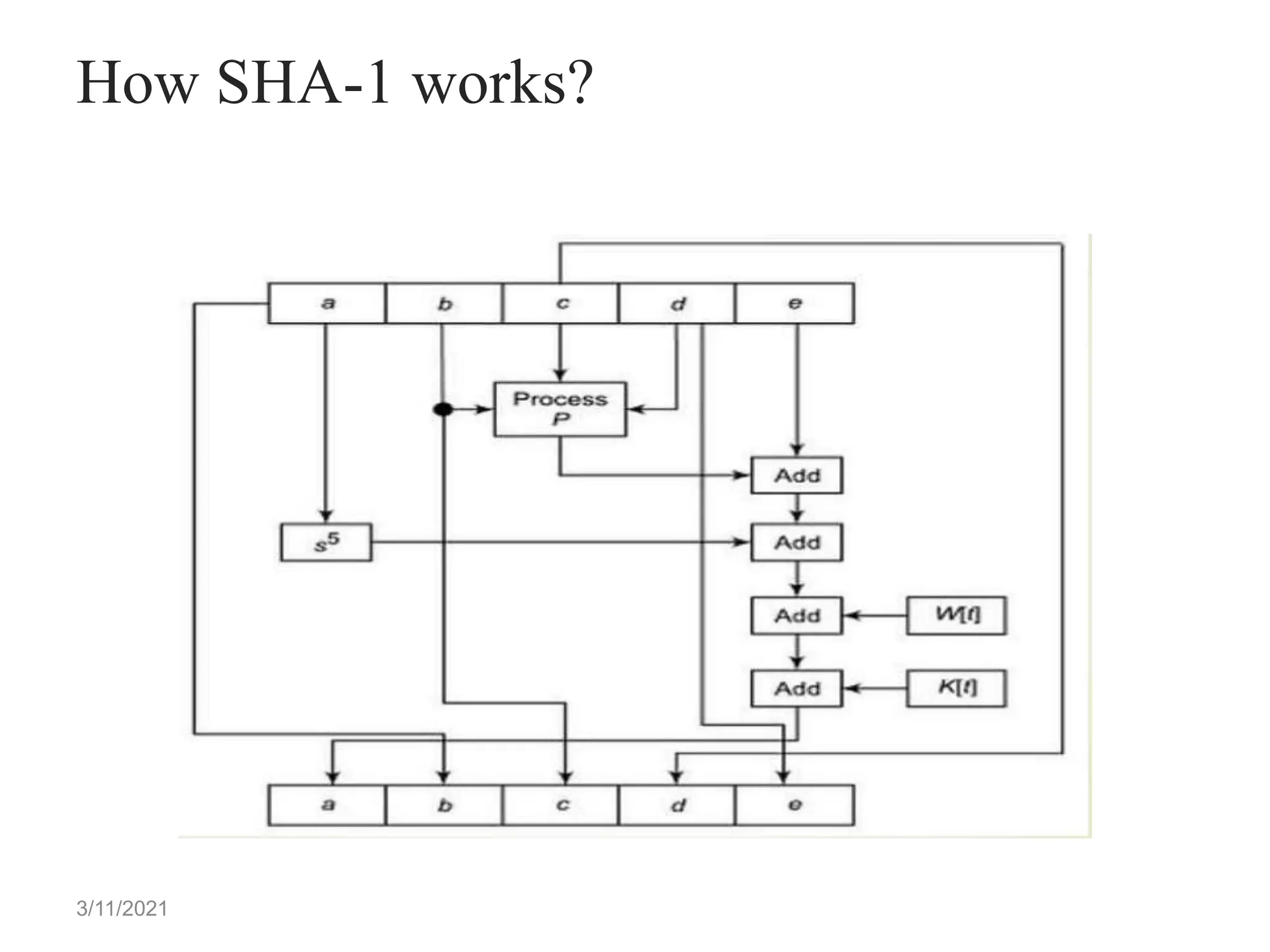
 Step 5.4 : SHA has a total of 80 iterations (4 rounds X 20
- iterations). Each iteration consists of following
operations:-
abcde = ( e +Process P + S (a) + W[t] + K[t] ), a, S (b) , c , d
Where,
abcde = The register made up of 5 variables a, b, c, d, e.
Process P = The logic operation.
S = Circular-left shift of 32-bit sub-block by t bits.
W[t] = A 32-bit derived from the current 32-bit sub-block.
K[t] = One of the five additive constants.
How SHA-1 works?
 Process P in each SHA round
Round Process P
1 (b AND c) OR (( NOT b) AND (d))
2 b XOR c XOR d
3 (b AND c ) OR (b AND d) OR (c AND d)
4 b XOR c XOR d
3/11/2021
How SHA-1 works?
1
How SHA-1 works?
 The values of W[t] are calculated as follows :
 For the first 16 words of W (i.e. t=0 to 15) , the
contents of the input message sub-block M[t] become
the contents of W[t].
 For the remaining 64 values of W are derived using
the equation
W[t] = s ( W[t-16] XOR W[t-14] XOR W[t-8] XOR W[t-3])
3/11/2021
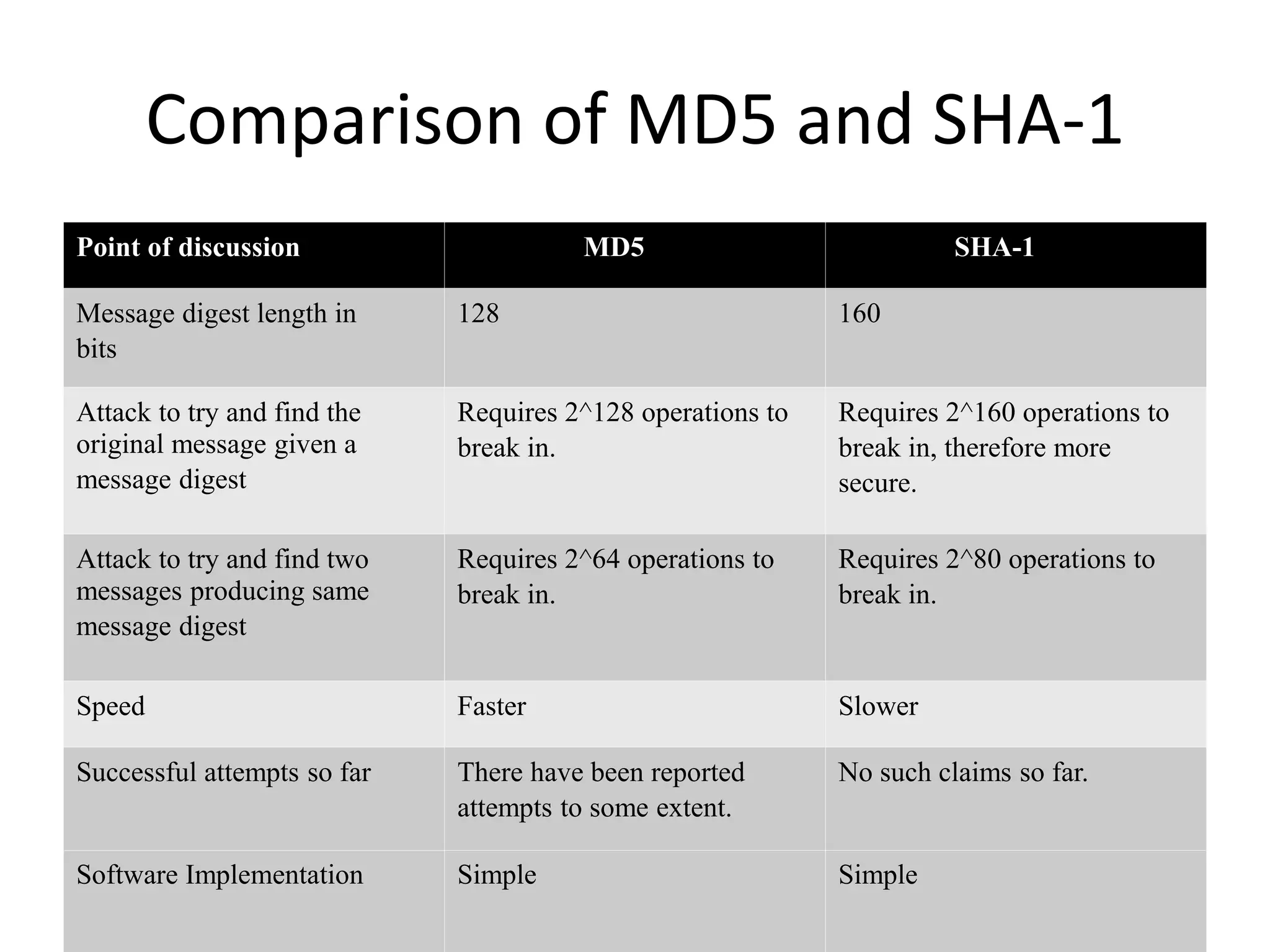
Comparison of MD5 and SHA-1
Point of discussion MD5 SHA-1
Message digest length in
bits
128 160
Attack to try and find the
original message given a
message digest
Requires 2^128 operations to
break in.
Requires 2^160 operations to
break in, therefore more
secure.
Attack to try and find two
messages producing same
message digest
Requires 2^64 operations to
break in.
Requires 2^80 operations to
break in.
Speed Faster Slower
Successful attempts so far There have been reported
attempts to some extent.
No such claims so far.
Software Implementation Simple Simple
3/11/2021
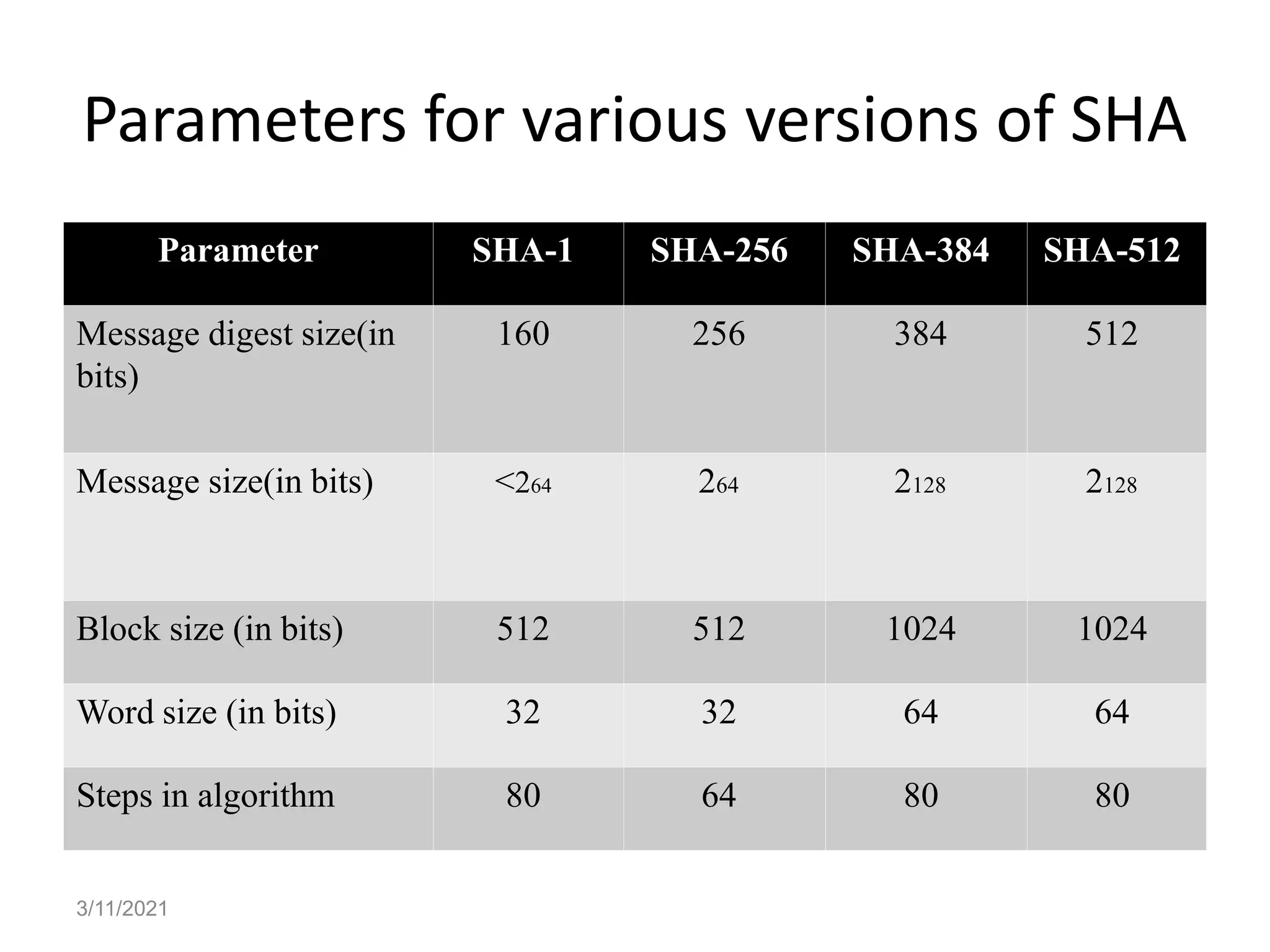
Parameters for various versions of SHA
Parameter SHA-1 SHA-256 SHA-384 SHA-512
Message digest size(in
bits)
160 256 384 512
Message size(in bits) <264 264 2128 2128
Block size (in bits) 512 512 1024 1024
Word size (in bits) 32 32 64 64
Steps in algorithm 80 64 80 80

SHA

  • 1.
  • 2.
    3/11/2021 SHA • Secure HashAlgorithm (SHA) was developed by NIST along with NSA. • In 1993, SHA was published as a Federal Information Processing Standard. • It was revised to FIPS PUB 180-1 in 1995 and the name was changed to SHA-1. • It is the modified version of MD5.
  • 3.
    3/11/2021 SHA • Input messageis less than 2^64 bits • Output of SHA is 160 bits in length • SHA is designed to be computationally infeasible to a) Obtain the original message, given its message digest b) Find two message producing the same message digest
  • 4.
    How SHA-1 works? Step 1: Padding of Bits similar to MD5 in a way that the length of the message is 64 bits short of a multiple of 512 Ex: Length of the message = 1000 bits Padding bits = 472 (1536-1064) 1000+472 +64 =1536 That is Multiple of 512 (512 x 3 = 1536)
  • 5.
    How SHA-1 works? Step 2: Append Length - Length of the message excluding the length of the padding is now calculated and appended. After the 64 bit length of the message is appended, it becomes the final message  Step 3: Divide the input into 512-bit blocks
  • 6.
    How SHA-1 works? Step 4: Initialize chaining variables Chaining Variables Hex values A 01 23 45 67 B 89 AB CD EF C FE DC BA 98 D 76 54 32 10 E C3 D2 E1 F0  Step 5: Process Blocks- Now the actual algorithm begins….
  • 7.
    How SHA-1 works? Step 5.1 : Copy chaining variables A-E into variables a-e.  Step 5.2 : Divide current 512-bit block into 16 sub- blocks of 32-bits.  Step 5.3 : SHA has 4 rounds, each consisting of 20 steps. Each round takes 3 inputs-    512-bit block, The register abcde A constant K[t] (where t= 0 to 79)
  • 8.
    3/11/2021 Value of K[t] RoundValue of t between K[t] in heaxadecimal 1 1 and 19 5A 92 79 99 2 20 and 39 6E D9 EB A1 3 40 and 59 9F 1B BC DC 4 60 and 79 CA 62 C1 D6
  • 9.
    5 30 t How SHA-1works?  Step 5.4 : SHA has a total of 80 iterations (4 rounds X 20 - iterations). Each iteration consists of following operations:- abcde = ( e +Process P + S (a) + W[t] + K[t] ), a, S (b) , c , d Where, abcde = The register made up of 5 variables a, b, c, d, e. Process P = The logic operation. S = Circular-left shift of 32-bit sub-block by t bits. W[t] = A 32-bit derived from the current 32-bit sub-block. K[t] = One of the five additive constants.
  • 10.
    How SHA-1 works? Process P in each SHA round Round Process P 1 (b AND c) OR (( NOT b) AND (d)) 2 b XOR c XOR d 3 (b AND c ) OR (b AND d) OR (c AND d) 4 b XOR c XOR d
  • 11.
  • 12.
    1 How SHA-1 works? The values of W[t] are calculated as follows :  For the first 16 words of W (i.e. t=0 to 15) , the contents of the input message sub-block M[t] become the contents of W[t].  For the remaining 64 values of W are derived using the equation W[t] = s ( W[t-16] XOR W[t-14] XOR W[t-8] XOR W[t-3])
  • 13.
    3/11/2021 Comparison of MD5and SHA-1 Point of discussion MD5 SHA-1 Message digest length in bits 128 160 Attack to try and find the original message given a message digest Requires 2^128 operations to break in. Requires 2^160 operations to break in, therefore more secure. Attack to try and find two messages producing same message digest Requires 2^64 operations to break in. Requires 2^80 operations to break in. Speed Faster Slower Successful attempts so far There have been reported attempts to some extent. No such claims so far. Software Implementation Simple Simple
  • 14.
    3/11/2021 Parameters for variousversions of SHA Parameter SHA-1 SHA-256 SHA-384 SHA-512 Message digest size(in bits) 160 256 384 512 Message size(in bits) <264 264 2128 2128 Block size (in bits) 512 512 1024 1024 Word size (in bits) 32 32 64 64 Steps in algorithm 80 64 80 80