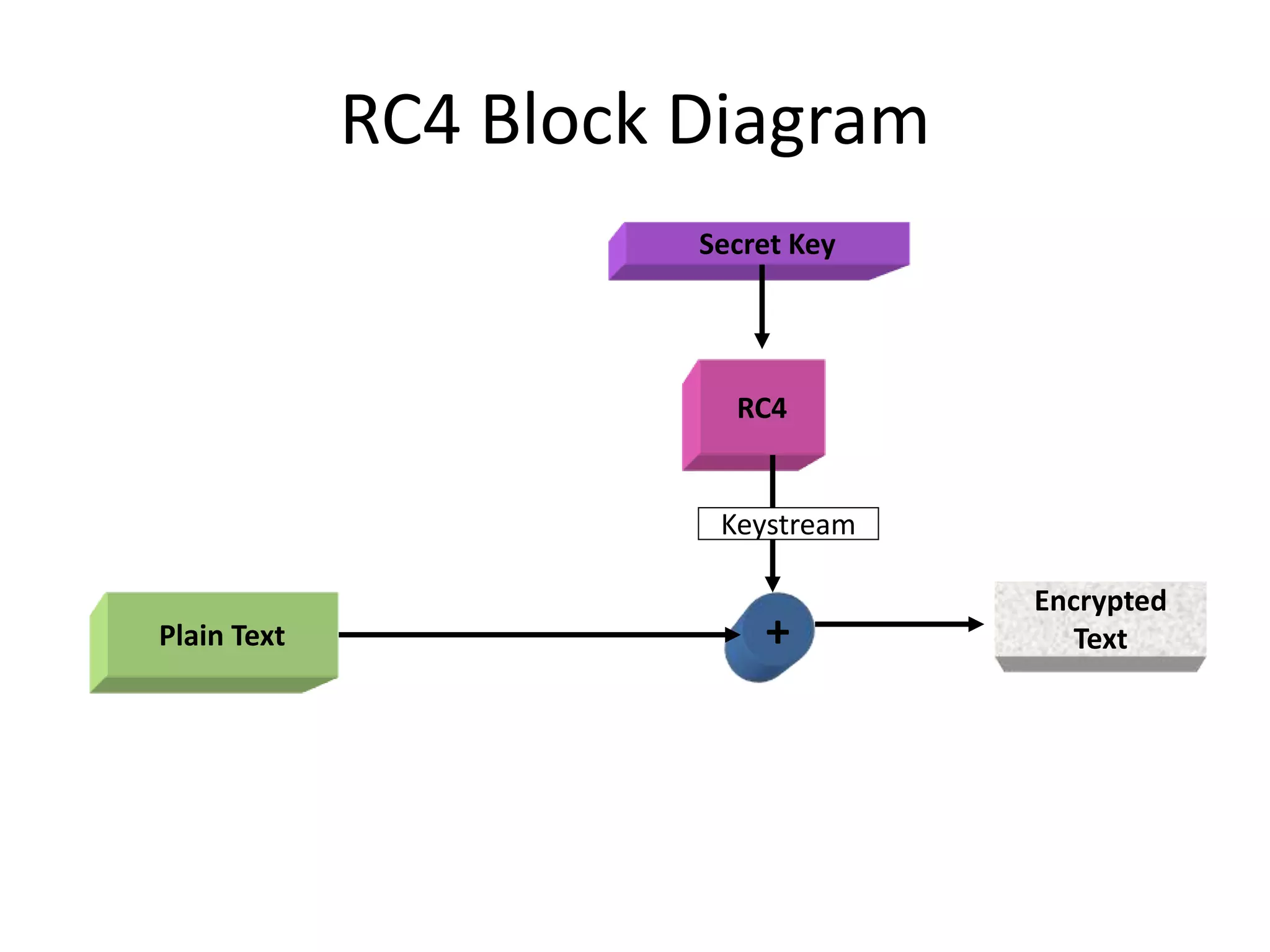
RC4 is a symmetric key encryption algorithm that uses a variable key size stream cipher. It operates by initializing a state vector S with values from 0 to 255, and then performing an initial permutation on S based on the secret key. A keystream is then generated by iterating through S, swapping values, and using the result to XOR with plaintext to produce ciphertext. The example demonstrates encrypting a 3-bit plaintext stream using an 8x3-bit simplified RC4 with a 4x3-bit key.


![Description
• Choose a key (K) of length between 1 to 256
bytes
• Set the values of state vector S equal to values
of 0 to 255.
• ie. S[0]=0,s[1]=1…s[255]=255
• Create a Temporary array T.
• Copy the contents of K into T if length of K is
256 bytes or fill the remaining position with
the values of K again.](https://image.slidesharecdn.com/cryptography-200305105403/75/Cryptography-4-2048.jpg)
![Steps:
• After this the array T is used to produce initial
permutation of S.
• A loop is executed from 0 to 255.
• S[i] and S[j] are swapped as per the arrangement
decided by T[i].
for i=0 to 255
S[i] = i
T[i] = K[i mod keylen]](https://image.slidesharecdn.com/cryptography-200305105403/75/Cryptography-5-2048.jpg)
![Initial Permutation
j=0;
for i=0 to 255
j=(j+S[i]+T[i]) mod 256;
swap (S[i], S[j]);](https://image.slidesharecdn.com/cryptography-200305105403/75/Cryptography-6-2048.jpg)
![Stream Generation
• Now S array is ready through initialization and
permutation.
• Then the initial key K is discarded.
• Now the key stream is going to be generated.
i=0;
j=0;
while (true)
i=(i+1) mod 256;
j =(j+S[i]) mod 256;
swap (S[i], S[j]);
t=(S[i]+S[j]) mod 256;
k=S[t]](https://image.slidesharecdn.com/cryptography-200305105403/75/Cryptography-7-2048.jpg)

![Example
• Lets consider the stream cipher RC4, but
instead of the full 256 bytes, we will use 8 x 3-
bits.
• That is, the state vector S is 8 x 3-bits.
• We will operate on 3-bits of plaintext at a time
since S can take the values 0 to 7, which can
be represented as 3 bits.
• Assume we use a 4 x 3-bit key of K = [1 2 3 6].
And a plaintext P = [1 2 2 2]](https://image.slidesharecdn.com/cryptography-200305105403/75/Cryptography-9-2048.jpg)
![• The first step is to generate the stream.
• Initialize the state vector S and temporary vector T. S is initialised so the
S[i] = i, and T is initialized so it is the key K (repeated as necessary).
• S = [0 1 2 3 4 5 6 7]
• T = [1 2 3 6 1 2 3 6]
• Now perform the initial permutation on S.
– j = 0;
– for i = 0 to 7 do
– j = (j + S[i] + T[i]) mod 8
– Swap(S[i],S[j]);
– end
• For i = 0:
– j = (0 + 0 + 1) mod 8 = 1
– Swap(S[0],S[1]);
– S = [1 0 2 3 4 5 6 7]](https://image.slidesharecdn.com/cryptography-200305105403/75/Cryptography-10-2048.jpg)
![• For i = 1:
– j = 3
– Swap(S[1],S[3])
– S = [1 3 2 0 4 5 6 7];
• For i = 2:
– j = 0
– Swap(S[2],S[0]);
– S = [2 3 1 0 4 5 6 7];
• For i = 3:
– j = 6;
– Swap(S[3],S[6])
– S = [2 3 1 6 4 5 0 7];](https://image.slidesharecdn.com/cryptography-200305105403/75/Cryptography-11-2048.jpg)
![• For i = 4:
– j = 3
– Swap(S[4],S[3])
– S = [2 3 1 4 6 5 0 7];
• For i = 5:
– j = 2
– Swap(S[5],S[2]);
– S = [2 3 5 4 6 1 0 7];
• For i = 6:
– j = 5;
– Swap(S[6],S[4])
– S = [2 3 5 4 0 1 6 7];
• For i = 7:
– j = 2;
– Swap(S[7],S[2])
– S = [2 3 7 4 0 1 6 5];
• Hence, our initial permutation of S = [2 3 7 4 0 1 6 5];](https://image.slidesharecdn.com/cryptography-200305105403/75/Cryptography-12-2048.jpg)
![• Now we generate 3-bits at a time, k, that we XOR with each 3-bits of
plaintext to produce the cipher text. The 3-bits k is generated by:
• i, j = 0;
while (true) {
i = (i + 1) mod 8;
j = (j + S[i]) mod 8;
Swap (S[i], S[j]);
t = (S[i] + S[j]) mod 8;
k = S[t]; }
• The first iteration:
– S = [2 3 7 4 0 1 6 5]
– i = (0 + 1) mod 8 = 1
– j = (0 + S[1]) mod 8 = 3
– Swap(S[1],S[3])
– S = [2 4 7 3 0 1 6 5]
– t = (S[1] + S[3]) mod 8 = 7
– k = S[7] = 5
– Remember, P = [1 2 2 2]](https://image.slidesharecdn.com/cryptography-200305105403/75/Cryptography-13-2048.jpg)
![• Remember, P = [1 2 2 2]
• So our first 3-bits of cipher text is obtained by: k XOR P
• 5 XOR 1 = 101 XOR 001 = 100 = 4
• The second iteration:
– S = [2 4 7 3 0 1 6 5]
– i = (1 + 1 ) mod 8 = 2
– j = (2 + S[2]) mod 8 = 1
– Swap(S[2],S[1])
– S = [2 7 4 3 0 1 6 5]
– t = (S[2] + S[1]) mod 8 = 3
– k = S[3] = 3
– Second 3-bits of cipher text are:
– 3 XOR 2 = 011 XOR 010 = 001 = 1](https://image.slidesharecdn.com/cryptography-200305105403/75/Cryptography-14-2048.jpg)
![• After 4 iterations:
• To encrypt the plaintext stream P = [1 2 2 2]
with key K = [1 2 3 6] using our simplified RC4
stream cipher we get C = [4 1 2 0].
• (or in binary: P = 001010010010,
• K = 001010011110
• C = 100001010000)](https://image.slidesharecdn.com/cryptography-200305105403/75/Cryptography-15-2048.jpg)


