1
The Secure Hash Function (SHA)
Network
Security
2
The Secure Hash Function (SHA)
Objectives of the Topic
• After completing this topic, a student will be
able to
• explain working of the secure hash
algorithm (SHA).
3
The Secure Hash Function (SHA)
Figures and material in this topic have
been adapted from
• “Network Security Essentials : Applications and
Standards”, 2014, by William Stallings.
4
The Secure Hash Function (SHA)
Secure Hash Algorithm (SHA)
• Is the most widely used hash function in
recent years.
• Developed by the National Institute of
Standards and Technology (NIST)
• FIPS 180 in 1993.
5
The Secure Hash Function (SHA)
• The actual standards document is entitled
“Secure Hash Standard.”
• SHA is based on the hash function (Message-
Digest) MD4, and its design closely models
MD4.
6
The Secure Hash Function (SHA)
• When weaknesses were discovered in SHA
(now known as SHA-0), a revised version was
issued as FIPS 180-1 in 1995 and is referred
to as SHA-1.
7
The Secure Hash Function (SHA)
• In 2002, NIST produced FIPS 180-2.
• Three new versions of SHA with hash value
lengths of 256, 384, and 512 bits known as
SHA-256, SHA-384, and SHA-512 were
defined.
• Collectively, these are known as SHA-2.
8
The Secure Hash Function (SHA)
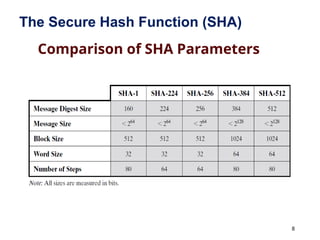
Comparison of SHA Parameters
9
The Secure Hash Function (SHA)
• In 2005 NIST announced the intention to
phase out approval of SHA-1 and move to a
reliance on SHA-2 by 2010.
• We focus on SHA-512.
10
The Secure Hash Function (SHA)
SHA-512 Logic:
• The algorithm takes as input a message with
a maximum length of less than 2128
bits and
produces as output a 512-bit message
digest.
• The input is processed in 1024-bit blocks.
11
The Secure Hash Function (SHA)
Step 1: Append padding bits
• Padding is added, even if the message is
already of the desired length. No. of
Padding bits = [1 1024]
• Padding consists of a single 1 bit followed by
the necessary number of 0 bits.
12
The Secure Hash Function (SHA)
Step 2: Append length
• A block of 128 bits is appended to the
message.
• This block is treated as an unsigned 128-bit
integer and contains the length of the
original message (before the padding).
13
The Secure Hash Function (SHA)
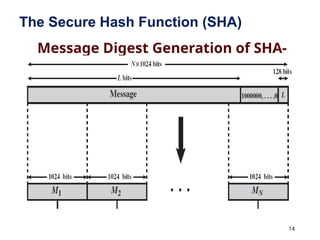
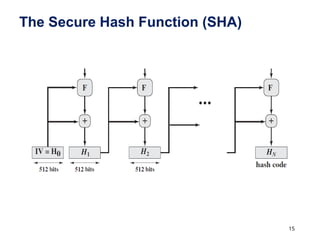
• Outcome of first two steps yields a message
an integer multiple of 1024 bits in length.
• Total length of the expanded message is N ×
1024 bits as the expanded message is a
sequence of 1024-bit blocks M1, M2, . . ., MN.
14
The Secure Hash Function (SHA)
Message Digest Generation of SHA-
512
15
The Secure Hash Function (SHA)
16
The Secure Hash Function (SHA)
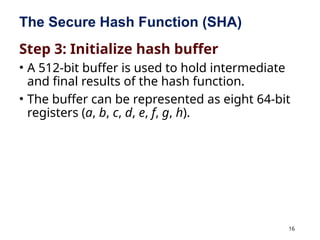
Step 3: Initialize hash buffer
• A 512-bit buffer is used to hold intermediate
and final results of the hash function.
• The buffer can be represented as eight 64-bit
registers (a, b, c, d, e, f, g, h).
17
The Secure Hash Function (SHA)
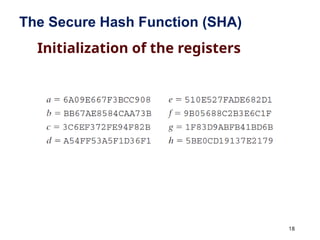
• Initialize these registers by taking the first
sixty-four bits of the fractional parts of the
square roots of the first eight prime
numbers.
18
The Secure Hash Function (SHA)
Initialization of the registers
19
The Secure Hash Function (SHA)
Step 4: Process message in 1024-bit
(128-word) blocks
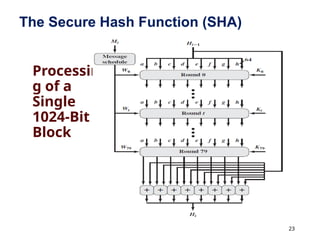
• The module labeled F consists of 80 rounds.
• Each round takes as input the 512-bit buffer
value abcdefgh and updates the contents of
the buffer.
20
The Secure Hash Function (SHA)
• At input to the first round, the buffer has
the value of the intermediate hash value, Hi-
1.
• Each round t makes use of a 64-bit value Wt
derived from the current 1024-bit block
being processed (Mi).
21
The Secure Hash Function (SHA)
• Each round also makes use of an additive
constant Kt, where t = 0 … … 79.
• The constants eliminate any regularities in
the input data.
22
The Secure Hash Function (SHA)
• The output of the 80th round is added to the
input to the first round (Hi-1) to produce Hi .
23
The Secure Hash Function (SHA)
Processin
g of a
Single
1024-Bit
Block
24
The Secure Hash Function (SHA)
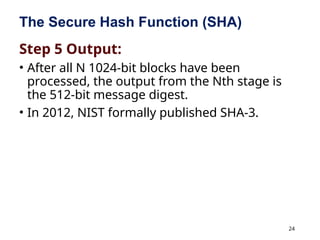
Step 5 Output:
• After all N 1024-bit blocks have been
processed, the output from the Nth stage is
the 512-bit message digest.
• In 2012, NIST formally published SHA-3.

Secure Hash Authentication in Network Security.pptx

  • 1.
    1 The Secure HashFunction (SHA) Network Security
  • 2.
    2 The Secure HashFunction (SHA) Objectives of the Topic • After completing this topic, a student will be able to • explain working of the secure hash algorithm (SHA).
  • 3.
    3 The Secure HashFunction (SHA) Figures and material in this topic have been adapted from • “Network Security Essentials : Applications and Standards”, 2014, by William Stallings.
  • 4.
    4 The Secure HashFunction (SHA) Secure Hash Algorithm (SHA) • Is the most widely used hash function in recent years. • Developed by the National Institute of Standards and Technology (NIST) • FIPS 180 in 1993.
  • 5.
    5 The Secure HashFunction (SHA) • The actual standards document is entitled “Secure Hash Standard.” • SHA is based on the hash function (Message- Digest) MD4, and its design closely models MD4.
  • 6.
    6 The Secure HashFunction (SHA) • When weaknesses were discovered in SHA (now known as SHA-0), a revised version was issued as FIPS 180-1 in 1995 and is referred to as SHA-1.
  • 7.
    7 The Secure HashFunction (SHA) • In 2002, NIST produced FIPS 180-2. • Three new versions of SHA with hash value lengths of 256, 384, and 512 bits known as SHA-256, SHA-384, and SHA-512 were defined. • Collectively, these are known as SHA-2.
  • 8.
    8 The Secure HashFunction (SHA) Comparison of SHA Parameters
  • 9.
    9 The Secure HashFunction (SHA) • In 2005 NIST announced the intention to phase out approval of SHA-1 and move to a reliance on SHA-2 by 2010. • We focus on SHA-512.
  • 10.
    10 The Secure HashFunction (SHA) SHA-512 Logic: • The algorithm takes as input a message with a maximum length of less than 2128 bits and produces as output a 512-bit message digest. • The input is processed in 1024-bit blocks.
  • 11.
    11 The Secure HashFunction (SHA) Step 1: Append padding bits • Padding is added, even if the message is already of the desired length. No. of Padding bits = [1 1024] • Padding consists of a single 1 bit followed by the necessary number of 0 bits.
  • 12.
    12 The Secure HashFunction (SHA) Step 2: Append length • A block of 128 bits is appended to the message. • This block is treated as an unsigned 128-bit integer and contains the length of the original message (before the padding).
  • 13.
    13 The Secure HashFunction (SHA) • Outcome of first two steps yields a message an integer multiple of 1024 bits in length. • Total length of the expanded message is N × 1024 bits as the expanded message is a sequence of 1024-bit blocks M1, M2, . . ., MN.
  • 14.
    14 The Secure HashFunction (SHA) Message Digest Generation of SHA- 512
  • 15.
    15 The Secure HashFunction (SHA)
  • 16.
    16 The Secure HashFunction (SHA) Step 3: Initialize hash buffer • A 512-bit buffer is used to hold intermediate and final results of the hash function. • The buffer can be represented as eight 64-bit registers (a, b, c, d, e, f, g, h).
  • 17.
    17 The Secure HashFunction (SHA) • Initialize these registers by taking the first sixty-four bits of the fractional parts of the square roots of the first eight prime numbers.
  • 18.
    18 The Secure HashFunction (SHA) Initialization of the registers
  • 19.
    19 The Secure HashFunction (SHA) Step 4: Process message in 1024-bit (128-word) blocks • The module labeled F consists of 80 rounds. • Each round takes as input the 512-bit buffer value abcdefgh and updates the contents of the buffer.
  • 20.
    20 The Secure HashFunction (SHA) • At input to the first round, the buffer has the value of the intermediate hash value, Hi- 1. • Each round t makes use of a 64-bit value Wt derived from the current 1024-bit block being processed (Mi).
  • 21.
    21 The Secure HashFunction (SHA) • Each round also makes use of an additive constant Kt, where t = 0 … … 79. • The constants eliminate any regularities in the input data.
  • 22.
    22 The Secure HashFunction (SHA) • The output of the 80th round is added to the input to the first round (Hi-1) to produce Hi .
  • 23.
    23 The Secure HashFunction (SHA) Processin g of a Single 1024-Bit Block
  • 24.
    24 The Secure HashFunction (SHA) Step 5 Output: • After all N 1024-bit blocks have been processed, the output from the Nth stage is the 512-bit message digest. • In 2012, NIST formally published SHA-3.